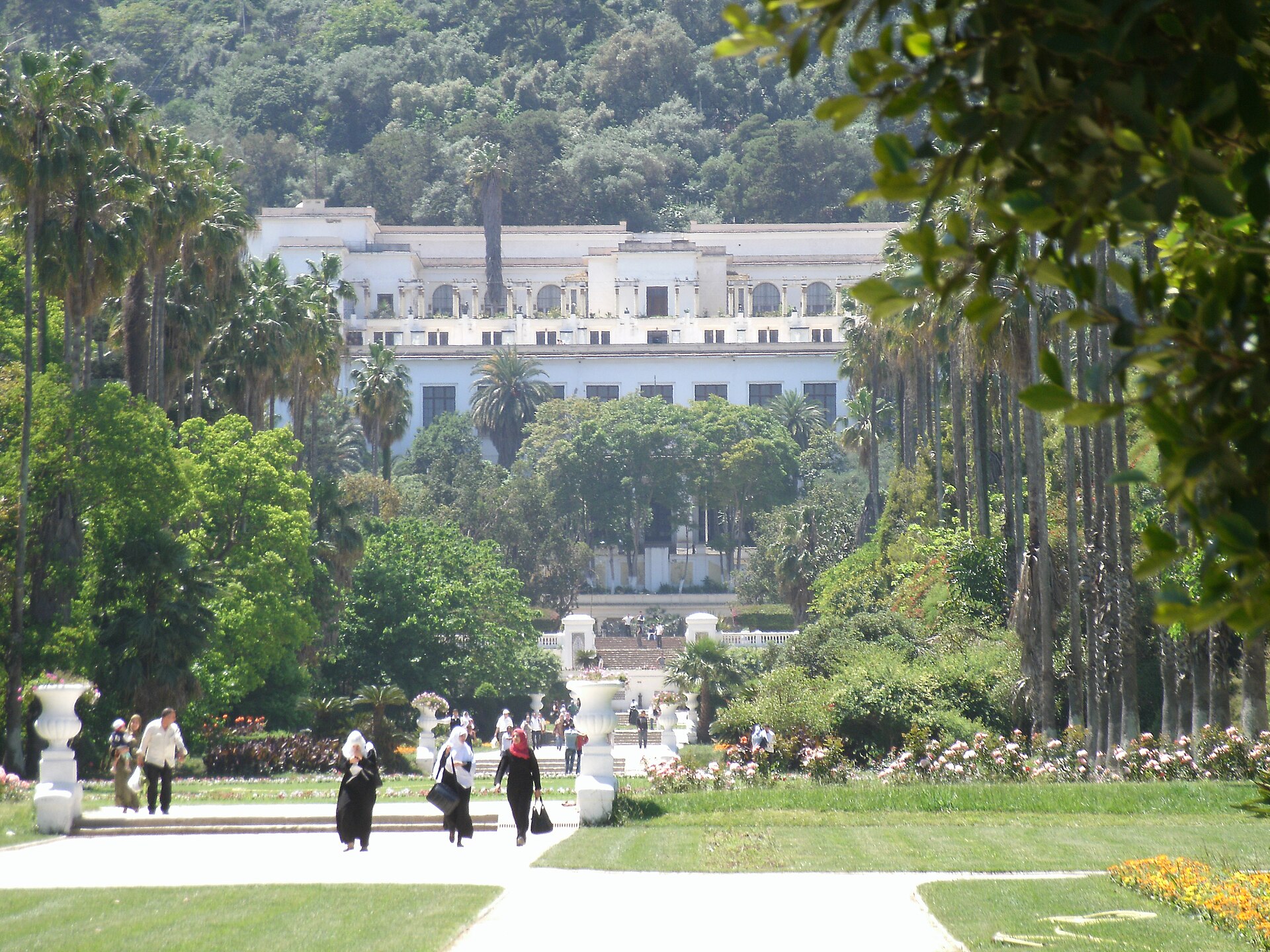
The museum's Beaux-Arts facade on its hillside site, seen from the central avenue of the adjoining Jardin d'Essai botanical garden.
Photograph by Yelles, CC BY-SA 3.0National Museum of Fine Arts of Algiers
Museum · Musee Public National des Beaux-Arts d'Alger · Founded 1930
Open, admission and hours confirmed 12 September 2026 · 14 sources
On this page 14 sections
ContentsClose
The museum's real strength is its French nineteenth-century and Impressionist painting, assembled deliberately in the 1920s and 1930s as a showcase of French art, alongside a large sculpture collection anchored by Rodin and Bourdelle. Its Algerian holdings, built almost entirely since 1962 through donation rather than acquisition, are smaller and less systematic but include the museum's most historically important miniature collection (61 works by Mohamed Racim) and paintings by Baya, one of the most internationally recognised Algerian artists of the twentieth century.
| Local name | Musee Public National des Beaux-Arts d'Alger |
|---|---|
| Kind | Museum |
| Founded | 1930 |
| City and country | Algiers, Algeria |
| Address | 178, Place Dar Essalem, El Hamma, Belouizdad, Algiers, Algeria |
| Website | musee-beauxarts.dz |
| Status | Open, confirmed |
| Record last verified |
Visiting
- Hours
- Saturday, Monday, Tuesday, Wednesday, Thursday09:00 to 17:00closed for a half-hour break from 12:30 to 13:00
- Closed
- Friday. Sunday. public holidays.
- Admission
- AdultDZD 200standard entry fee
- Students, trainees and apprenticesDZD 10050 percent reduction on the standard fee
- Artists and cultural workersDZD 14030 percent reduction on the standard fee
- Groups of 10 tickets or moreDZD 14030 percent reduction per ticket
- Under 16Freefree
- 65 and overFreefree
- Jobseekers, recipients of social minima, and persons with disability plus one companionFreefree
- National service conscriptsFreefree
Free entry: 18 April - International Monuments Day. 18 May - International Museum Day. 1 November - anniversary of the Revolution. 3 to 5 July - Independence and Youth holiday. 16 April - Knowledge Day. 8 March - International Women's Day- Do I need to book?
- No advance booking is described for individual visitors; entry is by ticket purchased on site
- Address
- 178, Place Dar Essalem, El Hamma, Belouizdad, Algiers, Algeria MapMetro Jardin d'Essai / Hamma area of the Algiers Metro; visitor accounts describe the nearest station as about a minute's walk from the museum gate
Bus and taxi Listed by the museum's own contact page as the other standard access routes; no specific line numbers published - Website
- musee-beauxarts.dz
- Telephone
- +213 21 66 49 16
- [email protected]
Before you go how long, access, photography, bags, eating, shop
- How long to allow
- Reviewers commonly give it one and a half to two hours across four floors; several note the top floor, reached past what looks like an empty transitional gallery, is the strongest section and is the one most visitors miss
- Access
- No lift is mentioned anywhere in visitor accounts; the collection is spread over roughly four levels and several reviewers flag this as hard going for anyone with a mobility limitation. One 2024 account recommends entering from the lower level directly off the Jardin d'Essai side rather than the main street-level door, which sits at the top of a steep, unmarked road
- Photography
- The museum's own visit rules prohibit flash inside the galleries and require prior authorisation for cameras and camcorders; a 2025 visitor account describes a separate 200 DZD photography ticket sold alongside the entry ticket for anyone wanting to take photos with a phone
- Bags
- All bags are subject to a security search at the entrance; large backpacks, briefcases and oversized bags are not allowed into the galleries and must be left at reception
- Eating
- The museum's own rules describe a pergola terrace and a cafeteria area open all day where food, drink and smoking are permitted; more than one recent visitor account says the cafeteria itself was not in service on the day of their visit
- Shop
- Visitor accounts describe a small boutique selling postcards and museum publications near the entrance
Prices and hours change. We take them from the institution's own pages and print the day we read them, and you can check the current position at the source we used. Confirm before you travel.
What is inside
Painting galleries
Thirty-five rooms across the upper floors carry the core painting collection, arranged chronologically from fourteenth-century European work to the mid-twentieth century. The nineteenth-century French and Dutch holdings are the deepest part: Delacroix, Daumier, Van Goyen and ter Brugghen sit alongside a strong run of Impressionists (Monet, Pissarro, Renoir, Degas, Boudin, Jongkind) and, per visitor accounts, occasional works on paper by Picasso. A separate floor is given over entirely to twentieth-century Algerian painting.
Sculpture and plaster-cast galleries
The ground floor holds the museum's collection of plaster casts after antique and Renaissance sculpture, assembled as a teaching collection when the museum opened. The first floor carries roughly 800 modern sculptures, including eight Rodin bronzes and six plasters (among them casts of Eve and The Walking Man) and Antoine Bourdelle's Herakles the Archer.
Cabinet of prints and drawings
About 3,500 works on paper: engravings, watercolours, lithographs, illuminated manuscript leaves, miniatures and calligraphy, built up alongside the painting collection since the 1930s and enlarged since independence with Algerian material.
Numismatic collection
Roughly 2,000 coins and medals, the museum's smallest published department by object count and the one least covered in visitor accounts or press coverage found for this record.
Bachir Yelles room
A room dedicated to the first generation of modern Algerian painters, named for Bachir Yelles, who briefly directed the museum after independence and whose own paintings and miniatures are held here alongside contemporaries such as Mohamed Racim.
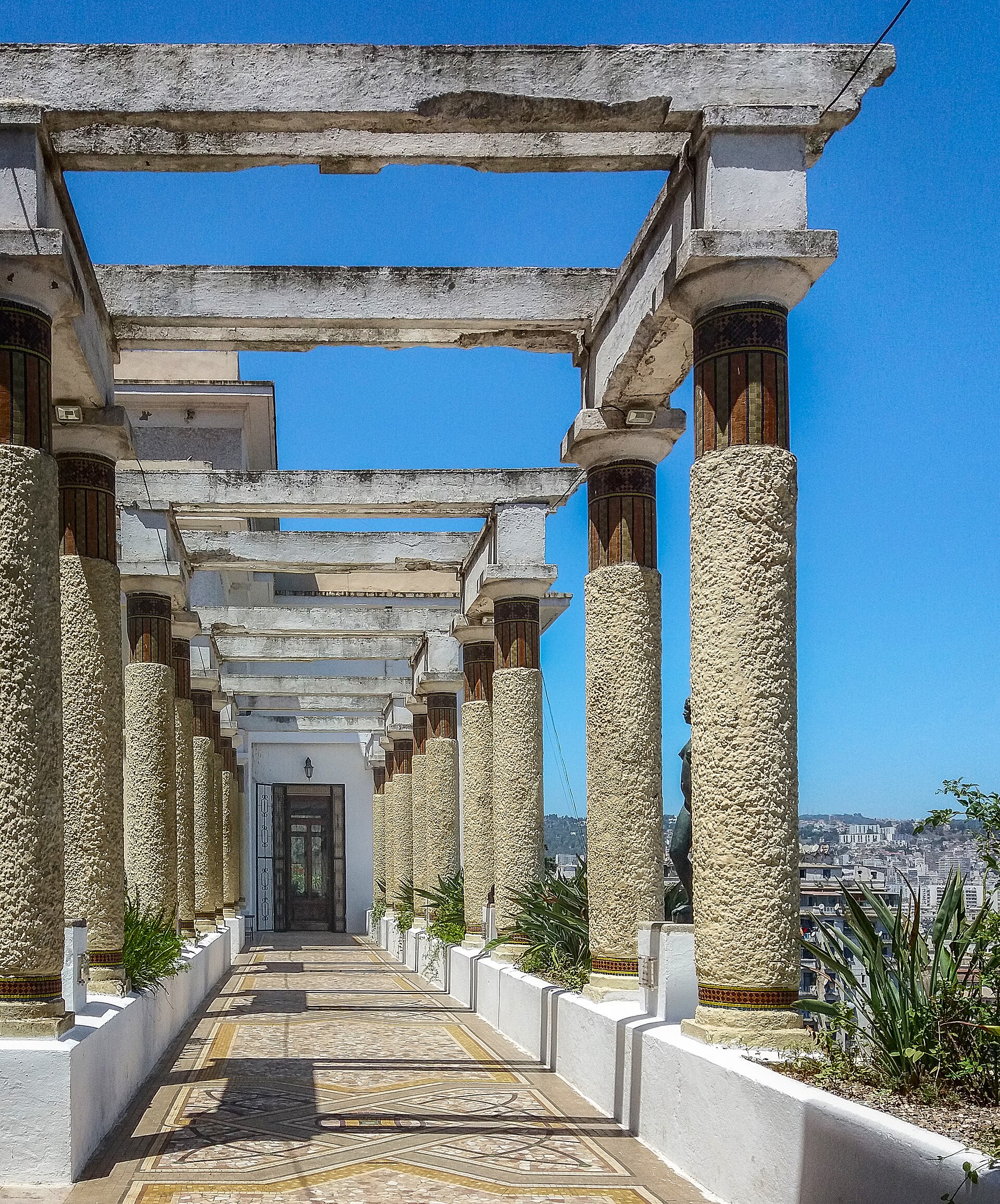
Photograph by Ryadh BAHIDJ · CC BY-SA 4.0 Rooftop pergola terrace
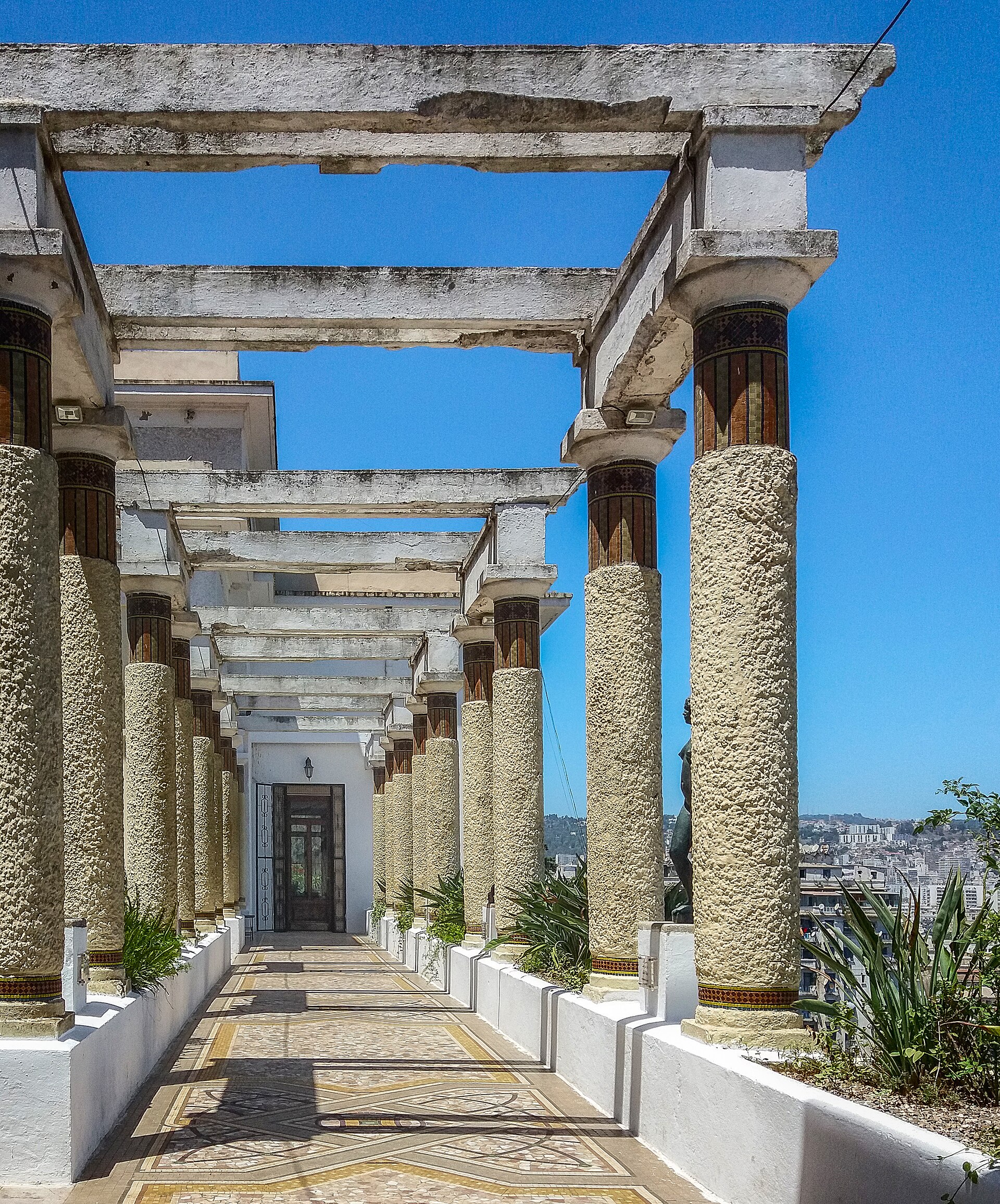
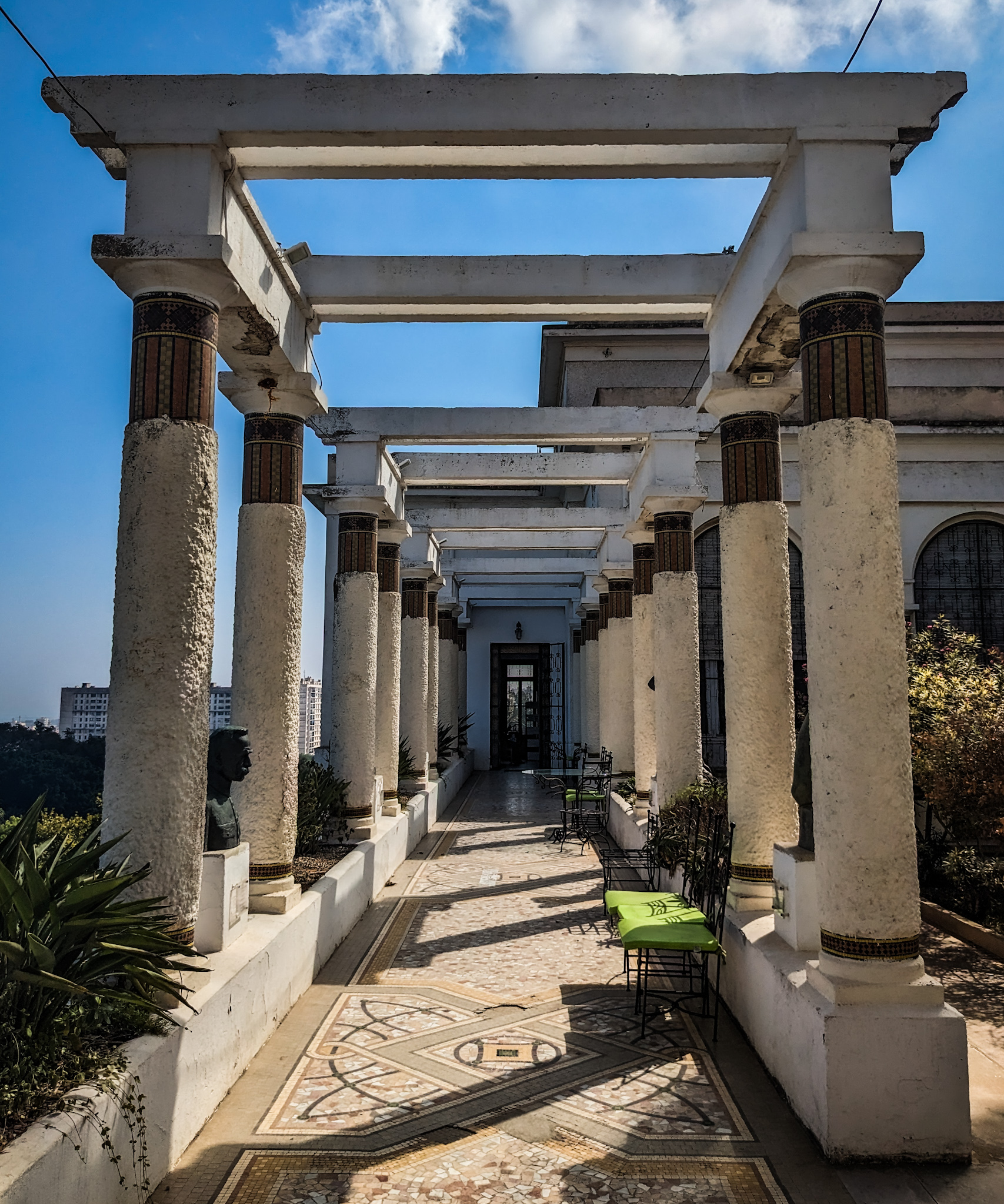
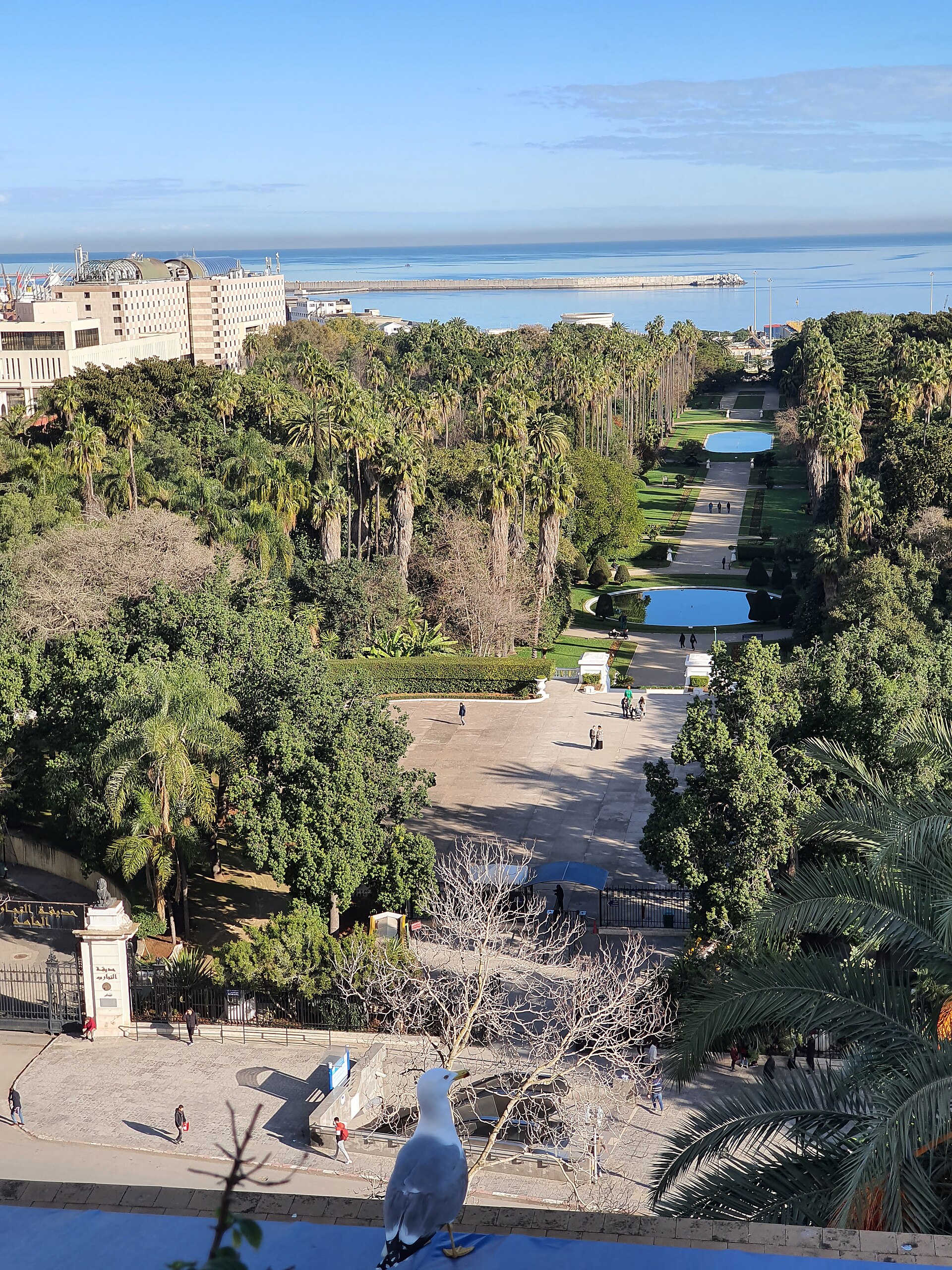
A mosaic-floored, colonnaded terrace running along the top of the building, part of Paul Guion's original 1930 design, looking out over the Jardin d'Essai botanical garden toward Algiers Bay. Visitor accounts consistently single it out as one of the best parts of a visit, view included.
What to see first
Le Joueur de flute (The Flute Player)
Caravaggio (attributed)A rare attributed Caravaggio held outside Europe; French Wikipedia's account of the collection names it among the museum's Old Master holdings acquired under the 1927-1930 purchasing programme2
Les Rochers de Belle-Ile
Claude Monet, 1886One of the museum's Impressionist paintings and the single most frequently named artist in visitor reviews of the collection; the Commons record for this specific canvas states it is held at this museum12
Jardin de Renoir a Cagnes
Henri Matisse, 1927-28A late Matisse landscape from the museum's French modern holdings, entering the public domain across most of the world only in 2025 (Matisse died in 1954); the Commons record for this canvas confirms the Algiers holding13
Eve and The Walking Man
Auguste Rodin (casts)Part of eight Rodin bronzes and six plasters described in the sculpture galleries; a rare concentration of Rodin outside France or a Rodin museum2
Herakles the Archer
Antoine BourdelleA signature Bourdelle bronze anchoring the modern sculpture floor alongside the Rodin group1
Miniatures and illuminations
Mohamed RacimRacim is credited with reviving the Algerian miniature tradition in the twentieth century; the museum holds 61 of his works, given in 1982, the largest single donation named in the museum's modern history2
Paintings by Baya
Baya (Fatma Haddad)A self-taught Algerian painter championed by Andre Breton and Picasso in 1940s Paris; her acquisition into the collection under Jean de Maisonseul's post-independence programme is cited as part of the deliberate effort to build up Algerian holdings that the pre-1962 collection had almost entirely lacked2
Two Orientalist paintings
Etienne DinetDonated in 2012 via BNP Paribas, adding to the museum's small but historically loaded Orientalist holdings, a genre now read critically for its French colonial gaze on Algeria2
A building for the centenary of French Algeria
The museum's own history begins earlier and more modestly than its 1930 building: a Societe des beaux-arts founded in Algiers in 1875 led to a first municipal collection in 1897, later moved into a former military barracks in 1908, which proved unsuitable and closed after two decades. The institution as it now stands was built for a specific political occasion. Marking the centenary of the French conquest and colonisation of Algeria (1830-1930), the Algiers municipal and colonial authorities commissioned the architect Paul Guion to design a purpose-built museum on a hill in the Hamma district, next to the Jardin d'Essai botanical garden and facing the bay. Construction began in 1928 and finished quickly; the building was inaugurated on 5 May 1930 as part of the centenary festivities, and opened to the public the following April. Guion's design, a symmetrical, rectilinear building of about 4,200 square metres over three main floors, drew on Mediterranean and North African decorative motifs (visible today in the tiled mosaic floor and painted column capitals of its rooftop pergola terrace) around a fundamentally French Beaux-Arts plan. Furnishings and fittings were designed by Louis Fernez, with pieces by the ensemblier Francis Jourdain. Historians of the museum read the building itself as a deliberate statement: a monument built to present French Algeria, ninety-eight years into colonial rule, as both a modern power and the custodian of a long civilisational tradition it had transplanted onto Algerian soil.
A French museum's idea of a canon
What went inside the building in 1930 reflected exactly that intent. The purchasing programme was overseen from 1927 by the historian Jean Alazard, the museum's first director, working with a commission chaired by Paul Leon and including conservators from the Louvre and the Musee du Luxembourg in Paris. The resulting collection, built up through purchases and gifts across the 1920s and 1930s, was strong in French nineteenth-century painting, from Delacroix and Daumier through to Impressionism, alongside Dutch Golden Age works and a smaller body of Old Masters. French-language accounts of the museum's own history are direct about what this collection was for: the acquisitions were meant to demonstrate the high points of French art of the period and to promote French art and culture to an Algerian and international public, at a moment when France had every institutional reason to assert its cultural authority over the colony. Algerian art and artists were essentially absent from this founding collection; what indigenous material entered the museum in its first decades did so mostly through the lens of French Orientalist painting, a genre that pictured Algeria and Algerians for a European audience rather than through any Algerian voice of its own. That imbalance, and the museum's origin as an instrument of colonial prestige rather than a neutral repository, is the starting point for any serious account of the institution, not a footnote to it.
Sculpture, prints and the applied arts
Alongside the paintings, the 1930 building was built to hold a broader collection on a genuinely large scale for its time and place. The ground floor carried a teaching collection of plaster casts after antique and Renaissance sculpture, standard practice for an academic museum of the period; the first floor was reserved for modern sculpture, and still holds roughly 800 pieces, including eight Rodin bronzes and six plasters (among them casts of Eve and The Walking Man) and Antoine Bourdelle's Herakles the Archer. A cabinet of prints and drawings, now numbering around 3,500 sheets, gathered engravings, watercolours, lithographs and illuminated manuscript material, and a numismatic collection of roughly 2,000 coins and medals rounded out the founding holdings, alongside decorative arts, ceramics, glass and period furniture. Taken together, the non-painting collections are large enough, and varied enough, that the museum's own description of itself as one of the largest art museums in Africa rests as much on this depth as on the picture galleries most visitor accounts focus on.
War, seizure and a contested return
The museum was not undamaged by the Algerian war of independence. In November 1961, during the final and most violent phase of the conflict, the Organisation Armee Secrete, the settler paramilitary group fighting to keep Algeria French, bombed the museum. The following year, as French rule ended, French authorities arranged for a large part of the collection, cited at close to 300 works in some accounts, to be secretly transferred to Paris in April 1962, reportedly out of concern both for the safety of the works amid the chaos of independence and, in some retellings, out of concern that an independent, Muslim-majority Algeria might object to the museum's nude paintings. What followed was a long negotiation under the framework of the Evian Accords that had ended the war; it took until December 1968 for the transferred works, given in French-language sources as 157 paintings and 136 drawings, to be returned to Algiers. Exactly how many objects left in 1962, and on what legal basis, is described somewhat differently across the sources found for this record, and no single itemised inventory of the 1962 transfer or the 1968 return was located; that gap is worth flagging rather than smoothing over, given how directly it bears on the museum's own history of dispossession and restitution.
Building an Algerian collection after independence
The conservator Jean de Maisonseul, who led the museum through the 1962-1975 period and negotiated the return of the Paris-held works, is also credited with a deliberate second project: correcting what French-language sources describe plainly as the poverty of the museum's Algerian holdings at independence. Under his direction the museum began acquiring work by Algerian and Maghrebi modern artists, including Baya, Abdallah Benanteur, Mohammed Khadda and Rezki Zerarti, building a body of work the founding, colonial-era collection had almost entirely excluded. That effort continued unevenly in the decades after de Maisonseul, driven more by donation than by purchase: 61 works by the miniaturist Mohamed Racim came to the museum as a gift in 1982; 174 paintings by the American-born artist Juanita Guccione arrived in 2012; two Orientalist paintings by Etienne Dinet were donated the same year through BNP Paribas; and the notary Salim Becha's collection of roughly 8,000 archaeological and artistic objects was given in 2013. An entire floor of the museum is now given over to twentieth-century Algerian painting, and a room named for Bachir Yelles, the Algerian miniaturist and painter who briefly directed the museum after independence, is dedicated to the first generation of modern Algerian painters. The result is a collection built in two very different periods under two very different mandates, still visibly stitched together rather than fully integrated: the deep, French-selected nineteenth-century holdings on one side, and a thinner, donation-driven Algerian collection assembled from 1962 onward on the other.
The museum today
Under its current director, Dalila Mahammed-Orfali, the museum continues to operate on the Ministry of Culture's own visiting rules: six days a week, a modest, tiered entrance fee, and a published calendar of educational workshops, temporary exhibitions and commemorative events running into 2026. Visitor accounts across the last several years describe an institution that rewards persistence: reviewers repeatedly single out a top floor that is easy to walk past, reached through what looks like an empty transitional gallery, as the strongest part of the museum, home to porcelain, icons, sculpture, glass and further painting alongside the Rodins and Impressionists. The same accounts are just as consistent about the museum's shortcomings: no English-language labelling, an inconsistent cafeteria, and no lift across four levels in a building that was never designed with modern accessibility in mind. Read together with its founding purpose and its unresolved 1962 transfer, the museum today reads less as a settled national institution than as a colonial-era building still being renegotiated, gallery by gallery and donation by donation, into an Algerian one.
What visitors say
Recent visitor accounts describe a surprisingly strong, if unevenly presented, collection in a genuinely striking building and setting. The building, the garden view from the terrace and a handful of works by major names (Rodin, Monet, Renoir, Degas, Picasso works on paper) are named repeatedly as the reasons to go. A significant minority of reviewers, especially those describing themselves as more informed about art, rate most of the collection as average, and the museum is consistently marked down for having no English-language labelling and no working lift across four levels.
What is praised, what is criticised
- Praised: the top (fourth) floor galleries, which several reviewers say are easy to miss and the best part of the museum
- Praised: the rooftop terrace and its view over the Jardin d'Essai botanical garden and Algiers Bay
- Praised: the low, symbolic entrance price relative to the size and range of the collection
- Praised: a genuine core of Impressionist paintings (Monet, Pissarro, Renoir, Degas, Boudin, Jongkind) and Rodin sculpture not usually expected in Algiers
- Praised: attentive, welcoming staff, named in more than one account across different years
- Criticised: no English-language signage or labels; French and Arabic only, repeated as a complaint across several years of reviews
- Criticised: a recurring view, especially from visitors describing themselves as more critical of art, that most of the roughly 8,000-object collection is average to mediocre outside a handful of strong pieces
- Criticised: no lift across the building's four levels, flagged as a genuine accessibility problem rather than an inconvenience
- Criticised: a terrace cafeteria that is described as present but not reliably in service
Ratings on other platforms
Tripadvisor: 4.3 from 87 ratings, read 12 September 2026
A platform average is a tertiary source: it moves, it is not audited, and we quote no visitor's words.
Questions about National Museum of Fine Arts of Algiers
Where is National Museum of Fine Arts of Algiers?
178, Place Dar Essalem, El Hamma, Belouizdad, Algiers, Algeria.
How much does it cost to visit?
Adult: DZD 200; Students, trainees and apprentices: DZD 100; Artists and cultural workers: DZD 140; Groups of 10 tickets or more: DZD 140; Under 16: free. As confirmed 12 September 2026.
When is it open?
Saturday, Monday, Tuesday, Wednesday, Thursday 09:00-17:00. Closed: Friday. Sunday. As confirmed 12 September 2026.
How do you get there?
Metro: Jardin d'Essai / Hamma area of the Algiers Metro; visitor accounts describe the nearest station as about a minute's walk from the museum gate; Bus and taxi: Listed by the museum's own contact page as the other standard access routes; no specific line numbers published.
What should you see first?
Le Joueur de flute (The Flute Player) (Caravaggio (attributed)); Les Rochers de Belle-Ile (Claude Monet, 1886); Jardin de Renoir a Cagnes (Henri Matisse, 1927-28); Eve and The Walking Man (Auguste Rodin (casts)); Herakles the Archer (Antoine Bourdelle); Miniatures and illuminations (Mohamed Racim).
What we could not confirm
- No single, dated inventory of the works transferred from Algiers to Paris in April 1962, or of the 157 paintings and 136 drawings returned in December 1968, was located; sources differ on the total number transferred and this record cannot resolve the discrepancy.
- No public, dated checklist of which of the roughly 8,000 catalogued objects are currently on display, room by room, was found; the wing descriptions here reflect what recent visitor accounts and the museum's own published department structure describe, not a verified current hang.
- Multiple recent visitor accounts state there is no English-language signage; this record has not independently verified current gallery labelling beyond citing those accounts.
- The museum's own listed official website, musee-beauxarts.dz, appears to be frozen at 2008-era content; its actively updated replacement, run under the domain adnsolution.net, was used for current practical information in this record, and whether the museum still uses the original domain for anything beyond staff email addresses is unconfirmed.
Images
Sources
- 1National Museum of Fine Arts of Algiers, English Wikipedia en.wikipedia.org/wiki/National_Museum_of_Fine_Arts_of_Algiers
- 2Musee national des Beaux-Arts d'Alger, French Wikipedia fr.wikipedia.org/wiki/Mus%C3%A9e_national_des_Beaux-Arts_d%27Alger
- 3Le Musee Public National des Beaux-Arts, Acces / Horaires et tarifs adnsolution.net/mba2/informations-pratiques/acces-horaires-et-tarifs/
- 4Le Musee Public National des Beaux-Arts, Contact page adnsolution.net/mba2/contact/
- 5Le Musee National Des Beaux Arts, Tripadvisor listing and visitor reviews tripadvisor.com/Attraction_Review-g293718-d3454286-Reviews-Le_Musee_National_Des_Beaux_Arts-Algiers_Algiers_Province.html
- 6Category: National Museum of Fine Arts of Algiers, Wikimedia Commons commons.wikimedia.org/wiki/Category:National_Museum_of_Fine_Arts_of_Algiers
- 7National Museum of Fine Arts of Algiers, Wikidata Q2912600 wikidata.org/wiki/Q2912600
- 8Site Du Musee National Des Beaux Arts (2008-era official domain, content frozen at 2008) musee-beauxarts.dz/indexfr.html
- 9File:MNBAR.JPG, Wikimedia Commons (licence and author record) commons.wikimedia.org/wiki/File:MNBAR.JPG
- 10File:Terrasse du musee des beaux arts d'Alger.jpg, Wikimedia Commons (licence and author record) commons.wikimedia.org/wiki/File:Terrasse_du_mus%C3%A9e_des_beaux_arts_d%27Alger.jpg
- 11File:The National Museum of Fine Arts in Algiers.jpg, Wikimedia Commons (licence and author record) commons.wikimedia.org/wiki/File:The_National_Museum_of_Fine_Arts_in_Algiers.jpg
- 12File:Claude Monet - 1886 - Les Rochers de Belle-Isle (Beaux-Arts Alger).jpg, Wikimedia Commons commons.wikimedia.org/wiki/File:Claude_Monet_-_1886_-_Les_Rochers_de_Belle-Isle_(Beaux-Arts_Alger).jpg
- 13File:Matisse - 1927-28 - Jardin de Renoir a Cagnes.jpg, Wikimedia Commons commons.wikimedia.org/wiki/File:Matisse_-_1927-28_-_Jardin_de_Renoir_%C3%A0_Cagnes.jpg
- 14File:From the National Museum of Fine Arts of Algiers 2022 09.jpg, Wikimedia Commons commons.wikimedia.org/wiki/File:From_the_National_Museum_of_Fine_Arts_of_Algiers_2022_09.jpg


.jpg)

