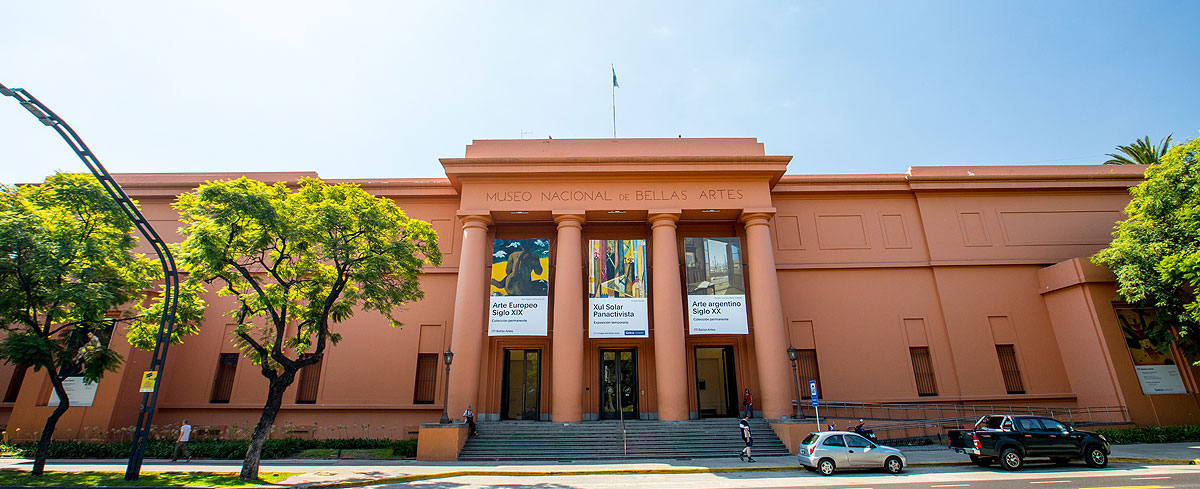
The museum's Recoleta building on Avenida del Libertador, photographed in 2017.
Gobierno de la Ciudad de Buenos Aires · CC BY 2.5 arNational Museum of Fine Arts
Museum · Museo Nacional de Bellas Artes · Founded 1895
Open, admission and hours confirmed 23 August 2026 · 14 sources
On this page 16 sections
ContentsClose
The museum describes its own holdings as built in two parallel tracks: a nineteenth-century European collection assembled in waves timed to national centenaries (1910, then the 1932-33 move into the present building), and a national collection - from Candido Lopez's war paintings and Eduardo Sivori's 1887 scandal-piece through to Xul Solar, Antonio Berni and the museum's twentieth-century Argentine holdings - that its own history page describes as a vast panorama of Argentine art built around the country's major artists. The museum's own figure for its total holdings is more than thirteen thousand pieces across national and international, historical and contemporary art.
| Local name | Museo Nacional de Bellas Artes |
|---|---|
| Kind | Museum |
| Founded | 1895 |
| City and country |  Buenos Aires, Argentina Buenos Aires, Argentina |
| Address | Av. del Libertador 1473, C1425AAT, Ciudad Autonoma de Buenos Aires, Argentina |
| Website | bellasartes.gob.ar |
| Status | Open, confirmed |
| Record last verified |
Visiting
- Hours
- Tuesday-Friday11:00 to 19:30last admission shortly before closing
- Saturday-Sunday10:00 to 19:30last admission shortly before closing
- Closed
- Monday. 1 May. 26 October. 9 November. 24, 25 and 31 December. 1 January.
- Admission
- General admissionFreeEntry is free. A voluntary contribution can be made at a self-service kiosk in the entrance hall, or paid in advance online, to skip the kiosk queue. Funds are earmarked for infrastructure and conservation projects.
Free entry: Every day (free general admission; contribution is voluntary)- Tickets
- go.waitry.net/order/10492/bellasartes/multipl... The museum's own ticket page.
- Do I need to book?
- No advance ticket is required for individual visitors; unguided groups of more than five must book ahead through an online form, and guided tours are arranged via the museum's agenda.
- Address
- Av. del Libertador 1473, C1425AAT, Ciudad Autonoma de Buenos Aires, Argentina MapSubte Linea H, Facultad de Derecho station
Bus (colectivo) Lines 17, 61, 62, 67, 92, 93, 110, 124 and 130 stop nearby - Website
- bellasartes.gob.ar
- Telephone
- +54 11 5288-9900
- [email protected]
Before you go how long, access, photography, bags, eating, shop
- How long to allow
- One to two hours for the permanent collection alone; the museum spans a ground floor, first floor and second floor of galleries plus sculpture terraces.
- Access
- Ramps from the entrance give access to every gallery; a lift with a 70 cm door serves all floors; wheelchairs are available on request at the information desk; restrooms are accessible; guide dogs are welcome under Argentina's Law 26.858/2013. The museum offers guided tours for blind and low-vision visitors, tours in Argentine Sign Language, and a 13-track audio guide for blind and low-vision visitors, all bookable through the museum's agenda.
- Photography
- Casual visitor photography is not separately addressed on the museum's own visitor page. Filming or content creation intended for publication requires a written request at least one week in advance and must not interfere with visitor circulation; the museum can restrict hours or require staff accompaniment.
- Bags
- Small bags and backpacks (up to 35 x 45 x 15 cm) may be carried into the galleries; larger items may be refused at security's discretion, and the cloakroom accepts items only as capacity allows. Bicycles, scooters and similar vehicles are not admitted, including to the cloakroom. Wheelchairs and strollers may be taken into the galleries.
- Eating
- Not stated on the museum's own visitor pages at the time of research.
- Shop
- The museum operates a shop, Tienda Bellas Artes, whose sales support the institution alongside membership and educational programme income.
Prices and hours change. We take them from the institution's own pages and print the day we read them, and you can check the current position at the source we used. Confirm before you travel.
What is inside
Ground floor - European art, 12th to 19th century
The museum's Old Master and 19th-century European galleries, including El Greco's Jesus en el huerto de los Olivos (Christ in the Garden of Olives), Edouard Manet's La ninfa sorprendida (The Surprised Nymph), Claude Monet's Orillas del Sena (Banks of the Seine), Paul Gauguin's Mujer del mar (Woman of the Sea) and Vincent van Gogh's Le Moulin de la Galette, alongside pieces by Francisco de Goya, Edgar Degas and Joaquin Sorolla acquired for the museum's 1910 centenary displays.
Ground floor - Argentine art, 19th century
The formation of a national school, from Candido Lopez's battle paintings of the Paraguayan War, including Despues de la Batalla de Curupayti, to Eduardo Sivori's Le lever de la bonne (El despertar de la criada), the 1887 nude that caused Argentina's first public art scandal, and works by Prilidiano Pueyrredon.
First floor - International art, 20th century
Twentieth-century acquisitions spanning Pablo Picasso, Amedeo Modigliani, Marc Chagall, Vassily Kandinsky, Paul Klee, Lucio Fontana, Jackson Pollock, Mark Rothko and the sculptor Henry Moore.
First floor - Argentine art, 20th century
The museum's holdings of Argentine modern and contemporary art, including Xul Solar, Emilio Pettoruti, Raquel Forner, Grete Stern, Antonio Berni, Alicia Penalba, Gyula Kosice, Marta Minujin, Antonio Segui and Leon Ferrari, alongside a Latin American grouping that includes Pedro Figari, Joaquin Torres Garcia, Tarsila do Amaral, Diego Rivera and Jesus Rafael Soto.
Second floor - temporary exhibition hall and sculpture terraces
A large temporary-exhibition pavilion, added in stages from 1961 and 1980, and two open-air sculpture terraces; at the time of research the temporary hall held the exhibition Adriana Bustos: Codigo natal, on the museum's own founding.
Library
An art-history reference library open Tuesday to Friday, 11:00 to 17:00, by appointment only, with an online catalogue; it became a public library during the 1940s.
What to see first
La ninfa sorprendida (The Surprised Nymph)
Edouard ManetAcquired for the museum's second home, the Argentine Pavilion, in the early 1910s; one of the earliest Impressionist-circle paintings to enter a Latin American public collection.4
Orillas del Sena (Banks of the Seine)
Claude MonetEntered the collection alongside the Manet in the Argentine Pavilion years, part of the museum's first wave of French 19th-century acquisitions.4
Mujer del mar (Woman of the Sea)
Paul GauguinAcquired after the museum's 1932-33 move to its present building, part of a push to deepen the Post-Impressionist holdings.4
Le Moulin de la Galette
Vincent van GoghA Montmartre windmill scene, not to be confused with Renoir's better-known dance-hall painting of the same name; acquired in the same building-move era as the Gauguin.4
Jesus en el huerto de los Olivos (Christ in the Garden of Olives)
El GrecoOne of the Old Master anchors of the ground-floor European galleries, acquired in the 1930s.4
Le lever de la bonne (El despertar de la criada)
Eduardo SivoriPainted in Paris in 1887 and shown at that year's Paris Salon before being sent to Buenos Aires, where its naturalistic nude of a working-class servant was denounced in the press as indecent; more than 250 artists and writers signed a public album in its defence. The museum's own catalogue calls it the first avant-garde gesture in Argentine art history.5
Despues de la Batalla de Curupayti (After the Battle of Curupayti)
Candido LopezPainted from memory by a soldier who lost his right arm to a grenade at the battle he depicts and then taught himself to paint left-handed; part of a self-taught, almost cartographic series on the Paraguayan War of which he completed 52 of a planned 100 canvases. This painting was donated to the museum by Lopez's descendants in 1968.6
Exhibitions on now
- On now9 Jul to 15 Nov 2026Confirmed , 7 weeks ago
Past exhibitions here
- Closed16 Apr to 2 Aug 2026Confirmed · check before you travel
A pumping station remade for painting
The museum a visitor walks into today on Avenida del Libertador was not built to hold paintings. The building began in the 1870s as a pumping station for Buenos Aires's waterworks, in the Recoleta district, and it was not until 1932-33 that the Museo Nacional de Bellas Artes moved in, after the architect Alejandro Bustillo remodelled the old pump house for museum use. That was the museum's third home. It had opened on 25 December 1896 in the Bon Marche department-store building on Calle Florida, now the Galerias Pacifico shopping centre, following a founding decree signed on 16 July 1895 by President Jose Evaristo Uriburu and his instruction minister Antonio Bermejo. The decree gave the new institution three jobs at once: a proper home for works already donated by private collectors, a pedagogical role, and an official showcase for a national art that the decree's own text said had not yet been given the institution it deserved. The first director was the painter and critic Eduardo Schiaffino, and the founding collection, built from donations by Adriano Rossi and Jose Prudencio de Guerrico, numbered 163 pieces.
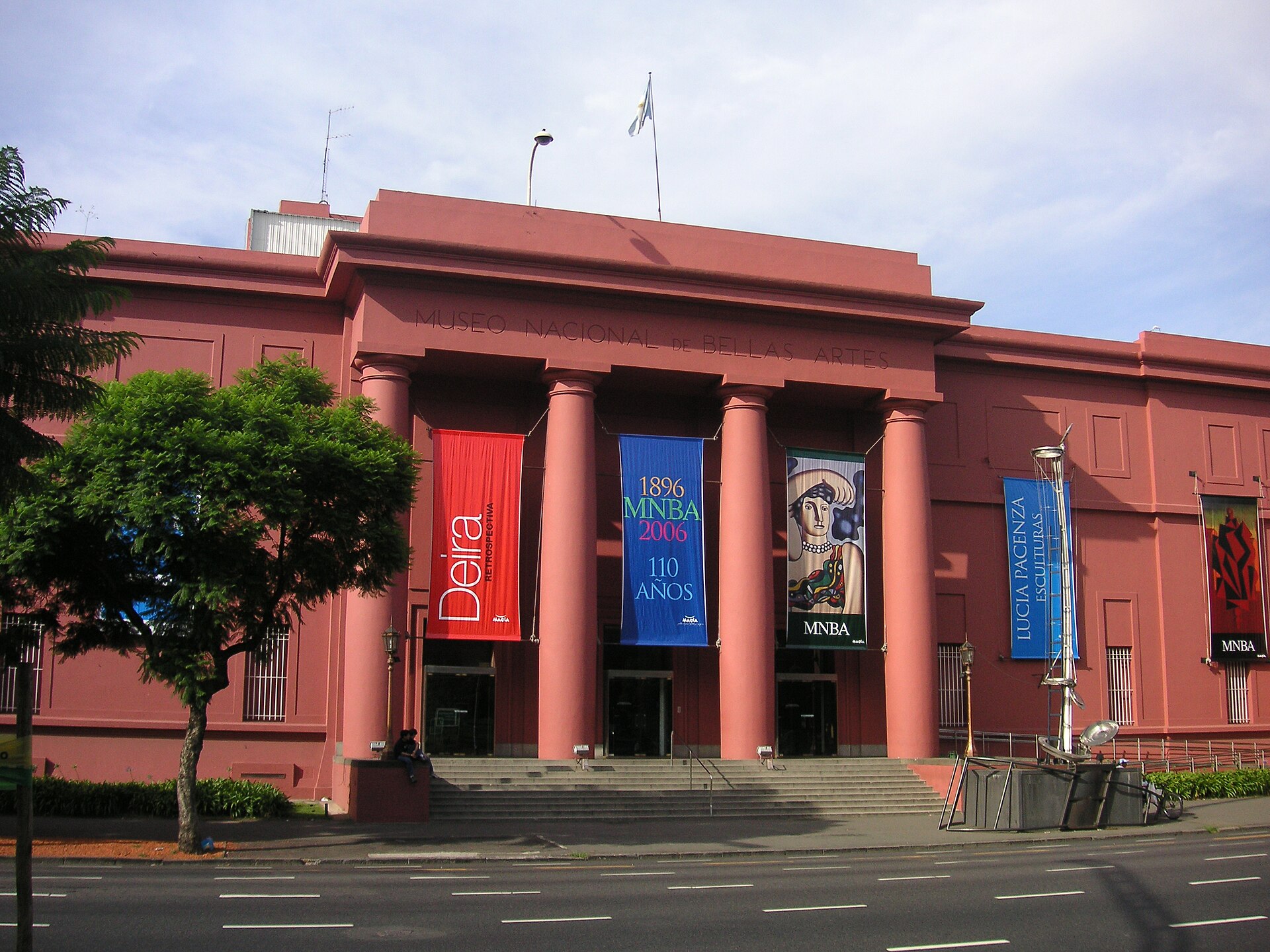
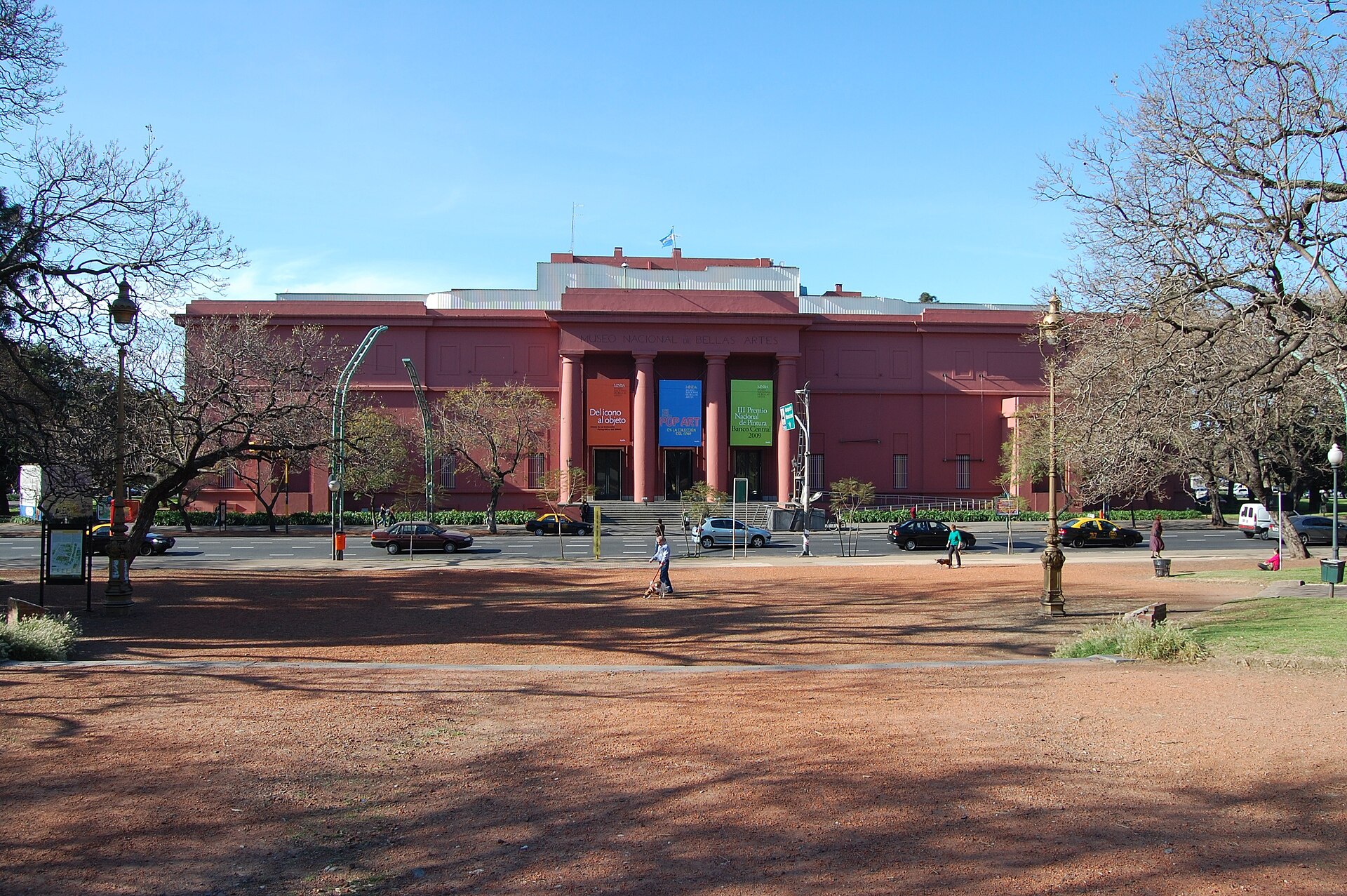
In 1909 the museum moved a second time, into the Argentine Pavilion, a monumental structure Argentina had built for the 1889 Paris Universal Exposition and then re-erected on the Plaza San Martin. It stayed there until the move to the former pump house in 1932-33, and that building, extended in stages through the twentieth century (a 1961 temporary-exhibition pavilion, a 1980 wing for contemporary Argentine art), is what a visitor sees today: a low, colonnaded, oxblood-red facade set back from the avenue, with a ground floor and first floor of galleries, a second-floor temporary-exhibition hall, and two open-air sculpture terraces.
Two centenaries, one collection
The museum's own account of its history is organised around the national anniversaries that pushed its collecting forward. By 1910, the centenary of the May Revolution, the collection already held pieces by Francisco de Goya, Joaquin Sorolla, Edgar Degas and Pierre-Auguste Renoir. The move into the Argentine Pavilion the following year brought Edouard Manet's La ninfa sorprendida and Claude Monet's Orillas del Sena into the collection, both bought as the museum broadened its holdings of French nineteenth-century painting. The 1932-33 move into the former pump house brought a further wave: Paul Gauguin's Mujer del mar, Vincent van Gogh's Le Moulin de la Galette, and El Greco's Jesus en el huerto de los Olivos all entered in this period. The later twentieth century added Pablo Picasso, Amedeo Modigliani, Marc Chagall, Vassily Kandinsky, Paul Klee, Lucio Fontana, Jackson Pollock, Mark Rothko and the sculptor Henry Moore, rounding out an international collection that now runs from the twelfth century to the present.
Running alongside it, in the museum's own telling, is the history of Argentine art itself: Candido Lopez, Prilidiano Pueyrredon, Emilio Pettoruti, Xul Solar, Raquel Forner, Grete Stern, Antonio Berni, Alicia Penalba, Gyula Kosice, Marta Minujin, Antonio Segui and Leon Ferrari, plus a Latin American grouping of Pedro Figari, Joaquin Torres Garcia, Tarsila do Amaral, Diego Rivera and Jesus Rafael Soto. Across a hundred and thirty years the museum has built a collection its own history page puts at more than thirteen thousand pieces, which it calls one of the most important cultural institutions on the continent; independent tallies put the total nearer 12,700 works, of which under 700 are counted as major, catalogued pieces and the rest are sketches, fragments and minor pieces.
The scandal that started Argentine modernism
Not every acquisition arrived quietly. Eduardo Sivori painted Le lever de la bonne (El despertar de la criada) in Paris and showed it at the 1887 Paris Salon before sending it home to Buenos Aires, where he knew it would provoke argument. The painting shows a young domestic servant, seated on the edge of an unmade bed, turning a stocking right-side out before putting it on: a plain, unnarrated body, its hands and face darkened by outdoor work, its legs and feet rendered with an unflattering, naturalist precision that Argentine critics called indecent and, in some newspapers, pornographic. The Sociedad Estimulo de Bellas Artes, which Sivori himself had helped found, chose to exhibit the painting anyway on 22 August 1887 and opened an album of support that drew more than 250 signatures from artists and writers. The museum's own catalogue entry calls it the first avant-garde gesture in the history of Argentine art, and the painting, inventory number 1894, now hangs in the nineteenth-century Argentine galleries.
A one-armed veteran's war in fifty-two paintings
Candido Lopez fought in the War of the Triple Alliance against Paraguay; at the Battle of Curupayti in September 1866 a grenade severed part of his right arm. He taught himself to paint left-handed, resuming his art career around 1869. He had no formal training as a painter before the war - he had worked as a photographer, soldier, shoemaker and rural labourer - and, commissioned by the former president Bartolome Mitre, he set out to record the war in around a hundred planned paintings, of which he completed fifty-two between 1888 and 1901, using a flat, descriptive, almost cartographic style derived from European military battle painting rather than from any school he had studied in. Despues de la Batalla de Curupayti, painted in 1893, was donated to the museum by Lopez's direct descendants in 1968. The museum's own commentary on the painting places Lopez's amateur, artisanal approach to war painting in the same regional tradition as Juan Manuel Blanes's earlier battle scenes, and reads his choice of style as itself a comment on how the Paraguayan war sat at the end of an era of civil wars in the Rio de la Plata.
A Christmas robbery under a dictatorship
The museum's history includes a still-unsolved theft. In the early hours of 26 December 1980, during Argentina's military dictatorship, four thieves entered through scaffolding left up for renovation work and took sixteen paintings and seven porcelain and jade objects, valued at the time at around twenty million dollars. The stolen paintings were by Matisse, Renoir, Cezanne, Gauguin, Degas, Rodin, Boudin and others; almost all of them had been donated to the state by the collector Mercedes Santamarina in 1970, and none of the works was insured. Only three paintings were ever recovered: Renoir's Retrato de mujer, Gauguin's El llamado and Cezanne's Recodo del camino, found in Paris and repatriated on 23 November 2005, twenty-five years after the theft, after a British art-recovery specialist traced them to a seller trying to place them with a Paris gallery. No one was ever convicted. Journalistic accounts published since have reported that five museum employees were detained and tortured during the original investigation and that the museum's curator was abducted; one author has theorised that the theft was connected to the military government's efforts to trade art for weapons abroad during the same period as the Falklands conflict, a claim that remains an author's theory rather than an established finding.
Visiting the Bellas Artes today
Entry to the Bellas Artes is free. The museum has introduced a voluntary-contribution system, asking visitors to give through a self-service kiosk in the entrance hall, with an online option to pay in advance and skip the queue; the money raised is earmarked for infrastructure and conservation. The museum is open Tuesday to Friday from 11:00 to 19:30 and Saturday and Sunday from 10:00 to 19:30, and closed on Mondays and a short list of national holidays. It sits opposite the Facultad de Derecho on Avenida del Libertador, reachable by Subte Line H to Facultad de Derecho or by any of nine bus lines that stop nearby. Beyond the galleries, the museum runs an accessibility programme that includes ramps and a lift to every floor, wheelchairs on request, guide-dog access under Argentine law, guided tours in Argentine Sign Language, and an audio guide for blind and low-vision visitors; it keeps a specialist library, open by appointment; and it has run Bellos Jueves, a late-opening evening series of music, readings and work by younger artists on the ground floor and terraces, as a recurring monthly programme.
What visitors say
Visitors consistently single out the range of the permanent collection, from European Old Masters to Argentine modernists, and the fact that it is free to enter; the building itself, a converted 1870s pumping station, draws its own praise for scale and calm. The most repeated complaint is crowding, particularly on rainy days and weekend afternoons, when the ground-floor galleries fill up.
What is praised, what is criticised
- Praised: the breadth and quality of the collection, spanning European Old Masters to 20th-century Argentine art
- Praised: free general admission
- Praised: the scale and atmosphere of the building, and clean, accessible facilities
- Criticised: the museum gets crowded, especially on rainy days and weekend afternoons
Ratings on other platforms
Tripadvisor: 4.6 from 7,007 ratings, read 23 August 2026
A platform average is a tertiary source: it moves, it is not audited, and we quote no visitor's words.
Questions about National Museum of Fine Arts
Where is National Museum of Fine Arts?
Av. del Libertador 1473, C1425AAT, Ciudad Autonoma de Buenos Aires, Argentina.
How much does it cost to visit?
General admission: free. As confirmed 23 August 2026.
When is it open?
Tuesday-Friday 11:00-19:30; Saturday-Sunday 10:00-19:30. Closed: Monday. 1 May. As confirmed 23 August 2026.
How do you get there?
Subte: Linea H, Facultad de Derecho station; Bus (colectivo): Lines 17, 61, 62, 67, 92, 93, 110, 124 and 130 stop nearby.
What should you see first?
La ninfa sorprendida (The Surprised Nymph) (Edouard Manet); Orillas del Sena (Banks of the Seine) (Claude Monet); Mujer del mar (Woman of the Sea) (Paul Gauguin); Le Moulin de la Galette (Vincent van Gogh); Jesus en el huerto de los Olivos (Christ in the Garden of Olives) (El Greco); Le lever de la bonne (El despertar de la criada) (Eduardo Sivori).
What we could not confirm
- Whether any further works from the December 1980 theft (13 of 16 paintings, all 7 decorative objects) will ever surface; the case remains formally unsolved.
- The theory that the 1980 robbery was connected to the military government's arms-for-art dealings abroad is a single author's account, not an established judicial finding, and is not corroborated by the museum itself.
Images
Sources
- 1Museo Nacional de Bellas Artes, official site, home page (open status, address, phone, email, hours summary) bellasartes.gob.ar/
- 2Museo Nacional de Bellas Artes, official site, 'Visita' page (hours, closed days, transport, accessibility, services, visitor rules, group-visit rules) bellasartes.gob.ar/paginas/planea-tu-visita/
- 3Museo Nacional de Bellas Artes, official site, 'Colabora' page (voluntary-contribution admission system) bellasartes.gob.ar/paginas/colaborar/
- 4Museo Nacional de Bellas Artes, official site, 'Museo / Historia' page and timeline (founding decree, directors, building moves, collection formation) bellasartes.gob.ar/paginas/museo/
- 5Museo Nacional de Bellas Artes, official collection page for 'Le lever de la bonne (El despertar de la criada)', Eduardo Sivori, inventory 1894 bellasartes.gob.ar/coleccion/obra/1894/
- 6Museo Nacional de Bellas Artes, official collection page for 'Despues de la Batalla de Curupayti', Candido Lopez, inventory 7122 bellasartes.gob.ar/coleccion/obra/7122/
- 7Wikimedia Commons, file description page and API metadata for File:MNBA fachada.jpg (licence CC BY 2.5 AR, credited Gobierno de la Ciudad de Buenos Aires, 2017) commons.wikimedia.org/wiki/File:MNBA_fachada.jpg
- 8Wikimedia Commons, file description page and API metadata for File:Museo Nacional de Bellas Artes (12407).jpg (licence CC BY-SA 2.0, credited Beatrice Murch, 2007) commons.wikimedia.org/wiki/File:Museo_Nacional_de_Bellas_Artes_(12407).jpg
- 9Wikimedia Commons, file description page and API metadata for File:Museo Nacional de Bellas Artes (Buenos Aires) 10209.jpg (licence CC BY 2.0, credited Brian Barbutti, 2009) commons.wikimedia.org/wiki/File:Museo_Nacional_de_Bellas_Artes_(Buenos_Aires)_10209.jpg
- 10Wikipedia, 'Museo Nacional de Bellas Artes (Buenos Aires)', English-language edition (building/collection cross-check, wing layout, visitor figures context) en.wikipedia.org/wiki/Museo_Nacional_de_Bellas_Artes_(Buenos_Aires)
- 11Wikidata, item Q1848918, Museo Nacional de Bellas Artes (coordinates, inception date, official website) wikidata.org/wiki/Q1848918
- 12Tripadvisor, attraction page for Museo Nacional de Bellas Artes, Buenos Aires (aggregate rating 4.6 of 5 from 7,007 reviews, Travelers' Choice 2026, visitor-praise and visitor-complaint summary), read 2026-08-23 tripadvisor.com/Attraction_Review-g312741-d311757-Reviews-Museo_Nacional_de_Bellas_Artes-Buenos_Aires_Capital_Federal_District.html
- 13Infobae, 'El robo al Museo Nacional de Bellas Artes en plena Navidad: 20 millones de dolares, tres cuadros recuperados y la sombra de la dictadura' (2020-12-25), account of the December 1980 theft, recovery and dictatorship-era context infobae.com/sociedad/2020/12/25/el-robo-al-museo-nacional-de-bellas-artes-en-plena-navidad-20-millones-de-dolares-tres-cuadros-recuperados-y-la-sombra-de-la-dictadura/
- 14Wikipedia (Spanish-language edition), 'Candido Lopez (pintor)' (details of his war wound, left-handed self-training, and the planned/completed count of his war paintings) es.wikipedia.org/wiki/C%C3%A1ndido_L%C3%B3pez_(pintor)

.jpg)
_10209.jpg)