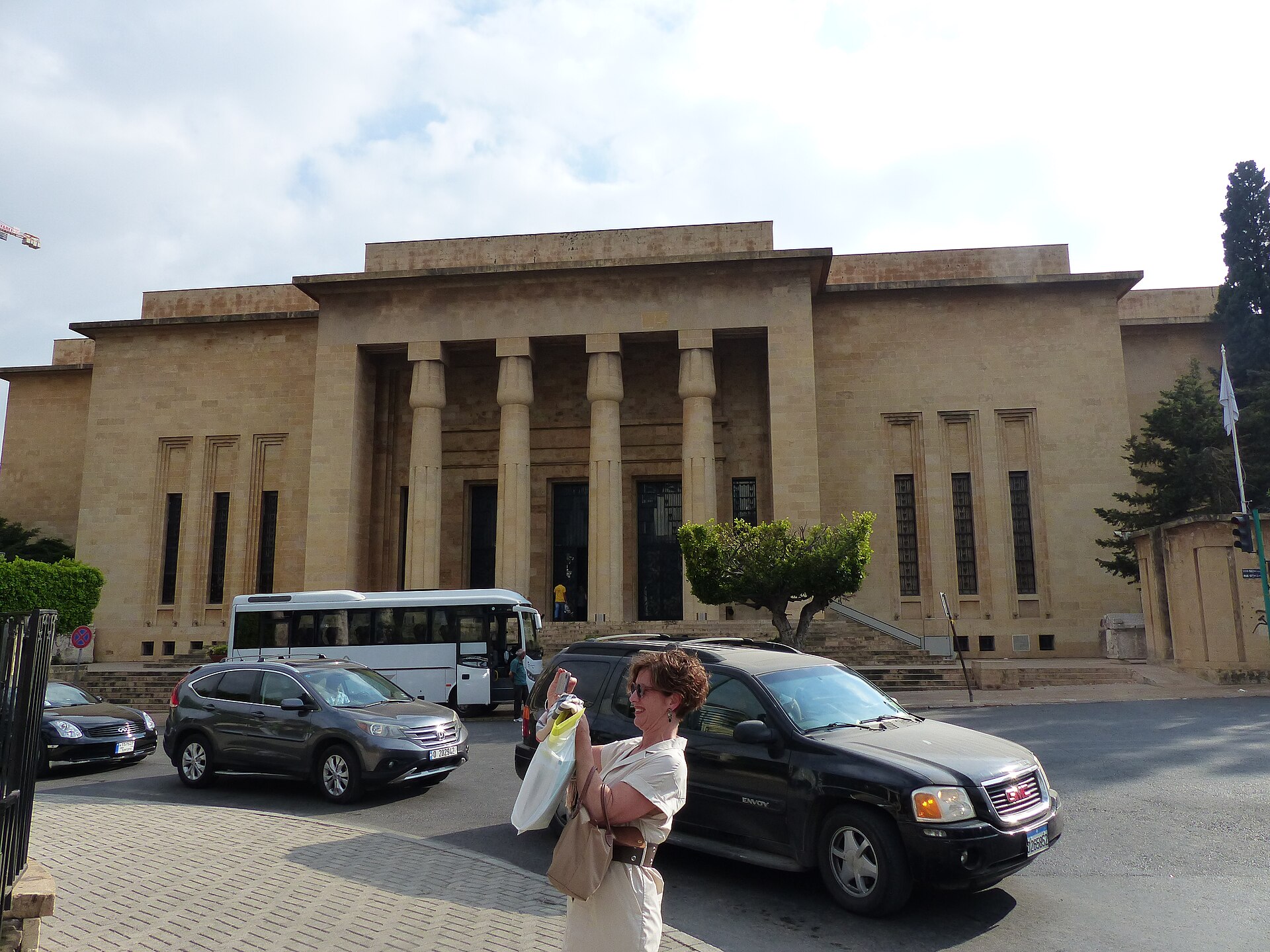
The Egyptian Revival facade of the National Museum of Beirut, faced in local limestone.
Voyager1500 · CC BY-SA 4.0National Museum of Beirut
Museum · Musee National de Beyrouth · Founded 1937
Open, admission and hours confirmed 7 September 2026 · 16 sources
On this page 14 sections
ContentsClose
The museum's real strength is depth in one narrow, well-excavated field rather than breadth: Lebanon's own Phoenician, Roman and Byzantine archaeology, drawn almost entirely from the Directorate General of Antiquities' own excavations at Byblos, Sidon, Tyre and the sanctuary of Eshmun, rather than from purchase or donation. The Ahiram inscription and the Ford Collection sarcophagi in particular give it holdings that are not duplicated in comparable depth anywhere else, because the objects were found here and have never left. What the collection lacks in geographic range it makes up for by being close to unimpeachable on provenance: this is excavated, state-held material with an excavation record behind nearly every major piece, in a region where that is often not true.
| Local name | Musee National de Beyrouth |
|---|---|
| Kind | Museum |
| Founded | 1937 |
| City and country |  Beirut, Lebanon Beirut, Lebanon |
| Address | Intersection of Abdallah al-Yafi Avenue and Damascus Road, Mazraa, Beirut, Lebanon |
| Website | museebeyrouth-liban.org |
| Status | Open, confirmed |
| Record last verified |
Visiting
- Hours
- Tue-Sun09:00 to 17:00Multiple recent sources (2025-2026) note that in practice last entry is 16:00 and staff ask visitors to leave by 16:30 despite the posted 17:00 closing.
- Closed
- Monday.
- Admission
- Lebanese citizens and residentsLBP 100,000As reported by recent (2025-2026) visitor accounts and travel-listing aggregators. The museum own site (museebeyrouth-liban.org) could not be reached (see admission_source_url note) and no official Ministry of Culture / Directorate General of Antiquities price page could be found. A second, much lower figure (5,000 LBP) also circulates on some travel sites; that figure matches what pre-currency-collapse (pre-2019) pricing would look like and is almost certainly stale, carried forward by aggregators that never updated after the Lebanese pound lost roughly 90-95 percent of its value from 2019, not a genuinely current alternative price. Given Lebanon own currency volatility this figure should be re-checked at the ticket window before being treated as reliable.
- Foreign visitorsLBP 1,000,000Same sourcing caveat as above; a lower figure (15,000 LBP) also circulates and is almost certainly the same stale pre-collapse price carried forward uncorrected by aggregators. US dollars are reportedly not accepted at the entrance itself; a currency-exchange attendant is on site (TripAdvisor review, November 2025).
Free entry: 17 May each year, National Heritage Day - free entry, per the Ministry of Culture's own page- Do I need to book?
- No advance booking found to be required; walk-in entry
- Address
- Intersection of Abdallah al-Yafi Avenue and Damascus Road, Mazraa, Beirut, Lebanon Map
- Website
- museebeyrouth-liban.org
- Telephone
- +961 1 426703
Before you go how long, access, photography, bags, eating, shop
- How long to allow
- Two to three hours for the main galleries; visitors researching in depth cite half a day or more
- Access
- Not established from sources fetched; not confirmed either way
- Photography
- Permitted in the galleries in visitor reports; not confirmed from an official source
- Bags
- Not established from sources fetched
- Eating
- The Pavillion Cafe, part of the Nuhad Es-Said Pavilion annex that opened in 2024 beside the original building; a November 2025 visitor reported an additional charge (about $5) to enter the Pavilion that was not clearly explained at admission
- Shop
- A museum gift shop and boutique exist on site (visitor reports); the Ministry of Culture page separately describes a 'Museum Boutique' hosting exhibitions by artists inspired by museum objects
Prices and hours change. We take them from the institution's own pages and print the day we read them, and you can check the current position at the source we used. Confirm before you travel.
What is inside
Ground floor, prehistory to the Iron Age
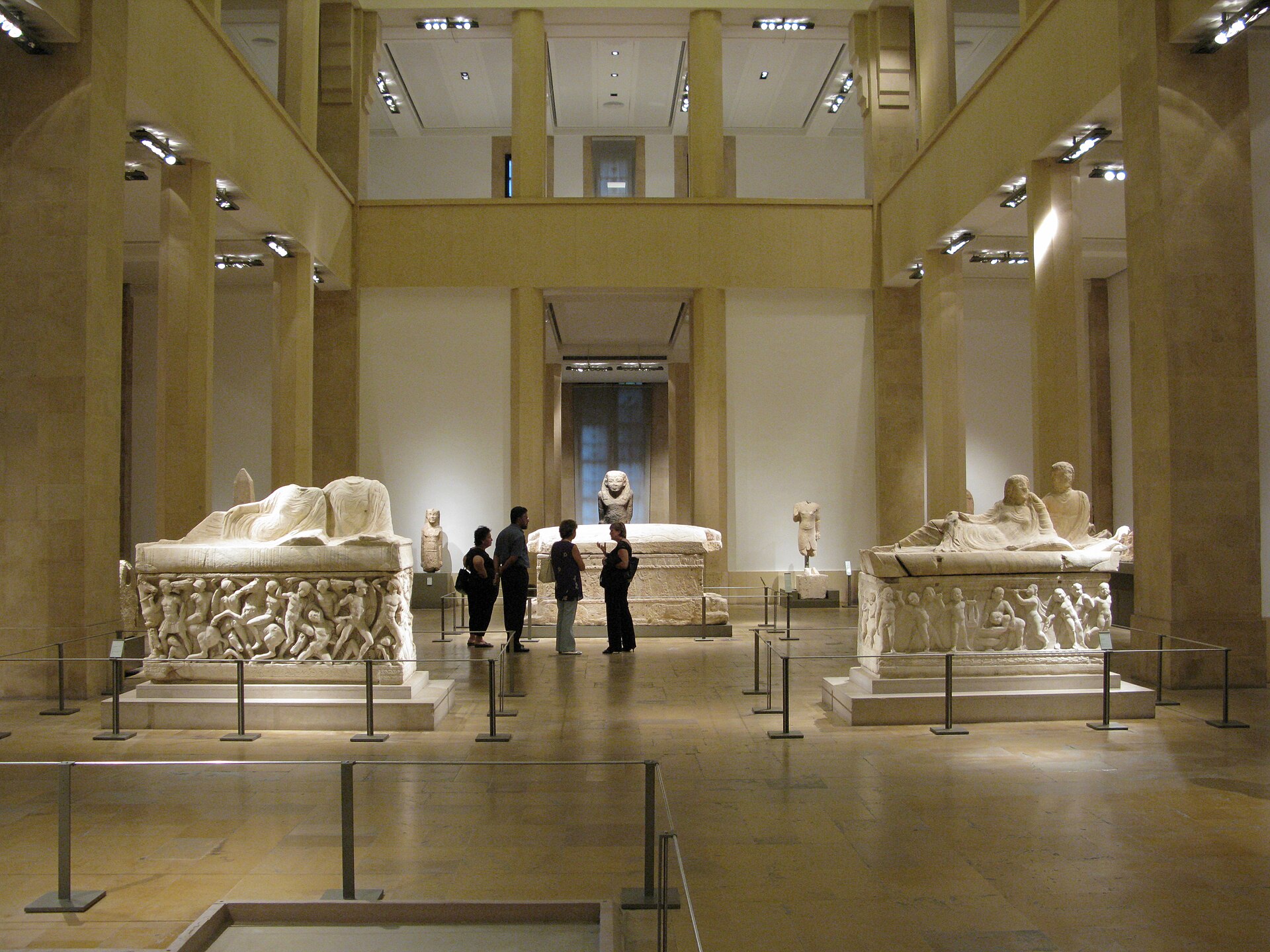
The chronological circuit opens with Palaeolithic and Neolithic stone tools, then Bronze Age material from Byblos, followed by the Phoenician material that is the museum's core strength: the sarcophagus of King Ahiram of Byblos with the earliest long inscription in the Phoenician alphabet, the Abishemu obelisk, several 'thrones of Astarte', and the ex-votos and tribune from the sanctuary of Eshmun at Bustan esh-Sheikh near Sidon. Of the roughly 83 large objects displayed on the ground floor, this is the largest single block.
Ground floor, Hellenistic to Byzantine
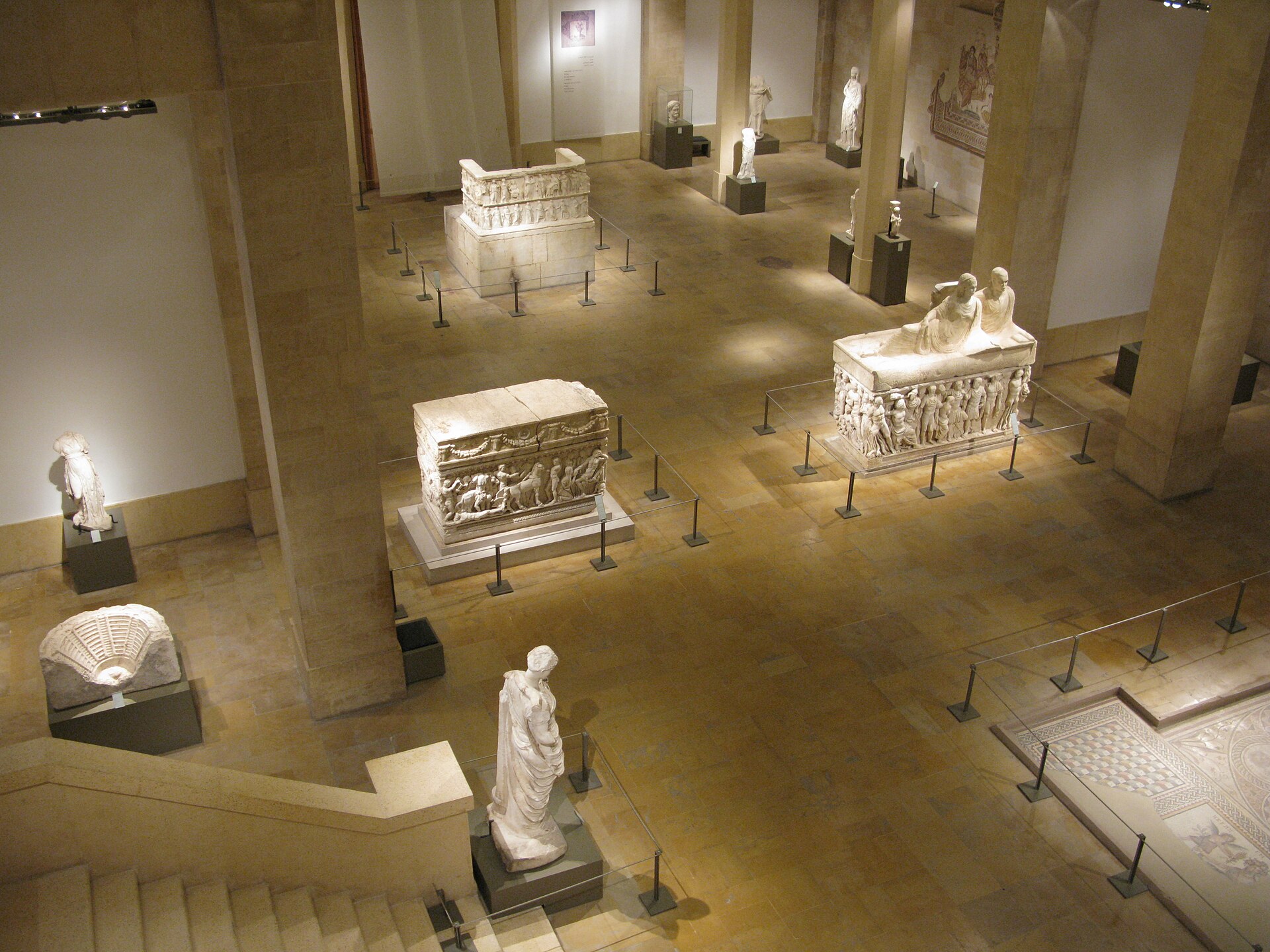
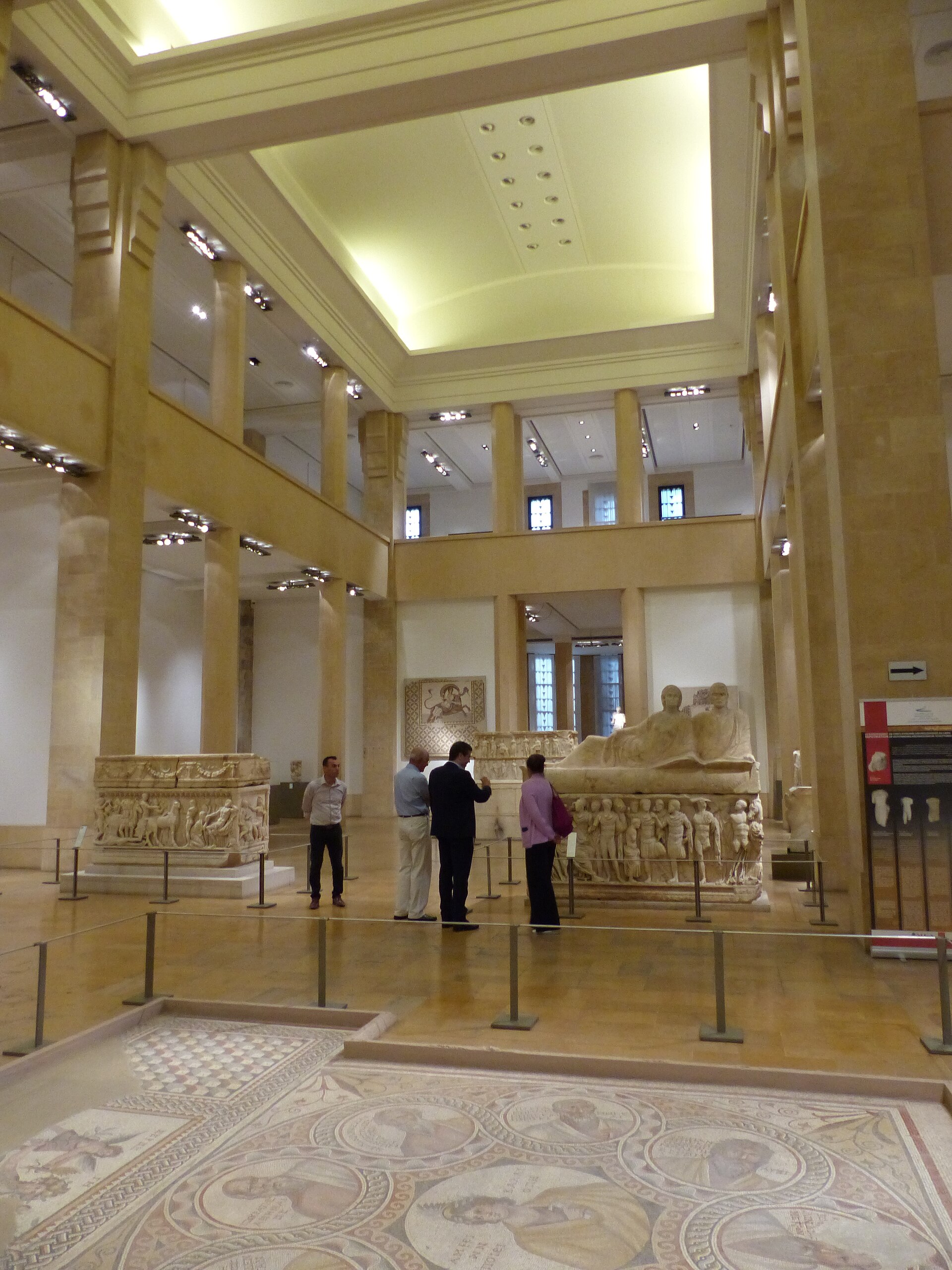
Roman and Byzantine-period sculpture and mosaics, including a third-century mosaic of the Seven Sages from Baalbek, a Roman sarcophagus carved with scenes from the final book of the Iliad, the Ford Collection of thirty-one Phoenician-period anthropoid sarcophagi from Sidon, and a bust of the Roman emperor Septimius Severus. This is also where the museum's fresco fragment showing Mary, mother of Jesus, dated to around 240 CE and described by several sources as among the oldest surviving depictions of the subject, is shown.
Basement, the funerary halls
A roughly 700 square metre gallery, reopened in October 2016 after a rehabilitation supported by the Italian government (EUR 1.2 million), dedicated to funerary rites and practice from the Palaeolithic to the Ottoman period: around 520 pieces, among them sarcophagi, stelae, and grave goods. This is the space that was sealed and used as protected storage for smaller artefacts during the civil war, while the statues and sarcophagi upstairs were boxed in sandbags, wood and concrete, and the ground-floor mosaics were themselves covered over in poured concrete to protect them in place.
Upper floor, Byzantine to Ottoman
Around 1,243 smaller objects tracing the Byzantine, early Islamic, Crusader, Mamluk and Ottoman periods: coins, jewelry, glassware, weapons, Byzantine ecclesiastical carvings, and Mamluk-era ceramics. Sources describe this floor as covering Lebanon's Christian and Islamic heritage in parallel rather than as two separate circuits.
Nuhad Es-Said Pavilion
A freestanding contemporary annex on the museum grounds, completed in 2021 to a design by Raed Abillama Architects for the Lebanese Ministry of Culture and opened to the public as a named, branded space in 2024. It holds a temporary-exhibition pavilion, a cafe, and back-of-house archive and administration space, and is described by its own operators as funding part of the National Museum's long-term upkeep through its cafe revenue.
What to see first
Sarcophagus of Ahiram
Phoenician, ByblosA limestone sarcophagus, dated by different scholars to the thirteenth, tenth or mid-ninth century BC, discovered in 1923 by Pierre Montet after a landslide exposed the royal tombs at Byblos. Its 38-word inscription is the earliest known example of the fully developed Phoenician alphabet, the ancestor of the Greek, Latin, Cyrillic, Hebrew and Arabic scripts, and UNESCO placed it on the Memory of the World register in 2005. The relief shows an enthroned king receiving a lotus flower from a priestess; the lid carries a curse against disturbing the tomb.12
Ford Collection of Phoenician sarcophagi
Phoenician, SidonThirty-one anthropoid sarcophagi of the fourth century BC excavated at Sidon, among the largest coherent groups of Phoenician anthropoid coffins in existence, forming the core of the basement funerary galleries.2
Mosaic of the Seven Sages
Roman, from BaalbekA third-century floor mosaic depicting the seven sages of Greek tradition, one of the museum's principal Roman-period mosaics and evidence of the classical literary culture current at Roman Heliopolis (Baalbek).2
Fresco of Mary, mother of Jesus
unknown, c. 240 CEA fragmentary wall painting that several sources describe as among the earliest surviving representations of Mary anywhere, predating the more famous Dura-Europos baptistery paintings by only a few years if the dating holds; it is displayed with the museum's Byzantine-era material.2
Tribune and ex-votos from the sanctuary of Eshmun
Phoenician-Persian period, Bustan esh-Sheikh near SidonArchitectural and votive material from the sanctuary of the healing god Eshmun, one of the best-documented Phoenician cult sites, giving the museum a rare architectural fragment rather than only portable objects.2
Sarcophagus with scenes from the Iliad
RomanA carved marble sarcophagus depicting episodes from the final book of the Iliad, illustrating the reach of Homeric imagery into Roman-period funerary art in the province of Syria-Phoenice.2
Phoenician sundial from Umm al-Amad
PhoenicianA rare Phoenician sundial, one of very few instruments of this kind to survive from the ancient Levant, giving the collection a scientific-instrument object type alongside its sculpture and ceramics.2
Abishemu obelisk
Bronze Age, Byblos, Obelisk TempleOne of the votive obelisks from the Obelisk Temple at Byblos, a monument type unique to that site and central to reconstructing Bronze Age Byblian religious practice.2
A museum built for a young state, opened onto a war
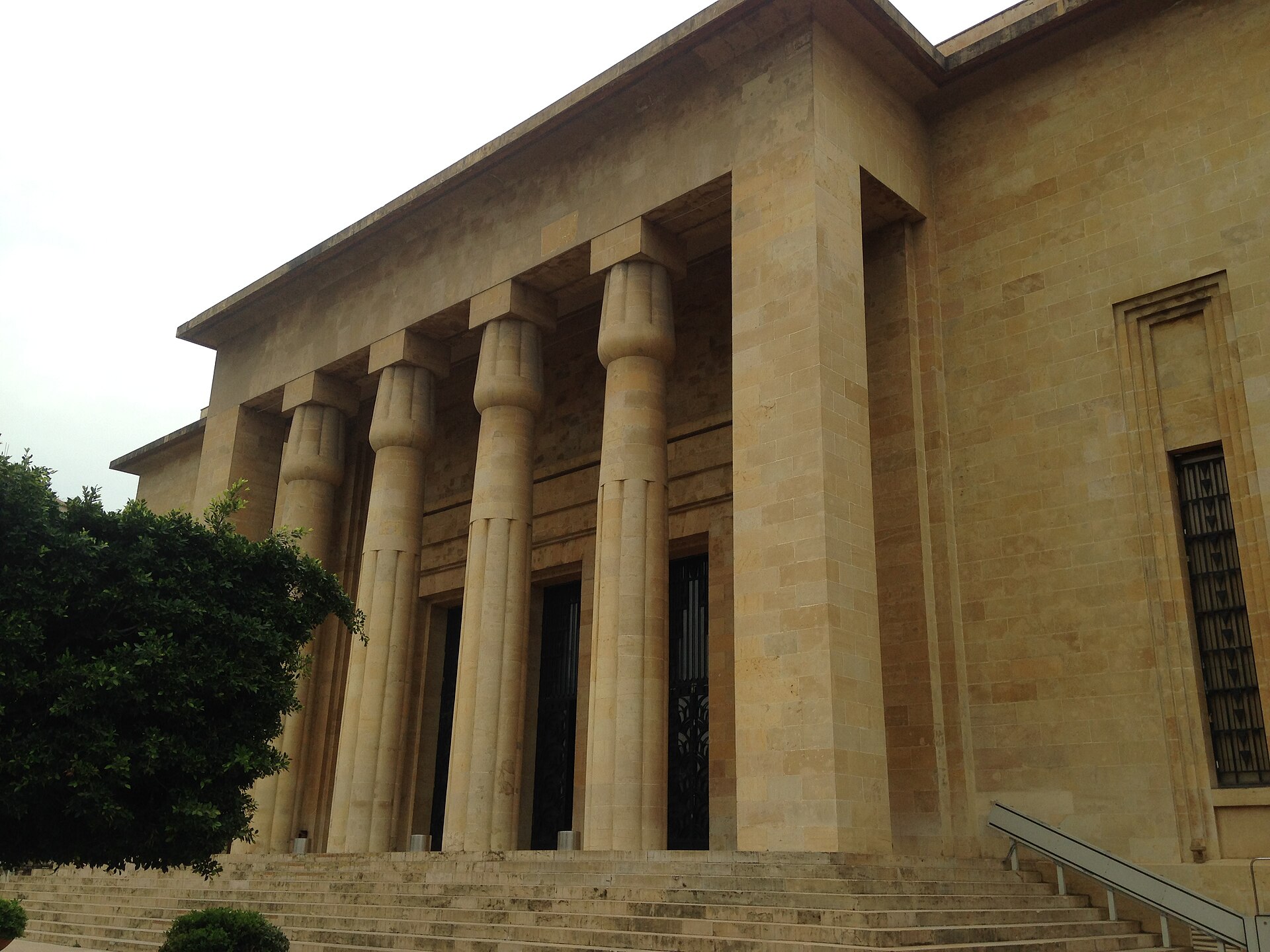
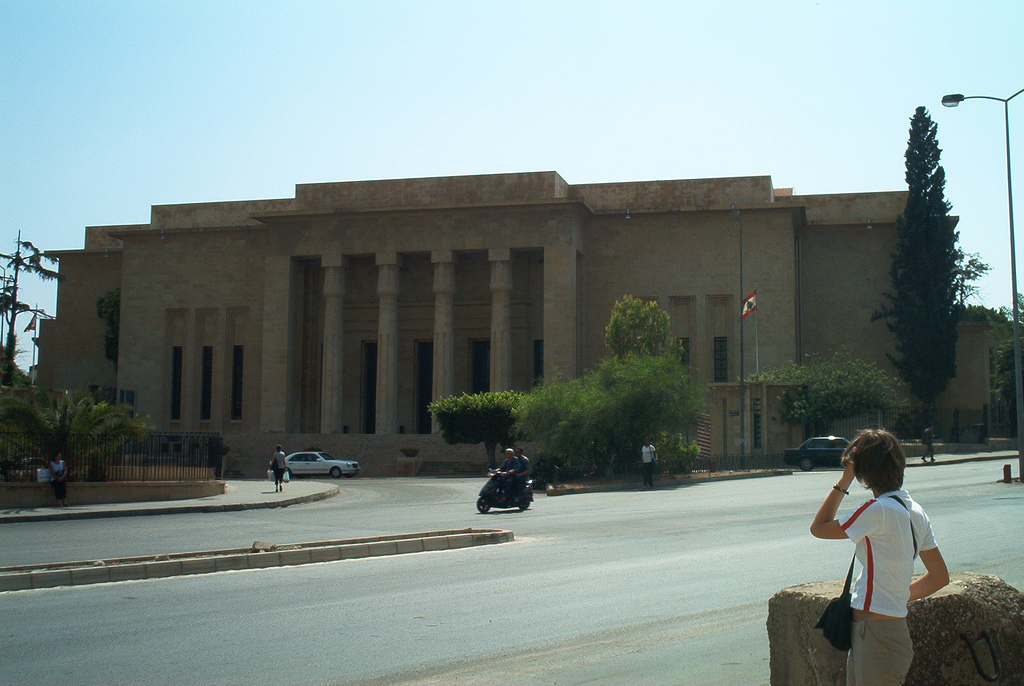
The National Museum of Beirut was conceived after the First World War, when the first antiquities recovered under the French Mandate's excavation programme needed a home, and its purpose-built Egyptian Revival building, designed by the architects Antoine Nahas and Pierre Leprince-Ringuet and faced in local limestone, went up from 1930 by the Beirut Hippodrome. Wikidata records the institution's founding in 1937; it was formally inaugurated on 27 May 1942 by President Alfred Naqqache. For the next three decades it functioned as the country's principal repository for the excavations of the Directorate General of Antiquities, built up under its long-serving director Maurice Chehab, and its holdings grew toward the roughly 100,000 objects the museum now holds in total, of which about 1,300 are on display at any time.
Then, in 1975, the Lebanese Civil War broke out, and the museum found itself standing directly on what came to be called the Green Line, the demarcation separating the warring factions that split Beirut for sixteen years. It is difficult to overstate how exposed that made it: shelling, bombing and periods of outright military occupation of the building continued for the length of the war.
What was done to save the collection
The museum's staff and the Directorate General of Antiquities made a deliberate, and largely successful, decision to protect the collection in place rather than evacuate it. Small and portable artefacts were moved into the basement storerooms, which were then sealed. The large floor mosaics on the ground floor were covered over in poured concrete, protecting them from shelling and looting at the cost of putting them out of sight for two decades. The statues and sarcophagi too heavy or fragile to move were encased where they stood in sandbags, timber and concrete casings. When the fighting ended in 1990 and the building could finally be opened up again, the protective measures were judged to have worked: the great majority of the collection had survived, even as the building around it had not. The bullet-marked facade, flooding, graffited walls and roughly forty-five boxes of artefacts lost to fires during the worst of the fighting were the price of what remained.
Restoration began in 1995. The ground floor reopened in November 1997, the first floor followed in October 1999, and the Maurice Chehab Hall, named for the museum's long-serving mid-century director, opened in 2011. The basement funerary galleries, still holding the objects that had spent fifteen years sealed away from the shelling above, did not reopen until October 2016, following a further phase of rehabilitation supported by the Italian government at a cost of roughly EUR 1.2 million. It is a sequence worth noting in full because it means the museum's civil-war recovery took over forty years from ceasefire to the last gallery reopening, longer than the war itself had lasted.
4 August 2020, and the second rescue in one lifetime
Just under three decades after its civil-war reopening was complete, the museum was damaged again. The double explosion at the Port of Beirut on 4 August 2020, roughly three kilometres from the building, killed more than 200 people and injured over 6,000 across the city; at the museum itself it blew out doors and windows, wrecked the security and surveillance systems, and cut air conditioning to a fraction of capacity. The Art Newspaper reported that emergency repair work began four weeks later, on 31 August 2020, as a joint project between the Musee du Louvre's Near Eastern Antiquities and Architectural Heritage departments and Lebanon's Directorate General of Antiquities, funded in full by the ALIPH Foundation (the International Alliance for the Protection of Heritage in Conflict Areas). A first, roughly $175,000 emergency phase addressed structural safety and the immediate protection of the collection; a second phase costing about $800,000 rebuilt the ventilation and air-conditioning systems that keep the galleries at a stable climate.
The museum reopened in stages, welcoming visitors again from around mid-2021. Sarkis el-Khoury, Lebanon's director general of antiquities, was quoted by The Art Newspaper as calling the pace of the repair, carried out in the middle of Lebanon's simultaneous economic collapse, 'a remarkable success'. UNESCO separately funded a three-month rescue and re-cataloguing operation in the basement repository under its Li Beirut programme, installing new storage shelving and completing an inventory of material that had never been on public display. By the article's date in August 2021, restoration was reported as roughly 95% complete, with air conditioning still limited and full technical systems still being brought back online.
What is actually inside
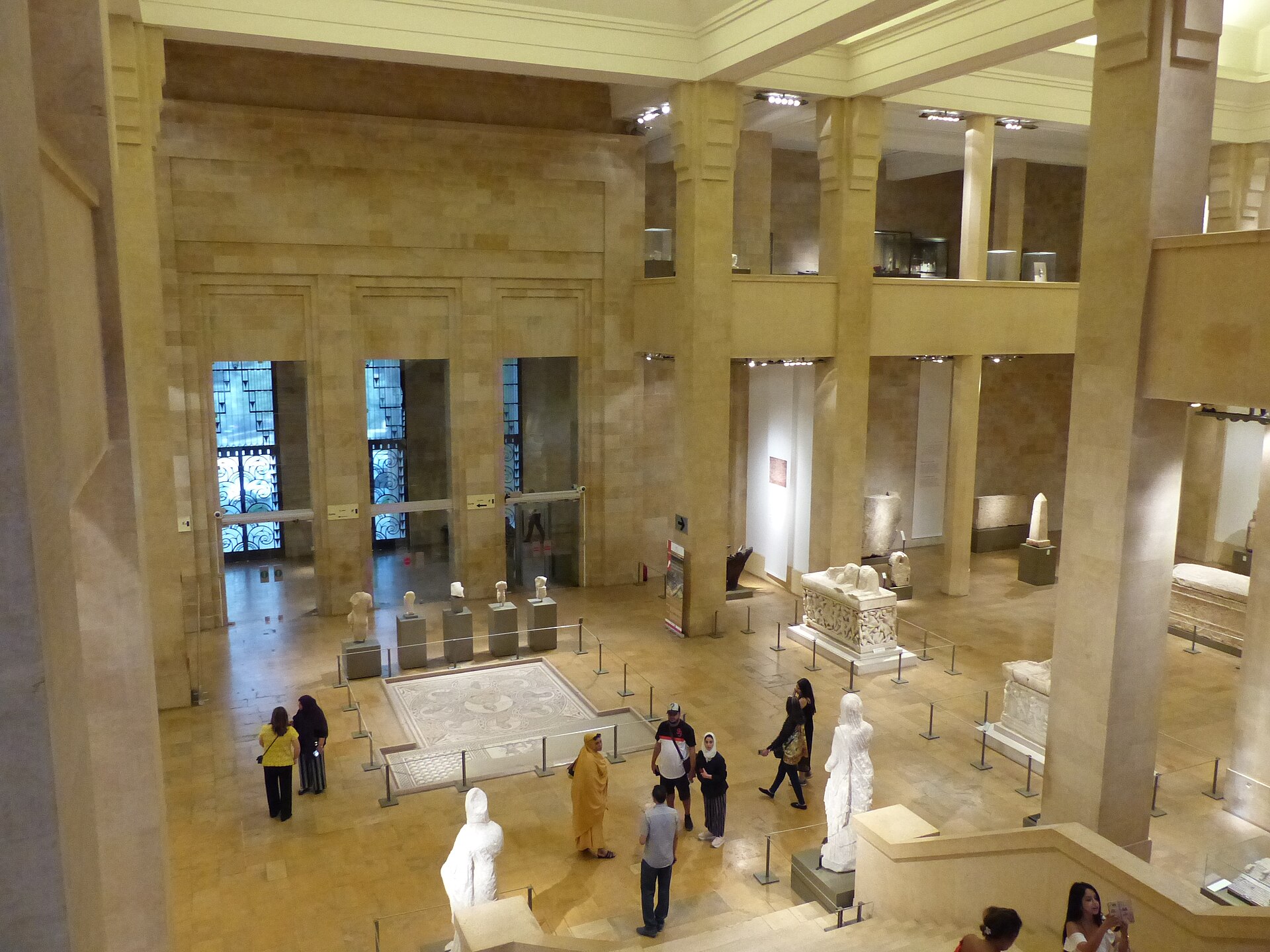
The display runs chronologically across three levels. The ground floor carries the museum's heaviest and most celebrated objects, roughly 83 large pieces arranged from the third millennium BC through the Byzantine period: the sarcophagus of Ahiram of Byblos with its founding inscription in the Phoenician alphabet, the votive material and architectural tribune from the sanctuary of Eshmun near Sidon, the Abishemu obelisk from Byblos's Obelisk Temple, several 'thrones of Astarte', Roman-period mosaics including the Seven Sages mosaic from Baalbek, and Roman sarcophagi carved with mythological scenes, among them one depicting the final book of the Iliad. Mixed in with the Roman and Byzantine material on the ground floor is a fresco fragment showing Mary, mother of Jesus, dated to around 240 CE, which several sources describe as among the oldest surviving images of the subject anywhere.
Below ground, the basement funerary galleries reopened in 2016 hold around 520 objects across roughly 700 square metres, organised around funerary custom from the Palaeolithic to the Ottoman period. Its centrepiece is the Ford Collection: thirty-one Phoenician-period anthropoid sarcophagi excavated at Sidon, one of the largest coherent groups of anthropoid coffins to survive from the ancient Levant, alongside stelae and grave goods. This is the level whose objects spent the civil war sealed in storage rather than boxed in place upstairs, and several recent visitor accounts single it out, unprompted, as the unexpected high point of a visit that most people arrive expecting to be about the ground-floor sarcophagi.
The upper floor holds around 1,243 smaller objects spanning the Byzantine, early Islamic, Crusader, Mamluk and Ottoman periods side by side: coins, jewelry, glass, weapons, Byzantine ecclesiastical carvings and Mamluk ceramics, tracing Lebanon's Christian and Islamic material culture as a continuous sequence rather than as two separated stories.
The Nuhad Es-Said Pavilion and a still-unsettled boundary
In 2021 the Lebanese Ministry of Culture completed a freestanding extension on the museum's grounds, on the boundary between the museum property and the Beirut Hippodrome, designed by Raed Abillama Architects: a linear pavilion with adjustable skylights intended as flexible exhibition space, a glass-fronted cafe overlooking the archaeological gardens, and, below ground, service space, a kitchen and museum administration and archive rooms. It was shortlisted for a 2023 architecture award. The pavilion was branded and opened to the public as the Nuhad Es-Said Pavilion in October 2024, and its operators describe its cafe revenue as helping fund the National Museum's own long-term upkeep, positioning the two as a 'living continuum' of heritage preservation and contemporary programming rather than as two separate institutions.
That framing has not yet reached the ticket desk. A detailed November 2025 visitor account describes being charged an unexplained additional five dollars to enter the Pavilion on top of ordinary museum admission, with no member of staff mentioning the separate charge, or the Pavilion's existence, at the point of paying for entry. Whatever the merits of the annex itself, the museum's own visitor experience has not caught up with its own expansion, and that gap between what the institution intends and what a paying visitor is actually told at the door is worth stating plainly rather than only praising the new building.
Visiting today
The museum operates Tuesday to Sunday, closed Monday, with posted hours of 09:00 to 17:00; recent visitor reports, however, describe last entry being enforced at 16:00 and staff moving to close the galleries by 16:30, regardless of the posted closing time, so a reader planning a visit for late afternoon should not count on the last hour being usable. Admission is charged in Lebanese pounds, and given the scale of the Lebanese pound's devaluation since 2019 any figure recorded here should be treated as needing a fresh check at the door rather than as a stable price; visitor reports through 2023-2025 consistently describe a lower rate for Lebanese citizens and residents and a substantially higher rate for foreign visitors, with US dollars reportedly not accepted directly at the ticket window itself. Entry is free for everyone on 17 May each year, National Heritage Day, an event the Ministry of Culture's own page describes as a recurring fixture of its calendar. The museum continued to operate through 2025 and into 2026, including hosting the public, free of charge, for National Heritage Day on 17 May 2026, evidence that whatever remains of the post-blast repair programme has not kept the building closed to visitors.
What visitors say
Visitors consistently rate the collection itself very highly and describe the Ahiram sarcophagus, the Ford Collection sarcophagi and the basement funerary galleries as the reasons to come; the most repeated complaints are about the front-of-house experience (language, warmth of welcome) and about the museum's ticketing not being clearly explained, particularly since the Nuhad Es-Said Pavilion introduced a separate charge in 2024.
What is praised, what is criticised
- Praised: The depth and rarity of the Phoenician material, above all the Ahiram sarcophagus and the Ford Collection sarcophagi, repeatedly singled out as unmissable
- Praised: The basement funerary galleries, several reviewers say the basement is the unexpected highlight of the visit and better than what is shown upstairs
- Praised: The building itself and the lighting and presentation of the sculpture halls, described as well-designed and uncrowded even when busy with school groups
- Criticised: Front-desk service: multiple 2025 reviews describe staff who spoke only French or Arabic and were, in two detailed accounts, actively unhelpful or rude to English-speaking visitors
- Criticised: Unclear and apparently improvised charging for the Nuhad Es-Said Pavilion (about $5 extra, not explained at the ticket desk) on top of the museum admission, and a currency-exchange arrangement at the door because US dollars are reportedly not accepted directly
- Criticised: Noise and crowd management: one reviewer described more than a hundred unsupervised school-group students inside at once with no staff managing the noise
Ratings on other platforms
TripAdvisor: 4.6 from 1,521 ratings, read 7 September 2026
Google (via Wanderlog aggregation): 4.5 from 2,844 ratings, read 7 September 2026
A platform average is a tertiary source: it moves, it is not audited, and we quote no visitor's words.
Questions about National Museum of Beirut
Where is National Museum of Beirut?
Intersection of Abdallah al-Yafi Avenue and Damascus Road, Mazraa, Beirut, Lebanon.
How much does it cost to visit?
Lebanese citizens and residents: LBP 100000; Foreign visitors: LBP 1000000. As confirmed 7 September 2026.
When is it open?
Tue-Sun 09:00-17:00. Closed: Monday. As confirmed 7 September 2026.
What should you see first?
Sarcophagus of Ahiram (Phoenician, Byblos); Ford Collection of Phoenician sarcophagi (Phoenician, Sidon); Mosaic of the Seven Sages (Roman, from Baalbek); Fresco of Mary, mother of Jesus (unknown, c. 240 CE); Tribune and ex-votos from the sanctuary of Eshmun (Phoenician-Persian period, Bustan esh-Sheikh near Sidon); Sarcophagus with scenes from the Iliad (Roman).
What we could not confirm
- No official, English-language price list or hours page from the museum's own domain (museebeyrouth-liban.org) could be reached: as of 2026-09-07 that domain serves only a default IIS Windows Server placeholder page, confirmed independently via direct browser navigation, not a bot block. No Lebanese Ministry of Culture or Directorate General of Antiquities page with a price list or hours was found by search either. The admission and hours figures recorded here come from recent (2025-2026) visitor reports and travel-aggregator listings. A second, independently-found set of figures (5,000/15,000 LBP against the 100,000/1,000,000 LBP recorded) also circulates online and is almost certainly stale pre-2019 pricing left uncorrected after Lebanon currency collapse, not a live alternative -- but neither figure has been confirmed against the museum itself, and both should be re-verified by phone (+961 1 426703) or in person before being treated as reliable.
- The precise current relationship, financially and operationally, between the National Museum proper and the Nuhad Es-Said Pavilion is not fully documented in sources found: whether the Pavilion charge is optional, bundled, or a separate ticket was not established, only that visitors report it was not explained to them.
- No official current figure for total annual visitor numbers post-2020 was found; the only figure located (40,211 in 2009) predates both the currency collapse and the port blast and should not be presented as current.
- Sources disagree on the closing time in practice (17:00 posted versus a 16:00-16:30 last-entry pattern described by 2025-2026 visitors); this may reflect a real, unannounced change in practice rather than a source error, and is worth a direct call to the museum to confirm.
Images
Sources
- 1Ministry of Culture (Lebanon), 'National Museum', Affiliates culture.gov.lb/en/Affiliates/National-Museum
- 2Wikipedia, 'National Museum of Beirut' en.wikipedia.org/wiki/National_Museum_of_Beirut
- 3Xinhua, 'Beirut National Museum opens to public', 18 May 2026 english.news.cn/20260518/3616acac7c15466c969af3b99181e8a0/c.html
- 4Gareth Harris, 'A year on from the devastating Beirut blast, the city's national museum slowly reopens', The Art Newspaper, 3 August 2021 theartnewspaper.com/news/beirut-national-museum-slowly-re-opens
- 5UNESCO, 'UNESCO leads a rescue mission at the National Museum of Beirut' unesco.org/en/articles/unesco-leads-rescue-mission-national-museum-beirut
- 6Nancy Kenney, 'Four weeks after blast, rehabilitation work begins at National Museum of Beirut', The Art Newspaper, 31 August 2020 theartnewspaper.com/news/four-weeks-after-blast-rehabilitation-work-begins-at-national-museum-of-beirut
- 7Musee du Louvre press office, 'Restoring the Beirut National Museum' presse.louvre.fr/restoring-the-beirut-national-museum/
- 8Council of Europe, Cultural Routes Database, 'National Museum of Beirut' coe.int/en/web/cultural-routes/-/national-museum-of-beirut
- 9Wanderlog, 'National Museum of Beirut, Beirut, Lebanon' wanderlog.com/place/details/3119/national-museum-of-beirut
- 10TripAdvisor, 'National Museum of Beirut - Reviews' tripadvisor.com/Attraction_Review-g294005-d1157183-Reviews-National_Museum_of_Beirut-Beirut.html
- 11The Plan, 'Raed Abillama Architects - Beirut National Museum Extension, to spend more time admiring the artifacts', Award 2023 theplan.it/eng/award-2023-Culture/beirut-national-museum-extension-to-spend-more-time-admiring-the-artifacts-raed-abillama-architects
- 12Wikipedia, 'Sarcophagus of Ahiram' en.wikipedia.org/wiki/Sarcophagus_of_Ahiram
- 13LebanonUntravelled, 'Beirut National museum' lebanonuntravelled.com/beirut-national-museum/
- 14Wikidata, Q2915627 'National Museum of Beirut' wikidata.org/wiki/Q2915627
- 15Nuhad Es-Said Pavilion, official site nuhadessaidpavilion.com/
- 16Musee National de Beyrouth, official site museebeyrouth-liban.org/