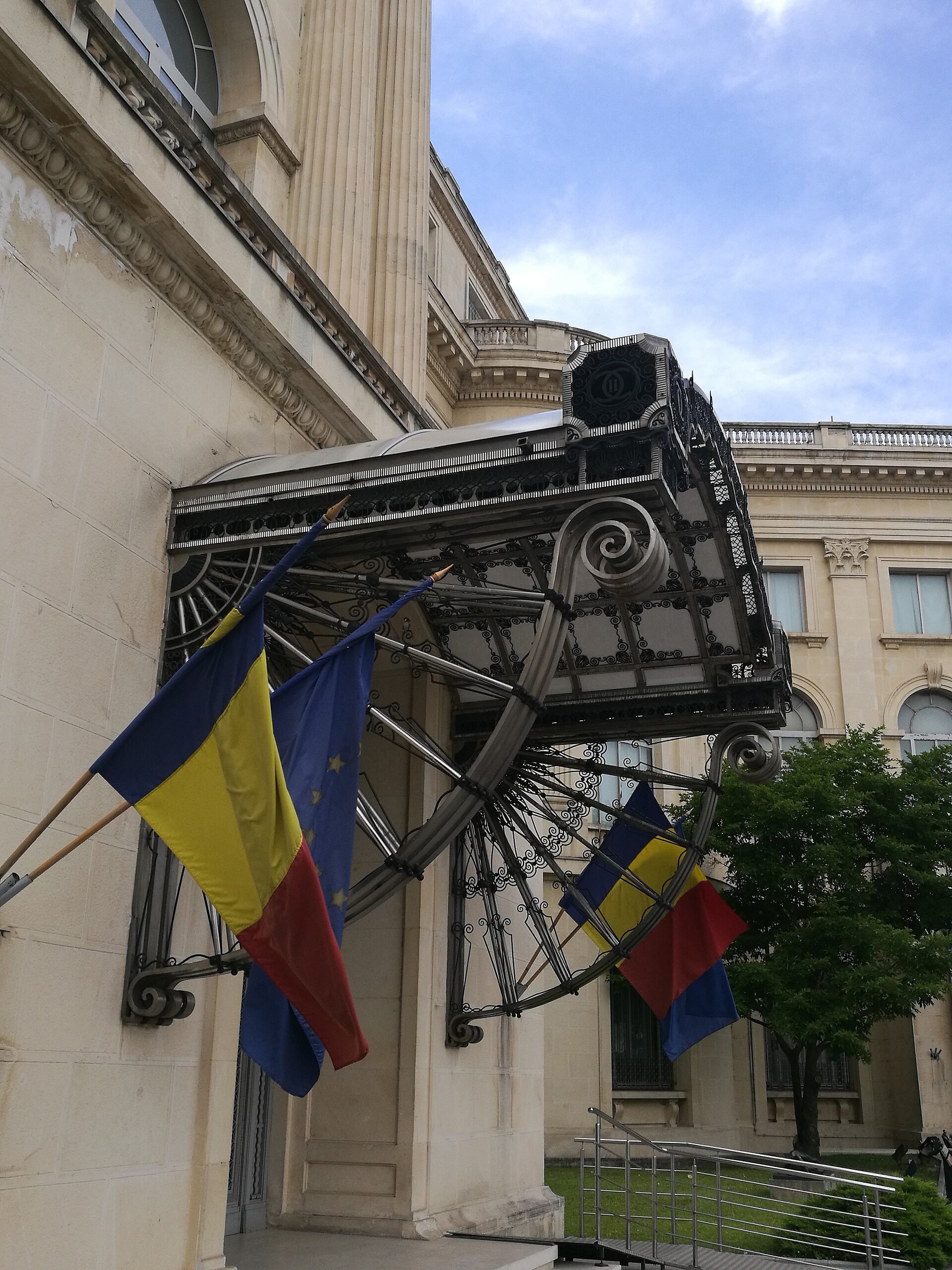
The wrought-iron porch canopy over the courtyard entrance of the former Royal Palace, bearing the cypher of King Carol II, photographed in 2017. This is the building the National Museum of Art of Romania occupies.
rsandu, CC BY-SA 4.0National Museum of Art of Romania
Museum · Muzeul National de Arta al Romaniei · Founded 1948
Open, admission and hours confirmed 30 August 2026 · 19 sources
On this page 16 sections
ContentsClose
The museum's own strength is breadth rather than a single narrow specialism: it is simultaneously the national repository of Romanian painting and sculpture from medieval icons to Brancusi, the largest public collection of European Old Masters in the country (built from a royal collection that was itself assembled by purchase and gift rather than by any single dynastic inheritance), and the custodian of at least three distinct private collections - Zambaccian, Rautu/Pallady, and the more than thirty gathered into the Museum of Art Collections - each preserved as a discrete unit rather than absorbed into a single hang. Its Oriental holdings, including one of the largest Islamic art collections in Romania, are comparatively recent (2024) and less internationally known than the Romanian and European galleries.
| Local name | Muzeul National de Arta al Romaniei |
|---|---|
| Kind | Museum |
| Founded | 1948 |
| City and country |  Bucharest, Romania Bucharest, Romania |
| Address | Calea Victoriei 49-53, sector 1, Bucuresti, 010063, Romania |
| Website | mnar.ro |
| Status | Open, confirmed |
| Record last verified |
Visiting
- Hours
- Wed-Fri10:00 to 18:00National Museum main site, European Gallery, Historic Spaces, K.H. Zambaccian Museum, Theodor Pallady Museum
- Sat-Sun11:00 to 19:00same locations as above
- Mon, Tue, Fri10:00 to 18:00Museum of Art Collections only (Calea Victoriei 111)
- Sat-Sun11:00 to 19:00Museum of Art Collections only; closed Wednesday and Thursday
- Closed
- Monday and Tuesday (main site, Zambaccian, Pallady). Wednesday and Thursday (Museum of Art Collections). 1, 2, 6, 7 and 24 January. Easter weekend and the Monday/Tuesday of Pentecost (Rusalii). 1 May, 1 June, 15 August, 30 November. 25 and 26 December (and 1 December for the Museum of Art Collections).
- Admission
- Adult - National Gallery, European Gallery, or Historic Spaces (single entry)RON 32one gallery only; three separate ticket points
- Reduced - students, under-30 Euro26 cardholders, moderate/mild disabilityRON 8same single-gallery entry as above
- Pensioner (-50 percent)RON 16same single-gallery entry as above
- Adult - Museum of Art Collections (Calea Victoriei 111)RON 40separate building and ticket point
- Adult - K.H. Zambaccian Museum or Theodor Pallady MuseumRON 16each museum sold separately at 16/4/8 RON adult/reduced/pensioner
- Adult - full complex (main museum + Art Collections + Zambaccian + Pallady)RON 120reduced 30 RON, pensioner 60 RON; the best-value combined ticket, valid across all sites
Free entry: First Wednesday of the month - National Museum, European Gallery, Historic Spaces, Zambaccian Museum, Theodor Pallady Museum. First Tuesday of the month - Museum of Art Collections. 1 December (Romania's National Day). 15 January (National Culture Day)- Tickets
- mnar.ro/tarife The museum's own ticket page.
- Do I need to book?
- No advance booking for individual visitors. Guided tours must be requested at [email protected] at least 7 days ahead; ticket booths and the museum shop close one hour before the museum itself.
- Address
- Calea Victoriei 49-53, sector 1, Bucuresti, 010063, Romania MapMetro Universitate station (M2/M3), about a 9-minute walk
Metro Piata Romana station (M1/M2), about a 10-minute walk - Website
- mnar.ro
- Telephone
- +40 21 313 3030
- [email protected]
Before you go how long, access, photography, bags, eating, shop
- How long to allow
- The museum's own reviewers on TripAdvisor routinely report three to four hours to cover the Romanian and European galleries alone; the combined ticket is valid for seven days from purchase so a visit can be split across more than one day.
- Access
- The permanent galleries are accessible to visitors with locomotor disabilities, in the company of a companion.
- Photography
- Mobile-phone photography without flash or tripod is permitted throughout the permanent galleries and the historic state rooms. Under Ministerial Order 3140 of 31 July 2025, weddings, christenings, name-day sessions, political events and similar staged photo sessions are not permitted on museum premises. Professional photography and filming require written permission and a fee (2,000-2,500 RON per hour).
- Bags
- Bags, backpacks, umbrellas, winter coats and other bulky items larger than 30 x 25 x 20 cm must be left in the cloakroom, as must all food and drink.
- Eating
- No on-site cafe is listed on the museum's own visitor pages.
- Shop
- A museum shop operates alongside the ticket booth in the European Gallery entrance; a 2026 visitor review noted it stocks little on individual Romanian painters such as Nicolae Grigorescu.
Prices and hours change. We take them from the institution's own pages and print the day we read them, and you can check the current position at the source we used. Confirm before you travel.
What is inside
European Art Gallery (Galeria de Arta Europeana)
The country's most important collection of European Old Masters, built around the personal collection of King Carol I and enlarged after 1950 with donations from the Kalinderu brothers, Toma Stelian, Anastasie Simu, Al. Saint-Georges and the former Bucharest municipal Pinacoteca. Rooms run chronologically through the Italian school (Domenico Veneziano, Jacopo Bassano, Bronzino, Tintoretto, Luca Giordano), the Dutch Golden Age (Rembrandt, Jan Davidsz. de Heem), Flemish painting (Rubens, Pieter Brueghel the Younger, Jan Brueghel the Elder), a room built around three El Greco canvases, German painting (Lucas Cranach the Elder, Hans von Aachen) and a French room of Monet, Signac and Sisley alongside sculpture by Rodin, Camille Claudel and Antoine Bourdelle.
Old Romanian Art Gallery (Galeria de Arta Veche Romaneasca)
Objects from the fourteenth to the mid-nineteenth century drawn from Wallachia, Moldova and Transylvania: icons, manuscripts, textiles and liturgical silver rooted in the Byzantine tradition, alongside the Western and Ottoman influences that reached the Romanian principalities. Occupies part of the ground and first floors of the National Gallery wing.
Modern Romanian Art Gallery (Galeria de Arta Romaneasca Moderna)
The history of Romanian painting and sculpture from the mid-nineteenth century to the late 1970s, with a dedicated Constantin Brancusi hall alongside Nicolae Grigorescu, Ion Andreescu, Stefan Luchian, Nicolae Tonitza, Theodor Pallady and Gheorghe Petrascu. Visitor reports consistently single out the top floor of this gallery as the strongest single run of rooms in the museum.
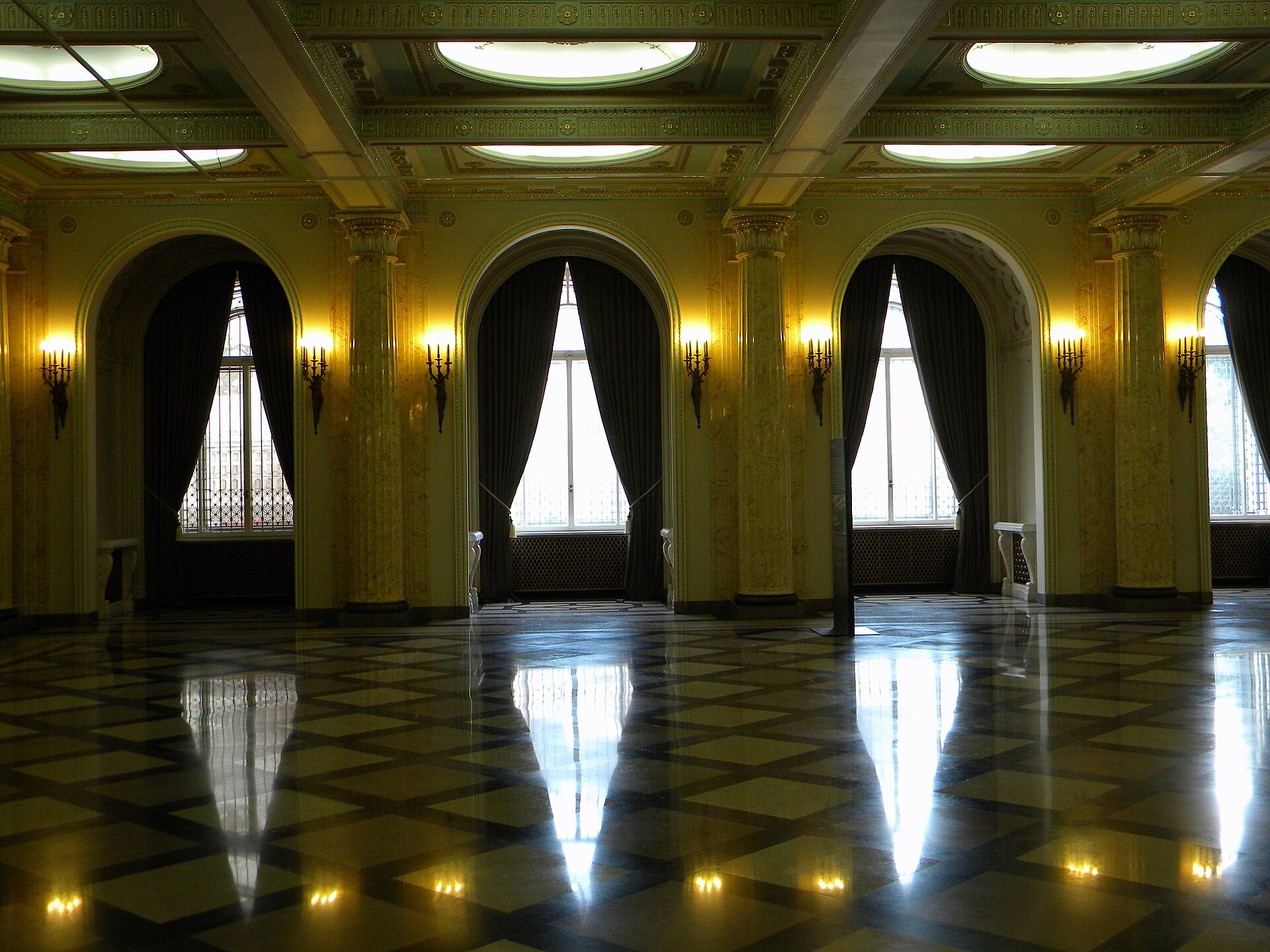
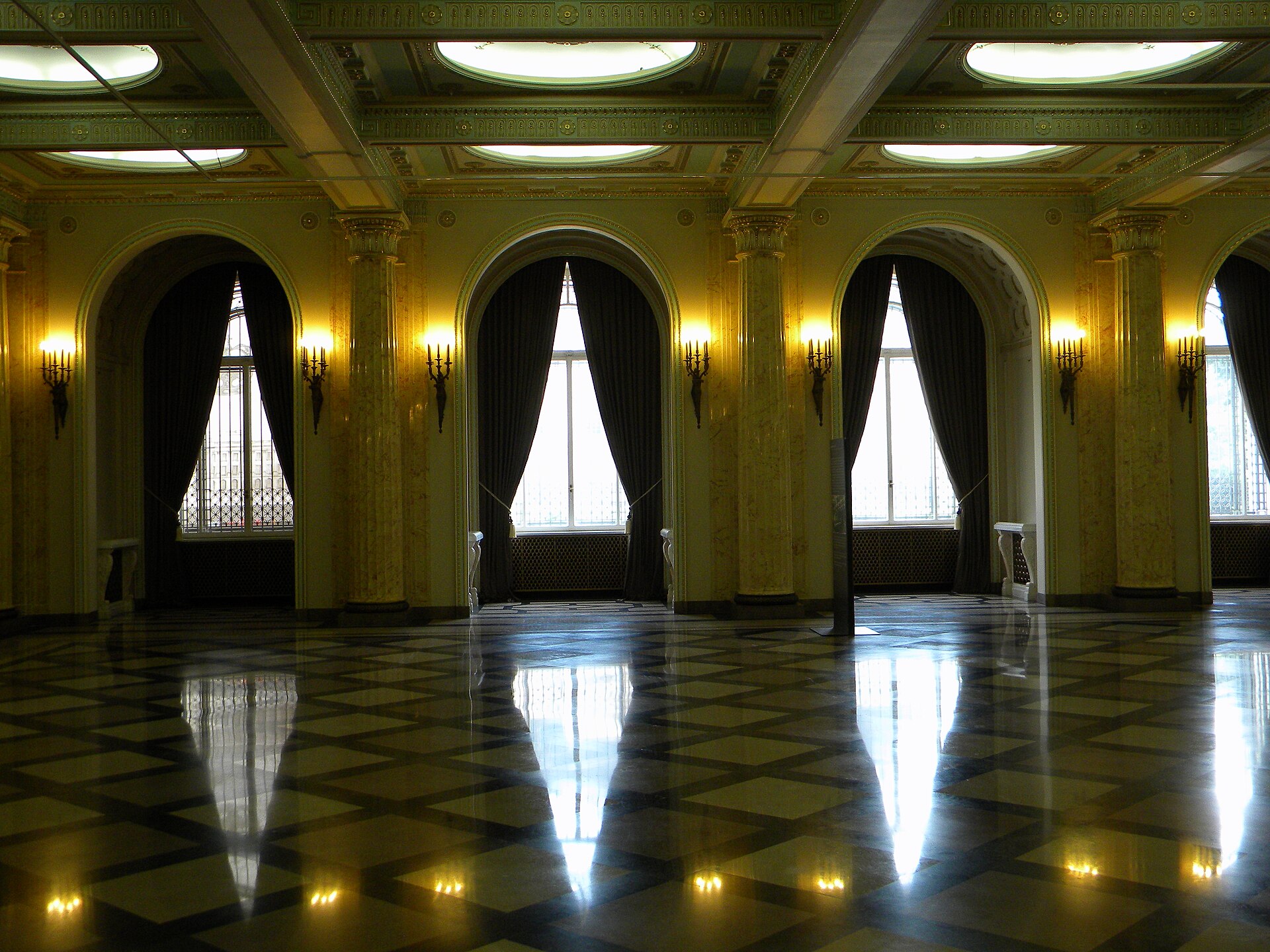
Photograph by Britchi Mirela · CC BY-SA 3.0 ro Historic Spaces of the Royal Palace: Throne Room, Royal Dining Room and Voievozi Staircase
The surviving state rooms of the working royal palace, reopened to the public in 2013 after a long restoration. The Throne Room is reached by the Carrara-marble Voievozi Staircase, its ceiling fresco 'The Apotheosis' by Arthur Verona and a portrait frieze of Romanian voivodes and kings by sculptor Cornel Medrea; the Throne Room itself carries a monumental royal coat of arms, 1934 portraits of Kings Carol I and Ferdinand by Aurel Bordenache, and a ceiling fresco by Cecilia Cutescu-Storck commissioned by Carol II. The ground-floor Royal Dining Room has an English Robert Adam-style coffered ceiling, French and Belgian marble flooring, Ruschita marble fireplaces, and large interwar canvases by Iosif Iser and Rudolf Schweitzer-Cumpana.
Museum of Art Collections (Muzeul Colectiilor de Arta), Calea Victoriei 111
A separate branch museum, inaugurated 1978 in the former Romanit Palace, presenting more than 30 private collections donated across the twentieth century by Bucharest collectors: paintings and sculpture by Theodor Aman, Nicolae Grigorescu, Ioan Andreescu, Nicolae Tonitza, Gheorghe Petrascu, Theodor Pallady, Iosif Iser and Camil Ressu, plus European and Japanese graphic art, French furniture, Oriental carpets and Transylvanian folk icons. Its vaulted cellars house the Lapidariu, salvaged stone carvings - tombstones, door and window frames, monumental columns and capitals - from Wallachian churches and monasteries demolished in the late nineteenth century and again under systematisation in 1977-1987.
K.H. Zambaccian Museum, Strada Muzeul Zambaccian 21A
The house-museum collector and critic Krikor H. Zambaccian (1889-1962) built in the 1940s specifically to display his collection, donated to the Romanian state in 1947. Romanian holdings run from Theodor Aman and Nicolae Grigorescu through Stefan Luchian, Nicolae Tonitza, Theodor Pallady and Gheorghe Petrascu to Corneliu Baba, with sculpture by Brancusi, Milita Petrascu, Oscar Han and Cornel Medrea. Alongside them sit paintings by Cezanne, Picasso, Matisse, Bonnard, Utrillo and Marquet - each one, per the museum, unique in a Romanian public collection.
Theodor Pallady Museum, Strada Spatarului 22 (Casa Melik)
Housed in Casa Melik, built in the second half of the eighteenth century and, per the museum, the oldest merchant house in Bucharest open to the public. Displays the collection of Serafina and Gheorghe Rautu, donated to the state in the late 1960s: a core of Theodor Pallady canvases and more than 800 of his Paris-period drawings and prints, plus the Rautus' own holdings of 16th-19th century French, Dutch, English and Spanish painting, small antique and Renaissance sculpture, textiles, furniture and Oriental ceramics. Reopened 24 April 2026 after a renovation that enlarged the display space and remade the garden as an events area; the museum's own ticket page states it, together with the Decorative and Oriental galleries at the main site, was again closed from 5 August 2026, with no reopening date published as of the last check.
European Decorative Art Gallery and Oriental Art Gallery (main site, third floor)
Six rooms of European decorative arts spanning four centuries of taste and manufacture from Austria, Belgium, Bohemia, Switzerland, France, Germany, Italy, the Netherlands, Spain and Russia (16th-19th century), opened 15 January 2024. Beside it, the Oriental Art Gallery, opened 22 November 2024, gathers close to 600 objects from Egypt, Greece, Bulgaria, Turkey, Syria, Daghestan, Azerbaijan, Iran, Turkmenistan, Uzbekistan, India, China and Japan, built up over more than seventy years of transfers, gifts and purchases; a separate virtual gallery presents the museum's roughly 1,400-piece Islamic art collection, the largest of its kind in Romania, spanning the 7th to the 20th century. As above, the museum's own ticket page states this gallery was closed from 5 August 2026, with no reopening date published as of the last check.
What to see first
Age of Bronze (Varsta de bronz)
Auguste RodinThe bronze anchors the French room of the European Gallery alongside sculpture by Camille Claudel and Antoine Bourdelle, the core of the gallery's holding of French sculpture.5
Three paintings by El Greco
El Greco (Domenikos Theotokopoulos)The three canvases, illustrating different periods of the painter's career, dominate the room given over to Spanish art in the European Gallery.5
Haman before Esther (Aman in fata Esterei)
Rembrandt van RijnThe museum's Dutch Golden Age room is built around this Rembrandt alongside still lifes by Jan Davidsz. de Heem.5
Portrait of Giovanna Spinola Pavese
Peter Paul RubensAnchors the Flemish room, shown with Pieter Brueghel the Younger and Jan Brueghel the Elder.5
The Brancusi hall
Constantin BrancusiA dedicated room in the Modern Romanian Art Gallery holding the museum's Brancusi sculptures, the centrepiece of the Romanian modern collection and, per visitor accounts, the single most requested stop in the building.6
Top-floor run of Romanian painting
Nicolae Grigorescu, Stefan Luchian and othersReviewers repeatedly single out this floor of the Modern Romanian Art Gallery as the strongest sequence of rooms in the museum, tracing Romanian painting from Grigorescu's generation onward.6
The Voievozi Staircase and Throne Room
Architects Paul Gottereau and Karel Liman; frescoes by Arthur Verona and Cecilia Cutescu-Storck; frieze by Cornel MedreaThe Carrara-marble staircase and the Throne Room it leads to are the grandest surviving interior of the former royal palace, restored and reopened to the public only in 2013.9
The Royal Dining Room
Interwar decoration under Queen Marie and Carol II; paintings by Iosif Iser and Rudolf Schweitzer-CumpanaAn intact interwar state room - coffered English-style ceiling, French and Belgian marble floor, Ruschita marble fireplaces - with large-scale paintings still in their original setting.9
Cezanne, Picasso, Matisse and Bonnard at the Zambaccian Museum
Paul Cezanne, Pablo Picasso, Henri Matisse, Pierre BonnardCollector Krikor Zambaccian assembled paintings by each artist that the museum describes as unique within a Romanian public collection, shown in the house he built to hold them.8
The Lapidariu
Wallachian stone carvers under princes Neagoe Basarab, Matei Basarab, Serban Cantacuzino and Constantin BrancoveanuSalvaged tombstones, door and window frames and monumental columns from religious and civic buildings demolished in the 1890s and again in 1977-1987 - the physical remains of a Romanian medieval architecture otherwise lost.7
Exhibitions on now
Past exhibitions here
- Closed8 May to 13 Sep 2026Confirmed · check before you travel
A merchant's house that became a royal palace
The building the National Museum of Art of Romania occupies did not start as a palace at all. In 1820 the boyar Dinicu Golescu built a private house on the Podul Mogosoaiei, the road that is now Calea Victoriei; in 1837 Prince Alexandru Ghica converted it into a ceremonial palace, and from 1859 it briefly housed Alexandru Ioan Cuza, the ruler of the newly united Romanian principalities. When Prince Carol of Hohenzollern - the future King Carol I - was installed there in May 1866, the modest Golescu house became the seat of the Romanian crown, and Carol spent the better part of his 48-year reign enlarging it. Bucharest's first electric lighting installation went into the palace in 1882. Between 1882 and 1906 Carol I employed the French architect Paul Gottereau and then Karel Liman, who had also worked on Peles Castle, to extend the building until it reached roughly the footprint it has today.
Carol I's 1914 will made his intentions for the building and its contents explicit, instructing that his picture gallery, catalogued by his own librarian Bachelin, remain in the country forever as Crown property. His nephew and successor Ferdinand died in the palace in 1927, shortly after a fire on 6-7 December 1926 destroyed the upper floor of the central block; Queen Marie had architects N.N. Nenciulescu and Karel Liman rebuild it. The palace's present form dates mostly from a second campaign under Carol II, from 1930 to 1937, when architect Arthur Lorentz and then again Nenciulescu rebuilt the central block and demolished what remained of the old Golescu house to build the south wing, named Kretzulescu after the neighbouring church. That wing, for the first time, included rooms designed to display the crown's art collection rather than simply to house the royal family - the point at which the building begins, architecturally, to anticipate the museum it would become. A north wing toward Strada Stirbei Voda followed in 1938-1940 and was partly destroyed by bombing in April 1944.
From royal collection to national museum, and the damage of 1989
The nationalisation that created today's museum came in 1948, when the Council of Ministers transferred the former royal palace - minus its reception halls, kept for the Council of Ministers and later the Council of State - to the Ministry of Arts and Information for use as a national art museum. The first gallery, devoted to national art, opened to the public in 1950; galleries of universal and old Romanian art followed over the next several years, and the museum operated without interruption until December 1989.
During the revolution the building was damaged across roughly 80 percent of its area, and more than a thousand works were damaged or destroyed in the fighting around University Square and the palace. A 1990 government decision handed the whole former palace, reception halls included, to the museum, which then closed for a decade of reconstruction, running only temporary exhibitions at home and abroad while the building was rebuilt. The European Art Gallery reopened in May 2000, the Modern Romanian Art Gallery in March 2001 and the Old Romanian Art Gallery in April 2002 - the sequence in which a visitor still encounters the collection today. The historic state rooms in the central block - the Throne Room, the Royal Dining Room and the Voievozi Staircase - took longer: shut up under communism as Council of State premises, damaged again in 1989, they were not restored and reopened to the public until 2013.
What is inside: two great galleries built from one royal collection and several private ones
The museum groups its main-site holdings into what it calls two permanent galleries. The National Gallery combines the Old Romanian Art Gallery - icons, manuscripts and liturgical objects from Wallachia, Moldova and Transylvania spanning the fourteenth to the mid-nineteenth century, rooted in Byzantine tradition but visibly touched by Western and Ottoman contact - with the Modern Romanian Art Gallery, which carries the story from the mid-nineteenth century to the late 1970s and gives Nicolae Grigorescu, Stefan Luchian and Constantin Brancusi rooms of their own. The European Art Gallery is built around King Carol I's own collection, enlarged after 1950 by donations from the Kalinderu brothers, from the collector and lawyer Toma Stelian, from Anastasie Simu, from Al. Saint-Georges and from the old municipal Pinacoteca of Bucharest; it runs chronologically through the Italian, Dutch, Flemish, Spanish, German and French schools, with named paintings by Domenico Veneziano, Tintoretto, Bronzino, Rembrandt, Rubens, three El Grecos, Lucas Cranach the Elder and a French room of Monet and Signac, plus sculpture by Rodin, Camille Claudel and Antoine Bourdelle.
Two more permanent sections sit on the third floor of the main building: a European Decorative Art Gallery of six rooms covering four centuries of taste across a dozen European countries, opened on National Culture Day, 15 January 2024, and an Oriental Art Gallery of close to 600 objects from Egypt to Japan by way of the Caucasus and Central Asia, opened 22 November 2024 and backed by a roughly 1,400-piece Islamic art collection - the largest such holding in the country - shown through a dedicated virtual gallery. As of the last check both the Decorative Art Gallery and the Oriental Art Gallery were stated, on the museum's own ticket page, to have closed again from 5 August 2026, with no reopening date yet published; the rest of the main site keeps its usual hours.
The state rooms: what survives of the working palace
A single ticket bought at the European Gallery desk also covers the Throne Room, the Royal Dining Room and the Voievozi Staircase that connects them - the part of the building that reads least like a museum and most like the palace it still technically is. The staircase, cut from Carrara marble, carries Arthur Verona's ceiling fresco 'The Apotheosis', an allegory of the 1918 union of Romania's provinces, and a frieze of medallion portraits of Romanian voivodes and kings by the sculptor Cornel Medrea. It leads to the Throne Room, dominated by a monumental royal coat of arms facing the throne alcove, flanked by 1934 portraits of Kings Carol I and Ferdinand by Aurel Bordenache, under a ceiling fresco by Cecilia Cutescu-Storck that Carol II commissioned specifically for the room; the artist's own account describes it as depicting the arts gathering under a Romanian sky to crown the nation's artistic effort. On the ground floor, the Royal Dining Room keeps an English, Robert Adam-style coffered ceiling, a floor of French and Belgian marble laid in a chequered pattern, and fireplaces cut from Ruschita marble - the decorative preferences of Queen Marie and Carol II - along with large interwar canvases by Iosif Iser and Rudolf Schweitzer-Cumpana that have hung there since the rooms were first decorated. Inaugurated in 1935, the rooms served as Council of State premises through the communist period, were damaged in December 1989, and reopened to the public only in 2013 after restoration.
Three private collections, kept whole rather than absorbed
Rather than folding every donated collection into its central galleries, the museum keeps three of them as separate branch museums, each still in the building its collector built or lived in. The Museum of Art Collections, inaugurated in 1978 in the former Romanit Palace at Calea Victoriei 111, spreads more than thirty private collections - donated across the twentieth century, mostly by Bucharest collectors - through rooms arranged to suggest each collection's original character; its vaulted cellars additionally hold the Lapidariu, salvaged medieval stone carvings from Wallachian buildings demolished first at the end of the nineteenth century and then again under Ceausescu-era systematisation in 1977-1987. At Strada Muzeul Zambaccian 21A, the house the collector and critic Krikor H. Zambaccian built in the 1940s specifically to display his pictures still holds the collection he donated to the state in 1947 in exchange for a seat in the Romanian Academy: a condensed history of Romanian painting from Aman and Grigorescu to Corneliu Baba, sculpture by Brancusi and Milita Petrascu, and paintings by Cezanne, Picasso, Matisse, Bonnard, Utrillo and Marquet that the museum describes as unrepeated elsewhere in a Romanian public collection. At Strada Spatarului 22, the Theodor Pallady Museum occupies Casa Melik, built in the second half of the eighteenth century and, per the museum, the oldest merchant house in Bucharest open to the public; it shows the collection Serafina and Gheorghe Rautu donated in the late 1960s, built around Pallady's own canvases and Paris-period drawings alongside the couple's own holdings of European painting, small sculpture, furniture and Oriental ceramics. The Pallady museum reopened 24 April 2026 after a renovation that enlarged its display space and remade its garden as an events area, and was, per the museum's own ticket page, closed again from 5 August 2026 without a published reopening date.
What the museum does not resolve: a collection organised by donor, and one collection it could not save
This is not only a museum of masterpieces; it is a museum of how a national collection gets assembled out of what individual collectors chose to keep, and that history left marks the museum itself does not smooth over. Visitors repeatedly note that the Romanian galleries are organised around the donor collections that built them rather than by artist or chronological period, so following a single painter's work can mean crossing several rooms and, in the Museum of Art Collections' case, an entirely different building across town; English-language object labels are reported as thin in several sections, and the museum shop is reported to carry little on individual Romanian artists despite the depth of the galleries devoted to them.
A harder case sits behind the European Gallery's list of nineteenth and twentieth-century donors. Anastase Simu (1854-1935) built his own museum on Strada Mercur, donated it and its collection - by 1927 numbering 1,182 works, and by 1944 close to 1,900, according to the institution that now documents its history, the Bucharest City Museum - to the Romanian state in 1927 on the condition it remain intact and open to the public. It did not. The Simu Museum building was demolished between April and November 1961 to clear the site for socialist-era apartment blocks, and its collection was broken up and redistributed to provincial museums and to the National Museum of Art of Romania itself, among other institutions; one Romanian account of the demolition notes the particular irony that the Romanian post office had issued a commemorative stamp of the Simu Museum building in 1959, two years before it was torn down. Objects that reached this museum through that dispersal sit in the European Gallery today credited to individual donors rather than flagged as fragments of the Simu bequest - a routine museological choice, but one that means a visitor cannot easily see, from the gallery labels alone, that Simu's collection was ever broken up against the terms on which he gave it.
What visitors say
Visitors consistently describe the museum as the essential art stop in Bucharest and are struck by its scale - housed across the former royal palace plus three satellite buildings - and by the building itself, particularly the restored state rooms and the Voievozi Staircase. The Romanian painting galleries, especially the Brancusi hall and the top floor of the Modern Romanian Art Gallery, and the Oriental art rooms are the most frequently praised single sections; the European Old Masters section draws a more mixed reaction, with some visitors finding it worth a separate visit and others finding it thin next to the Romanian holdings. The combined multi-site ticket, valid for seven days, is repeatedly cited as excellent value.
What is praised, what is criticised
- Praised: The scale and grandeur of the former royal palace itself, especially the restored Throne Room, Voievozi Staircase and Royal Dining Room
- Praised: The Modern Romanian Art Gallery, above all the Brancusi hall and the top-floor run of Grigorescu, Luchian and their contemporaries
- Praised: The Oriental and Asian art rooms, with visitors singling out the Japanese woodblock prints and ceramics as a surprise highlight
- Praised: The value of the combined ticket, which covers the main museum and three smaller museums over seven days
- Criticised: The Romanian galleries are arranged by donor collection rather than by artist or period, which several visitors say makes it hard to follow a single painter's work across the building
- Criticised: Sparse English-language wall text and object labels in a number of sections
- Criticised: Reports of a lift out of service and a museum shop with little stock on individual Romanian artists
Ratings on other platforms
TripAdvisor: 4.2 from 716 ratings, read 30 August 2026
A platform average is a tertiary source: it moves, it is not audited, and we quote no visitor's words.
Questions about National Museum of Art of Romania
Where is National Museum of Art of Romania?
Calea Victoriei 49-53, sector 1, Bucuresti, 010063, Romania.
How much does it cost to visit?
Adult - National Gallery, European Gallery, or Historic Spaces (single entry): RON 32; Reduced - students, under-30 Euro26 cardholders, moderate/mild disability: RON 8; Pensioner (-50 percent): RON 16; Adult - Museum of Art Collections (Calea Victoriei 111): RON 40; Adult - K.H. Zambaccian Museum or Theodor Pallady Museum: RON 16. As confirmed 30 August 2026.
When is it open?
Wed-Fri 10:00-18:00; Sat-Sun 11:00-19:00; Mon, Tue, Fri 10:00-18:00; Sat-Sun 11:00-19:00. Closed: Monday and Tuesday (main site, Zambaccian, Pallady). Wednesday and Thursday (Museum of Art Collections). As confirmed 30 August 2026.
How do you get there?
Metro: Universitate station (M2/M3), about a 9-minute walk; Metro: Piata Romana station (M1/M2), about a 10-minute walk.
What should you see first?
Age of Bronze (Varsta de bronz) (Auguste Rodin); Three paintings by El Greco (El Greco (Domenikos Theotokopoulos)); Haman before Esther (Aman in fata Esterei) (Rembrandt van Rijn); Portrait of Giovanna Spinola Pavese (Peter Paul Rubens); The Brancusi hall (Constantin Brancusi); Top-floor run of Romanian painting (Nicolae Grigorescu, Stefan Luchian and others).
What we could not confirm
- Whether and when the European Decorative Art Gallery and the Oriental Art Gallery, stated closed by the museum's own ticket page since 5 August 2026, will reopen; no date has been published as of the last check.
- How much of the Anastase Simu collection specifically survives inside the National Museum of Art of Romania's own holdings, as opposed to other institutions that also received pieces after the 1961 demolition of the Simu Museum; the museum's own gallery texts credit donors individually rather than tracing objects back to the Simu dispersal.
- Whether the Theodor Pallady Museum's own visitor page, which as of the last check still displayed a banner dated 4 February 2026 announcing a closure for renovation, has simply not been updated since the museum's 24 April 2026 reopening, or reflects some other status not resolved by the sources checked.
Images
Sources
- 1Muzeul National de Arta al Romaniei, 'Program si reguli de vizitare' (hours, address, phone, free days, visitor rules) mnar.ro/viziteaza/1-program
- 2Muzeul National de Arta al Romaniei, 'Bilete' (ticket price table, all sites) mnar.ro/tarife
- 3Muzeul National de Arta al Romaniei, 'Contact' mnar.ro/contact
- 4Muzeul National de Arta al Romaniei, 'Istoricul cladirii si al muzeului' mnar.ro/despre-muzeu/11-istoricul-cladirii-si-al-muzeului
- 5Muzeul National de Arta al Romaniei, 'Galeria de Arta Europeana' mnar.ro/descopera/galerii-permanente/44-galeria-de-arta-europeana
- 6Muzeul National de Arta al Romaniei, 'Galerii permanente' (overview of all permanent galleries) mnar.ro/descopera/galerii-permanente
- 7Muzeul National de Arta al Romaniei, 'Muzeul Colectiilor de Arta' mnar.ro/muzeul-colectiilor-de-arta
- 8Muzeul National de Arta al Romaniei, 'Muzeul K.H. Zambaccian' mnar.ro/muzeul-k-h-zambaccian
- 9Muzeul National de Arta al Romaniei, 'Locuri ale artei si istoriei noastre' (Throne Room, Royal Dining Room, Voievozi Staircase) mnar.ro/descopera/spatiile-istorice-ale-palatului-regal/341-spa%C8%9Biile-istorice-sala-tronului,-sufrageria-regal%C4%83-%C8%99i-scara-voievozilor
- 10Muzeul National de Arta al Romaniei, 'Muzeul Theodor Pallady' (closure notice and Casa Melik history) mnar.ro/muzeul-theodor-pallady
- 11Muzeul National de Arta al Romaniei, homepage (current exhibitions and Theodor Pallady reopening announcement, read 2026-08-30) mnar.ro/
- 12Wikipedia, 'National Museum of Art of Romania' (, founding date and collection size) en.wikipedia.org/wiki/National_Museum_of_Art_of_Romania
- 13TripAdvisor, 'Muzeul National de Arta al Romaniei' (aggregate rating and visitor reviews, read 2026-08-30) tripadvisor.com/Attraction_Review-g294458-d632461-Reviews-Muzeul_Nakional_de_Arta_al_Romaniei-Bucharest.html
- 14Muzeul Municipiului Bucuresti, 'Restituiri: Muzeul Anastase Simu' muzeulbucurestiului.ro/en/restituiri-muzeul-anastase-simu/
- 15Once Upon A Time in Bucharest, 'R.I.P. - Muzeul Simu 1910-1961' ouatib.blogspot.com/2016/02/museul-simu.html
- 16Curatorial.ro, 'Documentar - Muzeul National de Arta al Romaniei' curatorial.ro/arta/documentar-muzeul-national-de-arta-al-romaniei/
- 17Wikimedia Commons, File:The porch of the Royal Palace of Bucharest.jpg (licence and author record) commons.wikimedia.org/wiki/File:The_porch_of_the_Royal_Palace_of_Bucharest.jpg
- 18Wikimedia Commons, File:Muzeul de arta - vedere periferica 4.jpg (licence and author record) commons.wikimedia.org/wiki/File:Muzeul_de_arta_-_vedere_periferica_4.jpg
- 19Wikimedia Commons, historic state rooms interior file (licence and author record) commons.wikimedia.org/wiki/File:Bucuresti,_Romania,_Palatul_Regal_(Muzeul_National_de_Arta_al_Romaniei_-_Pavilionul_Sala_Tronului_-_interior_3_)%3B_B-II-m-A-19856.JPG


%3B_B-II-m-A-19856.JPG)