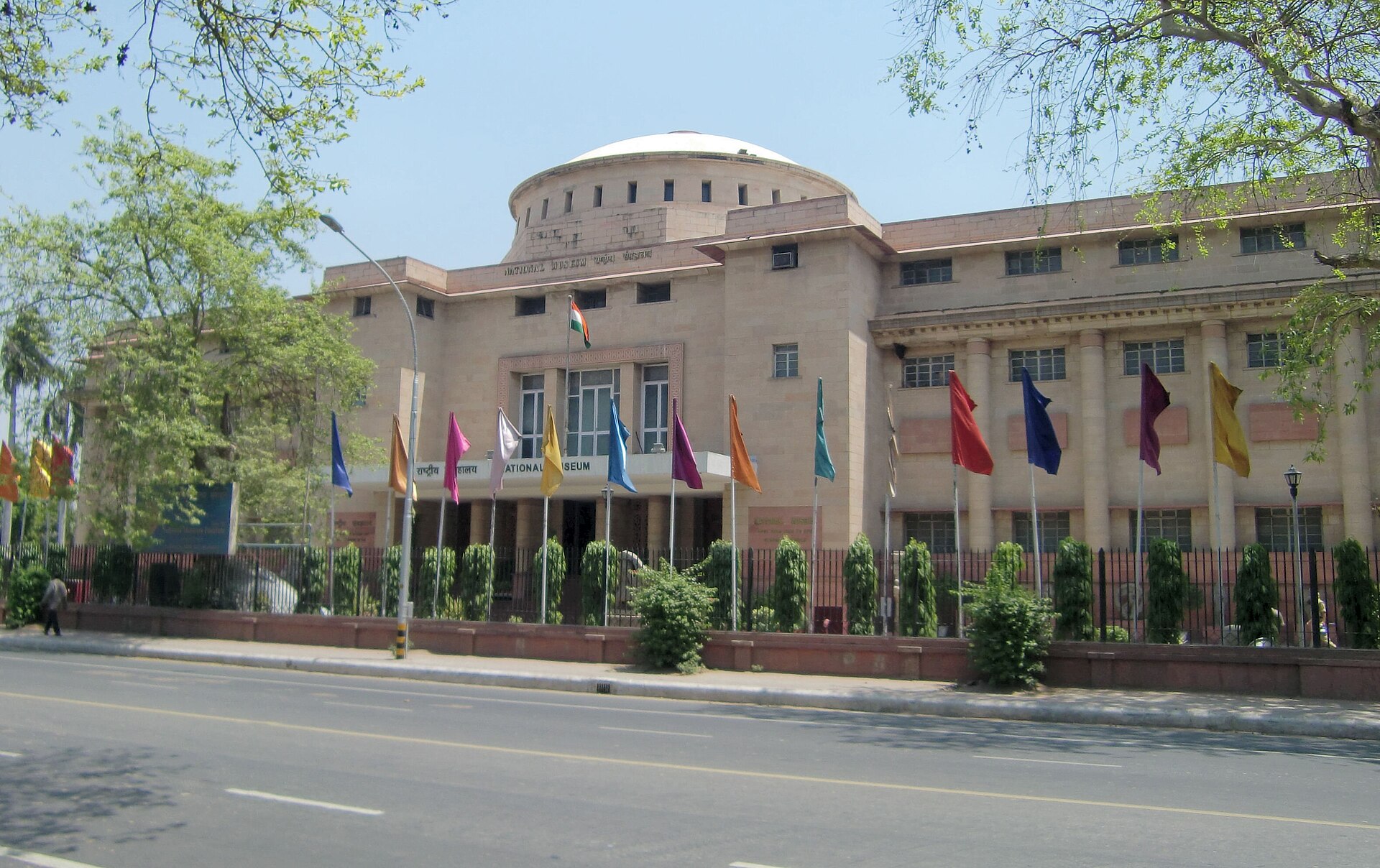
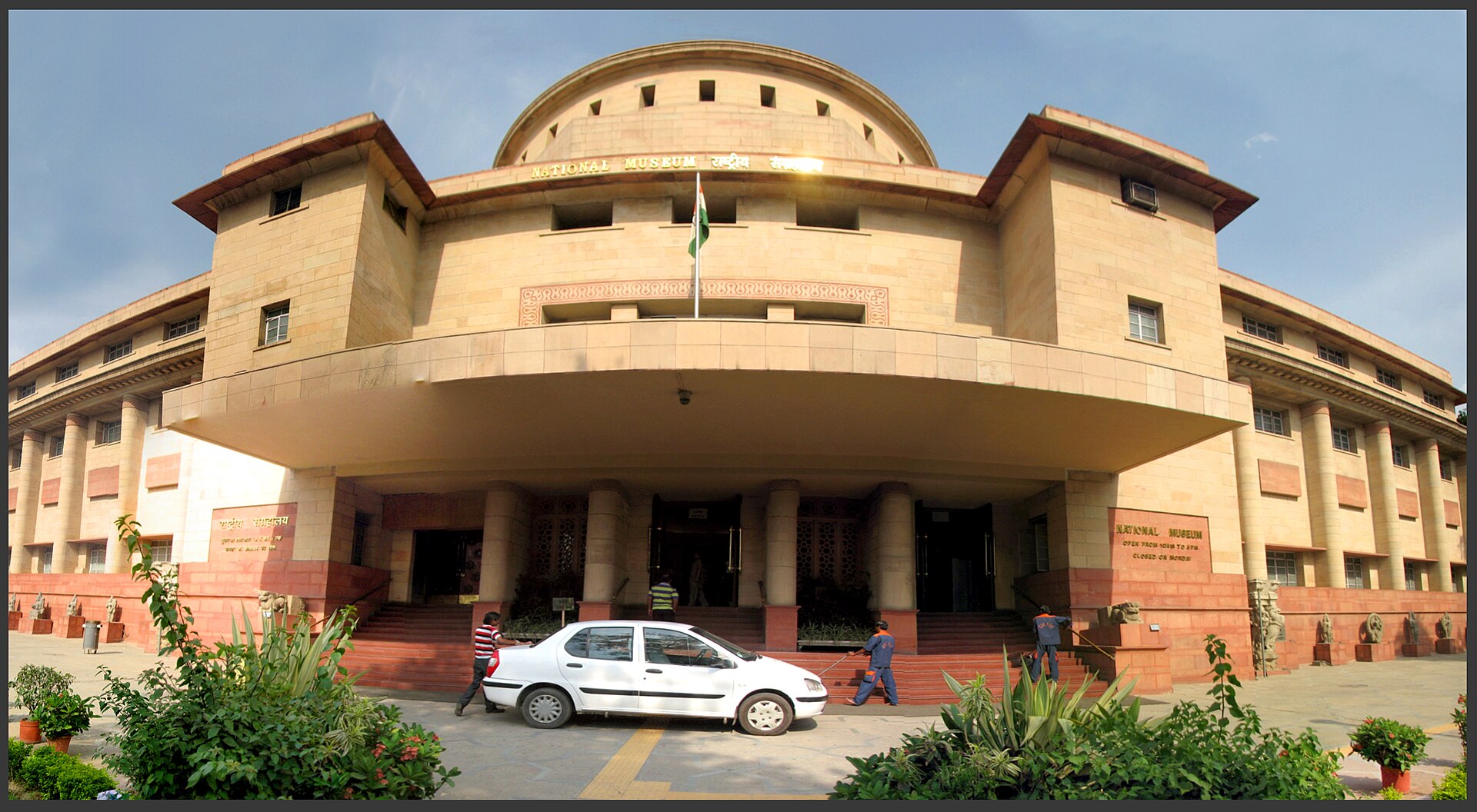
The front facade of the National Museum on Janpath, New Delhi, photographed in 2009.
Miya.m, CC BY-SA 3.0On this page 15 sections
ContentsClose
The museum's real strength is breadth rather than any single masterpiece: a documented, ASI-loaned core of Harappan material anchored by the Dancing Girl; one of the largest miniature-painting holdings in the world at close to 17,000 works; a coin collection running continuously from the 6th century BCE to the present; and, in the Aurel Stein material, a Silk Route excavation archive with few equivalents outside China, Britain and Hungary. Weighed against that breadth is thin coverage at the level of conservation and continuous display - only 6-7 percent of roughly 206,000 objects is on view at any time, and named galleries are reported closed for extended periods with no published reopening date.
| Kind | Museum |
|---|---|
| Founded | 1949 |
| City and country |  New Delhi, India New Delhi, India |
| Address | Janpath, New Delhi 110011, India |
| Website | nationalmuseumindia.gov.in |
| Status | Open, confirmed |
| Record last verified |
Visiting
- Hours
- Tue-Fri10:00 to 18:00
- Sat-Sun10:00 to 20:00
- Closed
- Monday. National holidays.
- Admission
- Indian nationalsINR 20adult entry
- Foreign nationalsINR 500
- Students up to class 12Freefree entry with a student identity card
- Tickets
- zoonga.com/national-museum The museum's own ticket page.
- Do I need to book?
- No advance booking is required; tickets are sold at the counter and online
- Address
- Janpath, New Delhi 110011, India MapMetro Central Secretariat and Udyog Bhawan stations, both a short walk away
Bus National Museum stop (routes 505, 521, 522, 526, 531, 580, 615) and the nearby Nirman Bhawan stop serve the museum; the Delhi Tourism hop-on hop-off bus also calls here - Website
- nationalmuseumindia.gov.in
- Telephone
- +91 11 2301 9272
- [email protected]
Before you go how long, access, photography, bags, eating, shop
- How long to allow
- A full day for a thorough visit. Visitor accounts consistently describe a single day as barely enough to cover the Harappan, miniature-painting, coin and bronze galleries alone; the building holds roughly 206,000 objects in total, of which only 6-7 percent is on display at any one time
- Access
- Visitor accounts describe the building as broadly step-free with lift access between floors, though the museum's own site publishes no dedicated accessibility statement
- Photography
- not stated on the museum's own site as of this research; general galleries have historically allowed non-flash photography, but this is not confirmed in a primary source and should be checked at the counter
- Bags
- not stated on the museum's own site
- Eating
- An on-site cafeteria is repeatedly mentioned in visitor accounts as inexpensive and adequate rather than notable
- Shop
- A museum bookshop is present; a 2025 visitor account describes the museum's former, larger souvenir shop as having been replaced by a smaller book counter
Prices and hours change. We take them from the institution's own pages and print the day we read them, and you can check the current position at the source we used. Confirm before you travel.
What is inside
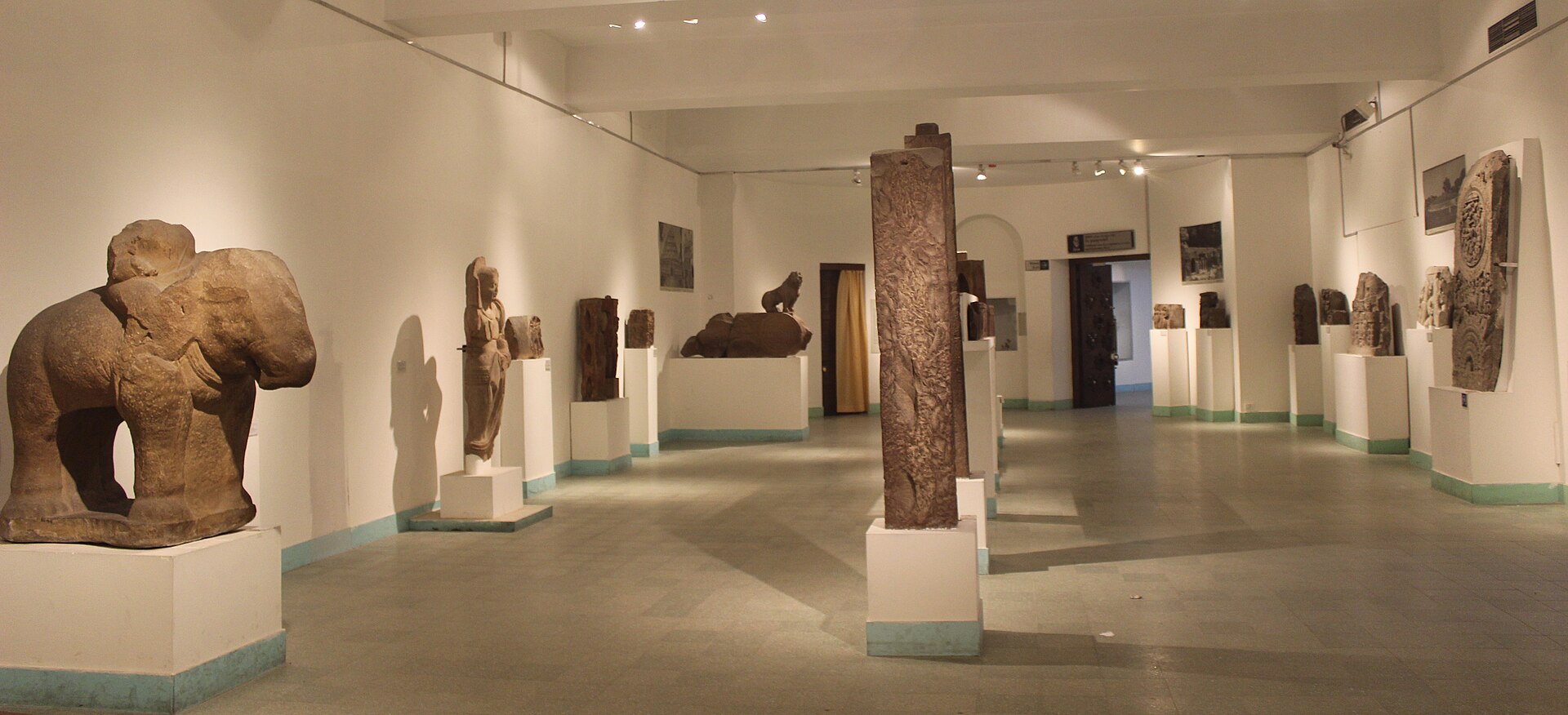
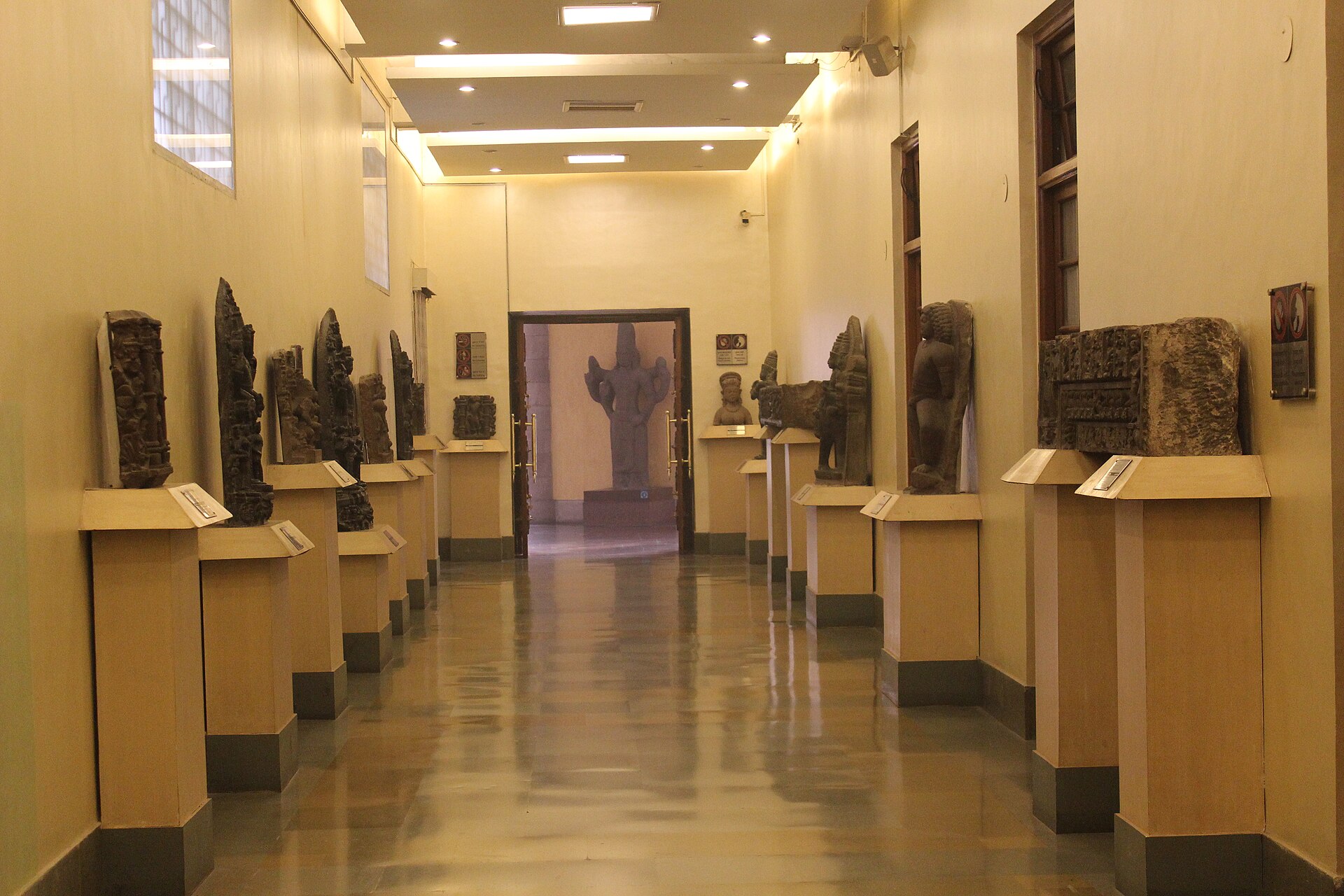
Photograph by Nomu420 · CC BY-SA 3.0 Archaeology: Maurya, Shunga and Satavahana Gallery
Stone and terracotta sculpture from the 4th to 1st century BCE, spanning the Maurya, Shunga and Satavahana dynasties, including fragments of railings from Buddhist stupas carved with episodes from the Buddha's life. The wider Archaeology department continues into further rooms devoted to the Kushana, Gupta and early and late medieval periods, tracing sculpture in stone, bronze and terracotta from the Mauryas through to the regional courts of the 13th century.
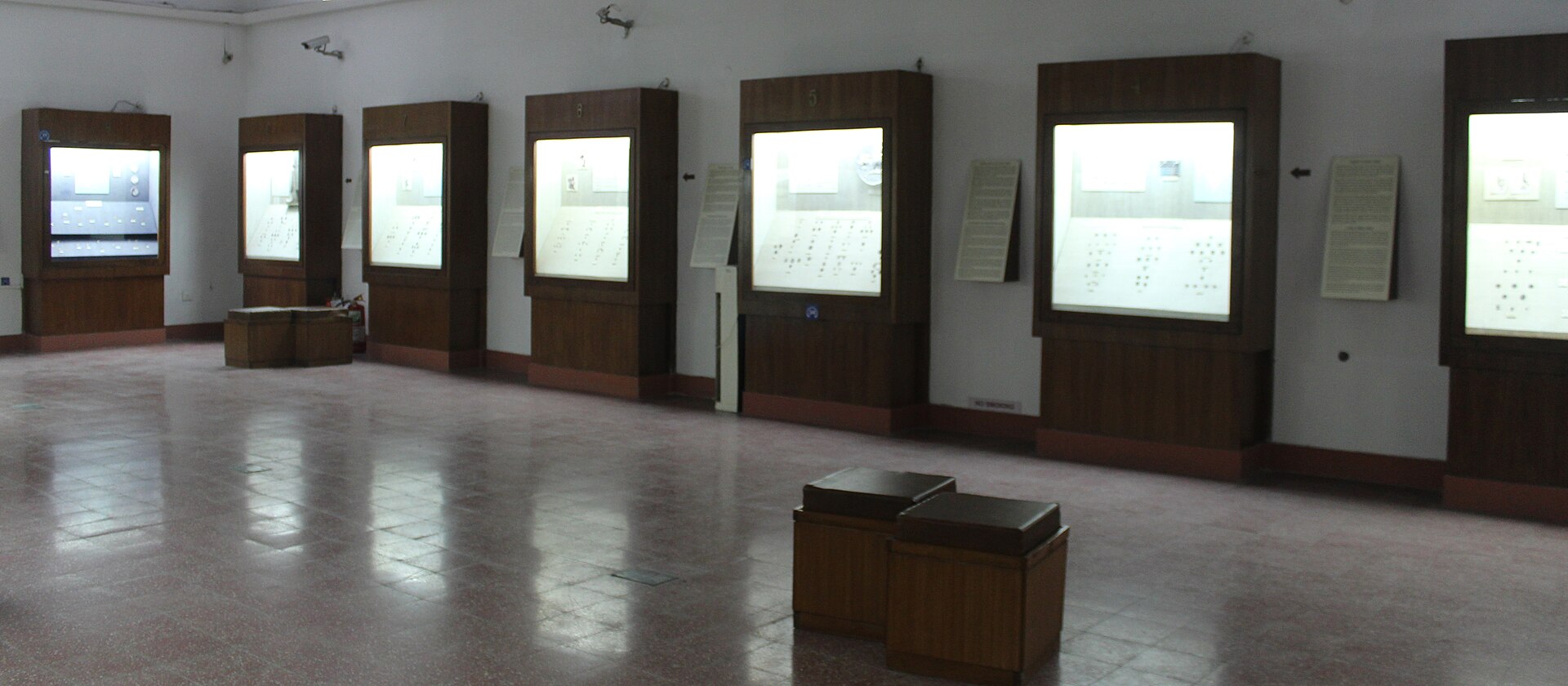
Photograph by Nomu420 · CC BY-SA 3.0 Numismatics and Epigraphy
The museum's coin collection, some 130,000 pieces in reserve of which about 1,669 are on display, spanning punch-marked coins of the 6th century BCE through Gupta, Mughal and British Indian issues to the early 21st century. A sealed copper vase holding 1,821 Gupta-period gold coins found at Bayana, Rajasthan, is shown alongside dioramas of historic minting methods.
Photograph by Nomu420 · CC BY-SA 3.0 Decorative Arts
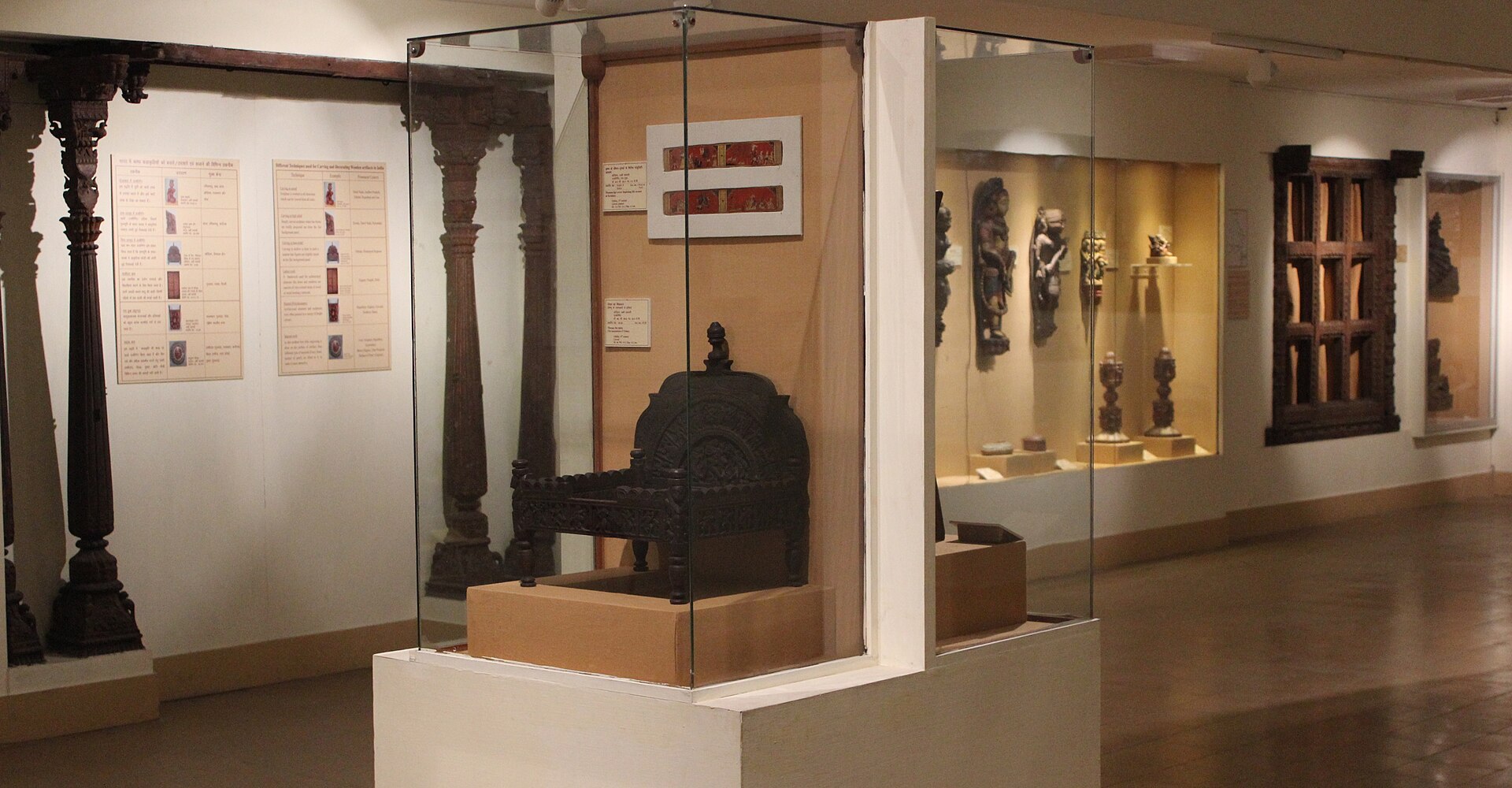
Ivory, jade, ceramics, glazed tile, metalware and carved wood spanning the 16th to 20th centuries, including a jewel-studded throne once belonging to the Raja of Varanasi, Mughal-period jade including a hookah associated with the emperor Jahangir, an ivory shrine carved with the ten avatars of Vishnu, and a section devoted to games and gaming pieces of the past.
Central Asian Antiquities
More than 12,000 objects that the archaeologist Sir Aurel Stein excavated from over 100 sites along the northern and southern Silk Route during three expeditions in 1900-1901, 1906-1908 and 1913-1916 - wall paintings, painted silk banners, wood, stucco and terracotta sculpture, coins, textiles and manuscripts in a mix of Hellenistic, Sassanian, Chinese, Tibetan and Indian idioms, dated roughly from the 3rd to the 12th century CE.
Manuscripts
Nearly 14,000 manuscripts, about a thousand of them illustrated, in Sanskrit, Pali, Prakrit, Persian, Arabic and regional Indian languages, executed on parchment, birch bark, palm leaf, paper, cloth, wood and metal and spanning roughly the 7th to the 20th century, including illustrated Baburnama folios from Akbar's reign and manuscripts bearing the seals of Mughal emperors.
Painting
Close to 17,000 works, one of the largest miniature-painting holdings anywhere, covering nine centuries and most Indian schools - Pala, Sultanate, Mughal, Deccani, the Rajasthani courts of Mewar, Bundi, Kota, Kishangarh, Jaipur and Bikaner, the Pahari schools of Basohli, Chamba, Guler and Kangra, and the Tanjore and Mysore schools of the south, the latter worked with real gold and silver foil.
Arms and Armour
Weapons and protective equipment from the pre-historic period to the 19th century - bows, daggers, shields, helmets, body armour and horse and elephant armour, firearms and powder flasks - including the personal sword of the Mughal emperor Aurangzeb.
Jewellery: Alamkara
More than 250 pieces spanning roughly 5,000 years, from the agate bead necklaces of Mohenjo-daro and Harappa to jewelled ornaments made for Mughal emperors and regional maharajas, presented under the gallery's own name, 'Alamkara - The Beauty of Ornament'.
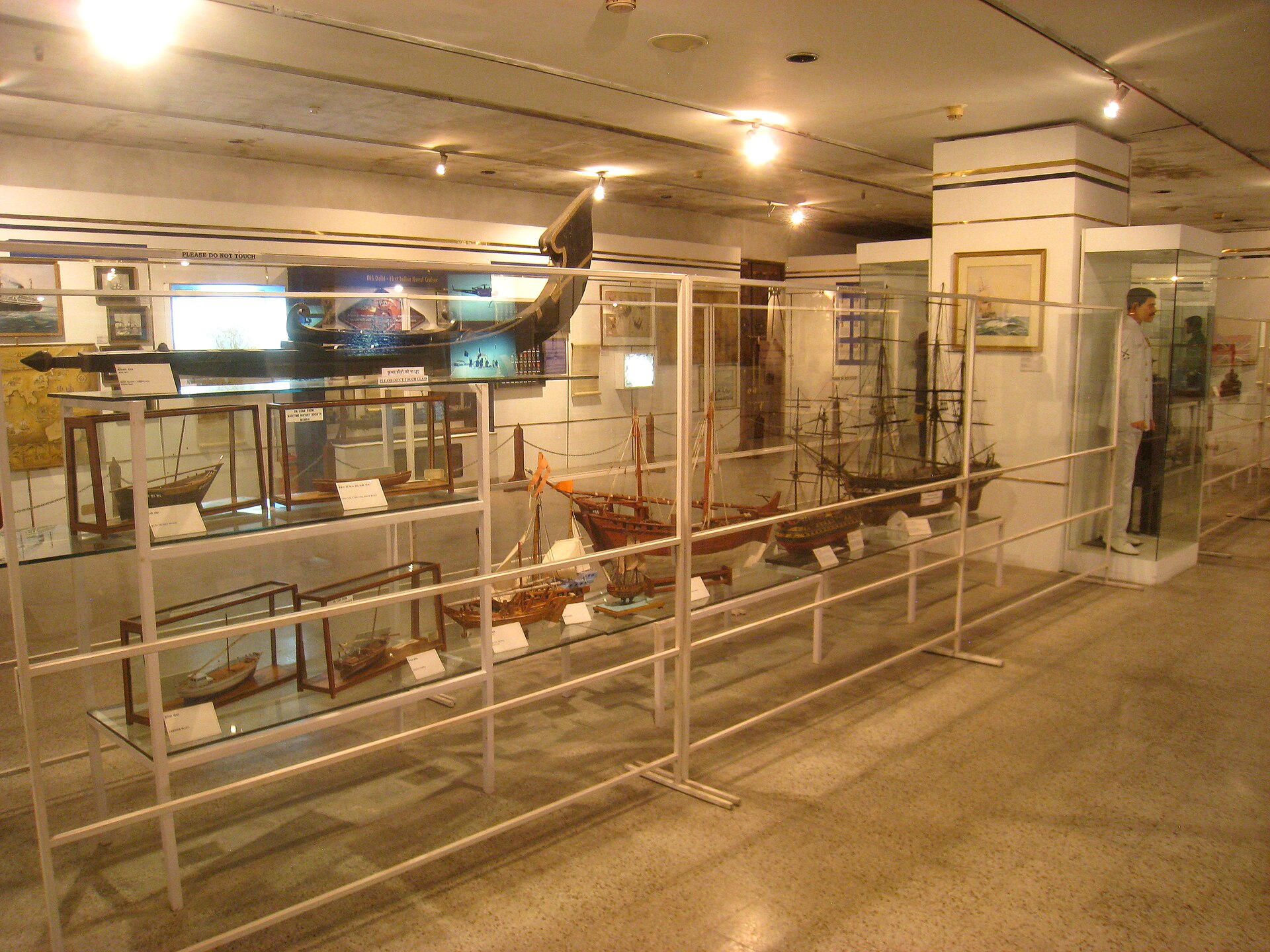
Photograph by Calvin Journey · CC BY-SA 4.0 Maritime Heritage Gallery
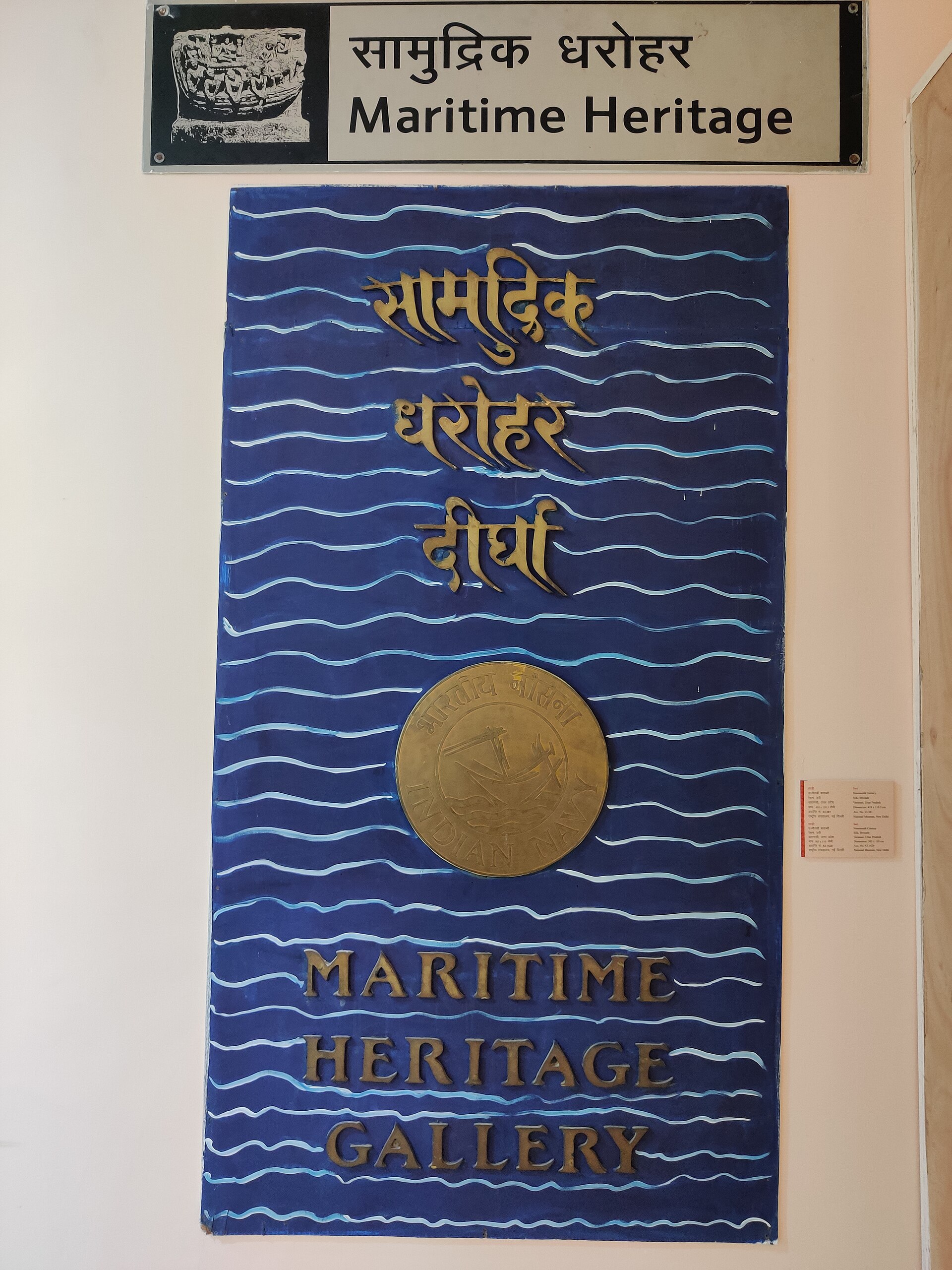
A first-floor gallery, opened in 1991, on India's maritime history, using artefacts, photographs and dioramas including a depiction of Maratha naval tactics.
What to see first
Dancing Girl
Harappan (Indus Valley) bronze caster, unknownA small bronze figure from Mohenjo-daro, about 2700-2100 BCE, and the single object most identified with the museum. When the Mohenjo-daro finds were divided between India and Pakistan after Partition, Pakistan received the steatite 'Priest King' figure and India retained the Dancing Girl; the division of the wider hoard was literal enough that some necklaces were taken apart bead by bead between the two collections.13
Nataraja, dancing Shiva
Chola bronze workshop, Tamil NaduA 12th-century Chola bronze in the Bronze Gallery, among the museum's principal holdings of South Indian temple bronze alongside Vishnu Vaikuntha from Kashmir and the Chamba bronze Svachchhanda Bhairavi.13
Sacred relics of the Buddha from Piprahwa
unknown, ancient Kapilavastu regionBone-fragment relics recovered from a stupa near Piprahwa in Uttar Pradesh, held in caskets inscribed as relics of the Buddha and dated to the 5th-4th century BCE; the Archaeological Survey of India excavated two further soapstone caskets at the same site between 1971 and 1977.13
Personal sword of the emperor Aurangzeb
Mughal court workshopNamed on the museum's own Arms and Armour page as a highlight of a collection that runs from pre-historic weapons to 19th-century firearms and animal armour.4
Ivory Carved Dashavatara shrine
unknown Indian ivory carverA carved ivory shrine depicting the ten avatars of Vishnu, one of the pieces the Decorative Arts galleries use to show devotional ivory carving alongside Christian-subject ivories from the same holding.13
Jahangir's jade hookah
Mughal court workshop, reign of JahangirA carved jade hookah associated with the emperor Jahangir, part of the museum's Mughal jade holding described on its own Decorative Arts page.5
Copper vase of Gupta gold coins from Bayana
Gupta-dynasty mintA hoard of 1,821 gold coins of the Gupta era, found still sealed inside its copper vase at Bayana, Rajasthan, and displayed together as the anchor piece of the Coins Gallery's account of Gupta gold currency.13
The Aurel Stein Central Asian collection
various Silk Route workshops, 3rd-12th century CEMore than 12,000 objects - wall paintings, painted silk banners, and wood, stucco and terracotta sculpture - that the archaeologist Sir Aurel Stein excavated from over a hundred sites along the Silk Route during three expeditions between 1900 and 1916; the museum's own Central Asian Antiquities page states the collection directly.10
Illustrated Baburnama folio, 1598
Mughal manuscript workshop, Akbar's reignAn illustrated Persian-language folio from the Baburnama, the memoirs of the first Mughal emperor Babur, produced under Akbar in 1598 and part of the museum's roughly 14,000-manuscript holding.13
A museum built from a travelling exhibition
The National Museum did not begin as a building. It began as an exhibition: the Exhibition of the Art of India and Pakistan, staged by the Royal Academy of Arts at Burlington House, London, over the winter of 1947-48 - arguably the first exhibition the British government itself sponsored that treated Indian artefacts as fine art rather than curiosities. Before the objects went back to their lending museums and private owners, and with Jawaharlal Nehru's backing, it was agreed that a permanent Indian museum should hold them instead. A committee under the former chief justice Sir Maurice Gwyer, with the archaeologist Sir Mortimer Wheeler among its members, had already been asked in 1946 to plan such an institution.
On 15 August 1949, the returned collection went on show in the state rooms of Rashtrapati Bhavan, then still called Government House, formally opened by the governor-general C. Rajagopalachari. For the next six years the National Museum was, in effect, the same travelling exhibition parked in a palace. Ground was broken for a purpose-built museum on Janpath in 1955; when it was finally ready in 1960, Nehru asked that a standing Buddha figure and the Rampurva bull capital stay behind at Rashtrapati Bhavan rather than move with everything else, and they remain there still.
The Deolalikar building and Grace Morley's museum
The architect Ganesh Bhikaji Deolalikar designed the building that stands on Janpath today. Nehru laid its foundation stone on 12 May 1955; the vice-president Sarvepalli Radhakrishnan inaugurated the finished building on 18 December 1960. It occupies a plot that Edwin Lutyens had originally marked out for an Imperial Museum, and which had briefly held a small museum devoted to the Central Asian antiquities of Sir Aurel Stein before Deolalikar's building replaced it. The plan was always for an octagon built in phases: the first phase opened in 1960, a second in 1989, and a foundation stone for a third and final phase was laid on 18 December 2017, requiring the demolition of an Archaeological Survey of India building on the site, since relocated to Dharohar Bhawan.
The museum's first director, Grace Morley, had already spent more than two decades founding and running the San Francisco Museum of Art before she took charge in New Delhi in August 1960. She installed the collection in white-cube rooms with minimal labelling, teak pedestals, track lighting and large glass cases on staggered risers - a modernist, uncluttered display language, drawn partly from her American training, that still shapes how the galleries look today. The National Museum Institute of History of Art, Conservation and Museology, founded on the building's first floor in 1983 and a deemed university since 1989, has since begun shifting its main teaching campus to Noida, though its registered office and student access to the collection remain at Janpath.
What Partition did to the Harappan collection
The museum's most famous single object, the small bronze Dancing Girl from Mohenjo-daro, cannot be separated from the story of how the Harappan material arrived in Delhi at all. Excavators in the 1920s first deposited the Mohenjo-daro finds in the Lahore Museum; Mortimer Wheeler later had them moved to Delhi in anticipation of a Central Imperial Museum. Partition then forced a division of ownership, and the two countries settled on splitting the collection roughly equally - in places literally, with individual necklaces and girdles taken apart so that half their beads went to Pakistan and half stayed in India. The historian Nayanjot Lahiri has written that the integrity of these objects was compromised in the name of an equitable division. Of the two most celebrated figures excavated at Mohenjo-daro, Pakistan asked for and received the steatite 'Priest King'; India kept the Dancing Girl. The museum's Harappan holding - more than 3,500 objects on permanent loan from the Archaeological Survey of India - grew afterward from sites that fell on the Indian side of the border after 1947, among them Rakhigarhi, Daimabad and Dholavira.
The departments, gallery by gallery
The National Museum organises its roughly 206,000 objects into named departments rather than a single chronological sweep, and only about 6-7 percent of the holding is on view at any one time, the rest held in reserve or rotated through temporary display. Archaeology carries sculpture in stone, bronze and terracotta from the Maurya and Shunga dynasties of the 4th-1st century BCE through the Kushana and Gupta periods to the regional courts of the early and late medieval centuries. Numismatics and Epigraphy holds some 130,000 coins in reserve, of which roughly 1,669 are displayed, tracing Indian coinage from 6th-century-BCE punch-marked pieces to the 21st century. Decorative Arts covers ivory, jade, ceramics, metalware, textiles and carved wood from the 16th to the 20th century. Central Asian Antiquities preserves what Sir Aurel Stein carried back from three Silk Route expeditions between 1900 and 1916. Manuscripts holds nearly 14,000 items in Sanskrit, Persian, Arabic and regional languages; Painting holds close to 17,000 miniatures, one of the largest such collections anywhere; Arms and Armour runs from pre-history to the 19th century; and the Jewellery gallery, named 'Alamkara', spans five thousand years from Harappan bead necklaces to Mughal court jewels. A first-floor Maritime Heritage Gallery, opened in 1991, and departments for Anthropology and Pre-Columbian and Western art round out the building.
The Aurel Stein material and its Silk Route context
The Central Asian Antiquities department is, on its own terms, a colonial-era excavation collection rather than a purchased or donated one. Sir Aurel Stein removed more than 12,000 objects from over a hundred sites along the northern and southern Silk Route during three expeditions in 1900-1901, 1906-1908 and 1913-1916 - wall paintings, painted silk banners depicting Buddhist deities, wood, stucco and terracotta sculpture, coins, textiles, leather and paper documents in a mix of Hellenistic, Sassanian, Uyghur, Chinese, Tibetan and Indian styles, mostly dated from the 3rd to the 12th century CE. The material sits in the museum's collection today as the residue of exactly the kind of early-twentieth-century foreign expedition whose finds are, at other institutions and in other countries, the subject of restitution argument; the National Museum's own published account of the gallery states Stein's role and the dates of his expeditions plainly, without addressing the terms on which the material left Chinese Turkestan for Delhi rather than London or Budapest, where much of the rest of the Stein collections went.
An uncertain future: Central Vista and Yug Yugeen Bharat
The Janpath building's own future is unresolved. The master plan for the Central Vista Redevelopment Project, the government's overhaul of the administrative core of New Delhi, scheduled the National Museum for demolition, with the site absorbed into new government office buildings. The government's proposed replacement is a museum called Yug Yugeen Bharat, to be built inside the historic North and South Block secretariat buildings on Raisina Hill in collaboration with France; the culture minister Gajendra Singh Shekhawat described it in June 2024 as intended to showcase the country's journey and become the world's largest museum by floor area. Critics, writing in The Wire in 2021, pointed out that North and South Block were still recorded in official land-use documents as government office space rather than public or semi-public use, that both are Grade-I listed heritage structures requiring separate conservation approval for any conversion, and that no feasibility or security study for turning working secretariat buildings into a museum near the Prime Minister's residence had been published.
As of a statement to the Lok Sabha on 11 December 2023, the Union Minister for Culture, G. Kishan Reddy, told Parliament that no decision had been taken on the demolition, in response to a question about its rationale. No revised timeline or decision has since appeared on the museum's own site. The practical result, confirmed by the museum's own current visitor page, is that the National Museum on Janpath continues to operate, sell tickets and receive visitors today exactly as it has for decades, with its own eventual fate stated nowhere on that page.
Visiting today
The museum sits on Janpath in the government and diplomatic quarter of New Delhi, a short walk from the Central Secretariat and Udyog Bhawan Metro stations and served by several bus routes that stop directly outside. Entry costs 20 rupees for Indian nationals and 500 rupees for foreign nationals, with free entry for students up to class 12 on production of an identity card; the museum's own site sells timed tickets online as well as at the counter. Opening hours run Tuesday to Friday from 10am to 6pm and Saturday and Sunday from 10am to 8pm, with the museum closed on Mondays and national holidays. Visitor accounts describe a building large enough that a first visit rarely covers everything in one sitting, an on-site cafeteria, and, in recent years, a recurring experience of finding one or more galleries closed for renovation without the closure being flagged in advance - a fact worth planning around rather than a reason not to go.
What visitors say
Visitors consistently describe the National Museum as far larger and more rewarding than a first glance suggests - a genuine full-day museum built around the Harappan and Indus Valley material, the Buddha relics, the bronze and coin galleries and one of the largest miniature-painting collections in the country. Against that, the same body of accounts returns again and again to the state of the building and its staffing: sections closed for renovation without notice on the museum's own channels, thin signage, little visible staff presence to direct visitors, and, in wetter months, visible water damage in stairwells and corridors.
What is praised, what is criticised
- Praised: the depth and rarity of the Harappan and Indus Valley material, in particular the Dancing Girl and the associated Mohenjo-daro finds
- Praised: the scale of the miniature-painting and bronze collections, widely described as enough on their own for a full day
- Praised: the Buddhist relics from Piprahwa, singled out by more than one account as a reason to travel to the museum specifically
- Praised: the museum's affordability and central, walkable location on Janpath
- Criticised: recurring, unannounced closure of entire galleries - Arms and Armour and the jewellery gallery among them - which several 2025 accounts describe encountering with no signage explaining the closure
- Criticised: visible neglect of the fabric of the building: dust, faded captions, water ingress and crumbling plaster reported in stairwells during the rainy season, and inconsistent air conditioning between older and newer wings
- Criticised: little on-site staff able to answer questions, and no functioning visitor information desk according to more than one recent account
Ratings on other platforms
Tripadvisor: 4.1 from 770 ratings, read 21 August 2026
A platform average is a tertiary source: it moves, it is not audited, and we quote no visitor's words.
Questions about National Museum
Where is National Museum?
Janpath, New Delhi 110011, India.
How much does it cost to visit?
Indian nationals: INR 20; Foreign nationals: INR 500; Students up to class 12: free. As confirmed 21 August 2026.
When is it open?
Tue-Fri 10:00-18:00; Sat-Sun 10:00-20:00. Closed: Monday. National holidays. As confirmed 21 August 2026.
How do you get there?
Metro: Central Secretariat and Udyog Bhawan stations, both a short walk away; Bus: National Museum stop (routes 505, 521, 522, 526, 531, 580, 615) and the nearby Nirman Bhawan stop serve the museum; the Delhi Tourism hop-on hop-off bus also calls here.
What should you see first?
Dancing Girl (Harappan (Indus Valley) bronze caster, unknown); Nataraja, dancing Shiva (Chola bronze workshop, Tamil Nadu); Sacred relics of the Buddha from Piprahwa (unknown, ancient Kapilavastu region); Personal sword of the emperor Aurangzeb (Mughal court workshop); Ivory Carved Dashavatara shrine (unknown Indian ivory carver); Jahangir's jade hookah (Mughal court workshop, reign of Jahangir).
What we could not confirm
- Whether the National Museum will be demolished and its collection transferred to a converted North and South Block under the Central Vista Redevelopment Project remains formally undecided; the Ministry of Culture told the Lok Sabha in December 2023 that no decision had been taken, and the museum's own site gives no revised timeline or status update.
- No published conservation or transport plan for moving roughly 206,000 objects, including fragile manuscripts, paintings and Aurel Stein's Central Asian material, has been disclosed, should a transfer to Yug Yugeen Bharat go ahead.
- The museum displays only 6-7 percent of its holding at any time; there is no published rotation schedule showing when specific reserve objects return to view, which limits how far this record can describe the current state of any gallery beyond what recent visitor and press accounts confirm.
- Multiple 2025 visitor accounts describe the Arms and Armour and Jewellery galleries as closed for extended periods; the museum's own site does not confirm, date or explain either closure.
Images
Sources
- 1National Museum, New Delhi - Plan Your Visit (hours, fees, ticketing, open status) nationalmuseumindia.gov.in/en/plan-your-visit
- 2National Museum, New Delhi - Contact Us (address, phone, transport) nationalmuseumindia.gov.in/en/contact-us
- 3National Museum, New Delhi - Collections: Archaeology nationalmuseumindia.gov.in/en/collections/index/7
- 4National Museum, New Delhi - Collections: Arms and Armour nationalmuseumindia.gov.in/en/collections/index/9
- 5National Museum, New Delhi - Collections: Decorative Arts nationalmuseumindia.gov.in/en/collections/index/10
- 6National Museum, New Delhi - Collections: Manuscript nationalmuseumindia.gov.in/en/collections/index/11
- 7National Museum, New Delhi - Collections: Numismatics and Epigraphy nationalmuseumindia.gov.in/en/collections/index/12
- 8National Museum, New Delhi - Collections: Painting nationalmuseumindia.gov.in/en/collections/index/13
- 9National Museum, New Delhi - Collections: Jewellery nationalmuseumindia.gov.in/en/collections/index/14
- 10National Museum, New Delhi - Collections: Central Asian Antiquities nationalmuseumindia.gov.in/en/collections/index/15
- 11National Museum, New Delhi - Collections: Pre-Columbian and Western Art nationalmuseumindia.gov.in/en/collections/index/16
- 12Wikidata Q1356138, National Museum (identity, coordinates) - wikidata.org/wiki/Q1356138
- 13Wikipedia, 'National Museum of India' (history, gallery descriptions, named highlights) - en.wikipedia.org/wiki/National_Museum_of_India
- 14Wikimedia Commons, File:India national museum 01.jpg (lead image, licence CC BY-SA 3.0, author Miya.m) commons.wikimedia.org/wiki/File:India_national_museum_01.jpg
- 15Wikimedia Commons, Category:National Museum, New Delhi (image sourcing) commons.wikimedia.org/wiki/Category:National_Museum,_New_Delhi
- 16Tripadvisor, National Museum, New Delhi - reviews and aggregate rating, read 2026-08-21 - tripadvisor.com/Attraction_Review-g304551-d319682-Reviews-National_Museum-New_Delhi_National_Capital_Territory_of_Delhi.html
- 17Prem Chandavarkar, 'In Central Vista Redevelopment, the Fate of Our Heritage Hangs in Balance', The Wire, 15 August 2021 thewire.in/government/central-vista-redevelopment-national-museum-archives-heritage
- 18'No decision taken regarding demolition of National Museum: Govt to Lok Sabha', Deccan Herald / PTI, 11 December 2023 deccanherald.com/india/no-decision-taken-regarding-demolition-of-national-museum-govt-to-lok-sabha-2806503
- 19'Yug Yugeen Bharat Museum Would Showcase Journey of Country: Culture Minister', All India Radio News, 29 June 2024 newsonair.gov.in/yug-yugeen-bharat-museum-would-showcase-journey-of-country-culture-minister
