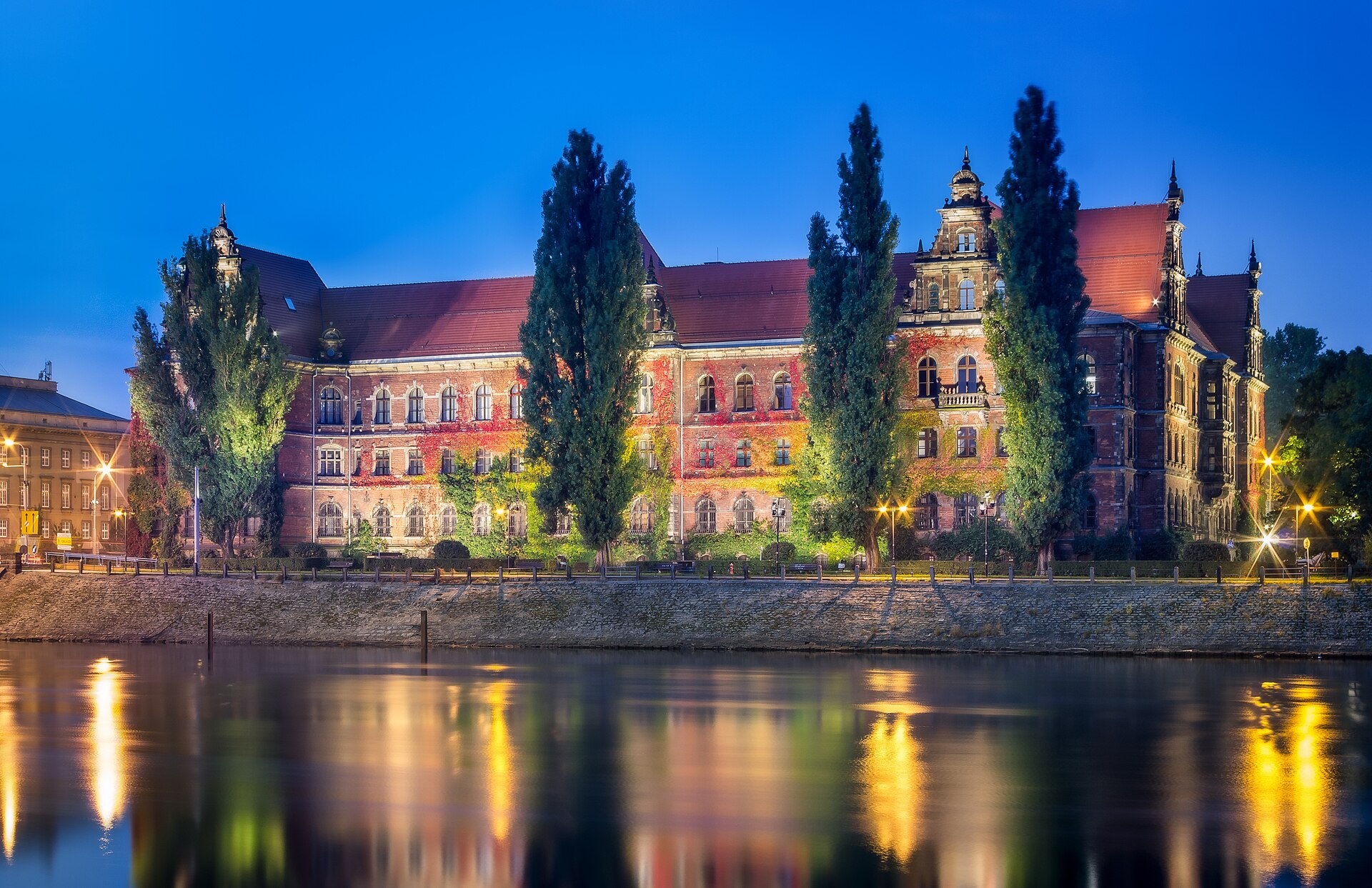
The ivy-covered former Regierungsbezirk building, built 1883-1886 to a design by Anton von Behr, seen from across the River Oder.
Photograph by Jar.ciurus, released CC BY-SA 3.0 plNational Museum in Wroclaw
Museum · Muzeum Narodowe we Wrocławiu · Founded 1947
Open, admission and hours confirmed 24 September 2026 · 14 sources
On this page 16 sections
ContentsClose
The museum's declared holdings run past 200,000 objects across sculpture, painting, prints, drawings, decorative arts and documents from antiquity to the early twentieth century, but its real strength is narrower and sharper than that number suggests: Silesian medieval and early modern art, where its stone sculpture, Gothic altarpieces and Baroque religious painting together form one of the most complete regional collections of its kind anywhere in Central Europe, built almost entirely from what survived in or was returned to the province itself rather than assembled by acquisition elsewhere. The Polish Art and European Art galleries are each strong on their own terms, particularly the Symbolist close of the Polish rooms and the German-speaking Renaissance and Baroque core of the European ones, but neither claims the encyclopaedic reach of a national capital's flagship museum. This is a regional collection of unusually high quality in its specialism, not a survey of everything, and it reads best when approached that way.
| Local name | Muzeum Narodowe we Wrocławiu |
|---|---|
| Kind | Museum |
| Founded | Established 1947 as a State Museum in the former Regierungsbezirk (provincial government) building; opened to the public 11 July 1948. Known as the Silesian Museum for about two decades from around 1950 before taking its present name, National Museum in Wroclaw. |
| City and country |  Wroclaw, Poland Wroclaw, Poland |
| Address | Plac Powstancow Warszawy 5, 50-153 Wroclaw, Poland |
| Website | mnwr.pl/en/branches/national-museum |
| Status | Open, confirmed |
| Record last verified |
Visiting
- Hours
- MondayClosed year-round
- Tuesday-Friday (1 Apr-30 Sep)10:00 to 17:00
- Saturday-Sunday (1 Apr-30 Sep)10:30 to 18:00
- Tuesday-Friday (1 Oct-31 Mar)10:00 to 16:00
- Saturday-Sunday (1 Oct-31 Mar)10:00 to 17:00
- Closed
- Monday, year-round.
- Admission
- Regular, permanent exhibitionsPLN 20
- Discounted, permanent exhibitionsPLN 15Students, pensioners, teachers and disabled visitors
- Group, permanent exhibitionsPLN 10Per person
- Family, permanent exhibitionsPLN 10Per person, 1-2 guardians with children aged 7-18
- SpecialPLN 3
- Students and pupils under 26PLN 1The museum's own Museum for a zloty offer
- Children under 7FreeFree
- Regular, temporary exhibitions (2nd floor)PLN 10
- Discounted, temporary exhibitions (2nd floor)PLN 8
Free entry: Saturday, free admission to the permanent exhibitions, on the museum's own information page- Tickets
- bilety.mnwr.pl The museum's own ticket page.
- Do I need to book?
- No, walk-in on a normal ticket; online booking is available through the museum's own ticket shop
- Address
- Plac Powstancow Warszawy 5, 50-153 Wroclaw, Poland MapTram Lines 2 and 10 stop directly beside the museum at the Urzad Wojewodzki stop, on the museum's own directions page. A wider set of lines, 2, 3, 4, 5, 8, 9, 10, 11, 17, 23 and 33, stops a five-minute walk away at the Galeria Dominikanska shopping centre.
Bus Buses A and N stop at the same Urzad Wojewodzki stop directly beside the museum; buses N, D, E and K stop at Galeria Dominikanska, a five-minute walk away.
Parking Street parking on ul. J.E. Purkyniego, an underground car park at Plac Nowy Targ, and car parks at Galeria Dominikanska and the Radisson Blu hotel, all named on the museum's own directions page. - Website
- mnwr.pl/en/branches/national-museum
- Telephone
- +48 71 372 51 50
- [email protected]
Before you go how long, access, photography, bags, eating, shop
- How long to allow
- The permanent collection spans five galleries across three floors; two to three hours is typical for a full pass through them
- Access
- The museum's own directions page and a published autism-access guide state facilities for disabled visitors are available; the ticket office also sells a discounted rate for disabled visitors
- Photography
- Not published in the sources read for this record
- Bags
- Not published in the sources read for this record
- Eating
- The museum's own branch listing names a cafe at the National Museum building
- Shop
- A bookstore is listed for the National Museum building on the museum's own branch information page
Prices and hours change. We take them from the institution's own pages and print the day we read them, and you can check the current position at the source we used. Confirm before you travel.
What is inside
Silesian Stone Sculpture, 12th-16th century
A lapidarium on the first floor, deliberately styled to resemble church vaults, holding Romanesque and Gothic architectural and sepulchral stone carving: a Lombardy sandstone tympanum from the Olbin church of around 1230, the knight's-armour effigy tomb of Duke Henryk IV Probus, a stone Pieta from the Holy Virgin Church on Piasek, and six 15th-century stained-glass panels made in Carinthia.
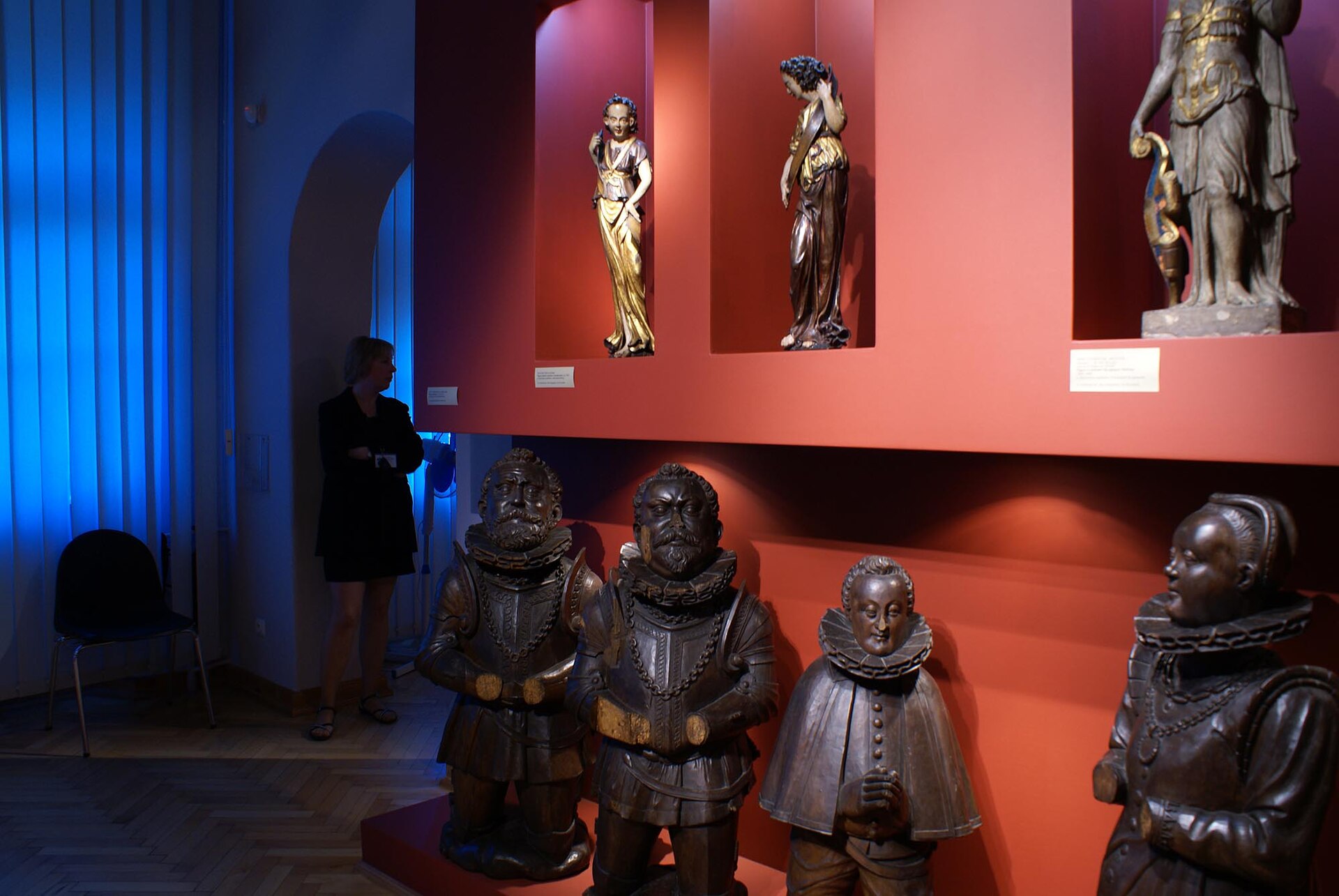
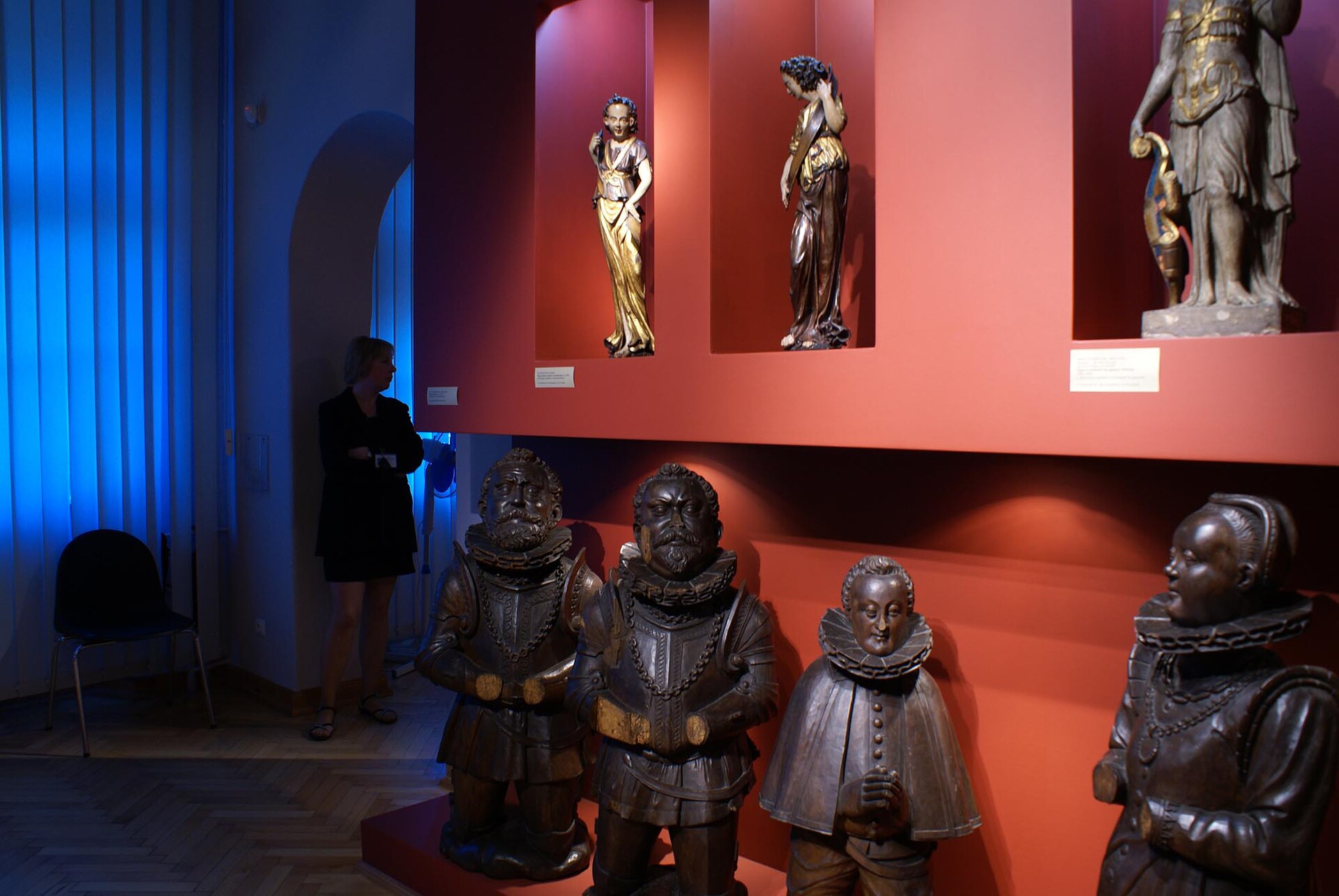
Photograph by Barbara Maliszewska · CC BY-SA 3.0 pl Silesian Art, 14th-16th century
The museum's own Gothic sculpture and panel-painting gallery, home to the museum's most-prized medieval holdings: the St Hedwig triptych of about 1470-1480, the Throne of Grace of about 1350, painted altarpieces attributed to the Master of the Wroclaw Polyptych of St Barbara, and the gilded reliquary herm of St Dorothea the museum itself names as the gallery's star piece. This specific gallery is marked temporarily closed on the museum's own site as of this record; related medieval pieces remain visible elsewhere in the building.
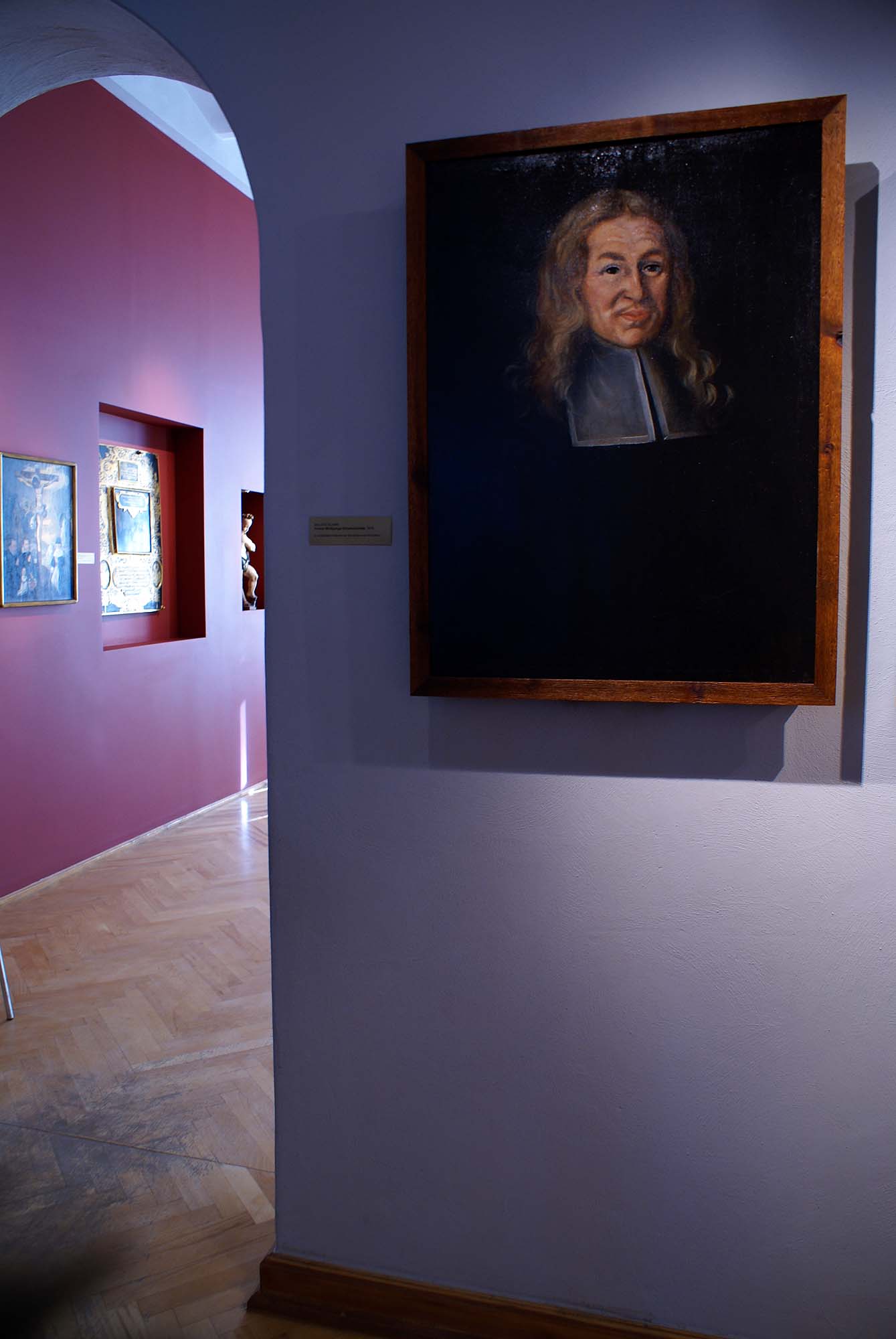
Photograph by Barbara Maliszewska · CC BY-SA 3.0 pl Silesian Art, 16th-19th century
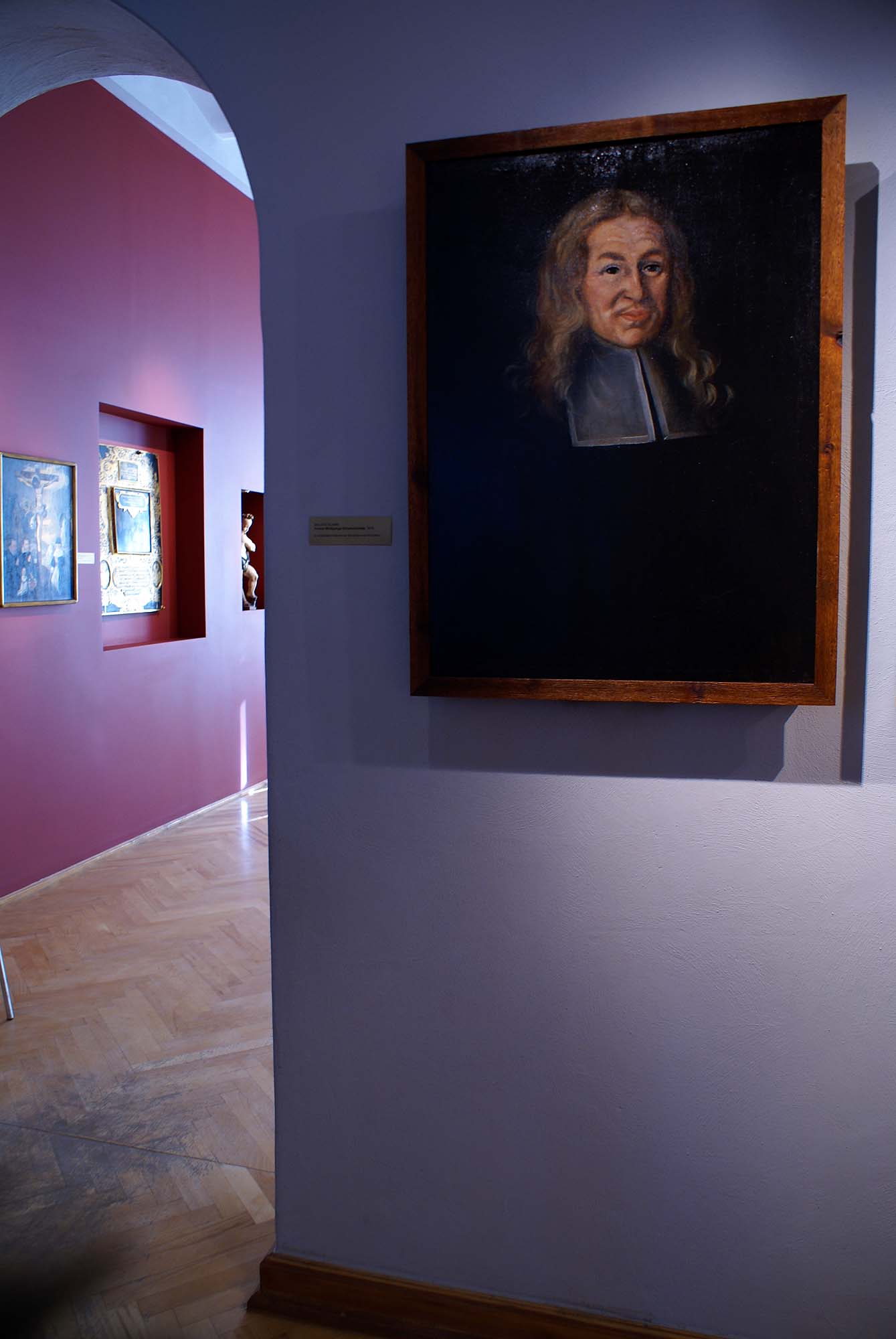
A first-floor gallery of Silesian Mannerist and Baroque painting, sculpture and decorative arts, including Bartholomaeus Spranger's Baptism of Christ of 1603, Michael Leopold Willmann's Orpheus among Animals of about 1670, Bartholomeus Strobel's 1628 portrait of Johann Vogt, and a run of religious sculpture, weaponry, goldsmith work and porcelain from the same three centuries.
Polish Art, 17th-19th century
A second-floor gallery built substantially on the former National Gallery of Lwow's 287 paintings and drawings and 180 items from Kiev museums, transferred here after Poland's post-1945 border changed. It holds Jan Matejko's unfinished Lwow Oath of Jan Kazimierz of 1893, the museum's largest painting; Piotr Michalowski's Napoleon on Horseback Giving Orders; and closes with the Symbolism of Jacek Malczewski and Stanislaw Wyspianski around 1900.
European Art, 15th-20th century
A second-floor, east-wing gallery of German, Italian, Netherlandish, French, British and Spanish painting arranged by subject and period, alongside sculpture and decorative arts. It runs from Lucas Cranach the Elder and Agnolo Bronzino through Pieter Brueghel the Younger, Francisco de Zurbaran and Jean-Baptiste-Simeon Chardin to an early, pre-abstract Wassily Kandinsky.
What to see first
St Hedwig triptych
Attributed to the Master of the Altar of the AnnunciationThe patron saint of Silesia stands at the centre holding a model of the Trzebnica basilica she founded, flanked by Wroclaw's and knighthood's patron saints, a Gothic altarpiece the museum treats as a keystone of its medieval holdings.6
Sarcophagus of Duke Henryk IV Probus
Silesian workshop, circa 1300-1320A three-dimensional knight's effigy in full armour with mourning figures on the tomb walls, the centrepiece of the stone lapidarium and a rare survival of Silesian Gothic ducal funerary sculpture.7
Reliquary herm of St Dorothea
Silesian goldsmith work, Gothic periodNamed by the museum itself as the star attraction of the Silesian Art gallery, a gilded bust reliquary that shows the wealth of the region's medieval church treasuries before Silesia's Reformation-era losses.6
Eve
Lucas Cranach the Elder, circa 1531A German Renaissance nude with what the museum itself describes as an intriguing restoration history, one of the anchor works of the European Art gallery's German-speaking rooms.8
The Lwow Oath of Jan Kazimierz
Jan Matejko, 1893At 500 by 315 centimetres the largest painting in the museum, left unfinished when Matejko fell ill, and a direct physical link to the Lwow collection this gallery was substantially built around.9
Boy in Sunshine
Aleksander Gierymski, after 1893A war loss recovered at auction only in 2004, hung today beside works that never left, a reminder of how much of this museum's Polish holdings were rebuilt piece by piece after 1945.9
The Law. The Fatherland. Art
Jacek Malczewski, 1903A Symbolist triptych built around a crowned Mother-Poland figure, the painting the museum's own curators point to as closing the Polish Art gallery on its strongest note.9
Lamentation of Christ
Workshop of Lucas Cranach the Elder, late 1530sStolen from the museum's wartime store at Kamenz in February 1946, bought unknowingly by Stockholm's Nationalmuseum in 1970, and formally returned to Wroclaw on 31 January 2022, a rare complete recovery of a named Breslau-era loss.10
Exhibitions on now
- Opening soon27 Oct 2026 to 21 Feb 2027Confirmed , 8 weeks ago
Past exhibitions here
- Closed2 Jun to 30 Aug 2026Confirmed · check before you travel
- Closed9 Jun to 30 Aug 2026Confirmed · check before you travel
The building and what it was built to hold
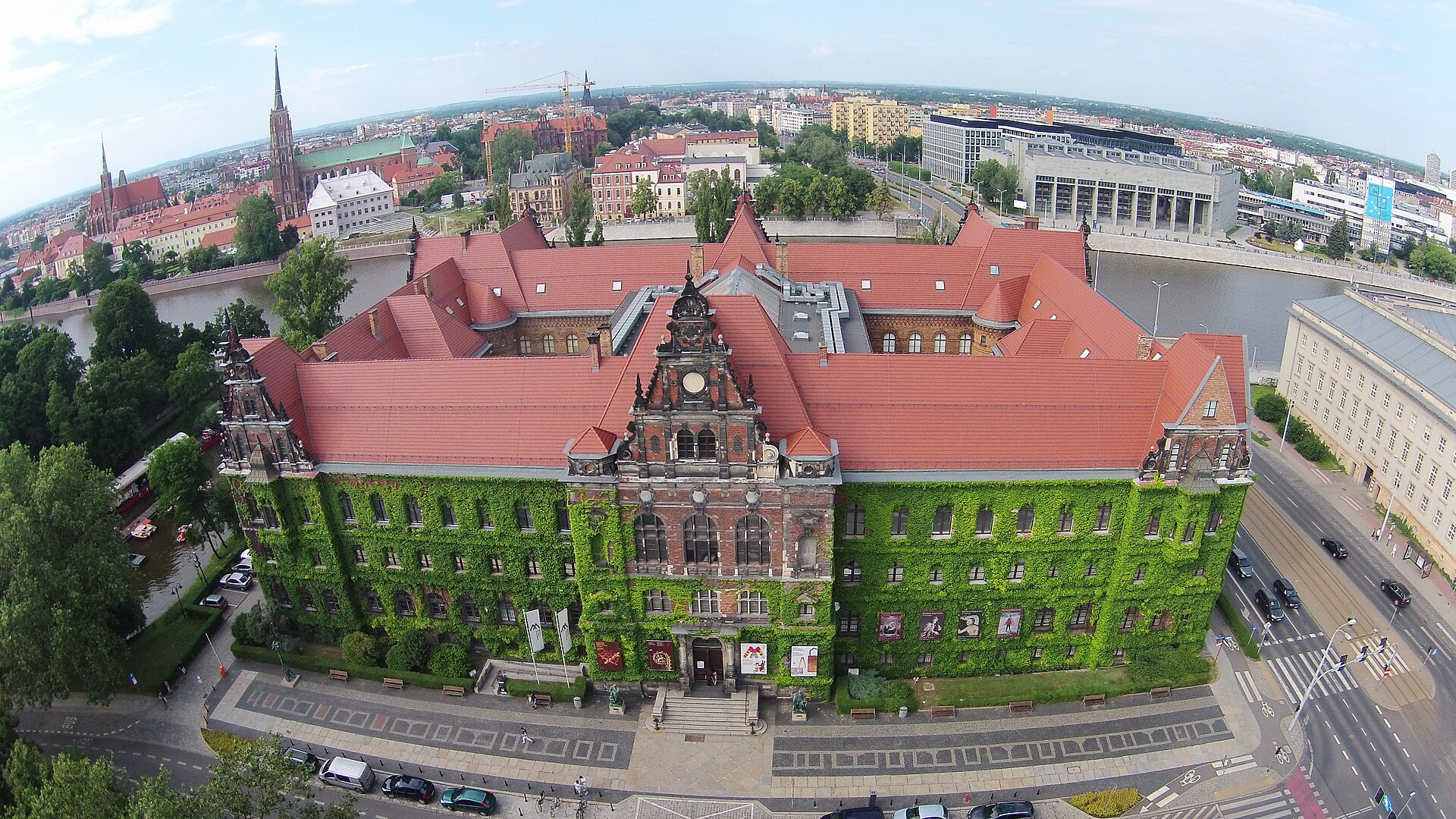
The National Museum in Wroclaw occupies a building that was never designed to hold art. Anton von Behr built it between 1883 and 1886 as the seat of the Regierungsbezirk, the Prussian provincial government administration for the district around what was then Breslau, a red-brick and sandstone pile on the bank of the Oder with steep gables and a corner tower. The Siege of Breslau in 1945 flattened most of the historic city around it; this building came through largely intact, which is the entire reason it became a museum at all. Selected on 1 January 1947 as the site for a new State Museum, it opened to the public on 11 July 1948, and the ivy that now covers most of its river facade has grown there since, becoming the single image most visitors and photographers reach for first.
A collection assembled from two ruptures
Almost nothing in this museum's core collection was assembled in the ordinary way, by a founder's bequest or a slow institutional purchase. Most of it arrived because of the Second World War and the border that Poland was given afterward. The bulk of the Silesian and German-period material had belonged to the Schlesisches Museum der bildenden Kunste, the old Breslau fine arts museum whose building burned after wartime bombing; some of its collection had already been evacuated to a repository at Kamenz, from which more than a hundred works were stolen in a break-in as Soviet troops withdrew in February 1946. Separately, when Poland's eastern border moved west and Lwow became Lviv in Soviet Ukraine, 287 paintings and drawings from that city's former National Gallery, plus roughly 180 items from Kiev's museums, were transferred here rather than left behind. The museum's Polish Art gallery today is substantially the Lwow collection rehoused, and its European Art gallery is substantially what survived of Breslau's. Neither history is hidden on the museum's own site, and neither is incidental to what is actually on the walls.
Medieval Silesia in stone and gilded wood
The museum's own account of its holdings puts the medieval Silesian material first, and the two galleries devoted to it justify that order. A first-floor lapidarium, built to feel like a church interior, holds the Romanesque Olbin tympanum of about 1230 and the armoured effigy tomb of Duke Henryk IV Probus, one of the few surviving Silesian ducal funerary monuments of its kind. Immediately beside it, in normal circumstances, sits the Gothic panel-painting and sculpture gallery: the St Hedwig triptych of about 1470-1480, the Throne of Grace of about 1350, and the gilded reliquary herm of St Dorothea that the museum itself calls the gallery's star piece. That second gallery is presently marked temporarily closed on the museum's own site, a fact worth knowing before planning a visit around it specifically, though the stone lapidarium beside it remains open.
Painting from Cranach to Kandinsky
The European Art gallery occupies the second floor's east wing and runs, roughly in order, from Lucas Cranach the Elder's Eve of about 1531 through Agnolo Bronzino's Florentine Mannerism, Pieter Brueghel the Younger's Flemish village scenes, and Francisco de Zurbaran's high-contrast Spanish Baroque, to an early, pre-abstract Wassily Kandinsky painted around 1902. Woven into that survey is one of the museum's better-documented recovery stories: a Lamentation of Christ from Lucas Cranach the Elder's workshop, stolen from the wartime Kamenz repository in February 1946, bought unknowingly by Stockholm's Nationalmuseum at a 1970 auction, and formally handed back to this museum on 31 January 2022, seventy-six years after it went missing. It is one of relatively few complete recoveries among the Breslau-era losses, and the museum displays it rather than treating the gap in its own history as something to work around.
Polish art and its Symbolist high point
The Polish Art gallery, on the second floor, tells the Lwow story in paint. Jan Matejko's Lwow Oath of Jan Kazimierz, at 500 by 315 centimetres the largest single painting the museum owns, arrived here unfinished, halted by the artist's own illness before his death, and its scale still dominates the room it hangs in. Piotr Michalowski's Napoleon on Horseback carries the same collection's Romantic strain, while Aleksander Gierymski's Boy in Sunshine returned to the museum only in 2004, bought back at auction after decades as a war loss. The gallery closes on Jacek Malczewski's 1903 triptych The Law. The Fatherland. Art, its crowned, allegorical Mother-Poland figure the clearest single statement in the building of what Polish Symbolist painting was doing at the turn of the twentieth century.
Visiting today
The museum keeps to a seasonal timetable: Tuesday to Friday plus the weekend, closed every Monday, with slightly longer summer hours from April to September than the winter schedule that runs the rest of the year. Saturdays carry free admission to the permanent galleries, which is also the museum's busiest day on the evidence of visitor comments about crowding. The building sits directly on two tram lines and a short walk from several more, with parking nearby on the street, underground at Plac Nowy Targ, and at the Galeria Dominikanska shopping centre. A single visit, worked through all five permanent galleries at a reasonable pace, runs to two or three hours, longer if the temporary exhibition on the second floor is showing something worth the extra ticket.
What visitors say
Visitors consistently single out the building itself, an ivy-covered former government palace on the Oder, and the strength and density of the Silesian medieval collection as the museum's biggest draw, alongside spacious, uncrowded galleries that make a full visit comfortable even at busy times. The recurring complaints are about labelling: object captions and gallery texts that do not always carry an English translation, and a front-of-house and ticketing experience visitors describe as inconsistent, helpful on some visits and brusque on others.
What is praised, what is criticised
- Praised: The riverside, ivy-clad former government building itself, widely called one of the most photogenic museum exteriors in Wroclaw
- Praised: The depth and quality of the Silesian medieval sculpture and altarpiece collection, repeatedly cited as the strongest reason to visit
- Praised: Spacious, well-lit galleries that stay comfortable to walk even when the museum is busy
- Criticised: Object labels and gallery wall texts that are not consistently translated into English, a real obstacle for visitors who do not read Polish
- Criticised: Inconsistent front-of-house experience, with ticket-desk and cloakroom staff described by some visitors as unhelpful even where gallery attendants are praised
- Criticised: The museum's own site currently marks its flagship Silesian Art of the 14th-16th century gallery as temporarily closed, meaning a visitor cannot count on seeing the Hedwig triptych and the St Dorothea reliquary herm in their usual room on any given day
Ratings on other platforms
Google: 4.6 from 9,407 ratings, read 13 August 2026
A platform average is a tertiary source: it moves, it is not audited, and we quote no visitor's words.
Questions about National Museum in Wroclaw
Where is National Museum in Wroclaw?
Plac Powstancow Warszawy 5, 50-153 Wroclaw, Poland.
How much does it cost to visit?
Regular, permanent exhibitions: PLN 20; Discounted, permanent exhibitions: PLN 15; Group, permanent exhibitions: PLN 10; Family, permanent exhibitions: PLN 10; Special: PLN 3. As confirmed 24 September 2026.
When is it open?
Monday closed; Tuesday-Friday (1 Apr-30 Sep) 10:00-17:00; Saturday-Sunday (1 Apr-30 Sep) 10:30-18:00; Tuesday-Friday (1 Oct-31 Mar) 10:00-16:00; Saturday-Sunday (1 Oct-31 Mar) 10:00-17:00. Closed: Monday, year-round. As confirmed 24 September 2026.
How do you get there?
Tram: Lines 2 and 10 stop directly beside the museum at the Urzad Wojewodzki stop, on the museum's own directions page. A wider set of lines, 2, 3, 4, 5, 8, 9, 10, 11, 17, 23 and 33, stops a five-minute walk away at the Galeria Dominikanska shopping centre; Bus: Buses A and N stop at the same Urzad Wojewodzki stop directly beside the museum; buses N, D, E and K stop at Galeria Dominikanska, a five-minute walk away; Parking: Street parking on ul. J.E. Purkyniego, an underground car park at Plac Nowy Targ, and car parks at Galeria Dominikanska and the Radisson Blu hotel, all named on the museum's own directions page.
What should you see first?
St Hedwig triptych (Attributed to the Master of the Altar of the Annunciation); Sarcophagus of Duke Henryk IV Probus (Silesian workshop, circa 1300-1320); Reliquary herm of St Dorothea (Silesian goldsmith work, Gothic period); Eve (Lucas Cranach the Elder, circa 1531); The Lwow Oath of Jan Kazimierz (Jan Matejko, 1893); Boy in Sunshine (Aleksander Gierymski, after 1893).
What we could not confirm
- When the Silesian Art of the 14th-16th century gallery, marked temporarily closed on the museum's own site as of August 2026, is due to reopen, and whether the St Hedwig triptych and the St Dorothea reliquary herm are on view elsewhere in the building in the meantime
Images
Sources
- 1Muzeum Narodowe we Wroclawiu, National Museum branch information page (hours, admission, contact, services), read 2026-08-13 mnwr.pl/en/branches/national-museum/information/
- 2Muzeum Narodowe we Wroclawiu, main contact page (switchboard, secretariat, address, NIP), read 2026-08-13 mnwr.pl/en/contact/
- 3Muzeum Narodowe we Wroclawiu, location and directions page (transport, parking), read 2026-08-13 mnwr.pl/en/location/
- 4Muzeum Narodowe we Wroclawiu, National Museum branch overview page (open status, gallery names), read 2026-08-13 mnwr.pl/en/branches/national-museum/
- 5Muzeum Narodowe we Wroclawiu, About the collection (founding history, Lwow and Kiev transfers, collection scope), read 2026-08-13 mnwr.pl/en/branches/national-museum/collection-2/
- 6Muzeum Narodowe we Wroclawiu, Silesian Art of the 14th-16th c. gallery page, including closure notice, read 2026-08-13 mnwr.pl/en/silesian-art-of-14th-16th-century/
- 7Muzeum Narodowe we Wroclawiu, Silesian Stone Sculpture of the 12th-16th c. gallery page, read 2026-08-13 mnwr.pl/en/silesian-stone-sculpture-of-12th-16th-century/
- 8Muzeum Narodowe we Wroclawiu, European Art of the 15th-20th c. gallery page, read 2026-08-13 mnwr.pl/en/european-art-15th-20th-century/
- 9Muzeum Narodowe we Wroclawiu, Polish Art of the 17th-19th c. gallery page, read 2026-08-13 mnwr.pl/en/polish-art-in-the-17th-19th-century/
- 10Notes from Poland, 'Stolen 16th-century painting returned to Poland by Sweden', 1 February 2022 notesfrompoland.com/2022/02/01/stolen-16th-century-painting-returned-to-poland-by-sweden/
- 11Wikidata, item Q1329563, National Museum in Wroclaw (identity, coordinates, country), read 2026-08-13, wikidata.org/wiki/Q1329563
- 12Wikipedia, 'National Museum, Wroclaw' (history overview), read 2026-08-13, en.wikipedia.org/wiki/National_Museum,_Wroc%C5%82aw
- 13Wikimedia Commons, File:Wroclaw - Muzeum Narodowe.jpg, image and licence metadata, read 2026-08-13 commons.wikimedia.org/wiki/File:Wroclaw_-_Muzeum_Narodowe.jpg
- 14Wanderlog, National Museum in Wroclaw listing citing the Google aggregate rating (4.6, 9,407 reviews), read 2026-08-13, wanderlog.com/place/details/492488/national-museum-in-wroc%C5%82aw
