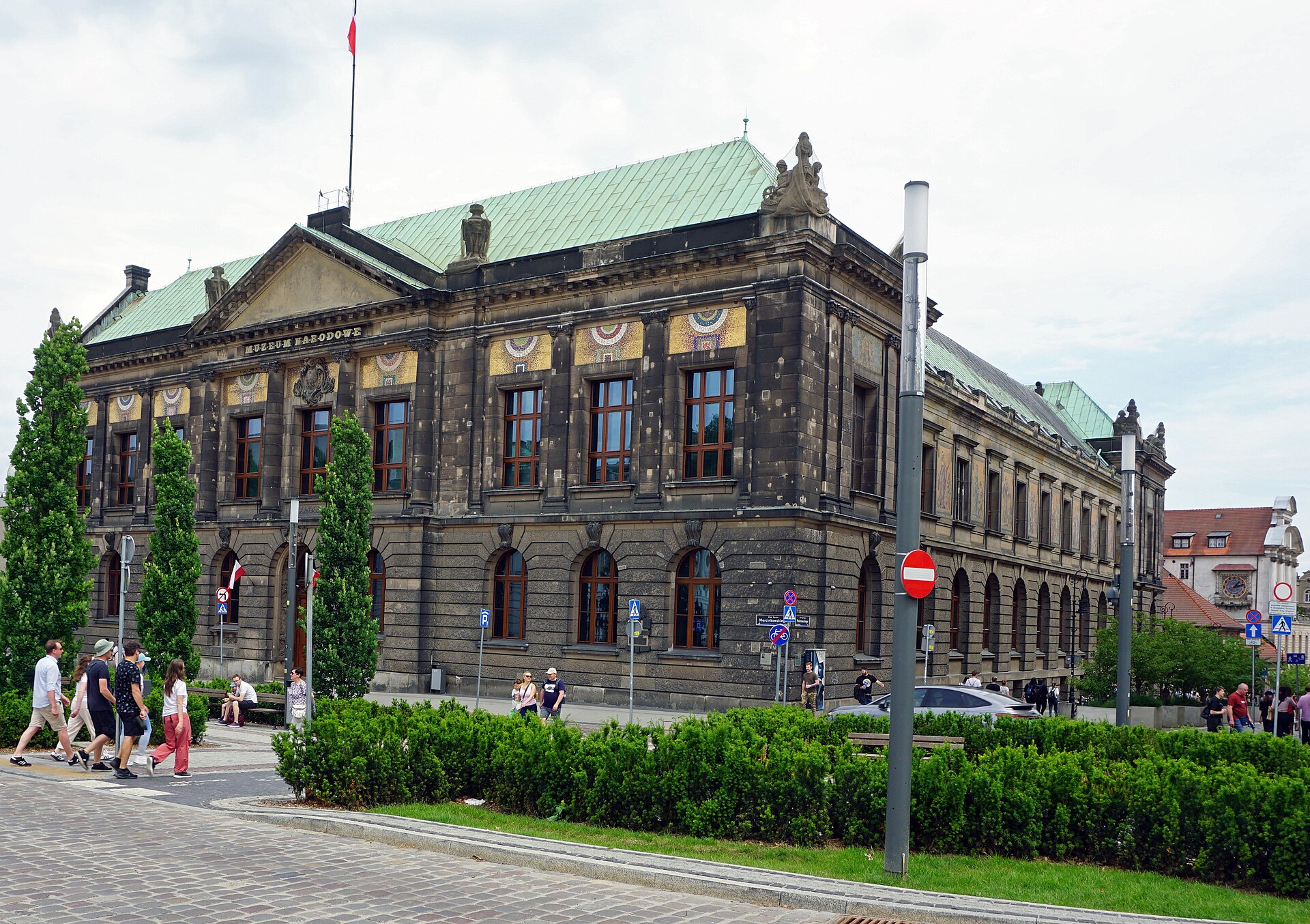
The eclectic stone facade of the Gallery of Painting and Sculpture, built 1899-1904 to a design by Karl Hinckeldeyn, seen from Plac Wolnosci with the museum's name still legible in the frieze.
Photograph by Igor123121, released CC BY 4.0National Museum in Poznan
Museum · Muzeum Narodowe w Poznaniu · Founded 1857
Open, admission and hours confirmed 24 September 2026 · 23 sources
On this page 16 sections
ContentsClose
The museum's own description of its holdings puts two things ahead of everything else: a Spanish Baroque painting collection it calls unrivalled in rank and size among Polish museums, built from the 1903 Raczynski deposit and postwar acquisitions and centred on Francisco de Zurbaran and Jusepe de Ribera, and a collection of 19th- and early-20th-century German painting it calls the largest and most valuable held by any Polish museum, running from the Nazarenes to Wilhelm von Kaulbach's monumental history painting. Both sit inside the European Art gallery, currently closed for renovation, which is itself the largest of the museum's seven departments at over 2,000 objects. The Polish holdings are just as distinctive on their own terms: the coffin-portrait collection is one of the country's principal assemblages of Sarmatian funerary painting, and the 20th-century gallery's Poznan avant-garde material, the Bunt group and the Kapist colourists' first permanent Polish installation in 1958, gives the museum a genuine claim to a chapter of Polish modern-art history that started in this building rather than merely passing through it. This is not an encyclopaedic survey collection on the scale of a national capital's flagship museum; it is a regional museum with two or three genuinely unmatched specialisms and a single instantly recognisable outlier, the country's only Monet.
| Local name | Muzeum Narodowe w Poznaniu |
|---|---|
| Kind | Museum |
| Founded | Traces to 1857, when the Poznan Society of Friends of Learning founded a Museum of Polish and Slavic Antiquities. Seweryn Mielzynski's 1870 gift of nearly 300 paintings, prints and drawings gave the collection its first real weight. The present building, purpose-built for the Prussian Provincial Museum, opened in 1904 as the Kaiser-Friedrich-Museum; the institution took its present name, National Museum in Poznan, in 1950. |
| City and country |  Poznan, Poland Poznan, Poland |
| Address | Aleje Marcinkowskiego 9, 61-745 Poznan, Poland |
| Website | mnp.art.pl/en |
| Status | Open, confirmed |
| Record last verified |
Visiting
- Hours
- MondayClosed year-round
- Tuesday10:00 to 16:00
- Wednesday10:00 to 16:00
- Thursday10:00 to 18:00
- Friday10:00 to 20:00
- Saturday10:00 to 17:00
- Sunday10:00 to 17:00
- Closed
- Monday, year-round. 1 January, Good Friday, Holy Saturday, Easter Sunday, Easter Monday, Corpus Christi, 1 November, 24-26 December, 31 December, on the museum's own hours page.
- Admission
- Normal (normalny)PLN 20Permanent exhibitions
- Reduced (ulgowy)PLN 13Students, pensioners and other eligible groups per the museum's own reduced-rate rules
- Children and students in education, 7-26PLN 1
- TuesdayFreeFree entry to the permanent exhibitions every Tuesday
Free entry: Every Tuesday, free admission to the permanent exhibitions, on the museum's own visit page- Tickets
- tobilet.pl/catalogsearch/result/?q=muzeum+nar... The museum's own ticket page.
- Do I need to book?
- Not published in the sources read for this record; tickets are sold through the tobilet.pl booking platform linked from the museum's own site
- Address
- Aleje Marcinkowskiego 9, 61-745 Poznan, Poland Map
- Website
- mnp.art.pl/en
- Telephone
- +48 61 856 80 00
- [email protected]
Before you go how long, access, photography, bags, eating, shop
- How long to allow
- About three hours for a full pass through the building, per the independent Poznan travel guide In Your Pocket; shorter at present with three of the seven permanent galleries closed
- Access
- The museum's own architectural accessibility declaration states the building is almost entirely wheelchair accessible except the Ancient Art gallery, reached by a step-free ramp along the new wing with automatic doors, an accessible toilet on the ground floor, induction loops at the ticket desk, shop and secretariat, and Braille signage on toilets, lifts, the ticket desk, shop and cafe. Lift buttons are not marked in Braille and there is no voice announcement in the lifts.
- Photography
- Not published in the sources read for this record
- Bags
- Not published in the sources read for this record
- Eating
- A cafe (kawiarnia) inside the building is confirmed on the museum's own architectural accessibility declaration, which lists it among the rooms marked with Braille signage
- Shop
- A small shop (sklepik) inside the building is confirmed on the same accessibility declaration
Prices and hours change. We take them from the institution's own pages and print the day we read them, and you can check the current position at the source we used. Confirm before you travel.
What is inside
Gallery of 19th-Century Polish Art
On the third floor of the new wing, paintings and sculpture arranged chronologically around the Mielzynski gift of about 300 works from 1870 and the Raczynski Foundation's Rogalin gallery. It opens with Marcello Bacciarelli's coronation portrait of King Stanislaus Augustus and the sole Polish monographic display of Joseph Grassi, moves through Piotr Michalowski and Aleksander Orlowski, Jan Matejko's historicism, and closes on Impressionism and Young Poland, including Wladyslaw Podkowinski's Wet Village and Jozef Pankiewicz's Flower Market.
Gallery of 20th-Century Polish Art
On the first floor, split into an interwar section and a colourists' section. The interwar rooms hold Polish Ecole de Paris painters (Gustaw Gwozdecki, Mela Muter, Eugeniusz Zak), the Krakow Formists around Zbigniew Pronaszko's Nude with a Book against the Miechow Skyline, and the Poznan avant-garde group Bunt beside Wladyslaw Strzeminski and Henryk Stazewski. The colourists' rooms trace the postwar Kapist painters who formed Poland's first permanent contemporary-art display here in 1958.
Gallery of Contemporary Art
On the second floor, arranged by theme rather than chronology, in sectors the museum itself calls Paint, Texture, Fantasy, Form, Realism, Body, Media and Experiment. Anchored by the postwar Poznan gallery scene (Andrzej Matuszewski's OdNowa, Izabella Gustowska's ON, Jaroslaw Kozlowski's Akumulatory 2), it holds substantial groups of Tadeusz Kantor, Jerzy Nowosielski and Stefan Gierowski alongside a double-sided reinstallation of two Andrzej Wroblewski paintings and recent acquisitions by younger Polish artists.
Study Gallery of Ancient Art
Opened in November 2024 as a working preview of a future permanent ancient-art gallery, built around an open study store where the collection is kept and cataloguing work happens in view of visitors. Holdings assembled since the 1899 rebuilding of the museum include the coffin of Iret-hor-iru from the Abusir excavations in Egypt, finds from Troy, Greek vases, a complete set of Tanagra figurine copies, and a group of Roman imperial portrait busts from the former Hohenzollern royal collections.
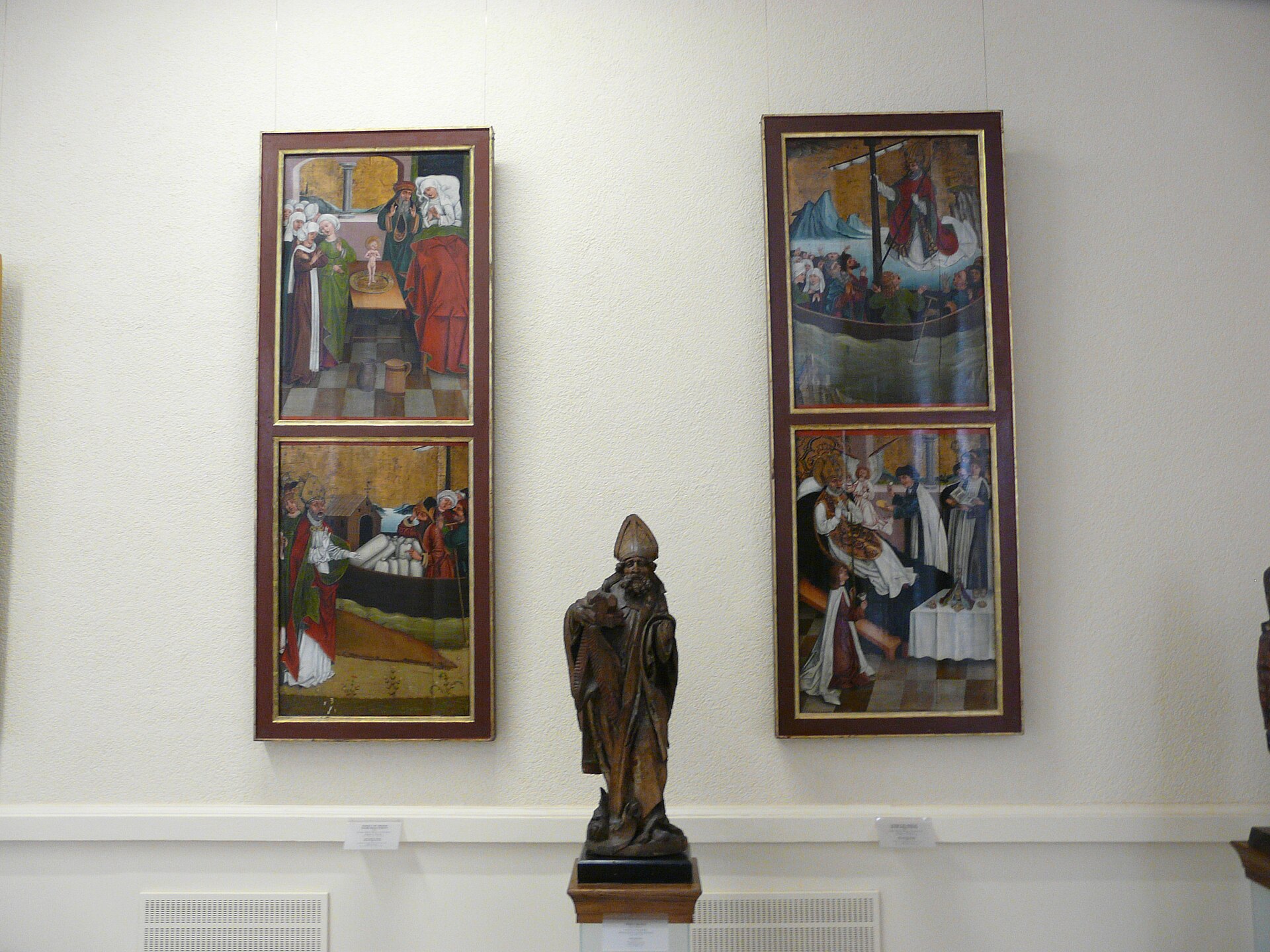
Photograph by Piotrus · CC BY-SA 3.0 Gallery of Medieval Art
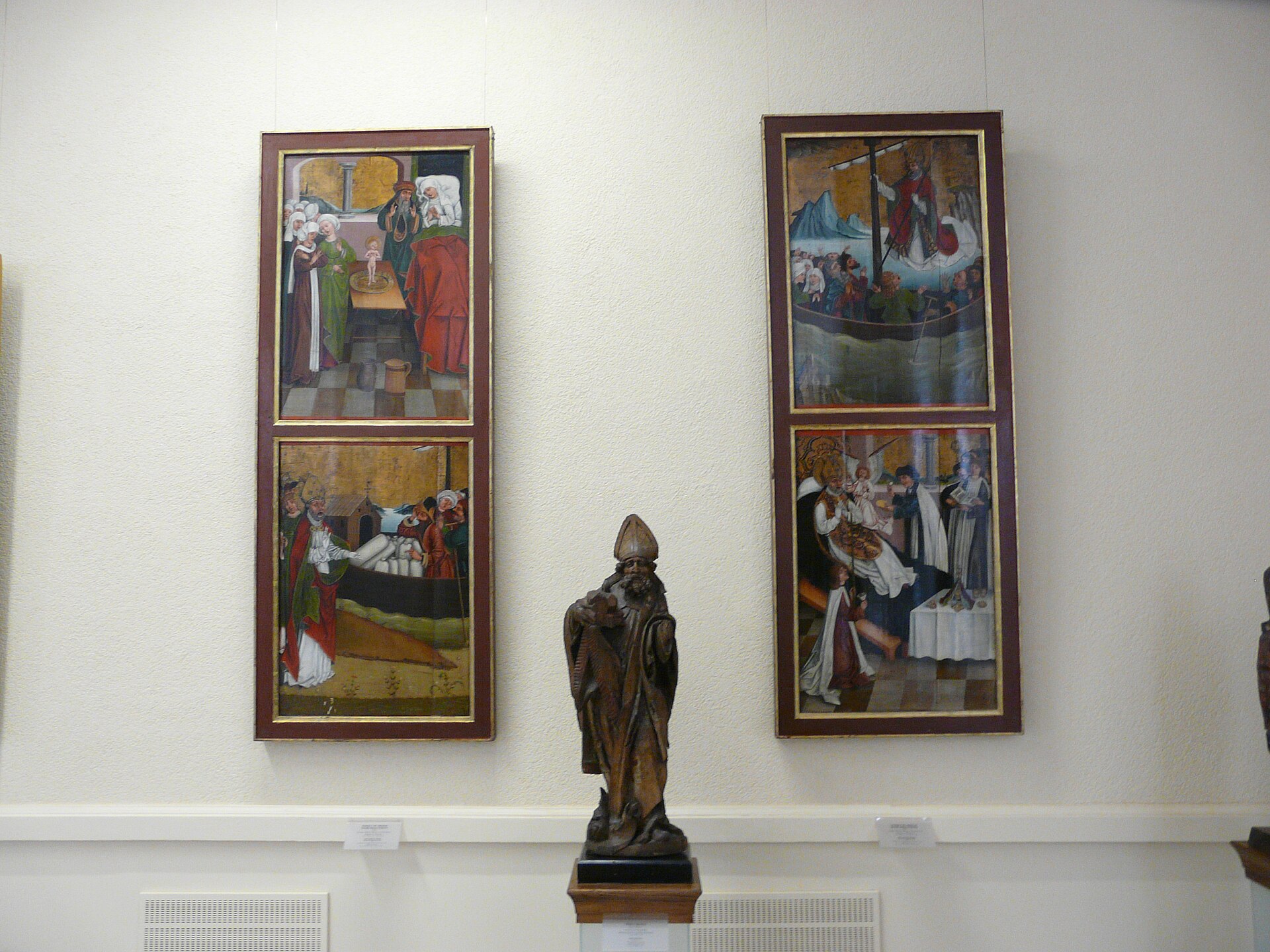
Temporarily closed for renovation as of this record. A compact but varied collection of 152 works of sacred art from Greater Poland, the Lubusz Land and West Pomerania, formed after 1945 around wooden sculptures gathered into the museum as a central wartime collection point. It runs from the late-Romanesque head of Christ salvaged from a burned tympanum at Strzelno and the rare Marianowo Crucifix, which mixes Romanesque and Gothic features, through the Lorraine workshop Madonna and Child of about 1330 to the late-14th-century Szydlow Marian Triptych.
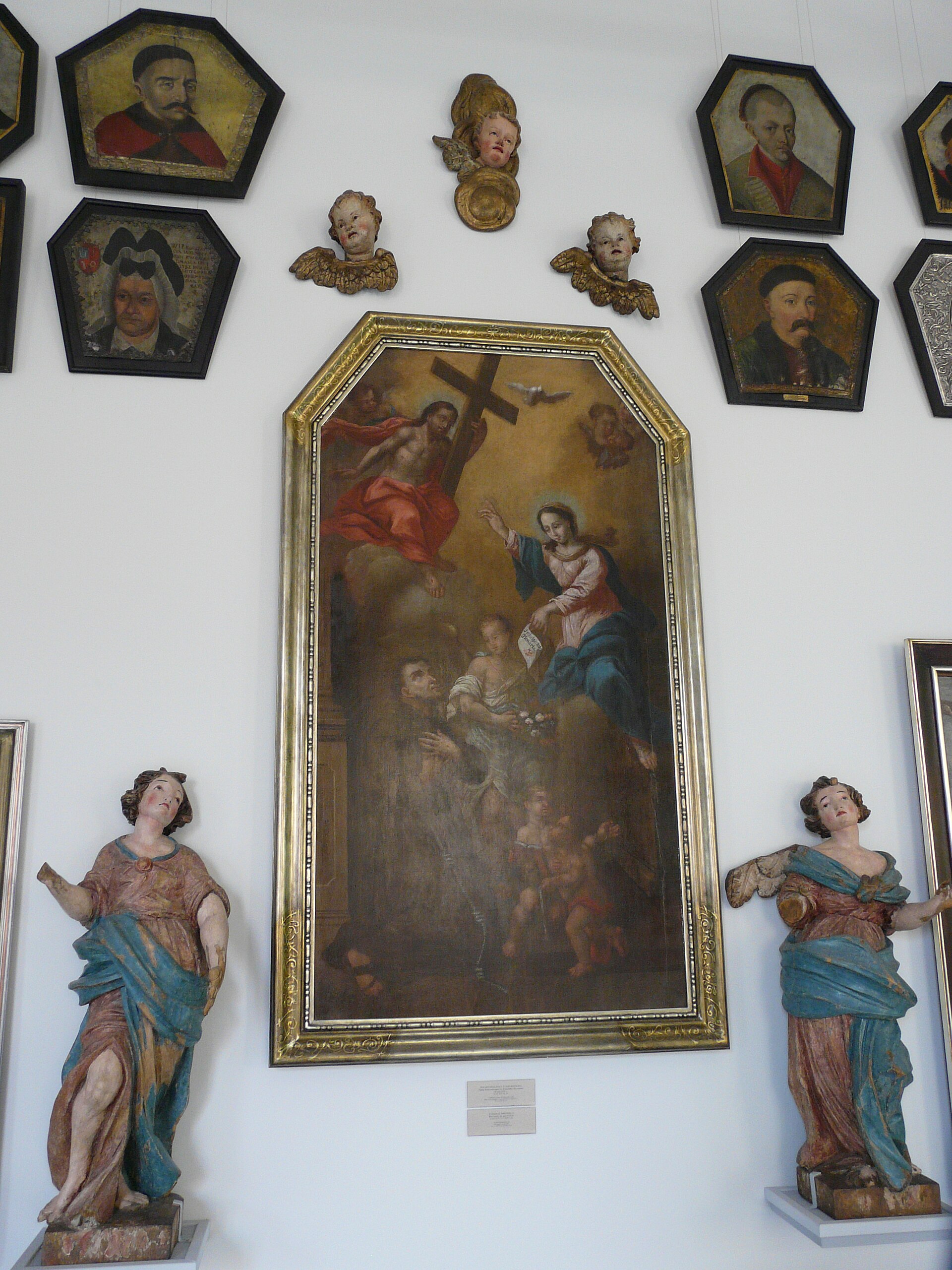
Photograph by Piotrus · CC BY-SA 3.0 Gallery of Polish Art, 16th-18th Century
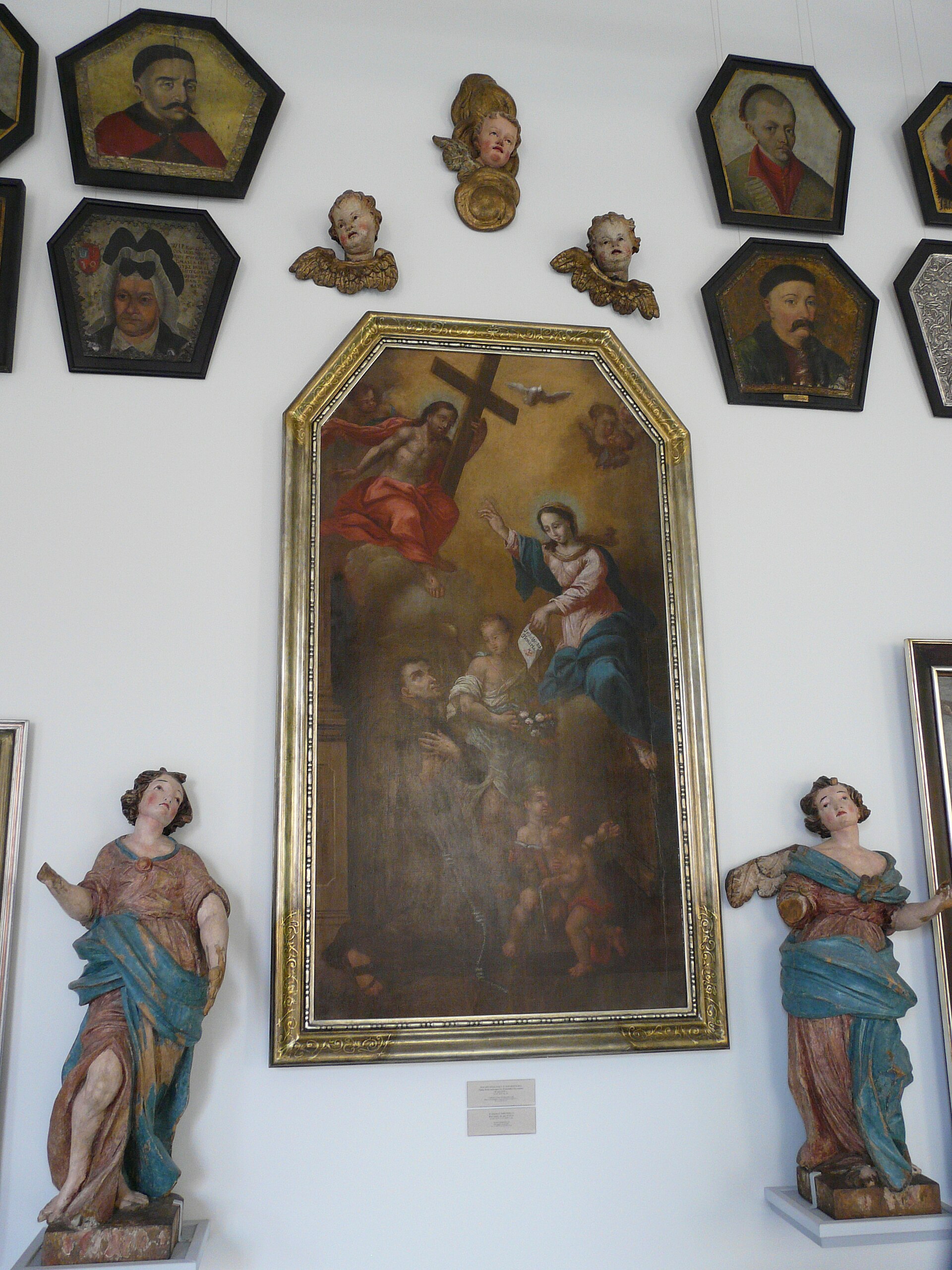
Temporarily closed for renovation as of this record. Two rooms on the ground floor of the historic building hold noble portraiture, sacred painting and historical-allegorical works from the elective kings' era, 1576 to 1763, drawn from the old Provincial Museum, the Kaiser-Friedrich-Museum, the Goluchow collection and other historic Poznan holdings. Its standout material is Old Polish funerary art: a set of coffin portraits, commemorating both Catholic and Protestant dead, shown with the heraldic and inscription plates and church furnishings they were removed from, alongside works by Bartlomiej Strobel the Younger, Augustyn Mirys, Hermann Han the Younger, Andreas Stech and Adolf Boy.
Gallery of European Art
Temporarily closed for renovation as of this record. Built substantially around nearly 200 works deposited from Atanazy Raczynski's Berlin gallery in 1903, this is the museum's largest department at over 2,000 paintings and sculptures, of which close to 300 are normally shown. Its two unrivalled strengths in Polish museums are Spanish Baroque painting, with Francisco de Zurbaran, Jusepe de Ribera, Juan Carreno de Miranda and the circle of Diego Velazquez, and 19th- to early-20th-century German painting, from the Nazarenes and Wilhelm von Kaulbach's vast Battle of the Huns through Max Liebermann and Lovis Corinth to Arnold Bocklin. Italian Renaissance holdings include Giovanni Bellini, Agnolo Bronzino and Sofonisba Anguissola's Chess Game of 1555, and the gallery holds the only Claude Monet painting in any Polish museum, Beach at Pourville.
What to see first
Beach at Pourville
Claude Monet, 1882The only Monet painting in any Polish museum collection, cut from its frame by a thief posing as an art student in September 2000 and recovered undamaged behind a wardrobe in a bricklayer's home near Olkusz in January 2010, a decade later.13
The Battle of the Huns
Wilhelm von Kaulbach, 19th centuryA vast history painting anchoring what the museum itself calls the largest and most valuable collection of 19th- and early-20th-century German painting in any Polish museum, a holding no other institution in the country can match.4
The Chess Game
Sofonisba Anguissola, 1555A celebrated Italian Renaissance portrait by one of the few women painters of her era to achieve international fame in her own lifetime, part of the museum's Italian Renaissance holdings alongside Giovanni Bellini and Agnolo Bronzino.4
The Spanish Baroque collection
Francisco de Zurbaran, Jusepe de Ribera, Juan Carreno de Miranda and the circle of Diego VelazquezNamed by the museum itself as the only collection of its rank and size in any Polish museum, built on the Raczynski deposit of 1903 and later postwar acquisitions.4
Coronation portrait of King Stanislaus Augustus
Marcello BacciarelliThe painting that opens the 19th-century Polish gallery on the side facing the historic building, the museum's chosen starting point for its whole survey of Polish painting from the last king's reign onward.5
The coffin portrait collection
Unknown Polish workshops, 17th-18th centuryA set of Sarmatian funerary portraits, commemorating Catholic and Protestant dead alike, that the museum's own curators single out as the defining strength of its Old Polish holdings.6
Marianowo Crucifix
Unknown workshop, circa late 12th-13th centuryA rare survival in Polish museum collections that fuses Romanesque and Gothic stylistic features in one carved figure, among the oldest objects in the Medieval Art gallery.8
Nude with a Book against the Miechow Skyline
Zbigniew PronaszkoThe museum's own key composition for the Krakow Formist group, hung at the point where the 20th-century Polish gallery turns from Ecole de Paris painting to Poland's home-grown interwar avant-garde.7
Past exhibitions here
- Closed10 Apr to 30 Aug 2026Confirmed · check before you travel
A building raised to outclass its own city
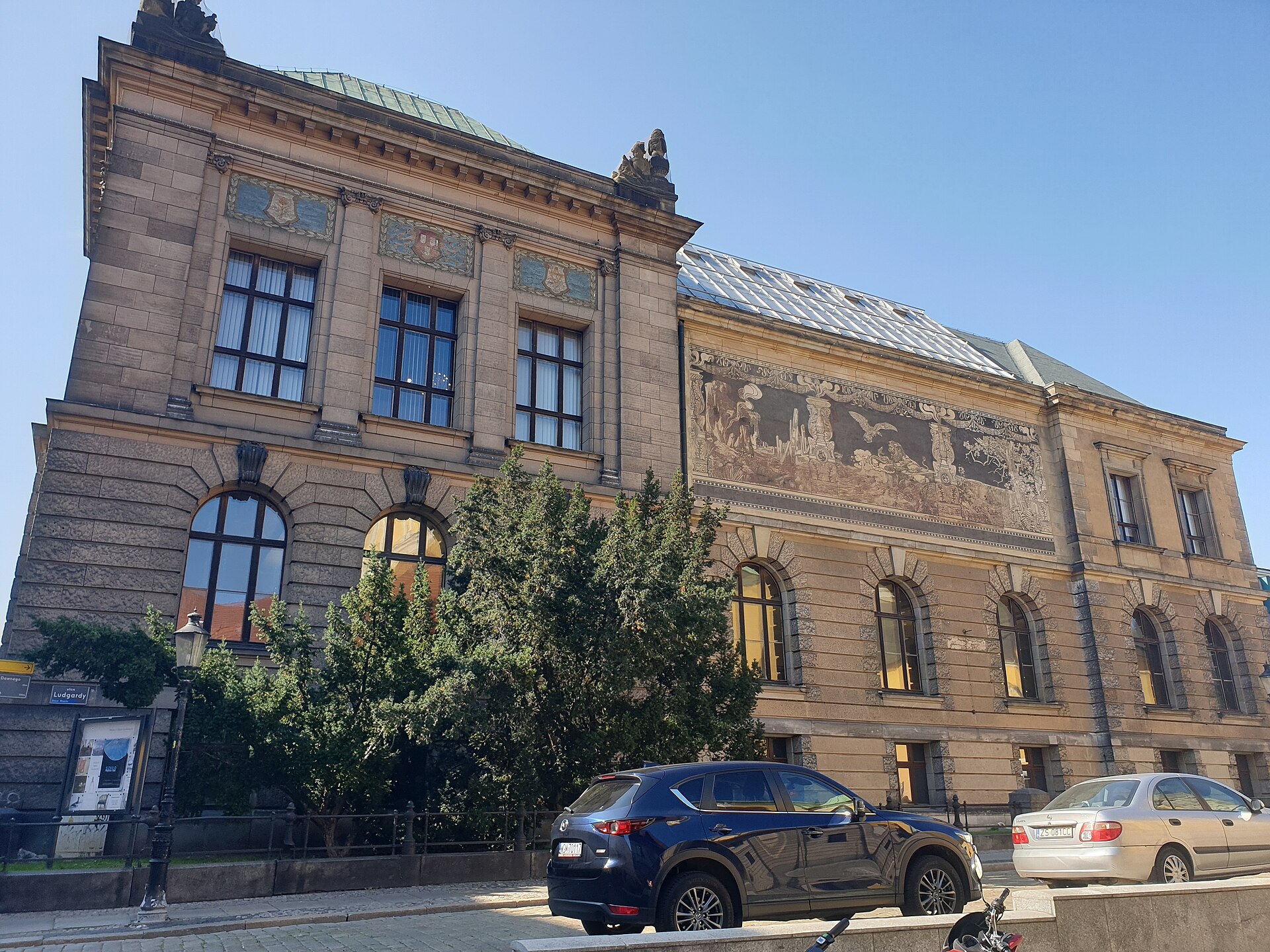
The National Museum in Poznan occupies a building that was designed, from the ground up, to be a showcase. Prussian authorities decided in 1899 to replace the modest Provincial Museum they had opened in 1893 with something grander, and the architect Karl Hinckeldeyn produced a structure at what is now Aleje Marcinkowskiego, built through 1904 and opened that year as the Kaiser-Friedrich-Museum, named for the recently deceased Emperor Frederick III. The eclectic stone facade still carries mosaic panels honouring Polish artists, restored in the 1970s by Zbigniew Bednarowicz after wartime and postwar decades of neglect. A second building phase came much later: a new wing designed by Marian Trzaska went up between the 1960s and the 1970s, was reworked internally by the designer Witold Gyurkovich, and finally opened to the public in 2001, giving the museum the modern galleries that now hold its 20th-century and contemporary collections. In 2026 the historic wing is itself mid-renovation, its facade under a two-year restoration that reached the Aleje Marcinkowskiego side this year after starting on the Ludgardy Street side in 2025.
Three founding collections, one Prussian showcase
Almost none of what hangs in this museum today was assembled by a single founder with a single vision. It is the sum of at least three separate 19th-century collecting projects that Prussian and then Polish administrations eventually merged. The oldest thread runs back to 1857, when the Poznan Society of Friends of Learning founded a Museum of Polish and Slavic Antiquities, given real substance in 1870 when the politician and collector Seweryn Mielzynski donated close to 300 paintings from the late 18th and early 19th centuries along with a large body of prints and drawings. Running alongside it, and initially in competition with it, was the German civic and then state museum that became the Kaiser-Friedrich-Museum, which absorbed the third and most consequential collection in 1903: close to 200 paintings from Atanazy Raczynski's private gallery in Berlin, deposited by the Raczynski family and still, since 1997, held under the Raczynski Foundation attached to this museum. Between them, the Mielzynski gift shaped the Polish 19th-century rooms and the Raczynski deposit still forms the core of the European Art gallery.
War, looting, and a recovery that took a decade to finish
The museum's German administrators did not stop collecting when war began; they kept buying old-master and 19th-century German paintings on the open market through the early 1940s while, at the same time, requisitioning private Polish and landed-gentry collections from across the Poznan region. From 1942 the most valuable objects were shipped out to Germany, mostly to Saxony, and some were lost outright, including paintings attributed to Lorenzo di Credi and Antoine Pesne and a sketch from Peter Paul Rubens' workshop. The museum's first postwar director, Gwidon Chmarzynski, spent the early months of 1945 turning the building into a central collection point for artistic property recovered across Greater Poland, Kujawy, the Lubusz Land and West Pomerania, gathering 64 sculptures alone by 1947 that still define the character of the medieval collection today. Restitution from Moscow, where looted German holdings had been taken, returned part of what had been lost in 1946 and again in 1956, including several works from the former Czartoryski collection at Goluchow Castle. Neither the wartime requisitioning nor the postwar restitution effort is a footnote the museum keeps quiet about; both are laid out on its own departmental pages.
A theft, a decade, and a painting that came home
The single best-known object in the collection has its own twentieth-century story that has nothing to do with the war. Claude Monet's Beach at Pourville, the only painting by the artist held in any Polish museum, was cut from its frame on 17 September 2000 by a thief who had spent hours in the gallery posing as an art student sketching the room; the theft was not even discovered for two days. Nobody was caught until 2009, when an automated fingerprint match connected crime-scene prints to an unemployed bricklayer from Olkusz in southern Poland. On 12 January 2010, police found the canvas hidden behind a wardrobe in his parents' house, undamaged after nearly a decade in hiding. It has since been examined and returned to the museum's care, though the European Art gallery that normally displays it is, as of this record, one of the three galleries closed for the ongoing renovation, so the painting a Monet-seeking visitor comes for cannot currently be guaranteed on view.
What the closed rooms hold
Three of the museum's seven permanent galleries are shut for renovation at the time of this record, and each is a genuine loss for a visitor rather than a minor inconvenience. The Medieval Art gallery holds a small but carefully assembled set of 152 sacred objects, from a late-Romanesque fragment of Christ's head rescued from a burned tympanum at Strzelno to the Szydlow Marian Triptych of the late 14th century. The Polish Art gallery covering the 16th to 18th centuries carries the museum's celebrated coffin-portrait collection, a form of funerary painting largely specific to the old Polish-Lithuanian Commonwealth, displayed alongside the heraldic and inscription plates the portraits were originally mounted with. And the European Art gallery, the museum's largest department by far at over 2,000 objects, holds both of the collection's two genuinely unrivalled strengths in Poland: a Spanish Baroque holding built around Zurbaran and Ribera that the museum itself says has no equal in rank or size in any other Polish museum, and the country's largest collection of 19th- and early-20th-century German painting, anchored by Wilhelm von Kaulbach's monumental Battle of the Huns.
What is open today
What remains open is still a full afternoon's visit in its own right. The 19th-century Polish gallery on the third floor of the new wing runs chronologically from Marcello Bacciarelli's coronation portrait of King Stanislaus Augustus through Jan Matejko's historicism to the Impressionist and Young Poland rooms. Below it, the 20th-century Polish gallery splits into an interwar section built around the Krakow Formists and the Poznan avant-garde group Bunt, and a postwar section devoted to the Kapist colourists, whose 1958 installation here was Poland's first permanent display of contemporary art anywhere in the country. The Contemporary Art gallery, arranged thematically rather than by date, carries substantial holdings of Tadeusz Kantor, Jerzy Nowosielski and Stefan Gierowski. And a Study Gallery of Ancient Art, opened only in November 2024 as a preview of a future permanent installation, lets visitors watch the museum's own conservators and curators working an open collection store that includes an Egyptian coffin from the Abusir excavations and a group of Roman imperial portrait busts.
Visiting mid-renovation
The museum kept its normal weekly rhythm through 2025 and into 2026 even as the facade scaffolding went up: open Tuesday to Sunday, closed every Monday, with the longest hours on Friday evenings and free admission to the permanent galleries every Tuesday. The nine branches under the National Museum in Poznan's management together drew a record 599,529 visitors in 2025, with a monographic show of the painter Jozef Chelmonski alone accounting for more than 124,000 of them between March and July, evidence that the institution's temporary-exhibition programme is drawing crowds even while parts of the permanent collection sit behind hoardings. The facade renovation itself is a two-year, multi-million-zloty project that reached the Aleje Marcinkowskiego frontage in 2026 after starting on the Ludgardy Street side the year before, with no published date yet for when the three closed permanent galleries reopen to visitors.
What visitors say
Google's aggregate rating, read through the Wanderlog listing, sits at 4.7 from more than 4,800 ratings, and the independent Poznan city guide In Your Pocket calls it simply a large and excellent museum. Visitors consistently praise the depth and quality of the collection, especially the Polish modern and contemporary rooms, and describe a calm, uncrowded space that rewards a relaxed few hours at a reasonable admission price. The most common complaint has nothing to do with the art itself and everything to do with access to it: named individual paintings, including the one Monet in the building, are reported as hard to find or unexpectedly absent, which tracks with the museum's own confirmation that three of its seven permanent galleries are closed for renovation as this record was written.
What is praised, what is criticised
- Praised: The range and quality of the collection, particularly the Polish 19th- and 20th-century rooms, which reviewers repeatedly call world-class for a regional museum
- Praised: A calm, uncrowded visiting experience with helpful staff, a bookshop, a cafe and lockers, at an admission price several reviewers call generous for what is on view
- Praised: Extensive English-language wall text and object labelling throughout the building, unusual enough among Polish regional museums that In Your Pocket calls it out specifically
- Criticised: The museum's single Monet, the one painting several visitors come specifically to see, is described by reviewers as easy to miss or oddly under-presented relative to its rarity in Poland
- Criticised: As of this record three of the museum's seven permanent galleries, Medieval Art, Polish Art 16th-18th century and European Art, are marked temporarily closed on the museum's own site with no published reopening date, so a visitor cannot count on seeing the Spanish Baroque paintings, the coffin portraits or the Monet on any given day
- Criticised: Some visitors report getting through the open rooms in under two hours, shorter than the roughly three hours the museum's own city guide suggests for a full visit, a gap the current partial closures make wider
Ratings on other platforms
Google: 4.7 from 4,811 ratings, read 13 August 2026
A platform average is a tertiary source: it moves, it is not audited, and we quote no visitor's words.
Questions about National Museum in Poznan
Where is National Museum in Poznan?
Aleje Marcinkowskiego 9, 61-745 Poznan, Poland.
How much does it cost to visit?
Normal (normalny): PLN 20; Reduced (ulgowy): PLN 13; Children and students in education, 7-26: PLN 1; Tuesday: free. As confirmed 24 September 2026.
When is it open?
Monday closed; Tuesday 10:00-16:00; Wednesday 10:00-16:00; Thursday 10:00-18:00; Friday 10:00-20:00; Saturday 10:00-17:00; Sunday 10:00-17:00. Closed: Monday, year-round. 1 January, Good Friday, Holy Saturday, Easter Sunday, Easter Monday, Corpus Christi, 1 November, 24-26 December, 31 December, on the museum's own hours page. As confirmed 24 September 2026.
What should you see first?
Beach at Pourville (Claude Monet, 1882); The Battle of the Huns (Wilhelm von Kaulbach, 19th century); The Chess Game (Sofonisba Anguissola, 1555); The Spanish Baroque collection (Francisco de Zurbaran, Jusepe de Ribera, Juan Carreno de Miranda and the circle of Diego Velazquez); Coronation portrait of King Stanislaus Augustus (Marcello Bacciarelli); The coffin portrait collection (Unknown Polish workshops, 17th-18th century).
What we could not confirm
- When the Medieval Art, Polish Art 16th-18th century and European Art galleries, all marked temporarily closed on the museum's own site as of August 2026, are expected to reopen, and whether any of their key objects (the coffin portraits, the Spanish Baroque paintings, the Monet) are being shown elsewhere in the building in the meantime
Images
Sources
- 1Muzeum Narodowe w Poznaniu, Galeria Malarstwa i Rzezby visit page (hours, admission, contact, accessibility summary), read 2026-08-13 mnp.art.pl/profile/wizyta-galeria-malarstwa-i-rzezby
- 2Muzeum Narodowe w Poznaniu, Galeria Malarstwa i Rzezby branch page (address, phone, collection overview), read 2026-08-13 mnp.art.pl/galeria-malarstwa-i-rzezby
- 3Muzeum Narodowe w Poznaniu, Deklaracja Dostepnosci (architectural accessibility declaration for the main building), read 2026-08-13 mnp.art.pl/deklaracja-dostepnosci
- 4Muzeum Narodowe w Poznaniu, Galeria Sztuki Europejskiej gallery page, including closure notice, read 2026-08-13 mnp.art.pl/profile/galeria-sztuki-europejskiej
- 5Muzeum Narodowe w Poznaniu, Galeria Sztuki Polskiej XIX wieku gallery page, read 2026-08-13 mnp.art.pl/profile/galeria-sztuki-polskiej-xix-wieku
- 6Muzeum Narodowe w Poznaniu, Galeria Sztuki Polskiej XVI-XVIII wieku gallery page, including closure notice, read 2026-08-13 mnp.art.pl/profile/galeria-sztuki-polskiej-xvi-xviii-wieku
- 7Muzeum Narodowe w Poznaniu, Galeria Sztuki Polskiej XX wieku gallery page, read 2026-08-13 mnp.art.pl/profile/galeria-sztuki-polskiej-xx-wieku
- 8Muzeum Narodowe w Poznaniu, Galeria Sztuki Sredniowiecznej gallery page, including closure notice, read 2026-08-13 mnp.art.pl/profile/galeria-sztuki-sredniowiecznej
- 9Muzeum Narodowe w Poznaniu, Studyjna Galeria Sztuki Starozytnej gallery page, read 2026-08-13 mnp.art.pl/profile/galeria-sztuki-starozytnej
- 10Muzeum Narodowe w Poznaniu, Galeria Sztuki Wspolczesnej gallery page, read 2026-08-13 mnp.art.pl/profile/galeria-sztuki-wspolczesnej
- 11Muzeum Narodowe w Poznaniu, 'Czas podsumowan i planow' (2025 attendance figures and 2026 renovation plans), read 2026-08-13 mnp.art.pl/galeria-malarstwa-i-rzezby/podsumowanie-roku-2025-i-plany-na-rok-2026
- 12dzieje.pl, 'Muzeum Narodowe w Poznaniu rozpoczelo modernizacje i odnowienie elewacji swojej siedziby' (facade renovation timeline and scope), read 2026-08-13 dzieje.pl/wiadomosci/muzeum-narodowe-w-poznaniu-rozpoczelo-modernizacje-i-odnowienie-elewacji-swojej-siedziby
- 13Poznan.pl / kultura.poznan.pl, 'How did Beach in Pourville get stolen?' (Monet theft and 2010 recovery), read 2026-08-13 kultura.poznan.pl/mim/kultura/en/news/how-did-beach-in-pourville-get-stolen,152528.html
- 14Wikidata, item Q194533, National Museum in Poznan (identity, coordinates, official website), read 2026-08-13, wikidata.org/wiki/Q194533
- 15Wikipedia, 'National Museum, Poznan' (founding history, architect, WWII, branches), read 2026-08-13, en.wikipedia.org/wiki/National_Museum,_Pozna%C5%84
- 16Wikipedia (Polish), 'Muzeum Narodowe w Poznaniu' (detailed founding, building and collection history), read 2026-08-13, pl.wikipedia.org/wiki/Muzeum_Narodowe_w_Poznaniu
- 17Wikimedia Commons, File:2025, Poznan, Galeria Malarstwa i Rzezby Muzeum Narodowego w Poznaniu.jpg, image and licence metadata, read 2026-08-13 commons.wikimedia.org/wiki/File:2025,_Pozna%C5%84,_Galeria_Malarstwa_i_Rze%C5%BAby_Muzeum_Narodowego_w_Poznaniu.jpg
- 18Wikimedia Commons, File:Muzeum Narodowe w Poznaniu, 2020.jpg, image and licence metadata, read 2026-08-13 commons.wikimedia.org/wiki/File:Muzeum_Narodowe_w_Poznaniu,_2020.jpg
- 19Wikimedia Commons, File:National Museum in Poznan - paintings and statues.JPG, image and licence metadata, read 2026-08-13 commons.wikimedia.org/wiki/File:National_Museum_in_Poznan_-_paintings_and_statues.JPG
- 20Wikimedia Commons, File:National Museum in Poznan - 4 paintings and a statue.JPG, image and licence metadata, read 2026-08-13 commons.wikimedia.org/wiki/File:National_Museum_in_Poznan_-_4_paintings_and_a_statue.JPG
- 21Wanderlog, Muzeum Narodowe w Poznaniu listing citing the Google aggregate rating (4.7, 4,811 reviews), read 2026-08-13, wanderlog.com/place/details/9400/muzeum-narodowe-w-poznaniu
- 22In Your Pocket, Poznan Travel Guide, 'Poznan National Museum' venue entry, read 2026-08-13 inyourpocket.com/poznan/poznan-national-museum_17482v
- 23VisitPoznan.pl, 'Gallery of Paintings and Sculpture' official tourism board page, read 2026-08-13 visitpoznan.pl/en/gallery-of-paintings-and-sculpture


