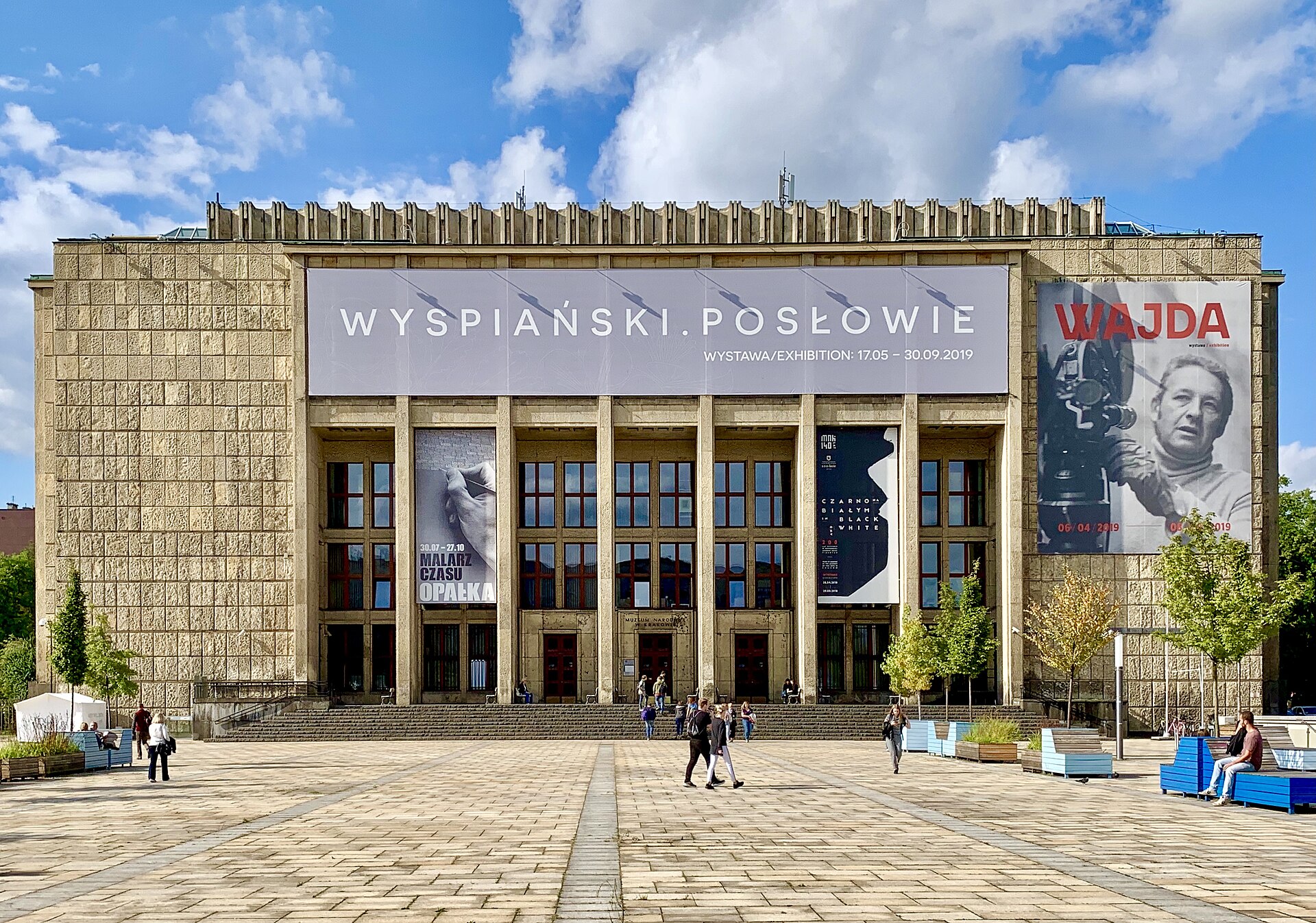
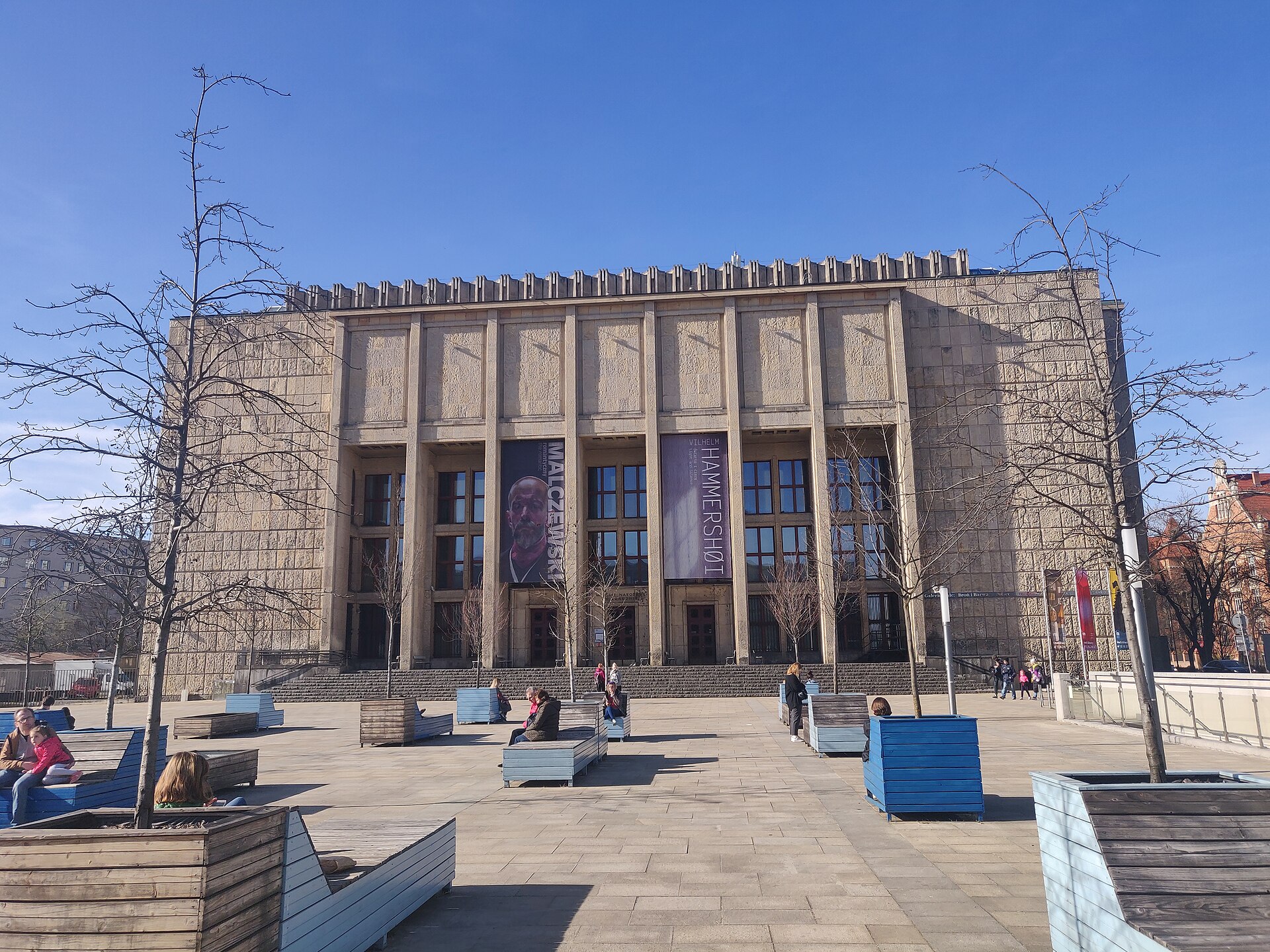
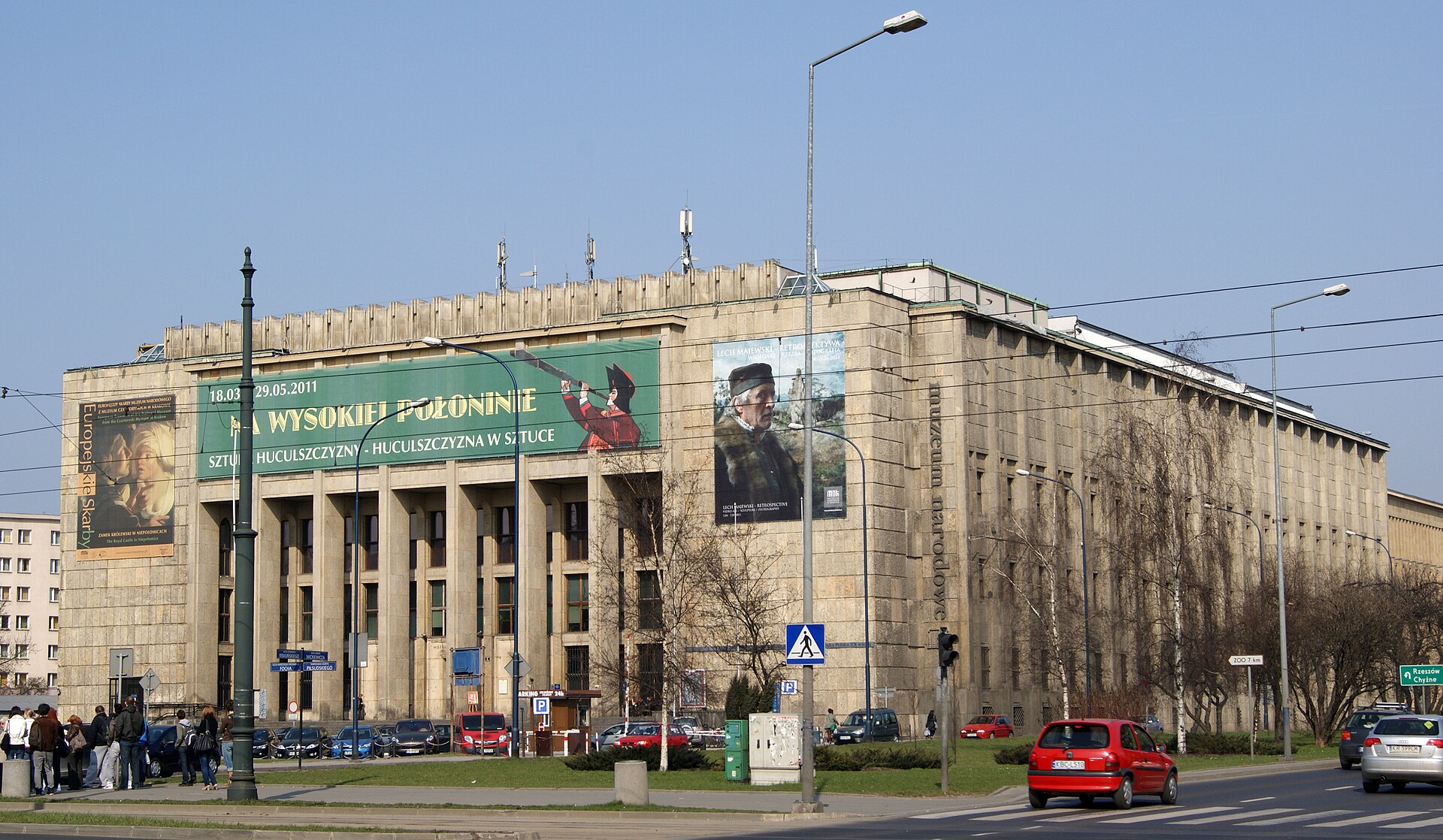
The Gmach Glowny (Main Building) of the National Museum in Krakow, facing Aleja 3 Maja, with banners for temporary exhibitions on its facade
Chris Olszewski · Photograph by Kgbo · CC BY-SA 4.0National Museum in Krakow
Museum · Muzeum Narodowe w Krakowie - Gmach Glowny · Founded 1879
Open, admission and hours confirmed 23 September 2026 · 11 sources
On this page 16 sections
ContentsClose
The Main Building's strength is modern and contemporary Polish art, gathered in the Gallery of Polish Art of the 20th and 21st Centuries into the largest permanent survey of its kind on public display in Poland, running from Young Poland secession through formism, colorism and the postwar avant-garde to work made after 1989 by artists including Wilhelm Sasnal. It is supported by a smaller but historically deep Gallery of European Art, now also home to Poland's only Van Gogh, and by a Gallery of Artistic Crafts that is the country's largest decorative-arts installation, spanning goldwork, glass, ceramics, furniture, textiles, clocks, musical instruments and Judaica from the early medieval period to the twentieth century.
| Local name | Muzeum Narodowe w Krakowie - Gmach Glowny |
|---|---|
| Kind | Museum |
| Founded | 1879 |
| City and country |  Krakow, Poland Krakow, Poland |
| Address | Aleja 3 Maja 1, 30-062 Krakow, Poland |
| Website | mnk.pl/oddzialy/gmach-glowny |
| Status | Open, confirmed |
| Record last verified |
Visiting
- Hours
- MondayClosed
- Tue-Sun10:00 to 18:00Last admission to galleries and exhibitions 20 minutes before closing
- Closed
- Monday.
- Admission
- Adult, permanent galleriesPLN 45Covers the Gallery of Polish Art of the 20th and 21st Centuries, the Gallery of European Art, the Gallery of Artistic Crafts and the Sculpture Hall
- Reduced, permanent galleriesPLN 35Poland's standard discounted-admission category; pupils and students have a separate lower rate below
- Family, permanent galleriesPLN 90
- Pupils and students, permanent galleriesPLN 1
- Adult, temporary exhibitionPLN 35Temporary shows are ticketed separately from the permanent galleries
- Reduced, temporary exhibitionPLN 25
- Combined ticket, two temporary exhibitions, adultPLN 50
Free entry: Tuesday, permanent galleries only- Tickets
- bilety.mnk.pl The museum's own ticket page.
- Do I need to book?
- Not required for general admission; a guided tour or audio-guide hire is booked through the Centrum Informacji i Rezerwacji (Information and Reservation Centre)
- Address
- Aleja 3 Maja 1, 30-062 Krakow, Poland MapTram Lines 1 and 20 to the Muzeum Narodowe stop on Aleja 3 Maja
Bus Lines 109, 124, 134, 144, 152, 164, 169, 173, 179, 194, 249, 304, 424, 502 and 503 to the Muzeum Narodowe stop - Website
- mnk.pl/oddzialy/gmach-glowny
- Telephone
- +48 12 433 57 44
- [email protected]
Before you go how long, access, photography, bags, eating, shop
- How long to allow
- Two to three hours to see all four permanent galleries; the Gallery of Polish Art of the 20th and 21st Centuries alone fills twelve rooms
- Access
- Audio description, a guide for deaf visitors, a sensory basket and a defibrillator are available on site. The building is accessible by wheelchair or crutches via lifts, stairlifts and portable ramps, with the exception of the cloakroom and the second-floor mezzanine. An external lift serves the main entrance, and accessible toilets are on the ground floor and second floor
- Photography
- Not detailed in the sources consulted for this page
- Bags
- Coats and bags must be left in the free cloakroom before entering the galleries
- Eating
- On-site cafe
- Shop
- Museum shop, on site, plus an online shop
Prices and hours change. We take them from the institution's own pages and print the day we read them, and you can check the current position at the source we used. Confirm before you travel.
What is inside
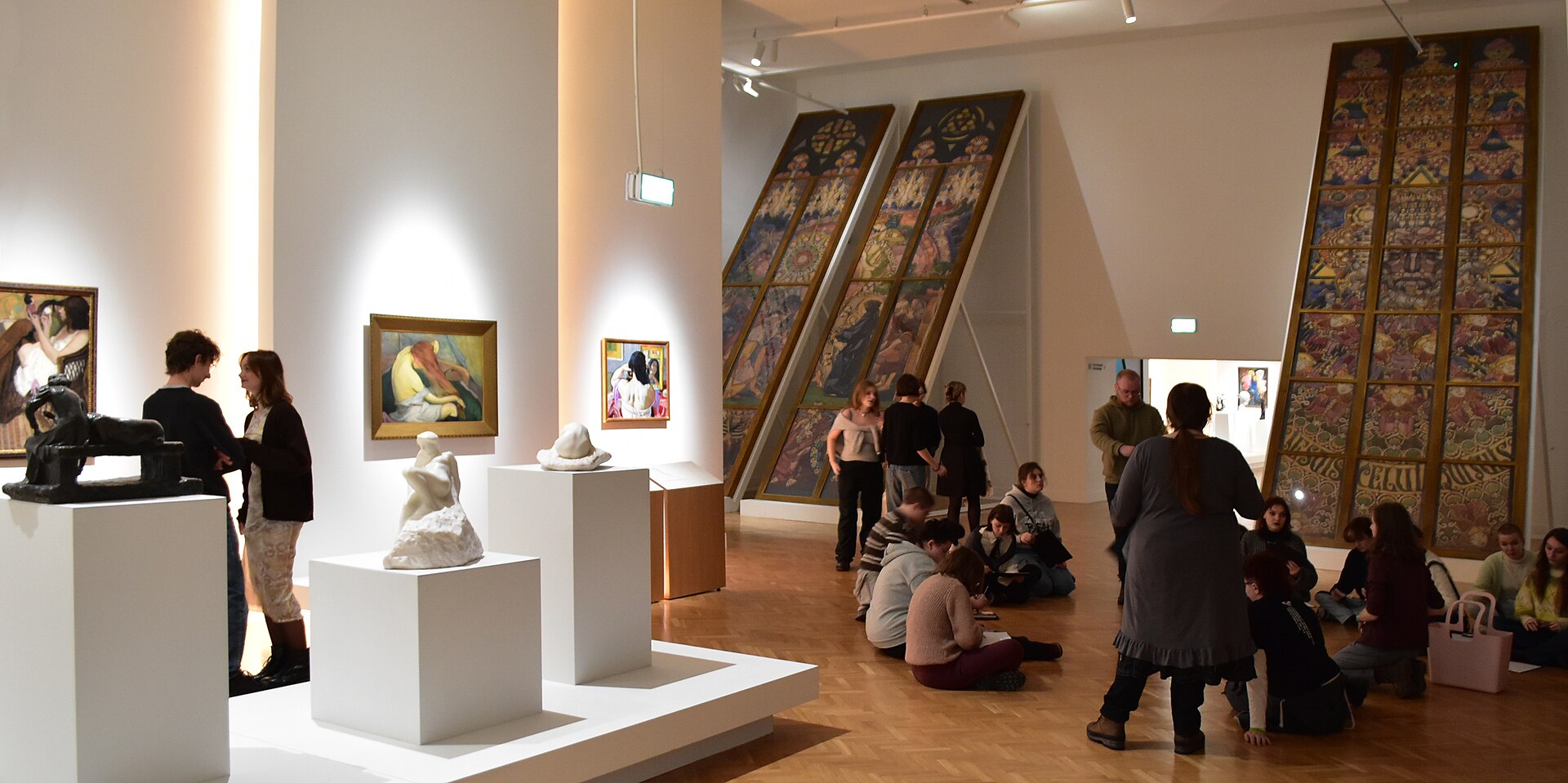
Photograph by Scotch Mist · CC BY-SA 4.0 Gallery of Polish Art of the 20th and 21st Centuries (XX+XXI)
Twelve rooms across roughly 3,000 square meters hold more than 500 works by some 200 artists, reopened in a renovated form in October 2021. The hang runs from Young Poland secession and modernism through expressionism, formism, colorism, conceptual art and geometric abstraction to work made after 1989, with figures including Tadeusz Kantor, Magdalena Abakanowicz, Alina Szapocznikow and Wilhelm Sasnal.
Gallery of European Art
Deliberately hung in reverse chronological order, this gallery presents over one hundred paintings and sculptures made in Europe between the 13th and 20th centuries, moving backward from later work toward Spanish Romanesque madonnas in the final room. Sculptors Antonio Canova and Gustav Vigeland appear alongside painters Paolo Veneziano, Lorenzo Lotto, Pieter Bruegel the Younger, Lucas Cranach the Younger and Luca Giordano, and, on long-term loan, Vincent van Gogh's Rural Cottages Among Trees.
Gallery of Artistic Crafts
Poland's largest permanent decorative-arts display fills nine halls and two annexes with close to 4,000 objects arranged chronologically from the early Middle Ages to the mid-20th century: goldwork and silver from the 10th century onward, the country's most extensive museum collection of medieval stained glass, Italian majolica and European porcelain, furniture ranging from Spanish varguenos to Art Nouveau pieces, and a Judaica collection considered among the most important in Poland.
XX+XXI Sculpture Hall
The final room on the visitor route, added in 2024, holds 33 works chosen from the museum's collection of roughly 500 sculptures made over the past seven decades. Curator Agata Malodobry traces the shift from figurative postwar sculpture toward experimental installation and environment-based work, completing a line that begins with the early-20th-century sculpture displayed in the second-floor hall.
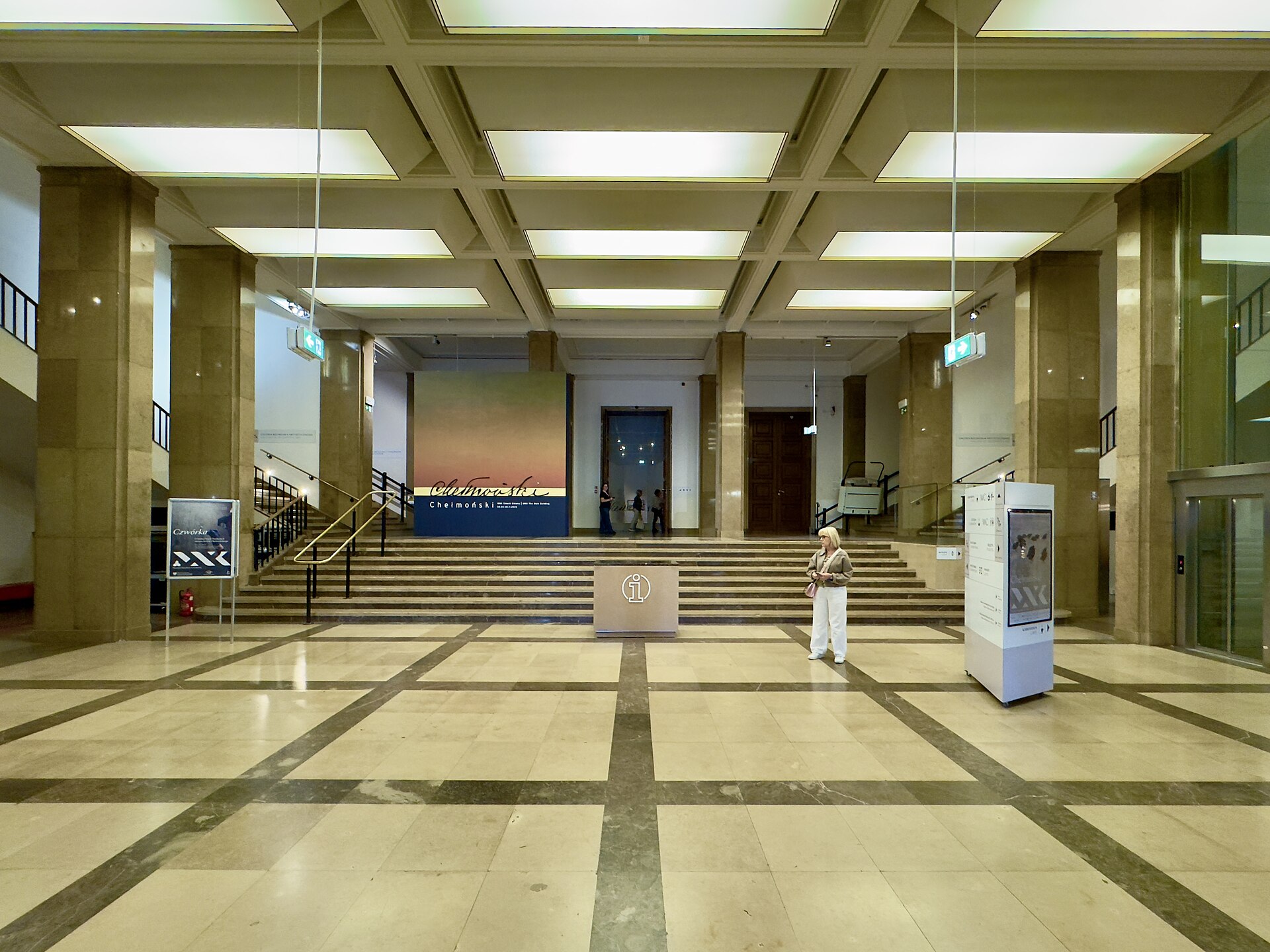
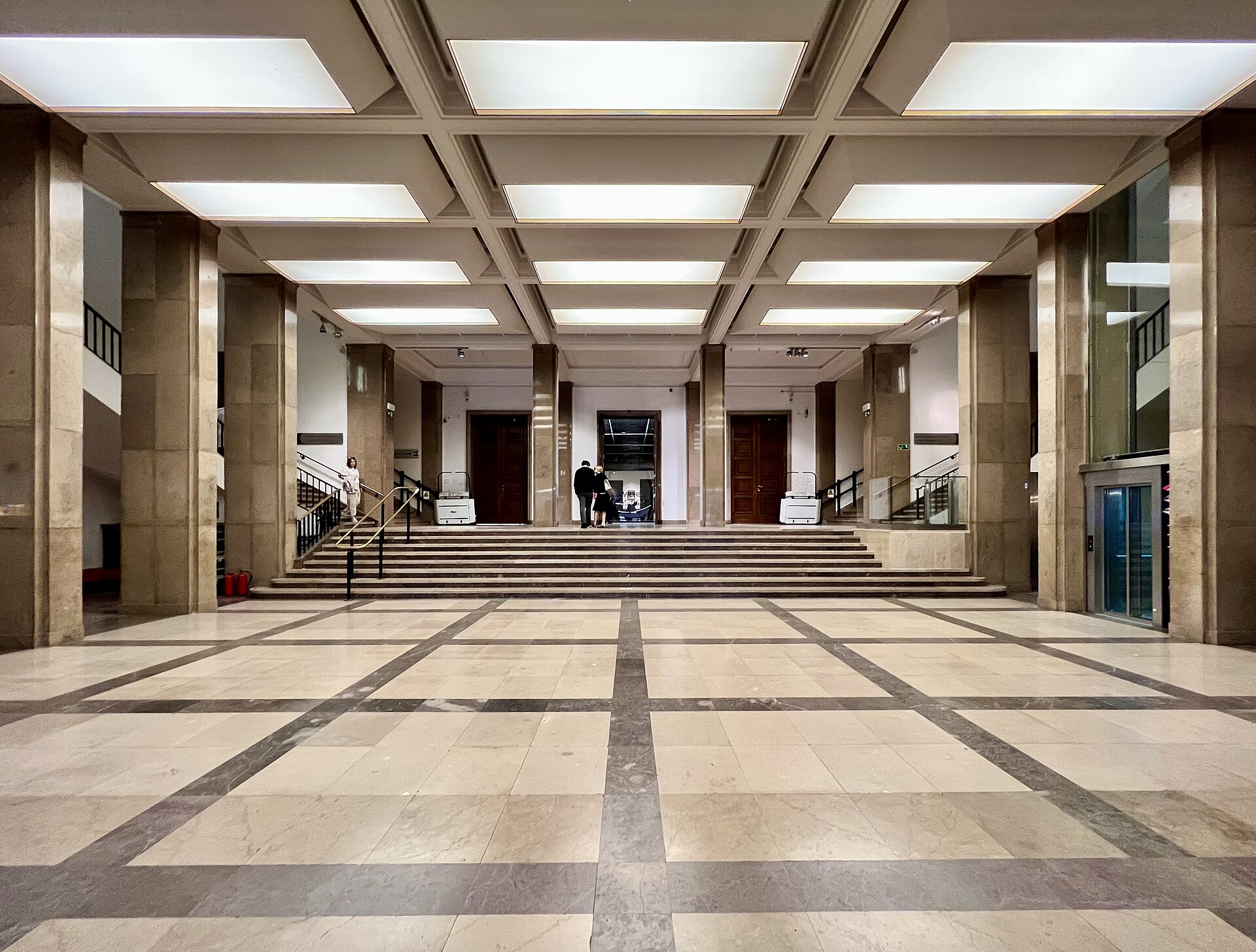
Photograph by Kgbo · CC BY-SA 4.0 Entrance Hall and Grand Staircase
The coffered, marble-floored lobby that opens directly off Aleja 3 Maja is the surviving showpiece of the building's 1930s modernized-classicism design. Its twin staircases and square stone columns have stood since the museum's ceremonial opening in November 1957 and now double as the starting point for the temporary exhibitions staged in the adjoining halls.
What to see first
Rural Cottages Among Trees
Vincent van GoghThe only Van Gogh painting in a Polish collection, painted in 1883 and authenticated in 2021 by the museum's own LANBOZ laboratory working with the Van Gogh Museum in Amsterdam, before going on long-term display in the European Art Gallery.4
Neoclassical sculpture
Antonio CanovaOne of the defining sculptors of European Neoclassicism, rarely found in public collections outside Italy, anchoring the European Art Gallery's holdings of sculpture.3
16th-century panel paintings
Lucas Cranach the Younger and Pieter Bruegel the YoungerRepresent two of the defining workshop dynasties of German and Flemish Reformation-era painting, shown together among the gallery's more than one hundred European works.3
Medieval stained glass collection
Central European workshops, medieval periodThe only such extensive holding of medieval stained glass in a Polish museum, part of a decorative-arts gallery that is the largest of its kind in the country.6
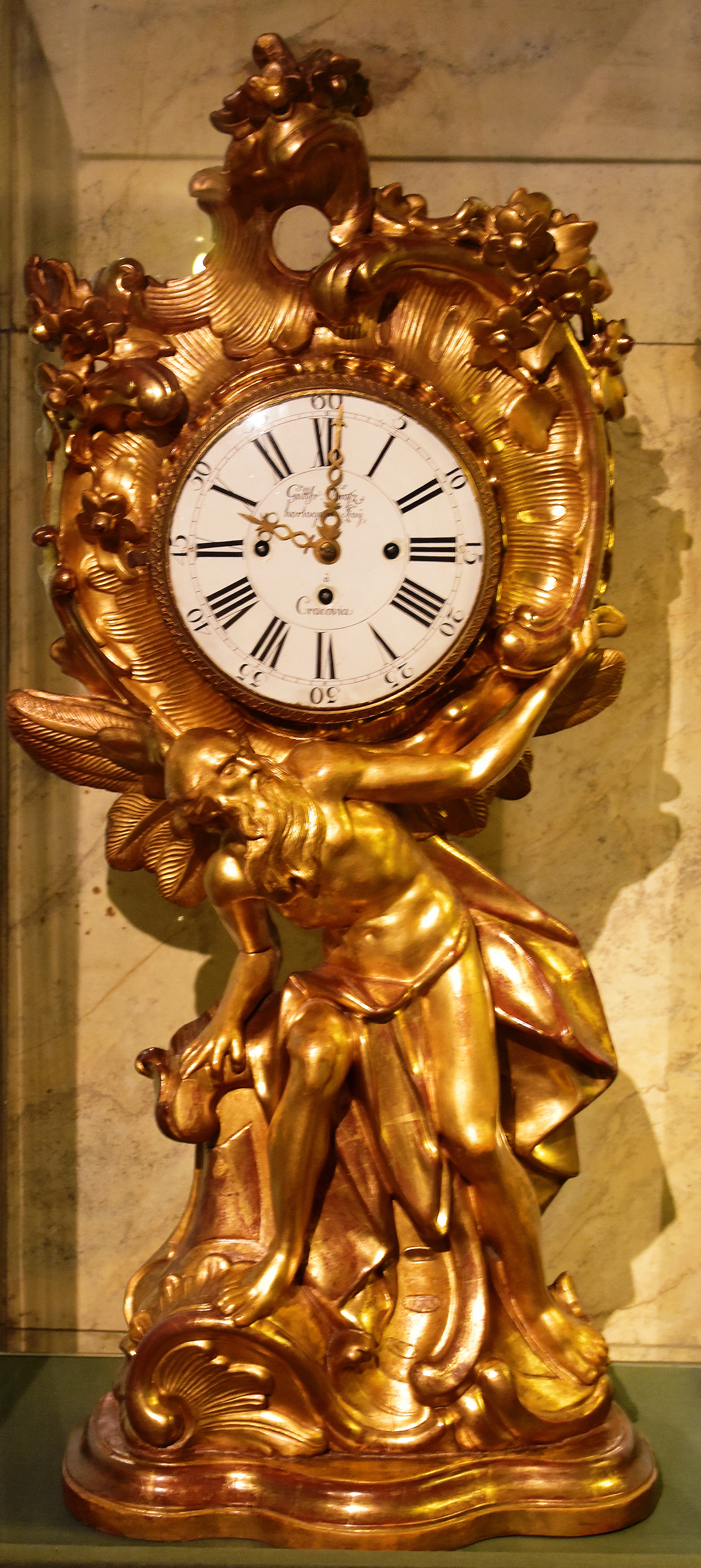
Gilded Rococo mantel clock
18th-century goldsmith's workshop, KrakowA winged figure of Chronos bears the clock face on its shoulders, a showpiece of the Gallery of Artistic Crafts' goldwork holdings, which range from 10th-century metalwork to 20th-century design.6
Postwar and contemporary Polish art holdings
Tadeusz Kantor, Magdalena Abakanowicz, Alina Szapocznikow, Wilhelm Sasnal and othersCentral figures of Poland's postwar avant-garde and its contemporary scene, shown across the twelve renovated rooms of the Gallery of Polish Art of the 20th and 21st Centuries.11
XX+XXI Sculpture Hall selection
Various, National Museum in Krakow collectionThirty-three works chosen from roughly five hundred sculptures made over seven decades, curated to trace Polish sculpture's turn from the figure toward installation and environment.5
Exhibitions on now
Past exhibitions here
Which National Museum in Krakow this is
The National Museum in Krakow is not one building but an institution of twelve divisions across the city and a thirteenth in Zakopane, all operating under the single name Muzeum Narodowe w Krakowie. This page covers one of them: the Gmach Glowny, or Main Building, at Aleja 3 Maja 1, facing the Blonia meadow west of the Old Town. It is a different building from the Sukiennice on the Main Square, which holds the Gallery of 19th-Century Polish Art, and different again from the Czartoryski Museum, which holds Leonardo da Vinci's Lady with an Ermine. The Main Building is the museum's administrative headquarters and its single largest exhibition building, housing the institution's directorate, conservation studios, photography workshop and library alongside four public galleries. Founded in 1879 as the first public museum of its kind in partitioned Poland, the institution built this specific building far later, opening it in stages from 1957 onward. A visitor who arrives expecting one museum in one building will instead find a campus, of which this is the flagship address.
A building raised across three political systems
The idea of a purpose-built home for the museum dates to 1921, when a citizens' committee formed to raise one as a monument to Poland's restored independence. Economic crisis stalled the project through the 1920s, and it was Krakow's president Mieczyslaw Kaplicki who revived it in 1931. An architectural competition followed; the winning entry from Warsaw architects was set aside, and the commission went instead to Czeslaw Boratynski, Edward Kreisler and Boleslaw Szmidt, whose modernized-classicist design broke ground in 1934 with a rectangular plan intended to allow the building to rise in stages. Construction was still underway when Germany occupied Krakow in 1939. During the occupation, the unfinished structure was requisitioned and altered by architect A. Zimmer to serve as a casino for German administrative staff, a use the museum's own institutional history records without euphemism. Work resumed after 1945, funded from 1949 by the Ministry of Culture and Art; parts of the building began functioning for museum purposes from 1952, and a ceremonial opening was held on 28 November 1957. Even then the building was not finished: further phases, including the installation of modern climate control, continued into the 1980s and were not fully complete until around 1990. From first committee to final fit-out, the building took the better part of six decades and outlasted interwar Poland, Nazi occupation and communist rule in turn.
Four galleries, and what each one is built around
What the building shows today is concentrated into four permanent installations. The Gallery of Polish Art of the 20th and 21st Centuries, reopened in a renovated form in October 2021 after a two-year, multi-million-zloty refit backed by Poland's Ministry of Culture, is the largest of the four: twelve rooms holding more than 500 works by roughly 200 artists, tracing a line from Young Poland secession to work made after 1989. The Gallery of European Art takes the opposite approach to scale, showing just over one hundred paintings and sculptures from the 13th to the 20th century, hung in reverse chronological order so a visitor walks backward through time from the entrance to a final room of Spanish Romanesque work. The Gallery of Artistic Crafts, unchanged in essential character since it opened, is the country's largest permanent decorative-arts display, spread across nine halls and two annexes. The newest addition, opened in 2024, is a dedicated Sculpture Hall extending the Polish Art gallery with three decades of postwar and contemporary work chosen from the museum's own holdings. None of the four is small; together they represent a significant share of everything the National Museum in Krakow chooses to keep on permanent view anywhere in the city.
The Van Gogh nobody expected to find in Krakow
Among everything in the European Art Gallery, one picture draws attention disproportionate to its size. Rural Cottages Among Trees, painted by Vincent van Gogh in September 1883 near The Hague, spent decades effectively lost: stored in trunks by the artist's mother, later found in an attic, and passed through private hands in Belgium and Switzerland before reaching Poland in the 1980s. Since 2020 it has been held as part of the John Paul II Collection, owned by the Archdiocese of Warsaw and kept on deposit at the Museum of John Paul II and Primate Wyszynski. Its authenticity was not a formality: in 2021 the National Museum in Krakow's own LANBOZ laboratory carried out a nine-month technical study with specialists from the Van Gogh Museum in Amsterdam, using ultraviolet light, X-rays, microscopy and scanning to examine paint layers and pigments against the artist's known technique. The painting was also cleaned, its wooden support reinforced, and given a new frame. It arrived at the newly reopened European Art Gallery in the Main Building, where press reporting at the time of its arrival described the loan as running through early 2027, making it, for now, the only Van Gogh on public view anywhere in Poland.
What the museum has been open about, and what the building itself represents
The National Museum in Krakow has published its own accounting of what the Second World War cost its collection, running a two-year digitization project in 2018 and 2019 to catalogue war losses from both its own holdings and those of the Princes Czartoryski collection. Several paintings thought lost have since resurfaced and been recovered, among them a portrait of President Ignacy Moscicki by Kazimierz Pochwalski and a still life by Jozef Pankiewicz; others, including royal jewelry and caskets from the 16th century, remain missing decades on. This building carries its own small piece of that history: unfinished when the occupation began, it was pressed into service as a casino for German administrative staff, a fact the museum states plainly on its own history page rather than glossing over. A different, quieter criticism follows from the building's scale. Much of its considerable footprint is given over to offices, conservation studios and storage rather than exhibition space, so a visitor drawn by the monumental facade may find that the four public galleries, however substantial individually, occupy a modest share of the whole structure. That gap between the building's ambition and its exhibited floor area is not hidden; it is simply how a project interrupted by two regime changes ended up being used.
Visiting: tickets, hours and a practical account of the complaints
The Main Building opens Tuesday to Sunday from 10:00 to 18:00 and is closed Monday, with last admission twenty minutes before closing. A ticket to the permanent galleries costs 45 PLN for an adult and 35 PLN reduced, with a family rate of 90 PLN and a 1 PLN rate for pupils and students; the permanent galleries are free to enter every Tuesday. Temporary exhibitions are ticketed separately, and guided tours in Polish or a foreign language, plus audio-guides in five languages, can be booked through the museum's Information and Reservation Centre. The building is largely wheelchair accessible via lifts and portable ramps, offers audio description and a guide for deaf visitors, and keeps a free cloakroom that visitors are required to use for coats and bags. Set against that, the pattern of visitor complaints is consistent enough to be worth stating rather than smoothing over: dim lighting in parts of the Gallery of Artistic Crafts that makes some labels hard to read, a multi-floor layout that visitors say is easy to get turned around in without much staff guidance, and cloakroom rules some find applied more strictly than the free service suggests. None of it displaces the collection underneath it, but a visitor planning a first trip should expect a building that rewards patience with its galleries and asks a little of it in return to find them.
What visitors say
Visitors consistently rate the Main Building among Krakow's stronger museum experiences, praising the depth of its Polish twentieth and twenty-first century holdings, the calm of a quieter alternative to the Old Town's busiest sights, and good value given free Tuesday admission and the steep student rate. Recurring complaints center on the building's layout and on lighting in the older decorative-arts galleries.
What is praised, what is criticised
- Praised: The breadth and quality of the Gallery of Polish Art of the 20th and 21st Centuries, widely regarded as one of the strongest surveys of modern Polish art on permanent public display
- Praised: Free admission to the permanent galleries every Tuesday, and a steeply discounted ticket for pupils and students the rest of the week
- Praised: A quieter, less crowded alternative to the museums clustered around the Main Square
- Praised: The free cloakroom and on-site cafe as practical conveniences for a longer visit
- Criticised: Dim lighting in parts of the Gallery of Artistic Crafts, which some visitors say makes labels hard to read
- Criticised: A layout spread across several floors and mezzanines that visitors say is easy to lose one's way in, with limited staff guidance when that happens
- Criticised: Uneven staff friendliness reported by some visitors, and a strictly enforced cloakroom policy some find unwelcoming on arrival
Ratings on other platforms
TripAdvisor: 4 from 400 ratings, read 13 August 2026
A platform average is a tertiary source: it moves, it is not audited, and we quote no visitor's words.
Questions about National Museum in Krakow
Where is National Museum in Krakow?
Aleja 3 Maja 1, 30-062 Krakow, Poland.
How much does it cost to visit?
Adult, permanent galleries: PLN 45; Reduced, permanent galleries: PLN 35; Family, permanent galleries: PLN 90; Pupils and students, permanent galleries: PLN 1; Adult, temporary exhibition: PLN 35. As confirmed 23 September 2026.
When is it open?
Monday closed; Tue-Sun 10:00-18:00. Closed: Monday. As confirmed 23 September 2026.
How do you get there?
Tram: Lines 1 and 20 to the Muzeum Narodowe stop on Aleja 3 Maja; Bus: Lines 109, 124, 134, 144, 152, 164, 169, 173, 179, 194, 249, 304, 424, 502 and 503 to the Muzeum Narodowe stop.
What should you see first?
Rural Cottages Among Trees (Vincent van Gogh); Neoclassical sculpture (Antonio Canova); 16th-century panel paintings (Lucas Cranach the Younger and Pieter Bruegel the Younger); Medieval stained glass collection (Central European workshops, medieval period); Gilded Rococo mantel clock (18th-century goldsmith's workshop, Krakow); Postwar and contemporary Polish art holdings (Tadeusz Kantor, Magdalena Abakanowicz, Alina Szapocznikow, Wilhelm Sasnal and others).
What we could not confirm
- Whether the loan of Van Gogh's Rural Cottages Among Trees from the John Paul II Collection will be extended beyond the early-2027 date reported when it arrived.
- Whether the lighting in the Gallery of Artistic Crafts, a repeated visitor complaint, is addressed in a future rehang of that gallery.
Images
Sources
- 1Muzeum Narodowe w Krakowie, MNK Gmach Glowny branch page (hours, admission, contact, accessibility, transport, description), read 2026-08-13 mnk.pl/oddzialy/gmach-glowny/
- 2Muzeum Narodowe w Krakowie, Godziny otwarcia (opening hours, all branches), read 2026-08-13 mnk.pl/informacje-praktyczne/godziny-otwarcia/
- 3Muzeum Narodowe w Krakowie, Galeria Sztuki Europejskiej (permanent exhibition page), read 2026-08-13 mnk.pl/wystawy/galeria-sztuki-europejskiej
- 4Muzeum Narodowe w Krakowie (media.mnk.pl), Obraz van Gogha w Muzeum Narodowym w Krakowie, read 2026-08-13 media.mnk.pl/aktualnosci/obraz-van-gogha-w-muzeum-narodowym-w-krakowie
- 5Muzeum Narodowe w Krakowie, XX + XXI. Rzezba (permanent exhibition page), read 2026-08-13 mnk.pl/wystawy/xx-xxi-rzezba
- 6Punkt Informacji Kulturalnej Krakow (pik.krakow.pl), Galeria Rzemiosla Artystycznego, read 2026-08-13 pik.krakow.pl/galeria-rzemiosla-artystycznego-wystawa-stala/
- 7Wikipedia (Polish), Gmach Glowny Muzeum Narodowego w Krakowie, , read 2026-08-13 pl.wikipedia.org/wiki/Gmach_G%C5%82%C3%B3wny_Muzeum_Narodowego_w_Krakowie
- 8Wikipedia (English), National Museum, Krakow, , read 2026-08-13 en.wikipedia.org/wiki/National_Museum,_Krak%C3%B3w
- 9Wikidata, Q195311, National Museum in Krakow, , read 2026-08-13 wikidata.org/wiki/Q195311
- 10TripAdvisor, National Museum in Krakow (attraction reviews), aggregate rating, read 2026-08-13 tripadvisor.com/Attraction_Review-g274772-d276736-Reviews-National_Museum_in_Krakow-Krakow_Lesser_Poland_Province_Southern_Poland.html
- 11dzieje.pl, Galeria Sztuki Polskiej XX i XXI w. krakowskiego Muzeum Narodowego w nowej odslonie, read 2026-08-13 dzieje.pl/dziedzictwo-kulturowe/galeria-sztuki-polskiej-xx-i-xxi-w-krakowskiego-muzeum-narodowego-w-nowej