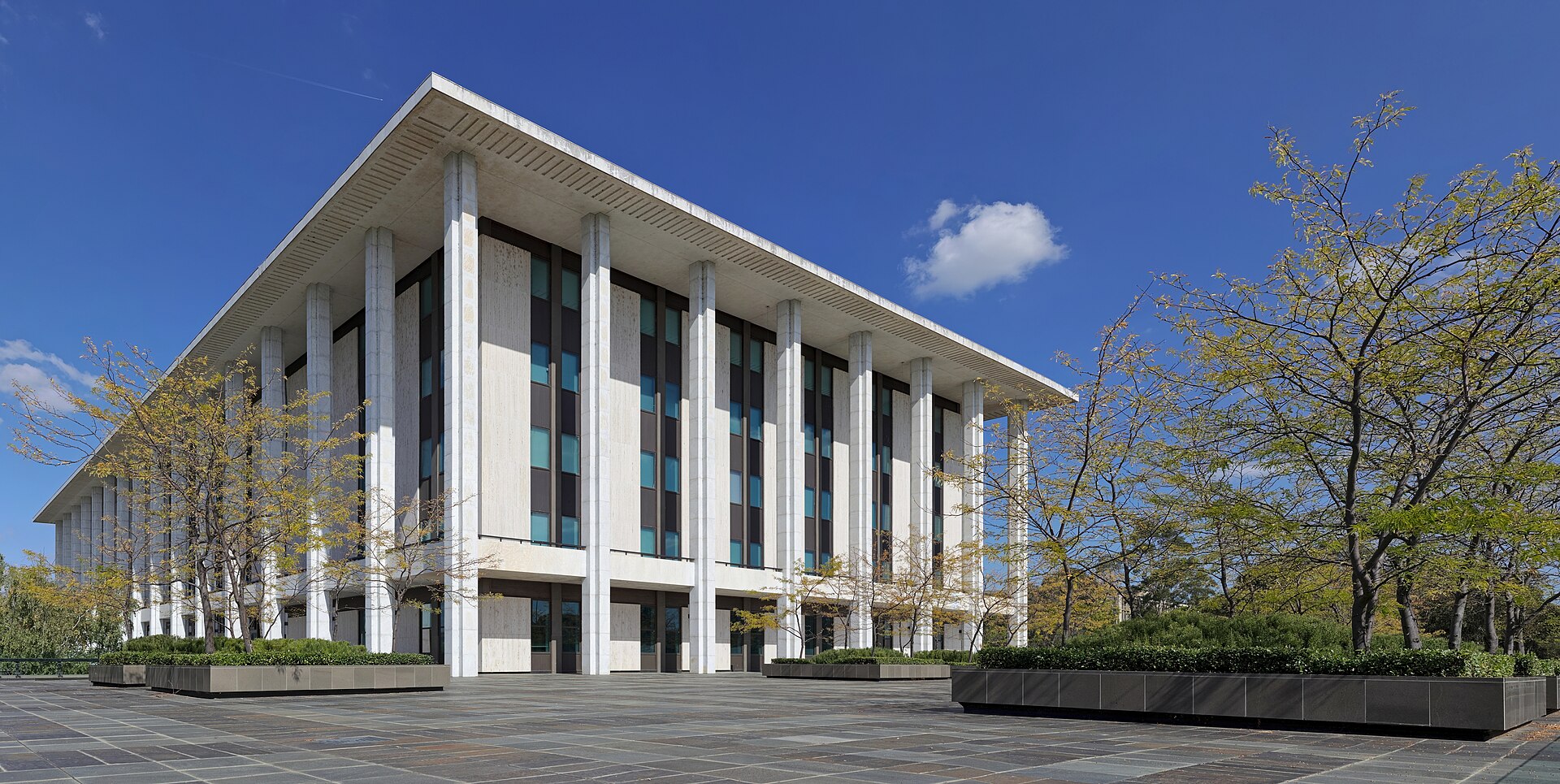
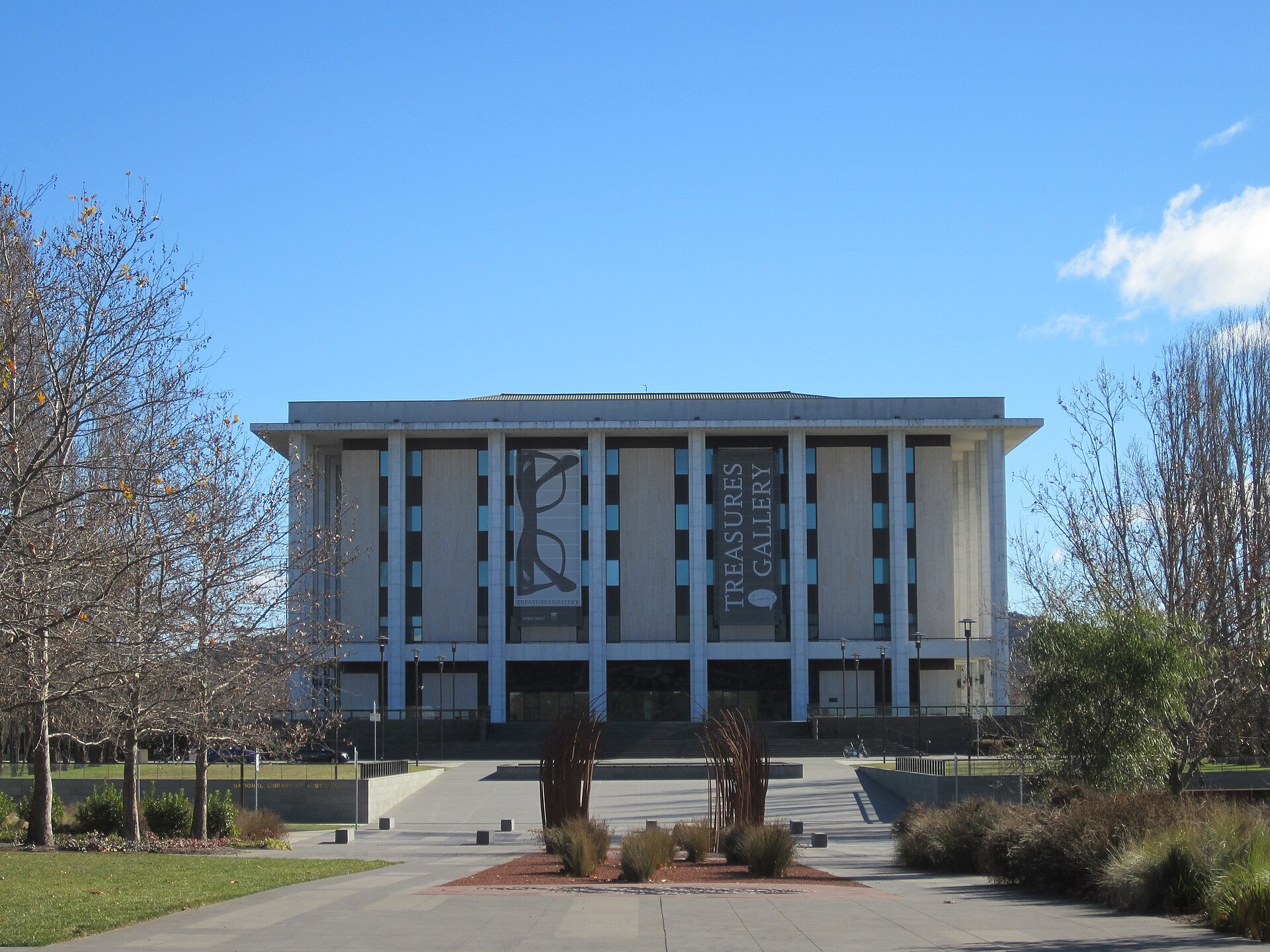
The National Library of Australia on the shore of Lake Burley Griffin, Canberra.
Thennicke · CC BY-SA 4.0National Library of Australia
Library · Founded 1960
Open, admission and hours confirmed 10 September 2026 · 15 sources
On this page 16 sections
ContentsClose
The National Library's strength is breadth of Australian documentary record rather than art or antiquities in the museum sense: more than ten million items built on legal deposit of everything published in Australia since 1968, spanning manuscripts, maps, photographs, oral histories, newspapers and ephemera, with digitisation routed through Trove, the Library's own free discovery platform. The permanent Treasures Gallery is the only part of that holding on continuous public display; everything else in the closed stacks is reached only by requesting it into a reading room.
| Kind | Library |
|---|---|
| Founded | 1960 |
| City and country |  Canberra, Australia Canberra, Australia |
| Address | Parkes Place, Canberra ACT 2600, Australia |
| Website | nla.gov.au |
| Status | Open, confirmed |
| Record last verified |
Visiting
- Hours
- Mon-Thu08:00 to 20:00Building hours
- Fri08:00 to 17:00Building hours
- Sat-Sun09:00 to 17:00Building hours
- Mon-Thu10:00 to 20:00Main Reading Room
- Fri-Sat10:00 to 17:00Main Reading Room
- Sun13:30 to 17:00Main Reading Room only; Special Collections and Petherick Reading Rooms are closed Sundays
- Closed
- Good Friday. Christmas Day.
- Admission
- General admissionFreeFree entry to the building, reading rooms and the Treasures Gallery exhibition
- Do I need to book?
- No for the building and Treasures Gallery; collection items in the reading rooms must be requested online in advance and typically take about 45 minutes to arrive on a weekday
- Address
- Parkes Place, Canberra ACT 2600, Australia MapBus Closest stops on King Edward Terrace and Commonwealth Avenue; Transport Canberra Journey Planner recommended for routes
Walking Within the Parliamentary Triangle, walking distance of Old Parliament House, the National Gallery of Australia and the National Portrait Gallery
Car Metered short-stay parking off Parkes Place West (AUD 4.20/hour) and long-stay parking toward the lake and off King Edward Terrace (AUD 17.50/day); 8 free accessible bays for permit holders - Website
- nla.gov.au
- Telephone
- +61 2 6262 1111
Before you go how long, access, photography, bags, eating, shop
- How long to allow
- 2-3 hours (Tripadvisor's own attraction summary)
- Access
- Ramp access on the south side, automatic doors to the foyer, reading rooms and galleries, lifts to all public floors, borrowable wheelchairs, height-adjustable desks, JAWS screen-reading software and video magnifiers in the Main Reading Room, hearing induction loops in the theatre and meeting rooms, and BindiMaps indoor Bluetooth-beacon navigation
- Eating
- Bookplate cafe in the foyer (Mon-Fri 8:30am-4pm, Sat-Sun 9am-4pm) and the smaller Paperplate (Mon-Fri 9am-3pm, closed weekends)
- Shop
- Bookshop in the foyer, 9am-5pm daily except Good Friday and Christmas Day, also trading online
Prices and hours change. We take them from the institution's own pages and print the day we read them, and you can check the current position at the source we used. Confirm before you travel.
What is inside
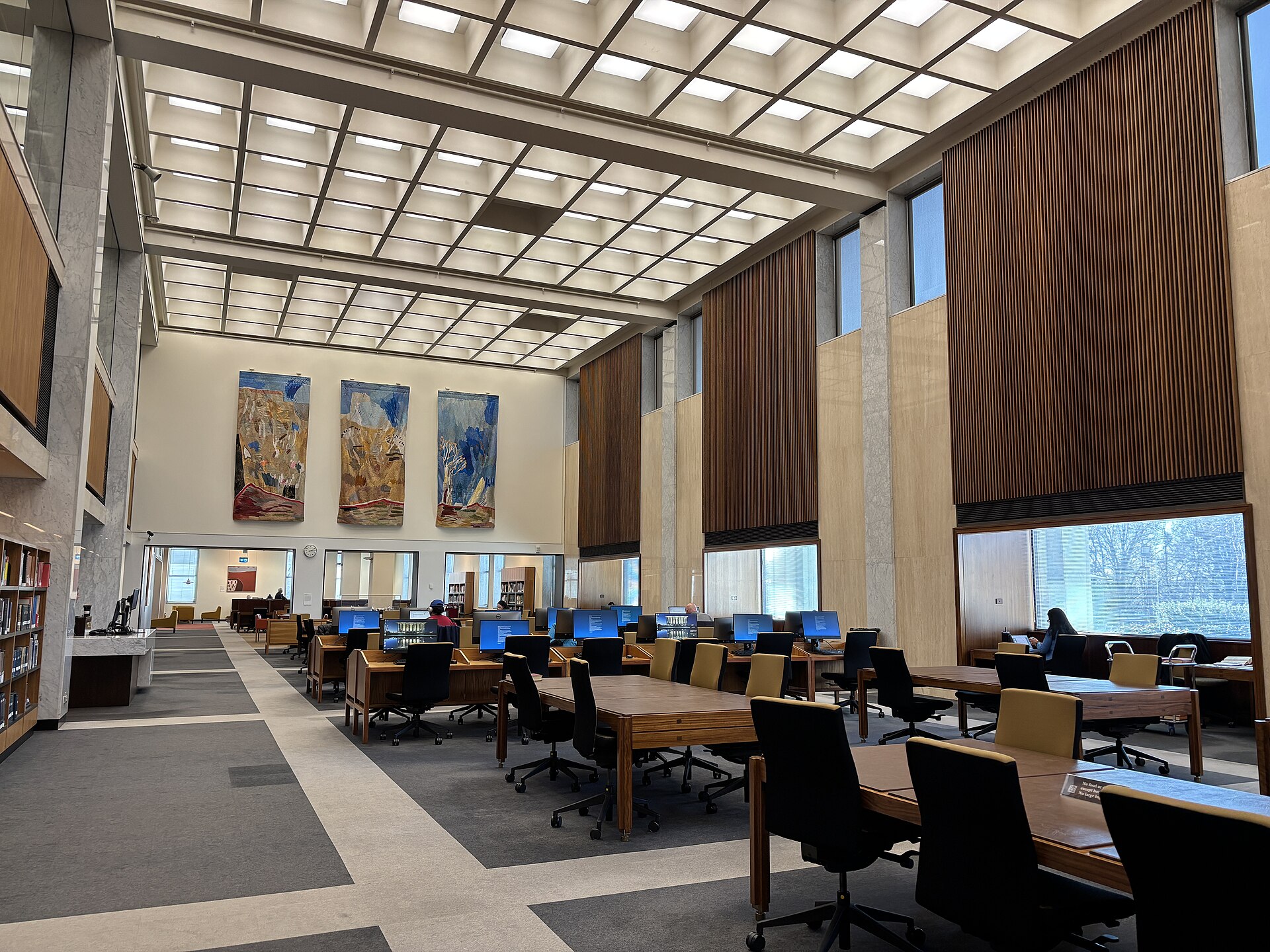
Photograph by Nick-D · CC BY-SA 4.0 Main Reading Room
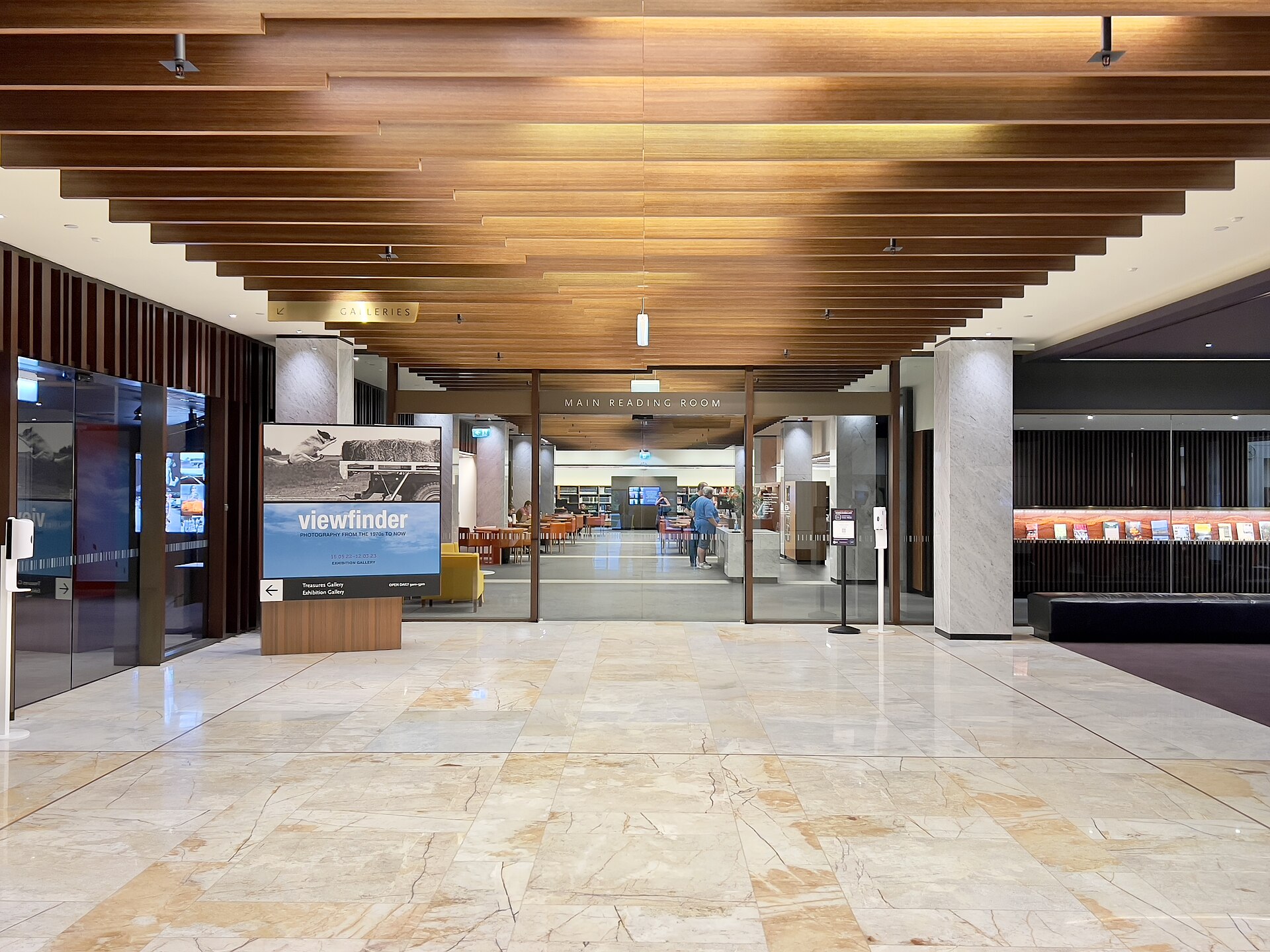
The Library's largest reading room and the usual first stop: general Australian and overseas published collections, current Australian daily newspapers, microforms, First Australians material, Asian-language titles and dictionaries, free computers and internet, and study desks with power and Wifi. Items from closed storage are requested online and delivered to the desk, generally within about 45 minutes on a weekday, and held for the reader for 7 days.
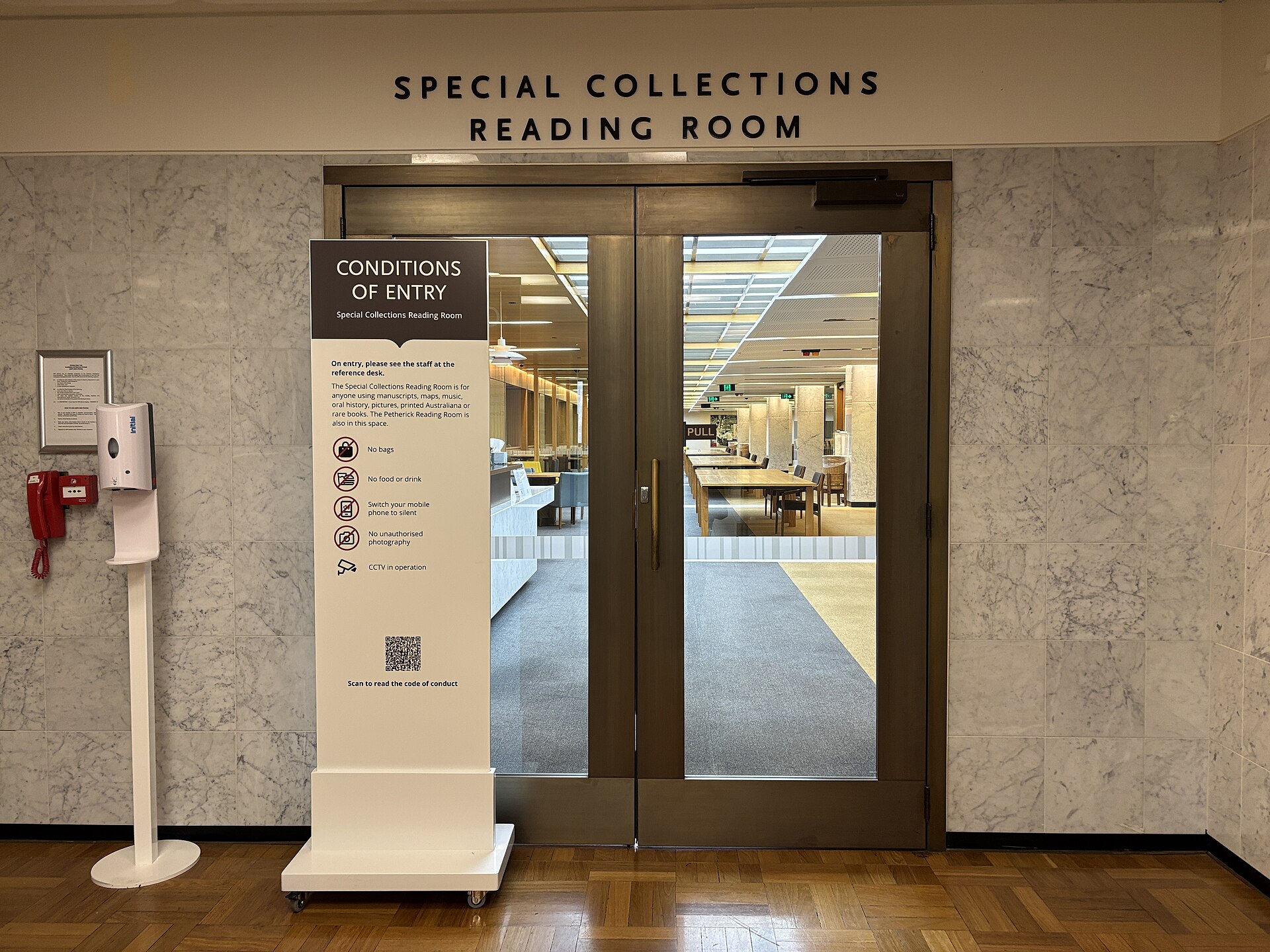
Photograph by Nick-D · CC BY-SA 4.0 Special Collections Reading Room
A separate, more closely supervised reading room where manuscripts, rare books, maps, family-history material and personal papers are produced to readers. Closed on Sundays as well as public holidays, unlike the Main Reading Room.
Photograph by Nick-D · CC BY-SA 4.0 Treasures Gallery
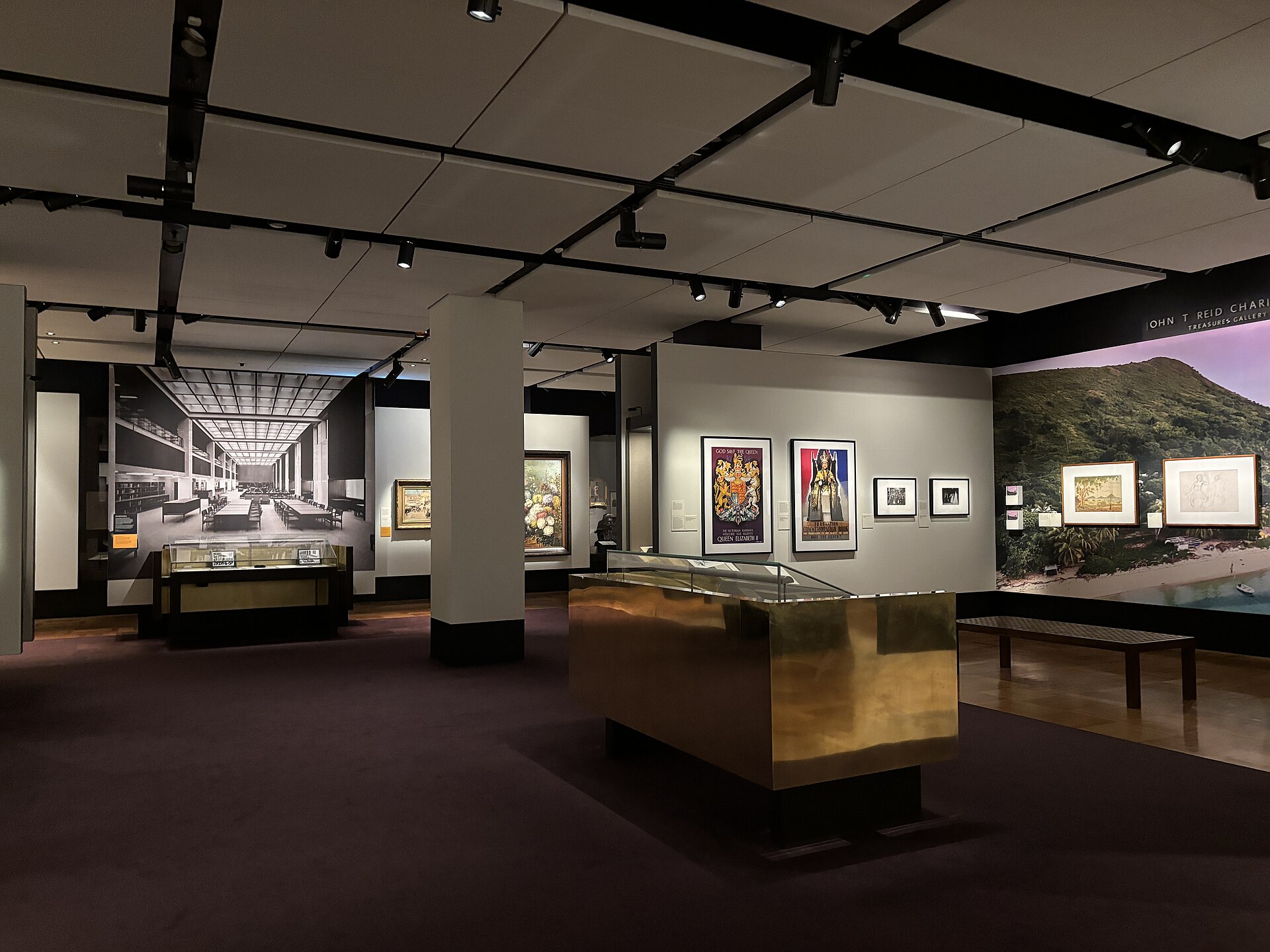
The Library's free permanent exhibition space off the main foyer, needing no reader's card. Refreshed in December 2025, it rotates highlights from the physical and digital collection: manuscripts, maps, photographs, paintings and everyday ephemera, chosen to show visitors what the Library actually holds beyond the reading rooms.
Photograph by Nick-D · CC BY-SA 4.0 Foyer
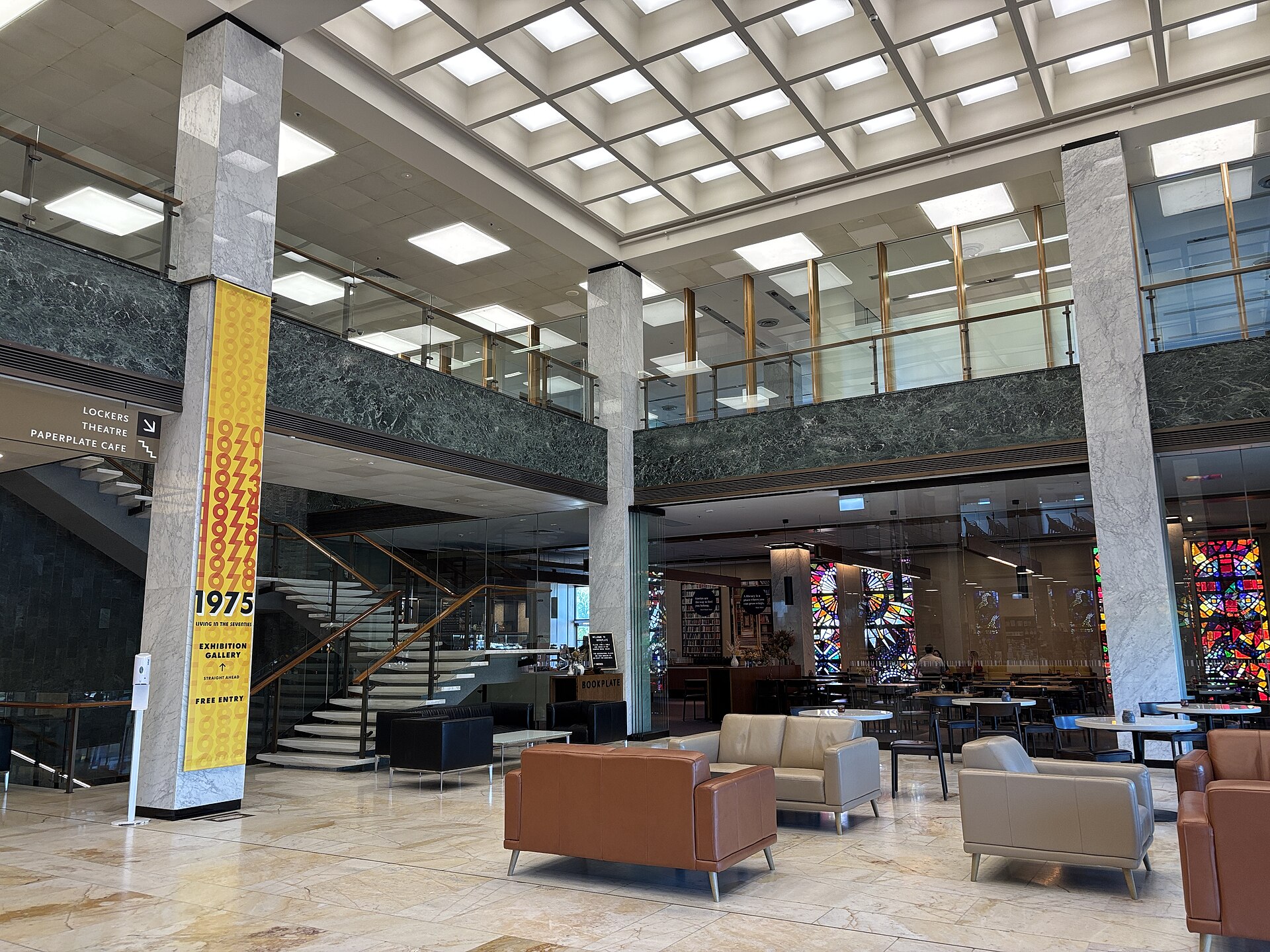
The building's entrance hall, with the information desk, the wheelchair loan point, Leonard French's stained-glass windows and Tom Bass's 1968 bas-relief, and access to the Bookplate cafe, the bookshop and the Treasures Gallery.
Bookplate cafe and the Library bookshop
The cafe and bookshop flank the entrance hall; Tripadvisor reviewers single out the bookshop's staff and range of gifts specifically. No free-licence interior photograph of either space was found on Commons; none is attached rather than substituting a different room.
What to see first
Waltzing Matilda manuscript (the Bartlam-Roulston manuscript)
Christina Macpherson, c.1895The earliest known written notation of the tune that became Australia's best-known song, held in the Treasures Gallery.11
Leaf from the First Folio: The Merchant of Venice
William Shakespeare, printed 1623; this binding by Sangorski and SutcliffeA surviving page from the 1623 First Folio, the collected edition that preserved half of Shakespeare's plays from being lost entirely.11
Tactile Braille map of Australia
Martin Kunz for the Verein zur Forderung der Blindenbildung, 1889An 1889 map of the continent embossed for reading by touch, evidence of how the Library's collecting reaches beyond conventional print.11
The Cats' Bathhouse
Japanese woodblock print, 1884A comic ukiyo-e print of cats at a public bathhouse, one of the Treasures Gallery's non-Australian holdings.11
Cedar bookcase carved by Dorothea Mackellar
Dorothea MackellarA piece of furniture made by the poet best known for 'My Country', tying the Library's literary holdings to an object rather than only a manuscript.11
Freda Thompson aviation photographs
Photographer unattributed in the Library's own description, c.1934Images of aviator Freda Thompson turning her own aircraft's propeller, part of the Library's photographic record of Australian women in aviation.11
Lockhart family wedding veil photographs
Multiple photographers, spanning 64 yearsA photographic series documenting 27 brides who wore the same family veil, an example of the Library's collecting of ordinary social history alongside its famous items.11
Working manuscript for Where Is the Green Sheep?
Mem Fox and Judy HoracekDraft material for a contemporary Australian picture book, placed beside centuries-old treasures to make the Library's point that the collection covers the everyday as well as the rare.13
Exhibitions on now
- On now4 Apr 2026 to 31 Jan 2027Confirmed , 5 weeks ago
- On now22 Sep 2026 to 19 Sep 2027Confirmed , 5 weeks ago
Past exhibitions here
The building and what it was designed to hold
The National Library of Australia stands on the shore of Lake Burley Griffin in Canberra's Parliamentary Triangle, a colonnaded marble hall that architect Walter Bunning, working with T. E. O'Mahony, designed in a style the Library itself calls Contemporary Classical - a deliberate merging of the American modernist classicism associated with Edward Stone and a distinctly Australian national identity. Construction took seven years; the building opened on 15 August 1968, dedicated by Prime Minister John Gorton, at a cost of 8 million dollars plus a further 600,000 dollars on furnishings and equipment.
The exterior is light marble cladding over a podium of grey trachyte, with granite, bronze, slate and copper detailing and a copper roof. The colonnade that gives the building its temple-like profile was originally drawn as seventeen columns by eight and cut back to sixteen by eight during construction, a change made purely to save 250,000 dollars. Inside, red cedar panelling lines the Nan Kivell Room and furniture designed by Fred Ward and Arthur Robinson remains part of the working collection of fittings. The foyer and reading rooms carry two major commissions: a 1968 bas-relief by sculptor Tom Bass, and stained-glass windows by Leonard French that visitors still mention first on arrival. A hailstorm in 2020 damaged the copper roof badly enough to require repair, a maintenance bill that landed on an institution already dealing with the funding pressure described below.
From a parliamentary annexe to an independent national library
The Library's own account of its history traces its origin to 1901, when the Commonwealth Parliamentary Library served the newly federated Australian Parliament; the collection moved to Canberra with Parliament in 1927 and for three decades remained administratively part of the legislature it served. The National Library Act 1960 separated it into an independent statutory body with its own national collecting mandate, and the new Parkes Place building gave that mandate a permanent home eight years later.
Under the Copyright Act 1968 the Library holds legal deposit rights over everything published in Australia, a right that its own curators describe as adding roughly 2.5 linear kilometres of new physical material to the collection every year, on top of everything gathered digitally. The Library now describes its holdings, spread across sites in Canberra and a fourth building in Jakarta, as more than ten million items - the overwhelming majority of which sit in closed storage rather than on any shelf a visitor can browse directly.
What is inside
Most of what the Library holds is reached by request rather than by browsing. The Main Reading Room on the ground floor is the usual first stop: general published collections, current Australian daily newspapers, microforms, First Australians material, Asian-language titles and dictionaries, plus free computers, scanners and study desks. Anything from closed storage has to be requested through a Library account in advance; it generally takes about 45 minutes to reach the desk on a weekday and is held for the reader for seven days. The Special Collections Reading Room, entered separately, is where manuscripts, rare books, maps and personal papers are produced to readers under closer supervision; unlike the Main Reading Room it is closed on Sundays as well as public holidays.
The free Treasures Gallery, reachable straight off the foyer, is the one part of the building that needs no reader's card at all: a rotating display of the Library's most striking holdings, refreshed in December 2025 specifically to answer the question curator Grace Blakeley-Carroll says visitors ask most often on arrival - where all the books actually are, given that none of the ten million items are visible from the foyer. The Bookplate cafe and the Library's own bookshop sit either side of the entrance hall and are, together with the volunteer-led behind-the-scenes tours, the two things Tripadvisor reviewers mention most often outside the collection itself.
In the Treasures Gallery
The objects the Library puts on permanent free display run from the instantly recognisable to the quietly strange, and the range is the point. The manuscript on which Christina Macpherson first wrote down the tune later known as Waltzing Matilda sits in the same gallery as a leaf from a 1623 First Folio printing of Shakespeare's The Merchant of Venice, an 1889 tactile map of Australia embossed in Braille by the Verein zur Forderung der Blindenbildung, and a nineteenth-century Japanese woodblock print of cats at a public bathhouse. A cedar bookcase carved by the poet Dorothea Mackellar, photographs of aviator Freda Thompson turning her own aircraft's propeller in about 1934, and a photographic record of the twenty-seven brides who wore one Canberra family's wedding veil across sixty-four years, sit beside the working drafts of a contemporary Australian picture book, Where Is the Green Sheep?. Director-General Guy Hansen put the curatorial logic behind that mix plainly: everything the Library holds, he said, is a treasure for the nation, not only the rare and famous items.
Underfunded twice: Trove's two near-collapses
The Library's public reputation for openness rests heavily on Trove, its free online discovery service linking millions of digitised newspaper pages, books, photographs and records, and Trove has twice come close to being switched off by its own funder. In February 2016 the federal government's efficiency dividend forced 4.4 million dollars of savings from the Library over two financial years; a leaked internal email from then Director-General Anne-Marie Schwirtlich put the resulting job losses at 22, more than double the number first raised at Senate Estimates, and named the digitisation programme that feeds Trove as the single largest casualty. Regional and remote researchers, who depend on digitised access rather than a reading-room visit, were flagged at the time as the group with most to lose.
The same pattern repeated in 2023: dedicated federal funding for Trove was due to lapse that July with no ongoing commitment behind it, and the Library said publicly it would have to consider withdrawing the service. Senator Katy Gallagher warned that without new money Trove would simply cease to exist within a few months. The May 2023 budget answered with 33 million dollars over four years for the Library as a whole, plus a further 9.2 million dollars specifically for Trove, with indexed ongoing funding promised only from July 2027. Both episodes are worth knowing before treating a national library as a synonym for permanently secure: the institution's core public-facing service has come within months of being switched off twice in less than a decade, for budgetary rather than technical reasons.
Visiting today
Entry to the building, the reading rooms and the Treasures Gallery is free. The building itself is open Monday to Thursday 8am to 8pm, Friday 8am to 5pm, and Saturday and Sunday 9am to 5pm, with public holiday hours matching the weekend and the building closed only on Good Friday and Christmas Day; the Main Reading Room keeps shorter hours than the building and the Special Collections and Petherick Reading Rooms close on Sundays as well as public holidays. The Library sits within walking distance of Old Parliament House, the National Gallery of Australia and the National Portrait Gallery, and is served by bus stops on King Edward Terrace and Commonwealth Avenue rather than light rail. Parking directly outside is metered rather than free, at 4.20 dollars an hour or 17.50 dollars for a full long-stay day, worth budgeting for given nothing else about the visit costs anything. Eight accessible parking bays sit off Parkes Place West, the building is reachable by ramp as well as the front steps, and BindiMaps indoor navigation, JAWS screen-reading software, video magnifiers and hearing induction loops are installed across the public reading rooms and theatre.
What visitors say
Visitors consistently rate the National Library well above its category average for Canberra attractions and, with 708 Tripadvisor reviews averaging 4.4 out of 5, describe a free, unhurried and unexpectedly rich visit built around the Treasures Gallery, the building's mid-century architecture and its staff, rather than around the closed-stack collection most readers never see. The main complaint is not about the collection but about access to see it: parts of the exhibition space have occasionally closed on short notice for staffing reasons, and paid parking is the one cost attached to an otherwise free day out.
What is praised, what is criticised
- Praised: Free entry to the building, the reading rooms and the Treasures Gallery, repeatedly called out by reviewers as unexpected value for a full morning or afternoon
- Praised: Free guided 'behind the scenes' tours of the closed stacks and compactus shelving, run by volunteer guides
- Praised: Friendly, knowledgeable staff, named specifically in both the Bookshop and on tours
- Praised: The building itself: Leonard French's stained glass, the colonnade, and the view across Lake Burley Griffin, which one reviewer compared to the Parthenon on the Acropolis
- Criticised: Sections of the exhibition galleries, including the Treasures Gallery itself, can close without warning when security staff are short, which has disappointed visitors who travelled specifically to see it (Tripadvisor, LAW64, 31 March 2026)
- Criticised: Parking directly at the Library is metered rather than free - AUD 4.20 an hour or AUD 17.50 for a long-stay day - an unexpected cost against a visit that is otherwise free
Ratings on other platforms
Tripadvisor: 4.4 from 708 ratings, read 10 September 2026
A platform average is a tertiary source: it moves, it is not audited, and we quote no visitor's words.
Questions about National Library of Australia
Where is National Library of Australia?
Parkes Place, Canberra ACT 2600, Australia.
How much does it cost to visit?
General admission: free. As confirmed 10 September 2026.
When is it open?
Mon-Thu 08:00-20:00; Fri 08:00-17:00; Sat-Sun 09:00-17:00; Mon-Thu 10:00-20:00; Fri-Sat 10:00-17:00; Sun 13:30-17:00. Closed: Good Friday. Christmas Day. As confirmed 10 September 2026.
How do you get there?
Bus: Closest stops on King Edward Terrace and Commonwealth Avenue; Transport Canberra Journey Planner recommended for routes; Walking: Within the Parliamentary Triangle, walking distance of Old Parliament House, the National Gallery of Australia and the National Portrait Gallery; Car: Metered short-stay parking off Parkes Place West (AUD 4.20/hour) and long-stay parking toward the lake and off King Edward Terrace (AUD 17.50/day); 8 free accessible bays for permit holders.
What should you see first?
Waltzing Matilda manuscript (the Bartlam-Roulston manuscript) (Christina Macpherson, c.1895); Leaf from the First Folio: The Merchant of Venice (William Shakespeare, printed 1623; this binding by Sangorski and Sutcliffe); Tactile Braille map of Australia (Martin Kunz for the Verein zur Forderung der Blindenbildung, 1889); The Cats' Bathhouse (Japanese woodblock print, 1884); Cedar bookcase carved by Dorothea Mackellar (Dorothea Mackellar); Freda Thompson aviation photographs (Photographer unattributed in the Library's own description, c.1934).
What we could not confirm
- The Library's current annual operating budget and whether the indexed Trove funding promised from July 2027 has since been confirmed in a later federal budget are not detailed on the Library's own site as read for this page.
- Whether the copper roof damage from the 2020 hailstorm has been fully repaired, or remains an ongoing maintenance item, is not stated on the Library's current site.
Images
Sources
- 1Wikidata, Q623578, National Library of Australia wikidata.org/wiki/Q623578
- 2Wikimedia Commons, Category:National Library of Australia commons.wikimedia.org/wiki/Category:National_Library_of_Australia
- 3National Library of Australia, Visit library.gov.au/visit
- 4National Library of Australia, Opening hours library.gov.au/visit/opening-hours
- 5National Library of Australia, Contact us library.gov.au/services/contact-us
- 6National Library of Australia, History of the National Library of Australia library.gov.au/visit/about-us/history-national-library-australia
- 7National Library of Australia, Our building library.gov.au/visit/our-building
- 8National Library of Australia, Main Reading Room library.gov.au/visit/reading-rooms/main-reading-room
- 9National Library of Australia, Accessibility library.gov.au/visit/accessibility
- 10National Library of Australia, Getting here library.gov.au/visit/getting-here
- 11National Library of Australia, Treasures Gallery library.gov.au/whats-on/exhibitions/treasures-gallery
- 12Tripadvisor, National Library of Australia, Canberra (reviews) tripadvisor.com.au/Attraction_Review-g255057-d2510369-Reviews-National_Library_of_Australia-Canberra_Australian_Capital_Territory.html
- 13ABC News, 'National Library of Australia reveals its treasures with exhibition showcasing books from throughout history', 11 December 2025 abc.net.au/news/2025-12-11/national-library-australia-exhibition-reveals-treasures/106126192
- 14ABC News, 'Trove secures funding as federal government comes to rescue of National Library of Australia's digitised archive', 3 April 2023 abc.net.au/news/2023-04-03/funding-for-trove-announced-by-federal-government/102177488
- 15ABC News, 'National Library funding cuts to have grave impact with 22 staff set to lose jobs', 22 February 2016 abc.net.au/news/2016-02-22/national-library-of-australia-funding-cuts/7190528