National Historical Museum of Ukraine
Museum · Natsionalnyi muzei istorii Ukrainy · Founded 1899
Closure confirmed 18 September 2026 · 20 sources
Closed to visitors - not permanently
National Historical Museum of Ukraine is currently closed. The museum's own homepage states plainly, in a standing notice, that it 'will be closed to visitors until 30 September for technical reasons.' A separate, more recent notice on the same page (04.09.2026) says the museum's public events are cancelled 'due to the security situation' in Kyiv, and a 31.08.2026 news item repeats that the museum is temporarily closed. The site gives no further detail tying the two notices together, so this record treats the technical closure as the operative status and records the security notice as an added, current restriction rather than assuming a single unstated cause. The Treasury branch at Lavrska/Mazepy Street 9, which is administratively part of this museum, continues to state its own Tuesday-Sunday hours on the same site and is not covered by the technical closure notice as worded.
Expected to reopen: until 30 September · a target, not yet confirmed
Closure confirmed 18 September 2026 from the institution's own page. We re-check this page on a schedule and will update it, from the institution's own announcement, the moment it reopens.
On this page 13 sections
ContentsClose
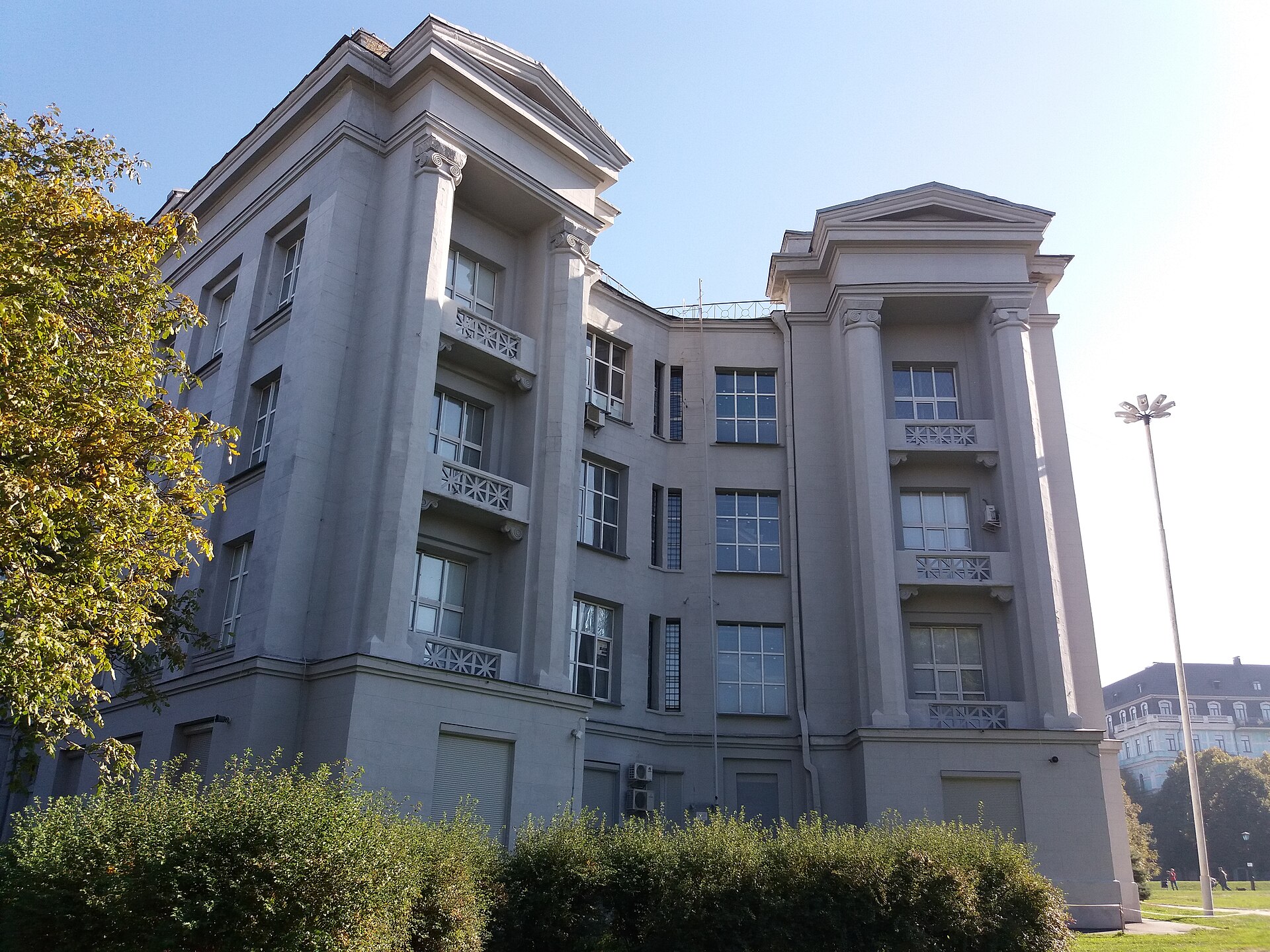
The museum's defining strength is depth in the archaeology of Ukrainian territory across the longest possible span, from Palaeolithic stone tools through Trypillia, the Scythian kurgan culture and Kyivan Rus to the modern period, backed by a Treasury branch holding what the museum describes as probably the world's largest collection of Scythian gold. That depth is now compounded by an unusual, and unwelcome, secondary strength: since 2022 the museum has also become one of Ukraine's central repositories for cultural property recovered from war-related displacement and cross-border looting, receiving both the Crimean gold stranded in Amsterdam since 2014 and archaeological material smuggled through Estonia, so that its current holdings increasingly double as a record of Ukraine's own fight to keep its patrimony inside its borders.
| Local name | Natsionalnyi muzei istorii Ukrainy |
|---|---|
| Kind | Museum |
| Founded | 1899, as the Museum of Antiquities and Arts; opened to the public in 1904; moved to its present building in 1944 |
| City and country |  Kyiv, Ukraine Kyiv, Ukraine |
| Address | 2 Volodymyrska Street, Kyiv, 01001, Ukraine |
| Website | nmiu.org |
| Status | Closed temporarily, confirmed 18 September 2026 |
| Record last verified | 18 September 2026 |
Visiting
- Hours (pre-closure)
- Daily10:00 to 18:00Main museum, Volodymyrska Street 2. Ticket desk closes at 17:00. These are the museum's own stated regular hours; the museum itself is currently closed to visitors, see open_status.
- Tue-Sun10:00 to 17:45Treasury branch, Lavrska/Mazepy Street 9. Cash desk closes at 17:00.
- Closed
- Treasury branch closed Mondays.
- Admission (pre-closure)
- Adult, self-guidedUAH 200Main museum building, Volodymyrska Street 2
- Concession (students, pupils, pensioners), self-guidedUAH 100
- Preschool childrenFreeFree, must be accompanied by an adult
- Combined ticket, adult (both the main museum and the Treasury, valid 30 days)UAH 300
- Combined ticket, concession (both sites, valid 30 days)UAH 150
- Do I need to book?
- The main museum building is not currently accepting visitors, see open_status. When open, self-guided entry needs no advance booking; guided tours (individual, family or group, in Ukrainian or a foreign language) are bookable in advance through the museum. Saturday public events have continued through the current closure of the main building.
- Address
- 2 Volodymyrska Street, Kyiv, 01001, Ukraine MapMetro Zoloti Vorota station (Syretsko-Pecherska line) has a street exit directly onto Volodymyrska Street and is linked by an underground passage to Teatralna station (Sviatoshynsko-Brovarska line), putting both metro lines within a short walk of the museum entrance.
- Website
- nmiu.org
- Telephone
- +380 44 278 48 64
- [email protected]
Before you go how long, access, photography, bags, eating, shop
- How long to allow
- The self-guided permanent exhibition runs across three floors and is large enough that reviewers who went without a guide have reported losing track of its chronological layout; visitors who booked an English-speaking guide describe sessions of an hour and a half or more.
- Access
- The museum's own visit page states that wheelchairs and prams are permitted and advises contacting staff in advance for assistance.
- Photography
- Permitted without flash; the museum's own wording is 'take pictures, but without a flash' to protect the artefacts.
- Bags
- Bags, backpacks, briefcases and umbrellas larger than 40 x 30 cm must be left in the cloakroom.
- Eating
- Not listed on the museum's own site.
- Shop
- Not listed on the museum's own site.
The museum is closed (see above). These are the figures published before the closure, kept here for a visitor planning ahead rather than presented as bookable today, and you can check the current position at the source we used. We will re-confirm them once it reopens.
What is inside
Archaeology department
The museum's founding department, tracing settlement in Ukraine from Palaeolithic stone tools through the Trypillia culture and the Scythian era to Kyivan Rus; it was built up from 1899 by the archaeologist Vikentii Khvoika and grew to roughly 15,000 items by 1909, before the collection's later growth to its present scale.
Numismatic department
Coins and medals from antiquity to the modern period, including Greek Black Sea colony issues, medieval and early modern Ukrainian and Rus coinage, and material connected to the museum's continuing recoveries of smuggled and looted finds.
Decorative and applied arts halls ("Decorative Landmarks")
Ukrainian silverwork, jewellery and decorative metalwork from the 16th to 19th centuries, medieval Rus jewellery from hoards such as Sakhnivka, and Jewish ceremonial silver and Crimean Tatar craftsmanship, tracing the applied arts across the different communities historically present on Ukrainian territory.
"Old Kyiv" and ethnographic department
Material on the city's own medieval and early modern history alongside the museum's ethnographic collection of Ukrainian folk material culture -- traditional dress, textiles and household objects -- assembled in large part through the early-20th-century acquisitions of Danylo Shcherbakivskyi.
Manuscripts and printed heritage ("Written Notes")
Manuscripts, early printed books and documentary material relating to Ukrainian statehood and cultural history, drawn from the museum's library, which already held over 1,700 volumes by 1909.
Treasury branch (precious-metal collection)
A separate building at Lavrska/Mazepy Street 9, administratively part of the museum, holding some 57,000 items in gold, silver and gemstones -- what the museum describes as probably the world's largest collection of Scythian precious-metal objects, including the Golden Pectoral from Tovsta Mohyla, gold-sheathed weapons, ceremonial helmets and the 2023 and 2024 repatriations from the Netherlands and Estonia.
What to see first
Golden Pectoral from Tovsta Mohyla
Greek goldsmiths, probably working in a workshop in the Bosporan Kingdom (the attribution is disputed; some scholars argue for Scythian makers)Discovered by the archaeologist Borys Mozolevskyi on 21 June 1971 in the Tovsta Mohyla kurgan, this 30.6 cm gold crescent weighing just over 1,150 grams is soldered from dozens of individually cast figures across three registers -- Scythian daily life, animal combat, and cosmology -- and is treated in the scholarship as the single most important object recovered from two and a half centuries of Scythian kurgan excavation. It is displayed in the Treasury branch.15
Scythian sword with gold-sheathed scabbard from Tovsta Mohyla
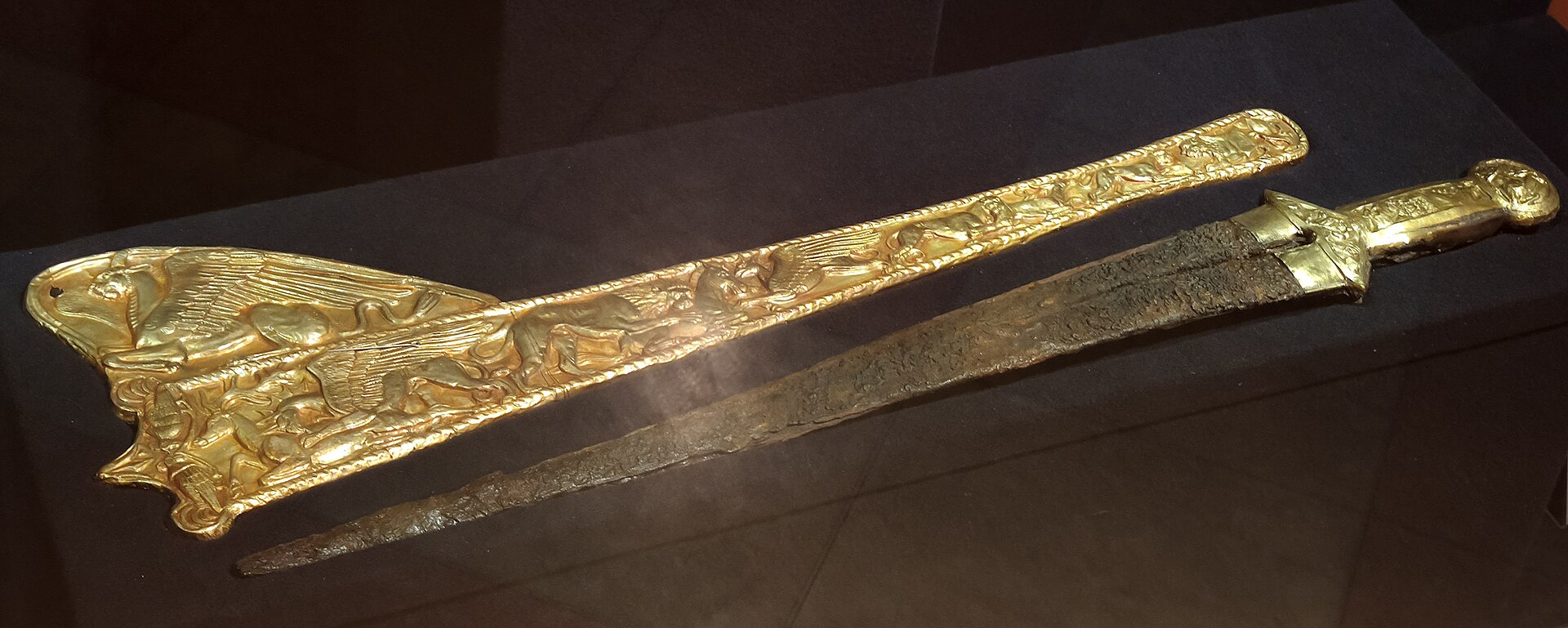
Scythian-Greek metalwork, 4th century BCRecovered from the same 1971 excavation as the pectoral, the gold scabbard is worked in relief with combat and animal scenes typical of the kurgan's grave goods and is displayed alongside the pectoral in the Treasury.12
Scythian golden gorytos (bow-and-arrow case)
Scythian-Greek metalwork, 4th century BCA gold-covered combined bow case and quiver of a type that recurs across the richest Scythian burials; the museum holds more than one example, including a further gorytos from a kurgan near Melitopol.12
Scythian ceremonial gold helmet from Perederieva Mohyla
Scythian-Greek metalwork, 4th century BCA gold funerary or ceremonial helmet from the Perederieva Mohyla kurgan, part of the same body of aristocratic Scythian grave goods as the pectoral and the gold-sheathed weapons in the Treasury's holdings.12
The 565 Crimean-gold objects returned from the Allard Pierson Museum, Amsterdam
Multiple Scythian and Sarmatian workshops, and later antique and Chinese lacquer pieces, on loan from four Crimean museumsLent to Amsterdam for the exhibition 'Crimea -- Gold and Secrets of the Black Sea' in 2014, the objects became stranded when Russia annexed Crimea that year. The Dutch Supreme Court ruled on 9 June 2023 that they belonged with the state of Ukraine rather than the occupied Crimean museums, and the collection reached Kyiv on 27 November 2023 to be held at this museum until Crimea's Ukrainian museums can receive it back.16
The 274 objects repatriated from Estonia
Scythian, Khazar, Byzantine and other workshops spanning roughly a millenniumEstonian customs seized the objects, including 115 ancient and medieval coins, gold and silver jewellery, and Khazar horse ornaments, from a truck at the Luhamaa border crossing from Russia in 2018 after determining they had been looted from sites in eastern and southern Ukraine. Estonia returned them in 2024 and the museum opened the exhibition 'From Sea to Sea' with the recovered objects, including a Viking-era sword, on 18 July 2024.17
The evacuated 2022 permanent-collection holdings
The museum's own archaeological, numismatic and decorative-arts holdings, 800,000 objects in totalIn the first days of the full-scale invasion in February and March 2022, museum staff dismantled the permanent exhibition and packed the collection for evacuation to safety within about a month, work director Fedir Androshchuk has described in detail; the display cases these objects came out of remain empty, and the museum has since run only temporary exhibitions in the spaces they occupied.18
A museum founded twice, in two different buildings
The institution now known as the National Historical Museum of Ukraine (Natsionalnyi muzei istorii Ukrainy) began in 1899 as the Museum of Antiquities and Arts, an archaeological exhibition assembled in an unfinished building on what was then Oleksandrivska Street. The building was designed by the architect Vladyslav Horodetskyi and paid for by Kyiv citizens; the archaeologist Vikentii Khvoika led the excavation and acquisition work that filled it, and by 1909 the archaeological department alone held some 15,000 objects, with an ethnographic collection of about 13,000 pieces and a library already past 1,700 volumes. The museum opened formally in 1904 as the Kyiv Art-Industrial and Scientific Museum, later named for Emperor Nicholas II. Patrons including the Tereshchenko family and the collector Bohdan Khanenko, who alone gave more than 3,000 archaeological objects, underwrote its early growth.
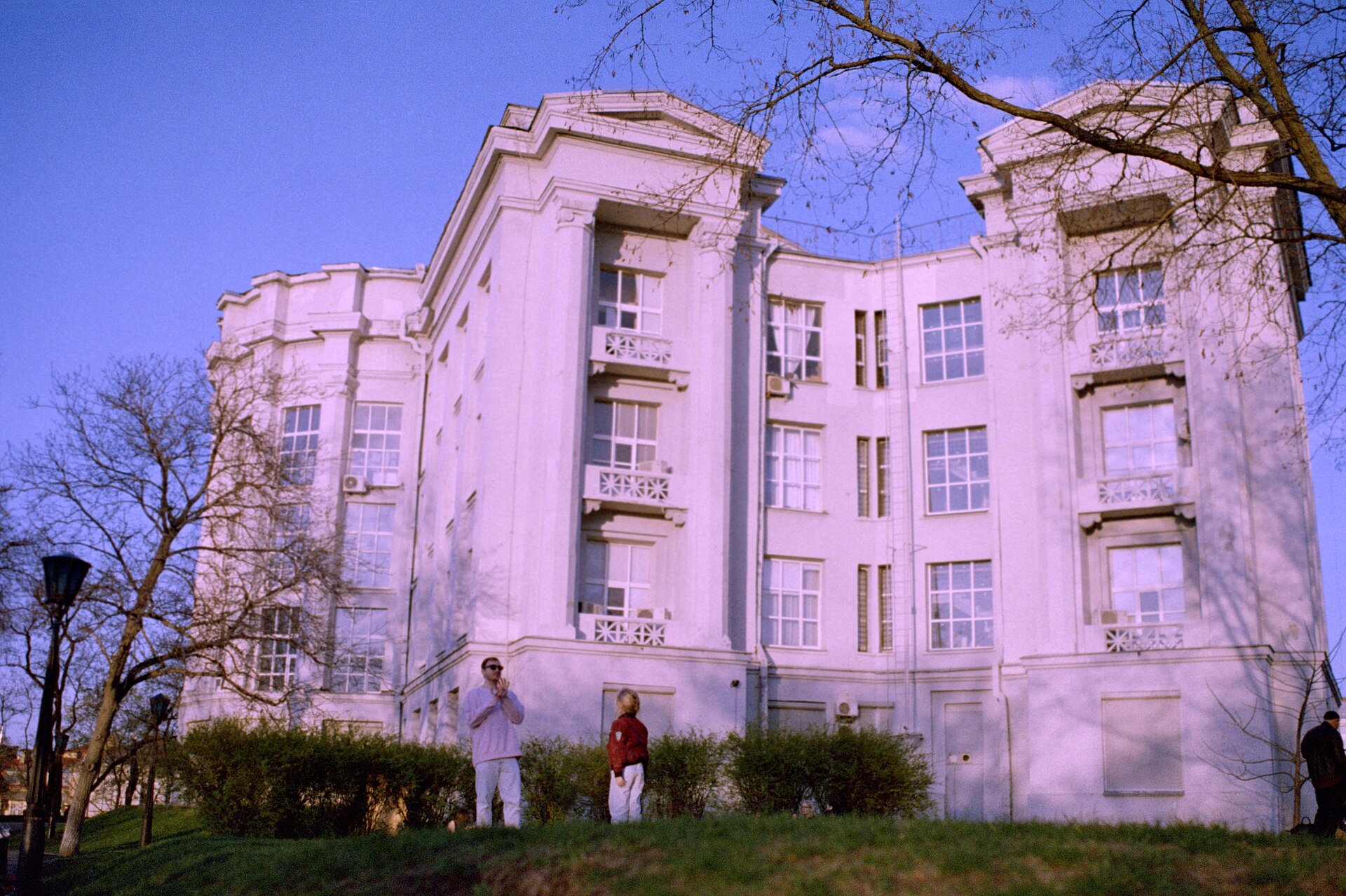
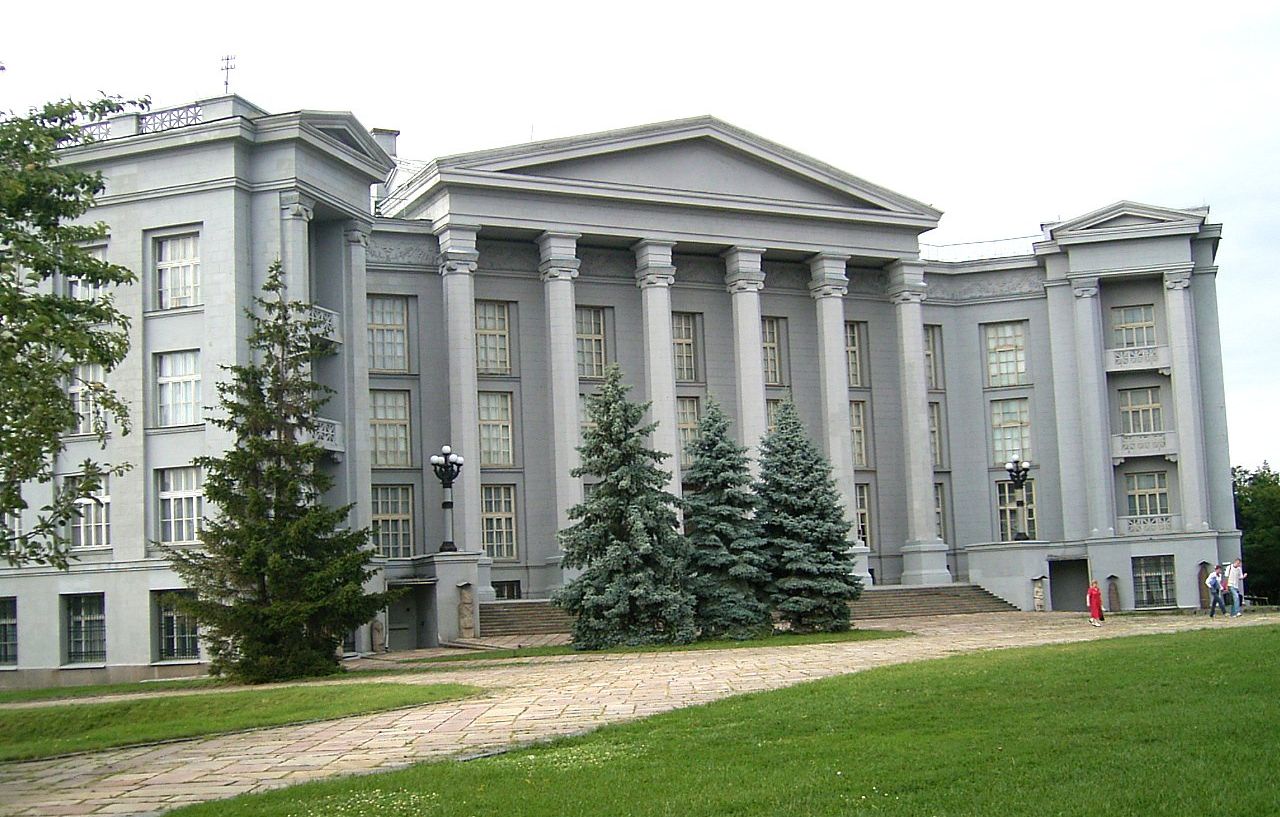
The museum did not stay in that first building or under that first name. Nationalised after the 1917-1921 revolutionary period, it was renamed and relocated repeatedly through the 1930s and early 1940s, including a period housed within the Kyiv Pechersk Lavra monastery complex. In 1944 it moved into its present home at 2 Volodymyrska Street, a building constructed in 1937-1939 to the design of the architect Joseph Karakis as the Shevchenko State Art School. The museum has occupied that building continuously since, through a further sequence of Soviet-era name changes, and adopted its current English name and a rebranding around the acronym MIST -- the Ukrainian word for 'bridge', chosen to signal a bridge between past and future -- in 2020.
What is inside: from flint tools to Scythian gold
The museum's holdings run to roughly 800,000 objects, of which about 22,000 are normally on permanent display, organised across archaeological, numismatic, ethnographic, decorative-arts and manuscript departments plus a dedicated 'Old Kyiv' section on the city's own history. The material spans from stone tools more than a million years old, through the Trypillia culture and the Scythian kurgans of the Ukrainian steppe, to Kyivan Rus, the Cossack Hetmanate and the twentieth century. The museum describes its own numismatic and weapons collections as world class, and its holdings of Ukrainian folk material culture were built up substantially by the early-twentieth-century curator Danylo Shcherbakivskyi.
A separate building, the Treasury branch at Lavrska/Mazepy Street 9 inside the Kyiv Pechersk Lavra complex, holds the museum's precious-metal collection: about 57,000 items of gold, silver and gemstones, including what the museum states is probably the largest collection of Scythian precious-metal objects anywhere. Its single best-known object is the Golden Pectoral from Tovsta Mohyla, a 4th-century-BC crescent of soldered gold figures found by the archaeologist Borys Mozolevskyi in 1971 and generally attributed to Greek goldsmiths working in Scythian territory, though the attribution remains disputed. The Treasury also holds gold-sheathed Scythian weapons and ceremonial helmets from the same class of aristocratic kurgan burials.
The 2022 invasion: bullets through the Church of the Tithe hall
The museum's response to the full-scale invasion that began on 24 February 2022 is itself now part of the object it holds up for scrutiny. Director Fedir Androshchuk has described being called at around 5:30 that morning about the bombing of Kyiv's airports and immediately beginning to empty the display cases; his staff worked through the first night into the small hours of 25 February and spent roughly a month dismantling, packing and cataloguing the collection so that, in his account, the objects would survive even if the building itself did not. The danger was not abstract: during street fighting in Kyiv, two bullets pierced a window into the hall built around the museum's Church of the Tithe material, fortunately after the exhibits in that hall had already been removed. About a dozen staff stayed on site continuously through the first two weeks, Androshchuk sleeping on a sofa in his own office, and some employees packed collections by day and enlisted in the National Guard by evening. The museum's water supply had already failed before the invasion began, forcing staff to queue at shops for basic supplies while fighting continued nearby.
Curators at the museum also used the museum's own published articles about individual objects to comment publicly on the invasion as it happened, drawing explicit parallels between historic artefacts and the war then unfolding around them -- among the small number of Kyiv cultural institutions that chose to do so in public, on the record, while the city itself was under direct threat. The museum's holdings, once removed from display, went into storage rather than into public view, and the galleries they came from have since carried temporary exhibitions rather than a restored permanent display.
Recovering what the war and earlier looting displaced
Since 2022 the museum has also become the receiving institution for two of the more significant repatriations of Ukrainian cultural property in recent years. In November 2023 it took delivery of 565 Scythian and Sarmatian gold objects, together with other antique and Chinese lacquer pieces, that had been lent by four museums in Crimea to the Allard Pierson Museum in Amsterdam for a 2014 exhibition and then became stranded there after Russia's annexation of Crimea later that same year. The Dutch Supreme Court ruled on 9 June 2023 that the objects belonged with the state of Ukraine rather than with the occupied Crimean museums that had lent them, and the collection -- commonly referred to in the press as the 'Crimean gold' -- reached Kyiv on 27 November 2023 to be held at this museum pending Crimea's return to Ukrainian control.
In 2024 the museum also received 274 archaeological objects that Estonian customs had seized in 2018 from a truck crossing the Luhamaa border point from Russia, after determining the objects, including 115 ancient and medieval coins, gold and silver jewellery and Khazar-era horse ornaments, had been looted from sites in eastern and southern Ukraine. Estonia formally returned the collection and the museum opened the exhibition 'From Sea to Sea' with the recovered material, including a Viking-era sword recovered in 2016, on 18 July 2024. Androshchuk called Estonia's return, given the country's size, the largest single contribution any state had made to Ukraine's cultural-heritage recoveries to date.
Visiting today
As of this record's last check, the main museum building at Volodymyrska Street 2 is not open to visitors. The museum's own website states that it 'will be closed to visitors until 30 September for technical reasons', and a separate, more recent notice on the same page reports that the museum's public events are cancelled because of the security situation in Kyiv. The site does not explain whether the two notices describe the same underlying cause. Saturday public events have continued to run through the closure. The Treasury branch, a separate building administratively part of the same museum, continues to list its own Tuesday-to-Sunday hours on the museum's site and is not described as affected by the main building's closure notice.
The figures recorded here for hours and admission are what the museum's own site states as its regular, pre-closure terms: the main museum normally opens daily from 10:00 to 18:00 with the ticket desk closing at 17:00, self-guided adult admission at 200 UAH and a concession rate of 100 UAH, and a combined ticket covering both the main museum and the Treasury within 30 days at 300 UAH (150 UAH concession). Photography without flash is permitted; bags larger than 40 by 30 centimetres must be left in the cloakroom; the site states that wheelchairs and prams are accommodated with advance notice. A reader planning a visit should check the museum's own site again nearer the date, given the closure notice's own uncertainty.
What visitors say
Visitors consistently rate the museum's holdings highly and describe the collection as a genuinely comprehensive sweep of Ukrainian history from prehistory onward, but repeatedly say the self-guided experience is hampered by limited English-language labelling and an unclear sense of the chronological route across the building's three floors; visitors who pay for an English-speaking guide report a substantially richer visit.
What is praised, what is criticised
- Praised: The breadth and depth of the collection as a single account of Ukrainian history, from prehistoric archaeology through to the Cossack era
- Praised: English-speaking guides, when booked, who visitors describe giving detailed, knowledgeable tours of an hour and a half or more
- Criticised: Object labels and wall text are mostly in Ukrainian, with reviewers repeatedly noting there is 'not so many English texts', making the self-guided visit hard to follow without a paid guide
- Criticised: The building's chronological layout across three floors is not obvious to visitors, several of whom report losing track of where in the historical sequence they are
- Criticised: One reviewer described feeling unnerved by museum attendants who closely shadowed visitors through the galleries
- Criticised: Coverage of pivotal recent history -- Ukrainian independence and the Euromaidan -- was described by one visitor as confined to a very small display
Ratings on other platforms
Tripadvisor: 3.9 from 80 ratings, read 18 September 2026
A platform average is a tertiary source: it moves, it is not audited, and we quote no visitor's words.
Questions about National Historical Museum of Ukraine
Where is National Historical Museum of Ukraine?
2 Volodymyrska Street, Kyiv, 01001, Ukraine.
How much does it cost to visit?
Adult, self-guided: UAH 200; Concession (students, pupils, pensioners), self-guided: UAH 100; Preschool children: free; Combined ticket, adult (both the main museum and the Treasury, valid 30 days): UAH 300; Combined ticket, concession (both sites, valid 30 days): UAH 150. As confirmed 18 September 2026.
When is it open?
Daily 10:00-18:00; Tue-Sun 10:00-17:45. Closed: Treasury branch closed Mondays. As confirmed 18 September 2026.
How do you get there?
Metro: Zoloti Vorota station (Syretsko-Pecherska line) has a street exit directly onto Volodymyrska Street and is linked by an underground passage to Teatralna station (Sviatoshynsko-Brovarska line), putting both metro lines within a short walk of the museum entrance.
What should you see first?
Golden Pectoral from Tovsta Mohyla (Greek goldsmiths, probably working in a workshop in the Bosporan Kingdom (the attribution is disputed; some scholars argue for Scythian makers)); Scythian sword with gold-sheathed scabbard from Tovsta Mohyla (Scythian-Greek metalwork, 4th century BC); Scythian golden gorytos (bow-and-arrow case) (Scythian-Greek metalwork, 4th century BC); Scythian ceremonial gold helmet from Perederieva Mohyla (Scythian-Greek metalwork, 4th century BC); The 565 Crimean-gold objects returned from the Allard Pierson Museum, Amsterdam (Multiple Scythian and Sarmatian workshops, and later antique and Chinese lacquer pieces, on loan from four Crimean museums); The 274 objects repatriated from Estonia (Scythian, Khazar, Byzantine and other workshops spanning roughly a millennium).
What we could not confirm
- The museum's own site gives no further detail behind the phrase 'technical reasons' for the closure running to 30 September 2026, and does not state whether that closure is connected to the security-situation notice posted in the same news feed on 4 September 2026
- Scholarly attribution of the Golden Pectoral from Tovsta Mohyla to a specific workshop remains unresolved: the prevailing view names Greek goldsmiths, probably at Panticapaeum in the Bosporan Kingdom, but some scholars argue for Scythian makers
- The Crimean-gold objects returned from the Allard Pierson Museum are held at this museum only pending Crimea's return to Ukrainian control, per the terms described in reporting on the Dutch Supreme Court ruling; no source consulted for this record states a further disposition plan
Images
Sources
- 1National Museum of the History of Ukraine, official site, home page (English) nmiu.org/en
- 2National Museum of the History of Ukraine, official site, home page (Ukrainian, closure and events notices) nmiu.org/
- 3National Museum of the History of Ukraine, official site, 'Plan a visit' (prices, policies) nmiu.org/en/planvisit
- 4National Museum of the History of Ukraine, official site, museum history page nmiu.org/en/museum-history
- 5National Museum of the History of Ukraine, official site, Treasury branch page nmiu.org/en/museums-treasury
- 6Wikipedia, 'National Museum of the History of Ukraine' (tertiary, machine facts only) en.wikipedia.org/wiki/National_Museum_of_the_History_of_Ukraine
- 7Wikipedia, 'Museum of Historical Treasures of Ukraine' (tertiary, machine facts only) en.wikipedia.org/wiki/Museum_of_Historical_Treasures_of_Ukraine
- 8Wikipedia, 'Golden Pectoral from Tovsta Mohyla' (tertiary, machine facts only) en.wikipedia.org/wiki/Golden_Pectoral_from_Tovsta_Mohyla
- 9Babel.ua, 'There was a street gunfight and several bullets hit the museum': director Fedir Androshchuk on hiding the collection and waiting for looters babel.ua/en/texts/79174-there-was-a-street-gunfight-and-several-bullets-hit-the-museum-director-of-the-national-museum-of-the-history-of-ukraine-fedir-androshchuk-tells-how-he-hid-the-collection-and-waited-for-looters
- 10The Art Newspaper, 'Kyiv museum curators bravely criticise war by telling stories of its collection's historic objects', 9 May 2022 theartnewspaper.com/2022/05/09/kyiv-museum-curators-bravely-criticise-war-by-telling-stories-of-its-collections-historic-objects
- 11Tripadvisor, 'National Museum of the History of Ukraine' attraction page, rating and reviews tripadvisor.com/Attraction_Review-g294474-d2617518-Reviews-National_Museum_of_the_History_of_Ukraine-Kyiv.html
- 12Wikimedia Commons, Category:Treasury of the National Museum of the History of Ukraine (object photographs and licensing) commons.wikimedia.org/wiki/Category:Treasury_of_the_National_Museum_of_the_History_of_Ukraine
- 13Wikimedia Commons, File:Building of National Museum of the History of Ukraine (2018-10-13).jpg (licence and author) commons.wikimedia.org/wiki/File:Building_of_National_Museum_of_the_History_of_Ukraine_(2018-10-13).jpg
- 14Wikimedia Commons, File:National Museum of the History of Ukraine.jpg (licence and author) commons.wikimedia.org/wiki/File:National_Museum_of_the_History_of_Ukraine.jpg
- 15Wikipedia, 'Golden Pectoral from Tovsta Mohyla', discovery, dimensions and attribution en.wikipedia.org/wiki/Golden_Pectoral_from_Tovsta_Mohyla
- 16NL Times, 'Allard Pierson Museum in Amsterdam returns Crimean artifacts to Ukraine', 27 November 2023 nltimes.nl/2023/11/27/allard-pierson-museum-amsterdam-returns-crimean-artifacts-ukraine
- 17UNESCO, 'Estonia returns to Ukraine the archaeological artifacts seized at the Estonian-Russian border' unesco.org/en/articles/estonia-returns-ukraine-archaeological-artifacts-seized-estonian-russian-border
- 18Ukrainska Pravda, "Ukraine's National History Museum displays Ukrainian treasures rescued by Estonia -- photos", 19 July 2024 pravda.com.ua/eng/news/2024/07/19/7466459/
- 19Wikipedia, 'Zoloti Vorota (Kyiv Metro)' (tertiary, transit facts only) en.wikipedia.org/wiki/Zoloti_Vorota_(Kyiv_Metro)
- 20European Pravda, 'Scythian Gold Returns to Ukraine', 27 November 2023 (565-item count and ruling detail) eurointegration.com.ua/eng/news/2023/11/27/7174352/
.jpg)
