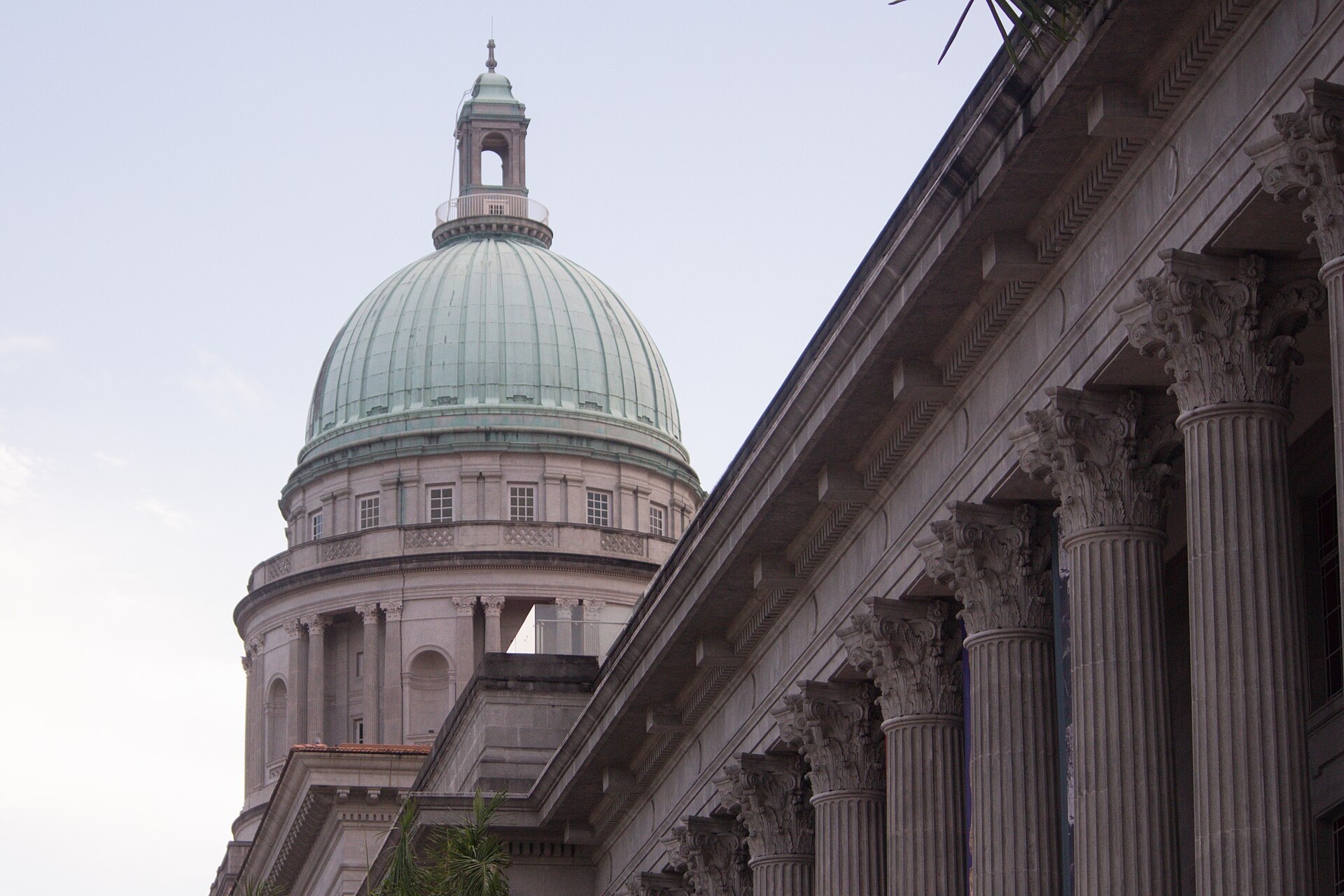
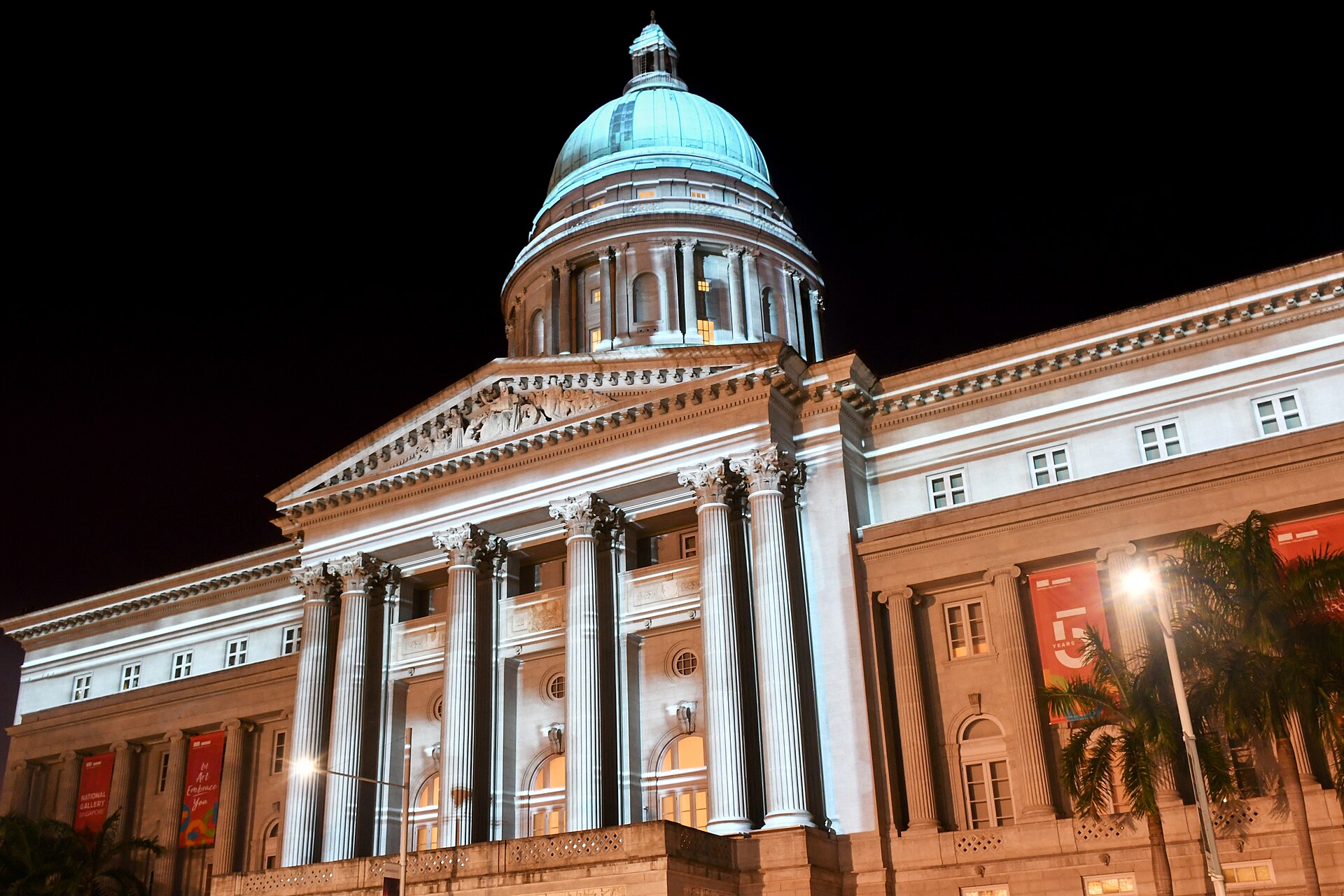
The former Supreme Court and City Hall buildings, converted into National Gallery Singapore, photographed in 2023.
Avin Teo, CC BY-SA 4.0National Gallery Singapore
Museum · Founded 2015
Open, admission and hours confirmed 19 August 2026 · 21 sources
On this page 17 sections
ContentsClose
The National Collection held by National Gallery Singapore runs to roughly 9,000 objects (per Wikipedia, a tertiary figure not independently confirmed on the Gallery's own site at research time), and the Gallery's own public framing is that it is the world's largest public collection of Singapore and Southeast Asian modern art. Its particular strength is depth in the Nanyang Style painters - Georgette Chen, Liu Kang, Chen Wen Hsi, Chen Chong Swee and Cheong Soo Pieng chief among them - and in mid-20th-century Southeast Asian modernism more broadly, from Indonesia (Raden Saleh, Affandi) to the Philippines (Hernando R. Ocampo, Fernando Amorsolo). The collection is deliberately not limited to painting: it holds photography, woodcuts, sculpture and design material, and the current long-term Singapore exhibition was built specifically to bring film, graphic design and calligraphy into that same core display rather than treating them as adjuncts to the painting collection.
| Kind | Museum |
|---|---|
| Founded | 2015 |
| City and country |  Singapore, Singapore Singapore, Singapore |
| Address | 1 St Andrew's Road, Singapore 178957 |
| Website | nationalgallery.sg |
| Status | Open, confirmed |
| Record last verified |
Visiting
- Hours
- Daily10:00 to 19:00last admission 18:30; ticket sales close 30 minutes before closing
- Admission
- General Admission - Singapore Citizen / PRFreefree, with valid ID
- General Admission - other nationalitiesSGD 20concession (ages 7-12, seniors 60+, full-time NSF, qualifying overseas students/teachers) is 5 SGD off
- All Access - Singapore Citizen / PRSGD 15one-time entry to selected exhibitions and tours, valid 180 days from purchase
- All Access - other nationalitiesSGD 30concession is 5 SGD off
- Special exhibition - other nationalitiesSGD 25the Gallery's own pricing table marks this tier not applicable to Singapore Citizens/PRs, whose general admission already covers it; concession is 5 SGD off
- Temporary paid exhibition, example ('Passion is Volcanic', R18) - Singapore Citizen / PRSGD 5one specific ticketed special exhibition seen on the pricing page at research time; prices vary by show
- Temporary paid exhibition, example ('Passion is Volcanic', R18) - other nationalitiesSGD 8same show; prices vary by show
- Free entry regardless of nationalityFreechildren 6 and under; Gallery Insiders members; locally based students and teachers; persons with disabilities plus one caregiver
- Tickets
- tickets.nationalgallery.sg/tickets The museum's own ticket page.
- Do I need to book?
- Not stated as mandatory; the Gallery's own visitor page does not require advance booking for general admission
- Address
- 1 St Andrew's Road, Singapore 178957 MapMRT City Hall station, Exit B, about a 7-minute walk (closest station)
MRT Raffles Place station, Exit B, about a 10-minute walk
MRT Clarke Quay station, Exit E, about a 10-minute walk along the Singapore River
Bus Bus 130 stops at the Coleman Street entrance; buses 195 and 961 stop at Parliament Place, about a minute's walk away - Website
- nationalgallery.sg
- Telephone
- +65 6271 7000
- [email protected]
Before you go how long, access, photography, bags, eating, shop
- How long to allow
- About three hours, per the Gallery's own visitor page
- Access
- All galleries are wheelchair-accessible; free wheelchair loans at three Visitor Services counters; accessible restrooms on most levels; stroller-friendly; designated accessible parking; galleries are climate-controlled and the Gallery advises bringing warm clothing
- Photography
- Still photography for non-commercial use is allowed without flash; no flash photography or videography anywhere; selfie sticks and tripods are prohibited; extra restrictions apply in the paid special-exhibition galleries on Levels 3 and 4
- Bags
- Bags may be inspected for security; bulky items must be stored in lockers at Basement 1
- Eating
- Several restaurants operate inside the building, including Odette and National Kitchen by Violet Oon
- Shop
- The Gallery Store, on site
Prices and hours change. We take them from the institution's own pages and print the day we read them, and you can check the current position at the source we used. Confirm before you travel.
What is inside
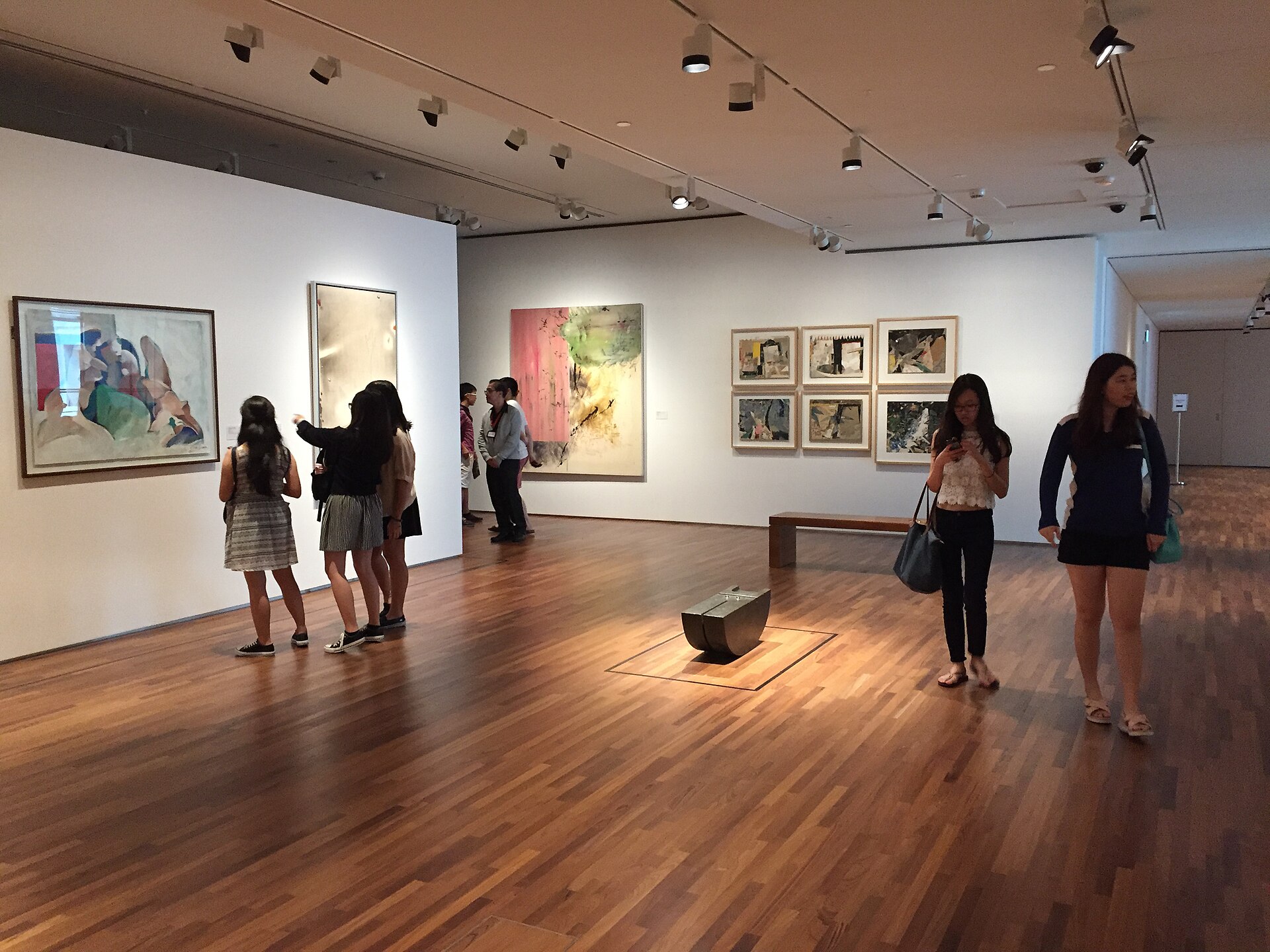
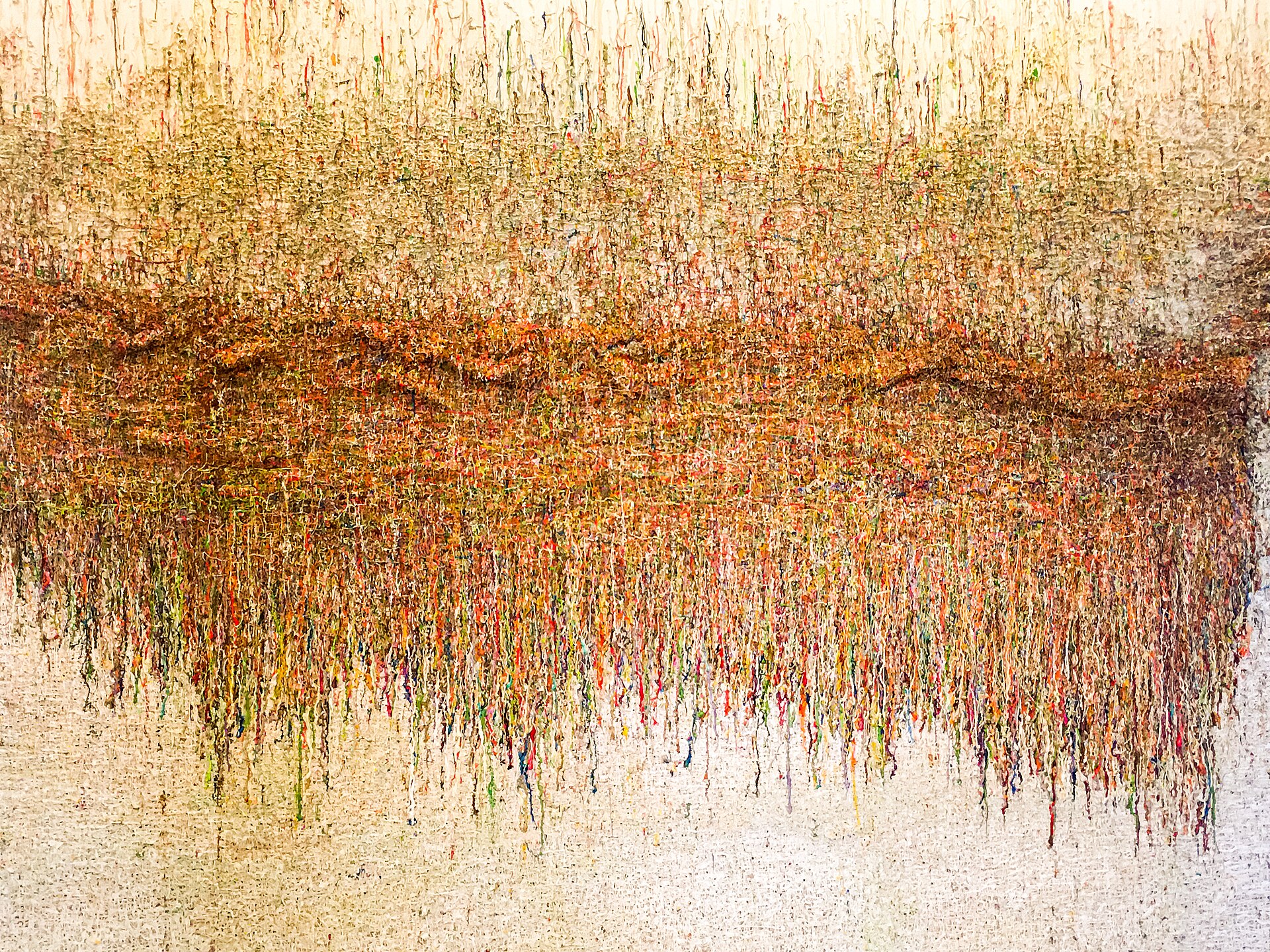
Photograph by Jacklee · CC BY-SA 4.0 DBS Singapore Gallery
On Level 2 of the City Hall Wing. Home to the long-term exhibition 'Singapore Stories: Pathways and Detours in Art', which opened in a first phase on 2 December 2024 and expanded across the full gallery in July 2025. Over 200 works and artefacts trace Singapore art from the 19th century through the 1960s across four sections - Market of the Tropics, Community and Self, Imagining Nation, and Seeking Connections - in media beyond painting and sculpture, including film, graphic design and calligraphy. Project director Dr Seng Yu Jin has said the exhibition was built to address themes such as class and labour, not just to hang pictures.
UOB Southeast Asia Gallery
Occupies the former Supreme Court building. As of research date it is temporarily closed, with the Gallery's own visitor page stating it will reopen in late 2027; works from the National Collection continue to be shown elsewhere in the building in the meantime. Before its closure the gallery presented over 300 works tracing Southeast Asian art across 11 countries from the mid-1800s to today, including Raden Saleh's 1849 'Boschbrand (Forest Fire)' and Hernando R. Ocampo's 1965 'Dancing Mutants'.
City Hall Chamber (the Surrender Chamber)
A chamber panelled in teak with brass and marble columns, preserved from the former Municipal Building. On 12 September 1945, Admiral Lord Louis Mountbatten accepted the surrender of Japanese forces in Southeast Asia here on behalf of the Allies, formally ending the occupation; the same room later hosted the swearing-in of Singapore's first cabinet in 1959.
The Rotunda and the Former Supreme Court Terrace
The former Supreme Court's five-storey block is arranged around a central domed rotunda, which once held a circular law library of more than 20,000 volumes; the smaller Rotunda dome is now visible up close following the insertion of a new floor beneath it during conversion. The adjoining Terrace, under a filigree metal canopy that the architects added to link the two historic buildings, is used as both an events venue and a public gathering space, and is covered by the Gallery's own free Building Highlights guided tour.
Keppel Centre for Art Education
A dedicated space for family and school learning, part of the Gallery's stated remit to build audiences for Singapore and Southeast Asian art alongside its exhibition galleries.
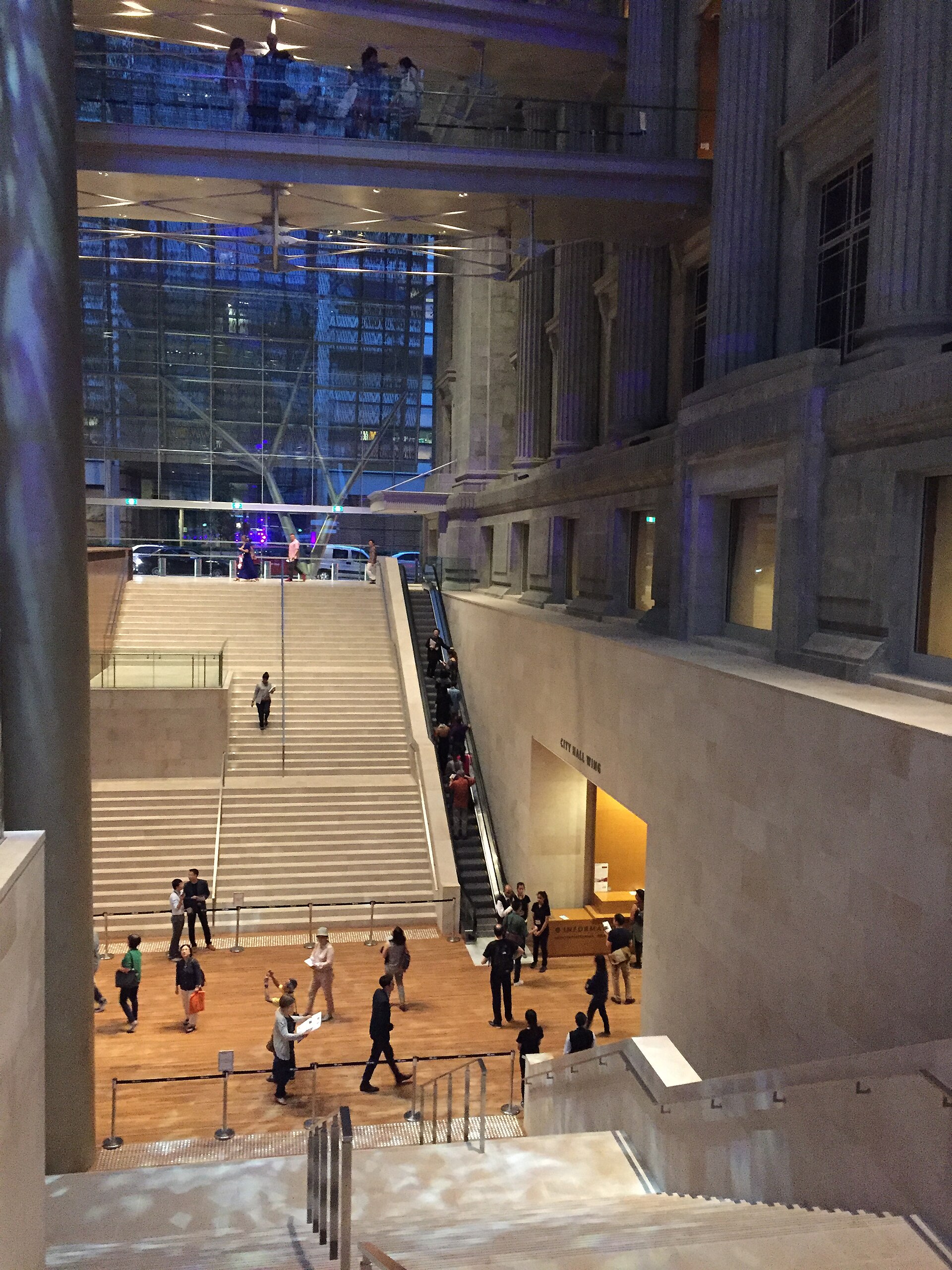
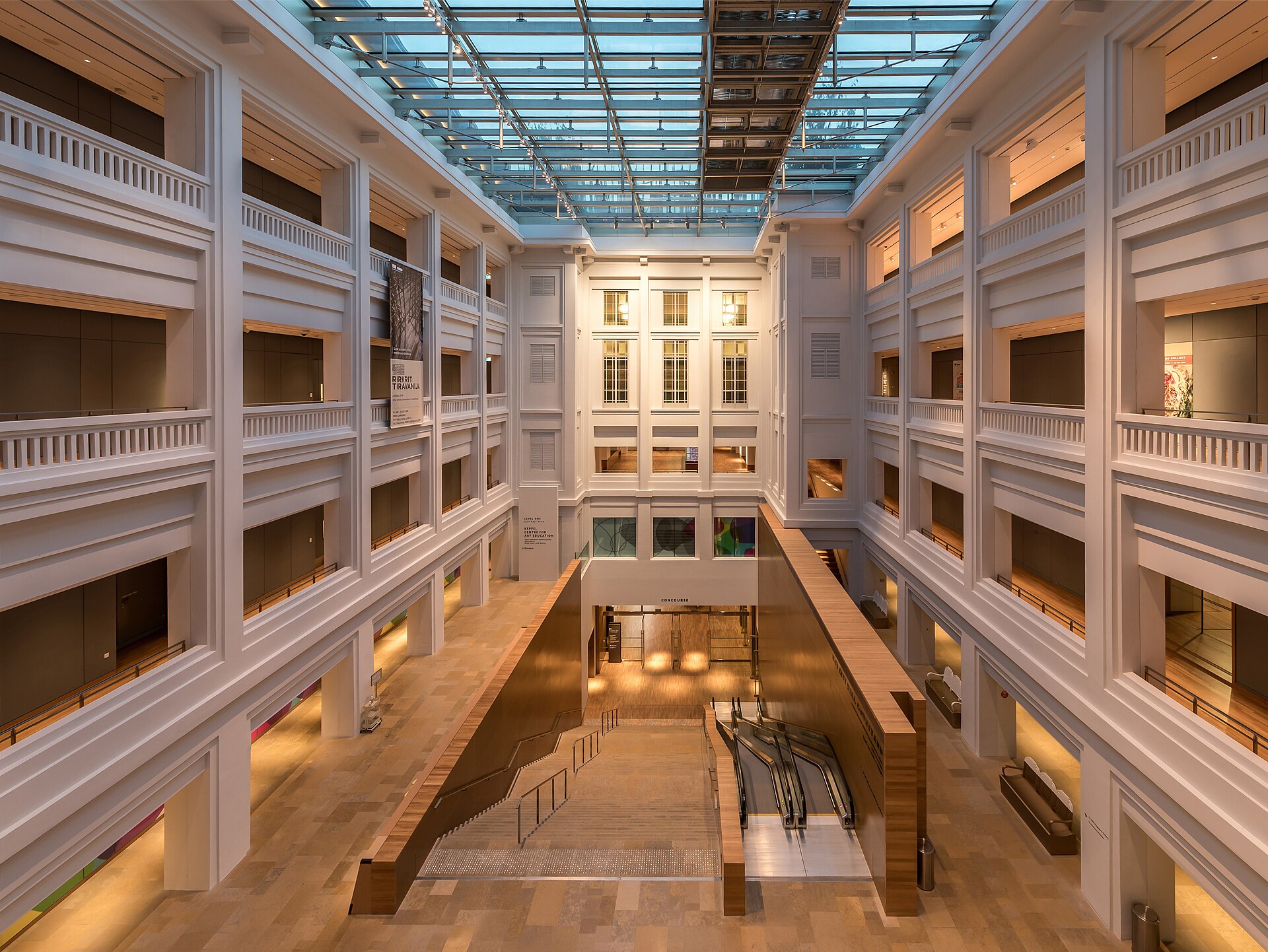
Photograph by Jacklee · CC BY-SA 4.0 Padang Atrium
One of the connecting public spaces threaded between the former Supreme Court and City Hall, linking the historic exteriors to the Padang, the ceremonial civic field the buildings face.
What to see first
Boschbrand (Forest Fire)
Raden SalehPainted in 1849, oil on canvas, 300 x 396 cm; adopted by the Yong Hon Kong Foundation and used by the Gallery as an anchor work for its Southeast Asia programming and family activities.6
Dancing Mutants
Hernando R. Ocampo1965, oil on canvas, 101.8 x 76 cm; a Philippine abstract work the Gallery uses to represent the region's mid-century modernist experiments.7
Life by the River
Liu Kang1975, oil on canvas; depicts kampung life near Pasir Panjang, painted by a Nanyang Style pioneer whose time in Paris shows in its fauvist colour and staccato brushwork.9
Fishermen
Chen Chong SweeChinese ink and colour on paper, made after the artist's 1952 trip to Bali; a pioneering fusion of Chinese pictorial composition with Western watercolour technique.9
Wayang Kulit
Choo Keng Kwang1950 woodcut, a tribute to Indonesian and Malaysian shadow-puppet theatre and one of the Gallery's cited key pieces from the National Collection.9
Untitled (Over the Balcony)
Kassian CephasA circa 1900 photograph by the first known photographer of Javanese descent, mixing intimate portraiture with a documentary eye.9
Self-Portrait
Georgette ChenOil on canvas; a Post-Impressionist self-portrait by a Nanyang Style pioneer and one of the founding figures of Singapore's modern art scene.9
Exhibitions on now
Past exhibitions here
- Closed24 Apr to 20 Sep 2026Confirmed · check before you travel
Two colonial law courts become one museum
National Gallery Singapore occupies two national monuments that face each other across the Padang, the ceremonial civic field at the heart of Singapore's Civic District: the former Supreme Court and the former City Hall. The Supreme Court, completed in 1939 to a design by government architect Frank Dorrington Ward, is generally described as the last neo-classical building built in Singapore; it is a five-storey structure of four blocks arranged around a central domed rotunda that originally held a circular law library of more than 20,000 volumes. It served as Singapore's courthouse until 2005.
City Hall, completed in 1929 as the Municipal Building and renamed when Singapore became a city in 1951, presents eighteen three-storey Corinthian columns to the Padang. It housed a succession of government departments, and it is where, on 12 September 1945, Admiral Lord Louis Mountbatten accepted the surrender of Japanese forces in Southeast Asia on behalf of the Allies - and where, in 1959, Singapore's first cabinet was sworn in. Both buildings were gazetted as national monuments before the conversion into a museum began.
A competition-won conversion, 2007 to 2015
The Singapore government ran an international design competition for the conversion in 2007. It was won by the French firm studioMilou Singapore, led by architect Jean-Francois Milou, working with the local firm CPG Consultants. Restoration and construction ran from 2009 to 2015, at a stated cost of roughly S$532 million. The Gallery opened to the public on 24 November 2015, in Singapore's fiftieth year of independence, with a formal Grand Opening ceremony on 27 November attended by then-President Tony Tan.
The stated design principle was restraint: to make the two buildings look, from outside, largely untouched, while inserting extensive new technical infrastructure - climate control, security, museum lighting, structural reinforcement - below and above. The work was not straightforward: City Hall's foundations were found to be listing by six degrees during the project, requiring new basements and reinforcement before the conversion could proceed. Above the two buildings, a filigree metal canopy links them at roof level, supported on tree-like columns and filtering daylight across the historic facades below; link bridges added during the same 2009-2014 phase connect the two structures at upper floors.
What the building still remembers
The most affecting rooms in the Gallery are the ones that were left alone. The City Hall Chamber, panelled in teak with brass and marble columns, is preserved as the room where the Japanese surrender was accepted in 1945 and where the first cabinet was sworn in 1959 - both events are part of the standard framing the Gallery gives the space today. Two of the former Supreme Court's courtrooms are kept largely as they stood in use: judge's bench, witness box, prisoner's dock, tiered public seating and timber panelling intact. The Rotunda's dome, once invisible above the old law library's stacks, is now visible up close, after a new gallery floor was inserted beneath it during the conversion.
The Nanyang painters and the world's largest collection of its kind
National Gallery Singapore's own framing of its mission is to be the steward of the world's largest public collection of Singapore and Southeast Asian modern art, and to put that collection into dialogue with the rest of the world - it lists partnerships with the Centre Pompidou, the Musee d'Orsay, Tate Britain and Tokyo's National Museum of Modern Art among others. A large part of that collection's core comes from the Nanyang art movement: Chinese migrant artists working in Singapore from the mid-20th century, among them Georgette Chen, Liu Kang, Chen Wen Hsi, Chen Chong Swee and Cheong Soo Pieng, who fused Chinese ink-painting traditions with modernist European technique and set the results against local, tropical subject matter - kampung life, market scenes, the Malay and Chinese communities around them.
That collecting focus is also a curatorial argument: that Singapore and Southeast Asian modern art deserves the kind of dedicated, purpose-built institution that has long existed for European and American modernism, rather than remaining a subsection of a general national museum.
Two long-term exhibitions, one of them currently dark
The permanent core of the Gallery is split across two long-term exhibitions in its two wings. The DBS Singapore Gallery, on Level 2 of the City Hall Wing, now houses 'Singapore Stories: Pathways and Detours in Art', which opened in a first phase on 2 December 2024 and reached its full form in July 2025: over 200 works and artefacts across four thematic sections, tracing Singapore's art history from the 19th century through the 1960s in media that go beyond painting and sculpture to include film, graphic design and calligraphy. Project director Dr Seng Yu Jin has said explicitly that the exhibition was built to address class and labour as subjects, not only to hang pictures in period order.
The UOB Southeast Asia Gallery, in the former Supreme Court building, is the regional counterpart: at full strength it shows more than 300 works from eleven countries, tracing Southeast Asian art from the mid-1800s to the present through colonialism, independence movements and the construction of national identity. As of this research, the Gallery's own visitor page states plainly that the UOB Southeast Asia Gallery is temporarily closed and will reopen in late 2027; works from the National Collection remain on view elsewhere in the building while it is shut.
Reception: an acclaimed building, a contested narrative
The architecture press was close to unanimous when the Gallery opened. Wallpaper*'s Daven Wu, writing at the opening in November 2015, called it a triumph of sensitive heritage restoration that finally gave Singapore an institution on the scale of the Musee d'Orsay or Tate Modern, and treated the mid-project structural crisis - a City Hall foundation found listing six degrees - as an engineering problem solved rather than a design compromise.
The curatorial content received a more mixed hearing. Writing in Hyperallergic in February 2016, critic Bharti Lalwani argued that the inaugural Southeast Asia Gallery displays amounted to writing a new history of the region's art without a clear methodology: no cogent framework connecting the art to the region's politics and architecture, and a near-total silence on the history of communism in Southeast Asia despite its centrality to the period the galleries claim to cover. She also found specific works, including pieces by Redza Piyadasa, inconsistently lit and contextualised relative to their importance.
Visitor-level feedback tends to split along the same line as the professional reviews: praise for the building and the free admission for residents, set against recurring complaints about navigating a museum built inside two connected historic structures on different floor grids - several independently written visitor reviews describe getting lost looking for the link bridges between wings, or finding wall text too small to read comfortably across what the Gallery itself estimates as a three-hour visit.
The Padang and the wider Civic District
The Gallery sits inside Singapore's Civic District, immediately beside the Padang and within walking distance of the Esplanade, the Asian Civilisations Museum and the Victoria Theatre - a cluster the Gallery's own siting treats as a single cultural precinct rather than an isolated building. The Gallery is reachable on foot from three MRT stations - City Hall, Raffles Place and Clarke Quay - and hosts recurring public festivals on its grounds and terraces, including the annual Light to Night Singapore festival, which projects light installations across the historic facades.
What visitors say
The building conversion is the part of National Gallery Singapore that draws the most unqualified praise, in the international design press and from visitors alike: two colonial monuments turned into a museum on the scale of the Musee d'Orsay or Tate Modern without losing their exteriors. The collection and its framing draw a more divided response - admired for its scale and ambition as the world's largest public collection of its kind, but faulted by at least one specialist reviewer for a curatorial narrative that stays vague at the points where Southeast Asian history gets difficult. At street level, the most common visitor complaint is not the art but the building: two connected historic structures on different grids, sparsely signed, that are easy to get lost in.
What is praised, what is criticised
- Praised: The sensitivity of the restoration - the Palladian exteriors of the former Supreme Court and City Hall were kept largely as they were, with the new engineering hidden below and above
- Praised: The scale and ambition of the collection: the Gallery's own framing is that it holds the world's largest public collection of Singapore and Southeast Asian modern art
- Praised: Free general admission for Singapore citizens and permanent residents, and free entry for local students, teachers and children 6 and under
- Praised: The preserved historic rooms - the Surrender Chamber, the old courtrooms, the Rotunda - which visitors and critics both single out as more affecting than a plaque-and-vitrine museum display would be
- Criticised: A 2016 review in Hyperallergic by Bharti Lalwani argued the opening displays did not build a clear analytical framework connecting the art to the region's architecture and political history, and singled out the near-total absence of the word 'communism' from wall text and guides despite its central role in 20th-century Southeast Asian history
- Criticised: The same review found individual works, including pieces by Redza Piyadasa, inconsistently contextualised and lit given their significance
- Criticised: Visitors repeatedly describe the layout across two joined historic buildings as confusing to navigate, with several independently titled reviews on record complaining about poor wayfinding signage and about ending up in restricted areas while looking for connecting bridges between wings
- Criticised: Some visitors report wall text set too small to read comfortably over a multi-hour visit
Questions about National Gallery Singapore
Where is National Gallery Singapore?
1 St Andrew's Road, Singapore 178957.
How much does it cost to visit?
General Admission - Singapore Citizen / PR: free; General Admission - other nationalities: SGD 20; All Access - Singapore Citizen / PR: SGD 15; All Access - other nationalities: SGD 30; Special exhibition - other nationalities: SGD 25. As confirmed 19 August 2026.
When is it open?
Daily 10:00-19:00. As confirmed 19 August 2026.
How do you get there?
MRT: City Hall station, Exit B, about a 7-minute walk (closest station); MRT: Raffles Place station, Exit B, about a 10-minute walk; MRT: Clarke Quay station, Exit E, about a 10-minute walk along the Singapore River; Bus: Bus 130 stops at the Coleman Street entrance; buses 195 and 961 stop at Parliament Place, about a minute's walk away.
What should you see first?
Boschbrand (Forest Fire) (Raden Saleh); Dancing Mutants (Hernando R. Ocampo); Life by the River (Liu Kang); Fishermen (Chen Chong Swee); Wayang Kulit (Choo Keng Kwang); Untitled (Over the Balcony) (Kassian Cephas).
What we could not confirm
- The Gallery's own architecture-and-history page (fetched 2026-08-19) states the Grand Opening ceremony fell on 27 November 2015, while Wikipedia and a Wallpaper* piece written at the time both give 24 November 2015 as the date the Gallery opened to the public. The two dates are not necessarily in conflict - a public opening ahead of a formal ceremony is a common pattern - but no single source fetched for this page states both dates and explains the gap; the next desk to touch this page should try to confirm directly with the Gallery's press office or an official history timeline.
- Trade and travel press reporting from February 2026 (not the Gallery's own site) described a wider closure of the whole former Supreme Court Wing - including the Rotunda Library and the UOB Theatrette, not just the UOB Southeast Asia Gallery - running from April 2026 to around November 2027, with a smaller interim gallery opening from October 2026. The Gallery's own visitor-information and architecture pages, fetched directly on 2026-08-19, mention only the UOB Southeast Asia Gallery as closed, with no notice on the Rotunda or the Former Supreme Court Terrace pages. This page follows the Gallery's own current site rather than the trade press. Re-check both official pages before the next recheck cycle, since a wing described here as open (the Rotunda, the Terrace) may in practice be inaccessible if the wider closure reported elsewhere is real and the Gallery's own pages are simply not yet updated.
- No numeric platform rating (Google, TripAdvisor) could be confirmed from a source actually fetched for this page - both platforms blocked automated retrieval. The reception section here rests on a positive and a critical named review plus a consensus drawn from visible visitor-review headlines; a future pass with browser access to Google Maps or TripAdvisor could add a proper reception.ratings[] entry.
Images
Sources
- 1National Gallery Singapore, Visitor Information nationalgallery.sg/sg/en/visit/visitor-information.html
- 2National Gallery Singapore, Contact page (thank-you/confirmation view) nationalgallery.sg/sg/en/contact/thank-you.html
- 3National Gallery Singapore, Our Architecture and History nationalgallery.sg/sg/en/architecture-and-history.html
- 4National Gallery Singapore, Former Supreme Court Terrace nationalgallery.sg/sg/en/architecture-and-history/former-supreme-court-terrace.html
- 5National Gallery Singapore, About nationalgallery.sg/about
- 6National Gallery Singapore, DBS Singapore Gallery Highlights guided tour page nationalgallery.sg/sg/en/guided-tours/dbs-singapore-gallery-highlights.html
- 7National Gallery Singapore, UOB Southeast Asia Gallery Highlights guided tour page nationalgallery.sg/sg/en/guided-tours/uob-southeast-asia-gallery-highlights.html
- 8National Gallery Singapore, media centre release on 'Singapore Stories: Pathways and Detours in Art' nationalgallery.sg/sg/en/about/media-centre/singapore-stories--pathways-and-detours-in-art--national-gallery.html
- 9Time Out Singapore, '5 key pieces in Singapore's National Collection' timeout.com/singapore/art/5-key-pieces-in-singapores-national-collection
- 10Wallpaper*, Daven Wu, on the opening of National Gallery Singapore wallpaper.com/architecture/singapore-national-gallery-opens
- 11Hyperallergic, Bharti Lalwani, 'Singapore's New National Gallery Dubiously Rewrites Southeast Asian Art History', 1 February 2016 hyperallergic.com/singapores-new-national-gallery-dubiously-rewrites-southeast-asian-art-history/
- 12Wikipedia, 'National Gallery Singapore' (, used only for machine facts: collection size, visitor figures) en.wikipedia.org/wiki/National_Gallery_Singapore
- 13Wikidata, Q6970475 (, used only for coordinates/identity cross-check) wikidata.org/wiki/Q6970475
- 14Wikimedia Commons, Category:National Gallery Singapore commons.wikimedia.org/wiki/Category:National_Gallery_Singapore
- 15Wikimedia Commons, File:National Gallery Singapore Building.jpg commons.wikimedia.org/wiki/File:National_Gallery_Singapore_Building.jpg
- 16Wikimedia Commons, File:National Gallery Singapore, Singapore.jpg commons.wikimedia.org/wiki/File:National_Gallery_Singapore,_Singapore.jpg
- 17Wikimedia Commons, File:Interior of the National Gallery Singapore.jpg commons.wikimedia.org/wiki/File:Interior_of_the_National_Gallery_Singapore.jpg
- 18Wikimedia Commons, File:National Gallery Singapore Supreme Court Wing.jpg commons.wikimedia.org/wiki/File:National_Gallery_Singapore_Supreme_Court_Wing.jpg
- 19Singapore-Tickets.com, National Gallery Singapore location and getting there (, third-party ticket vendor, used only for transit directions) singapore-tickets.com/national-gallery-singapore-tickets/location-getting-there-directions/
- 20Wikimedia Commons, File:Padang Atrium, National Gallery Singapore - 20151127-03.jpg commons.wikimedia.org/wiki/File:Padang_Atrium,_National_Gallery_Singapore_-_20151127-03.jpg
- 21Wikimedia Commons, File:Gallery 1, DBS Singapore Gallery, National Gallery Singapore - 20160101.jpg commons.wikimedia.org/wiki/File:Gallery_1,_DBS_Singapore_Gallery,_National_Gallery_Singapore_-_20160101.jpg


