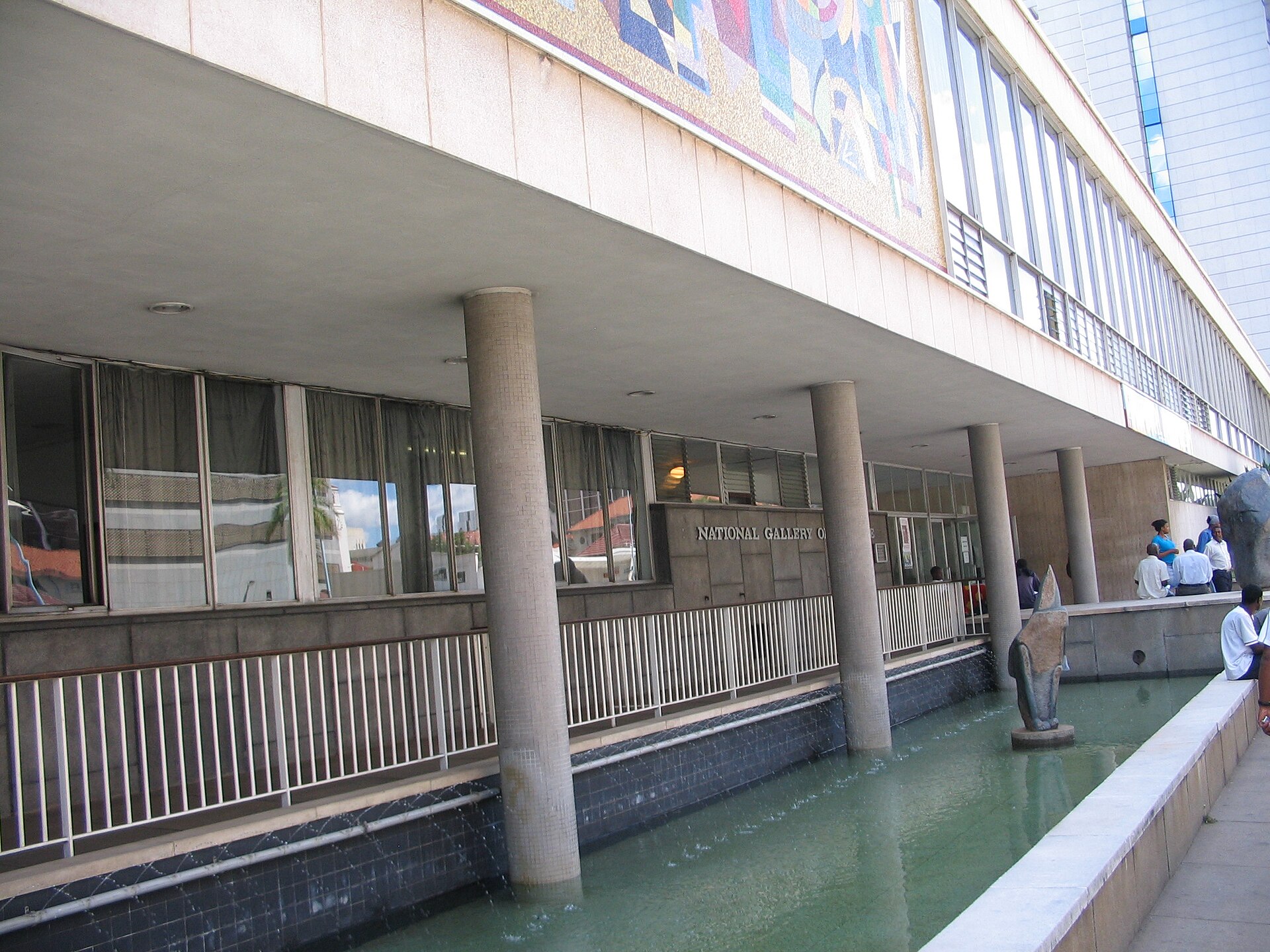
The colonnaded entrance of the National Gallery of Zimbabwe in Harare, with its reflecting pool set with a Shona stone sculpture and the abstract mosaic mural above. The gallery's name is visible in raised lettering on the wall.
National Gallery of Zimbabwe (donated to Wikimedia Commons by the institution, VRTS-confirmed) · CC BY-SA 3.0National Gallery of Zimbabwe
Museum · Founded 1957
Open, admission and hours confirmed 26 August 2026 · 16 sources
On this page 15 sections
ContentsClose
The gallery's international reputation rests on one specific thing: it is the institution that turned informal basement space into the Shona stone sculpture movement, and its collection of first-generation Workshop School sculptors - Bernard Matemera, Nicholas Mukomberanwa, John and Bernard Takawira, Henry Munyaradzi among them - is the primary documented record of how that movement began. Around this core sits a broader, independence-era collecting programme in painting, drawing, installation, and craft including basketry, plus a smaller holding of work by other African artists such as Malangatana Ngwenya, Twins Seven Seven and Henry Tayali. No source consulted publishes a full breakdown of the roughly 6,000-object collection by medium, period or acquisition date.
| Kind | Museum |
|---|---|
| Founded | 1957 |
| City and country |  Harare, Zimbabwe Harare, Zimbabwe |
| Address | 20 Julius Nyerere Way, Park Lane, Harare, Zimbabwe |
| Website | nationalgallery.co.zw |
| Status | Open, confirmed |
| Record last verified |
Visiting
- Hours
- Daily09:00 to 16:30Afrotopia Cafe keeps the same hours
- Closed
- Public holidays.
- Admission
- Resident childUSD 1Amount shown as a bare dollar figure on the source page, with no currency code printed; recorded here as USD, the currency this figure is quoted in for foreign-facing pricing at Zimbabwean attractions as of 2026.
- Resident adultUSD 2
- African (non-Zimbabwean resident) childUSD 2
- African (non-Zimbabwean resident) adultUSD 5
- International (non-African) childUSD 5
- International (non-African) adultUSD 15
- School group, pre-booked (per child)USD 1Groups of 12 or more
- School group, walk-in (per child)USD 1.50
- Do I need to book?
- Not required for individuals; groups of 12 or more are asked to pre-book
- Address
- 20 Julius Nyerere Way, Park Lane, Harare, Zimbabwe MapOn foot Central Harare, adjacent to Harare Gardens, about two minutes from the Rainbow Towers/Monomutapa Hotel
- Website
- nationalgallery.co.zw
- Telephone
- +263 867 700 2043
- [email protected]
Before you go how long, access, photography, bags, eating, shop
- How long to allow
- Not published by the gallery; reviewers who left the shop and cafe out describe walking the halls and forecourt in under an hour
- Access
- Designated parking and accessible restrooms are listed on the gallery's own visit page; no further detail is published
- Photography
- Not stated in any source consulted; not confirmed
- Bags
- Not stated in any source consulted; not confirmed
- Eating
- Afrotopia Cafe, on site, open the same hours as the gallery
- Shop
- ArtLife Shop, selling original work, craft and books by Zimbabwean artists
Prices and hours change. We take them from the institution's own pages and print the day we read them, and you can check the current position at the source we used. Confirm before you travel.
What is inside
Main exhibition hall
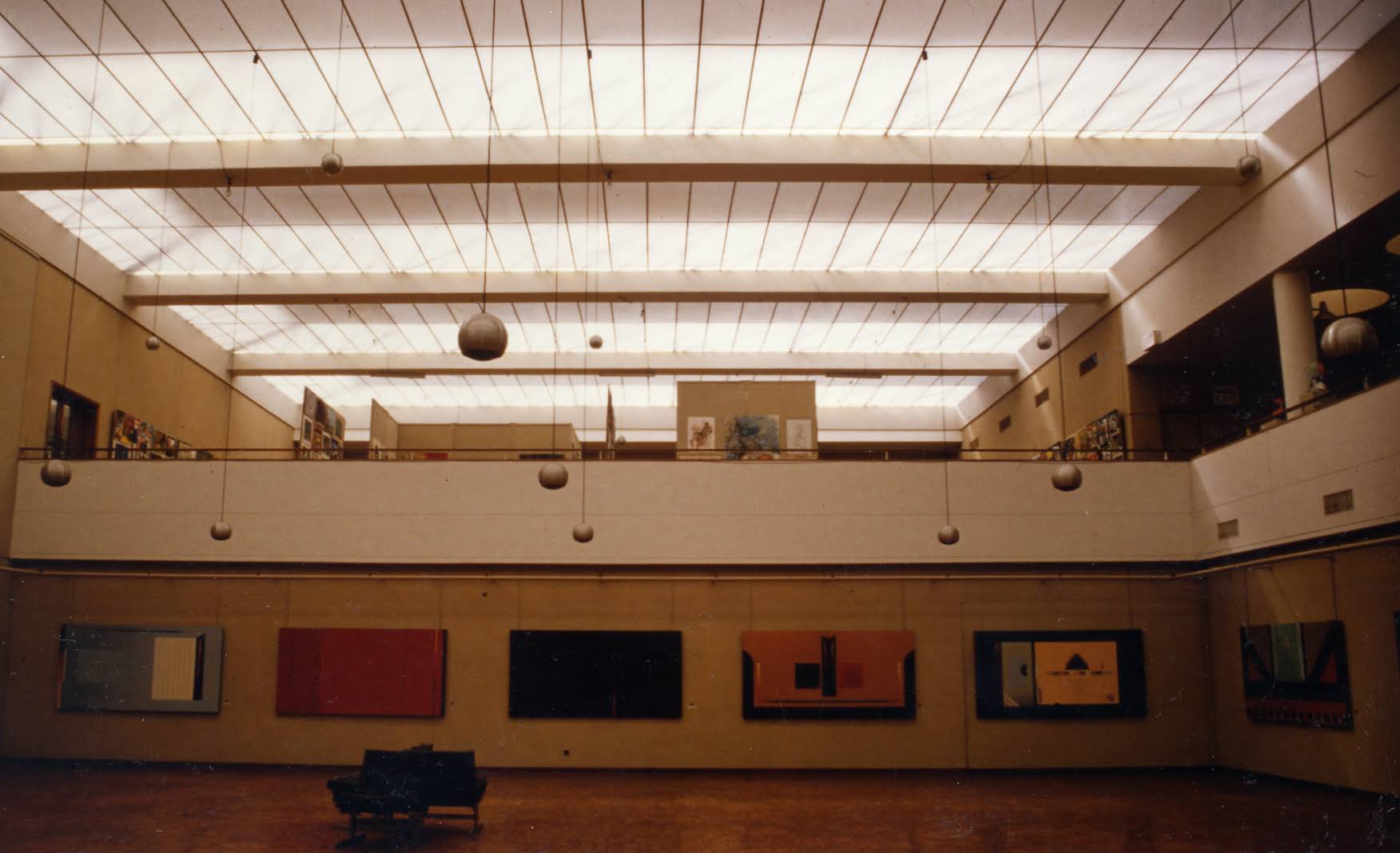
The gallery's original 1957 exhibition space: a double-height, open-plan hall lit by a saw-tooth glass roof and ringed by a mezzanine, built so temporary partitions can reconfigure it for touring shows without disturbing the structure. It hosts the changing programme of Zimbabwean and visiting exhibitions.
Entrance colonnade and reflecting pool
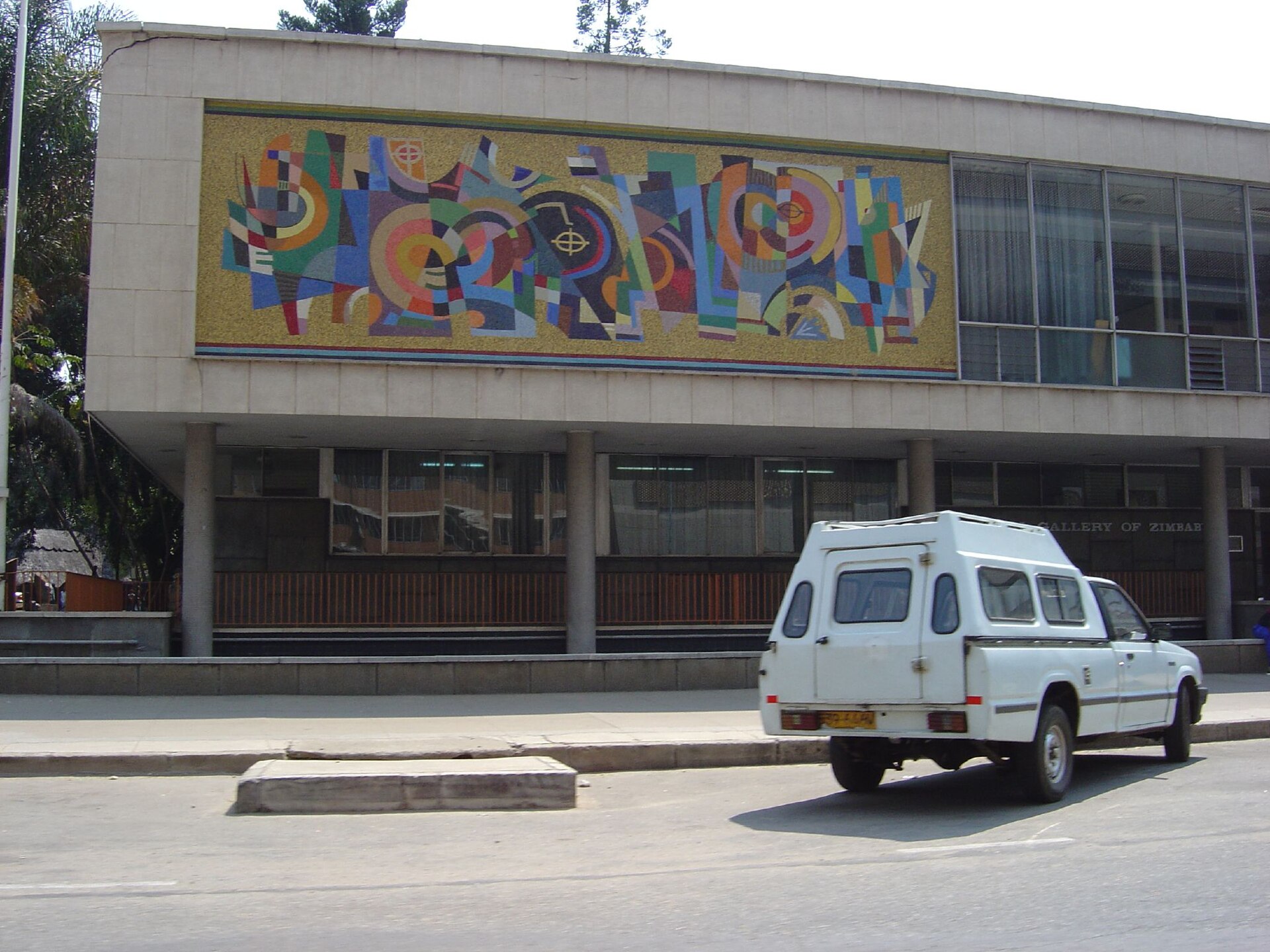
A colonnaded walkway runs the length of the facade past a long reflecting pool set with Shona stone sculptures, under a large abstract mosaic mural spanning the wall above. This is the gallery's public face on Julius Nyerere Way.
Outdoor sculpture garden and forecourt
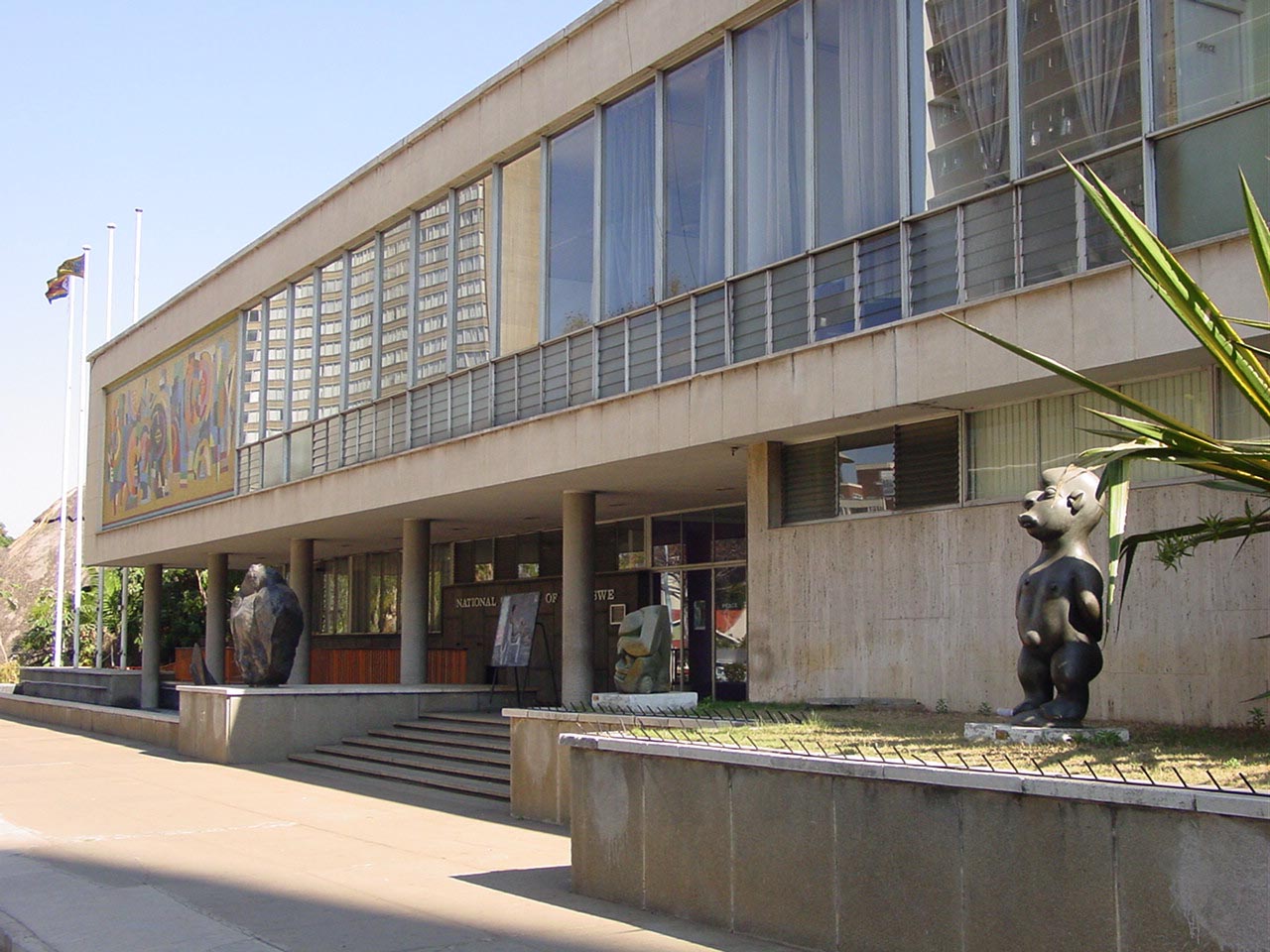
Large-format Shona stone sculptures stand in the grounds outside the building and can be seen without paying admission, alongside the national flag poles; the display has drawn on work by sculptors who trained through the gallery's own Workshop School.
Basement Workshop School (historic)
The room in the gallery's basement where founding director Frank McEwen gave space, tools and materials to self-taught carvers from 1957 onward, starting what became the Shona sculpture movement; Nicholas Mukomberanwa trained here after meeting McEwen in 1962. The workshop later grew into BAT Studios in Mbare and, from 2012, the formally registered National Gallery School of Visual Art and Design, which today teaches from its own campus rather than the gallery basement.
The library
A reference library dating to the 1950s and expanded through the 1980s, holding books and resources on Zimbabwean culture, architecture and modern art; used by students as well as the public.
ArtLife Shop
The gallery's shop, selling original work and craft by Zimbabwean artists together with books and souvenirs.
Afrotopia Cafe
An on-site cafe in the grounds beside Harare Gardens, open the same hours as the gallery.
What to see first
Sculpture by Bernard Matemera in the permanent collection
Bernard MatemeraOne of the first-generation Shona stone sculptors identified by Frank McEwen; his work entered the Rhodes National Gallery's exhibitions from 1967-68 and the gallery gave him two later solo shows, African Metamorphosis (1988) and Whispering the Gospel of Sculpture (1989). His sculptures remain in the permanent collection.15
Sculpture by Nicholas Mukomberanwa
Nicholas MukomberanwaTrained in the gallery's own basement workshop after McEwen encouraged him to take up stone carving in 1962; became one of the best-known names to come out of the Workshop School, won the gallery's Nedlaw/Baringa exhibition award in 1989, and has work in its permanent collection.16
Sculpture by John and Bernard Takawira
John Takawira and Bernard TakawiraBrothers among the first generation of Workshop School sculptors whose stone carvings are held in the gallery's collection of Zimbabwean sculpture.11
Sculpture by Henry Munyaradzi
Henry MunyaradziA Workshop School sculptor represented in the gallery's holdings of Zimbabwean stone sculpture, part of the movement the gallery is internationally known for having launched.11
Paintings by Malangatana Ngwenya, alongside Twins Seven Seven and Henry Tayali
Malangatana Ngwenya (Mozambique); Twins Seven Seven (Nigeria); Henry Tayali (Zambia)The collection reaches beyond Zimbabwe: these three artists' work sits in the gallery's holdings of contemporary African art, reflecting a continental rather than purely national collecting remit.11
Basketry collection
Various Zimbabwean makersA collection of basketry representing the country's major craft industries, spanning the pre-colonial period through independence - one of the few places this craft tradition is held alongside painting and sculpture in a single national collection.10
The Zimbabwe Pavilion at the Venice Biennale
Organised by the National Gallery of ZimbabweThe gallery has commissioned Zimbabwe's national pavilion at the Venice Biennale since the country's first participation in 2011. The 2026 edition, Second Nature - Manyonga, is commissioned by the gallery's Executive Director Raphael Chikukwa and curated by Fadzai Muchemwa, showing five Zimbabwean artists at Santa Maria della Pieta - a direct line from the Harare building's own collection and staff to an international stage.14
A federation-era bequest and a modernist landmark
The gallery exists because of a single bequest. In 1943 Sir James McDonald left 30,000 pounds "in trust for the people of the colony" to found an art institution in Salisbury, in what was then Southern Rhodesia. Planning had already been discussed in the 1930s and was interrupted by the Second World War; it was not until the National Gallery Act of the early 1950s dissolved the original inaugural board and created a Board of Trustees that the project moved forward in earnest. The board's Sir Stephen Courtauld wrote in the 1954 annual report that a National Art Gallery was essential to the progress of the people of the land, and the board went on to raise construction funds from local businesses as well as public money.
A design competition was won by the firm Montgomerie and Oldfield, and construction began in 1955. Frank McEwen, a Scotsman, was appointed the gallery's first director in 1956 and was closely involved in the building's design, including making sure it could store and display works loaned from overseas. The gallery - first named the National Gallery of Rhodesia, and briefly conceived to represent the whole Federation of Rhodesia and Nyasaland - opened to the public on 16 July 1957, with Queen Elizabeth The Queen Mother presiding over the ceremony. Queen Elizabeth II herself visited in October 1991, for the sixth Zimbabwe Heritage Exhibition. The gallery marked its fiftieth anniversary in 2007 and its sixty-seventh in 2024.
Frank McEwen and the Workshop School: how a gallery basement started an art movement
McEwen's most consequential decision was not curatorial in the ordinary sense. From the gallery's earliest years he gave space, tools and materials in the building's own basement to self-taught carvers who had no formal training and no market - and encouraged them to work in stone. Nicholas Mukomberanwa, who met McEwen in 1962, is one of the clearest cases on record: McEwen provided the materials and the basement space, and Mukomberanwa went on to become one of the most celebrated names the Workshop School produced, winning the gallery's Nedlaw/Baringa exhibition award in 1989. Bernard Matemera, Joram Mariga, John and Bernard Takawira and Henry Munyaradzi were part of the same first generation, several of them later serving the gallery in other capacities - Mariga sat on its Board of Trustees from 1982 to 1993.
What began as informal basement space became a named workshop, then BAT Studios in the Harare suburb of Mbare, and, formally registered in 2012, the National Gallery School of Visual Art and Design, which trained later artists including Sylvester Mubayi and Joseph Ndandarika under the earlier BAT name. The school today runs from its own campus rather than the gallery basement, but the line from one to the other is direct and the gallery still credits it as the origin of Shona sculpture as an international art movement. McEwen resigned in 1973; his successor Roy Guthrie went on to found the privately run Chapungu Sculpture Park in 1970.
The building: skylights, a mosaic facade and a reflecting pool
The building is a modernist, essentially single-storey structure that relies heavily on natural light. Its main exhibition hall is a large open-plan room lit by a saw-tooth glass roof, with a mezzanine running around part of the space; the walls below the mezzanine can be broken up with temporary partitions, which is how the gallery has hung both permanent and touring shows in the same room since 1957. A large abstract mosaic mural spans the facade above the entrance colonnade, and a long reflecting pool set with Shona stone sculptures runs along the front of the building, beneath the gallery's name lettering on the wall. No source consulted for this page names the mosaic's maker or its date beyond the building's own 1957 completion.
What is inside today
Beyond the main hall, the gallery's grounds carry an outdoor sculpture display that can be seen without paying admission - large-format Shona stone pieces stand in the forecourt alongside the national flag poles. Indoors, a reference library dating to the 1950s and expanded through the 1980s holds books and resources on Zimbabwean culture, architecture and modern art, and is used by students as well as the public. The ArtLife shop sells original work, craft and books by Zimbabwean artists, and the Afrotopia cafe operates on site during gallery hours. The historic basement workshop space where the Shona sculpture movement began is no longer a working studio in the way it was in the 1960s and 1970s - that activity now belongs to the National Gallery School of Visual Art and Design's own campus - but it remains part of the building's history and is why the gallery still describes sculpture, rather than painting, as its signature strength.
One head gallery, two regional branches - and why this page is not about them
The National Gallery of Zimbabwe is not a single building. A Bulawayo branch opened in 1970 and has occupied Douslin House since 1993; a Mutare branch opened in 1999 in Kopje House, built in 1897. Both operate under the same national institution and, since a 1972 restructuring of the National Gallery Act, under unified management, each with its own regional director. This page describes only the head gallery on Julius Nyerere Way in Harare - the building the Wikidata record for this institution (Q4113712) points to, and the one whose entrance, forecourt, main hall and library are photographed and described above. Its hours, admission prices, phone number and reviews are specific to Harare and should not be read across to Bulawayo or Mutare, which keep their own opening times, admission tables and, in Bulawayo's case, a separate and differently reviewed exhibition programme.
Zimbabwe's pavilion at the Venice Biennale
Since Zimbabwe's first participation in the Venice Biennale in 2011, the National Gallery of Zimbabwe has been the institution that commissions the country's national pavilion - putting the Harare gallery's own leadership on one of the largest stages in contemporary art. The 2026 edition, titled Second Nature - Manyonga, is commissioned by the gallery's Executive Director and Chief Curator Raphael Chikukwa and curated by Fadzai Muchemwa, showing work by five Zimbabwean artists - Gideon Gomo, Eva Raath, Franklyn Dzingai, Felix Shumba and Pardon Mapondera - at the Santa Maria della Pieta in Venice, running from spring to late autumn 2026 with free admission. It is a direct line from the Workshop School basement of the 1960s to a national pavilion in Venice, run by the same institution.
The collection, and what visitors find when they go
The gallery holds around 6,000 works, spanning stone, metal and wood sculpture, painting, drawing, installation and basketry, with an acquisitions focus since Zimbabwean independence in 1980 on the country's traditional culture and contemporary art. It also holds work by artists from elsewhere on the continent - Mozambique's Malangatana Ngwenya, Nigeria's Twins Seven Seven and Zambia's Henry Tayali among them - which sits alongside the Zimbabwean sculpture the gallery is best known for internationally.
What a visitor actually finds on a given day is a genuinely mixed picture, and it is worth saying so plainly rather than only listing what the collection contains on paper. Recent visitor reviews describe the low admission price, the shop and the cafe as clear positives, and are equally clear that the building can feel under-resourced and that the permanent Shona sculpture collection is not always what is on the walls when they visit - a gap between the institution's historical importance and its day-to-day resourcing that the gallery's own published material does not address. The gallery's public collection pages, as read for this record, currently show unrelated placeholder content left over from the website's template rather than a real online catalogue, so no inventory of the true holdings beyond the named artists documented in the third-party sources above could be verified directly from the museum's own site.
What visitors say
Visitors consistently like the low local admission price, the outdoor stone sculpture displays, the ArtLife shop and the Afrotopia cafe, and describe the grounds as a quiet, green stop next to Harare Gardens. Recent reviews are just as consistent on the other side: several describe the building and displays as under-maintained, note that the permanent Shona sculpture collection the gallery is famous for is often not on view inside, and say gallery staff offer little engagement or explanation once you are past the entrance.
What is praised, what is criticised
- Praised: the outdoor Shona stone sculpture displays and reflecting pool at the entrance
- Praised: the ArtLife shop, selling original Zimbabwean art and craft
- Praised: the Afrotopia cafe and the quiet green setting beside Harare Gardens
- Praised: the very low admission price for Zimbabwean residents
- Criticised: the building and grounds read as neglected or under-resourced to several recent visitors
- Criticised: the permanent Shona sculpture collection the gallery is internationally known for is often not the work on view
- Criticised: gallery staff are described as offering minimal engagement or interpretation
- Criticised: visitor numbers on the day are frequently very low, which some reviewers read as a sign of decline
Ratings on other platforms
Tripadvisor: 3.8 from 55 ratings, read 26 August 2026
A platform average is a tertiary source: it moves, it is not audited, and we quote no visitor's words.
Questions about National Gallery of Zimbabwe
Where is National Gallery of Zimbabwe?
20 Julius Nyerere Way, Park Lane, Harare, Zimbabwe.
How much does it cost to visit?
Resident child: USD 1; Resident adult: USD 2; African (non-Zimbabwean resident) child: USD 2; African (non-Zimbabwean resident) adult: USD 5; International (non-African) child: USD 5. As confirmed 26 August 2026.
When is it open?
Daily 09:00-16:30. Closed: Public holidays. As confirmed 26 August 2026.
How do you get there?
On foot: Central Harare, adjacent to Harare Gardens, about two minutes from the Rainbow Towers/Monomutapa Hotel.
What should you see first?
Sculpture by Bernard Matemera in the permanent collection (Bernard Matemera); Sculpture by Nicholas Mukomberanwa (Nicholas Mukomberanwa); Sculpture by John and Bernard Takawira (John Takawira and Bernard Takawira); Sculpture by Henry Munyaradzi (Henry Munyaradzi); Paintings by Malangatana Ngwenya, alongside Twins Seven Seven and Henry Tayali (Malangatana Ngwenya (Mozambique); Twins Seven Seven (Nigeria); Henry Tayali (Zambia)); Basketry collection (Various Zimbabwean makers).
What we could not confirm
- No source consulted names who made the entrance mosaic mural or when, beyond the building's 1957 completion.
- The gallery's own /collection/ web page currently displays unrelated placeholder content (including a painting resembling Van Gogh's The Yellow House and artists with no documented link to Zimbabwe) rather than a real catalogue; this appears to be leftover website-template content rather than a description of the actual holdings, and should not be mistaken for one.
- The total size and any breakdown of the approximately 6,000-work collection by medium, period or date of acquisition is not published in any source consulted.
- Current visitor photography and bag policy are not stated on the gallery's own visit page or any other source consulted.
Images
Sources
- 1National Gallery of Zimbabwe, official website, home page nationalgallery.co.zw/home/
- 2National Gallery of Zimbabwe, official website, Visit Us (hours, admission, contact) nationalgallery.co.zw/visit-us/
- 3Wikimedia Commons, Category:National Gallery of Zimbabwe commons.wikimedia.org/wiki/Category:National_Gallery_of_Zimbabwe
- 4Wikimedia Commons, File:Entrance to the National Gallery of Zimbabwe.jpg (file page and metadata) commons.wikimedia.org/wiki/File:Entrance_to_the_National_Gallery_of_Zimbabwe.jpg
- 5Wikimedia Commons, File:National Gallery Zimbabwe.jpg (file page and metadata) commons.wikimedia.org/wiki/File:National_Gallery_Zimbabwe.jpg
- 6Wikimedia Commons, File:Zimbabwe Art Gallery Harare.jpg (metadata via API) commons.wikimedia.org/wiki/File:Zimbabwe_Art_Gallery_Harare.jpg
- 7Wikimedia Commons, File:1989 Thakor Patel Exhibition at The National Gallery of Zimbabwe .jpg (metadata via API) commons.wikimedia.org/wiki/File:1989_Thakor_Patel_Exhibition_at_The_National_Gallery_of_Zimbabwe_.jpg
- 8Wikipedia, National Gallery of Zimbabwe en.wikipedia.org/wiki/National_Gallery_of_Zimbabwe
- 9Pindula, National Art Gallery of Zimbabwe pindula.co.zw/National_Art_Gallery_of_Zimbabwe
- 10MoMAA (Museum of Modern Art Africa) directory, National Gallery of Zimbabwe momaa.org/directory/national-gallery-of-zimbabwe/
- 11Contemporary And, National Gallery of Zimbabwe contemporaryand.com/en/places/national-gallery-of-zimbabwe
- 12CIMAM, National Gallery of Zimbabwe (institutional member listing) cimam.org/general-information/who-are-our-members-home/institutional-members/national-gallery-of-zimbabwe/
- 13Tripadvisor, National Gallery of Zimbabwe, Harare (reviews and rating) tripadvisor.com/Attraction_Review-g293760-d2310694-Reviews-National_Gallery_of_Zimbabwe-Harare_Harare_Province.html
- 14La Biennale di Venezia, Zimbabwe (Republic of) national pavilion, Biennale Arte 2026 labiennale.org/en/art/2026/zimbabwe-republic
- 15Wikipedia, Bernard Matemera en.wikipedia.org/wiki/Bernard_Matemera
- 16Wikipedia, Nicholas Mukomberanwa en.wikipedia.org/wiki/Nicholas_Mukomberanwa


