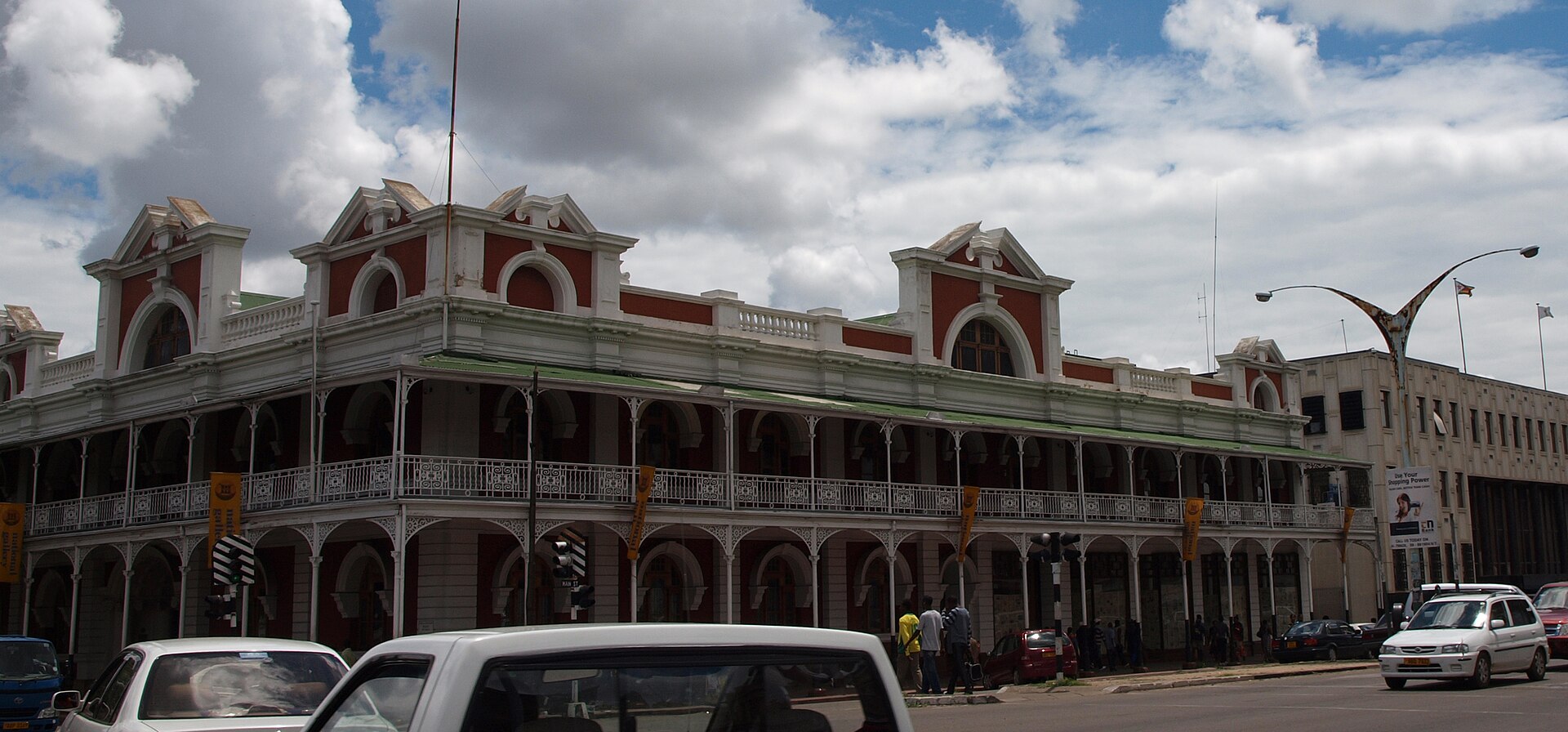
The street facade of Douslin House, home of the National Gallery of Zimbabwe in Bulawayo, showing its two-storey Edwardian colonial architecture with cast-iron balconies and colonnade along the street front.
Digr, via Wikivoyage · CC BY-SA 3.0National Gallery of Zimbabwe in Bulawayo
Museum · Founded 1970
Open, admission and hours confirmed 1 September 2026 · 24 sources
On this page 14 sections
ContentsClose
The gallery's own published strength is less a single deep holding than a working record of Bulawayo's and Matabeleland's art community across roughly a century, anchored by Bulawayo-born painter Marshall Baron and reaching, through the Pachipamwe workshop programme, as far as a Turner Prize winner exhibited and discussed on these premises in 2016. Its more distinctive asset may be functional rather than collected: seven working artist studios and a reference library holding press cuttings back to 1972, which together make the building a place where Zimbabwean art history is still being made rather than only stored.
| Kind | Museum |
|---|---|
| Founded | 1970 |
| City and country |  Bulawayo, Zimbabwe Bulawayo, Zimbabwe |
| Address | Douslin House, corner of J.M.N. Nkomo Street and Leopold Takawira Avenue, Bulawayo, Zimbabwe |
| Website | nationalgallerybyo.co.zw |
| Status | Open, confirmed |
| Record last verified |
Visiting
- Hours
- Tue-Sat09:00 to 17:00
- Closed
- Sunday. Monday. Public holidays.
- Admission
- Resident adultUSD 2
- Resident childUSD 1
- Non-resident adultUSD 10
- Non-resident childUSD 5
- Organised group (per person)USD 1Group size and whether this rate is resident-only are not specified in the source
- Do I need to book?
- Not stated; nothing in any source consulted suggests booking is required for individual visitors
- Address
- Douslin House, corner of J.M.N. Nkomo Street and Leopold Takawira Avenue, Bulawayo, Zimbabwe MapOn foot Central Bulawayo's historic Main Street commercial district, within the same city-centre grid as Bulawayo City Hall
- Website
- nationalgallerybyo.co.zw
- Telephone
- +263 2922 70721
- [email protected]
Before you go how long, access, photography, bags, eating, shop
- How long to allow
- Reviewers describe the display halls alone as viewable in well under an hour; visitors who stop to talk with the resident artists in their studios report staying considerably longer
- Access
- Not stated in any source consulted
- Photography
- Not stated in any source consulted
- Bags
- Not stated in any source consulted
- Eating
- The Hideout Cafe, on site
- Shop
- The Sabona shop, off the main foyer, selling Matabeleland crafts and art, postcards, music CDs and books by local and international authors
Prices and hours change. We take them from the institution's own pages and print the day we read them, and you can check the current position at the source we used. Confirm before you travel.
What is inside
Anglo American Gallery and Marshal Baron Gallery
The gallery's two named main exhibition halls, used for the changing programme of solo and group shows; the Marshal Baron Gallery is named for the Bulawayo-born painter Marshall Baron, whose own work is held in the permanent collection. Recent shows staged in these rooms include a Charles Msimanga retrospective (Anglo American Gallery, opened 28 August 2025) and Perfection is Not Always Reality by Tinotenda Chivhinge (Marshal Baron Gallery, opened 12 June 2025).
Resident artist studios
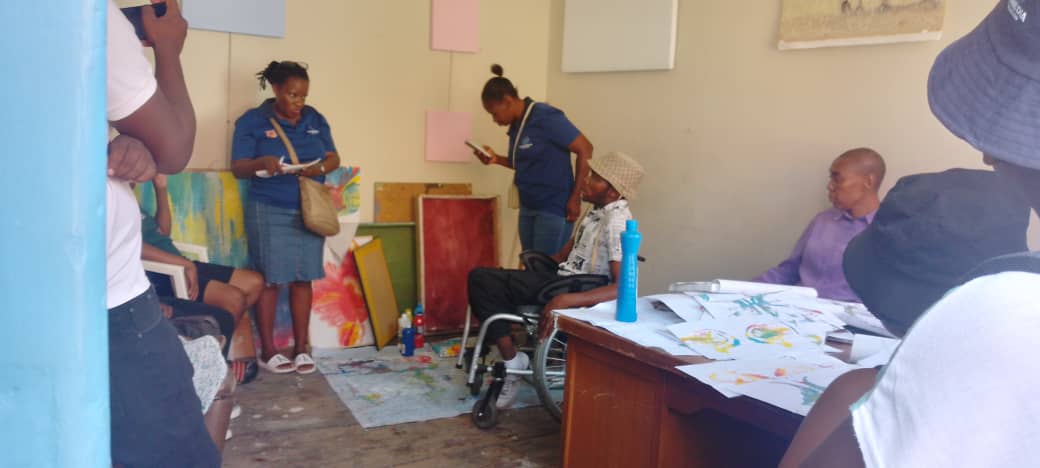
Seven studios of about 16.8 square metres each, let individually or shared to visual artists on residencies of two weeks to a year under the gallery's self-funded Artist-in-Residence Programme. Studios come with a desk, chairs and internet access but no air conditioning, heating or specialist equipment; residents are expected to bring their own tools. Visitor reviews describe this as a highlight of a visit in its own right: the artists work with the door open and are generally happy to talk about what they are making.
Beit Reference Library
A visual-art reference library on the first floor of Douslin House, open to the public Tuesday to Friday. It holds books, periodicals and press cuttings going back to 1972 on printmaking, painting, music, photography, the graphic and decorative arts, architecture and sculpture, and has recently added an Open Educational Resources collection developed with the United States Embassy.
Courtyard and balconies
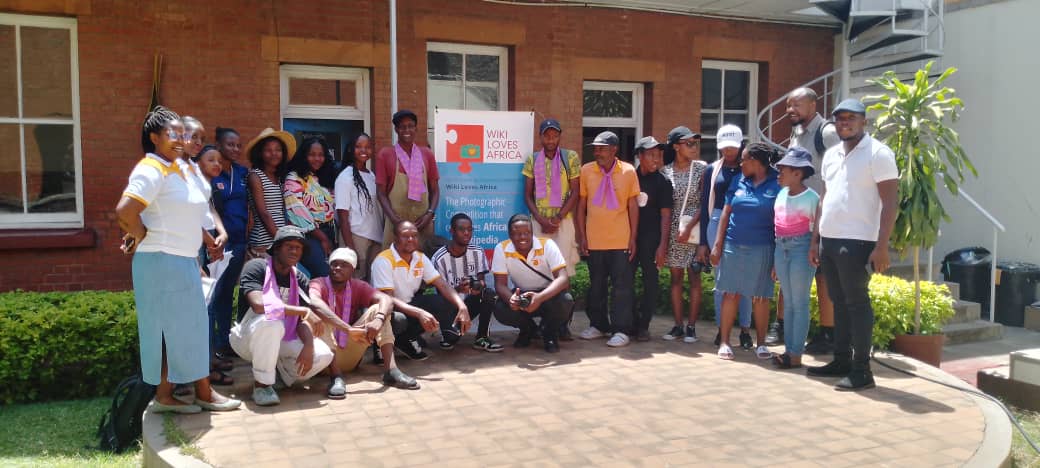
An open courtyard used for outdoor events and gatherings - including, in March 2024, a Wiki Loves Africa Zimbabwe photo-hunt meet-up held on the gallery's grounds - plus first-floor balconies overlooking J.M.N. Nkomo Street and Leopold Takawira Avenue, both offered for venue hire alongside the indoor galleries.
The Sabona shop
The gallery's shop, off the main foyer, stocking hand-picked crafts and art from the Matabeleland region together with postcards, music CDs and books by local and international authors.
The Hideout Cafe
An on-site cafe serving light meals; third-party listings describe a limited menu of sandwiches, pasta dishes and salads.
John Knight Cinema and Lecture Theatre
Smaller indoor spaces used for screenings, lectures and talks, and offered for venue hire alongside the main galleries; the gallery's venue-hire page also lists a carport fitted with a performance stage for outdoor events.
What to see first
Paintings by Marshall Baron in the permanent collection
Marshall BaronBaron (1934-1977) was born in Bulawayo, practised as a lawyer in the city from 1957 and was music critic of the Bulawayo Chronicle from 1962, while building a parallel career as a painter exhibited across Southern Africa. Some of his paintings are held in the National Gallery of Zimbabwe's collection, and this gallery has named its Marshal Baron Gallery exhibition room after him.15
The 2016 Pachipamwe retrospective built around Chris Ofili
Chris OfiliIn 2016 the gallery's Pachipamwe retrospective exhibition - part of a workshop series running in Zimbabwe since 1988 - made the 1998 Turner Prize winner and 2003 British Venice Biennale representative Chris Ofili its central focus, alongside Zimbabwean artists including Voti Thebe and Rashid Jogee; assistant curator Clifford Zulu said Ofili's contribution to the Zimbabwean arts industry compelled the gallery to recognise him.19
Unya kubili njengombankwa, by Voti Thebe
Voti ThebeA 2009 clay-on-canvas work, 30 by 30 centimetres, by an artist who trained through Bulawayo's own art community and whose work the gallery's permanent collection page lists by name and medium.5
Protecting the Innocent and Stretched to the Max, by Danisile Ncube
Danisile NcubeTwo metal sculptures in the permanent collection - Protecting the Innocent at 172 by 73 by 62 centimetres and Stretched to the Max at 90 by 43 by 47 centimetres - among the few three-dimensional works the gallery's own collection listing documents by exact dimension.5
Blind Guard, by Josephine O'Farrell
Josephine O'FarrellAn oil-on-board work from 1976, 90 by 90 centimetres, one of the earlier dated pieces the gallery's permanent collection page records by title, medium and year.5
Waiting Room, Basketball and Rescue, by Alex Lambeth
Alex LambethA group of three works spanning oil on canvas, a further oil on canvas dated 1986, and a charcoal drawing dated 1987, all listed in the gallery's own permanent collection record.5
Charles Msimanga retrospective exhibition
Charles MsimangaA retrospective devoted to Msimanga opened in the Anglo American Gallery on 28 August 2025, one of the gallery's most recent named solo shows and evidence of continuing programming through the period this record was researched.4
From Willoughby's Building to Douslin House
The building the gallery occupies has carried three names. Put up on Main Street in Bulawayo at the turn of the twentieth century - the gallery's own history page dates construction to 1900, though it is recorded elsewhere as 1901 - it was known first as Willoughby's Building from 1901 to 1956, then renamed Asbestos House from 1957 to 1979, and only took its present name, Douslin House, after that, honouring the architect who designed it. It is a two-storey Edwardian colonial building, red brick below a white cast-iron colonnade and balcony that runs the length of the street facade, and it is now a protected structure in Bulawayo.
The gallery itself is a separate, older institution that only later moved into this specific building. It opened to the public on 4 December 1970 as a branch of the National Gallery of Zimbabwe, initially housed in an old market building behind Bulawayo's City Hall. It occupied that first home for roughly two decades before relocating into Douslin House - the gallery's own account gives 1994 as the year of the move, while other sources give 1993, a discrepancy this record cannot resolve from the sources consulted. Restoring the building for gallery use began in 1991 and drew funding from national and international bodies, but the gallery's own history page is emphatic that the largest share came from Bulawayo itself: businessmen, city councillors, artists and ordinary residents raising the money between them to bring the old building back into use.
A second national gallery for Zimbabwe's second city
The National Gallery of Zimbabwe is not one building but three: the head gallery in Harare, opened in 1957 on a bequest from Sir James McDonald and led in its early years by Frank McEwen; this Bulawayo branch, opened in 1970; and a third branch in Mutare, opened in 1999 in a building called Kopje House. All three have operated under one national institution since a 1972 restructuring of the National Gallery Act, but each branch keeps its own regional manager, its own exhibition programme and its own building history. This page describes only the Bulawayo branch - its own hours, admission prices, phone number, collection highlights and reviews are specific to Douslin House and should not be read across to the Harare or Mutare galleries, which this archive treats, and reviews, separately.
Bulawayo's branch has had a working list of regional managers and directors distinct from Harare's own leadership, including at various points Stephen Williams, the novelist Yvonne Vera, Addelis Sibutha, Voti Thebe and Butholezwe Kgosi Nyathi, with Silenkosi Moyo named as the current Regional Manager in the most recent source consulted. Stephen Williams' name also surfaces independently, in a 2016 newspaper account of an exhibition staged at this same gallery, discussed below - one of several points where the branch's own artists, staff and collection turn out to be more tightly interwoven than a simple administrative listing would suggest.
What Douslin House holds today
The building's ground and first floors now carry a working art institution rather than a single museum hall. Two named exhibition rooms, the Anglo American Gallery and the Marshal Baron Gallery - the second named for the Bulawayo-born painter Marshall Baron - host the gallery's changing programme; in the twelve months before this record was researched they carried, among others, a Charles Msimanga retrospective, a photography show titled Nothing to See Here by Elliot Moyo, and Perfection is Not Always Reality by Tinotenda Chivhinge. A further exhibition strand, the Annual Provincial Exhibition, runs in smaller galleries along J.M.N. Nkomo Street itself; its 2025 edition, opened 18 September, carried the theme Dreams vs Reality.
Away from the exhibition halls, seven resident artist studios of about 16.8 square metres each are let to visual artists on residencies running from two weeks to a year under a self-funded Artist-in-Residence Programme, with fees of 50 to 150 US dollars a month depending on nationality and whether a studio is shared; the gallery's own programme page records residents having come from the United Kingdom, India, South Africa, the United States and Germany, without naming individuals. On the first floor, the Beit Reference Library holds books, periodicals and press cuttings on the visual arts going back to 1972, open to the public four days a week. The building also carries a shop, Sabona, selling Matabeleland crafts and books, and a cafe, the Hideout, plus a courtyard, balconies and a covered carport with a performance stage that the gallery offers for venue hire alongside its exhibition spaces. An outreach art school run from the building teaches painting, drawing and sculpture to students from six years old through to adults, issuing a certificate on completion of its year-long course.
The permanent collection: named works and named makers
The gallery's own permanent-collection listing, read directly rather than through a summary, names a working set of Zimbabwean and Zimbabwe-connected artists and titles it documents by medium, dimension and date: Voti Thebe's Unya kubili njengombankwa, a clay-on-canvas piece from 2009; Peter Msimanga's Umkwenyana yinxoza, oil on canvas, also 2009; Josephine O'Farrell's Blind Guard, oil on board, 1976; three works by Alex Lambeth spanning oil on canvas and charcoal on paper through the 1980s; and two metal sculptures by Danisile Ncube, Protecting the Innocent and Stretched to the Max, each recorded to the centimetre. The same page also names Marshall Baron, Rashid Jogee, Berry Bickle, Charles Msimanga (rendered elsewhere on the same page as Charles Msimenta), Charles Bhebhe and Keith Zenda as artists represented in the collection, and states that the holdings as a whole span paintings, sculpture and ethnographic artefacts from the 1920s to 2024, drawn from Zimbabwe, elsewhere in Africa and Europe. A number of further entries on the same page are catalogued only under internal accession codes, without an artist name or title - a gap in the gallery's own published record that this account has not tried to fill.
One name on that list, Chris Ofili, sits apart from the others: an internationally celebrated British painter with no ordinary claim to a place in a small regional gallery's permanent collection. His presence there is explained not by an acquisition but by an exhibition, described in the next section.
An unlikely international connection: the Pachipamwe workshops and Chris Ofili
Since 1988, Zimbabwe has run a series of Pachipamwe international artists' workshops - the word means, roughly, coming together again - bringing local and international artists together to work side by side. In March 2016 this gallery opened a two-month exhibition under the banner Pachipamwe Retrospective, running works from the earlier workshops alongside pieces by visiting artists from Canada, South Africa and Namibia and by Zimbabwean names including Voti Thebe, Rashid Jogee, Stephen Williams, Marvelous Mangena and George Newi. The exhibition's assistant curator, Clifford Zulu, told the Bulawayo newspaper Sunday News that the show's central focus that year was the work of the British painter Chris Ofili, winner of the 1998 Turner Prize and Great Britain's representative at the 2003 Venice Biennale, saying his contribution to the Zimbabwean arts industry had compelled the gallery to recognise him. The show ran alongside the twenty-eighth annual exhibition of the Visual Artists Association of Bulawayo, an artist-led body founded in 1983 that works in partnership with the National Gallery of Zimbabwe.
It is this exhibition history, rather than a straightforward acquisition, that accounts for an internationally famous British artist's name sitting on a small Bulawayo gallery's own collection page alongside painters known mainly within Zimbabwe - a genuinely unusual point of contact between a regional institution and the wider contemporary art world, and one that would be easy to miss without reading the gallery's exhibition history rather than only its current listings.
What a visitor actually finds
Reviews of a visit are consistent on what stands out. The building is the first thing most visitors mention: a well-preserved piece of old Bulawayo, its ironwork balconies and colonnade still intact more than a century after Willoughby's Building first went up. The second is the resident artists - reviewers describe stopping to talk with people actually at work in the seven ground-level studios, and buying directly from them, as the most memorable part of a visit, more so than the formal exhibition halls. Where criticism appears, it is about scale rather than quality: some visitors describe the display halls themselves as small enough to see in under an hour, and non-resident visitors sometimes note that their admission fee runs five times the resident rate. None of this amounts to a criticism of the collection's substance so much as of its size relative to expectations set by the word national in the gallery's own name - a genuine tension between a modest regional building and the scope its name implies, and one the gallery's own extensive artist-residency and outreach programme goes some way to answering even if the exhibition halls alone do not.
What visitors say
Visitors consistently single out two things: the building itself, a well-preserved Edwardian-era landmark in the middle of Bulawayo, and the chance to meet resident artists working in their own on-site studios and buy directly from them. Criticism, where it appears, concerns scale rather than quality - a small display that some visitors clear in well under an hour - and price, since the non-resident admission fee runs five times the resident rate.
What is praised, what is criticised
- Praised: the Douslin House building itself, described repeatedly as a handsome, well-preserved piece of old Bulawayo
- Praised: meeting resident artists in their own studios and being able to buy work directly from them
- Praised: the on-site Sabona shop and Hideout Cafe
- Praised: the changing exhibition programme in the Anglo American and Marshal Baron galleries
- Criticised: some visitors describe the display space as small, with the halls themselves walkable in well under an hour
- Criticised: the non-resident admission fee is five times the resident fee, which some international visitors consider steep for the amount on view
Ratings on other platforms
Google: 4.1 from 793 ratings, read 1 September 2026
Tripadvisor: 4 from 66 ratings, read 1 September 2026
A platform average is a tertiary source: it moves, it is not audited, and we quote no visitor's words.
Questions about National Gallery of Zimbabwe in Bulawayo
Where is National Gallery of Zimbabwe in Bulawayo?
Douslin House, corner of J.M.N. Nkomo Street and Leopold Takawira Avenue, Bulawayo, Zimbabwe.
How much does it cost to visit?
Resident adult: USD 2; Resident child: USD 1; Non-resident adult: USD 10; Non-resident child: USD 5; Organised group (per person): USD 1. As confirmed 1 September 2026.
When is it open?
Tue-Sat 09:00-17:00. Closed: Sunday. Monday. As confirmed 1 September 2026.
How do you get there?
On foot: Central Bulawayo's historic Main Street commercial district, within the same city-centre grid as Bulawayo City Hall.
What should you see first?
Paintings by Marshall Baron in the permanent collection (Marshall Baron); The 2016 Pachipamwe retrospective built around Chris Ofili (Chris Ofili); Unya kubili njengombankwa, by Voti Thebe (Voti Thebe); Protecting the Innocent and Stretched to the Max, by Danisile Ncube (Danisile Ncube); Blind Guard, by Josephine O'Farrell (Josephine O'Farrell); Waiting Room, Basketball and Rescue, by Alex Lambeth (Alex Lambeth).
What we could not confirm
- Whether the gallery's move into Douslin House took place in 1993 (Wikipedia) or 1994 (the gallery's own history page) is not resolved by the sources consulted.
- No dedicated Wikidata item for this Bulawayo branch could be found; a direct Wikidata search for it returned no results, and the existing Wikidata item for the National Gallery of Zimbabwe (Q4113712) is used by the Harare head-gallery record in this archive, not this one.
- The gallery's own permanent-collection page lists a number of works only by internal accession code, with no artist name or title attached; this record does not attempt to identify them.
- No admission-prices or opening-hours page could be found on the gallery's own website (nationalgallerybyo.co.zw); the figures in this record come from the Bulawayo Publicity Association and are corroborated by Wikivoyage and a Wanderlog listing, but have not been confirmed directly by the institution.
- Wikipedia records a list of past Bulawayo regional directors (including novelist Yvonne Vera) without dates for each tenure; this record has not attempted to verify or date that list independently.
Images
Sources
- 1National Gallery of Zimbabwe in Bulawayo, official website, home page nationalgallerybyo.co.zw/
- 2National Gallery of Zimbabwe in Bulawayo, official website, Contact nationalgallerybyo.co.zw/contact/
- 3National Gallery of Zimbabwe in Bulawayo, official website, The story of the gallery and the Douslin House nationalgallerybyo.co.zw/the-story-of-the-gallery-and-the-douslin-house/
- 4National Gallery of Zimbabwe in Bulawayo, official website, Current exhibitions nationalgallerybyo.co.zw/current/
- 5National Gallery of Zimbabwe in Bulawayo, official website, Permanent Collections nationalgallerybyo.co.zw/permanent-collections/
- 6National Gallery of Zimbabwe in Bulawayo, official website, Artist Residency Programme nationalgallerybyo.co.zw/artist-residency-3/
- 7National Gallery of Zimbabwe in Bulawayo, official website, Outreach and Education nationalgallerybyo.co.zw/outreach-and-education/
- 8National Gallery of Zimbabwe in Bulawayo, official website, Library (Beit Reference Library) nationalgallerybyo.co.zw/library-3/
- 9National Gallery of Zimbabwe in Bulawayo, official website, Venue Hire nationalgallerybyo.co.zw/venue-hire-3/
- 10National Gallery of Zimbabwe in Bulawayo, official website, From the gallery shop nationalgallerybyo.co.zw/from-the-gallery-shop/
- 11National Gallery of Zimbabwe in Bulawayo, official website, About nationalgallerybyo.co.zw/about/
- 12Bulawayo Publicity Association, National Gallery of Zimbabwe listing (hours, admission, contact) bulawayopublicity.com/national-gallery-of-zimbabwe/
- 13MoMAA (Museum of Modern Art Africa) directory, National Gallery of Bulawayo momaa.org/directory/national-gallery-of-bulawayo/
- 14Wikipedia, National Gallery of Zimbabwe (Bulawayo branch section) en.wikipedia.org/wiki/National_Gallery_of_Zimbabwe
- 15Wikipedia, Marshall P. Baron en.wikipedia.org/wiki/Marshall_P._Baron
- 16Pindula, Marshall Baron pindula.co.zw/Marshall_Baron
- 17Wikivoyage, Bulawayo (National Art Gallery listing) en.wikivoyage.org/wiki/Bulawayo
- 18Wanderlog, National Gallery in Bulawayo (aggregated Google and Tripadvisor ratings, hours) wanderlog.com/place/details/334160/national-gallery-in-bulawayo
- 19Sunday News (Bulawayo), 'Pachipamwe exhibition opens at National gallery', by Ntombiyolwandle Ndlovu, 13 March 2016 (fetched via Herald Online republication) sundaynews.co.zw/pachipamwe-exhibition-opens-at-national-gallery/
- 20OpenStreetMap / Nominatim, National Art Gallery Bulawayo node nominatim.openstreetmap.org/search?q=National+Gallery+Bulawayo&format=jsonv2
- 21Wikimedia Commons, File:ZW Bulawayo National Art Gallery.JPG (file page and metadata) commons.wikimedia.org/wiki/File:ZW_Bulawayo_National_Art_Gallery.JPG
- 22Wikimedia Commons, File:Photo hunt at the Art Gallery.jpg (file page and metadata) commons.wikimedia.org/wiki/File:Photo_hunt_at_the_Art_Gallery.jpg
- 23Wikimedia Commons, File:Interviews with Artists.jpg (file page and metadata) commons.wikimedia.org/wiki/File:Interviews_with_Artists.jpg
- 24Wikimedia Commons, Category:National Gallery of Zimbabwe commons.wikimedia.org/wiki/Category:National_Gallery_of_Zimbabwe


