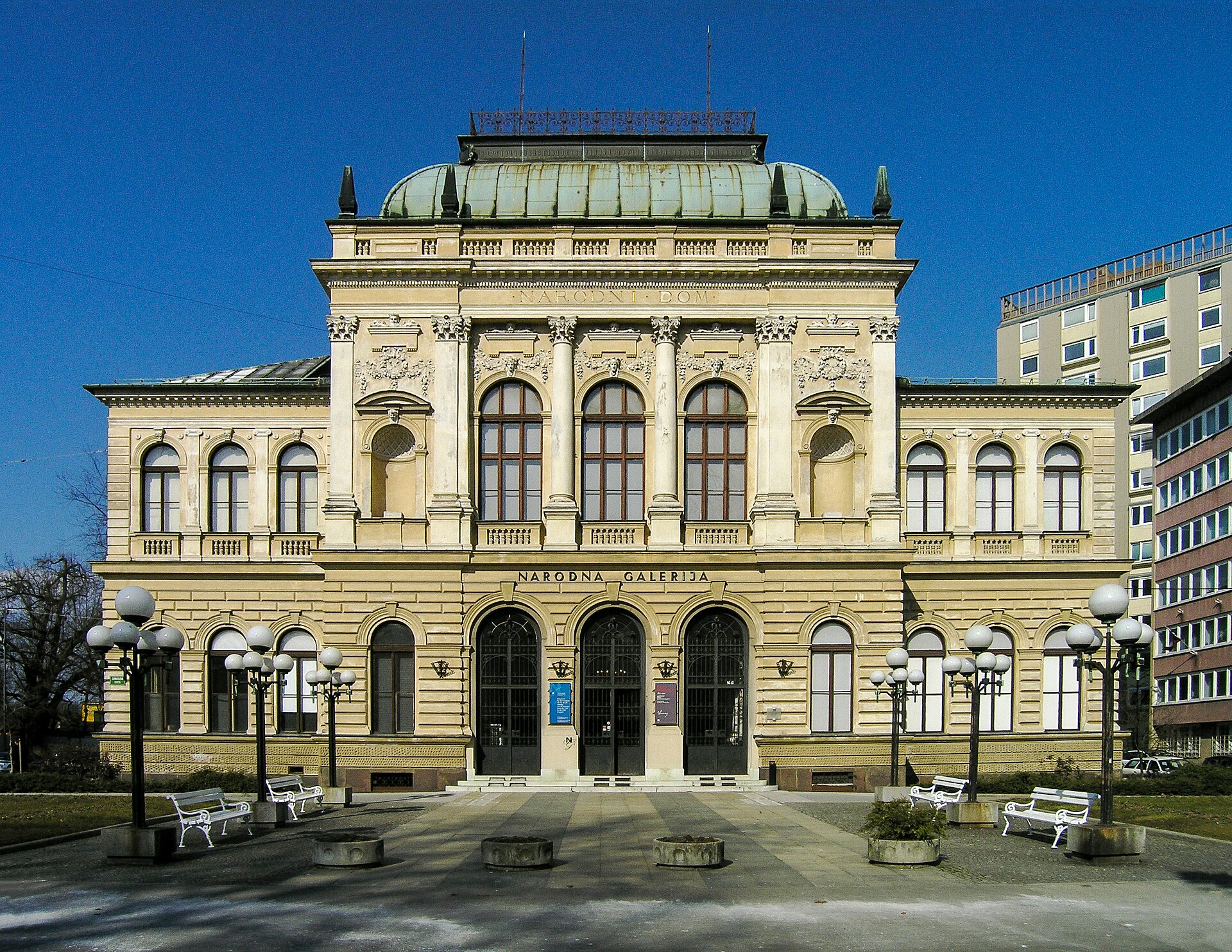
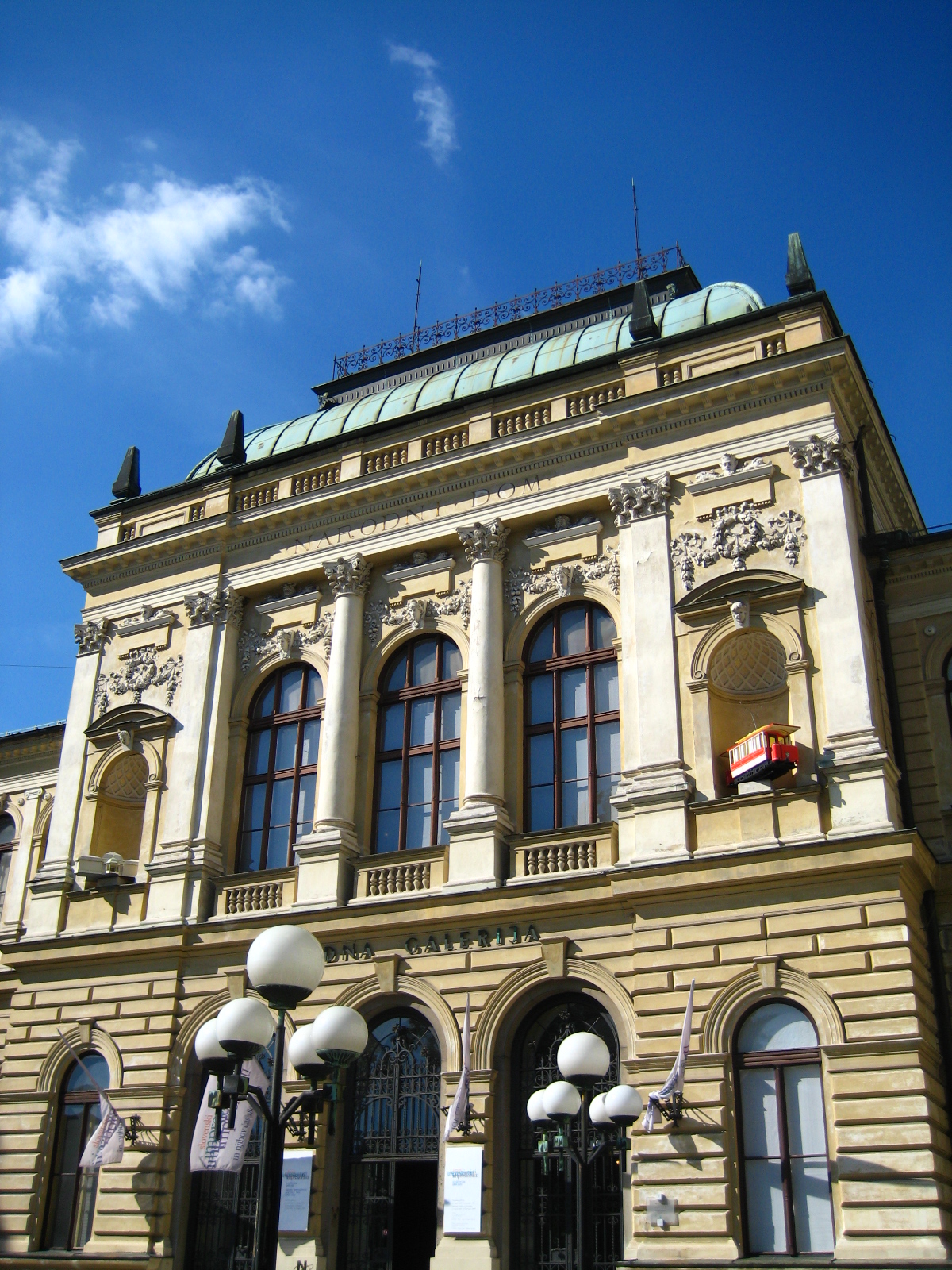
The National Gallery of Slovenia's facade, as identified on the file's own Wikimedia Commons description
Petar Milosevic, CC BY-SA 3.0 · Photograph by PetarMNational Gallery of Slovenia
Museum · Narodna galerija · Founded 1918
Open, admission and hours confirmed 23 August 2026 · 21 sources
On this page 15 sections
ContentsClose
The National Gallery of Slovenia's strength is breadth across eight centuries of art made in or brought into Slovenian territory, from Gothic panel painting and sculpture through Baroque golden altars and portraiture to what the institution itself treats as its signature holding, the Slovenian Impressionists of 1900 to 1918: Grohar, Jakopic, Sternen and Jama, painters the Gallery's own account is candid about being a partly invented national school rather than a purely stylistic grouping. Its one late, single-donor acquisition of international standing is the 2016 Zoran Music gift, which gives the collection a dedicated body of work by a painter with a genuinely international, postwar reputation, anchored by the Dachau-derived Register of Corpses series. The building itself, three renovated and interconnected wings running from an 1896 national cultural hall to a 2001 glass entrance pavilion holding a restored 18th-century civic fountain, is presented by the institution as inseparable from the collection it houses.
| Local name | Narodna galerija |
|---|---|
| Kind | Museum |
| Founded | 1918 |
| City and country |  Ljubljana, Slovenia Ljubljana, Slovenia |
| Address | Presernova cesta 24, 1000 Ljubljana, Slovenia |
| Website | ng-slo.si/en |
| Status | Open, confirmed |
| Record last verified |
Visiting
- Hours
- Tuesday to Sunday10:00 to 18:00
- Thursday10:00 to 20:00extended hours
- 24 and 31 December10:00 to 15:00shortened hours
- Closed
- Monday. 1 January. 1 May. 1 November. 25 December.
- Admission
- Permanent Collection, regularEUR 10
- Permanent Collection, reducedEUR 6children, pupils, students, pensioners and sponsors on presentation of ID
- Permanent Collection, family ticketEUR 20
- Permanent Collection, group (10 to 25 adults)EUR 6per person
- Temporary Exhibitions, regularEUR 6
- Temporary Exhibitions, reducedEUR 4
- Temporary Exhibitions, family ticketEUR 12
- Combined ticket (Permanent Collection and Temporary Exhibitions), regularEUR 14
- Combined ticket, reducedEUR 8
- Combined ticket, familyEUR 28
- Visitors with disabilities and their carersFreefree, per the museum's own accessibility page
Free entry: First Sunday of every month, Permanent Collection- Tickets
- ng-slo.si/en/visit-us/opening-hours-and-entra... The museum's own ticket page.
- Do I need to book?
- Not required for individual visitors; the museum's own tickets page lists guided tours in foreign languages as needing advance reservation
- Address
- Presernova cesta 24, 1000 Ljubljana, Slovenia MapOn foot / city bus The museum's own accessibility page describes the building as close to Ljubljana city centre and Slovenska cesta, served, in its words, by almost all city bus lines; no specific route numbers are given
Parking Paid on-street parking around the building; the nearest large public car park is in Tivoli Park, reached on foot through an underpass with an exit in front of the Gallery - Website
- ng-slo.si/en
- Telephone
- +386 1 24 15 434
- [email protected]
Before you go how long, access, photography, bags, eating, shop
- How long to allow
- TripAdvisor's own listing gives a duration of one to two hours, though several visitor reviews describe staying much longer, with one calling it easy to spend an entire day immersed in the collection
- Access
- The museum's own accessibility page states the Gallery is accessible to everyone and that guide dogs are allowed. It is equipped with ramps and lifts, and wheelchair users can move independently around the exhibition spaces on all floors from the main entrance at Presernova cesta 24, though reaching the Zoran Music display on the ground floor and the basement exhibition space of the Narodni dom Gallery requires the assistance of museum attendants. Aids on site include induction loops, audio guides, audio descriptions reached by QR code, video content in Slovenian Sign Language, and a tactile adaptation of the painting Luiza Pesjak with a magnifying glass, Braille description and audio description. People with disabilities and their carers are admitted free of charge
- Photography
- Not stated in the sources consulted for this page
- Bags
- Visitors are required to leave coats, rucksacks, bags larger than A4 format (21 by 30 cm) and other luggage in the Gallery's self-service cloakroom, per the museum's own admission page. One 2026 visitor review describes the cloakroom as an honour system with no attendant on duty
- Eating
- A cafe operates inside the Gallery; visitor reviews describe it as cosy and, in one case, beautiful
- Shop
- A museum gift shop operates on site, reached through the same Presernova cesta 24 entrance as the ticket desk
Prices and hours change. We take them from the institution's own pages and print the day we read them, and you can check the current position at the source we used. Confirm before you travel.
What is inside
Medieval and Gothic Art, 1200 to 1600
The Gallery's own period note describes religious art spreading through the Slovenian lands from monastic houses and then from Gorizia, Villach and Ljubljana, with Gothic painting persisting even after the Renaissance had begun elsewhere. Frescoes lead the painting holdings, shown mostly through fragments and copies of subjects such as St Christopher, St George, the Procession and Adoration of the Magi, Sunday Christ and the Dance of Death, alongside named masters including Johannes Aquila, Johannes de Laybaco and Master Bolfgang. Medieval sculpture workshops supplied altar reliefs and statues on Crucifixion, Madonna and Child, and Pieta subjects; the Gallery names the Ptujska Gora sculpture workshop, maker of the Beautiful Madonna and the Pieta from Podsreda, as the peak of Slovenian Gothic sculpture, alongside the Virgin with Child, St Catherine and St Magdalene from Avce and the Christ Crucified from Dramlje in the so-called late Gothic baroque manner around 1500.
Baroque Painting and Sculpture, 1600 to 1800 (the Grand Hall)
The 17th-century rooms hold the so-called golden altars, gilded and polychrome carved wooden retables that combined printmaking, carving, gilding and painting, alongside religious paintings carrying Mannerist and then secular, genre and portrait subjects under northern early-Baroque influence, including work by the Carniola-based painter and gilder Hans Georg Geiger von Geigerfeld and the itinerant painter known only as Almenak. The 18th-century High Baroque rooms are anchored by the Venetian sculptor Francesco Robba, whose fountain of the Carniolan rivers is Ljubljana's civic emblem, and by the monumental canvases of Valentin Metzinger, the oldest of four Ljubljana Baroque painters the Gallery names, plus frescoes and a small oil output by Franc Jelovsek. Late-Baroque and Rococo rooms carry the Venetian-influenced painting of Anton Cebej, the Kremser Schmidt-influenced work of Martin Johann Schmidt, and the portraits of Carniolan nobility by Fortunat Bergant, which the Gallery credits with especially penetrating characterisation.
Biedermeier to Realism, 1800 to 1900
Portraiture dominates this run of rooms: Matevz Langus, Jozef Tominc, Mihael Stroj and Anton Karinger established themselves as self-confident portraitists, at first working from Neoclassical formal habits before Stroj's late work and Karinger's portraits in particular moved toward realism. Landscape painting of Mt Triglav, Lake Bohinj and Bled by Karinger and Marko Pernhart, and still lifes including work by the amateur painter Countess Maria Auersperg Attems, sit alongside the realist generation: the brothers Janez and Jurij Subic, whose teacher Janez Wolf raised the status of the artist above craftsman and pushed his pupils toward academy study; Jozef Petkovsek's plein-air river scenes; and Ivana Kobilca's 1890 painting Summer, singled out by the Gallery's own account as the point where her allegorical training gave way fully to plein-air observation.
Slovenian Impressionism and Art Nouveau, 1900 to 1918
The rooms built around the 1904 Sava artists' exhibition at the Galerie Miethke in Vienna, after which Viennese critics recognised Slovenian painting as a distinct province of the Empire. Ivan Grohar's plein-air landscapes run through to his 1907 painting The Sower, which the Gallery's own account calls a programme-based image fusing earth and man through the handling of paint; Rihard Jakopic's counterlight interiors and intimist images of women; Matej Sternen's The Red Parasol and his ambitious nude and dressing-room compositions after 1911; and Matija Jama's obsessive treatment of light in landscapes of Lower Austria and Croatia. Sculpture from Ivan Zajec, who met Auguste Rodin in Paris in 1905, and the Art Nouveau stylisation of Lojze Dolinar and Ivan Napotnik, complete the rooms.
Art in Slovenia from 1918 Onwards (the New Wing)
The Gallery's own account calls the 20th century a third renaissance for Ljubljana as an art centre, running from the Art Nouveau-inflected Expressionism of the brothers France and Tone Kralj and the Surrealist-leaning Stane Kregar, through the colour realism of the 1930s Zagreb-academy generation (France Mihelic, Maksim Sedej, the early Zoran Music, Gabriel Stupica) and Gojmir Anton Kos's Courbet-and-Manet-derived realism, into the postwar modernism of Marij Pregelj among painters and Jakob Savinsek, Drago Trsar and Stojan Batic among sculptors. The Gallery's own text notes that Italian painters of the 1930s, Gino Severini, Giorgio Morandi and Filippo de Pisis, are also represented, evidence, in its words, that Slovenian art in this century reached beyond regional ambition.
The Zoran Music Collection
A dedicated ground-floor gallery built around the 2016 donation from the artist's niece Vanda Music: 56 works given outright, a further 40 placed in the Gallery's long-term care and 48 more lent temporarily, together surveying Music's work from 1935 to 1999. The Gallery's own account names his recurring little horses and Karst motifs, Venetian views, self-portraits and, in its own words, the profoundly moving Dachau motifs, alongside oil and acrylic paintings, tempera works, prints, drawings and a tapestry Music designed showing the ocean liner Augustus.
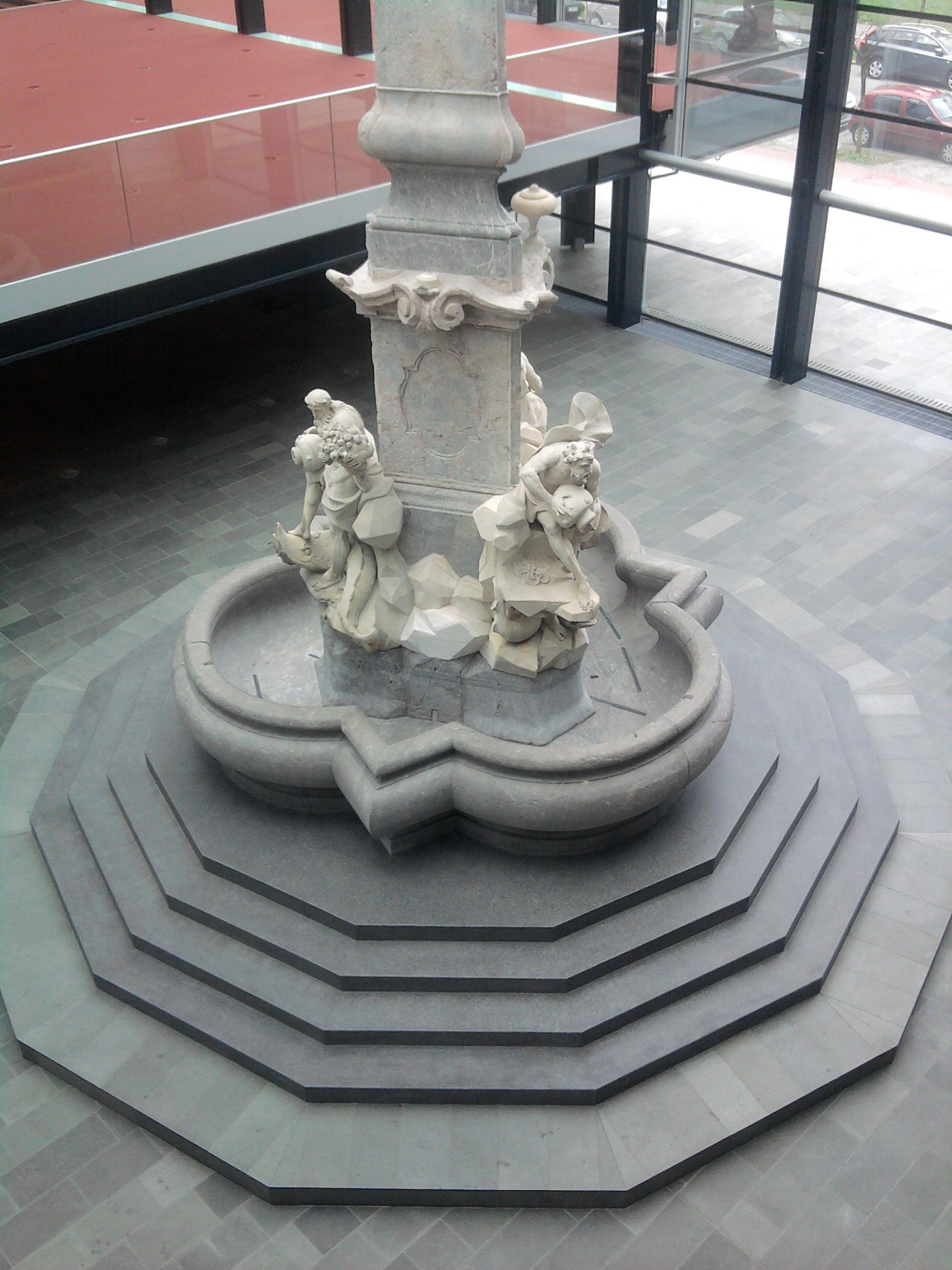
Photograph by Prunk · CC BY-SA 3.0 Entrance Hall and the Robba Fountain
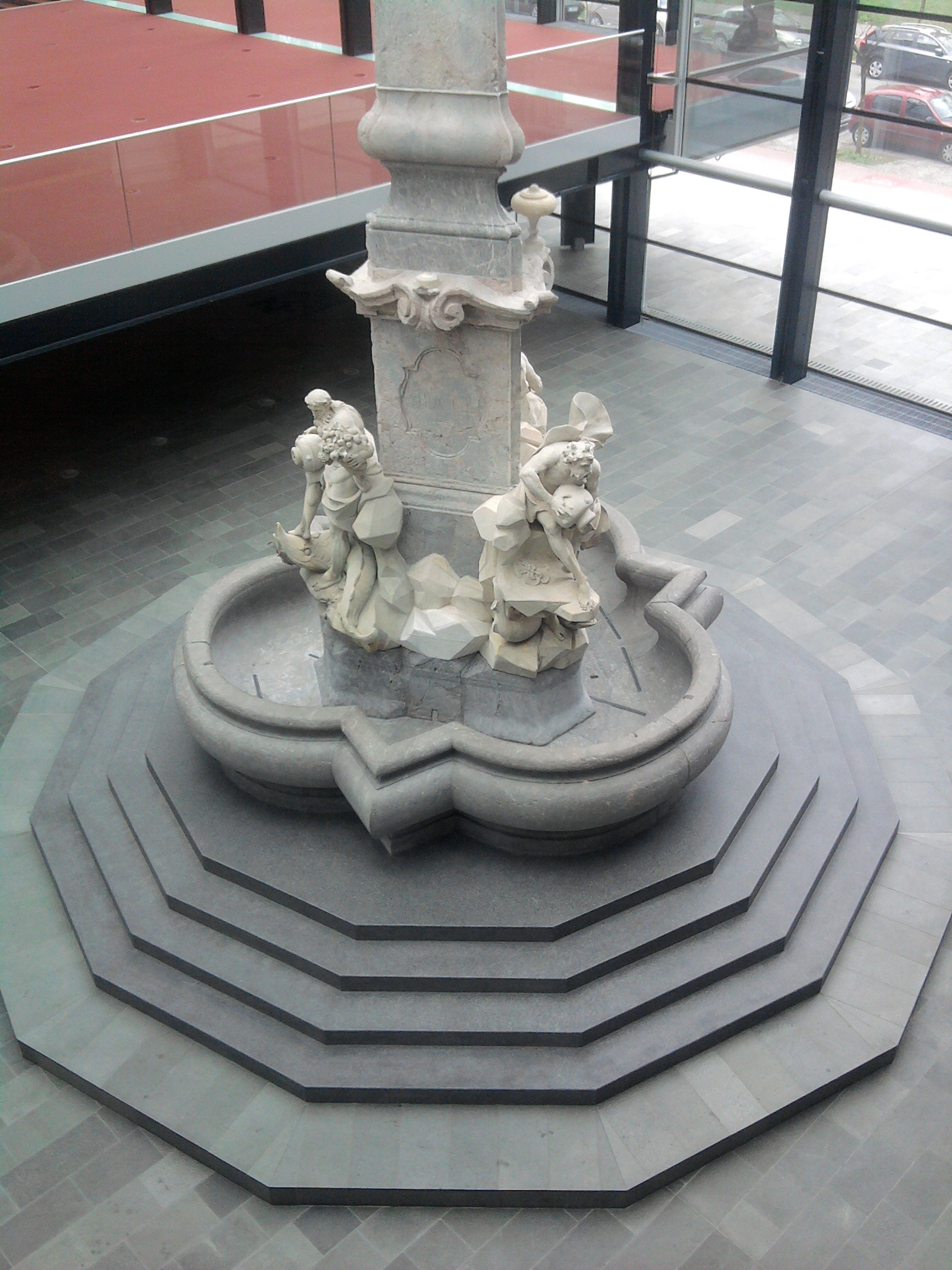
The glass entrance hall completed in 2001 to a design by Sadar Vuga Architects, which connects the historic Narodni dom Palace to the 1990s New Wing. Since 2008 it has held the restored original of Francesco Robba's Baroque fountain of the three Carniolan rivers, moved here after conservation while a replica took its historic place outside Ljubljana Town Hall; TripAdvisor's own summary of the museum notes visitors can see the original fountain without a ticket.
What to see first
The Sower (Sejalec)
Ivan GroharA 1907 painting the Gallery's own account describes as fusing earth and labourer into near-mythical identification through the handling of paint, and the picture most identified with the invention of a Slovenian national school of Impressionist landscape11
Standing Virgin, the Beautiful Madonna
Ptujska Gora WorkshopNamed by the Gallery's own period account as the zenith of Gothic sculpture on Slovenian territory, from the workshop that also produced the Pieta from Podsreda6
Register of Corpses (Cadastre de Cadavres) series
Zoran MusicPart of the 2016 donation from the artist's niece Vanda Music; the Gallery's own history page singles out these Dachau-derived works, made decades after Music's wartime internment, as profoundly moving among the roughly 144 pieces the family gave, lent or placed in the collection's care4
The Robba Fountain (original)
Francesco RobbaThe restored 18th-century original of Ljubljana's civic fountain of the three Carniolan rivers, moved into the Gallery's glass entrance hall in 2008 after conservation, while a replica stands in its historic place at Town Hall Square; viewable without a ticket4
Summer
Ivana KobilcaAn 1890 painting the Gallery's own account credits as the moment Kobilca's academic, allegory-tinted training gave way fully to plein-air observation, exhibited in Paris before her later career settled into portraiture and flower still lifes10
The Red Parasol
Matej SternenA portrait of a fashionable, self-confident townswoman that the Gallery's own account reads as the opening of Sternen's series of ambitious nudes and intimate interiors after 191111
Portraits of Carniolan nobility
Fortunat BergantLate-Baroque portraits the Gallery's own account singles out for penetrating characterisation, elegant posture and suggestive rendering of materials, standing apart from the era's more etheric religious imagery8
Golden altars
Various 17th-century Carniolan workshopsGilded, polychrome carved wooden retables the Gallery's own period account identifies as the characteristic sculptural production of 17th-century Slovenian territory, combining printmaking, carving, gilding and painting in one object7
Past exhibitions here
- Closed16 Apr to 4 Oct 2026Confirmed · check before you travel
A gallery born from a national ambition
The National Gallery of Slovenia traces its founding to 1918, when the National Gallery Society was formed, though the ambition behind it reached back further: the Gallery's own history page records that the desire to build a home for Slovenian art, called an acropolis at its founding, had already been raised toward the end of the 19th century by the aristocratic polymath and correspondent Peter Radics and the mayor of Ljubljana, Dr Ivan Hribar, and carried forward by the Christian Art Society, which assembled a collection of older Slovenian art in 1907. The Society's first home was a set of rooms in the Kresija Palace on the bank of the Ljubljanica, acquired in 1919. The desire for a permanent building was met in the mid-1920s, when the Society leased seven rooms in the Narodni dom, the National Hall, in 1925, followed by a renovation of fourteen spaces for the permanent collection in 1928 and a further expansion in 1933.
Acquisitions accompanied the search for a building from the start. The 1929 legacy from the estate of Dr Fran Windischer, a patron who became the Society's president that same year, gave the Gallery its first bequest and remains, in the Gallery's own words, the foundation of its collection today. On 22 June 1933 the Gallery held the ceremonial opening of its expanded permanent collection of Slovenian art, an event that drew congratulatory telegrams from across the country and from abroad and marked, in the institution's own account, the point at which it began to enjoy a wide public reputation.
The Narodni dom Palace: a cultural centre becomes a gallery
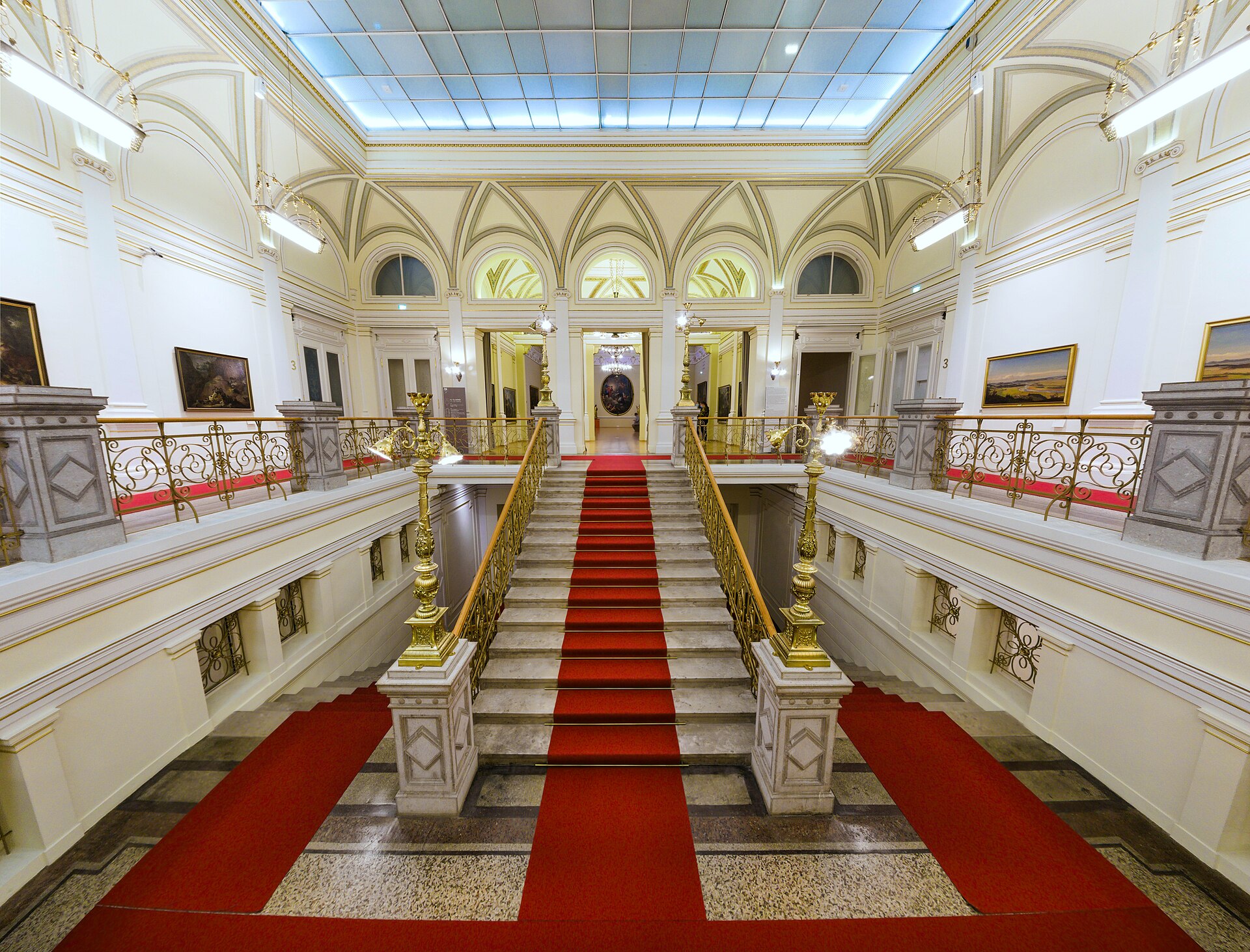
The building the Gallery occupies did not start life as a museum. It was constructed in 1893 to 1896 to a design by the Czech architect Frantisek Skabrout, during the mayoral term of Ivan Hribar, as the Narodni dom, a Slovenian national cultural centre, according to Wikipedia's summary of the building's history. The Gallery moved into part of it in the 1920s and expanded within it over the following decades, and the Narodni dom Palace was declared a cultural monument of Slovenia in 1993.
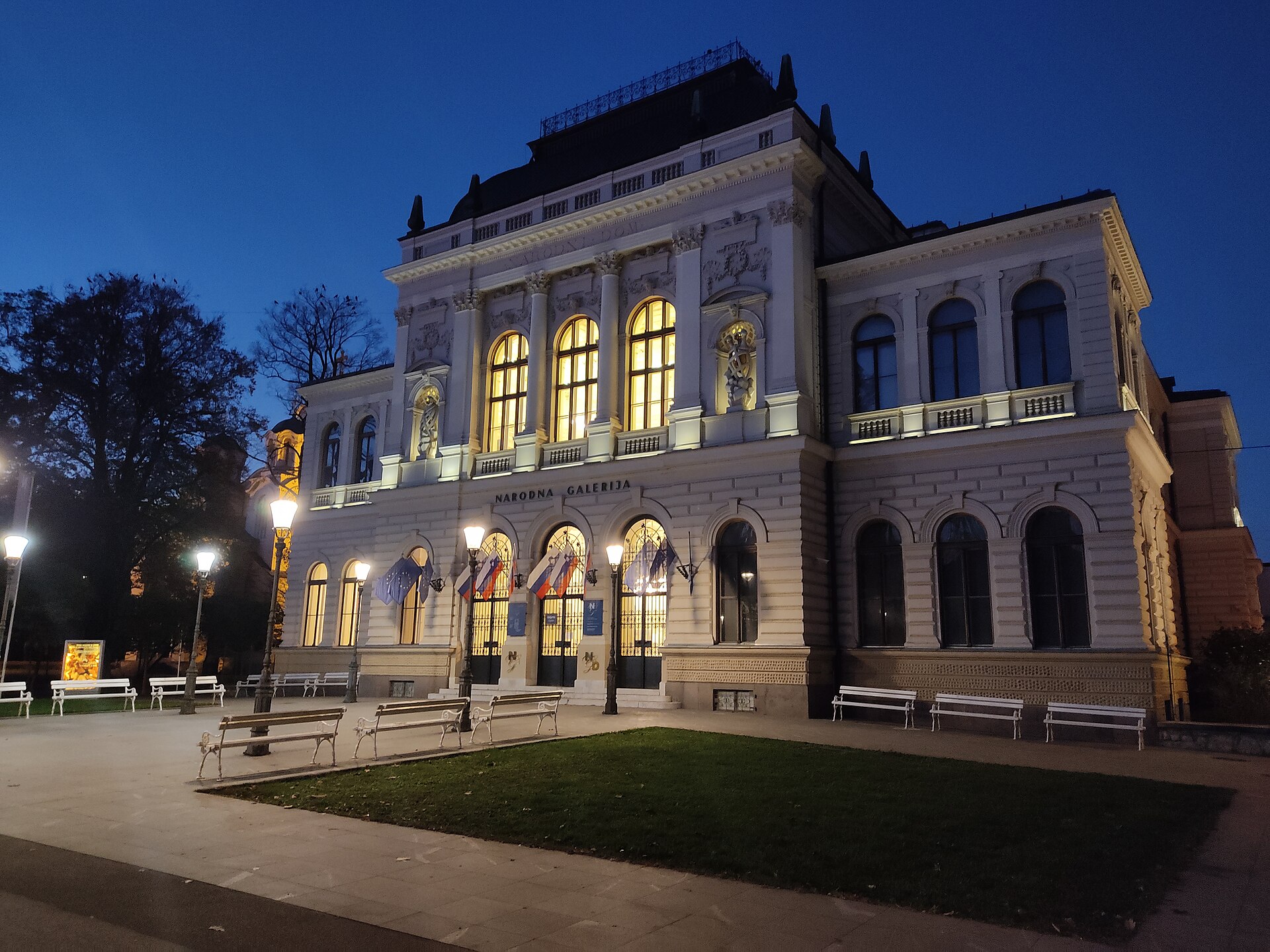
The building's later growth reflects the Gallery's own expansion rather than a single design. In 1988 the Gallery took over the premises of the former Delegates Club, and construction of a new wing, designed by the Slovenian architect Edvard Ravnikar, began in 1991; the new wing was completed in 1993 and the permanent collection of European painters installed there in 1997. In the summer of 1991, while that construction was starting, the Gallery's own history records that its entire staff had to evacuate the works of art to the deepest basement storage on account of the military aggression against Slovenia that followed the country's declaration of independence. The final major addition came in 2001, when a glass entrance hall designed by Sadar Vuga Architects was completed, physically joining the historic palace to the new wing and giving the Gallery, in its own words, new means of transmitting its collection to the public. A long-delayed renovation of the Narodni dom Palace itself and a further expansion began in 2012 and concluded with the grand reopening of the renovated permanent collection on 27 January 2016; the complex today comprises three integrated wings across 12,670 square metres, of which 3,955 square metres are exhibition space, a renovation led by the API ARHITEKTI bureau working with Slovenia's Institute for the Protection of Cultural Heritage and its Restoration Centre.
Eight centuries under one roof: what the permanent collection holds
The Gallery organises its permanent collection into a run of period rooms rather than a single chronological sweep, and its own descriptions of each period, published alongside the works on view, give an unusually direct account of what is actually on the walls. The earliest rooms, covering 1200 to 1600, hold the largest fine-art record of Gothic devotional painting and sculpture on Slovenian territory, including the Beautiful Madonna and other works from the Ptujska Gora workshop, which the Gallery's own text calls the zenith of Slovenian Gothic sculpture, alongside frescoes and panels by named masters such as Johannes Aquila and Johannes de Laybaco. The 17th-century rooms move into the so-called golden altars, gilded and polychrome retables that combined several branches of craft in one object, and into early-Baroque painting carrying northern influence through artists such as the settled outsider Hans Georg Geiger von Geigerfeld.
The 18th century is represented in the Grand Hall by the Venetian sculptor Francesco Robba, whose fountain of the Carniolan rivers remains Ljubljana's best-known civic monument, and by the Ljubljana Baroque painter Valentin Metzinger, whose devotional canvases the Gallery's own text credits with setting a standard of quality that outlasted his own century. The late-Baroque and Rococo rooms that follow hold the portraiture of Fortunat Bergant, whose depictions of Carniolan nobility the Gallery singles out for penetrating characterisation, and the lighter, more narrative religious imagery introduced by Martin Johann Schmidt, known as Kremser Schmidt, whose influence reached the following century through the Layer painting workshop of Kranj.
The 19th-century rooms trace a shift from Biedermeier portraiture and idyllic, homeland-themed landscape, in the work of Matevz Langus, Jozef Tominc, Mihael Stroj and Anton Karinger, into realism carried by the brothers Janez and Jurij Subic and by Jozef Petkovsek, whose river scenes the Gallery's own account links to an early, independent arrival at the same questions of light and reflection that occupied French Impressionism. Ivana Kobilca's 1890 painting Summer marks, in the Gallery's words, the point at which her training in allegory gave way to direct plein-air observation, shortly before the painting was exhibited in Paris.
The Slovenian Impressionists and the invention of a national art
The rooms covering 1900 to 1918 hold what the Gallery itself frames as a turning point: after Slovenian painters exhibited at the Sava artists' society show at the Galerie Miethke in Vienna in 1904, Viennese critics recognised, for the first time, a distinct Slovenian painting province within the Habsburg Empire. Ivan Grohar exhibited his painting Spring at that show and followed it with a series of plein-air landscapes that culminated in 1907 in The Sower, a picture the Gallery's own text describes as achieving a near-mythical identification of earth and labourer through the handling of paint, with a Carniolan hayrack standing in as a national attribute of the agricultural worker.
Rihard Jakopic's paintings, shaped by his encounter with Symbolist art in Munich before the turn of the century, use counterlight, looking at the sun through tree crowns, to build the shaded, intimate spaces in which his lone figures and interior scenes of middle-class women appear. Matej Sternen's The Red Parasol, showing a fashionable, self-confident townswoman on a walk, opens a series of increasingly ambitious nudes and dressing-room scenes the painter developed after 1911. Matija Jama, working mostly with landscape motifs from outside Slovenia's own borders, is nonetheless described by the Gallery as having incorporated his subjects imperceptibly into the national idea through what its own text calls an obsessive dealing with light. The Gallery's own account is careful to flag the resulting label, Slovenian Impressionism, as ideologically loaded rather than a neutral art-historical description, precisely because several of its leading painters were working on landscapes that were not, strictly, Slovenian at all.
Zoran Music: exile, Dachau and a homecoming in 2016
The Gallery gives Zoran Music, among the most internationally recognised painters of Slovenian origin, a dedicated gallery of his own rather than a place inside the general 20th-century rooms. His work entered the collection in a single sizeable gift: in 2016 his niece, Vanda Music, donated 56 of his works outright, placed a further 40 in the Gallery's long-term care, and lent 48 more temporarily, a group the Gallery's own history page describes as an overview of his work from 1935 to 1999. Named among the pieces are what the Gallery calls his most recognisable subjects, his little horses and Karst motifs, his Venetian landscapes, and his self-portraits, alongside oil and acrylic paintings, tempera works, prints, drawings, and a tapestry he designed showing the ocean liner Augustus.
The Gallery's own text singles out one further body of work in this donation in stronger language than it uses anywhere else on the same page: what it calls the profoundly moving Dachau motifs, a reference to Music's internment in the Dachau concentration camp during the Second World War, which he returned to as a subject decades later in paintings and prints carrying titles such as Register of Corpses and We Are Not the Last. The sources consulted for this page do not give a fuller account, on the museum's own site, of Music's wartime internment beyond this framing; his biography before and after that period is not detailed on the pages fetched for this record.
A collection interrupted and restored: what a visit involves today
The Gallery's own visitor information sets out a museum open Tuesday to Sunday, with extended hours on Thursday evenings, and closed on Mondays and a short list of public holidays; admission to the permanent collection is a modest, tiered charge with a family ticket and a standing free day on the first Sunday of every month, and a combined ticket covers both the permanent collection and whatever temporary exhibition is running. The museum's own accessibility page describes an unusually thorough set of provisions for disabled visitors, including ramps and lifts to every floor, induction loops, audio guides, sign-language video content, and a tactile, Braille-labelled adaptation of the painting Luiza Pesjak by Mihael Stroj, with guided tours for disabled visitors offered free of charge.
That said, the museum's own homepage in 2026 announces the reopening of a renovated permanent collection of Slovenian art from 1870 onwards under a new set-up, language that lines up with a run of visitor complaints reaching TripAdvisor through the first half of 2026 describing that same wing as closed for renovation for over a month with no reduction to the standard ticket price. Read together, the museum's own announcement and the visitor complaints describe the same event from either side: a real, extended closure of one of the collection's most visited sections, now presented on the Gallery's own site as resolved. Whether every part of that wing was back on view by the date this page was researched is not confirmed by a source this desk could fetch directly, and is recorded here as an open question rather than settled fact.
What visitors say
Visitor reviews consistently describe the National Gallery of Slovenia as the essential art museum stop in Ljubljana, praising the renovated building itself, the rooms devoted to the Slovenian Impressionists, and practical touches such as free lockers and QR-code audio content. The recurring complaints in 2026 reviews centre on a long partial closure of the 19th-to-20th-century wing for renovation with no reduction in the ticket price, and, from a minority of reviewers, an admission price and staff manner they found out of proportion to a relatively compact collection.
What is praised, what is criticised
- Praised: the renovated building itself, where reviewers describe a seamless, uncrowded blend of the historic Narodni dom Palace and the light-filled modern New Wing and entrance hall
- Praised: the rooms devoted to the Slovenian Impressionists, which more than one reviewer named as the best galleries in the museum and recommended visiting first
- Praised: practical details: free lockers and cloakroom facilities, QR-code audio descriptions beside key exhibits, and staff visitors called helpful and knowledgeable
- Criticised: a partial closure of the 19th-to-20th-century Slovenian art wing running through mid-2026, which reviewers said lasted over a month with no discount offered on the full-price ticket
- Criticised: an admission price and, from at least one reviewer, a heavy-handed enforcement of bag-check and quiet rules that felt out of proportion to a museum of this size
- Criticised: medieval devotional rooms that at least one reviewer found repetitive given the volume of religious subject matter
Ratings on other platforms
TripAdvisor: 4.2 from 224 ratings, read 23 August 2026
A platform average is a tertiary source: it moves, it is not audited, and we quote no visitor's words.
Questions about National Gallery of Slovenia
Where is National Gallery of Slovenia?
Presernova cesta 24, 1000 Ljubljana, Slovenia.
How much does it cost to visit?
Permanent Collection, regular: EUR 10; Permanent Collection, reduced: EUR 6; Permanent Collection, family ticket: EUR 20; Permanent Collection, group (10 to 25 adults): EUR 6; Temporary Exhibitions, regular: EUR 6. As confirmed 23 August 2026.
When is it open?
Tuesday to Sunday 10:00-18:00; Thursday 10:00-20:00; 24 and 31 December 10:00-15:00. Closed: Monday. 1 January. As confirmed 23 August 2026.
How do you get there?
On foot / city bus: The museum's own accessibility page describes the building as close to Ljubljana city centre and Slovenska cesta, served, in its words, by almost all city bus lines; no specific route numbers are given; Parking: Paid on-street parking around the building; the nearest large public car park is in Tivoli Park, reached on foot through an underpass with an exit in front of the Gallery.
What should you see first?
The Sower (Sejalec) (Ivan Grohar); Standing Virgin, the Beautiful Madonna (Ptujska Gora Workshop); Register of Corpses (Cadastre de Cadavres) series (Zoran Music); The Robba Fountain (original) (Francesco Robba); Summer (Ivana Kobilca); The Red Parasol (Matej Sternen).
What we could not confirm
- Whether the 19th-to-20th-century Slovenian art wing that TripAdvisor reviewers described as closed for renovation through at least June and July 2026 was fully back on public view, in every room, at the point this page was researched; the museum's own homepage announces a reopening under a new set-up but the sources fetched for this page do not give a room-by-room confirmation or a firm reopening date.
- The museum's own history page and the sources consulted for this page make no mention of Nazi-era or wartime provenance disputes affecting works currently in the collection; whether that reflects a genuinely clean institutional history or simply a gap in what the Gallery publishes about its own acquisitions is not established here.
- The exact current size of the permanent collection, in number of individual works, is not stated as a single figure anywhere in the sources consulted for this page; the museum describes itself only as holding the largest visual arts collection of its kind in Slovenia.
Images
Sources
- 1National Gallery of Slovenia, Opening Hours and Entrance Fee (official) ng-slo.si/en/visit-us/opening-hours-and-entrance-fee
- 2National Gallery of Slovenia, Getting Here (official) ng-slo.si/en/visit-us/getting-here
- 3National Gallery of Slovenia, Accessibility (official) ng-slo.si/en/visit-us/accessibility
- 4National Gallery of Slovenia, About us / History of the National Gallery of Slovenia 1918-2021 (official) ng-slo.si/en/about-the-national-gallery-of-slovenia
- 5National Gallery of Slovenia, homepage (official, current exhibitions and contact footer) ng-slo.si/en/
- 6National Gallery of Slovenia, Permanent Collection 1200-1600, About the Period (official) ng-slo.si/en/permanent-collection/1200-1600?tab=description
- 7National Gallery of Slovenia, Permanent Collection 1600-1700, About the Period (official) ng-slo.si/en/permanent-collection/1600-1700?tab=description
- 8National Gallery of Slovenia, Permanent Collection 1700-1800, About the Period (official) ng-slo.si/en/permanent-collection/1700-1800?tab=description
- 9National Gallery of Slovenia, Permanent Collection 1820-1870, About the Period (official) ng-slo.si/en/permanent-collection/1820-1870?tab=description
- 10National Gallery of Slovenia, Permanent Collection 1870-1900, About the Period (official) ng-slo.si/en/permanent-collection/1870-1900?tab=description
- 11National Gallery of Slovenia, Permanent Collection 1900-1918, About the Period (official) ng-slo.si/en/permanent-collection/1900-1918?tab=description
- 12National Gallery of Slovenia, Permanent Collection From 1918 Onwards, About the Period (official) ng-slo.si/en/permanent-collection/from-1918-onwards?tab=description
- 13National Gallery of Slovenia, Permanent Collection, Zoran Music, works list (official) ng-slo.si/en/permanent-collection/zoran-music
- 14TripAdvisor, National Gallery of Slovenia, Ljubljana, aggregate rating and reviews (read 2026-08-23) tripadvisor.com/Attraction_Review-g274873-d276326-Reviews-National_Gallery_of_Slovenia-Ljubljana_Upper_Carniola_Region.html
- 15Wikipedia, National Gallery of Slovenia (building history and architect, ) en.wikipedia.org/wiki/National_Gallery_of_Slovenia
- 16Wikimedia Commons, File:Narodna galerija v Ljubljani.JPG (licence and description) commons.wikimedia.org/wiki/File:Narodna_galerija_v_Ljubljani.JPG
- 17Wikimedia Commons, File:Staircase National Gallery of Slovenia.jpg (licence and description) commons.wikimedia.org/wiki/File:Staircase_National_Gallery_of_Slovenia.jpg
- 18Wikimedia Commons, File:National Gallery of Slovenia.jpg (licence and description) commons.wikimedia.org/wiki/File:National_Gallery_of_Slovenia.jpg
- 19Wikimedia Commons, File:Robba Fountain Original.jpg (licence and description) commons.wikimedia.org/wiki/File:Robba_Fountain_Original.jpg
- 20Wikimedia Commons, File:National Gallery of Slovenia at night.jpg (licence and description) commons.wikimedia.org/wiki/File:National_Gallery_of_Slovenia_at_night.jpg
- 21Wikidata, Q1953536, National Gallery of Slovenia (identity and coordinates, ) wikidata.org/wiki/Q1953536


