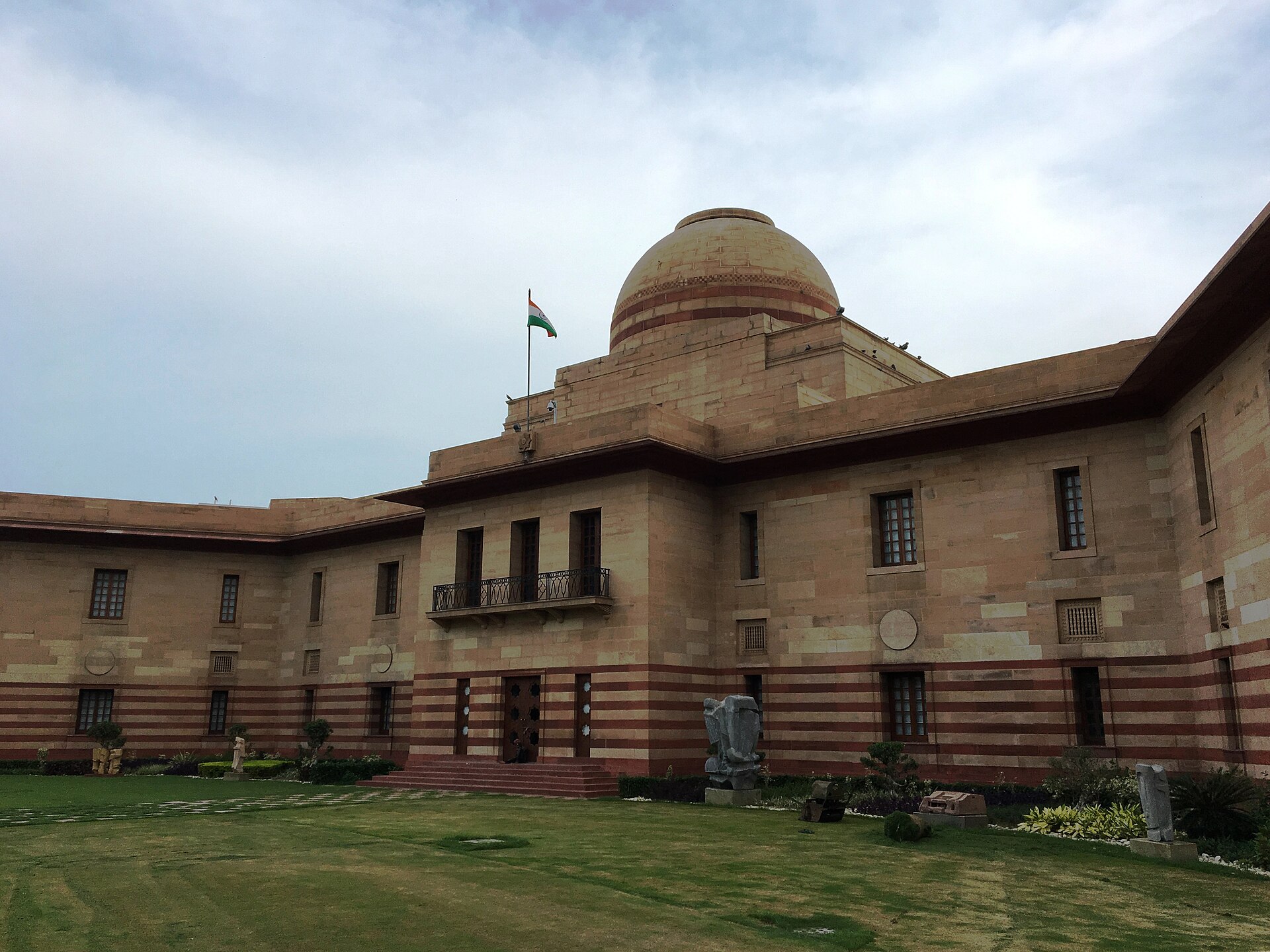
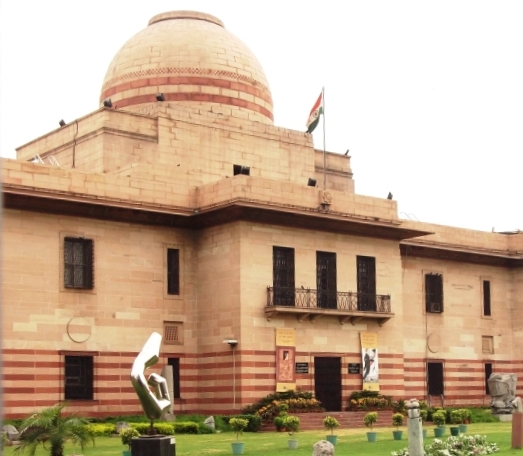
Jaipur House, New Delhi, seen from the lawns; the domed, butterfly-plan building was completed in 1938 as the Maharaja of Jaipur's residence and has held the National Gallery of Modern Art since 1954.
CC0National Gallery of Modern Art, New Delhi
Museum · Founded 1954
Open, admission and hours confirmed 5 September 2026 · 28 sources
On this page 15 sections
ContentsClose
The National Gallery of Modern Art's claim on this archive is depth in one specific area: modern Indian painting from roughly 1850 to the Progressive Artists' Group and after, anchored by the largest single holding of Amrita Sher-Gil's work anywhere and a Jamini Roy collection the museum itself says is deep enough in drawings and sketches to matter to serious study of the artist. Its sculpture, photography and print-making departments are real but explicitly still being built out, in the museum's own words, rather than comparably exhaustive.
| Kind | Museum |
|---|---|
| Founded | 1954 |
| City and country |  New Delhi, India New Delhi, India |
| Address | Jaipur House, India Gate, New Delhi - 110003 |
| Website | ngmaindia.gov.in |
| Status | Open, confirmed |
| Record last verified |
Visiting
- Hours
- Tue-Fri10:00 to 18:00
- Sat-Sun11:00 to 20:00
- Closed
- Monday. National holidays.
- Admission
- Indian nationalsINR 20
- Foreign nationalsINR 500
- Students / children under 18Freefree, valid ID required
- Defence personnelFreefree, must be in uniform, valid ID required
- Differently abled visitorsFreefree, valid ID required
- Underprivileged childrenFreefree, valid ID required
- ICOM membersFreefree, valid ID required
- Tickets
- experiences.highwaydelite.com/new-delhi/cultu... The museum's own ticket page.
- Do I need to book?
- No, tickets can be booked online in advance or bought at the gate
- Address
- Jaipur House, India Gate, New Delhi - 110003 MapMetro Central Secretariat station, on the Yellow and Violet lines, is the nearest metro stop
Walking About 0.5 km from India Gate - Website
- ngmaindia.gov.in
- Telephone
- +91 11 2338 6111
- [email protected]
Before you go how long, access, photography, bags, eating, shop
- How long to allow
- Visitors commonly plan two to three hours to cover the collection across the old and new blocks
- Access
- The gallery lists a free entry category for differently abled visitors on valid ID; no further detail on ramps or lifts is published on the museum's own site
- Photography
- General photography is permitted; visitor reports describe mixed enforcement of restrictions inside individual galleries
- Bags
- Not stated on the museum's own site
- Eating
- A cafeteria was added in the 2009 expansion
- Shop
- An art shop and museum shop were added in the 2009 expansion
Prices and hours change. We take them from the institution's own pages and print the day we read them, and you can check the current position at the source we used. Confirm before you travel.
What is inside
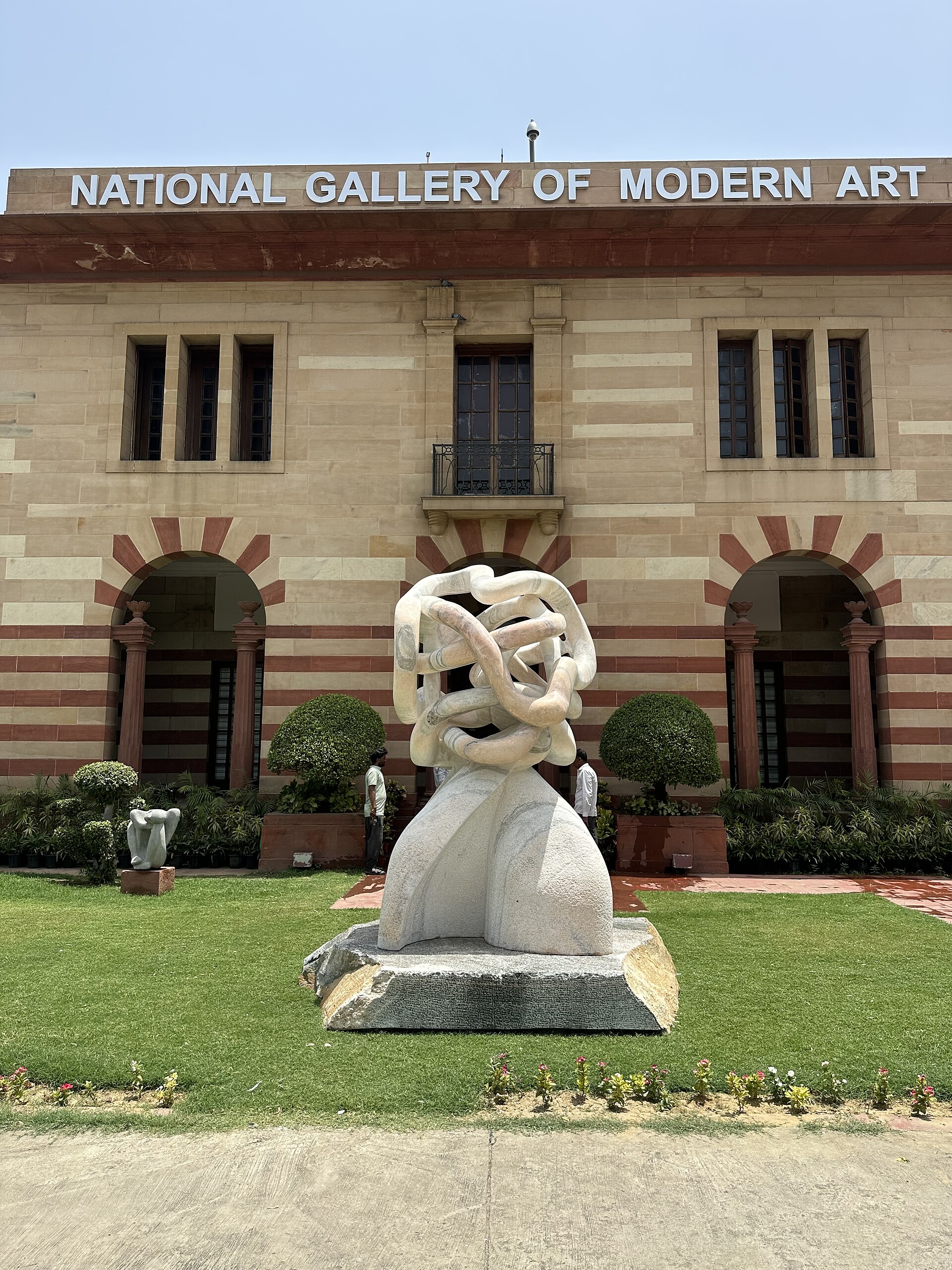
CC0 Sculpture garden and the modern sculpture collection
The lawns and courtyards around Jaipur House hold NGMA's sculpture holdings, described by the museum itself as 'amongst the richest in the country'. Early modernists D. P. Roy Chowdhury, Fanindranath Bose and V. P. Karmarkar sit alongside Ramkinkar Baij, and the collection continues into contemporary work by Satish Gujral, Mrinalini Mukherjee, Ravinder Reddy and Sudarshan Shetty, which the museum says 'blur the boundaries between sculpture and installation'.
Company Period, miniature and European traveller painting
Galleries devoted to painting before and around colonial contact: a miniature-painting collection the museum traces from around 750 AD through Mughal and Rajput court schools (Mewar, Marwar, Hadoti, Pahari), Company Period provincial-school work from Calcutta, Delhi, Patna, Tanjore and Mysore, and canvases by the European travellers who painted India for a home market, including Thomas Daniell and William Hodges.
The Bengal School and the ten founding names of modern Indian art
The museum organises its account of modern Indian art around ten artists it treats as foundational: Raja Ravi Varma, Rabindranath Tagore, Gaganendranath and Abanindranath Tagore, Nicholas Roerich, Nandalal Bose, Jamini Roy, Ramkinkar Baij, Sailoz Mookherjea and Amrita Sher-Gil. The early nationalist Bengal School, led by Abanindranath Tagore with support from E. B. Havell and Sister Nivedita, is shown here alongside Kalighat painting and the wash-technique work it drew from Japanese sources.
Progressive Artists' Group and post-independence contemporaries
Rooms carrying the collective that formed in Bombay in 1947 - F. N. Souza, M. F. Husain, S. H. Raza, K. H. Ara, H. A. Gade and the sculptor S. Bakre - alongside the associated Calcutta Group (Prodosh Das Gupta, Gopal Ghosh, Paritosh Sen) and later painters including Tyeb Mehta, V. S. Gaitonde, Ram Kumar, Krishen Khanna, Anjolie Ela Menon and Arpita Singh.
Photography and print-making
A photography collection anchored by the Lala Deen Dayal archive of princely-era portraiture, extended through the twentieth century by Raghu Rai, Sanjeev Saith, Parthiv Shah, Dayanita Singh, Vivan Sundaram and Nemai Ghosh; the museum states this department is still being actively built. A separate print-making collection sits alongside it.
What to see first
Nude
Amrita Sher-Gil, 1931A figure study from Sher-Gil's years at the Ecole des Beaux-Arts in Paris, from the period before her move to India reshaped her subject matter; the museum holds the bulk of her surviving work.15
Sumair
Amrita Sher-Gil, 1936A portrait of the artist's cousin, painted after Sher-Gil's return to India, and part of the 161 of her paintings the gallery holds - more than half of them acquired directly from her father, Umrao Singh Sher-Gil.16
Rabindranath Tagore in the Island of Birds
Gaganendranath Tagore, c.1921-1925A cubist-inflected portrait of the poet Rabindranath Tagore set against arcs of soft colour, by his nephew - one of the ten artists the museum treats as foundational to its collection.17
Santhal Girl
Jamini Roy, early-to-mid 20th centuryAn oil painting of a Santhal woman, representative of Roy's turn away from his European academic training toward the folk-art sources - Kalighat pat painting among them - that define his mature style.18
Black Horse
Jamini Roy, early-to-mid 20th centuryA tempera study reducing a horse to a stylised, minimalist form against a flat red ground, typical of the calligraphic idiom Roy developed from Kalighat painting.19
Portrait of Nandalal Bose
Mukul Dey, 1930A chalk-and-pencil portrait of one artist by another at Santiniketan's Vichitra Club; Dey went on to direct the National Gallery of Modern Art itself from 1956 to 1958.20
Past exhibitions here
A Maharaja's palace becomes a national gallery
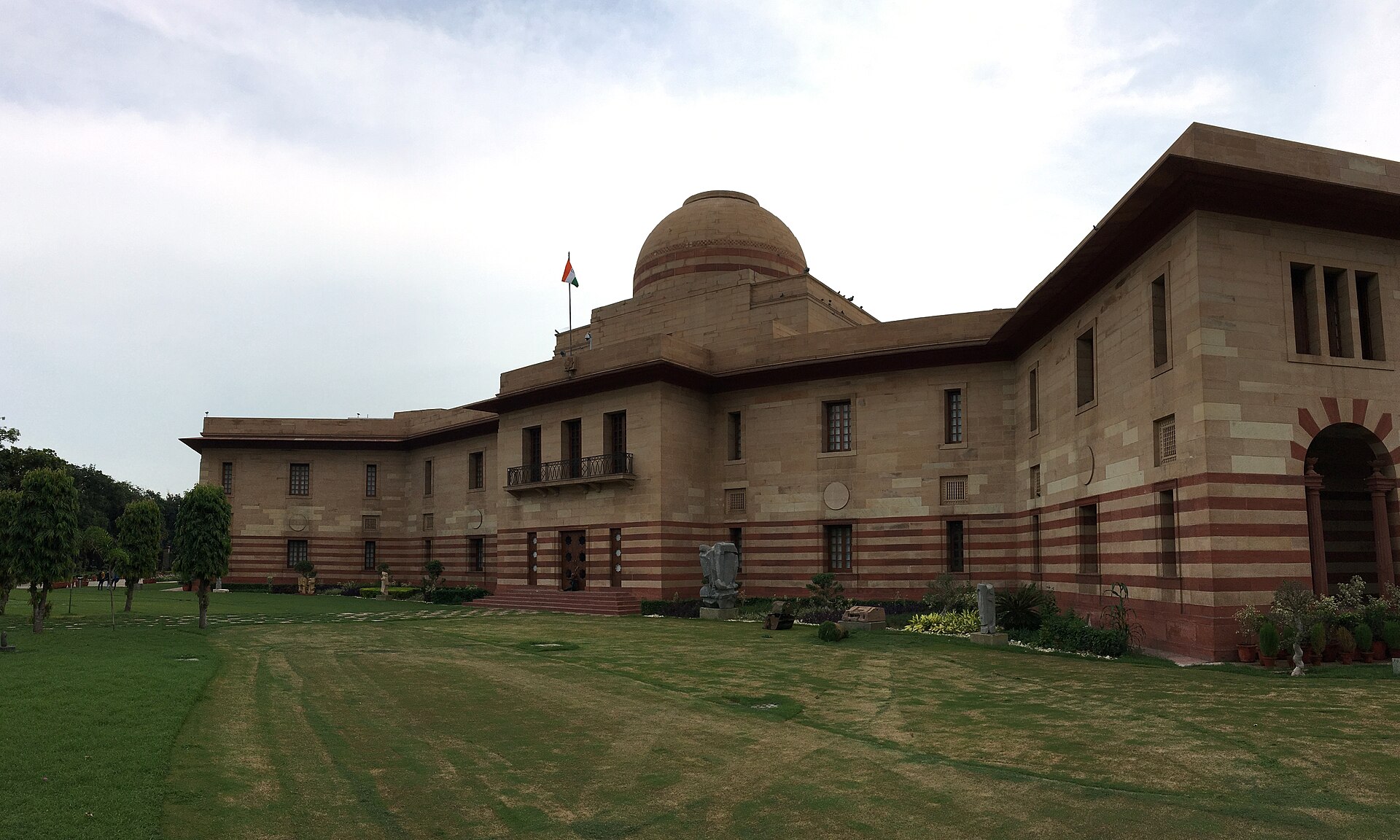
The building the National Gallery of Modern Art occupies was not built to hold paintings. Jaipur House was commissioned in 1936 by Maharaja Man Singh II of Jaipur as his residence within Lutyens' New Delhi, and completed in 1938 to a design by the architect Arthur Blomfield and his brother Francis. It sits at the end of Rajpath facing India Gate, one of a ring of princely-state houses built around Edwin Lutyens' central hexagon. The plan is a butterfly: two symmetrical wings radiate from a central domed pavilion, the whole faced in alternating bands of red and buff Dholpur sandstone, with Rajput-style columns framing the arched openings and Mughal motifs worked into the stonework beneath a saucer-shaped dome.
After independence the government turned the palace to a different purpose. The National Gallery of Modern Art was formally inaugurated inside it on 29 March 1954 by Vice-President Sarvepalli Radhakrishnan, with Prime Minister Jawaharlal Nehru, Maulana Abul Kalam Azad and Humayun Kabir present. The idea itself was older than the building's conversion: the Delhi-based All India Fine Arts and Crafts Society had proposed a national art gallery as early as 1938, and a 1949 conference of artists and critics in Calcutta, convened by the new government, had passed a resolution backing it. The gallery's opening exhibition, fittingly for a palace turned public building, was not painting but sculpture: 65 works by 31 Indian sculptors, shown across five rooms, with D. P. Roy Chowdhury, Ramkinkar Baij, Sankho Chaudhuri and Dhanraj Bhagat among the artists.
A collection built, in its first years, around one family's paintings
The museum's first director was Hermann Goetz, a German art historian who had previously run the Baroda Museum, and who set up the gallery's restoration service, its reference library and its documentation centre in his two years in the post. But the collection he inherited and built was shaped less by institutional planning than by a single, unusually large acquisition. Amrita Sher-Gil had died in 1941, and in the years around the gallery's founding the government acquired 161 of her paintings - more than half of the entire early collection - through her father, Umrao Singh Sher-Gil: thirty-three works purchased outright, another thirty-three donated on the condition that the museum also acquire paintings by her husband. Nehru personally committed fifty thousand rupees from National Museum funds to the purchase. In 1953 the gallery separately bought sixty-six paintings, sketches and drawings by Abanindranath Tagore from his sister Pratima Tagore for thirty thousand rupees, along with ten works by Abdur Rahman Chughtai and eight each by Jamini Roy and Nandalal Bose. The result was a founding collection in which two names, Sher-Gil and Tagore, accounted for more than half of everything the new gallery owned - an imbalance the museum has spent the seven decades since correcting by acquisition, exhibition and, since 2009, by simply having somewhere to put more of what it already held in storage.
What is inside: from Mughal-era miniatures to the artists who invented Indian modernism
The museum organises its account of Indian art from roughly 1750 to the present around ten names it treats as foundational: Raja Ravi Varma, Rabindranath Tagore, his nephews Gaganendranath and Abanindranath Tagore, the Russian painter Nicholas Roerich, Nandalal Bose, Jamini Roy, the sculptor Ramkinkar Baij, Sailoz Mookherjea and Amrita Sher-Gil. Ahead of them, chronologically, sit galleries of Mughal and Rajput court miniature painting - the museum's own account traces the form back to around 750 AD - and the Company Period work produced in provincial ateliers in Calcutta, Delhi, Patna, Tanjore and Mysore for British patrons, alongside canvases by the European travelling painters, Thomas Daniell and William Hodges among them, who painted India for audiences at home.
The Bengal School that Abanindranath Tagore led in the early twentieth century, with the Englishman E. B. Havell and Sister Nivedita among its supporters, is shown as a deliberate rejection of the academic realism the colonial art schools taught: its painters worked in wash and tempera rather than oil, borrowing a wash technique from Japanese painters and turning to Kalighat pat painting and folk sources for a visual language that owed nothing to Europe. Jamini Roy took that turn furthest, abandoning an academic training in Impressionism and Pointillism for the flat, calligraphic figures - peasants, artisans, village women, animals rendered in a few strokes - that the gallery holds in unusual depth: its own collection notes call the number of Roy drawings and sketches it holds important enough that no serious study of his work can skip it.
Independence-era and later collecting brought in the Progressive Artists' Group that formed in Bombay in 1947 - F. N. Souza, M. F. Husain, S. H. Raza, K. H. Ara, H. A. Gade and the sculptor S. Bakre - who the museum says made 'engagement with pure form' their creed, plus the associated Calcutta Group and later painters such as Tyeb Mehta, V. S. Gaitonde, Ram Kumar, Krishen Khanna, Anjolie Ela Menon and Arpita Singh. A photography collection built around the Lala Deen Dayal archive of princely-era portraiture - which the museum calls one of its greatest assets - extends through Raghu Rai, Dayanita Singh, Vivan Sundaram and Nemai Ghosh, though the museum describes this department as still being actively built rather than complete.
The 2009 expansion, and a collection finally given room to be seen
For its first half-century the gallery showed only a fraction of what it owned; the rest sat in storage inside Jaipur House itself. A major expansion completed in 2009 added three new blocks behind the original palace, built to echo its sandstone banding and colonnaded screens, and multiplied the exhibition space roughly sixfold to around 12,000 square metres across four levels - office space, a cafeteria, a museum shop, an auditorium, a preview theatre, a conservation laboratory and an academic library among the additions. The expansion also converted around fifty rooms previously used for storage into gallery space. The museum's collection today runs to more than 17,000 objects - some 9,000 paintings, over 2,000 drawings, close to 1,500 prints and some 1,400 sketches, by its own count - by more than 2,000 artists, with the oldest works dating to 1857. On the strength of that expanded footprint the institution describes its Delhi site as one of the largest museums of modern art anywhere, a claim resting on floor area rather than on the density or fame of any single gallery's holdings.
A working institution, its record mostly untroubled but not spotless
The gallery has been led by a long line of art historians and artists rather than career administrators - Mukul Dey, who as a young artist drew the 1930 chalk portrait of Nandalal Bose the museum still holds, himself directed the institution from 1956 to 1958, followed by the sculptor Pradosh Dasgupta, the archaeologist B. B. Lal, and a further decade under Laxmi Prasad Sihare from 1971. Its later branches in Mumbai and Bengaluru extended the same collecting mandate under regional emphases on curatorial practice and contemporary work rather than duplicating the Delhi galleries. Its published history is not free of the ordinary hazards of lending abroad: a 1989 press report the museum's own historical record cites described works from the collection returning from international festival loans in damaged condition, a reminder that a national collection whose paintings travel is a collection with something at stake every time a crate is opened at the other end.
Visiting today
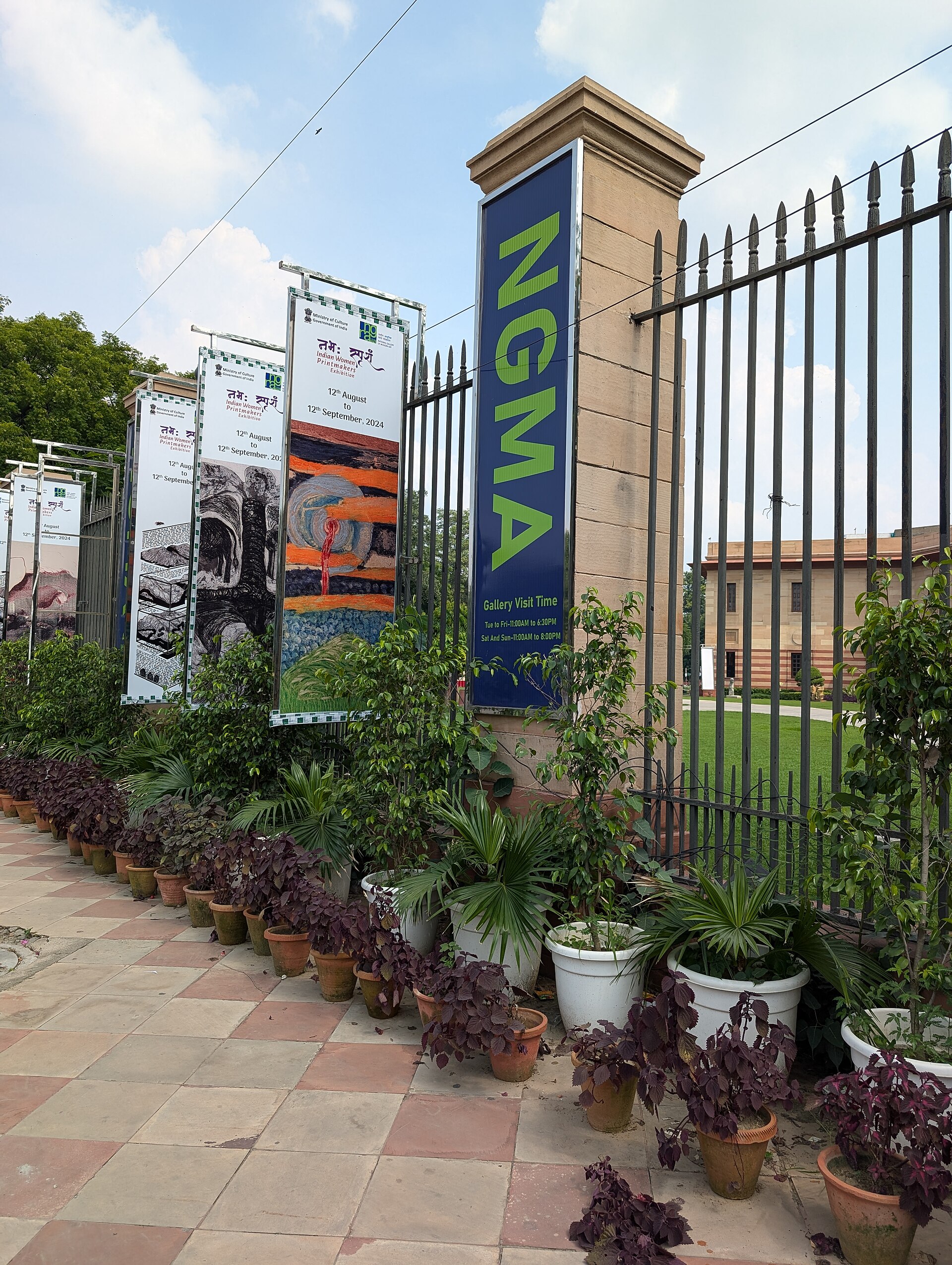
The gallery keeps longer hours at the weekend than during the week - Tuesday to Friday from ten in the morning to six in the evening, Saturday and Sunday from eleven to eight - and is closed on Mondays and national holidays. Entry costs twenty rupees for Indian nationals and five hundred for foreign visitors, with free entry for students and children under eighteen, defence personnel in uniform, differently abled visitors, underprivileged children and ICOM members, all on production of valid identification. The nearest metro stop is Central Secretariat, on the Yellow and Violet lines, about half a kilometre's walk from the gate. Visitors most often cite the Sher-Gil and Tagore holdings and the calm of the sculpture-garden lawns as the reason to come, and most often name the state of the building's upkeep, inconsistent staff at the ticket counter and sparse labelling of individual works as what they wish were better - a gap, more than a contradiction, between a collection this large and the everyday experience of walking through it.
What visitors say
Visitors consistently single out the collection of modern Indian painting - Tagore, Sher-Gil, Raja Ravi Varma - and the calm of the Jaipur House grounds as the draw, while also consistently naming the building's upkeep and the way works are labelled as the gap between the collection and the experience of seeing it.
What is praised, what is criticised
- Praised: The depth and rarity of the modern Indian painting collection, and specifically the Amrita Sher-Gil and Rabindranath Tagore holdings
- Praised: The peaceful, uncrowded galleries and the sculpture garden on the Jaipur House lawns
- Praised: Low admission price for Indian visitors and the heritage building itself
- Criticised: Facility maintenance - visitors describe chipping paint and worn carpets and walls in parts of the building
- Criticised: Inconsistent or unhelpful staff at the ticket counter, and inconsistently enforced photography rules
- Criticised: Sparse labelling of works, with little historical dating or context provided next to individual paintings
Ratings on other platforms
Tripadvisor: 4.3 from 386 ratings, read 5 September 2026
A platform average is a tertiary source: it moves, it is not audited, and we quote no visitor's words.
Questions about National Gallery of Modern Art, New Delhi
Where is National Gallery of Modern Art, New Delhi?
Jaipur House, India Gate, New Delhi - 110003.
How much does it cost to visit?
Indian nationals: INR 20; Foreign nationals: INR 500; Students / children under 18: free; Defence personnel: free; Differently abled visitors: free. As confirmed 5 September 2026.
When is it open?
Tue-Fri 10:00-18:00; Sat-Sun 11:00-20:00. Closed: Monday. National holidays. As confirmed 5 September 2026.
How do you get there?
Metro: Central Secretariat station, on the Yellow and Violet lines, is the nearest metro stop; Walking: About 0.5 km from India Gate.
What should you see first?
Nude (Amrita Sher-Gil, 1931); Sumair (Amrita Sher-Gil, 1936); Rabindranath Tagore in the Island of Birds (Gaganendranath Tagore, c.1921-1925); Santhal Girl (Jamini Roy, early-to-mid 20th century); Black Horse (Jamini Roy, early-to-mid 20th century); Portrait of Nandalal Bose (Mukul Dey, 1930).
What we could not confirm
- The museum's own site does not publish a current, dated breakdown of gallery-by-gallery locations for each named collection strand (miniature, Company Period, Progressive Artists' Group and so on) within the 2009 expansion's four levels, so which physical rooms hold which works cannot be stated precisely from published sources.
- Coverage of the 1989 report of works returning damaged from international loans is limited to a citation inside the museum's own published history; the original report has not been traced and located directly for this record.
- No accessibility detail beyond a free-entry ticket category for differently abled visitors is published on the museum's own site; ramp, lift and accessible-toilet provision at Jaipur House is not confirmed either way.
Images
Sources
- 1National Gallery of Modern Art, New Delhi - official site (redirects to the museum's Google Sites microsite) ngmaindia.gov.in
- 2NGMA - Home (museum's own microsite, confirms current operation and online ticketing) sites.google.com/view/ngmaindia/home
- 3NGMA - Plan your visit (hours, closed days) sites.google.com/view/ngmaindia/home/plan-your-visit
- 4NGMA - Contact us sites.google.com/view/ngmaindia/home/contact-us
- 5NGMA - About sites.google.com/view/ngmaindia/home/about
- 6NGMA - History sites.google.com/view/ngmaindia/home/history
- 7NGMA - Collection overview sites.google.com/view/ngmaindia/collection
- 8NGMA - Collection: Miniature painting sites.google.com/view/ngmaindia/collection/miniature
- 9NGMA - Collection: Bengal School sites.google.com/view/ngmaindia/collection/bengal-school
- 10NGMA - Collection: European traveller artists sites.google.com/view/ngmaindia/collection/european-traveler-artists
- 11NGMA - Collection: Progressive Artists' Group Bombay sites.google.com/view/ngmaindia/collection/progressive-artists-group-bombay
- 12Delhi Tourism - National Gallery of Modern Art delhitourism.gov.in/entertainment/national_gallery_modern_art.html
- 13Holidify - National Gallery of Modern Art, Delhi (entry fee, timings, access) holidify.com/places/delhi/national-gallery-of-modern-art-sightseeing-120671.html
- 14NGMA official ticket booking partner - entry ticket pricing experiences.highwaydelite.com/new-delhi/culture-and-heritage/national-gallery-of-modern-art
- 15Museums of India (Ministry of Culture) - record 'Nude', Amrita Sher-Gil, ngma-00040 museumsofindia.gov.in/repository/record/ngma_del-ngma-00040-333
- 16Museums of India (Ministry of Culture) - record 'Sumair', Amrita Sher-Gil, ngma-00035 museumsofindia.gov.in/repository/record/ngma_del-ngma-00035-328
- 17Museums of India (Ministry of Culture) - record 'Rabindranath Tagore in the Island of Birds', Gaganendranath Tagore, ngma-01004 museumsofindia.gov.in/repository/record/ngma_del-ngma-01004-25
- 18Museums of India (Ministry of Culture) - record 'Santhal Girl', Jamini Roy, ngma-00080 museumsofindia.gov.in/repository/record/ngma_del-ngma-00080-13
- 19Museums of India (Ministry of Culture) - record 'Black Horse', Jamini Roy, ngma-00079 museumsofindia.gov.in/repository/record/ngma_del-ngma-00079-12
- 20Museums of India (Ministry of Culture) - record, portrait of Nandalal Bose, Mukul Dey, ngma-01554 museumsofindia.gov.in/repository/record/ngma_del-ngma-01554-3401
- 21Museums of India (Ministry of Culture) - National Gallery of Modern Art, New Delhi, museum overview and object counts museumsofindia.gov.in/repository/museum/ngma_del
- 22Wikipedia - National Gallery of Modern Art, New Delhi (; directors list, acquisition history, 1989 loan-damage report) en.wikipedia.org/wiki/National_Gallery_of_Modern_Art,_New_Delhi
- 23Wikipedia - Jaipur House (; building and architectural history) en.wikipedia.org/wiki/Jaipur_House
- 24Wikidata - National Gallery of Modern Art, Q1338832 (; identity, coordinates) wikidata.org/wiki/Q1338832
- 25Tripadvisor - National Gallery of Modern Art reviews (rating, visitor consensus) tripadvisor.com/Attraction_Review-g304551-d2144317-Reviews-National_Gallery_of_Modern_Art-New_Delhi_National_Capital_Territory_of_Delhi.html
- 26Trawell - National Gallery of Modern Art, Delhi City (cross-check on access, fee, history) trawell.in/delhi/delhi-city/national-gallery-of-modern-art
- 27Wikimedia Commons - Category:Jaipur House (image licensing) commons.wikimedia.org/wiki/Category:Jaipur_House
- 28Wikimedia Commons - Category:National Gallery of Modern Art, New Delhi (image licensing) commons.wikimedia.org/wiki/Category:National_Gallery_of_Modern_Art,_New_Delhi