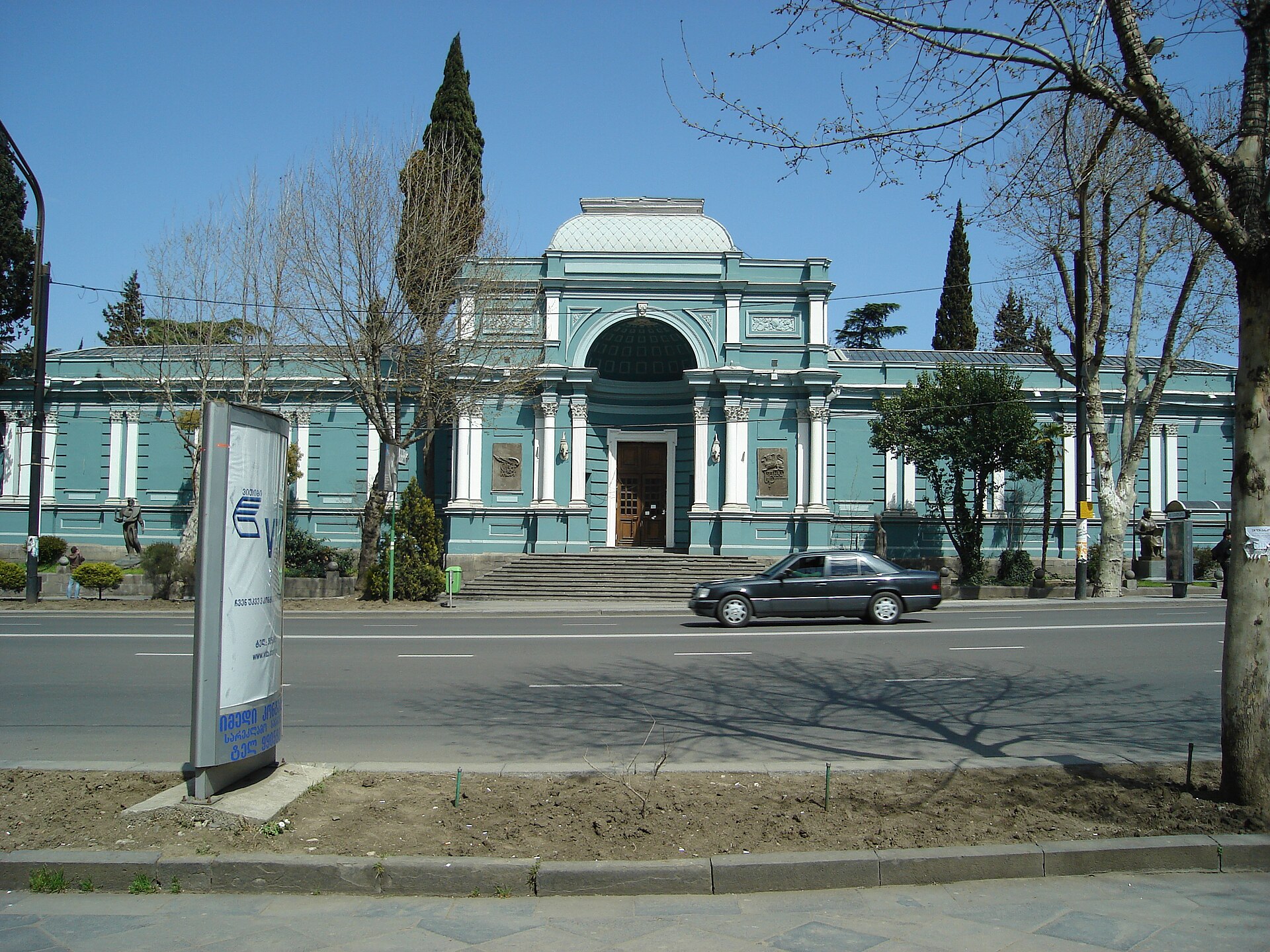
The Rustaveli Avenue facade of the National Gallery of Georgia, formerly the Russian Military-Historical Museum and known locally as the Blue Gallery before its 2007 repainting.
Public domainNational Gallery of Georgia
Museum · sakartvelos erovnuli galereia · Founded 1920
Open, admission and hours confirmed 31 August 2026 · 14 sources
On this page 15 sections
ContentsClose
The gallery's claim to attention is narrow and specific rather than broad: it holds and displays, in one building, the largest surviving concentration of paintings by Niko Pirosmani, Georgia's best-known painter internationally, alongside the core work of the Georgian modernist generation that followed him -- Kakabadze, Gudiashvili, Akhvlediani, Kobuladze -- and the sculpture of Iakob Nikoladze, trained under Rodin. It is not a general old-masters collection; the European loan shows it periodically hosts (Michelangelo, Titian, Botticelli, Cranach) are visiting exhibitions, not the permanent holding. The permanent strength is entirely Georgian, and entirely twentieth-century in its centre of gravity.
| Local name | sakartvelos erovnuli galereia |
|---|---|
| Kind | Museum |
| Founded | 1920 |
| City and country |  Tbilisi, Georgia Tbilisi, Georgia |
| Address | 11 Rustaveli Avenue, Mtatsminda District, 0108 Tbilisi, Georgia |
| Website | museum.ge |
| Status | Open, confirmed |
| Record last verified |
Visiting
- Hours
- Tue-Sun10:00 to 18:00Last admission 30 minutes before closing
- Closed
- Monday. Public holidays.
- Admission
- AdultGEL 5The gallery's own visit page prints this figure with the qualifier (until January 1), giving no year; it may be stale. Third-party ticketing and tourism sites (Advantour, biletebi.ge, Georgian Holidays) instead list an adult ticket at 25 GEL, consistent with the Georgian-citizen/foreign-visitor split documented on other Georgian National Museum branches (Janashia Museum: 20 GEL Georgian citizens, 40 GEL foreign citizens) -- but this split is not stated on the gallery's own page and has not been confirmed by us for this venue specifically.
- Student / school pupilGEL 0.50with valid student or pupil documentation
- Under 6Freefree
- Tickets
- museum.ge/index.php?m=350&lang=eng&museum=54&... The museum's own ticket page.
- Do I need to book?
- No booking required for general admission
- Address
- 11 Rustaveli Avenue, Mtatsminda District, 0108 Tbilisi, Georgia MapMetro Rustaveli station, Akhmeteli-Varketili Line, at the north end of Rustaveli Avenue, next to the Shota Rustaveli statue
Metro Liberty Square station, at the south end of Rustaveli Avenue, also within walking distance - Website
- museum.ge
- Telephone
- +995 32 2 15 73 00
- [email protected]
Before you go how long, access, photography, bags, eating, shop
- How long to allow
- One to two hours for the eight permanent halls
- Access
- Free admission is granted to visitors with disabilities and one companion; the 2007 renovation added modern circulation to the building, but no dedicated step-free route is described on the gallery's own page
- Photography
- Not stated on the gallery's own page as of this research
- Bags
- Not stated on the gallery's own page as of this research
- Eating
- Not confirmed on site; not listed among the gallery's own facilities in the sources fetched for this record
- Shop
- A gift shop was added in the 2007 renovation, alongside the eight exhibition halls, a restoration laboratory, temporary-exhibition storage and a training space
Prices and hours change. We take them from the institution's own pages and print the day we read them, and you can check the current position at the source we used. Confirm before you travel.
What is inside
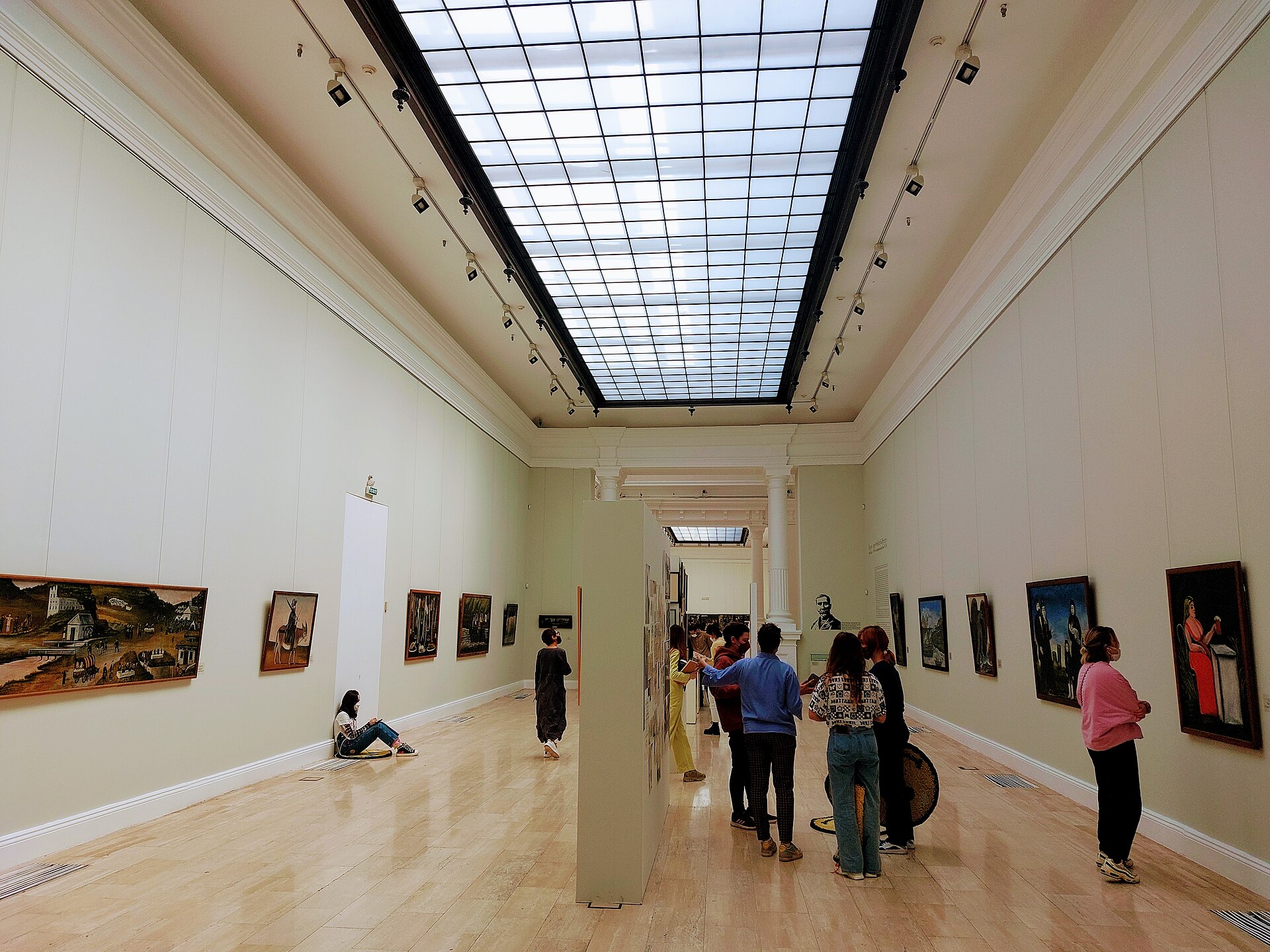
Photograph by Kober · CC BY-SA 4.0 The Niko Pirosmani hall
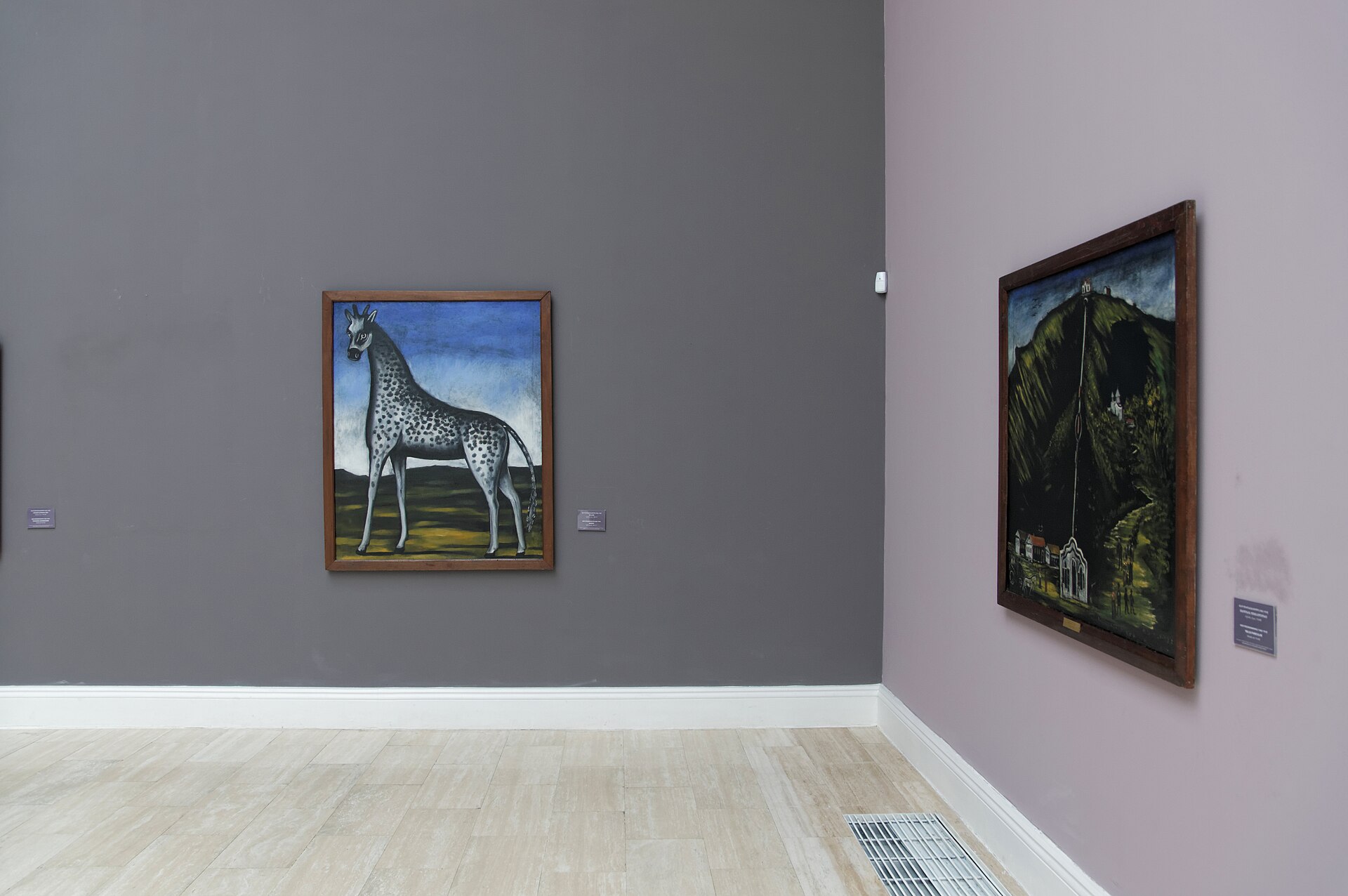
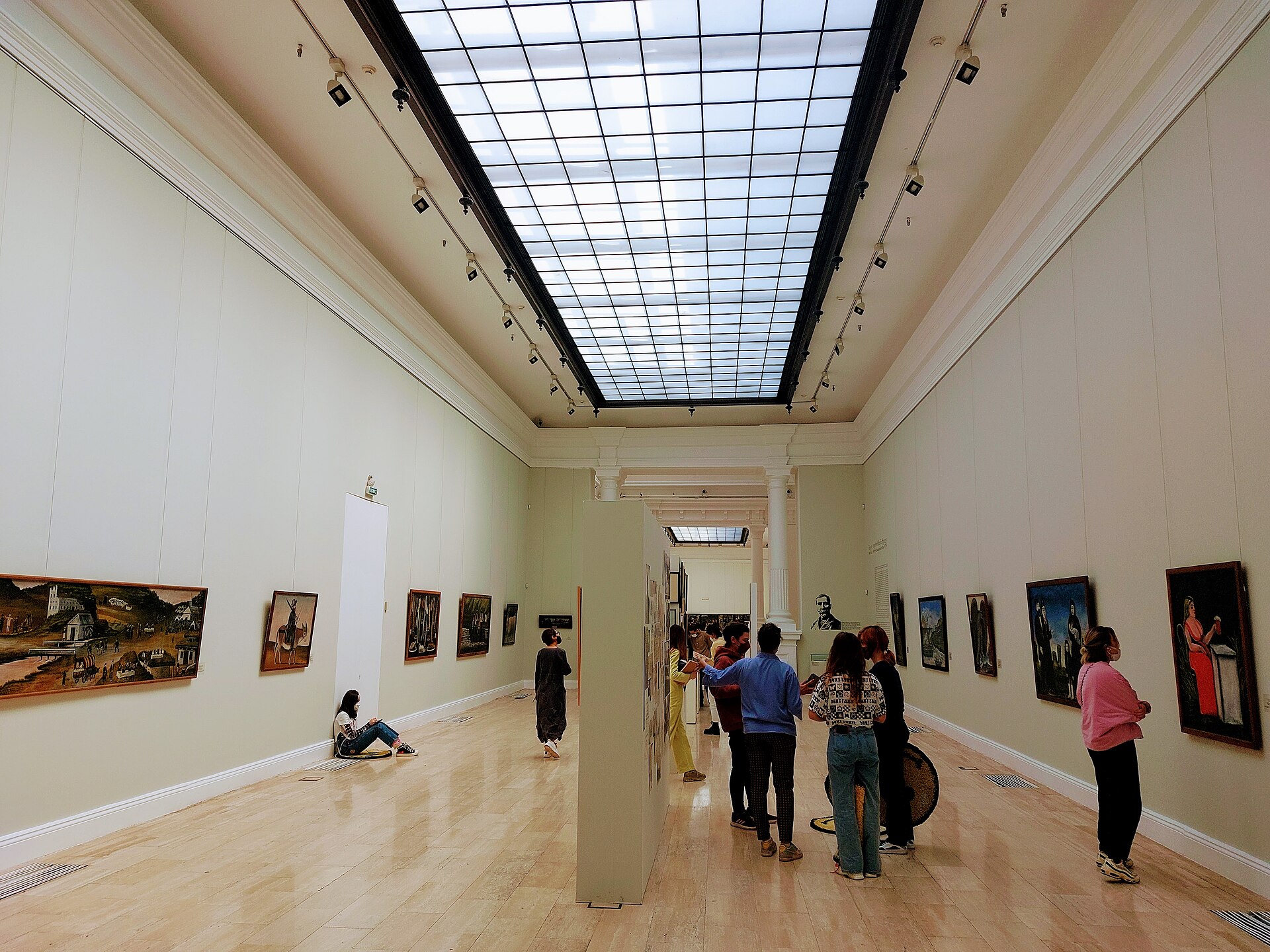
The gallery's single most-visited room, hung with paintings by the self-taught Georgian primitivist Niko Pirosmani (1862-1918), including A Party by the River (1907, oil on oilcloth) and Gatekeeper (1909). The National Gallery holds and displays the largest concentration of Pirosmani's surviving work anywhere, though individual pieces are periodically lent to international exhibitions -- in 2023-2024 a renewed hang here coincided with Pirosmani loan shows at the Louisiana Museum of Modern Art in Denmark and the Fondation Beyeler in Switzerland.
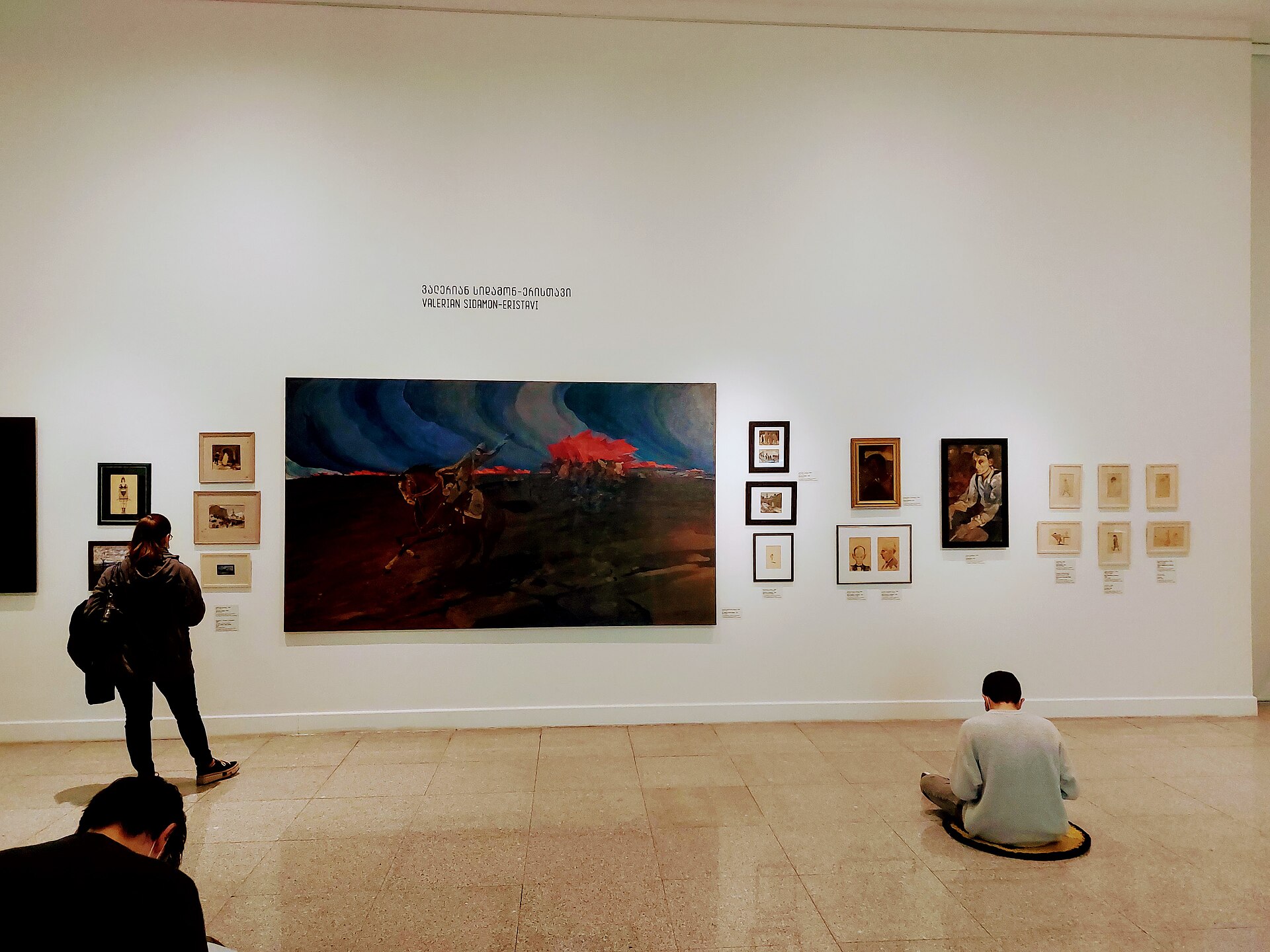
Photograph by Kober · CC BY-SA 4.0 Twentieth-century Georgian painting
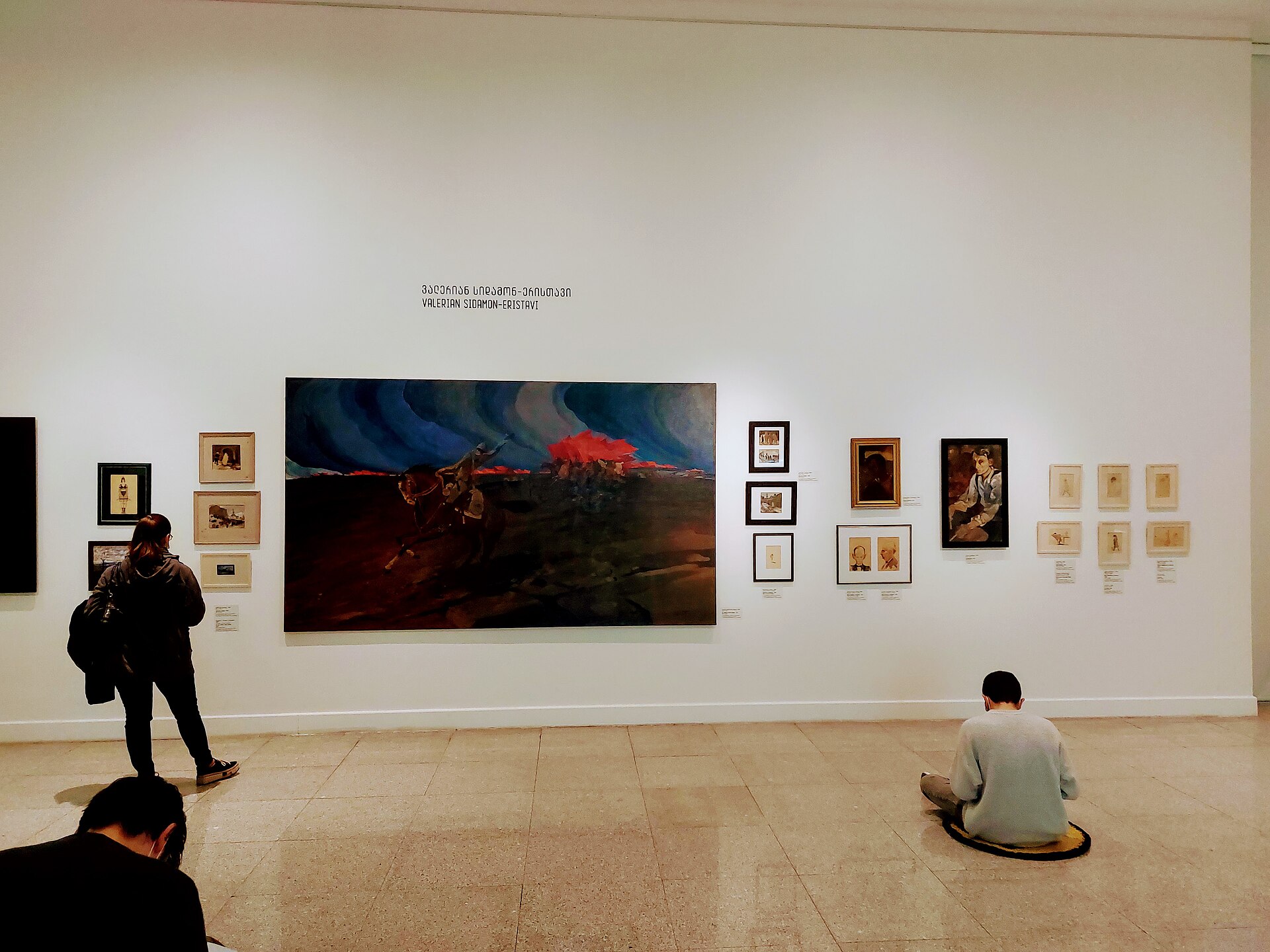
Halls devoted to the generation of Georgian painters who worked alongside and after Pirosmani: Davit Kakabadze, Lado Gudiashvili, Elene Akhvlediani, Sergo Kobuladze and Valerian Sidamon-Eristavi, whose work sits at the meeting point of Georgian folk tradition and the European modernism its painters had studied in Paris and Munich.
The Georgian sculpture hall
Work by Iakob Nikoladze, generally credited as Georgia's first sculptor to work in a modern idiom after training in Paris under Auguste Rodin, alongside later Georgian sculptors including Rocko Iremashvili.
Temporary and contemporary exhibition space
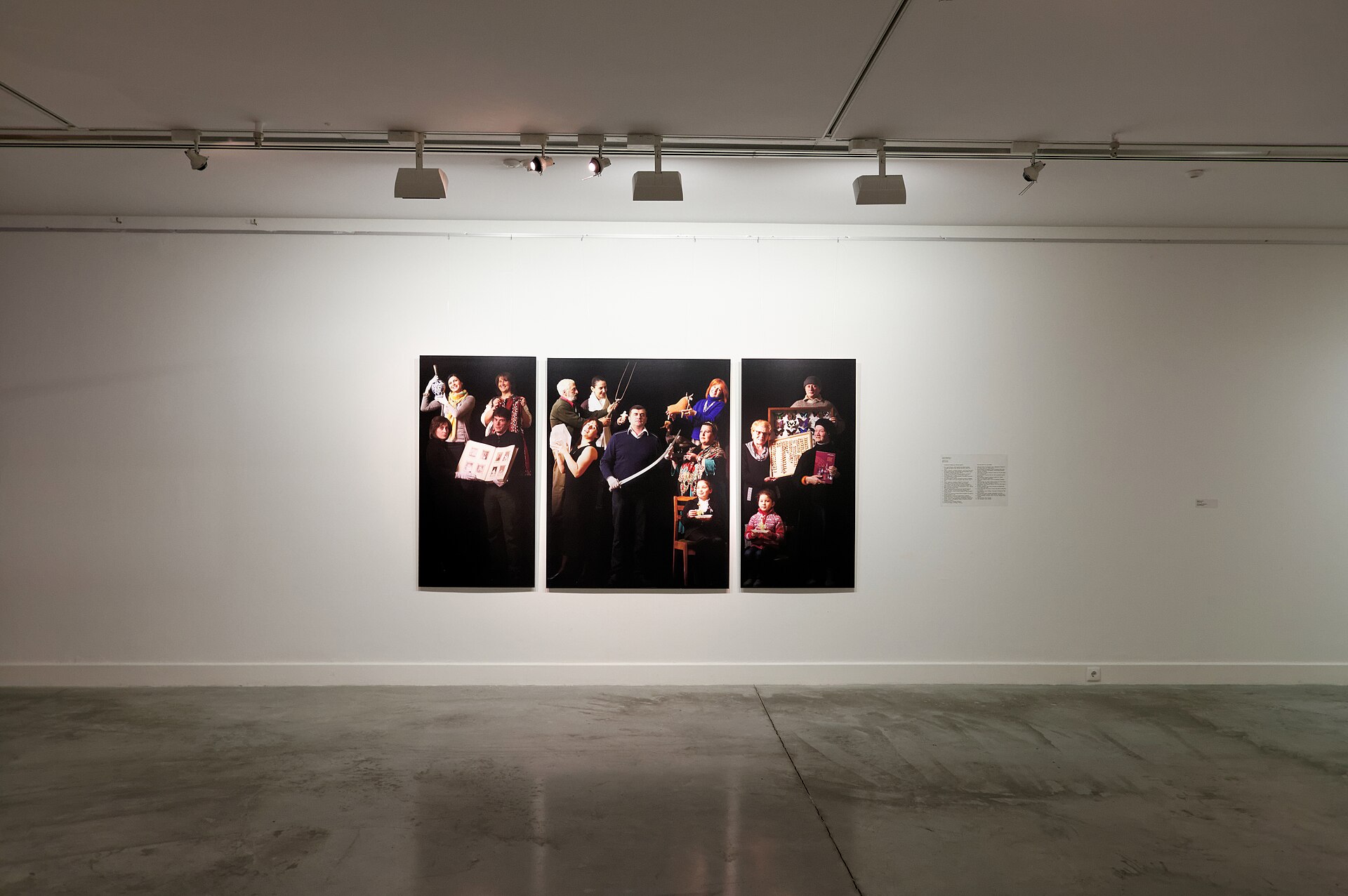
Space added in the 2007 renovation for loan shows and living artists. Recent programming has ranged from international old-master loans -- work by or after Michelangelo, Titian, Botticelli and Lucas Cranach has been shown here -- to contemporary Georgian artists; in 2025 the gallery gave a major show to Marina Ivanishvili, built around themes of the body, sacrifice and the crucifix.
What to see first
A Party by the River
Niko PirosmaniA 1907 oil-on-oilcloth work in the gallery's core holding of the artist who is Georgia's best-known painter internationally; the gallery holds the largest surviving concentration of his work.8
Gatekeeper
Niko PirosmaniA 1909 painting from the same core Pirosmani holding, exhibited in the hall built around his work.8
Sculpture group
Iakob NikoladzeWork by the sculptor generally credited as the founder of modern Georgian sculpture, who trained in Paris under Auguste Rodin before returning to Tbilisi.9
Paintings held in the gallery's Kakabadze holding
Davit KakabadzeCore work by one of the central figures of early-twentieth-century Georgian modernism, who studied and exhibited in Paris before returning to Georgia.6
Paintings held in the gallery's Gudiashvili holding
Lado GudiashviliCore work by a painter who, with Kakabadze, defined Georgian modernism's engagement with Paris-trained technique and Georgian subject matter.6
Paintings by Valerian Sidamon-Eristavi
Valerian Sidamon-EristaviA dedicated hang of this early-twentieth-century Georgian painter's work, photographed in situ and used here as the gallery's own record of the room.2
Works by Elene Akhvlediani
Elene AkhvledianiCore holding of one of Georgia's leading twentieth-century painters, whose Tbilisi studio is preserved as a separate house-museum elsewhere in the city -- itself a measure of her standing in Georgian art.6
Past exhibitions here
The building and what it was built to hold
The building on Rustaveli Avenue that now houses the National Gallery of Georgia was not built as an art gallery at all. It went up between 1888 and 1892, commissioned under an 1888 resolution of the Russian imperial administration and designed by the German architect Albert Salzmann, to serve as a museum of Russian military history -- a Temple of Glory to the imperial army's campaigns in the Caucasus. Salzmann modelled the facade loosely on Rome's Palazzo delle Esposizioni, scaled down for an avenue that was then the ceremonial spine of Russian-administered Tbilisi. The Rustaveli Avenue front carries a richly worked Baroque facade with the entrance set centrally, and two of the interior halls were built with glass ceilings to light the displays from above -- a detail that still governs how paintings are hung in those rooms today.
The building was, for decades, known locally as the Blue Gallery, after the blue-green colour it was originally painted. That colour lasted until the building's 2007 restoration, when the facade was repainted the pearl-grey it carries now -- a change substantial enough that older Tbilisi residents still sometimes call the gallery by its old nickname and colour rather than its official name.
The military-history museum's own life was short. Its collection was evacuated during the First World War, and the building stood empty of its original purpose by the time Georgia's brief window of independence opened in 1918.
Dimitri Shevardnadze and the founding of the gallery
The gallery's founding is inseparable from one man. Dimitri Shevardnadze (1885-1937) was a Georgian painter, trained in Saint Petersburg and Munich, who returned home to found and lead the Association of Georgian Artists in 1916. In 1917, with the poet-artists Kirill and Ilia Zdanevich, he organised an exhibition of the self-taught painter Niko Pirosmani in his own apartment -- one of the first serious efforts to preserve and present a body of work that was, at the time, still hanging in Tbilisi taverns as decoration rather than being treated as art. That instinct for rescue defined the rest of his career.
Shevardnadze led the conversion of the former military museum into Georgia's National Gallery, opening its first exhibition in October 1920 with a mixed hang of Iranian miniatures, European paintings and Georgian portraiture and contemporary work assembled from collections that had been scattered by war and revolution. He spent the following years travelling within Georgia acquiring work for the new institution, and in 1922 helped found the Tbilisi State Academy of Arts alongside his museum work.
Shevardnadze did not survive Stalin's purges. In 1937 he led public opposition to a plan by the Soviet secret-police chief Lavrentiy Beria to demolish Tbilisi's medieval Metekhi Church. Beria is reported to have offered him the directorship of a future museum in exchange for dropping his objection; Shevardnadze refused, was arrested, and was executed the same year. The church he had defended survived him. The gallery he founded still carries his name in full -- the Dimitri Shevardnadze National Gallery is its formal title within the Georgian National Museum system -- and the Pirosmani room he helped establish the case for in 1917 remains the room visitors come to see first.
What is inside
The gallery's eight permanent halls hold more than 30,000 items of Georgian fine and decorative art, weighted heavily toward the twentieth century. The strongest single holding is Pirosmani -- the largest concentration of his surviving paintings under one roof, including A Party by the River (1907) and Gatekeeper (1909) -- shown in a dedicated hall built around his primitivist scenes of Tbilisi street and tavern life. Around it sit rooms devoted to the generation of Georgian modernists who came directly after him and, in several cases, studied in Paris and Munich before returning home to paint: Davit Kakabadze, Lado Gudiashvili, Elene Akhvlediani, Sergo Kobuladze and Valerian Sidamon-Eristavi. A separate hall is given to Georgian sculpture, anchored by Iakob Nikoladze, who trained in Paris under Auguste Rodin and is generally credited as the founder of a modern sculptural tradition in Georgia, alongside later work by Rocko Iremashvili.
Temporary exhibition space, added in the 2007 renovation, has hosted two different kinds of programming in the years covered by this research: loan shows built around European old masters -- work by or after Michelangelo, Titian, Botticelli and Lucas Cranach has appeared here -- and contemporary Georgian art, including a 2025 exhibition of Marina Ivanishvili's drawings and sculpture on themes of the body, sacrifice and the crucifix. The building also carries a restoration laboratory and storage built for touring shows, and a gift shop.
Joining the Georgian National Museum and the 2007 renovation
The gallery operated as an independent institution for most of its history before joining the Georgian National Museum system in 2007 -- the same umbrella body that runs the Simon Janashia Museum of Georgia, the Art Museum of Georgia (the Shalva Amiranashvili Museum of Fine Arts, a separate building and a separate collection from this one) and several smaller sites across the city. The 2007 restoration that accompanied that merger repainted the building from its historic blue to pearl-grey, expanded the exhibition space on the garden side while leaving the Rustaveli Avenue facade and the two glass-ceilinged halls intact, and added the restoration laboratory, storage and shop the building now has. The building was formally recognised as a Monument of National Importance of Georgia on 7 November 2006, ahead of that renovation.
Two Tbilisi museums, and why they are not the same
Visitors researching this gallery online will repeatedly run into a second, similarly named institution a short distance away: the Art Museum of Georgia, also called the Shalva Amiranashvili Museum of Fine Arts. It is a different building with a different collection, run by the same Georgian National Museum system. The confusion is not entirely a naming accident -- some of the paintings shown in the National Gallery's Pirosmani and Georgian-modernism halls are catalogued under the Amiranashvili Museum's own collection and are on long-term display here rather than owned outright by this building. This record describes the National Gallery of Georgia at 11 Rustaveli Avenue -- the former Russian military museum, the Blue Gallery, Dimitri Shevardnadze's 1920 foundation -- and not the Amiranashvili museum's own building or holding.
What visitors say now
Independent reviews across Google and TripAdvisor cluster in a similar place: strong praise for the depth of the Pirosmani holding specifically, tempered by recurring complaints about partial closures, thin object labelling and inconsistent staff friendliness. More than one visitor has reported paying full admission while only part of the building was open to the public on the day of their visit. None of this appears to be a dated or resolved complaint -- it recurs across reviews spanning several years -- and it sits oddly against a collection that, by the account of the same visitors, justifies the trip on its own terms.
What visitors say
Visitors consistently single out the Pirosmani hall as the reason to come, and consistently describe the building and hang as modest in scale next to the international masters it sometimes borrows for loan shows. Praise centres on the authenticity and concentration of the Georgian modernist holding; complaints centre on inconsistent access to upper floors, thin object labelling, and staff who are not always described as welcoming.
What is praised, what is criticised
- Praised: Seeing genuine Pirosmani paintings in depth, described by more than one visitor as reason enough for the visit
- Praised: The permanent hang of twentieth-century Georgian modernists (Kakabadze, Gudiashvili among them), and the calm, uncluttered way the rooms are set out
- Criticised: Partial closures of the building on some visits -- one visitor reported the entire first floor closed while full admission was still charged for the two rooms left open
- Criticised: Thin wall text and object labelling, leaving visitors to look up context for themselves
- Criticised: Cleanliness and staff friendliness, raised often enough across independent reviews to read as a pattern rather than a one-off
Ratings on other platforms
Google: 4.3 from 1,577 ratings, read 31 August 2026
TripAdvisor: 4.1 from 265 ratings, read 31 August 2026
A platform average is a tertiary source: it moves, it is not audited, and we quote no visitor's words.
Questions about National Gallery of Georgia
Where is National Gallery of Georgia?
11 Rustaveli Avenue, Mtatsminda District, 0108 Tbilisi, Georgia.
How much does it cost to visit?
Adult: GEL 5; Student / school pupil: GEL 0.5; Under 6: free. As confirmed 31 August 2026.
When is it open?
Tue-Sun 10:00-18:00. Closed: Monday. Public holidays. As confirmed 31 August 2026.
How do you get there?
Metro: Rustaveli station, Akhmeteli-Varketili Line, at the north end of Rustaveli Avenue, next to the Shota Rustaveli statue; Metro: Liberty Square station, at the south end of Rustaveli Avenue, also within walking distance.
What should you see first?
A Party by the River (Niko Pirosmani); Gatekeeper (Niko Pirosmani); Sculpture group (Iakob Nikoladze); Paintings held in the gallery's Kakabadze holding (Davit Kakabadze); Paintings held in the gallery's Gudiashvili holding (Lado Gudiashvili); Paintings by Valerian Sidamon-Eristavi (Valerian Sidamon-Eristavi).
What we could not confirm
- Admission pricing is not consistent across sources: the gallery's own page states an adult price of 5 GEL, qualified '(until January 1)' with no year given and possibly stale, while third-party ticketing and tourism sites list 25 GEL for adults. Other Georgian National Museum branches operate a documented Georgian-citizen/foreign-visitor price split (confirmed at the Janashia Museum: 20 GEL / 40 GEL); whether the same split applies here, and at what figures, was not confirmed on the gallery's own page in the sources fetched for this record.
- The founding date is given as 1920 (the date of the first public exhibition) by the gallery's own history and by Wikidata, though at least one secondary source states 1917 -- the year Shevardnadze's Pirosmani exhibition took place in his own apartment, which may be the source of the discrepancy rather than a claim about the gallery's own opening.
- Which specific paintings on display are owned by the National Gallery outright versus held on long-term loan from the Shalva Amiranashvili Museum of Fine Arts' own collection was not itemised in any source fetched for this record; the Pirosmani hall in particular is described by at least one source as drawing partly on the Amiranashvili collection.
Images
Sources
- 1museum.ge, Dimitri Shevardnadze National Gallery visit page (Georgian National Museum official site) museum.ge/index.php?m=350&lang=eng&museum=54&lng=eng
- 2Wikimedia Commons, Category:Tbilisi National Gallery, and per-file via the Commons API commons.wikimedia.org/wiki/Category:Tbilisi_National_Gallery
- 3Wikidata, Q42650192 (National Gallery of Georgia) wikidata.org/wiki/Q42650192
- 4Wikipedia, "Tbilisi Art Gallery" en.wikipedia.org/wiki/Tbilisi_Art_Gallery
- 5Wikipedia, "Dimitri Shevardnadze" en.wikipedia.org/wiki/Dimitri_Shevardnadze
- 6Advantour, "Georgian National Gallery (Tbilisi Art Gallery)" advantour.com/georgia/tbilisi/art-gallery.htm
- 7Eurasia.Travel, "The Georgian National Gallery" eurasia.travel/georgia/tbilisi/national-gallery/
- 8art.gov.ge (Ministry of Culture arts portal), "Renewed Exhibition of Niko Pirosmani at Dimitri Shevardnadze National Gallery" art.gov.ge/en/event/renewed-exhibition-of-niko-pirosmani-at-dimitri-shevardnadze-national-gallery/
- 9Museum Studies Abroad, "Georgian National Gallery: A Unique Artistic Vision in Tbilisi" museumstudiesabroad.org/georgian-national-gallery/
- 10Georgian Holidays, "National Gallery of Art Tbilisi by D. Shevardnadze" georgianholidays.com/attraction/museums-in-tbilisi/dimitri-shevardnadze-national-gallery
- 11Georgia.travel (Georgian National Tourism Administration), "Georgian National Gallery" georgia.travel/georgian-national-gallery
- 12Wanderlog, National Gallery Tbilisi place page, aggregating Google and TripAdvisor ratings, read 2026-08-31 wanderlog.com/place/details/102217/galerie-nationale
- 13Wikipedia, "Rustaveli (Tbilisi Metro)" en.wikipedia.org/wiki/Rustaveli_(Tbilisi_Metro)
- 14museum.ge, general admission price schedule (used only to cross-check the Georgian-citizen/foreign-visitor pricing pattern documented at the Janashia Museum, a sibling institution in the same system) museum.ge/index.php?m=319&lang=eng&lng=eng