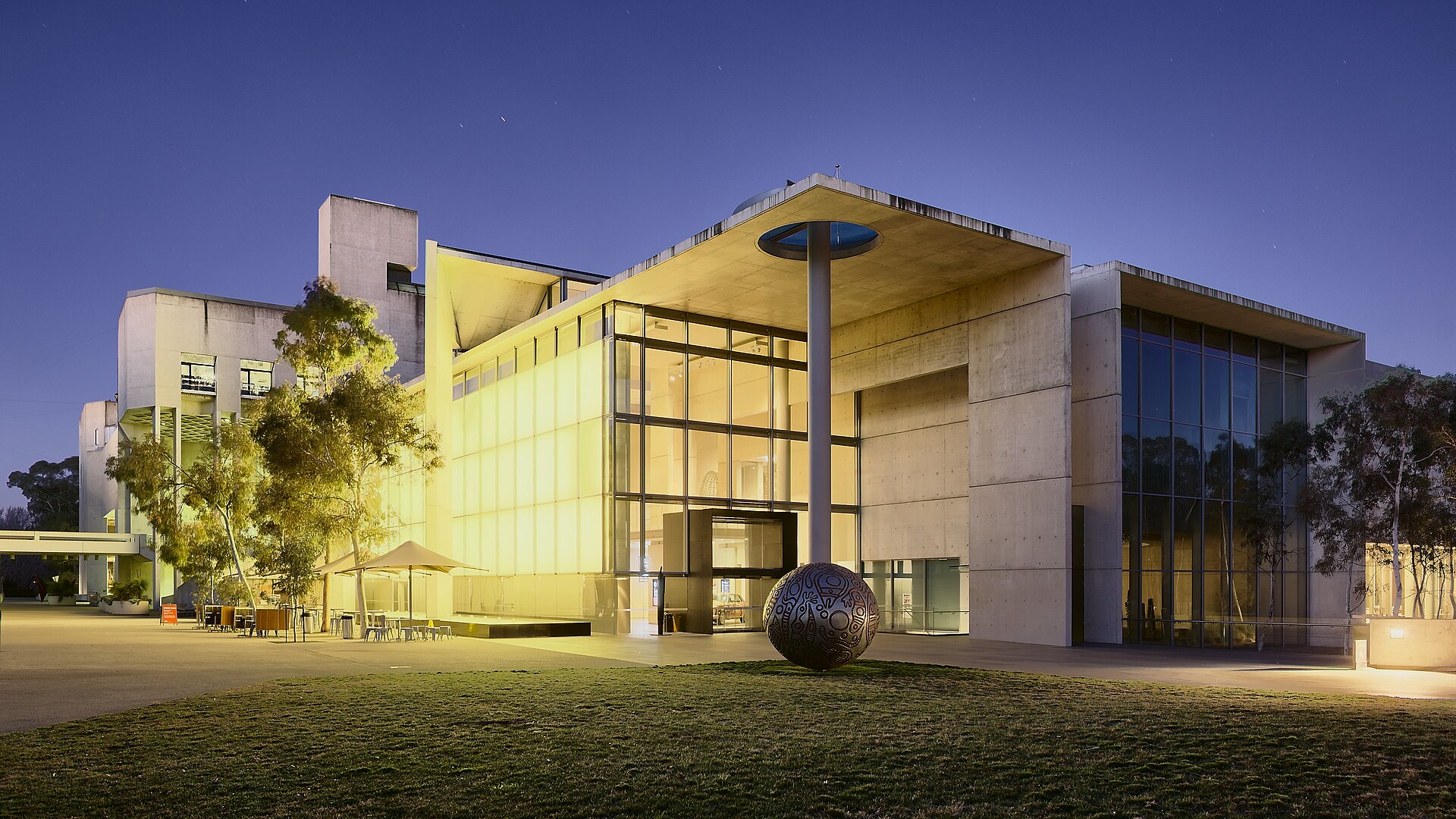
The National Gallery of Australia building at blue hour, its bush-hammered concrete and glass entrance lit from within, photographed in 2017
Photograph by Thennicke · CC BY-SA 4.0National Gallery of Australia
Museum · Founded 1967
Open, admission and hours confirmed 12 September 2026 · 18 sources
On this page 16 sections
ContentsClose
The National Gallery's strength is breadth built on two poles at once: the world's largest collection of Aboriginal and Torres Strait Islander art, and one of the fuller surveys of twentieth-century international modernism held anywhere in the southern hemisphere, from Blue Poles to French Impressionism, Dada, Surrealism, the Russian avant-garde, Abstract Expressionism, Pop Art, Minimalism and Conceptual Art. Its Australian holdings run from the colonial period through the Heidelberg School to Sidney Nolan's Ned Kelly series, and its Asian and Pacific collections, though smaller, are old enough and broad enough that the Gallery has spent a decade actively researching and correcting their own acquisition history rather than leaving it unexamined.
| Kind | Museum |
|---|---|
| Founded | 1967 |
| City and country |  Canberra, Australia Canberra, Australia |
| Address | Parkes Place, Parkes, Canberra ACT 2600, Australia |
| Website | nga.gov.au |
| Status | Open, confirmed |
| Record last verified |
Visiting
- Hours
- Every day10:00 to 17:00Stated by the Gallery as open every day; closed only for Christmas Day, per the Gallery's own accessibility page
- Closed
- Christmas Day (25 December).
- Admission
- General admission (permanent collection and National Sculpture Garden)FreeFree every day the Gallery is open. Select major exhibitions are ticketed when scheduled; as of this research (12 September 2026) no ticketed exhibition was currently running - the exhibitions and collection displays on the Gallery's own What's On listing, including the Arthur Boyd: Tapestries major exhibition, were all marked Free, so no live ticket price exists to record. The Gallery's own FAQ confirms that where a paid exhibition does run, visitors with disability are admitted at a concession rate and an accompanying carer is admitted free.
Free entry: Every day - general admission and the National Sculpture Garden are always free- Tickets
- nga.gov.au/whats-on The museum's own ticket page.
- Do I need to book?
- No booking is needed for general admission or the Sculpture Garden; timed, paid tickets apply only when a major loan exhibition is running
- Address
- Parkes Place, Parkes, Canberra ACT 2600, Australia MapBus Transport Canberra routes 2 and 6 stop on Parkes Place East, immediately outside the Gallery; routes 4, 5, 7, 10, 180 and 181 stop near the Albert Hall, about a 15-minute walk away
Walking On the southern shore of Lake Burley Griffin in Canberra's Parliamentary Triangle, a short walk from the National Portrait Gallery, the High Court of Australia and the National Library of Australia - Website
- nga.gov.au
- Telephone
- +61 2 6240 6411
- [email protected]
Before you go how long, access, photography, bags, eating, shop
- How long to allow
- Two to three hours for the international and Australian collection galleries and a walk through the Sculpture Garden; add an hour for the eleven Aboriginal and Torres Strait Islander Art galleries
- Access
- Free wheelchairs, motorised scooters, wheelie walkers and walking sticks are available on request; the Companion Card is honoured; a Parents Room is on Level 1 and Auslan-interpreted and audio-description tours run monthly
- Photography
- Personal photography without flash, tripods or selfie sticks is allowed in most galleries unless a work is specifically marked otherwise
- Bags
- Bags, backpacks and any item larger than a 30cm cube must be cloaked in the free lockers near the entrance
- Eating
- Kitchen by Mike serves meals overlooking the Sculpture Garden
- Shop
- The Art Store sells art books, prints and contemporary design objects and keeps the Gallery's own hours
Prices and hours change. We take them from the institution's own pages and print the day we read them, and you can check the current position at the source we used. Confirm before you travel.
What is inside
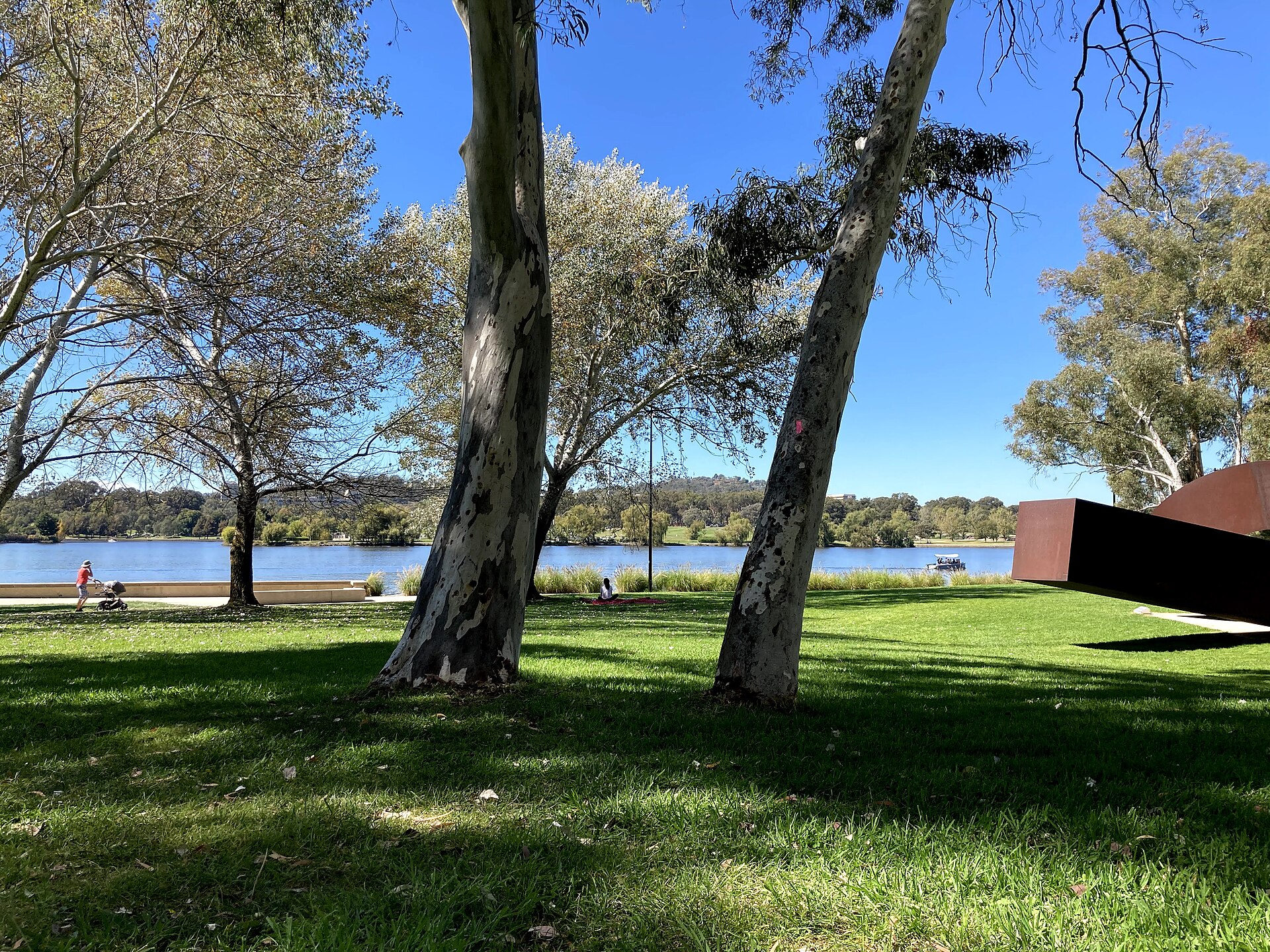
Photograph by Nick-D · CC BY-SA 4.0 National Sculpture Garden
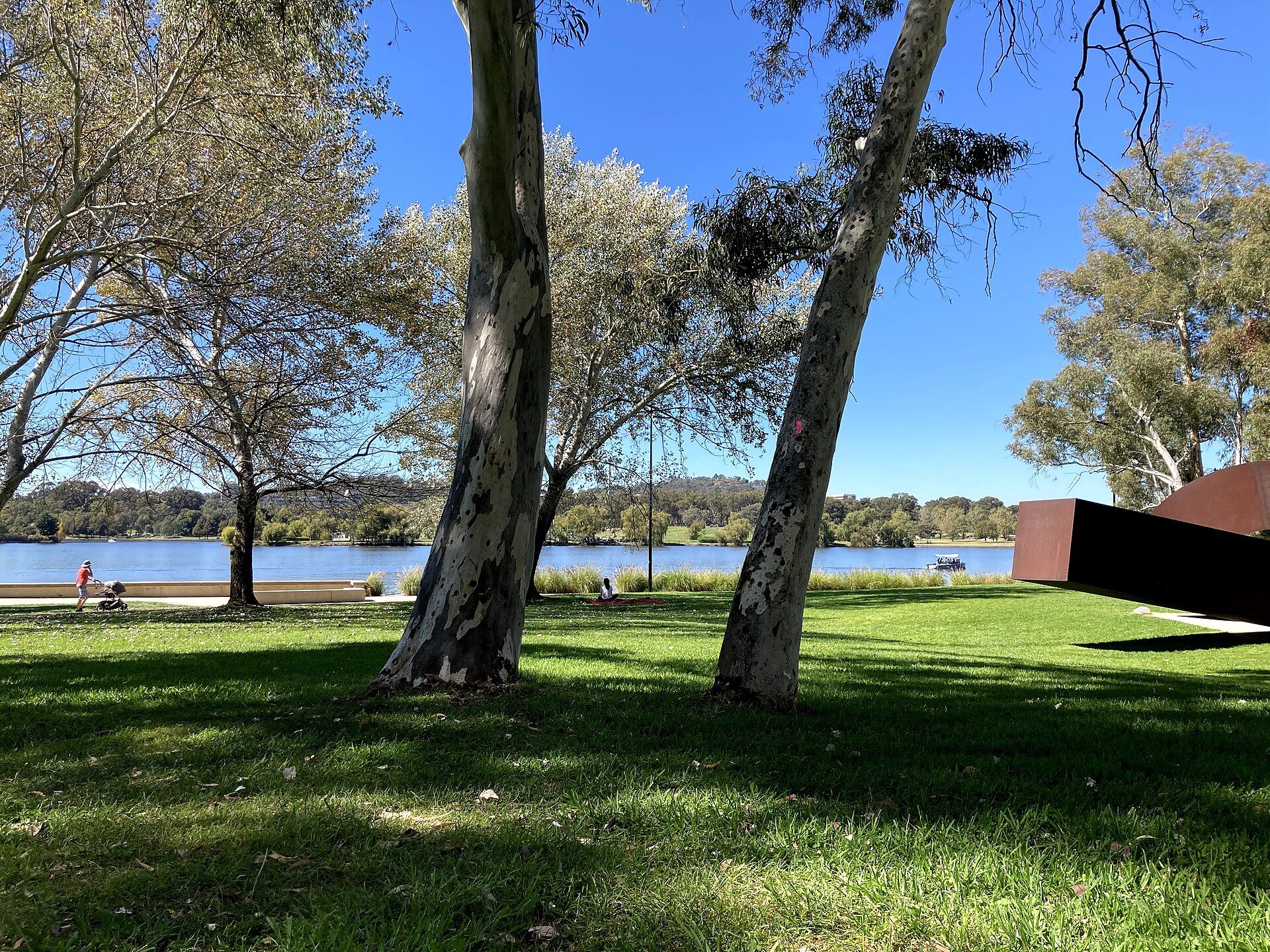
About thirty works spread across the lawns on the shore of Lake Burley Griffin, free to enter every day, including Auguste Rodin's bronze cast of The Burghers of Calais, Henry Moore's Hill Arches, Bert Flugelman's Cones, James Turrell's walk-in skyspace Within Without and Lindy Lee's 2024 stainless-steel Ouroboros. As of September 2026 the Fiona Hall Fern Garden is closed for significant rectification and the National Sculpture Garden Pavilion is closed, with a new pavilion targeted for mid-2027, both part of the Gallery's 2026-2030 Capital Works Program; the Garden itself remains open and free daily.
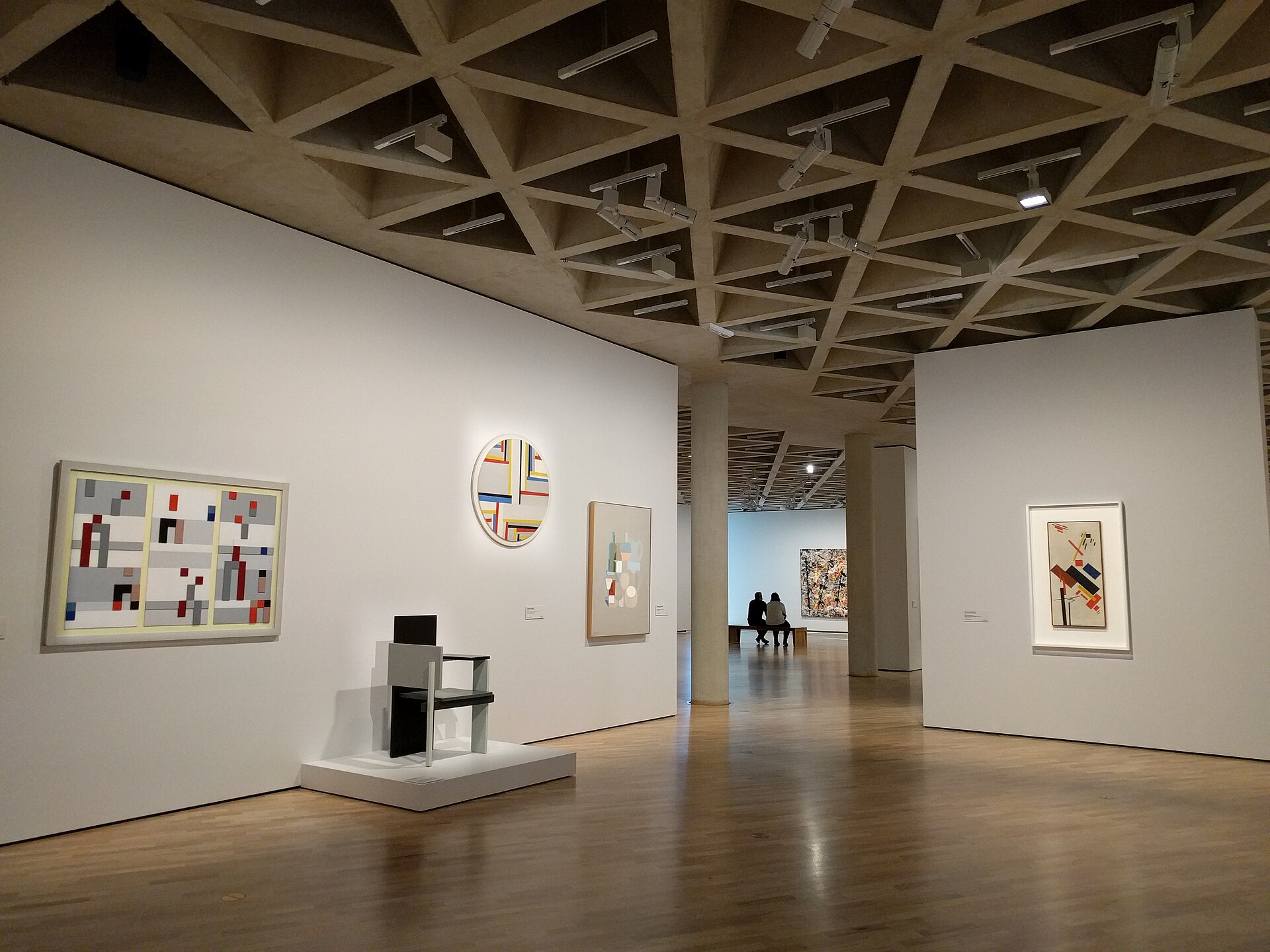
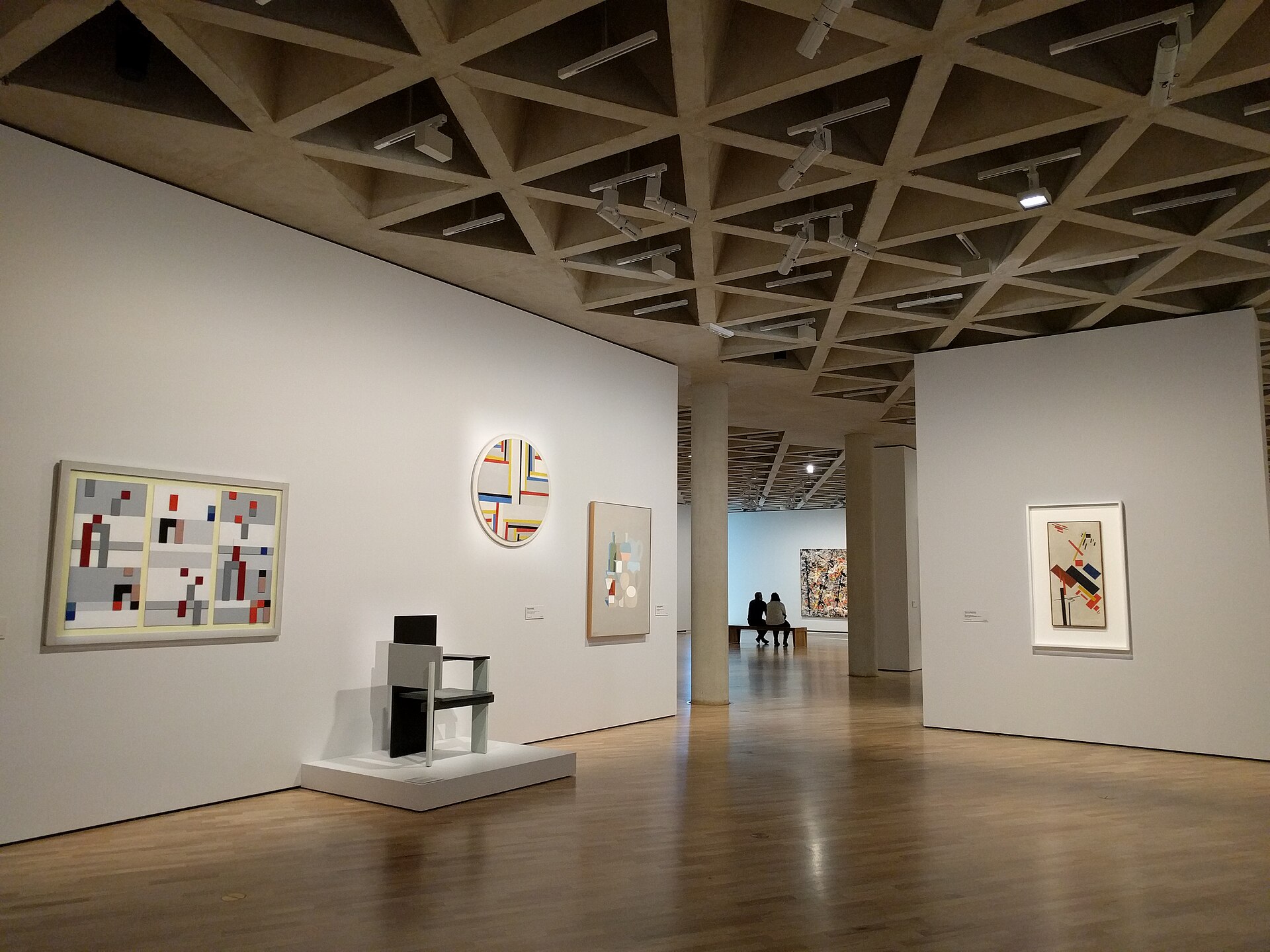
Photograph by Nick-D · CC BY-SA 3.0 International Art galleries (Gallery 10, Level 1)
European and American painting and sculpture from the twentieth century, hung in top-lit rooms under the building's coffered concrete ceiling grid, including Blue Poles and works spanning Cubism, Dada, Surrealism and Abstract Expressionism
Aboriginal and Torres Strait Islander Art galleries
Eleven galleries opened in 2010 as part of the building's PTW-designed extension, the first in Australia purpose-built for this collection, showing around 600 works drawn from a holding of more than 7,500 and anchored by The Aboriginal Memorial's 200 memorial poles
Australian Art galleries (Gallery 23, Level 2)
An ongoing display of Australian painting and sculpture from the colonial period to postwar modernism, including Sidney Nolan's Ned Kelly series, part of the Gallery's stated focus on elevating Australian and First Nations art and women artists overlooked by earlier collecting
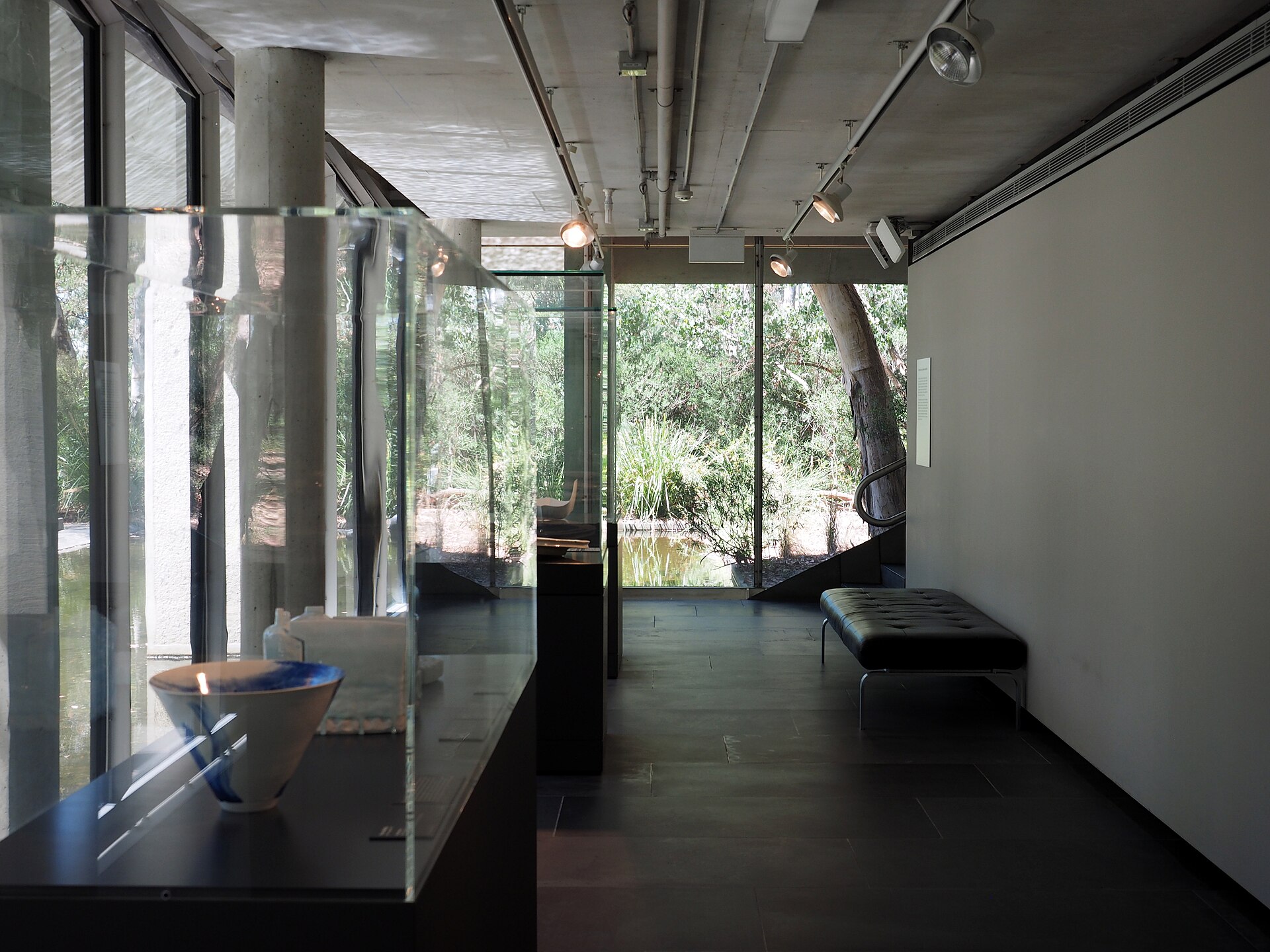
Photograph by Nick-D · CC BY-SA 4.0 Asian and Pacific art, lower level
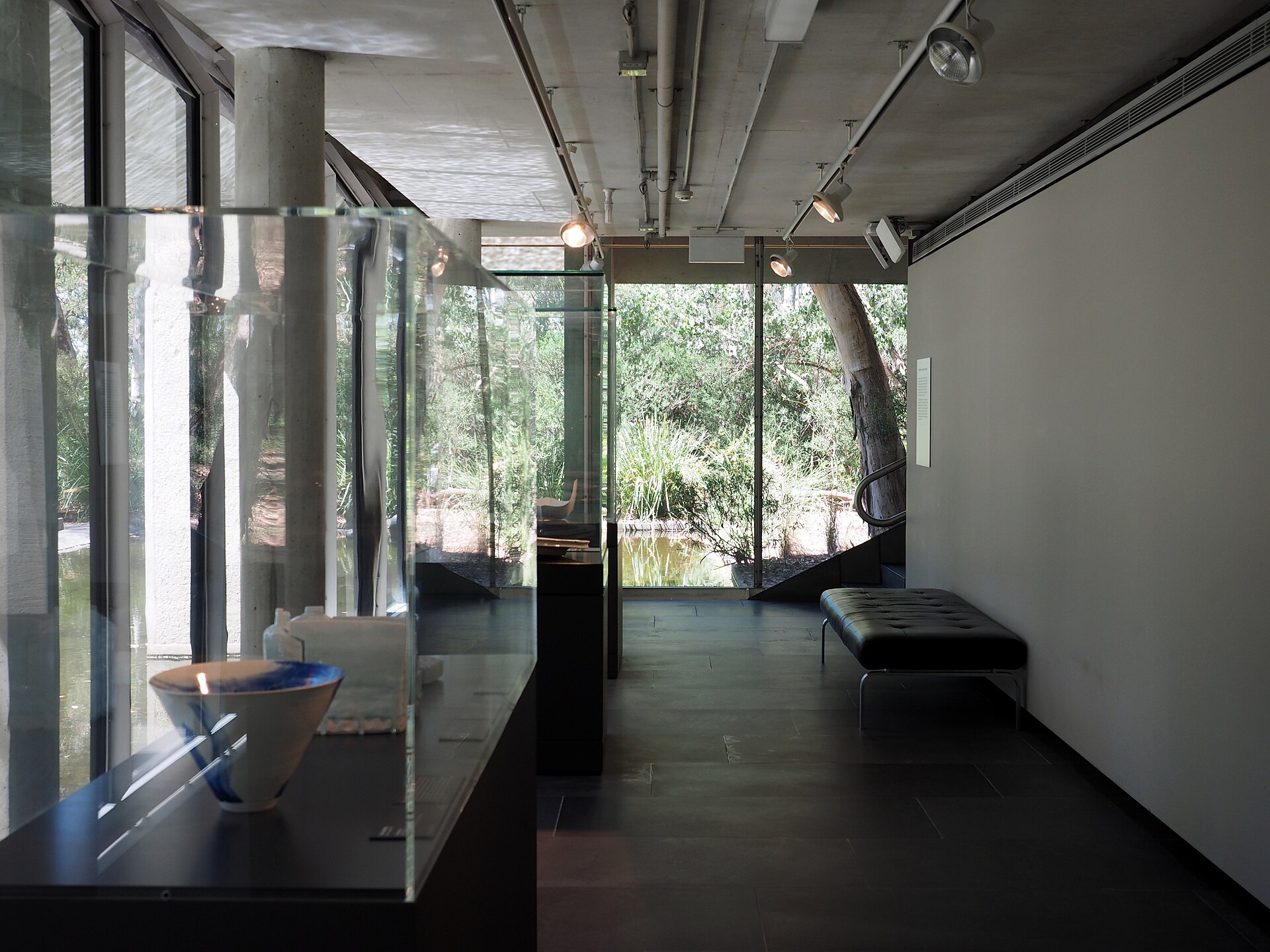
Textiles, ceramics, bronzes and sculpture from South and Southeast Asia and the Pacific, shown in the lower-level galleries including the glass-walled Water Gallery, which looks out through the building's concrete piers to a pond and bushland
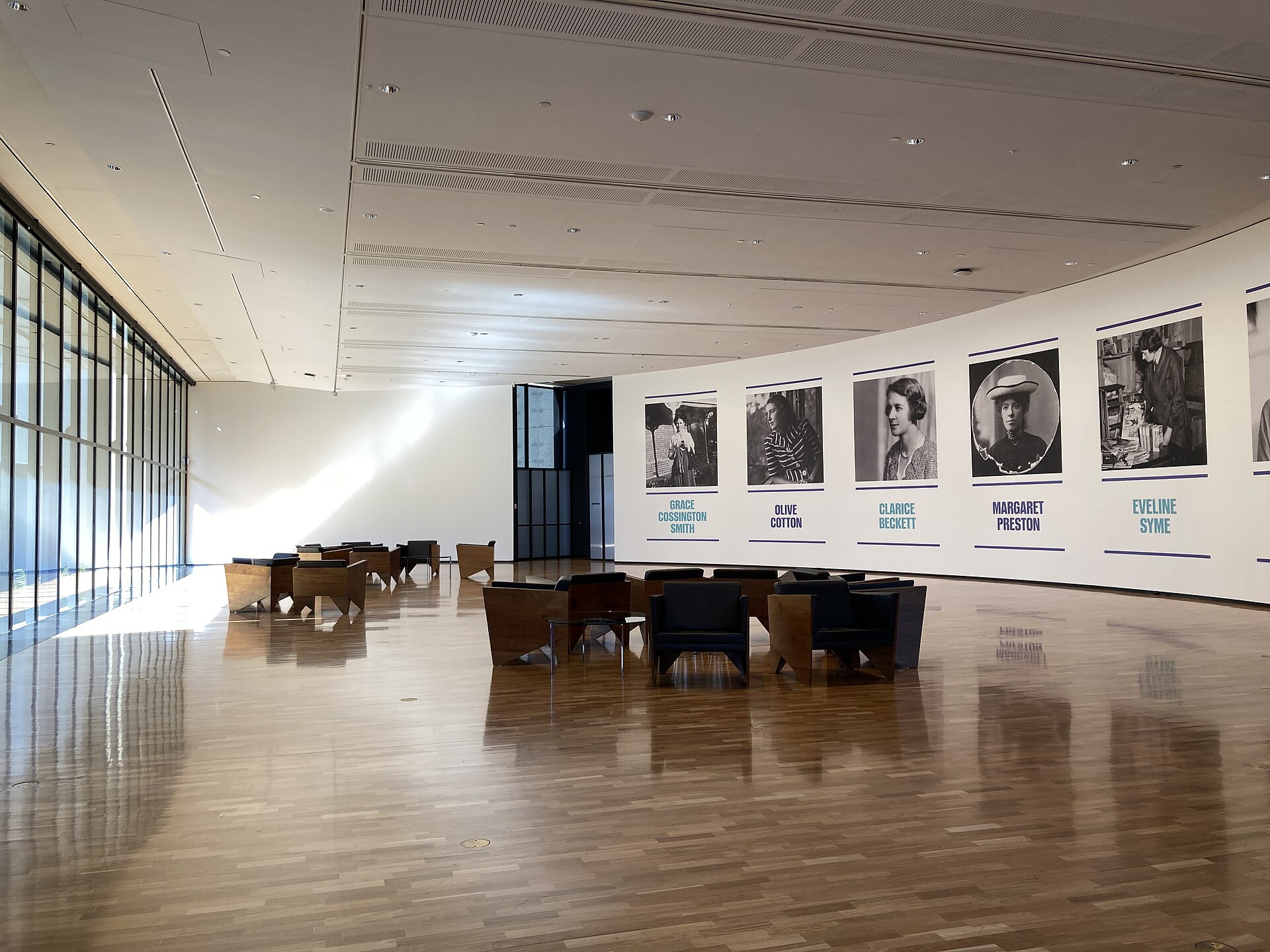
Photograph by Nick-D · CC BY-SA 4.0 Temporary exhibitions and Know My Name displays
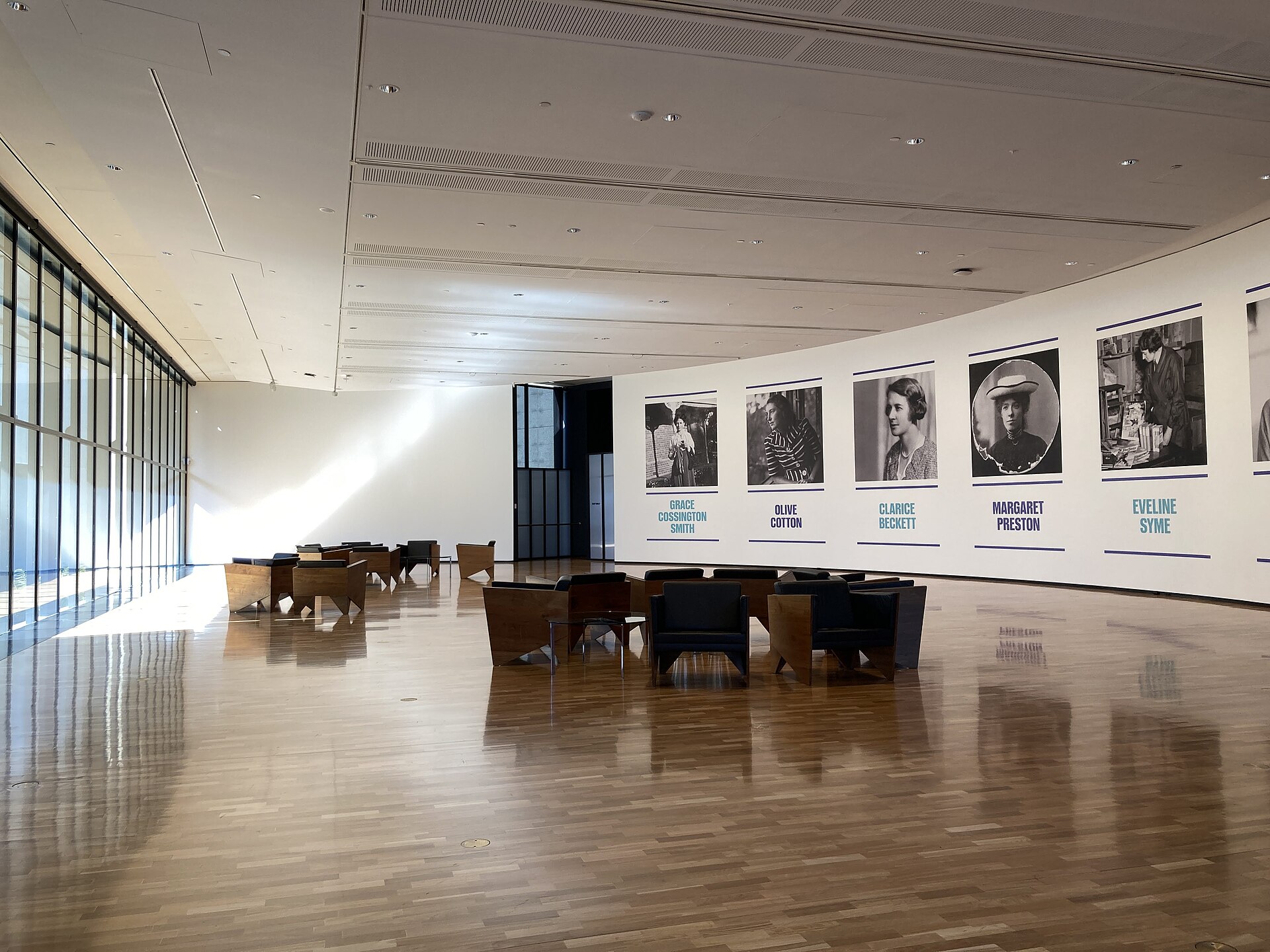
Foyer and gallery space used for ticketed loan exhibitions and for the Gallery's Know My Name initiative, which rehangs and researches women artists historically overlooked by the collection
What to see first
Blue Poles
Jackson Pollock, 1952Acquired in 1973 in a purchase that became a national political controversy, it is the best-known single painting in the collection and is rarely off display6
Ned Kelly series
Sidney Nolan, 1946-47Twenty-five of Nolan's original twenty-seven Kelly paintings, a 1977 gift from Sunday Reed, forming one of the defining sequences in twentieth-century Australian painting7
The Aboriginal Memorial
Ramingining artists, 1987-88Two hundred hollow-log poles by forty-three artists from nine Central Arnhem Land clans, one for every year of settlement since 1788, standing as both war memorial and mass funerary rite5
The Burghers of Calais
Auguste Rodin, cast 1973A full-size bronze cast of Rodin's civic masterpiece, standing in the open air of the Sculpture Garden rather than behind glass17
Within Without
James Turrell, 2010A walk-in pyramid skyspace commissioned directly from Turrell for the 2010 extension, at its most dramatic at dawn and dusk as the sky changes over its open oculus9
Ouroboros
Lindy Lee, 2024A four-metre, thirteen-tonne stainless-steel sculpture unveiled for the Gallery's fortieth anniversary, reported as Australia's most expensive public artwork and built from recycled material8
The Aboriginal and Torres Strait Islander Art galleries
Eleven galleries, opened 2010The first galleries in Australia purpose-built for this collection, holding the world's largest single collection of Aboriginal and Torres Strait Islander art3
Exhibitions on now
A building announced in 1967, opened in 1982
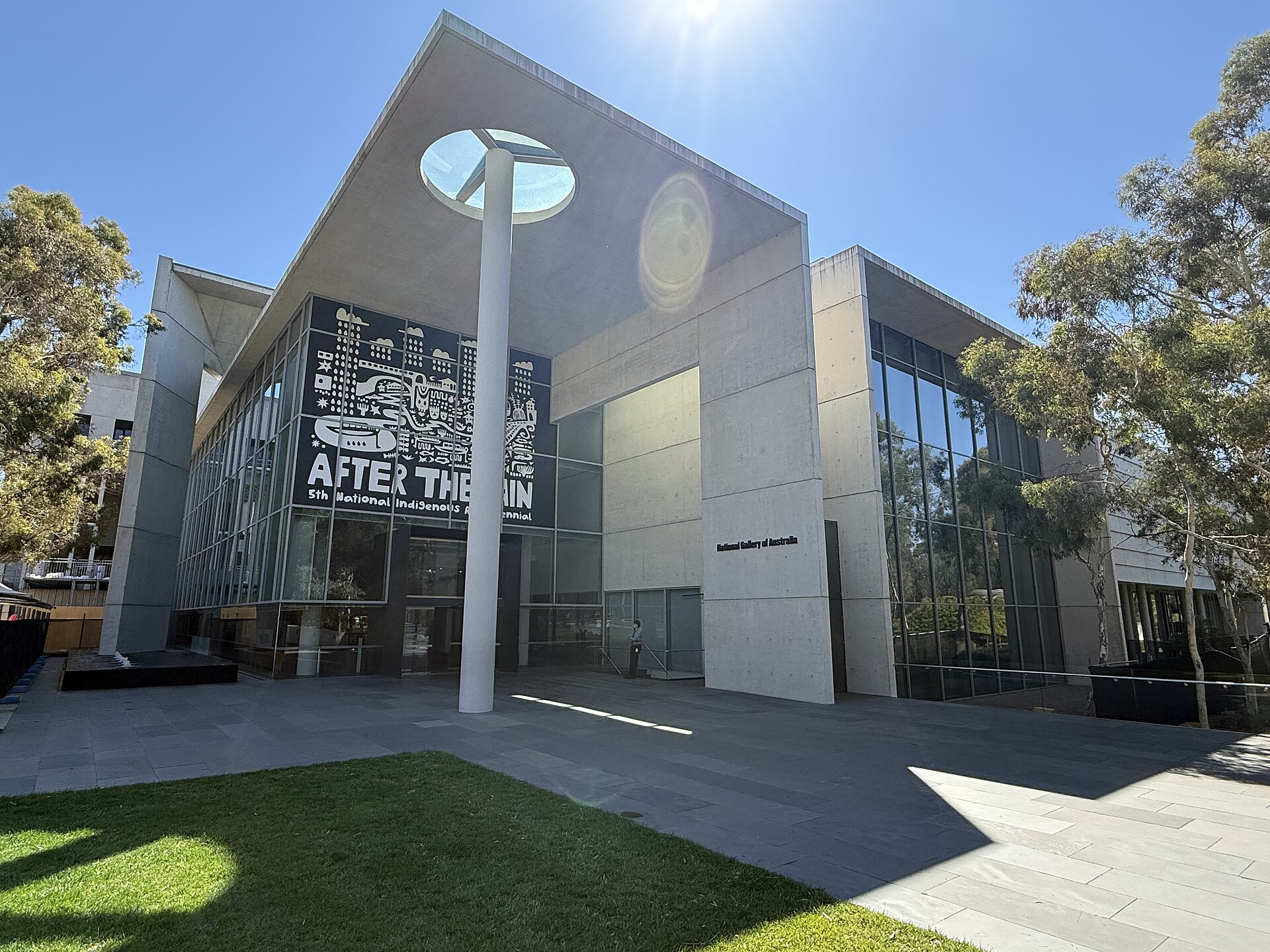
In 1967 Prime Minister Harold Holt announced that a new national gallery would be built in Canberra to hold the Commonwealth's growing art collection. The firm Edward Madigan Torzillo and Partners was chosen to design it, with architect Col Madigan leading the team, and after much deliberation a site was fixed on the southern shore of Lake Burley Griffin, within the newly formed Parliamentary Triangle. Construction began in 1973 and finished in 1981, and the building was formally opened by Queen Elizabeth II in 1982, fourteen years after the project was first announced. The result is a striking Brutalist edifice of sweeping, bush-hammered concrete, its layout built around a spiral progression of galleries across three floors and the entrance level.
Blue Poles and the making of a national collection
Jackson Pollock's Blue Poles, painted in 1952, was acquired by the National Gallery in 1973, nine years before the building itself opened, and its purchase became one of the most public controversies in Australian cultural politics: press and parliament argued over the sum paid for a single foreign painting years before ordinary visitors could see it hung. That controversy has faded into the painting's fame rather than its shame, and Blue Poles has been rarely off display since the Gallery opened in 1982. It underwent its most comprehensive conservation project to date beginning in 2020, when the Gallery's own pandemic closure created an unplanned opportunity for the first in-depth technical research and treatment of the work since it entered the collection.
The world's largest collection of Aboriginal and Torres Strait Islander art
The National Gallery holds more than 155,000 works of art in total, and within that collection its holding of Aboriginal and Torres Strait Islander art, more than 7,500 works, is the largest anywhere. Eleven galleries dedicated to this collection opened in 2010 as part of the building's first major extension, designed by Andrew Andersons of PTW Architects; they were the first galleries in Australia designed specifically for this purpose, and around 600 works are on display in them at any time. Their centrepiece is The Aboriginal Memorial, 200 hollow-log poles, or dupun, made in 1987-88 by forty-three artists from nine neighbouring clans of Central Arnhem Land, one pole for every year of European settlement between 1788 and 1988. Each dupun follows the form of a hollow-log mortuary rite without ever having held human remains; the installation stands instead as a permanent, public war memorial and a collective funeral rite for Aboriginal people denied a proper burial by history. The Gallery states that elevating First Nations culture and the work of women artists sits at the centre of its current vision for the collection.
A sculpture garden on the shore of Lake Burley Griffin
The National Sculpture Garden was laid out on the building's grounds to display the Gallery's outdoor sculpture collection and remains free to enter every day, even when the galleries themselves are closed. Around thirty works are sited among its lawns and bushland, including a full-size bronze cast of Auguste Rodin's Burghers of Calais, Henry Moore's Hill Arches and Bert Flugelman's stainless Cones. Two more recent commissions have become landmarks in their own right. James Turrell's Within Without, a walk-in skyspace entered through a sloping tunnel to a domed viewing chamber open to the sky, was commissioned for the 2010 extension and is at its most dramatic at dawn and dusk. Lindy Lee's Ouroboros, a four-metre, thirteen-tonne stainless-steel sculpture based on the ancient image of a snake eating its own tail, was unveiled in October 2024 to mark the Gallery's fortieth anniversary; built from recycled material and renewable energy, it has been reported as the most expensive public artwork ever commissioned in Australia.
Provenance and the Subhash Kapoor repatriations
The Gallery's own record is not without a serious blemish, and it does not hide it. Beginning in 2014, research under its Asian Art Provenance Project established that a number of the Asian antiquities it had purchased, including a bronze Shiva Nataraja, had been looted or illegally exported and supplied through the jailed Manhattan dealer Subhash Kapoor and his gallery, Art of the Past. The Gallery repatriated works to India in 2014, 2016, 2019 and again in 2021, when a further round returned thirteen stolen objects to India in a single repatriation. Following that fourth round, the Gallery stated it no longer held any work acquired through Kapoor. Its director at the time, Nick Mitzevich, described the governing standard as returning anything considered, on the balance of probability, to have been stolen, illegally excavated or unethically acquired. It is a record of a public institution correcting its own past purchases under outside pressure and its own research, rather than one that discovered nothing wrong to begin with.
A Brutalist building visitors still argue about
The National Gallery is one of Australia's most significant works of Brutalist architecture, and also one that has never entirely settled its relationship with the art inside it. Its original triangular, circuit-based geometry and narrow, gash-like windows drew confusion bordering on outrage when the building opened, and successive directors softened its raw concrete interiors with inserted hanging walls to give curators a more conventional surface for paintings. The 2010 PTW extension was partly built to resolve the confusion created by the building's several entrances, configured decades earlier for a surrounding urban plan that was never completed. Architecture Australia's own review of that extension judged the new Indigenous galleries a technical success but argued the new glazed entry foyer still fails to give visitors a clear sightline through to the original upper-level foyer, creating, in the reviewer's words, a new kind of confusion for arrivals from the lakeside or the portico. A further Capital Works Program, running 2026 to 2030, is now under way to protect the heritage-listed building and the national collection it holds, with parts of the Gallery and Sculpture Garden closing temporarily in stages as the work proceeds.
Visiting today
The National Gallery is open every day from 10am to 5pm, closed only for Christmas Day, and general admission, including the National Sculpture Garden, is free. Free guided Collection Tours run daily at 11.30am and 2pm, wheelchairs and mobility aids are available on request, and the Companion Card is honoured for ticketed exhibitions. Kitchen by Mike overlooks the Sculpture Garden for those wanting a meal with their visit, and the Art Store sells books, prints and design objects drawn from the collection. The building sits on Parkes Place on the southern shore of Lake Burley Griffin, an easy walk from the National Portrait Gallery, the High Court of Australia and the National Library, with Transport Canberra buses stopping immediately outside on Parkes Place East. Visitors planning around the 2026-2030 Capital Works Program should expect some construction noise and occasional closures of individual spaces, but the Gallery and its collection remain open throughout. Re-confirmed 12 September 2026: as the Capital Works Program continues, Fujiko Nakaya's fog sculpture Foggy wake in a desert: An ecosphere and Fiona Hall's Fern Garden are both closed for maintenance, and the Sculpture Garden Pavilion is closed, with the Gallery targeting mid-2027 for a new pavilion and the fog work's reopening; the Gallery itself and the rest of the Sculpture Garden remain open daily. Current exhibitions on the Gallery's own What's On listing include the major exhibition Arthur Boyd: Tapestries (20 June-18 October 2026, Gallery 12) and the collection display David Hockney: Portraits in Print (5 September 2026-9 May 2027, Gallery 13), both free.
What visitors say
Visitors consistently describe the National Gallery as an essential, unhurried stop in Canberra, helped by the fact that entry is free every day: Google's aggregate rating sits at 4.6 from more than seven thousand ratings. The Aboriginal and Torres Strait Islander galleries and Blue Poles are repeatedly named as the must-see reasons to visit, and the Sculpture Garden draws praise as a destination in its own right. Complaints cluster around wayfinding inside the original 1982 building and around the disruption from the Gallery's ongoing capital works.
What is praised, what is criticised
- Praised: Free general admission extended to the entire National Sculpture Garden as well as the permanent collection galleries
- Praised: The depth and presentation of the Aboriginal and Torres Strait Islander Art galleries, widely called the best introduction to the collection
- Praised: Blue Poles and the Sculpture Garden as reliable, photogenic highlights worth the visit on their own
- Criticised: The building's original circuit-based layout and multiple, unaligned entrances, which Architecture Australia's own review of the 2010 extension argued the new wing did not fully resolve
- Criticised: A provenance history that included Asian antiquities bought from the jailed dealer Subhash Kapoor, requiring four rounds of repatriation to India between 2014 and 2021 before the Gallery could say it held no Kapoor-sourced works
Ratings on other platforms
Google: 4.6 from 7,218 ratings, read 13 August 2026
A platform average is a tertiary source: it moves, it is not audited, and we quote no visitor's words.
Questions about National Gallery of Australia
Where is National Gallery of Australia?
Parkes Place, Parkes, Canberra ACT 2600, Australia.
How much does it cost to visit?
General admission (permanent collection and National Sculpture Garden): free. As confirmed 12 September 2026.
When is it open?
Every day 10:00-17:00. Closed: Christmas Day (25 December). As confirmed 12 September 2026.
How do you get there?
Bus: Transport Canberra routes 2 and 6 stop on Parkes Place East, immediately outside the Gallery; routes 4, 5, 7, 10, 180 and 181 stop near the Albert Hall, about a 15-minute walk away; Walking: On the southern shore of Lake Burley Griffin in Canberra's Parliamentary Triangle, a short walk from the National Portrait Gallery, the High Court of Australia and the National Library of Australia.
What should you see first?
Blue Poles (Jackson Pollock, 1952); Ned Kelly series (Sidney Nolan, 1946-47); The Aboriginal Memorial (Ramingining artists, 1987-88); The Burghers of Calais (Auguste Rodin, cast 1973); Within Without (James Turrell, 2010); Ouroboros (Lindy Lee, 2024).
What we could not confirm
- Whether the building's National Heritage List entry postdates 1982 or reflects a later assessment was not confirmed on the sources read for this page.
- No verified Commons photograph was found for the Aboriginal and Torres Strait Islander Art galleries or for the Australian Art galleries (Gallery 23); do not substitute an unrelated interior for either.
Images
Sources
- 1National Gallery of Australia, 'Visit' (hours, admission, address, phone, email) nga.gov.au/visit/
- 2National Gallery of Australia, 'About' (collection size, Aboriginal and Torres Strait Islander collection, architect, free admission, Capital Works Program) nga.gov.au/about-us/
- 3National Gallery of Australia, 'History of the Building' (Col Madigan, construction 1973-1981, opened by Queen Elizabeth II 1982, 2010 PTW extension and Indigenous galleries) nga.gov.au/about-us/the-building/
- 4National Gallery of Australia, 'What's On' (current exhibitions and collection displays, confirming all currently free) nga.gov.au/whats-on/
- 5National Gallery of Australia, 'The Aboriginal Memorial' (Ramingining artists, 200 poles, forty-three artists) nga.gov.au/on-demand/the-aboriginal-memorial/
- 6National Gallery of Australia, 'Jackson Pollock's Blue poles' (1973 acquisition, 2020 conservation project) nga.gov.au/on-demand/jackson-pollocks-blue-poles-conservation-research-project/
- 7Chloe Hooper, 'The artist and the bushranger', National Gallery of Australia, 13 February 2024 (Ned Kelly series, 1977 gift of Sunday Reed) nga.gov.au/stories-ideas/the-artist-and-the-bushranger/
- 8National Gallery of Australia, 'Lindy Lee: Ouroboros' nga.gov.au/art-artists/sculpture-garden/lindylee-ouroboros/
- 9National Gallery of Australia, 'James Turrell: Within without' nga.gov.au/art-artists/sculpture-garden/james-turrell-within-without-2010/
- 10National Gallery of Australia, 'Conditions of Entry' nga.gov.au/visit/conditions-of-entry/
- 11Wikidata, 'National Gallery of Australia' (Q795228) - identity, coordinates, inception, wikidata.org/wiki/Q795228
- 12Wikimedia Commons, File:National Gallery at dusk, Canberra ACT.jpg (licence CC BY-SA 4.0, author Ted Hennicke) commons.wikimedia.org/wiki/File:National_Gallery_at_dusk,_Canberra_ACT.jpg
- 13Elizabeth Fortescue, 'National Gallery of Australia to return 13 stolen objects to India that it bought from disgraced art dealer Subhash Kapoor', The Art Newspaper, 29 July 2021 theartnewspaper.com/2021/07/29/national-gallery-of-australia-to-return-13-stolen-objects-to-india-that-it-bought-from-disgraced-art-dealer-subhash-kapoor
- 14Laura Harding, 'Extending the National Gallery of Australia', Architecture Australia, published online by ArchitectureAU 14 March 2013 architectureau.com/articles/extending-the-nga/
- 15National Portrait Gallery, 'Public Transport' (Transport Canberra bus routes on Parkes Place, immediately adjacent to the National Gallery) portrait.gov.au/content/public-transport
- 16Google Maps listing for the National Gallery of Australia (aggregate rating, , read 13 August 2026) google.com/maps/search/National+Gallery+of+Australia+Canberra
- 17Wikimedia Commons, Category:Sculptures by Auguste Rodin in the Sculpture Garden of the National Gallery of Australia (confirms The Burghers of Calais is sited in the Gallery's Sculpture Garden) commons.wikimedia.org/wiki/Category:Sculptures_by_Auguste_Rodin_in_the_Sculpture_Garden_of_the_National_Gallery_of_Australia
- 18National Gallery of Australia, 'National Sculpture Garden' (temporary closures: Fiona Hall's Fern Garden and Fujiko Nakaya's Foggy wake in a desert closed for maintenance; Sculpture Garden Pavilion closed, new pavilion targeted mid-2027), read 12 September 2026 nga.gov.au/art-artists/sculpture-garden/
