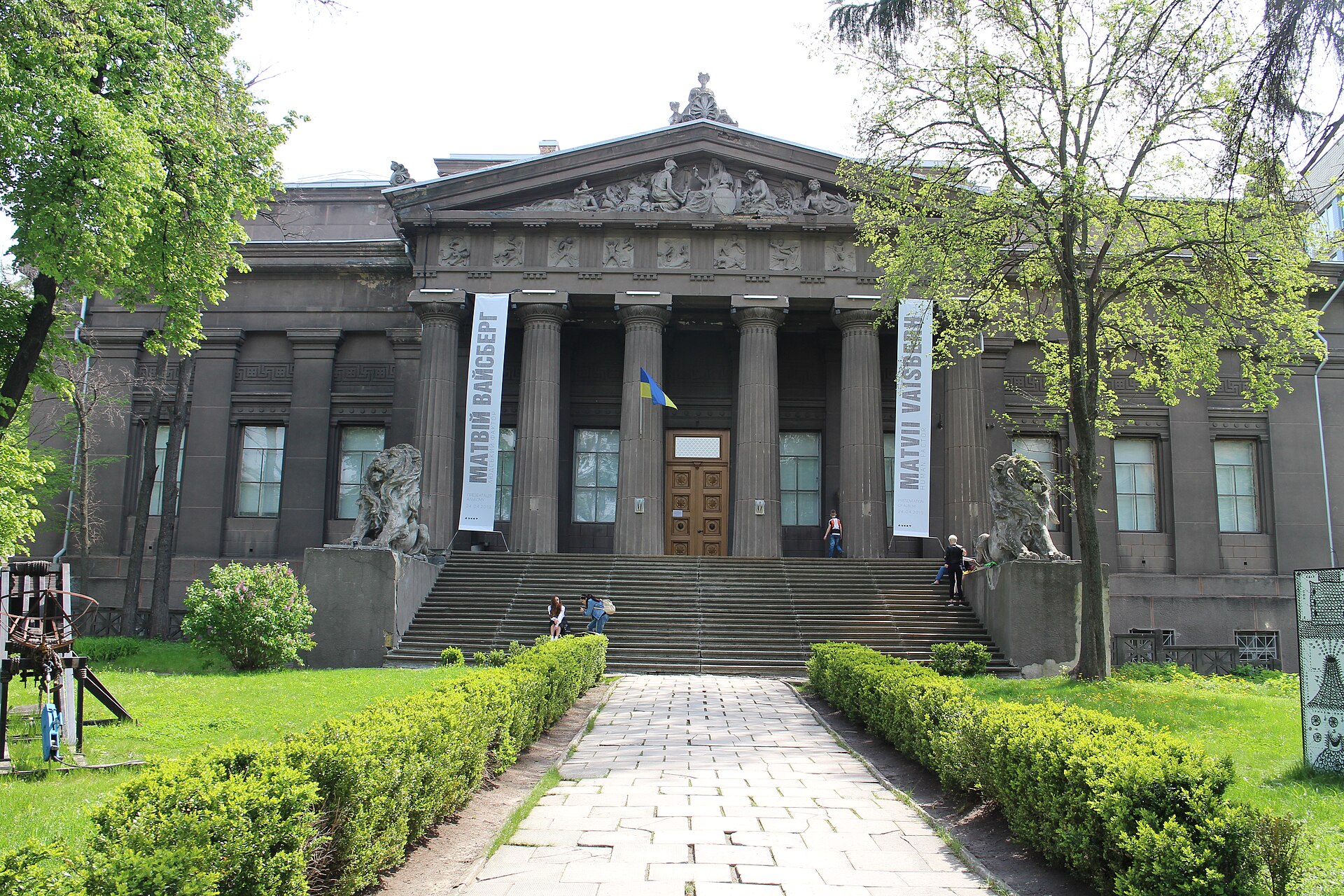
The neoclassical facade of the National Art Museum of Ukraine at 6 Mykhaila Hrushevskoho Street, Kyiv, photographed in 2019.
Suicasmo · CC BY-SA 4.0National Art Museum of Ukraine
Museum · Natsionalnyi khudozhnii muzei Ukrainy · Founded 1904
Closure confirmed 31 August 2026 · 14 sources
Closed to visitors - not permanently
National Art Museum of Ukraine is currently closed, on the evidence sourced below.
Expected to reopen: not before the end of autumn, per the museum's own communications director · a target, not yet confirmed
Closure confirmed from the institution's own page. We re-check this page on a schedule and will update it, from the institution's own announcement, the moment it reopens.
On this page 13 sections
ContentsClose
The museum's strongest ground is Ukrainian religious and Baroque painting: a icon collection running from the 12th century into the 18th that is repeatedly cited as among the best held anywhere in Ukraine, and a body of Cossack-era Baroque portraiture and devotional imagery, typified by the Intercession with the portrait of Hetman Khmelnytsky, that exists almost nowhere else in this depth. Its second strength is holding, in whatever fragments survived the Stalinist purges, the physical evidence of Kyiv's own suppressed modernist decades, including one of the few major surviving paintings by the executed Boichukist school founder Mykhailo Boichuk.
| Local name | Natsionalnyi khudozhnii muzei Ukrainy |
|---|---|
| Kind | Museum |
| Founded | 1904 |
| City and country |  Kyiv, Ukraine Kyiv, Ukraine |
| Address | 6 Mykhaila Hrushevskoho Street, Kyiv, 01001, Ukraine (entrance from the rear of the building) |
| Website | namu.ua |
| Status | Closed temporarily, confirmed |
| Record last verified |
Visiting
- Hours (pre-closure)
- Thu-Sun12:00 to 18:00pre-closure schedule, as published on the museum's own site
- Closed
- Monday. Tuesday. Wednesday.
- Admission (pre-closure)
- Full ticketUAH 150pre-closure price, permanent collection
- Discounted (schoolchildren, students, pensioners)UAH 100pre-closure price
- Military personnelFreefree entry
- Guided excursionUAH 300add-on, booked by phone, not the entry fee
- Museum lecture hall, fullUAH 250public programme ticket, separate from gallery entry
- Museum lecture hall, discountedUAH 150students, schoolchildren, pensioners
- Do I need to book?
- No online booking published; guided excursions are arranged by phone
- Address
- 6 Mykhaila Hrushevskoho Street, Kyiv, 01001, Ukraine (entrance from the rear of the building) MapMetro Maidan Nezalezhnosti station, on the museum's own list of the nearest air-raid shelters, a short walk away across European Square
- Website
- namu.ua
- Telephone
- +380 44 278 13 57
- [email protected]
Before you go how long, access, photography, bags, eating, shop
- How long to allow
- Not stated by the museum. A pre-war Saturday visitor described roughly two hours spent mostly in queues to see four rooms during a crowded special exhibition, which is a caution about peak-day crowding rather than a guide to normal pace
- Access
- Not published on the museum's own site as of this research
- Photography
- Permitted without flash, for non-commercial use only, and visitors are asked to stay at least 40cm from exhibits
- Bags
- Coats and umbrellas go to the cloakroom; lockers are provided for large bags
- Eating
- Not listed among the museum's own visitor information
- Shop
- The museum operates its own shop, linked from the main site navigation
The museum is closed (see above). These are the figures published before the closure, kept here for a visitor planning ahead rather than presented as bookable today, and you can check the current position at the source we used. We will re-confirm them once it reopens.
What is inside
Ukrainian icon painting, 12th to 18th century
The museum holds one of the strongest icon collections in Ukraine, anchored by a 12th-century Saint George with hagiography from the Byzantine-Rus tradition and continuing through Galician and Volhynian panels of the 14th to 16th centuries into the fuller, more decorative icon painting of the 18th century, including a paired Saints Barbara and Catherine from the 1740s.
Ukrainian Baroque and Cossack-era portraiture, 17th to 18th century
The Cossack Hetmanate's own visual language: parsuna-style portraits of starshyna officers and church patrons, and the Baroque fusion of religious and political imagery typified by the Intercession of the Holy Virgin with the Portrait of Hetman Bohdan Khmelnytsky, in which the Marian Pokrova composition shelters an identifiable historical ruler rather than an anonymous congregation.
Nineteenth-century Ukrainian painting
Realist and early-modern painting from the decades either side of 1900, including Serhii Vasylkivsky's steppe and lake landscapes, Mykola Pymonenko's genre scenes of village life, and Oleksandr Murashko's portraiture, of which Girl in a Red Hat (1902-1903) is the museum's most reproduced single canvas.
Ukrainian modernism and the avant-garde, 1900s-1930s
Kyiv's short, brutally curtailed modernist decades: Vsevolod Maksymovych's Symbolist Masquerade of 1913, Oleksandr Bohomazov's Cubo-Futurist Sawing Wood of 1927, and surviving work by Mykhailo Boichuk, founder of the Boichukist school of monumental fresco painting, whose 1922-1923 tempera Dairy Maid is one of the relatively few major Boichuk paintings the Stalinist purges did not manage to destroy.
Soviet-era and later twentieth-century Ukrainian art
Painting made under, and in some cases quietly against, Soviet cultural policy from the 1930s to 1991, including officially sanctioned figures such as Tetyana Yablonska and Mykola Hlushchenko alongside unofficial and underground work from 1950-1991 that the museum began actively collecting only after independence.
Sculpture and the building's own decorative programme
Free-standing sculpture in the collection is shown alongside the building's own sculptural apparatus: the Doric portico's pediment relief and the pair of large stone lions on the entrance stairs, both by the Italian sculptor Emilio Sala's workshop, which are as much a part of what a visitor sees on arrival as anything hung inside.
What to see first
Saint George with Hagiography
Unknown Byzantine-Rus icon painter, 12th centuryAmong the oldest works in the collection, predating the Mongol destruction of Kyiv and grounding the museum's icon holdings in the earliest surviving layer of Rus religious painting5
Intercession of the Holy Virgin with the Portrait of Hetman Bohdan Khmelnytsky
Unknown Ukrainian Baroque painterA signature genre of Cossack-era Ukrainian Baroque, fusing the Marian Pokrova composition with the actual portrait of the Hetman who led the 1648 uprising, so that a specific political figure stands inside a devotional scene5
Saints Barbara and Catherine
Unknown Ukrainian icon painter, 1740sA well-preserved paired martyr icon that the museum itself chose to put on its own homepage rotation as representative of its 18th-century holdings1
Girl in a Red Hat
Oleksandr Murashko, 1902-1903Murashko's best-known portrait and the most reproduced single painting associated with the museum, exemplifying the Kyiv realist-into-impressionist portraiture of the turn of the century5
Sunset over the Lake
Serhii Vasylkivskyi, 1900A landscape by the leading Ukrainian steppe painter of his generation, held in the museum's own paintings collection and shown on its own site as a representative work1
Sawing Wood
Oleksandr Bohomazov, 1927A Cubo-Futurist composition from an artist who spent the 1920s trying to build a specifically Ukrainian modernist idiom before Soviet cultural policy closed that door1
Masquerade
Vsevolod Maksymovych, 1913Painted by a Symbolist prodigy who had his first solo exhibition at nineteen and was dead within the year; one of the signature works of pre-revolutionary Kyiv Symbolism1
Dairy Maid
Mykhailo Boichuk, 1922-1923, tempera on canvasA rare surviving major painting by the founder of the Boichukist school of monumental fresco art; Boichuk was arrested by the NKVD in November 1936 on a fabricated charge, shot the same day as two of his closest students, and most of his public frescoes were subsequently destroyed13
Life (Triptych) - Family
Fedir Krychevsky, 1927A large-scale triptych by one of the founding professors of the Ukrainian Academy of Arts, bridging the museum's turn-of-century and Soviet-era holdings1
The building and what it was built to hold
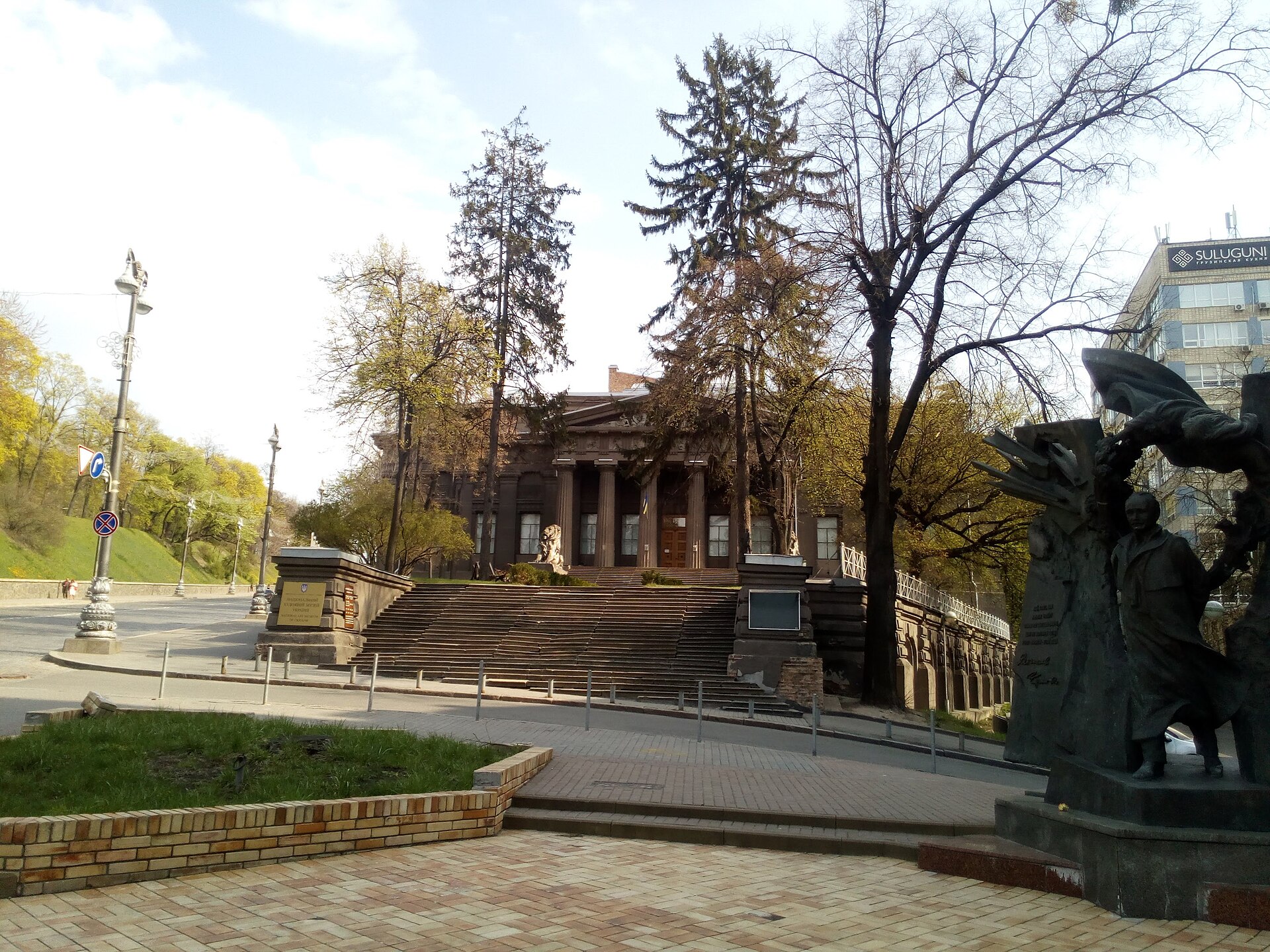
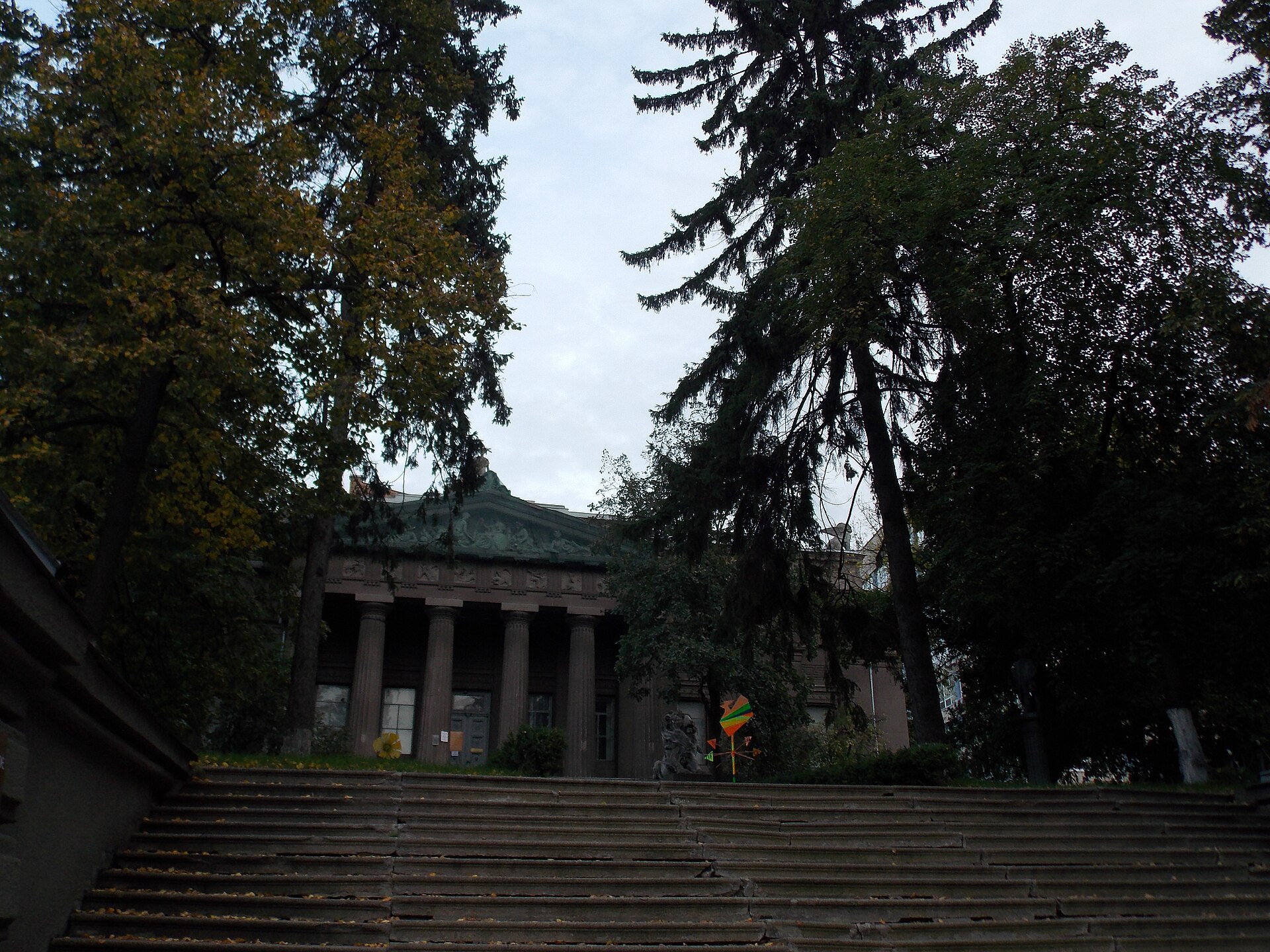
The museum occupies a neoclassical building at 6 Mykhaila Hrushevskoho Street in Kyiv that was designed for exactly this purpose. Moscow architect Petro Boitsov drew the original project, but it lacked government approval and it was the Kyiv-based architect Vladyslav Horodetskyi who reworked the design and supervised construction, completing the building in 1898 at a cost of 249,000 rubles, with the wealthy Tereshchenko family alone contributing 108,000 rubles toward it. The facade carries a six-column Doric porch with a pediment relief depicting the Triumph of the Arts, and the entrance stairs are guarded by large stone lions, both made by the workshop of the Italian sculptor Emilio Sala. The building is listed as an Immovable Monument of National Significance and appeared on a Ukrainian postage stamp in 2013.
The foundation stone was laid on 21 September 1897, with the state treasury releasing an initial 50,000 rubles toward construction. The first public exhibition opened in the still-unfinished building in August 1899, timed to the Eleventh All-Russian Archaeological Congress. The official consecration and opening followed on 30 December 1904, when the institution was named the Kyiv Art-Industrial and Scientific Museum. That is the date this record uses as the museum's founding, though the site itself has, by its own account, existed in some form since the 1897 foundation stone.
Twelve names in a hundred and twenty years
The museum has changed its name twelve times since 1904, and the sequence is itself a record of the political ground shifting under Kyiv. After the 1917 revolution and Soviet nationalization in 1919 it passed through a series of Soviet-era identities: renamed for Taras Shevchenko in 1924, restyled the State Ukrainian Museum in 1936, and then the State Museum of Ukrainian Art in 1939. Under German occupation in 1942 it was merged with Russian collections under the name State Museum of East European Art, before regaining independent status after Kyiv's liberation in 1944. Each renaming tracked a real change beneath it: parts of the founding collection were repeatedly hived off to seed other Kyiv and Ukrainian museums, so the institution's boundaries moved with its name.
The museum took its current name, the National Art Museum of Ukraine, in 1994, three years after Ukrainian independence, a change the museum itself describes as confirming its status as the country's leading collection of national art. Today it is led by director Yulia Lytvynets and publishes its own scholarly output, including the Muzeinyi Provulok (Museum Lane) magazine and monographs on individual works such as its own study of Murashko's Annunciation. The collection now runs to more than 40,000 objects spanning Ukrainian iconography, painting, sculpture, graphics and media from the 12th century to the present.
What the purges took, and what survived
Not every gap in a museum's holdings is an accident of collecting, and the Boichukist school is the clearest case here. Mykhailo Boichuk founded a studio of monumental fresco, mosaic and tempera painting at the newly established Ukrainian Academy of Arts in Kyiv from late 1917, developing what became known as Boichukism: a synthesis of Byzantine art, Italian pre-Renaissance fresco technique and Ukrainian folk motifs, taught to roughly thirty students including Ivan Padalka, Vasyl Sedliar, Sofiia Nalepinska and Boichuk's own brother Tymofii. The school won major state commissions through the 1920s and briefly made monumental Ukrainian fresco painting a defining visual language of the young Soviet republic.
The Stalinist purges ended it. Boichuk was arrested by the NKVD in November 1936 on the fabricated charge of being a Vatican agent, interrogated, tortured and shot the same day as Padalka and Sedliar; his wife was executed four months later. Most of the school's public frescoes and paintings were subsequently destroyed, including examples that had survived into postwar Lviv museums only to be lost there. Against that record, the museum's holding of Boichuk's own 1922-1923 tempera Dairy Maid is not simply one more attribution on a wall label. It is one of a genuinely small number of major Boichuk paintings known to have survived at all, which is why the work has traveled internationally in the touring exhibition on Ukrainian modernism that the museum has helped supply loans to in recent years, including its own Kyiv showing of In the Eye of the Storm: Modernism in Ukraine, 1900s-1930s in February 2025.
Inside the collection
Walking the museum in normal times means moving through roughly a millennium of Ukrainian visual culture under one roof, from a 12th-century Saint George icon that predates the Mongol destruction of Kyiv, through the fuller Baroque icon painting of the Cossack Hetmanate period, into nineteenth-century realism, the short and violently interrupted Ukrainian avant-garde of the 1900s to 1930s, and on into Soviet-era and post-independence work. The museum has described its icon holdings and its Ukrainian Baroque material as being of particular importance within Ukraine's museum system, and the icon rooms are the section visitors single out most often for praise.
The building's own decorative programme, the Doric portico and Emilio Sala's lions and pediment relief, is inseparable from any visit; it is the first and last thing most visitors photograph, and it long predates every painting inside by comparison with the youngest acquisitions. The museum also runs its own shop and a public programme of lectures, master classes and expert consultations, priced separately from gallery admission, alongside an expert department that formally receives visitors on Tuesdays and Thursdays to assess works brought in from outside the collection.
The museum since February 2022
Since Ukraine's independence the museum has evacuated or hidden parts of its holdings three separate times: during the Orange Revolution, during the 2014 Revolution of Dignity, and again in the opening days of Russia's full-scale invasion. Preparations for the third evacuation had in fact begun in late 2021, before the invasion, and when it came on 24 February 2022, staff began packing works the following morning. The permanent collection was removed from display for security reasons that same week and shuttled to confidential storage sites, some in western Ukraine and some abroad, that the museum has not published for the collection's own protection. Some staff effectively lived inside the building through the first weeks of the war. The museum reopened to the public only in the summer of 2023, and every exhibition shown since has been a temporary or touring one rather than the permanent galleries, which remain empty of their main holdings.
The building itself was undamaged by the war until the night of 23-24 May 2026, when Russia launched one of the largest combined missile and drone attacks of the war on Kyiv, killing four people and injuring about one hundred, and including, for only the third time in the conflict, a hypersonic Oreshnik missile. A blast wave from the attack struck the museum, blowing out every window, damaging window frames and entrance doors, breaking facade sculpture, and cracking the roof skylight that lights the building's second-floor rooms, with plaster coming down in several exhibition spaces. Because the permanent collection had already been in confidential storage since 2022, neither the artworks nor the staff were harmed. The museum announced on its own social media the same day that it was closing its doors, in its own words, for an indefinite period, telling followers that although the museum was physically closed its work had not stopped and that further updates on needs and support would follow. That statement is repeated, unchanged, on the museum's own visit page as of this research: the museum is temporarily closed for an indefinite period, with any resumption to be announced separately on its official channels.
NAMU's communications director, Victoria Voloshyna, told Ukrainian press that the damage bill ran into millions of hryvnias, that a fundraising campaign for repairs was being organized, and that structural work, possibly including new foundation piling, could be needed before the building reopens; her own estimate, given days after the strike, was that the museum would not operate again before the end of autumn. The Ukrainian National Chornobyl Museum nearby lost roughly forty percent of its own collection in the same attack, which the country's Culture Minister described as the largest single wave of damage to Kyiv's cultural institutions since the start of the full-scale invasion. This record uses the museum's own pre-closure admission and hours figures, since a reader planning ahead is better served by them than by nothing, but they describe the museum as it operated before 24 May 2026 and not as it operates today.
What visitors say
Visitors consistently praise the depth of the collection, especially the icon rooms and the run from nineteenth-century realism into the Ukrainian avant-garde, and just as consistently complain about crowd and queue management on busy days, a problem that predates the war. Since the permanent galleries were emptied for safekeeping in February 2022, the museum has shown touring and temporary exhibitions rather than its own collection, and at least one visitor has objected to paying full price to see a mostly empty hall as a result.
What is praised, what is criticised
- Praised: The range and quality of the icon collection, repeatedly singled out as among the best in the country
- Praised: The breadth of the holdings, running from twelfth-century icons through Cossack-era Baroque to the Ukrainian avant-garde in one building
- Criticised: Crowd and queue management during busy periods and special exhibitions, reported well before the war as turning a visit into an hour or more of waiting between small rooms
- Criticised: Since 2022 the loss of access to the permanent collection itself, evacuated to confidential storage for safekeeping, leaving only temporary and touring shows on view and prompting at least one visitor complaint about paying full admission for largely empty galleries
Ratings on other platforms
TripAdvisor: 4.2 from 85 ratings, read 31 August 2026
A platform average is a tertiary source: it moves, it is not audited, and we quote no visitor's words.
Questions about National Art Museum of Ukraine
Where is National Art Museum of Ukraine?
6 Mykhaila Hrushevskoho Street, Kyiv, 01001, Ukraine (entrance from the rear of the building).
How much does it cost to visit?
Full ticket: UAH 150; Discounted (schoolchildren, students, pensioners): UAH 100; Military personnel: free; Guided excursion: UAH 300; Museum lecture hall, full: UAH 250. As confirmed 31 August 2026.
When is it open?
Thu-Sun 12:00-18:00. Closed: Monday. Tuesday. As confirmed 31 August 2026.
How do you get there?
Metro: Maidan Nezalezhnosti station, on the museum's own list of the nearest air-raid shelters, a short walk away across European Square.
What should you see first?
Saint George with Hagiography (Unknown Byzantine-Rus icon painter, 12th century); Intercession of the Holy Virgin with the Portrait of Hetman Bohdan Khmelnytsky (Unknown Ukrainian Baroque painter); Saints Barbara and Catherine (Unknown Ukrainian icon painter, 1740s); Girl in a Red Hat (Oleksandr Murashko, 1902-1903); Sunset over the Lake (Serhii Vasylkivskyi, 1900); Sawing Wood (Oleksandr Bohomazov, 1927).
What we could not confirm
- The confidential storage locations for the permanent collection, evacuated since February 2022, have not been published by the museum for security reasons, so the current physical location and condition of most of the 40,000-object collection cannot be independently verified from open sources
- No firm reopening date has been set for the building following the 24 May 2026 strike; the museum's own communications director gave only an estimate of not before the end of autumn, which this record notes as unconfirmed
- The final cost of repairs and the extent of structural work, including whether new foundation piling is required, had not been determined as of the sources available for this research
Images
Sources
- 1National Art Museum of Ukraine, official site, home page namu.ua/en/
- 2National Art Museum of Ukraine, official site, Visit the museum page (address, admission, opening hours, visitor rules, and the museum's own closure statement) namu.ua/en/visit/
- 3National Art Museum of Ukraine, official site, News page (contact details, exhibition history) namu.ua/en/news/
- 4Wikidata, National Art Museum of Ukraine, Q1189277 wikidata.org/wiki/Q1189277
- 5Wikipedia, National Art Museum of Ukraine en.wikipedia.org/wiki/National_Art_Museum_of_Ukraine
- 6Wikimedia Commons, Category:National Art Museum of Ukraine commons.wikimedia.org/wiki/Category:National_Art_Museum_of_Ukraine
- 7Suspilne Kultura, report on the museum's own social media statement after the 24 May 2026 attack on Kyiv suspilne.media/culture/1315240-nacionalnij-hudoznij-muzej-pokazav-naslidki-pisla-rosijskoi-ataki-na-kiiv-foto/
- 8ZN.ua, report on damage to the National Art Museum of Ukraine and its closure announcement zn.ua/ukr/war/u-kijevi-poshkodzheno-natsionalnij-khudozhnij-muzej-ukrajini-joho-zachinili-na-neviznachenij-termin.html
- 9Forbes Ukraine, report on Kyiv cultural institutions' losses from the 24 May 2026 attack, quoting NAMU communications director Victoria Voloshyna forbes.ua/lifestyle/40-ekspozitsii-vtracheni-muzei-ta-kontsertni-maydanchiki-kieva-zaznali-milyonnikh-zbitkiv-cherez-rosiysku-ataku-koli-zapratsyuyut-namu-i-zhovtneviy-26052026-39091
- 10Artnet News, Vittoria Benzine, Ukrainian Museums and Cultural Sites Damaged in Massive Russian Attack, 25 May 2026 news.artnet.com/art-world/ukraine-museums-damaged-russian-attack-2776107
- 11TripAdvisor, National Art Museum of Ukraine, visitor reviews and rating tripadvisor.com/Attraction_Review-g294474-d1958017-Reviews-National_Art_Museum_of_Ukraine-Kyiv.html
- 12Museum Portal, National Art Museum of Ukraine museum-portal.com/en/museums/87_national-art-museum-of-ukraine
- 13Encyclopedia of Ukraine, entry Boichuk, Mykhailo encyclopediaofukraine.com/display.asp?linkpath=pagesBOBoichukMykhailo.htm
- 14Art Blart, exhibition post on In the Eye of the Storm: Modernism in Ukraine, 1900-1930s, noting Boichuk's Dairy Maid as held by the National Art Museum of Ukraine artblart.com/2023/04/22/exhibition-in-the-eye-of-the-storm-modernism-in-ukraine-1900-1930s-at-the-thyssen-bornemisza-museum-madrid/