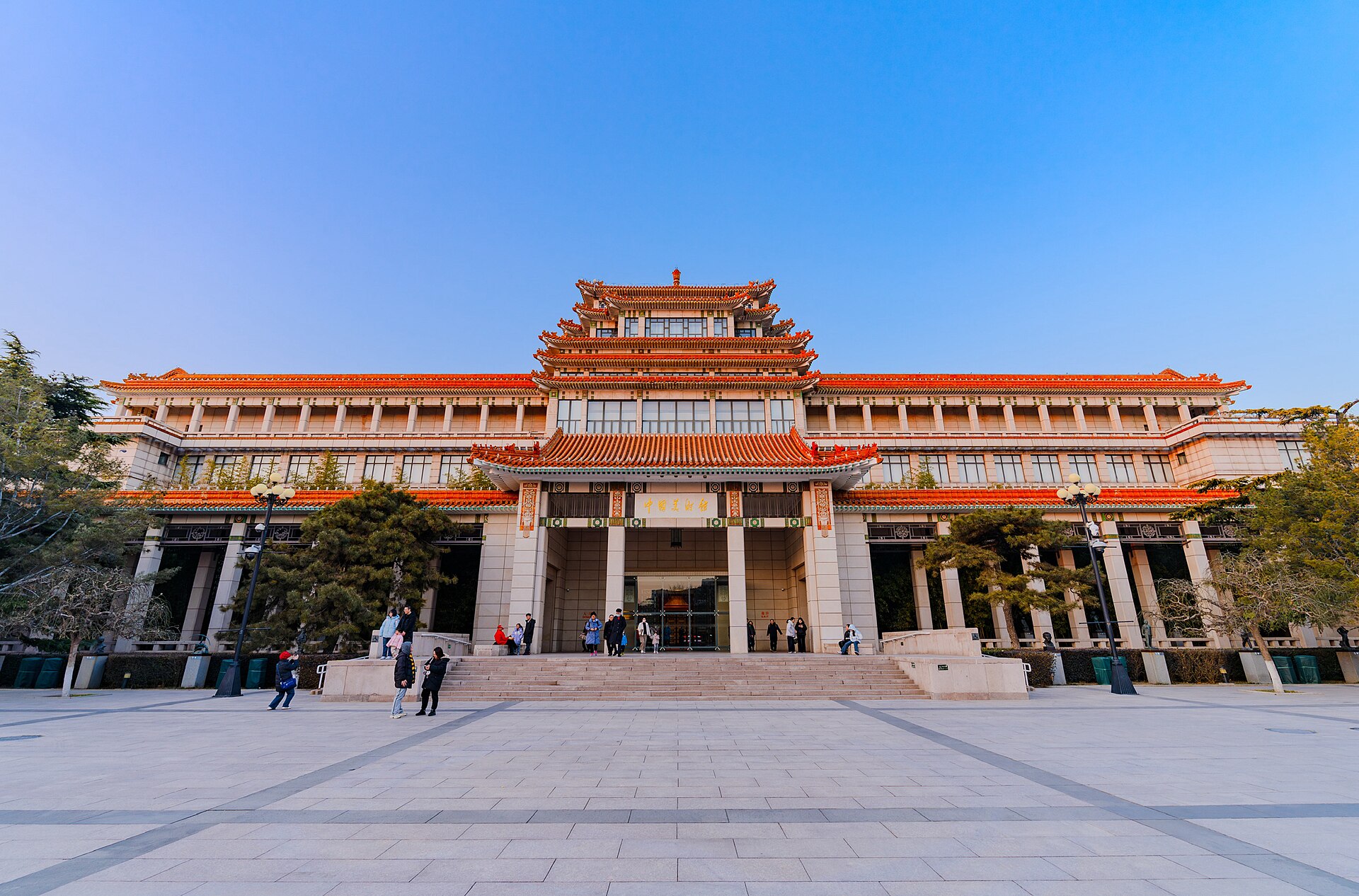
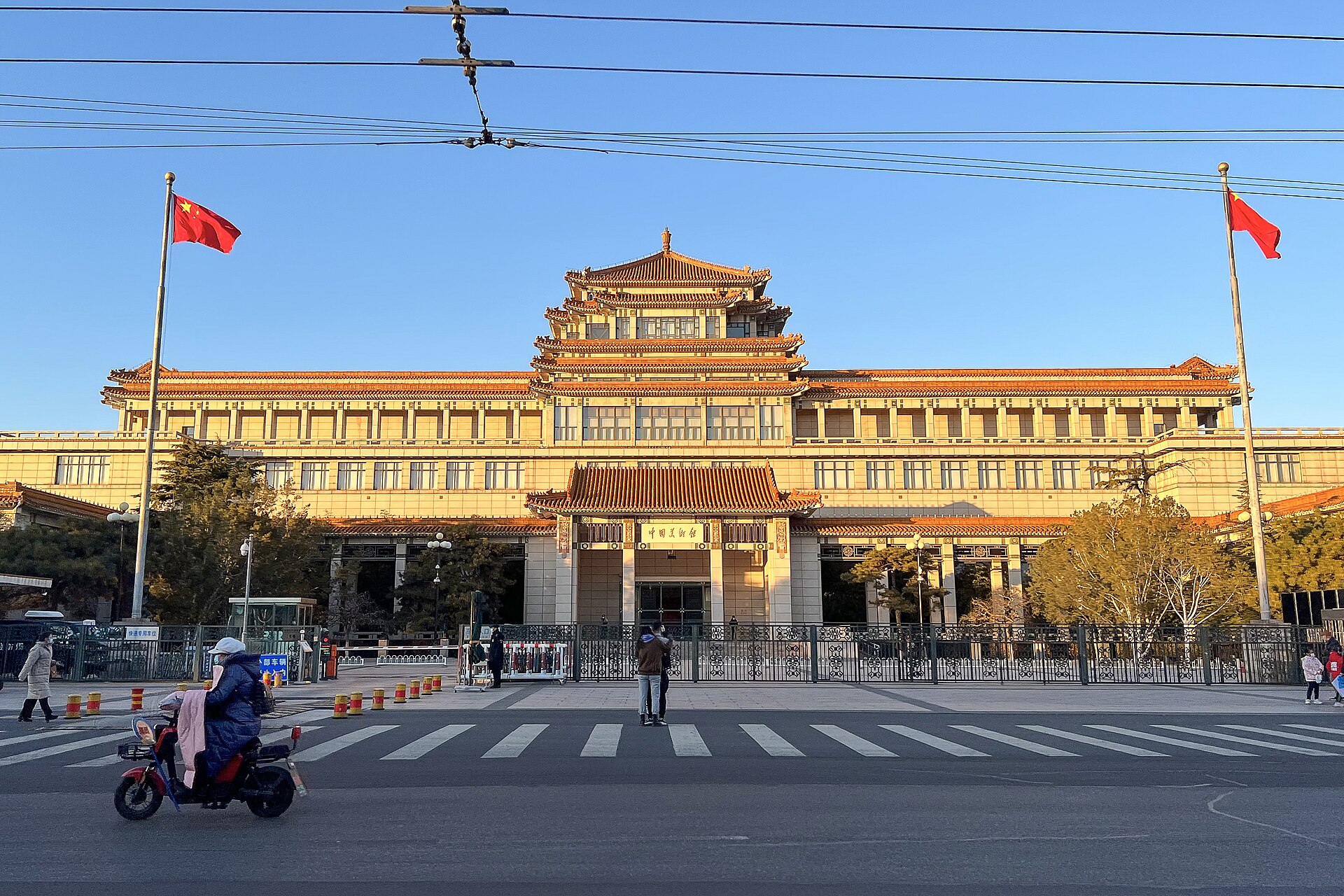
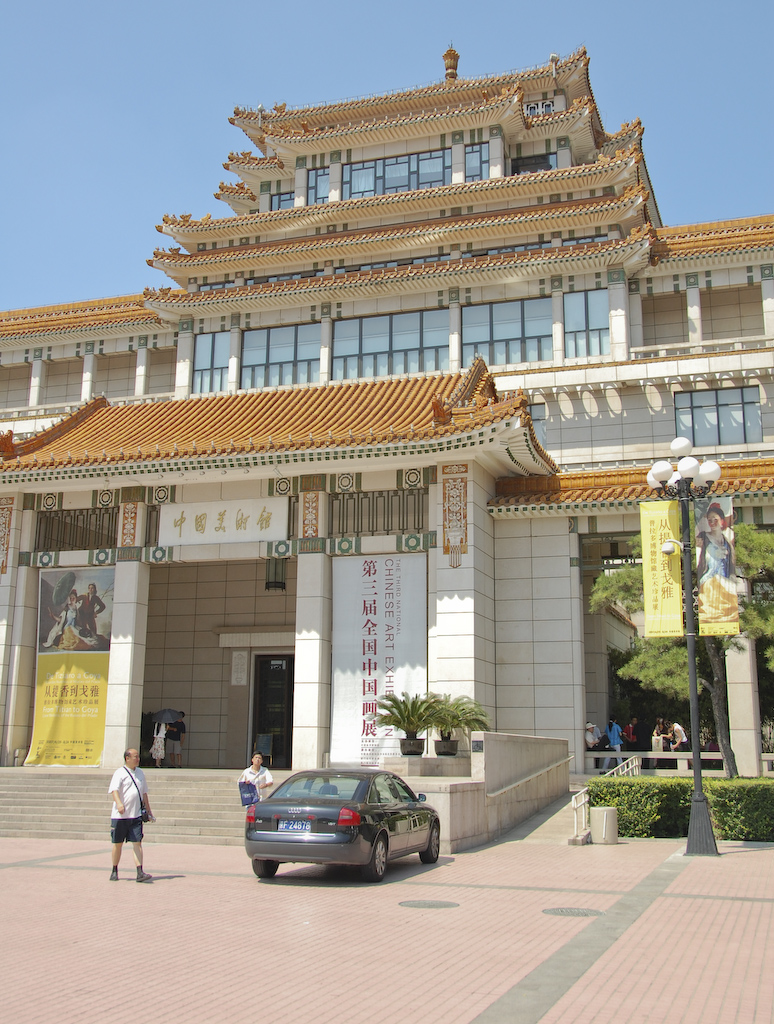
The main entrance of the National Art Museum of China, Beijing, showing the tiered yellow-glazed-tile roof modelled on the Nine-Story Pagoda at Dunhuang's Mogao Caves.
Jackiejackie123123, CC BY-SA 4.0National Art Museum of China
Museum · Zhongguo Meishuguan (NAMOC) · Founded 1963
Open, admission and hours confirmed 5 September 2026 · 14 sources
On this page 15 sections
ContentsClose
NAMOC's strength is depth in named 20th-century Chinese ink painters (410 works by Qi Baishi alone) held alongside a folk art collection of more than 60,000 pieces and a postwar Western holding, the Ludwig Collection, with no real equivalent in another Chinese state museum. Its weakness, by its own visitors' account, is that almost none of this is on permanent view: the museum organises itself around a fast-changing temporary and thematic programme rather than fixed period galleries, so what a visitor sees on any given day is a small and unpredictable slice of a much larger, mostly stored, collection.
| Local name | Zhongguo Meishuguan (NAMOC) |
|---|---|
| Kind | Museum |
| Founded | 1963 |
| City and country |  Beijing, China Beijing, China |
| Address | 1 Wusi Street, Dongcheng District, Beijing, China |
| Website | namoc.cn |
| Status | Open, confirmed |
| Record last verified |
Visiting
- Hours
- Tue-Sun09:00 to 17:00Last admission 16:00
- Closed
- Monday, except statutory public holidays.
- Admission
- General admissionFreeFree to all visitors. Advance online reservation required (museum website, WeChat service account or mini-program); daily cap of 6,000 visitors, first-come first-served.
Free entry: Every open day - the museum charges no admission at all- Tickets
- namoc.cn/namoc/zxyy/dl.shtml The museum's own ticket page.
- Do I need to book?
- Yes. Free timed-entry reservation opens seven days ahead at 16:00 on the museum's own website, WeChat service account or mini-program. Visitors 60 or older, visitors with disabilities, active and retired military personnel, firefighters, and children under 6 are exempted and need only show valid identification at the gate.
- Address
- 1 Wusi Street, Dongcheng District, Beijing, China MapSubway Line 8, National Art Museum (Meishuguan) station; Lines 5 and 6, Dongsi station
- Website
- namoc.cn
- Telephone
- +86 10 6400 6326
Before you go how long, access, photography, bags, eating, shop
- How long to allow
- Two to three hours. The main building holds 21 exhibition halls across five to six floors plus an outdoor sculpture garden, and the programme of temporary shows changes frequently.
- Access
- Not detailed on the museum's own visitor pages.
- Photography
- No flash photography inside the galleries. Tripods, monopods, selfie sticks and camera stabilisers are prohibited.
- Bags
- Deposited at the front desk of each exhibition hall; must be collected by the 17:00 closing time.
- Eating
- Not stated on the museum's own visitor pages.
- Shop
- An on-site bookstore exists; visitor reports describe its English-language section as small.
Prices and hours change. We take them from the institution's own pages and print the day we read them, and you can check the current position at the source we used. Confirm before you travel.
What is inside
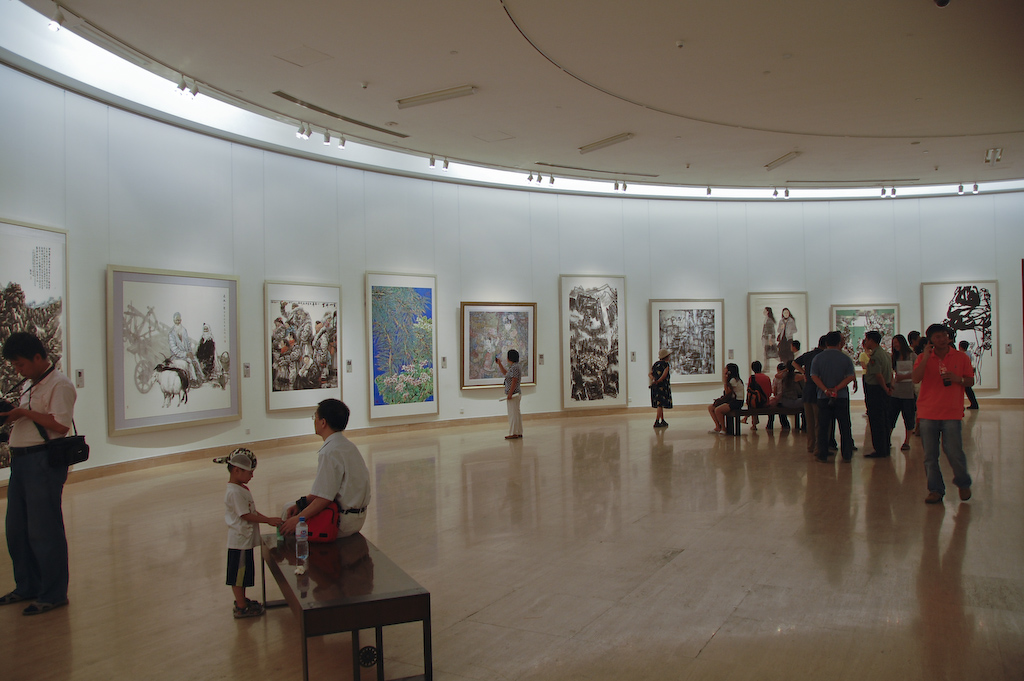
Photograph by Cygnus78 · CC BY-SA 2.0 Permanent collection: 20th-century Chinese ink and oil painting
Rotating displays drawn from the museum's holdings of modern Chinese painting, including named masters such as Xu Beihong, Lin Fengmian, Liu Haisu, Jiang Zhaohe, Wu Zuoren, Li Keran, Dong Xiwen and Wu Guanzhong, alongside classical-period figures the museum also holds in depth, such as Su Shi, Ni Zan, Tang Yin and Xu Wei.
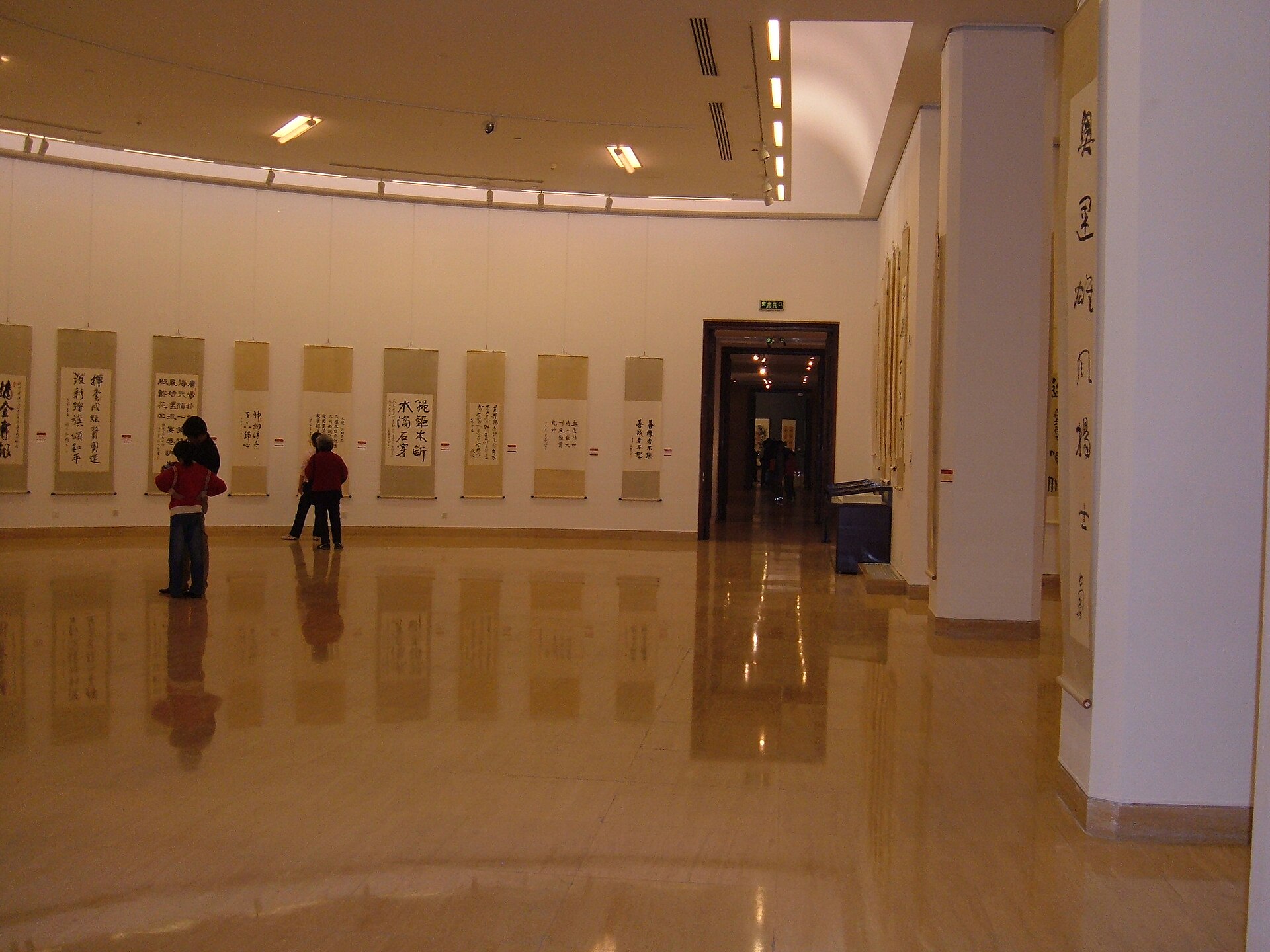
Photograph by BrokenSphere · CC BY-SA 3.0 Calligraphy galleries
Dedicated hanging-scroll displays of calligraphy, drawing on the museum's holdings of modern calligraphers including Qi Gong and Sha Menghai alongside historical work.
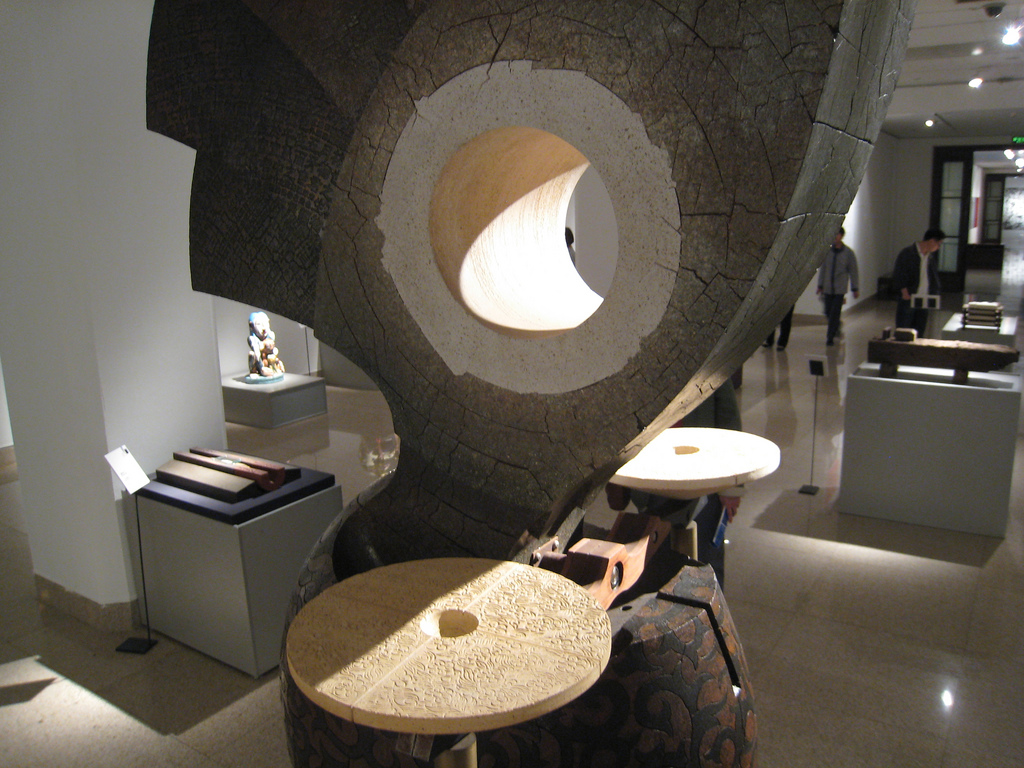
Photograph by caswell_tom · CC BY 2.0 Sculpture and installation galleries
Indoor sculpture and mixed-media installation on rotation, shown alongside the museum's painting and calligraphy programme rather than in a separate department.
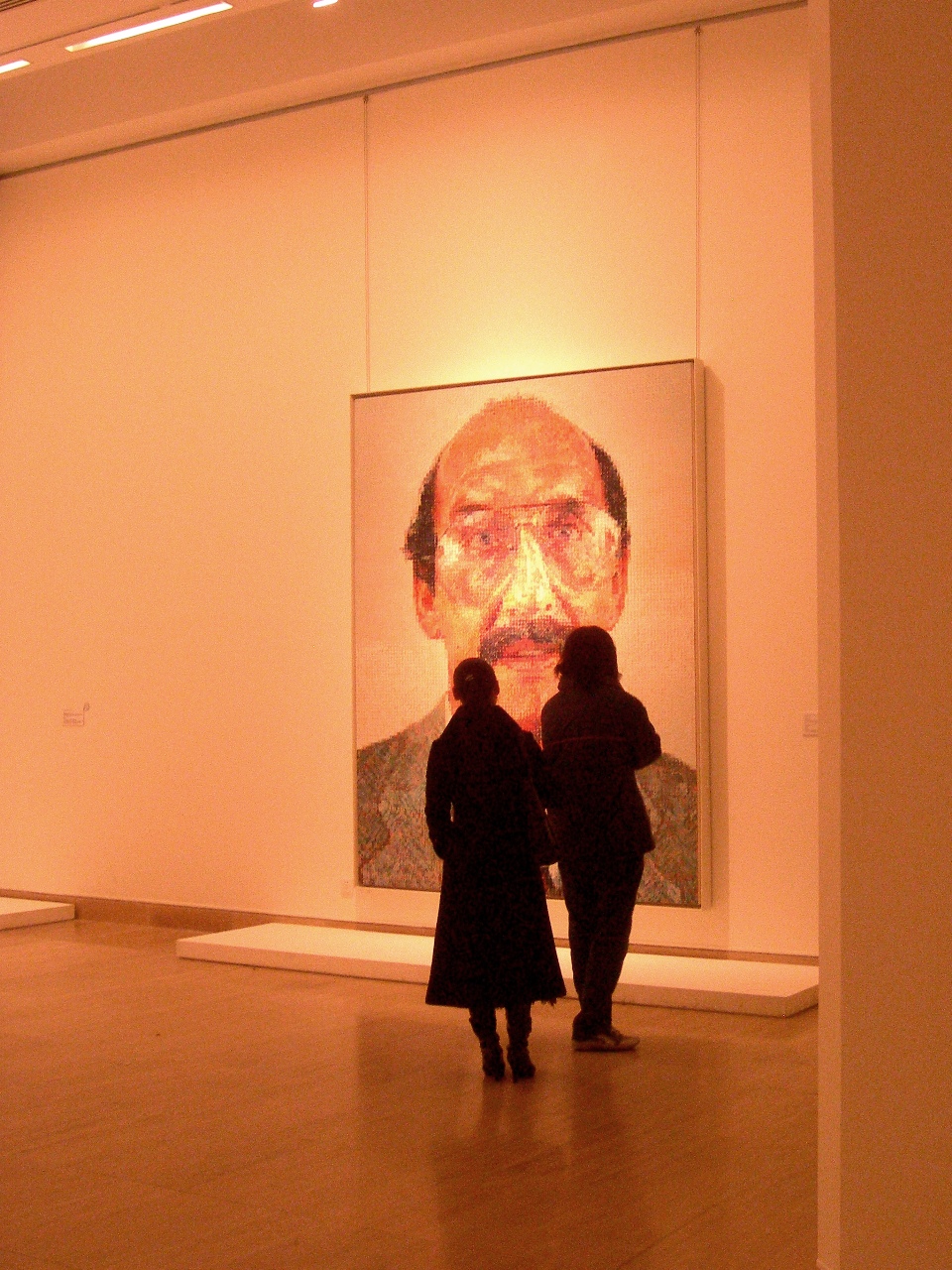
Photograph by myuibe · CC BY 2.0 International and donated Western art (the Ludwig Collection)
117 works (89 sets) of postwar European and American art given by the German collectors Peter and Irene Ludwig, including pieces by Pablo Picasso, Andy Warhol, Gerhard Richter, Anselm Kiefer, Georg Baselitz and Roy Lichtenstein; shown periodically in exhibitions built around the donation.
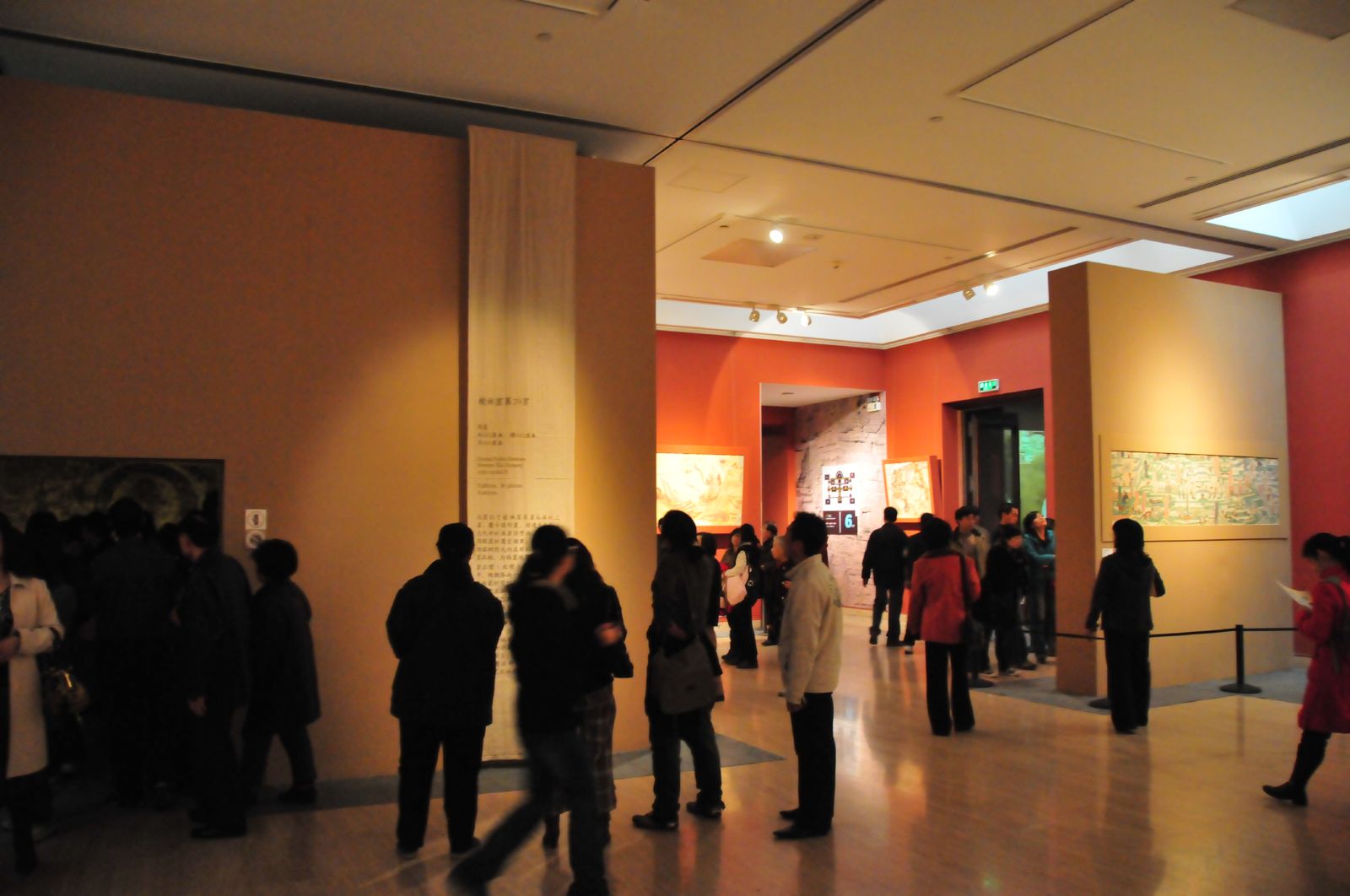
Photograph by gongfu_king · CC BY-SA 2.0 Special and temporary exhibition halls
The bulk of the museum's public programme: themed group shows, anniversary exhibitions and touring displays that change on a schedule far faster than the permanent collection rotates.
Sculpture Garden
A 3,000 square metre outdoor garden surrounding the main building, holding sculpture on long-term outdoor display.
Folk art collection
Built up since the 1980s: more than 60,000 pieces of Chinese folk art, including Ming and Qing New Year woodblock prints, papercuts, embroidery and clay figures, shown in rotating thematic exhibitions rather than a fixed gallery.
What to see first
Qi Baishi holdings
Qi Baishi (1864-1957)The museum holds 410 works by Qi Baishi, one of the largest institutional concentrations of his ink painting and calligraphy anywhere.9
Huang Binhong holdings
Huang Binhong (1865-1955)129 works by the landscape painter Huang Binhong, shown periodically as part of the museum's modern ink-painting rotation.9
Wu Changshuo holdings
Wu Changshuo (1844-1927)189 works by Wu Changshuo, the late-Qing painter, seal-carver and calligrapher; the museum's holdings include his 1915 ink Buddha, catalogued in its own collection.9
20th-century ink and oil painting galleries
Xu Beihong, Lin Fengmian, Pan Tianshou, Li Keran, Wu Guanzhong and other 20th-century mastersThe museum's own account of its holdings names these artists among the core of its modern Chinese painting collection, the spine of its permanent rotation.2
The Ludwig Collection
Donated by Peter and Irene Ludwig; works by Pablo Picasso, Andy Warhol, Gerhard Richter, Anselm Kiefer, Georg Baselitz, Roy Lichtenstein117 postwar Western works (89 sets), one of the largest single gifts of Western art to a Chinese state museum, giving NAMOC a Pop Art and Neo-Expressionist holding most Chinese museums do not have.9
Folk art collection
Various folk workshops and named and unnamed regional artistsMore than 60,000 pieces of New Year woodblock prints, papercuts, embroidery and clay figures assembled since the 1980s, a scale that makes NAMOC a reference collection for Chinese folk visual culture, not only fine art.9
Past exhibitions here
- Closed6 Sep to 7 Oct 2026Confirmed · check before you travel
- Closed8 Sep to 19 Sep 2026Confirmed · check before you travel
- Closed16 Aug to 15 Sep 2026Confirmed · check before you travel
From the Ten Great Buildings to Mao's own inscription
The National Art Museum of China was planned as one of the Ten Great Buildings commissioned to mark the tenth anniversary of the People's Republic in 1959, a construction programme that also produced the Great Hall of the People and Beijing Railway Station. Material shortages pushed the art museum's own completion past the anniversary; construction began in 1958 and the building was finished in 1962, opening to the public in 1963. The architect was Dai Nianci, and the roofline he gave the museum, a stack of seven flying eaves, was modelled on the Nine-Story Pagoda carved into the cliff face at the Mogao Caves in Dunhuang. Premier Zhou Enlai is credited with the suggestion to wrap the building in corridors and gardens so the grounds could double as public recreation space, a detail that still shapes how the site is used today. The horizontal name board over the main entrance was inscribed by Mao Zedong himself, and it is this inscription, more than the building's architecture, that the museum's own literature credits with establishing its status as the country's national art museum.
The building itself
The main building covers a floor area given variously as 18,000 and 22,379 square metres across five to six floors, with 21 exhibition halls totalling roughly 6,660 to 7,000 square metres of hanging space (sources differ on the precise figures; see the open questions below). A 3,000 square metre sculpture garden wraps the building, and a separate 4,100 square metre climate-controlled storage annex was added in 1995 to hold the growing collection. The 2004-2005 renovation added a further 5,375 square metres. Nothing about the exterior has changed since: the tiered, yellow-glazed-tile roof and long colonnaded corridors remain the museum's most photographed feature, and the building itself carries protected status as one of Beijing's mid-century national landmarks.
A state museum's history of confrontation
NAMOC's grounds were the site of one of the founding events of Chinese contemporary art before the museum was two decades old. On 27 September 1979, a group of self-taught artists calling themselves the Stars, denied any official exhibition space, hung their work on the railings outside the museum. Police shut the display down and detained core members; the group staged a protest for cultural openness, reopened the show, and the authorities banned it again after three days. A formal, sanctioned Stars exhibition followed that November at Beihai Park. Ten years later, the confrontation moved inside the building. The China/Avant-Garde Exhibition opened at NAMOC on 5 February 1989, bringing together roughly 300 works by more than 180 artists from across mainland China in the first large state-sanctioned survey of the country's experimental art. It closed two hours after opening, after the artist Xiao Lu fired a pellet gun at her own installation, Dialogue. After the crackdown on the Tiananmen Square protests four months later, press retrospectively described those two shots as the first shots of Tiananmen. NAMOC operates today as a level-1 public welfare institution funded by China's Ministry of Culture and Tourism, and its temporary-exhibition programme is reviewed by visitors, including on TripAdvisor, as carrying overt political and nation-building themes; several reviewers of the museum's 70th-anniversary-of-the-PRC exhibitions in 2019 described the political undertone directly.
What is inside
The collection runs to more than 100,000 works, cited variously as over 110,000 and over 130,000 depending on the source and the date it was compiled, spanning classical and modern Chinese painting, calligraphy, sculpture, prints, photography and folk art, plus a smaller foreign collection of around 3,400 pieces. The depth is concentrated rather than even: the museum holds 410 works by Qi Baishi, 189 by Wu Changshuo and 129 by Huang Binhong, alongside its core holding of 20th-century masters, Xu Beihong, Lin Fengmian, Liu Haisu, Pan Tianshou, Jiang Zhaohe, Wu Zuoren, Li Keran, Dong Xiwen and Wu Guanzhong among them. A separate and much larger body of folk art, more than 60,000 pieces of New Year woodblock prints, papercuts, embroidery and clay figures, has been assembled since the 1980s and is shown in rotating thematic exhibitions rather than a permanent room. The single largest foreign gift is the Ludwig Collection: 117 works in 89 sets of postwar European and American art, given by the German collectors Peter and Irene Ludwig, including pieces by Picasso, Warhol, Richter, Kiefer, Baselitz and Lichtenstein, a body of work with no real equivalent in another Chinese state collection. None of this is on permanent view in full: NAMOC's own visitor pages describe a museum built around a fast-changing programme of temporary and thematic shows rather than fixed period rooms, which is also the single most consistent complaint in visitor reviews of the museum, that the fraction of the collection actually on the walls at any one time is small next to what the institution says it holds.
Visiting today
Admission has been free since the reservation system now in force was introduced, and remains free with only identification required at the gate. Visitors must book online in advance through the museum's own website, its WeChat service account or its mini-program; reservations open seven days ahead of the visit date at 16:00, the daily cap is 6,000 visitors on a first-come basis, and each account may book for up to five people. Visitors aged 60 and over, visitors with disabilities, active and retired military personnel, firefighters and children under six are exempt from the booking requirement and need only show valid identification. The museum is open 09:00 to 17:00, with last admission at 16:00, and is closed on Mondays except statutory public holidays. Bags are deposited at the front desk of the relevant exhibition hall and must be collected before closing; flash photography, tripods, monopods and selfie sticks are prohibited in the galleries. The nearest metro stop is the National Art Museum station on Line 8, with Dongsi station on Lines 5 and 6 a short walk away.
What comes next
A second, far larger NAMOC building has been in planning for close to two decades. The French architect Jean Nouvel, working with the Beijing Institute of Architectural Design, won a 2008 competition for a new National Art Museum of China on the former Olympic Green in Chaoyang district, near the Bird's Nest stadium; the design, unveiled publicly in 2014, called for roughly 128,600 to 130,000 square metres, about eight times the footprint of the existing building. Progress after that design was unveiled was, on the public record, essentially silent for a decade. On 27 March 2026, the Beijing Municipal Commission of Planning and Natural Resources issued a formal site-selection and land-use pre-approval document for the project, with a stated target completion of 2029. That approval is the first concrete land-use milestone reported since the 2014 design, and there is no public confirmation yet of a construction start date, a final budget, or whether the 2008 Nouvel design is still the one being built.
What visitors say
Visitors consistently value that the museum is free and easy to reach, and are struck by the sheer scale of the building and its temporary-exhibition programme. Opinion splits over content: some find a rich, constantly changing show of contemporary ink, oil and sculpture; others note that only a small fraction of the stated collection is on view at any time, that wall text is almost entirely in Chinese, and that recent thematic exhibitions lean toward state-anniversary and nation-building subject matter rather than a survey of historical Chinese art.
What is praised, what is criticised
- Praised: Free admission, with only a passport or ID needed at the gate
- Praised: The scale of the building and its sculpture displays
- Praised: A programme of large temporary exhibitions that visitors describe as rich and frequently changing
- Criticised: Only a small slice of the museum's stated 130,000-plus object collection is ever on public display
- Criticised: Little to no English-language wall text or object labelling
- Criticised: Recent exhibitions have leaned toward overtly political, nation-building subject matter rather than historical Chinese art
Ratings on other platforms
TripAdvisor: 4 from 151 ratings, read 5 September 2026
A platform average is a tertiary source: it moves, it is not audited, and we quote no visitor's words.
Questions about National Art Museum of China
Where is National Art Museum of China?
1 Wusi Street, Dongcheng District, Beijing, China.
How much does it cost to visit?
General admission: free. As confirmed 5 September 2026.
When is it open?
Tue-Sun 09:00-17:00. Closed: Monday, except statutory public holidays. As confirmed 5 September 2026.
How do you get there?
Subway: Line 8, National Art Museum (Meishuguan) station; Lines 5 and 6, Dongsi station.
What should you see first?
Qi Baishi holdings (Qi Baishi (1864-1957)); Huang Binhong holdings (Huang Binhong (1865-1955)); Wu Changshuo holdings (Wu Changshuo (1844-1927)); 20th-century ink and oil painting galleries (Xu Beihong, Lin Fengmian, Pan Tianshou, Li Keran, Wu Guanzhong and other 20th-century masters); The Ludwig Collection (Donated by Peter and Irene Ludwig; works by Pablo Picasso, Andy Warhol, Gerhard Richter, Anselm Kiefer, Georg Baselitz, Roy Lichtenstein); Folk art collection (Various folk workshops and named and unnamed regional artists).
What we could not confirm
- Sources disagree on the size of the main building and its exhibition space: English Wikipedia gives 18,000+ sqm across six floors with 6,660 sqm of exhibition space; Chinese Wikipedia gives 22,379 sqm across five floors with 7,000 sqm and 2,110 metres of hanging line. Both may be measuring different things (footprint vs. floor area, or different renovation dates) but this record has not resolved which figure is current.
- Total collection size is cited as both 'over 110,000' and 'over 130,000' works across sources fetched for this record, without a clear date attached to either figure. Treat both as approximate.
- Four of Xu Beihong's best-known paintings (Yugong Yishan, Tian Heng and His Five Hundred Retainers, Baren Jishui and a fourth work) are held by the separate Xu Beihong Memorial Hall in Beijing, not by NAMOC, though they were exhibited together at NAMOC through early March 2018. Do not attribute these specific titles to NAMOC's own collection in any future record; NAMOC's own site lists Xu Beihong only in general terms among the 20th-century masters it holds, without naming individual works.
- Contact phone numbers vary by source: NAMOC's own site gives 010-6400-6326 (used in this record) for its 09:00-16:00 enquiry line; a 2019 China Daily piece gives (+86-10) 84033500; the Beijing municipal government's English page gives +86-10-64017076. These may be different departments (reservations vs. administration vs. an older number retained by a syndicated article) rather than an error, but it has not been resolved which, if any, are now dead.
- The status of the planned Jean Nouvel Olympic Green building beyond the March 2026 site-selection approval is unconfirmed: no construction start date, contractor, budget or confirmation that the original 2014 design is still the one being built was found in sources fetched for this record.
Images
Sources
- 1National Art Museum of China, official site, homepage namoc.cn/
- 2National Art Museum of China, official site, Overview (Gaikuang) namoc.cn/namoc/gaik/gk.shtml
- 3National Art Museum of China, official site, Visitor Guide (Daolan) namoc.cn/namoc/daolan/dl.shtml
- 4National Art Museum of China, official site, Online Reservation (Zaixian Yuyue) namoc.cn/namoc/zxyy/dl.shtml
- 5National Art Museum of China, Wikipedia (English) en.wikipedia.org/wiki/National_Art_Museum_of_China
- 6Zhongguo Meishuguan, Wikipedia (Chinese) zh.wikipedia.org/zh-hans/%E4%B8%AD%E5%9B%BD%E7%BE%8E%E6%9C%AF%E9%A6%86
- 7Beijing Municipal Government (English site), 'National Art Museum of China' english.beijing.gov.cn/consuminginbeijing/onedayinbeijing/museums/updatesofmuseums/202306/t20230601_3119283.html
- 8China Daily (govt.chinadaily.com.cn), 'National Art Museum of China' govt.chinadaily.com.cn/a/201909/10/WS5d770222498ebcb1905792e1.html
- 9'A Gathering of Treasures. The Journey to the National Art Museum of China', The Tretyakov Gallery Magazine tretyakovgallerymagazine.com/node/5853
- 10National Art Museum Of China, visitor reviews, TripAdvisor tripadvisor.com/Attraction_Review-g294212-d1438465-Reviews-National_Art_Museum_Of_China-Beijing.html
- 11Stars Art Exhibition, Wikipedia en.wikipedia.org/wiki/Stars_Art_Exhibition
- 12China/Avant-Garde Exhibition, Wikipedia en.wikipedia.org/wiki/China/Avant-Garde_Exhibition
- 13File:Buddha by Wu Changshuo.jpg, Wikimedia Commons (collection record, NAMOC) commons.wikimedia.org/wiki/File:Buddha_by_Wu_Changshuo.jpg
- 14Xu Beihong's major works and the Xu Beihong Memorial Hall, visitbeijing.com.cn english.visitbeijing.com.cn/article/47OO0AeiYbs
