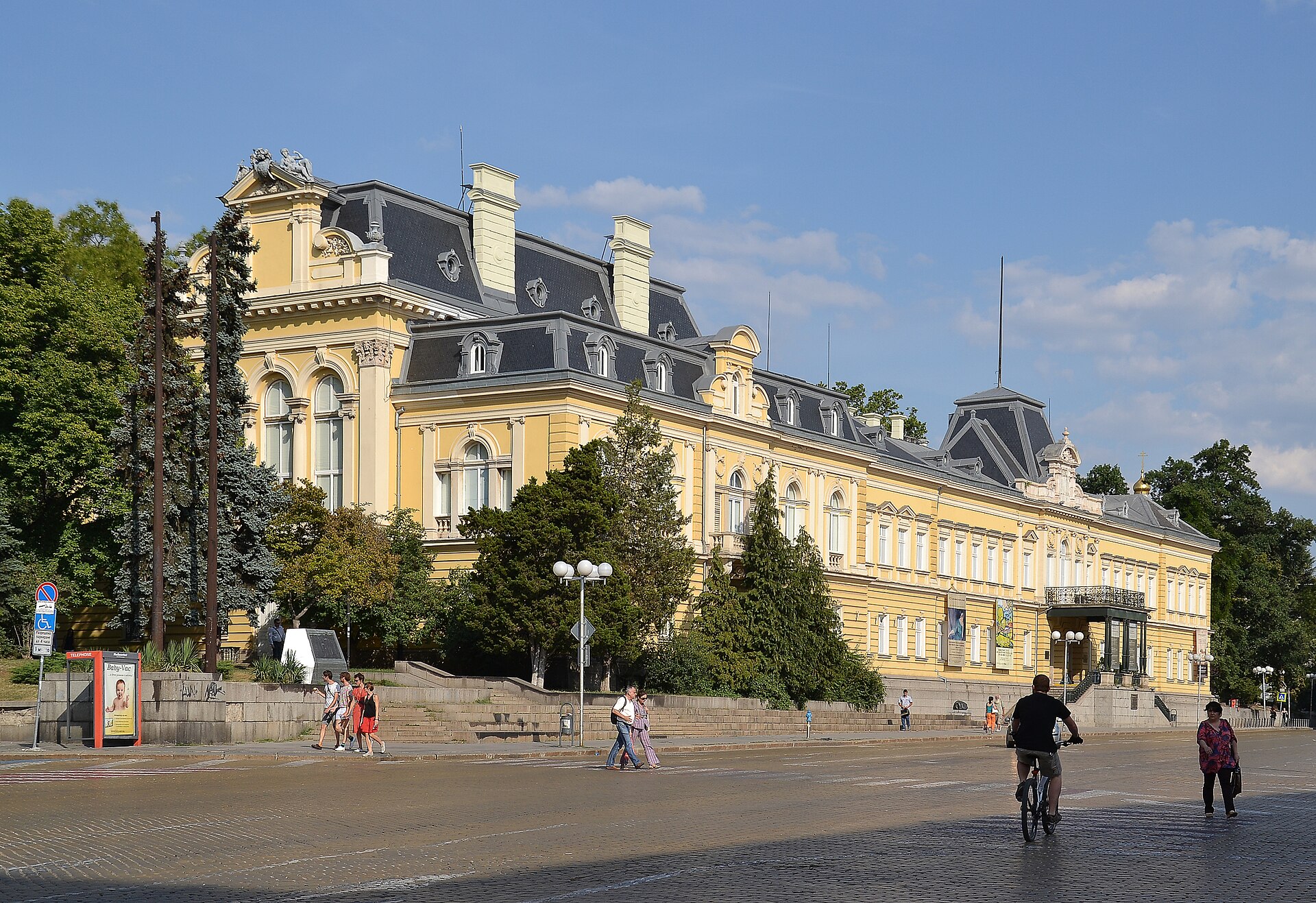
The former Royal Palace on Battenberg Square, Sofia, now the National Art Gallery.
Photograph by Marcin Szala (Pudelek), released CC BY-SA 3.0National Art Gallery of Bulgaria
Museum · Nacionalna hudozhestvena galeriya · Founded 1948
Open, admission and hours confirmed 4 September 2026 · 11 sources
On this page 15 sections
ContentsClose
The National Art Gallery's Palace building holds no fixed permanent collection of its own; its strength is the building, not a room of masterworks. What it offers a visitor is a former royal palace still legible as one - a throne room, ballrooms, a Reception Hall and rooms of dynastic portraiture, all surviving despite a documented post-1946 stripping of their original decoration - now used to stage roughly ten temporary exhibitions a year of Bulgarian and international art, from single-artist retrospectives to print shows by international masters. The wider National Gallery institution's permanent holdings of more than 40,000 works, including its Bulgarian 19th- and 20th-century painting and its foreign art, moved to the Kvadrat 500 building in 2015 and are described on that venue's own page, not this one; a reader planning a single Sofia museum visit for the fixed collection wants that building, while a reader who wants to stand inside the rooms a Bulgarian prince built for himself in 1882, and see whatever exhibition currently occupies them, wants the Palace.
| Local name | Nacionalna hudozhestvena galeriya |
|---|---|
| Kind | Museum |
| Founded | 1948 |
| City and country |  Sofia, Bulgaria Sofia, Bulgaria |
| Address | 1 Knyaz Alexander I Square, 1000 Sofia, Bulgaria |
| Website | nationalgallery.bg |
| Status | Open, confirmed |
| Record last verified |
Visiting
- Hours
- Tue-Sun10:00 to 18:00Ticket office closes 17:30
- MonClosed
- Closed
- Monday. official Bulgarian public holidays. Christmas. New Year's Day. Easter.
- Admission
- Individual, adultEUR 8Standard admission to the Palace
- Reduced (pensioners, 65+, students)EUR 4
- All branches, ThursdaysEUR 2Reduced flat rate on Thursdays, all National Gallery branches
- Combined ticket, Palace + Kvadrat 500, adultEUR 15Reduced rate 7.50 EUR. Kvadrat 500 is a separate National Gallery building near Alexander Nevsky Cathedral, not this one
- Combined ticket, Palace + Museum of Christian Art, adultEUR 15Reduced rate 7.50 EUR
- Combined ticket, all three (Palace, Kvadrat 500, Museum of Christian Art), adultEUR 25Reduced rate 12.50 EUR
- Guided tour, Bulgarian or EnglishEUR 40Advance booking required, tel +359 87 914 7678
- Children, students under 18, disabled visitors, art-school students, museum staff, journalists, members of professional arts organisationsFreeFree admission categories as published by the museum
- Do I need to book?
- Not required for individual visitors; guided tours (Bulgarian or English) need advance phone booking
- Address
- 1 Knyaz Alexander I Square, 1000 Sofia, Bulgaria MapMetro Serdika and Serdika II stations, about seven minutes' walk
- Website
- nationalgallery.bg
- Telephone
- +359 2 980 00 93
- [email protected]
Before you go how long, access, photography, bags, eating, shop
- How long to allow
- Reported by visitors as anywhere from one hour to a full afternoon, depending on how many of the building's halls are open to the current exhibition programme
- Access
- Not detailed in the sources consulted for this page
- Photography
- Not detailed in the sources consulted for this page
- Bags
- A free locker system is available, per visitor reports
- Eating
- Not detailed in the sources consulted for this page
- Shop
- Not detailed in the sources consulted for this page
Prices and hours change. We take them from the institution's own pages and print the day we read them, and you can check the current position at the source we used. Confirm before you travel.
What is inside
Second floor state rooms - the former Throne Room and ballrooms
The palace's own site lists the throne room and ballrooms among the state rooms on the second floor, built for Knyaz Alexander I Battenberg's household in 1880-1882. These rooms, stripped of their original furnishing after the palace was nationalised in 1946, now serve as the gallery's principal exhibition halls for the changing programme of Bulgarian and international shows.
The Reception Hall
A large former state reception room, named by the museum's own visiting page among the historic rooms of the palace's second floor and confirmed by a visitor account as still shown to the public alongside portraits of the Bulgarian royal family.
Rooms devoted to the Bulgarian royal dynasty
Two rooms are given over to portraits of the Battenberg and Saxe-Coburg-Gotha rulers of Bulgaria, the dynasty that occupied this building until 1946, according to a visitor who toured the galleries in March 2026. A separate visitor account from May 2026 likewise describes portraits of the Bulgarian royal family on view together with the Reception Hall.
The winter garden and dining room
Listed by the museum's own visiting page among the historic apartments built for the royal household on the palace's second floor. The sources consulted for this page do not establish whether these specific rooms are currently open to gallery visitors or used for another purpose.
Temporary exhibition halls, ground and upper floors
Since the permanent Bulgarian and foreign collections were rehoused at the Kvadrat 500 building near Alexander Nevsky Cathedral in 2015, the Palace's halls are given over to a programme of roughly ten temporary exhibitions a year, honouring individual Bulgarian artists or thematic surveys of Bulgarian and international art. Recent examples read directly in visitor accounts include a graphic-print exhibition of Francisco Goya, seen by a visitor within days of its opening in August 2026, and Corpus Equorium by the Bulgarian artist Luchezar Boyadjev, on view in September 2025.
What to see first
The former Throne Room
Viktor Rumpelmayer (1880-1882 build)The formal state room of the Bulgarian monarchy under Knyaz Alexander I Battenberg, now used as one of the gallery's principal exhibition spaces; its survival as a named, identifiable room inside a working art museum is unusual among former royal palaces converted to public collections.4
The Reception Hall
Viktor Rumpelmayer (1880-1882 build)The palace's large state reception room, singled out by the museum's own visiting page and confirmed by a visitor account as still open to the public and hung with royal-era portraits.10
Portraits of the Battenberg and Saxe-Coburg-Gotha rulers of Bulgaria
Various, 19th-20th centuryTwo rooms of the gallery are given to portraiture of the German-origin dynasty that built and occupied this palace until the monarchy's abolition in 1946, a direct visual record of the building's own royal history displayed inside the building itself.10
The palace facade and grand staircase system
Viktor Rumpelmayer and Friedrich GruenangerA visitor who spent over two hours in the building in August 2026 described three floors of staircases, corridors and exhibition halls so extensive that not every room could be covered in a single visit; the building's own architecture, built in two campaigns three decades apart, is as much a draw as any single object inside it.10
Corpus Equorium
Luchezar BoyadjevA temporary exhibition by the contemporary Bulgarian artist, on view at the Palace in September 2025 and singled out by a visitor who returned twice to see the full show, illustrating the kind of contemporary programming the palace halls now host in place of a fixed permanent display.10
Graphic prints by Francisco Goya
Francisco GoyaA print exhibition seen by a visitor within days of its opening in August 2026, at an $10 EUR admission the visitor called an essential stop for any art lover in Sofia; named here as a dated example of the Spanish and other international print and painting material the gallery has brought to the Palace, not as a standing display.10
Bulgarian National Revival and modern painting shown in rotation
Various Bulgarian painters, including Elena Karamihaylova and Zanko LavrenovVisitor accounts from 2026 describe Bulgarian painters largely unfamiliar outside Bulgaria shown here in changing exhibitions, among them Elena Karamihaylova's portraiture and Zanko Lavrenov's cityscapes; the museum's own site states its wider holdings include Bulgarian art from the National Revival period onward, though the bulk of that permanent collection is now shown at Kvadrat 500 rather than at the Palace.10
Exhibitions on now
Past exhibitions here
A palace built for a new capital, in two campaigns thirty years apart
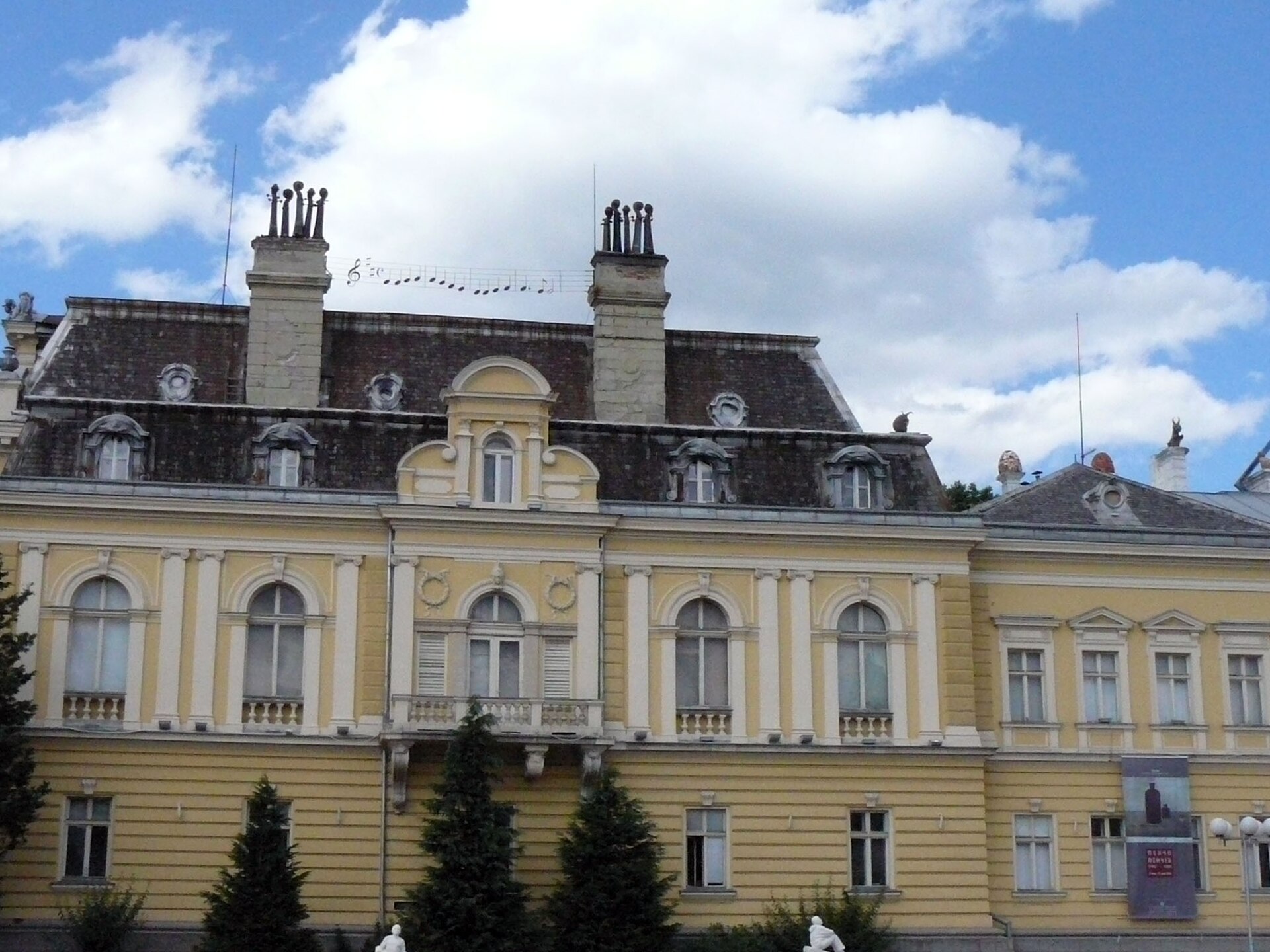
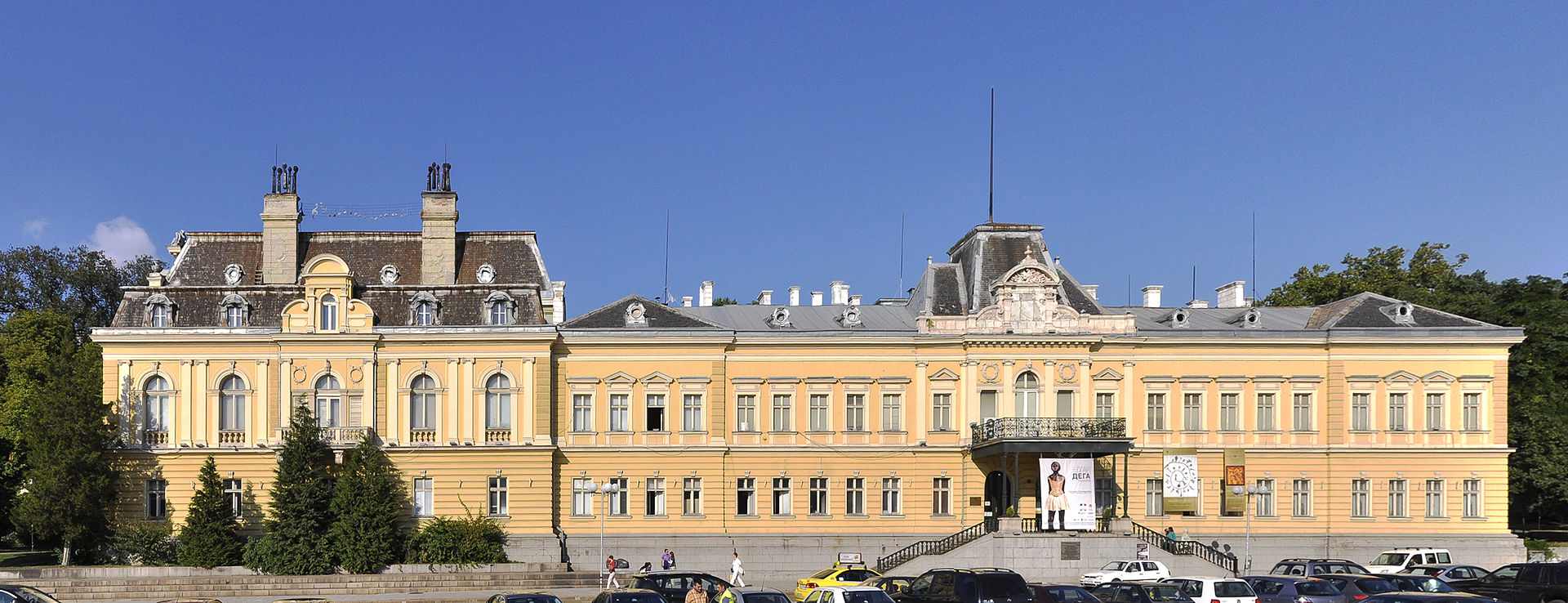
The building on Battenberg Square exists because Sofia needed a residence for a monarch it did not yet have. When Bulgaria gained autonomy from Ottoman rule in 1878 and Sofia was chosen the following year as capital of the new principality, the site held an old Ottoman konak, a provincial governor's residence with no claim to grandeur. Knyaz Alexander I Battenberg, the newly installed prince, commissioned the Austrian architect Viktor Rumpelmayer to rebuild it into a palace fit for a European court, reusing the old building's stone foundations and part of its main facade while raising a Second Empire structure with chateau-like massing above them. The palace opened on 26 December 1882, with an administrative ground floor, ballrooms on the floor above, and service rooms under the roof. A second building campaign followed after Knyaz Ferdinand I's marriage, when the Viennese architect Friedrich Gruenanger added a three-storey north-eastern wing between 1894 and 1896 for the royal family's private apartments, mixing Viennese Neo-Baroque detailing with echoes of French Louis XV and XVI decoration and fitting the new wing with an electric lift, a genuine novelty for Sofia at the time. A further renovation followed Tsar Boris III's 1930 marriage to Princess Giovanna of Savoy. The result, standing today, is not one building but two overlapping ones, assembled across half a century of Bulgarian statehood.
1946: the monarchy leaves, and so does the decoration
The palace's royal life ended abruptly rather than gradually. By 1942, with the war turning against the Axis powers Bulgaria had allied itself with, the royal family had already largely relocated to Vrana Palace outside Sofia and to a hunting lodge in the Rila mountains, leaving the Battenberg Square palace increasingly a formal address rather than a lived-in home. The monarchy itself was abolished by referendum in 1946 as Bulgaria came under communist rule, and the palace was repurposed as the seat of the new Council of Ministers. According to the building's own documented history, most of the palace's original royal-era interior was destroyed in this transition, not by wartime bombing but by the new government's own alterations: rooms were boarded up with plywood and haphazardly whitewashed to serve an administrative rather than ceremonial purpose. This is the specific, dated history behind a complaint that recurs in visitor reviews today, that the palace's original decoration feels stripped away and the building itself cold rather than opulent - the sources consulted for this page indicate that impression has a documented cause rather than being simple neglect.
1953: one palace, two museums
The state transferred the former palace to museum use in 1953, dividing it between two separate institutions that still share the building today: the National Art Gallery, occupying most of the original 1880s structure and the ground and upper floors, and the National Ethnographic Museum, occupying Gruenanger's 1896 wing, the rooms once built for the royal family's private apartments. The two are administratively and legally distinct museums under one roof, a point worth holding onto for anyone comparing what is on view: a display, a plaque or a photograph correctly captioned to one institution's rooms does not describe the other's, even though both sit inside the same walls on the same square. This page concerns only the National Art Gallery's occupation of the building - the institution registered on Wikidata as Q2991178, legally and physically distinct both from the Ethnographic Museum next door and from the National Gallery for Foreign Art, a separate branch of the same modern merged institution housed in an entirely different Sofia building.
2015: the collection moves out, the building stays open
The most consequential change to what a visitor actually finds at the Palace happened recently and is easy to miss. In May 2015, the National Gallery's 19th- and 20th-century Bulgarian holdings, together with the separate National Gallery for Foreign Art's collection, were rehoused in an expanded building called Kvadrat 500 near Alexander Nevsky Cathedral, spreading roughly 1,700 works across twenty-eight halls on four levels. That move left the Battenberg Square palace without the fixed permanent display that a visitor unfamiliar with the change might expect to find there. What the Palace does today instead is host a rotating programme of roughly ten temporary exhibitions a year, according to art-history coverage of the site, typically built around a single Bulgarian artist's career or a thematic survey of Bulgarian and international art, staged inside the former state rooms of the building's royal history. It is, in effect, a historic building doing a different job than it did before 2015, and several recent visitor reviews describe finding this out only after arriving expecting the main collection.
What a visitor finds today: royal rooms, a rotating show, and two galleries easily confused
Walk in today and the building itself does much of the talking. The museum's own visiting page names the throne room, ballrooms, a reception hall, a dining room and a winter garden among the historic rooms surviving on the palace's second floor, now serving as exhibition halls; visitor accounts independently describe touring a Reception Hall and rooms devoted to portraits of the Bulgarian royal dynasty, the Battenberg and Saxe-Coburg-Gotha rulers who once lived here. Layered onto that architecture is whatever exhibition happens to be running: a 2025 show of the contemporary Bulgarian artist Luchezar Boyadjev's Corpus Equorium, a 2026 exhibition of graphic prints by Francisco Goya, and reviews describing Bulgarian painters such as Elena Karamihaylova and Zanko Lavrenov shown alongside French, Russian, Hungarian, Romanian and Czech work in changing thematic hangs. None of this is permanent in the way a national gallery's masterworks room usually is, and the single most common thread running through the building's Tripadvisor reviews, praise and complaint both, is that visitors either understand this and enjoy a quiet, historically loaded exhibition space, or expect the fixed national collection that in fact now lives across town at Kvadrat 500.
What visitors say
Visitors consistently respond to the building itself as much as to what is inside it: the former royal state rooms, staircases and the Reception Hall draw comment on nearly every review, and several note that the palace's own history as a residence, then a nationalised government building with its original decoration stripped out, then a museum from 1953, is part of what they came to see. The most common source of visitor frustration is confusion with the National Gallery's other Sofia address at Kvadrat 500, which now holds the bulk of the institution's permanent Bulgarian and foreign collection; visitors who expect a large fixed display at the Palace and instead find a single rotating temporary exhibition sometimes leave underwhelmed, while those aware of the distinction describe the Palace positively as a quieter, less crowded counterpart to Kvadrat 500.
What is praised, what is criticised
- Praised: the former royal state rooms themselves - the Reception Hall, the throne room and the grand staircase system - described by visitors as being as much the attraction as any painting on the walls
- Praised: a calm, uncrowded, well-lit atmosphere, with rooms and themes visitors describe as clearly labelled in English
- Praised: the changing programme of temporary exhibitions, including named 2025-2026 shows of Luchezar Boyadjev and Francisco Goya, which reward a repeat visit
- Praised: friendly, attentive but unobtrusive staff, and a free locker system, in at least one detailed visitor account
- Criticised: confusion between this venue and the National Gallery's other Sofia building at Kvadrat 500, which now holds the permanent collection; several visitors describe expecting a larger fixed display and finding only the current temporary exhibition
- Criticised: the loss of the palace's original royal-era interior decoration, which one visitor describes as making the building feel less authentic than its history promises, a complaint that matches the documented deliberate stripping and whitewashing of the interior after the palace was nationalised in 1946
- Criticised: at least one visitor found the changing exhibition on view during their visit modest in scope, without works by internationally famous names
Ratings on other platforms
Tripadvisor: 3.7 from 238 ratings, read 4 September 2026
A platform average is a tertiary source: it moves, it is not audited, and we quote no visitor's words.
Questions about National Art Gallery of Bulgaria
Where is National Art Gallery of Bulgaria?
1 Knyaz Alexander I Square, 1000 Sofia, Bulgaria.
How much does it cost to visit?
Individual, adult: EUR 8; Reduced (pensioners, 65+, students): EUR 4; All branches, Thursdays: EUR 2; Combined ticket, Palace + Kvadrat 500, adult: EUR 15; Combined ticket, Palace + Museum of Christian Art, adult: EUR 15. As confirmed 4 September 2026.
When is it open?
Tue-Sun 10:00-18:00; Mon closed. Closed: Monday. official Bulgarian public holidays. As confirmed 4 September 2026.
How do you get there?
Metro: Serdika and Serdika II stations, about seven minutes' walk.
What should you see first?
The former Throne Room (Viktor Rumpelmayer (1880-1882 build)); The Reception Hall (Viktor Rumpelmayer (1880-1882 build)); Portraits of the Battenberg and Saxe-Coburg-Gotha rulers of Bulgaria (Various, 19th-20th century); The palace facade and grand staircase system (Viktor Rumpelmayer and Friedrich Gruenanger); Corpus Equorium (Luchezar Boyadjev); Graphic prints by Francisco Goya (Francisco Goya).
What we could not confirm
- The institution's own founding date is given inconsistently across sources: the National Gallery's own about-us page states 1948, Wikidata's inception field states 1946 (the year the collection moved into this building) and Wikidata separately records a 1948 official opening date, while other tertiary sources trace the underlying National Art Gallery collection to an 1892 department of the National Archaeological Museum and a 1934 re-establishment. The sources consulted for this page do not resolve which date the institution itself now treats as its founding.
- Whether the throne room, dining room and winter garden named on the museum's own visiting page are all currently open to the public, or whether some are used for purposes other than exhibition space, is not established by the sources consulted for this page.
- The exact scope of what was destroyed or removed from the palace's interior during its 1946-1953 use as the Council of Ministers' seat - beyond the general description of boarding-up and whitewashing - was not itemised in the sources consulted for this page.
Images
Sources
- 1National Gallery (Bulgaria), The Palace - Visiting Information (English) nationalgallery.bg/en/visiting/the-palace/
- 2National Gallery (Bulgaria), The Palace - Visiting Information (Bulgarian) nationalgallery.bg/bg/visiting/the-palace/
- 3National Gallery (Bulgaria), Contacts nationalgallery.bg/contacts/
- 4National Gallery (Bulgaria), About Us - Mission and Goals nationalgallery.bg/en/about-us/mission-and-goals/
- 5Wikimedia Commons, Category:Royal Palace (Sofia) commons.wikimedia.org/wiki/Category:Royal_Palace_(Sofia)
- 6Wikimedia Commons, File:National Art Gallery, Bulgaria (by Pudelek).JPG (licence and author metadata) commons.wikimedia.org/wiki/File:National_Art_Gallery,_Bulgaria_(by_Pudelek).JPG
- 7Wikipedia, National Art Gallery, Bulgaria (, for identity and general history) en.wikipedia.org/wiki/National_Art_Gallery,_Bulgaria
- 8Wikipedia, Royal Palace (Sofia) (, for building and construction history, 1946 nationalisation and interior alteration) en.wikipedia.org/wiki/Royal_Palace_(Sofia)
- 9Wikidata, National Art Gallery of Bulgaria (Q2991178) wikidata.org/wiki/Q2991178
- 10Tripadvisor, National Art Gallery, Sofia (listing d552438) - rating, review count, and visitor reviews read in full on the page tripadvisor.com/Attraction_Review-g294452-d552438-Reviews-National_Art_Gallery-Sofia_Sofia_Region.html
- 11GuideBG, The National Gallery, Sofia - Two Addresses, One Art Story (distinguishing the Palace's temporary-exhibition programme from Kvadrat 500's permanent collection) guidebg.com/national-gallery-sofia/
.JPG)