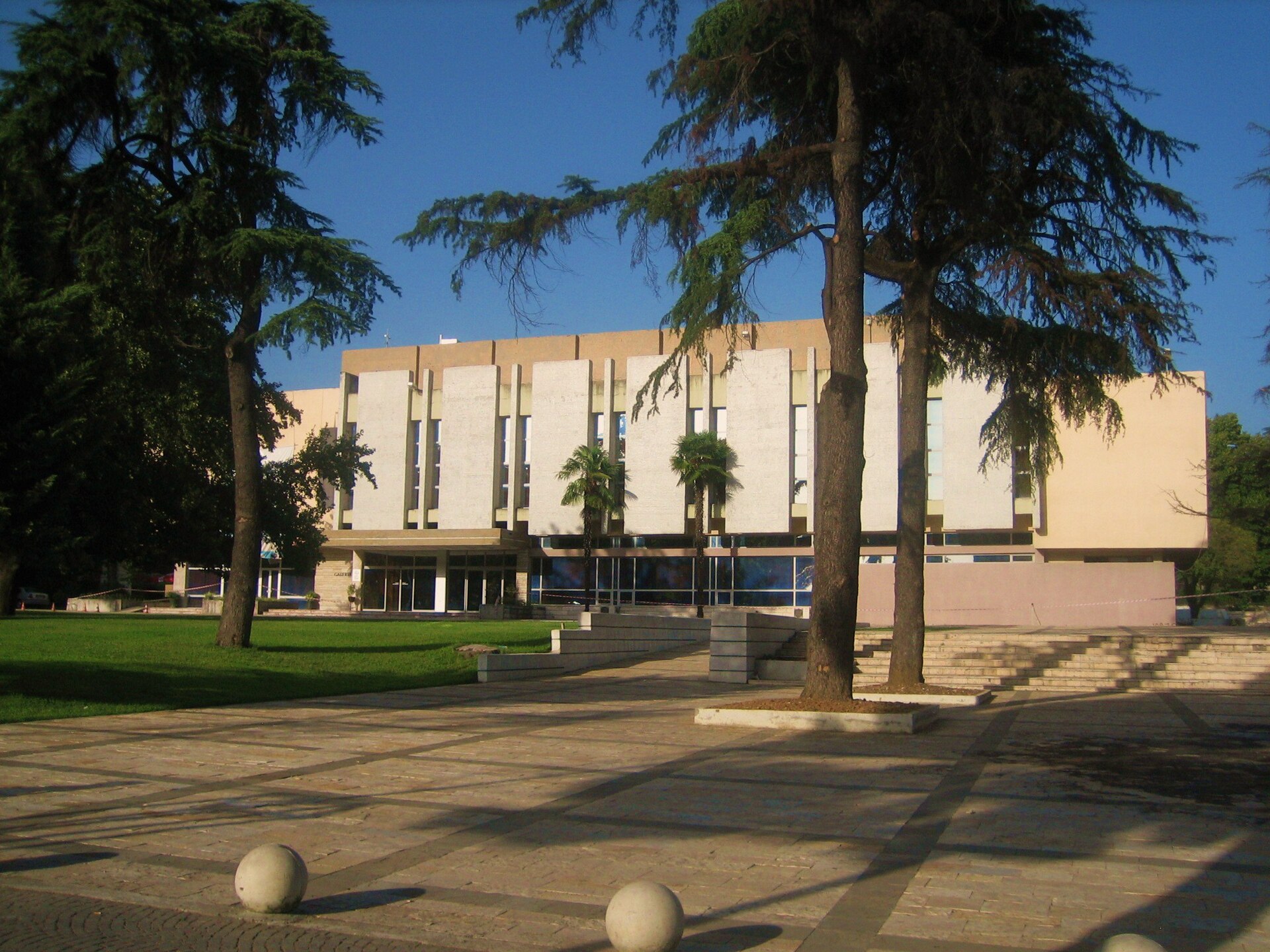
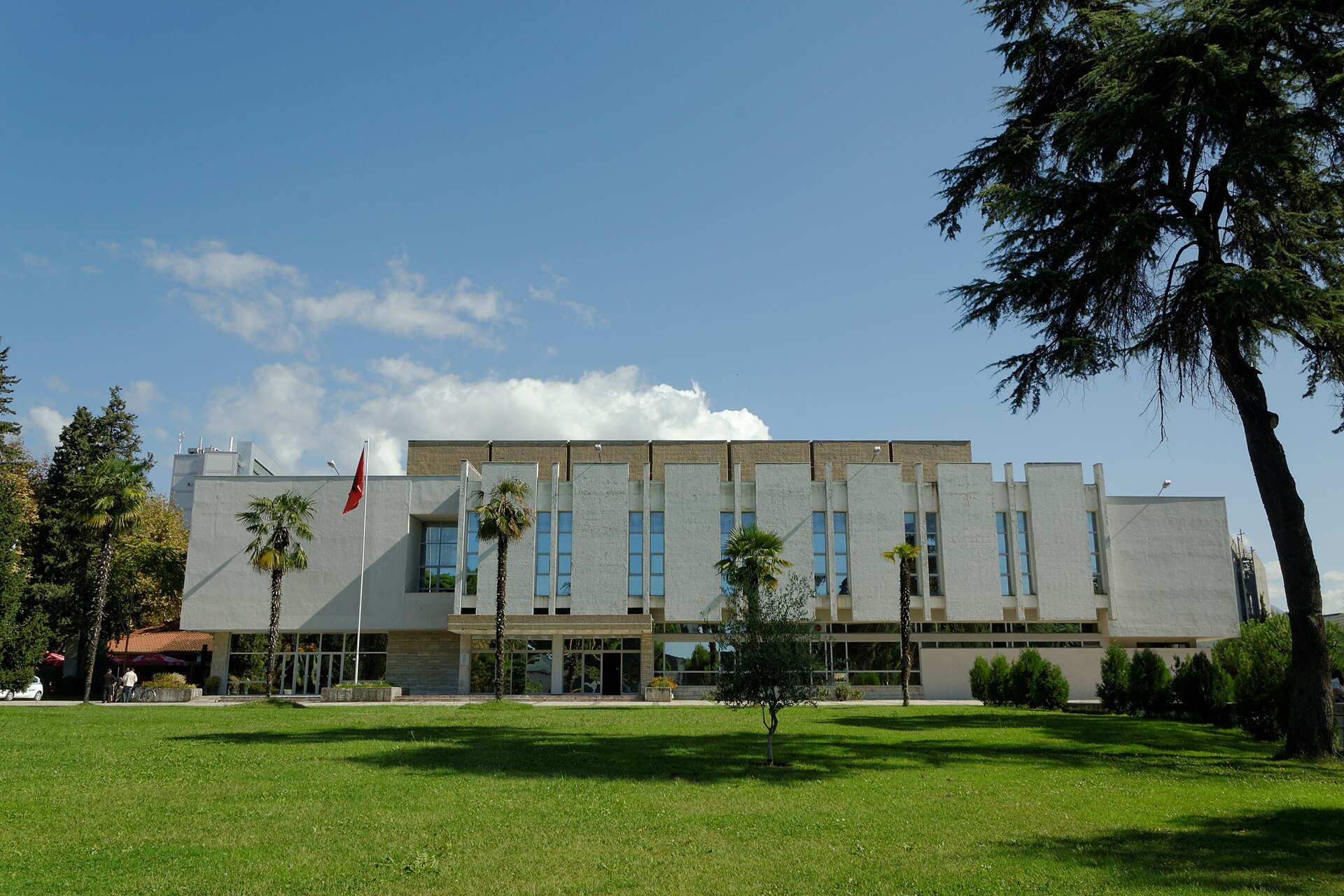
The gallery's 1974 building on the Boulevard of the Martyrs of the Nation, seen from the forecourt; the entrance signage reading GALERI is visible under the concrete-fin facade
Gertjan R., CC BY-SA 3.0National Art Gallery of Albania
Museum · Galeria Kombetare e Arteve · Founded 1954
Closure confirmed 3 September 2026 · 12 sources
Closed to visitors - not permanently
National Art Gallery of Albania is currently closed, on the evidence sourced below.
Expected to reopen: The Ministry of Culture's own announcement on 18 October 2021 said the closure would run until the works were finished, and gave a duration of 2 years, meaning end of 2023; no revised completion date has been published since, and the gallery's own Instagram account still read CLOSED / In reconstruction when checked for this page · a target, not yet confirmed
Closure confirmed from the institution's own page. We re-check this page on a schedule and will update it, from the institution's own announcement, the moment it reopens.
On this page 13 sections
ContentsClose
The gallery's distinguishing strength is depth in one narrow period: Albanian Socialist Realist painting and sculpture, 1944-1990, documented at more than fifty artists on a single pre-closure visit and covering nearly every state-sanctioned theme of the period. It also holds, in smaller quantity, the preceding generation of Albanian painting through Kole Idromeno and the country's first known sculpted bust by an Albanian artist. It is not a collection of foreign or historical European art; version-safety matters here because press coverage sometimes elides it with Tirana's larger National Historical Museum, a different institution with a different building and a different, much broader remit.
| Local name | Galeria Kombetare e Arteve |
|---|---|
| Kind | Museum |
| Founded | 1954 |
| City and country |  Tirana, Albania Tirana, Albania |
| Address | Bulevardi Deshmoret e Kombit, Tirana 1001, Albania |
| Website | galeriakombetare.al |
| Status | Closed temporarily, confirmed |
| Record last verified |
Visiting
- Hours (pre-closure)
- Mon-Sun09:00 to 19:30last published hours, before the 2021 closure; not in effect while the building is closed
- Closed
- Entire building closed for reconstruction since 18 October 2021.
- Admission (pre-closure)
- AdultALL 200last published price, before the 2021 closure
- Student / SeniorALL 100last published price, before the 2021 closure
- Visitor with disabilityALL 100last published price, before the 2021 closure
- Do I need to book?
- Not applicable while closed
- Address
- Bulevardi Deshmoret e Kombit, Tirana 1001, Albania MapOn foot Central Tirana, on the Boulevard of the Martyrs of the Nation between Skanderbeg Square and the Faculty of Economics; a 10-12 minute walk from Skanderbeg Square
- Website
- galeriakombetare.al
- Telephone
- +355 4 222 6033
- [email protected]
Before you go how long, access, photography, bags, eating, shop
- How long to allow
- Before the closure, visitors typically reported one to two hours for the permanent collection
- Access
- Not confirmed; unknown whether the expansion project now under way will add step-free access
- Photography
- Not confirmed for the current closure period
- Bags
- Not confirmed for the current closure period
- Eating
- Not confirmed
- Shop
- Not confirmed
The museum is closed (see above). These are the figures published before the closure, kept here for a visitor planning ahead rather than presented as bookable today, and you can check the current position at the source we used. We will re-confirm them once it reopens.
What is inside
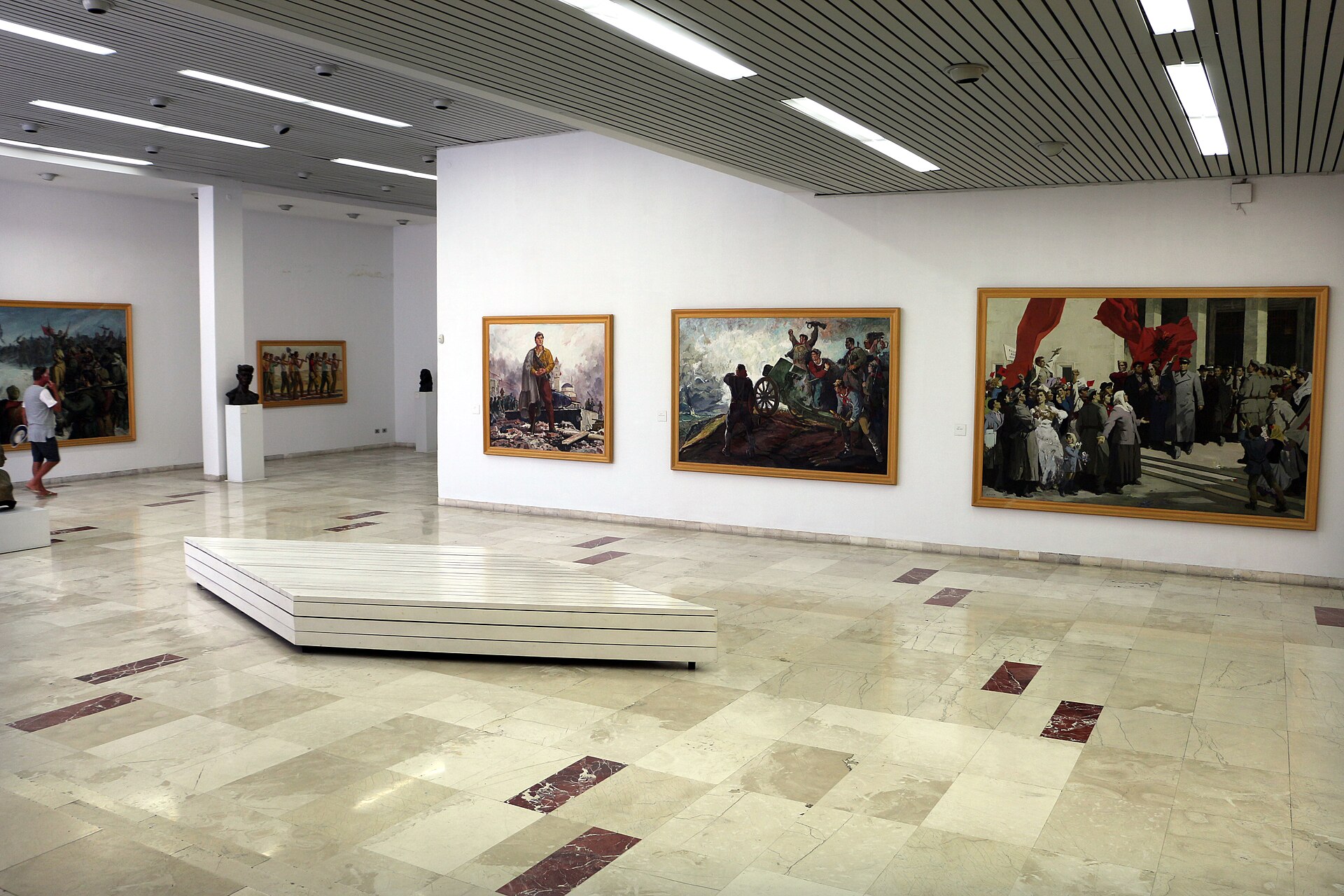
Photograph by Sailko · CC BY-SA 4.0 Socialist Realism galleries (1944-1990)
The core of the collection: paintings and sculpture made under state patronage during the communist period, more than fifty Albanian artists represented on a single visit as documented in 2019 before the closure. Recurring subjects are partisan war, industrial labour, electrification and land reform, painted in a state-approved realist style with almost no self-critical content. This is the body of work the gallery is most identified with and the reason foreign visitors travel to see it specifically.
Pre-war and early Albanian painting
Work by the generation before the communist period, above all Kole Idromeno (1860-1939), regarded as a founding figure of Albanian painting and of photography in Albania; his Last Judgment is repeatedly singled out by visitors as the collection's strongest single picture from this period.
Sculpture and monument maquettes
The gallery's sculpture holding includes the bust of Skanderbeg made by Murat Toptani in 1908, recorded as the first sculpted bust by an Albanian artist, alongside socialist-era public-monument maquettes by sculptors such as Kristaq Rama, who also designed several of Tirana's large communist-era monuments.
Contemporary and post-1990 galleries
Albanian art made after the fall of the dictatorship, and the space used for temporary and contemporary exhibitions, including the 2019-2020 show Tirana Patience, which set newly commissioned contemporary work by Albanian and international artists directly against the covered-up Socialist Realism collection.
Public library
A specialist art library open to the public since 1999, holding albums, journals and art-historical literature connected to the collection.
What to see first
Vojo Kushi
Sali Shijaku, 1969One of the largest canvases in the permanent hang, depicting the partisan Vojo Kushi at the moment of his death fighting occupying forces; treated by the gallery and by visitors as one of the signature paintings of the Socialist Realism collection6
The Victor
Fatmir Haxhiu, 1979Depicts the partisan liberation of Tirana on 17 November 1944 with the Et'hem Bey Mosque in the background, one of the gallery's set-piece history paintings of the war years6
Declaration of the Republic
Vilson Kilica, 1982-83A large history painting of the 1946 declaration of the People's Republic, with Enver Hoxha shown at the rostrum; a directly political commission from the gallery's core holding6
The Crossing of the Striking Division of Brigade No. 1
Sadik Kaceli, 1954By one of the gallery's own founding artists (Kaceli helped establish the institution and later became People's Artist of Albania), depicting a War of Liberation episode; one of the earliest Socialist Realist paintings in the collection7
A Contemporary of the Republic
Kristaq Rama, 1964Sculpture by Kristaq Rama, who also designed several of Tirana's large public communist-era monuments and is the father of former prime minister Edi Rama; ties the gallery's holdings directly to the city's monumental sculpture outside its walls6
Bust of Skanderbeg
Murat Toptani, 1908Recorded as the first sculpted bust made by an Albanian artist, and the gallery's oldest named work of sculpture4
The Last Judgment (Gjyqi i Fundit)
Kole IdromenoBy the artist regarded as a founder of Albanian painting; visitors and local critics repeatedly name this as the outstanding pre-communist-era work in the galleries10
Skroskie 1944
Fatmir Haxhiu, 1966A War of Liberation history painting that documents the episode's own contested memory: it was removed from display after the 1981 political fall of Mehmet Shehu, a rare case of the gallery's own hang being edited for political reasons after the fact6
The building and what it was built to hold
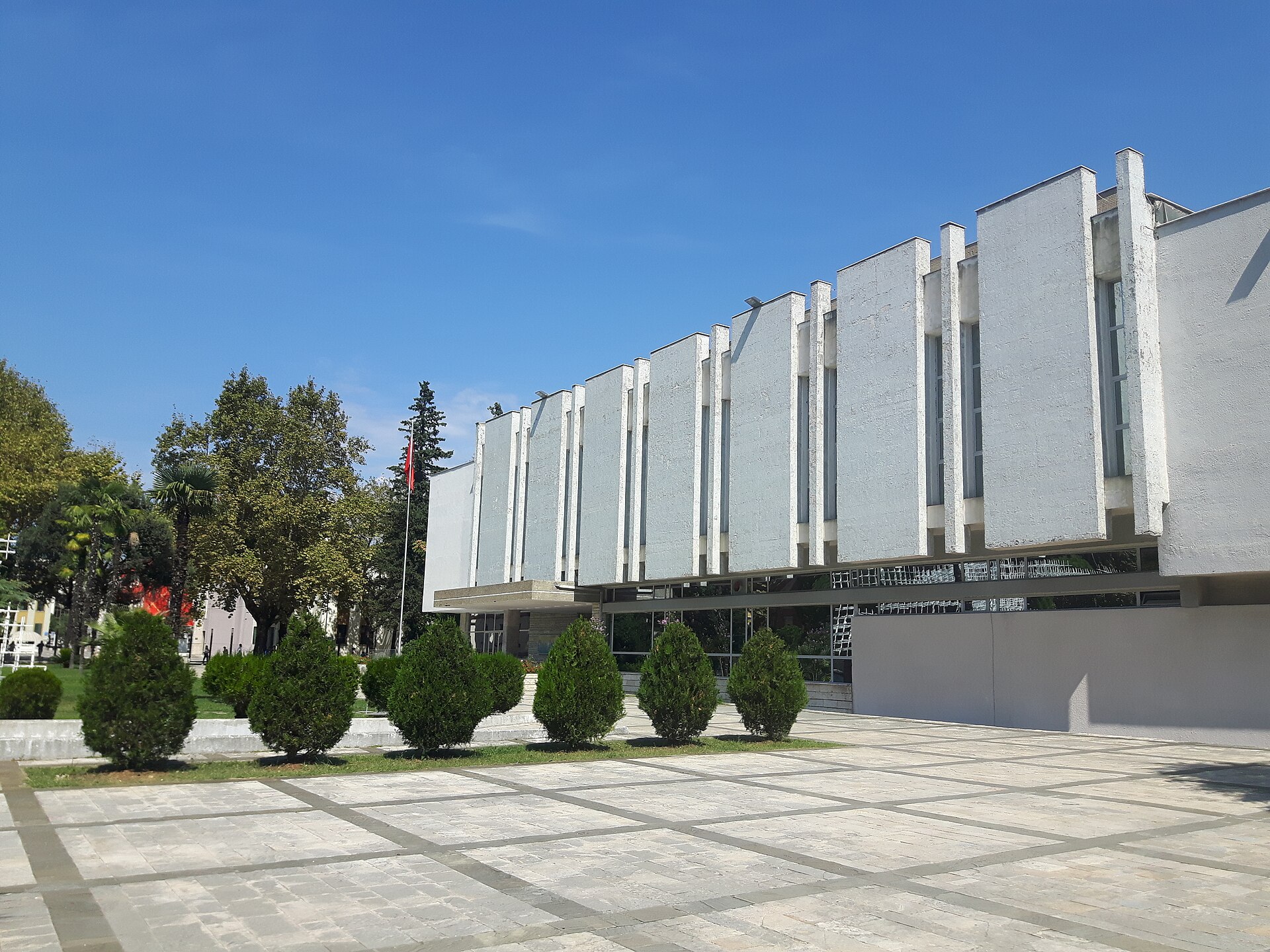
The institution traces itself to 1946, when a group of Albanian artists and the state Arts Committee set up Pinakoteka, the country's first fine-art collecting body. It opened to the public as a gallery on 11 January 1954. Twenty years later, on 29 November 1974, it moved into the purpose-built modernist building it still occupies, on the Boulevard of the Martyrs of the Nation in central Tirana: a low, wide block faced in vertical concrete fins over a glazed ground floor, set back behind lawns and cedar and palm planting. The building was substantially reworked inside in 2009-2010, updating the display spaces and museology while keeping the original architectural design.
The building's own recent history is now a large part of the story a visitor has to be told before anything else. A 2019 earthquake prompted a structural study of the building, and in October 2021 the gallery closed entirely for reconstruction: the Ministry of Culture's own announcement, reported the same day, put the closure at two years, with the museum's holdings moved to Albafilm, a building near the Ministry that had earlier served as a temporary home for the Opera and Ballet Theatre. The project as announced was not a repair alone: the plan adds a twin building behind the existing one, in the same volumes, intended to take the gallery's footprint from around 4,600 to around 10,100 square metres. Five years on, no revised completion date has been published, and the gallery's own Instagram account still reads CLOSED / In reconstruction.
What is inside: the Socialist Realism collection
The reason this gallery is worth the detour, even closed, is the body of painting and sculpture made under state patronage between 1944 and 1990. A visitor who went through the rooms in September 2019, before the closure, catalogued work by more than fifty named Albanian artists on that single visit: partisan combat and partisan martyrdom, the electrification of villages, the mechanisation of farms, textile and metal factories, land reform, and civic ritual around the declaration of the republic and its early institutions. The style is a state-approved realism, painted for public instruction as much as for aesthetic judgement, and it is largely untouched by the self-criticism that entered Eastern Bloc art elsewhere after the 1960s.
The collection is also, in places, a record of the state editing its own history after the fact. Fatmir Haxhiu's 1966 painting Skroskie 1944 was withdrawn from display after the 1981 political fall of Mehmet Shehu, whose presence in the painting had become politically unacceptable; his 1979 painting The Victor, showing the partisan entry into Tirana on 17 November 1944 in front of the Et'hem Bey Mosque, remained a centrepiece. Vilson Kilica's Declaration of the Republic (1982-83) and Sali Shijaku's Vojo Kushi (1969) are, by visitor and documentary account alike, among the largest and most frequently singled-out canvases in the permanent hang. Sculpture from the same decades sits alongside the paintings, including work by Kristaq Rama, who also designed several of the large public monuments still standing in Tirana.
Before the dictatorship: Kole Idromeno and the older collection
The gallery's holdings reach back before 1944 as well. Kole Idromeno (1860-1939) is treated in Albanian art history as a founding figure of both painting and, separately, photography in the country, and his Last Judgment is the work from this earlier period that recurs most often in visitor accounts as the standout piece outside the socialist-era rooms. The gallery also holds what is recorded as the first sculpted bust made by an Albanian artist: a 1908 bust of Skanderbeg by Murat Toptani, after whom the street the gallery's rear entrance sits on is named.
This older material sits in a smaller part of the building than the Socialist Realism galleries, and several pre-closure visitor accounts noted that, unlike the best-known communist-era paintings, it often carried little translated wall text. A specialist art library, open to the public since 1999 and holding albums, journals and art-historical literature tied to the collection, occupies part of the building separately from the exhibition floors.
Tirana Patience and the gallery's own contested reception
The gallery's most discussed recent exhibition was not a straightforward display of its own collection. Tirana Patience, curated by Natasa Ilic and Adam Szymczyk with exhibition architecture by Joanna Meyer-Grohbrugge, ran from 18 December 2019 into 2020 and set new commissions, performances and installations by contemporary artists, including Anri Sala and Ibrahim Mahama, directly against the Socialist Realism collection - largely by covering most of the permanent paintings under cloth, so that only a minority remained visible at any time. The stated intent was to slow down looking and to open debate about how Albanian society has processed the dictatorship period.
The reception among ordinary visitors was sharply divided, and this publication treats that division as part of the record rather than smoothing over it. Visitors who had come specifically to see the socialist-era paintings, several of them from outside Albania, wrote that they paid admission and left within minutes having seen almost nothing of what they came for; one review from this period is titled, in full, Paintings Posing as Bedsheets. Other visitors, and the curators, treated the covering as the point: a deliberate refusal to let the collection be consumed as a completed historical curiosity. Both responses are on the public record, and neither is more official than the other.
What a visitor cannot do today, and what is still unresolved
As this page is written, there is no public collection to visit. The building has been closed since 18 October 2021, the announced two-year timetable has passed by several years with no replacement date published, and the museum's own social media account still describes it as under reconstruction. The Ministry of Culture's original plan was an expansion, not a like-for-like repair, effectively doubling the building's footprint with a new structure to the rear; whether that expansion has progressed, and whether the Socialist Realism collection will return to display in the same rooms and the same density once it reopens, has not been confirmed by any source reachable for this page. The gallery's live web presence, at galeriakombetare.al, currently carries only administrative notices - staff vacancies and a 2026 open call for an artists' production fund - and no visitor information at all; the address the institution is listed under on Wikidata, galeriakombetare.gov.al, no longer resolves.
None of this displaces what the closure interrupted: a national collection of Socialist Realist Albanian art with, on the documentary record, no real peer anywhere else, housed in a purpose-built modernist building that is itself a piece of the same period's design history. The record kept here is of what that collection held and how it was received while it was open, so that it is not lost between the closure and whatever the reopened building eventually shows.
What visitors say
Visitors consistently describe the Socialist Realism galleries as the reason to come: a scale and concentration of communist-era Albanian painting and sculpture that has no equivalent elsewhere, displayed in a purpose-built modernist building that is itself part of the experience. The same visitors just as consistently note that curatorial care beyond that core holding is thin: many later and contemporary works carry little or no English text, some rooms read as under-resourced or under-maintained, and the 2019-2020 Tirana Patience exhibition, which covered most of the permanent collection under cloth to make a curatorial point about looking, left a number of visitors who had come specifically to see the socialist-era paintings feeling they had paid to see almost nothing.
What is praised, what is criticised
- Praised: the scale and concentration of the Socialist Realism collection, described as unmatched elsewhere
- Praised: the low admission price relative to what was on show, before the closure
- Praised: the modernist 1974 building itself, and its use of varied floor materials (stone, terrazzo, wood) noted by more than one visitor
- Criticised: little or no English-language wall text for anything outside the best-known socialist-era paintings
- Criticised: a general sense of under-maintenance in parts of the building, reported independently by multiple visitors between 2019 and 2021
- Criticised: the 2019-2020 Tirana Patience exhibition, which covered most of the permanent collection under cloth and drew complaints that visitors paying admission to see the Socialist Realism paintings specifically could not do so
Ratings on other platforms
Tripadvisor: 4.1 from 210 ratings, read 3 September 2026
A platform average is a tertiary source: it moves, it is not audited, and we quote no visitor's words.
Questions about National Art Gallery of Albania
Where is National Art Gallery of Albania?
Bulevardi Deshmoret e Kombit, Tirana 1001, Albania.
How much does it cost to visit?
Adult: ALL 200; Student / Senior: ALL 100; Visitor with disability: ALL 100. As confirmed 3 September 2026.
When is it open?
Mon-Sun 09:00-19:30. Closed: Entire building closed for reconstruction since 18 October 2021. As confirmed 3 September 2026.
How do you get there?
On foot: Central Tirana, on the Boulevard of the Martyrs of the Nation between Skanderbeg Square and the Faculty of Economics; a 10-12 minute walk from Skanderbeg Square.
What should you see first?
Vojo Kushi (Sali Shijaku, 1969); The Victor (Fatmir Haxhiu, 1979); Declaration of the Republic (Vilson Kilica, 1982-83); The Crossing of the Striking Division of Brigade No. 1 (Sadik Kaceli, 1954); A Contemporary of the Republic (Kristaq Rama, 1964); Bust of Skanderbeg (Murat Toptani, 1908).
What we could not confirm
- No source reachable for this page gives a current target reopening date; the original 2021 announcement's two-year timetable (to end of 2023) has passed with no public replacement date
- Whether the announced expansion (roughly doubling the building's footprint with a new rear structure) has actually broken ground, stalled, or been revised is not confirmed by any source reached for this page
- Whether the Socialist Realism collection will be redisplayed at the density documented before the closure, or reduced or reorganised in the expanded building, is unconfirmed
- Reported project cost figures for the reconstruction differ between contemporaneous reports (one billion lek over two years per the initial Ministry announcement, versus a larger figure of 1.365 billion lek reported elsewhere); this page has not been able to reconcile the two
Images
Sources
- 1Wikidata, Q1968108 (National Art Gallery of Albania) wikidata.org/wiki/Q1968108
- 2Instagram, @galeriakombetarearteve, official account bio ("CLOSED / In reconstruction"), read 2026-09-03 instagram.com/galeriakombetarearteve/
- 3A2 CNN / a2news.com, "Mbyllet perkohesisht Galeria Kombetare e Arteve", 18 October 2021 a2news.com/mbyllet-perkohesisht-galeria-kombetare-e-arteve
- 4Albanian Wikipedia, "Galeria Kombetare e Arteve", read 2026-09-03 sq.wikipedia.org/wiki/Galeria_Komb%C3%ABtare_e_Arteve
- 5English Wikipedia, "National Museum of Fine Arts (Albania)", read 2026-09-03 en.wikipedia.org/wiki/National_Museum_of_Fine_Arts_(Albania)
- 6Michael Harrison, "Socialist Realist Paintings and Sculptures on Display at the National Art Gallery, Tirana", michaelharrison.org.uk, September 2019 michaelharrison.org.uk/2019/09/socialist-realist-paintings-and-sculptures-on-display-at-the-national-art-gallery-tirana/
- 7English Wikipedia, "Sadik Kaceli", read 2026-09-03 en.wikipedia.org/wiki/Sadik_Kaceli
- 8Harabel, "Exhibition: Tirana Patience, National Gallery of Arts, December 18th 2019 - December 2020, Tirana" harabel.org/harabel-cpt/exhibition-tirana-patience-national-gallery-of-arts-december-18th-2019-december-2020-tirana/
- 9Visit Tirana, "National Gallery of Arts", read 2026-09-03 (address, transport context) visit-tirana.com/locations/national-gallery-of-arts/
- 10Tripadvisor, "National Gallery of Art" (Tirana), reviews and rating, read 2026-09-03 tripadvisor.com/Attraction_Review-g294446-d2694602-Reviews-National_Gallery_of_Art-Tirana_Tirana_County.html
- 11Wikimedia Commons, File:National Art Gallery, Tirana.jpg, licence and author metadata commons.wikimedia.org/wiki/File:National_Art_Gallery,_Tirana.jpg
- 12Wikimedia Commons, File:Tirana, galleria nazionale d'arte, interno 06.JPG, licence and author metadata commons.wikimedia.org/wiki/File:Tirana,_galleria_nazionale_d%27arte,_interno_06.JPG

