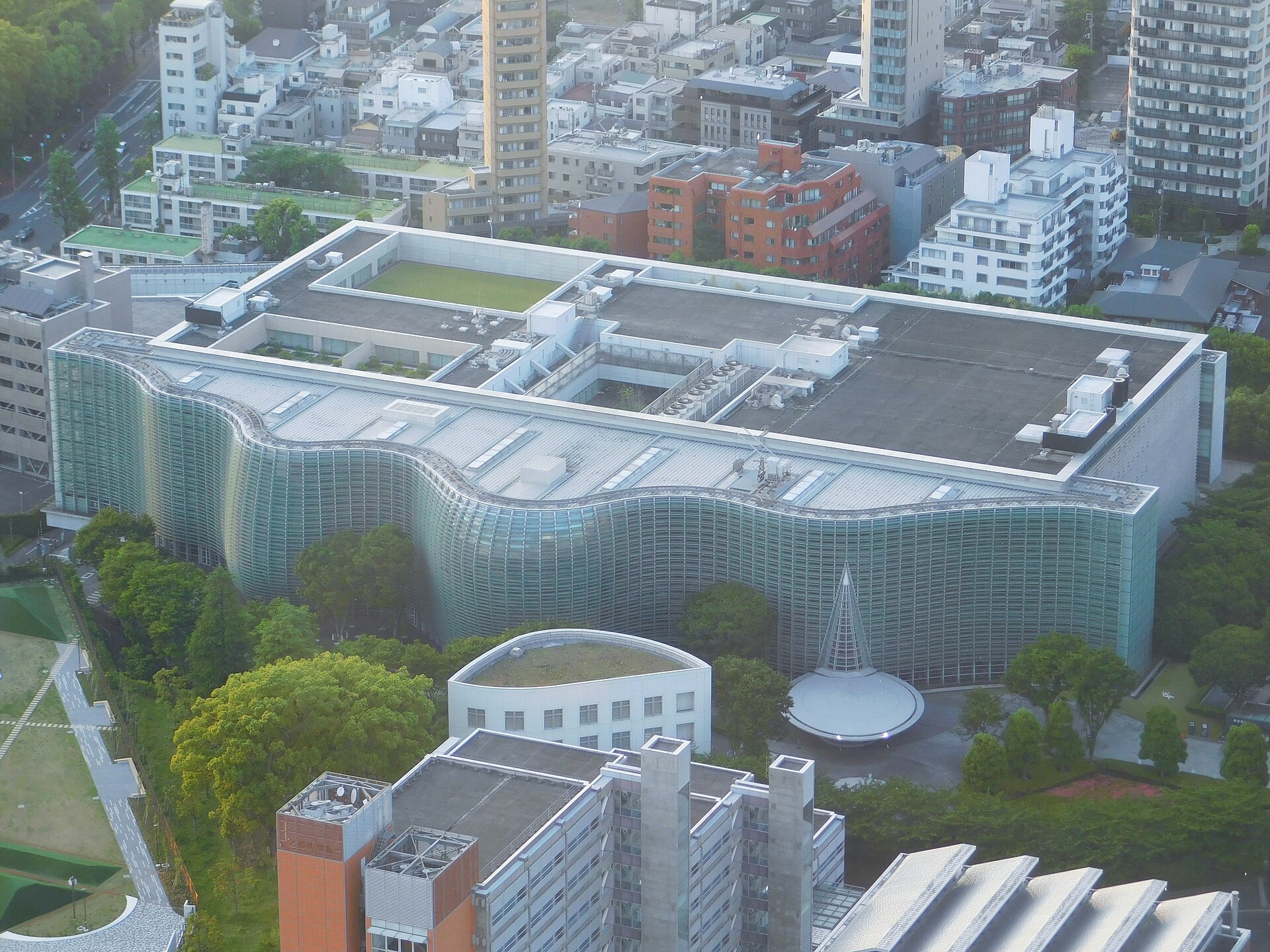
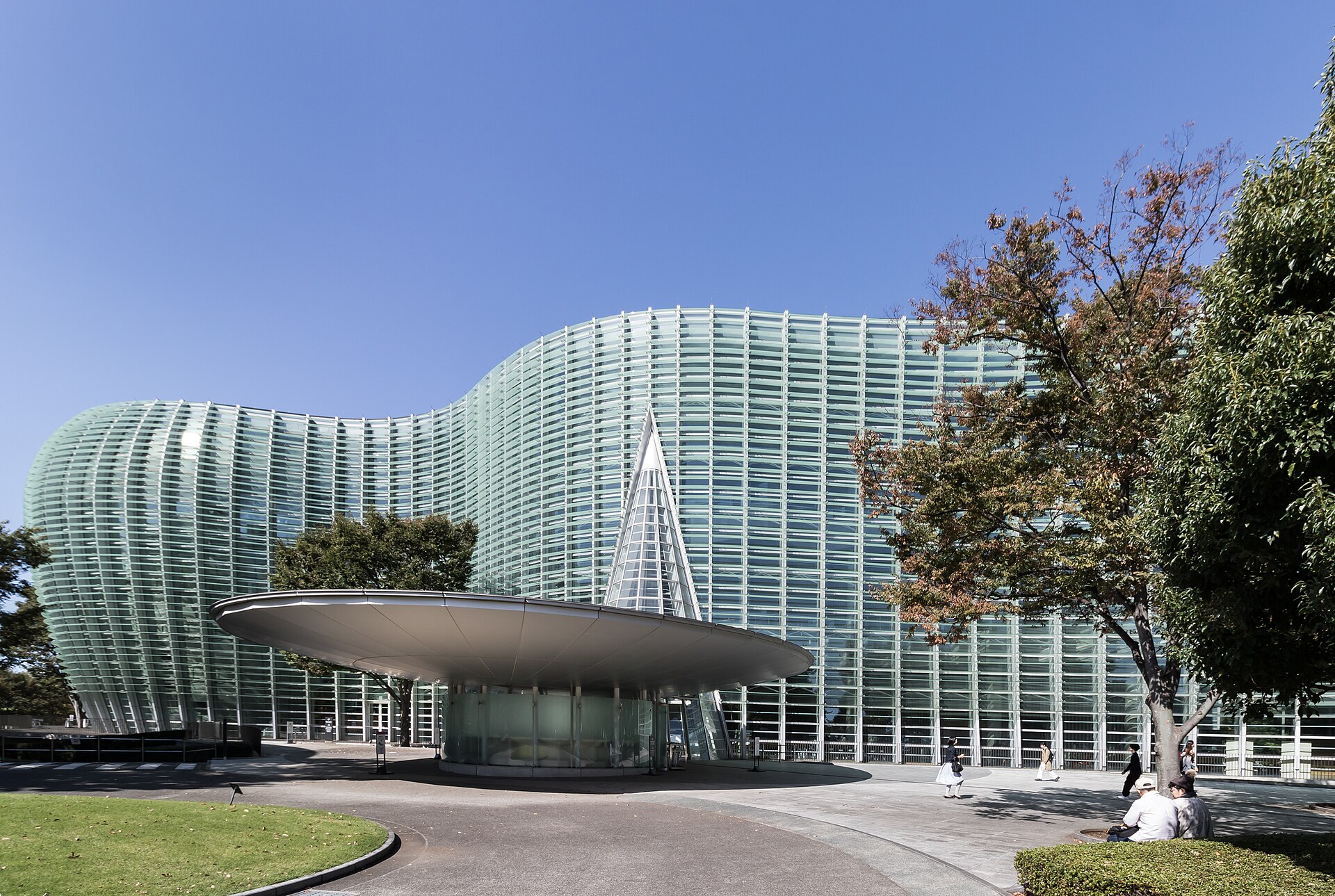
An aerial view of the National Art Center, Tokyo, showing the full length of Kisho Kurokawa's undulating wave-facade glass curtain wall, the rooftop garden above the galleries, and the point of the smaller inverted cone rising from the atrium below.
Photograph by Akonnchiroll, CC BY-SA 4.0National Art Center, Tokyo
Museum · Kokuritsu Shin-Bijutsukan · Founded 2007
Open, admission and hours confirmed 21 August 2026 · 22 sources
On this page 16 sections
ContentsClose
The National Art Center, Tokyo has no permanent collection to be strong or weak in the conventional sense, and it was built deliberately not to have one; among the institutions grouped under Japan's Independent Administrative Institution National Museum of Art, it is the one built purely as an exhibition venue. What it holds instead is capacity and infrastructure: roughly 14,000 square metres of gallery space across twelve rooms, the largest such area of any museum in Japan, split between international loan exhibitions curated by the center's own staff or by outside guest curators, and a year-round programme let to more than fifty Japanese artist associations who mount their own annual shows in the same rooms. Its durable holdings are architectural and institutional rather than art-historical: Kurokawa's wave facade and inverted-cone atrium as a landmark of early twenty-first-century Japanese museum design, and the Art Library's growing archive of exhibition catalogues as the one part of the building with genuine curatorial continuity rather than a rotating cast of borrowed shows. A visitor cannot come here to see a specific named object the way they would at a museum with its own galleries of holdings; they come to see whatever exhibition, association show or loan display happens to be running, and the institution's whole identity is built around making that changing programme, rather than any object it owns, the reason to visit.
| Local name | Kokuritsu Shin-Bijutsukan |
|---|---|
| Kind | Museum |
| Founded | 2007, opened to the public 21 January 2007; construction completed 2006; the institution was formally named in 2003 and the architect was commissioned in 2000 |
| City and country |  Tokyo, Japan Tokyo, Japan |
| Address | 7-22-2 Roppongi, Minato-ku, Tokyo 106-8558, Japan |
| Website | nact.jp |
| Status | Open, confirmed |
| Record last verified |
Visiting
- Hours
- Wednesday-Monday (special exhibitions)10:00 to 18:00Last admission 30 minutes before closing
- Friday-Saturday (special exhibitions, extended)10:00 to 20:00Extended evening hours for special exhibitions only; the Artist Associations' galleries keep the standard 10:00-18:00 hours
- Closed
- Tuesday, except when a national holiday falls on a Tuesday, in which case the museum stays open and closes on the following weekday instead. The New Year holiday period.
- Admission
- Building entry (no exhibition)FreeThe building itself, the art library, the shop and the cafes are free to enter. A ticket is required only to enter a specific exhibition, and each exhibition sets its own price.
- Adult, current special exhibition (example: Picasso, through the Eyes of Paul Smith, 2026)JPY 2,4002200 yen in advance. Prices vary by exhibition; this is the illustrative current example, not a general admission fee.
- College student, same exhibitionJPY 1,4001200 yen in advance
- High school student, same exhibitionJPY 1,000800 yen in advance; free for high school students on specific dates published per exhibition
- Under 15 / visitors with disability plus one companion, special exhibitions generallyFreeFree admission is a standing policy for children 15 and under and for visitors with a disability plus one companion, applied per exhibition
Free entry: No general free day applies across the whole institution; individual exhibitions occasionally publish their own free-admission windows for specific visitor categories, such as high-school students on set dates- Tickets
- nact.jp/english/ticket The museum's own ticket page.
- Do I need to book?
- No advance booking for standard entry; a few high-demand special exhibitions have introduced timed-slot reservation systems for their final weeks (the 2026 Louvre Renaissance exhibition does this from 7 December 2026)
- Address
- 7-22-2 Roppongi, Minato-ku, Tokyo 106-8558, Japan MapTokyo Metro Chiyoda Line Direct underground access from Nogizaka Station, Exit 6
Tokyo Metro Hibiya Line About 5 minutes on foot from Roppongi Station, Exit 4a
Toei Oedo Subway Line About 4 minutes on foot from Roppongi Station, Exit 7 - Website
- nact.jp
- Telephone
- +81 47 316 2772
Before you go how long, access, photography, bags, eating, shop
- How long to allow
- One to two hours for a single special exhibition; longer if combined with the Artist Associations' galleries or the Art Library
- Access
- Free wheelchairs and strollers are available at the information desk, the building is step-free throughout with lift access between all floors, accessible restrooms are provided, and multilingual staff are on hand at the information desk. Visitors with a disability are admitted free to ticketed exhibitions along with one companion.
- Photography
- Not published in the sources read for this record; policy is set per exhibition and posted at each gallery entrance
- Bags
- Not published in the sources read for this record
- Eating
- Cafe Coquille on the first floor, Salon de The Rond on the second floor, and Cafeteria Carre in the basement
- Shop
- The museum shop, Souvenir from Tokyo, in the basement, plus exhibition-specific pop-up shops for major special exhibitions
Prices and hours change. We take them from the institution's own pages and print the day we read them, and you can check the current position at the source we used. Confirm before you travel.
What is inside
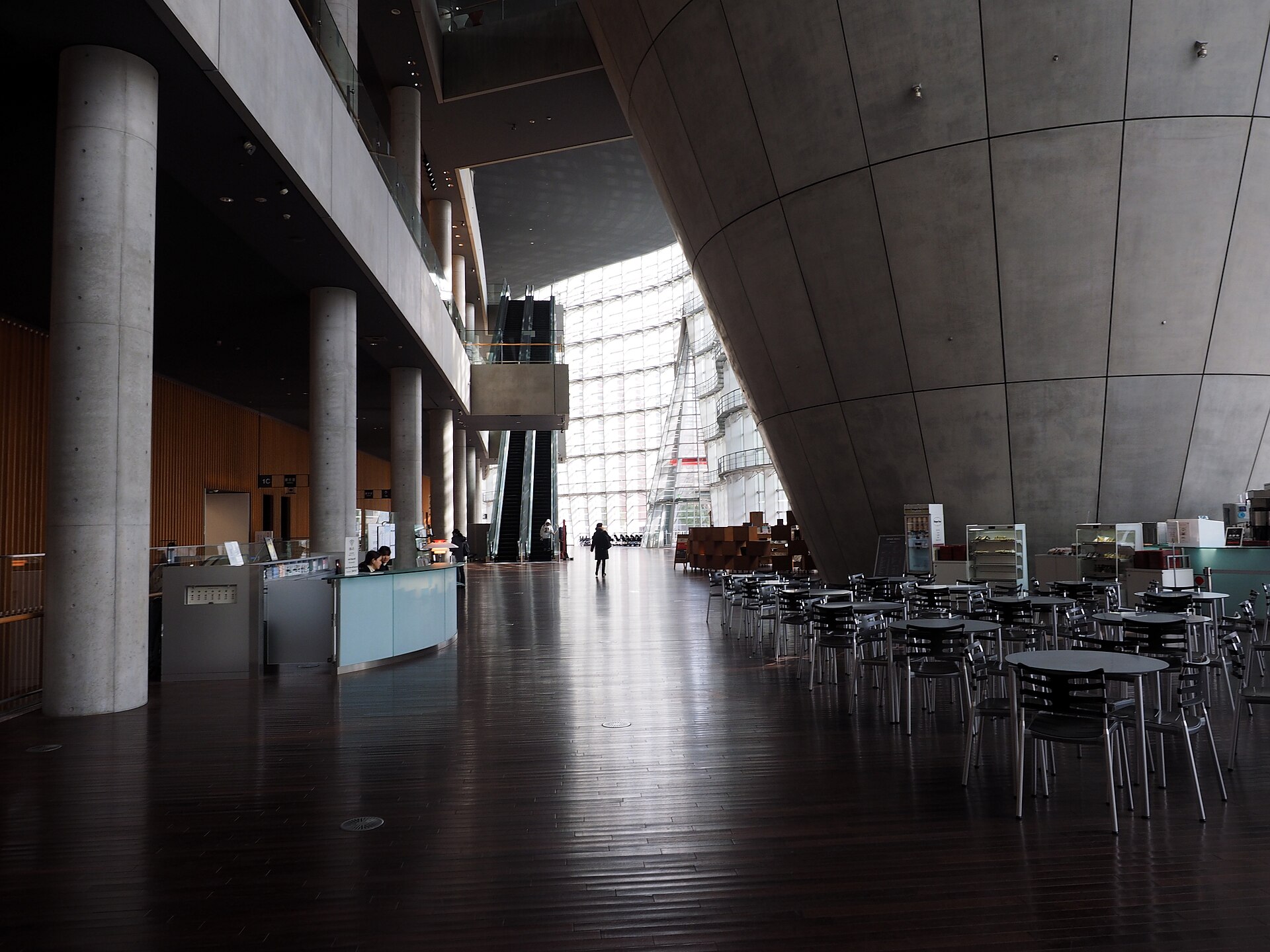
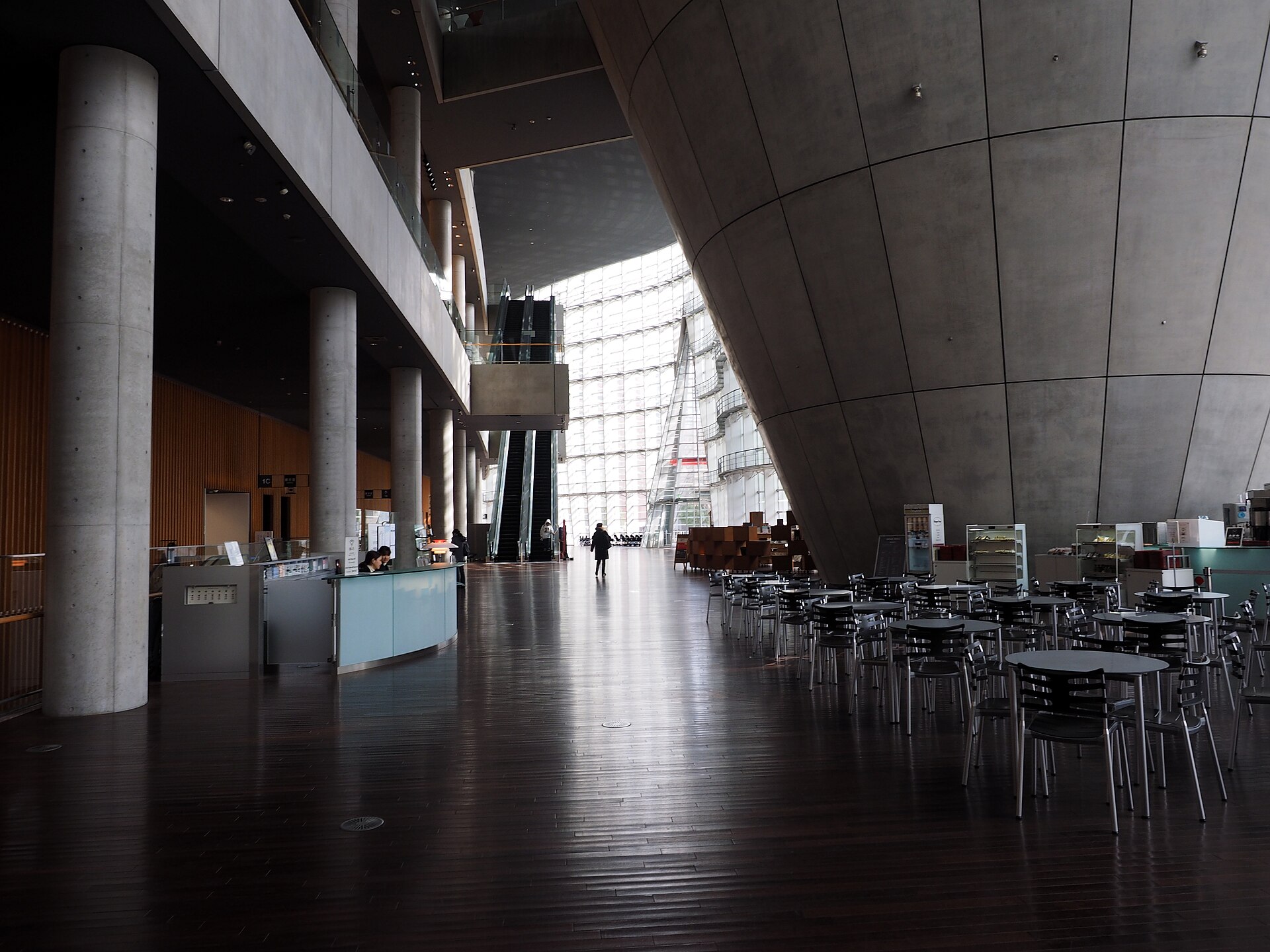
Photograph by Nick-D · CC BY-SA 4.0 The Atrium and its two inverted concrete cones
A 3,180 square metre atrium behind the wave facade, its ceiling rising 21.6 metres, dominated by two inverted cone structures. The larger cone carries Brasserie Paul Bocuse Le Musee at its top, a fine-dining room that opened as the French chef's first restaurant outside France; the smaller cone, visible from outside as the pointed glass form beside the main entrance, anchors the ground-floor lobby with the information desk and a cafe.
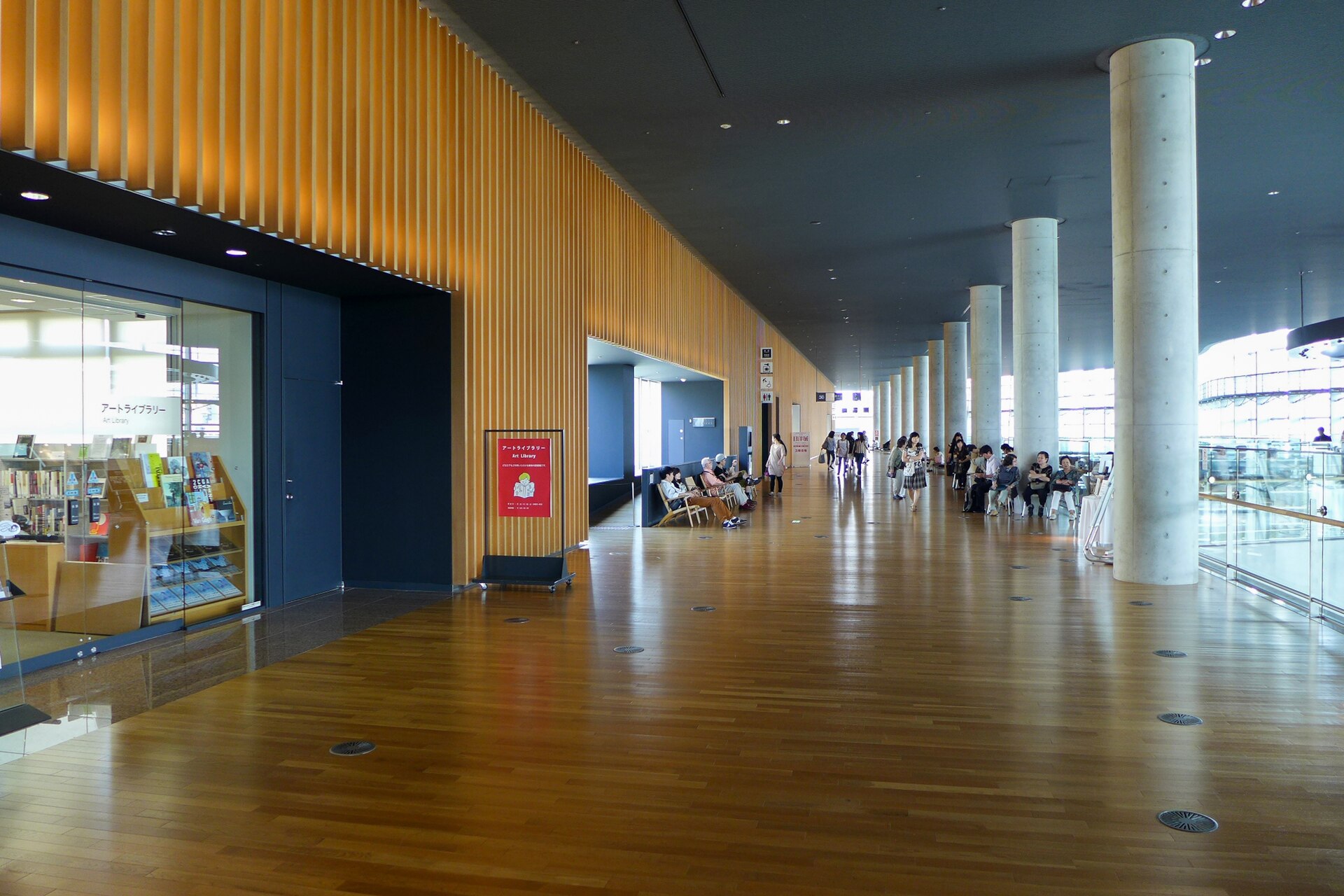
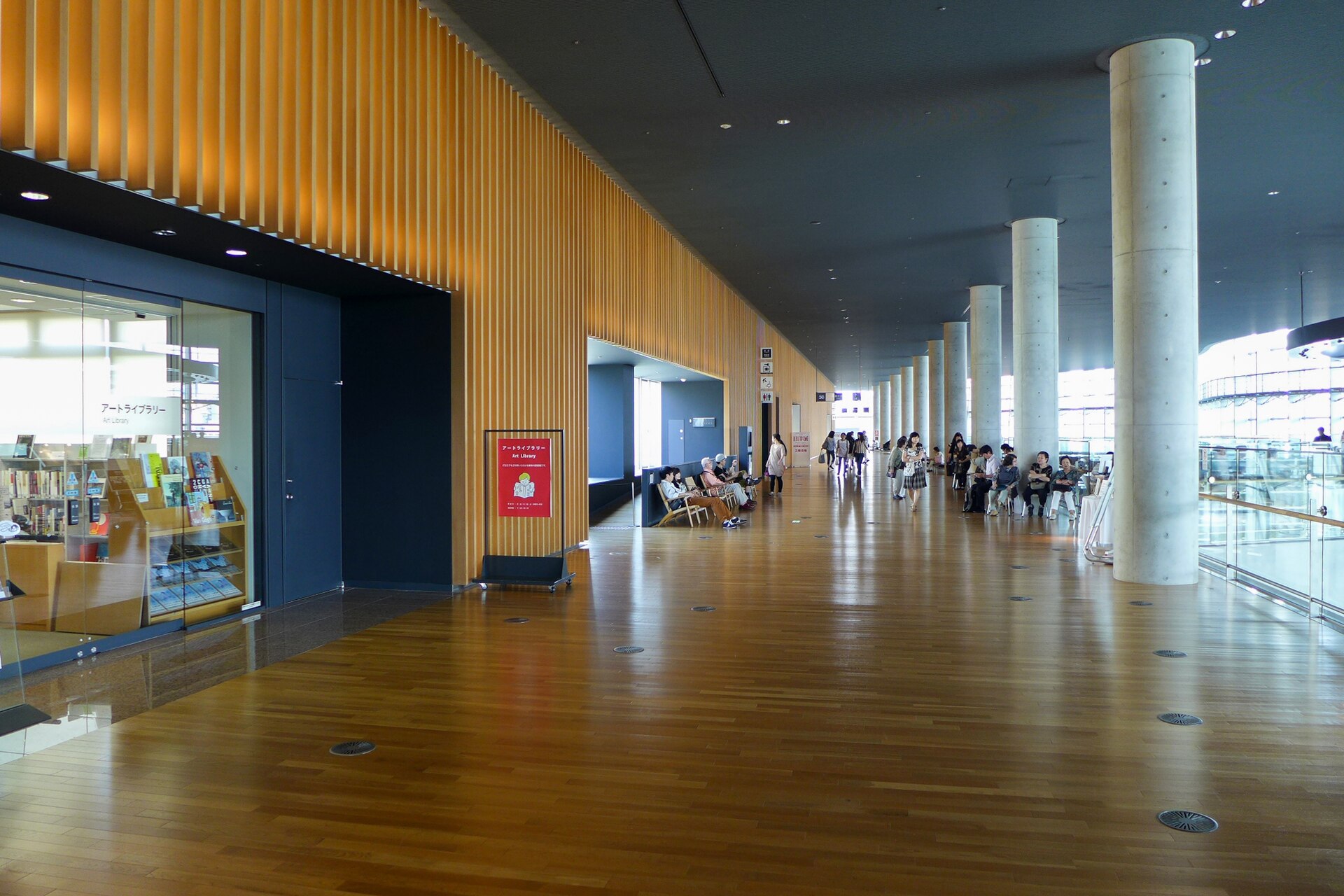
Photograph by Wpcpey · CC BY-SA 4.0 The Art Library
A public reference library on the third floor holding exhibition catalogues from the second half of the 20th century onward, together with other materials supporting research into modern and contemporary Japanese art; entry is free and does not require an exhibition ticket.
Special Exhibition Galleries 1E and 2E
The largest and most heavily used galleries in the building, one on each of the first and second floors, where the museum's own touring loan shows are staged; recent and current examples include a Tate Collection survey of light in art, a Keiichi Tanaami retrospective, a Picasso exhibition curated by the designer Paul Smith, and a Musee du Louvre Renaissance loan show.
Galleries 1A-1D and 2A-2D
Eight further galleries, each about 1,000 square metres with 8 metre ceilings, spread across the first and second floors and let to Japan's nationwide artist associations for their own annual exhibitions; more than fifty associations use these rooms across a year, from the long-established Nitten and Nika-kai fine-art societies to calligraphy groups such as Dokuritsu Sho and the Sogen Calligraphy Association, and specialist bodies covering photography and Nihonga painting.
Open-air exhibition areas, ground floor
Five outdoor spaces at ground level, used by the artist associations for sculpture and installation work that will not fit inside the standard galleries; they sit alongside the building's landscaped grounds, part of Kurokawa's stated intention that the center function as a museum set into a forest rather than a single enclosed hall.
What to see first
The wave facade
Kisho Kurokawa and Nihon Sekkei, 2006-2007An undulating glass curtain wall more than 150 metres long, the building's defining feature and the last completed design of Kurokawa's career; he died in October 2007, the same year it opened to the public3
The two inverted cones and Brasserie Paul Bocuse Le Musee
Kisho Kurokawa and Nihon Sekkei, with Paul Bocuse, 2007A structural gesture unique among Tokyo's museums, an inverted concrete cone rising through the atrium that carries a fine-dining room at its top; it was Paul Bocuse's first restaurant opened outside France9
Claude Monet: The Art of Monet and Its Legacy
The National Art Center, Tokyo, 7 April - 2 July 2007One of the opening year's special exhibitions and, by published attendance rankings, the second most visited exhibition anywhere in the world that year, establishing the new building's drawing power before its first anniversary13
LIGHT: Works from the Tate Collection
Tate, London, shown at NACT 12 July - 2 October 2023Around 120 works spanning two centuries of artists engaging with light, from Turner and Constable to James Turrell and Olafur Eliasson, with nearly 100 pieces shown in Japan for the first time10
Keiichi Tanaami: Adventures in Memory
The National Art Center, Tokyo, 7 August - 11 November 2024The first major retrospective of the Japanese artist and designer, covering more than sixty years of work from his PLAYBOY Japan art direction to his contemporary paintings, made at the age of 8812
Picasso, through the Eyes of Paul Smith
Musee National Picasso-Paris loan, curated by Paul Smith, 10 June - 21 September 2026A Picasso survey across fifteen thematic sections, from the Blue Period to late ceramics, staged as a collaboration between the Paris museum's holdings and a British fashion designer's eye rather than a conventional in-house curatorial reading7
Masterpieces of the Renaissance from the Musee du Louvre
Musee du Louvre loan, 9 September - 13 December 2026More than fifty Renaissance works on loan from the Louvre, centered on Leonardo da Vinci's Portrait of a Woman, also known as La Belle Ferronniere, on public view in Japan for the first time8
The Artist Associations' Exhibitions programme
Fifty-plus Japanese art associations, annually since 2007A standing, defining part of the building's identity rather than a single show: the same galleries that host international loan exhibitions are let out across the year to nationwide societies including Nitten, Nika-kai and multiple calligraphy associations, a role the National Art Center was built specifically to provide6
Exhibitions on now
- On now9 Sep to 13 Dec 2026Confirmed , 7 weeks ago
Past exhibitions here
- Closed10 Jun to 21 Sep 2026Confirmed · check before you travel
A forty-year wait for a venue
The National Art Center, Tokyo exists because Japan's own artist community asked for it decades before it was built. In 1978 the country's artistic associations called for a new exhibition venue in Tokyo large enough to host their annual shows, which had outgrown the exhibition halls available to them. It took more than twenty years for that call to turn into a plan: Japan's Agency for Cultural Affairs did not establish a preparatory committee until 1999. The following year, 2000, the architect Kisho Kurokawa and the firm Nihon Sekkei were commissioned to design the building. The institution was formally named the National Art Center, Tokyo in 2003, construction was completed in 2006, and the building opened to the public on 21 January 2007, becoming the fifth institution under Japan's Independent Administrative Institution National Museum of Art.
The wave facade, Kurokawa's last completed building
The center's defining feature is its facade: an undulating glass curtain wall running more than 150 metres along the building's south side, rippling in and out rather than sitting flat, built up from vertical glass louvres that catch and diffuse daylight across the atrium behind them. The building itself occupies one basement level and four floors above ground, spanning roughly 49,830 square metres in total, of which about 14,000 square metres is exhibition space, one of the largest such areas of any museum in Japan. Kurokawa described his intention as a museum set into a forest rather than a conventional enclosed hall, a concept reflected in the landscaped grounds around the building and the open-air exhibition areas at ground level. The National Art Center, Tokyo was Kurokawa's final completed architectural project; he died in October 2007, within the same year the building opened.
Two inverted cones, a library, and Paul Bocuse's dining room in the air
Behind the wave facade, the atrium opens into a space of about 3,180 square metres with a ceiling 21.6 metres high, and it is here that the building's most unusual structural gesture stands: two inverted concrete cones rising up through the open volume. The larger of the two carries a restaurant at its top, its dining room spreading out at the wide upper end of the cone and lit by the glass roof above; the space became Brasserie Paul Bocuse Le Musee, the French chef Paul Bocuse's first restaurant opened outside France, when the center opened in 2007. The smaller cone anchors the ground-floor lobby near the main entrance, close to the information desk and a cafe. A third floor above the galleries holds the Art Library, a public reference collection of exhibition catalogues from the second half of the twentieth century onward, free to enter without an exhibition ticket, alongside an auditorium and lecture rooms used for public programmes.
A museum built to hold nothing of its own
Unlike every other institution under the Independent Administrative Institution National Museum of Art, the National Art Center, Tokyo was built to have no permanent collection at all. Its own stated mission is to make a contribution to culture through art in order to advance mutual understanding and coexistence, and it pursues that mission entirely through temporary exhibitions rather than through works it owns. In practice this shapes the admission structure as much as the galleries: entry to the building, the Art Library, the shop and the cafes is free, and a ticket is required only for a specific exhibition, with each exhibition setting its own price rather than the museum charging one general admission fee. A visitor planning a trip around what NACT holds, in the way they might plan around a museum's Rembrandts or its Egyptian galleries, will find there is nothing to plan around beyond whatever happens to be on the walls on the day they arrive.
What has filled the galleries: from Monet to Picasso through Paul Smith's eyes
In its first year alone the center hosted sixty-nine exhibitions organized by outside art associations plus ten organized by the institution itself, drawing more than two million visitors before its first anniversary. One of those opening-year shows, Claude Monet: The Art of Monet and Its Legacy, running from 7 April to 2 July 2007, was, by published attendance rankings, the second most visited exhibition anywhere in the world that year. The special-exhibition programme since then has ranged widely: LIGHT, Works from the Tate Collection brought around 120 works spanning two centuries of artists engaging with light, from J.M.W. Turner and John Constable through to James Turrell and Olafur Eliasson, to Tokyo from 12 July to 2 October 2023, with nearly a hundred of those pieces shown in Japan for the first time. Keiichi Tanaami: Adventures in Memory, from 7 August to 11 November 2024, was the first major retrospective of the Japanese artist and designer, tracing more than sixty years of his work from his years as art director of the Japanese edition of PLAYBOY through to paintings made at the age of 88. In 2026 the galleries turned first to Picasso, through the Eyes of Paul Smith, a survey of Pablo Picasso's career across fifteen thematic sections drawn from the Musee National Picasso-Paris and curated by the British fashion designer Paul Smith rather than by an in-house art historian, running 10 June to 21 September. It was followed from 9 September to 13 December 2026 by Masterpieces of the Renaissance from the Musee du Louvre, more than fifty works on loan built around Leonardo da Vinci's Portrait of a Woman, also known as La Belle Ferronniere, on public display in Japan for the first time.
Japan's art associations and the country's largest exhibition venue
Alongside the loan exhibitions the National Art Center exists, in large part, for the reason its founders first asked for it in 1978: to give Japan's nationwide artist associations somewhere large enough to hold their own annual shows. More than fifty associations use the center's galleries across a typical year, from long-established fine-art societies such as Nitten, the Japan Fine Arts Exhibition, and Nika-kai, to calligraphy organizations including Dokuritsu Sho and the Sogen Calligraphy Association, and specialist bodies covering photography and Nihonga painting. These exhibitions are not curated by the center's own staff; each association selects and hangs its own show, and the galleries simply provide the space, ticketing and infrastructure. Combined with the loan exhibitions, this dual role has made the building one of the most heavily visited art venues in Japan: it passed ten million cumulative visitors in 2010, twenty million in 2015, and thirty million by 2018, and recorded 2,271,487 visitors in 2023 alone. The current Director General, appointed in April 2026, is Tomio Sugaya.
What visitors say
Visitors and critics separate the building from what is inside it far more than at most museums, because there is no fixed collection to anchor an opinion about the place as a whole. The architecture itself, the wave facade and the atrium's inverted cones, draws close to universal praise and is repeatedly described as worth visiting on its own; reaction to the programme depends entirely on which exhibition happens to be running, so a visitor's overall impression swings with the calendar rather than settling into a single verdict the way it would at a museum with a permanent collection.
What is praised, what is criticised
- Praised: The wave-facade exterior and the atrium's cone structures are consistently called out as architecture worth seeing in their own right, independent of any exhibition on show
- Praised: The building's amenities, the cafes, the restaurant atop the larger cone, and the free Art Library, draw specific repeat mentions as reasons to stay after seeing an exhibition
- Praised: The special exhibitions on loan from major international collections are frequently praised for their scale and for bringing works to Japan that have not travelled there before
- Criticised: Because the museum holds no permanent collection, visitors repeatedly note they must check well ahead of a visit to know what will actually be on show, unlike a museum whose galleries are the same on any given day
- Criticised: Some visitor reviews describe individual special exhibitions as narrow in scope or as drawing long queues at peak times, a complaint that attaches to whichever show is running rather than to the institution itself
Ratings on other platforms
TripAdvisor: 4.3 from 1,332 ratings, read 21 August 2026
A platform average is a tertiary source: it moves, it is not audited, and we quote no visitor's words.
Questions about National Art Center, Tokyo
Where is National Art Center, Tokyo?
7-22-2 Roppongi, Minato-ku, Tokyo 106-8558, Japan.
How much does it cost to visit?
Building entry (no exhibition): free; Adult, current special exhibition (example: Picasso, through the Eyes of Paul Smith, 2026): JPY 2400; College student, same exhibition: JPY 1400; High school student, same exhibition: JPY 1000; Under 15 / visitors with disability plus one companion, special exhibitions generally: free. As confirmed 21 August 2026.
When is it open?
Wednesday-Monday (special exhibitions) 10:00-18:00; Friday-Saturday (special exhibitions, extended) 10:00-20:00. Closed: Tuesday, except when a national holiday falls on a Tuesday, in which case the museum stays open and closes on the following weekday instead. The New Year holiday period. As confirmed 21 August 2026.
How do you get there?
Tokyo Metro Chiyoda Line: Direct underground access from Nogizaka Station, Exit 6; Tokyo Metro Hibiya Line: About 5 minutes on foot from Roppongi Station, Exit 4a; Toei Oedo Subway Line: About 4 minutes on foot from Roppongi Station, Exit 7.
What should you see first?
The wave facade (Kisho Kurokawa and Nihon Sekkei, 2006-2007); The two inverted cones and Brasserie Paul Bocuse Le Musee (Kisho Kurokawa and Nihon Sekkei, with Paul Bocuse, 2007); Claude Monet: The Art of Monet and Its Legacy (The National Art Center, Tokyo, 7 April - 2 July 2007); LIGHT: Works from the Tate Collection (Tate, London, shown at NACT 12 July - 2 October 2023); Keiichi Tanaami: Adventures in Memory (The National Art Center, Tokyo, 7 August - 11 November 2024); Picasso, through the Eyes of Paul Smith (Musee National Picasso-Paris loan, curated by Paul Smith, 10 June - 21 September 2026).
What we could not confirm
- No source read for this record gives a single, disclosed total construction budget for the 2006 building
- The exact split between the Independent Administrative Institution National Museum of Art's overall operating budget and the National Art Center's own share is not stated in any source read for this record
- No verified interior photograph of the Special Exhibition Galleries themselves, the Artist Associations' galleries 1A-1D and 2A-2D, or the open-air exhibition areas was found on Wikimedia Commons for this record; only the atrium/cone area and the Art Library corridor could be verified as showing those specific spaces
Images
Sources
- 1The National Art Center, Tokyo, English homepage (hours, closed days, current exhibitions) nact.jp/english/
- 2The National Art Center, Tokyo, About the National Art Center, Tokyo (history, mission, founding timeline, no permanent collection, exhibition space size) nact.jp/english/introduce/about.html
- 3Wikipedia (English), The National Art Center, Tokyo (architect, wave facade, opening date, building size, visitor numbers, coordinates) en.wikipedia.org/wiki/The_National_Art_Center,_Tokyo
- 4The National Art Center, Tokyo, Access page (subway stations and exits, address) nact.jp/english/information/access/
- 5The National Art Center, Tokyo, Opening Hours / Contact Information page (phone number, address) nact.jp/english/information/inquiry/
- 6The National Art Center, Tokyo, Artist Associations' Exhibitions page (participating associations, programme structure) nact.jp/english/exhibition_public/
- 7The National Art Center, Tokyo, Picasso, through the Eyes of Paul Smith exhibition page (dates, admission prices, content) nact.jp/english/exhibition_special/2026/picasso_paulsmith/
- 8The National Art Center, Tokyo, Masterpieces of the Renaissance from the Musee du Louvre exhibition page (dates, admission prices, content, Leonardo da Vinci painting) nact.jp/english/exhibition_special/2026/louvre2026/
- 9The National Art Center, Tokyo, Interior of the National Art Center, Tokyo, Wikimedia Commons category (atrium, inverted cones, Brasserie Paul Bocuse, Art Library interior views) commons.wikimedia.org/wiki/Category:Interior_of_the_National_Art_Center,_Tokyo
- 10The National Art Center, Tokyo, LIGHT: Works from the Tate Collection exhibition page (dates, content, scale) nact.jp/english/exhibition_special/2023/tate/index.html
- 11The National Art Center, Tokyo, Welcome to the NACT page (ticketing structure, free building entry, facilities list, accessibility) nact.jp/en/info.html
- 12The National Art Center, Tokyo, Keiichi Tanaami: Adventures in Memory exhibition page (dates, retrospective scope) nact.jp/english/exhibition_special/2024/keiichitanaami/
- 13Tokyo Art Beat, Claude Monet: L'art de Monet et sa Posterite listing (2007 exhibition dates) tokyoartbeat.com/en/events/-/2007%2FA7A7
- 14Japan Manifest, Joe Wu, 'The National Art Center, Tokyo: Japan's Empty Museum' (characterisation of the no-collection exhibition model) japanmanifest.com/the-national-art-center-tokyo/
- 15TripAdvisor, The National Art Center, Tokyo listing ( aggregate rating and review-preview summary, read 21 August 2026) tripadvisor.com/Attraction_Review-g14129735-d1170018-Reviews-The_National_Art_Center_Tokyo-Roppongi_Minato_Tokyo_Tokyo_Prefecture_Kanto.html
- 16Independent Administrative Institution National Museum of Art, The National Art Center, Tokyo page (governance, institutional structure, mission) artmuseums.go.jp/en/museums/nact
- 17The National Art Center, Tokyo, Floor Map page (gallery numbering 1A-1E, 2A-2E, 3A-3B, facility locations by floor) nact.jp/english/information/floormap/
- 18Wikidata, Q1362638 (; identity confirmation, coordinates, official website, inception date) wikidata.org/wiki/Q1362638
- 19Wikimedia Commons, File:The National Art Center, Tokyo 2023.jpg (licence verification: CC BY-SA 4.0, Akonnchiroll) commons.wikimedia.org/wiki/File:The_National_Art_Center,_Tokyo_2023.jpg
- 20Wikimedia Commons, File:2018 National Art Center, Tokyo 2.jpg (licence verification: CC BY-SA 4.0, Kakidai) commons.wikimedia.org/wiki/File:2018_National_Art_Center,_Tokyo_2.jpg
- 21Wikimedia Commons, File:Foyer of the National Art Center, Tokyo January 2019.jpg (licence verification: CC BY-SA 4.0, Nick-D) commons.wikimedia.org/wiki/File:Foyer_of_the_National_Art_Center,_Tokyo_January_2019.jpg
- 22Wikimedia Commons, File:National Art Center Tokyo Interior 201505.jpg (licence verification: CC BY-SA 4.0, Wpcpey) commons.wikimedia.org/wiki/File:National_Art_Center_Tokyo_Interior_201505.jpg


