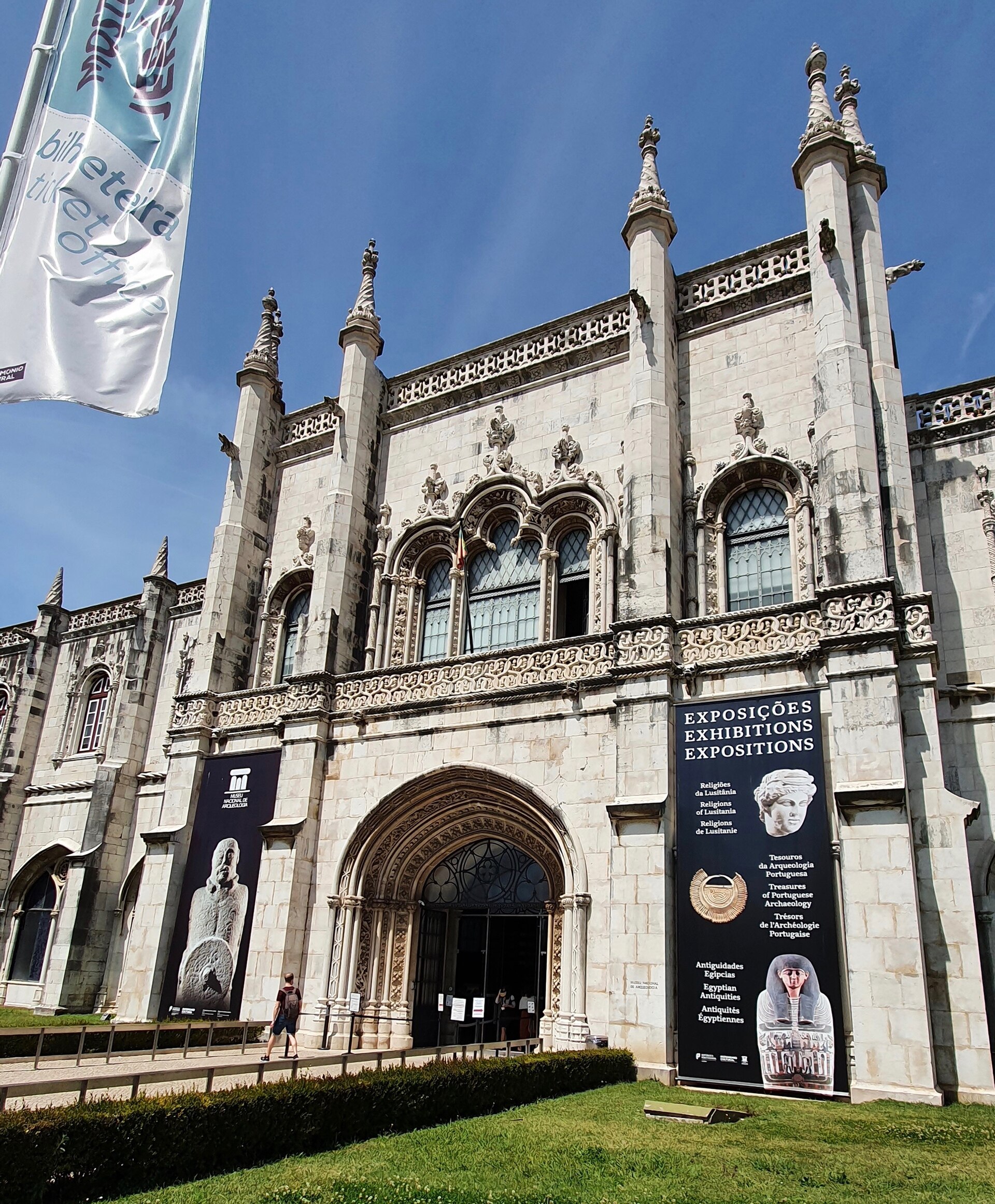
The Neo-Manueline entrance facade of the National Archaeology Museum, the west wing of the Jeronimos Monastery in Belem, Lisbon, photographed with the museum's own exhibition banners hung across the facade and its name visible on the banner at lower left.
Yair Haklai · Photograph by Yair-haklai · CC BY-SA 4.0National Archaeology Museum
Museum · Museu Nacional de Arqueologia · Founded 1893
Closure confirmed 26 August 2026 · 18 sources
Closed to visitors - not permanently
National Archaeology Museum is currently closed. Not open and not permanently closed; a dated, sourced temporary closure for renovation. The museum's own site (museunacionalarqueologia.gov.pt) was unreachable across five independent methods tried on 2026-08-26: a direct curl request (connection timed out against IP 62.193.192.49 on both port 80 and 443), WebFetch (connection refused, same IP), the in-app Claude Browser (navigation denied), the user's own local Chrome via the claude-in-chrome extension (loaded a browser error page), and a text-proxy fetch via r.jina.ai (HTTP 422). All five failed identically against the same server, consistent with a genuine current outage rather than a bot block. A Google search independently confirms the museum's own site carries a page titled 'Museu de Arqueologia encerrado para visitantes ate 2025' at museunacionalarqueologia.gov.pt/?p=10949, corroborating the closure without depending on the outage. In place of the museum's own page, this record's closure date and status are sourced to a Lusa wire report in which the museum's own director, Antonio Carvalho, is quoted on the record giving 19 April 2022 as the closure date and describing the building as closed to the public for a full renovation of the structure and a complete redesign of the exhibitions, funded through Portugal's Plano de Recuperacao e Resiliencia (PRR, the EU-backed Recovery and Resilience Plan).
Expected to reopen: no reopening date has been set for the public; the first phase of PRR-funded works (interior, roofing, structural reinforcement, and facade cleaning and conservation) was targeted for completion around mid-2026, but the museum's director and the Ministry of Culture say a second phase is still needed to finish the renovation, has a different and as yet unsecured funding source, and carries no date · a target, not yet confirmed
Closure confirmed from the institution's own page. We re-check this page on a schedule and will update it, from the institution's own announcement, the moment it reopens.
On this page 14 sections
ContentsClose
The strength of the collection is its breadth within a single Iberian archaeological tradition: more than 3,200 recorded find-sites feeding six distinct departments, from the largest ensemble of Galaico-Lusitanian granite warrior statues on the peninsula to the largest body of Roman mosaics and classical sculpture identified anywhere in Portugal, a c.30,000-piece Roman coin collection, and, set apart from the rest of the holdings entirely, one of the country's largest Egyptian collections. The museum also holds, rather than merely displays a cast of, the actual Upper Palaeolithic remains from Abrigo do Lagar Velho, among the most closely studied hominin finds associated with the Neanderthal-modern-human interbreeding debate in Iberia.
| Local name | Museu Nacional de Arqueologia |
|---|---|
| Kind | Museum |
| Founded | Decreed 20 December 1893 by archaeologist Jose Leite de Vasconcelos, with the backing of Bernardino Machado; the collection moved into the west wing of the Jeronimos Monastery, granted to it on 20 November 1900, and opened there in April 1906 |
| City and country |  Lisbon, Portugal Lisbon, Portugal |
| Address | Praca do Imperio, 1400-206 Lisbon, Portugal |
| Website | museunacionalarqueologia.gov.pt |
| Status | Closed temporarily, confirmed |
| Record last verified |
Visiting
- Hours (pre-closure)
- Tue-Sun10:00 to 18:00Last entry 17:30. Last published hours before the closure; the museum is not open to visitors while the PRR renovation continues.
- Closed
- Monday. 1 January. Easter Sunday. 1 May. 13 June. 24 December. 25 December.
- Admission (pre-closure)
- AdultEUR 15Last published price before the closure; raised from EUR 8 on 1 January 2025 as part of a general increase across national museums, monuments and palaces. The museum is not currently selling tickets while closed for renovation; this figure is what a reader should expect on reopening, not a price bookable today.
Free entry: Citizens and residents of Portugal get 52 free-entry days per year, on any day of the week, at 37 Ministry of Culture museums, monuments and palaces including this one, under a scheme effective from 1 August 2024. Registration is by Cartao de Cidadao and tax number at the ticket counter on the first visit.- Do I need to book?
- Not applicable: the museum is closed to the public for renovation and is not selling tickets or timed entries.
- Address
- Praca do Imperio, 1400-206 Lisbon, Portugal MapTram Tram 15E, from Praca da Figueira or Cais do Sodre in central Lisbon, alights at the Mosteiro dos Jeronimos stop directly outside the building.
Train CP's Cascais Line, direction Cascais, to Belem station; about seven minutes from Cais do Sodre, followed by a ten-minute walk to the monastery.
Bus Carris lines 714, 727, 728, 729 and 751 stop at Mosteiro dos Jeronimos or Belem - Palacio.
Tram (alternative source) Tram 15, cited independently as the standard route from central Lisbon to the museum. - Website
- museunacionalarqueologia.gov.pt
- Telephone
- +351 213 620 000
- [email protected]
Before you go how long, access, photography, bags, eating, shop
- How long to allow
- Before the closure, visitor commentary on Tripadvisor described the collection as thorough but housed in a smaller footprint than comparable national museums, with cases and labels set low along the cloister-facing galleries.
- Access
- Not established while the museum is closed; not stated on any source reached for this record.
- Photography
- Not established while the museum is closed; not stated on any source reached for this record.
- Bags
- Not established while the museum is closed; not stated on any source reached for this record.
- Eating
- Not established while the museum is closed; not stated on any source reached for this record.
- Shop
- Not established while the museum is closed; not stated on any source reached for this record.
The museum is closed (see above). These are the figures published before the closure, kept here for a visitor planning ahead rather than presented as bookable today, and you can check the current position at the source we used. We will re-confirm them once it reopens.
What is inside
Prehistoric and proto-historic Portugal
The museum's founding collection: goldwork of the Bronze and Iron Ages, among the largest holdings of archaic Iberian gold in Portugal at roughly a thousand pieces, including the Vilas Boas torques, alongside funerary stelae and grave goods drawn from more than 3,200 recorded sites across the country.
Galaico-Lusitanian sculpture (the warrior statues)
Granite statues of armed warriors -- the 'guerreiros galaico-lusitanos' -- shown with shields, short swords, torques and armour carved in low relief. The museum holds the largest and most complete ensemble of this sculpture type identified anywhere on the Iberian peninsula.
Roman Portugal: mosaics, inscriptions and coins
The largest collection of Roman mosaics in Portugal, including pavements from Torre de Palma and Milreu depicting the voyages of Ulysses, the myth of Orpheus and the Labours of Hercules; a large lapidary collection of Latin funerary and votive inscriptions; and a numismatic collection of roughly 30,000 Roman coins.
Classical sculpture
The largest collection of classical sculpture identified on Portuguese territory, centred on the marble Apollo from Herdade do Alamo in Alcoutim and a group of monumental togate statues recovered at Mertola.
Egyptian antiquities
Portugal's largest Egyptian collection, some 500 to 584 objects spanning the pre-dynastic period to the Coptic era, weighted toward funerary art: mummies of people and animals, painted sarcophagi, amulets and hieroglyph-inscribed tomb stelae.
Ethnography
A Portuguese and African ethnographic collection assembled under the museum's original 'Museu Etnografico Portugues' mandate to document material culture alongside archaeological finds, reflecting founder Jose Leite de Vasconcelos's broader project of documenting the life of the 'Portuguese man.'
What to see first
Guerreiros galaico-lusitanos (Galaico-Lusitanian warrior statues)
Iron Age Lusitanian sculptors, pre-Roman IberiaThe museum holds the largest and most complete ensemble of this granite warrior-statue type known on the Iberian peninsula; the figures wear torques and carry shields and short swords carved in relief, and several stand as if guarding the museum's own entrance.13
Torques de Vilas-Boas and the prehistoric gold collection
Bronze and Iron Age goldsmiths, IberiaRoughly a thousand pieces of archaic goldwork, among the finest such holdings in Portugal, anchored by the gold torques recovered at Vilas Boas.15
Apollo from Herdade do Alamo
Roman-era sculptor, AlcoutimCentrepiece of the largest classical-sculpture collection identified on Portuguese soil.13
Roman mosaics from Torre de Palma and Milreu
Roman workshops, LusitaniaThe largest collection of Roman mosaics in Portugal, with pavements depicting the voyages of Ulysses, the myth of Orpheus and the Labours of Hercules.15
Egyptian funerary collection
Ancient Egyptian, pre-dynastic to CopticPortugal's largest Egyptian holding, with mummies, painted sarcophagi and hieroglyph-inscribed stelae spanning several thousand years.13
Roman numismatic collection
Roman mints, variousApproximately 30,000 Roman coins, one of the museum's deepest single holdings by object count.13
Remains from Abrigo do Lagar Velho (the 'Lapedo child')
Upper Palaeolithic, discovered 28 November 1998 at Lapedo, Leiria districtThe roughly 28,000-year-old skeleton of a child of about four, whose skull, jaw, teeth and postcranial bones were interpreted by the excavating team as showing a mosaic of early-modern-human and Neanderthal features, making it one of the most discussed finds in the debate over Neanderthal and modern-human interbreeding in Iberia. The remains are held by this museum; a replica is on view at the Abrigo do Lagar Velho interpretation centre near the find site.14
A monastery wing built for kings, given to a museum
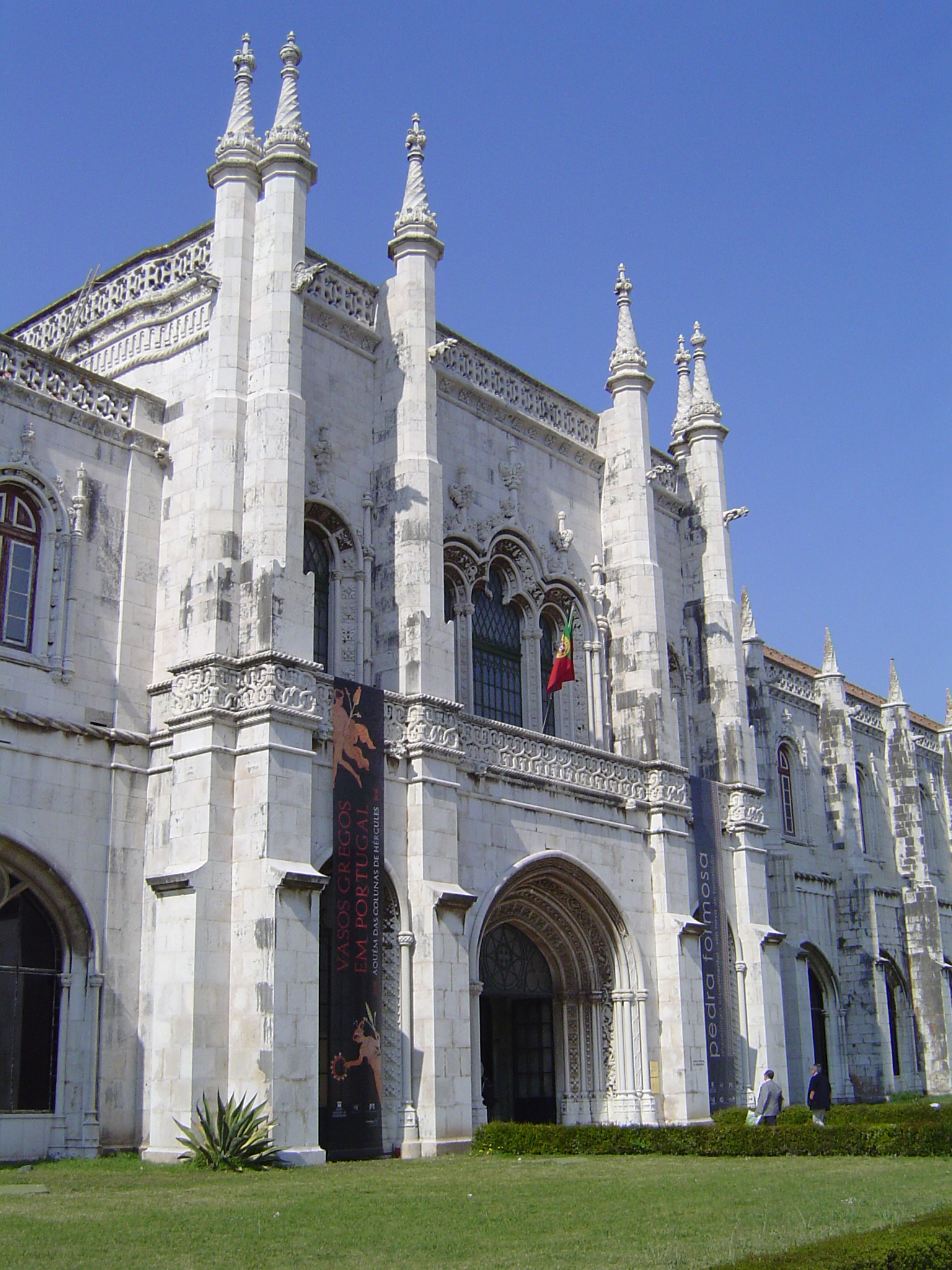
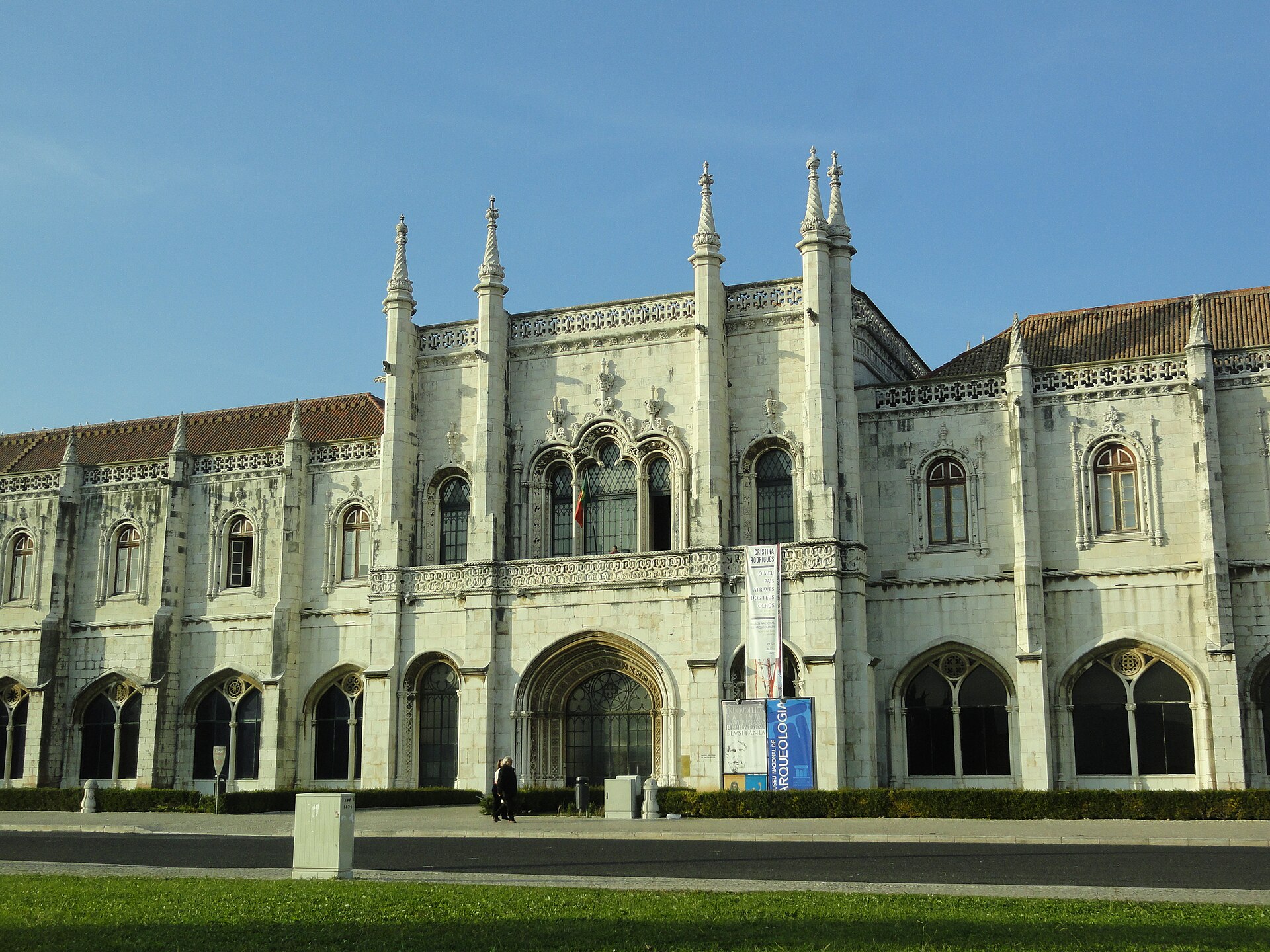
The museum occupies the western wing of the Mosteiro dos Jeronimos in Belem, a UNESCO World Heritage property whose eastern range, and the church between them, belong to separate institutions and are not part of this museum. The wing itself was not part of the sixteenth-century monastery core: it is a nineteenth-century addition, built in a Neo-Manueline style that quotes the twisted piers, maritime-rope moulding and finialled pinnacles of the original cloister next door without literally being one. The Portuguese state granted this wing to the museum on 20 November 1900, and the collection moved in from its previous home, opening to the public in April 1906.
The facade a visitor meets today, three arched Manueline windows over a deep entrance archway flanked by exhibition banners, is the same wing photographed for this record. It stands apart from the church of Santa Maria de Belem and from the cloister proper, both of which face the same square, Praca do Imperio, from the same UNESCO-listed complex.
Founded to study the Portuguese man
The museum's founder, the archaeologist Jose Leite de Vasconcelos, secured the decree that created it on 20 December 1893, with the political backing of Bernardino Machado. His founding brief was not narrowly archaeological: he set out, in his own words, to gather the material evidence needed for a total knowledge of the life of the 'Portuguese man' -- archaeology, ethnography, numismatics and popular material culture together, under one roof, an ambition that still shows in the ethnography holdings alongside the excavated collections. Leite de Vasconcelos was also the first scholar to study the religions of pre-Roman Lusitania exhaustively and methodically, work that grew directly out of the museum's early collecting.
The institution has been renamed and re-administered several times since, and today sits within Museus e Monumentos de Portugal, the public body that also runs the neighbouring Jeronimos Monastery and a national network of museums and palaces; its collecting mandate, however, both archaeological finds from Portuguese soil and imported antiquities such as the Egyptian holdings, has stayed continuous since Leite de Vasconcelos's own tenure.
What is inside: six departments of finds
The collection runs from the Bronze Age to the early modern period and spans more than 3,200 recorded archaeological sites across Portugal, alongside a substantial body of material that has nothing to do with Portuguese soil at all: several hundred Egyptian objects, among the largest such holdings in the country. Visitors moving through the galleries before the closure met, in sequence, the founding prehistoric and proto-historic collection of goldwork and funerary stelae; a lapidary gallery of granite Galaico-Lusitanian warrior statues, unmatched anywhere else on the peninsula for completeness; Roman Portugal in mosaics, inscriptions and roughly 30,000 coins; the country's largest body of classical sculpture, centred on the marble Apollo from Herdade do Alamo; the Egyptian funerary material; and an ethnographic collection that carries forward the founder's original, broader brief.
The full detail of each department is set out in the inside listing on this page. None of it is currently viewable in the building: the galleries are empty of the public while the renovation proceeds, though the collection itself remains in the museum's own care throughout.
Closed since 2022: the PRR renovation and its delays
The museum's own director, Antonio Carvalho, has put the closure date on the record: 19 April 2022. The trigger was a decision, taken in 2021, to fund a full renovation of the building and a complete redesign of its exhibitions through Portugal's Plano de Recuperacao e Resiliencia, the EU-backed Recovery and Resilience Plan (PRR). The scope is not cosmetic: interior works, roof repair, structural reinforcement, and separately, cleaning and conservation of the exterior facades, with a first-phase budget in the region of 24.5 million euros.
That first phase was, as of the most recent reporting reached for this record, on course to finish around the middle of 2026, with more than 28 percent of the planned PRR investment already executed as of January 2025, according to the Secretary of State for Culture, Maria de Lurdes Craveiro, who told the Portuguese broadcaster RTP that the museum would reopen in 2026 and that the entire planned works programme had needed revising along the way. That framing did not hold for long: in May 2025, Publico reported that the works would not be finished by the PRR's own funding deadline of 30 June 2026, prompting the Minister of Culture, Dalila Rodrigues, to insist publicly that the project would never be left unfinished and that funding, PRR or otherwise, would keep flowing. Her own language conceded the point she was pushing back on: some projects, she said, might be 'redimensionados ou substituidos' -- rescaled or substituted -- because Portugal's public-works sector could not absorb every PRR-funded project on its original schedule.
By November 2025, the museum's own director was describing a second phase of works, needed to complete the renovation, that had a different funding source not yet secured and, in his own words, no date foreseen for reopening. That is the state of the record as this page was written: a first phase nearing completion, and a second phase, un-dated, standing between the building and its public.
Arqueologia na Rua: a museum without walls
Rather than go dark for the length of the renovation, the museum built a public-facing programme around the closure itself. Its centrepiece is a 228.89-metre mural wrapped around the hoarding that now rings the Jeronimos Monastery site, running from the Museu da Marinha end to the entrance of the monastery cloister, unveiled in November 2025 under the name 'Arqueologia na Rua' -- Archaeology in the Street. The mural reproduces objects from the museum's own collection in sequence: material connected to the sea near the Museu da Marinha end, objects drawn from Portuguese territory and from the wider civilisations represented in the collection along the stretch that fronts the museum itself, and religious material near the monastery church. It is captioned in multiple languages, legible to passengers on the Cascais line trains that run past, and paired with a digital twin of the same imagery online.
The museum's education service runs guided walks along the mural when weather allows, and the director has described the closure years as carrying, in his own phrase, an 'agridoce' -- bittersweet -- character: watching a much-loved museum sit empty while working toward what he has called a genuinely new museum on the other side of the rebuild.
Sharing a UNESCO monastery with the navy museum
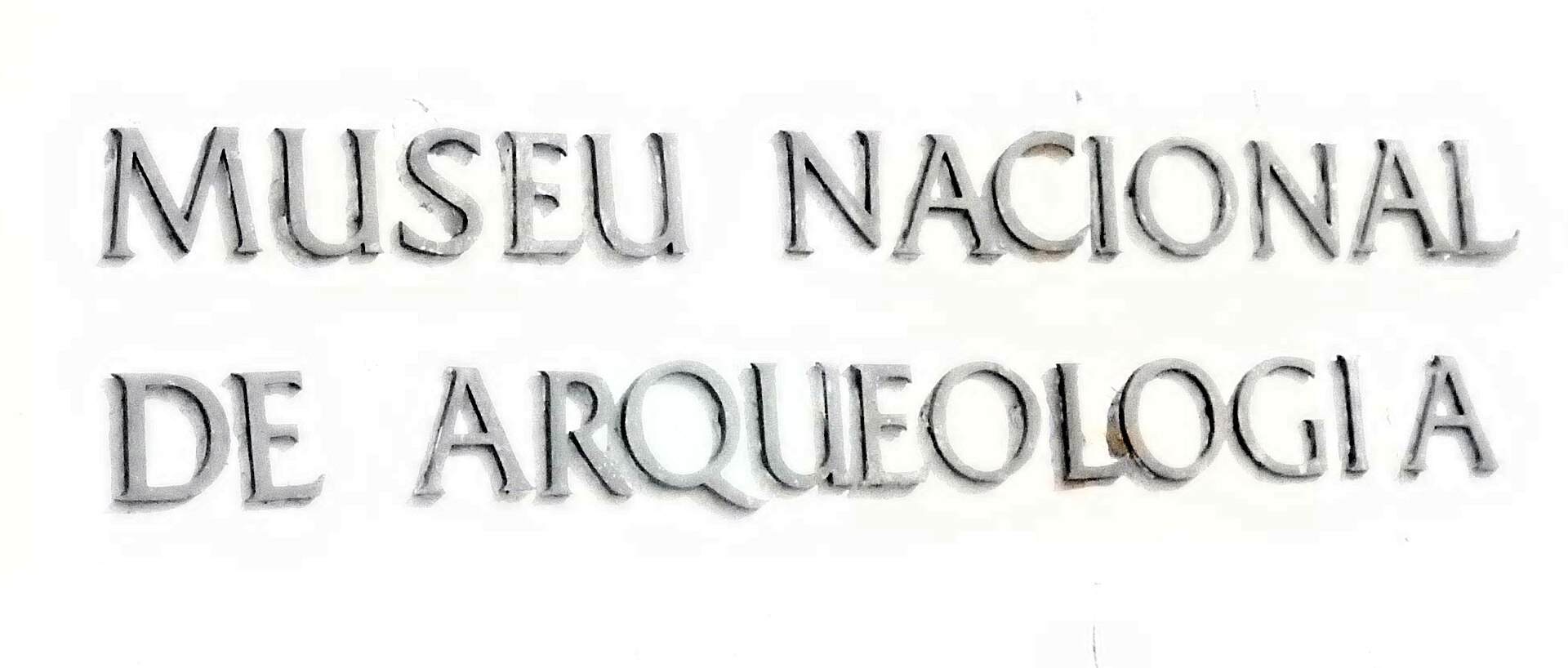
The Jeronimos Monastery complex is shared ground, and it is worth being precise about which institution is which. The church of Santa Maria de Belem in the centre of the site is a working parish church, not part of either museum. The monastery's eastern wing, and a modern extension behind it, house the separate Museu de Marinha, Portugal's national maritime museum, an entirely different institution with its own collection, its own administration and its own history. This record, and the photographs attached to it, concern only the western wing: the Neo-Manueline range granted to the National Archaeology Museum in 1900, the building whose facade faces Praca do Imperio and carries the museum's own name in stone lettering above its arched entrance.
What visitors say
Pre-closure visitor commentary described a genuinely deep, well-labelled archaeological collection inside a striking Manueline setting, let down for some visitors by the scale of the display space relative to national museums abroad and by uneven staff service.
What is praised, what is criticised
- Praised: The range and density of the collection -- prehistoric gold, Roman mosaics, Egyptian funerary material and the warrior statues in one visit
- Praised: The Neo-Manueline building itself, inside the west wing of the Jeronimos Monastery, as a setting for the objects
- Criticised: A footprint that several visitors felt was small for a national collection of this range, especially set against expectations from the grandeur of the monastery outside
- Criticised: Object labels mounted low, on knee-height cases, forcing repeated bending to read them
- Criticised: Guided tour groups blocking sequential display cases for extended periods
- Criticised: Limited English-language labelling in parts of the galleries
- Criticised: Inconsistent staff helpfulness, raised in multiple independent reviews
Ratings on other platforms
Tripadvisor: 3.5 from 253 ratings, read 26 August 2026
A platform average is a tertiary source: it moves, it is not audited, and we quote no visitor's words.
Questions about National Archaeology Museum
Where is National Archaeology Museum?
Praca do Imperio, 1400-206 Lisbon, Portugal.
How much does it cost to visit?
Adult: EUR 15. As confirmed 26 August 2026.
When is it open?
Tue-Sun 10:00-18:00. Closed: Monday. 1 January. As confirmed 26 August 2026.
How do you get there?
Tram: Tram 15E, from Praca da Figueira or Cais do Sodre in central Lisbon, alights at the Mosteiro dos Jeronimos stop directly outside the building; Train: CP's Cascais Line, direction Cascais, to Belem station; about seven minutes from Cais do Sodre, followed by a ten-minute walk to the monastery; Bus: Carris lines 714, 727, 728, 729 and 751 stop at Mosteiro dos Jeronimos or Belem - Palacio; Tram (alternative source): Tram 15, cited independently as the standard route from central Lisbon to the museum.
What should you see first?
Guerreiros galaico-lusitanos (Galaico-Lusitanian warrior statues) (Iron Age Lusitanian sculptors, pre-Roman Iberia); Torques de Vilas-Boas and the prehistoric gold collection (Bronze and Iron Age goldsmiths, Iberia); Apollo from Herdade do Alamo (Roman-era sculptor, Alcoutim); Roman mosaics from Torre de Palma and Milreu (Roman workshops, Lusitania); Egyptian funerary collection (Ancient Egyptian, pre-dynastic to Coptic); Roman numismatic collection (Roman mints, various).
What we could not confirm
- No confirmed reopening date exists for the second phase of the renovation; this record will need re-checking once the museum or the Ministry of Culture publishes one.
- No verified free-licence photograph of any interior gallery or object display was located on Wikimedia Commons for this record; all confirmed images show the exterior only.
- The museum's own website was unreachable by every method tried on 2026-08-26; its content, including any updated hours, prices or reopening notice posted after that date, has not been checked.
Images
Sources
- 1Wikimedia Commons, File:Corpo central do Museu Nacional de Arqueologia.jpg (photographer Yair Haklai, CC BY-SA 4.0) commons.wikimedia.org/wiki/File:Corpo_central_do_Museu_Nacional_de_Arqueologia.jpg
- 2Wikimedia Commons, File:Balcon del Museo Nacional de Arqueologia de Lisboa.jpg (photographer Jl FilpoC, CC BY-SA 4.0) commons.wikimedia.org/wiki/File:Balc%C3%B3n_del_Museo_Nacional_de_Arqueolog%C3%ADa_de_Lisboa.jpg
- 3Wikimedia Commons, File:MuseuArqueo-CCBYSA.jpg (photographer Scalleja, CC BY-SA 2.0) commons.wikimedia.org/wiki/File:MuseuArqueo-CCBYSA.jpg
- 4Wikimedia Commons, File:Museu Nacional de Arqueologia (11569460596).jpg (photographer Anne-Lotte O'Dwyer, CC BY-SA 2.0) commons.wikimedia.org/wiki/File:Museu_Nacional_de_Arqueologia_(11569460596).jpg
- 5Wikimedia Commons, File:Portugal National Museum of Archaeology (42512958672).jpg (photographer Mike Steele, CC BY 2.0) commons.wikimedia.org/wiki/File:Portugal_National_Museum_of_Archaeology_(42512958672).jpg
- 6Agencia Lusa via Observador, 'Museu Nacional de Arqueologia leva acervo para a rua enquanto decorrem obras do PRR', 27 November 2025 observador.pt/2025/11/27/museu-nacional-de-arqueologia-leva-acervo-para-a-rua-enquanto-decorrem-obras-do-prr/
- 7RTP / Antena 1, 'Museu Nacional de Arqueologia reabre em 2026', updated 16 January 2025 rtp.pt/noticias/cultura/museu-nacional-de-arqueologia-reabre-em-2026_a1627903
- 8Agencia Lusa / Publico, 'Ministra diz que nao ficarao por acabar obras no Museu de Arqueologia e no Sao Carlos', 28 May 2025 publico.pt/2025/05/28/culturaipsilon/noticia/ministra-nao-ficarao-acabar-obras-museu-arqueologia-sao-carlos-2134693
- 9Cultura Portugal (official Portuguese government culture portal), museum listing page culturaportugal.gov.pt/pt/conhecer/local/mmp-locais/museu-nacional-de-arqueologia/
- 10ECO (SAPO), 'Precos de entrada em museus e monumentos nacionais aumentam ate 7 euros', 1 January 2025 eco.sapo.pt/2025/01/01/precos-de-entrada-em-museus-e-monumentos-nacionais-aumentam-ate-7-euros/
- 11Tripadvisor, Museu Nacional de Arqueologia reviews and rating page, read 26 August 2026 tripadvisor.com/Attraction_Review-g189158-d3238655-Reviews-Museu_Nacional_de_Arqueologia-Lisbon_Lisbon_District_Central_Portugal.html
- 12Portugal.gov.pt (XXIV Governo Constitucional), 'Novo regime de gratuitidade em museus e monumentos', 1 August 2024 portugal.gov.pt/pt/gc24/comunicacao/noticia?i=novo-regime-de-gratuitidade-no-museu-e-monumentos
- 13Wikipedia (English), 'National Museum of Archaeology, Lisbon' -- , used for identity, founding and collection-department facts only en.wikipedia.org/wiki/National_Museum_of_Archaeology,_Lisbon
- 14Wikipedia (English), 'Abrigo do Lagar Velho' -- , used for the Lapedo child find and its current holding institution only en.wikipedia.org/wiki/Abrigo_do_Lagar_Velho
- 15Google Arts and Culture, 'Museu Nacional de Arqueologia - 125 anos' -- museum-partnered content, used for founding history and collection highlights artsandculture.google.com/story/museu-nacional-de-arqueologia-125-anos/ZwVBeMlFhx_cLQ?hl=pt-PT
- 16The Jeronimos Tour, 'How to Get to Jeronimos Monastery: Tram, Train, Bus, Uber and Parking' thejeronimostour.com/blog/how-to-get-to-jeronimos-monastery
- 17GoLisbon, Archaeology Museum visitor page golisbon.com/sight-seeing/archeology-museum.html
- 18Wikidata, Q1954384 -- , used for identity and coordinate cross-check only wikidata.org/wiki/Q1954384


.jpg)
.jpg)