National Archaeological Museum
Museum · Ethniko Archaiologiko Mouseio · Founded 1829
Open, admission and hours confirmed 9 September 2026 · 10 sources
On this page 13 sections
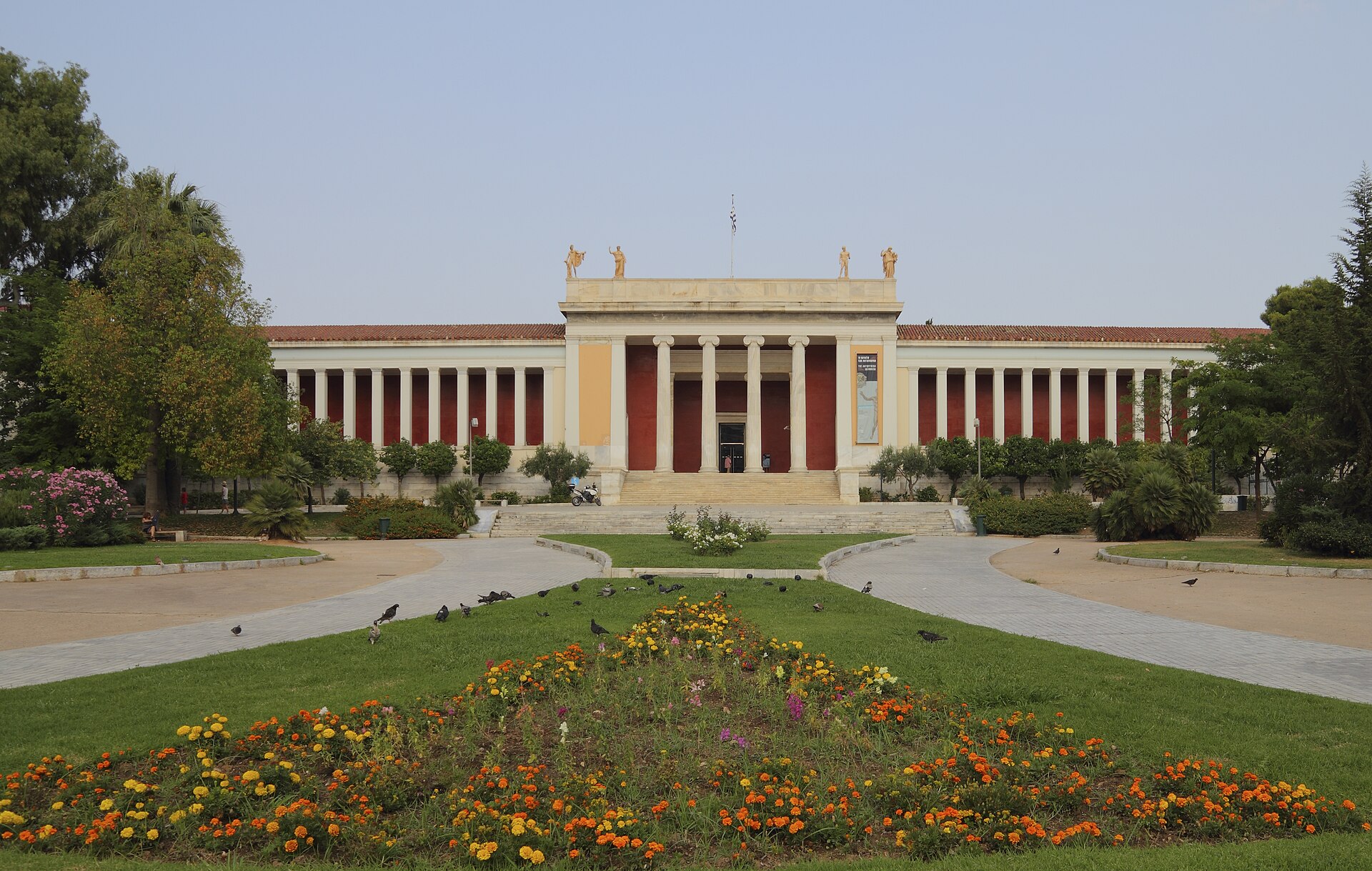
The museum's advantage is breadth held at genuine depth: it is not merely Greece's largest archaeological collection but one that runs a complete, unbroken sequence from Neolithic figurines through the full development of Greek sculpture to Roman-era Egyptian and Cypriot material, all under one roof and largely excavated from Greek soil rather than acquired abroad. Few institutions anywhere hold Mycenaean gold, large-scale original Greek bronze sculpture, Cycladic figurines and a two-thousand-year-old astronomical computer in the same set of ground-floor rooms.
| Local name | Ethniko Archaiologiko Mouseio |
|---|---|
| Kind | Museum |
| Founded | 1829 |
| City and country |  Athens, Greece Athens, Greece |
| Address | 44, 28th of October (Patission) Street, Athens 106 82, Greece |
| Website | namuseum.gr/en |
| Status | Open, confirmed 9 September 2026 |
| Record last verified | 9 September 2026 |
Visiting
- Hours
- Wednesday to Monday, summer season (4 May to 15 November 2026)08:00 to 20:00Last admission 19:30.
- Tuesday, summer season13:00 to 20:00Last admission 19:30.
- Wednesday to Monday, winter season (16 November 2025 to 3 May 2026)08:30 to 15:30Last admission 15:00.
- Tuesday, winter season13:00 to 20:00Last admission 19:30.
- Closed
- 25 and 26 December. 1 January. 25 March. 1 May. Orthodox Easter Sunday. The museum publishes occasional one-off amended hours for specific dates (a New Year's Eve half-day, a Tuesday closed for a state visit) as separate notices on its own news page rather than folding them into the standing schedule.
- Admission
- Standard admissionEUR 20Single, year-round fee in force since 1 January 2026. The museum's own visit page states this figure with no seasonal split and does not itemise a separate reduced or free tier of its own. It replaces a 12 EUR holding price kept through the end of 2025 on account of building works, itself a sign of how much the museum's admission policy has moved in the last two years.
- Tickets
- tickets.hh.gr/en/venues/national-archaeologic... The museum's own ticket page.
- Do I need to book?
- Not stated as mandatory. Tickets can be bought online through the museum's e-ticketing partner or at the door; visitor reports from 2026 disagree on how much the online ticket actually saves in practice, some describing a ten-minute security queue with no separate ticket queue at all, others describing a long walk-up line that online buyers skip.
- Address
- 44, 28th of October (Patission) Street, Athens 106 82, Greece MapMetro Line 1 (green) to Victoria, about a seven minute walk, or Line 2 (red) to Omonoia, about an eight minute walk
Bus Routes B5, A6, B6, E6, A7, B7, E7, A8, B8, A12, B12, C12, E12, 022, 035, 046, 060, 200, 224, 605, 608 and 622 all stop near the museum
Trolley Routes 2, 3, 4, 5, 6, 7, 8, 9, 11, 13 and 14
On foot The museum stands on Patission Street (officially 28th of October Street) in the Exarchia district, a district of students and small bookshops rather than the tourist core around the Acropolis, a few streets north of Omonoia Square - Website
- namuseum.gr/en
- Telephone
- +30 213 214 4800
- [email protected]
Before you go how long, access, photography, bags, eating, shop
- How long to allow
- Most visitors plan three to four hours for a full circuit; the numbered-room system runs from Room 3 into the 60s across two floors, and more than one recent review notes that no printed floor plan is handed out at the door, so a visitor without a downloaded map or the museum's own app has to work out the route on the move.
- Access
- A separate entrance for visitors with disabilities is on the Vasileos Herakleiou Street side of the building, reached either by a ramp from the main forecourt or directly from the pavement; the museum recommends priority use of the lift for visitors with mobility or health conditions.
- Photography
- Not itemised on the museum's own visit pages as of this reading.
- Bags
- Not itemised on the museum's own visit pages as of this reading.
- Eating
- A cafe occupies a renovated courtyard-garden planted with some 700 species, and doubles as a venue for small art shows and for concerts tied to the Ministry of Culture's annual calendar of museum events, including the August full moon and Museums Day; entry to the cafe alone, without a ticket to the galleries, is free. Several 2026 visitor reports describe the courtyard itself as attractive but the cafe's own upkeep and food as run down, with smokers gathered at the outdoor tables.
- Shop
- The museum shop reopened under new management on 5 August 2025 and trades during the museum's normal opening days and hours.
Prices and hours change. We take them from the institution's own pages and print the day we read them, and you can check the current position at the source we used. Confirm before you travel.
What is inside
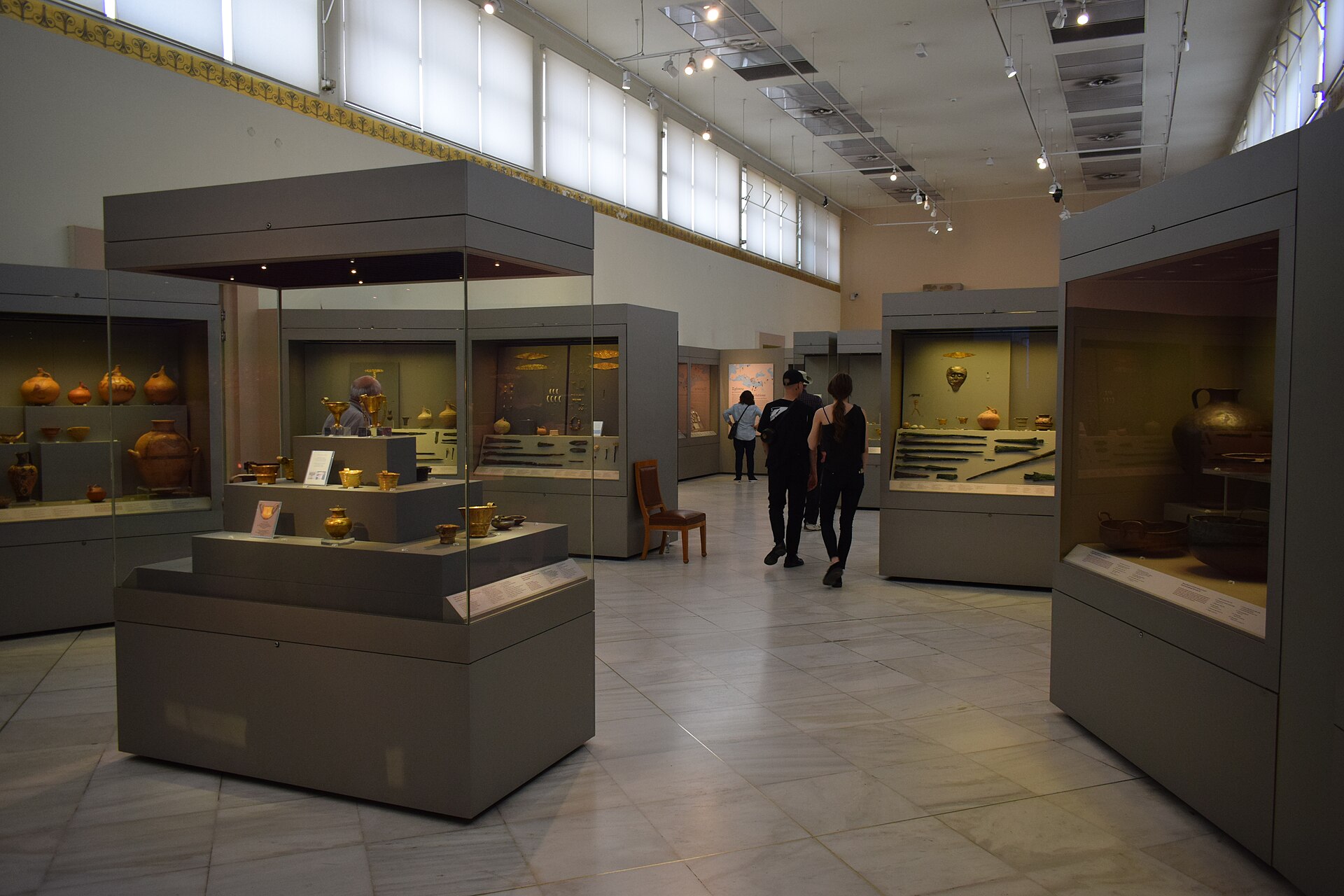
Photograph by Jeanhousen · CC BY-SA 4.0 Prehistoric Antiquities
Neolithic, Cycladic and Mycenaean material from the Aegean world, roughly the seventh millennium BC to about 1050 BC, plus finds from the prehistoric settlement buried by the Bronze Age eruption on Thera (Santorini). The single richest holding is the gold from the royal shaft graves at Mycenae: cups, daggers, jewellery, swords and several gold funerary masks, the best known of which is popularly called the Mask of Agamemnon. The Linear B tablets and the smooth-bodied, geometrically stylised Cycladic marble figurines that later artists from Modigliani to Brancusi are said to have looked at are both held here, alongside large-scale wall paintings from Akrotiri on Thera, among the best-preserved wall paintings to survive from the Aegean Bronze Age.
Sculpture
Around sixteen thousand sculptures tracing Greek sculpture from about 700 BC to the fifth century AD, drawn chiefly from sanctuaries, cemeteries and public buildings in Attica, the Peloponnese, central Greece and the Aegean islands, with further pieces from Thessaly, Macedonia, Thrace and Cyprus. The core collection was assembled from 1874 as antiquities recovered by accident or by the Archaeological Society were transferred to the museum then under construction. The galleries run in period order, Archaic through Roman, and include grave stelae, kouroi and the large-scale votive and funerary statuary that make up the bulk of what most visitors picture when they think of ancient Greek sculpture.
Metalwork (the Bronze Collection)
One of the richest collections of original bronze work anywhere, formed mainly from the large systematic excavations of the late nineteenth and early twentieth centuries, with the antiquarian K. Karapanos's collection (acquired 1902) and the physician K. Lambros's set of 903 ancient medical instruments (1899) among its landmark acquisitions. It holds figurines, mythological creatures, vessels, weapons, and the entire group of objects recovered from the Antikythera shipwreck, including the Antikythera Mechanism itself. This is the museum's own department, not a guess by this page: the museum's collections page lists the shipwreck finds and the Mechanism specifically under Metalwork.
Vases and Minor Arts
About six thousand objects tracing Greek pottery and painting from the eleventh to the fourth century BC through the major workshops (Attic, Boeotian, Corinthian, Laconian, the island and Ionian schools), including material from the sanctuaries at Sounion, Thermos, the Argive Heraion and the Heraion at Perachora. The later rooms hold the Stathatos Collection and the Vlastos-Serpieris Collection of miniature and precious-metal objects, Hellenistic and glass vessels, figurines, and gold and silver jewellery.
Egyptian and Eastern Antiquities
A collection ranking among the most important outside Egypt itself for its range and quality, built on two nineteenth-century donations from Greek expatriates in Egypt, Ioannis Dimitriou (1880) and Alexandros Rostovich (1904), enlarged by further gifts from the Archaeological Society and the Egyptian government. Holdings run from the pre-dynastic period, around 5000 BC, through the Ptolemaic and Roman periods, and include a well-known bronze statue of the Egyptian princess Takushit, about 670 BC.
Cypriot Antiquities
Around 850 objects covering the whole of Cypriot antiquity, from the Early Bronze Age, about 2500 BC, to the Roman period. The collection was built up from nineteenth-century purchases and donations and an official exchange of antiquities in 1928; its permanent exhibition was inaugurated in March 2009, financed by the A.G. Leventis Foundation, jointly opened by the Presidents of Greece and Cyprus.
What to see first
The Antikythera Mechanism
Unknown Greek workshop, about the second century BCA hand-turned bronze device of at least thirty interlocking gears that modelled lunar and solar cycles, predicted eclipses and tracked the four-year cycle of the Panhellenic Games; recovered in fragments from the Antikythera shipwreck in 1901 and displayed today in the Bronze Collection alongside the rest of that ship's cargo. Nothing of comparable mechanical sophistication is known to survive from anywhere in the ancient world.3
Full record in this archiveThe Mask of Agamemnon
Mycenaean workshop, about 1550 to 1500 BCA beaten gold funerary mask from the royal shaft graves at Mycenae, one of several found in the graves and the one that gave Heinrich Schliemann the line he is remembered for, wrongly claiming to have looked on the face of Agamemnon; the mask in fact predates the Trojan War of legend by several centuries, and remains the single image most visitors associate with the museum.4
The Artemision Bronze
Unknown Greek bronze caster, about 460 BCA two-metre standing bronze of a god, either Zeus hurling a thunderbolt or Poseidon a trident, recovered from the sea off Cape Artemision; it stands free in its own gallery so a visitor can walk a full circle around it, one of only a handful of large-scale original Greek bronzes to survive at all, most having been melted down for their metal in later centuries.4
The Jockey of Artemision
Unknown Greek bronze caster, about 140 BCA bronze horse and boy jockey recovered in pieces from the same stretch of sea as the Artemision Bronze, between 1928 and 1937, and reassembled; a rare survival of Hellenistic large-scale bronze group sculpture in motion, easy to miss because it does not sit on the most direct route through the galleries.4
The Cycladic marble figurines
Cycladic workshops, third millennium BCSpare, geometric standing figures carved from island marble many centuries before Greek sculpture as usually taught begins; their pared-back forms are frequently cited, including by the museum's own visitor material, as an influence later artists including Brancusi and Modigliani are thought to have looked toward.3
The wall paintings from Akrotiri, Thera
Bronze Age Theran workshop, before about 1600 BCLarge, brightly coloured pictorial compositions preserved by the volcanic ash that buried the Bronze Age settlement at Akrotiri on Thera (Santorini), among the best-preserved wall paintings from anywhere in the Aegean Bronze Age precisely because the disaster that destroyed the town also sealed the paintings against the centuries.3
The Varvakeion Athena
Roman-era copyist, second or third century AD, after a cult statue by PhidiasA small marble copy, found in Athens in 1880, of the huge gold-and-ivory cult statue of Athena Parthenos that once stood inside the Parthenon; because Phidias's original is lost, this modest copy is one of the main sources scholars use to reconstruct what the statue actually looked like.4
Bronze statue of the Egyptian princess Takushit
Egyptian workshop, about 670 BCA finely worked, inlaid bronze figure of a princess of the Twenty-fifth or early Twenty-sixth Dynasty, among the best-known pieces in a collection that ranks, for range and quality, among the most significant Egyptian holdings outside Egypt itself.4
The building and what it was built to hold
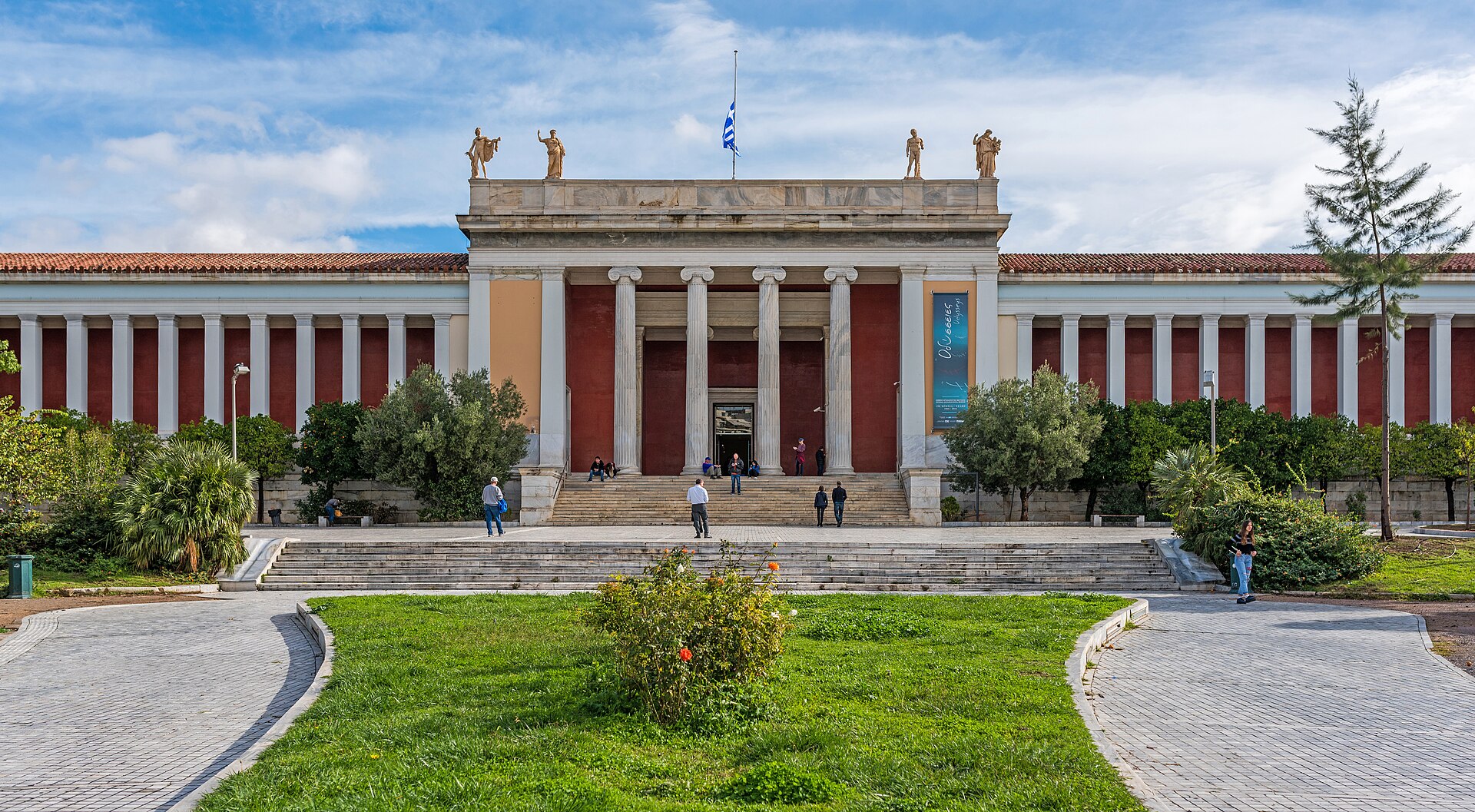
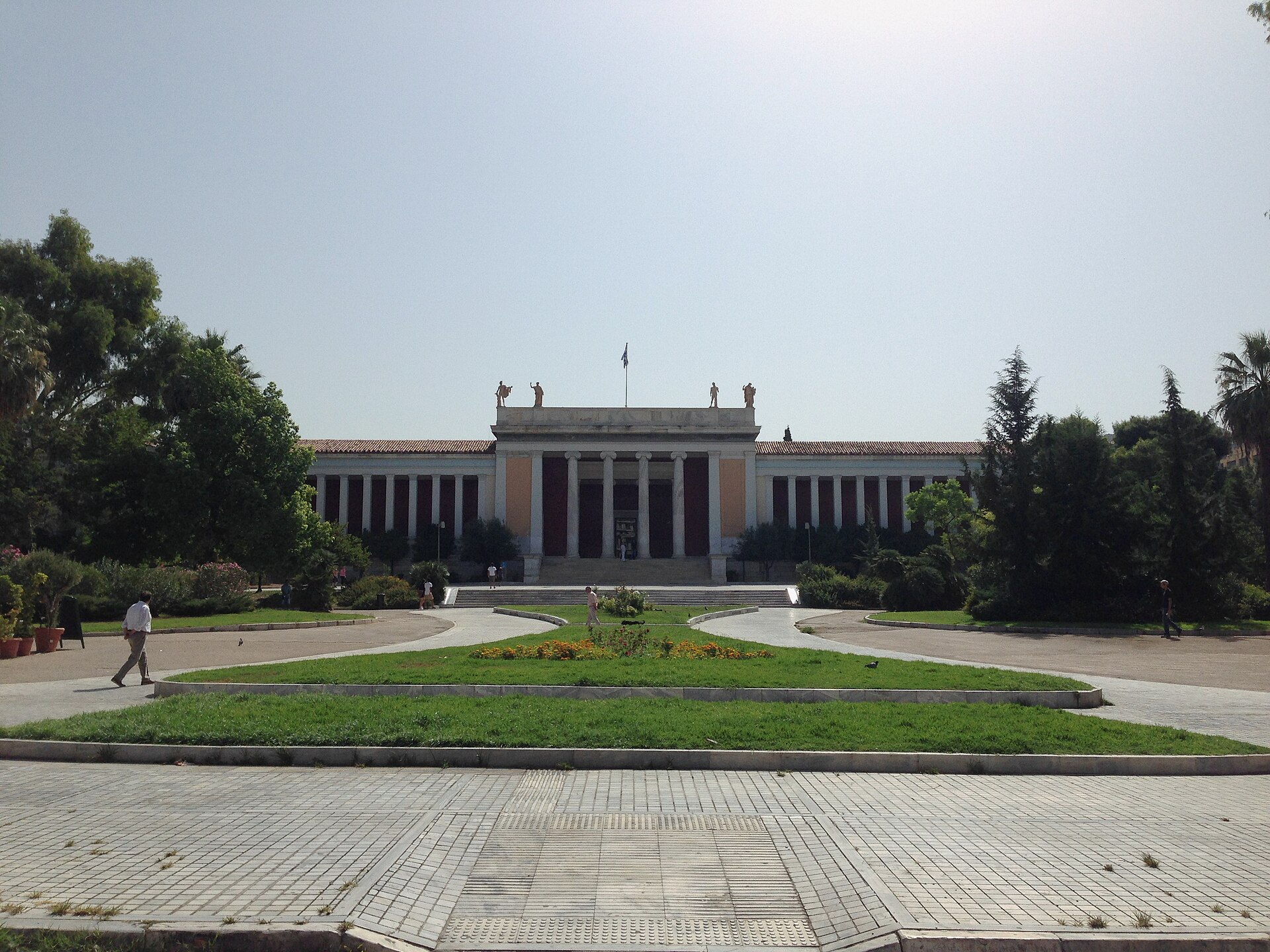
The National Archaeological Museum traces its founding to 1829, when the newly independent Greek state's first governor, Ioannis Kapodistrias, established a public collection of antiquities on the island of Aigina. The collection later moved to Athens, and the neoclassical building it occupies today on Patission Street was begun in 1866 to a plan by the German architect Ludwig Lange, with Panagis Kalkos as the main executing architect; the design was revised again by Armodios Vlachos and finally by Ernst Ziller, whose name appears on more nineteenth-century Athenian public buildings than almost any other architect of the period. Construction finished in 1889, though sections opened progressively from 1874 as antiquities recovered from excavation and by the Archaeological Society were transferred in. The institution took its current name, the National Archaeological Museum, in 1881 under the government of Prime Minister Charilaos Trikoupis; a second floor was added in 1939. The finished building today covers about 8,000 square metres of exhibition space across dozens of rooms on two floors, fronted by the formal garden and forecourt that most photographs of the building, including the one leading this page, are taken from.
The building has not always held everything it houses now without incident. As occupation approached during the Second World War, the museum's own staff dismantled major parts of the collection and buried them for safekeeping, a decision credited with protecting much of what the museum still shows today. The building underwent a substantial modernisation completed in 2004, ahead of that summer's Athens Olympics, reorganising the display sequence and updating climate and security systems that had not kept pace with a collection that had grown for more than a century.
Five departments and six collections: what is actually inside
The museum's own site describes itself as holding five major permanent collections, though its room-by-room breakdown in practice runs to six distinct departments, each with its own numbered rooms, formation history and centre of gravity. The Prehistoric Antiquities collection covers the Aegean Bronze Age and Neolithic, and includes the Mycenaean shaft-grave gold, the Cycladic marble figurines and the Thera wall paintings. The Sculpture collection, formed from 1874 onward, traces Greek sculpture from about 700 BC to the fifth century AD through roughly sixteen thousand individual pieces. The Metalwork collection, commonly called the Bronze Collection, holds the museum's original bronze work, built substantially from two landmark early acquisitions, the antiquarian K. Karapanos's collection in 1902 and the physician K. Lambros's set of ancient medical instruments in 1899, and it is this department, not any other, that holds everything recovered from the Antikythera shipwreck. The Vases and Minor Arts collection covers Greek pottery from the eleventh century BC into the Roman era, including the Stathatos Collection of miniature and precious-metal objects. The Egyptian and Eastern Antiquities collection, built on two nineteenth-century donations from Greek expatriates living in Egypt, ranks among the most significant Egyptian collections outside Egypt itself. The Cypriot Antiquities collection, the smallest of the six at around 850 objects, got its own permanent exhibition only in 2009, financed by the A.G. Leventis Foundation.
The Antikythera shipwreck and its Mechanism
In 1901, sponge divers working off the small island of Antikythera found the wreck of a cargo ship that had gone down in the first century BC, carrying luxury goods, bronze and marble statuary, glassware, furniture fittings and, among the corroded lumps of bronze brought up with everything else, the mechanism that would eventually be recognised as an analogue astronomical computer unlike anything else known from antiquity. It survives today in some eighty-two fragments, the largest three of which preserve more than thirty hand-cut bronze gears with triangular teeth, arranged to drive a set of dial faces that tracked the phases of the moon, the position of the sun against the zodiac, eclipse prediction cycles, and the four-year calendar of the Panhellenic Games including the Olympiad. Nothing of comparable mechanical complexity survives from anywhere else in the ancient world, and nothing matching it in sophistication is known to have been built again for well over a thousand years, a gap that has driven a great deal of the scholarly fascination with the object. The museum's own collections page is explicit that this material sits within the Metalwork, or Bronze, Collection, together with the rest of the shipwreck's cargo, including bronze couches, lamp stands and figures also recovered from the same wreck, and it is displayed today in that department's rooms on the ground floor, not in a stand-alone shipwreck pavilion.
War, burial, and a restitution the museum's own history includes
A museum built on excavated antiquities is, as a matter of course, also a party to the argument over how such objects reach a collection and whether they should stay there. The wartime burial of the museum's own holdings against occupation and looting is one chapter of that history that reflects well on the institution. Another involves objects that left Greece and had to be brought back through legal argument rather than excavation: in 2007, the J. Paul Getty Museum in California returned a fourth-century BC gold funerary wreath and a sixth-century BC archaic marble statue to Greece after a decade-long dispute over how the Getty had acquired them, one of a wider set of restitutions Greek authorities pursued against major Western museums in the 2000s. Neither episode is unique to this museum among the great encyclopaedic collections of the eastern Mediterranean, but both are part of the same institution's own record, and belong on a page that is not only cataloguing what stands behind the glass.
An independent museum, a new flat price, and a closure most visitors do not know is coming
In 2023 the Greek state converted the National Archaeological Museum, together with four other major museums including the Archaeological Museum of Heraklion and the Byzantine and Christian Museum in Athens, into an independent public-law entity, meaning it now sets its own admission pricing rather than following the Ministry of Culture's standard five-tier system applied to the roughly 350 other state-run archaeological sites and museums. Under that new independence, the museum's standard admission rose to a single flat 20 EUR fee from 1 January 2026, replacing a 12 EUR holding price that had applied through 2025 because of ongoing building works; the museum's own visit page states this figure without publishing a separate reduced or free-admission tier of its own, a departure from the more elaborate discount categories that still apply at most other state sites.
The building works referred to in that pricing note are the leading edge of something much larger. In 2023 the Greek government approved a roughly 20,000 square metre underground extension and complete overhaul of the museum, designed by the British architect David Chipperfield, alongside a full remodelling of the adjoining Epigraphic Museum and a re-landscaping of the surrounding grounds. According to reporting on the project, studies are due to be completed by mid-2027, after which building permits and tender documents follow; museum and ministry officials have indicated the museum is expected to close its doors entirely at the end of 2027 for a minimum of five years, during which every object in the collection would be removed from display for conservation and eventual reinstallation under a substantially rethought museological plan. Officials involved in the project have themselves acknowledged that the five-year estimate could run considerably longer if the construction timetable proves unfeasible, and reporting on the project's cost, put in some reporting at around 300 million euro though never officially confirmed by the Ministry, has drawn a direct comparison to Chipperfield's Pergamon Museum renovation in Berlin, where an initial budget of around 261 million euro grew to roughly 1.5 billion euro over the life of the project. None of this changes what is true today, on the date this page was last checked: the museum is open, keeping the hours above, at the address above. It does mean a visit planned for the end of this decade or the early 2030s should be checked against the museum's own site before travel, since a building that has stood on Patission Street since 1889 is due, on current planning, to close for the longest renovation in its history.
What visitors say
Visitors consistently rank the museum among the strongest archaeological collections anywhere, citing the Mycenaean gold, the large-scale bronzes and the sheer range of the eleven thousand-plus objects on display as reasons to give it a half day rather than a quick pass-through. The most persistent complaints are practical rather than curatorial: rooms closed to the public without warning on the day of a visit, most painfully when the closed room is the one holding a headline object; a run-down cafe despite an attractive garden setting; inconsistent staff helpfulness; and a numbered-room layout that is hard to follow without a downloaded map or the museum's own app, since none is handed out at the entrance.
What is praised, what is criticised
- Praised: the range and quality of the headline pieces in one building: the Mycenaean gold death masks, the large bronze figures recovered from the sea off Cape Artemision, and the Cycladic figurines, none of which a visitor can see gathered in this depth anywhere else
- Praised: galleries described repeatedly as spacious and well organised for a half-day visit, with the collection's chronological layout making the development of Greek art legible room by room
- Praised: free or low-friction online ticket booking, and a free audio-guide app, which several 2026 reviews single out as removing the need to hire a guide
- Criticised: a recurring complaint that entire rooms are closed to the public on the day of a visit without advance warning, most damagingly for visitors whose main reason for coming was a specific gallery
- Criticised: the ground-floor cafe in the courtyard-garden is repeatedly described as run down, with poor food, despite visitors otherwise liking the garden setting
- Criticised: no printed floor plan is given out at the entrance, and the numbered-room system spans two floors and more than sixty rooms, which several 2026 reviews say makes the museum hard to navigate without a phone
- Criticised: staff helpfulness is described as inconsistent from one visit to the next
Ratings on other platforms
Tripadvisor: 4.6 from 8,267 ratings, read 9 September 2026
A platform average is a tertiary source: it moves, it is not audited, and we quote no visitor's words.
Questions about National Archaeological Museum
Where is National Archaeological Museum?
44, 28th of October (Patission) Street, Athens 106 82, Greece.
How much does it cost to visit National Archaeological Museum?
Standard admission: EUR 20. As confirmed 9 September 2026.
When is National Archaeological Museum open?
Wednesday to Monday, summer season (4 May to 15 November 2026) 08:00-20:00; Tuesday, summer season 13:00-20:00; Wednesday to Monday, winter season (16 November 2025 to 3 May 2026) 08:30-15:30; Tuesday, winter season 13:00-20:00. Closed: 25 and 26 December. 1 January. As confirmed 9 September 2026.
How do you get to National Archaeological Museum?
Metro: Line 1 (green) to Victoria, about a seven minute walk, or Line 2 (red) to Omonoia, about an eight minute walk; Bus: Routes B5, A6, B6, E6, A7, B7, E7, A8, B8, A12, B12, C12, E12, 022, 035, 046, 060, 200, 224, 605, 608 and 622 all stop near the museum; Trolley: Routes 2, 3, 4, 5, 6, 7, 8, 9, 11, 13 and 14; On foot: The museum stands on Patission Street (officially 28th of October Street) in the Exarchia district, a district of students and small bookshops rather than the tourist core around the Acropolis, a few streets north of Omonoia Square.
What should you see at National Archaeological Museum?
The Antikythera Mechanism (Unknown Greek workshop, about the second century BC); The Mask of Agamemnon (Mycenaean workshop, about 1550 to 1500 BC); The Artemision Bronze (Unknown Greek bronze caster, about 460 BC); The Jockey of Artemision (Unknown Greek bronze caster, about 140 BC); The Cycladic marble figurines (Cycladic workshops, third millennium BC); The wall paintings from Akrotiri, Thera (Bronze Age Theran workshop, before about 1600 BC).
What we could not confirm
- The museum's own visit page publishes a single flat admission fee with no reduced or free tiers of its own; since becoming an independent public-law entity in 2023 it sets pricing separately from the Greek Ministry of Culture's standard reduced and free-admission categories used elsewhere in the state system, and its own pages do not confirm which, if any, of those categories (student, senior, EU-youth, free days) it still honours. A visitor who qualifies for reduced entry at other Greek state sites should confirm at the door or by phone rather than assume the same terms apply here.
- Officials have discussed a closure of the museum for a minimum of five years beginning at the end of 2027, for the Chipperfield-designed underground extension, with the timetable itself flagged by officials as liable to slip. No firm closure date has yet been confirmed by the museum's own site as of this reading, so this page records open_status as open rather than anticipating a closure that has not yet been announced by the institution itself.
- The projected cost of the extension, reported around 300 million euro in some coverage, has never been officially confirmed by the Ministry of Culture; the true figure, and how it develops against the same architect's Pergamon Museum renovation in Berlin, is worth checking again as tenders are issued.
Images
Sources
- 1National Archaeological Museum, official website, home page namuseum.gr/en/
- 2National Archaeological Museum, official website, Visit page (hours, tickets, transport, accessibility, cafe, shop) namuseum.gr/en/episkepsi/
- 3National Archaeological Museum, official website, Collections page namuseum.gr/en/collections/
- 4Wikipedia, 'National Archaeological Museum, Athens' (tertiary, used for founding history, architects, WWII, 2004 renovation, 2007 Getty restitution and highlight identification only) en.wikipedia.org/wiki/National_Archaeological_Museum,_Athens
- 5Wikipedia, 'Antikythera mechanism' (tertiary, used for object description only) en.wikipedia.org/wiki/Antikythera_mechanism
- 6Tripadvisor, National Archaeological Museum listing, rating, review text and neighbourhood description read directly (tertiary) tripadvisor.com/Attraction_Review-g189400-d198713-Reviews-National_Archaeological_Museum-Athens_Attica.html
- 7To Vima, 'National Archaeological Museum Prepares For Leap Into 21st Century' (renovation and closure plan, budget, Chipperfield comparison) tovima.com/stories/national-archaeological-museum-prepares-for-leap-into-21st-century/
- 8GeoTour, 'The Revised Ticketing Policy for Archaeological Sites and Museums in Greece, Effective April 2025' (tertiary, national pricing context and NPDD status) geotour.gr/the-revised-ticketing-policy-for-archaeological-sites-and-museums-in-greece-effective-april-2025/
- 9Wikimedia Commons, Category:Building of the National Archaeological Museum of Athens (image sourcing and licence verification) commons.wikimedia.org/wiki/Category:Building_of_the_National_Archaeological_Museum_of_Athens
- 10Santorini Dave, National Archaeological Museum visitor guide (tertiary, highlight identification and typical visit duration) santorinidave.com/athens-archaeological-museum