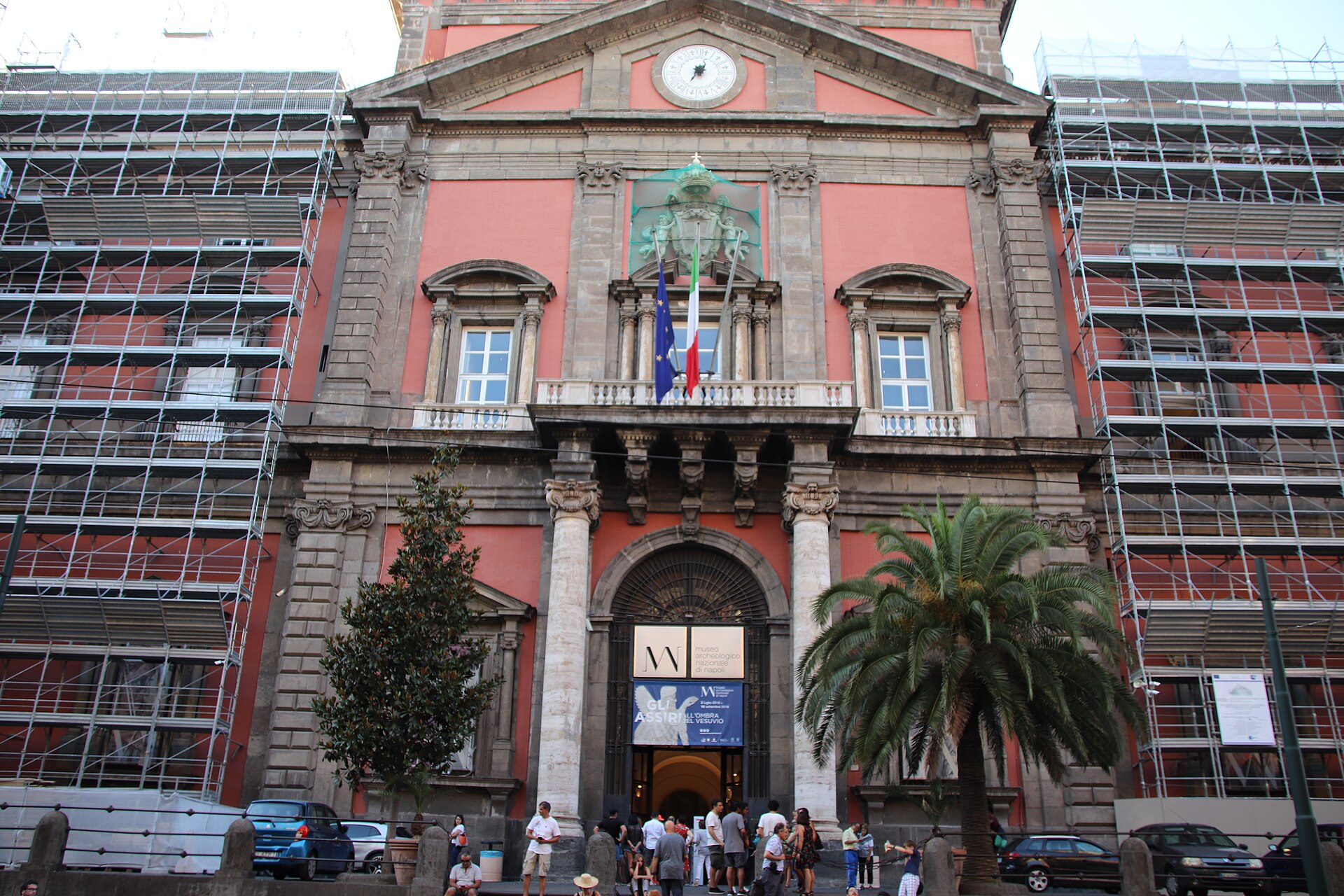
The main entrance facade on Piazza Museo, with the museum's Italian and EU flags and visitors queuing at the door.
Public domainNational Archaeological Museum of Naples
Museum · Museo Archeologico Nazionale di Napoli · Founded 1777
Open, admission and hours confirmed 23 August 2026 · 14 sources
On this page 14 sections
ContentsClose
The strength of this collection is that almost none of it was made for a museum. The Farnese marbles are the residue of a Renaissance cardinal's Roman collecting, moved south by dynastic inheritance; the Pompeii and Herculaneum material is what a buried Roman town actually contained, furniture, wall paintings, bronze fittings, erotica and all, rather than what a later collector or museum thought worth keeping. That combination, a princely sculpture collection and an entire excavated town's contents in one building, is not duplicated at any other Italian museum, including the sites of Pompeii and Herculaneum themselves, most of whose portable finds were shipped to Naples rather than left in place.
| Local name | Museo Archeologico Nazionale di Napoli |
|---|---|
| Kind | Museum |
| Founded | 1777, by Bourbon decree gathering the Farnese and Pompeian-Herculaneum collections into one building; opened to the public in 1816 as the Real Museo Borbonico |
| City and country |  Naples, Italy Naples, Italy |
| Address | Piazza Museo 18/19, 80135 Napoli, Italy |
| Website | museoarcheologiconapoli.it/en |
| Status | Open, confirmed |
| Record last verified |
Visiting
- Hours
- Wednesday to Monday09:00 to 19:30Last entry 18:30; staff begin clearing the galleries from 19:00
- Closed
- Tuesday, except when Tuesday falls on a public holiday, in which case the museum opens as usual and closes on the Wednesday instead. Some rooms close on a rotating schedule for structural works independent of the museum's general hours - see notes_for_editor.
- Admission
- Full priceEUR 20Standard adult entrance
- Reduced, age 18-25EUR 2Citizens of EU/EEA states, or of a state with a reciprocal agreement with Italy, aged 18 to 25
- Under 18FreeFree at all times
- Reduced, ArtecardEUR 10Applies to Campania Artecard holders once the card's free entries are used
- OPEN MANN Annual Card, adultEUR 25Annual pass for repeat entry, sold alongside the single-visit tickets on the same page
- OPEN MANN Annual Card, youthEUR 5
- OPEN MANN Annual Card, university studentEUR 10
- OPEN MANN Annual Card, familyEUR 23
Free entry: First Sunday of every month (the museum's 'domenicalmuseo' scheme) - but on free days the Egyptian Collection, the Secret Cabinet and the Magna Graecia section stay closed for safety and staffing reasons, per the museum's ticketing partner CoopCulture. All visitors under 18, every day. Italian teachers, on presentation of ID. Visitors with disabilities and one accompanying companion. All women on 8 March, International Women's Day. 25 April, 2 June and 4 November 2026, Italian national civic holidays- Tickets
- coopculture.it/en/products/mann-national-arch... The museum's own ticket page.
- Do I need to book?
- No for individual visitors, though online timed booking is available. Group and school visits must book an entrance slot with CoopCulture in advance
- Address
- Piazza Museo 18/19, 80135 Napoli, Italy MapMetro Line 1, Museo stop
Metro Line 2, Piazza Cavour stop - Website
- museoarcheologiconapoli.it/en
- Telephone
- +39 081 0098800
- [email protected]
Before you go how long, access, photography, bags, eating, shop
- How long to allow
- TripAdvisor's own listing gives a duration of one to two hours; a visitor wanting the Farnese marbles, the mosaics, the Gabinetto Segreto and the Villa of the Papyri bronzes in one pass should plan for closer to three
- Access
- Three entrances; the western entrance is step-free and used for wheelchairs and buggies. Visitors with disabilities, pregnant women and elderly visitors with reduced mobility may skip the line. Lifts serve the main wings, though the museum's own page notes navigation between some first-floor wings is not direct. Touch tours are available on request and an International Sign tour is published on the museum's YouTube channel
- Photography
- Not stated on the museum's own visitor-services page as read on 2026-08-07; not confirmed for this file
- Bags
- Large luggage, including some bags and rucksacks, must go in the lockers; bulky wheeled suitcases cannot be stored at all and coats must be carried inside
- Eating
- MANNCaffe, ground floor, next to the left-wing lift; breakfast, lunch, coffee and snacks, 9:00 to 19:00 daily except Tuesday
- Shop
- Bookshop in the central hall on the ground floor, same days as the museum, closing 30 minutes before the galleries
Prices and hours change. We take them from the institution's own pages and print the day we read them, and you can check the current position at the source we used. Confirm before you travel.
What is inside
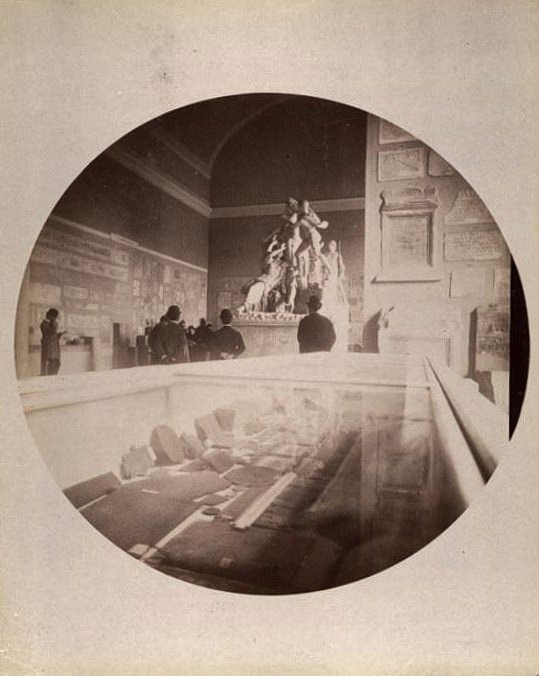
Public domain The Farnese marbles (ground floor)
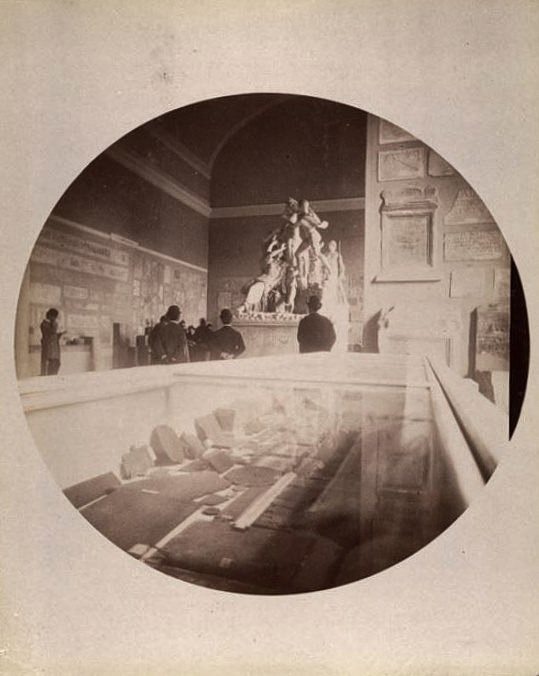
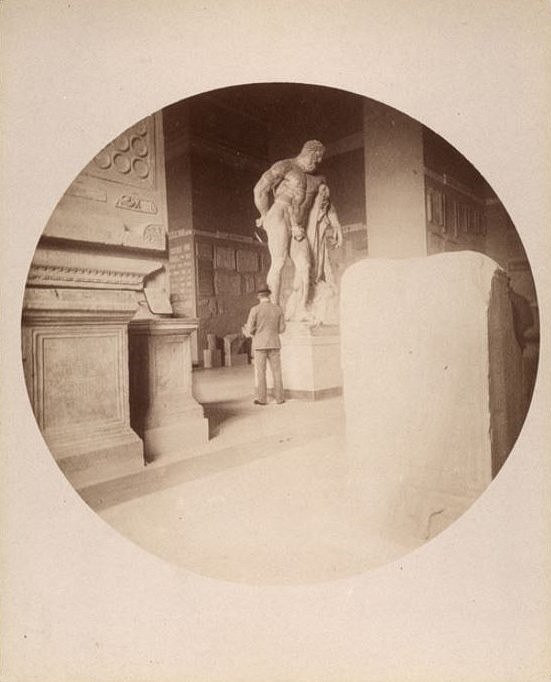
The Toro Farnese and Ercole Farnese rooms hold the two largest pieces of the Farnese sculpture collection inherited by Charles of Bourbon and moved from Rome to Naples in the later 18th century: the Farnese Bull, the largest single sculptural group to survive from antiquity, and the Farnese Hercules, a colossal marble copy of a bronze by Lysippos. Both rooms were partly closed on a rotating basis for structural work through spring 2026.
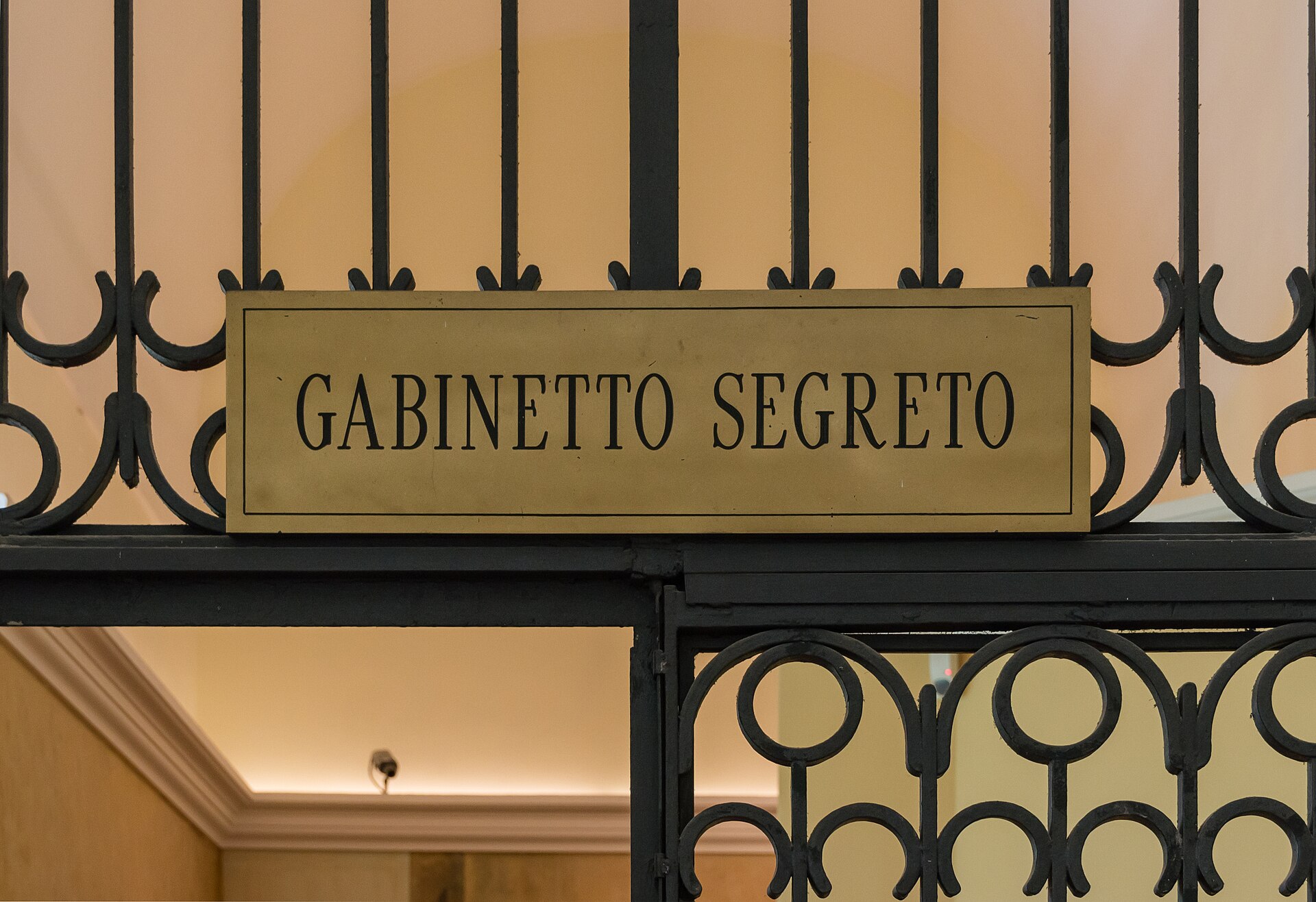
CC0 The Gabinetto Segreto (Secret Cabinet)
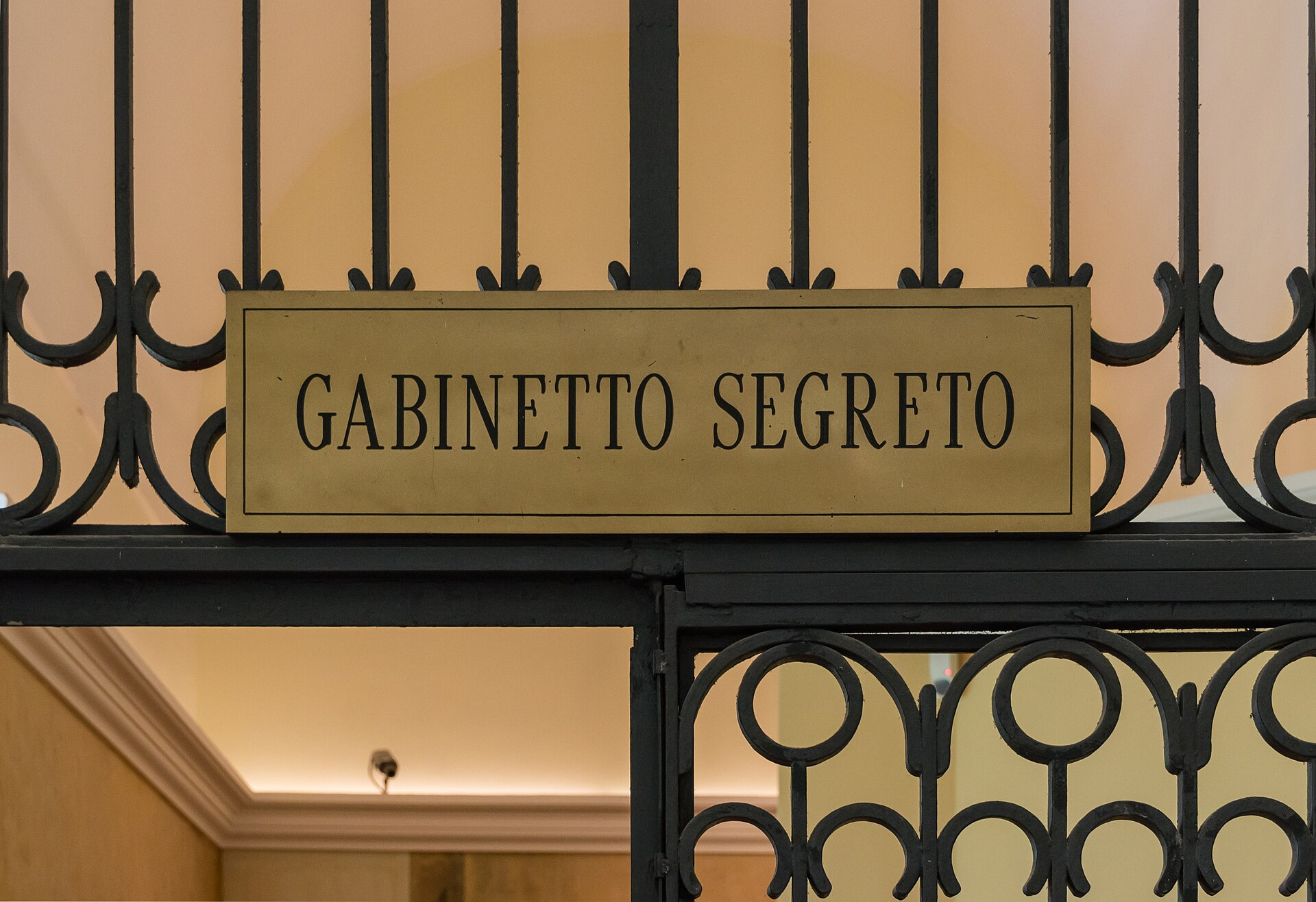
A separate, gated room off the mosaic collection holding roughly 250 sexually explicit objects excavated at Pompeii and Herculaneum: frescoes, garden ornaments, brothel decoration, bronze wind chimes and votive phalli. Locked away from general view for most of two centuries; see the narrative below for the history.
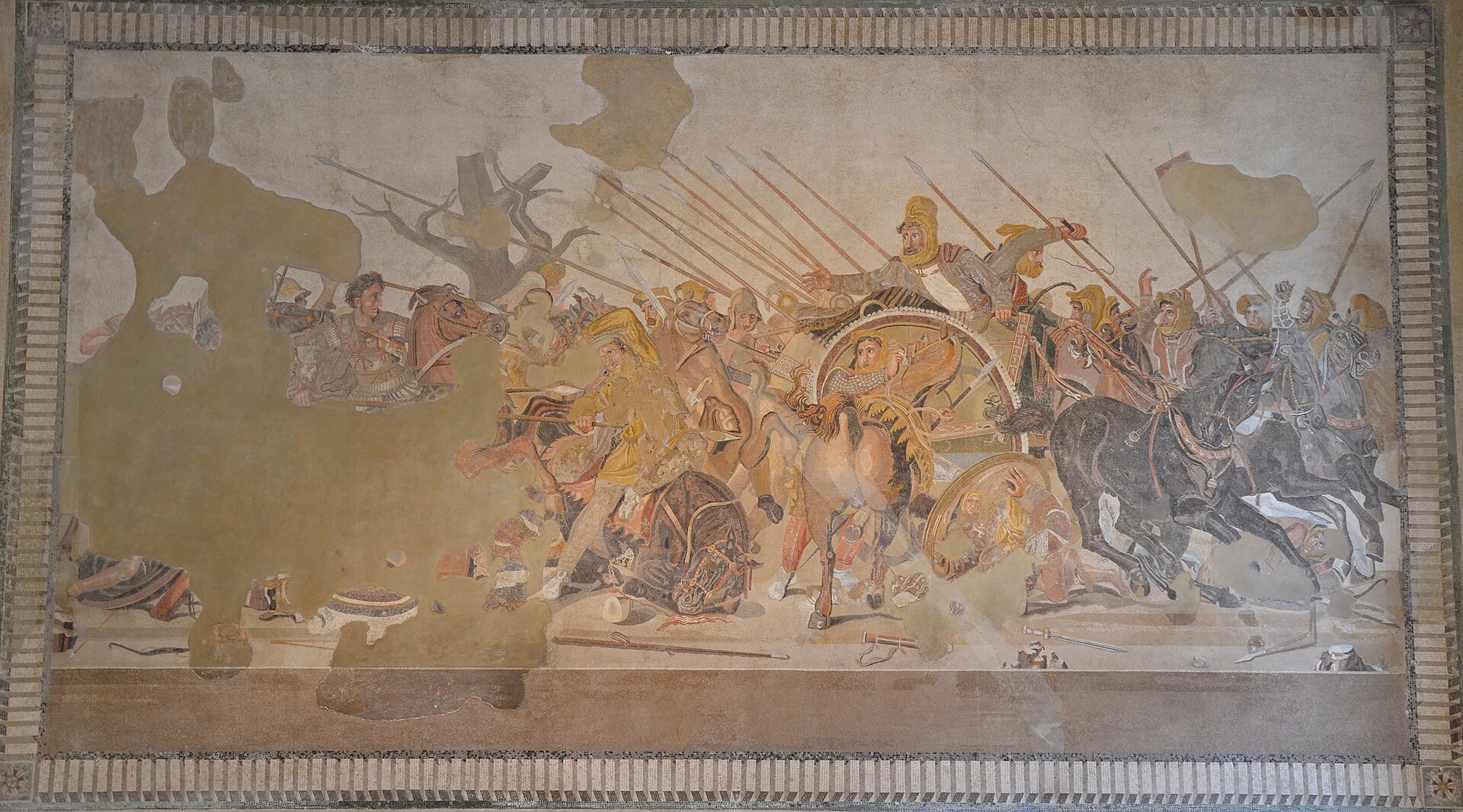
Photograph by Carole Raddato from FRANKFURT, Germany · CC BY-SA 2.0 The mosaic collection (mezzanine)
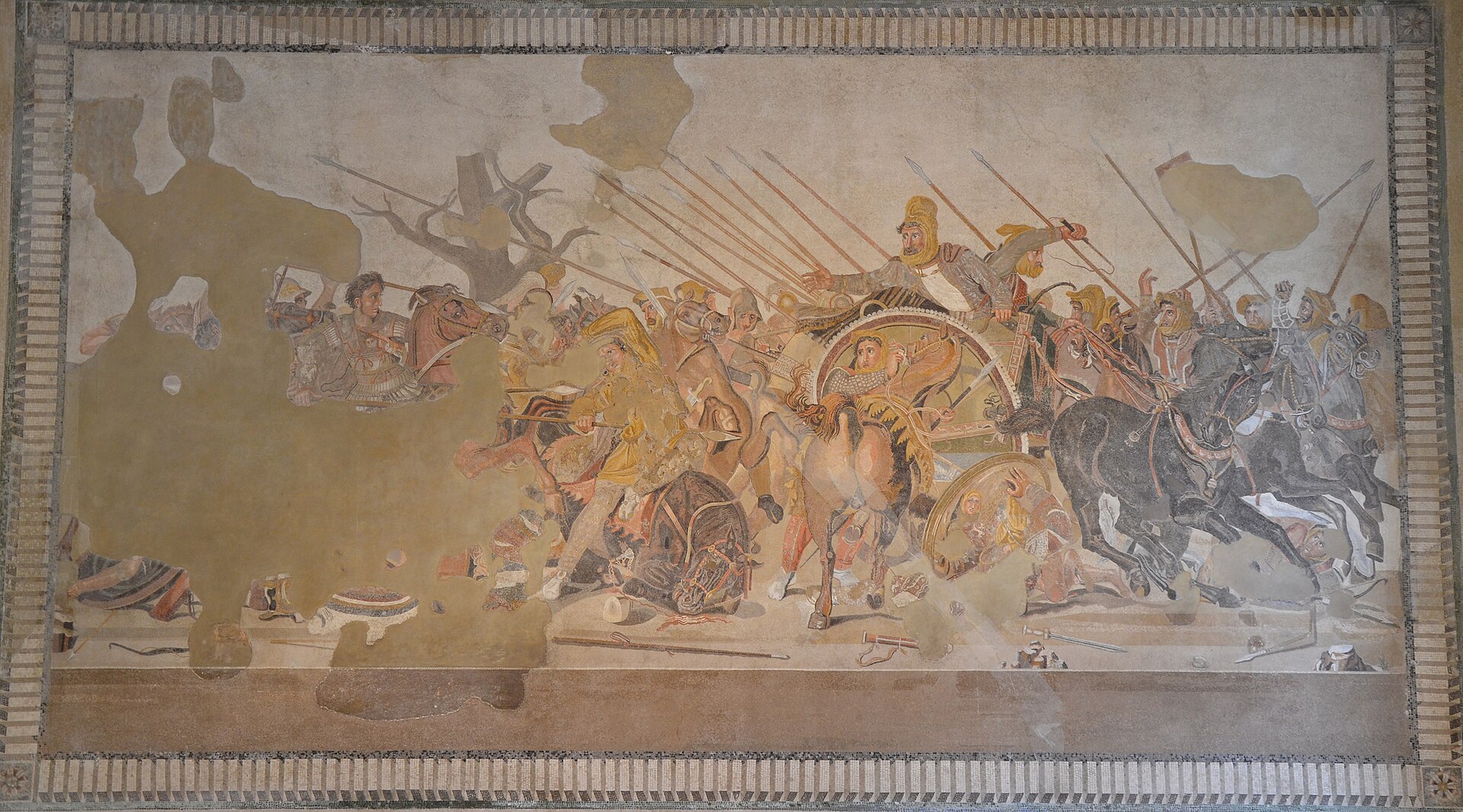
Floor mosaics lifted whole from Pompeian houses in the 19th century, most famously the Alexander Mosaic from the House of the Faun, showing Alexander the Great confronting Darius III at the Battle of Issus. The mosaics were among the first Pompeian finds to travel to Naples and remain the collection most reproduced in print.
The Egyptian Collection (mezzanine)
Formed between 1817 and 1821 from the private collections of Borgia, Drosso-Picchianti, Hogg and Schnars, plus Bourbon excavations in the Phlegraean Fields, with a single major piece, a naophorous statue, contributed by the original Farnese holdings. Seven rooms of mummies, sarcophagi, canopic jars, funerary stelae and temple statuary; the museum's own page calls it second in Italy only to the Egyptian Museum of Turin. No verifiable free-licence photograph of this room's interior was located; it is described from the museum's own published account.
The Villa of the Papyri bronzes (second floor)
Close to a hundred bronze and marble sculptures excavated from the Villa of the Papyri at Herculaneum from 1750 onward, arranged by the room of the villa they originally furnished: philosophers' heads, athletes, the Drunken Satyr and the Resting Hermes among them. The villa's carbonised papyrus scrolls are not part of this collection - they are held separately at the adjoining National Library, see open_questions.
Magna Graecia and pre-Roman Campania
Material from Greek and indigenous sites of southern Italy predating the Roman period: painted pottery, bronze armour and grave goods from Cumae, Paestum and the Campanian interior, tracing the region's history before Pompeii and Herculaneum were Roman towns at all. Closed to visitors on the monthly free-admission Sunday, unlike most of the museum.
What to see first
The Farnese Bull (Toro Farnese)
Roman marble group, probably after a Hellenistic Rhodian bronzeThe largest single sculptural group known from antiquity, showing the punishment of Dirce tied to a wild bull; excavated at the Baths of Caracalla in Rome in 1545 and moved to Naples with the rest of the Farnese inheritance in the 1780s.9
The Farnese Hercules (Ercole Farnese)
Signed by Glykon of Athens, after a bronze by LysipposA colossal marble copy also from the Baths of Caracalla; its ancient legs were separated from the torso at discovery, replaced with sculpted plaster legs, and only reunited with the original ancient legs, found later in a different excavation, decades after the statue first went on display.9
The Alexander Mosaic
Roman, 2nd-1st century BC, after a lost Hellenistic paintingLifted from the floor of the House of the Faun at Pompeii, it is the single most reproduced image to survive the eruption of AD 79 and the main visual source for how Alexander the Great was imagined confronting Darius III.9
The Gabinetto Segreto collection
Roman, from Pompeii and HerculaneumAbout 250 sexually explicit frescoes, sculptures and objects, locked away from 1819 (bricked up entirely from 1849) and open to the general public only since 2000 - the display makes the history of its own censorship as much a subject as the objects themselves.6
The Farnese Cup (Tazza Farnese)
Hellenistic Egyptian, sardonyx agate cameo, 2nd-1st century BC or Augustan (disputed)The largest known ancient cameo, carved from a single piece of banded agate; documented at the court of Alfonso of Naples by 1458, bought by Lorenzo de' Medici in Rome in 1471, and later absorbed into the Farnese collection - a provenance chain of five centuries before it even reaches the museum's own founding.10
The Drunken Satyr and the Resting Hermes
Bronze, from the Villa of the Papyri, HerculaneumAmong roughly a hundred bronzes recovered from a single villa buried in AD 79 - a survival rate for ancient bronze sculpture found almost nowhere else, since most Roman bronzes were later melted down.9
The Egyptian Collection's naophorous statue
Ancient Egyptian, dated variouslyThe one Egyptian object that came to the museum through the Farnese inheritance rather than through the Bourbon-era Egyptian acquisitions that built the rest of the collection - the seed of a collection later grown to be Italy's second largest.11
Objects from Tesori Ritrovati, the recovered-antiquities holdings
Various, Archaic period to the Middle Ages, southern ItalyThe museum houses roughly 15,000 antiquities recovered from looting and the black market by Italy's cultural-heritage police over half a century; 600 of them, including tomb frescoes once in the private collection of the opera singer Maria Callas, were shown together for the first time in the 2025 exhibition Tesori Ritrovati.14
Past exhibitions here
A cavalry barracks, then a university, then a museum
The building on Piazza Museo was not designed to hold antiquities. It went up in the late 16th century as a cavalry barracks for the Spanish viceroys, and from 1616 to 1777 it served as the seat of the University of Naples. In 1777 Ferdinand IV of Bourbon issued the decree that gave the building its present purpose: gathering the Farnese collection his father had brought south, together with the growing haul from the excavations at Pompeii and Herculaneum, under one roof as a public museum. Architects Ferdinando Fuga and Pompeo Schiantarelli adapted the old university building for its new role, and after the interruption of the Napoleonic period - during which the collection functioned as an encyclopaedic institution with a royal library, a drawing academy and a workshop for unrolling papyrus - the museum reopened formally in 1816 as the Real Museo Borbonico, following the Bourbon Restoration.
Italian unification in 1860 brought a change of name to the National Museum, and the collection kept expanding through the 19th and 20th centuries with material from further excavations across Campania and southern Italy. The single largest structural change came in 1957, when the Bourbon and Farnese painting collection was transferred out entirely, to the Museo di Capodimonte on the hill above the city. That is why a visitor who comes here expecting Farnese paintings finds none: the Farnese inheritance was split between two Naples museums in the 20th century, sculpture and antiquities staying on Piazza Museo, paintings going to Capodimonte.
The Farnese collection and how it reached Naples
The collection takes its name from Cardinal Alessandro Farnese, later Pope Paul III, who assembled ancient sculpture in Rome in the 16th century, much of it excavated from the Baths of Caracalla, including the Farnese Bull and the Farnese Hercules. The collection passed down the Farnese line until it reached Elisabetta Farnese, who married Philip V of Spain in 1714. When the direct Farnese line died out, the collection passed to her son, the future Charles of Bourbon. Charles inherited it in 1731, and when he became King of Naples in 1734 he began moving parts of the collection south, setting up a Museo Farnesiano alongside his new excavations of the buried Vesuvian towns. The bulk of the Roman sculpture stayed in the Farnese palaces in Rome until his son Ferdinand IV had it transported to Naples in the 1780s, to join the Pompeian and Herculaneum material in the building the 1777 decree had designated for it.
The Farnese Cup, the largest known ancient cameo, is the single object in the museum with the longest documented ownership chain, and it long predates the Farnese family itself. Carved from banded sardonyx agate in Hellenistic Egypt, it is recorded at the court of Alfonso of Naples by 1458, was bought in Rome by Lorenzo de' Medici in 1471, and reached the Farnese collection through Margaret of Austria before following the rest of the inheritance south. Its date is still argued: some scholarship places the carving around 300 to 100 BC, other scholarship in the Augustan period a century or more later. The museum's own display does not resolve the dispute and this file does not either.
Pompeii and Herculaneum come indoors
Charles of Bourbon's excavations at Herculaneum began in 1738 and at Pompeii in 1748, driven as much by the hunt for saleable antiquities as by scholarship, and the objects found were shipped to Naples rather than left in place - the practice, common to excavation of the period, that put the Alexander Mosaic, most of the surviving wall paintings, and the Villa of the Papyri bronzes in this museum rather than at the sites themselves. The mosaic collection includes floors lifted whole from Pompeian houses, the Alexander Mosaic from the House of the Faun foremost among them, showing the Battle of Issus between Alexander the Great and Darius III; it survives only because it was made of stone tesserae rather than paint, and it remains the source most people actually picture when they picture Alexander in battle.
The Villa of the Papyri at Herculaneum, excavated by tunnel from 1750, produced close to a hundred bronze and marble sculptures - an extraordinary survival rate for ancient bronze, most of which was melted down for its metal value long before the 18th century. The Drunken Satyr and the Resting Hermes are the best known of them. The villa also gave its name to a library of carbonised papyrus scrolls, the only library to survive whole from the ancient world, but those scrolls are not part of this museum's holdings: they are kept at the adjoining National Library, Biblioteca Nazionale Vittorio Emanuele III, and most remain too fragile to physically unroll. In the 2020s, researchers working as the Vesuvius Challenge began reading some of the carbonised scrolls by CT scanning and machine learning rather than unrolling them, recovering legible text from a scroll that had not been opened since AD 79. This museum holds the sculpture the villa's owner displayed; the library he kept is a different institution's collection, a distinction easy to lose since both came out of the same 18th-century dig.
The Gabinetto Segreto: locked for a century and a half
Among the material excavated at Pompeii and Herculaneum was a substantial body of sexually explicit art: frescoes of gods and satyrs in mythological encounters, garden ornaments, brothel decoration, bronze wind chimes shaped as phalli, and small sculpture including a carving of a satyr and a goat that became the most notorious single piece. Roman erotic imagery was pervasive and unembarrassed in a way that unsettled the museum's own 19th-century keepers more than it had unsettled the Romans. A French guide to the collection with illustrations circulated from 1816, and French authorities confiscated and destroyed most copies, which only made it more sought after. In 1819, King Francis I visited the museum with his wife and young daughter, was shocked by what he saw, and ordered everything of a sexual nature removed from the public galleries and locked in a separate cabinet, access restricted to scholars and to male visitors willing to pay the attendants. In Pompeii itself, metal shutters went up over erotic wall paintings left in place, opened for male tourists for an extra fee - viewing the secret collection became, perversely, a rite of passage on the Grand Tour precisely because it was supposed to be forbidden.
In 1849 the room was bricked up outright. For roughly a century and a half it stayed closed to the general public, reopened only briefly during more liberal political moments - under Garibaldi in the 1860s, and again at the end of the 1960s - before being sealed again each time. It finally reopened to the public on a permanent basis in 2000, redisplayed on what the museum's own material calls advanced curatorial criteria intended to place the objects in their ancient context rather than treat them as curiosities, and moved into its current separate, gated room in 2005. The room closed again, along with the rest of the museum, during the 2020-2021 pandemic closures, and has been open since. Two centuries of a state museum deciding, then reversing, then deciding again who is allowed to see what its own excavations produced is itself part of what the room now documents.
A museum that also takes things back
Most of the restitution stories that touch this museum's collection run the other way round from the pattern familiar at Anglo-American institutions: rather than being asked to return objects taken from someone else, this museum is one of the places Italy's own recovered antiquities come home to. For more than fifty years a specialised Carabinieri unit has been recovering looted Italian antiquities from the black market, from tomb robbers, and occasionally from unexpected private hands - three frescoed tomb slabs recovered for this museum's 2025 exhibition Tesori Ritrovati had been in the collection of the opera singer Maria Callas. Roughly 15,000 recovered objects are held at the museum in total, of which 600, ranging from the Archaic period to the Middle Ages, were shown together for the first time in that exhibition, which closed in September 2025. The exhibition's own framing, in the words of Massimo Osanna, director of Italy's national museums, called it 'a story of redemption for our stolen archaeological artifacts, which often find their way into private property or even international museums' - a pointed line for a museum whose own founding collection was assembled by an 18th-century king excavating other people's buried towns for exactly the kind of saleable antiquities his 20th and 21st-century successors would spend decades trying to recover from smugglers.
What visitors say
The scale and importance of the Pompeii and Herculaneum material draws a strong and consistent consensus that this is one of the essential archaeological collections in Europe, on a level visitors did not always expect walking in. The complaint that recurs is not about the collection but about reliably seeing all of it: rolling structural work has closed whole rooms, including the two Farnese rooms and a main corridor, on a schedule the museum publishes separately from its general opening hours because the plan changes often enough that the printed hours alone are not a safe guide to what will actually be open on a given day.
What is praised, what is criticised
- Praised: The Farnese Bull and Farnese Hercules and the Pompeii and Herculaneum material generally are named first and most often as the reason to come
- Praised: The Gabinetto Segreto is repeatedly singled out as unlike the contents of a conventional museum, and visitors note the museum treats its own history of censoring the room as part of what is on display
- Criticised: Rooms close on short notice for structural work - the Toro and Ercole Farnese rooms and Corridor VIII were shut on a rotating basis through spring 2026 - and there is no guarantee before arrival that a given room will be open that day
Ratings on other platforms
TripAdvisor: 4.4 from 9,551 ratings, read 7 August 2026
A platform average is a tertiary source: it moves, it is not audited, and we quote no visitor's words.
Questions about National Archaeological Museum of Naples
Where is National Archaeological Museum of Naples?
Piazza Museo 18/19, 80135 Napoli, Italy.
How much does it cost to visit?
Full price: EUR 20; Reduced, age 18-25: EUR 2; Under 18: free; Reduced, Artecard: EUR 10; OPEN MANN Annual Card, adult: EUR 25. As confirmed 23 August 2026.
When is it open?
Wednesday to Monday 09:00-19:30. Closed: Tuesday, except when Tuesday falls on a public holiday, in which case the museum opens as usual and closes on the Wednesday instead. Some rooms close on a rotating schedule for structural works independent of the museum's general hours - see notes_for_editor. As confirmed 23 August 2026.
How do you get there?
Metro: Line 1, Museo stop; Metro: Line 2, Piazza Cavour stop.
What should you see first?
The Farnese Bull (Toro Farnese) (Roman marble group, probably after a Hellenistic Rhodian bronze); The Farnese Hercules (Ercole Farnese) (Signed by Glykon of Athens, after a bronze by Lysippos); The Alexander Mosaic (Roman, 2nd-1st century BC, after a lost Hellenistic painting); The Gabinetto Segreto collection (Roman, from Pompeii and Herculaneum); The Farnese Cup (Tazza Farnese) (Hellenistic Egyptian, sardonyx agate cameo, 2nd-1st century BC or Augustan (disputed)); The Drunken Satyr and the Resting Hermes (Bronze, from the Villa of the Papyri, Herculaneum).
What we could not confirm
- The Farnese Cup's date is unresolved: sources place it anywhere from roughly 300 BC to the Augustan period two and a half centuries later, and the museum's own display does not adjudicate between them.
- The Villa of the Papyri's carbonised scrolls are held by the neighbouring National Library, not by this museum, and most remain unopened; recent computational work has begun reading some without physically unrolling them, but this is a different institution's holding and a different, ongoing story from the sculpture this museum displays.
- The museum's room-by-room accessibility changes on a rotating basis for structural work - the Toro and Ercole Farnese rooms and Corridor VIII were affected through spring 2026 - and the museum's published general hours do not reflect which specific rooms are open on a given day; only the separate schedule-of-open-rooms page does.
Images
Sources
- 1MANN, Contact us (museum's own site) museoarcheologiconapoli.it/en/contact/
- 2MANN, Hours and tickets (museum's own site) museoarcheologiconapoli.it/en/timetables-and-fares/
- 3MANN, Visitor services (museum's own site) museoarcheologiconapoli.it/en/visitor-services/
- 4CoopCulture, MANN - Museo Archeologico Nazionale di Napoli (official ticketing partner) coopculture.it/en/poi/mann-museo-archeologico-nazionale-di-napoli/
- 5MANN, Museum's history (museum's own site) museoarcheologiconapoli.it/en/museums-history/
- 6MANN, Secret Cabinet (museum's own site) museoarcheologiconapoli.it/en/portfolio-item/secret-room/
- 7Atlas Obscura, Gabinetto Segreto in Naples atlasobscura.com/places/gabinetto-segreto
- 8Wikipedia, Secret Museum, Naples () en.wikipedia.org/wiki/Secret_Museum,_Naples
- 9MANN, Villa of Papyri (museum's own site) museoarcheologiconapoli.it/en/portfolio-item/villa-of-papyri/
- 10Wikipedia, Farnese Cup () en.wikipedia.org/wiki/Farnese_Cup
- 11MANN, Egyptian Collection (museum's own site) museoarcheologiconapoli.it/en/portfolio-item/egyptian-collection/
- 12TripAdvisor, Museo Archeologico Nazionale di Napoli, aggregate rating () tripadvisor.com/Attraction_Review-g187785-d195493-Reviews-National_Archaeological_Museum_of_Naples-Naples_Province_of_Naples_Campania.html
- 13Wikidata Q637248, National Archaeological Museum of Naples (, identity and coordinates) wikidata.org/wiki/Q637248
- 14Smithsonian Magazine, Hundreds of Looted Ancient Artifacts Confiscated From the Black Market Are Now on Display in Naples, 17 April 2025 smithsonianmag.com/smart-news/hundreds-of-looted-artifacts-confiscated-from-the-black-market-are-now-on-display-in-naples-180986443/