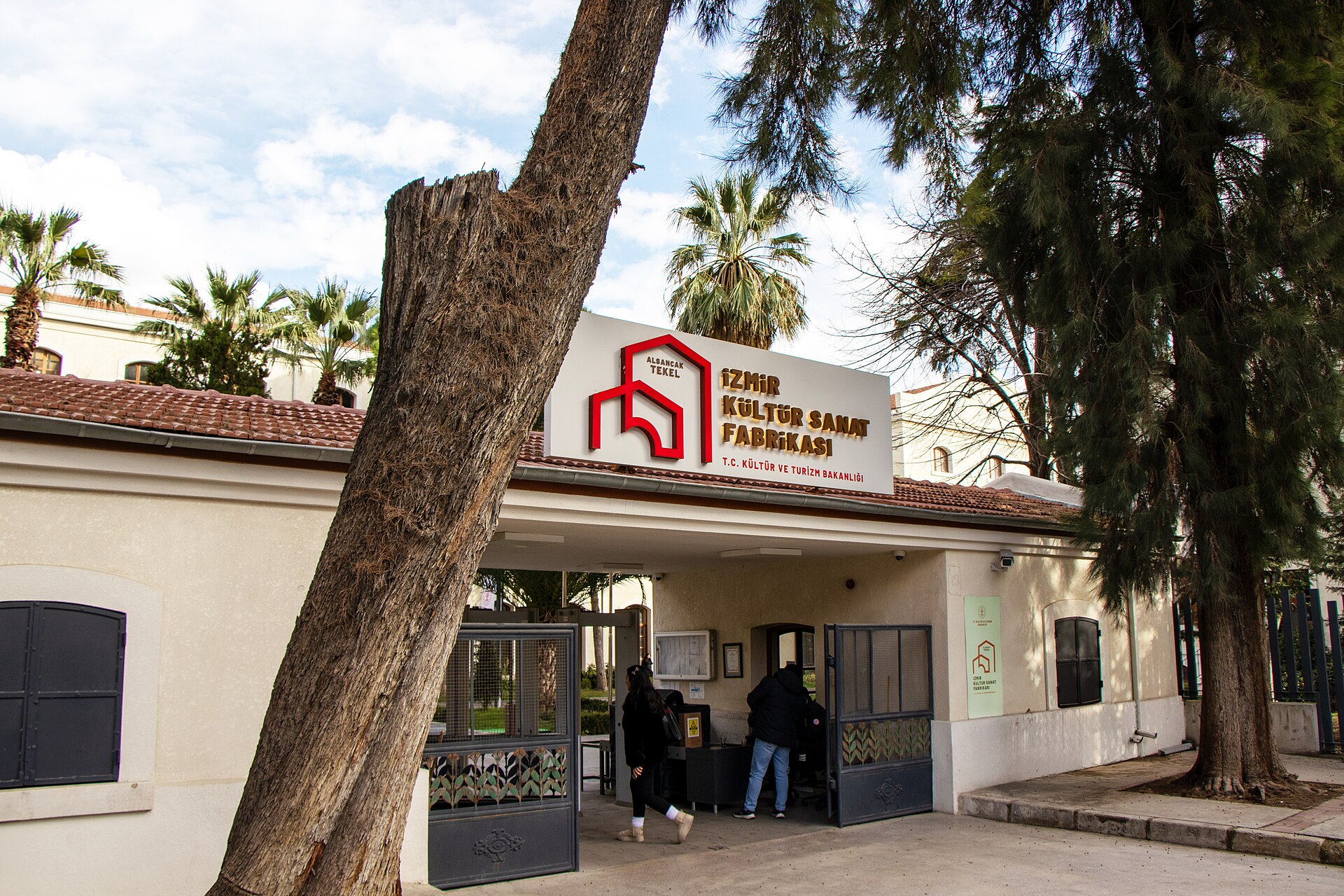
The restored entrance of the former Alsancak Tekel factory, now Izmir Kultur Sanat Fabrikasi, photographed in February 2026.
Koray · CC BY-SA 4.0Izmir Kultur Sanat Fabrikasi
Museum · Founded 2004
Open, admission and hours confirmed 12 September 2026 · 15 sources
On this page 14 sections
ContentsClose
The collection's real weight sits in regional archaeology drawn from Izmir's own hinterland, Ephesus, Pergamon, Smyrna, Teos, Metropolis and Klazomenai, arranged thematically rather than chronologically, alongside a second, separately administered art collection running from the earliest Ottoman academic painters to Fahrelnissa Zeid's international-standard modernism. Neither collection is large by the standards of Turkey's national museums, but together, inside one restored industrial site with its own libraries and public grounds, they form one of the more ambitious cultural-heritage conversions completed in Turkey since 2020.
| Kind | Museum |
|---|---|
| Founded | Built from the 1880s as the Alsancak Tekel (state tobacco monopoly) factory, in continuous industrial use until 2004; restored by the Ministry of Culture and Tourism 2021-2023 and reopened as a culture campus on 29 April 2023. The Izmir Painting and Sculpture Museum housed inside it was itself founded separately in 1952 and only moved into this building in 2023. |
| City and country |  Izmir, Turkey Izmir, Turkey |
| Address | Mimar Sinan Mahallesi, Ziya Gokalp Bulvari No:36, 35220 Konak, Izmir, Turkey |
| Website | izmirkultursanatfabrikasi.gov.tr/en |
| Status | Open, confirmed |
| Record last verified |
Visiting
- Hours
- Every day08:30 to 17:30Ticket window closes at 17:00.
- Admission
- Turkish citizensEntry is via MuzeKart, the Ministry of Culture and Tourism's paid annual museum pass, rather than a separate walk-up ticket priced by this venue; the province's own fee tariff lists this line only as 'MuzeKart ile girilebilir' (admissible with MuzeKart), with no walk-up TRY figure printed for a non-cardholder.Entry is via MuzeKart, the Ministry of Culture and Tourism's paid annual museum pass, rather than a separate walk-up ticket priced by this venue; the province's own fee tariff lists this line only as 'MuzeKart ile girilebilir' (admissible with MuzeKart), with no walk-up TRY figure printed for a non-cardholder.
- Foreign visitorsEUR 10Single-visit entry, as printed on the Izmir provincial culture directorate's own museum and site entrance-fee tariff.
- Tickets
- muze.gov.tr/muze-detay?DistId=MRK&SectionId=I... The museum's own ticket page.
- Do I need to book?
- No advance booking published; MuzeKart holders and ticket-window visitors both enter at the gate.
- Address
- Mimar Sinan Mahallesi, Ziya Gokalp Bulvari No:36, 35220 Konak, Izmir, Turkey MapTrain / commuter rail The Izmir Banliyo (IZBAN) commuter line's Alsancak station is about 100 metres from the site.
Tram The Izmir Tram's Hocazade Camii stop is a few minutes' walk away.
Bus Several ESHOT city bus routes stop on or near Ziya Gokalp Bulvari.
On foot Level walking distance from the Alsancak and Kemeralti districts and the Konak waterfront. - Website
- izmirkultursanatfabrikasi.gov.tr/en
- Telephone
- +90 232 280 97 00
- [email protected]
Before you go how long, access, photography, bags, eating, shop
- How long to allow
- Visitor accounts describe two to three hours for the Archaeology and Ethnography Museum alone, and a full day if the Painting and Sculpture Museum, the libraries and the grounds are added.
- Access
- The Archaeology and Ethnography Museum has step-free entry and a lift serving all three floors, with wide walkways between displays; more than one visitor account contrasts this favourably with the older, harder-to-navigate Izmir Archaeology Museum in Konak.
- Photography
- Not published on the venue's own channels at the point this page was researched.
- Bags
- Not published on the venue's own channels at the point this page was researched.
- Eating
- Cafes and places to eat are noted inside the grounds by multiple visitor accounts.
- Shop
- Not confirmed at the point this page was researched.
Prices and hours change. We take them from the institution's own pages and print the day we read them, and you can check the current position at the source we used. Confirm before you travel.
What is inside
Archaeology and Ethnography Museum - ground and first floors (archaeology)
About 6,000 objects spanning roughly 8,500 years, drawn from Izmir and the surrounding region: Ephesus, Pergamon (Bergama), the ancient city of Smyrna itself, Teos, Metropolis, Klazomenai, and the Yesilova and Ulucak prehistoric mounds. The display is organised into six named thematic rooms rather than a strict chronological run: The Power from the Sea, The Spirit of Entertainment, Heritage Created in Marble, Symbols of Death, The Mind of Civilization, and A World Between Knowledge and Myths. A large-scale replica of the Hellenistic Belevi Mausoleum, the c. 2,300-year-old tomb monument near Selcuk, stands near the entrance.
Archaeology and Ethnography Museum - second floor (ethnography)
Textiles and everyday material culture of the wider Aegean region and the transition into the Turkish Republic: Bergama and Gordes hand-knotted carpets, Ottoman and regional folk costumes, horse and camel tack, and household and decorative objects, shown alongside items associated with Ataturk and the early Republic.
Izmir Painting and Sculpture Museum
A dedicated art-history museum, founded in 1952 and moved into this building in 2023 after earthquake damage forced an earlier, temporary return to its original home at Kulturpark. Around 700 paintings, sculptures, ceramics and original prints run from the Tanzimat period to the present, including a mini-retrospective of Seref Akdik built from a 1973 donation by his heirs.
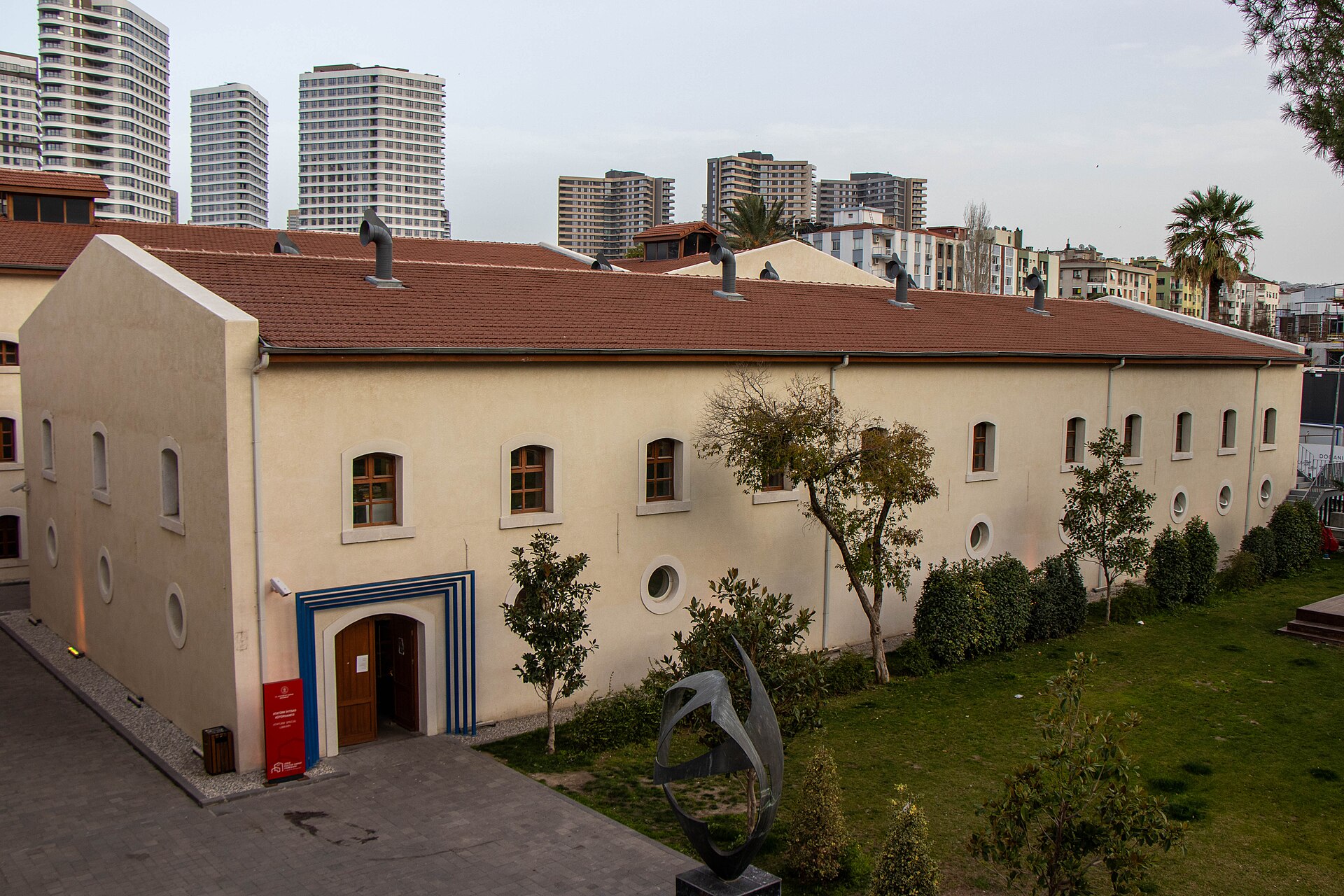
Photograph by Koray · CC BY-SA 4.0 Ataturk Specialised Library
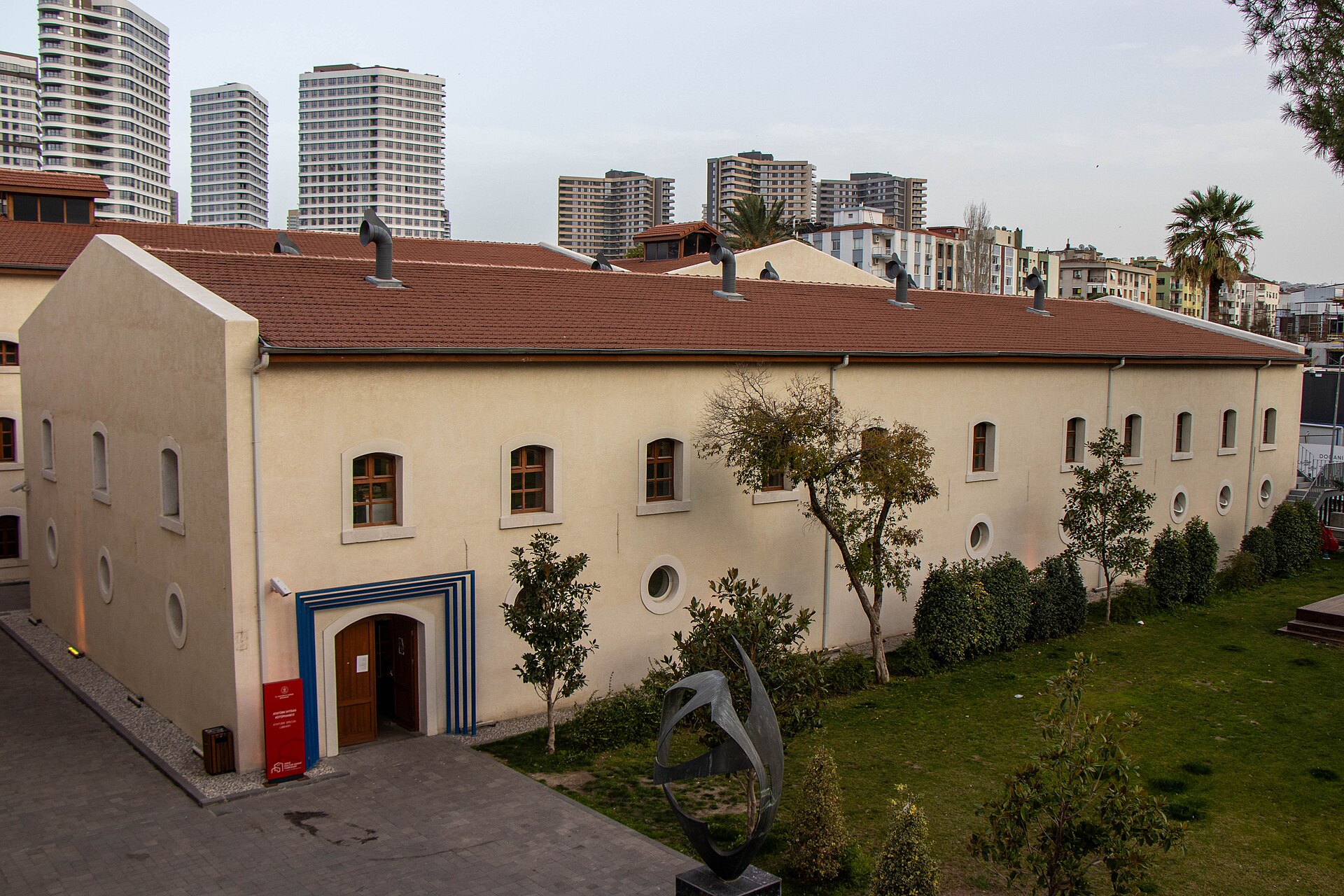
A reference library on Ataturk and the Republican era, described by the site as the largest collection of its kind in the Aegean region, with a public reading room inside the restored factory building.
Alsancak Public Library, Turkish World Music Specialised Library, and the wider campus
A general public library with its own children's, youth and periodicals sections; a specialised library and archive of Turkic-world music and dance tied to the resident State ensemble; an exhibition corridor (Sanat Sokagi, 'Art Street'); art and education workshops; and an open-air cinema and gardens across the grounds. These are what keep the site a working civic building rather than a single-purpose museum.
What to see first
Colossal reclining statue of the river-god Kaystros (Caystrus)
Roman, 2nd century ADFound in the frigidarium of the Vedius Gymnasium at Ephesus, this is one of the largest and best-documented Roman marbles in the collection, and the one object on this page with its own photograph verified as taken inside this museum in 2026.5
Statue of Homer
Hellenistic periodThe torso was excavated in 1950; the head was not recovered until roughly thirty years later and the two pieces were only physically reunited in 2004, giving the object its own excavation history spanning more than half a century.5
Statue of Androklos, mythical founder of Ephesus
Roman periodShown as a hunter with his dog, it ties the collection directly to the founding legend of the region's most-visited ancient city; reported here as part of this museum's holdings by Hurriyet Daily News's own coverage of the reopened collection.5
Reliefs of Poseidon and Demeter from the Agora of Smyrna
Roman periodExcavated in Izmir's own Roman-era marketplace rather than brought in from another ancient city, these are physical evidence of Smyrna's civic life on the same ground the museum now stands near.5
Large-scale replica of the Belevi Mausoleum
After a Hellenistic original near Selcuk, c. 300s-200s BCPlaced near the entrance, it stands in for a monument most visitors will never travel to see in person; both a named news feature and independent visitor accounts single it out as a first impression of the museum.6
Bergama and Gordes carpets
Western Anatolian weaving traditionsTwo of the most widely collected named carpet-weaving traditions of the region, shown on the ethnography floor alongside costumes and tack rather than isolated as trophies.14
Paintings by Seker Ahmed Pasa and Ibrahim Calli
Seker Ahmed Pasa (1841-1907); Ibrahim Calli (1882-1960)Seker Ahmed Pasa is generally credited as one of the first Ottoman painters trained in academic oil technique in Paris; Calli led the generation that brought Turkish painting into direct contact with European Impressionism. Together they anchor the Painting and Sculpture Museum's chronological start.8
Works by Fahrelnissa Zeid
Fahrelnissa Zeid (1901-1991)The collection's best-known internationally exhibited name, given a full retrospective at Tate Modern in 2017; represented here inside a museum collection that otherwise runs largely within Turkey's own art history.8
A tobacco factory becomes a culture campus
Izmir Kultur Sanat Fabrikasi occupies the former Alsancak Tekel factory, a state tobacco and cigarette works built from the 1880s in the Alsancak district of Izmir and kept in production until 2004. For nearly two decades afterward the site stood as disused industrial land inside a dense residential district, its twelve historic buildings registered for protection in stages between 1979 and 2007 but with no public use. The Ministry of Culture and Tourism began restoration work in 2021, and the complex reopened to the public on 29 April 2023 under its present name, translated on its own English-language site as the Izmir Culture and Arts Factory.
The scale of the conversion is unusual for a Turkish state museum project: roughly 20,000 square metres of restored interior space and a further 9,200 square metres of landscaped grounds, built around two purpose-refitted museums, three libraries, workshop space, an open-air cinema and exhibition corridors, rather than a single gallery building. The Ministry's own description frames it as a multi-generational meeting point, and the building's industrial fabric, exposed brick, factory floors and roof trusses among them, is kept visible rather than concealed behind a conventional museum fit-out.
The Archaeology and Ethnography Museum
The largest of the restored buildings, previously the factory's own production hall, now holds the Archaeology and Ethnography Museum (locally abbreviated IKSF or referred to in English coverage as Museum ICAF). Archaeological material fills the ground and first floors; ethnographic material occupies the second. Rather than a single chronological walk, the archaeology floors are organised into six named thematic rooms: The Power from the Sea, The Spirit of Entertainment, Heritage Created in Marble, Symbols of Death, The Mind of Civilization, and A World Between Knowledge and Myths, each built around objects from a specific site or period.
The material itself is drawn almost entirely from the wider Izmir region rather than assembled from elsewhere in Turkey: Ephesus, Pergamon, ancient Smyrna itself, Teos, Metropolis, Klazomenai, and the Yesilova and Ulucak prehistoric mounds are named as source sites, giving the museum's roughly 6,000 displayed objects a span of about 8,500 years. Individual pieces documented by name in the reopening coverage include a colossal Roman-period reclining statue of the river-god Kaystros from the Vedius Gymnasium at Ephesus, a Hellenistic statue of Homer whose head and torso were excavated thirty years apart and only reunited in 2004, and reliefs of Poseidon and Demeter recovered from Smyrna's own Roman-era agora. A large-scale replica of the Belevi Mausoleum, the Hellenistic tomb monument near Selcuk, greets visitors close to the entrance; more than one visitor account also mentions a run of Roman sarcophagi and gladiatorial material on the ground floor, material from the sanctuary at Klaros, Roman-era medical instruments, and, in a jump across the collection's full chronological range, twentieth-century firearms held alongside objects associated with Ataturk.
The second-floor ethnography galleries move the same building into a different register: hand-knotted Bergama and Gordes carpets, regional Ottoman costume, camel and horse tack, and household objects, continuing through into material tied to Ataturk and the founding of the Republic.
The Izmir Painting and Sculpture Museum, twice moved
The second major museum inside the complex has its own, older history. Founded on 9 September 1952, it operated first from the Maarif Vekaleti Kultur Pavyonu in Kulturpark before settling into its own building on Ataturk Boulevard in Konak in 1973. Earthquake damage in the 2020 Aegean Sea earthquake forced a temporary return to Kulturpark, and in April 2023 the museum reopened for a second time inside one of the second-largest buildings of the newly restored factory complex.
Its holdings, around 700 paintings, sculptures, ceramics and original prints, run from the Tanzimat period to the present day, and the named artist list represents a working survey of modern Turkish painting rather than a single school: Seker Ahmed Pasa and Hoca Ali Riza from the earliest Ottoman generation of academically trained oil painters; Ibrahim Calli and Hikmet Onat from the '1914 Generation' that brought direct contact with French Impressionism; and, further into the twentieth century, Fahrelnissa Zeid, an Ottoman-Turkish painter whose international standing was confirmed by a full retrospective at Tate Modern in 2017. A dedicated Seref Akdik mini-retrospective, built from a 1973 donation by his heirs, sits inside the wider permanent display.
Libraries, workshops and the grounds
Three specialised libraries share the site: the Ataturk Specialised Library, described by the venue as the largest collection of its kind in the Aegean region; the general-purpose Alsancak Public Library, with separate sections for young children, older children, young adults and periodicals; and a Turkish World Music Specialised Library serving the resident State Turkic World Dance and Music Ensemble. Around these sit art and education workshops, an exhibition corridor referred to as Sanat Sokagi ('Art Street'), and an open-air cinema set into the landscaped grounds.
This working mix of functions is what most separates Izmir Kultur Sanat Fabrikasi from a conventional museum building, and it is also the source of the one recurring complaint in visitor accounts: a site built to hold this much at once does not always present it in a single legible sequence, and more than one visitor has described the non-archaeological sections in particular as feeling loosely organised by comparison with the archaeology floors.
Restoration, protection status and scale
The individual factory buildings on the site were not registered for heritage protection all at once: successive Koruma Kurulu (Conservation Board) decisions listed different structures in 1979, 1985 and 2007, reflecting how the wider Alsancak Tekel works was recognised piecemeal over nearly thirty years before the Ministry's single, unified restoration project brought the whole 17,000-square-metre footprint back into public use together. The restored complex is reported to have been designed to meet Biosphere sustainability certification criteria, a target aimed at the site's ongoing operation rather than at the historic fabric of the buildings themselves.
The two headline museums occupy the two largest of the twelve historic structures: the former production hall, at roughly 7,240 square metres over two storeys, for the Archaeology and Ethnography Museum, and the second-largest building for the Painting and Sculpture Museum. The remaining structures were redistributed among the libraries, workshops and administrative space rather than left as unconverted industrial shell, which is part of why the site reads, on the ground, as a small campus rather than a single museum with outbuildings.
Two Izmir museums, one administration
Izmir Kultur Sanat Fabrikasi sits under the same Izmir Muzesi Mudurlugu (Izmir Museum Directorate) as the separate Izmir Archaeology Museum in Bahribaba Park, Konak, a different building with a different founding history dating to the 1920s. The two are not the same institution and do not hold the same collection: the Bahribaba building is the older, purpose-built archaeology museum; the factory complex is a 2023 addition built around its own, largely distinct set of objects and around an entirely separate art museum, three libraries and a public park. Shared administration under one regional Ministry directorate is common practice across Turkey's state museum system and does not make either site a branch of the other.
For a visitor planning a trip, the practical distinction is straightforward: the Bahribaba museum is the older, single-purpose archaeology collection near Konak's ferry terminal and metro station; the factory complex in Alsancak is the newer, larger, mixed-use site nearer Alsancak's own railway and tram stops, and includes its own permanent collection under a different roof. At least one visitor account also notes that a single ticket does not automatically cover every department on this site, and that a visitor wanting both museums plus the libraries should expect to plan for it rather than assume one gate fee opens everything.
What visitors say
Visitor accounts and press coverage are consistently positive about the scale of the restoration and the breadth of what it now holds, and consistently note that the building tries to be several institutions at once: an archaeology museum, an ethnography museum, an art museum, two libraries and a public park under one roof. The most common reservation is that the result can feel like several separate visits stitched together rather than one coherent museum.
What is praised, what is criticised
- Praised: The scale and ambition of the renovation, turning a disused 19th-century tobacco factory into a full cultural campus rather than a single building.
- Praised: The breadth of the archaeology and ethnography floors, covering everything from Aegean prehistory to the early Turkish Republic in one visit.
- Praised: Step-free access and a lift serving all three floors of the Archaeology and Ethnography Museum, called out favourably against the older Izmir Archaeology Museum in Konak by at least one visitor who uses a wheelchair.
- Criticised: One detailed visitor account (January 2025) described the mix of archaeology, ethnography, history and contemporary art inside one very large building as running together without a clear sequence or theme, calling the non-archaeology sections comparatively 'amateurish' in their arrangement.
- Criticised: A paid audio-guide and interpretation system that a January 2026 visitor reported was not functioning properly during their visit.
Ratings on other platforms
TripAdvisor: 4.7 from 6 ratings, read 12 September 2026
A platform average is a tertiary source: it moves, it is not audited, and we quote no visitor's words.
Questions about Izmir Kultur Sanat Fabrikasi
Where is Izmir Kultur Sanat Fabrikasi?
Mimar Sinan Mahallesi, Ziya Gokalp Bulvari No:36, 35220 Konak, Izmir, Turkey.
How much does it cost to visit?
Turkish citizens: see the museum; Foreign visitors: EUR 10. As confirmed 12 September 2026.
When is it open?
Every day 08:30-17:30. As confirmed 12 September 2026.
How do you get there?
Train / commuter rail: The Izmir Banliyo (IZBAN) commuter line's Alsancak station is about 100 metres from the site; Tram: The Izmir Tram's Hocazade Camii stop is a few minutes' walk away; Bus: Several ESHOT city bus routes stop on or near Ziya Gokalp Bulvari; On foot: Level walking distance from the Alsancak and Kemeralti districts and the Konak waterfront.
What should you see first?
Colossal reclining statue of the river-god Kaystros (Caystrus) (Roman, 2nd century AD); Statue of Homer (Hellenistic period); Statue of Androklos, mythical founder of Ephesus (Roman period); Reliefs of Poseidon and Demeter from the Agora of Smyrna (Roman period); Large-scale replica of the Belevi Mausoleum (After a Hellenistic original near Selcuk, c. 300s-200s BC); Bergama and Gordes carpets (Western Anatolian weaving traditions).
What we could not confirm
- No walk-up Turkish-lira admission figure for a Turkish citizen without a MuzeKart was found on either the museum's own site or the Ministry's own ticketing portal; only the MuzeKart requirement and the EUR 10 foreign-visitor figure are confirmed in the province's own tariff document.
- Sources disagree on the size of the Painting and Sculpture Museum's collection: the museum's own dedicated Turkish Wikipedia article gives about 700 works, while at least one general description of the wider complex gives about 400; this page follows the dedicated-article figure but the discrepancy was not independently resolved.
- Whether the Belevi Mausoleum piece near the entrance is a built replica (the wording used by Daily Sabah and by one TripAdvisor reviewer, 'giant size model') or incorporates original remains from the monument (the wording used by a second TripAdvisor reviewer) was not fully reconciled against a primary curatorial source; this page follows the replica wording.
- Individual phone lines for the Painting and Sculpture Museum, the two public libraries and the music-and-dance ensemble were found on the venue's own contact page but were not independently verified by calling them.
Images
Sources
- 1T.C. Kultur ve Turizm Bakanligi, muze.gov.tr museum ticketing portal, Izmir Kultur Sanat Fabrikasi (ITK01) entry muze.gov.tr/muze-detay?DistId=MRK&SectionId=ITK01
- 2Izmir Il Kultur ve Turizm Mudurlugu, Izmir ili muze ve oren yerleri giris ucreti tarifesi (provincial museum and site entrance-fee tariff) izmir.ktb.gov.tr/TR-376139/izmir-ili-muze-ve-oren-yerleri-giris-ucreti-tarifesi.html
- 3Izmir Kultur Sanat Fabrikasi, official English-language site, homepage izmirkultursanatfabrikasi.gov.tr/en
- 4Izmir Kultur Sanat Fabrikasi, official English-language site, contact page izmirkultursanatfabrikasi.gov.tr/en/hakkimizda/iletisim
- 5Hurriyet Daily News, 'Izmir museum presents thematic exhibits', 21 April 2025 hurriyetdailynews.com/izmir-museum-presents-thematic-exhibits-208294
- 6Daily Sabah, 'Izmir's 120-year-old Ottoman-era factory hosts millennia of art', 11 May 2023 dailysabah.com/arts/izmirs-120-year-old-ottoman-era-factory-hosts-millennia-of-art/news
- 7Turkish Wikipedia, 'Izmir Kultur Sanat Fabrikasi' (, identity and building history) tr.wikipedia.org/wiki/%C4%B0zmir_K%C3%BClt%C3%BCr_Sanat_Fabrikas%C4%B1
- 8Turkish Wikipedia, 'Izmir Resim ve Heykel Muzesi' (, museum history and artist list) tr.wikipedia.org/wiki/%C4%B0zmir_Resim_ve_Heykel_M%C3%BCzesi
- 9Wikidata, Q117472126, Izmir Culture and Arts Factory (, identity and coordinates) wikidata.org/wiki/Q117472126
- 10TripAdvisor, 'Izmir Kultur Sanat Fabrika' attraction page and visitor reviews () tripadvisor.com/Attraction_Review-g298006-d26524829-Reviews-Izmir_Kultur_Sanat_Fabrika-Izmir_Izmir_Province_Turkish_Aegean_Coast.html
- 11Wikimedia Commons, File:Statue of Caystrus.jpg commons.wikimedia.org/wiki/File:Statue_of_Caystrus.jpg
- 12Wikimedia Commons, Category:Izmir Culture and Arts Factory commons.wikimedia.org/wiki/Category:%C4%B0zmir_Culture_and_Arts_Factory
- 13Wikimedia Commons, File:Entrance of the Izmir Culture and Arts Factory.jpg commons.wikimedia.org/wiki/File:Entrance_of_the_%C4%B0zmir_Culture_and_Arts_Factory.jpg
- 14Wanderlog, 'Izmir Culture and Arts Factory Archaeology and Ethnography Museum' ( aggregator, object descriptions and visitor tips) wanderlog.com/place/details/10682449/izmir-culture-and-arts-factory-archaeology-and-ethnography-museum
- 15Wikimedia Commons, File:Ataturk Special Library.jpg commons.wikimedia.org/wiki/File:Atat%C3%BCrk_Special_Library.jpg


