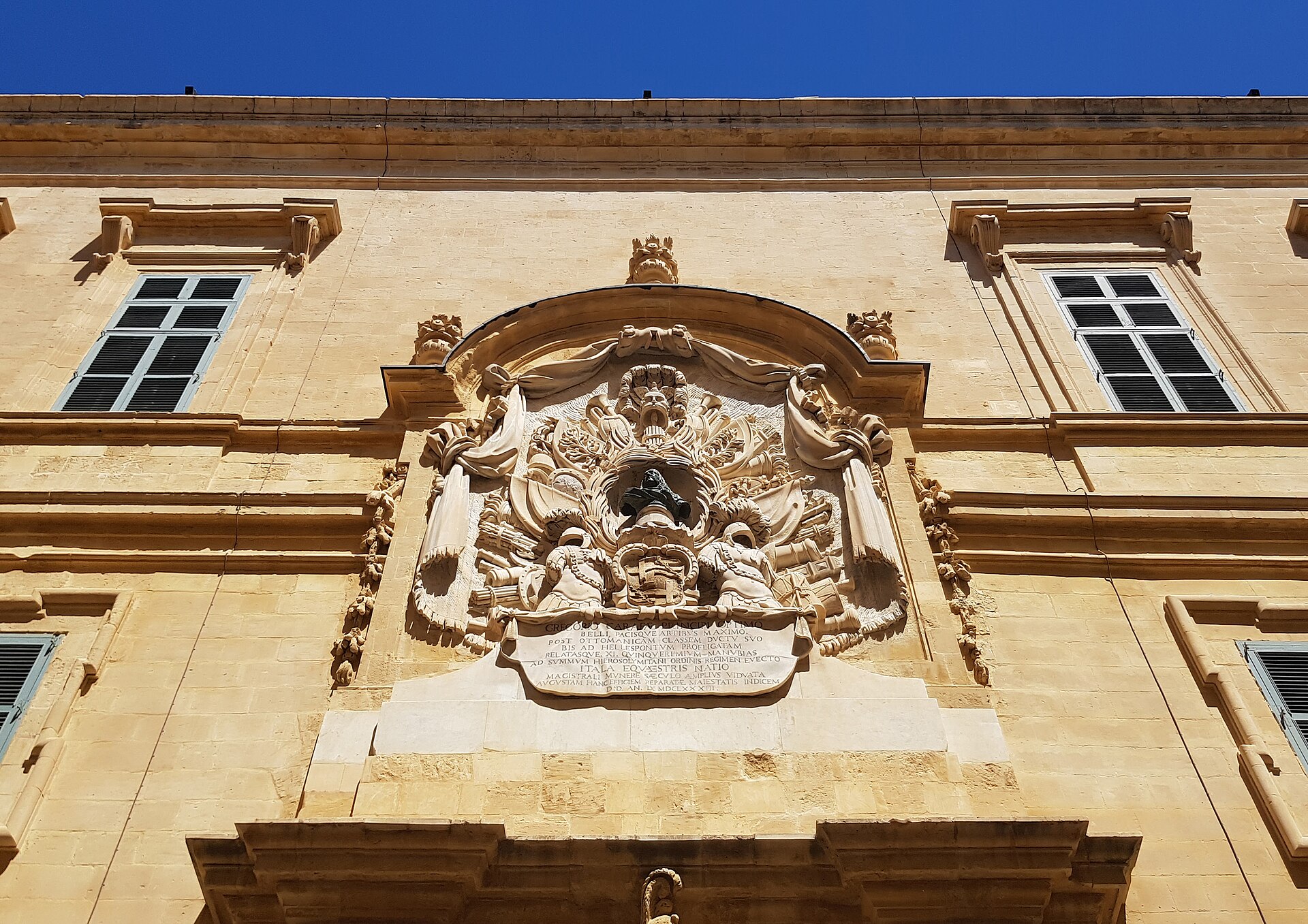
The Baroque main facade of Auberge D'Italie on Merchants Street, Valletta, seat of MUZA since 2018.
Matthew Axiak, CC BY-SA 4.0MUZA
Museum · MUZA - Muzew Nazzjonali tal-Arti · Founded 2018
Open, admission and hours confirmed 26 August 2026 · 17 sources
On this page 15 sections
ContentsClose
MUZA's deepest holding is Baroque painting, anchored by what the museum's own description calls the largest collection of Mattia Preti's work anywhere, and by the Old Master Drawings assembled through Vincenzo Bonello's 1933-34 purchase, whose Italian attributions -- Perugino, Carpaccio, Guercino, Baglione and Passerotti among them -- are still actively studied. Its second strength is continuity between the collection and the room that holds it: the museum has folded its own building history, including the rediscovered Scala Grande and the kitchen of the Auberge, into the visitor experience rather than treating the historic fabric as a neutral shell around the art.
| Local name | MUZA - Muzew Nazzjonali tal-Arti |
|---|---|
| Kind | Museum |
| Founded | 2018 |
| City and country |  Valletta, Malta Valletta, Malta |
| Address | Auberge D'Italie, Merchants Street, Valletta VLT 1170, Malta |
| Website | heritagemalta.org/muza-national-community-art-museum |
| Status | Open, confirmed |
| Record last verified |
Visiting
- Hours
- Mon, Wed-Sun09:00 to 17:00January and February; last admission 16:30; closed Tuesdays
- Daily10:00 to 18:00March to October; last admission 17:30
- Daily09:00 to 17:00November and December; last admission 16:30
- Closed
- Tuesdays in January and February. 1 January, Good Friday, and 24, 25 and 31 December (all Heritage Malta sites).
- Admission
- Adult (18+)EUR 10
- Senior Citizens (60+)EUR 7.50
- Youths (12-17)EUR 7.50
- Concessions and StudentsEUR 7.50
- Children (6-11)EUR 5.50
- Infants (1-5)Freefree
- Heritage Malta MembersFreefree
- Heritage Malta Passport HoldersFreefree
- Tickets
- heritagemalta.mt/store/s59 The museum's own ticket page.
- Do I need to book?
- Not required for individual visitors; tickets can be booked online in advance and are valid for 30 days after purchase
- Address
- Auberge D'Italie, Merchants Street, Valletta VLT 1170, Malta MapBus The nearest bus stop is about two minutes on foot from the museum, per the museum's own visit page
- Website
- heritagemalta.org/muza-national-community-art-museum
- Telephone
- +356 23954500
- [email protected]
Before you go how long, access, photography, bags, eating, shop
- How long to allow
- Tripadvisor's own listing states a duration of one to two hours; individual visitor accounts describe stays of two to three hours
- Access
- A lift reaches the first floor and two further wheelchair lifts serve individual first-floor galleries; accessible restrooms with grab bars are provided on every floor; the museum states it is working toward becoming autism-friendly, with no date yet given
- Eating
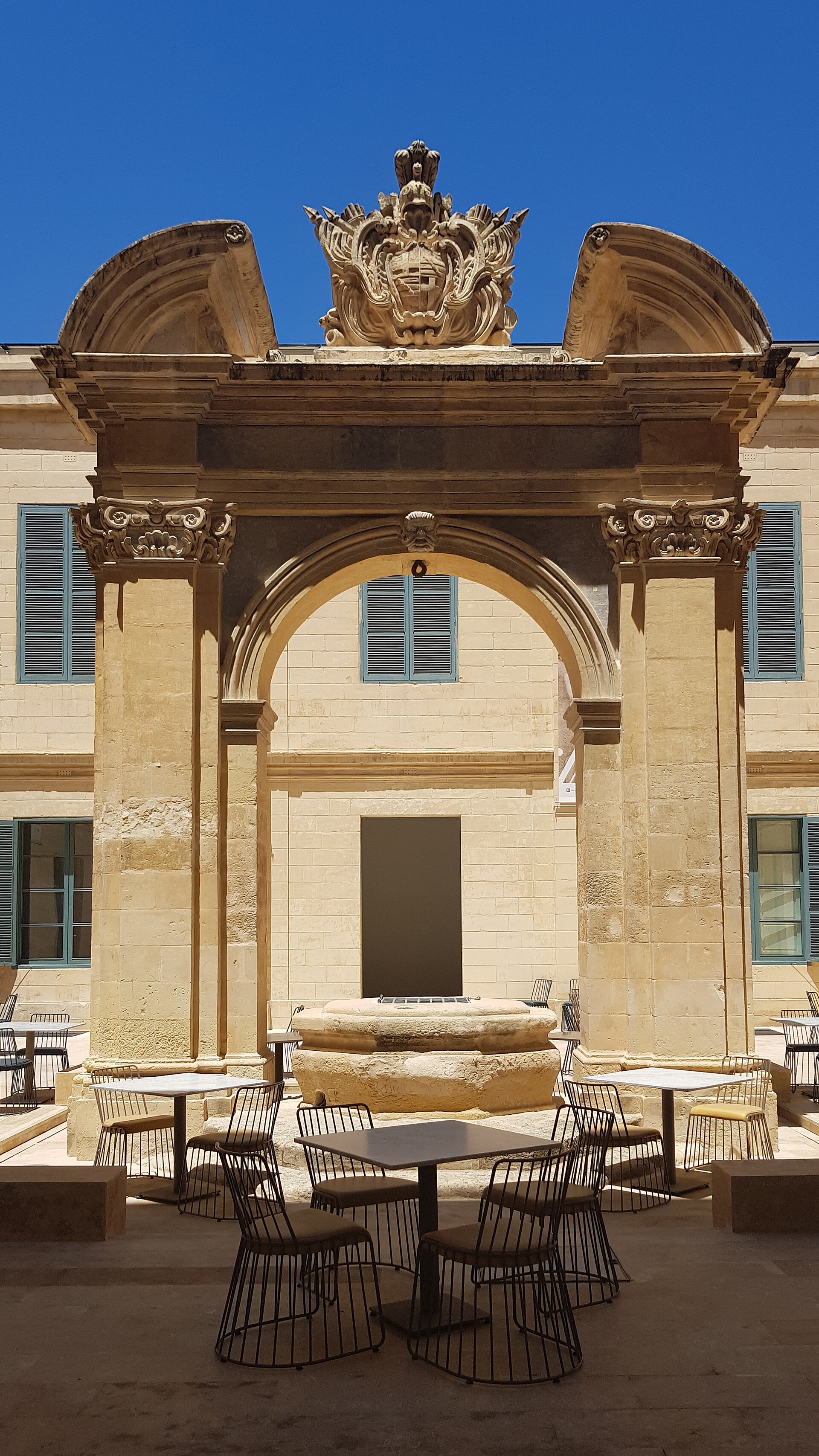
- No dedicated cafe is listed; the museum's own facilities list names an indoor and outdoor seating area, set in the restored courtyard
- Shop
- A gift shop is on site at the exit
Prices and hours change. We take them from the institution's own pages and print the day we read them, and you can check the current position at the source we used. Confirm before you travel.
What is inside
Mediterranean
The narrative tracing the artistic ideas and cultural currents that reached Malta by sea from continental Europe and North Africa, weighted toward medieval and Renaissance material: a strong religious imprint, links to the classical tradition of Greece and Rome, and everyday objects shaped by the island's position in the Mediterranean, with connections carried forward into later centuries and contemporary art.
Europe
The narrative of the sixteenth to eighteenth centuries, when the Order of St John's cosmopolitan, aristocratic networks brought European artists and styles onto the island; Baroque painting including Mattia Preti, alongside Maltese furniture, silverware and tableware arranged to reconstruct the interiors of the island's noble houses, with one gallery dedicated to the Order's rule and to Valletta as its capital.
Empire
The nineteenth and early twentieth century narrative of Malta inside the British imperial system: paintings and views by travelling and Maltese artists made possible by improved travel, including journeys as far as the Far East, set against an island that stayed inward-looking, Catholic and Mediterranean underneath its colonial ties, read through the Nazarene and Purist schools active on Malta.
The Artist
The narrative of Maltese and visiting artists from the late nineteenth century to today: the generation who trained in Rome, the sculptor Antonio Sciortino's international career, and the postwar and post-independence push toward abstraction, which the museum credits the British painter Victor Pasmore with helping to catalyse among Maltese artists.
What to see first
View of Valletta and the Grand Harbour
Joseph Mallord William TurnerA watercolour on loan from HSBC, the single British Romantic voice inside a collection otherwise dominated by continental Baroque painting, and repeatedly the object visitors say they were most surprised to find in a Maltese museum8
The Old Master Drawings collection
Various, assembled by curator Vincenzo BonelloBonello's largest single purchase, made in 1933-34, brought in sheets attributed to Perugino, Carpaccio, Guercino, Mattia Preti, Baglione and Passerotti; the Italian bias reflects Bonello's own scholarly interests and the attributions are still actively studied by specialists10
The Mattia Preti Baroque paintings
Mattia PretiDescribed by the museum as the largest holding of Preti's work anywhere; Preti was a Knight of the Order who spent the second half of his life on Malta and also worked on the interior of the Conventual Church of St John, Valletta's co-cathedral8
The bust and trophy-of-arms over the main doorway
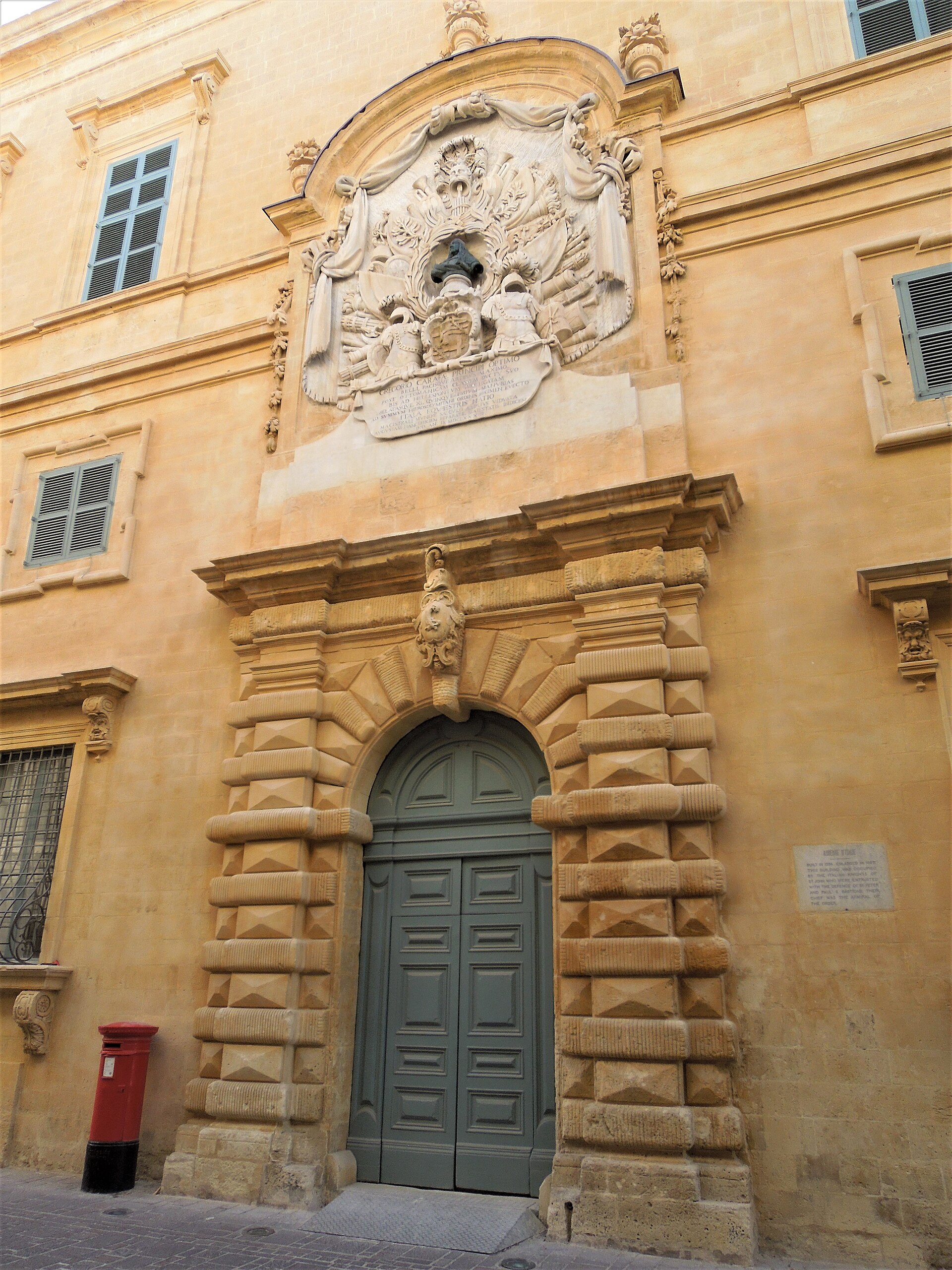
Designed by Raymond La FageCommissioned by the Italian Langue in 1680 to honour the newly elected Grand Master Gregorio Carafa, this Baroque centrepiece replaced the building's plainer Mannerist front and is the feature most visitors photograph from Merchants Street; it was restored in 2015-162
Sculpture by Antonio Sciortino
Antonio SciortinoThe Maltese sculptor who built an international career based in Rome, presented by the museum as the culmination of the Italian-trained generation of Maltese artists in The Artist narrative7
Baroque sculpture by Melchiorre Cafa
Melchiorre CafaA Maltese Baroque sculptor whose work sits alongside Sciortino's as one of the collection's two Maltese sculptors named directly by visitors and guides describing the permanent display11
The postwar Maltese modernists
Emvin Cremona, Giorgio Preca, Willie and Vincent Apap, Alfred Chircop, among othersThe group of Maltese artists the museum credits the British painter Victor Pasmore with pushing toward abstraction after his own move to Malta, forming the modern half of The Artist narrative7
Past exhibitions here
- Closed3 Sep to 4 Oct 2026Confirmed · check before you travel
The building and what it was built to hold
Auberge D'Italie was raised between 1574 and the 1590s as the residence of the Italian Langue of the Order of St John, one of the eight language-groups of Hospitaller knights that governed Malta from 1530. The site was granted to the Langue on 28 April 1576, when Grand Master La Cassiere handed over the previous auberge and the plot became part of the ground of the original Grand Master's Palace; construction of the main facade on Merchants Street was underway by 25 June 1593, and a first phase of building was largely complete by 1580, with a front facing what is today Pjazza de Vallette. Girolamo Cassar, the architect responsible for much of Valletta's earliest civic and religious fabric, is credited with the Mannerist design of the original structure: a rectangular block of rooms in three storeys, cut from Malta's limestone, arranged around a central courtyard in the manner of an Italian Renaissance palace, with a symmetrical main front, rusticated corner quoins and six windows to each floor. Master mason Gio Andrea Farrugia oversaw the work until his death, and the engineer Francesco Antrini also contributed to the design.
In 1631 the Auberge hosted the first opera ever performed on the Maltese islands, staged there for Carnival, a use that continued in the years that followed. The severe Mannerist front was transformed nearly a century later: on 10 September 1669 extensive renovation works on the main facade were concluded, most likely funded by the Italian Grand Master Gregorio Carafa and carried out to designs attributed to the architect Mederico Blondel, who reworked the entrance into the Baroque idiom that still defines the building today. After Carafa's election as Grand Master in 1680, the Italian Langue commissioned a marble centrepiece over the main doorway in his honour, a trophy of arms with a bronze bust designed by the French artist Raymond La Fage, then working in Naples; it is this ornate pediment, not the plainer Mannerist elevation it replaced, that a visitor photographs on Merchants Street today.
Four centuries between the Order and the museum
By the late eighteenth century the building itself was in trouble: on 13 July 1769 the Order's resident architect Giuseppe Bonnici certified that the Auberge had extensive structural problems, and for years afterward it needed constant repair; a full demolition and rebuilding was scheduled, then definitively shelved on 5 August 1785 after the Langue's different commanderies failed to fund it. The Order's rule in Malta ended on 11 June 1798, when the French Republican fleet sailed into Grand Harbour and seized the islands; the Auberge became a governmental building serving first the French, then the British military administration that followed from 1800.
Its interior kept changing use. In 1838 the Great Hall was earmarked for conversion into a Protestant chapel, a plan never carried out; in the years that followed, the upper floors instead became the studio and residence of the Maltese artist Giuseppe Hyzler. In 1850 the Notarial Archives were moved to the top floor, and the refurbishment that made room for them demolished the Scala Grande, the building's original grand staircase, entirely. The first proposal to turn the Auberge into a museum reached Parliament on 21 February 1920, when Dr Enrico Mizzi formally proposed that the paintings being assembled by the collector Vincenzo Bonello be constituted as a museum on the site. Two years later the plan went ahead: the Auberge became the seat of the Valletta Museum, combining archaeology, art, numismatics and natural history under one roof, with a conservation laboratory attached and the archaeologist Sir Themistocles Zammit as its first director; it was formally inaugurated on 19 November 1925.
The Second World War reached the building directly: on 7 April 1942 the Auberge took two direct hits, damaging both the Notarial Archives, still housed there, and the natural history collections in the basement. In 1954 the Valletta Museum's collections were removed altogether and a criminal tribunal moved into the halls purpose-built for the Fine Arts Section, standing in for the war-damaged law courts at the nearby Auberge d'Auvergne. A 1967 plan to reinstate the Auberge as the national museum got as far as moving some items back in before it was reversed in 1971 in favour of Admiralty House on South Street, which then held Malta's fine art collection as the National Museum of Fine Arts for the following decades. The Auberge itself became, in turn, the seat of the Post and Communications Department from 4 July 1973, functioning partly as a working post office, and from 18 March 2002 the seat of the Ministry of Tourism and the Malta Tourism Authority.
Rediscovery: the restoration that became MUZA
The conservation and restoration that turned the Auberge back into a museum was, in Heritage Malta's own account, a process of discovery as much as repair: a relatively unknown building, documented in only a handful of published sources, gave up findings that had to be pieced together by researchers, architects and curators working across archival material and physical evidence on site, room by room, almost as an archaeological reading of the standing fabric. The location of the long-lost Scala Grande, demolished in 1850, was reconstructed from archival descriptions of a stairwell with cross-vaulted landings and large French windows at each level, and its rediscovery is treated as one of the project's principal findings. Investigators also recovered the original kitchen that had served the Auberge's dining hall, known as Il Camerone, together with the private quarters of the donato, the lower-ranking knight who ran the building's daily affairs: the marks of the hood that stood over the hearth, the original flagstone floor, cupboards built into the thickness of the walls, and a layer of soot on the high walls all survived to be uncovered. The main facade itself went through a further restoration between 2015 and 2016, which recovered decorative detail and returned Carafa's bust to legibility.
MUZA opened to the public on 10 November 2018, as one of the projects delivered under Valletta's year as European Capital of Culture. The move brought Malta's national art collection out of Admiralty House, where it had operated since the 1970s under conditions its own record-keeping shows were constraining attendance, and into a building the museum's history page treats as an exhibit in its own right, with the restored spaces read alongside the collection rather than as a neutral shell around it.
Four narratives instead of one chronology
MUZA does not organise its galleries as a single chronological march from early to modern. Heritage Malta's published account of the concept describes four parallel storylines through the same national collection, developed with input from public consultation during the project's early stages as well as from the curatorial team: Mediterranean, Europe, Empire and The Artist. Works of art are positioned in response to a narrative or story rather than a strict period sequence, so a visitor can follow any one of the four threads in isolation or let them cross.
The Mediterranean narrative is the strand most weighted toward the medieval and Renaissance, tracing the ideas and cultural currents that reached Malta by sea from continental Europe and North Africa. Europe covers the two and a half centuries of the Order's rule, when the Hospitaller Knights' cosmopolitan, aristocratic networks brought a stream of European artists and styles onto the island; Mattia Preti is the exemplary case, the Baroque painter who spent the second half of his life on Malta, shown alongside Maltese furniture, silverware and tableware arranged to reconstruct the interiors of the island's noble houses. Empire runs from Malta's absorption into the British imperial system through the nineteenth century, when improved travel exposed Maltese artists to further-flung British territories, even as the islands themselves stayed inward-looking, Catholic and Mediterranean underneath their new colonial ties, a tension the section reads through the Nazarene and Purist schools active on the island. The Artist, finally, follows Maltese and visiting artists from the late nineteenth century to the present, from the generation who trained in Rome, through the sculptor Antonio Sciortino's international career, to the postwar and post-independence push toward abstraction that the British painter Victor Pasmore is credited with helping to catalyse among Maltese artists.
The collection: from Bonello's purchases to the national holdings
The collection MUZA now shows had begun accumulating on this same site nearly a century before the museum's 2018 reopening. Vincenzo Bonello was appointed founder and first curator of the Fine Arts Section established within the Valletta Museum in 1922, a post he held from 1924 to 1937, and it was under his direction that the collection grew through acquisition on the local market and abroad, in London and in Italy, alongside donations from Maltese collectors. His largest single purchase, made in 1933-34, brought in the museum's Old Master Drawings, a body of work whose Italian bias reflects Bonello's own scholarly interests: pages attributed to Perugino, Carpaccio, Guercino, Baglione and Passerotti sit alongside further sheets by Mattia Preti, and their attributions are still actively studied by specialists.
The paintings collection built on Bonello's foundation includes what the museum describes as the largest holding of work by Mattia Preti (1613-1699) anywhere, the Neapolitan-trained Baroque painter and Knight of the Order who also worked on the interior of the Conventual Church of St John, Valletta's co-cathedral; alongside him hang Guido Reni, Valentin de Boulogne, Jusepe de Ribera and other Caravaggisti, as well as Northern European, French and British painters, including a watercolour of Valletta and the Grand Harbour by J. M. W. Turner, on loan from HSBC, and views by Edward Lear. The Maltese side of the collection runs from the sculptors Melchiorre Cafa and Antonio Sciortino through nineteenth century portraitists and landscape painters such as Giuseppe Cali and Girolamo Gianni, to the twentieth century modernists Edward Caruana Dingli, Anton Inglott, Emvin Cremona, Giorgio Preca, the brothers Willie and Vincent Apap, and Alfred Chircop. Beyond paintings, the museum holds sculpture in wood, bronze, marble, plaster, ivory and composite materials, Maltese furniture, ecclesiastical and domestic silverware, ceramics and maiolica jars, jewellery and objets d'art, works on paper spanning drawings to photographs, and video art acquired in more recent decades.
Visiting MUZA
The museum today occupies the restored ground and first floors of the Auberge, entered through the courtyard where Heritage Malta's own facilities list names a gift shop, an indoor and outdoor seating area, lockers and a nappy changing facility. Access has been built into the restoration rather than added afterward: a lift reaches the first floor, two further wheelchair lifts serve individual galleries on that level, and accessible toilets with grab bars are provided on every floor Heritage Malta lists; the museum states it is working toward becoming autism-friendly, without yet giving a date. Opening hours change through the year and run longest, 10am to 6pm daily, from March to October; the museum, like every Heritage Malta site, is closed on 1 January, Good Friday and 24, 25 and 31 December.
Visitor reaction, drawn from the aggregate rating and dozens of individual accounts, is consistent on a small number of points: the building itself, its restoration, and the way the museum has been fitted into it without crowding the historic fabric; the quality and clarity of the English language interpretation, particularly on the first floor; and, repeatedly, surprise at finding a Turner watercolour in a Maltese museum. Complaints cluster just as consistently around a modern glass staircase that some visitors find disconcerting to use, and, less often, a sense that the museum's abstract and later sculpture is the least engaging part of the collection next to its Baroque core.
What visitors say
Visitors consistently single out the building itself: the restored Auberge d'Italie, its Baroque facade and its courtyard, read alongside the collection rather than as a shell around it. The clarity of the English-language interpretation, especially on the first floor, and the presence of a Turner watercolour in a Maltese museum both come up repeatedly. Complaints cluster on the opposite end from the building: a modern glass staircase some visitors find disorienting, and, less often, the later and more abstract parts of the collection landing less well than its Baroque core.
What is praised, what is criticised
- Praised: The restored Auberge d'Italie building and its courtyard, described as a quiet escape from Valletta's crowded streets
- Praised: Clear, well-written English-language interpretation, particularly on the first floor
- Praised: Accessibility: a working lift, wheelchair lifts to individual galleries, and staff described as knowledgeable and helpful
- Praised: Value for the admission price, and a lack of crowding that lets visitors take their time
- Criticised: The modern glass staircase inserted into the historic building, which some visitors find disconcerting to use
- Criticised: Uneven appeal of the later, more abstract and modern sculpture compared with the museum's Baroque strength
- Criticised: Parts of the ground floor were still under development when several visitors passed through in the year or so after the 2018 opening
Ratings on other platforms
Tripadvisor: 4 from 108 ratings, read 26 August 2026
A platform average is a tertiary source: it moves, it is not audited, and we quote no visitor's words.
Questions about MUZA
Where is MUZA?
Auberge D'Italie, Merchants Street, Valletta VLT 1170, Malta.
How much does it cost to visit?
Adult (18+): EUR 10; Senior Citizens (60+): EUR 7.5; Youths (12-17): EUR 7.5; Concessions and Students: EUR 7.5; Children (6-11): EUR 5.5. As confirmed 26 August 2026.
When is it open?
Mon, Wed-Sun 09:00-17:00; Daily 10:00-18:00; Daily 09:00-17:00. Closed: Tuesdays in January and February. 1 January, Good Friday, and 24, 25 and 31 December (all Heritage Malta sites). As confirmed 26 August 2026.
How do you get there?
Bus: The nearest bus stop is about two minutes on foot from the museum, per the museum's own visit page.
What should you see first?
View of Valletta and the Grand Harbour (Joseph Mallord William Turner); The Old Master Drawings collection (Various, assembled by curator Vincenzo Bonello); The Mattia Preti Baroque paintings (Mattia Preti); The bust and trophy-of-arms over the main doorway (Designed by Raymond La Fage); Sculpture by Antonio Sciortino (Antonio Sciortino); Baroque sculpture by Melchiorre Cafa (Melchiorre Cafa).
What we could not confirm
- The exact cost and full scope of the 2015-2018 restoration and museum fit-out were not located in the sources checked for this record.
- Which of Vincenzo Bonello's 1933-34 Old Master Drawings attributions (Perugino, Carpaccio, Guercino among them) remain disputed and which have since been confirmed is not detailed in the sources checked here.
Images
Sources
- 1MUZA official site, Plan your visit muza.mt/planyourvisit/
- 2MUZA official site, About MUZA - History muza.mt/?page_id=2112
- 3MUZA official site, The MUZA Concept muza.mt/?page_id=1812
- 4MUZA official site, Collection narrative - Mediterranean muza.mt/?page_id=1549
- 5MUZA official site, Collection narrative - Europe muza.mt/?page_id=3511
- 6MUZA official site, Collection narrative - Empire muza.mt/?page_id=3515
- 7MUZA official site, Collection narrative - The Artist muza.mt/?page_id=3516
- 8Heritage Malta, MUZA - The National Community Art Museum (official page) heritagemalta.mt/explore/muza/
- 9Heritage Malta online store, Muza ticket heritagemalta.mt/store/s59/
- 10Heritage Malta, The Old Master Drawings Collection at MUZA: Highlights from the Vincenzo Bonello Acquisition (1933-1934) heritagemalta.mt/whats-on/the-old-master-drawings-collection-at-muza-highlights-from-the-vincenzo-bonello-acquisition-1933-1934/
- 11Tripadvisor, MUZA - The Malta National Community Art Museum (reviews and rating) tripadvisor.com/Attraction_Review-g190328-d15631567-Reviews-MUZA_The_Malta_National_Community_Art_Museum-Valletta_Island_of_Malta.html
- 12Wikipedia, MUZA (, identity and opening date) en.wikipedia.org/wiki/MU%C5%BBA
- 13Wikipedia, Auberge d'Italie (, architecture) en.wikipedia.org/wiki/Auberge_d%27Italie
- 14Wikimedia Commons, File:Auberge d'Italie, Valletta 001.jpg (lead image, licence and author) commons.wikimedia.org/wiki/File:Auberge_d%27Italie,_Valletta_001.jpg
- 15Wikimedia Commons, File:Valletta, Auberge d'Italie, portal.jpg (licence and author) commons.wikimedia.org/wiki/File:Valletta,_Auberge_d%27Italie,_portal.jpg
- 16Wikimedia Commons, File:Auberge d'Italie courtyard, Valletta 001.jpg (licence and author) commons.wikimedia.org/wiki/File:Auberge_d%27Italie_courtyard,_Valletta_001.jpg
- 17Heritage Malta, Opening Hours (site-wide holiday closures) heritagemalta.mt/opening-hours/


