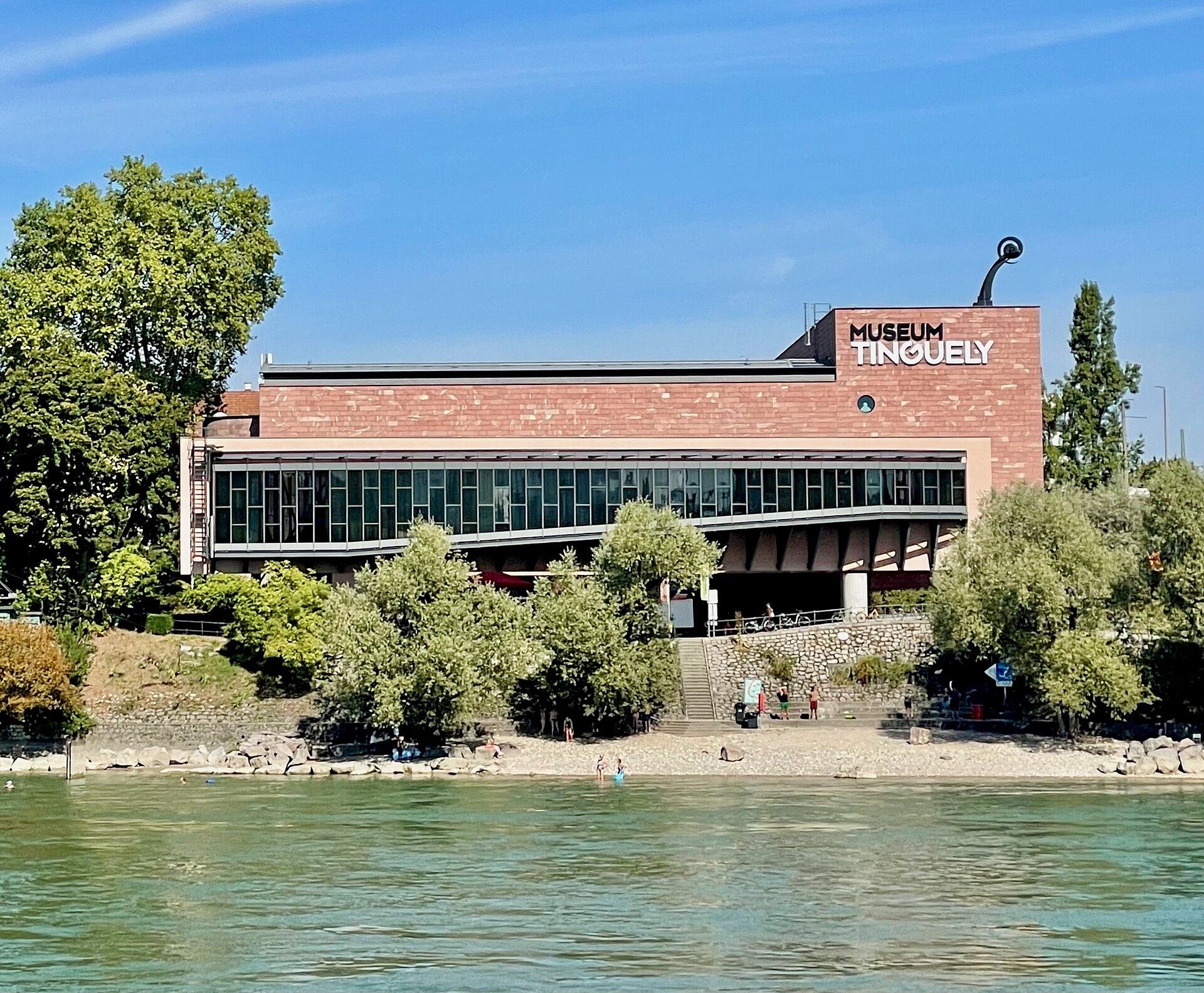
The Botta building seen from across the Rhine, with the museum name on the tower and the suspended riverside gallery below it.
HerBauhaus, CC BY-SA 4.0Museum Tinguely
Museum · Founded 1996
Open, admission and hours confirmed 17 November 2026 · 18 sources
On this page 16 sections
ContentsClose
The collection is the largest of Jean Tinguely's work anywhere, by the museum's own claim, and it covers four decades from delicate early reliefs and wire sculptures of the 1950s through the Meta-Matic drawing machines, the scrap-metal and black sculptures of the 1960s, the music machines and the monumental late works of the 1980s. It is supplemented by drawings, posters, catalogues, photographs and a picture archive. Its core came from Niki de Saint Phalle's donation and from works held by Roche, and it keeps growing through bequests, donations and acquisitions.
| Kind | Museum |
|---|---|
| Founded | 1996 |
| City and country |  Basel, Switzerland |
| Address | Paul Sacher-Anlage 1, 4058 Basel, Switzerland |
| Website | tinguely.ch |
| Status | Open, confirmed |
| Record last verified |
Visiting
- Hours
- Tue-Sun11:00 to 18:00
- Thu11:00 to 21:00open until 9 pm
- Closed
- Monday. 25 December 2026. Special hours: 24 and 31 December 2026 11:00-16:00.
- Admission
- AdultCHF 18
- Students and apprenticesCHF 12
- People with disabilitiesCHF 12reduced admission
- Groups of 12 or moreCHF 12per person
- KulturLegiCHF 12
- BaselCard and Baselland-CardCHF 13.50reduced rate 9 CHF
- Roche employeesCHF 9
- Children under 16Freefree
- Late Thursday, 18:00 to 21:00Freefree admission
Free entry: Every Thursday from 18:00 to 21:00 (Late Thursday). Free with Swiss Museum Pass, Museums-Pass-Musees, Swiss Travel Pass, Colourkey, Raiffeisen MemberPlus, ICOM, CIMAM and VMS membership, and other listed groups- Tickets
- tinguely.ch/en/information/admission/tickets.... The museum's own ticket page.
- Do I need to book?
- Not stated as required; the museum offers online tickets and timeslot reservation, and schools must register
- Address
- Paul Sacher-Anlage 1, 4058 Basel, Switzerland MapTram and bus Main station (SBB): tram 1 or 2 to Wettsteinplatz, then bus 31 or 38 to Tinguely Museum
Bus From Badischer Bahnhof: bus 36 to Tinguely Museum
Car Park at the Badischer Bahnhof or Messe garages; no parking in front of the museum; the Wettsteinallee motorway exit is closed until the end of 2026 - Website
- tinguely.ch
- Telephone
- +41 61 681 93 20
Before you go how long, access, photography, bags, eating, shop
- How long to allow
- The museum publishes no suggested visit length
- Access
- The entire museum is wheelchair accessible; wheelchairs and collapsible chairs can be borrowed at the info desk; disabled parking at the entrance on Grenzacherstrasse.
- Photography
- Permitted without flash or tripod; selfie sticks are prohibited; some special exhibitions prohibit it.
- Bags
- Backpacks and bags larger than A4, umbrellas and skates go to the cloakroom.
- Eating
- Bistro Chez Jeannot, with brunch; tables bookable through lunchgate.
- Shop
- Ground floor entrance area, open during museum hours without a ticket; ships worldwide except original prints.
Prices and hours change. We take them from the institution's own pages and print the day we read them, and you can check the current position at the source we used. Confirm before you travel.
What is inside
The great hall (ground floor)
The largest exhibition space at 30 by 60 metres, divisible into five areas and facing the park, built for the monumental machine-sculptures. The permanent show La roue = c'est tout brings its music machines and walk-through works back here, running in sequence.
Rhine promenade gallery (first storey)
The first storey at 2.90 metres above ground, reached along the suspended riverbank section of the south facade; a gallery open to the ground floor on one side and to the exhibition rooms on the other.
Classical rooms with daylight
A series of classical rooms at 7.85 metres with daylight entering through slanted skylights, as described in the architect's text.
Lower level
A level three metres below ground for works that do not require daylight, according to the museum's architecture page.
Mezzanine of the 1980s
A newly built mezzanine for Tinguely's late work, often dark and religious in character, with animal skulls and fragments of damaged racing cars.
Restoration showcase and picture archive
Rotating exhibits on the conservation of kinetic works since July 2026, and a picture archive section added in December 2025 built around Heureka (1964).
Solitude Park and Rhine bank
The historical park with its old trees, the riverbank promenade, the Bistro and the kinetic fountain Schwimmwasserplastik (1980).
What to see first
L'Eloge de la Folie (1966)
Jean TinguelyA flat black gear train 5 by 7.5 metres, lit from behind like a shadow play. It began as part of the stage set for a ballet of the same name at the Theatre des Champs-Elysees in 1966 and is shown by the museum as a key work of the 1960s on view again for the first time in over twenty years.8
Grosse-Meta-Maxi-Maxi-Utopia (1987)
Jean TinguelyA walk-through sculpture in the great hall that visitors enter, which is why the museum rules mention barefoot walking on its surfaces.8
Fatamorgana - Meta-Harmonie IV (1985)
Jean TinguelyOne of the music machines, started in sequence with the others in the hall so that visitors hear each work in turn.8
Meta-Harmonie II (1979)
Jean TinguelyA music machine of the late 1970s that returned to the open space of the great hall in the 2023 presentation.8
Meta-Matic No. 6 (1959)
Jean TinguelyIllustrates the Meta-Matic drawing machines of 1959, the breakthrough in which the audience took part and which questioned the capitalist art market, according to the museum.8
Hannibal II (1967)
Jean TinguelyNamed by the museum with the black sculptures made from the mid-1960s, in which painting the parts black shifts attention to the type of movement.8
Schwimmwasserplastik (1980)
Jean TinguelyA kinetic fountain in the park, driven by black-painted wheels with five moving nozzles, a work to see outside before or after the galleries.12
Exhibitions on now
The building and what it was built to hold
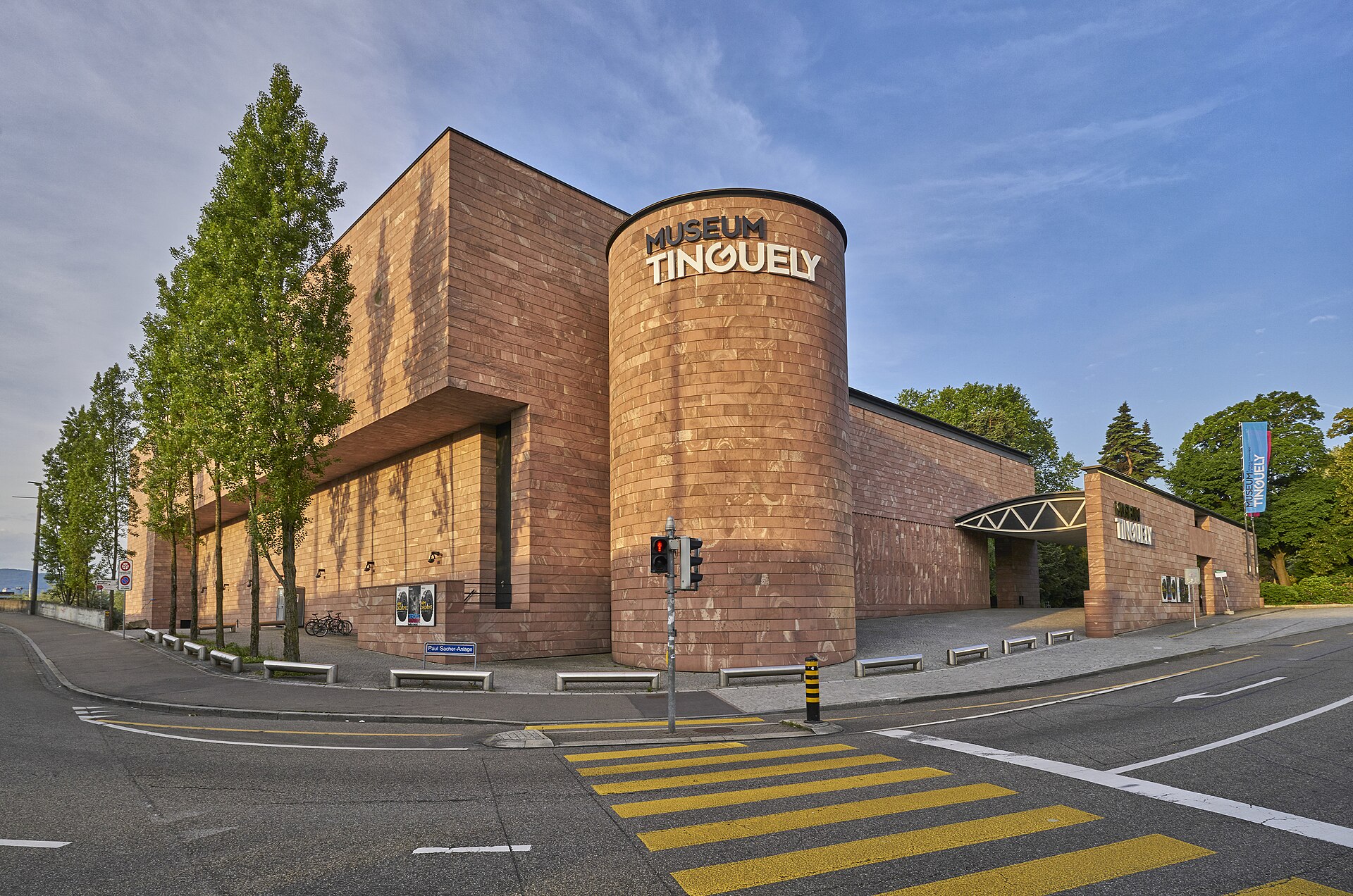
Museum Tinguely stands on the right bank of the Rhine in Basel, inside the Solitude Park, and it was designed by the Ticino architect Mario Botta. The museum opened in 1996 and, in its own words, houses the world's largest collection of works by the Swiss artist Jean Tinguely (1925-1991). It is a single-artist museum, but the building was drawn up around a particular problem: how to give machine-sculptures that clatter, turn and make noise a hall they can fill.
The museum's architecture page gives the answer in plain terms. In the huge central hall alone there is space for twenty machine-sculptures. The ground-floor interior can be divided by walls that are raised and concealed in the ceiling, and the largest exhibition space measures 30 by 60 metres, divisible into five areas and facing the park. The museum states that the visitor's tour ends here, on the ground floor, with the monumental sculptures.
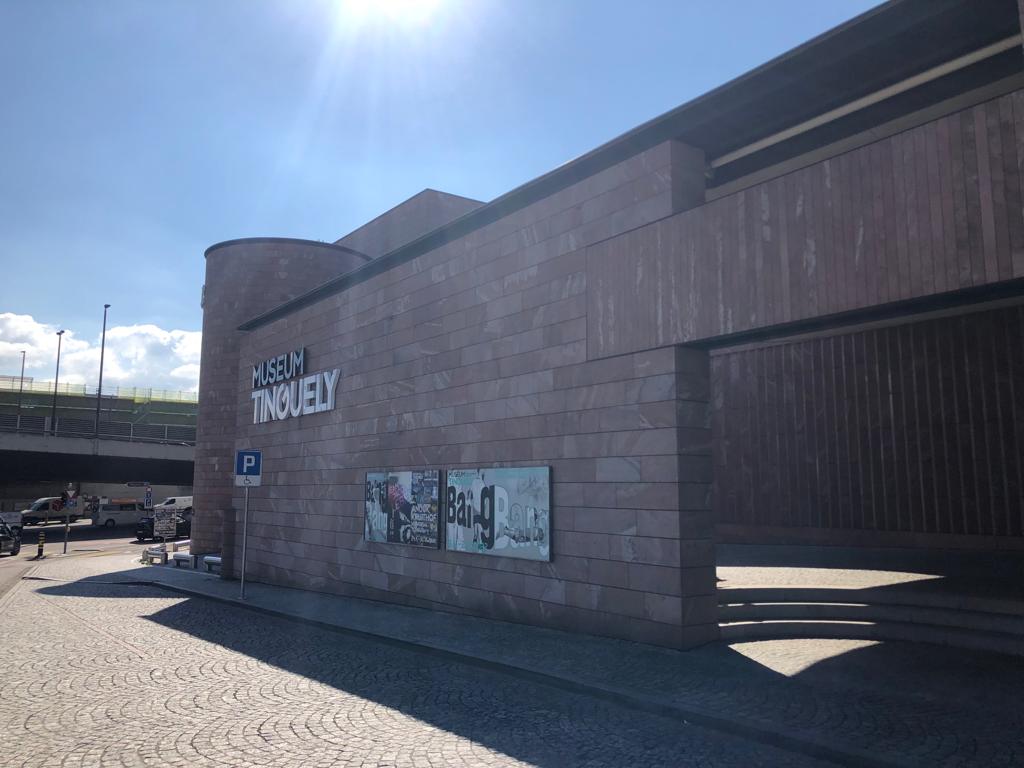
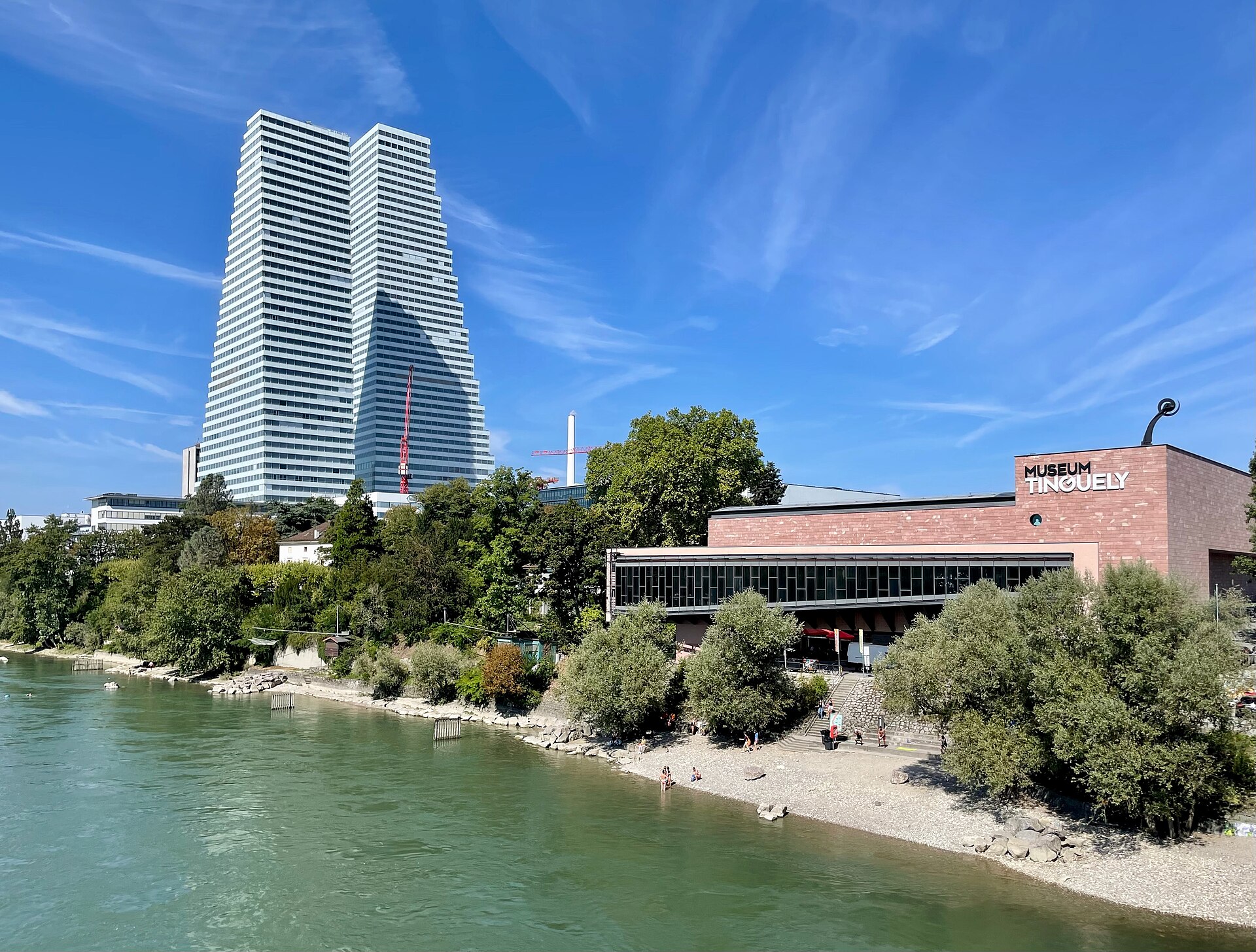
Botta wrote of the site that on the river side, where the Rhine forms the outer border of a large district of the city, the museum creates a new order within what he called a rather questionable urban design alongside the highway. The rectangular building occupies the entire eastern part of the Solitude Park, and each of its four sides relates to its surroundings in a different way. The southern facade, facing the river, carries an elongated suspended section detached from the body of the building. It forms a kind of riverbank promenade along which every visitor must pass on the way in, an itinerary that turns the eye towards the Rhine. The facade facing the motorway to the east is the tallest part, with three levels of exhibition space above ground level, and the museum describes it as a sound barrier towards the green spaces. The park side consists of five sections, three of which open onto the park through a wide porch, and the north side runs parallel to the Grenzacherstrasse with a covered area giving access to the park and the museum.
One detail of the structure is worth knowing. The museum says the static support system of the ground floor is coordinated with a pre-existing underground reservoir, five storeys deep, built for treating Rhine water. The building therefore sits on top of earlier industrial infrastructure rather than on a clean site, which fits an artist who built with scrap.
How a museum for one artist came to exist
The museum credits itself as opened in 1996, and Wikidata records the same year as its inception. Who made it possible is told slightly differently by the sources read for this page, and the differences are listed under open questions below rather than smoothed over. Finestre sull'Arte, an Italian art magazine, writes that the museum came into being in 1996 at the behest of the pharmaceutical company Roche, whose headquarters are a stone's throw away and which financed the operation. The same article says that Niki de Saint Phalle, Tinguely's wife from 1971, donated fifty-two works from her collection in 1992, soon after the artist's death, and that this donation created the preconditions for the museum. It adds that Roche also contributed a donation of Tinguely works in its possession.
SwitzerLanding, a travel blog written by a long-term Swiss resident, says the museum was made possible by donations from Tinguely's widow, works from the Roche collection and various gifts and acquisitions, and gives the number of sculptures Saint Phalle donated as 55. Wikipedia says more than 50 works. The museum's own About us page does not itemise the donation at all. What all the sources agree on is the shape of the arrangement: an artist's widow gave the core, a Basel company paid for the building and gave works, and the collection has grown since through bequests, donations and acquisitions.
That arrangement is also a fact about who stands behind the walls. The museum's shop and access pages, its contact page and its admission list all carry the Roche name in some form, from the Roche-employee admission tier to the roche.com domain used for museum contact addresses, and the park and museum precinct is addressed as the Paul Sacher-Anlage. A reader assessing the institution as a party to the record should note that the museum's own pages describe the programme and the collection at length and say little about this corporate foundation.
The permanent exhibition: La roue = c'est tout
Since 8 February 2023 the permanent display has been called La roue = c'est tout, a phrase of Tinguely's that the museum takes as the leitmotif of the show and that it dates to 2028 as the planned end of the presentation. The museum says this was the first time since its founding in 1996 that a new permanent exhibition had been built on the museum's own ever-growing collection, supplemented by loans of key works. The wheel is both a recurring motif across his career and a statement of his belief that changing times should find expression in art. Tinguely himself is quoted by the museum as saying that we live in a wheeled civilisation.
The route is chronological and thematic. The first section covers the years after 1952, when Tinguely moved from Basel to Paris having trained at the Academy of Applied Arts and worked as a window dresser, and shows the wire sculptures and reliefs of the 1950s. His breakthrough, the museum says, came in 1959 with the Meta-Matic drawing machines, which involved the audience and questioned both the definition of artwork and artist and the structures of the capitalist art market. A second section sets his scrap-metal works from his time with the Nouveaux Realistes, which he joined in 1960, against the black sculptures he made from the mid-1960s. Painting them black, the museum explains, shifted attention from the individual parts to the types of movement built into the machines, from light and elegant to heavy and pounding.
Performances and happenings have their own focus, with planning sketches, photographs, film footage and surviving fragments from projects that took him from Paris to London, New York and the Nevada desert, and from Stockholm and Milan to Milly-la-Foret and back to Basel. The great hall then returns to the music machines and walk-through works: Grosse-Meta-Maxi-Maxi-Utopia (1987), Fatamorgana - Meta-Harmonie IV (1985) and Meta-Harmonie II (1979) run in sequence so that visitors watch them one after the other. A newly built mezzanine holds the work of the 1980s, which the museum calls often dark and religious in character, marked by his engagement with death and transience and his fascination with motor racing. The late machines often include animal skulls and fragments of damaged racing cars.
Working machines and what keeping them alive means
The most unusual thing about the collection is that most of it is meant to move, and the museum is open about what that costs. The artworks carry black starting buttons, and the museum rules say their runtime is limited in order to preserve them. Since July 2026 the collection presentation includes a restoration showcase with rotating exhibits that explains the daily problems of the conservation team: wheels turn, motors purr and metal parts clatter, yet the movement itself causes wear.
The museum describes a real conservation dilemma. Tinguely used found, already-used materials and often welded them together in a makeshift way. While he was alive, defective elements were repaired or replaced pragmatically, even where that changed the structure and composition of the work. Since his death the restoration team has tried to maintain the state of the works and keep them alive without freezing them. Each work needs its own solution. The focus is on prevention through a stable climate, limited running times and careful maintenance, and every intervention should be reversible and is documented in writing and photographs. The workshop keeps spare parts identical to the materials Tinguely used, including motors and screws from the countries where he worked, and the team shares its expertise with other institutions and restores Tinguely works in other collections.
A further section, added in December 2025, is devoted to the museum's picture archive and uses Heureka (1964) as its example. Heureka was commissioned for the Swiss National Exhibition in Lausanne, where it stood from 30 April 1964 as a metal giant four metres high on a concrete base. The collector Walter Bechtler bought it and campaigned for a public site, and it was installed at the Zurichhorn in 1967. The sculpture itself is therefore not in the museum. What the Basel display shows is the documentation of its making and its later history.
The park, the river and the rest of the site
The grounds are part of the visit. The museum calls the surrounding Solitude Park a place for a stroll after the exhibition, with the historical park's centenary trees, the promenade along the Rhine and the Bistro Chez Jeannot. The About us page notes that the museum has access to its own stretch of riverbank. In the park stands the kinetic fountain Schwimmwasserplastik, which SwitzerLanding dates to 1980 and describes as driven by black-painted wheels, with five moving nozzles on hoses throwing water in every direction. Commons carries a photograph of it by Rudolf H. Boettcher, but it is an object in the park and is not used as a plate here.
The shop is on the ground floor in the entrance area and can be entered during opening hours without an admission ticket. It sells catalogues, posters and postcards from the collection and current exhibitions, stationery, objects by Swiss designers and a Niki de Saint Phalle range, and ships within Switzerland, to Europe and overseas, though not original prints. The museum's Bistro offers brunch, with tables bookable through lunchgate according to its page. SwitzerLanding also says the Bistro was renovated and reopened in December 2019 and mentions a bar by the Swiss conceptual artist Dieter Roth made from recycled objects, which is a point the museum's own bistro pages read for this page do not confirm.
Temporary exhibitions and the programme
Alongside the permanent display the museum runs a changing programme that the museum says has comprised more than 120 exhibitions and artistic interventions since opening, featuring Tinguely and the artists he knew, among them Niki de Saint Phalle, Yves Klein and Marcel Duchamp, and contemporary artists who address socially relevant issues. As of 17 November 2026 the museum's list of current and upcoming shows runs from Nicolas Darrot's Fuzzy Logic (5 March 2026 to 7 March 2027) and Zilla Leutenegger's Spaces Between (23 September 2026 to 7 March 2027) to Les temoins oculistes, a group show on the sense of sight in art (2 December 2026 to 9 May 2027), and a show of the Munich artist Irma Huenerfauth (24 March to 5 September 2027).
The museum notes that Les temoins oculistes continues a series on the senses in fine art. Its Thursday evenings from 18:00 to 21:00 are free, and the homepage lists guided tours, concerts and performances in the days around this writing, several of them free and some tied to a conference called Kunst Kann. Dates and titles of temporary shows change and are the most perishable part of this page.
Visiting: practical notes
The museum is open Tuesday to Sunday from 11:00 to 18:00, with late opening until 21:00 on Thursdays, and closed on Monday. Its special-hours list for the end of 2026 shows 24 December open 11:00 to 16:00, 25 December closed, 26 December open 11:00 to 18:00, 31 December open 11:00 to 16:00 and 1 January 2027 open 11:00 to 18:00. Adult admission is 18 Swiss francs, students and apprentices pay 12, and children under 16 enter free. A long list of passes gives free entry, including the Swiss Museum Pass and the Swiss Travel Pass.
Getting there is by tram and bus from the main station. The museum names tram 1 or 2 to Wettsteinplatz and then bus 31 or 38 to Tinguely Museum, or bus 36 from the Badischer Bahnhof. For drivers the museum advises that the Basel Wettsteinallee motorway exit is closed until the end of 2026 and suggests the Hochbergerstrasse or Riehenring exits, noting that there is no parking in front of the museum. The whole museum is wheelchair accessible and wheelchairs can be borrowed at the info desk.
Photography without flash or tripod is allowed in the exhibition rooms, except in special exhibitions where lenders forbid it, and selfie sticks are not allowed. Backpacks and bags larger than A4 go to the cloakroom. Children under 14 must be accompanied by an adult, and the museum warns that children are especially at risk from moving objects. Drawing with dry materials is permitted. Walking barefoot is generally allowed on the museum's walk-through work, at the visitor's own risk.
What visitors say
The sources read for this page are favourable and agree on three things: the machines are what people come for, being able to set many of them moving by button is the draw, and Botta's building and the riverside park are worth the trip in themselves. No platform rating was read for this page. The caution that follows from the museum's own rules is that motion is rationed to protect fragile works, so a visitor should expect to start machines in turn rather than see everything running at once.
What is praised, what is criticised
- Praised: The scale of the collection and the great hall, which Time Out says wins over even people sceptical about Tinguely
- Praised: Machines that visitors can set going with a starting button
- Praised: The setting on the Rhine in the Solitude Park and the Botta building itself, which SwitzerLanding calls a work of art worth seeing from outside
- Criticised: Motion is limited by design: the museum's rules say runtime is limited to preserve the works, and its restoration pages explain that movement causes wear
- Criticised: Time Out opens by calling Tinguely an artist you either love or hate, so the single-artist focus will not suit everyone
- Criticised: The museum's own pages say little about the Roche foundation behind the building, which Finestre sull'Arte reports financed it, and the admission list still gives Roche employees a reduced tier
- Criticised: Car access is awkward in 2026: the museum itself says the Wettsteinallee motorway exit is closed until the end of the year and there is no parking in front
Questions about Museum Tinguely
Where is Museum Tinguely?
Paul Sacher-Anlage 1, 4058 Basel, Switzerland.
How much does it cost to visit?
Adult: CHF 18; Students and apprentices: CHF 12; People with disabilities: CHF 12; Groups of 12 or more: CHF 12; KulturLegi: CHF 12. As confirmed 17 November 2026.
When is it open?
Tue-Sun 11:00-18:00; Thu 11:00-21:00. Closed: Monday. 25 December 2026. As confirmed 17 November 2026.
How do you get there?
Tram and bus: Main station (SBB): tram 1 or 2 to Wettsteinplatz, then bus 31 or 38 to Tinguely Museum; Bus: From Badischer Bahnhof: bus 36 to Tinguely Museum; Car: Park at the Badischer Bahnhof or Messe garages; no parking in front of the museum; the Wettsteinallee motorway exit is closed until the end of 2026.
What should you see first?
L'Eloge de la Folie (1966) (Jean Tinguely); Grosse-Meta-Maxi-Maxi-Utopia (1987) (Jean Tinguely); Fatamorgana - Meta-Harmonie IV (1985) (Jean Tinguely); Meta-Harmonie II (1979) (Jean Tinguely); Meta-Matic No. 6 (1959) (Jean Tinguely); Hannibal II (1967) (Jean Tinguely).
What we could not confirm
- How many works Niki de Saint Phalle gave and when: Finestre sull'Arte says fifty-two in 1992, SwitzerLanding says 55 sculptures, Wikipedia says more than 50 works soon after the opening, and the museum's own pages read here give no figure.
- The street number: the museum's visit pages give Paul Sacher-Anlage 1 and its contact page gives Paul Sacher-Anlage 2 for the administration; SwitzerLanding and Time Out print number 2.
- No public rating aggregate (Google, Tripadvisor) was read for this page, and the museum's email address is obfuscated on its site, so none is recorded.
- Which of the rooms described in Botta's 1996 text (lower level, classical rooms) currently hold which works in the 2023 presentation is not stated on the pages read.
Images
Sources
- 1Museum Tinguely, Admission and online tickets (opening hours, prices, address, phone) tinguely.ch/en/information/admission.html
- 2Museum Tinguely, Special opening hours tinguely.ch/en/information/special-opening-hours.html
- 3Museum Tinguely, Contact tinguely.ch/en/information/contact.html
- 4Museum Tinguely, Access by car or with public transport tinguely.ch/en/information/access.html
- 5Museum Tinguely, Architecture of Mario Botta tinguely.ch/en/information/architecture.html
- 6Museum Tinguely, About us tinguely.ch/en/information/about-us.html
- 7Museum Tinguely, Museum rules tinguely.ch/en/information/museum-rules.html
- 8Museum Tinguely, La roue = c'est tout (permanent exhibition) tinguely.ch/en/exhibitions/exhibitions/2023/sammlungspraesentation.html
- 9Museum Tinguely, On view now and upcoming exhibitions tinguely.ch/en/exhibitions/on-view-now-and-upcoming.html
- 10Museum Tinguely, Inclusive: walking (mobility access) tinguely.ch/en/inclusive/walking.html
- 11Museum Tinguely, Shop tinguely.ch/en/shop.html
- 12SwitzerLanding (Ashley Faulkes), Visiting The Tinguely Museum in Basel (Is It Worth It?), travel blog switzerlanding.com/tinguely-museum-basel/
- 13Finestre sull'Arte (Redazione), The engaging Tinguely Museum in Basel, 13 June 2021, finestresullarte.info/en/museums/the-engaging-tinguely-museum-in-basel-the-institution-where-jean-tinguely-s-work-lives-on
- 14Time Out Switzerland, Museum Tinguely (dated 21 October 2014 on the page), timeout.com/switzerland/museums/museum-tinguely
- 15Wikipedia, Museum Tinguely (machine facts only, ) en.wikipedia.org/wiki/Museum_Tinguely
- 16Wikidata Q180904, Museum Tinguely (inception 1996, ) wikidata.org/wiki/Q180904
- 17Museum Tinguely, Jean Tinguely: life and work (1925-1991) tinguely.ch/en/tinguely-collection-conservation/tinguely-biographie.html
- 18Wikimedia Commons, File:Museum Tinguely from across the Rhine in Basel, Switzerland (August 2025).jpg (CC BY-SA 4.0, HerBauhaus) commons.wikimedia.org/wiki/File:Museum_Tinguely_from_across_the_Rhine_in_Basel,_Switzerland_(August_2025).jpg
