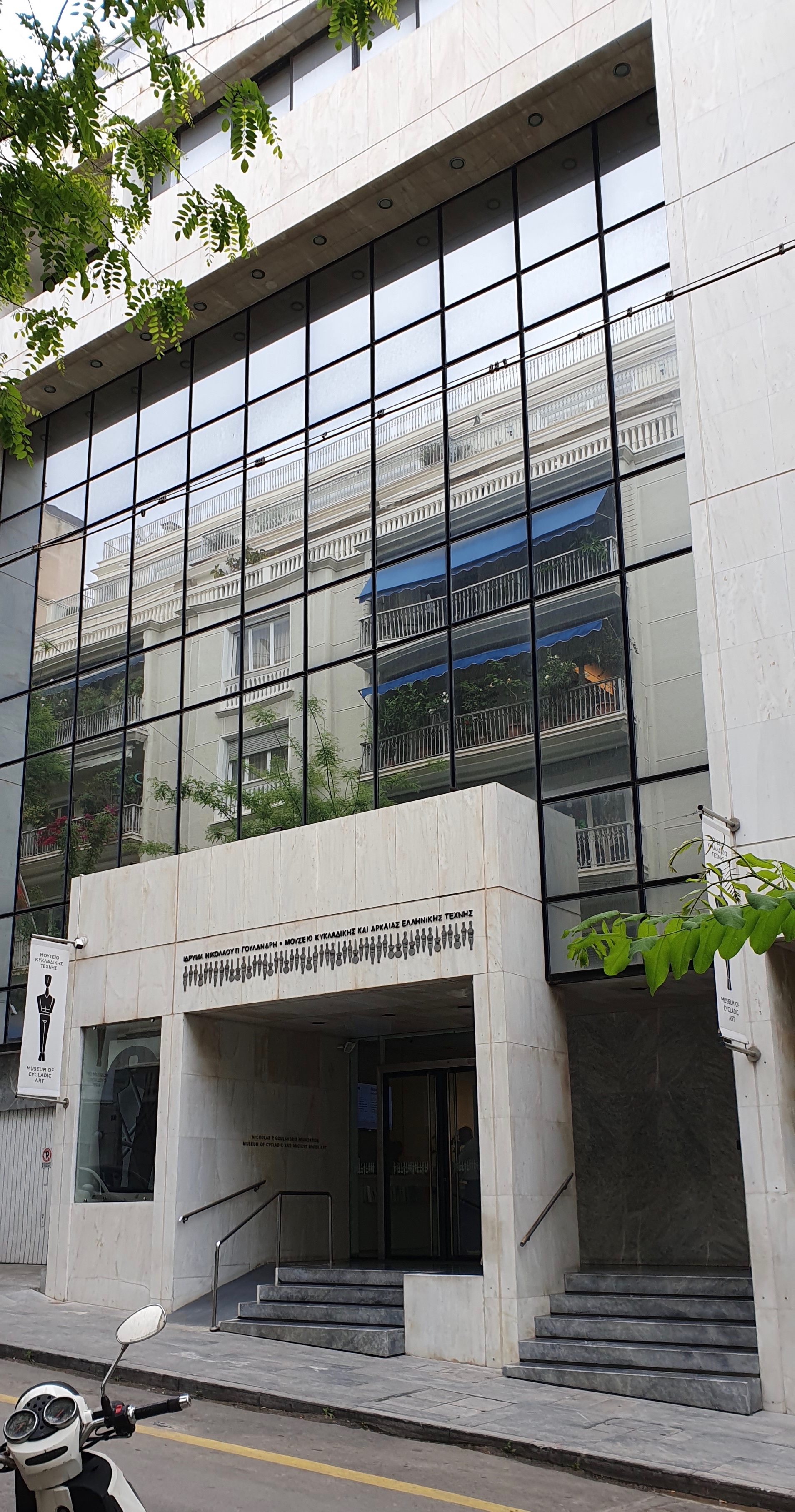
The main building of the Museum of Cycladic Art at 4 Neophytou Douka Street, Athens.
Photograph by Yair Haklai, CC BY-SA 4.0 · Photograph by Yair-haklaiMuseum of Cycladic Art
Museum · Mouseio Kykladikis Technis · Founded 1986
Open, admission and hours confirmed 9 September 2026 · 14 sources
On this page 15 sections
ContentsClose
Cycladic marble figurines and vessels of the third millennium BC form the museum's core and its reason for existing; the ancient Greek and, in particular, the Th. N. Zintilis collection of ancient Cypriot art (one of the largest outside Cyprus) extend that strength into the Bronze Age through Roman-period eastern Mediterranean more broadly.
| Local name | Mouseio Kykladikis Technis |
|---|---|
| Kind | Museum |
| Founded | 1986 |
| City and country |  Athens, Greece Athens, Greece |
| Address | 4 Neophytou Douka Street, Athens 106 74, Greece |
| Website | cycladic.gr/en |
| Status | Open, confirmed |
| Record last verified |
Visiting
- Hours
- Monday10:00 to 17:00
- TuesdayClosed
- Wednesday10:00 to 17:00
- Thursday10:00 to 20:00
- Friday10:00 to 17:00
- Saturday10:00 to 17:00
- Sunday11:00 to 17:00
- Closed
- Tuesday, year round. January 1. Clean Monday. March 25. Easter Sunday and Monday. May 1. Whit Monday (Holy Spirit Monday). August 15. December 25. December 26.
- Admission
- Adult, permanent collectionEUR 12Permanent exhibitions only
- Reduced/group, permanent collectionEUR 9Permanent exhibitions only
- Under 18FreeFree, all exhibitions
- Cycladic Friends (members)FreeFree, all exhibitions
- Adult, Jeff Koons temporary exhibitionEUR 10Temporary exhibition only, current show
- Reduced/group, Jeff Koons temporary exhibitionEUR 7Temporary exhibition only, current show
- Adult, combined ticketEUR 16Permanent collection plus temporary exhibition
- Group, combined ticketEUR 12Permanent collection plus temporary exhibition
- Reduced, combined ticketEUR 10Permanent collection plus temporary exhibition
- Tickets
- cycladic.gr/en/episkeftheite-to-mouseio The museum's own ticket page.
- Do I need to book?
- No. Online booking is available and encouraged; the museum asks visitors to prefer electronic tickets and card payment
- Address
- 4 Neophytou Douka Street, Athens 106 74, Greece MapMetro Evangelismos station, Line 3, about 500m; Syntagma station, Lines 2 and 3, about 600m
Bus/trolleybus Rigilis stop: lines 3, 203, 211, 214, 220, 221, 224, 235, 608, 622, 815, A5, E14, X95
Walking About 10 minutes from Syntagma Square; about 3 minutes from Filikis Etairias Square in Kolonaki - Website
- cycladic.gr/en
- Telephone
- +30 210 7228321-3
- [email protected]
Before you go how long, access, photography, bags, eating, shop
- How long to allow
- One to two hours for the permanent collection; visitors on a guided tour report needing longer to take in the Cycladic, Greek and Cypriot floors together with a current temporary show
- Access
- Wheelchair access via a ramp at the Stathatos Mansion entrance, with elevator access to the upper floors
- Photography
- Permitted without flash or tripod, for non-commercial use only
- Bags
- Handbags are allowed in the galleries; lockers are provided for backpacks and larger luggage
- Eating
- On-site cafe, open independently of the admission ticket and repeatedly singled out by name in visitor reviews
- Shop
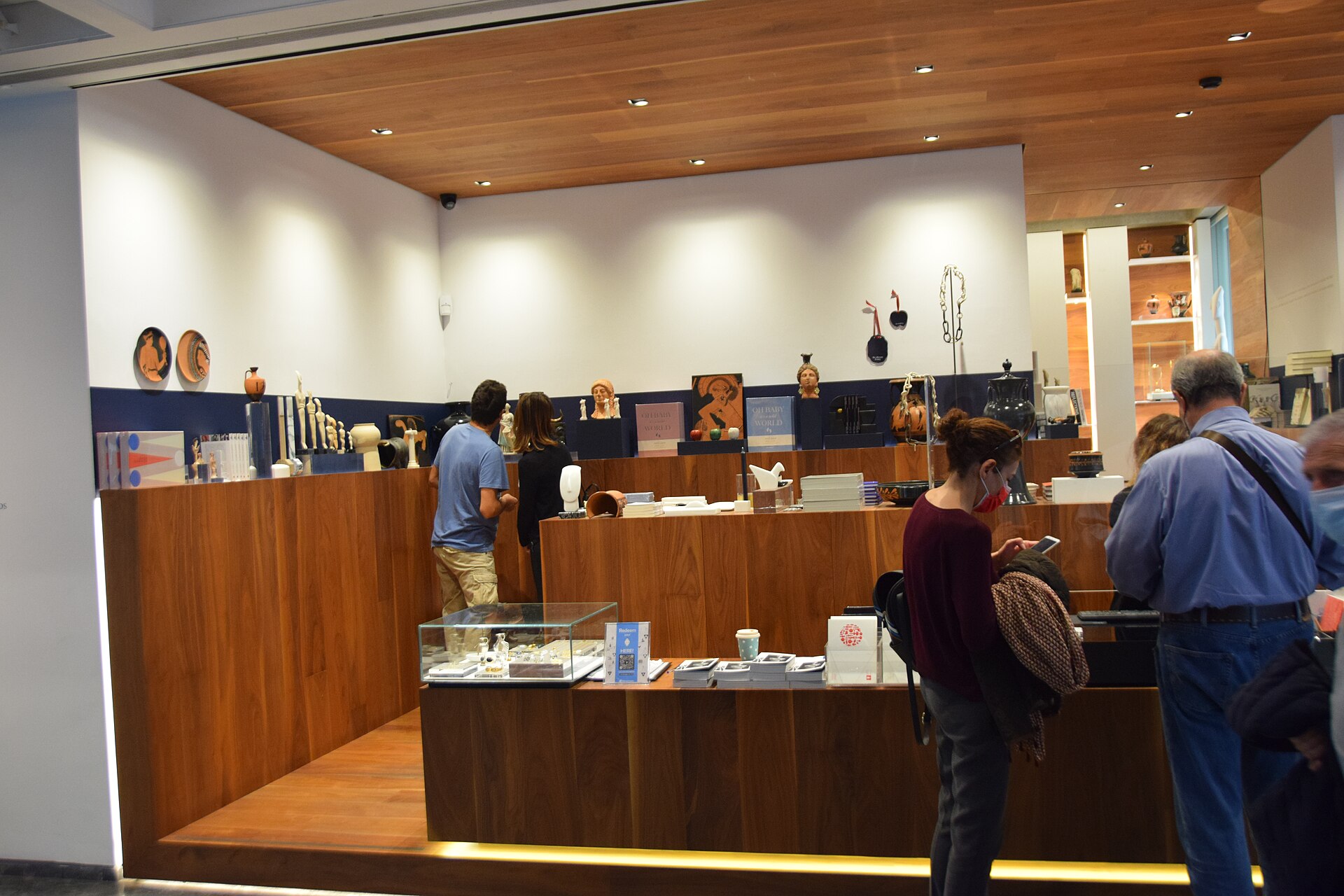
- Museum shop, accessible without a ticket, selling collection-related items including figurine reproductions
Prices and hours change. We take them from the institution's own pages and print the day we read them, and you can check the current position at the source we used. Confirm before you travel.
What is inside
Cycladic Art (First Floor)
The museum's founding collection: about 350 Cycladic marble figurines and vessels of the third millennium BC, gathered by Nikolaos and Dolly Goulandris from the 1960s onward, including examples of the canonical folded-arm female figurine type that later drew the attention of early twentieth-century sculptors.
Ancient Greek Art (Second Floor)
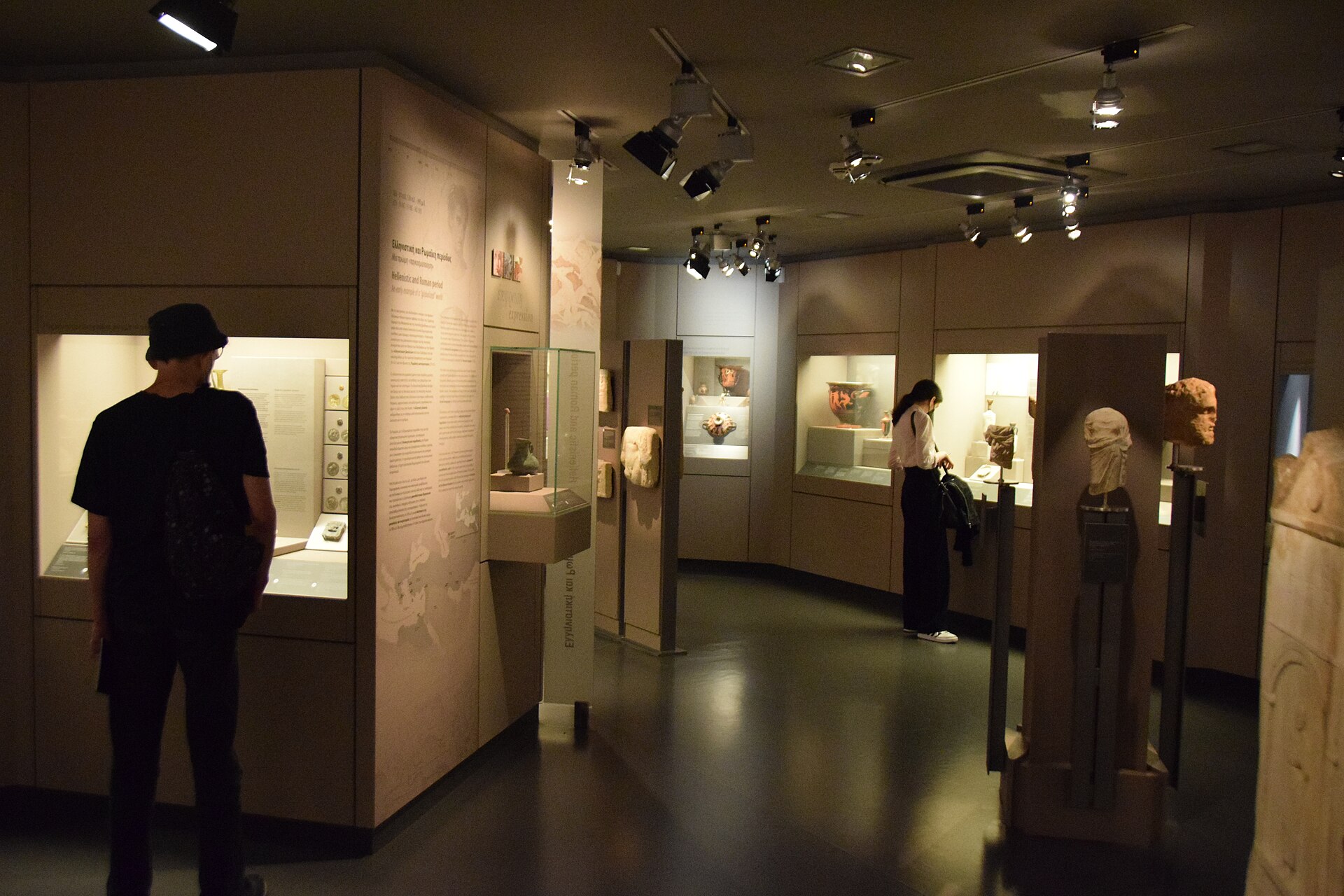
Pottery, coins, bronzes and figurines of gods and heroes arranged chronologically from the Greek Bronze Age through the Roman period, with interactive touchscreen panels supporting the displays.
Ancient Cypriot Art (Third Floor)
The Th. N. Zintilis Collection, one of the largest holdings of Cypriot antiquities outside Cyprus, spanning the Chalcolithic period to the early medieval era: prehistoric figurines, Archaic and Classical sculpture, inscriptions, bronzes, coins, gold jewellery, glass and ceramics, arranged by theme (worship, weaving, perfumery, burial custom, writing, metalwork, coinage, seal carving, foreign relations).
Scenes from Everyday Life in Antiquity (Fourth Floor)
Objects and inscribed texts of the Classical and Hellenistic periods (fifth to first century BC) grouped around religious practice, myth and belief rather than by object type.
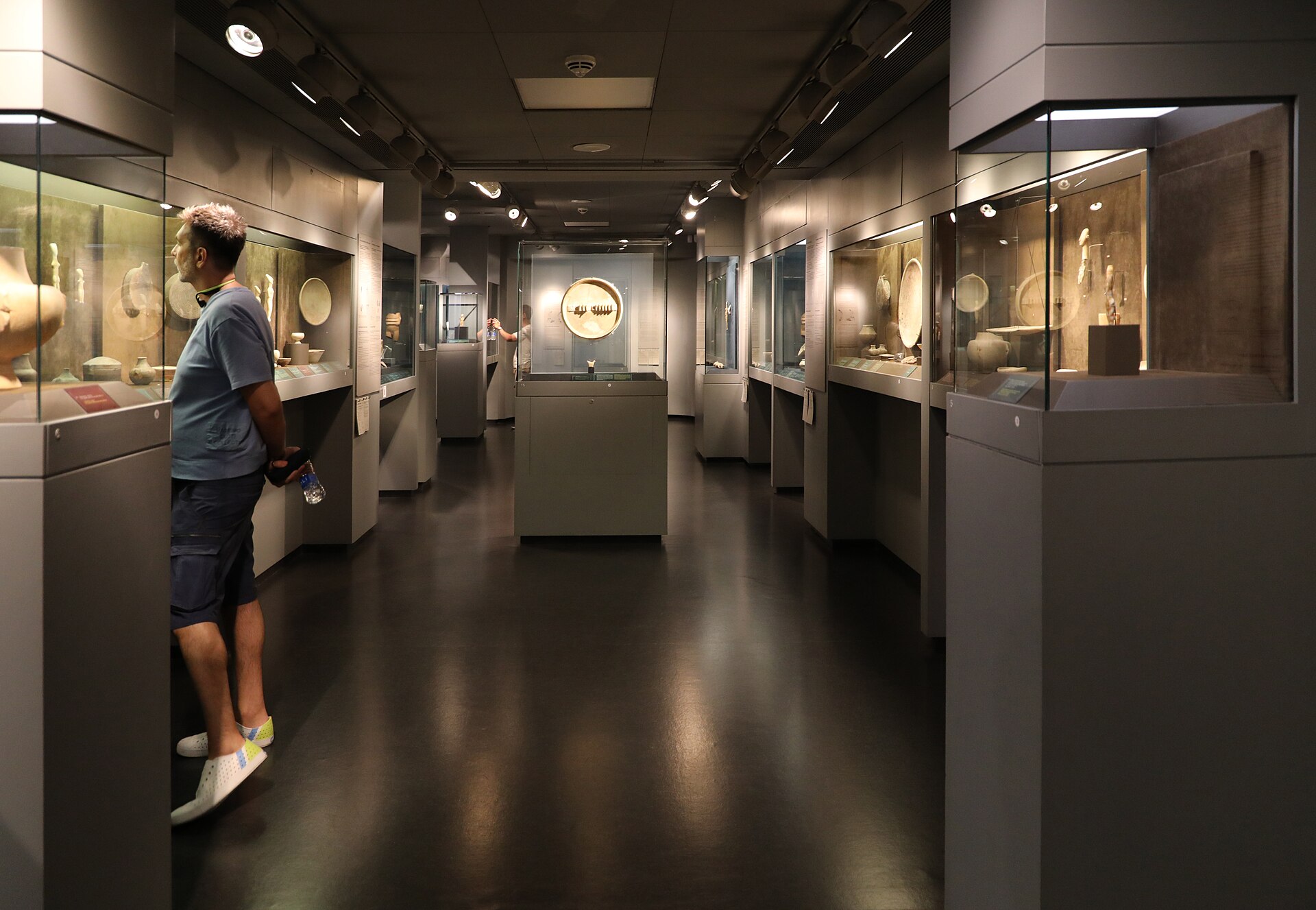
Photograph by Sailko · CC BY-SA 4.0 New Wing of Dolly Goulandris
A 2007 addition to the main building used for temporary exhibitions and by the Museum's Educational Department; it currently hosts contemporary-art shows staged in dialogue with the permanent collection.
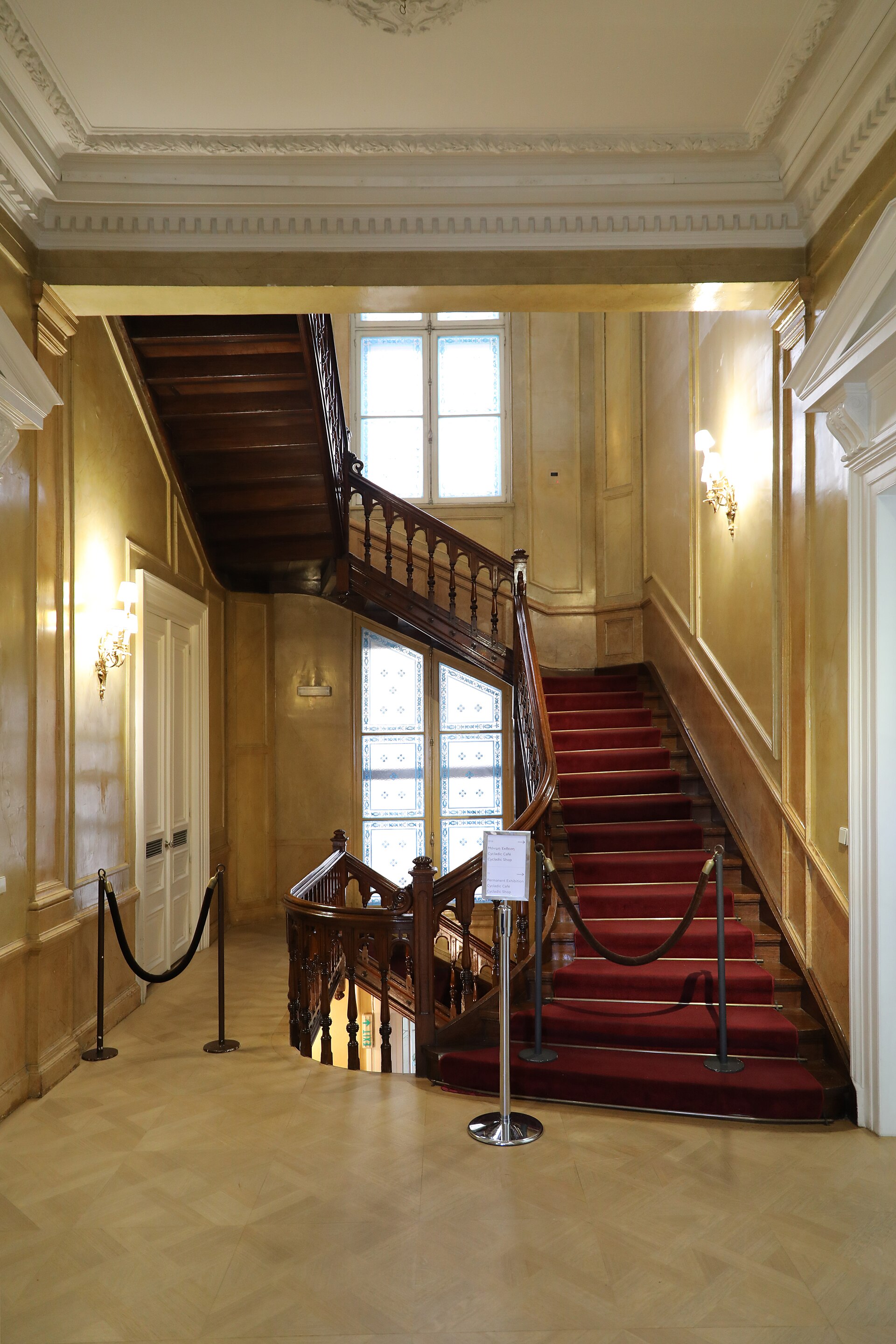
Photograph by Sailko · CC BY-SA 4.0 Stathatos Mansion
A neoclassical 1895 townhouse by Ernst Ziller, connected to the main building, used for temporary exhibitions since 1991; its first floor keeps its original gilded plasterwork and Renaissance-style staircase alongside the exhibition displays.
What to see first
Female figurine of the Spedos variety
Unknown Cycladic sculptor, Early Cycladic II period (about 2800-2300 BC)The canonical folded-arm type, held in this collection, is the Cycladic form most directly echoed in the reduced, geometric figures of early twentieth-century sculptors including Brancusi and Modigliani, and in Picasso's own experiments with simplified form.8
Cycladic frying-pan vessel
Unknown Cycladic maker, Early Bronze AgeAn enigmatic, flat ceremonial vessel type unique to the Cyclades, incised with spiral or boat motifs whose original use is still debated by archaeologists.13
Cycladic bird (dove) vase
Unknown Cycladic maker, Early Bronze AgeA zoomorphic pottery form distinct to the islands, illustrating the range of Cycladic ceramic production beyond the better-known marble figurines.13
Limestone bust of a bearded man
Unknown Cypriot sculptor, first half of the sixth century BCAn Archaic Cypriot portrait bust from the Th. N. Zintilis Collection, one of the earlier sculptural highlights of the third-floor galleries and evidence of Cyprus's own distinct fusion of Greek, Egyptian and Near Eastern sculptural habits.5
Cypriot double-necked jug
Unknown Cypriot potter, about 2500-2300 BCAn Early Bronze Age Cypriot ceramic form with no direct Aegean parallel, used by the museum to show Cyprus developing its own material culture alongside, not merely in imitation of, the Cyclades and mainland Greece.5
Cypriot gold necklace with precious stones
Unknown Cypriot goldsmith, about 350 ADA late-Roman-period example of the Zintilis Collection's goldwork, marking how far past the Bronze Age the Cypriot holdings run and the technical range of the collection's metalwork.5
Cypriot stone figurine
Unknown Cypriot maker, about 3900-2500 BCAmong the oldest objects in the Cypriot galleries, a Chalcolithic figurine that lets the museum set Cypriot figurative sculpture directly beside the better-known Cycladic marble tradition of the same broad era.5
Venus of Lespugue
Jeff Koons, contemporary sculpture on view 2026A large-scale contemporary restaging of a Palaeolithic Venus figurine, shown in the museum's temporary-exhibition space through 28 September 2026 in deliberate conversation with the prehistoric female forms one floor away, extending the same modernist-meets-prehistoric thread the Cycladic collection itself set running a century earlier.6
Past exhibitions here
A private collection becomes a public foundation
Nikolaos and Dolly Goulandris began collecting Greek antiquities in the late 1950s, spending summers on the Greek islands where Dolly, in particular, developed a fascination with the spare marble forms of Cycladic art. She obtained an official collector's licence from the Greek Archaeological Council in 1962, a legal route to acquisition that was ordinary for the period and that later criticism of the collection has had to reckon with directly. Over the following two decades the couple assembled what the New York Times has called one of the world's most significant privately formed collections of Cycladic and ancient Greek antiquities. Nikolaos died in 1983, before the museum opened. Dolly established the N.P. Goulandris Foundation in 1985 in his memory, donated the entire collection to it, and the Museum of Cycladic Art was inaugurated on 26 January 1986 in central Athens. She remained president of the Foundation until her own death in February 2008, having spent the intervening years building the museum's education programme, a priority she is credited with personally.
Two buildings joined by a walkway: Vikelas, Ziller and the New Wing
The museum occupies two connected buildings a short walk from Syntagma Square. The main building, at 4 Neophytou Douka Street, was designed by the Greek architect Ioannis Vikelas and completed in 1985: a four-storey structure of marble and glass built to hold the founding collection, with about 2,300 square metres of exhibition space. In 2007 a New Wing, named for Dolly Goulandris, was added to expand capacity for temporary exhibitions and for the museum's Educational Department. The second building is older and was not built for the museum at all. The Stathatos Mansion, on the corner of Vasilissis Sofias Avenue and Irodotou Street, was designed by the Saxon-Greek architect Ernst Ziller and built in 1895 for the Stathatos family, who kept it until 1938; it then passed through a period of diplomatic use before the Hellenic state restored it in 1982 as a planned guest house for state visitors, a plan that was never carried out. In 1991 the building was given to the museum instead, and in 2001 the Hellenic Republic extended the arrangement into a fifty-year lease to the Goulandris Foundation. Its first floor, still fitted with its original gilded plasterwork and a Renaissance-style staircase, now serves as the museum's temporary-exhibition space, reached on foot from the main building.
The figurines that unsettled twentieth-century sculpture
Cycladic marble figurines are classified by archaeologists into a sequence of regional types running from the schematic, often ungendered Pelos and Plastiras figures of the earliest Bronze Age through to the canonical folded-arm forms of the Spedos variety, the type most people now picture when they hear the word Cycladic. A Spedos-variety female figurine of this canonical type is held in the Goulandris collection. When figurines of this kind reached European private and museum collections in the late nineteenth and early twentieth centuries, their reduction of the human body to a flat, geometric outline struck sculptors working through their own break from representational form. Critics and art historians have long drawn a direct line from these figures to Constantin Brancusi's elongated, simplified heads, to Amedeo Modigliani's stretched figures, and to Pablo Picasso's own flattenings of the body, reading the Cyclades as one of the quiet sources of early modernist sculpture rather than a footnote to it. The museum's own temporary-exhibition programme, most recently its 2026 hosting of a large Jeff Koons sculpture explicitly modelled on a Palaeolithic Venus figure, keeps that same conversation between prehistoric and contemporary form running in the building today.
Four floors, a mansion, and what is on each
The permanent collection is arranged over the four floors of the main building. The first floor holds the founding Cycladic collection: about 350 marble figurines and vessels of the third millennium BC. The second floor carries ancient Greek art from the Greek Bronze Age through the Roman period, its pottery, coinage and bronze figures of gods and heroes set out chronologically with the help of interactive panels. The third floor is given entirely to the Th. N. Zintilis Collection of ancient Cypriot art, one of the largest such holdings outside Cyprus itself, running from the Chalcolithic period to the early medieval centuries and organised by theme rather than strictly by date: worship, weaving, perfumery, burial custom, writing, metalwork, coinage, seal carving and foreign contact all get their own section. The fourth floor, titled Scenes from Everyday Life in Antiquity, steps back from chronology again to look at Classical and Hellenistic religious practice, myth and belief through objects and inscribed texts of the fifth to first centuries BC. The Stathatos Mansion, reachable from the main building, is where the museum's temporary exhibitions are staged, most recently a Jeff Koons show and, before it, exhibitions built around Marlene Dumas and around the museum's own Kykladitisses research project on women in Cycladic society.
A collection assembled by licence, and the case still open against it
The Cyclades were extensively and illegally excavated for the international antiquities trade, especially through the 1950s and 1960s, a fact the museum's own publications acknowledge in general terms. The Goulandris collection was formed inside that market rather than outside it, and its critics have not let the point drop. Writing on his Looting Matters blog in April 2008, the archaeologist David Gill noted that a number of figurines once published with stated find-spots appear in the collection's most recent catalogue simply as provenance unknown, and quoted a blunter judgement from the archaeologist Ricardo Elia, that one can only guess at the cost of forming the Goulandris collection in terms of archaeological sites destroyed and information lost. Writing in Hyperallergic in November 2022, in the context of a separate deal between Greece, the Metropolitan Museum of Art and a Delaware-based entity over a different collector's Cycladic holdings, the archaeologist Yannis Hamilakis argued that the Museum of Cycladic Art has, across its history, helped fuel the international demand that drove that looting in the first place, and pointed out that some of the specific looted-Keros material at issue in that later deal had already been illustrated in a 2005 book on the Keros hoard that the museum itself published. The Association of Greek Archaeologists is reported to have taken that evidence to the Greek Public Prosecutor. The museum has not, on its own website, published a reply to either critique.
Visiting today
The museum draws strong and consistent visitor ratings, with reviewers on Tripadvisor scoring it 4.7 out of 5 across 1,280 reviews as of September 2026, and most of that praise goes to the two buildings themselves and to the on-site cafe and shop rather than to any single case. A same-site combined ticket currently covers both the permanent collection and the Jeff Koons temporary show, priced above the permanent-collection-only ticket, which is the detail most likely to catch out a visitor planning a quick stop rather than a full visit. Guided tours in English and Greek run on set days and are worth booking ahead in a museum this compact, where the four permanent floors alone can otherwise be seen faster than a visitor expects.
What visitors say
Visitors consistently praise the building and the clarity of the displays over any single object, and repeatedly single out the cafe and shop by name; the main complaint, where one is given, is the price of a combined permanent-plus-temporary-exhibition ticket, and a few reviewers note the core Cycladic galleries are smaller and faster to see than they expected.
What is praised, what is criticised
- Praised: The light-filled marble and glass main building and the neoclassical Stathatos Mansion, both called out as attractions in their own right
- Praised: The on-site cafe and museum shop, named specifically in a large share of visitor reviews as worth the trip alone
- Praised: Bilingual Greek/English labelling and a chronological layout that visitors describe as easy to follow without a guide
- Criticised: One visitor reviewing the 2024-2025 Kykladitisses show called the 18-euro combined adult ticket, and the 14-euro student rate she was quoted, too expensive 'for the Greek data'
- Criticised: Several reviewers note the permanent Cycladic, Greek and Cypriot floors can be seen in under an hour, faster than the museum's own one-to-two-hour estimate, unless a temporary exhibition or guided tour is added
Ratings on other platforms
Tripadvisor: 4.7 from 1,280 ratings, read 9 September 2026
A platform average is a tertiary source: it moves, it is not audited, and we quote no visitor's words.
Questions about Museum of Cycladic Art
Where is Museum of Cycladic Art?
4 Neophytou Douka Street, Athens 106 74, Greece.
How much does it cost to visit?
Adult, permanent collection: EUR 12; Reduced/group, permanent collection: EUR 9; Under 18: free; Cycladic Friends (members): free; Adult, Jeff Koons temporary exhibition: EUR 10. As confirmed 9 September 2026.
When is it open?
Monday 10:00-17:00; Tuesday closed; Wednesday 10:00-17:00; Thursday 10:00-20:00; Friday 10:00-17:00; Saturday 10:00-17:00; Sunday 11:00-17:00. Closed: Tuesday, year round. January 1. As confirmed 9 September 2026.
How do you get there?
Metro: Evangelismos station, Line 3, about 500m; Syntagma station, Lines 2 and 3, about 600m; Bus/trolleybus: Rigilis stop: lines 3, 203, 211, 214, 220, 221, 224, 235, 608, 622, 815, A5, E14, X95; Walking: About 10 minutes from Syntagma Square; about 3 minutes from Filikis Etairias Square in Kolonaki.
What should you see first?
Female figurine of the Spedos variety (Unknown Cycladic sculptor, Early Cycladic II period (about 2800-2300 BC)); Cycladic frying-pan vessel (Unknown Cycladic maker, Early Bronze Age); Cycladic bird (dove) vase (Unknown Cycladic maker, Early Bronze Age); Limestone bust of a bearded man (Unknown Cypriot sculptor, first half of the sixth century BC); Cypriot double-necked jug (Unknown Cypriot potter, about 2500-2300 BC); Cypriot gold necklace with precious stones (Unknown Cypriot goldsmith, about 350 AD).
What we could not confirm
- Which, if any, of the figurines now on permanent display carry find-spots that the museum's own current catalogue no longer states, per David Gill's 2008 comparison of published versus catalogued provenance
- Whether the Association of Greek Archaeologists' evidence to the Public Prosecutor, reported by Hyperallergic in 2022, led to any formal proceeding, and if so its outcome
Images
Sources
- 1Museum of Cycladic Art, official homepage cycladic.gr/en/
- 2Museum of Cycladic Art, Plan your Visit cycladic.gr/en/episkeftheite-to-mouseio/
- 3Museum of Cycladic Art, The Buildings cycladic.gr/en/ta-ktiria/
- 4Museum of Cycladic Art, The Founders cycladic.gr/en/idrytes/
- 5Museum of Cycladic Art, Ancient Cypriot Art (Th. N. Zintilis Collection) cycladic.gr/en/ektheseis/kypriaki-techni/
- 6Museum of Cycladic Art, Exhibitions (Jeff Koons: Venus Lespugue and others) cycladic.gr/en/ektheseis/
- 7Wikipedia, Goulandris Museum of Cycladic Art () en.wikipedia.org/wiki/Goulandris_Museum_of_Cycladic_Art
- 8Wikipedia, Cycladic art (, figurine typology and Spedos-type example in the Goulandris collection) en.wikipedia.org/wiki/Cycladic_art
- 9Wikidata, Museum of Cycladic Art, Q1230253 () wikidata.org/wiki/Q1230253
- 10Yannis Hamilakis, 'Sorry, But This Is Not Repatriation', Hyperallergic, 3 November 2022 hyperallergic.com/this-is-not-repatriation-stern-cycladic-art-met-greece/
- 11David Gill, 'Aegean Waves: Collecting Cycladic Figures', Looting Matters, April 2008 lootingmatters.blogspot.com/2008/04/aegean-waves-collecting-cycladic.html
- 12Tripadvisor, Museum of Cycladic Art listing ( rating and visitor reviews, read 2026-09-09) tripadvisor.com/Attraction_Review-g189400-d198712-Reviews-Museum_of_Cycladic_Art-Athens_Attica.html
- 13Google Arts and Culture, Museum of Cycladic Art partner page ( highlight list) artsandculture.google.com/partner/museum-of-cycladic-art
- 14Wikimedia Commons, Category:Museum of Cycladic Art and linked file pages (image licensing) commons.wikimedia.org/wiki/Category:Museum_of_Cycladic_Art