Museum of Contemporary Art
Museum · Muzej na sovremenata umetnost Skopje · Founded 1964
Open, admission and hours confirmed 16 September 2026 · 20 sources
On this page 14 sections
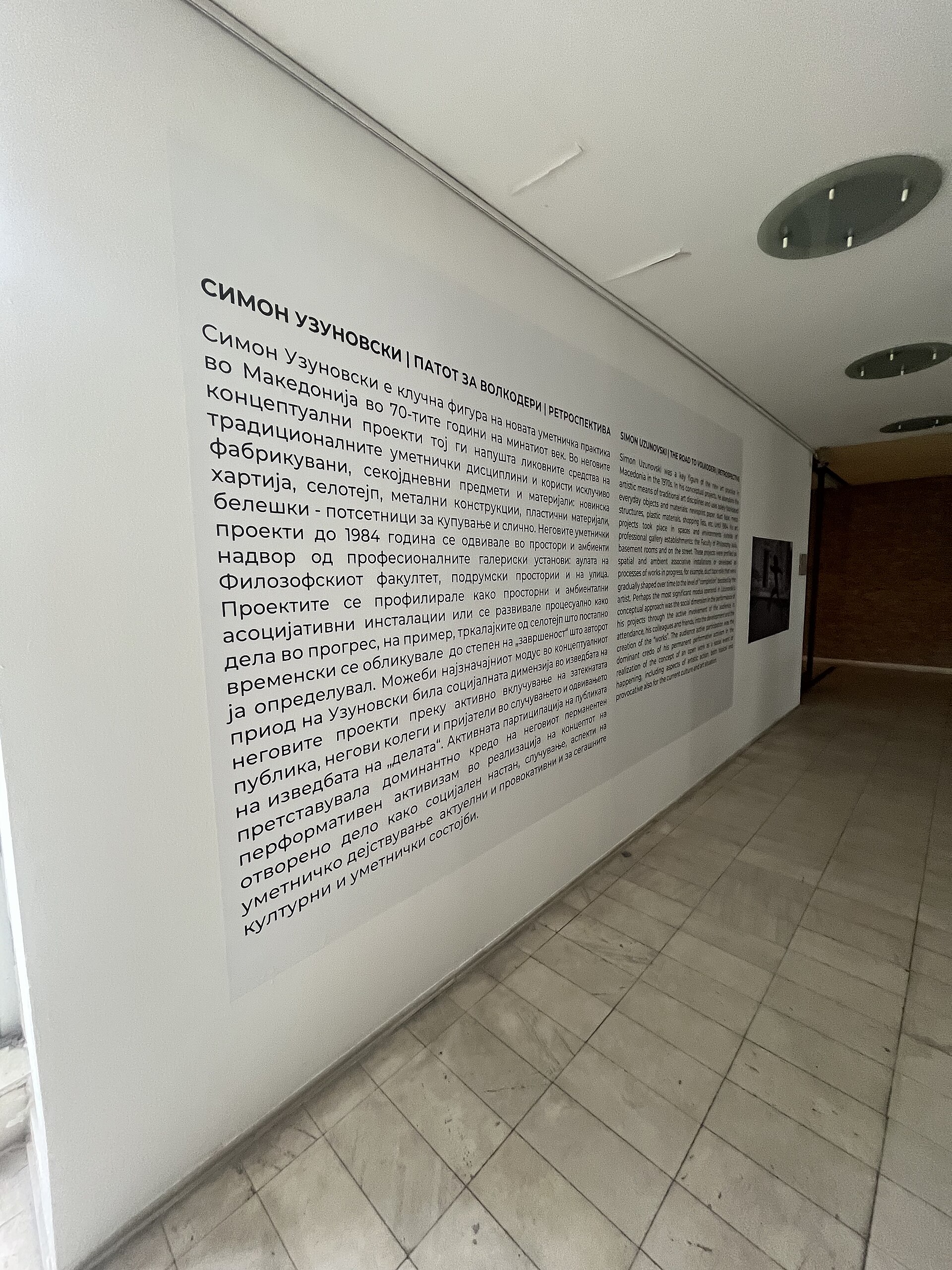
The museum's strength is depth and range built in a very short historical window: nearly 6,000 works, most of them donated between 1963 and the early 1970s under conditions no other museum's founding collection has replicated. It holds real breadth across the Cold War divide, from a large body of Polish gifts (Stazewski, Nowosielski, Fijalkowski, Berdyszak and more than two hundred others) to internationally recognised Western names such as Picasso, Calder, Hartung, Vasarely, Burri and Christo, set against a national Macedonian collection and a naive art department built up over the decades since. What it lacks is not range but resources. By the director's own account the building went undersupported for decades before its first major renovation reopened it in February 2014, and contemporary works that need serious technical support to show properly still compete with a museum whose visitors describe long stretches of gallery space standing empty.
| Local name | Muzej na sovremenata umetnost Skopje |
|---|---|
| Kind | Museum |
| Founded | 1964 |
| City and country | Skopje, North Macedonia |
| Address | Samoilova 17, 1000 Skopje, North Macedonia |
| Website | msu.mk |
| Status | Open, confirmed 16 September 2026 |
| Record last verified | 16 September 2026 |
Visiting
- Hours
- Tue-Sat10:00 to 17:00
- Sun09:00 to 13:00
- Closed
- Monday.
- Admission
- Single ticketMKD 100
- Do I need to book?
- No advance booking required, per the museum's own visit page
- Address
- Samoilova 17, 1000 Skopje, North Macedonia MapWalking / city bus On Kale hill beside Skopje Fortress, about 900 m from Ploshtad Makedonija, Skopje's main square, an uphill walk of some 10 to 15 minutes; city buses serving the Old Bazaar stop within a few hundred metres, and taxis are inexpensive
- Website
- msu.mk
- Telephone
- +389 2 3110 123
- [email protected]
Before you go how long, access, photography, bags, eating, shop
- How long to allow
- One to two hours if the current exhibitions fill the main wings; visitors report some visits are far shorter when only one or two shows are up
- Access
- The museum's 2026 Museum in a Suitcase programme provides tactile replicas of works for visually and hearing-impaired visitors; no wider accessibility statement (step-free routes, lifts) was found on the museum's own site
- Eating
- An on-site snack bar is mentioned by a visitor guide; the museum's own site does not describe cafe facilities in detail
- Shop
- Museum shop on site
Prices and hours change. We take them from the institution's own pages and print the day we read them, and you can check the current position at the source we used. Confirm before you travel.
What is inside
International Collection
Modern art donated from around the world in the 1950s, 1960s and 1970s, plus roughly a hundred earlier works of early modern art. Includes gifts from Pablo Picasso, Alexander Calder, Hans Hartung, Victor Vasarely, Alberto Burri and Christo, a large group of more than two hundred Polish works, and pieces by artists from across the former Eastern bloc and the Global South drawn into the same 1960s donation campaign.
National (Macedonian) Collection
Traces the development of art in Macedonia from the early-modern generation of Nikola Martinoski, Petar Lubarda and Tomo Vladimirski onward, the museum's own account of a national art history alongside the international donations.
Naive Art department
A separate department holding more than a hundred works, including paintings by the Macedonian naive painters Risto Lozanoski and Dimitar Manev.
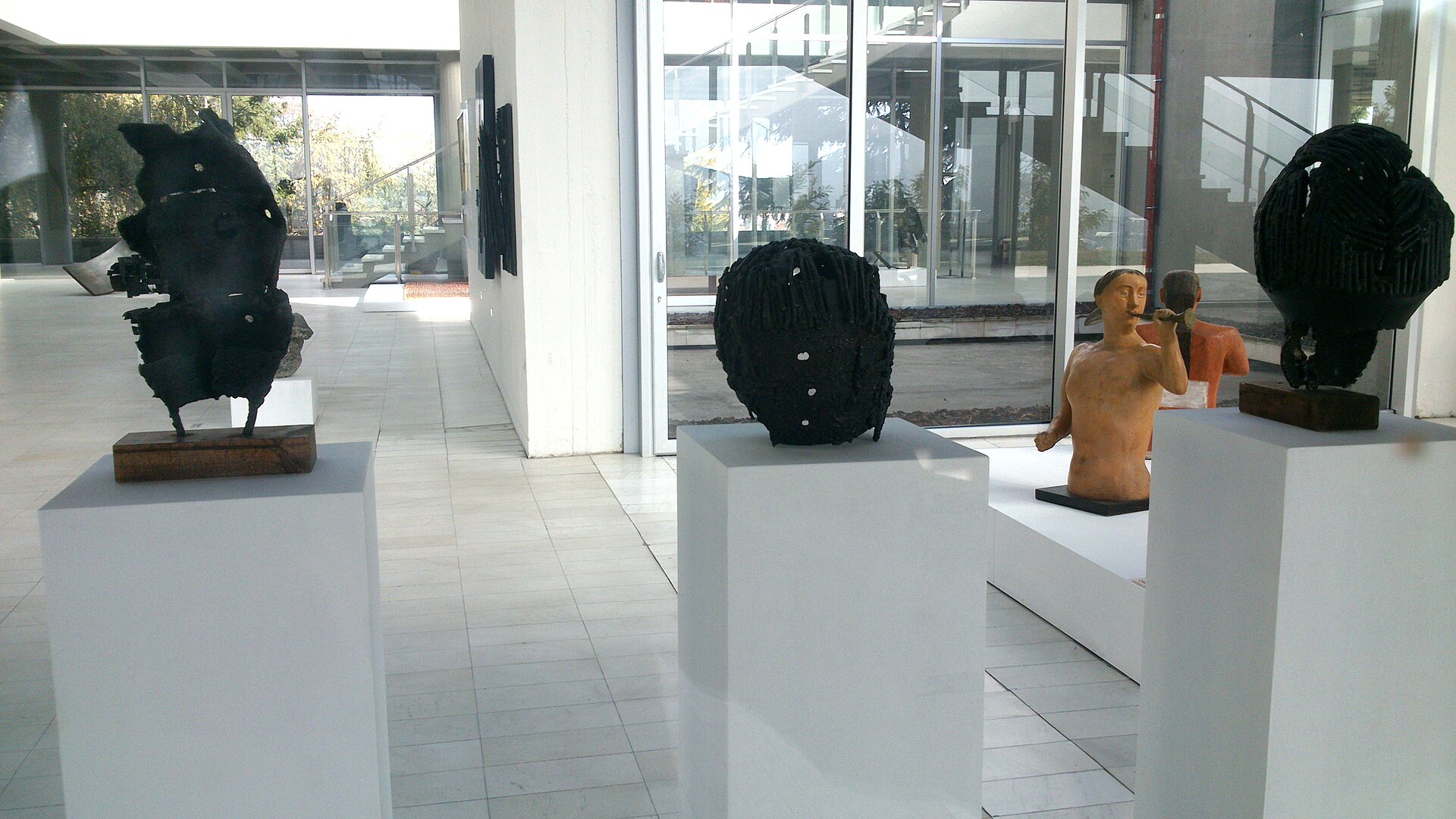
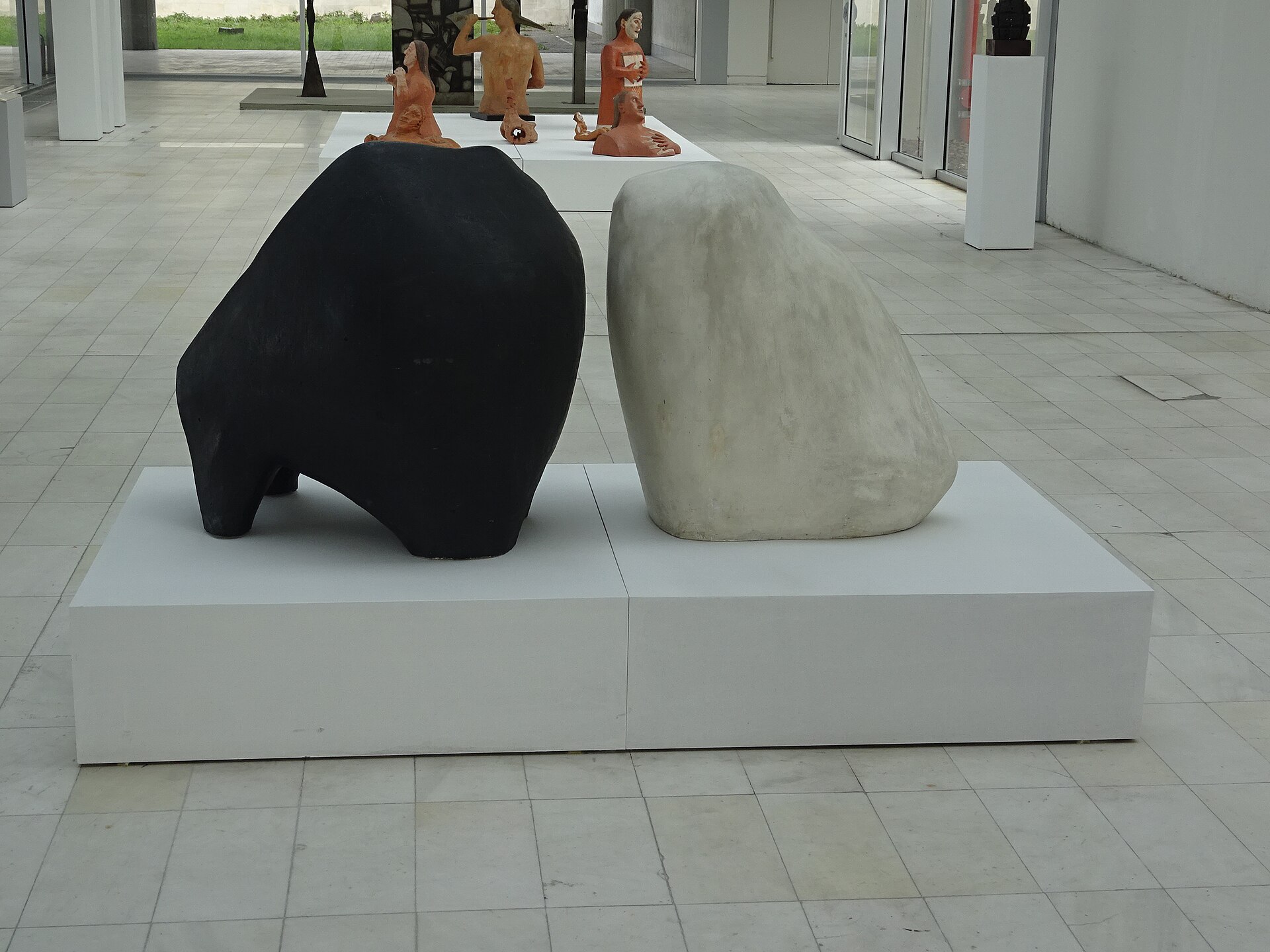
Photograph by Nikolina Hristovska · CC BY-SA 3.0 Ground-floor foyer and sculpture court
The glazed entrance hall opening onto the outdoor sculpture court, used to show sculpture and smaller graphic and photographic work alongside the main galleries.
Cinema, library and archive
A 120-seat cinema, a library, and what the museum describes as Macedonia's only complete archive of national art history, the source for its own publication, The Large Glass Journal.
What to see first
Kompozycja (The Composition)
Henryk Stazewski, 1964Part of the more than two hundred Polish works sent to Skopje alongside the Polish government's separate gift of the museum building itself, and still on display in the permanent hang.13
Mountain Landscape
Jerzy Nowosielski, 1964, oil on canvasOne of the documented Polish gifts, dated to the same year Skopje's Town Assembly voted to found the museum.13
10.I.65
Stanislaw Fijalkowski, 1965, linocutA print-medium entry in the Polish donation, dated the year construction preparations were underway for the permanent building.13
Stal i powietrze (Steel and Air)
Jan Berdyszak, steelOne of the few sculptural works in a Polish gift otherwise dominated by painting and print, showing the range of media that arrived after the earthquake.13
Founding gifts from Picasso, Calder, Hartung and Vasarely
Pablo Picasso, Alexander Calder, Hans Hartung, Victor VasarelyThe internationally recognised names among the earliest donations, credited with drawing wider attention to the post-earthquake appeal and anchoring the museum's international segment.5
Naive art collection
Risto Lozanoski, Dimitar Manev and other Macedonian naive paintersA distinct department of more than a hundred works, kept apart from the national modern collection as its own line within the museum's holdings.14
National modern collection
Nikola Martinoski, Petar Lubarda, Tomo VladimirskiThe part of the collection unique to this museum rather than shared with any donor nation, tracing an emerging Macedonian modern art scene alongside the international gifts.5
Post-earthquake architectural models
Unattributed, from the museum's own reconstruction-era archiveShown alongside the paintings in Kunsthalle Wien's 2023 loan exhibition, evidence the museum treats its own founding history as part of what it holds, not only the art itself.10
A museum founded to answer an earthquake
On 26 July 1963 an earthquake destroyed most of Skopje and killed more than a thousand people. Within months the International Association of Plastic Arts, meeting in New York that October, called on artists everywhere to donate work in support of the city's reconstruction, and UNESCO, AICA and ICOM lent their weight to the appeal. Donations arrived quickly enough that Skopje's Town Assembly voted on 11 February 1964 to found a Museum of Contemporary Art to house them, with the art historian Boris Petkovski as its first director, a post he held until 1976.
The museum existed for six years before it had a building of its own. Exhibitions in these years included work by Hans Hartung and Anna-Eva Bergman; a survey of Pop Art prints by Andy Warhol, Roy Lichtenstein, Tom Wesselmann and James Rosenquist; and a show of Picasso's graphic work. All of it appeared in rented galleries in central Skopje before the permanent site on Kale hill opened. Construction of the permanent building ran from April 1969 to its ceremonial opening on 13 November 1970, and the first full hang of the permanent collection followed soon after, with further reinstallations in 1981 and 1986. Since 1992 the museum has worked mainly through thematic and temporary exhibitions rather than a single fixed display, and the building had its first major renovation since opening, reopening on 22 February 2014 with an exhibition pointedly titled Solidarity: An Unfinished Project.
The Solidarity Collection
What the earthquake appeal produced was a real museum collection, assembled within a few years from work donated by artists and institutions in more than thirty countries plus contributions channelled through the United Nations. Kunsthalle Wien, which borrowed 94 works from Skopje for its 2023 exhibition No Feeling Is Final, described the result as a time capsule of international art from a moment when modernism was still in its prime, and a rare artistic encounter across the Cold War divide between East and West. The collection is not limited to familiar Western names. It holds paintings, prints and sculpture by artists from the Eastern bloc and the Global South alongside internationally recognised figures such as Pablo Picasso, Alexander Calder, Hans Hartung, Victor Vasarely, Alberto Burri and Christo, whose gifts anchor its international segment.
Poland's contribution was unusually large and unusually well documented. Alongside funding and designing the museum's building, Polish cultural authorities sent more than two hundred works by Polish artists, among them Henryk Stazewski's 1964 composition Kompozycja, which remains on display in the permanent hang, Jerzy Nowosielski's 1964 oil Mountain Landscape, and Stanislaw Fijalkowski's 1965 linocut 10.I.65 and Jan Berdyszak's steel sculpture Stal i powietrze (Steel and Air), one of the few three-dimensional works in a Polish gift otherwise dominated by painting and print.
The museum's own archive of correspondence and exhibition history from those founding years is treated as a historical record in its own right. Its 2023 loan to Vienna included five architectural models from Skopje's post-earthquake reconstruction shown alongside the paintings, using the art collection to tell the story of a rebuilt city as much as of a museum.
A building given by Poland
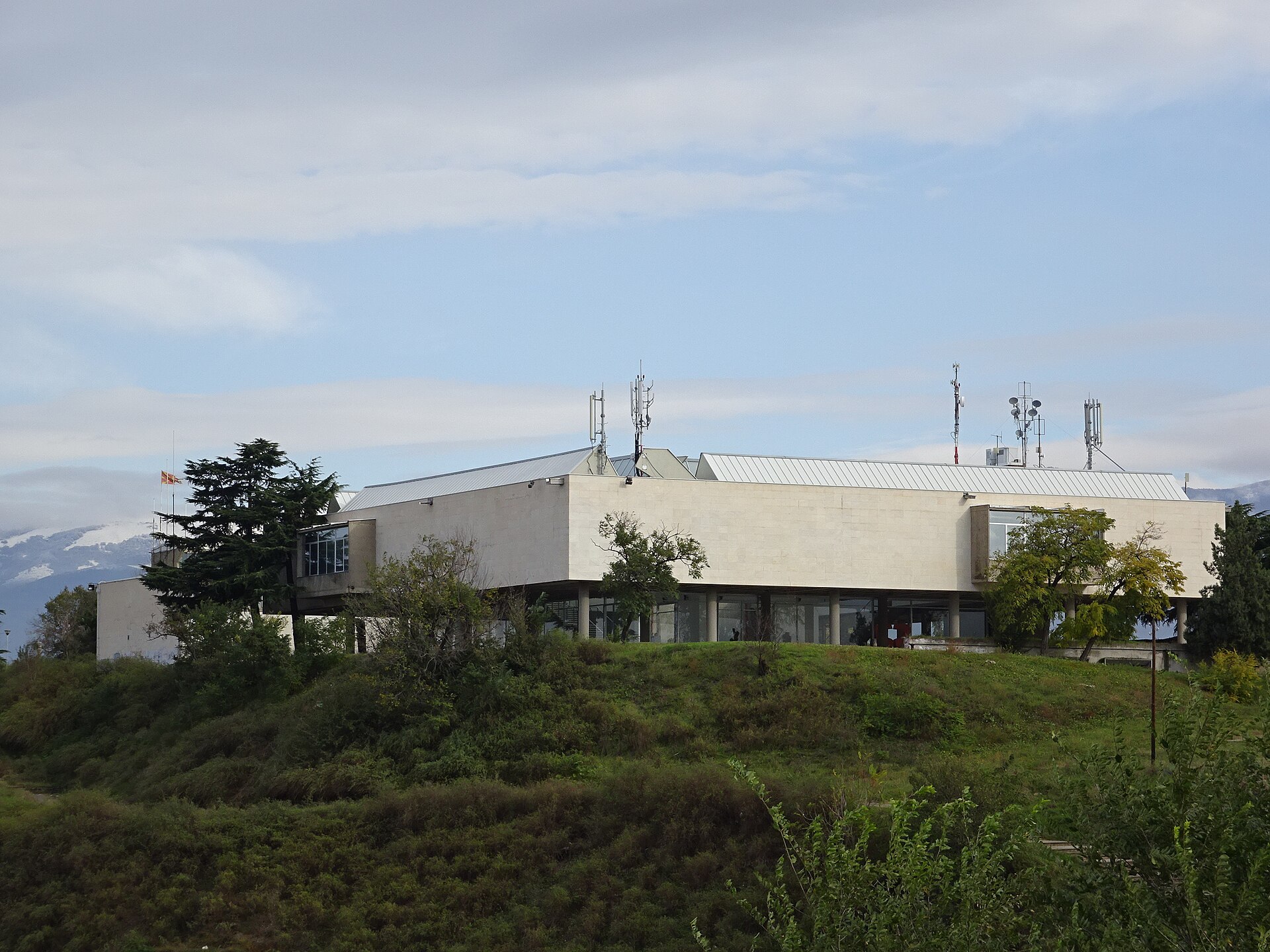
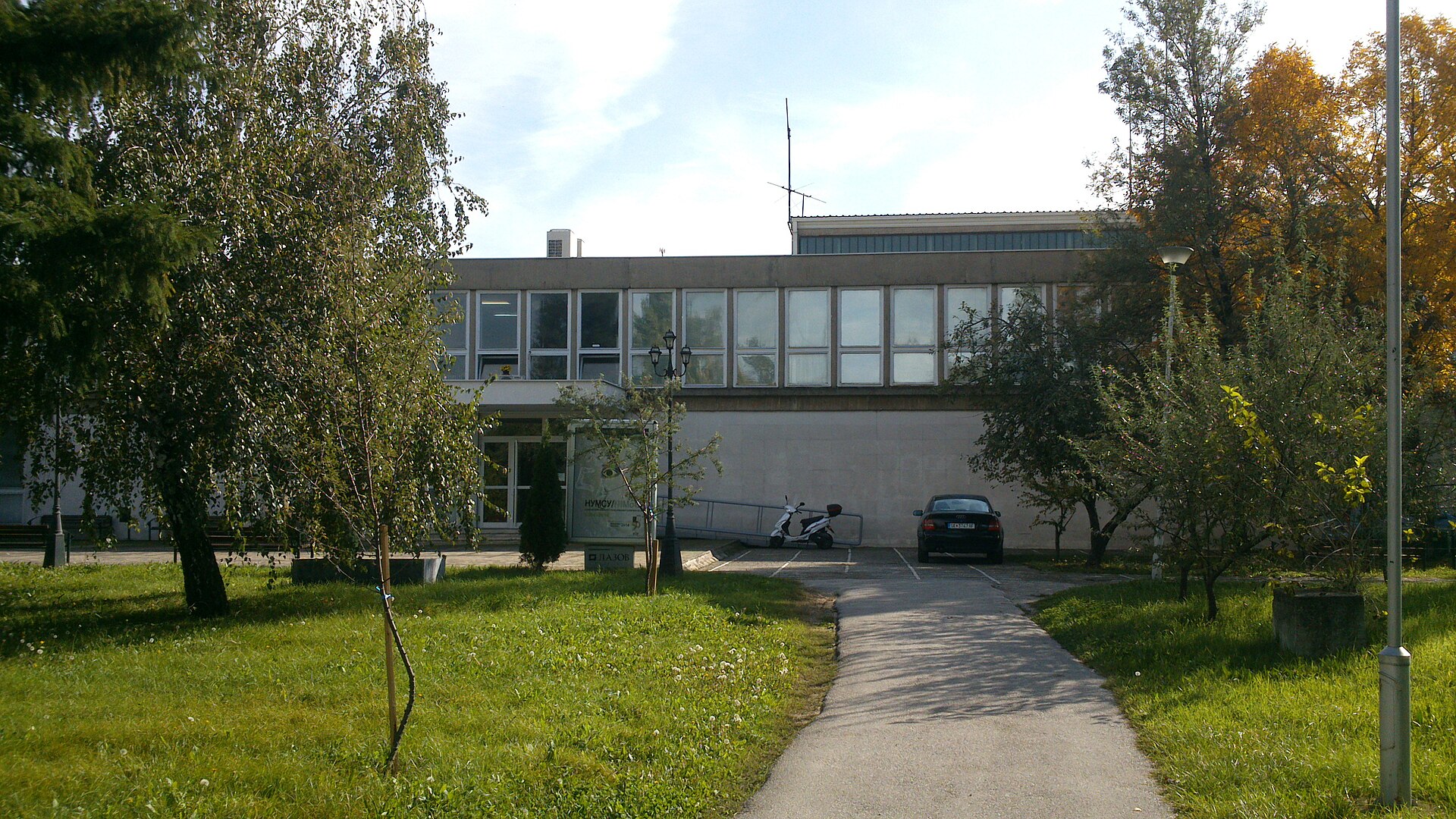
The museum's permanent home was itself a donation, separate from the art inside it. The Polish government funded and gave the building, choosing its design through an open competition in 1966 that drew more than eighty entries. The winning team, an architectural group known as Tigers, comprised Waclaw Klyszewski, Jerzy Mokrzynski and Eugeniusz Wierzbicki. Construction ran from April 1969 to November 1970, financed through the Fund for Assistance for Skopje's Reconstruction, and the finished building is a late-modernist structure of roughly 5,000 to 5,500 square metres in white stone and glass, set on a hilltop site next to the medieval Skopje Fortress with the city spread out below.
Inside, three interconnected wings frame large, open and flexible exhibition spaces around a central glazed atrium, extending outward into an outdoor sculpture court. A Wikimedia Commons photograph of the ground-floor foyer shows exactly this: terracotta figures and abstract stone sculptures set on plinths, with the outdoor court visible through a glass wall behind them. Architectural writers have described the building as a deliberate counterpart to the earthquake and the international response that followed it, sited above the rebuilt city like, in one description, a temple of art.
What is inside
The collection divides into two segments. The international segment holds the modern art donated from around the world in the 1950s, 1960s and 1970s, plus roughly a hundred earlier works of early modern art. Besides the Polish gift and the Western names already mentioned, it includes work by artists from across the former Eastern bloc and the Global South who were drawn into the same 1960s donation campaign. The national segment traces the development of art in Macedonia, from the early-modern generation of Nikola Martinoski, Petar Lubarda and Tomo Vladimirski onward. A separate naive art department holds more than a hundred works, including paintings by the Macedonian naive painters Risto Lozanoski and Dimitar Manev.
Beyond the galleries, the building holds a 120-seat cinema, a library and what the museum describes as Macedonia's only complete archive of national art history, which it draws on for its own publication, The Large Glass Journal. The current director, Mira Gaqina, has said publicly that the building went decades without serious renovation; that staffing has fallen since the museum's founding; and that contemporary works needing real technical support to display properly still compete for resources with a building whose infrastructure has not kept pace. The 2014 renovation addressed part of that gap but, on her account, not all of it.
Visiting today
The museum keeps regular hours: Tuesday to Saturday 10:00 to 17:00, Sunday 09:00 to 13:00, closed Monday, with a single admission price of 100 Macedonian denar. Its 2026 programme is active. Current and recent shows include a Laze Tripkov digital installation built around the Glagolitic alphabet; a photomontage survey titled To Begin, Once Again; a Ken Friedman Fluxus retrospective marking seventy years of his practice; and a Skopje Pride Weekend exhibition addressing the body through queer, feminist and decolonial perspectives. A Museum in a Suitcase programme adds tactile replicas of works for visually and hearing-impaired visitors.
Visitor opinion splits along a fairly consistent line. The building draws real praise on its own terms: reviewers describe the modernist architecture and the panoramic views over Skopje from its terraces, and some single out the quiet, uncrowded galleries as a contrast with the city's busier sights. The complaint that recurs just as often is scale. Visitors describe finding only one or two small shows on view at a time, sometimes seen through in a matter of minutes, with long stretches of the building standing empty. A city guidebook is blunter still, calling the admission price steep for what is on show and noting that much of the work on display can be seen through the windows from outside without paying at all.
A collection read differently now
The Solidarity Collection was built inside a specific piece of Cold War politics: non-aligned Yugoslavia positioning itself as a meeting point between blocs, with an earthquake as the occasion and international artists' goodwill as the instrument. Recent curatorial work, at the museum and abroad, has started to say so directly rather than let the founding story stand only as a feel-good origin myth. Kunsthalle Wien's 2023 exhibition paired the historical gifts with new commissions from six contemporary artists and a photographer, among them Brook Andrew, Hristina Ivanoska and Gulsun Karamustafa, asking what the collection means once the Cold War moment that produced it has passed. The organisers framed the collection as having grown out of the history of the city and an ambition to rebuild it for a different kind of society, rather than out of any single collector's taste. The museum's own 2026 programme runs in a similar direction, including a show that addresses colonial atmospheres and institutional power directly, plus a foyer exhibition built around how the institution itself operates and what it makes visible or invisible.
No restitution claim or ownership dispute over the Solidarity Collection turned up in the sources checked for this page, and the museum's own account of the donations gives no indication of one. The open question here is smaller and more practical than a legal dispute. A museum built out of an extraordinary act of international generosity is, by its own director's account and its visitors', thinly resourced and unevenly hung against the size of the building and the scale of what it actually holds.
What visitors say
Visitor opinion consistently splits along the same line: real praise for the modernist building itself and its views over Skopje, set against frequent disappointment at how little of the building is actually hung with art on any given visit.
What is praised, what is criticised
- Praised: The modernist building and its panoramic views over Skopje from the terraces
- Praised: The quiet, uncrowded galleries, a contrast some visitors draw with the city's busier sights
- Criticised: Exhibitions that occupy only a small part of the building and can be seen through in a matter of minutes
- Criticised: An admission price and level of staff helpfulness one guidebook called into question, noting that much of the work on display can be seen through the windows from outside without paying
- Criticised: A building its own long-time director said had gone decades without serious renovation, with staffing reduced since the museum's founding and technical support lagging behind what contemporary works need
Ratings on other platforms
TripAdvisor: 3.3 from 44 ratings, read 16 September 2026
A platform average is a tertiary source: it moves, it is not audited, and we quote no visitor's words.
Questions about Museum of Contemporary Art
Where is Museum of Contemporary Art?
Samoilova 17, 1000 Skopje, North Macedonia.
How much does it cost to visit Museum of Contemporary Art?
Single ticket: MKD 100. As confirmed 16 September 2026.
When is Museum of Contemporary Art open?
Tue-Sat 10:00-17:00; Sun 09:00-13:00. Closed: Monday. As confirmed 16 September 2026.
How do you get to Museum of Contemporary Art?
Walking / city bus: On Kale hill beside Skopje Fortress, about 900 m from Ploshtad Makedonija, Skopje's main square, an uphill walk of some 10 to 15 minutes; city buses serving the Old Bazaar stop within a few hundred metres, and taxis are inexpensive.
What should you see at Museum of Contemporary Art?
Kompozycja (The Composition) (Henryk Stazewski, 1964); Mountain Landscape (Jerzy Nowosielski, 1964, oil on canvas); 10.I.65 (Stanislaw Fijalkowski, 1965, linocut); Stal i powietrze (Steel and Air) (Jan Berdyszak, steel); Founding gifts from Picasso, Calder, Hartung and Vasarely (Pablo Picasso, Alexander Calder, Hans Hartung, Victor Vasarely); Naive art collection (Risto Lozanoski, Dimitar Manev and other Macedonian naive painters).
What we could not confirm
- No source checked for this page gives a current inventory figure broken down by segment; the widely repeated total of nearly 6,000 works is not split between international, national and naive art holdings.
- The museum does not publish a searchable online collection database, so which specific Picasso, Calder, Vasarely or Christo pieces are on view at any given time, rather than in storage, could not be confirmed for this page.
- No restitution claim or ownership dispute over any part of the Solidarity Collection turned up in the sources checked for this page; that is not confirmation none exists, only that none surfaced.
Images
Sources
- 1Wikimedia Commons, File:Contemporary Art Museum (North Macedonia) 2022 October 01.jpg, imageinfo/extmetadata commons.wikimedia.org/w/api.php?action=query&titles=File:Contemporary_Art_Museum_(North_Macedonia)_2022_October_01.jpg&prop=imageinfo&iiprop=extmetadata%7Curl&format=json
- 2Museum of Contemporary Art Skopje, official site, home/visit page msu.mk/home/
- 3Museum of Contemporary Art Skopje, official site, History msu.mk/history/
- 4Museum of Contemporary Art Skopje, official site, Exhibitions listing msu.mk/en/exhibition/
- 5Museum of Contemporary Art Skopje, official site, collection tag archive mail.msu.mk/tag/collection/
- 6Wikipedia, Museum of Contemporary Art (Skopje) en.wikipedia.org/wiki/Museum_of_Contemporary_Art_(Skopje)
- 7Macedonian Wikipedia, Muzej na sovremenata umetnost, Skopje mk.wikipedia.org/wiki/%D0%9C%D1%83%D0%B7%D0%B5%D1%98_%D0%BD%D0%B0_%D1%81%D0%BE%D0%B2%D1%80%D0%B5%D0%BC%D0%B5%D0%BD%D0%B0%D1%82%D0%B0_%D1%83%D0%BC%D0%B5%D1%82%D0%BD%D0%BE%D1%81%D1%82,_%D0%A1%D0%BA%D0%BE%D0%BF%D1%98%D0%B5
- 8Wikidata, Q3329592 wikidata.org/wiki/Q3329592
- 9CIMAM, Welcome to CIMAM, Museum of Contemporary Art Skopje! cimam.org/news-archive/welcome-to-cimam-museum-of-contemporary-art-skopje/
- 10Kunsthalle Wien, exhibition page, No Feeling Is Final. The Skopje Solidarity Collection kunsthallewien.at/en/exhibition/no-feeling-is-final-the-skopje-solidarity-collection
- 11e-flux, announcement, No Feeling Is Final. The Skopje Solidarity Collection e-flux.com/announcements/509744/no-feeling-is-final-the-skopje-solidarity-collection/
- 12Architectuul, Museum of Contemporary Art Skopje architectuul.com/architecture/museum-of-contemporary-art-skopje
- 13Contemporary Lynx, interview with Kinga Nettmann-Multanowska on the Polish collection in Skopje contemporarylynx.co.uk/exciting-discovery-in-skopje-contemporary-lynx-in-converstion-with-kinga-nettmann-multanowska
- 14Kupi.com, Museum of Contemporary Art Skopje: Best Modern Art Guide kupi.com/en/explore/macedonia/skopje/museum-of-contemporary-art-skopje
- 15Travel2Macedonia, Museum of Contemporary Art travel2macedonia.com/tourist-attraction/museum-contemporary-art-skopje
- 16TripAdvisor, Contemporary Art Museum of Macedonia, reviews tripadvisor.com/Attraction_Review-g295110-d8674046-Reviews-Contemporary_Art_Museum_of_Macedonia-Skopje_Skopje_Region.html
- 17In Your Pocket, Museum of Contemporary Art, Skopje guide inyourpocket.com/skopje/museum-of-contemporary-art_150513v
- 18Sloboden Pecat, interview with Mira Gaqina, Director of MoCA Skopje slobodenpecat.mk/en/intervju-so-mira-gakina-direktorka-na-msu-skopje-mojot-odnos-kon-msu-e-dlaboko-emotiven/
- 19Wikimedia Commons, categorymembers listing for Category:Contemporary Art Museum (North Macedonia) commons.wikimedia.org/w/api.php?action=query&list=categorymembers&cmtitle=Category:Contemporary_Art_Museum_(North_Macedonia)&cmtype=file&cmlimit=100&format=json
- 20Wikimedia Commons, imageinfo/extmetadata for gallery plates (Muzej na sovremena umetnost (1),(30),(61).JPG; Muzej na sovremenata umetnost - Skopje (1),(20).jpg; Museum of Contemporary Art Skopje 1.jpg) commons.wikimedia.org/w/api.php?action=query&titles=File:Muzej%20na%20sovremena%20umetnost%20(1).JPG%7CFile:Muzej%20na%20sovremena%20umetnost%20(30).JPG%7CFile:Muzej%20na%20sovremena%20umetnost%20(61).JPG%7CFile:Muzej%20na%20sovremenata%20umetnost%20-%20Skopje%20(1).jpg%7CFile:Muzej%20na%20sovremenata%20umetnost%20-%20Skopje%20(20).jpg&prop=imageinfo&iiprop=extmetadata%7Curl&format=json
_2022_October_01.jpg&prop=imageinfo&iiprop=extmetadata%7Curl&format=json)
.JPG%7CFile:Muzej%20na%20sovremena%20umetnost%20(30).JPG%7CFile:Muzej%20na%20sovremena%20umetnost%20(61).JPG%7CFile:Muzej%20na%20sovremenata%20umetnost%20-%20Skopje%20(1).jpg%7CFile:Muzej%20na%20sovremenata%20umetnost%20-%20Skopje%20(20).jpg&prop=imageinfo&iiprop=extmetadata%7Curl&format=json)