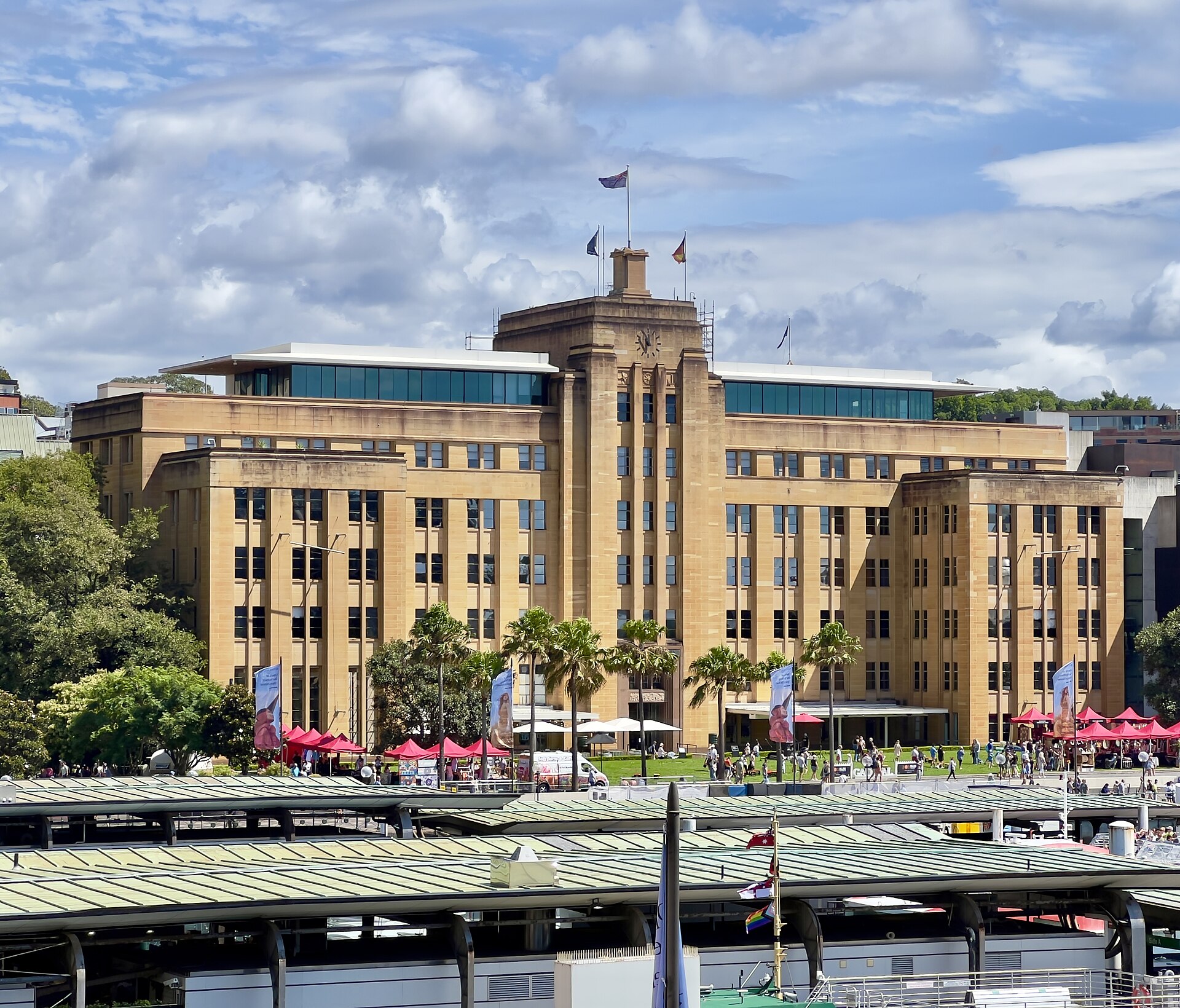
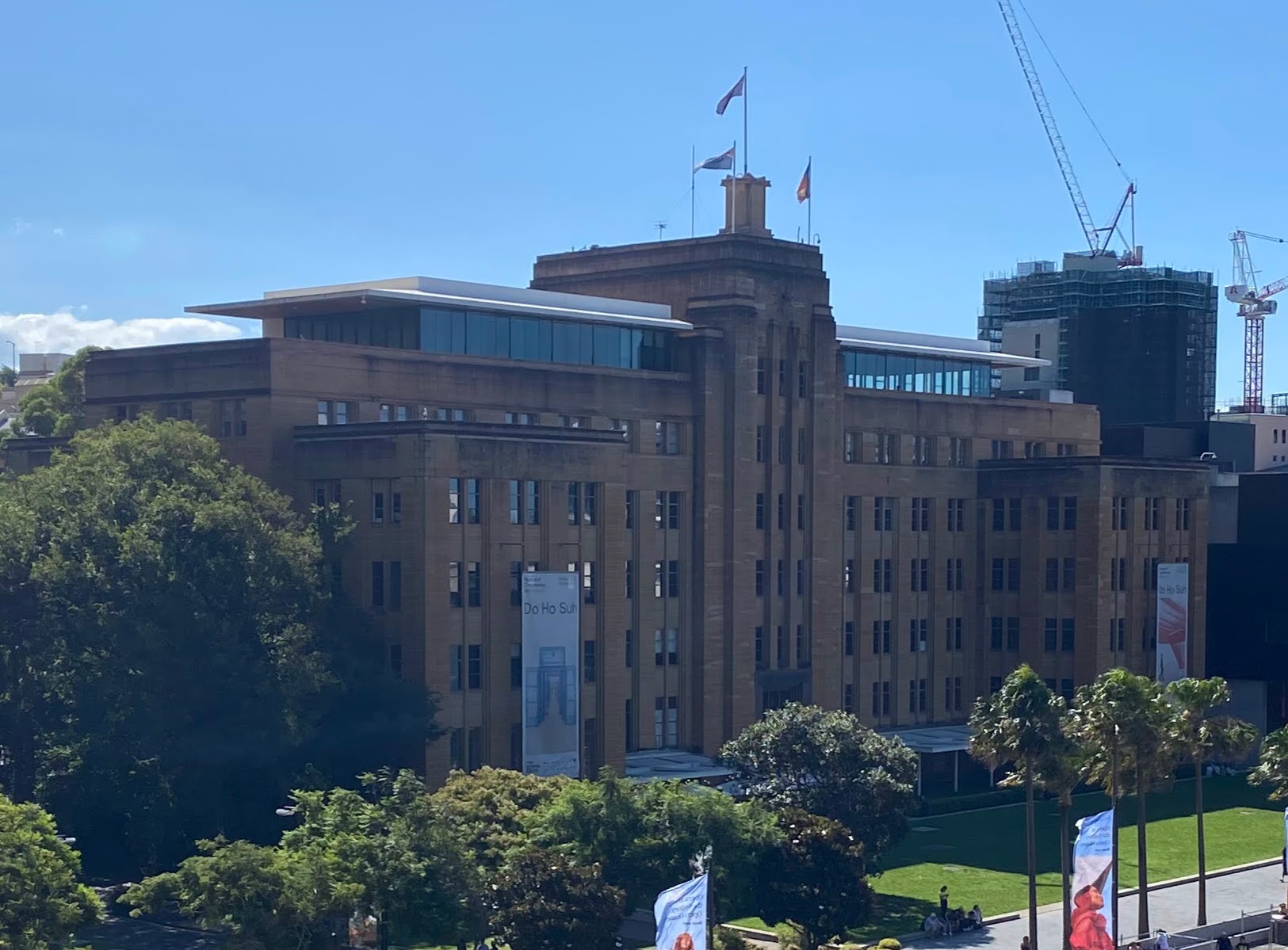
The sandstone Art Deco-inspired former Maritime Services Board building, home of the Museum of Contemporary Art Australia since 1991, seen from Circular Quay railway station in 2023.
Kgbo, CC BY-SA 4.0Museum of Contemporary Art Australia
Museum · Founded 1991
Open, admission and hours confirmed 18 November 2026 · 18 sources
On this page 17 sections
ContentsClose
The strength of the MCA Collection is its concentration on living artists and its depth in Aboriginal and Torres Strait Islander art. More than 4,700 works were acquired during the artists' lifetimes, and the named holdings of bark paintings, fibre works and 1980s and 1990s Australian art give a reader a wide range. The museum describes its collection as the only public collection in Australia dedicated to the work of living artists. Its limitation is the flip side: it is not a historical survey, and its international holdings are largely prints and multiples acquired in the 1990s.
| Kind | Museum |
|---|---|
| Founded | 1991 |
| City and country |  Sydney, Australia |
| Address | 140 George Street, The Rocks, Sydney NSW 2000, Australia |
| Website | mca.com.au |
| Status | Open, confirmed |
| Record last verified |
Visiting
- Hours
- Mon10:00 to 17:00
- Wed10:00 to 17:00
- Thu10:00 to 21:00
- Fri-Sun10:00 to 17:00
- Closed
- Tuesday. 25 December (open on all other public holidays, including those on a Tuesday).
- Admission
- AdultAUD 25Museum Admission: all galleries and displays, excluding the current major exhibition. A booking fee applies at checkout.
- ConcessionAUD 20Proof of concession required
- TertiaryAUD 20Valid ID from a registered education provider required
- MCA Member - FriendAUD 17Can only be purchased by an MCA Member
- Under 18s (13-17 years)FreeFree
- Under 13s (0-12 years)FreeFree; must be accompanied by a paid ticket holder
- Mob Tix (Aboriginal and/or Torres Strait Islander community)FreeFree
Free entry: MCA Late, Thursday 5-9pm, is sold as 2-for-1 tickets (not free entry)- Tickets
- tix.mca.com.au/events?category=Admission The museum's own ticket page.
- Do I need to book?
- Museum entry is ticketed and tickets are sold on the MCA's own ticketing site; the booking page asks the visitor to choose a date. The MCA is a cashless venue.
- Address
- 140 George Street, The Rocks, Sydney NSW 2000, Australia MapWalk, train, bus, ferry, light rail Six-minute walk from Circular Quay, where public buses, trains, ferries and light rail run regularly
Car Nearby parking at the 155 George St Car Park and the Clocktower Car Park; bike parking along the Circular Quay foreshore at the southern end of the Museum - Website
- mca.com.au
- Telephone
- +61 2 9245 2400
- [email protected]
Before you go how long, access, photography, bags, eating, shop
- How long to allow
- The sources read give no recommended visit length.
- Access
- Enter via George Street or Circular Quay West; all public areas are reached by lift. Wheelchairs can be borrowed from the information desk on level 1. Accessible toilets are on levels 2, 3 and 4 and all-gender toilets on level 2. The MCA recognises the Hidden Disabilities Sunflower lanyard, offers hearing loops in the Lecture Theatre, the National Centre for Creative Learning and some venue spaces, welcomes all assistance animals, and publishes a Visual Story and a Sensory Map.
- Photography
- Not stated on the pages read; the museum points visitors to its Visitor policies.
- Bags
- A cloakroom is on level 1; the museum points visitors to its Visitor policies for items allowed.
- Eating
- MCA Cafe at Tallawoladah on the ground floor, open 9am-5pm daily (10am-5pm on public holidays), and Canvas restaurant on Level 4, open Wednesday to Sunday 11am-4.30pm with last orders 2.30pm. Neither requires an admission ticket. Members receive 10% off.
- Shop
- The MCA Store sells work by emerging and established Australian artists and designers, in store and online.
Prices and hours change. We take them from the institution's own pages and print the day we read them, and you can check the current position at the source we used. Confirm before you travel.
What is inside
The Collection floor
The MCA describes the building as housing an entire floor dedicated to the MCA Collection, which holds more than 4,700 artworks made by living artists, about a third of them by Aboriginal and Torres Strait Islander artists. Displays change; the museum lists the Collection works currently on view on its website.
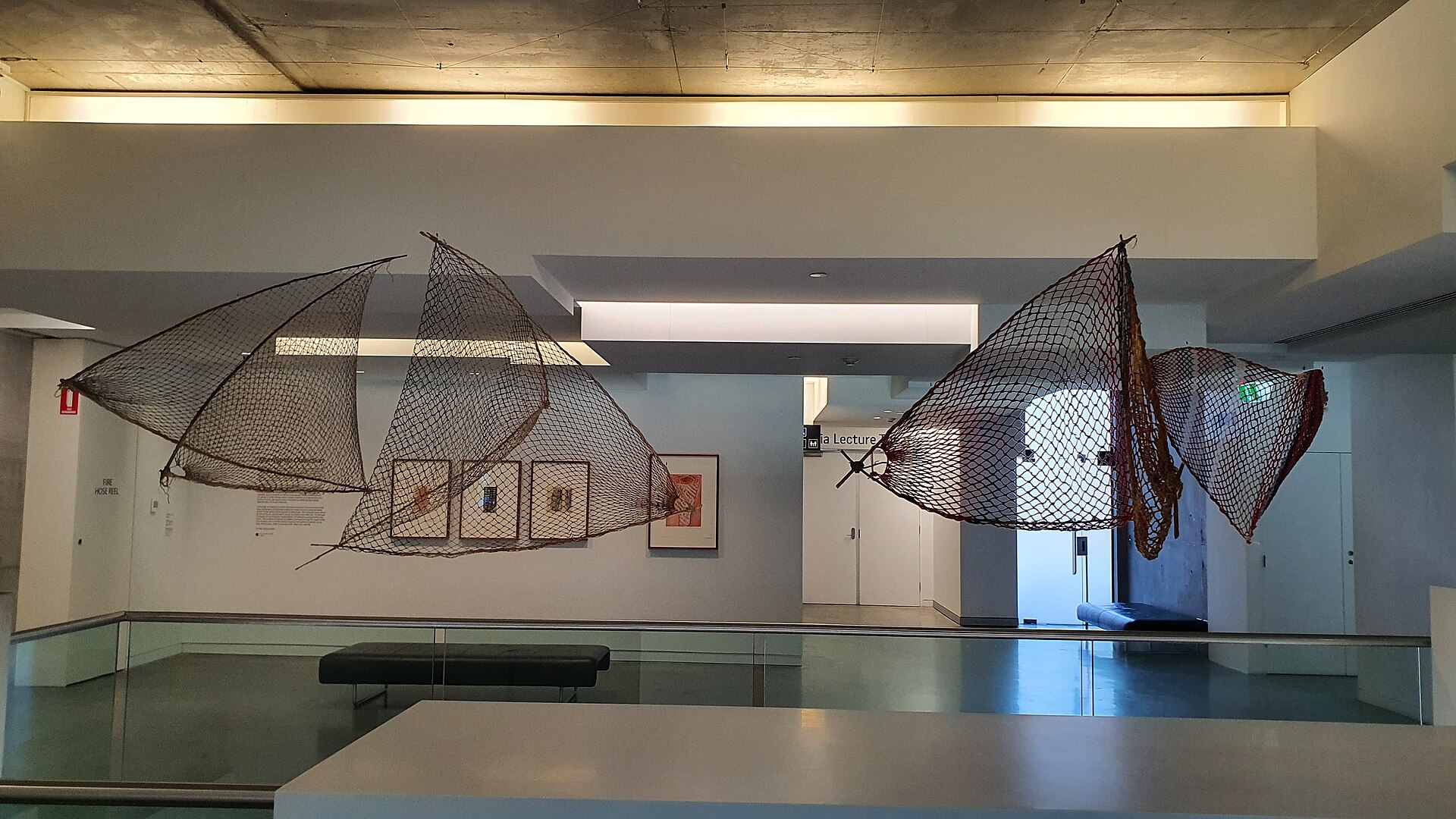
Photograph by Shkuru Afshar · CC BY-SA 4.0 Exhibition galleries
Two floors of galleries are given to temporary exhibitions, from the major ticketed show to smaller commissions and the Primavera young-artist series. A photograph on Commons shows suspended net-like objects in a second-floor gallery.
National Centre for Creative Learning
The learning centre includes digital and multimedia studios, a seminar room and a lecture theatre. It is a major national resource for education and interpretative programs, and it hosts the school and community programs listed on the MCA site.
Circular Quay foyer and the Warrang commission
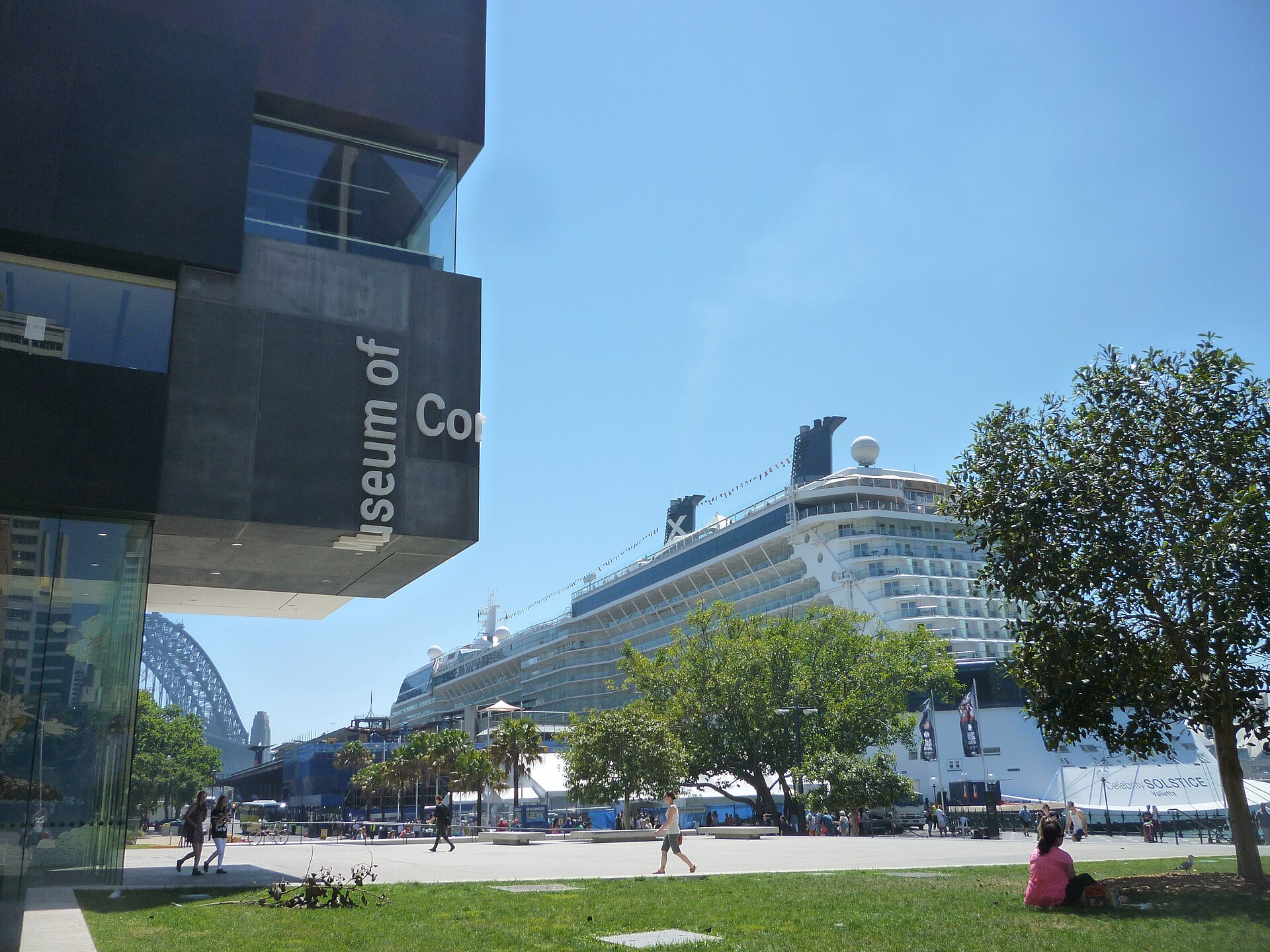
From the foyer there are uninterrupted views to Sydney Harbour. Brook Andrew's public artwork Warrang, built into the 2012 wing, interprets the heritage significance of the colonial naval docks. The foyer wall also carries a rotating commission; John Prince Siddon's Worra Munga! Ernie and Bert Dreamtime voice is listed there from 24 April 2026 to 8 May 2028.
Canvas restaurant and the rooftop
Canvas restaurant on Level 4 serves lunch with harbour views under a seasonal Chef-in-Residence. The museum also says its rooftop venue spaces look over the harbour to the Sydney Opera House.
Outdoor commissions: lawn and sculpture terrace
The Neil Balnaves Tallawoladah Lawn Commission and the Loti Smorgon Sculpture Terrace Commission present outdoor works. Ai Weiwei's Mushrooms (2026) is listed on the lawn from 25 September 2026 to April 2027.
What to see first
The Mordant Wing (2012)
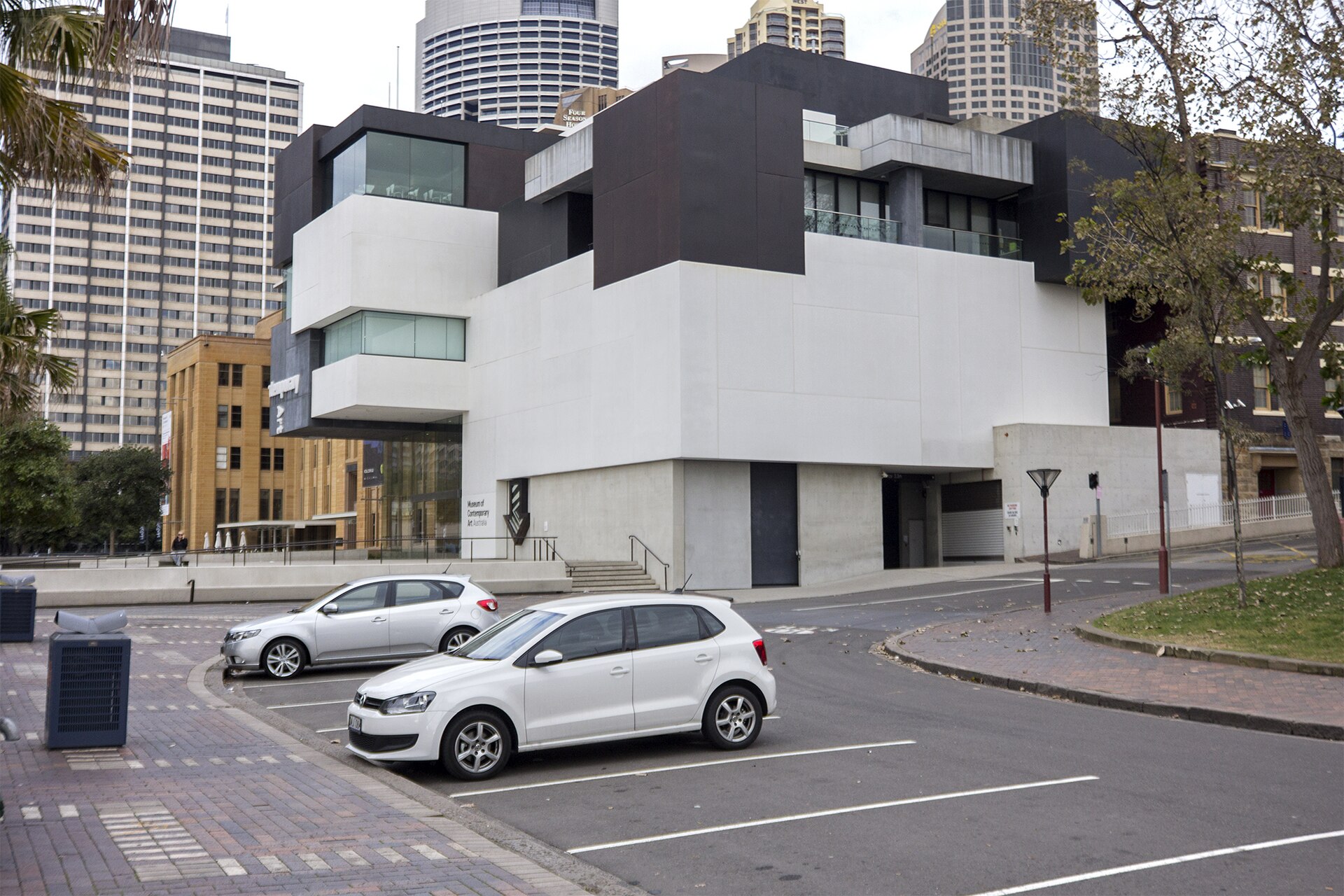
Sam Marshall with the NSW Government Architect's OfficeA five-storey wing that opened on 29 March 2012 and added 4,500 square metres, almost 50% of the museum's size. The museum named it after Simon and Catriona Mordant, who contributed $15 million.5
Untitled (2014)
Daniel BoydMirrored disks and synthetic polymer paint on the wall, donated through the Australian Government's Cultural Gifts Program. The MCA picks it out on its Collection and First Peoples pages as a key work on display.7
We Call Them Pirates Out Here
Daniel BoydAn oil on canvas bought by the MCA in 2006 with funds from the Coe and Mordant families. The museum pairs it with the story of the First Fleet landing on the very ground the building stands on,.4
Warrang (2012)
Brook AndrewA public artwork commissioned for the new wing as a contemporary reading of the colonial naval docks whose archaeological remains lie beneath the extension.5
The Arnott's Biscuits Collection of bark paintings
Artists from Groote Eylandt, Yirrkala, Galiwin'ku, Milingimbi, Maningrida, Ramingining, Gunbalanya, Wadeye and the Tiwi islandsDescribed by the MCA as one of the most important collections of bark paintings in the country: 275 works made from the 1960s to the early 1980s, donated by Arnott's Biscuits Limited in June 1993.8
The Maningrida Collection of Aboriginal Art
Maningrida artists, mostly womenAbout 600 works in fibre and other materials from the mid-to-late 1980s, including dragnets, fish traps and hunting bags. It is held in trust for the people of Maningrida under a cultural agreement.8
The Loti and Victor Smorgon Collection
Three generations of Australian artistsA gift of 154 works in 1995 covering Australian art of the 1980s and 1990s, including artists from the landmark 1968 exhibition The Field.8
Gift of Ann Lewis AO
Rosalie Gascoigne, Emily Kame Kngwarreye, Robert Rauschenberg, Ricky Swallow and othersFifty-four paintings, sculptures and photographs given in 2009, giving a second-half-of-the-twentieth-century view of Australian art.8
The Clock
Christian MarclayThe show that opened the new wing, 29 March 2012 to 3 June 2013. Critic John McDonald called it a crowd-pleaser and a tour de force in the Sydney Morning Herald, while arguing the upstairs exhibitions were the museum's real test.12
Past exhibitions here
A site older than the museum
The Museum of Contemporary Art Australia stands at Tallawoladah, the name the Gadigal people of the Eora Nation gave the ground now called The Rocks. The museum states that the place has been a home to stories, art and culture for over 65,000 years, and that it is also where the First Fleet landed in 1788, when eleven ships carrying convicts and soldiers from Britain arrived to found the colony. The museum treats this as the location of first contact between Indigenous and European peoples and as the beginning of the country's colonial history.
The western side of Circular Quay became a hub of boat building and naval trading. Important archaeological remains of the first government dockyard in Australia, established in 1797 by Governor John Hunter, lie underneath the museum's newer extension. In the 1930s the commissariat stores and the taxation building on the site were demolished to make way for a Maritime Services Board building.
The Maritime Services Board building
The older of the museum's two buildings is Art Deco-inspired and clad in sandstone quarried at Maroubra. Government architect W H Withers began the plans in 1939, but the project stopped for want of wartime labour and materials. Work resumed in 1944 under W D H Baxter, builders were appointed in 1946, the foundation stone was laid in 1949, and in 1952 the six-storey headquarters of the Maritime Services Board opened.
When the Board moved to larger premises in 1989, the New South Wales government granted a long lease to the University of Sydney to house a museum over four floors. The refurbishment and extension were paid for by the University and the Power Bequest under Andrew Andersons of Peddle Thorp and John Holland Interiors. In 1998 the lease took in the remaining two floors for galleries and commercial events.
John Power and the founding bequest
The museum owes its existence to the Australian expatriate artist John Power, who lived from 1881 to 1943. By the museum's account he left his personal fortune to the University of Sydney so that Australians could be informed and educated about international contemporary visual art. Power was also a surgeon and philanthropist, and the MCA describes him as a participant in the international avant-garde of the 1920s and 1930s whose inherited wealth let him keep most of his own work.
The Museum of Contemporary Art opened to the public in November 1991. Its first exhibition, Opening Transformations: The Museum Collection, ran from 12 November 1991 to 15 February 1992 and showed works from the JW Power Collection alongside others. Founding Director Leon Paroissien and Chief Curator Bernice Murphy set the original vision of innovative programming and groundbreaking exhibitions from Australia, the Asia-Pacific region and around the world. Wikipedia, a tertiary source used here only for identity facts, adds that Elizabeth Ann Macgregor directed the museum from 1999 to 2021 and Suzanne Cotter took over in January 2022.
Outgrowing the building and the 2012 wing
By the museum's own history, a 2001 change of stakeholders replaced the University of Sydney and the Power Bequest with the New South Wales Government and the Australia Council as key backers. Attendance rose to more than 580,000 in 2010. The building's shortcomings, as the museum lists them, were poor circulation, access to some galleries only by goods lift, a lack of facilities for education groups, cramped foyers and no outside signage.
A redevelopment of $53 million by Sydney architect Sam Marshall, working with the New South Wales Government Architect's Office, began in August 2010. The refurbished building reopened on 29 March 2012 with a new five-storey wing and 4,500 square metres of added space, nearly 50% of the previous size. The Federal Government and the New South Wales Government each gave $13 million, Simon and Catriona Mordant gave $15 million, and the extension is named the Mordant Wing in their recognition. The City of Sydney added $1 million. Wikipedia records that earlier schemes did not proceed: a 1997 competition won by SANAA was dropped after remains of the colonial dockyard were found, and a 2000 competition won by Sauerbruch Hutton, which would have demolished the older building, was abandoned after public outcry.
What the collection is
The MCA Collection holds more than 4,700 artworks acquired during the lifetimes of the artists represented. It is, in the museum's words, the only public collection in Australia dedicated to the work of living artists, and over a third is by Aboriginal and Torres Strait Islander artists. The Collection also includes works by international artists acquired in the 1990s, primarily prints and multiples.
Four named holdings shape it. The Maningrida Collection of about 600 fibre works is held in trust for the people of Maningrida. The Arnott's Biscuits Collection of 275 bark paintings was donated in 1993. The Loti and Victor Smorgon Collection of 154 works came in 1995, and the Gift of Ann Lewis AO added 54 works in 2009. The museum's First Peoples pages add that an Aboriginal and Torres Strait Islander Advisory Group was initiated in 2003 and that a first Aboriginal and Torres Strait Islander Policy was launched in 2015 with quantifiable targets.
What is on now and next
The exhibitions page, read on 18 November 2026, lists current shows including Connections: MCA x Tate, with contemporary art from the collections of MCA Australia and Tate Modern, running 15 August 2026 to 1 March 2027, and Robyn Kahukiwa: My Ancestors Are Always With Me, running 14 October 2026 to 7 February 2027. Ai Weiwei's Mushrooms sits on the Tallawoladah lawn from 25 September 2026 to April 2027.
Philippe Parreno: 5 Moons, part of the Sydney International Art Series 2026-27, runs from 21 November 2026 to 26 April 2027. The ticketing site sells it as a combined ticket with Museum Admission, while standard Museum Admission excludes the current major exhibition. d harding: Inheritance, described as the first major museum survey of the work of the First Nations Australian artist, follows from 25 March to 2 August 2027. The MCA's long-running Primavera series for young Australian artists and its commissions for the foyer wall, lawn and sculpture terrace continue the programme, and the archive of past shows runs back to 1991.
Money, free entry and the 2025 charge
The MCA describes itself as an independent, not-for-profit organisation that raises over 85% of its revenue each year through donations and commercial activities. The Art Newspaper reported in February 2025 that annual recurring government funding was A$4.36 million, about 14% of operating costs, and that the museum said it had not risen since 2008. Researchers at the University of Sydney put the 2023-24 figure at $4.2 million, about 16% of revenue, against $46.2 million for the Art Gallery of New South Wales and $47.4 million for the Australian Museum.
Against that background the museum began charging adults A$20 on 31 January 2025, ending a period of free general admission that The Art Newspaper dates from the start of Macgregor's tenure and the University of Sydney authors count as 24 years. The museum said it acted out of necessity to secure its future. The Art Newspaper noted that annual visitors grew from fewer than 100,000 to more than one million under her, and that the Art Gallery of New South Wales had committed to free entry seven days a week. By November 2026 the MCA's own ticketing page shows an adult price of A$25, with free entry kept for under 18s and for Aboriginal and Torres Strait Islander community members.
Planning a visit
The museum is open every day except Tuesday and on 25 December, with Thursday hours running until 9pm, and the MCA says it is open on all other public holidays. It is a six-minute walk from Circular Quay. Lifts reach every public area, wheelchairs are lent from the level 1 information desk, and the museum publishes a Visual Story and a Sensory Map for visitors who want to prepare. The ground-floor cafe and the level 4 restaurant do not need an admission ticket, which makes the harbour views available to visitors who only want a coffee or lunch.
What visitors say
The sources read agree on two things the MCA does well and two it is argued about. Writers credit it with a long-standing record of reaching a young and varied public: in 2023 about half of its on-site visitors were under 35 and 45% came from culturally and linguistically diverse backgrounds, according to University of Sydney museum scholars, and The Art Newspaper reports annual attendance growing from fewer than 100,000 to more than one million across one director's tenure. Its Aboriginal and Torres Strait Islander holdings are the part of the collection the museum itself leads with. The disputes are about the building, where critics split in 2012 over the extension, and about money, where the 2025 return of a general admission charge after about 24 years of free entry drew commentary and a defence from the museum on funding grounds. No survey of visitor opinion was found, so this page does not claim what visitors generally think.
What is praised, what is criticised
- Praised: A rooftop cafe and sculpture terrace described in 2012 by Sydney Morning Herald critic John McDonald as a brilliant spot, and a Circular Quay entrance and mural he also praised
- Praised: Its commitment to Aboriginal and Torres Strait Islander art: roughly a third of the Collection, an advisory group initiated in 2003 and a published policy since 2015
- Praised: A programme of ambitious international shows and commissions, with Christian Marclay's The Clock named by McDonald as a crowd-pleaser and tour de force at the 2012 reopening
- Criticised: The 2012 galleries: McDonald found them short on height and space, noting that exhibition space grew by 26% although the museum cited growth of about 50% for the whole building
- Criticised: The architecture of the 2012 wing, which Wikipedia records as dividing critics, with Philip Cox saying the MSB building should have been demolished and Andrew Andersons calling the addition insensitive
- Criticised: The return of paid entry on 31 January 2025: commentators noted the MCA's government funding of about A$4.2 million a year compared with tens of millions for state museums, and warned that access could narrow to those who can afford it; the museum said the step was taken out of necessity to secure its future
Questions about Museum of Contemporary Art Australia
Where is Museum of Contemporary Art Australia?
140 George Street, The Rocks, Sydney NSW 2000, Australia.
How much does it cost to visit?
Adult: AUD 25; Concession: AUD 20; Tertiary: AUD 20; MCA Member - Friend: AUD 17; Under 18s (13-17 years): free. As confirmed 18 November 2026.
When is it open?
Mon 10:00-17:00; Wed 10:00-17:00; Thu 10:00-21:00; Fri-Sun 10:00-17:00. Closed: Tuesday. 25 December (open on all other public holidays, including those on a Tuesday). As confirmed 18 November 2026.
How do you get there?
Walk, train, bus, ferry, light rail: Six-minute walk from Circular Quay, where public buses, trains, ferries and light rail run regularly; Car: Nearby parking at the 155 George St Car Park and the Clocktower Car Park; bike parking along the Circular Quay foreshore at the southern end of the Museum.
What should you see first?
The Mordant Wing (2012) (Sam Marshall with the NSW Government Architect's Office); Untitled (2014) (Daniel Boyd); We Call Them Pirates Out Here (Daniel Boyd); Warrang (2012) (Brook Andrew); The Arnott's Biscuits Collection of bark paintings (Artists from Groote Eylandt, Yirrkala, Galiwin'ku, Milingimbi, Maningrida, Ramingining, Gunbalanya, Wadeye and the Tiwi islands); The Maningrida Collection of Aboriginal Art (Maningrida artists, mostly women).
What we could not confirm
- The pages read do not state a recommended visit length, a photography rule or a bag-size rule; the museum refers to its Visitor policies, which were not read.
- The price of the combined Museum Admission and Philippe Parreno: 5 Moons ticket was not read.
- Google or Tripadvisor ratings were not collected, so the reception section rests on named published pieces rather than an aggregate score.
- The attribution of the 2012 reception pieces by Elizabeth Farrelly, Penny Craswell, Philip Cox and Andrew Andersons comes from Wikipedia and should be replaced with the primary reviews.
Images
Sources
- 1MCA Australia, Visitor information (location, hours, admission summary, transport, access, facilities) mca.com.au/visitor-information/
- 2MCA Australia ticketing, Museum Admission (adult, concession, , under 18s, Mob Tix and Member prices), read 18 Nov 2026 for a 20 Nov 2026 session tix.mca.com.au/events/a5f499c1-d58d-1808-4770-4934715a3779
- 3MCA Australia, About the MCA mca.com.au/about-us/
- 4MCA Australia, MCA history mca.com.au/about-us/our-history/
- 5MCA Australia, The MCA building mca.com.au/about-us/mca-story/our-building/
- 6MCA Australia, History of the MCA site mca.com.au/about-us/mca-story/history-mca-site/
- 7MCA Australia, MCA Collection mca.com.au/collection/
- 8MCA Australia, Special holdings mca.com.au/collection/special-holdings/
- 9MCA Australia, Eat and drink mca.com.au/visitor-information/eat-and-drink/
- 10MCA Australia, Exhibitions mca.com.au/exhibitions/
- 11Elizabeth Fortescue, The Art Newspaper, 20 February 2025, Museum of Contemporary Art Australia reverses ban on admission fees theartnewspaper.com/2025/02/20/museum-of-contemporary-art-australia-reverses-ban-on-admission-fees
- 12John McDonald, Sydney Morning Herald, 7 April 2012 (reproduced as New MCA on the author's website) johnmcdonald.net.au/?p=3294
- 13Chiara O'Reilly and Anna Lawrenson, The Conversation, reposted by the University of Sydney 30 January 2025 sydney.edu.au/news-opinion/news/2025/01/30/museum-of-contemporary-arts-new-entry-charge-is-a-sign-our-cultural-sector-needs-help.html
- 14Wikipedia, Museum of Contemporary Art Australia (; identity facts and architecture history only; replace with primary sources) en.wikipedia.org/wiki/Museum_of_Contemporary_Art_Australia
- 15MCA Australia, John Power mca.com.au/about-us/mca-story/John-Power/
- 16MCA Australia, First Peoples of Australia mca.com.au/first-peoples/
- 17MCA Australia, homepage (telephone and email in footer) mca.com.au/
- 18Wikimedia Commons, Category:Museum of Contemporary Art Australia (photographs, licences checked per file) commons.wikimedia.org/wiki/Category:Museum_of_Contemporary_Art_Australia