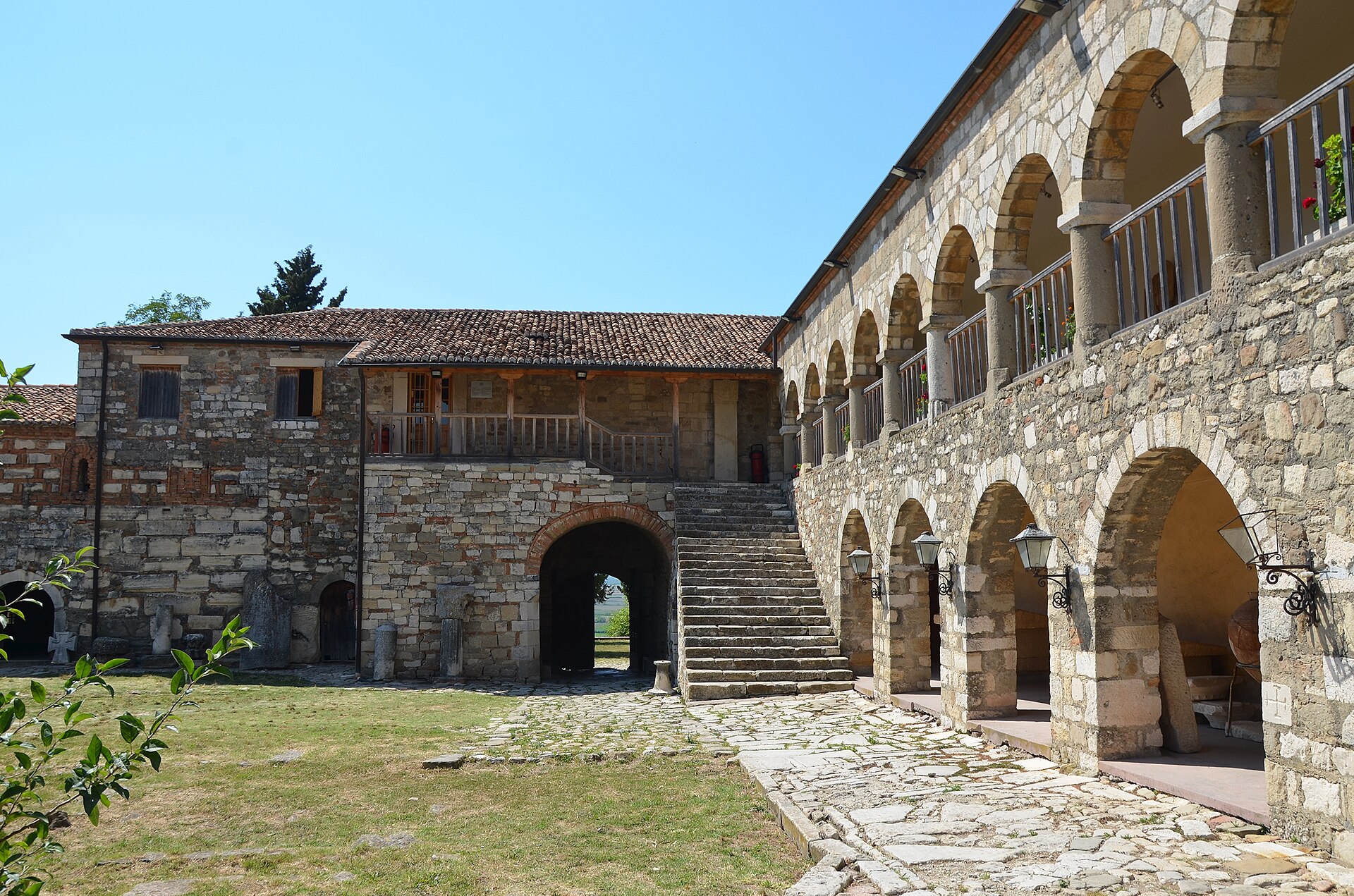
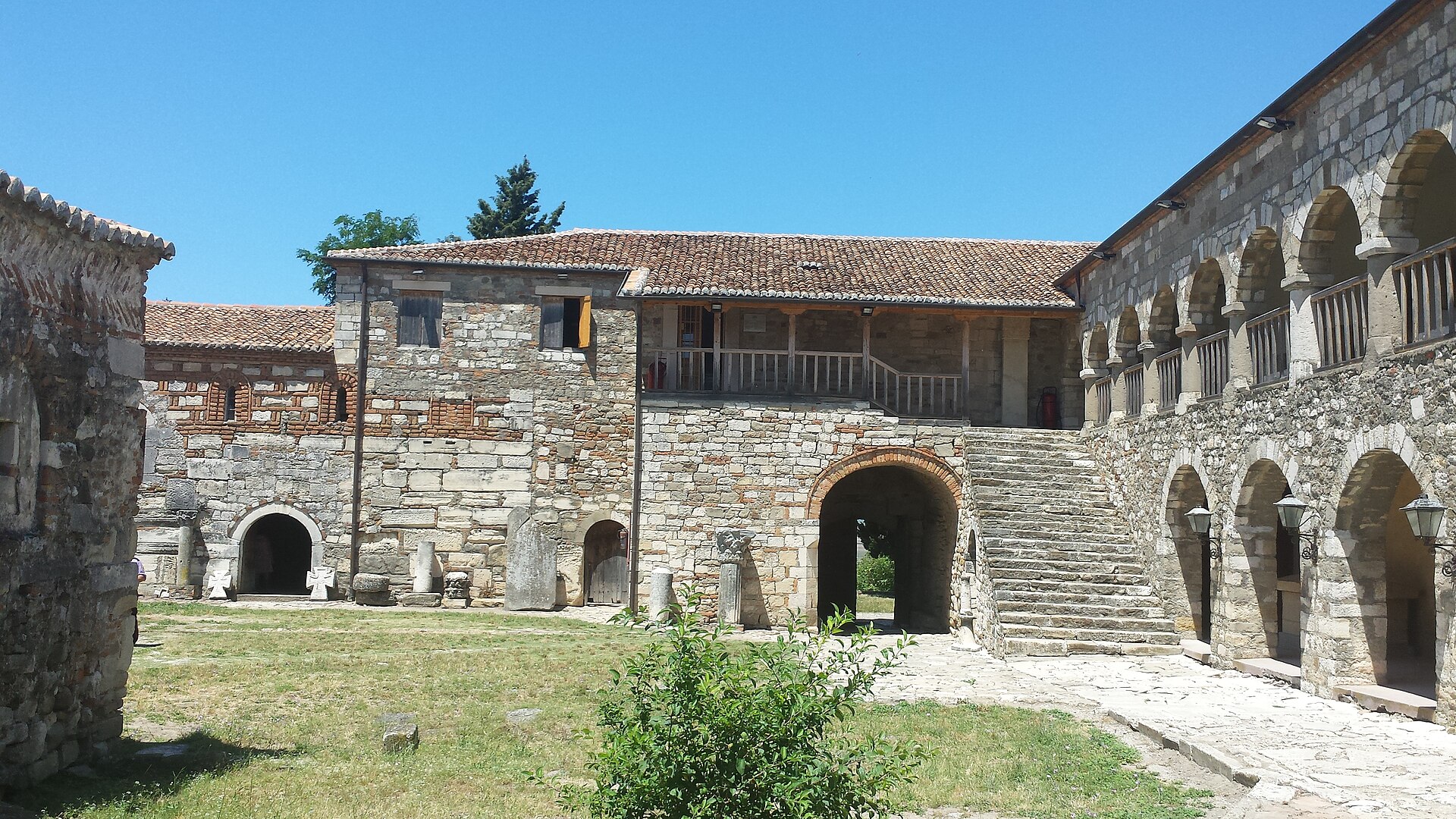
The courtyard of the Museum of Apollonia in the former Monastery of Saint Mary: the stone arcade, the stair to the upper walk and the terracotta-roofed ranges.
Carole Raddato, CC BY-SA 2.0 · Photograph by Carole Raddato from FRANKFURT, GermanyMuseum of Apollonia
Museum · Muzeu Arkeologjik i Apolonise · Founded 1958
Open, admission and hours confirmed 20 November 2026 · 21 sources
On this page 15 sections
ContentsClose
The strength of the collection is its local depth: finds from one city and its hinterland, from the seventh century BC to the late Roman period, set in the building that was built from that city. The coins, pottery and sculpture give a continuous picture of a Greek colony that became a Roman cultural centre. The weakness is documentation. The museum publishes no catalogue and no collection database that we could find, the object counts in print range from 688 to 750 and, according to the minister in December 2025, the holdings are only now being digitally documented. Only about ten percent of the ancient city has been excavated, so what the museum shows is a fraction of what the ground still holds.
| Local name | Muzeu Arkeologjik i Apolonise |
|---|---|
| Kind | Museum |
| Founded | 1958; closed in the early 1990s; reopened December 2011 |
| City and country |  Pojan (near Fier), Albania |
| Address | Apollonia Archaeological Park, Pojan, Fier County, Albania (plus code PFCF+Q4C) |
| Website | apolloniaarchaeologicalpark.al |
| Status | Open, confirmed |
| Record last verified |
Visiting
- Hours
- 1 Nov to 28 Feb: Tuesday to Sunday09:00 to 16:00Last entry and ticket 15:45
- 1 Mar to 30 Apr: every day09:00 to 17:00Last entry and ticket 16:45
- 1 May to 31 Oct: every day09:00 to 19:00Last entry and ticket 18:45
- Closed
- Mondays from 1 November to 28 February.
- Admission
- IndividualALL 600Apollonia Archaeological Park; the museum stands inside the park and the park lists no separate museum ticket
- Individual, onlineALL 500booked online
- Group of 12 or moreALL 500400 lek if booked online
- Pupils and studentsALL 180the park also lists -70 percent for students with a student card
- Age 12 to 18ALL 180
- Disabled people and pensionersALL 300listed as 50 percent off
- Age 0 to 12Freefree
Free entry: Last Sunday of the month, October to May. 18 April. 18 May. 21 May. 29 September. 28 and 29 November. Orthodox believers enter free on holidays and religious ceremonies- Tickets
- e-albania.al/ServiceDetails/16946 The museum's own ticket page.
- Do I need to book?
- No. The park offers an online ticket at a lower price, and guided visits are programmed for groups above 12 people.
- Address
- Apollonia Archaeological Park, Pojan, Fier County, Albania (plus code PFCF+Q4C) MapCar The park's own itineraries give 120 km and one hour 47 minutes from Tirana to the park, then onward routes to Ardenica, Byllis and Vlore.
Bus or minibus Two older travel guides say minibuses or buses run from Fier to the site for about 50 lek (Travellingfoot names routes B5 and B7; Lonely Planet gives a taxi at about 500 lek one way). These figures are undated, check locally. - Website
- apolloniaarchaeologicalpark.al
- Telephone
- +355 69 202 3949
- [email protected]
Before you go how long, access, photography, bags, eating, shop
- How long to allow
- About two hours for museum, church and the main ruins; allow more to walk the whole site (a 2016 visitor and a 2026 travel guide give two hours and two to three hours).
- Access
- The park publishes nothing on access. A travel guide describes rough ground and limited wheelchair access; the monastery court is stone and earth with steps to the upper walk.
- Photography
- A 2017 reviewer found photography allowed and noted that this is rare in Albanian museums. Confirm on arrival. The lighting in the church is poor for photographs.
- Bags
- The sources we read do not mention a cloakroom.
- Eating
- A travel guide reports a small cafe and shaded rest areas; one 2016 visitor found toilets in a corner of the monastery.
- Shop
- Not described by the sources we read.
Prices and hours change. We take them from the institution's own pages and print the day we read them, and you can check the current position at the source we used. Confirm before you travel.
What is inside
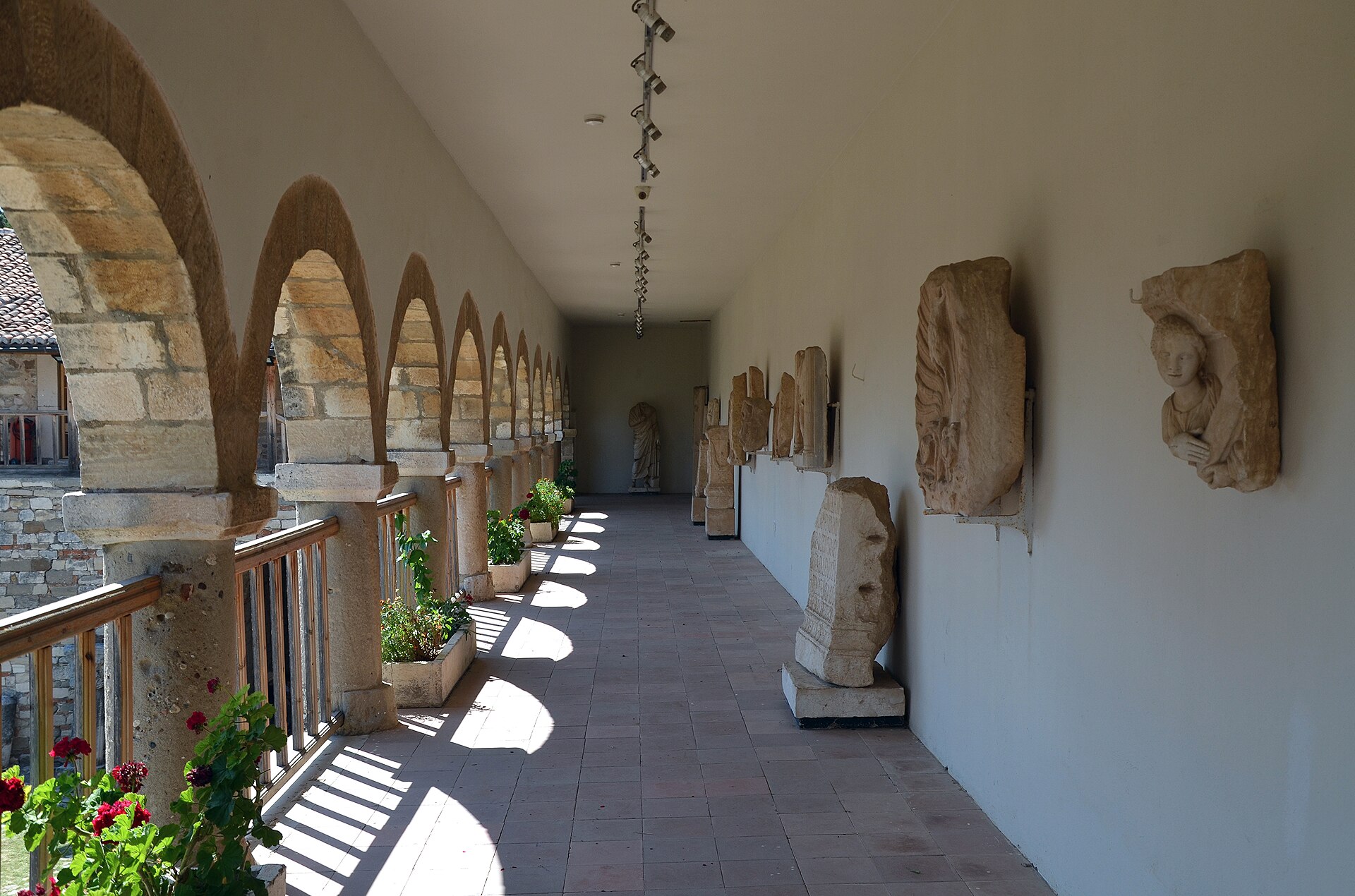
Photograph by Carole Raddato from FRANKFURT, Germany · CC BY-SA 2.0 The statuary portico on the north wing
The covered upper walk of the north range, an arcade of stone arches opening to the courtyard. Reliefs, stelae and statues from Apollonia and its surroundings stand on plinths and hang on the wall, with track lighting overhead. Wikipedia places an impressive statue collection in a portico; the Tirana Times reported in 2010 and 2014 that this portico had cracked in landslides and that its statues had been moved out for about three years. A photograph of 2016 shows them back on the walk.
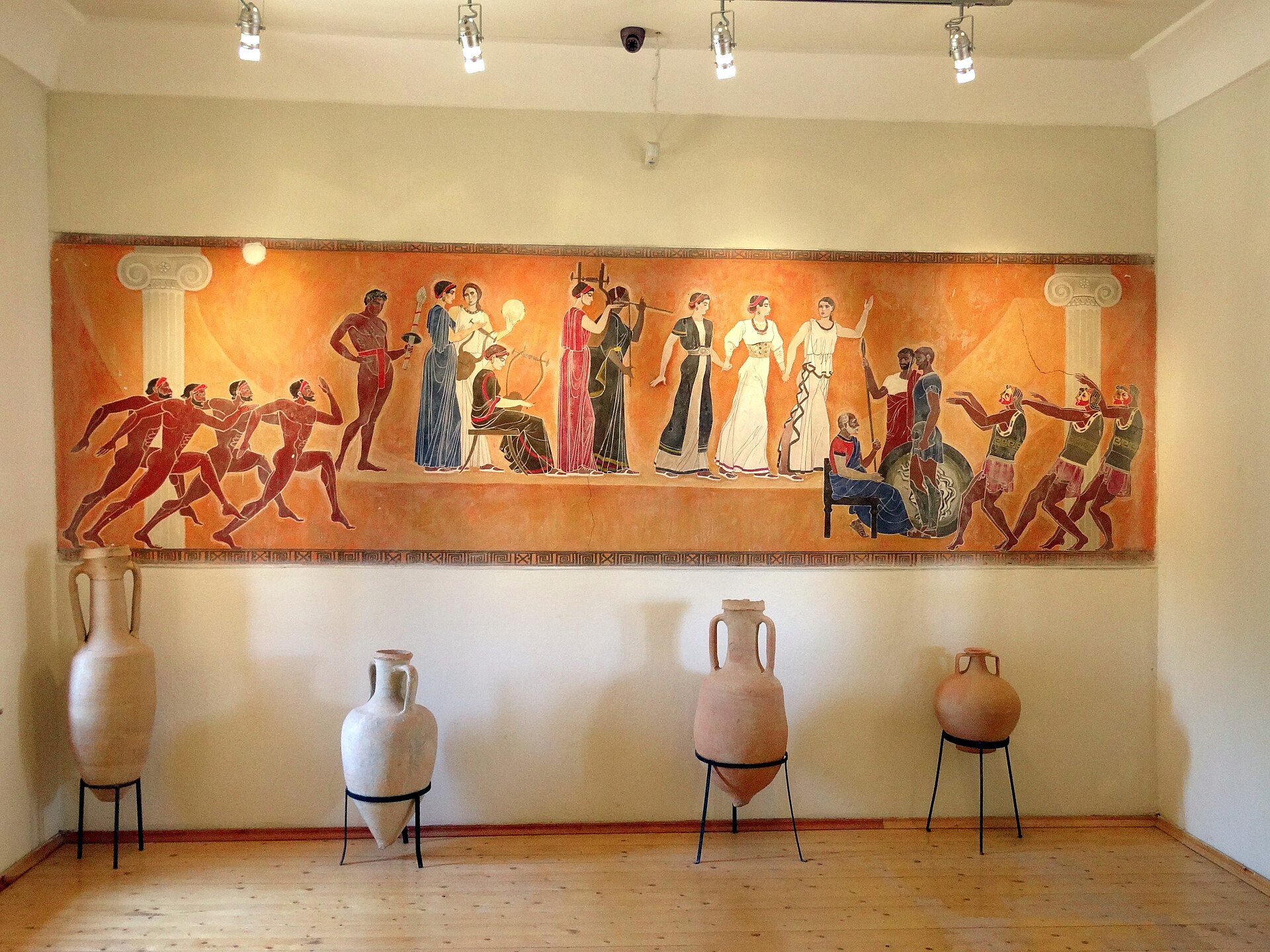
Photograph by Anmad1 · CC BY 4.0 The ground-floor galleries of ancient finds
Most of the collection, in six rooms to the north and west of the complex per Wikipedia (one 2017 reviewer places the rooms on the first floor, so check on arrival). Pottery, glass, coins, inscriptions and sculpture from the seventh century BC to the late Roman period. The photograph shows a room with transport amphorae set beneath a large painted frieze of athletes and musicians.
Photograph by Marmontel · CC BY 2.0 The refectory
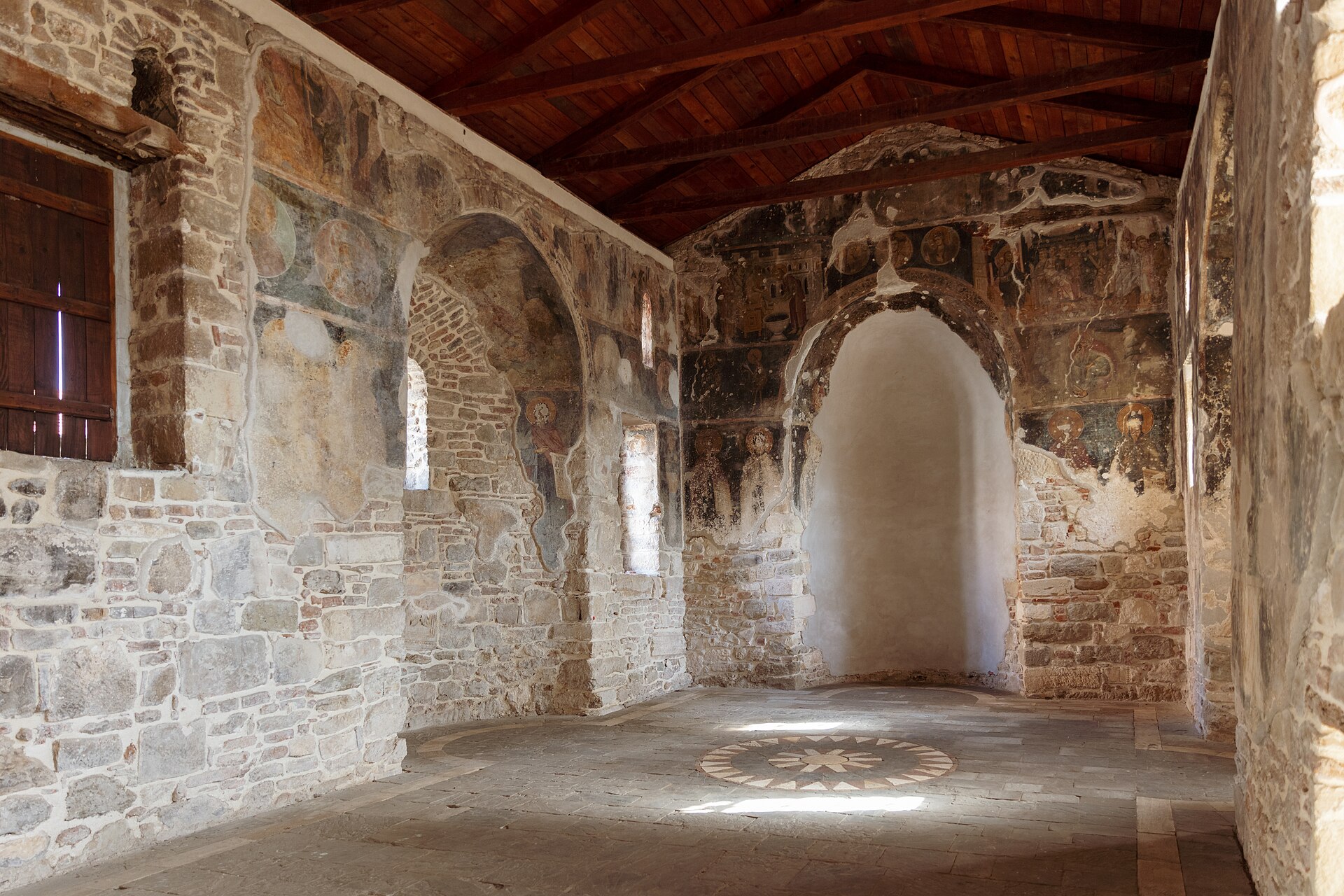
A stone hall of the monastery with surviving medieval wall paintings, which Wikipedia names as the place where most of the building's medieval frescoes remain. Sources differ on the date: a 2017 reviewer gives the fifteenth century, the photographer's own caption on Commons the fourteenth. A circular mosaic roundel marks the floor.
The church of the Dormition of the Virgin
The monastery church at the centre of the court, dated by the park to the early thirteenth century: a domed cross-in-square plan, a portico of eight octagonal columns with carved sirens and bird monsters on the capitals, a cistern under the porch and the fresco of the Palaiologan imperial family. Faded wall paintings and floor mosaics inside, according to Lonely Planet. No free photograph of the interior that we could verify, so none is attached.
The coin and small-finds holdings
Wikipedia counts a large number of ancient coins beside the 688 objects, and the Tirana Times reports coin treasuries among the 750 items at the 2011 reopening. Apollonia minted its own coinage. Not separately photographed on Commons, so no plate is attached.
What to see first
The statuary portico
Sculpture and reliefs from Apollonia and surroundingsA covered arcade where reliefs and statues from Apollonia stand along a wall. It cracked in landslides in 2010 and was a repair priority in the years after.6
The capitals of the church portico
Byzantine masons, early thirteenth century on the park's datingEight octagonal columns whose capitals show sirens and bird monsters, which the park reads as a Romanesque element from southern Italy and the reason the church is unique in Albania.3
The fresco of the Palaiologan imperial family
Byzantine painters, late thirteenth centuryThe park calls it the only painting in Byzantine art that shows Michael VIII and his son Andronikos II together. The fragment where the emperor offers a model of the church to Saint Mary also indicates who paid for the rebuilding.3
The cistern with a Doric column mouth
Ancient and medieval reuseUnder the portico stands a water cistern whose opening is a section of a column from a Doric temple, a small example of the monastery being built from the ancient city.3
The refectory frescoes
Medieval painters, dated to the fourteenth or fifteenth century depending on the sourceThe room where Wikipedia says most of the medieval wall painting in the building survives, with a mosaic floor roundel.6
The pottery, amphorae and glass
Workshops of Apollonia and its trade networksTwo independent visitor accounts single out the pottery and the glass collection.14
The medieval and floor mosaics
Late antique and medieval makersWikipedia lists a collection of medieval mosaics while Lonely Planet reports Roman floor mosaics in the church; the sources disagree on the date and the exact place, which is itself a reason to look.12
The ancient coin holdings
The mint of Apollonia and later issuesThe 'large number of ancient coins' Wikipedia counts, and the coin treasuries the Tirana Times counted at the reopening, are the part of the collection that tells the city's trading history.8
The single-headed eagle relief
Medieval, later restorationA relief of an eagle with a double cross on the south wall of the church, which the park uses as evidence that the building was restored after its first construction.3
A museum inside a monastery on the hill of Apollonia
The Museum of Apollonia is not a building put up to hold a collection. It occupies the cloister of a Byzantine monastery, the Monastery of Saint Mary, which stands on a low hill inside the ancient city of Apollonia, about 8 to 12 kilometres west of Fier in southwest Albania (sources differ on the distance; the park's own itineraries count the drive from Tirana at 120 km and one hour 47 minutes). Visitors arrive at a walled complex of grey stone, terracotta roofs and a two-storey arcade, with the church of the monastery at the centre and the ancient objects arranged in the ranges around it. Wikipedia describes the building as having seven pavilions, a gallery and two porticos; the museum is therefore a set of rooms and covered walks that happen to be filled with antiquities, rather than a gallery with a monastery attached.
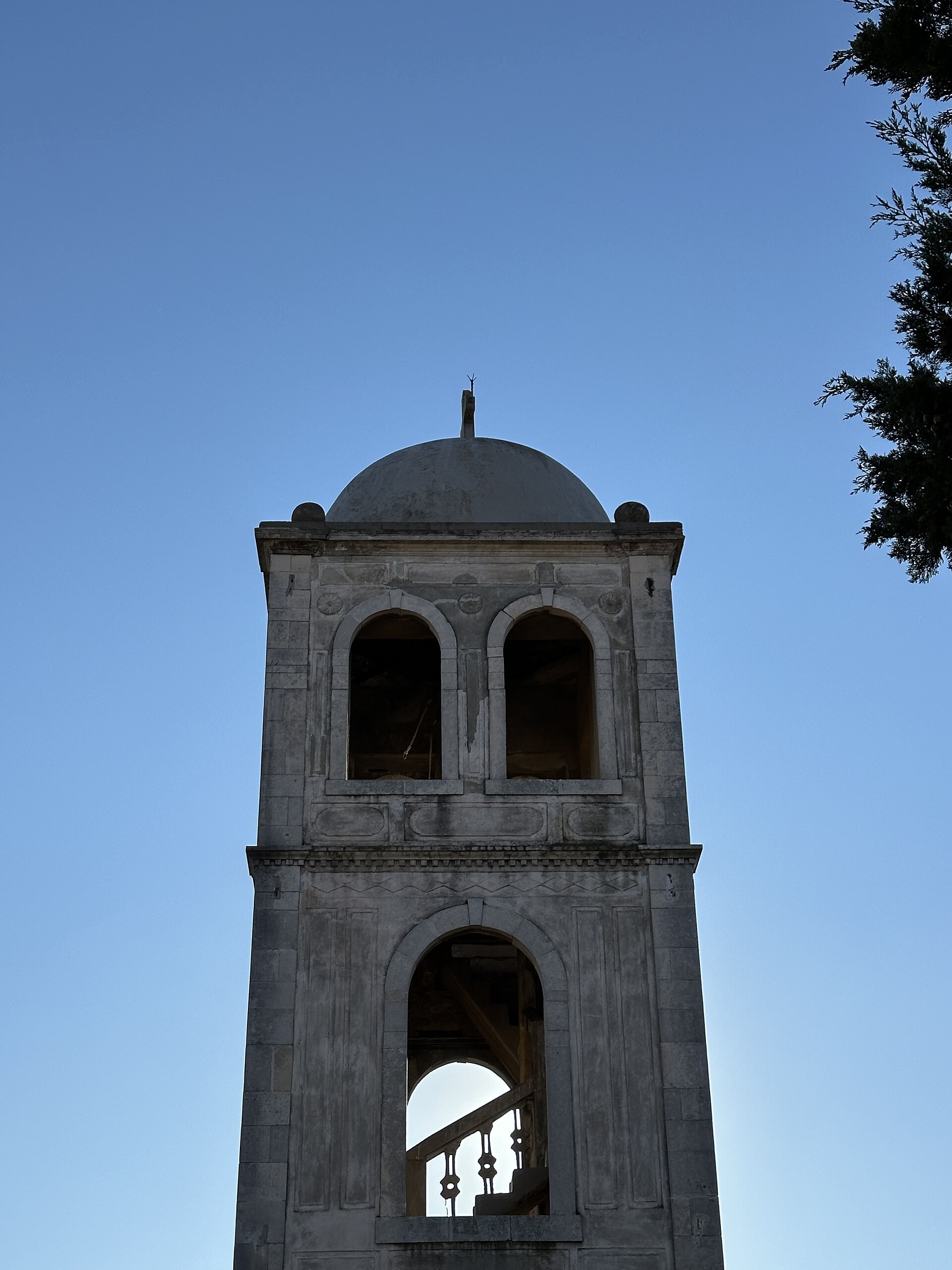
That arrangement is the reason to come. The church, the refectory, the bell tower and the arcaded walks are exhibits in their own right, and the sculpture hung and stood along the upper walk is lit by the same sun that falls on the courtyard. The park that surrounds the complex, the Apollonia Archaeological Park, is the larger destination: the museum is the roof over what the excavations produced, and the monastery is the later chapter of the same hill.
The institution is run by the park authority, which presents itself on its own site as the Apollonia and Byllis Archaeological Parks, under the Ministry of Tourism, Culture and Sports. The same office looks after the sister park at Byllis, and the museum has no separate website, ticket or opening hours of its own: it is entered through the park gate and priced as part of the park.
What the hill was before the monastery
Apollonia was founded in 588 BC according to the figure Lonely Planet and Wikipedia both give, by settlers from Corinth and Corfu on land of the Illyrian Taulantii, on the right bank of the river Vjose, then known as the Aoos. It grew into a trading city with its own coinage, and the Romans later kept it as a centre of Greek learning: the young Octavian, the future Augustus, was studying there in 44 BC when news arrived that Julius Caesar had been killed. Cicero called it a great and weighty city. A third-century earthquake changed the course of the river, the harbour silted up, the inland area turned malarial and the population drifted south towards Vlore. By late antiquity the city was largely empty, and what remained was a small Christian community with its own bishop.
The park's own text on the region's faith history explains what followed: after the Edict of Milan in 313 Apollonia became an important centre of church organisation, its bishop Eusebius spoke for Apollonia and Byllis until the council of 451, and then the see moved to Byllis. The monastery that now holds the museum was raised on the ruins of the ancient city and of an early Christian basilica, and, in the words of the park, it was built with architectural elements of Apollonia itself. The lower part of the church is made of stone from the ancient theatre; the upper part is plastered brick. In the long run this means that the museum's best-known architectural fact is also a piece of provenance: the building is made out of the city whose finds it now displays.
The church of the Dormition and what is in the courtyard
The monastery church, dedicated to the Dormition of the Virgin and known locally as Shen Meri, is dated by the park to the early thirteenth century, a cross-in-square plan under a dome, of the Byzantine type. The park describes its architecture as unique of its kind in Albania. Its portico stands on eight octagonal columns whose capitals carry mythological creatures, sirens and bird monsters, which the park reads as Romanesque elements and as a style that came from southern Italy. Beneath the portico there is a water cistern whose mouth is a section of Doric column taken from an ancient temple. On the south outer wall a relief shows a single-headed eagle with a double cross, evidence in the park's account that the church was restored in a later period.
The painting is what scholars come for. The park says the church was once frescoed throughout and that the frescoes survive only in places. One of them, on the west side, shows the imperial family of Michael VIII Palaiologos with the empress and their son Andronikos II. The park calls it the only painting in Byzantine art that shows these two emperors together, and notes that the fragment in which Michael offers a model of the church to Saint Mary indicates the church was rebuilt on his order late in the thirteenth century. Under it lies an older fresco, which shows the church is older still, at least from the start of the thirteenth century. The feast of the monastery is the Dormition on 15 August.
A travel writer who visited in 2017 for Silver Travel Advisor gives a different, later layer of the same story: the church restored in the nineteenth century when the bell tower was added, and an iconostasis dating from 1927 because the original was burnt in the First World War. The park itself does not discuss either, so those points are one visitor-writer's account and are not confirmed by the institution.
The collection and the rooms that hold it
The collection is archaeological and local: finds from the excavations at Apollonia and its surroundings, from the seventh century BC to the late Roman period when the site was abandoned. Wikipedia counts over 688 important objects plus a large number of ancient coins; the Tirana Times, reporting the reopening in December 2011, counted 750 archaeological items and coin treasuries in a 1,000 square metre display. The counts differ, which is normal for a collection that was moved, stored and rearranged more than once, and no figure is on the museum's own pages.
Most of the material is shown in six rooms on the ground floor, to the north and west of the complex, according to Wikipedia; Silver Travel Advisor's reviewer instead describes a series of first-floor rooms along the monastery walls. The upper walk, a covered arcade on the north wing, is the statuary portico: reliefs, stelae and statues are set along its wall on plinths, with the arches opening to the courtyard. There are inscription fragments and re-used stones on the walls, a collection of medieval mosaics, and frescoes in the refectory. A visitor writing in 2016 singled out a glass collection and said several pieces were new to her; the 2017 reviewer called the pottery particularly impressive and added that this is one of the few museums in Albania that allowed photography.
Lonely Planet judges that the on-site museum complex is excellent and does much to make up for how thin the explanation is across the ruins outside. That is the single most useful sentence for planning a visit: the museum is where the context is.
Looting, landslides and a long closure
The French mission led by Leon Rey began systematic excavation in 1924, and Wikipedia records that its finds were shown in 1936 in the government building at Vlore, which was bombed and looted in the Second World War. The museum itself dates from 1958, when the archaeologists S. Anamali and H. Ceka raised the money for a 1,000 square metre museum in the village of Pojan on the ancient site. In the communist period it was treated as a success and displayed about forty years of Albanian excavation. Wikipedia's separate article on Apollonia adds that the ancient city also saw some 400 concrete military bunkers built on and near it in those years.
The end of communism was hard on it. Wikipedia says the collection was plundered in the anarchy of the early 1990s and the museum closed; the Tirana Times says it was shut for safety reasons, and later accounts give about 20 years of closure. The two accounts agree on the length and not on the cause, and probably both were true. The Wikipedia article on the city adds that the new museum of 2011 replaced an older one dating from 1985, a date that does not fit with 1958 and which we have not been able to reconcile.
In February 2010 the building itself was in danger. The Tirana Times reported that heavy rains and landslides had cracked the walls and that some 36 objects, among them statues, vases, inscriptions and finds, were evacuated with German archaeologists, with the park's director calling for the ministry to pay for restoring the portico. A 2014 report records European Union money for the monastery and a plan for the portico, and says that, because of the damage, the statues had been moved to other open-air places for three years. A Commons photograph taken in 2016 shows reliefs and statues on the north wing balcony again.
Reopening in 2011 and the work since
The museum reopened in December 2011 after about twenty years. Wikipedia credits UNESCO's MDG-F joint programme Culture and Heritage for Social and Economic Development and records a 2008 restoration project with 140,000 dollars from UNESCO. The Tirana Times, quoting the archaeologist Neritan Ceka at the opening, said he believed the park would become the tourism centre of southwestern Albania within five years. Before reopening, the collection had been stored at the Institute of Cultural Monuments in Tirana.
The recent record is a mix of modernisation and unfinished business. In December 2025 the Minister of Tourism, Culture and Sports said the park had over 125 thousand visitors during 2025, that the museum collections were being modernised and digitally documented, and that a new Visitor Center was under construction. The same statement says that, according to archaeologists, only about ten percent of the ancient city has been uncovered so far. A government notice, undated on the copy we read, announces a landscaping and entrance project covering parking, ticketing, an information point, pathways and signage. Both announcements mean that the entrance experience the older reviews criticise is being rebuilt, and the sources we read do not say when it will be finished.
Visiting: what to expect and what to know first
The park's own page, read on 20 November 2026, gives winter hours of Tuesday to Sunday, 09:00 to 16:00, with the last ticket at 15:45, and Mondays closed from 1 November to 28 February. From 1 March to 30 April it is open every day from 09:00 to 17:00, and from 1 May to 31 October every day from 09:00 to 19:00, with the last ticket 15 minutes before the close in each season. The individual ticket is 600 lek, 500 lek online, with lower prices for groups of twelve or more, students, young people from 12 to 18, disabled people and pensioners, and free entry for children up to 12 and, on religious occasions, for Orthodox believers. The park also lists free days: the last Sunday of each month from October to May, 18 April, 18 May, 21 May, 29 September and 28 or 29 November. The prices are the park's own figures; older travel pages quote 300, 400 or 700 lek, which only shows how often the tariff has moved.
The park itself says nothing about a separate museum ticket, and one travel guide reports a combined fee for the museum, the grounds and the visible ruins. Allow about two hours for everything, and more if you want to walk the whole site. The church is quiet and its lighting is difficult for photographs, as a 2016 visitor noted. Toilets are in a corner of the monastery, and an English-language pamphlet was handed out in 2016. One travel guide advises sturdy shoes for the rough ground.
The advice from the sources is consistent on the order. See the museum first, because it supplies the story the open ground does not; then walk to the theatre and the administrative centre; and treat the rest of the site as an optional extra if you like piecing a city together from low walls. The Church of Saint Mary and the museum are where an hour is best spent.
What visitors say
Visitors who write about the museum are warm about the objects and the setting and cooler about the way the site explains itself. The praise is for the pottery, the glass, the frescoes and the quiet church inside a stone monastery court, and several say the museum is what makes the visit. The complaints are of thin explanation across the ruins outside, rough signs and an awkward approach, a small museum, and difficult light for photographs in the church. We found no museum-specific rating, so the number below is the park's aggregate.
What is praised, what is criticised
- Praised: The quality and variety of the pottery, glass and sculpture for a small regional museum
- Praised: The church and its frescoes, and the quiet of the stone monastery court
- Praised: The museum is where the explanation is: it makes up for the outside ruins
- Praised: A stop that rewards time: a 2016 writer relays the view of expats from Tirana that the museum shows more antiquity than the national museum
- Criticised: The ruins outside carry fairly minimal descriptions and are hard to piece together (Lonely Planet)
- Criticised: The approach is poorly signed: a 2016 visitor followed beaten-up metal signs along a dirt track
- Criticised: The museum is small, and the church is dark for photography
- Criticised: The entrance has been under reconstruction: parking, ticketing, signage and a visitor center are announced but not finished in the sources we read
Ratings on other platforms
Tripadvisor: 4.3 from 333 ratings, read 20 November 2026
A platform average is a tertiary source: it moves, it is not audited, and we quote no visitor's words.
Questions about Museum of Apollonia
Where is Museum of Apollonia?
Apollonia Archaeological Park, Pojan, Fier County, Albania (plus code PFCF+Q4C).
How much does it cost to visit?
Individual: ALL 600; Individual, online: ALL 500; Group of 12 or more: ALL 500; Pupils and students: ALL 180; Age 12 to 18: ALL 180. As confirmed 20 November 2026.
When is it open?
1 Nov to 28 Feb: Tuesday to Sunday 09:00-16:00; 1 Mar to 30 Apr: every day 09:00-17:00; 1 May to 31 Oct: every day 09:00-19:00. Closed: Mondays from 1 November to 28 February. As confirmed 20 November 2026.
How do you get there?
Car: The park's own itineraries give 120 km and one hour 47 minutes from Tirana to the park, then onward routes to Ardenica, Byllis and Vlore; Bus or minibus: Two older travel guides say minibuses or buses run from Fier to the site for about 50 lek (Travellingfoot names routes B5 and B7; Lonely Planet gives a taxi at about 500 lek one way). These figures are undated, check locally.
What should you see first?
The statuary portico (Sculpture and reliefs from Apollonia and surroundings); The capitals of the church portico (Byzantine masons, early thirteenth century on the park's dating); The fresco of the Palaiologan imperial family (Byzantine painters, late thirteenth century); The cistern with a Doric column mouth (Ancient and medieval reuse); The refectory frescoes (Medieval painters, dated to the fourteenth or fifteenth century depending on the source); The pottery, amphorae and glass (Workshops of Apollonia and its trade networks).
What we could not confirm
- How many objects the museum actually holds: Wikipedia says over 688, the Tirana Times in 2011 said 750, and the museum publishes no count
- Whether the museum ticket is separate from the park ticket: the park lists only a park price, and one older guide quotes a combined fee
- Whether the statuary portico has been fully restored after the 2010 landslide damage, and what the 2025 to 2026 modernisation will change inside the rooms
- When the new Visitor Center and the entrance and signage project will be finished
- The 1985 date for an earlier museum in Wikipedia's article on the city, which does not fit the 1958 opening
- The date of the refectory frescoes (fourteenth or fifteenth century in different sources) and whether the church floor mosaics are Roman or medieval
- Whether the room count of six on the ground floor or the first-floor description is correct
Images
Sources
- 1Apollonia and Byllis Archaeological Parks, home page (English): hours, tickets, free days. Read 2026-11-20. apolloniaarchaeologicalpark.al/en/home/
- 2Apollonia and Byllis Archaeological Parks, home page (Albanian): the same schedule and tariffs, and the e-mail address. Read 2026-11-20. apolloniaarchaeologicalpark.al/
- 3Apollonia and Byllis Archaeological Parks, Rruget e Besimit (Paths of Faith): the church of the Dormition, its architecture and frescoes. Read 2026-11-20. apolloniaarchaeologicalpark.al/rruget-e-besimit/
- 4Apollonia and Byllis Archaeological Parks, transparency programme: services, concessions and the published institutional phone. Read 2026-11-20. apolloniaarchaeologicalpark.al/programi-i-transparences/
- 5Apollonia and Byllis Archaeological Parks, itineraries: the drive from Tirana. Read 2026-11-20. apolloniaarchaeologicalpark.al/itinerare/
- 6Read 2026-11-20. en.wikipedia.org/wiki/Archaeological_Museum_of_Apolonia
- 7Read 2026-11-20. en.wikipedia.org/wiki/Apollonia_(Illyria)
- 8Tirana Times, Apollonia museum reopens after 20 years, 9 December 2011. Read 2026-11-20. tiranatimes.com/apollonia-museum-reopens-after-20-years_113012/
- 9Tirana Times, Apollonia museum threatened by landslides, 16 April 2010. Read 2026-11-20. tiranatimes.com/apollonia-museum-threatened-by-landslides_109077/
- 10Tirana Times, Apollonia park undergoing restoration under EU funding, 28 February 2014. Read 2026-11-20. tiranatimes.com/?p=116252
- 11ATA, Digital documentation of museum collections in Apollonia, 13 December 2025 (2025 visitor figure, new Visitor Center). Read 2026-11-20. aman-alliance.org/Home/ContentDetail/98357
- 12Lonely Planet, Apollonia entry (undated). Read 2026-11-20. lonelyplanet.com/points-of-interest/apollonia/1252488
- 13Reflections en Route, Searching for the Past at Apollonia Archaeological Park, Jim Vail, 26 September 2016. Read 2026-11-20. reflectionsenroute.com/digging-up-the-past-at-apollonia-archaeological-park-albania/
- 14Silver Travel Advisor, Monastery Church of St Mary and Archaeology Museum, Apollonia, review of a March 2017 visit. Read 2026-11-20. silvertraveladvisor.com/reviews/monastery-church-of-st-mary-and-archaeology-museum-apollonia/
- 15Tripadvisor, Apollonia Archaeological Park (Pojan) review page, carrying the park's aggregate 4.3 from 333 reviews. Read 2026-11-20. tripadvisor.cn/ShowUserReviews-gNaN-d1875928-r3301611789932087949-
- 16Read 2026-11-20. wikidata.org/wiki/Special:EntityData/Q6940744.json
- 17Wikimedia Commons, File:Museum of Apollonia. Albania 01.jpg (Carole Raddato, CC BY-SA 2.0). Read 2026-11-20. commons.wikimedia.org/wiki/File:Museum_of_Apollonia._Albania_01.jpg
- 18WhichMuseum, Archaeological Museum of Apolonia (address plus code, older fee table). Read 2026-11-20. whichmuseum.co.uk/museum/archaeological-museum-of-apolonia-pojan-24538
- 19Travellingfoot, Apollonia (bus numbers, tips). Read 2026-11-20. travellingfoot.com/best-places-to-visit-in-albania/tourist-attractions-in-pojan/apollonia
- 20Media and Information Agency, Work begins on Landscaping and Entry to Apollonia Archaeological Park project (undated). Read 2026-11-20. mia.gov.al/en/work-begins-on-landscaping-and-entry-to-apollonia-archaeological-park-project-2/
- 21Nomads Travel Guide, Apollonia Archaeological Park (six rooms, facilities, terrain). Read 2026-11-20. nomads-travel-guide.com/places/apollonia-archaeological-park/
