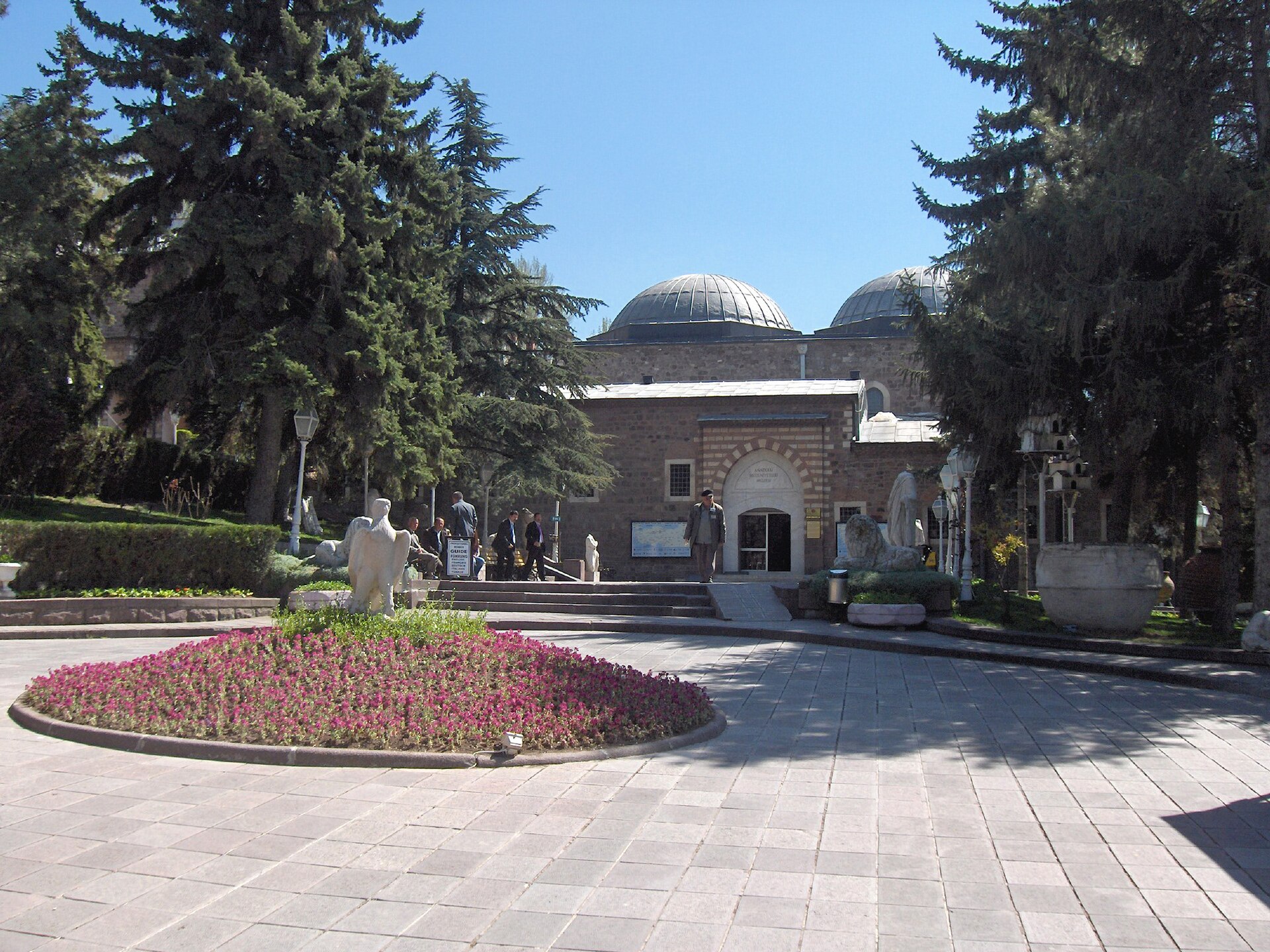
The entrance to the Museum of Anatolian Civilizations, housed in the restored Mahmut Pasa Bedesteni in Ankara
Georges Jansoone (JoJan) · CC BY-SA 3.0Museum of Anatolian Civilizations
Museum · Anadolu Medeniyetleri Muzesi · Founded 1921
Open, admission and hours confirmed 22 August 2026 · 14 sources
On this page 15 sections
ContentsClose
The museum's strength is depth concentrated rather than breadth spread thin: for the Hatti, Hittite and early Phrygian periods in particular, it is not simply an important collection but close to the primary surviving record, because the excavated material from Alacahoyuk, Hattusa, Kultepe and Gordion was brought here rather than dispersed among regional or foreign museums. That concentration is also what makes the single-hall format work as a visit; a reader planning a trip gets, in one room, the closest thing that exists to a complete material history of pre-classical Anatolia.
| Local name | Anadolu Medeniyetleri Muzesi |
|---|---|
| Kind | Museum |
| Founded | 1921 |
| City and country |  Ankara, Turkey Ankara, Turkey |
| Address | Gozcu Sokak No:2, Hisar, 06240 Ulus, Altindag, Ankara, Turkey |
| Website | anadolumedeniyetlerimuzesi.gov.tr |
| Status | Open, confirmed |
| Record last verified |
Visiting
- Hours
- Every day08:30 to 18:45Ticket window closes at 18:45
- Every day (Night Museum)19:00 to 21:00Separate ticket, sold until 20:15
- Admission
- Foreign visitor, adultEUR 12Standard foreign-visitor entry price on the Ministry's own tariff list
- Turkish citizens under 18, with accompanying teachersFreeFree under the Ministry's nationwide free-admission categories
- Turkish citizens 65 and overFreeFree under the Ministry's nationwide free-admission categories
- Foreign visitors under 8FreeFree under the Ministry's nationwide free-admission categories
- Tickets
- muze.gov.tr/muze-detay?SectionId=AMM01&DistId... The museum's own ticket page.
- Do I need to book?
- No advance booking required; tickets are sold at the door or through the Ministry's e-Bilet system
- Address
- Gozcu Sokak No:2, Hisar, 06240 Ulus, Altindag, Ankara, Turkey MapOn foot About 10 minutes' walk from Ataturk Kultur Merkezi in the Ulus district; the museum sits just below Ankara Castle in the old city
- Website
- anadolumedeniyetlerimuzesi.gov.tr
- Telephone
- +90 312 324 3160
- [email protected]
Before you go how long, access, photography, bags, eating, shop
- How long to allow
- Two to three hours to walk the full chronological sequence from the Paleolithic hall to the classical courtyard
- Access
- The main hall occupies a single-storey domed bazaar with a level floor; visitors report the core route is walkable without stairs, though the museum's own site does not publish a formal accessibility statement in the pages fetched for this record
- Photography
- Visitors report photography is permitted in the galleries without flash
- Bags
- Not documented on the pages fetched for this record
- Eating
- A cafe on site is reported by visitors as covered by the MuzeKart pass
- Shop
- A museum shop on site is reported favourably by visitors
Prices and hours change. We take them from the institution's own pages and print the day we read them, and you can check the current position at the source we used. Confirm before you travel.
What is inside
Paleolithic and Neolithic Hall
The earliest material in the museum: stone tools from Karain Cave, and the famous Neolithic finds from Catalhoyuk near Konya, including the baked-clay Seated Woman figurine (a corpulent seated female flanked by two feline-headed armrests, about 17 cm long, excavated by James Mellaart in 1961 and usually read as a mother-goddess or fertility image) and a set of wall-painting fragments from the settlement's houses, among them a bull scene and a hunting scene in red ochre and a mural sometimes read as a view of an erupting volcano and the town below it.
Chalcolithic and Early Bronze Age Hall
Grave goods from the royal tombs at Alacahoyuk, of the Hatti civilization that preceded the Hittites: bronze standards and disc-shaped emblems worked with stags and bulls, gold jewellery, and bronze figurines, including a nursing woman from a grave at Horoztepe.
Assyrian Trade Colonies Hall
The archive from Kanesh (modern Kultepe) near Kayseri: thousands of cuneiform clay tablets left by Assyrian merchant families trading with Anatolia in the early second millennium BC, recording contracts, marriage agreements and complaints, alongside the animal-shaped rhyta and drinking vessels the same merchants imported and used.
Hittite Empire Hall
Material from the Hittite capital Hattusa (Bogazkoy) and other Hittite sites: the limestone relief of a warrior god from the King's Gate at Hattusa, moved to the museum in 1907 and about 2.25 metres tall, a cuneiform letter in Akkadian sent by the Egyptian queen Nefertari to the Hittite queen Puduhepa after the peace with Ramesses II, painted cult vases such as the Inandik and Bitik vases, and bronze standards used in Hittite religious processions.
Phrygian Hall (Gordion)
Furniture and vessels from the royal tumuli at Gordion, associated with King Midas: the inlaid 'Pagoda Table' and a pair of matching serving stands from the great tumulus (Tumulus MM), built of boxwood, juniper and walnut with geometric inlay, plus bronze cauldrons and situlae, one set with siren-shaped attachments, and a small terracotta vase and a toy bronze chariot from the child's grave known as Tumulus P.
Urartian and Classical Hall
Ivory furniture fittings carved as griffins from the Urartian fortress of Altintepe in eastern Anatolia, Urartian bronze belts and votive plates, and, from the Greek, Hellenistic, Roman and Byzantine periods, marble sculpture, jewellery in gold, silver, glass and bronze, and a coin sequence running from the earliest struck money found in Anatolia toward the modern era.
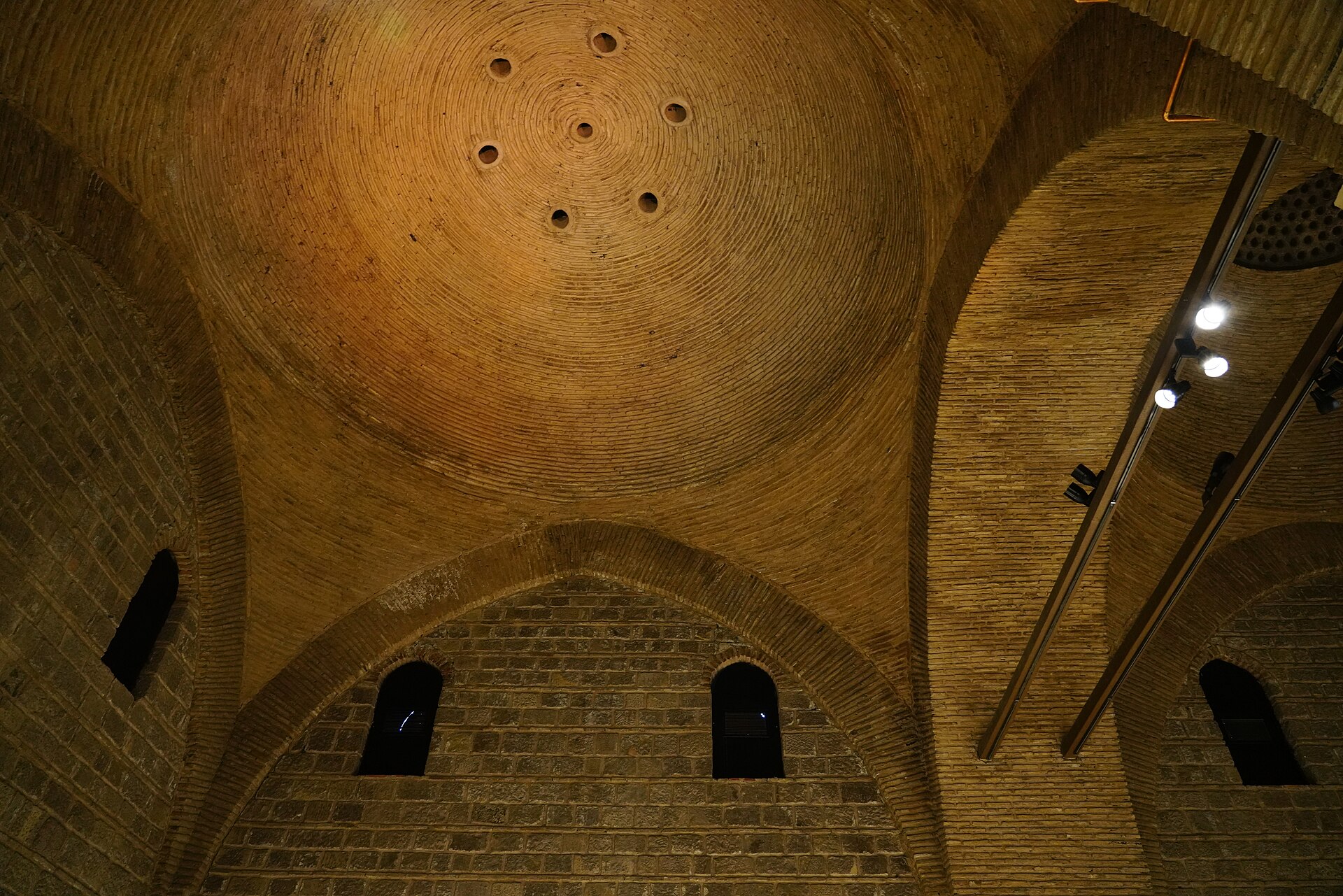
Photograph by Ray Swi-hymn from Sijhih-Taipei, Taiwan · CC BY-SA 2.0 The Bedesten's central domed hall
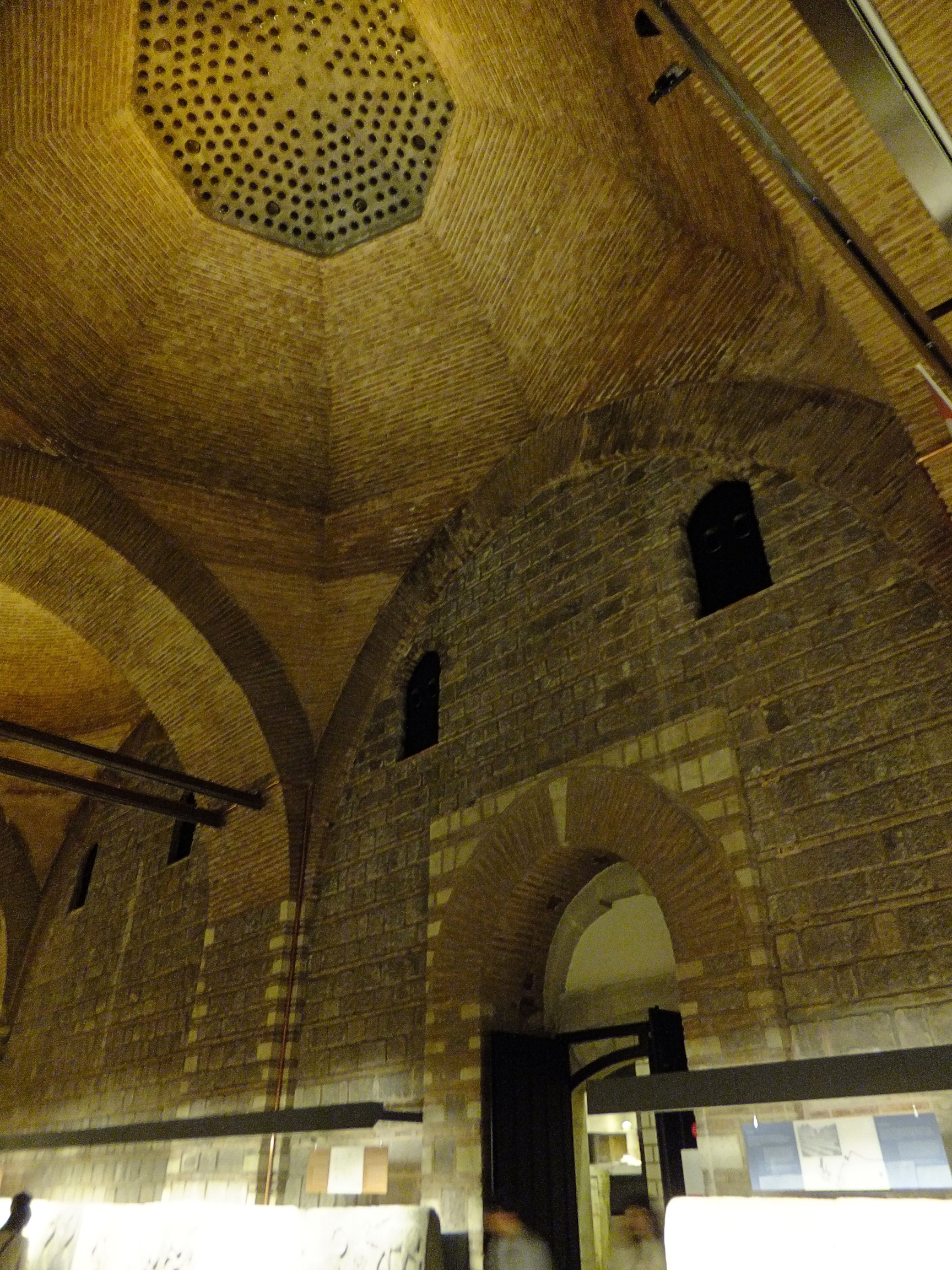
The building itself is part of the display: a single rectangular hall roofed by ten stone domes on square piers, built as a covered bazaar in the 1460s and now the museum's main exhibition space, with the chronological galleries arranged around its perimeter and centre.
What to see first
Seated Woman of Catalhoyuk
Catalhoyuk Neolithic communityA baked-clay figure of a seated woman flanked by two feline-headed armrests, about 8,000 years old, one of the most reproduced images of Anatolian prehistory and the anchor exhibit of the Neolithic hall7
Kultepe cuneiform archive
Old Assyrian merchant colony of KaneshRoughly 20,000 clay tablets recording nearly two centuries of private trade, marriage and litigation, the earliest written documents found on Anatolian soil6
Alacahoyuk bronze sun-standards
Hatti civilization, Early Bronze AgeRoyal-tomb regalia combining a stag or bull with a disc thought to represent the sun, among the most recognisable emblems the museum owns6
Relief of the warrior god from the King's Gate, Hattusa
Hittite Empire, 14th-13th century BCA 2.25-metre limestone relief of a horned deity moved from the Hittite capital's fortifications to the museum in 1907; the figure still standing at the gate today is a modern copy6
Letter of Nefertari to Puduhepa
Hittite royal chancery, 13th century BCAn Akkadian-language diplomatic letter from the Egyptian queen to the Hittite queen following the peace between Ramesses II and Hattusili III, distinct from the treaty tablets themselves, which are held in Istanbul6
The Gordion 'Pagoda Table' and serving stands
Phrygian workshop, 8th century BCInlaid wooden furniture from the great tumulus at Gordion associated with King Midas, built of boxwood, juniper and walnut and reassembled from a tomb chamber that had collapsed onto it9
Urartian ivory griffin fittings from Altintepe
Urartian kingdom, 8th-7th century BCCarved furniture inlays from an eastern Anatolian fortress, representing a civilization whose material culture is comparatively little known outside specialist collections6
Two Ottoman buildings and the idea of a Hittite museum
The Museum of Anatolian Civilizations occupies two structures built for entirely different purposes in the fifteenth century, on the slope below Ankara Castle in the old Ulus district. The Mahmut Pasa Bedesteni is a covered bazaar built between about 1464 and 1471 under a vizier of Mehmed II, a single rectangular hall roofed by ten stone domes with more than a hundred shops originally arranged around it, where Ankara's famous mohair cloth was once traded. Next to it stands the Kursunlu Han, a caravanserai of the same period built around an open courtyard with two storeys of rooms for merchants and their goods. Both buildings were abandoned after a fire in 1881 and stood empty for decades.
The museum's own history begins earlier and elsewhere, with a small collection assembled from 1921 in the Akkale tower of Ankara Castle itself. As that space filled up, the idea took hold of turning it into a proper Hittite museum, a project associated with the early Turkish Republic's interest in presenting Anatolia's pre-classical past as part of the new state's identity. In 1938 the Directorate of Culture proposed restoring the derelict Bedesteni and Han for the purpose, and repair work began that year.
From ruin to museum, 1938 to 1968
The restoration was slow and took place in stages. The domed central hall of the Bedesteni was finished first, and curator Hans Gustav Guterbock arranged the first chronological displays there in 1940; the hall opened to visitors in 1943 while work continued around it. Repairs to the rest of the two buildings went on for another two and a half decades, with a 1946 restoration of the Kursunlu Han turning up coins from the reign of the fifteenth-century sultan Murad II inside its fabric. The whole project was declared complete in 1968, by which date the museum had already been operating out of the finished sections for years. Today the Bedesteni is the exhibition hall and the Han serves as the institution's offices, library, conservation laboratories and conference space, so a visitor sees only one of the two buildings from the inside, with the other visible from the shared courtyard.
The museum's reputation grew alongside its collection: in April 1997 it was named European Museum of the Year, the first Turkish museum to receive the award, and it remains one of the most visited state museums outside Istanbul.
A single hall, arranged like a timeline
What makes the museum unusually easy to visit is that its entire display sits inside one domed room, arranged so that walking around the perimeter and then the centre takes a visitor in order through the Paleolithic, Neolithic, Chalcolithic, Early Bronze Age, the Assyrian trading colonies, the Hittite Empire, the post-Hittite Iron Age kingdoms of Phrygia and Urartu, and finally the Lydian, Greek, Hellenistic, Roman and Byzantine periods, before a courtyard lapidarium of larger stone pieces closes the circuit outside. Few archaeological museums anywhere compress so long a span into so legible a walk, and several of the individual sections below (Kultepe, Alacahoyuk, Hattusa, Gordion) are themselves the primary museum record for entire archaeological cultures, because so much of what survives from those sites was brought here rather than left in regional collections.
Objects that carry the museum's reputation
A handful of pieces recur in almost every account of the museum. The Neolithic Seated Woman from Catalhoyuk, a corpulent seated female figure resting her arms on two feline heads, is the collection's most reproduced image and the one most visitors ask for by description if not by name. The Kultepe archive of Assyrian trading tablets is, on its own, one of the largest bodies of private commercial writing to survive from the ancient world, predating by centuries the Hittite state that would later rule the same region. The Alacahoyuk sun-standards, bronze regalia from Hatti-period royal graves combining a stag or bull with a solar disc, have become something close to a national emblem, reproduced on coins, monuments and tourism material well beyond the museum itself. From the Hittite capital comes the warrior-god relief taken from the King's Gate at Hattusa in 1907, a limestone figure over two metres tall that visitors to the site today see only as a modern copy, the original having stood in Ankara for more than a century. A smaller but historically pointed piece is a cuneiform letter from the Egyptian queen Nefertari to the Hittite queen Puduhepa, written after the peace that followed the battle of Kadesh; it is a different object from the treaty tablets themselves, which are held across the country in Istanbul, and the two are worth telling apart. Furniture recovered from the royal tumuli at Gordion, associated with King Midas, rounds out the picture with a domestic register: an inlaid banqueting table and matching stands, built of boxwood, juniper and walnut, that were reassembled after the wooden tomb chamber holding them had collapsed under its earth mound.
Visiting today
The museum opens every day from 8:30 in the morning to 6:45 in the evening, with a separate Night Museum session from 7 to 9 in the evening on a second ticket. There are no weekly closing days on the Ministry's own listing. Foreign visitors currently pay 12 euros at the door on the Ministry's own tariff; Turkish citizens under 18 or over 65, foreign children under 8, and several other categories set out in the Ministry's nationwide visiting regulation enter free, and Turkish MuzeKart holders can use their pass here as at other state museums. Visitors report photography without flash is permitted throughout the galleries, and that the MuzeKart also covers use of an on-site cafe; a museum shop is mentioned favourably as well. Because the whole collection sits in one hall, the museum is unusually well suited to a focused two to three hour visit rather than a full day, and several visitors note it pairs naturally with a walk up to Ankara Castle immediately above it.
What visitors and critics say
Aggregate opinion is strongly positive: at last count the museum held a 4.7 out of 5 rating from more than two thousand reviews on Tripadvisor, placing it among the highest-rated attractions in Ankara. The praise is consistent in its particulars rather than generic: reviewers single out the chronological arrangement, the density of genuinely important objects for a museum of modest physical size, and English-language labelling that lets a visitor work through the galleries unassisted. The most frequently repeated criticism is the cost of entry for foreign visitors, which a number of reviewers describe as high by comparison with other Turkish museums, though the same reviewers typically go on to say the collection justified the price. A smaller number of visitors comment that context for cultures that traded with but were not centred in Anatolia, Mesopotamia and the Assyrian trading system in particular, is thinner than the depth given to the Hittite and Phrygian material, though the Assyrian trading-colony tablets themselves are extensively displayed.
Repatriation and what the collection still lacks
The museum has been a repeated destination for artifacts recovered from abroad as Turkey has pursued the return of pieces removed from its territory in the twentieth century, including Bronze Age, Urartian and Roman objects returned from Switzerland and displayed after conservation. That current, both the outward record of loss and the more recent record of return, is not the subject of a single gallery or wall text that this research could confirm from the pages fetched for this record; it surfaces instead in the museum's temporary exhibitions and in Ministry press material rather than in the permanent chronological display. Two smaller gaps are worth naming plainly. First, the museum's own web presence, reached at anadolumedeniyetlerimuzesi.gov.tr, returned a certificate mismatch during this research and could not be read directly, so contact and history details here are drawn from the Ministry's central museum portal and its Directorate General instead; a reader relying on the museum's own domain in a browser may see a security warning that has nothing to do with whether the museum is open. Second, an official Ministry tariff notice logged during this research recorded that the museum's entrance section and its Paleolithic-Age gallery were closed for a few weeks in the summer of 2026 for conservation work, a closure that had already ended before this record was written; it is mentioned here because a museum whose single hall is its entire display is more exposed than most to a partial closure disrupting the visit a reader plans.
What visitors say
Visitors consistently describe the museum as one of the best-organised archaeology museums they have seen, praising the clear chronological path through the two Ottoman buildings, the volume and quality of what is on show, and the English-language labelling. The most repeated complaint is the entrance fee for foreign visitors, which some reviewers call steep next to Turkish museum pricing generally, though most who raise it also say the collection justifies it. A minority of visitors note that some non-Hittite or non-Anatolian context (one review specifically mentions Mesopotamian and Sumerian background) is thin given how central Anatolia's trade links were to those cultures.
What is praised, what is criticised
- Praised: The chronological layout, walking visitors from the Stone Age through to the classical period in one continuous route
- Praised: The density and quality of the objects on display relative to the size of the museum
- Praised: English-language labelling throughout, making the collection legible without a guide
- Criticised: The entrance fee for foreign visitors is described by some reviewers as high, even though most add that they thought it worth paying
Ratings on other platforms
Tripadvisor: 4.7 from 2,068 ratings, read 22 August 2026
A platform average is a tertiary source: it moves, it is not audited, and we quote no visitor's words.
Questions about Museum of Anatolian Civilizations
Where is Museum of Anatolian Civilizations?
Gozcu Sokak No:2, Hisar, 06240 Ulus, Altindag, Ankara, Turkey.
How much does it cost to visit?
Foreign visitor, adult: EUR 12; Turkish citizens under 18, with accompanying teachers: free; Turkish citizens 65 and over: free; Foreign visitors under 8: free. As confirmed 22 August 2026.
When is it open?
Every day 08:30-18:45; Every day (Night Museum) 19:00-21:00. As confirmed 22 August 2026.
How do you get there?
On foot: About 10 minutes' walk from Ataturk Kultur Merkezi in the Ulus district; the museum sits just below Ankara Castle in the old city.
What should you see first?
Seated Woman of Catalhoyuk (Catalhoyuk Neolithic community); Kultepe cuneiform archive (Old Assyrian merchant colony of Kanesh); Alacahoyuk bronze sun-standards (Hatti civilization, Early Bronze Age); Relief of the warrior god from the King's Gate, Hattusa (Hittite Empire, 14th-13th century BC); Letter of Nefertari to Puduhepa (Hittite royal chancery, 13th century BC); The Gordion 'Pagoda Table' and serving stands (Phrygian workshop, 8th century BC).
What we could not confirm
- The museum's own domain, anadolumedeniyetlerimuzesi.gov.tr, presented a TLS certificate registered to the Ministry's ktb.gov.tr domain rather than its own name during this research, so it could not be fetched directly; all contact and history details sourced to 'the museum's own site' in this record in fact come from the Ministry's muze.gov.tr and kvmgm.ktb.gov.tr portals, which the museum itself uses as its primary online presence
- No Turkish-Lira walk-in adult price for Turkish citizens without a MuzeKart was found on the pages fetched for this record; only the euro-denominated foreign-visitor price and the free-admission categories are sourced here
- The museum's role in Turkey's ongoing repatriation of artifacts recovered from abroad is documented in Ministry and press material but was not confirmed in a permanent-gallery wall text or catalogue fetched for this record
Images
Sources
- 1T.C. Kultur ve Turizm Bakanligi, muze.gov.tr, museum detail page for Anadolu Medeniyetleri Muzesi muze.gov.tr/muze-detay?SectionId=AMM01&DistId=AMM
- 2T.C. Kultur ve Turizm Bakanligi Doner Sermaye Isletmesi (DOSIM), museum and site entrance fee tariff dosim.ktb.gov.tr/TR-218202/muze-ve-oren-yeri-ucretleri.html
- 3T.C. Kultur ve Turizm Bakanligi, Kultur Varliklari ve Muzeler Genel Mudurlugu, Ankara Anadolu Medeniyetleri Muze Mudurlugu page kvmgm.ktb.gov.tr/TR-44060/ankara-anadolu-medeniyetleri-muze-mudurlugu.html
- 4T.C. Kultur ve Turizm Bakanligi (Isparta provincial directorate mirror), free-visit conditions for museums and archaeological sites isparta.ktb.gov.tr/TR-259029/muze-ve-orenyerlerine-ucretsiz-ziyaret-kosullari.html
- 5Wikidata, Q754322, Museum of Anatolian Civilizations wikidata.org/wiki/Q754322
- 6Wikipedia, Museum of Anatolian Civilizations en.wikipedia.org/wiki/Museum_of_Anatolian_Civilizations
- 7Wikipedia, Seated Woman of Catalhoyuk en.wikipedia.org/wiki/Seated_Woman_of_%C3%87atalh%C3%B6y%C3%BCk
- 8Turkish Archaeological News, Finds from Catalhoyuk in the Museum of Anatolian Civilizations in Ankara turkisharchaeonews.net/article/finds-%C3%A7atalh%C3%B6y%C3%BCk-museum-anatolian-civilizations-ankara
- 9Turkish Archaeological News, Finds from Gordion in the Museum of Anatolian Civilizations in Ankara turkisharchaeonews.net/article/finds-gordion-museum-anatolian-civilizations-ankara
- 10Tripadvisor, Anadolu Medeniyetleri Muzesi, Ankara (attraction page and visitor reviews) tripadvisor.com/Attraction_Review-g298656-d294556-Reviews-Anadolu_Medeniyetleri_Muzesi-Ankara.html
- 11Wikimedia Commons, File:Museum of Anatolian Civilizations001.jpg, licence and author metadata commons.wikimedia.org/wiki/File:Museum_of_Anatolian_Civilizations001.jpg
- 12Wikimedia Commons, File:Ankara bedesten and museum DSCF7046.jpg, licence and author metadata commons.wikimedia.org/wiki/File:Ankara_bedesten_and_museum_DSCF7046.jpg
- 13Wikimedia Commons, File:Museo de las Civilizaciones Anatolicas. Interior.jpg, licence and author metadata commons.wikimedia.org/wiki/File:Museo_de_las_Civilizaciones_Anat%C3%B3licas._Interior.jpg
- 14Wikimedia Commons, File:20180108 Anatolian 2728 (25956377918).jpg, licence and author metadata commons.wikimedia.org/wiki/File:20180108_Anatolian_2728_(25956377918).jpg


.jpg)