Museum of African Art
Museum · Muzej africke umetnosti · Founded 1977
Open, admission and hours confirmed 15 September 2026 · 27 sources
On this page 15 sections
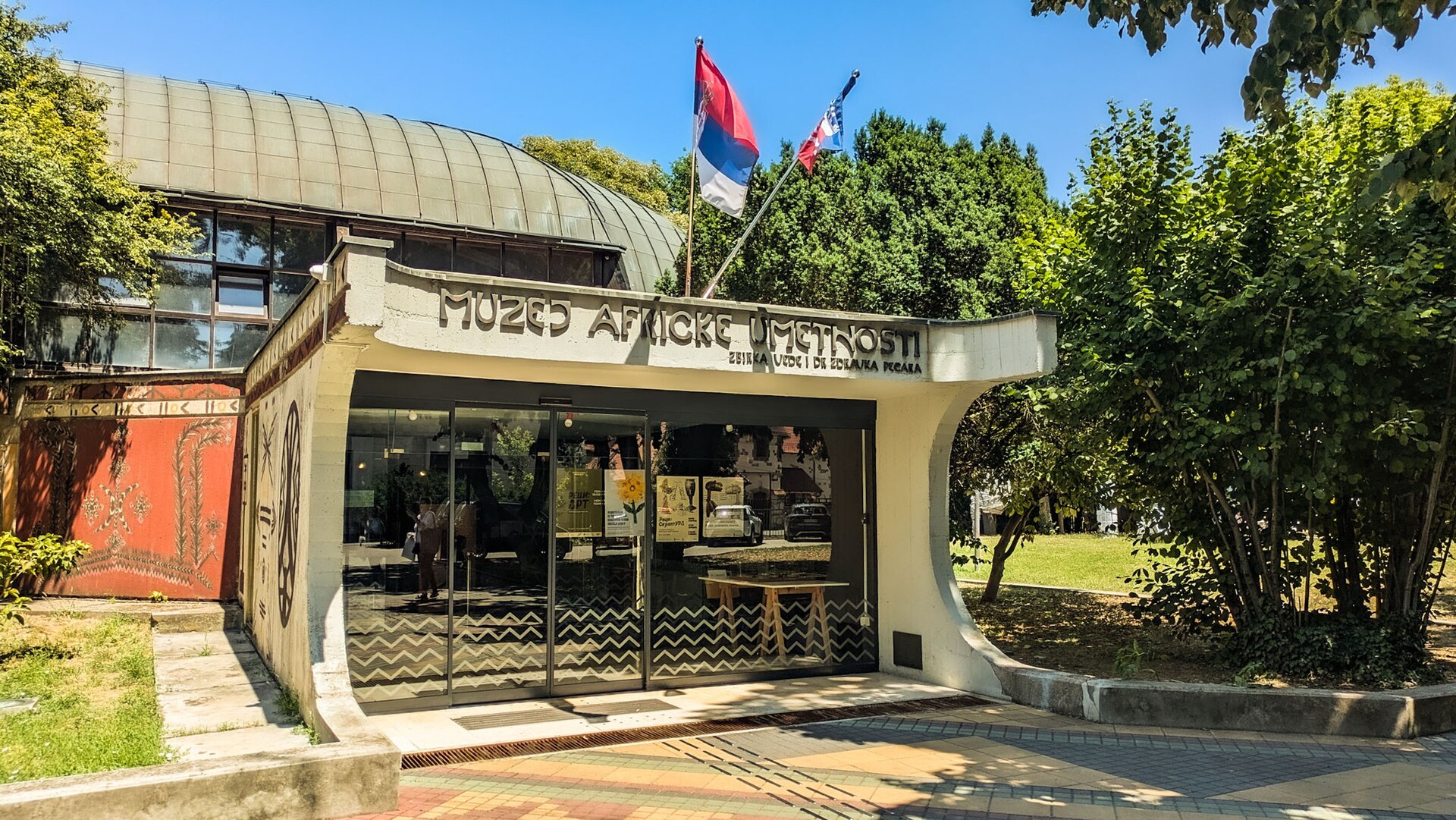
The museum's depth is in West African material culture tied to specific named peoples rather than a broad survey of the continent: Bambara and Bamana ritual and hunting objects and Dogon everyday ware from Mali, Ashanti goldweights and kente cloth from Ghana, Baga and Guere and Dan work from Guinea and the Cote d'Ivoire and Liberia border region, and Bamileke work from Cameroon, gathered first-hand by the founders during their own postings rather than assembled later from the market. Bronze and brass regalia extends the collection east toward the historical casting traditions of the Nigerian region. Temporary exhibitions and recent field acquisitions, including the 2024 Tanzania fieldwork behind the current Recy: Art show, are pushing the collection's working range toward contemporary African material culture rather than only historical pieces.
| Local name | Muzej africke umetnosti |
|---|---|
| Kind | Museum |
| Founded | 1977 |
| City and country |  Belgrade, Serbia Belgrade, Serbia |
| Address | Andre Nikolica 14, 11000 Belgrade, Serbia |
| Website | mau.rs |
| Status | Open, confirmed 15 September 2026 |
| Record last verified | 15 September 2026 |
Visiting
- Hours
- Every day10:00 to 18:00
- Admission
- IndividualRSD 300
- Group, 10 or more persons, per personRSD 200
- Senior Card, ISIC, ITIC or EYCA cardholderRSD 15050 percent discount on the individual price; a lower percentage discount applies to group bookings
- Preschool children, persons with disabilities, fine arts students, ICOM/AICA/IAA members, accredited mediaFreefree entry
- Do I need to book?
- Not for general admission. Specialised guided tours of the permanent display or the current temporary exhibition must be booked with the curators at least two days in advance, by phone (9am to 4pm daily) or by email
- Address
- Andre Nikolica 14, 11000 Belgrade, Serbia MapBus Routes 34 and 44 serve the Senjak neighbourhood stop nearest the museum
- Website
- mau.rs
- Telephone
- +381 11 2651 654
- [email protected]
Before you go how long, access, photography, bags, eating, shop
- How long to allow
- The single-level permanent display can be walked in well under an hour; visitors who take the audio guide, a booked tour, or the current temporary exhibition stay longer
- Access
- Access ramps for wheelchairs, a guided path for visually impaired visitors, and tactile objects with audio description and Braille signage
- Shop
- A small museum shop; visitor reviews describe it as limited in stock, with no food sold on site
Prices and hours change. We take them from the institution's own pages and print the day we read them, and you can check the current position at the source we used. Confirm before you travel.
What is inside
Masks
Masks used across West and Central African societies for ritual, judicial, protective and educational purposes, including examples tied to Dan and Gere justice and initiation practice. The museum's own text frames differences in mask style as evidence of differing world views and myths between communities rather than a single African style.
Sculpture in wood
Carved ancestor and ritual figures from farming peoples of West Africa, including figures used in ancestor veneration that the museum says received daily food and drink offerings, alongside magical and divinity figures tied to specific cults.
Bronze sculpture and royal regalia
Lost-wax cast bronze and brass work in the West African royal tradition, including commemorative busts and heads for royal ancestral altars, cast-brass bells that marked rank, bronze masks, rattle-staffs and animal figures such as roosters and mudfish. The museum traces the technique's origin to 9th-century Igbo-Ukwu in present-day Nigeria, with production peaking in West African kingdoms between the 14th and 19th centuries.
Akan goldweights
Brass weights cast by Akan goldsmiths in Ghana for weighing gold dust, in both geometric forms (cubes, cylinders, pyramids) and figurative forms modelled on people, animals, plants and everyday tools; some were cast directly from a seed or insect rather than modelled in wax. Several figurative weights encode proverbs, one showing two men helping each other climb a tree.
Musical instruments
String, percussion and wind instruments including the kora, an African harp historically played by griottes who preserved oral history through music, and the balafon, a wooden-keyed idiophone with gourd resonators, alongside talking drums, rattles, sanzas, whistles and horns.
Textiles
Woven and dyed cloth from West African weaving traditions, produced on narrow horizontal looms as strips as narrow as three centimetres and later joined, decorated by dyeing, painting, stamping, applique and embroidery. The museum notes that among the Dogon the word for woven cloth translates as the spoken word, reflecting the material's role carrying social meaning beyond decoration.
What to see first
Hunter's suit
Bambara people, MaliA hunter's costume hung with amulets and charms; the museum's own text on the piece describes hunters as figures of exceptional standing in Bambara and neighbouring West African societies.10
Elephant mask
Bamileke people, CameroonA cloth and beadwork mask measuring 65 by 122 cm, described by the museum as one of the most valuable objects in its collection and characteristic of Bamileke decorative and symbolic practice.10
Nimba
Baga people, GuineaA 77 cm wood mask figure the museum calls one of its most attractive and intriguing objects, and among the first pieces the founders acquired for the collection.10
Kente cloth
Ashanti people, GhanaA strip-woven cotton and silk cloth measuring 215 by 340 cm, worn as a man's toga and presented by the museum as representative of the peak of Ashanti weaving craftsmanship.10
Ji-Wara
Bamana people, MaliA 100 cm wood mask the museum presents as a representative example of mask carving from western and central Africa.10
Ceremonial rice ladle
Dan and Gere peoples, Cote d'Ivoire and LiberiaA carved wooden ladle with a human-form handle, used in the everyday-objects display to show how ceremonial rice-serving implements blurred the line the museum draws elsewhere between ritual and utilitarian object.14
A diplomat's collection becomes a museum
The Museum of African Art occupies a low, round-windowed building in Belgrade's Senjak district, among the same residential streets as the city's embassy row, and its origin is unusually personal for a national collecting institution. The core of the collection was not bought at auction or inherited from a colonial-era ethnographic cabinet. It came from the private travels of two people: Zdravko Pecar, a Yugoslav journalist and later diplomat who served as ambassador to Ghana and Mali, and his wife Veda Zagorac. Pecar had reported from Algeria during its war of independence, at one point crossing the Morice Line, the fortified frontier the French army built between Algeria and Tunisia, to cover the war from the side of the National Liberation Front. The couple spent roughly two decades moving through West Africa on diplomatic postings, and in that time assembled several thousand pieces of what the museum now describes as authentic traditional art from West, Central and East Africa.
Pecar and Zagorac donated the bulk of what they had collected to the Belgrade City Assembly in 1974, keeping a smaller number of pieces in family hands that remain available for study at the museum today. The city opened the collection to the public in 1977 as the Museum of African Art, the Veda and Dr Zdravko Pecar Collection, and it remains the only museum in Serbia, and one of very few anywhere in southeastern Europe, dedicated entirely to African art.
A brutalist building in the embassy quarter
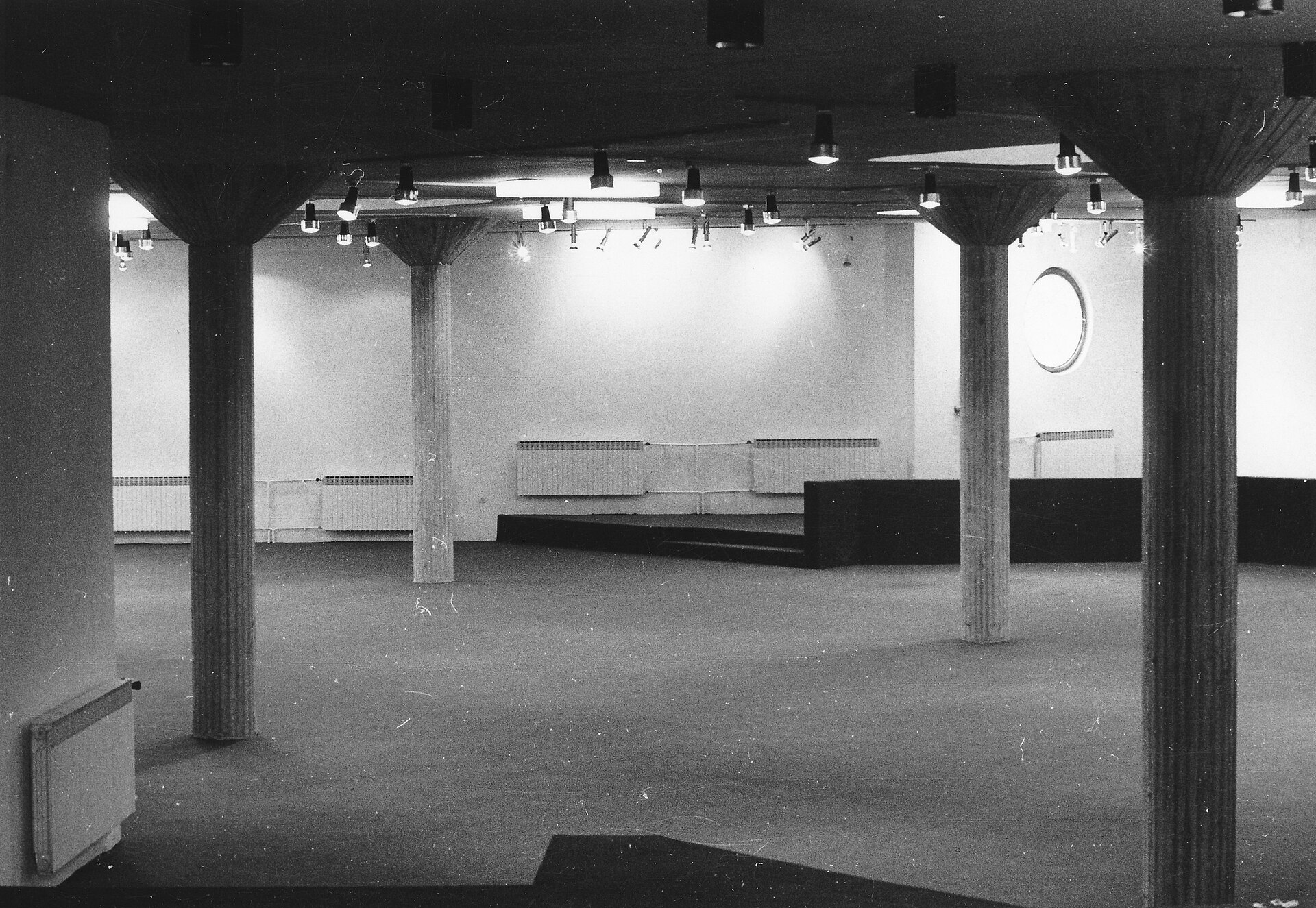
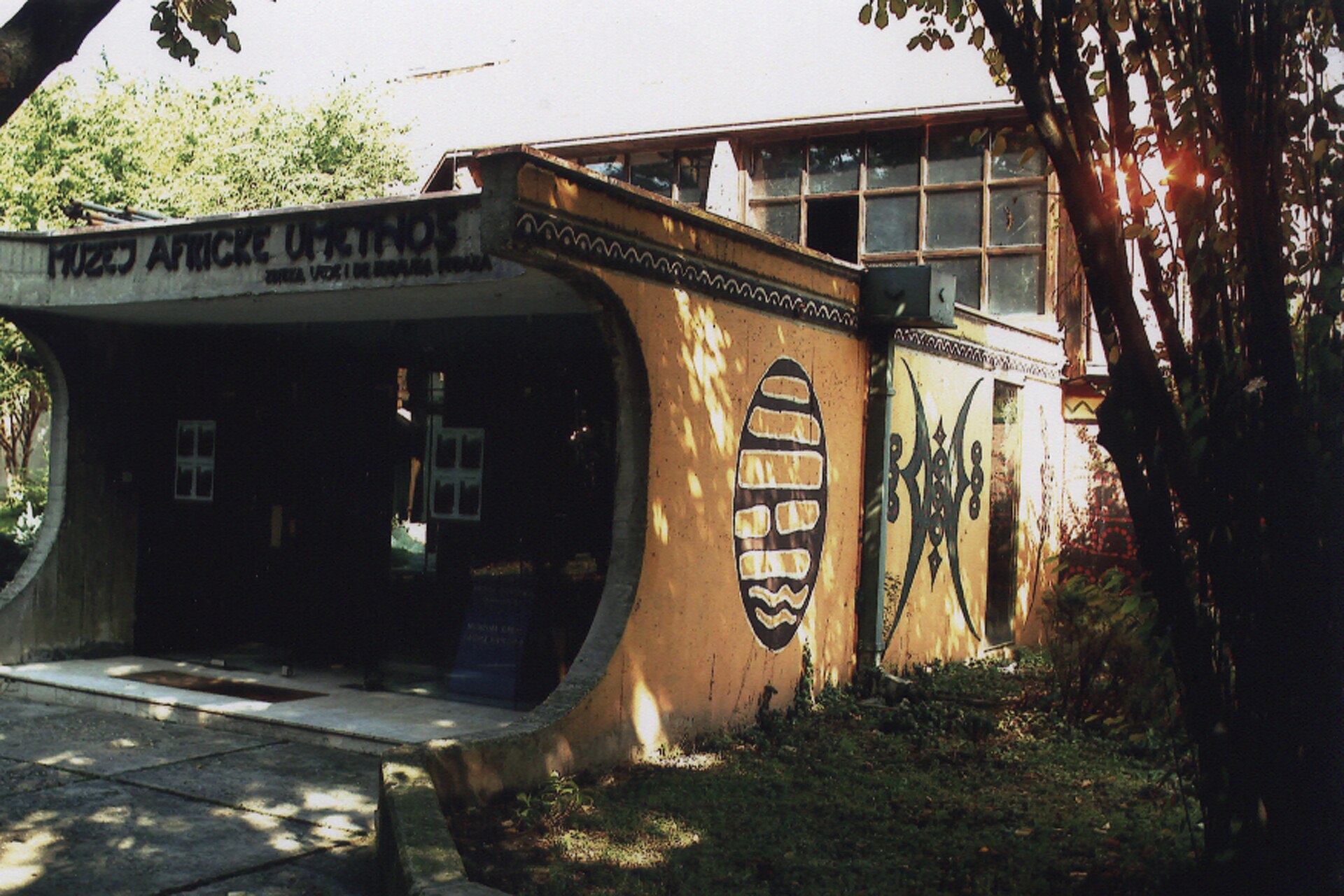
The building is a piece of 1970s Yugoslav design, a low concrete structure with a curved, ribbed roofline and small round windows that recur inside as porthole-like openings in the gallery walls. It sits in a garden setting rather than on a monumental civic square, folded into the same quiet, tree-lined streets that house many of Belgrade's foreign embassies, a location several visitors single out as worth the trip on its own before a single object is seen. A photograph of the building's interior taken before the permanent display was installed shows the same round windows and a run of tapered, fluted concrete columns down an otherwise empty hall, evidence that the architecture was built around the display design rather than fitted out afterward.
What is actually on display
The permanent display is organised less by country than by object type, following the categories the museum uses on its own site: masks, sculpture in wood, bronze sculpture, Akan goldweights, ceramics, musical instruments, textiles, jewelry and objects of everyday use. The geographic centre of gravity is West Africa, above all Mali, Ghana, Guinea, Cote d'Ivoire and Cameroon, with named holdings from the Bambara, Bamileke, Baga, Ashanti, Bamana, Dan and Gere peoples among others. Temporary exhibitions range further, into the arts of Ethiopia, the Maghreb and central and southern Africa. Wikipedia's count, current to 2006, put permanent holdings at roughly 1,700 pieces; the museum's current language describes several thousand objects once study pieces and loans are included.
Among the objects longest associated with the museum are a Bambara hunter's suit hung with amulets from Mali, a cloth and beadwork elephant mask made by Bamileke carvers in Cameroon, and a Baga wood mask known as Nimba, one of the first pieces the founders acquired and, by the museum's own account, one of the most striking single objects on display. A Ghanaian Ashanti kente cloth, a wide length of hand-woven cotton and silk built up from many narrow strips, is shown as an example of how far dress textiles were pushed as a craft.
An anti-colonial claim, and the argument scholars have with it
The museum has described itself since 1977 as the only anti-colonial museum of African art in Europe, a claim tied directly to Yugoslavia's role as a founding state of the Non-Aligned Movement. The argument runs that because the objects arrived as gifts and purchases made in friendship rather than as loot taken under colonial administration, the collection sits outside the history that shaped most European Africana museums. Belgrade's own museum professionals were not fully convinced even at the time; the founding of the museum was viewed in parts of the local heritage community as an overtly political project pursued at the expense of collections more directly tied to Serbian or Yugoslav national culture.
The art historian Ana Sladojevic has examined the anti-colonial claim in detail, in a 2012 article in the journal Kultura and again in a 2023 piece for EuropeNow, and her reading is more complicated than the museum's own framing. She argues that the act of collecting African objects for display in a European museum carries a colonial structure regardless of how the objects were obtained, and she points to a specific, checkable failure: museum labels that for years identified African makers only as the work of an unknown African, crediting no one, while the names of the Yugoslav collectors who acquired the pieces were preserved and celebrated. In her account this let the museum lean on Western art market expertise and Western curatorial authority even as it rejected the colonial plunder that filled other European collections, so that what she calls the coloniality of knowledge survived the anti-colonial rhetoric intact. She does not conclude the museum should discard its founding story, but argues it should treat the anti-colonial narrative as a piece of cultural memory to be examined through current curatorial and artistic work rather than repeated as settled fact.
From a city museum to a national one
In late December 2022, just before the museum's fiftieth anniversary, the Belgrade City Assembly transferred founding rights over the Museum of African Art to the Republic of Serbia, at the proposal of the national Ministry of Culture. The Serbian outlet Vreme reported that the change went largely unnoticed by the public, since the assembly's own website carried the news only after the decision had already been adopted. Museum director Marija Aleksic told Vreme the initiative came from the ministry, crediting the museum's cultural and political cooperation with African states, and said she expected the change to help the museum's work without wanting to say more before it took effect. The same report noted a building reconstruction project already under way at the time, with the design finished and a building permit expected around the New Year; no source consulted for this record confirms whether that renovation was completed, and the point is carried here as unresolved rather than assumed either way.
The museum today
The museum functions today as an active exhibition and events venue rather than a fixed permanent-collection stop. Its current temporary show, Recy: Art, running through the end of September 2026 under curator Ivana Vojt, examines waste as a material in African art and design, presenting more than a hundred new acquisitions gathered during 2024 fieldwork in Tanzania alongside pieces from Eswatini, Kenya and Ghana, and a sculpture installed at the museum entrance built from recycled material. Beyond its exhibitions the museum runs the Afro Festival, AFRAM and Coloured World public events, lecture and film programmes, an audio guide and a virtual tour, publishes exhibition catalogues and monographs and produces the journal Afrika: Studies in Art and Culture. Its courtyard, as much as its galleries, is where much of this public programming happens, hosting concerts, workshops and activities for children and seniors through the year.
What visitors find
Visitor commentary on the museum is consistent in its shape even when it disagrees on the verdict. A frequent theme, from casual tourists and more engaged visitors alike, is that the museum rewards a detour into a part of Belgrade nobody visits by accident; the embassy-district setting and the garden around the building come up almost as often as the collection itself. Admission has stayed cheap for years, and reviewers repeatedly flag the price as good value regardless of what else they thought of the visit. The recurring complaint runs the other way: object labels and wall text are thin, the display occupies a single small hall that most people clear in well under an hour, and the shop and grounds beyond the garden offer little to extend the visit. One 2015 review titled itself plainly Hardly worth a visit, faulting the sparse explanations and the lack of anything to buy or eat on site; a review filed the same year, after the museum hosted a diplomatic Africa Day reception, called itself Well Worth a Visit and found the display, thin captions aside, more interesting than the reviewer expected from an out-of-the-way museum.
What visitors say
Visitor commentary is consistent in shape even when it disagrees on the verdict. Reviewers across nationalities single out the setting, a quiet garden building tucked into Belgrade's embassy district, as worth the detour on its own, and repeatedly flag admission as cheap for what is offered. The recurring complaint runs the other way: labels and wall text are thin, the permanent display occupies one small hall that most visitors clear in under an hour, and there is little beyond the galleries themselves, no cafe and a limited shop, to extend a visit.
What is praised, what is criticised
- Praised: The embassy-quarter garden setting, called worth a visit on its own by more than one reviewer
- Praised: Low admission price, repeatedly flagged as good value regardless of the visitor's overall verdict
- Praised: The museum's courtyard programme of concerts, workshops and events for children and seniors, praised by a Belgrade reviewer as reason to check the schedule and return
- Criticised: Sparse object labels and explanatory text, noted by both positive and negative reviews
- Criticised: A very small single-hall display that most visitors finish in well under an hour, with little else on site (no food, a minimal shop) to extend the visit
Ratings on other platforms
TripAdvisor: 4.6 from 14 ratings, read 15 September 2026
Google: 4.7 from 1,378 ratings, read 15 September 2026
A platform average is a tertiary source: it moves, it is not audited, and we quote no visitor's words.
Questions about Museum of African Art
Where is Museum of African Art?
Andre Nikolica 14, 11000 Belgrade, Serbia.
How much does it cost to visit Museum of African Art?
Individual: RSD 300; Group, 10 or more persons, per person: RSD 200; Senior Card, ISIC, ITIC or EYCA cardholder: RSD 150; Preschool children, persons with disabilities, fine arts students, ICOM/AICA/IAA members, accredited media: free. As confirmed 15 September 2026.
When is Museum of African Art open?
Every day 10:00-18:00. As confirmed 15 September 2026.
How do you get to Museum of African Art?
Bus: Routes 34 and 44 serve the Senjak neighbourhood stop nearest the museum.
What should you see at Museum of African Art?
Hunter's suit (Bambara people, Mali); Elephant mask (Bamileke people, Cameroon); Nimba (Baga people, Guinea); Kente cloth (Ashanti people, Ghana); Ji-Wara (Bamana people, Mali); Ceremonial rice ladle (Dan and Gere peoples, Cote d'Ivoire and Liberia).
What we could not confirm
- Whether the museum's object labels still identify African makers only as the work of an unknown African, the specific practice Ana Sladojevic documented in 2012 and revisited in 2023, was not confirmed by any source obtained for this record; it may or may not have been corrected in the current permanent display.
- The building reconstruction reported by Vreme in December 2022, with a design finished and a permit expected around the New Year, has no confirmed completion date in any source consulted here; whether the renovation is finished, ongoing or shelved is unresolved.
- No source consulted for this record addresses whether individual objects in the Pecar collection carry export or acquisition paperwork from the 1960s and 1970s, despite the museum's public position that nothing in the collection was acquired through plunder or exploitation.
Images
Sources
- 1Museum of African Art, official site, Serbian home page mau.rs/
- 2Museum of African Art, About Us (English) mau.rs/en/about-us.html
- 3Museum of African Art, Visit Us (English), hours, admission, contact, accessibility mau.rs/en/visit-us.html
- 4Museum of African Art, History (English) mau.rs/en/history.html
- 5Museum of African Art, Masks (English) mau.rs/en/masks.html
- 6Museum of African Art, Sculptures in Wood (English) mau.rs/en/sculptures-in-wood.html
- 7Museum of African Art, Bronze Sculpture (English) mau.rs/en/bronze-sculpture.html
- 8Museum of African Art, Goldweights (English) mau.rs/en/goldweights.html
- 9Museum of African Art, Musical Instruments (English) mau.rs/en/musical-instruments.html
- 10Museum of African Art, Highlights (English) mau.rs/en/highlights.html
- 11Museum of African Art, Textiles (English) mau.rs/en/textiles.html
- 12Museum of African Art, Ceramics (English) mau.rs/en/ceramics.html
- 13Museum of African Art, Jewelry (English) mau.rs/en/jewelry.html
- 14Museum of African Art, Objects of Everyday Use (English) mau.rs/en/objects-of-everyday-use.html
- 15Museum of African Art, Current Exhibition, Recy: Art (English) mau.rs/en/current-exhibition.html
- 16Wikipedia, Museum of African Art, Belgrade en.wikipedia.org/wiki/Museum_of_African_Art,_Belgrade
- 17Wikidata Q2291222, Museum of African Art wikidata.org/wiki/Q2291222
- 18Wikimedia Commons, Category:Museum of African Art (Belgrade) commons.wikimedia.org/wiki/Category:Museum_of_African_Art_(Belgrade)
- 19Wikimedia Commons, File:Museum of African Art, Belgrade.jpg, licence and description commons.wikimedia.org/wiki/File:Museum_of_African_Art,_Belgrade.jpg
- 20Wikimedia Commons, Category:Museum of African Art (Belgrade) building commons.wikimedia.org/wiki/Category:Museum_of_African_Art_(Belgrade)_building
- 21Wikimedia Commons, Category:Collections of the Museum of African Art (Belgrade) commons.wikimedia.org/wiki/Category:Collections_of_the_Museum_of_African_Art_(Belgrade)
- 22Tourism Organisation of Belgrade, The Museum of African Art tob.rs/en/what-to-see/museums-and-arts/the-museum-of-african-art
- 23TripAdvisor, reviews of Museum of African Art, Belgrade (rating breakdown and individual reviews) tripadvisor.com/ShowUserReviews-g294472-d7675944-r328998446-Museum_of_African_Art-Belgrade.html
- 24Ana Sladojevic, An Anticolonial Museum, EuropeNow, 21 February 2023 europenowjournal.org/2023/02/21/an-anticolonial-museum/
- 25Ana Sladojevic, Museum of African Art in Belgrade and its Anti/Colonial Discourse, Kultura no. 134, 2012 casopiskultura.rs/en/publikacije/museum-of-african-art-in-belgrade-and-its-anti-colonial-discourse/
- 26Sonja Ciric, The Museum of African Art changed its founder, Vreme, 27 December 2022 vreme.com/en/vesti/muzej-africke-umetnosti-promenio-osnivaca-prelazak-na-republicki-nivo/
- 27Wanderlog, The Museum of African Art, Belgrade, aggregated ratings wanderlog.com/place/details/22081/the-museum-of-african-art
