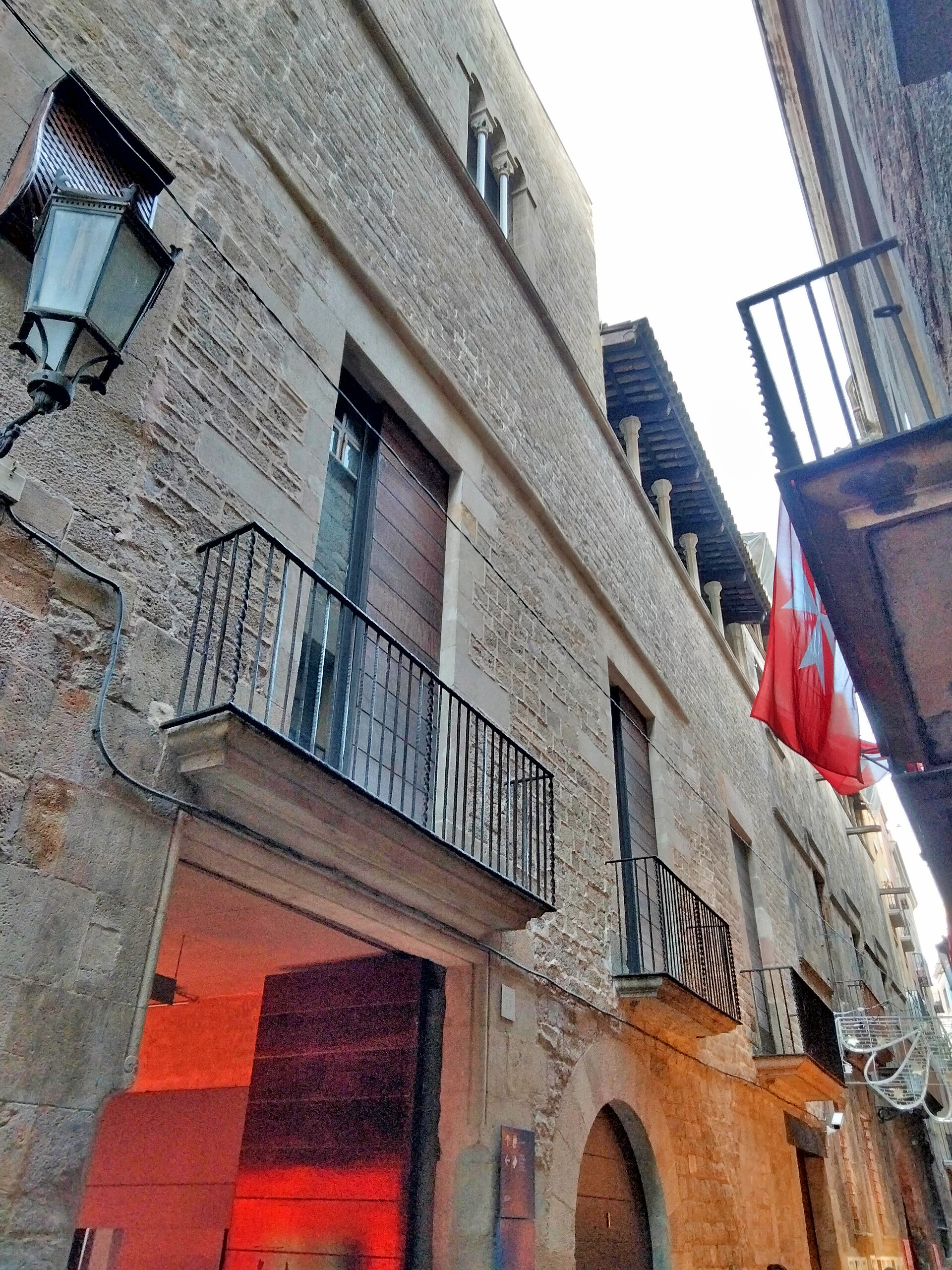
The street facade of Palau Finestres, part of the museum, on Carrer de Montcada in the Born district. A Catalan flag hangs beside the lit entrance.
Enric · CC BY-SA 4.0Museu Picasso de Barcelona
Museum · Founded 1963
Open, admission and hours confirmed 26 August 2026 · 11 sources
On this page 14 sections
ContentsClose
Roughly 5,000 works make this the largest single-artist holding of Picasso's formative years anywhere, built from Jaume Sabartes's own collection outward rather than assembled retrospectively by curators. What it is not is a survey of Picasso's whole career: there is no Cubist landmark, no late self-portrait, no Guernica. What there is instead is a documented education, almost year by year, from a fourteen-year-old copying academic exercises to a fifteen-year-old winning honourable mentions at national exhibitions, plus two later, self-contained bodies of work - the 1917 Barcelona paintings and the complete 1957 Las Meninas series - that Picasso himself chose to keep together and give to this specific city.
| Kind | Museum |
|---|---|
| Founded | 9 March 1963, opened as the Col.leccio Sabartes because Franco's government would not permit a public museum named for Picasso, an open opponent of the regime |
| City and country |  Barcelona, Spain Barcelona, Spain |
| Address | Carrer de Montcada, 15-23, 08003 Barcelona, Spain |
| Website | museupicassobcn.cat |
| Status | Open, confirmed |
| Record last verified |
Visiting
- Hours
- Tuesday, Wednesday, Sunday, 31 March-27 September09:00 to 20:00summer hours
- Thursday, Friday, Saturday, 31 March-27 September09:00 to 21:00summer hours
- Tuesday-Sunday, 29 September-29 March10:00 to 19:00winter hours
- MondayClosed all year, plus 1 January, 1 May, 24 June and 25 December
- 24 and 31 December10:00 to 14:00reduced hours
- Closed
- Every Monday. 1 January, 1 May, 24 June, 25 December. Ticket office closes 30 minutes before the museum.
- Admission
- General, onlineEUR 14Collection plus temporary exhibitions
- General, at the ticket officeEUR 15
- ReducedEUR 7.50Ages 18-25, Barcelona library-card holders, accredited university students, over 65, unemployed with a pink card
- Bicing card holdersEUR 10.5025 percent off the general price
- Under 18Freefree at all times
- Pink Card, ICOM, disability card, teachers, journalists and Apropa Cultura cardholdersFreefree at all times, accreditation required
- "Picasso Cyprus" (temporary exhibition)FreeFree of charge, prior booking required
Free entry: First Sunday of every month, reservation required. 12 February, 17 May (International Museum Day) and 24 September, reservation required. 29 September to 29 March: every Thursday, 4pm to 7pm, reservation required- Tickets
- museupicassobcn.cat/en/plan-your-visit/buy-ti... The museum's own ticket page.
- Do I need to book?
- No for a paid general ticket; yes, with advance reservation, for every free-admission slot
- Address
- Carrer de Montcada, 15-23, 08003 Barcelona, Spain MapMetro Jaume I (L4) and Arc de Triomf (L1), both a short walk through the Born district
Bus Routes 120, 45, V15 and V17 on Via Laietana; 39, 51 and H14 on Passeig Picasso and Pla de Palau
Rail Estacio de Franca and Estacio de Sants both connect; the museum itself has no car park - Website
- museupicassobcn.cat
- Telephone
- +34 93 256 30 00 / +34 93 256 30 22
- [email protected]
Before you go how long, access, photography, bags, eating, shop
- How long to allow
- One to two hours for the permanent collection, by the museum's own listing, though the chronological hang of nearly a decade of Picasso's early work rewards longer
- Access
- The museum's regulations page defers detail to a separate accessibility section of the site; guide dogs are the only animals admitted
- Photography
- Personal photography and video are allowed without flash or tripods; photographing other visitors requires their consent; commercial or professional photography needs advance clearance from the press office
- Bags
- Rucksacks, suitcases, umbrellas and any bag larger than 30 x 30cm are not allowed in the galleries; a free locker service is offered against the entry ticket, for bags up to 56 x 45 x 25cm, subject to availability
- Eating
- Not detailed on the museum's own visitor pages at the date read
- Shop
- Museum shop on site
Prices and hours change. We take them from the institution's own pages and print the day we read them, and you can check the current position at the source we used. Confirm before you travel.
What is inside
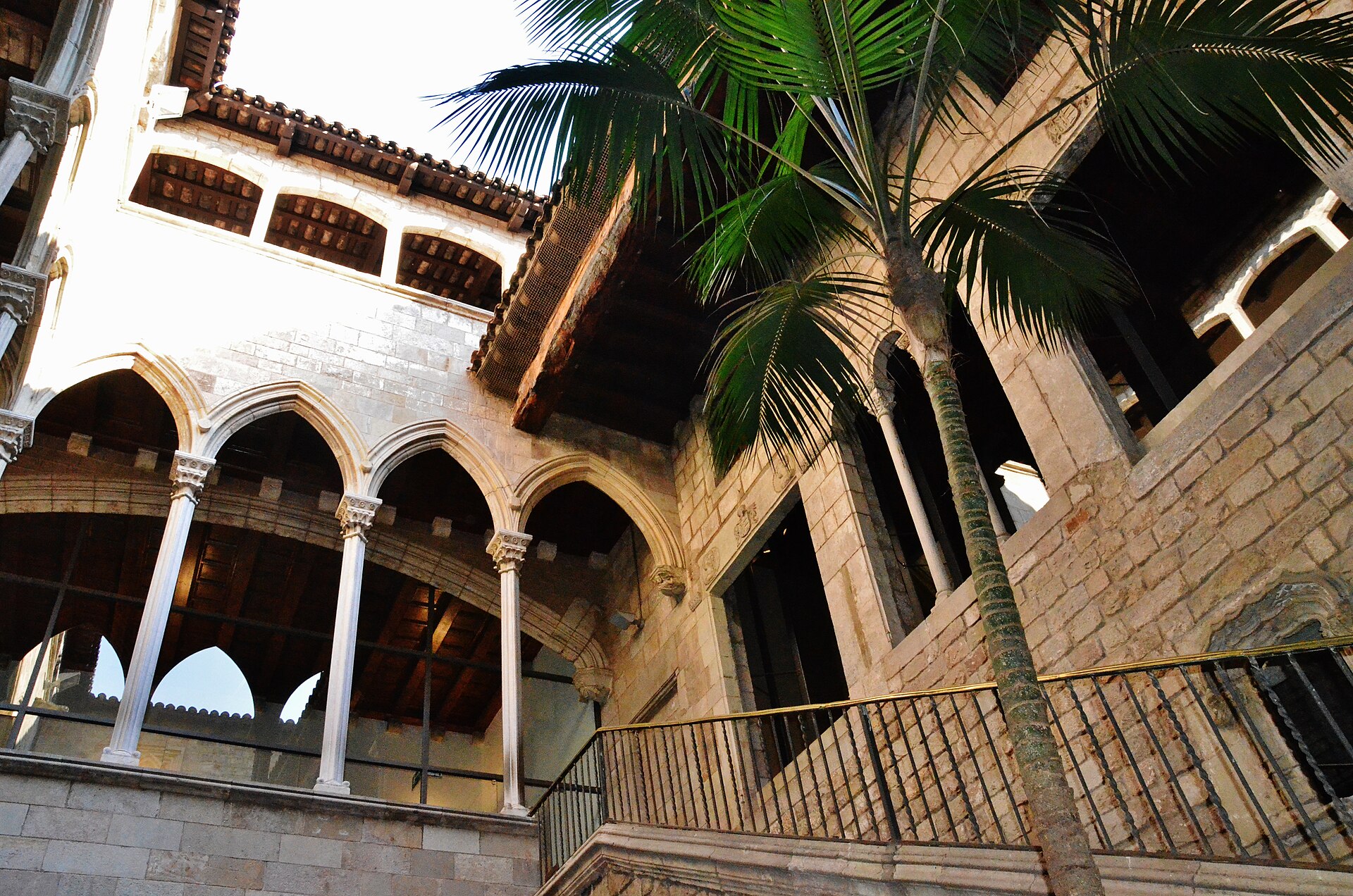
Photograph by MARIA ROSA FERRE ✿ from Vilafranca del penedes, Catalunya · CC BY-SA 2.0 Palau Aguilar (1963)
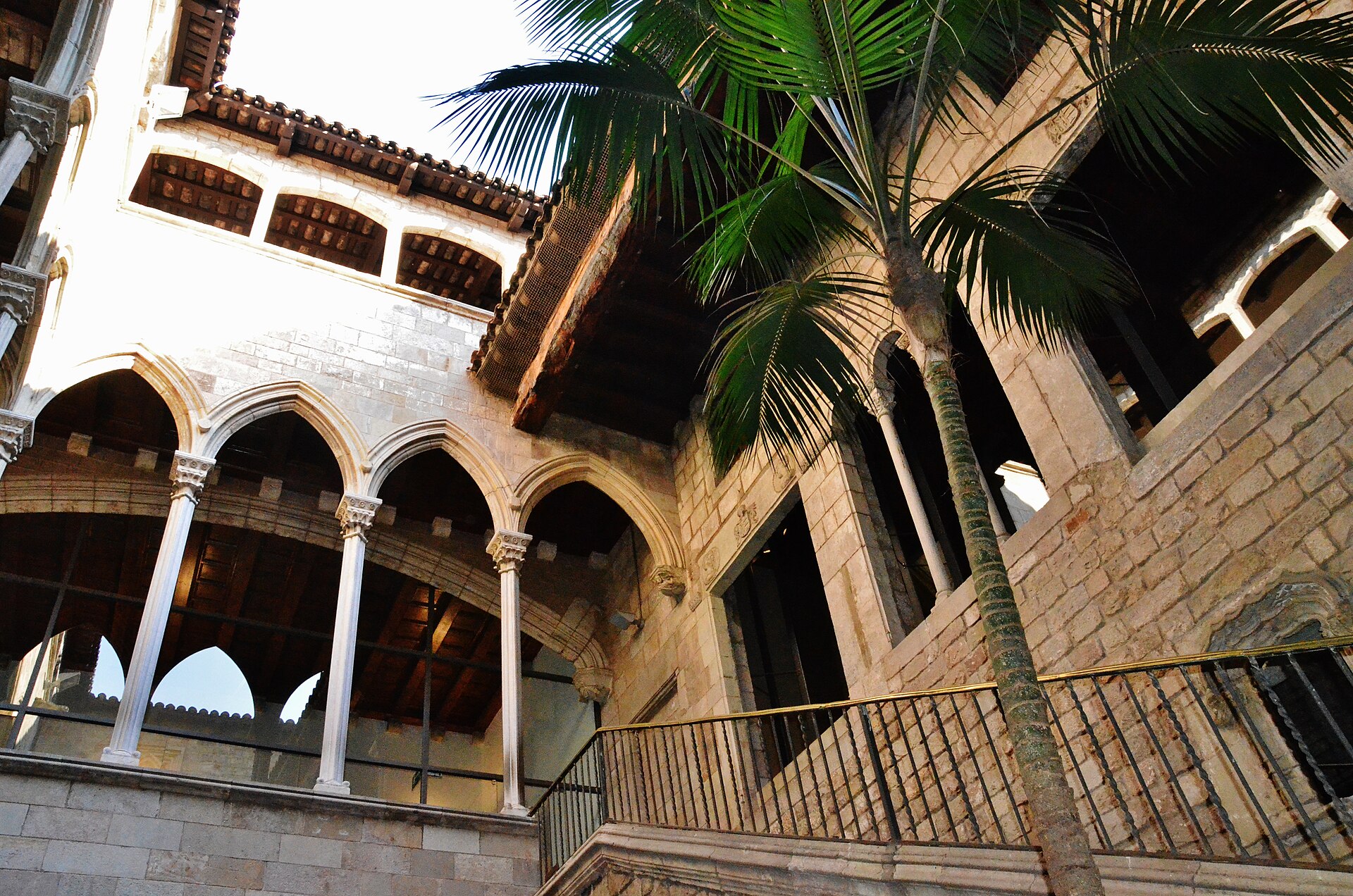
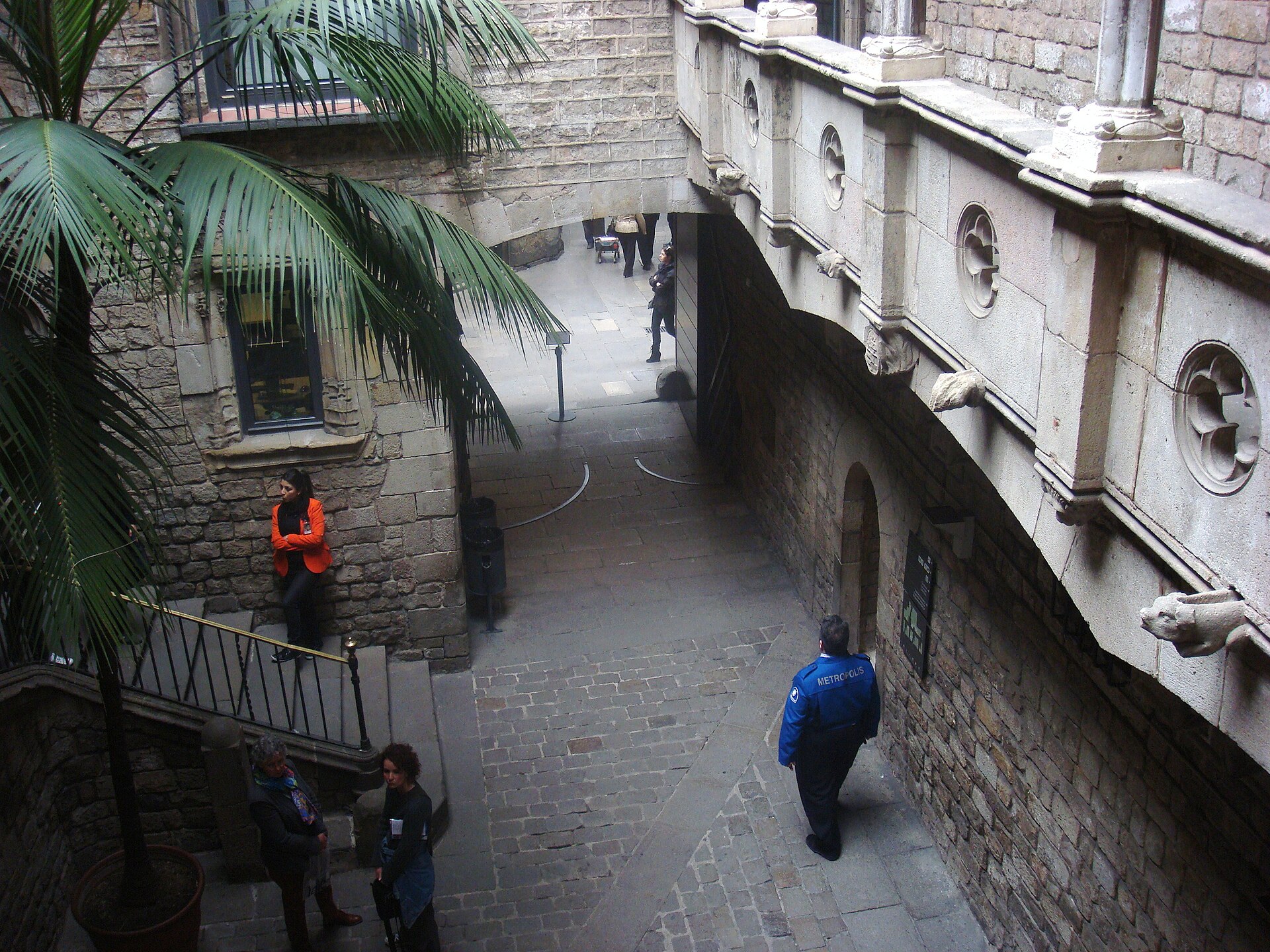
The first of the five palaces to open, and still the entrance sequence: a Gothic courtyard with an open-air stairway and pointed-arch gallery of the 15th century, coffered ceilings on the first floor, and the earliest rooms of the chronological hang, covering Picasso's childhood and academic training in Malaga, A Coruna and Barcelona.
Palau del Baro de Castellet (1970)
Added when Picasso made his major 1970 donation of more than 900 works from the family's Barcelona apartment for his 90th birthday. The palace keeps a neoclassical hall from the mid-18th century, mixing classical and baroque elements, over an older brick-vaulted ground floor.
Palau Meca (1981)
The rooms devoted to the Blue Period and the years around 1917, when Picasso was moving between Barcelona and Paris. The palace itself keeps polychrome medieval coffered ceilings on its main floor, reworked again after the building was damaged in the 1714 bombardment of the city.
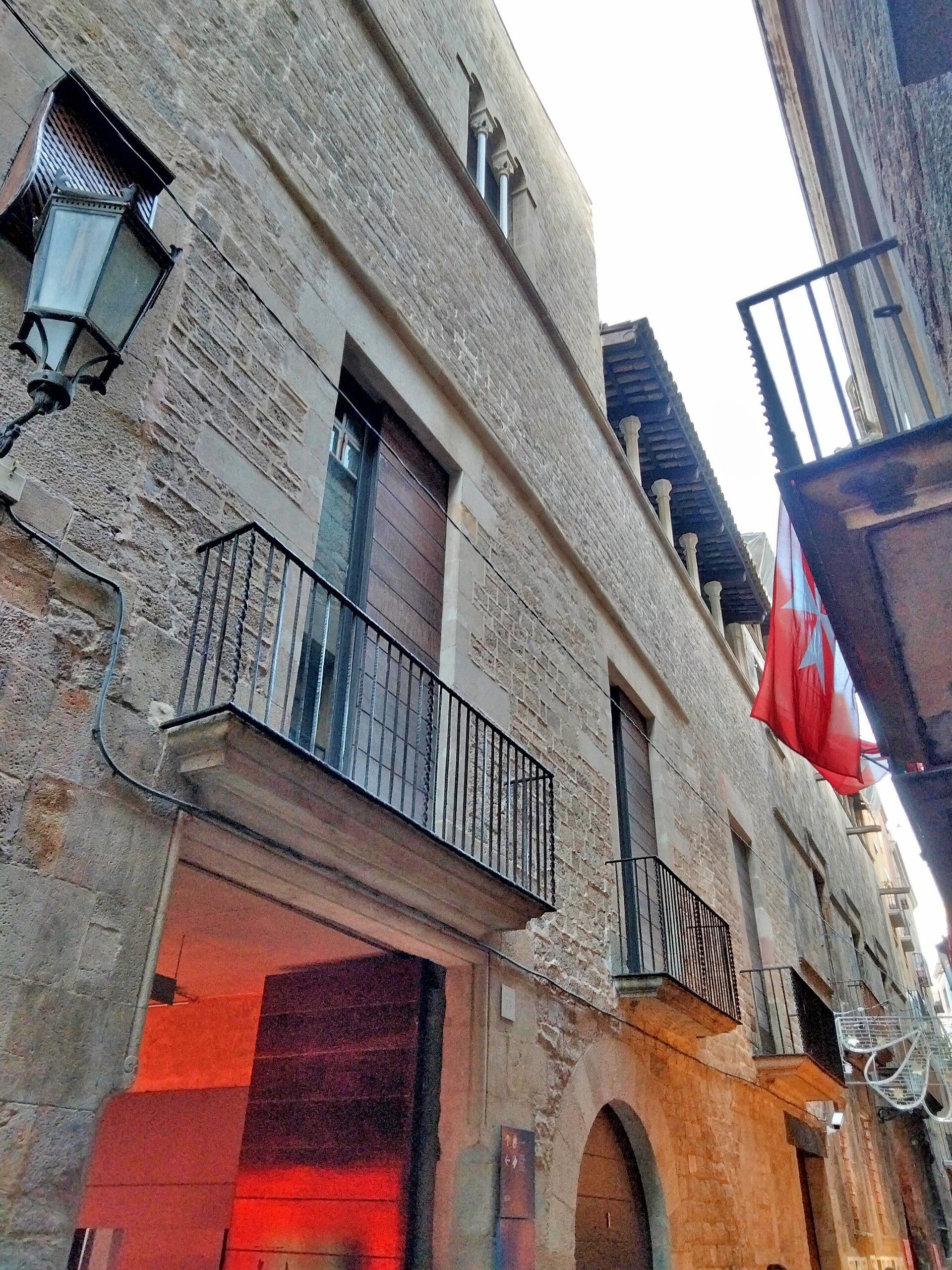
Photograph by Enric · CC BY-SA 4.0 Palau Finestres and Casa Mauri (1999)
The most recent extension, giving the museum a dedicated space for temporary exhibitions and for showing the Las Meninas series as a complete run rather than in passing. Finestres keeps a coffered ceiling of the late 13th or early 14th century and a courtyard gallery added in stages through the 17th and 18th centuries.
Ceramics galleries
Built around the gift Jacqueline Picasso made to the museum in 1982, shown apart from the paintings and works on paper rather than folded into the chronological run.
What to see first
Science and Charity
Pablo Picasso, 1897Painted at 15 with his father posing as the doctor, submitted to Madrid's National Exhibition of Fine Arts and awarded an honourable mention; the clearest evidence in the building of the academic mastery he had before he broke from it.6
First Communion
Pablo Picasso, 1896An earlier large-scale academic exercise, painted the year before Science and Charity and shown near it, tracing the same rapid technical development.6
The Las Meninas series
Pablo Picasso, 1957Fifty-eight paintings made in a single sustained run, reworking Velazquez's Las Meninas panel by panel and figure by figure; the museum holds the complete series intact, which is why it gets its own dedicated room rather than a single representative canvas.7
Blue Period paintings
Pablo Picasso, c. 1901-1904The museum's own account calls its holding of this period practically exhaustive, painted in the years Picasso moved between Barcelona and Paris and worked through the death of his friend Carles Casagemas.7
The 1917 Barcelona paintings
Pablo Picasso, 1917A concentrated group from the months Picasso spent in Barcelona working on sets and costumes for the Ballets Russes production of Parade, a return visit the museum holds an unusually deep record of.7
The 1970 donation
Works given by Pablo Picasso, 1970More than 900 works, kept at the family's Passeig de Gracia apartment until Picasso gave them to the museum for his 90th birthday; the single largest addition the collection ever received from the artist himself, and the reason the museum needed a second palace.9
Jacqueline Picasso's ceramics gift
Pablo Picasso, ceramics, various datesGiven by the artist's widow in 1982, extending the collection into a medium the paintings and prints do not otherwise represent here.5
The Sabartes portraits
Pablo Picasso, various datesPicasso's portraits of Jaume Sabartes, his lifelong friend and secretary, whose own collection was the museum's founding gift and whose name the museum carried at its 1963 opening because Picasso's own could not be used under Franco.10
Past exhibitions here
- Closed6 Jun to 27 Sep 2026Confirmed · check before you travel
A museum the artist endorsed but never entered
The Museu Picasso opened on 9 March 1963, and it did not open under Picasso's name. Franco's government, seventeen years into a dictatorship Picasso had opposed since the Spanish Civil War, would not permit a large public museum named for a self-declared enemy of the regime, so the project was registered as the Col.leccio Sabartes, after Jaume Sabartes, Picasso's lifelong friend and secretary, whose own collection formed the founding gift. Picasso had sworn not to set foot in Spain again while Franco ruled, and he never did: Franco outlived him by two years, so the artist who gave this museum most of what it holds died in 1973 without ever having walked through it.
That absence shaped the collection more than it constrained it. Picasso kept adding to the museum by post and by proxy for the rest of his life - most decisively in 1970, when he gave more than 900 works kept at his family's old Passeig de Gracia apartment to the city, timed to his 90th birthday, which forced the museum to annex a second palace to hold it. His wife Jacqueline added a further gift of ceramics in 1982, after his death. The result is a museum built entirely on gift rather than acquisition, curated at a distance by an artist who trusted the city to house what he sent it.
Five palaces, not one building
The museum occupies five adjoining medieval palaces on Carrer de Montcada, a street that has been an address of consequence in Barcelona since the 1300s, and it grew into all five in stages rather than opening complete. Palau Aguilar, 13th and 14th century with a 15th-century Gothic courtyard and stairway, opened the museum in 1963. Palau del Baro de Castellet, with a mid-18th-century neoclassical hall grafted onto its medieval shell, was annexed in 1970 to hold the 90th-birthday donation. Palau Meca followed in 1981, its polychrome medieval ceilings rebuilt once already after the artillery bombardment of 1714. Casa Mauri and Palau Finestres, the most recent addition, opened together in 1999 and gave the museum its first dedicated space for temporary exhibitions and for the Las Meninas series shown as a complete run.
A visitor moving through the building is moving through five different construction histories as much as through one collection, and the museum makes no attempt to disguise the seams: courtyards, stairways and ceilings from each palace are left legible rather than unified behind a single museum finish.
What the collection actually is, and what it is not
The museum's own description of its strength is specific rather than promotional: practically exhaustive up to the Blue Period, with a further concentration on the 1917 paintings Picasso made in Barcelona while working on designs for the Ballets Russes production of Parade, and the complete 1957 Las Meninas series, fifty-eight paintings reworking Velazquez's court scene panel by panel. Two paintings from 1896 and 1897, First Communion and Science and Charity, anchor the earliest rooms: the second was submitted to Madrid's National Exhibition of Fine Arts and won an honourable mention, made when Picasso was fifteen with his own father sitting as the model for the doctor.
What is genuinely absent is the work most visitors arrive expecting. There is no Cubist landmark here, no Guernica, no late self-portrait: those pictures are in Paris, in New York, in Malaga's Picasso museum, or in private hands. A reader planning a first visit around the famous late Picasso will be planning around the wrong museum; a reader who understands this as a record of formation rather than a greatest-hits survey gets one of the most complete such records for any major twentieth-century artist anywhere.
Ceramics, and what the palaces do not show
Jacqueline Picasso's 1982 gift of ceramics gave the museum a medium its paintings and works on paper cannot represent on their own: Picasso's postwar production at the Madoura workshop in Vallauris, made in the last two decades of his life, the period the painting galleries here stop short of. It is shown apart from the chronological run rather than folded into it, which keeps the core Barcelona-years narrative intact but means a visitor who only follows the numbered rooms can walk past it.
The Knowledge and Research Centre, added in 2011 in premises adjoining the original palaces, holds the museum's archive, photographs and bibliographic material and functions as a working research base for the study of Picasso's early years rather than as a visitor-facing gallery. Between the ceramics and the archive, the museum's real holdings run wider than the five palaces most visitors walk through.
Crowds, queues and the ticket most visitors do not read closely
Carrer de Montcada is a narrow medieval street with no capacity to absorb a queue, and the museum draws well over a million visitors in a typical year through a building never designed for that volume. Visitors without a pre-booked time slot report waits of up to 45 minutes on weekends and holidays, and the museum's own booking system now pushes online purchase hard enough that arriving without a ticket is treated as the exception rather than the norm it might once have been.
The free-admission calendar compounds this rather than easing it for anyone hoping to walk in unplanned: a first Sunday each month, three named open days through the year, and a winter Thursday evening slot, every one of them requiring its own advance reservation rather than simply waiving the fee at the door. A visitor comparing only the headline 12 to 15 euro ticket price against, say, MNAC across town will miss that both museums attach real conditions to their free hours rather than leaving them open-door.
What visitors say
We publish no visitor review prose and cite no invented consensus. TripAdvisor's own aggregate for the attraction, read on the date below, put it at 4.2 of 5 from 10,199 ratings, ranked 75th of 1,551 things to do in Barcelona. What recurs across press and visitor commentary is a mismatch between expectation and collection: this is a museum of Picasso's formative years and his late Las Meninas project, not of the Cubist and later work most visitors associate with his name.
What is praised, what is criticised
- Praised: the completeness of the early, academic-period holdings, described by the museum itself as practically exhaustive up to the Blue Period
- Praised: the Las Meninas series shown whole, in its own room, rather than as a single representative panel
- Praised: the five connected medieval palaces themselves, and their Gothic courtyards, as a setting distinct from a purpose-built gallery
- Criticised: visitors expecting Guernica, Les Demoiselles d'Avignon or mature Cubist paintings consistently report disappointment; the collection is weighted toward Picasso's training and his 1917 and 1957 Barcelona-linked work rather than his best-known Paris-period paintings
- Criticised: queues on Carrer Montcada for visitors without a pre-booked time slot are a recurring complaint, particularly on weekends and holidays
- Criticised: the free-admission schedule is complicated - a first Sunday, three named open days and a winter Thursday evening slot, each needing its own advance reservation - which is easy to miss when checking only the headline ticket price
Ratings on other platforms
TripAdvisor: 4.2 from 10,199 ratings, read 7 August 2026
A platform average is a tertiary source: it moves, it is not audited, and we quote no visitor's words.
Questions about Museu Picasso de Barcelona
Where is Museu Picasso de Barcelona?
Carrer de Montcada, 15-23, 08003 Barcelona, Spain.
How much does it cost to visit?
General, online: EUR 14; General, at the ticket office: EUR 15; Reduced: EUR 7.5; Bicing card holders: EUR 10.5; Under 18: free. As confirmed 26 August 2026.
When is it open?
Tuesday, Wednesday, Sunday, 31 March-27 September 09:00-20:00; Thursday, Friday, Saturday, 31 March-27 September 09:00-21:00; Tuesday-Sunday, 29 September-29 March 10:00-19:00; Monday closed; 24 and 31 December 10:00-14:00. Closed: Every Monday. 1 January, 1 May, 24 June, 25 December. As confirmed 26 August 2026.
How do you get there?
Metro: Jaume I (L4) and Arc de Triomf (L1), both a short walk through the Born district; Bus: Routes 120, 45, V15 and V17 on Via Laietana; 39, 51 and H14 on Passeig Picasso and Pla de Palau; Rail: Estacio de Franca and Estacio de Sants both connect; the museum itself has no car park.
What should you see first?
Science and Charity (Pablo Picasso, 1897); First Communion (Pablo Picasso, 1896); The Las Meninas series (Pablo Picasso, 1957); Blue Period paintings (Pablo Picasso, c. 1901-1904); The 1917 Barcelona paintings (Pablo Picasso, 1917); The 1970 donation (Works given by Pablo Picasso, 1970).
What we could not confirm
- Whether Picasso ever formally addressed the museum being registered under Sabartes's name rather than his own; the sources found for this page describe the political constraint but not Picasso's own stated view of the workaround.
- The exact current total of works in the collection is given inconsistently even by the museum's own site, as approximately 5,000; older tertiary sources give figures from 3,500 to over 4,200, which appear to reflect the collection's size at different points rather than a single disputed count.
- Whether the museum's own visitor pages will ever address, on the visit pages a ticket-buyer actually reads, the gap between what the collection is known for and what most first-time visitors expect to see.
Images
Sources
- 1Museu Picasso de Barcelona, Buy tickets and opening hours: every admission tier, seasonal hours, closed days and free-admission conditions. Read 7 August 2026. museupicassobcn.cat/en/plan-your-visit/buy-tickets-and-opening-hours
- 2Museu Picasso de Barcelona, The Museu Picasso buildings: the five palaces, their construction periods and the date each was incorporated into the museum. Read 7 August 2026. museupicassobcn.cat/en/museum/buildings
- 3Museu Picasso de Barcelona, Getting here: phone numbers, email, address and public transport directions. Read 7 August 2026. museupicassobcn.cat/en/plan-your-visit/getting-here
- 4Museu Picasso de Barcelona, Good practices and regulations: photography policy, bag and locker policy, animals. Read 7 August 2026. museupicassobcn.cat/en/plan-your-visit/good-practices-and-regulations
- 5Wikipedia, Museu Picasso: founding history, the five palaces, collection size, Jacqueline Picasso's 1982 ceramics gift, 2023 visitor numbers. en.wikipedia.org/wiki/Museu_Picasso
- 6Wikipedia and museum-guide coverage of Science and Charity (1897) and First Communion (1896), cross-checked: subject, date, and the Madrid National Exhibition honourable mention. en.wikipedia.org/wiki/Museu_Picasso
- 7TripAdvisor, Museu Picasso attraction page: the museum's own descriptive text (formative years, practically exhaustive to the Blue Period, the 1917 paintings, the complete 1957 Las Meninas series) and the aggregate rating of 4.2 from 10,199 reviews. Read in the in-app browser, 7 August 2026. tripadvisor.com/Attraction_Review-g187497-d190165-Reviews-Museu_Picasso-Barcelona_Catalonia.html
- 8Confirms this is the Barcelona institution, distinct from the Museo Picasso Malaga (a separate Wikidata entity). wikidata.org/wiki/Q1050032
- 9Salterton Arts Review, 'Museu Picasso Barcelona', August 2025: why the museum opened as the Col.leccio Sabartes under Franco, Picasso's refusal to return to Spain, and the 1970 donation of more than 900 works for his 90th birthday. saltertonartsreview.com/2025/08/museu-picasso-barcelona/
- 10Museu Picasso de Barcelona, The Museu Picasso of Barcelona (presentation/history page): Jaume Sabartes's founding role, the 1970 donation, the collection's approximately 5,000 works and its focus on the formative years. Read 7 August 2026. museupicassobcn.cat/en/museum/presentation
- 11Wikimedia Commons, search results for 'Museu Picasso' Barcelona and the numbered Palau Finestres facade series: the plates on this page, each from .LicenseShortName and each image downloaded and inspected before use. commons.wikimedia.org/w/index.php?search=intitle%3A%22Museu+Picasso%22+Barcelona&title=Special:MediaSearch&type=image