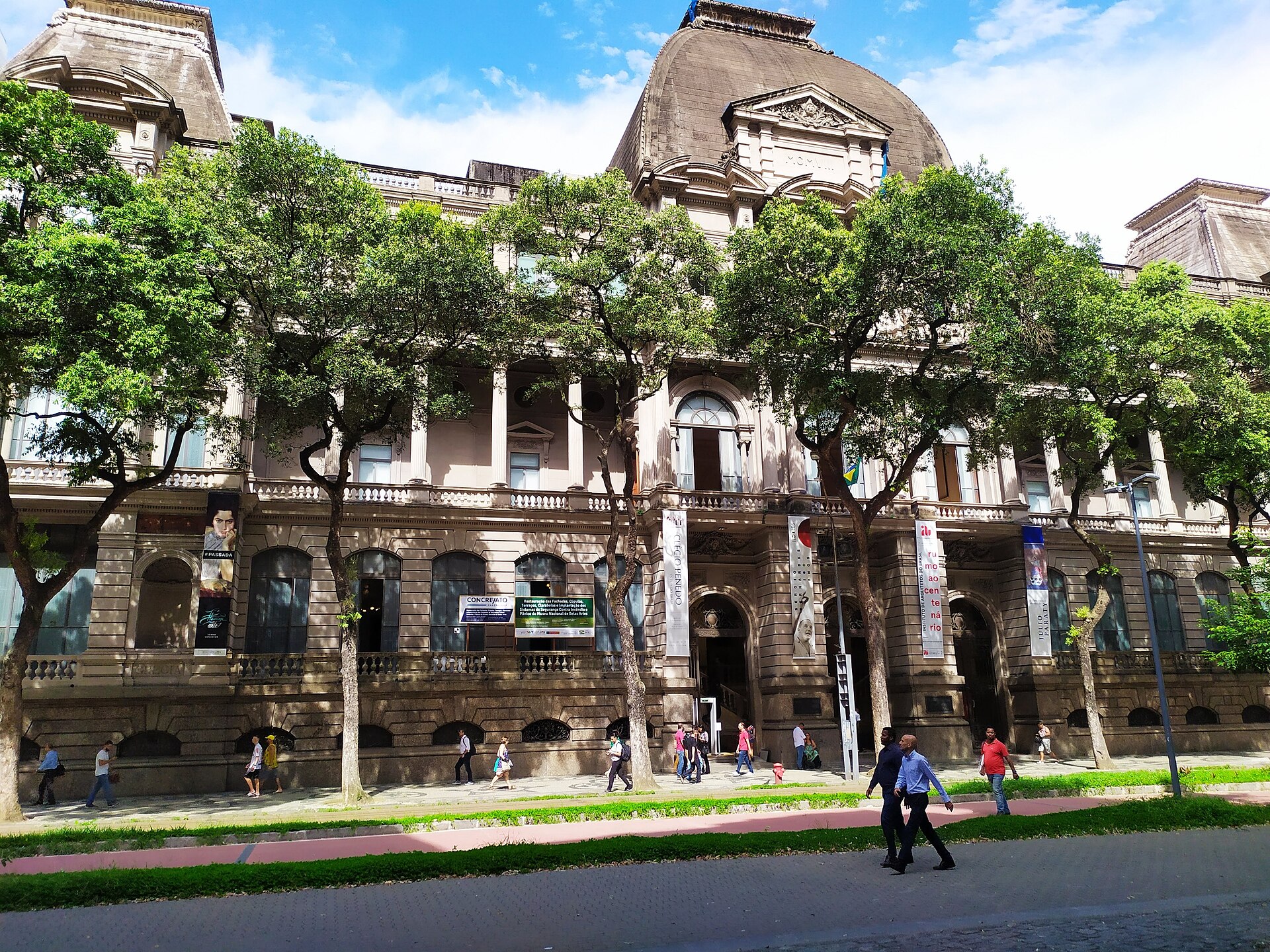
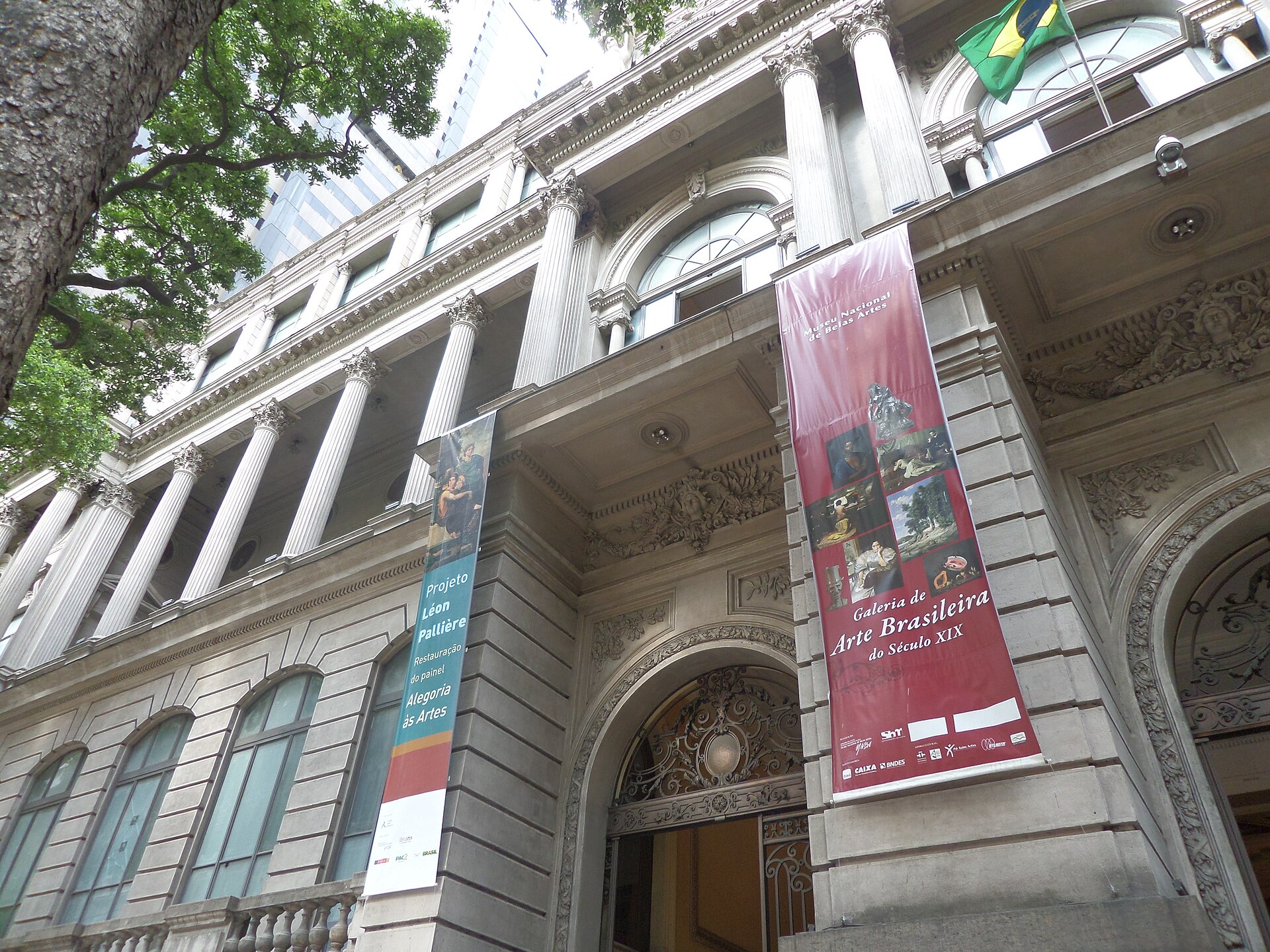
The museum's French Renaissance-inspired main facade on Avenida Rio Branco, seen from across the avenue with its central dome and colonnade visible above the street trees.
Boaventuravinicius · CC BY-SA 4.0Closed to visitors - not permanently
Museu Nacional de Belas Artes is currently closed. Not fully open and not permanently closed. Re-checked live on 9 September 2026: the museum's own entry on IBRAM's official visitor registry for Brazil's museums still states, word for word, under 'Dias e Horarios de Abertura para o Publico': 'O museu esta fechado para o publico para obras de requalificacao' (the museum is closed to the public for requalification works) - unchanged since this record was first researched. The main building, including the principal Brazilian and international painting galleries, remains closed for the renovation that began in 2020. The soft-opening program, Um olhar pela Fechadura, had reopened single rooms in stages - the Galeria de Moldagens II in 2025, and the Sala Bernardelli from 17 April 2026 with the exhibition Historias que a Arte Conta - but even that limited access is currently interrupted: the museum's own notice, published 31 August 2026, says public activities have been paused since Monday 31 August 2026 for the installation of new exhibitions and events, resuming Wednesday 16 September 2026. Press reporting from 8 August 2026 (Tempo Real RJ, citing O Globo columnist Ancelmo Gois) describes what that resumption is expected to add: about 650 square meters across three galleries - Galeria de Moldagens 1 (previously not part of the soft-opening program, unlike its neighbor Galeria de Moldagens II), Galeria Rodrigo Mello Franco, a room not previously recorded here, showing new acquisitions, and the Sala Bernardelli reopening 'integralmente' (fully, rather than partially) with a new exhibition, Abolicionistas Brasileiras. As of this check, 9 September 2026, none of that expanded opening has yet happened - the museum's own gov.br homepage still names Historias que a Arte Conta as the current exhibition and the pause notice is still in effect - so this record treats the September expansion as reported and expected, not yet confirmed on the museum's own page, and flags it for the next re-check after 16 September 2026.
Expected to reopen: end of 2026 · a target, not yet confirmed
Closure confirmed from the institution's own page. We re-check this page on a schedule and will update it, from the institution's own announcement, the moment it reopens.
On this page 14 sections
ContentsClose
Few museums outside the old European royal collections can point to as direct a line from a monarch's own paintings to a national public collection: the 1808 transfer of Joao VI's holdings, enlarged within a few years by the French Artistic Mission, gave this museum an old-master and 18th-19th century European nucleus most Latin American institutions of its kind do not have. Layered onto that royal inheritance is a genuinely deep, locally built holding of 19th-century Brazilian academic history painting and Rodolfo Bernardelli's own sculpture, plus a drawings and print department serious enough to be called one of the country's most significant. That combination - inherited European core, homegrown 19th-century strength, and real depth in works on paper - is what the renovation is working, room by room, to put back in front of the public.
| Kind | Museum |
|---|---|
| Founded | Collection formed from the royal collection Joao VI brought from Portugal in 1808; the museum was created by decree on 13 January 1937 and inaugurated on 19 August 1938 by President Getulio Vargas |
| City and country |  Rio de Janeiro, Brazil Rio de Janeiro, Brazil |
| Address | Avenida Rio Branco 199, Centro, Rio de Janeiro, RJ 20040-008, Brazil |
| Website | gov.br/museus/pt-br/museus-ibram/mnba |
| Status | Closed temporarily, confirmed |
| Record last verified |
Visiting
- Hours (pre-closure)
- Monday to Friday (Um olhar pela Fechadura soft-opening program only, when running)13:00 to 17:00Last entry 30 minutes before closing, per regional press coverage of the program. Covers only the Galeria de Moldagens II and, since 17 April 2026, the Sala Bernardelli; the rest of the museum is closed on these days too. Re-confirmed 9 September 2026: these hours do not currently apply because the whole soft-opening program is paused for exhibition installation from 31 August 2026, per the museum's own notice, and is due to resume 16 September 2026 with an expanded set of rooms per press reporting - see open_status.note.
- Second Saturday of the month (Um olhar pela Fechadura soft-opening program only, when running)11:00 to 15:00Also currently suspended by the same programming pause noted above.
- Saturday (other than the second Saturday) and SundayClosed, including the soft-opening rooms.
- Closed
- Every day, for the great majority of the building beyond the two rooms named above, for the duration of the renovation that began in 2020. Every day from 31 August 2026 through 15 September 2026, for the soft-opening rooms as well, per the museum's own notice of a programming pause for exhibition installation.
- Admission (pre-closure)
- Current partial soft-opening access (Sala Bernardelli and Galeria de Moldagens II only, when the program is running)FreeFree entry, per the museum's own gov.br page for the Historias que a Arte Conta exhibition, which states plainly 'Entrada gratis'. This covers only the rooms open under the Um olhar pela Fechadura program, not the full collection. Re-confirmed 9 September 2026: the program is itself currently paused (see open_status.note) - the museum's own notice says public activities stopped 31 August 2026 for the installation of new exhibitions and resume 16 September 2026. Press reporting on the September reopening names a new exhibition, Abolicionistas Brasileiras, in a fully-reopened Sala Bernardelli plus two further rooms, but no source read for this record states a price for that new exhibition specifically; this desk expects the same free-entry policy to continue and will confirm it once the museum's own page reflects the reopening.
- Standard admission, pre-closure policy on fileFreeIBRAM's own national museum registry records the museum's standing admission policy as 'Gratis aos domingos. Venda de ingressos e entrada de visitantes ate 30 min antes do fechamento do Museu' (free on Sundays; ticket sales and visitor entry until 30 minutes before closing) - but the same registry entry, re-read 9 September 2026 and unchanged, states the museum is currently closed to the public, so no weekday adult price could be confirmed from a source this desk actually fetched, and this figure needs reconfirming once the full collection reopens.
Free entry: Sundays, under the standing pre-closure policy recorded in the museum's own IBRAM registry entry (not applicable while only the soft-opening rooms are accessible, and not applicable at all while the soft-opening program is itself paused, 31 August to 16 September 2026)- Do I need to book?
- No, free walk-in entry to the two rooms currently open when the soft-opening program is running (currently paused, see open_status.note)
- Address
- Avenida Rio Branco 199, Centro, Rio de Janeiro, RJ 20040-008, Brazil MapMetro Cinelandia station (lines 1 and 2), a short walk from the museum entrance on Avenida Rio Branco
VLT (light rail) Cinelandia stop, at Praca Floriano, a few minutes' walk from the museum - Website
- gov.br/museus/pt-br/museus-ibram/mnba
- Telephone
- +55 21 99169-1058 / +55 21 99435-8166
- [email protected]
Before you go how long, access, photography, bags, eating, shop
- How long to allow
- Twenty to thirty minutes for the rooms open under the current soft-opening program; a full visit once the renovation ends will need several hours given the size of the collection
- Access
- The museum's own coverage of the Historias que a Arte Conta exhibition states it offers audio description and sensory experiences for visitors with visual disabilities, and Libras (Brazilian Sign Language) interpretation for its companion podcast series
- Photography
- Not confirmed in the sources read for this record
- Bags
- Not confirmed in the sources read for this record
- Eating
- Not currently operating; the museum's own reporting on the renovation lists reopening the cafe among the works still to be completed
- Shop
- Not currently operating; listed alongside the cafe and the theater among the spaces awaiting reopening once renovation funding for them is complete
The museum is closed (see above). These are the figures published before the closure, kept here for a visitor planning ahead rather than presented as bookable today, and you can check the current position at the source we used. We will re-confirm them once it reopens.
What is inside
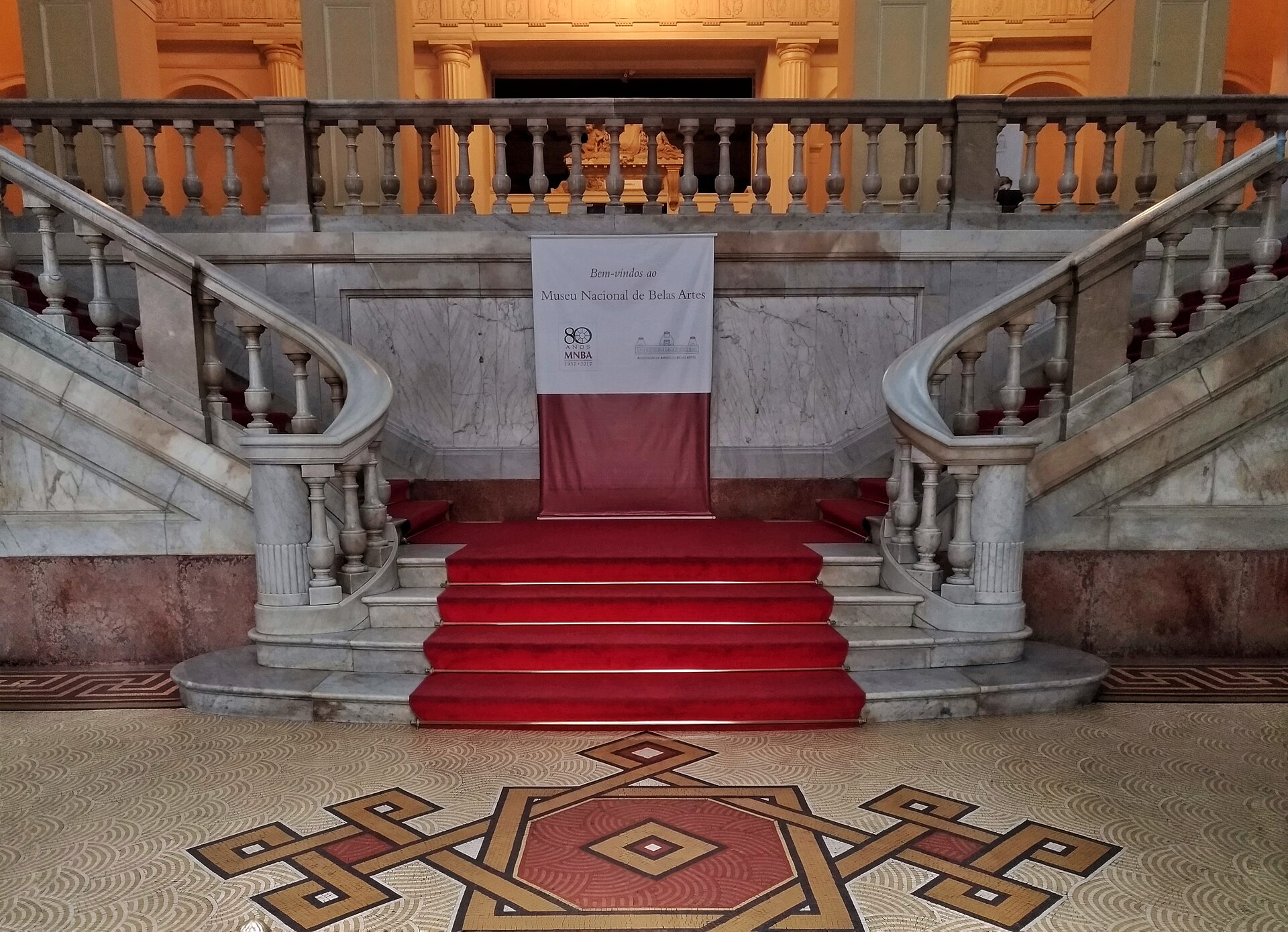
Photograph by Julio imagenations · CC BY-SA 4.0 Entrance hall
The ground-floor hall where visitors are received, opening onto the grand double staircase; it is the room the museum's soft-opening program uses to welcome the public back into the building in stages as each new space is cleared for reopening.
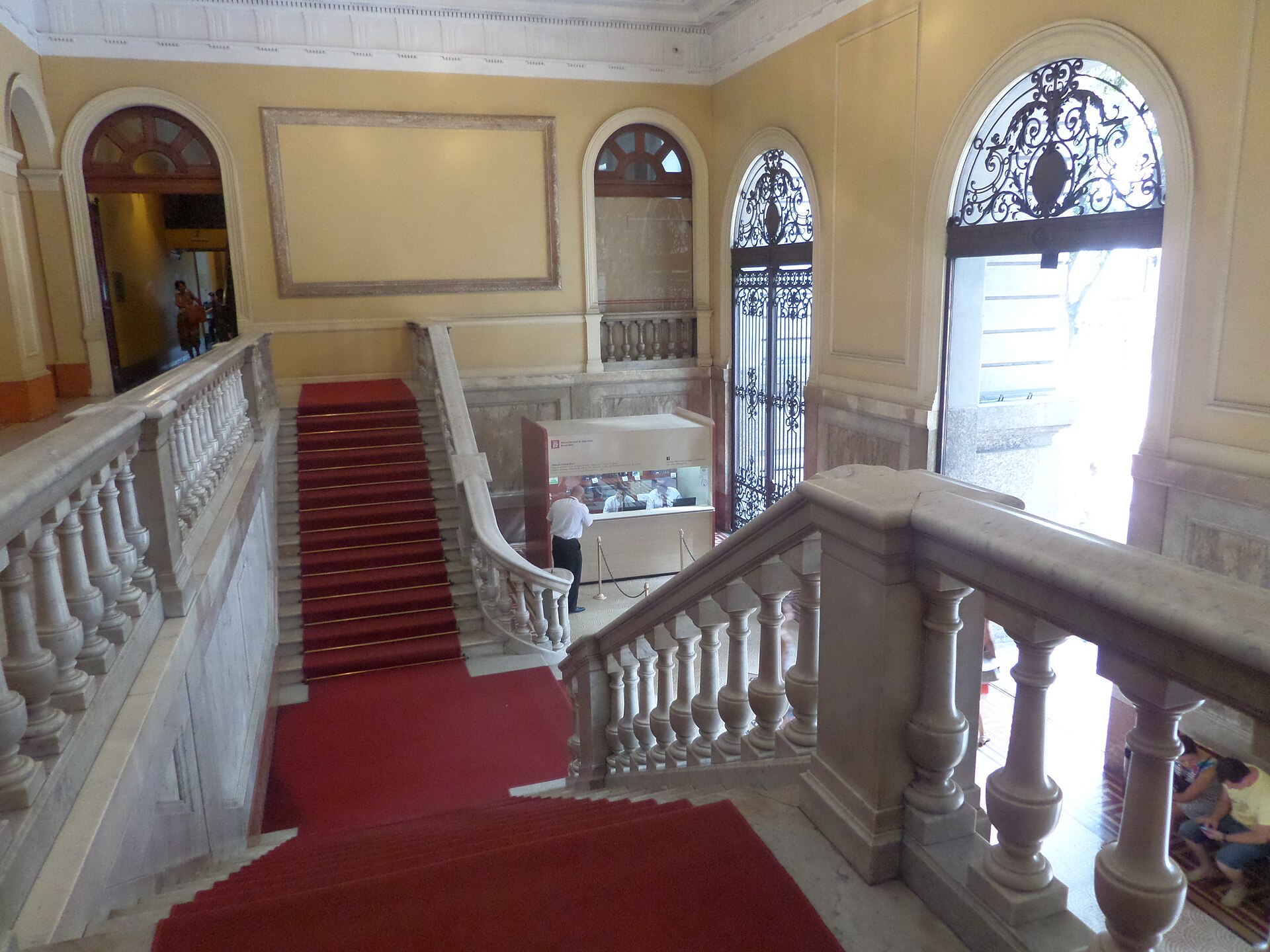
Photograph by Daniel Kuster · CC BY-SA 4.0 The grand marble staircase
A double marble staircase rising from the entrance hall past wrought-iron balustrades and arched glazed doors to the upper galleries, part of the original 1908 building and one of the most photographed interior spaces in the museum.
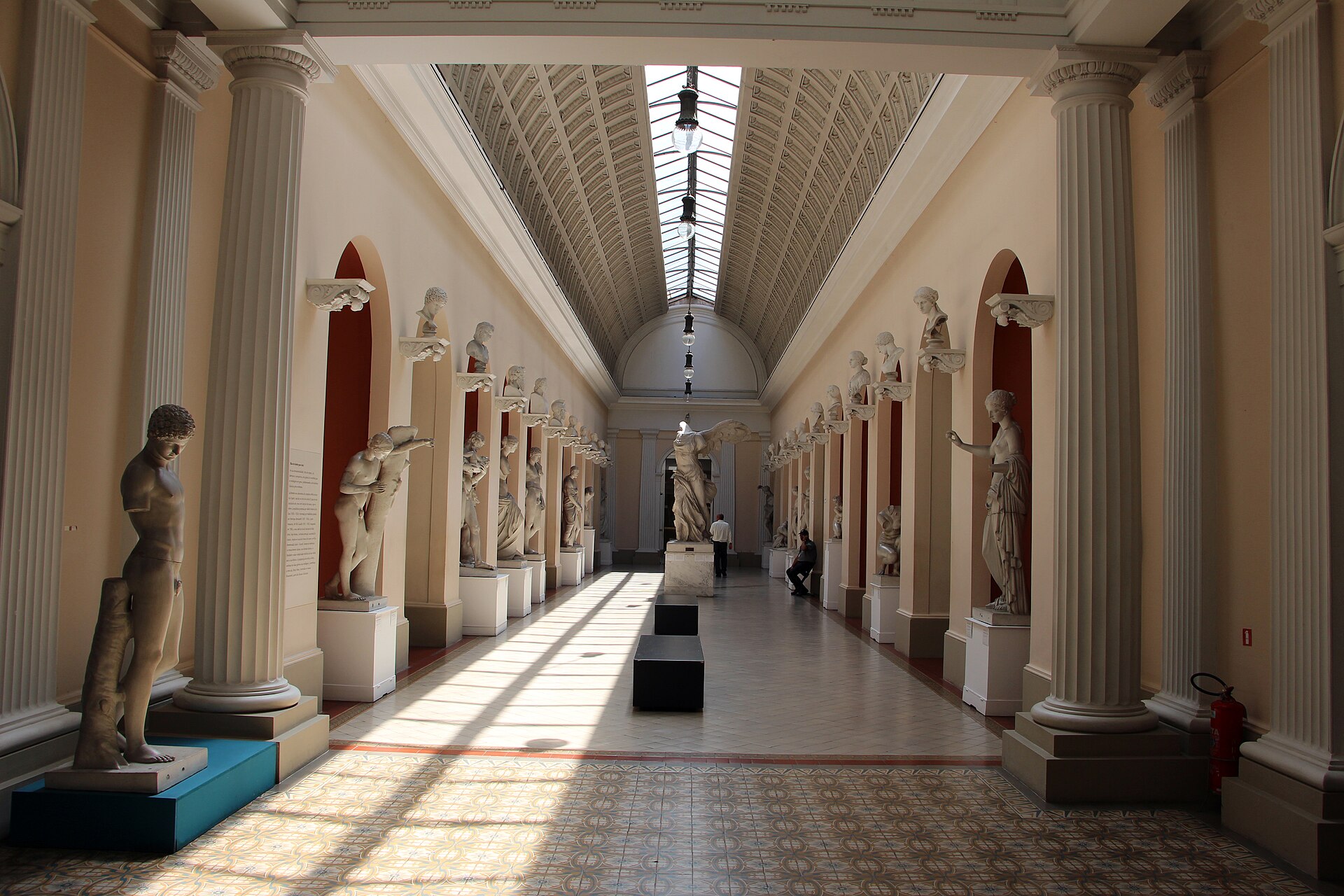
Photograph by Sailko · CC BY 3.0 Galeria de Moldagens I and II
Two second-floor galleries holding plaster casts of Hellenistic, Roman, classical Greek and Renaissance sculpture, most cast in France between about 1860 and 1875 for teaching drawing at the old Imperial Academy and National School of Fine Arts; casts of the Winged Victory of Samothrace, the Laocoon group and the Bust of Antinous are among the pieces on view. Galeria de Moldagens II was the first space reopened to the public during the renovation. Galeria de Moldagens I, which holds the Winged Victory of Samothrace cast, had not itself been part of the soft-opening program; press reporting of 8 August 2026 (Tempo Real RJ, citing O Globo columnist Ancelmo Gois) says it is expected to reopen alongside two further rooms in an expanded phase of the program, though the museum's own page had not yet confirmed this as of 9 September 2026 - see open_status.note.
Sala Bernardelli
A second-floor room named for the sculptor and academy director Rodolfo Bernardelli, reopened 17 April 2026 with the exhibition Historias que a Arte Conta, pairing ten works from the collection - by artists including Pedro Americo, Correia Lima and Raimundo Cela - with a companion podcast series; the room also displays a 2nd-3rd century AD bust of Antinous, among the museum's oldest holdings. Press reporting of 8 August 2026 says the room is due to be reopened 'integralmente' (fully, rather than only partially) alongside a new exhibition, Abolicionistas Brasileiras, as part of the same expanded phase; the museum's own notice of 31 August 2026 confirms activities are paused for exhibition installation and due to resume 16 September 2026, but as of this record's last check, 9 September 2026, the museum's own page still names Historias que a Arte Conta as current and the new exhibition is not yet confirmed there.
Galeria Rodrigo Mello Franco
A room not previously recorded on this page; press reporting of 8 August 2026 (Tempo Real RJ, citing O Globo columnist Ancelmo Gois) names it as one of three galleries expected to reopen in an expanded September phase of the soft-opening program, showing an exhibition of the museum's new collection acquisitions. Not yet confirmed on the museum's own page as of 9 September 2026, and no photograph of this specific room has been sourced for this record.
Brazilian painting galleries
The core of the collection when fully open: history painting by Victor Meirelles and Pedro Americo through to the modernists Tarsila do Amaral and Candido Portinari, with particular depth in 19th-century Brazilian academic painting. Closed to visitors, along with the rest of the main building, for the current renovation.
International painting galleries
Old-master and 18th-19th century European painting descended from the royal collection Joao VI brought from Portugal in 1808 and later enlarged by Joachim Lebreton's French Artistic Mission; holdings include Italian Mannerist and Baroque work, eight Brazilian landscapes by the Dutch painter Frans Post, and twenty paintings by Eugene Boudin. Closed with the rest of the main building for the renovation.
Sculpture, prints, drawings and folk and African art departments
Rodolfo Bernardelli's own sculpture, more than 250 pieces given to the museum by his brother after his death; a prints cabinet holding Rembrandt, Durer and Goya among roughly 2,000 international prints, one of the country's most significant engraving collections; about 4,000 Brazilian drawings including over 600 by Djanira; and separate collections of 442 folk-art objects and West African carvings and masks from the Bight of Benin region. All closed during the renovation, alongside the painting galleries.
What to see first
The First Mass in Brazil (Primeira Missa no Brasil)
Victor Meirelles, 1861The most reproduced single image of Brazil's colonial founding, taught from Brazilian school textbooks for generations and treated by the museum's own account as a cornerstone of the 19th-century Brazilian painting collection.2
Battle of Avai (Batalha do Avai)
Pedro Americo, 1872-1877A monumental Paraguayan War battle scene, among the largest 19th-century Brazilian history paintings, painted at the same period the museum's international galleries were being enlarged by new royal-collection donations.2
Battle of Guararapes (Batalha dos Guararapes)
Victor Meirelles, 1879A second major Meirelles history painting, named directly in press coverage of the 2020-2026 renovation as one of the pieces the closed museum's largest-ever conservation project was undertaken to protect.8
The Last Tamoyo (O Ultimo Tamoio)
Rodolfo Amoedo, 1883A key work of 19th-century Brazilian Indianist history painting, part of the same academic tradition the museum inherited from the old Imperial Academy of Fine Arts.2
Eight Brazilian landscapes
Frans Post, 17th centuryAmong the earliest surviving landscape paintings of Brazil made from direct observation, painted during the brief Dutch colonial period and preserved through the museum's international-painting collection.2
Twenty paintings
Eugene BoudinA concentration of work by one painter that the museum's own collection description singles out within its 18th-19th century French holdings, itself descended from the royal collection Joao VI brought to Brazil in 1808.2
Santa Barbara mosaic panel
Djanira, ceramic mosaicA large mosaic composed of thousands of tiles in the museum's central courtyard, tying the modernist painter and printmaker Djanira - already represented by hundreds of drawings in the museum's own holdings - to a permanent architectural work rather than only works on paper.11
Rodolfo Bernardelli's sculpture bequest
Rodolfo BernardelliMore than 250 sculptures given to the museum by the sculptor's brother after his death, making Bernardelli by far the best-represented sculptor in the collection and giving the room now named for him its foundation.2
Plaster casts of the Winged Victory of Samothrace, the Laocoon group and the Bust of Antinous
Cast in France, circa 1860-1875, after ancient originalsThe first works the public could see again when the renovation began reopening rooms, cast specifically to teach drawing from classical form at the old Imperial Academy and National School of Fine Arts.11
International prints by Rembrandt, Durer and Goya
VariousPart of a roughly 2,000-piece international print collection the museum's own account calls one of the country's most significant, held in a dedicated prints cabinet alongside the Brazilian drawings department.2
Past exhibitions here
A royal collection becomes a national museum
The collection now on Avenida Rio Branco did not start as a museum's. It started as the personal art collection of the Portuguese royal family, brought across the Atlantic in 1808 when Joao VI and the court fled Napoleon's armies and relocated to Rio de Janeiro. A few years later that founding group of works was substantially enlarged by Joachim Lebreton, who led the French Artistic Mission invited to help establish formal art teaching in the new capital, and the combined holdings became, in the museum's own words, the country's single most important collection of paintings. For most of the 19th century this collection lived inside the teaching institutions built around it - first the Imperial Academy of Fine Arts, later its republican successor, the National School of Fine Arts - rather than as an independent public museum with its own building and its own name. That changed only in the 20th century: the museum was created by government decree on 13 January 1937, at the initiative of education minister Gustavo Capanema, and formally inaugurated on 19 August 1938 by President Getulio Vargas, more than a century after the collection it was built to house first arrived in Brazil.
A palace built for a school, inherited by a museum
The building itself was not designed to be a museum at all. It was commissioned for the National School of Fine Arts, the Academy's direct successor, at the initiative of the school's director, the sculptor Rodolfo Bernardelli, who judged the old teaching building inadequate for a modernizing institution. The Spanish-born architect Adolfo Morales de los Rios designed the new structure as part of the wholesale remaking of what was then Avenida Central, Rio's showpiece boulevard for the Belle Epoque modernization pushed through by mayor Francisco Pereira Passos; construction began in the mid-1900s and the building opened in 1908. Morales de los Rios gave each facade a different register: the main front, facing the avenue, is French Renaissance in style, with Corinthian columns, caryatids and gabled frontons; the side elevations, on the streets now called Araujo Porto-Alegre and Heitor de Mello, turn to a plainer Italian Renaissance vocabulary; and the rear is austere Neoclassical. Terracotta bas-reliefs by the Pernambuco sculptor Honorio da Cunha e Mello run along the front and part of the sides, honoring a sequence of ancient civilizations, while fresco medallions by the painter Henrique Bernardelli commemorate teachers from the French Artistic Mission and the old Imperial Academy. When the museum was created as its own institution in 1937, it inherited this building - built for teaching, not display - along with the collection the schools inside it had been assembling for more than a century.
Six years dark, and a slow, staged return
The museum has been closed to visitors since 2020, for what its own architects describe as the largest restoration project in the building's history, covering nearly the entire structure across more than 20,000 square meters. By January 2025, coverage of the project put it at over 90 percent complete: the facade's terracotta reliefs, bas-reliefs, niches and medallions restored, window frames and glass recovered throughout, and a new fire-protection system installed. What remained was less visible but no less necessary - an overhaul of the electrical system, financed through the national development bank BNDES, and new climate control, funded by the oil company Shell as the museum's master sponsor, alongside Shell-funded renewal of the educational program and the long-duration exhibition itself. Rather than wait for every element to finish before letting anyone back in, the museum began reopening single rooms as they cleared: the Galeria de Moldagens II, with its plaster casts of classical sculpture, came first, paired with a photography exhibition on the restoration itself; the Sala Bernardelli followed on 17 April 2026 with a new exhibition built around ten works and a companion podcast series. Press reporting from early August 2026 described a further expansion due in September - three galleries in all, adding about 650 square meters, with the Sala Bernardelli reopening fully rather than in part - but the museum's own notice of 31 August 2026 shows that expansion arriving behind a short pause in public activities while the new rooms are installed, rather than as a clean handover from one phase to the next. Coverage of the renovation has described the target for full reopening in narrowing terms across this period, from simply '2026' in reporting from early 2025 to 'end of 2026' by March 2026, restated again without a firmer date in the August 2026 reporting on the September expansion - the kind of tightening that is worth naming rather than smoothing over, since the same reporting shows the date has moved before.
What the collection holds when the doors are fully open
The strength of the collection runs in two directions that trace directly back to its double origin. One is the royal and academic inheritance: old-master and 18th-19th century European painting descended from the 1808 collection and the Lebreton-era additions, including eight Brazilian landscapes by the Dutch painter Frans Post, twenty works by Eugene Boudin, and a print cabinet holding Rembrandt, Durer and Goya among roughly 2,000 international prints. The other is home-grown: a deep run of 19th-century Brazilian academic history painting - Victor Meirelles, Pedro Americo, Rodolfo Amoedo - moving into the modernists Tarsila do Amaral and Candido Portinari, backed by a sculpture department built almost entirely around one figure, Rodolfo Bernardelli, whose brother donated more than 250 of his works after his death, and a drawings department holding some 4,000 Brazilian works including over 600 by Djanira. Two smaller but distinctive collections round out the holdings: 442 pieces of Brazilian folk art, and a collection of West African carvings, masks and ceremonial objects concentrated in the Bight of Benin region, unusually coherent for a museum built primarily around European academic teaching. Almost none of this is currently on view; it is what the renovation is working to reopen.
What a visitor meets today
A visitor who travels to Avenida Rio Branco 199 in September 2026 will not see the museum most of these highlights describe, and on the day this record was last checked, 9 September 2026, will not even find the limited soft-opening rooms open: the museum's own notice says public activities have been paused since 31 August 2026 for the installation of new exhibitions, with a return promised for 16 September 2026. What returns then, on the museum's own account and in press reporting that named the rooms in advance, is meant to be broader than before - the plaster-cast Galeria de Moldagens I joining its neighbor Galeria de Moldagens II, a new Galeria Rodrigo Mello Franco showing recent acquisitions, and the Sala Bernardelli reopening fully with a new exhibition, Abolicionistas Brasileiras, rather than only in part. None of that was independently confirmed on the museum's own page as of this check, so a reader travelling before that date should expect the museum closed outright, and a reader travelling after it should still confirm on the museum's own site that the announced rooms actually opened as described. Anyone planning around the great Meirelles history paintings, the royal collection's old masters, or the full sculpture and drawings departments should plan for a date once full reopening is confirmed, not for this year's partial calendar.
What visitors say
Visitor sentiment splits along exactly the line the renovation drew: real enthusiasm for the collection and the building that holds it, set against real frustration at how much of both has been inaccessible for so long. The aggregate rating stays high even after years of a mostly closed museum, which says more about what people remember seeing on past visits than about what is open today.
What is praised, what is criticised
- Praised: The breadth and quality of the Brazilian and international paintings, and interior spaces such as the sculpture-lined galleries and the grand staircase, which reviewers describe as attractions in their own right rather than mere circulation space
- Praised: Free admission and a central, easy-to-reach location a short walk from Cinelandia, repeatedly cited as reasons to fit the museum into a short visit to downtown Rio de Janeiro
- Criticised: The building's maintenance and climate control, described in reviews written before the current renovation as inadequate for a tropical climate and for artworks that plainly needed conservation attention - a complaint the renovation itself is meant to answer
- Criticised: The length of the closure: six years without access to the great majority of the collection, with a full-reopening target that press coverage has described in narrowing terms, from simply '2026' in early reporting to 'end of 2026' by March 2026, restated again in August 2026 reporting with no more specific date given
- Criticised: A collection some visitors feel is thinner in 20th-century material than in its 19th-century core, a gap the museum's own published collection description does not really contest
Ratings on other platforms
Tripadvisor: 4.4 from 962 ratings, read 12 August 2026
A platform average is a tertiary source: it moves, it is not audited, and we quote no visitor's words.
Questions about Museu Nacional de Belas Artes
Where is Museu Nacional de Belas Artes?
Avenida Rio Branco 199, Centro, Rio de Janeiro, RJ 20040-008, Brazil.
How much does it cost to visit?
Current partial soft-opening access (Sala Bernardelli and Galeria de Moldagens II only, when the program is running): free; Standard admission, pre-closure policy on file: free. As confirmed 9 September 2026.
When is it open?
Monday to Friday (Um olhar pela Fechadura soft-opening program only, when running) 13:00-17:00; Second Saturday of the month (Um olhar pela Fechadura soft-opening program only, when running) 11:00-15:00; Saturday (other than the second Saturday) and Sunday closed. Closed: Every day, for the great majority of the building beyond the two rooms named above, for the duration of the renovation that began in 2020. Every day from 31 August 2026 through 15 September 2026, for the soft-opening rooms as well, per the museum's own notice of a programming pause for exhibition installation. As confirmed 9 September 2026.
How do you get there?
Metro: Cinelandia station (lines 1 and 2), a short walk from the museum entrance on Avenida Rio Branco; VLT (light rail): Cinelandia stop, at Praca Floriano, a few minutes' walk from the museum.
What should you see first?
The First Mass in Brazil (Primeira Missa no Brasil) (Victor Meirelles, 1861); Battle of Avai (Batalha do Avai) (Pedro Americo, 1872-1877); Battle of Guararapes (Batalha dos Guararapes) (Victor Meirelles, 1879); The Last Tamoyo (O Ultimo Tamoio) (Rodolfo Amoedo, 1883); Eight Brazilian landscapes (Frans Post, 17th century); Twenty paintings (Eugene Boudin).
What we could not confirm
- No source read for this record gives a firm, dated schedule for full reopening beyond the recurring target of 'end of 2026', and that target has already narrowed once in the reporting available and been restated without a firmer date as recently as August 2026; a reader should treat any specific reopening date as provisional until the museum's own site confirms it.
- No standard weekday adult admission price for the full collection could be confirmed from a source this desk actually fetched; the museum's own registry records only a 'free on Sundays' policy dating from before the 2020 closure, and a specific figure should be reconfirmed once ticketing resumes.
- Coverage of the renovation names BNDES and Shell as funders of specific remaining work (electrical systems and climate control respectively) but does not give a total project cost; this record does not assert one.
- Press reporting from early August 2026 named three galleries (Galeria de Moldagens I, Galeria Rodrigo Mello Franco and a fully-reopened Sala Bernardelli) and a new exhibition, Abolicionistas Brasileiras, as due to open 16 September 2026 after a programming pause; as of this record's last check, 9 September 2026, none of that was yet visible on the museum's own page, and it should be re-verified on the museum's own site after that date rather than assumed.
Images
Sources
- 1Wikidata, Q1954370, Museu Nacional de Belas Artes (, identity and coordinates) wikidata.org/wiki/Q1954370
- 2Wikipedia, Museu Nacional de Belas Artes () en.wikipedia.org/wiki/Museu_Nacional_de_Belas_Artes
- 3IBRAM / gov.br, Museu Nacional de Belas Artes home page (museum's own site) gov.br/museus/pt-br/museus-ibram/mnba
- 4IBRAM, national museum visitor registry, Museu Nacional de Belas Artes entry (official government registry maintained by the museum's own governing body) visite.museus.gov.br/instituicoes/museu-nacional-de-belas-artes/
- 5IBRAM / gov.br, MNBA Contatos page, updated 31 August 2026 (museum's own site) gov.br/museus/pt-br/museus-ibram/mnba/assuntos/contatos
- 6IBRAM / gov.br, 'Exposicao Historias que a Arte Conta reabre a Sala Bernardelli no MNBA', published 14 April 2026, updated 10 August 2026 (museum's own site) gov.br/museus/pt-br/museus-ibram/mnba/assuntos/noticias/exposicao-201chistorias-que-a-arte-conta201d-reabre-a-sala-bernardelli-no-mnba
- 7Radio Itatiaia, 'Museu Nacional de Belas Artes reabre parcialmente no Rio apos seis anos', 19 March 2026 itatiaia.com.br/turismo/museu-nacional-de-belas-artes-reabre-parcialmente-no-rio-apos-seis-anos/
- 8Jornal do Brasil (Agencia Brasil wire story), 'Museu Nacional de Belas Artes conclui 90% da reforma iniciada em 2020', 14 January 2025 jb.com.br/cadernob/2025/01/1053857-museu-nacional-de-belas-artes-conclui-90-da-reforma-iniciada-em-2020.html
- 9Tripadvisor, Museu Nacional De Belas Artes reviews () tripadvisor.com/Attraction_Review-g303506-d311269-Reviews-Museu_Nacional_De_Belas_Artes-Rio_de_Janeiro_State_of_Rio_de_Janeiro.html
- 10Google Arts & Culture, 'Museu Nacional de Belas Artes: the building and some of its stories' (official museum partner content) artsandculture.google.com/story/museu-nacional-de-belas-artes-the-building-and-some-of-its-stories-museu-nacional-de-belas-artes/0gWhauzuUDhHyQ?hl=en
- 11Google Arts & Culture, 'Inside the museum: the interior of the Museu Nacional de Belas Artes' (official museum partner content) artsandculture.google.com/story/inside-the-museum-the-interior-of-the-museu-nacional-de-belas-artes-museu-nacional-de-belas-artes/TgXhTnjN4JSw1g?hl=en
- 12Via Trole Bus, 'Como ir aos museus do Rio de metro', May 2026 viatrolebus.com.br/2026/05/como-ir-aos-museus-do-rio-de-metro/
- 13IBRAM / gov.br, 'Pausa na programacao do MNBA', published 31 August 2026, updated same day (museum's own site) gov.br/museus/pt-br/museus-ibram/mnba/assuntos/noticias/pausa-na-programacao-do-mnba
- 14Tempo Real RJ, 'Apos seis anos fechado para reformas, Museu Nacional de Belas Artes, no Centro do Rio, reabre tres galerias em setembro', citing O Globo columnist Ancelmo Gois, 8 August 2026 temporealrj.com/museu-nacional-belas-artes-reabre-rio/