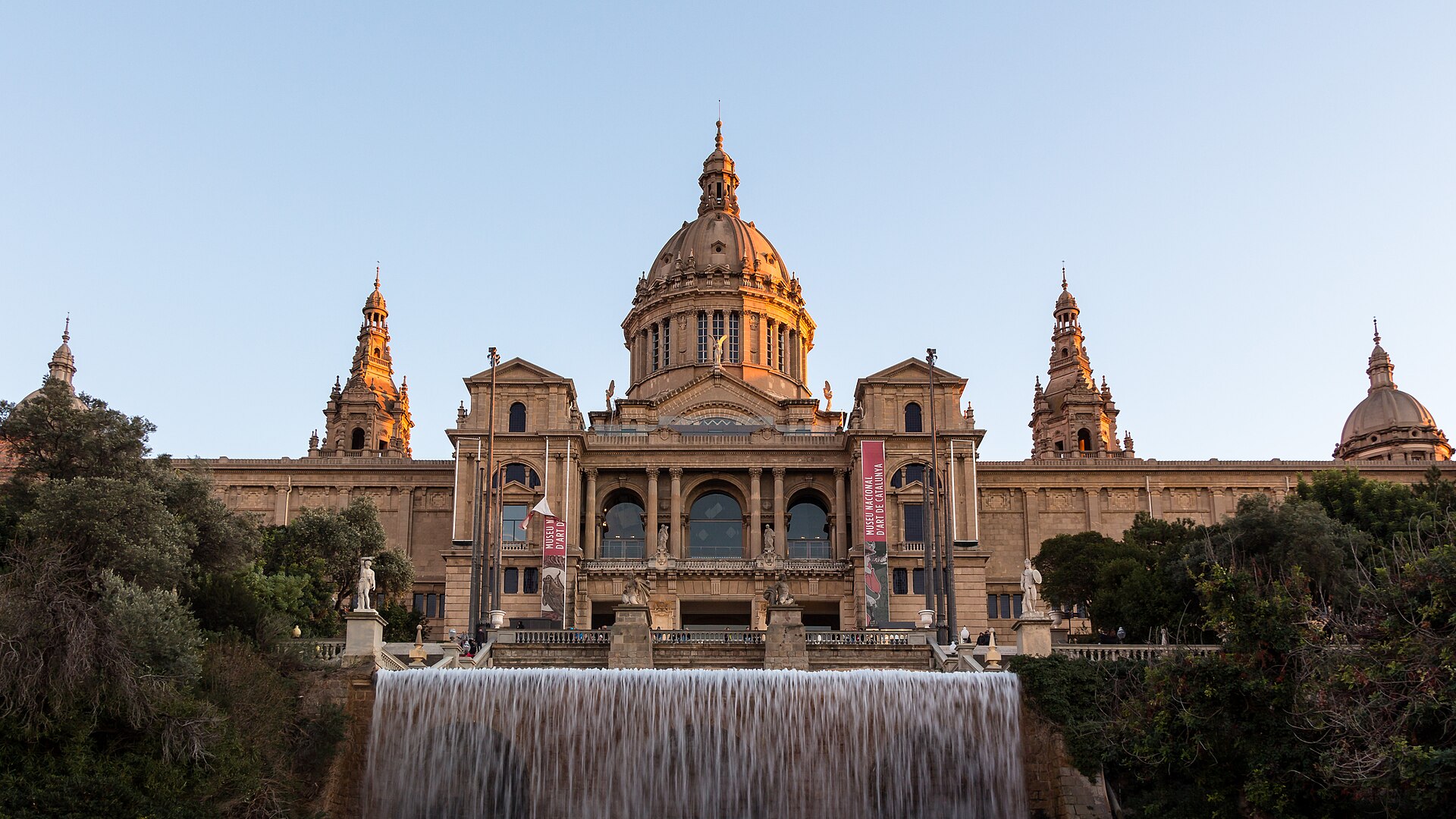
The Palau Nacional on Montjuic, home to MNAC since the collections were consolidated here; the banner on the facade names the museum. Photographed 27 December 2017.
Rafa Esteve · Photograph by Rafesmar · CC BY-SA 4.0Museu Nacional d'Art de Catalunya
Museum · Founded 1934
Open, admission and hours confirmed 26 August 2026 · 10 sources
On this page 15 sections
ContentsClose
MNAC's claim to be unmissable rests on one holding nobody else has: the largest assembled collection of Romanesque mural painting anywhere, taken bodily from small Pyrenean churches in the 1920s and rebuilt here at full scale. Everything after that is a second, separately strong museum layered on top of it - Catalan Gothic altarpieces, a Renaissance and Baroque collection built around one collector's late bequest, and the Modernisme and Noucentisme painting that Barcelona itself produced. A numismatic cabinet and a growing photography collection sit outside the main chronological run. The Sijena chapter house murals are a second, unrelated removal a reader needs to keep separate from the Pyrenean rescue: same technique of transfer to a museum wall, entirely different legal status today.
| Kind | Museum |
|---|---|
| Founded | Project launched 1934 to house the collection in the Palau Nacional, a building raised for the 1929 International Exposition; the museum did not stand as a single, fully merged institution until its galleries reopened in stages through December 2004 |
| City and country |  Barcelona, Spain Barcelona, Spain |
| Address | Palau Nacional, Parc de Montjuic, s/n, 08038 Barcelona, Spain |
| Website | museunacional.cat/en |
| Status | Open, confirmed |
| Record last verified |
Visiting
- Hours
- Tuesday-Saturday, October-April10:00 to 18:00winter hours
- Sunday and public holidays, October-April10:00 to 15:00winter hours
- Tuesday-Saturday, May-September10:00 to 20:00summer hours
- Sunday and public holidays, May-September10:00 to 15:00summer hours
- MondayClosed, except public holidays that fall on a Monday
- Closed
- 1 January, 1 May and 25 December every year. Ticket offices close 30 minutes before the museum itself.
- Admission
- GeneralEUR 12Building, permanent collection, temporary exhibitions and the rooftop viewpoint; valid for two visits within one month of purchase
- BasicEUR 2Building and rooftop viewpoint only, with self-guided tour materials, not the collection galleries
- Under 16Freefree at all times
- Over 65, EU residentFreefree at all times
- Students of Art History, teachers, ICOM members, tourist guides, accredited unemployed, disability cardholdersFreefree at all times, accreditation required at the desk
- General, discountedEUR 8.4030 percent off for students, families, single-parent families, large-family cardholders and groups
- General, Youth CardEUR 650 percent off for Catalan Youth Card holders
- MNAC + Poble Espanyol combinedEUR 20
- Articket BCN, six museumsEUR 38covers MNAC plus five other Barcelona museums
- BCN CardEUR 33.30From EUR 33.30 depending on validity; free/discounted entry to major Barcelona museums including MNAC, plus free transport and other discounts
- MNAC + Centre del Romanic de la Vall de BoiEUR 15Covers the churches of Sant Climent de Taull, Sant Joan de Boi and Santa Eulalia d'Erill la Vall (Santa Maria de Taull is separately free) plus MNAC's permanent collection, temporary exhibitions and rooftop viewpoint; valid one year from purchase
Free entry: Every Saturday from 3pm, museum-wide, advance online reservation required. The first Sunday of every month, museum-wide, advance online reservation required- Tickets
- museunacional.cat/en/opening-hours-and-prices The museum's own ticket page.
- Do I need to book?
- No for individual visitors; groups of 10 or more must book a guided visit in advance
- Address
- Palau Nacional, Parc de Montjuic, s/n, 08038 Barcelona, Spain MapMetro Espanya (L1, L3, L8 and FGC), about a ten-minute walk up through the Fira grounds and past the Magic Fountain
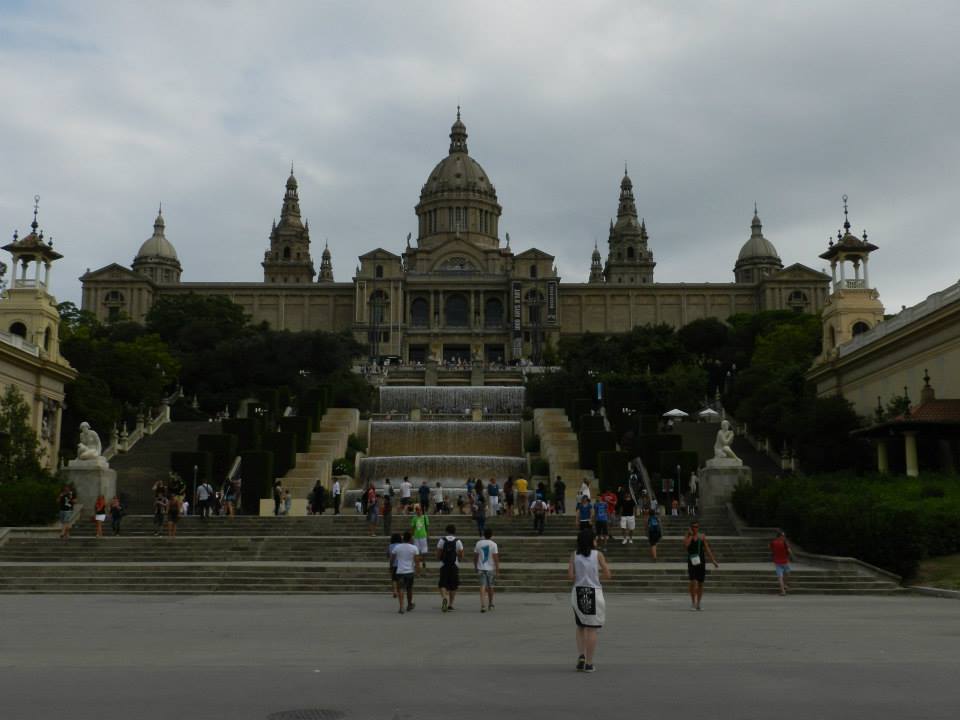
On foot The museum sits at the top of the monumental staircase and escalators rising from Placa d'Espanya, on the north face of the hill of Montjuic
Bus Municipal routes serving Placa d'Espanya and the Montjuic hillside stop within a short walk of the building - Website
- museunacional.cat/en
- Telephone
- +34 93 622 03 60
Before you go how long, access, photography, bags, eating, shop
- How long to allow
- A full circuit from the Romanesque apses to the Modern Art rooms and the rooftop viewpoint runs to a half day; the general ticket's two-day validity within a month is aimed at exactly that scale of visit
- Access
- Toilets adapted for reduced mobility in the foyer, the Sala Oval and the library; hearing loops at the ticket and information desks and at library reception; individual magnetic loops for hearing-aid users; prams, folding chairs and wheelchairs on loan from the cloakroom
- Photography
- Not stated on the museum's own visitor-services page at the date read
- Bags
- Any item larger than 35 x 35 x 25cm, and any sharp object, must be left in the cloakroom; the museum accepts no responsibility for items deposited there
- Eating
- Oval Cafe on the ground floor, open through museum hours; Absis restaurant on the first floor
- Shop
- Two shop counters on site, selling catalogues, books, postcards and gifts
Prices and hours change. We take them from the institution's own pages and print the day we read them, and you can check the current position at the source we used. Confirm before you travel.
What is inside
The Romanesque rooms
Apses, altar frontals and wall paintings taken from small Pyrenean churches in Lleida province between 1919 and 1923, reassembled at the scale and in the layout of the buildings they came from. The apse of Sant Climent de Taull, with its Pantocrator, is the centrepiece; the apse of Santa Maria de Taull and a run of altar frontals from the same valleys surround it. This is described by the museum's own sources as the most complete collection of Romanesque mural painting anywhere.
The Sijena Chapter House room
A separate group of murals from the chapter house of the Royal Monastery of Sijena in Aragon, painted around 1200, badly burned in 1936, transferred to canvas and installed here from 1961. It is shown apart from the Pyrenean Romanesque rooms because it is a distinct, still-disputed body of material rather than part of the same 1919-1923 rescue.
Gothic and the Cambo Bequest
Catalan Gothic altarpieces by Bernat Martorell, Jaume Huguet, Lluis Borrassa and Lluis Dalmau lead into the Renaissance and Baroque rooms built largely around the bequest of the politician and collector Francesc Cambo, assembled between 1927 and 1936: Italian quattrocento and cinquecento painting, Titian and Sebastiano del Piombo, Rubens, Cranach, Tiepolo, Fragonard and Goya.
Modern Art galleries
Catalan painting and design from the mid-nineteenth century to the mid-twentieth: Maria Fortuny, the Modernisme generation of Ramon Casas and Santiago Rusinol, and decorative arts and furniture through the interwar years, with rooms added on art during the Spanish Civil War.
The entrance hall and rooftop viewpoint
The glazed vestibule under the Palau Nacional's central dome, restored by Gae Aulenti's team from 1990 and reopened in stages through the 1992 Olympic year; a glass wall at the rear frames the view down over the Magic Fountain, Placa d'Espanya and the city to the sea. The rooftop, reached separately, extends the same view further round the building.
Numismatic Cabinet
The Gabinet Numismatic de Catalunya, a coin and medal collection built up from several older Barcelona collections and now counted among the largest of its kind in Europe, shown in a dedicated study gallery rather than folded into the painting rooms.
What to see first
Apse of Sant Climent de Taull (the Pantocrator)
Master of Taull, c. 1123The single image the museum is known for: a Christ in Majesty painted for a small Pyrenean church, detached by the strappo technique in the 1919-1923 rescue campaign and rebuilt here at its original scale and curvature.6
Apse of Santa Maria de Taull
Anonymous Romanesque workshop, 12th centuryTaken from the same valley and the same rescue campaign as the Sant Climent apse; the two together are the core of the Romanesque rooms.6
Chapter House murals from the Royal Monastery of Sijena
Anonymous, Aragon, c. 1200Moved to Barcelona for safekeeping during the 1936 civil war, restored and transferred to canvas, on view since 1961, and now the subject of a Spanish Supreme Court order that MNAC return them to Aragon, which the museum has not complied with.8
La Vicaria (The Spanish Wedding)
Maria Fortuny, 1870The museum's own account names this as one of its star nineteenth-century paintings, a large, crowded genre scene that made Fortuny's reputation.9
The Cambo Bequest paintings
Titian, Sebastiano del Piombo, Rubens, Cranach the Elder, Tiepolo, Fragonard, Goya and othersFifty paintings assembled by the politician Francesc Cambo between 1927 and 1936 specifically to bridge the gap between the museum's medieval Catalan holdings and its modern collection, left to the museum on his death.9
Altarpiece of Saint Vincent and Saint Eulalia
Bernat Martorell, 15th centuryA principal work of Catalan Gothic painting, shown with Martorell's scenes of the martyrdom of the two saints in the room the museum devotes to him.9
Ramon Casas i Pere Romeu en un tandem
Ramon Casas, 1897The best-known image of Barcelona Modernisme's own self-mythology, the painter and his business partner shown riding out from the cafe Els Quatre Gats they ran together.6
The Gabinet Numismatic de Catalunya
Multiple mints and periodsA coin and medal cabinet built from several older Barcelona collections, counted among the largest numismatic holdings in Europe and shown in its own study gallery rather than as a footnote to the paintings.6
Exhibitions on now
- On now7 May to 31 Dec 2026Confirmed , 8 weeks ago
Past exhibitions here
- Closed20 Feb to 4 Oct 2026Confirmed · check before you travel
A palace built for an exhibition, not a museum
The building the museum occupies was never designed to hold a permanent collection. The Palau Nacional was raised on the north face of Montjuic for the 1929 International Exposition, an exhibition palace in the Italianate manner with a central dome intended to be seen from Placa d'Espanya and the avenue leading up to it. A modest municipal art collection had existed since 1891, in the aftermath of the 1888 Universal Exhibition, but the project to gather Catalonia's art into the Palau Nacional itself was only launched in 1934, under the direction of Joaquim Folch i Torres, and was cut short within two years by the Spanish Civil War.
What followed was decades of partial use and partial renovation rather than a single opening day. The Oval Hall under the dome was restored by the architects Gae Aulenti and Enric Steegmann, joined later by Josep Benedito Tobias, and reopened for the 1992 Barcelona Olympics, whose medal ceremonies used the space. The museum did not present its collections as one integrated building until a further, larger reopening in December 2004. A reader who assumes the grand Beaux-Arts facade dates the institution inside it will be off by most of a century.
The largest collection of Romanesque mural painting in the world, and how it got here
The museum's own account of its Romanesque rooms starts with a sale, not a rescue. In 1919 it emerged that the wall paintings of the church of Santa Maria de Mur, in Pallars Jussa, had been sold to an American dealer and shipped out of Catalonia to Boston. That sale alarmed Catalonia's Board of Museums, which concluded that the rest of the region's Romanesque mural painting, scattered across small, poorly resourced parish churches in the Pyrenees, was at the same risk. Between 1919 and 1923 the board, under Folch i Torres, ran a campaign to detach the murals of a series of these churches and bring them to Barcelona, using the strappo technique: only the painted plaster surface is removed, leaving the underlying wall intact.
The museum's own framing of this history, published on its own site, is unambiguous: a rescue that prevented a second Boston. What that framing leaves less room for is the argument, made at the time and periodically since, that strappo removal is itself a form of loss - the murals survive, but as museum objects reassembled on false armatures at Montjuic, detached from the buildings, the light and the liturgical use they were painted for. The apses of Sant Climent and Santa Maria de Taull are the most complete result of that campaign anywhere, and they are also the clearest surviving case of the preservation-versus-removal argument that ran through European conservation practice for most of the twentieth century, argued out in real churches rather than in the abstract.
The Sijena murals: a second removal, still contested
A second, unrelated body of Romanesque wall painting sits in its own room at MNAC, and it should not be read as part of the same 1919-1923 campaign. The chapter house murals of the Royal Monastery of Sijena, in Aragon, were painted around 1200 and badly damaged by fire when anarchist militias burned the monastery during the civil war in 1936. In the emergency of that year the surviving paintings were moved to Barcelona for safekeeping, later restored and transferred onto canvas, and have hung at MNAC since 1961.
The legal position changed in May 2025, when Spain's Supreme Court ordered the museum to return the murals to the monastery in Aragon, setting a one-month deadline. MNAC missed it, and by the date this page was researched a Huesca court had set a further deadline of May 2027. The museum's director, Pepe Serra, has argued publicly that dismantling the murals for transport risks the paint layer itself, citing conservation reports from August and September 2025 on existing paint damage and the risks of vibration and climate change in transit; he dismissed one proposal to split the murals into 74 transportable pieces in blunt terms. Aragon's regional government has accused the museum of negligence and a lack of diligence in caring for work that does not belong to it, and the dispute escalated in November 2025 when the municipality of Villanueva de Sijena tried to stop a concert at MNAC on the grounds that the vibration could harm the murals, and threatened a defamation claim against Serra over remarks he made in the row. Nothing on the museum's own visitor pages mentions any of this; a reader who wants the full picture of what is, in effect, an unresolved restitution case involving one of the rooms they are about to walk into has to look outside the institution for it.
Gothic altarpieces and a bequest built to fill a gap
The Gothic rooms hold work by the artists who defined Catalan painting after the Romanesque period lost ground to the new Italian-influenced style: Bernat Martorell, Jaume Huguet, Lluis Borrassa and Lluis Dalmau, most of it altarpiece panels taken down from parish and cathedral settings across Catalonia over the same decades that supplied the Romanesque rooms. Martorell's altarpiece of Saint Vincent and Saint Eulalia, with its scenes of both saints' martyrdoms, is the room's anchor.
The collection then jumps three centuries in one bequest. Francesc Cambo, a Catalan politician who served in national government and built a private fortune alongside his political career, assembled a collection of European painting between 1927 and 1936 specifically to give the museum what it otherwise lacked: a Renaissance and Baroque holding to sit between its medieval Catalan strength and its modern Catalan strength. Titian and Sebastiano del Piombo represent the Venetian cinquecento; Rubens, Cranach the Elder, Tiepolo, Fragonard and Goya carry the collection through the following two centuries. Cambo left the fifty paintings to the museum on his death in 1947, and the bequest still does the structural job he built it for: without it, the museum's chronology would run from Catalan Gothic panels straight to nineteenth-century Barcelona with nothing European in between.
Modernisme, the Numismatic Cabinet, and what is still being shaped
The Modern Art rooms carry the collection from Marian Fortuny's large-scale genre painting of the 1860s and 1870s through to the Modernisme generation that made fin-de-siecle Barcelona a byword for the style: Ramon Casas, whose double portrait of himself and his business partner Pere Romeu riding out from their cafe Els Quatre Gats has become the collection's own shorthand image, and Santiago Rusinol alongside him. Decorative arts and design carry the same rooms into the interwar period, and newer galleries add material on art produced during the Spanish Civil War itself.
Two parts of the collection sit outside this main chronological run entirely. The Gabinet Numismatic de Catalunya, a coin and medal cabinet drawn from several older Barcelona collections, is shown in its own study gallery and is counted among the largest such holdings in Europe, a scale most visitors walking past the paintings never learn about. The museum's own current strategy documents describe photography, and the postwar and second-avant-garde periods generally, as parts of the collection that are still being shaped rather than finished - an unusually direct admission from an institution more often inclined to present everything on its walls as settled.
What visitors say
We publish no visitor review prose and no invented consensus. TripAdvisor's own aggregate for the attraction, read on the date below, put it at 4.6 of 5 from 7,454 ratings, ranked 30th of 1,551 things to do in Barcelona. Recurring themes in what is visible on that listing and in press coverage are the building and the view rather than any single gallery, and, on the institutional side, the museum's public refusal so far to comply with a Supreme Court order over the Sijena murals.
What is praised, what is criticised
- Praised: the Palau Nacional building itself, and the view over the Magic Fountain and the city from the entrance hall and rooftop
- Praised: the scale and completeness of the Romanesque rooms, built at the size and curvature of the original church apses
- Praised: free entry every Saturday afternoon and the first Sunday of the month, and unconditional free entry under 16
- Criticised: MNAC's own director has publicly refused to return the Sijena Chapter House murals after Spain's Supreme Court ordered it to do so in May 2025, citing conservation risk; Aragon's regional government has accused the museum of negligence and lack of diligence in that dispute
- Criticised: the removal of the Pyrenean Romanesque murals by strappo in 1919-1923, while framed by the museum as a rescue from sale abroad, is itself argued by some conservators and by the source villages as an extraction the buildings never fully recovered from
- Criticised: the museum charges separately for a basic building-only ticket and a full collection ticket, which visitors relying on search listings for a single headline price have been caught out by
Ratings on other platforms
TripAdvisor: 4.6 from 7,454 ratings, read 7 August 2026
A platform average is a tertiary source: it moves, it is not audited, and we quote no visitor's words.
Questions about Museu Nacional d'Art de Catalunya
Where is Museu Nacional d'Art de Catalunya?
Palau Nacional, Parc de Montjuic, s/n, 08038 Barcelona, Spain.
How much does it cost to visit?
General: EUR 12; Basic: EUR 2; Under 16: free; Over 65, EU resident: free; Students of Art History, teachers, ICOM members, tourist guides, accredited unemployed, disability cardholders: free. As confirmed 26 August 2026.
When is it open?
Tuesday-Saturday, October-April 10:00-18:00; Sunday and public holidays, October-April 10:00-15:00; Tuesday-Saturday, May-September 10:00-20:00; Sunday and public holidays, May-September 10:00-15:00; Monday closed. Closed: 1 January, 1 May and 25 December every year. Ticket offices close 30 minutes before the museum itself. As confirmed 26 August 2026.
How do you get there?
Metro: Espanya (L1, L3, L8 and FGC), about a ten-minute walk up through the Fira grounds and past the Magic Fountain; On foot: The museum sits at the top of the monumental staircase and escalators rising from Placa d'Espanya, on the north face of the hill of Montjuic; Bus: Municipal routes serving Placa d'Espanya and the Montjuic hillside stop within a short walk of the building.
What should you see first?
Apse of Sant Climent de Taull (the Pantocrator) (Master of Taull, c. 1123); Apse of Santa Maria de Taull (Anonymous Romanesque workshop, 12th century); Chapter House murals from the Royal Monastery of Sijena (Anonymous, Aragon, c. 1200); La Vicaria (The Spanish Wedding) (Maria Fortuny, 1870); The Cambo Bequest paintings (Titian, Sebastiano del Piombo, Rubens, Cranach the Elder, Tiepolo, Fragonard, Goya and others); Altarpiece of Saint Vincent and Saint Eulalia (Bernat Martorell, 15th century).
What we could not confirm
- Whether MNAC will comply with the Supreme Court's order to return the Sijena chapter house murals before the Huesca court's May 2027 deadline, or whether the dispute runs further; the museum's public position as of April 2026 was still refusal on conservation grounds.
- Whether any of the villages the Pyrenean Romanesque murals were taken from between 1919 and 1923 have an active claim of their own, distinct from the Sijena case, which this research did not find evidence of but which the strappo-removal literature raises as a live question in principle.
- The museum's own strategy papers describe its postwar, second-avant-garde and photography holdings as still being shaped; what that collection will look like once it is not is not yet stated.
Images
Sources
- 1Museu Nacional d'Art de Catalunya, Opening hours and prices: winter and summer hours, closed days, every admission tier, free-admission conditions and combined tickets. Read 7 August 2026. museunacional.cat/en/opening-hours-and-prices
- 2Museu Nacional d'Art de Catalunya, Visitor services: phone number, accessibility provisions, cafe and shop, cloakroom and bag policy, group booking requirement. Read 7 August 2026. museunacional.cat/en/visitor-services
- 3Museu Nacional d'Art de Catalunya, home page: contact phone and address, and confirmation the museum is operating. Read 7 August 2026. museunacional.cat/en
- 4Wikidata, Museu Nacional d'Art de Catalunya (Q861252): coordinates, country and inception date, used as the and cross-checked against the museum's own address. wikidata.org/wiki/Q861252
- 5Wikipedia, Museu Nacional d'Art de Catalunya: building history, the 1990s Aulenti renovation, the 1992 reopening of the Oval Hall and the December 2004 full reopening, source for the institutional timeline. en.wikipedia.org/wiki/Museu_Nacional_d%27Art_de_Catalunya
- 6Museu Nacional d'Art de Catalunya, The technique of mural painting: taking down, transferring and arrival in the museum: the strappo technique, the Santa Maria de Mur sale to Boston, and the 1919-1923 campaign under Joaquim Folch i Torres. Read 7 August 2026. museunacional.cat/en/technique-mural-painting-taking-down-transferring-and-arrival-museum
- 7TripAdvisor, Museu Nacional d'Art de Catalunya attraction page: address, walking distance to Espanya metro, and the aggregate rating of 4.6 from 7,454 reviews. Read in the in-app browser, 7 August 2026. tripadvisor.com/Attraction_Review-g187497-d257527-Reviews-Museu_Nacional_d_Art_de_Catalunya-Barcelona_Catalonia.html
- 8The Art Newspaper, 'Barcelona museum refuses to return Sijena murals to monastery', 16 April 2026: the Supreme Court's May 2025 order and missed deadline, director Pepe Serra's public comments, the conservation reports, and Aragon's negligence accusation and threatened defamation claim. theartnewspaper.com/2026/04/16/barcelona-museum-refuses-to-return-sijena-murals-to-monastery
- 9Museu Nacional d'Art de Catalunya and secondary museum-guide coverage of the permanent collection, cross-checked across sources, for the Cambo Bequest artist list (Titian, Sebastiano del Piombo, Rubens, Cranach, Tiepolo, Fragonard, Goya), Fortuny's La Vicaria, and Bernat Martorell's altarpiece of Saint Vincent and Saint Eulalia in Room 32. museunacional.cat/en/collection
- 10Wikimedia Commons, Category:Museu Nacional d'Art de Catalunya and Category:Interior of Museu Nacional d'Art de Catalunya: the plates on this page, each from .LicenseShortName and each image downloaded and inspected before use. commons.wikimedia.org/wiki/Category:Museu_Nacional_d%27Art_de_Catalunya