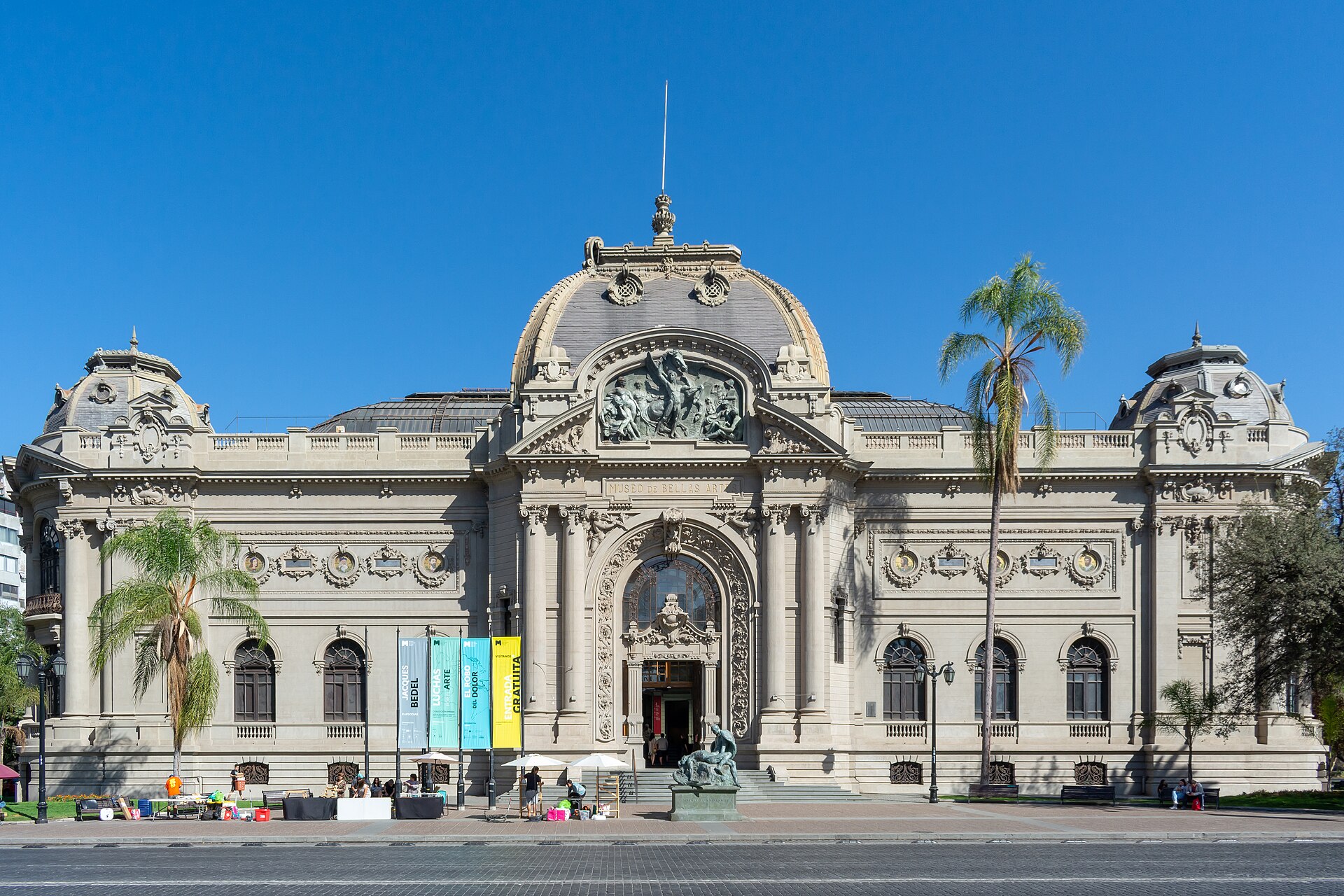
The main facade of the Palacio de Bellas Artes on Parque Forestal, built to a design by Emile Jequier and opened for Chile's 1910 centenary.
Carlos Figueroa Rojas · Photograph by Carlos yo · CC BY-SA 4.0Museo Nacional de Bellas Artes
Museum · Founded 1880
Open, admission and hours confirmed 24 August 2026 · 15 sources
On this page 16 sections
ContentsClose
The museum's real strength is depth in Chilean painting and sculpture from the colonial period to the present, built up through Salon-era acquisition and two large twentieth-century gifts, set beside a smaller but genuine European survey - Spanish, Flemish, Dutch, French and Italian - that gives the Chilean material something to be measured against. What it does not have is room: with a collection above 5,000 pieces and only a slice of it on view at any time, the museum functions less as a fixed permanent hang and more as a rotating selection from an archive most of which stays in storage.
| Kind | Museum |
|---|---|
| Founded | 1880 |
| City and country |  Santiago, Chile Santiago, Chile |
| Address | Jose Miguel de la Barra 650, Parque Forestal, Santiago, Chile |
| Website | mnba.gob.cl |
| Status | Open, confirmed |
| Record last verified |
Visiting
- Hours
- Tue-Sun10:00 to 18:30Last entry 18:20
- Closed
- Monday. 1 January. Good Friday. 1 May. 18-19 September. 25 December.
- Admission
- General admissionFreeFree for all visitors; the museum is a public institution of the National Cultural Heritage Service (Servicio Nacional del Patrimonio Cultural)
Free entry: Every open day - admission is free year-round, with no separate free-day schedule- Do I need to book?
- No advance booking needed for individual visitors; groups of 10-20 need 48 hours notice for a guided tour
- Address
- Jose Miguel de la Barra 650, Parque Forestal, Santiago, Chile MapMetro Linea 5, Estacion Bellas Artes, about two minutes on foot
Bus Public transit stops on Merced, Santo Domingo, Miraflores and Bellavista streets
Car Paid underground parking on Jose Miguel de la Barra between Monjitas and Merced - Website
- mnba.gob.cl
- Telephone
- +56 2 2997 8700
- [email protected]
Before you go how long, access, photography, bags, eating, shop
- How long to allow
- Two to three hours to see both floors; several visitors report closer to two and a half hours to cover every room
- Access
- One wheelchair lift serves the building, entered from Ismael Valdes Vergara street; as of the last check it was reported temporarily out of service, and there is an accessible restroom on the first floor
- Photography
- Personal, non-flash photography is described as permitted on the museum's current visitor page; professional cameras, tripods and lighting need prior authorisation. An older service page on the same site instead states that cameras and video are barred inside the exhibition rooms altogether - see notes_for_editor
- Bags
- Large bags, backpacks and umbrellas are not allowed in the galleries; lockers are provided at the entrance
Prices and hours change. We take them from the institution's own pages and print the day we read them, and you can check the current position at the source we used. Confirm before you travel.
What is inside
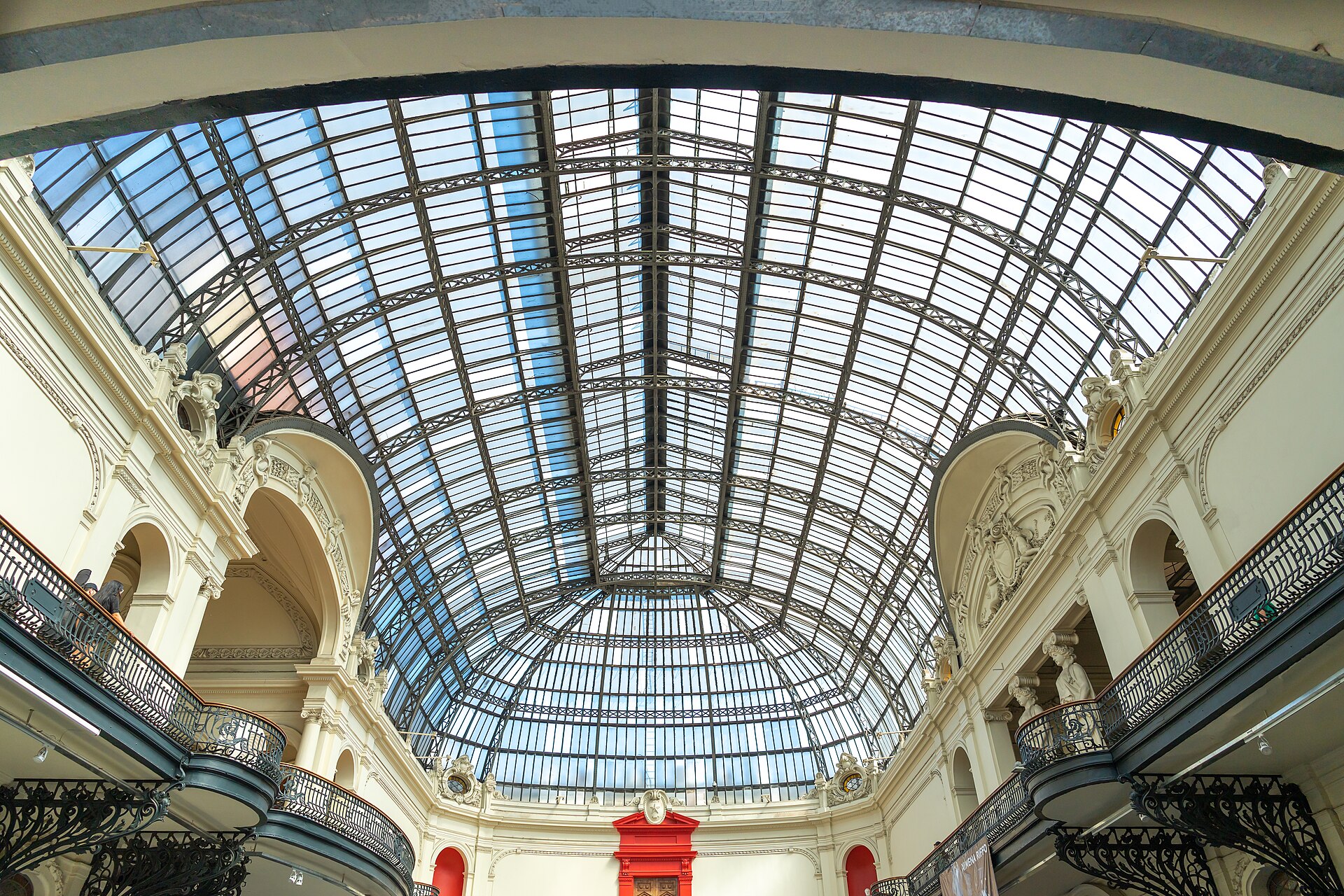
Photograph by Rjcastillo · CC BY-SA 4.0 Central Hall and glass dome
The building's covered central hall, roofed by a glass and cast-iron dome shipped from Belgium in 1907 and weighing about 115 tonnes assembled. This is the axis the whole floor plan turns around, with the grand staircase and the main sculpture displays beneath it.
Chilean Collection galleries
Nineteenth- and twentieth-century Chilean painting and sculpture: colonial and Andean religious works, academic portraiture and landscape from the Salon era, and the modern generation running through Juan Francisco Gonzalez, Alfredo Valenzuela Puelma and the artists of the 1913 generation.
International Collection galleries
Spanish, Flemish, Dutch, French and Italian holdings from the 15th to the 20th century, together with a set of non-Western pieces - Japanese kakemonos and prints, and West African sculpture from Senufo and Yohure carvers.
Sala Matta
A basement gallery built in 1970-1971 under director Nemesio Antunez and named for Roberto Matta; it is used for the museum's contemporary and twentieth-century programme and was itself renamed during the military dictatorship because of Matta's politics.
Paulonia sculpture terrace
One of the building's exterior terraces, reopened to the public as an outdoor sculpture setting that connects the museum physically to the surrounding Parque Forestal.
Library and documentation centre (CEDOC)
The museum's specialised art library and documentation centre, cited at roughly 100,000 volumes, serving researchers and supporting the museum's print and drawing holdings, including the 17th-century Codice Bonola album of 131 drawings.
What to see first
El huaso y la lavandera
Johann Moritz RugendasCited by the museum's own sources as its single most recognised painting, a genre scene by the German-born chronicler of 19th-century Chilean life14
Unidas en la Gloria y en la Muerte
Rebeca MatteThe museum's best-known sculpture, an allegorical marble group by one of the few women sculptors given major public commissions in early-20th-century Chile14
Portrait of Don Pablo Burchard
Pedro LiraA defining oil by the painter who also sat on the museum's own governing board in the 1880s and 1890s and helped shape its early Chilean holdings14
Virgen con el nino
Bartolome Esteban MurilloThe museum's Spanish Golden Age holding, alongside works attributed to Francisco de Zurbaran, forming the core of its European religious painting14
Selection of Roberto Matta paintings
Roberto MattaA group of major canvases by the Chilean Surrealist shown in the basement room built for him in 1970-1971 and renamed during the dictatorship because of his politics14
Codice Bonola
Unknown 17th-century Italian draughtsmenAn album of 131 drawings held by the museum's documentation centre, one of the few holdings of this kind in a South American national collection14
Retrato de mi hermana
Francisco MandiolaA 19th-century Chilean portrait damaged by gunfire in the September 1973 attack on the building, later restored and shown alongside the museum's own 2014 exhibition on the episode12
Japanese kakemono scroll paintings
VariousA set of 46 kakemonos and 27 prints donated to the museum in 1968, an unusual non-Western holding for a Latin American national fine arts museum14
Past exhibitions here
- Closed29 May to 6 Sep 2026Confirmed · check before you travel
A museum before it had a home
The Museo Nacional de Bellas Artes was founded on 18 September 1880, under President Anibal Pinto, as the Museo Nacional de Pinturas - the National Painting Museum. The idea came from the sculptor Jose Miguel Blanco, who had argued in a Chilean journal the year before that the country's scattered art works, held piecemeal across institutional buildings, needed a single home on the European model. The painter Juan Mochi became its first director. For its first seven years the collection lived inside the National Congress building, sharing space with the legislature rather than standing as an institution in its own right.
In 1887, coordination problems with Congress forced a move to a building known as the Partenon, in the Quinta Normal de Agricultura, put up by the Union Artistica for its annual exhibitions. The institution took the name it still carries at this point, Museo de Bellas Artes. It would spend more than two decades there, a tenant in a building not built for it, while the state weighed a purpose-built home to mark the coming centenary of Chilean independence.
A palace for the centenary
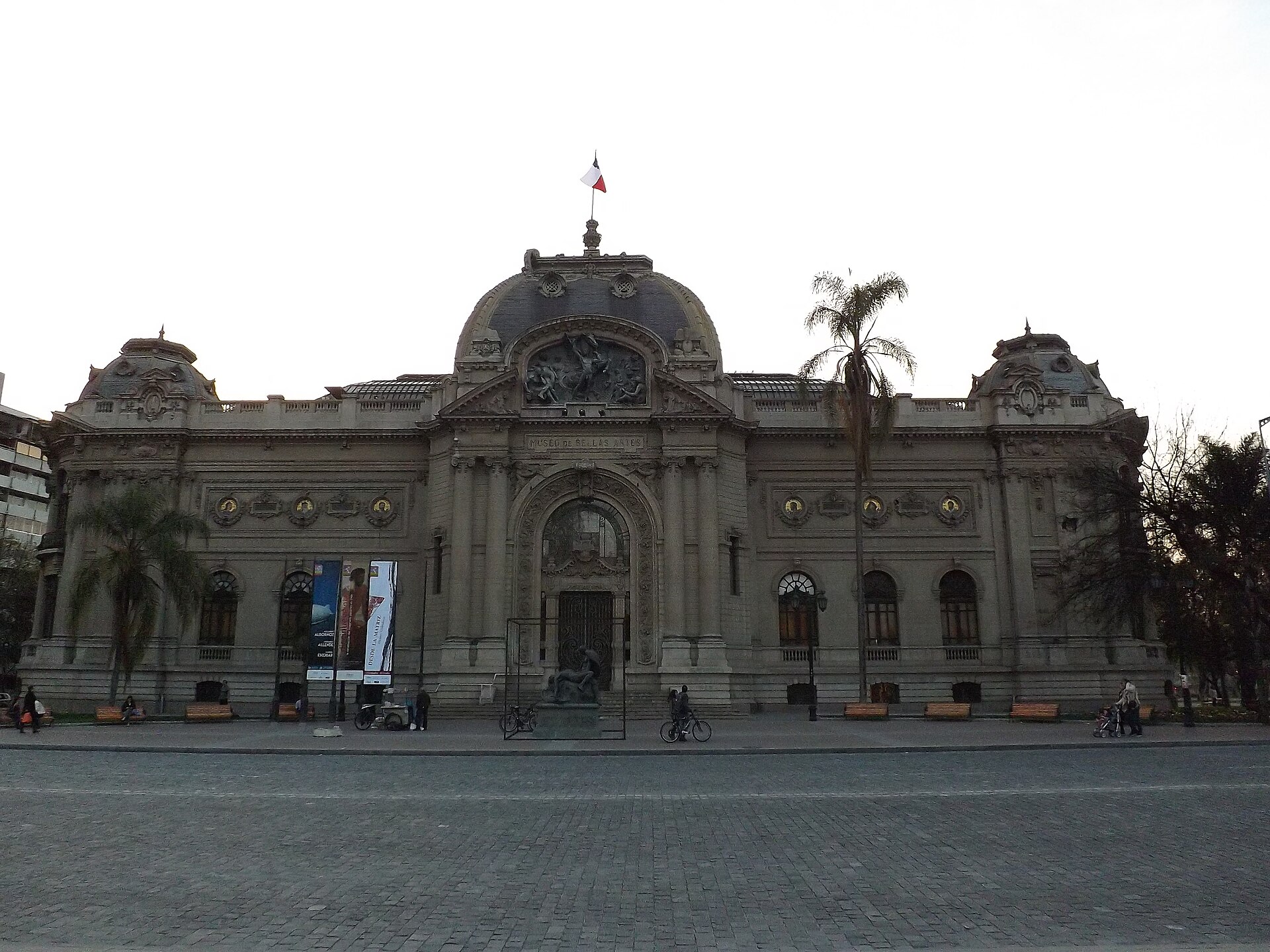
In 1901 the government commissioned the Chilean-French architect Emile Jequier to design a permanent building. Jequier trained at the Ecole Speciale d'Architecture in Paris, and the result draws openly on the Petit Palais, built in that city for the 1900 Exposition Universelle: a French academic facade, a plan organised around a central hall and grand staircase, and a glass dome over the whole. The Palacio de Bellas Artes opened on 21 September 1910, timed to the centenary of Chile's declaration of independence, and its opening exhibition brought in work from fourteen countries.
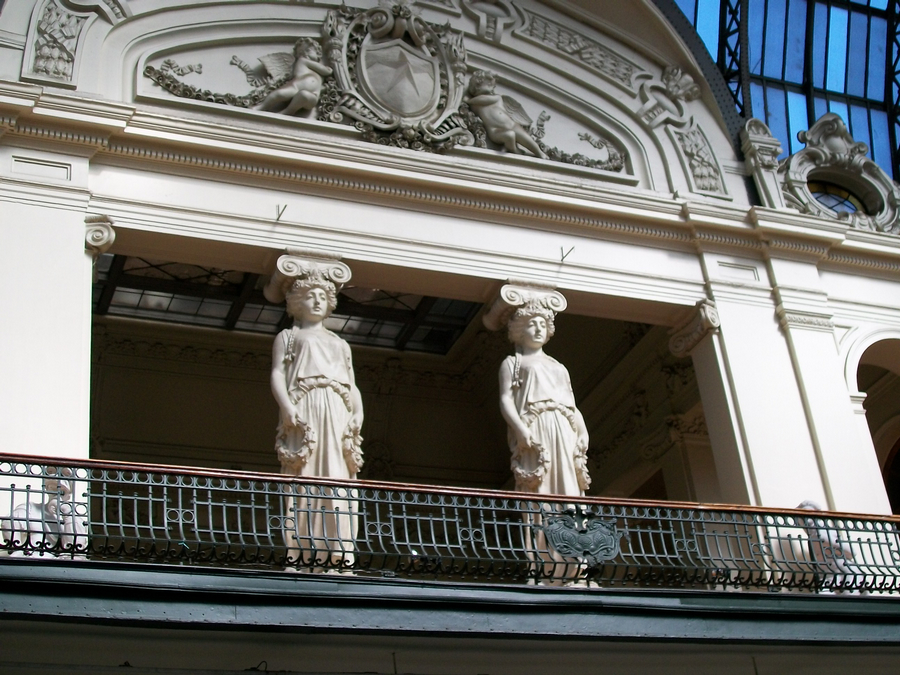
The building's central feature is its dome: cast iron and glass, manufactured in Belgium, shipped in pieces and raised on site in 1907 ahead of the wider building's completion, with a finished structure weighing on the order of 115 tonnes. The facade carries an allegorical relief by the sculptor Guillermo Cordova above the entrance, two caryatids by Antonio Coll y Pi, and twenty-two ceramic medallions with the portraits of historical artists and architects set into the stonework - Art Nouveau ornament laid over an otherwise neoclassical body. The building was declared a National Historical Monument on 30 December 1976, and it has needed structural reinforcement more than once since: after the 1960 earthquake, and again over three years following the 1985 Santiago earthquake, after which it reopened in September 1988. The 2010 earthquake, by comparison, cost it only broken exterior ornament, with no reported damage to the collection inside.
Chile on its own walls
The museum's Chilean holdings run from the colonial period to the present and account for the larger share of a collection put at somewhere above 5,000 works. The earliest material is religious painting from the Andean highlands, work that mixes European iconography with pre-Hispanic visual habits - pieces associated with painters such as Melchor Perez de Holguin and Gaspar Miguel de Berrio sit in this group. The nineteenth century is carried by academic portraiture and landscape: Francisco Mandiola and Pedro Lira on the portrait side, Thomas Somerscales and Onofre Jarpa in landscape, against a backdrop of neoclassicism and romanticism introduced by visiting Europeans such as Raymond Monvoisin and Johann Moritz Rugendas.
Rugendas is the source of the single work the museum's own material points to most often as its best-known picture, a genre scene of Chilean rural life. Pedro Lira is a case apart: beyond his paintings, he sat on the museum's own governing board between 1887 and 1897 and had co-founded the Sociedad Artistica in 1867 to promote Chilean painting and sculpture in the first place, so his presence in the collection is also a presence in the institution's own early governance. The twentieth century brings in avant-garde and modernist work - Henriette Petit's cubism, and later Nemesio Antunez and Roberto Matta - continuing through to contemporary figures such as Jose Balmes and Gracia Barrios. Two major acquisitions did much to shape this holding: roughly 250 contemporary works bought around the 1910 centenary exhibition, and the 377-piece Luis Alvarez Urquieta collection, acquired in 1939 and weighted heavily toward Chilean art.
The international rooms
Alongside the Chilean galleries the museum keeps a smaller but still substantial international collection, mostly European. The Spanish rooms run from the fifteenth to the twentieth century and include Golden Age names - Francisco de Zurbaran and Bartolome Esteban Murillo among them - through to nineteenth-century figures such as Joaquin Sorolla and Mariano Fortuny. Flemish and Dutch holdings bring in Peter Paul Rubens, Jacob Jordaens, Aelbert Cuyp and Meindert Hobbema; the French rooms carry Camille Corot, Charles-Francois Daubigny and Camille Pissarro in painting, and sculpture by Auguste Rodin and Antoine Bourdelle. Roughly sixty Italian paintings span the fifteenth to twentieth centuries, including work by Giovanni Boldini and Mattia Preti, and the museum's documentation centre holds the Codice Bonola, a seventeenth-century album of 131 drawings.
Beyond Europe, the collection includes forty-six Japanese kakemono scroll paintings and twenty-seven prints, given to the museum in 1968, and fifteen sub-Saharan African sculptures from Senufo and Yohure carvers - an unusual pairing for a Latin American national fine arts museum, and one that sits at the edge of what most visitors expect to find inside a building built to hold Chilean and European academic painting.
Bullets in the galleries
The museum's own published record does not soften what happened to the building during the 1973 coup. On 11 September 1973, the day the coup began, two paintings inside the Palacio de Bellas Artes were damaged by gunfire: La guasa, by Clara Filleul, and Retrato de mi hermana, by Francisco Mandiola. Chilean press reporting and the museum's own account describe a further, larger episode of machine-gun fire directed at the building from military positions outside it in the days that followed. Sergio Berthoud, a photographer, documented the aftermath in eight black-and-white photographs at the order of the museum's then director, Nemesio Antunez.
The museum returned to this episode itself in 2014, opening an exhibition titled La pieza que falta. Impactos, 1973 on 20 November of that year, pairing the damaged works with documentary evidence, expert reports and witness testimony; a documentary film, Impactos, el otro golpe de la dictadura, reconstructed the attack the same year using forensic and eyewitness material. The years that followed the coup were lean ones for the institution more broadly: the Sala Matta, the basement room built for and named after Roberto Matta, was itself renamed during the dictatorship because of Matta's own politics, and museum activity and visitor numbers fell through the 1970s under director Lily Garafulic, who nonetheless established the museum's conservation and restoration laboratory during that period.
One collection, a fraction on the walls
The museum operates under a constraint that shapes almost everything a visitor sees: with a collection put at more than 5,000 pieces and gallery space that was never expanded to match it, only a small share of the holdings - reporting on the institution has put the figure at around one percent - is on view at any one time. Recent directors have responded by rotating thematic exhibitions rather than attempting anything close to a full chronological hang, a choice that shows up directly in visitor comments about rooms being closed or the display feeling thinner than the collection's reputation suggests.
Public funding has been part of this story for decades: reporting on the institution's budget put its annual state allocation at around 800 million Chilean pesos, well behind comparable cultural institutions such as the Centro Cultural Palacio de La Moneda. The museum shares its Parque Forestal site, if not its building proper, with the Museo de Arte Contemporaneo of the University of Chile, originally housed in the adjoining former Escuela de Bellas Artes; a proposal to relocate the contemporary museum to the Quinta Normal and free up more room for the Bellas Artes collection did not go ahead, and the two institutions instead built a connecting corridor between them - which is also, on the visitor evidence, part of why some arrivals are not sure which museum they have walked into.
Visiting today
Entry is free for everyone and does not require booking for individual visitors; groups of ten to twenty need to request a guided tour forty-eight hours in advance through the museum's education team. The museum is open Tuesday to Sunday, with last entry twenty minutes before closing, and closes on Mondays and on a short list of national holidays. Large bags, backpacks and umbrellas are not allowed into the galleries and are left in lockers at the entrance; the museum's current visitor page describes personal, non-flash photography as permitted, with prior authorisation needed for tripods, professional cameras or lighting - a position that does not fully square with an older service page on the same site, which instead bars cameras from the exhibition rooms outright, a discrepancy this record has flagged rather than resolved on the museum's behalf.
A single wheelchair lift, reached from a side entrance on Ismael Valdes Vergara street, serves visitors with mobility impairments, though it was reported out of service at the time of the last check. Guide dogs are welcome throughout. Most visitors report needing two to three hours to see both floors properly, and the museum sits close enough to the Cerro Santa Lucia hill and the Lastarria neighbourhood that it is routinely folded into a longer walk through central Santiago rather than visited as a destination on its own.
What visitors say
Visitors consistently single out the building itself - a glass-domed Beaux-Arts palace built for the 1910 centenary and modelled on the Petit Palais in Paris - and value that entry costs nothing and needs no booking. Many describe a calm, unhurried visit through both floors covering Chilean and international art. The recurring complaint is that the display feels thinner than the collection promises: rooms closed on the day, a sense that only part of the holdings are up, and confusion at the entrance because the museum shares its Parque Forestal building with the separately run Museo de Arte Contemporaneo.
What is praised, what is criticised
- Praised: The Beaux-Arts building itself, its glass dome and grand central hall compared favourably to the Petit Palais in Paris
- Praised: Free admission with no advance booking required for individual visitors
- Praised: The span of the permanent collection, described by more than one visitor as covering over 140 years of Chilean art alongside the European rooms
- Praised: A quiet, well-kept atmosphere that visitors say suits a slow, unhurried walk through the galleries
- Criticised: Some visitors report closed rooms or a display that feels sparse for a national collection, and describe the curation as inconsistent
- Criticised: The shared Parque Forestal address with the adjoining Museo de Arte Contemporaneo leaves some visitors unsure which entrance belongs to which museum
- Criticised: No dedicated museum shop selling books, catalogues or souvenirs tied to the collection, which at least one detailed visitor account flags as a missed opportunity given the depth of the holdings
Ratings on other platforms
Tripadvisor: 4.1 from 2,112 ratings, read 24 August 2026
A platform average is a tertiary source: it moves, it is not audited, and we quote no visitor's words.
Questions about Museo Nacional de Bellas Artes
Where is Museo Nacional de Bellas Artes?
Jose Miguel de la Barra 650, Parque Forestal, Santiago, Chile.
How much does it cost to visit?
General admission: free. As confirmed 24 August 2026.
When is it open?
Tue-Sun 10:00-18:30. Closed: Monday. 1 January. As confirmed 24 August 2026.
How do you get there?
Metro: Linea 5, Estacion Bellas Artes, about two minutes on foot; Bus: Public transit stops on Merced, Santo Domingo, Miraflores and Bellavista streets; Car: Paid underground parking on Jose Miguel de la Barra between Monjitas and Merced.
What should you see first?
El huaso y la lavandera (Johann Moritz Rugendas); Unidas en la Gloria y en la Muerte (Rebeca Matte); Portrait of Don Pablo Burchard (Pedro Lira); Virgen con el nino (Bartolome Esteban Murillo); Selection of Roberto Matta paintings (Roberto Matta); Codice Bonola (Unknown 17th-century Italian draughtsmen).
What we could not confirm
- The museum's own visitor pages disagree on photography rules inside the exhibition rooms - planifica-tu-visita permits personal non-flash photography, while servicios/visita-el-museo bars cameras and video entirely - and neither page is dated, so it is not clear which reflects current policy.
- No current, dated attendance figure has been published by the museum itself since the 386,714 visitors reported for 2009; more recent numbers, if the museum has them, are not on its own site.
- Reporting cites an annual state allocation of about 800 million Chilean pesos, but no year is attached to that figure and the museum's own site does not publish its budget.
Images
Sources
- 1Wikimedia Commons, File:Museo Nacional de Bellas Artes, Santiago 20230311.jpg, licence CC BY-SA 4.0, author Carlos Figueroa Rojas commons.wikimedia.org/wiki/File:Museo_Nacional_de_Bellas_Artes,_Santiago_20230311.jpg
- 2Wikimedia Commons, File:Museo Bellas Artes-Vista Frontal.JPG, licence CC BY-SA 3.0, author Alvaro Vidal commons.wikimedia.org/wiki/File:Museo_Bellas_Artes-Vista_Frontal.JPG
- 3Wikimedia Commons, File:Cupula Museo Nacional de Bellas Artes - A740454.jpg, licence CC BY-SA 4.0, author Rjcastillo commons.wikimedia.org/wiki/File:C%C3%BApula_Museo_Nacional_de_Bellas_Artes_-_A740454.jpg
- 4Wikimedia Commons, File:CariatidesMNBASantiago.jpg, licence CC BY-SA 3.0, author Jofrigerio commons.wikimedia.org/wiki/File:CariatidesMNBASantiago.jpg
- 5Museo Nacional de Bellas Artes, homepage, hours and closure notice, read 24 August 2026 mnba.gob.cl/
- 6Museo Nacional de Bellas Artes, Planifica tu visita, read 24 August 2026 mnba.gob.cl/planifica-tu-visita
- 7Museo Nacional de Bellas Artes, Visita el Museo, read 24 August 2026 mnba.gob.cl/servicios/visita-el-museo
- 8Museo Nacional de Bellas Artes, Historia del Museo, read 24 August 2026 mnba.gob.cl/historia-del-museo
- 9Museo Nacional de Bellas Artes, Museo Nacional de Bellas Artes: Momentos para una historia 1879-1910, read 24 August 2026 mnba.gob.cl/noticias/museo-nacional-de-bellas-artes-momentos-para-una-historia-1879-1910
- 10Museo Nacional de Bellas Artes, Colecciones digitales, read 24 August 2026 mnba.gob.cl/colecciones
- 11Museo Nacional de Bellas Artes, Itinerario de la coleccion del MNBA, read 24 August 2026 mnba.gob.cl/colecciones/itinerario-de-la-coleccion-del-mnba
- 12Museo Nacional de Bellas Artes, La pieza que falta. Impactos, 1973, read 24 August 2026 mnba.gob.cl/noticias/la-pieza-que-falta-impactos-1973
- 13Wikipedia (English), Chilean National Museum of Fine Arts, source, read 24 August 2026 en.wikipedia.org/wiki/Chilean_National_Museum_of_Fine_Arts
- 14Wikipedia (Spanish), Museo Nacional de Bellas Artes (Chile), source, read 24 August 2026 es.wikipedia.org/wiki/Museo_Nacional_de_Bellas_Artes_(Chile)
- 15Tripadvisor, National Museum of Fine Arts attraction page, rating and visitor reviews, source, read 24 August 2026 tripadvisor.com/Attraction_Review-g294305-d314561-Reviews-National_Museum_of_Fine_Arts-Santiago_Santiago_Metropolitan_Region.html


