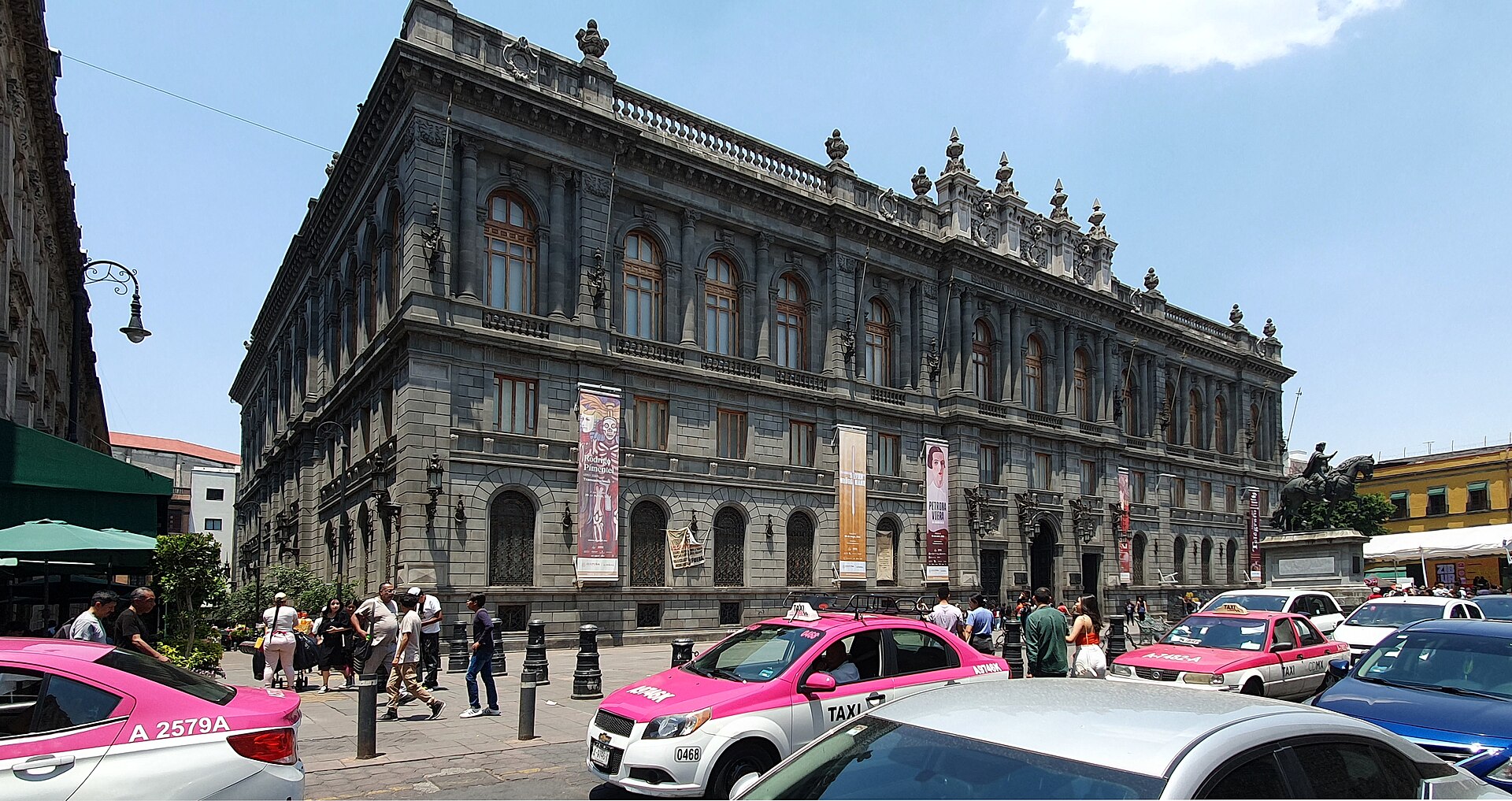
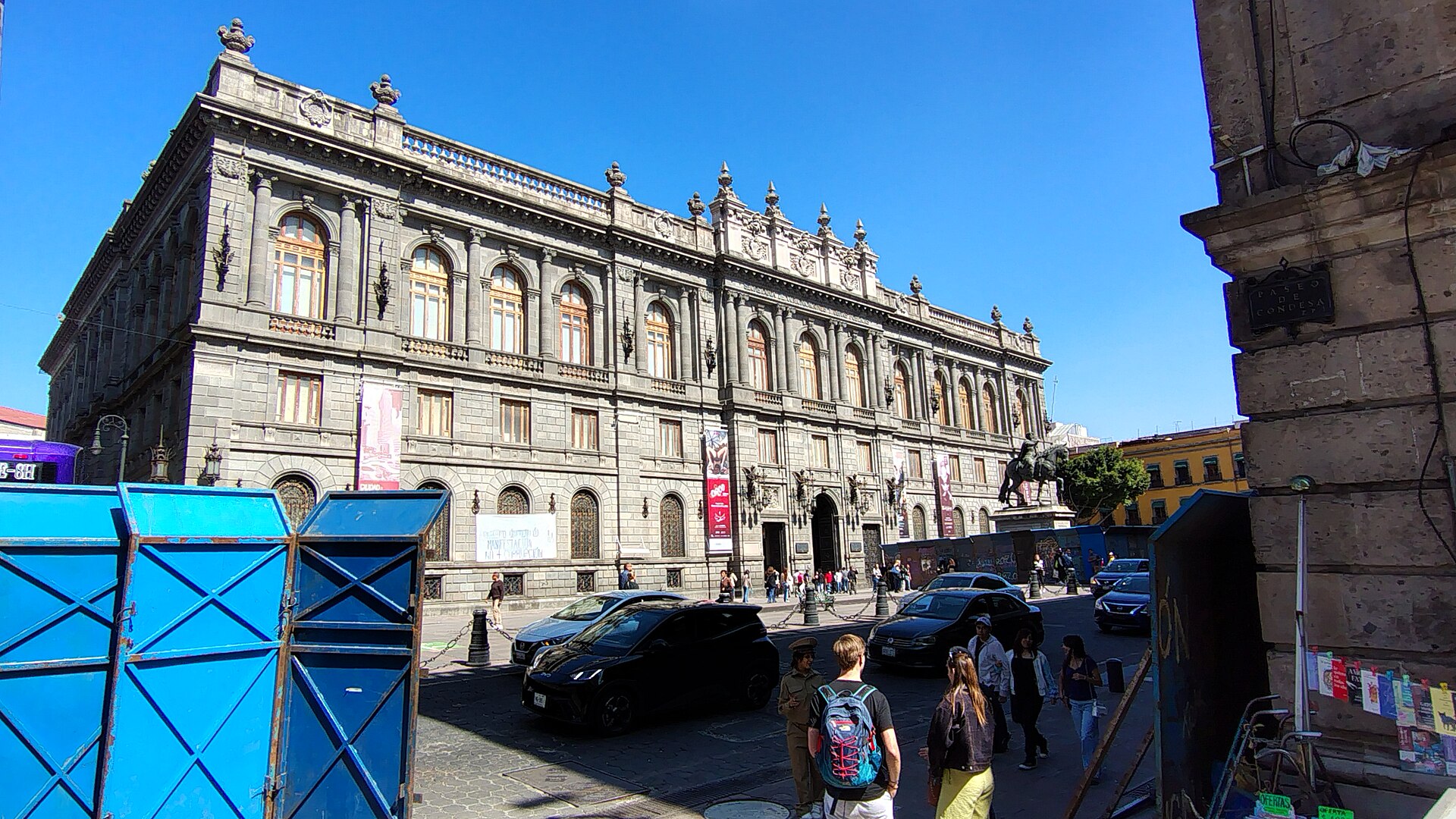
The main facade of the Museo Nacional de Arte on Tacuba street in Mexico City's Centro Historico, photographed in 2024.
Photograph by Jose Luiz, CC BY-SA 4.0, via Wikimedia Commons · Photograph by José LuizMuseo Nacional de Arte
Museum · Founded 1982
Open, admission and hours confirmed 5 September 2026 · 17 sources
On this page 16 sections
ContentsClose
MUNAL's advantage is chronological completeness within one national tradition rather than encyclopedic range: it is the closest Mexico has to a single-building survey of four centuries of its own painting and sculpture, from the mannerist-influenced altarpieces of Andres de Concha in the 1580s through casta painting, academic history painting, Symbolist portraiture and the muralist generation, entirely from Mexican production. Its viceregal rooms are strengthened rather than weakened by their origin: the 290 canvases that arrived from the closed Pinacoteca Virreinal in 2000 came already vetted and catalogued by a dedicated colonial-art institution rather than assembled piecemeal, and its Jose Maria Velasco holdings, close to three hundred oils, watercolors and lithographs, are among the largest concentrations of that painter's work anywhere. What it does not attempt is Mexican art after 1955 or non-Mexican art of any period, both left by design to sister INBAL institutions such as the Museo de Arte Moderno and the Museo Tamayo.
| Kind | Museum |
|---|---|
| Founded | 1982 |
| City and country |  Mexico City, Mexico Mexico City, Mexico |
| Address | Tacuba 8, Centro Historico, Cuauhtemoc, 06010 Ciudad de Mexico, Mexico |
| Website | munal.mx |
| Status | Open, confirmed |
| Record last verified |
Visiting
- Hours
- Tue-Sun10:00 to 18:00last entry 17:30
- Closed
- Monday. January 1. December 25.
- Admission
- General admissionMXN 95paid on site, no advance ticket required
- ICOM membersMXN 47.5050 percent discount off general admission
- Under 13, national teachers and students, INAPAM seniors, persons with disabilitiesFreefree with valid official ID or credential
- Photo or video permit (non-cellphone)MXN 30personal use only; no flash, tripod or extension arm; no professional or commercial sessions; cellphone photography is exempt from this fee
Free entry: Sundays, free for Mexican nationals and foreign residents with a valid FM immigration card- Do I need to book?
- No; general admission is paid on site and no advance ticket is required
- Address
- Tacuba 8, Centro Historico, Cuauhtemoc, 06010 Ciudad de Mexico, Mexico MapMetro Bellas Artes (Lines 2 and 8) or Allende (Line 2), both a short walk south down Tacuba street; the museum faces the Palacio de Mineria across Plaza Manuel Tolsa
- Website
- munal.mx
- Telephone
- +52 55 8647 5430 ext. 5049 / 5067
- [email protected]
Before you go how long, access, photography, bags, eating, shop
- How long to allow
- Reviewers describe the three chronological floors, roughly sixty viceregal paintings on the second floor alone plus the nineteenth and twentieth century rooms, as taking several hours to see properly
- Access
- Free loan of wheelchairs and walkers with official photo ID, Tuesday to Sunday 10:00 to 17:30; strollers up to 100 x 50 x 39 cm admitted, also on free loan with ID
- Photography
- Personal photography without flash is permitted at no charge; a permit for photo or video beyond a cellphone costs 30.00 MXN; tripods, selfie sticks and extension arms are not allowed, and professional or commercial shoots are prohibited
- Bags
- Bags, backpacks or bundles larger than 40 x 40 cm cannot be brought into the galleries; a free coat check (guardarropa) operates Tuesday to Sunday 10:00 to 17:30
- Eating
- No on-site cafe is listed on the museum's own visit page as of September 2026
- Shop
- A ground-floor shop sells catalogues, books, magazines and souvenirs during museum hours
Prices and hours change. We take them from the institution's own pages and print the day we read them, and you can check the current position at the source we used. Confirm before you travel.
What is inside
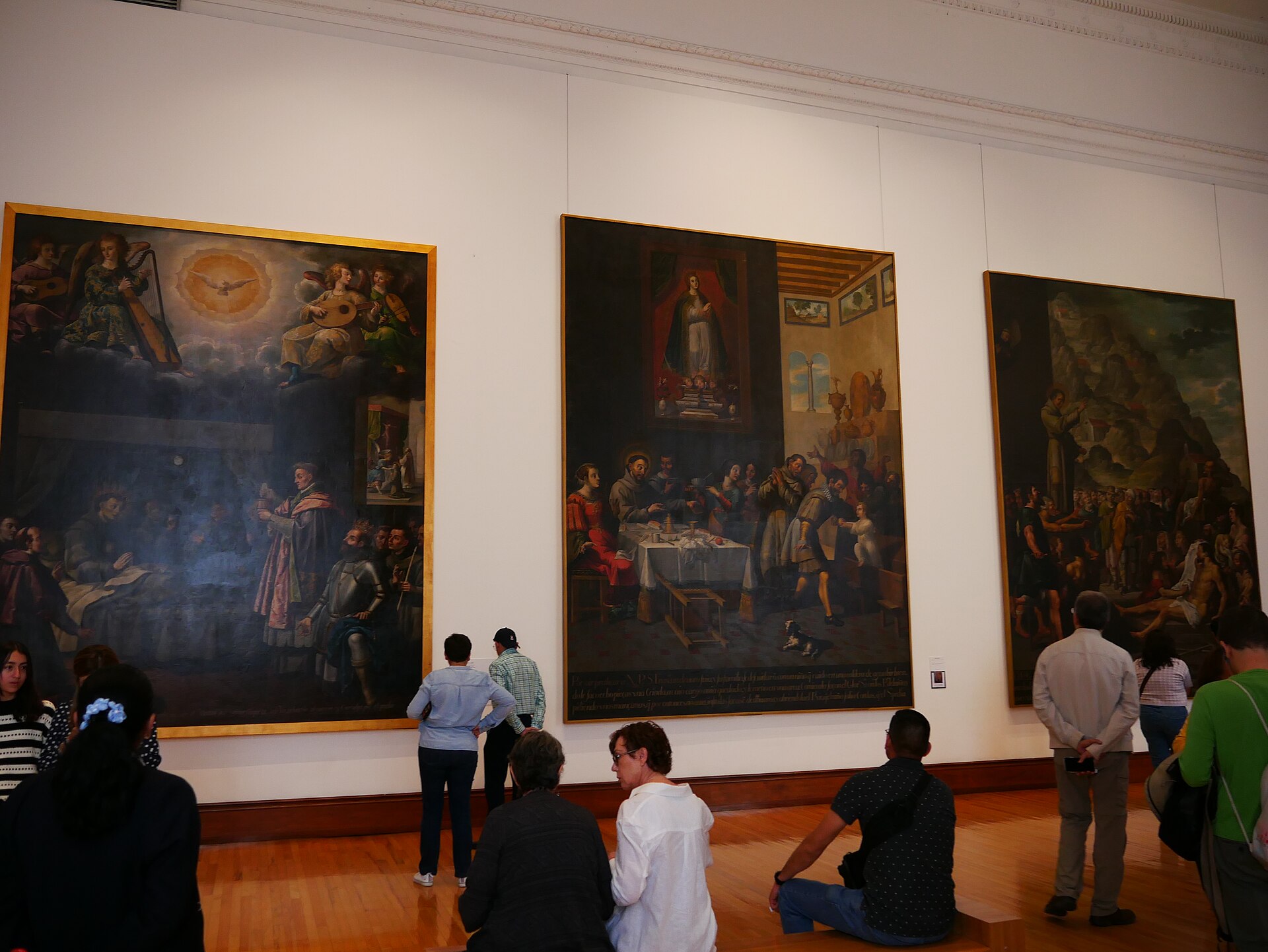
Photograph by Luisalvaz · CC BY-SA 4.0 Asimilacion de Occidente (viceregal painting, 1550-1821)
Second-floor galleries of colonial religious and secular painting; a 2024 renovation put about sixty oils on view spanning the Echave and Juarez painting dynasties, Sebastian Lopez de Arteaga, Andres de Concha, Miguel Cabrera and Cristobal de Villalpando, using portraiture, landscape and casta painting to trace sacred and secular art under Spanish rule. Much of the material arrived in a single 2000 transfer of 290 paintings from the closed Pinacoteca Virreinal.
La Academia de San Carlos: Ilustracion e Independencia
Academic and neoclassical history painting from the new nation's own art academy: Juan Cordero, Santiago Rebull, Felix Parra and Leandro Izaguirre, whose 1893 canvas of the torture of the Aztec leader Cuauhtemoc is among the room's best-known works.
Rooms dedicated to Romanticism, Symbolism and Decadentism
Sixteen works by German Gedovius, Angel Zarraga, Julio Ruelas, Antonio Fabres and other turn-of-the-twentieth-century Mexican modernists, renewed in January 2025 around exotic landscapes, mythology, death and eroticism borrowed from European Symbolism.
Territorio Ideal: Jose Maria Velasco
A permanent room devoted to the landscape painter Jose Maria Velasco, curated by Victor Rodriguez Rangel, including views such as La Alameda de Mexico and Catedral de Oaxaca; Velasco produced close to three hundred paintings, watercolors and lithographs over his career, applying a naturalist's eye to volcanoes, aqueducts and the advancing railway.
XX en el XXI: twentieth-century Mexican art, 1910-1955
The museum's collecting mandate ends at 1955, covered here through Saturnino Herran, Diego Rivera, Jose Clemente Orozco, David Alfaro Siqueiros, Gerardo Murillo (Dr. Atl), Joaquin Clausell, Roberto Montenegro, Manuel Rodriguez Lozano and Rufino Tamayo.
Gliptoteca: De la piedra al barro (sculpture, 19th-20th century)
Mexican sculpture from Manuel Vilar's 1851 plaster Tlahuicole through Jesus F. Contreras's 1898 marble Malgre tout to Manuel Felguerez's 1954 bronze El flechador, his last figurative work before he turned to abstraction.
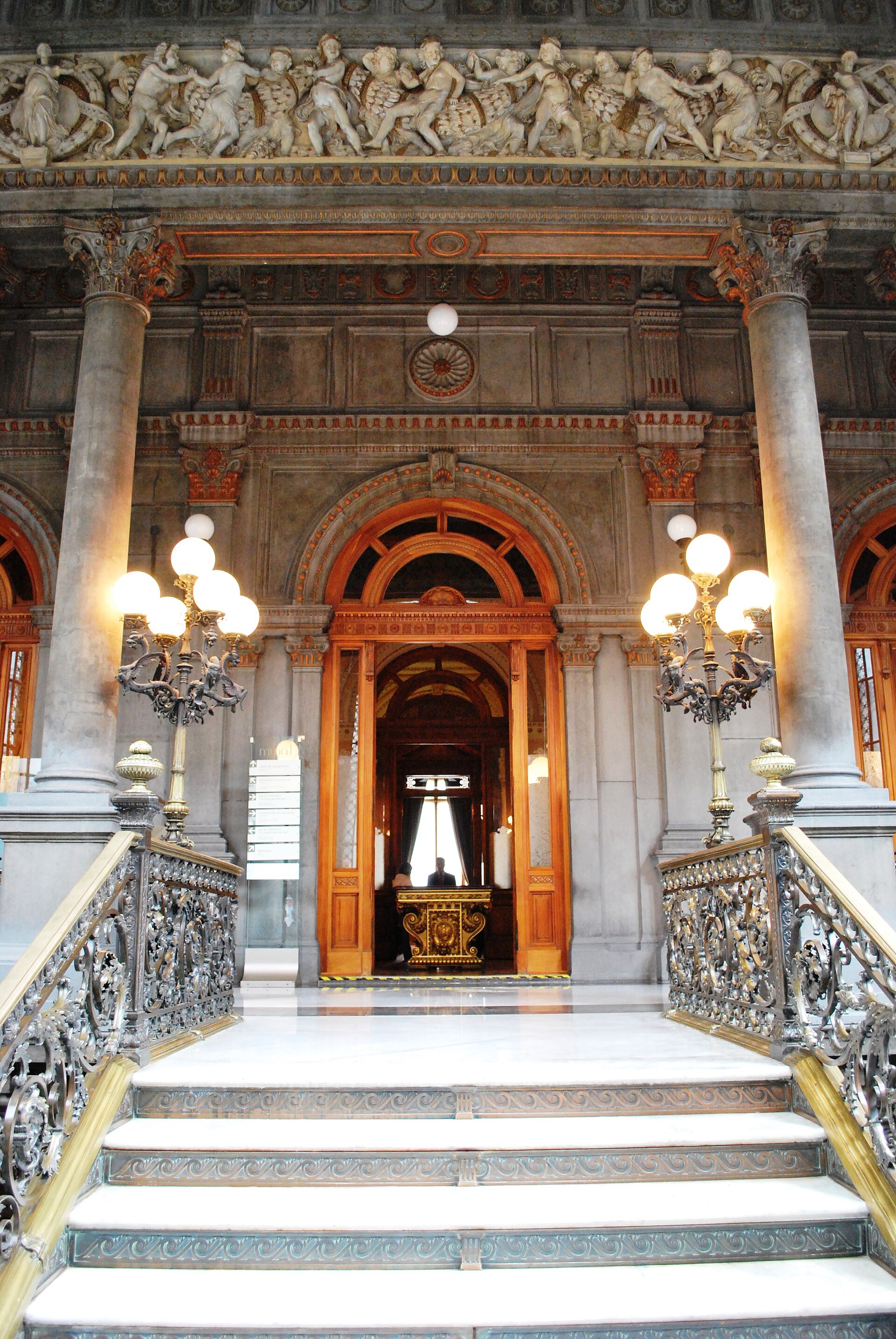
Photograph by AlejandroLinaresGarcia · CC BY-SA 4.0 The Grand Staircase and Reception Hall
The building's own Porfirian ceremonial spaces: a marble staircase with wrought-iron and gilt-bronze balustrades rising to the Salon de Recepciones, a gilded hall with allegorical murals built for state functions under the old Secretaria de Comunicaciones y Obras Publicas and now shown to visitors as part of the museum itself.
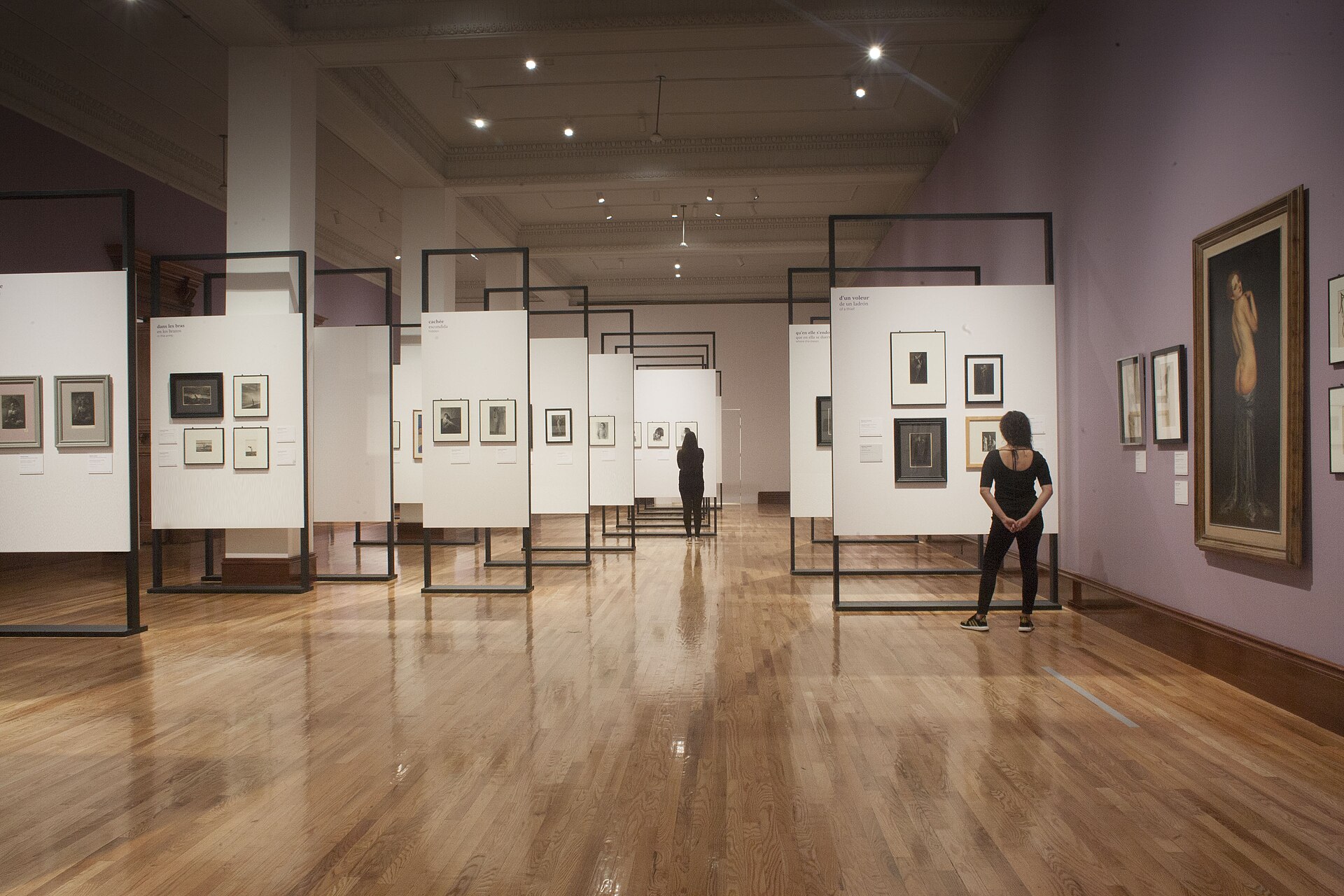
Photograph by Carlos Hano · CC BY-SA 4.0 Temporary exhibition galleries
White-walled rooms used for rotating shows of works on paper and other temporary exhibitions, distinct from the chronological permanent galleries.
What to see first
La Sagrada Familia y san Juan Bautista nino
Andres de Concha, circa 1585A Holy Family panel from the earliest viceregal painting MUNAL holds, from before the 290-painting Pinacoteca Virreinal transfer reshaped the colonial rooms in 20003
Los desposorios de la Virgen y san Jose
Cristobal de Villalpando, circa 1705-1714A marriage scene by the leading painter of New Spain's late Baroque, on the wall the museum itself names among its treasures3
Retrato de Pedro Barbosa Gomez de Guzman y Parreno
Juan Rodriguez Juarez, 1712A formal portrait in Bourbon court fashion by a member of the Juarez painting dynasty that dominated viceregal portraiture for three generations3
De espanol y morisca produce albino
Francisco Clapera, 1780A casta painting, the genre that catalogued colonial Mexico's social taxonomy of racial mixture in paint, from a set the museum displays alongside its religious and portrait holdings rather than apart from them3
El suplicio de Cuauhtemoc
Leandro Izaguirre, 1893An academic history painting that turned the torture of the last Aztec ruler into an origin story for the new nation, painted at the Academia de San Carlos the room next door is named for3
Canada de Metlac
Jose Maria Velasco, 1893A landscape showing a train crossing a ravine near Orizaba, staging the tension between Mexican nature and the railroad progress Velasco's own government patrons were building3
La dama del manton
Saturnino Herran, 1914A portrait built around an embroidered Manila shawl and Spanish-influenced dress, from the Mexican modernist who helped define the visual language later taken up by the muralists3
Paisaje zapatista
Diego Rivera, 1915A Synthetic Cubist composition Rivera painted in Paris while the revolution it celebrates was still being fought at home, built from the geometric planes of his Cubist years before he turned to mural painting3
Autorretrato (El Coronelazo)
David Alfaro Siqueiros, 1945A self-portrait in pyroxylin lacquer on celotex with the spiraling, off-axis perspective that became Siqueiros's signature technique after the muralist project matured3
Exhibitions on now
The Palace of Communications and what it was built to hold
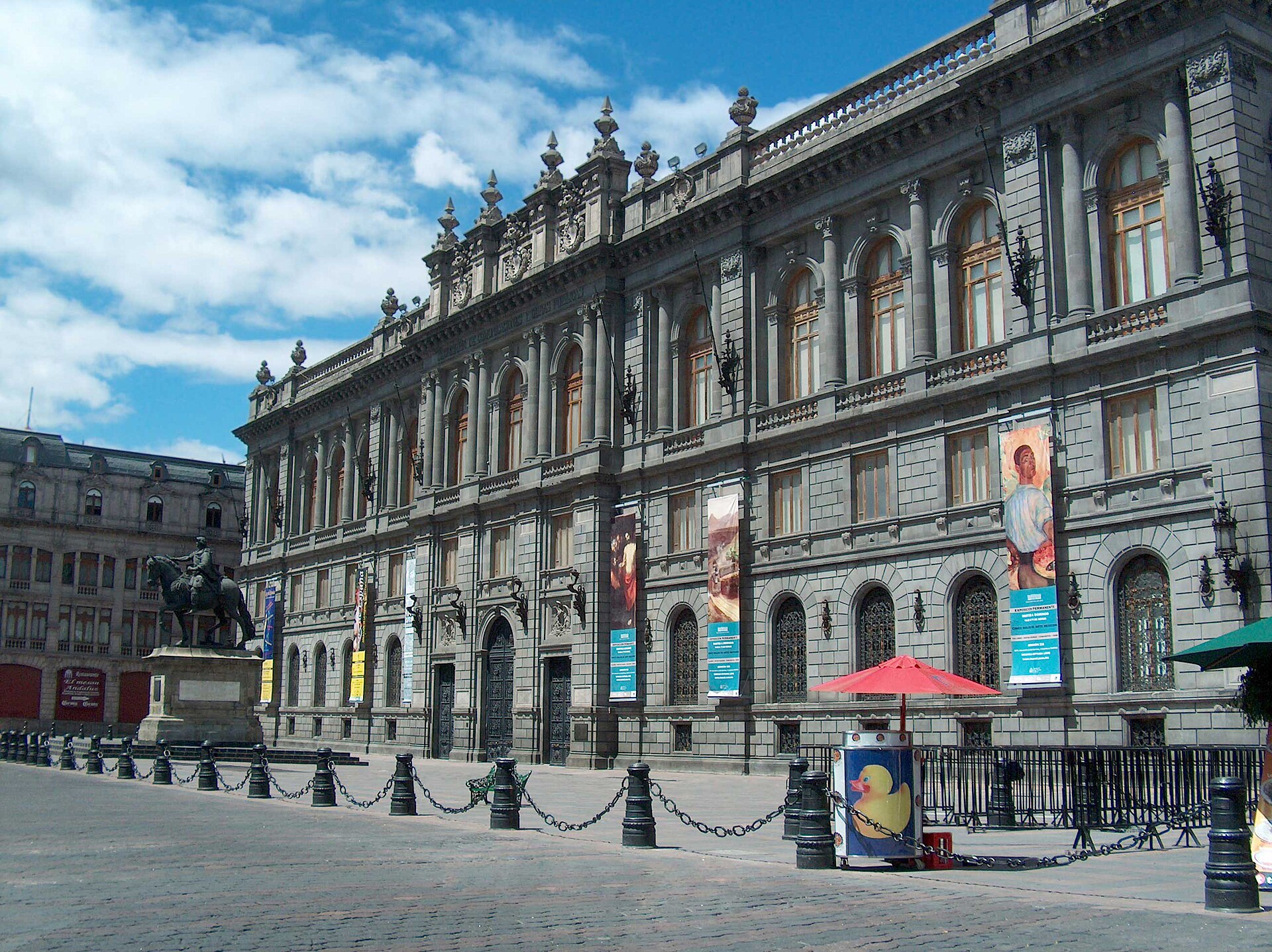
On Tacuba street in Mexico City's Centro Historico stands a grey stone palace built between 1904 and 1911 for a purpose that had nothing to do with art. Porfirio Diaz's government commissioned the Italian architect Silvio Contri to design a headquarters for the Secretaria de Comunicaciones y Obras Publicas, the ministry running the railways, telegraphs and public works central to the regime's modernizing program, and the building still carries the ministry's name carved across its main frieze. Contri worked in an eclectic style drawing on the Italian and French Renaissance and Baroque, importing marble, stained glass and wrought ironwork to give the young ministry a facade equal to the ambitions of the government behind it. Inside, the building's ceremonial spaces, a grand marble staircase rising to a gilded Reception Hall decorated with allegorical murals, were built for receptions and state functions rather than for viewing pictures, and the museum that occupies the building today still shows visitors those rooms as part of the visit. The ministry moved out in 1954 to a new building in the Narvarte district, and the vacated palace passed through years of other uses, including a period housing the Archivo General de la Nacion, before it was handed to the Instituto Nacional de Bellas Artes y Literatura for conversion into a museum.
Founding the national collection, 1982-2000
The Museo Nacional de Arte opened to the public on 23 July 1982, under founding director general Jorge Alberto Manrique, an art historian, with the sculptor Helen Escobedo as founding technical director. Its stated mission from the start was to preserve and exhibit art made in Mexico between the second half of the sixteenth century and the first half of the twentieth, a span the museum still uses to define its collecting scope today. The opening collection did not arrive by purchase; it came almost entirely as transfers from sister institutions inside the same INBAL network, chiefly the Museo Nacional de San Carlos, the Palacio de Bellas Artes and the Museo de Arte Moderno, which gave up paintings and sculpture to seed the new national museum. The building closed for restoration in 1997 and reopened in 2000, and that reopening brought a second major transfer: 290 viceregal paintings arrived from the Pinacoteca Virreinal, a museum housed in the former Convento de San Diego near the Alameda that closed the same year. The Pinacoteca Virreinal's own collection had been built up from religious art recovered from convents and monasteries nationalized under the mid-nineteenth-century Reform Laws, so a substantial share of the colonial paintings now on MUNAL's walls trace their public ownership back to that nineteenth-century confiscation rather than to a donation or purchase made by the museum itself. Which convent originally held which canvas is not set out on the museum's own site, and that finer chain of custody, for the period before the 2000 transfer, is not established by any source consulted for this page.
Inside: the viceregal rooms and the Academy
The permanent collection is organized chronologically and, in the museum's own naming, divided into distinct sequences rather than a single continuous walk. Asimilacion de Occidente covers 1550 to 1821, the viceregal painting galleries that hold the bulk of the transferred Pinacoteca Virreinal canvases alongside work acquired independently; a 2024 renovation of these second-floor rooms put roughly sixty oils on view, spanning the Echave and Juarez painting dynasties, Sebastian Lopez de Arteaga, Andres de Concha, Miguel Cabrera and Cristobal de Villalpando, and using portraiture, landscape and casta painting to trace the relationship between sacred and secular art under Spanish rule. La Academia de San Carlos: Ilustracion e Independencia follows with the academic history painting the nation's own art academy trained its students to produce: Juan Cordero, Santiago Rebull, Felix Parra and Leandro Izaguirre, whose 1893 canvas of the torture of Cuauhtemoc turned a founding moment of national memory into an academy showpiece. A separate set of rooms, renewed in January 2025, is given over to Romanticism, Symbolism and Decadentism at the turn of the twentieth century: sixteen works by German Gedovius, Angel Zarraga, Julio Ruelas and Antonio Fabres among others, built around exotic landscapes, mythology and the erotic and macabre themes late nineteenth-century Mexican modernists borrowed from European Symbolism.
Jose Maria Velasco's own room
One painter has a permanent room to himself. Territorio Ideal: Jose Maria Velasco, perspectiva de una epoca, curated by Victor Rodriguez Rangel, gathers the landscape painter's views of the Valley of Mexico and beyond, including La Alameda de Mexico and Catedral de Oaxaca, and the museum presents it as a permanent exhibition rather than a rotating show. Velasco, who died in 1912, produced close to three hundred paintings, watercolors and lithographs over his career, applying the eye of a trained naturalist to volcanoes, aqueducts and the advancing railway alike. Canada de Metlac, an 1893 canvas showing a train crossing a ravine near Orizaba, is one of the museum's most reproduced images precisely because it stages that tension between landscape and the railroad progress Velasco's own patrons were building. A temporary cabinet on Velasco's sketches and studies, drawn partly from the Museo Kaluz and the Academia de San Carlos, ran from September 2025 to April 2026 and has since closed, but the permanent room devoted to his finished work remains on view.
The revolution on the walls: modern Mexican art, 1910-1955
XX en el XXI, the museum's name for its twentieth-century galleries, carries the collection from the last years of the Diaz regime into the 1950s, the point at which MUNAL's own collecting mandate stops. Saturnino Herran's 1914 La dama del manton, a portrait built around an elaborately embroidered Manila shawl and Spanish-influenced dress, sits in the same sequence of rooms as Diego Rivera's Paisaje zapatista of 1915, a Synthetic Cubist composition built from geometric planes that Rivera painted in Paris while the revolution he was celebrating was still being fought at home, and David Alfaro Siqueiros's 1945 self-portrait Autorretrato (El Coronelazo), painted in pyroxylin lacquer on celotex with the spiraling, off-axis perspective that became his signature after the muralist project matured. Jose Clemente Orozco, Gerardo Murillo (known as Dr. Atl), Joaquin Clausell, Roberto Montenegro, Manuel Rodriguez Lozano and Rufino Tamayo all have work in the same rooms, alongside sculpture: the museum's Gliptoteca, De la piedra al barro, tracks Mexican sculpture across the nineteenth and twentieth centuries, from Manuel Vilar's 1851 plaster Tlahuicole through Jesus F. Contreras's 1898 marble Malgre tout to Manuel Felguerez's 1954 bronze El flechador, the artist's last figurative work before he turned toward abstraction.
El Caballito and the plaza outside
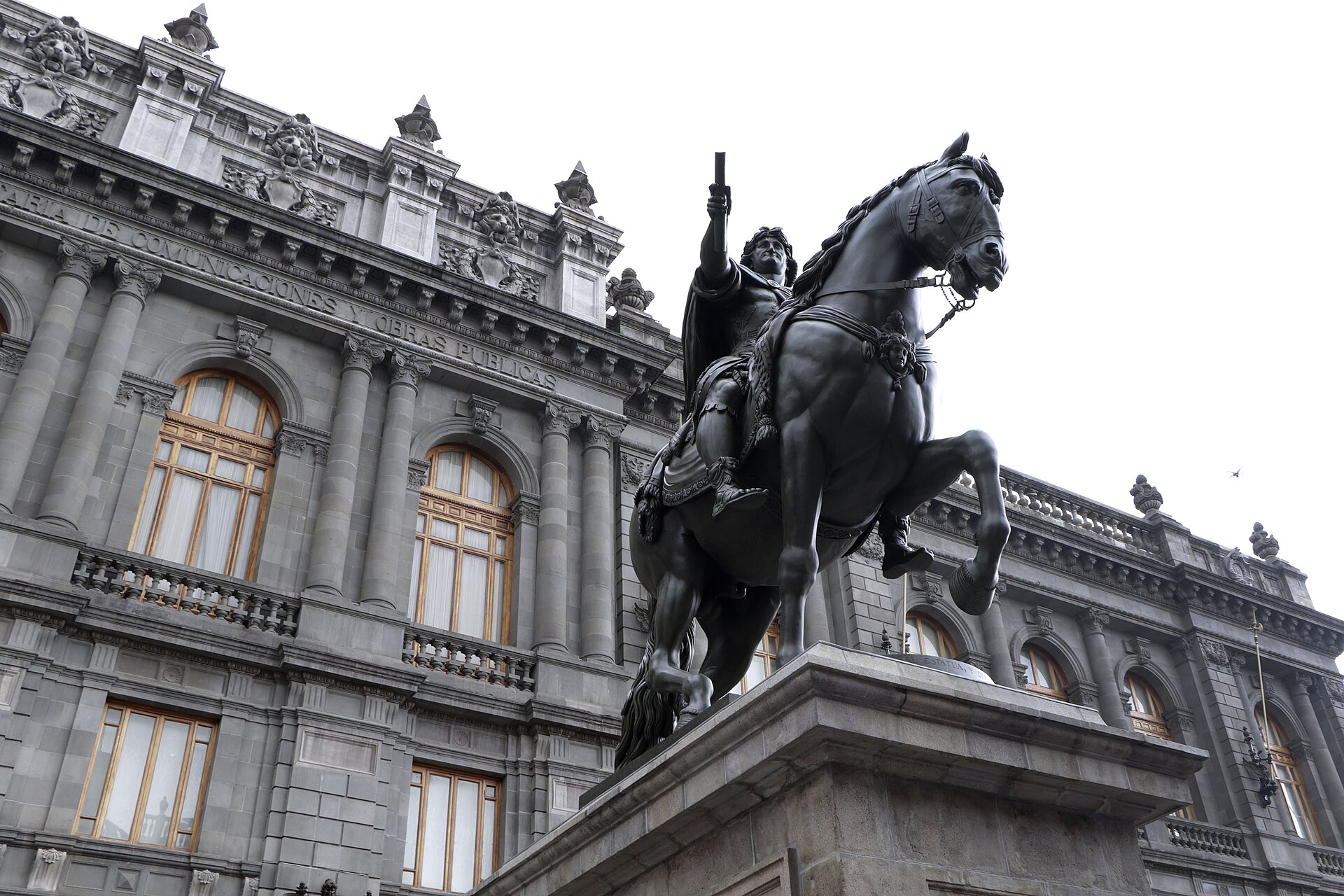
The museum's own front door shares its plaza with one of Mexico City's best-known public monuments. Manuel Tolsa's bronze equestrian statue of King Charles IV of Spain, cast in 1803 and known locally as El Caballito, the little horse, stands in the plaza that now bears Tolsa's own name, facing the museum's main facade across Tacuba street. It is not part of the museum's collection and predates the building by a century, but the two have shared the same corner of the Centro Historico since the palace went up, and most photographs of the museum's exterior include the statue in the same frame. The building itself sits directly opposite the Palacio de Mineria, another Centro Historico landmark, in a stretch of Tacuba that concentrates several of Mexico City's grandest Porfirian and colonial facades within a few hundred metres of each other.
Closed by a protest camp, June 2026
The museum's most recent disruption had nothing to do with its own collection or programming. On 2 June 2026 MUNAL closed its doors, telling the public only that it would remain shut por causas ajenas a este recinto, for reasons beyond this venue's control, hasta nuevo aviso, until further notice, without naming what those reasons were. The closure came as the Coordinadora Nacional de Trabajadores de la Educacion, a teachers' union federation, occupied streets around the Centro Historico, including Tacuba itself, with a protest encampment; the museum never confirmed the connection in its own statement, but press reporting tied the closure directly to the encampment, which also affected the Templo Mayor archaeological site and several other Centro Historico venues during the same weeks. The closure fell awkwardly against the museum's own plans: MUNAL had been named one of five INBAL flagship venues for extended hours during the 2026 World Cup period, and a renovation of its twentieth-century galleries, Arte y visualidad en el Mexico Moderno, had been scheduled to open on 10 June. MUNAL reopened on Wednesday 17 June 2026; museum director Mireida Velazquez said in a video statement that the delayed exhibition would open proximamente, soon, without giving a firm date. As of this page's research, in September 2026, the museum's own visit page shows no closure notice and lists normal Tuesday-to-Sunday hours.
What visitors say
Visitors consistently rate the museum highly for the combination of a major survey of Mexican painting and sculpture with the Porfirian palace that holds it; the building's marble staircase and gilded Reception Hall come up almost as often as the paintings themselves. The most repeated complaints are practical rather than curatorial: thin English-language labeling, a heavily monitored feel in the galleries, and the museum's exposure to the kind of sudden, unexplained closure that shut it for two weeks in June 2026.
What is praised, what is criticised
- Praised: The depth of the collection across four centuries in one building, from viceregal religious painting through the muralist generation, with reviewers naming Jose Maria Velasco's landscapes and works by Diego Rivera and David Alfaro Siqueiros specifically
- Praised: The building itself: reviewers describe the marble entrance staircase and the decorated Reception Hall as a highlight independent of the art on the walls, and several call the architecture the equal of the collection
- Praised: Value for the entrance fee, and the free Sunday admission for Mexican nationals and residents
- Criticised: Minimal English-language wall text and labeling, flagged by non-Spanish-speaking visitors as a barrier to following the collection's context
- Criticised: A sense of being closely watched or over-controlled by security staff, raised by some visitors as detracting from the visit
- Criticised: Exposure to sudden closure without public explanation, most recently the two-week shutdown from 2 to 17 June 2026 during a nearby teachers' protest encampment, which the museum's own statement never explained beyond citing causes outside its control
Ratings on other platforms
Tripadvisor: 4.6 from 892 ratings, read 5 September 2026
A platform average is a tertiary source: it moves, it is not audited, and we quote no visitor's words.
Questions about Museo Nacional de Arte
Where is Museo Nacional de Arte?
Tacuba 8, Centro Historico, Cuauhtemoc, 06010 Ciudad de Mexico, Mexico.
How much does it cost to visit?
General admission: MXN 95; ICOM members: MXN 47.5; Under 13, national teachers and students, INAPAM seniors, persons with disabilities: free; Photo or video permit (non-cellphone): MXN 30. As confirmed 5 September 2026.
When is it open?
Tue-Sun 10:00-18:00. Closed: Monday. January 1. As confirmed 5 September 2026.
How do you get there?
Metro: Bellas Artes (Lines 2 and 8) or Allende (Line 2), both a short walk south down Tacuba street; the museum faces the Palacio de Mineria across Plaza Manuel Tolsa.
What should you see first?
La Sagrada Familia y san Juan Bautista nino (Andres de Concha, circa 1585); Los desposorios de la Virgen y san Jose (Cristobal de Villalpando, circa 1705-1714); Retrato de Pedro Barbosa Gomez de Guzman y Parreno (Juan Rodriguez Juarez, 1712); De espanol y morisca produce albino (Francisco Clapera, 1780); El suplicio de Cuauhtemoc (Leandro Izaguirre, 1893); Canada de Metlac (Jose Maria Velasco, 1893).
What we could not confirm
- The convent or monastery of origin for each of the 290 viceregal paintings transferred from the closed Pinacoteca Virreinal in 2000 is not published on the museum's own site, so the fuller chain of custody behind the viceregal rooms before that transfer is not established here.
- The museum's own statement on the June 2026 closure never named the CNTE teachers' encampment as the cause; that link comes from press reporting rather than from MUNAL itself, and the museum does not appear to have commented on it directly since.
- The renovated twentieth-century exhibition Arte y visualidad en el Mexico Moderno, delayed by the June 2026 closure, had not been given a firm opening date in any source consulted for this page.
Images
Sources
- 1Museo Nacional de Arte, official visit page (hours, admission, contact, accessibility, photography, bags, shop, library) munal.mx/es/visita
- 2Museo Nacional de Arte, El Museo (building and institutional history) munal.mx/es/el-museo
- 3Museo Nacional de Arte, Tesoros del MUNAL (official list of highlighted works) munal.mx/es/tesoros-del-munal
- 4Museo Nacional de Arte, Colecciones (donor funds and holdings) munal.mx/es/colecciones
- 5INBA press release, 'El Museo Nacional de Arte celebra su 38 aniversario' (23 July 1982 opening date, founding director and technical director, opening collection sources) inba.gob.mx/prensa/14402/el-museo-nacional-de-arte-celebra-su-38-aniversario
- 6INBA press release on the renewal of MUNAL's permanent viceregal art rooms inba.gob.mx/prensa/20638/el-munal-renueva-sus-salas-permanentes-de-arte-virreinal-nbsp
- 7INBA press release on the renewal of MUNAL's Romanticism, Symbolism and Decadentism rooms inba.gob.mx/prensa/21680/el-munal-renueva-sus-salas-dedicadas-al-romanticismo-simbolismo-y-decadentismo
- 8INBA press release, 'Jose Maria Velasco lego en su obra la belleza del paisaje mexicano' (permanent Velasco room, Territorio Ideal) inba.gob.mx/prensa/16389/jose-maria-velasco-lego-en-su-obra-la-belleza-del-paisaje-mexicano-
- 9INBA, Museo Nacional de Arte institutional page inba.gob.mx/recinto/33/museo-nacional-de-arte
- 10Proceso, 'Museos del Centro Historico reabren tras semanas de cierre por el planton de la CNTE' (21 June 2026, closure and reopening dates, director's statement) proceso.com.mx/cultura/2026/6/21/museos-del-centro-historico-reabren-tras-semanas-de-cierre-por-el-planton-de-la-cnte-374402.html
- 11Infobae, 'Cierre temporal del MUNAL: museo suspende actividades hasta nuevo aviso en CDMX' (2 June 2026 closure announcement) infobae.com/mexico/2026/06/02/cierre-temporal-del-munal-museo-suspende-actividades-hasta-nuevo-aviso-en-cdmx/
- 12Tripadvisor, Museo Nacional de Artes attraction page (aggregate rating and visitor comments) tripadvisor.com/Attraction_Review-g150800-d152631-Reviews-Museo_Nacional_de_Artes-Mexico_City_Central_Mexico_and_Gulf_Coast.html
- 13Tripadvisor, named visitor review of Museo Nacional de Artes tripadvisor.com/ShowUserReviews-g150800-d152631-r571977945-Museo_Nacional_de_Artes-Mexico_City_Central_Mexico_and_Gulf_Coast.html
- 14Museos de Mexico, MUNAL directory entry (transport and access details) museosdemexico.com/munal_22.html
- 15Wikidata, Q1138147 (identity, coordinates, inception year) wikidata.org/wiki/Q1138147
- 16Wikipedia (Spanish), Museo Nacional de Arte (Mexico) (collection formation, Pinacoteca Virreinal transfer, room names) es.wikipedia.org/wiki/Museo_Nacional_de_Arte_(M%C3%A9xico)
- 17Mexico City government, National Art Museum venue page (amenities and phone cross-check, El Caballito) mexicocity.cdmx.gob.mx/venues/national-art-museum-munal/?lang=en