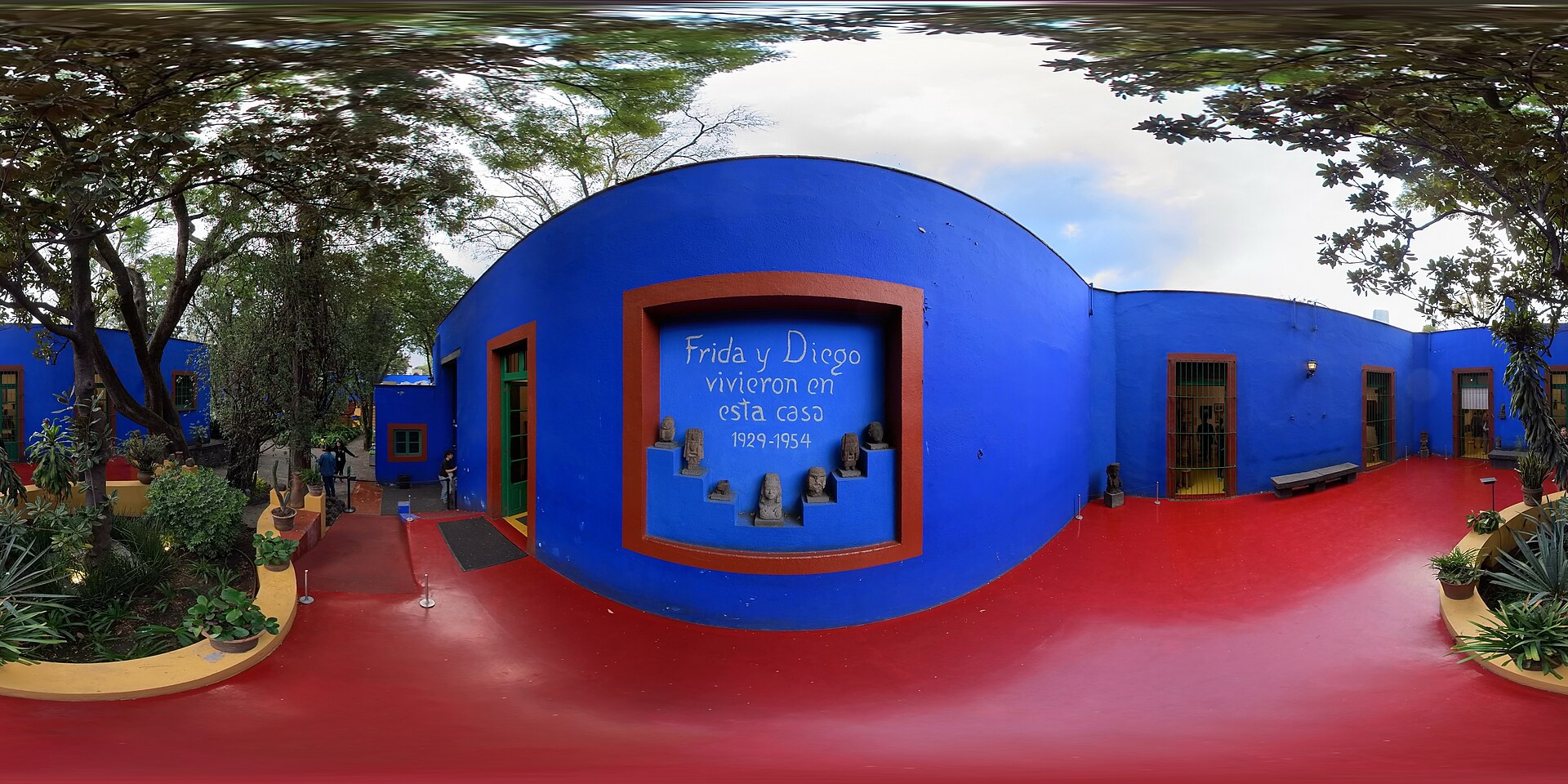
360-degree panorama of the exterior and courtyard of the Frida Kahlo Museum (La Casa Azul), Coyoacan, Mexico City, photographed November 2025.
Fuzheado, CC0Frida Kahlo Museum
Museum · Museo Frida Kahlo (La Casa Azul) · Founded 1958
Open, admission and hours confirmed 25 August 2026 · 12 sources
On this page 14 sections
ContentsClose
The Frida Kahlo Museum is not, by its own account, a picture gallery: it holds only a small number of paintings by Frida and by Diego Rivera. Its real strength is as an intact domestic and material archive of the two of them, built from three overlapping collections that were never assembled with a museum in mind. The first is Rivera's own pre-Hispanic holdings, the second is the couple's collection of Mexican popular and folk art, in particular one of the country's more complete groups of votive paintings, and the third is Frida's own body, worked through her clothing, jewellery, medical devices and hand-painted corsets, which the museum treats as primary material on the same footing as the paintings. The 2004 discovery of her sealed wardrobe added a fourth, later layer to that material record, one that is still being catalogued.
| Local name | Museo Frida Kahlo (La Casa Azul) |
|---|---|
| Kind | Museum |
| Founded | 1958 |
| City and country |  Mexico City, Mexico Mexico City, Mexico |
| Address | Londres 247, Colonia del Carmen Coyoacan, 04100 Ciudad de Mexico, Mexico |
| Website | museofridakahlo.org.mx |
| Status | Open, confirmed |
| Record last verified |
Visiting
- Hours
- Tuesday10:00 to 18:00
- Wednesday11:00 to 18:00
- Thursday-Sunday10:00 to 18:00
- Thursday evenings, Noche Azul17:15 to 21:00extended hours every Thursday
- Last Wednesday of the month, Noche de Museos18:00 to 21:00extended evening hours
- Closed
- Monday. September 16. October 1. December 1-2. December 25. January 1.
- Admission
- GeneralMXN 320
- Mexican residents (valid ID)MXN 160
- Students and teachers (valid ID)MXN 60
- Guides and tour operators (valid ID)MXN 60
- Seniors and children 6-12MXN 30
- Children under 6 and visitors with disabilitiesFreefree
- Tickets
- boletos.museofridakahlo.org.mx/en The museum's own ticket page.
- Do I need to book?
- Yes, online only; there is no ticket booth, and timed entry should be booked well ahead in high season
- Address
- Londres 247, Colonia del Carmen Coyoacan, 04100 Ciudad de Mexico, Mexico MapMetro Line 3 to Coyoacan or to Viveros/Derechos Humanos, both about a 15-20 minute walk
Metro Line 2 to General Anaya, about a 15-20 minute walk
Metrobus Line 3 to Pueblo Santa Cruz Atoyac
Microbus Ruta 34 toward Metro General Anaya or central Coyoacan - Website
- museofridakahlo.org.mx
- Telephone
- +52 55 5554 5999
- [email protected]
Before you go how long, access, photography, bags, eating, shop
- How long to allow
- About ninety minutes for the house and garden
- Access
- Free admission for visitors with disabilities, with reserved parking, wheelchairs, crutches, ramps, an elevator and Braille labels in some rooms and staff trained in Mexican Sign Language, though the age of the house means not every floor is fully wheelchair accessible
- Photography
- The ticket covers flash-free phone photography of the rooms and artworks for personal use; a separate paid permit is required for other cameras indoors, and video recording is prohibited throughout
- Eating
- A small cafe sits in the courtyard garden, open the same days and hours as the museum
- Shop
- A small gift shop on the same street also runs a self-service ticket kiosk
Prices and hours change. We take them from the institution's own pages and print the day we read them, and you can check the current position at the source we used. Confirm before you travel.
What is inside
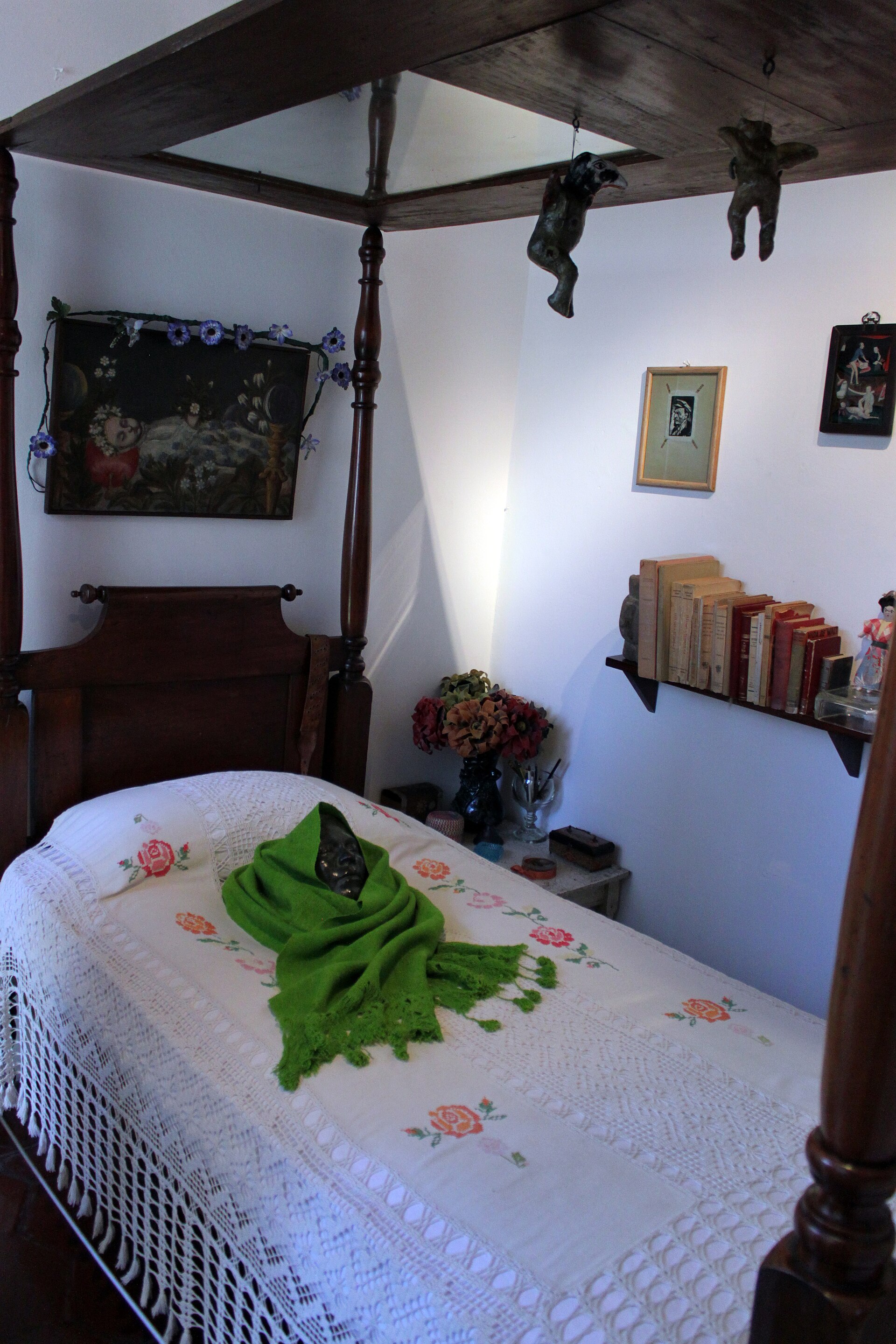
Photograph by Anagoria · CC BY 3.0 Frida's bedroom
Her four-poster bed with a mirror set into the canopy, installed so she could paint self-portraits while immobile; the pre-Hispanic urn holding her ashes stands on a dresser nearby, arranged as an altar with a funeral mask and a small dog figure referencing her pet Xolotl.
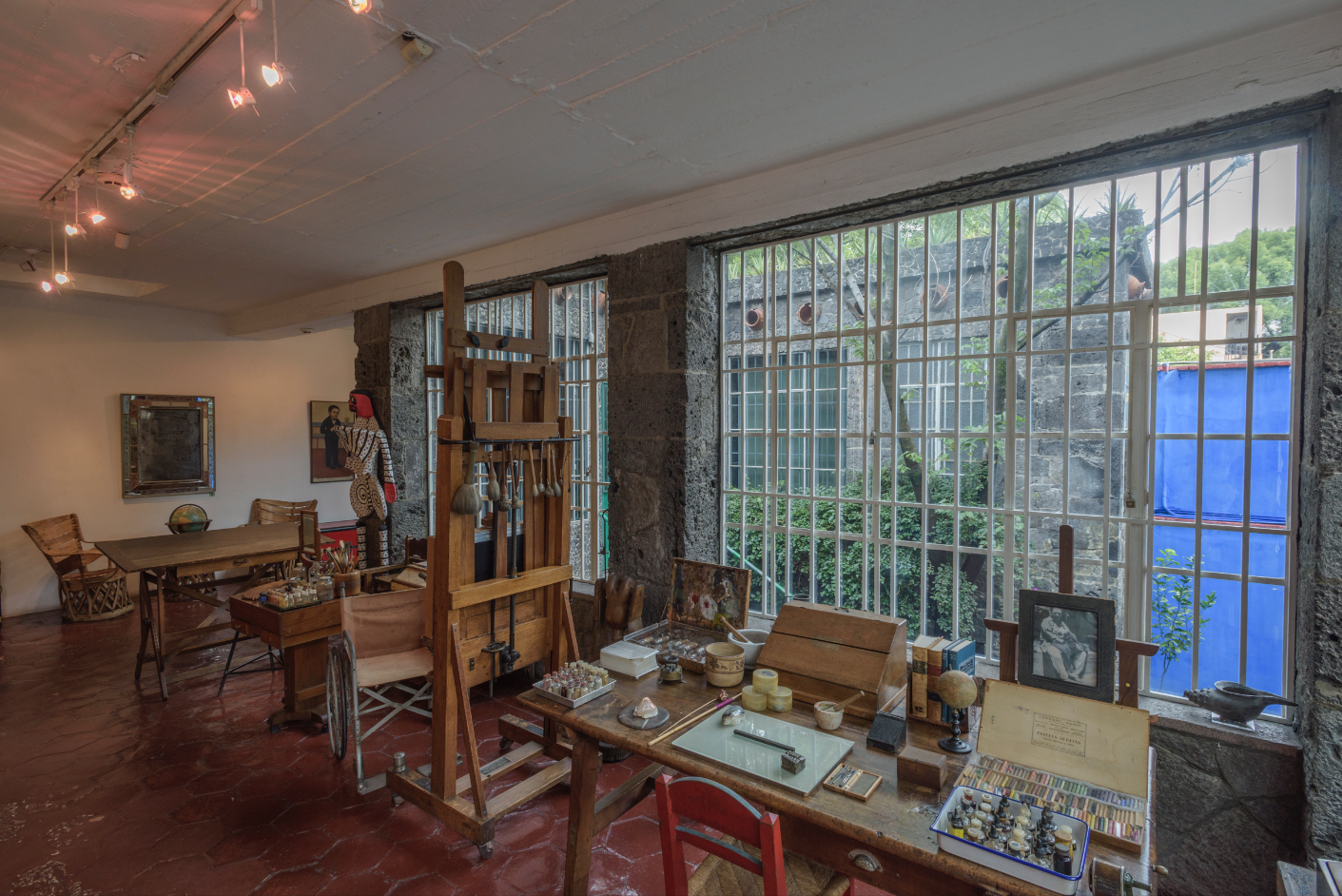
Photograph by Leonardo DPB · CC BY-SA 4.0 Frida's studio
An easel that Nelson Rockefeller had built for painters with limited mobility, positioned facing the wheelchair she used in her later years, alongside her paints and a papier-mache Judas figure made in her own likeness.
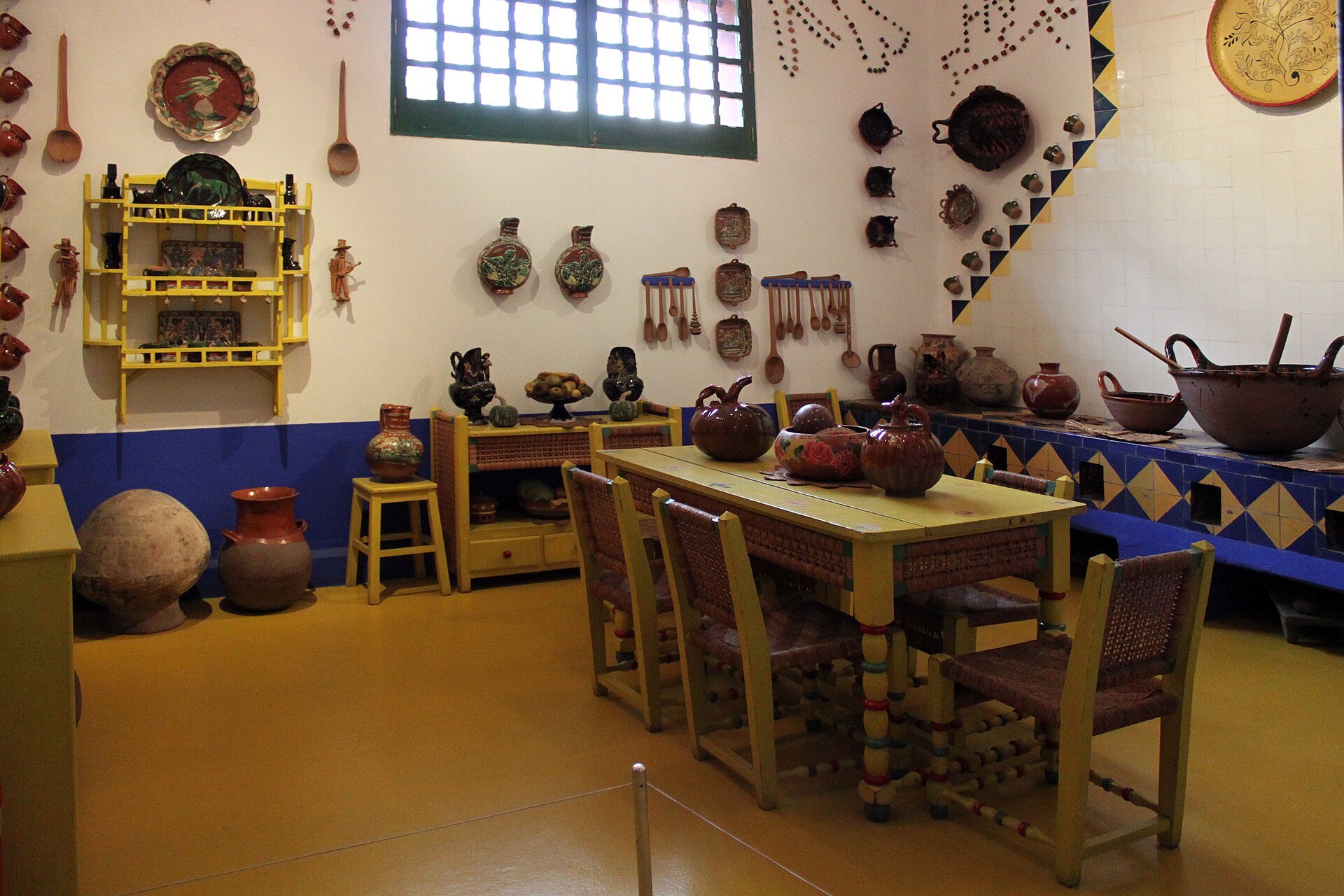
Photograph by Anagoria · CC BY 3.0 Kitchen
A wood-fired traditional Mexican kitchen in yellow and blue tile, with the couple's cazuelas and a recipe for Frida's mole sauce painted on the wall.
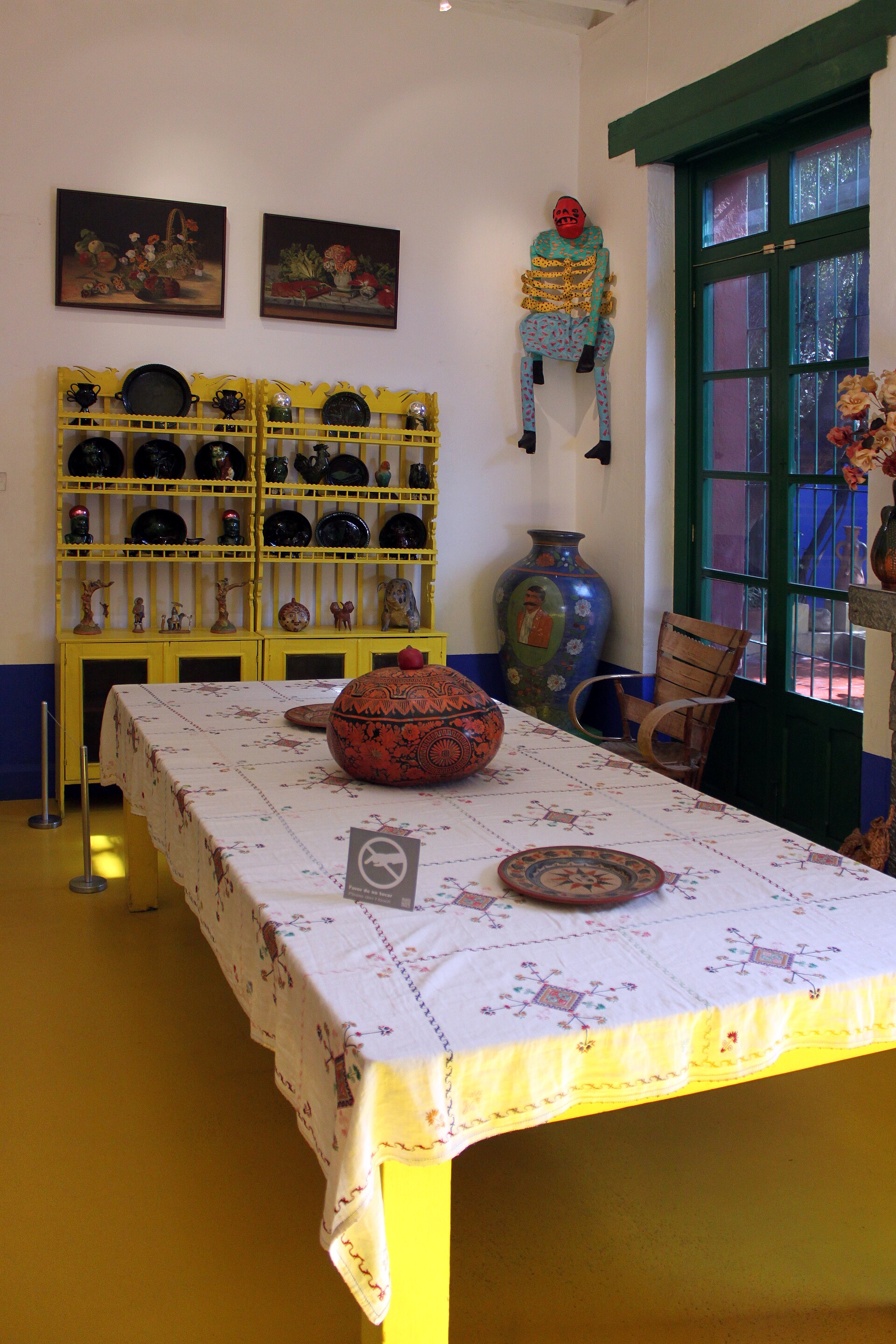
Photograph by Anagoria · CC BY 3.0 Dining room
The dining table sits beneath papier-mache Judas figures hanging from the ceiling, the same folk tradition of firecracker-filled effigies burned at Easter that the couple collected throughout the house.
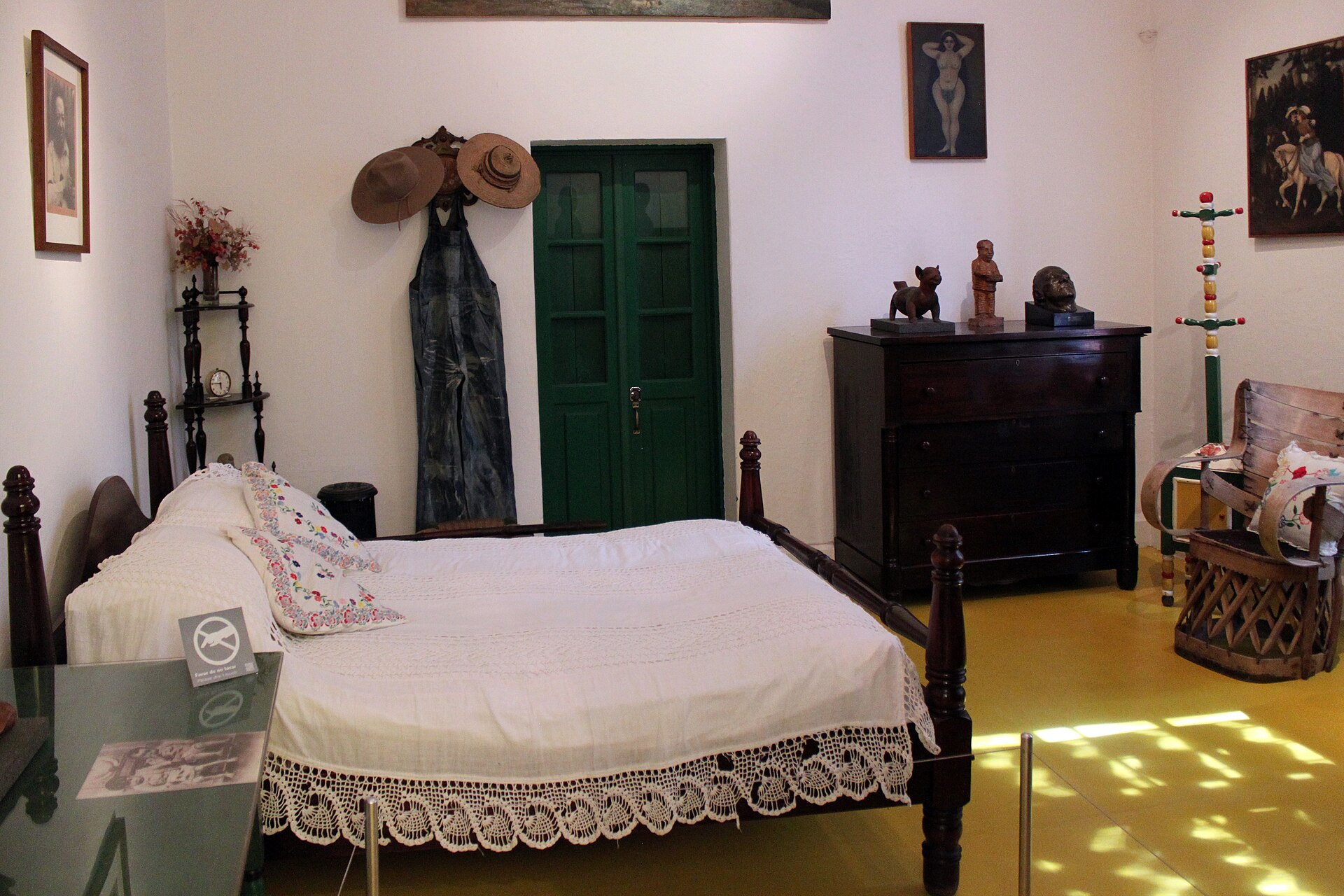
Photograph by Anagoria · CC BY 3.0 Diego Rivera's bedroom and workroom
A separate room across the courtyard kept much as Rivera used it, with his personal effects, drafting materials and architectural plans, including drawings for the Anahuacalli museum he was building nearby.
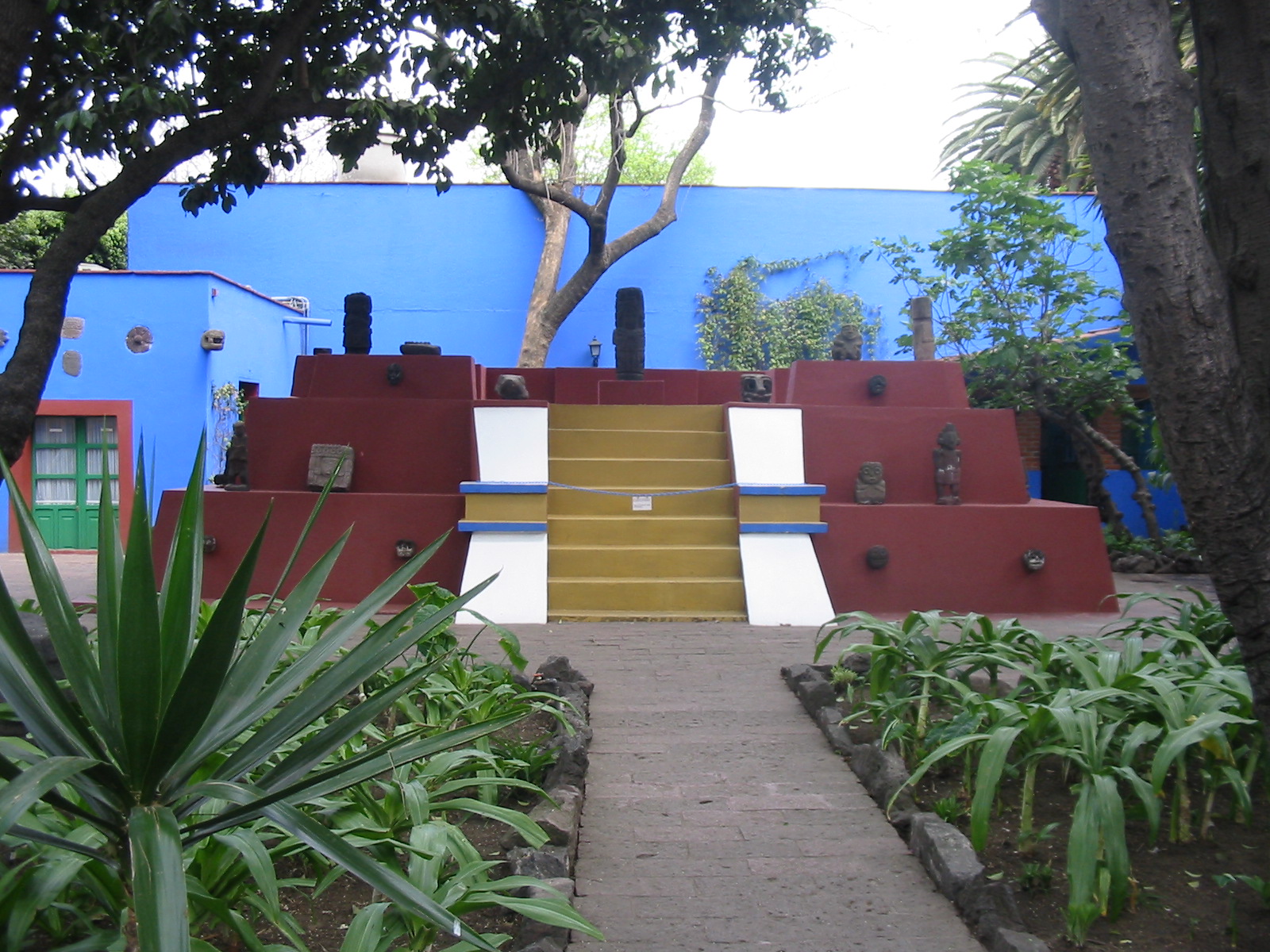
Public domain The courtyard garden
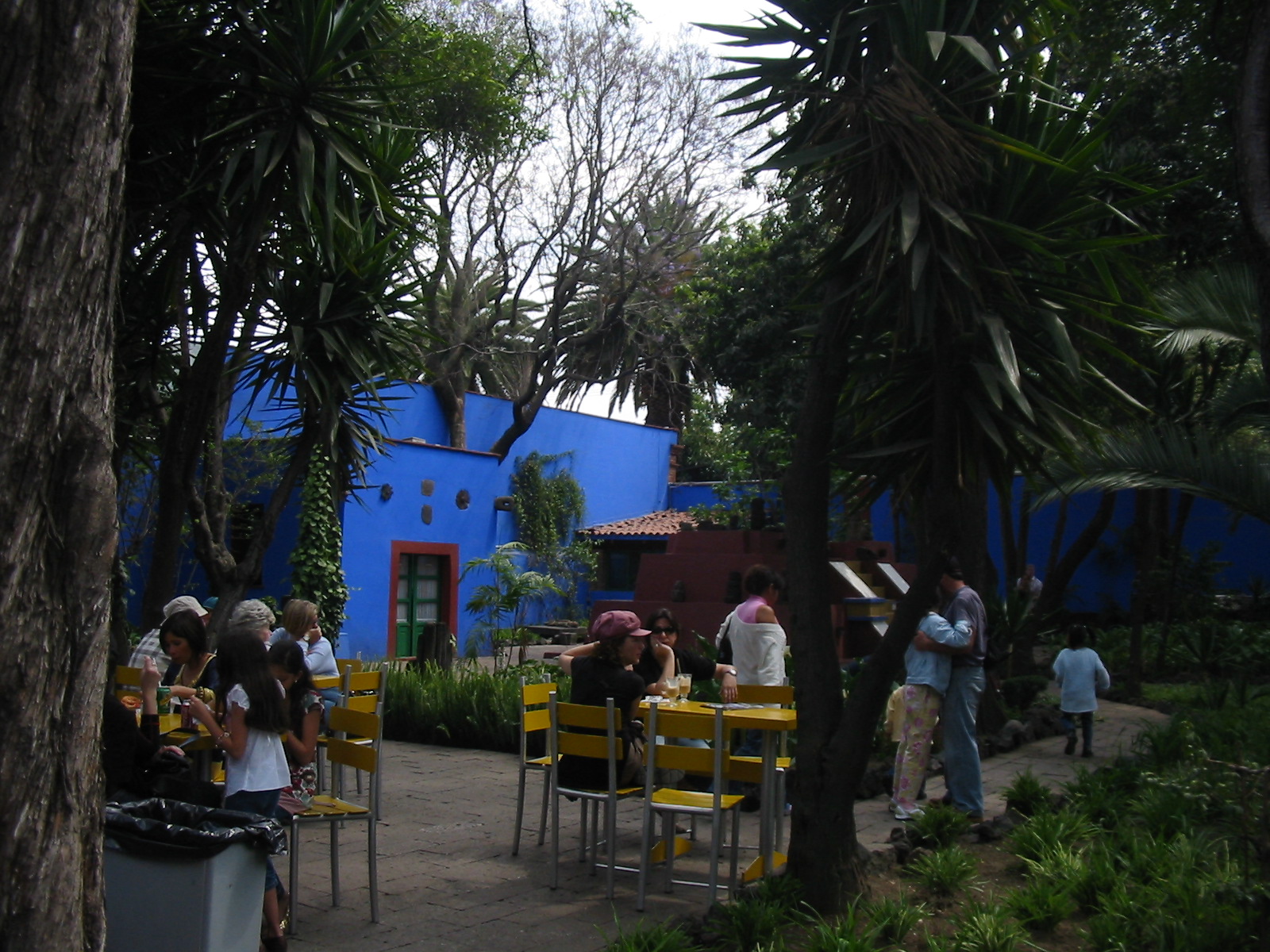
A stepped pre-Hispanic-style pyramid built during Rivera's 1941 expansion of the house, set among pre-Hispanic sculpture, a fountain and dense planting; the museum cafe opens onto it.
What to see first
Viva la Vida (Long Live Life)
Frida Kahlo, 1954Her last finished painting, a still life of sliced watermelons inscribed with the phrase she chose as her epitaph, painted about eight days before she died.4
Self-Portrait with Velvet Suit
Frida Kahlo, 1926Her first self-portrait, painted at nineteen while recovering from the 1925 bus accident that shaped the rest of her life and work.4
The painted plaster corsets
Frida KahloMedical corsets she wore after her spine injury, several hand-decorated by her, including one showing a shattered column standing in for her spine and one bearing the hammer and sickle.4
The urn holding Frida Kahlo's ashes
Pre-Hispanic urn, maker unrecordedSet on a dresser in her bedroom as an altar, with a funeral mask and a pre-Hispanic dog figure referencing Xolotl, the guide of the dead in Mexica belief.4
The votive-painting (ex-voto) collection
Various Mexican folk painters, 19th-20th centuryMore than 450 small devotional paintings assembled by the couple, among the most complete such holdings in the country; Frida is recorded as favouring examples showing beds, women and animals.4
The Rockefeller easel and Frida's wheelchair
Easel commissioned by Nelson RockefellerAn easel built for a painter with limited mobility, placed facing the wheelchair she used to work in her final years, in her studio.4
The wardrobe sealed for fifty years
Frida Kahlo's personal effectsMore than 300 garments, pieces of jewellery and medical devices, found in a locked bathroom in 2004; the room had been kept shut on Diego Rivera's instruction after Frida's death and later at Dolores Olmedo's, and its contents were unseen for half a century.9
Diego Rivera's Judas figure of Frida
Made in the papier-mache Judas tradition Rivera collectedA large effigy modelled on Frida herself, made for the Easter tradition of burning Judas figures; the museum's own account holds that she likely altered it herself to sharpen the likeness.4
A house built for a family, not a museum
The house was built in 1904 in Coyoacan's Colonia del Carmen, then a separate town south of Mexico City, by Frida Kahlo's father, the German-born photographer Guillermo Kahlo. Frida was born in it on 6 July 1907 and lived there as a child. After the September 1925 bus accident that fractured her spine and pelvis and left her in recurring pain for the rest of her life, she spent long periods confined to the house recovering. She married the muralist Diego Rivera in 1929, and from then on, through a divorce in 1939 and a remarriage the following year, the house on Calle Londres was the couple's main home in Mexico City. Rivera expanded it in 1941, adding the courtyard's stepped pyramid and enlarging the studio wing.
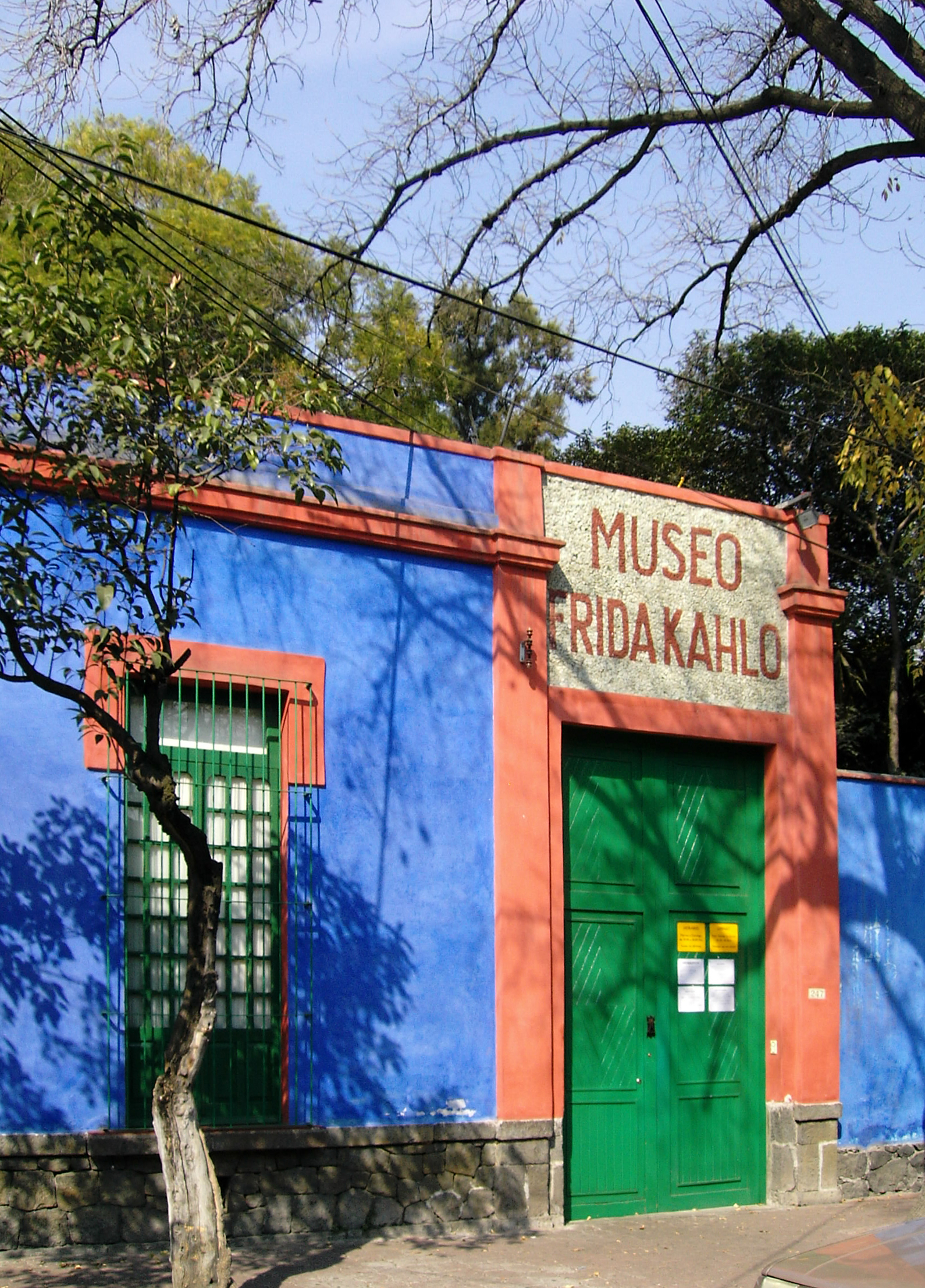
Frida Kahlo died in the house on 13 July 1954. Rivera outlived her by three years and used that time to turn the house into a museum in her name, establishing a trust under Banco de Mexico in 1957 to hold and administer it, alongside the Diego Rivera-Anahuacalli Museum he was then building across the city to house his own pre-Hispanic collection. Their friend, the museographer and poet Carlos Pellicer, designed the first installation of rooms and objects. The Frida Kahlo Museum opened to the public in July 1958, its exterior painted the cobalt blue that gave it its popular name, La Casa Azul.
Room by room
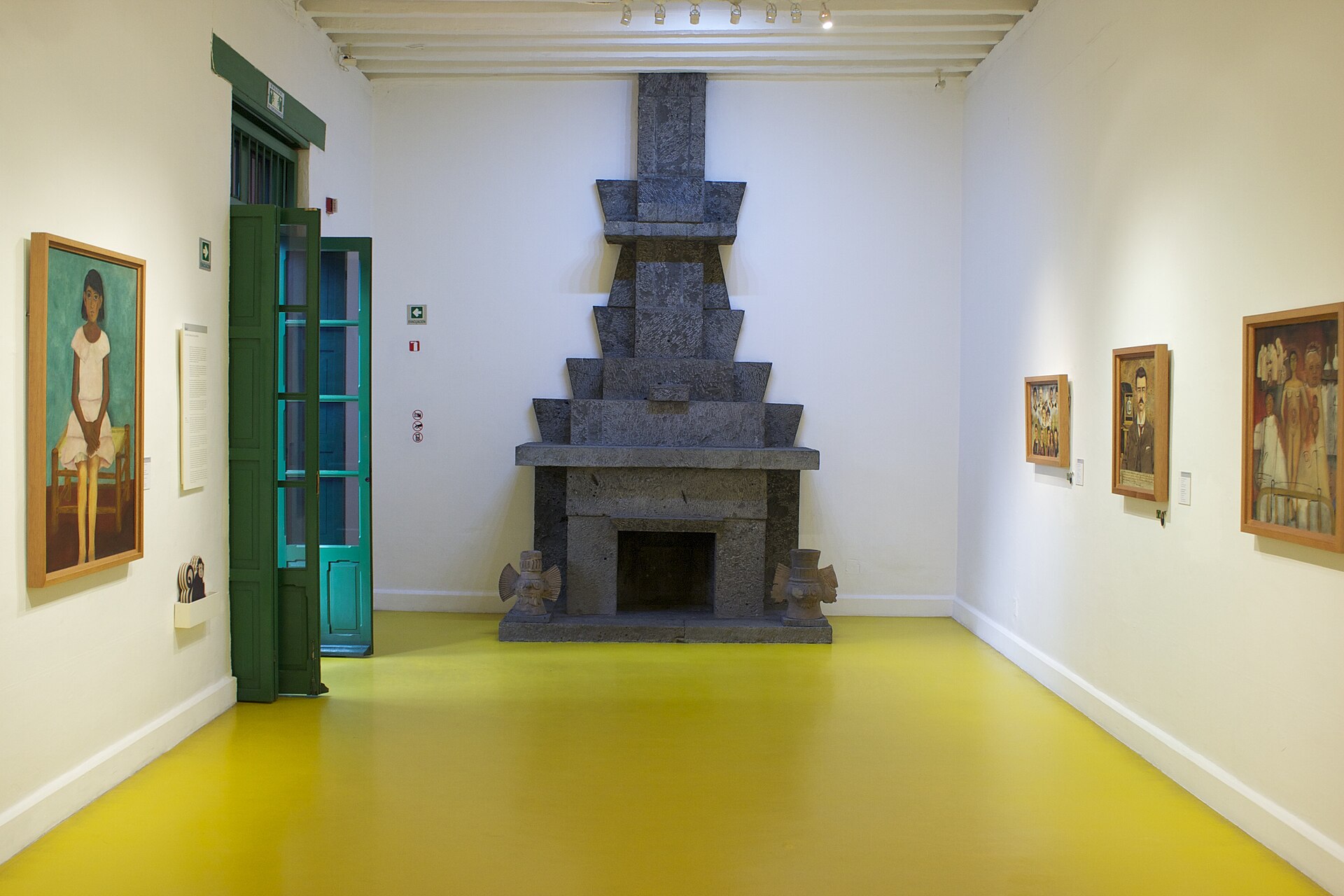
A fixed route leads visitors through around ten rooms on two floors. The ground floor holds a formal living room where the couple entertained visiting artists, political figures and intellectuals, galleries hung with paintings by Frida, by Rivera and by contemporaries of their circle, and the kitchen and dining room, kept in the traditional Mexican style the couple favoured: yellow and blue tile, hand-thrown cazuelas, and a recipe for Frida's mole sauce painted directly onto the kitchen wall. Papier-mache Judas figures, the effigies traditionally stuffed with firecrackers and burned in the days before Easter, hang from the dining-room ceiling, one of several places in the house where the couple's collecting of Mexican folk and popular art is on direct view rather than confined to a case.
The upper floor holds the more private rooms: Frida's bedroom, with the four-poster bed and canopy mirror that let her paint self-portraits while lying down, and her studio, added in Rivera's 1941 expansion and fitted later with an easel that Nelson Rockefeller had built for painters with limited mobility, positioned facing the wheelchair she used toward the end of her life. Diego Rivera kept a separate bedroom and workroom across the courtyard, shown with his own personal effects and, among them, drawings for the Anahuacalli museum. The courtyard garden itself, with its stepped pyramid, fountain and dense planting, is where the museum's small cafe sits, and is generally the calmest part of a visit that is otherwise dictated by crowd flow through comparatively small rooms.
What Frida and Diego collected
Rivera was an obsessive collector of pre-Hispanic art, assembling more than sixty thousand objects over his lifetime, divided today between this house and the Anahuacalli museum, which alone displays about two thousand pieces at a time from a holding of more than forty-five thousand. What remains at Casa Azul includes a basalt sculpture of Chicomecoatl, the Mexica goddess of maize and fertility, jade beads and necklaces, and the urn that now holds Frida's ashes on the dresser in her bedroom.
The couple were also serious collectors of Mexican popular and folk art on their own account: more than 450 votive paintings, or ex-votos, small devotional works in which ordinary people gave thanks for surviving accidents or illness, described by the museum itself as one of the most complete such collections in the country. Frida is recorded as having preferred examples that showed beds, women and animals. Alongside the ex-votos are Judas figures, painted ceramics, a clay Tree of Life candelabra from Izucar de Matamoros, and Frida's own huipils, skirts and rebozos, garments chosen in part because their length let her conceal the asymmetry and the orthopaedic supports her injuries required. Her jewellery, prosthetic leg and the several plaster corsets she decorated by hand, one with a shattered column standing in for her spine, another marked with the hammer and sickle, sit alongside her medicine bottles as a direct record of thirty years of surgery and pain management run in parallel with the painting.
A wardrobe sealed for fifty years
Diego Rivera asked that a bathroom adjoining Frida's bedroom, used to store her wardrobe and personal effects, be kept locked after her death. His instruction was honoured first by the trust and later by Dolores Olmedo, the couple's friend and patron who oversaw the museums for decades, and the room stayed sealed for exactly fifty years. It was finally opened in 2004, revealing around 300 items: traditional and everyday garments, jewellery, medicines and orthopaedic devices that had never been catalogued or seen since Frida's death. The Japanese photographer Ishiuchi Miyako was given access to document the find using natural light, and the resulting photographs later formed the core of the exhibition Appearances Can Be Deceiving, which put a selection of the wardrobe on public view for the first time. The museum describes the 2004 discovery, which also turned up letters, magazines, books and photographs from the house's archive, as the largest single find in its history; more than 6,500 photographs from the wider archive have since been catalogued.
A trust, a book, and a fight over what is real
The Fideicomiso de los Museos Diego Rivera y Frida Kahlo, the private trust under Banco de Mexico that Rivera set up in 1957, still administers both this museum and the Anahuacalli, and also holds the copyright to Frida Kahlo's work. That copyright interest put the trust at the centre of a public dispute in 2009 and 2010, when a couple running an antiques shop in San Miguel de Allende, Carlos and Leticia Noyola, announced a forthcoming book, Finding Frida Kahlo, built around an archive of paintings, letters, diaries and sketches they said had come down through a woodcarver who once worked for Rivera. A dozen Kahlo specialists, including the dealer Mary-Anne Martin, who had founded the Latin American art department at Sotheby's, and the art historian James Oles, signed a letter denouncing the material as fake; Oles, shown laboratory dating results the Noyolas had commissioned from a Chicago laboratory, said he did not consider the science relevant to his judgment. The trust filed a criminal complaint and sought to block publication. The Noyolas maintained the works were genuine and argued that the experts were protecting a sanitised, market-friendly version of Frida Kahlo rather than engaging with the personal archive they had found. Newsweek's account of the dispute, published in 2010, left the matter unresolved between the two camps, and no announcement since has settled which side was right.
Visiting today
The house underwent a structural restoration in 2009 and 2010, partly funded by the German government, that also went toward conserving roughly a third of the collection. The museum now draws on the order of 25,000 visitors a month, making it one of the most visited single-site house-museums in Mexico City, and ticketing has moved entirely online in response: there is no box office, and in high season same-day availability can run out before the doors open. A ticket to Casa Azul also covers entry to the Diego Rivera-Anahuacalli Museum on the other side of Coyoacan, the pre-Hispanic collection Rivera built for himself, which most visitors treat as a separate trip rather than a same-day double booking given the distance between the two sites.
What visitors say
Visitors consistently describe the museum less as a picture gallery than as an intact house: the couple's own paintings are few, and what people remember afterward is the kitchen, the corsets, the bed and the garden rather than any single canvas. Nearly every account also mentions the same two frustrations, in some order: the length of the queue, and having to buy a timed ticket online weeks in advance because there is no box office at the door.
What is praised, what is criticised
- Praised: the intimacy of standing in the couple's actual rooms and looking at their possessions, especially the kitchen, the corsets and Frida's bed, rather than only their paintings
- Praised: the courtyard garden and its pre-Hispanic pyramid and cafe, offered as a quiet break from the crowds inside the house
- Criticised: the length of the queues and the requirement to book a timed slot online well in advance, with no in-person ticket sales at all
- Criticised: the small scale of the rooms relative to visitor numbers, which produces bottlenecks on weekends and during the Thursday evening openings
- Criticised: the separate paid permit required to photograph indoors with anything other than a phone, and the outright ban on video recording
Ratings on other platforms
Google: 4.5 from 44,958 ratings, read 25 August 2026
A platform average is a tertiary source: it moves, it is not audited, and we quote no visitor's words.
Questions about Frida Kahlo Museum
Where is Frida Kahlo Museum?
Londres 247, Colonia del Carmen Coyoacan, 04100 Ciudad de Mexico, Mexico.
How much does it cost to visit?
General: MXN 320; Mexican residents (valid ID): MXN 160; Students and teachers (valid ID): MXN 60; Guides and tour operators (valid ID): MXN 60; Seniors and children 6-12: MXN 30. As confirmed 25 August 2026.
When is it open?
Tuesday 10:00-18:00; Wednesday 11:00-18:00; Thursday-Sunday 10:00-18:00; Thursday evenings, Noche Azul 17:15-21:00; Last Wednesday of the month, Noche de Museos 18:00-21:00. Closed: Monday. September 16. As confirmed 25 August 2026.
How do you get there?
Metro: Line 3 to Coyoacan or to Viveros/Derechos Humanos, both about a 15-20 minute walk; Metro: Line 2 to General Anaya, about a 15-20 minute walk; Metrobus: Line 3 to Pueblo Santa Cruz Atoyac; Microbus: Ruta 34 toward Metro General Anaya or central Coyoacan.
What should you see first?
Viva la Vida (Long Live Life) (Frida Kahlo, 1954); Self-Portrait with Velvet Suit (Frida Kahlo, 1926); The painted plaster corsets (Frida Kahlo); The urn holding Frida Kahlo's ashes (Pre-Hispanic urn, maker unrecorded); The votive-painting (ex-voto) collection (Various Mexican folk painters, 19th-20th century); The Rockefeller easel and Frida's wheelchair (Easel commissioned by Nelson Rockefeller).
What we could not confirm
- Whether the archive marketed since 2009 as Finding Frida Kahlo, and denounced as fake by a dozen Kahlo specialists and by the trust that holds her copyright, contains any genuine material has never been publicly resolved between the two sides.
- How much of the house's furnishing and object placement reflects Carlos Pellicer's original 1958 installation versus later rearrangement is not laid out in detail on the museum's own site.
Images
Sources
- 1Museo Frida Kahlo, official site, home page, read 25 August 2026 museofridakahlo.org.mx/
- 2Museo Frida Kahlo, official site, Visit page (hours, admission, policies), read 25 August 2026 museofridakahlo.org.mx/visit/?lang=en
- 3Museo Frida Kahlo, official site, contact directory, read 25 August 2026 museofridakahlo.org.mx/modales/directory/?lang=en
- 4Museo Frida Kahlo, official site, Museum/collection page, read 25 August 2026 museofridakahlo.org.mx/museo/?lang=en
- 5Mexico City government tourism site, Frida Kahlo Museum (Casa Azul) venue page, read 25 August 2026 mexicocity.cdmx.gob.mx/venues/frida-kahlo-museum-casa-azul/?lang=en
- 6Wikipedia, 'Frida Kahlo Museum', read 25 August 2026 en.wikipedia.org/wiki/Frida_Kahlo_Museum
- 7Google Maps business listing for Frida Kahlo Museum (rating, review count, phone), read 25 August 2026 google.com/maps/place/Museo+Frida+Kahlo
- 8Newsweek, 'The Case of the Questionable Frida Kahlo Paintings', 2010 newsweek.com/case-questionable-frida-kahlo-paintings-71721
- 9My Modern Met, 'Frida Kahlo's Colorful Wardrobe Finally Revealed After Being Hidden for 50 Years', read 25 August 2026 mymodernmet.com/frida-kahlo-closet/
- 10Historimex, 'Como llegar al Museo Frida Kahlo - Casa Azul', read 25 August 2026 historimex.com/como-llegar-al-museo-frida-kahlo-casa-azul/
- 11Conde Nast Traveler, 'Museo Frida Kahlo', museum review by Scarlett Lindeman, read 25 August 2026 cntraveler.com/activities/mexico-city/museo-frida-kahlo
- 12Wikimedia Commons, Category:Museo Frida Kahlo and linked file pages, licences verified per file, read 25 August 2026 commons.wikimedia.org/wiki/Category:Museo_Frida_Kahlo