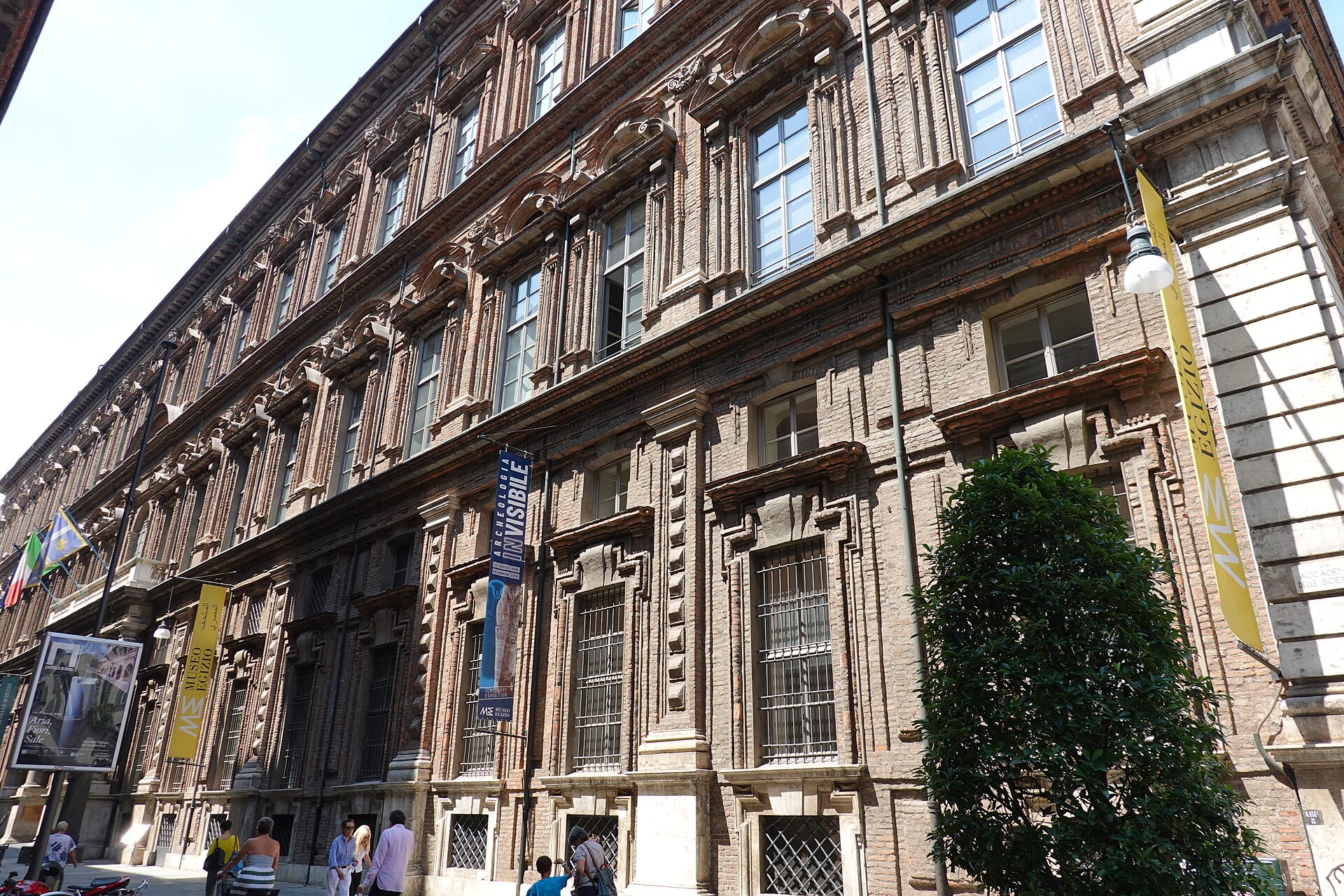
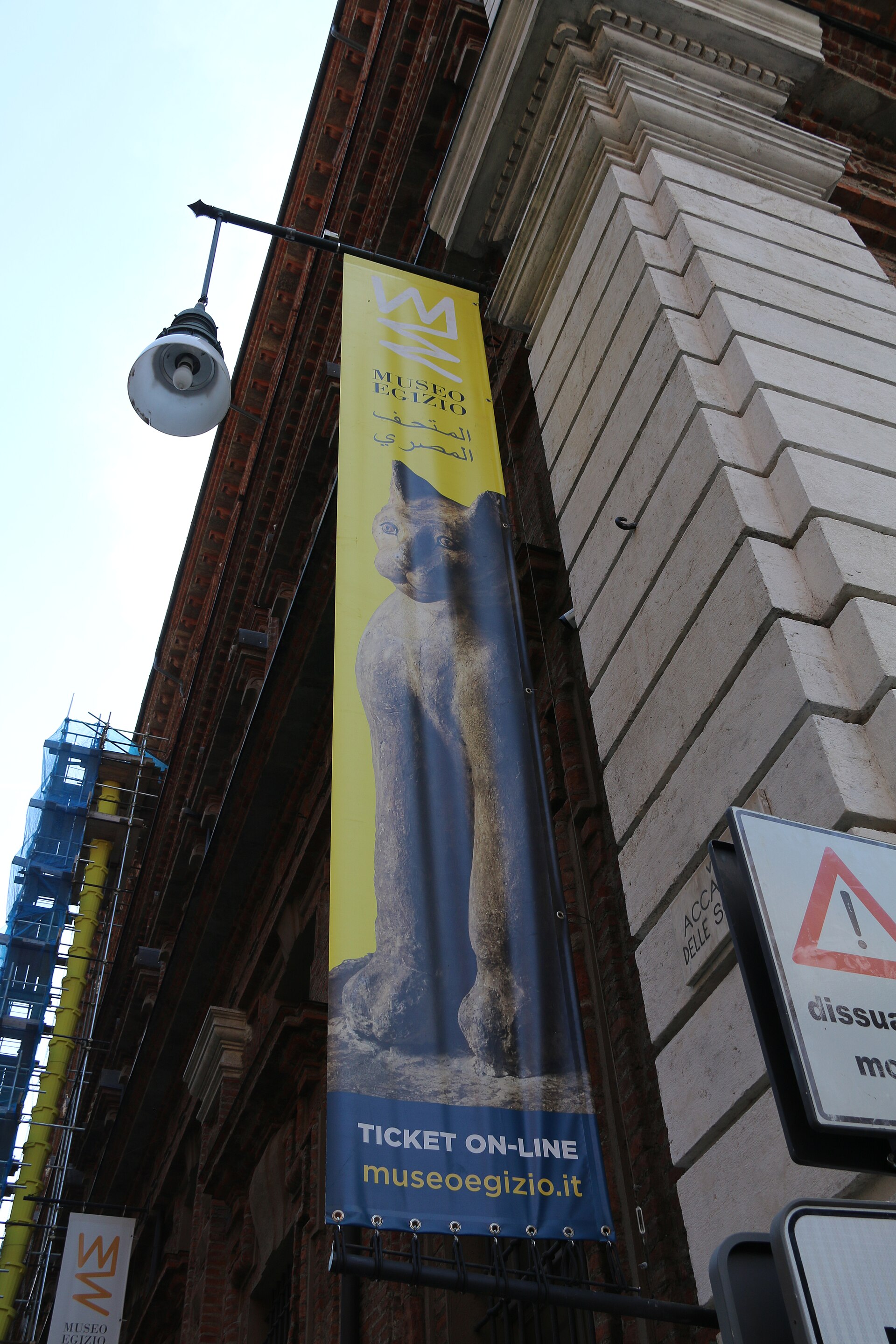
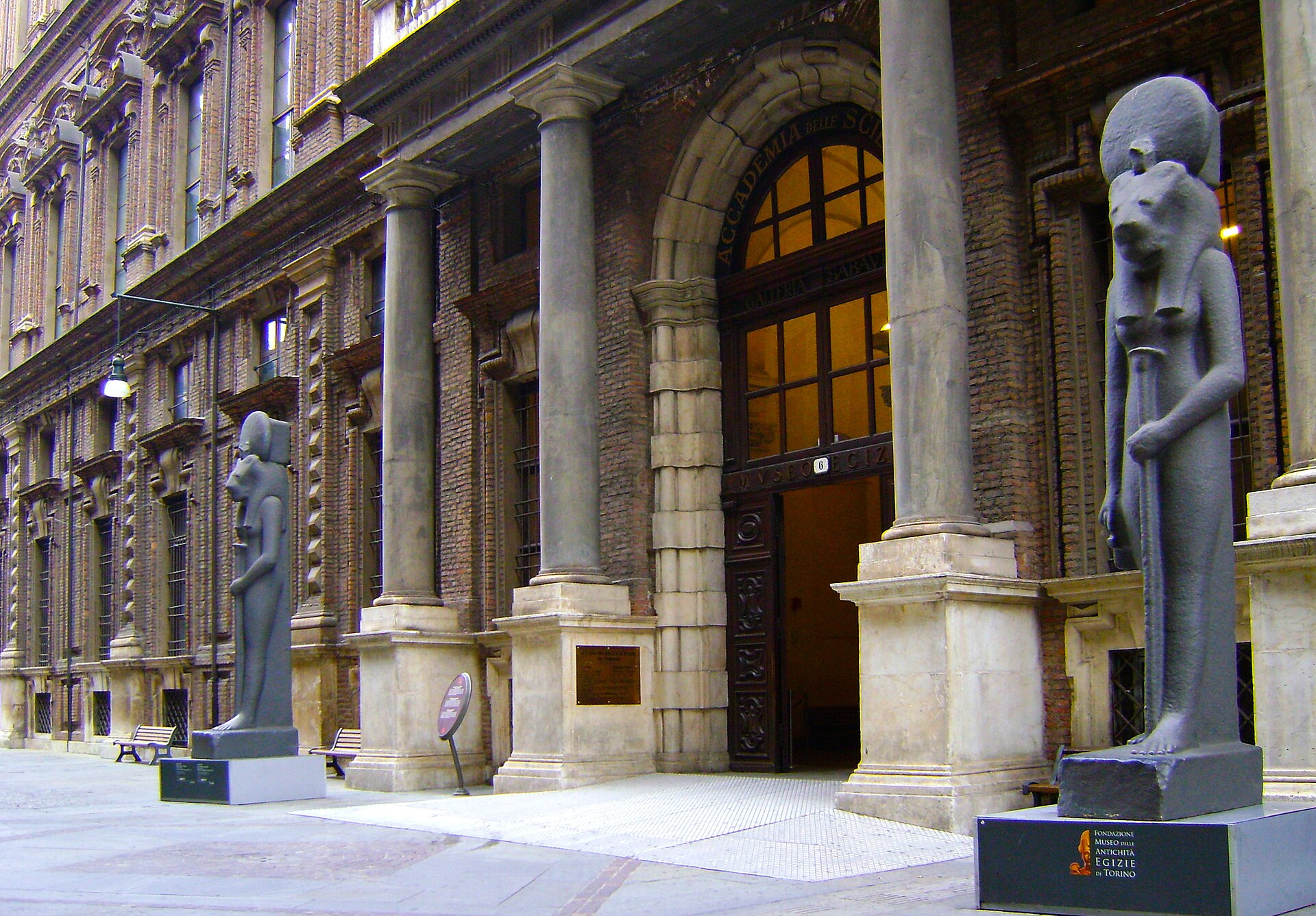
The facade of the Museo Egizio on Via Accademia delle Scienze, Turin, part of the Palazzo dell'Accademia delle Scienze, with a museum banner hanging beside the entrance.
Photograph by Prof. Mortel · CC BY 2.0Museo Egizio
Museum · Museo Egizio di Torino · Founded 1824
Open, admission and hours confirmed 24 August 2026 · 17 sources
On this page 14 sections
ContentsClose
The oldest museum anywhere devoted entirely to ancient Egypt, and by most counts still the second-largest Egyptological collection in the world after Cairo's, built from a single decisive 1824 purchase of Bernardino Drovetti's collection rather than accumulated slowly. Its papyri, the Turin King List foremost among them, gave Champollion the material to test hieroglyphic decipherment in the same year the museum was founded. Its single strongest holding is depth rather than scattered highlights: the intact tomb assemblage of Kha and Merit, three separate versions of the Book of the Dead, a temple moved whole from Nubia, and a statue corridor redesigned twice in twenty years to stage colossal royal sculpture as theatre. The institution around the objects has been almost as often rebuilt as the objects themselves, changing legal structure in 2004, its principal rooms in 2006, its entire layout in 2015, and, as of this page's research date, parts of its galleries again, while its director has spent a decade defending the museum's own choices about who it addresses and how, in Italy's national political arena rather than only in its exhibition halls.
| Local name | Museo Egizio di Torino |
|---|---|
| Kind | Museum |
| Founded | 1824 (King Charles Felix of Sardinia bought the Drovetti collection of 5,268 pieces to combine with the 300 Egyptian objects already in Turin since 1753); the world's first museum dedicated entirely to ancient Egypt |
| City and country |  Turin, Italy Turin, Italy |
| Address | Via Accademia delle Scienze 6, 10123 Torino, Italy |
| Website | museoegizio.it/en |
| Status | Open, confirmed |
| Record last verified |
Visiting
- Hours
- Tuesday, Wednesday, Thursday, Friday, Sunday09:00 to 18:30Last entrance one hour before closing
- Saturday09:00 to 20:00Last entrance one hour before closing. Several Saturdays and one Monday in August 2026 carry extended hours to 22:30, listed on the museum's own special-openings calendar
- Monday09:00 to 14:00Shortened hours
- Closed
- See the museum's own opening-hours calendar for holiday exceptions.
- Admission
- Full price (Intero)EUR 18
- Reduced-price (Ridotto)EUR 15Over 70; licensed journalists; companion of a member under 14
- Student reducedEUR 3Age 11 to 18, and university students; also the Carta Giovani Nazionale (National Youth Card) discount rate
- Junior reducedEUR 1Age 6-14
- Family ticketEUR 362 adults plus 2 under 18
- Free admissionFreeMuseo Egizio members; children 0-5; people with disabilities plus one accompanying person
Free entry: Your own birthday, all year, ID required at the ticket office. International Women's Day, 8 March, free for all women. Father's Day and Mother's Day, free for parents accompanied by their children. Free admission every Saturday 18:30-22:30 from 4 July to 8 August 2026, sponsored by Francorosso, online booking still required- Tickets
- egizio.museitorino.it/en The museum's own ticket page.
- Do I need to book?
- Entry is guaranteed only with an online ticket; the ticketing site states walk-up entrance is not assured
- Address
- Via Accademia delle Scienze 6, 10123 Torino, Italy MapMetro/walking Central Turin, a short walk from Piazza Castello and the Palazzo Reale; the museum shares the building (Palazzo dell'Accademia delle Scienze) with the Galleria Sabauda picture gallery
- Website
- museoegizio.it/en
- Telephone
- +39 011 5617776
- [email protected]
Before you go how long, access, photography, bags, eating, shop
- How long to allow
- The museum's own ticketing site states an average independent visit takes about two and a half hours
- Access
- Built with people with specific access needs as project partners: associations for blind and partially sighted people (UICI Piedmont and Turin) and the Fondazione Istituto dei Sordi di Torino. Tools include a dedicated route for blind and partially sighted visitors with 35 tactile panels and labels, 60-plus audio descriptions, a full audioguide in Italian Sign Language (LIS) and International Sign, an Egyptological glossary in LIS, Augmentative and Alternative Communication publications, Easy Read resources and a social story, developed with PNRR (EU recovery-fund) money and Fondazione Paideia. Visitors with disabilities and one companion are admitted free regardless of disability type, on presentation of documentation
- Photography
- Not detailed on the pages fetched for this record
- Bags
- The cloakroom service is temporarily unavailable as of August 2026 because of ongoing renovation work, per the ticketing site's own visitor notice
- Eating
- Not detailed on the pages fetched for this record
- Shop
- Museum Shop just past the atrium entrance, reachable without a museum ticket, plus an online shop
Prices and hours change. We take them from the institution's own pages and print the day we read them, and you can check the current position at the source we used. Confirm before you travel.
What is inside
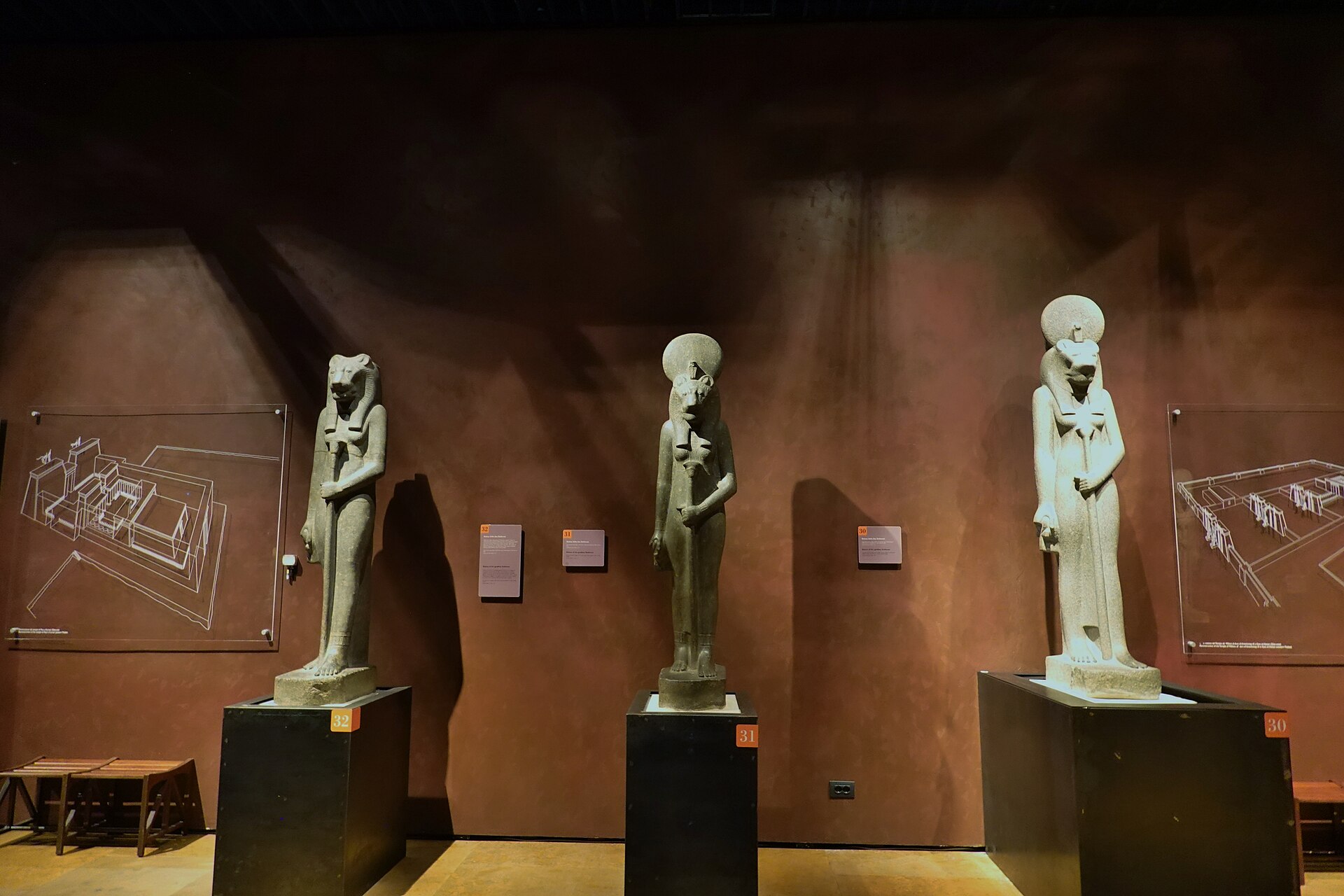
Photograph by Prof. Mortel · CC BY 2.0 Galleria dei Re (Gallery of the Kings)
The museum's signature room, redesigned for the building's 2006 rebuild ahead of the Turin Winter Olympics by the film production designer Dante Ferretti, using dramatic single-source lighting and mirrored surfaces to stage colossal royal statues, Sekhmet figures and the Assemblea dei Re, a set of statues assembled to represent the kings of the New Kingdom, along a single dark corridor. It is consistently the most photographed room in the museum
Historic Rooms, floor -1 (currently closed)
As of the museum's own notice, the Historic Rooms on floor -1 have been closed to the public since 12 December 2025, described only as 'temporarily' closed, with no reopening date published as of August 2026. The notice does not specify which objects or displays are affected beyond naming the floor
Room 7, the Kha and Merit itinerary
The museum route dedicated to the intact tomb of the architect Kha and his wife Merit (TT8, Deir el-Medina), found undisturbed by Ernesto Schiaparelli in 1906 and transferred to Turin as a complete funerary assemblage rather than as scattered finds. From 14 February to 17 August 2026, for the tomb's 120th anniversary, this room additionally hosts two loans never before shown alongside the Turin material: the pyramidion bearing Kha's name from the Musee du Louvre, and Merit's Book of the Dead from the Bibliotheque nationale de France
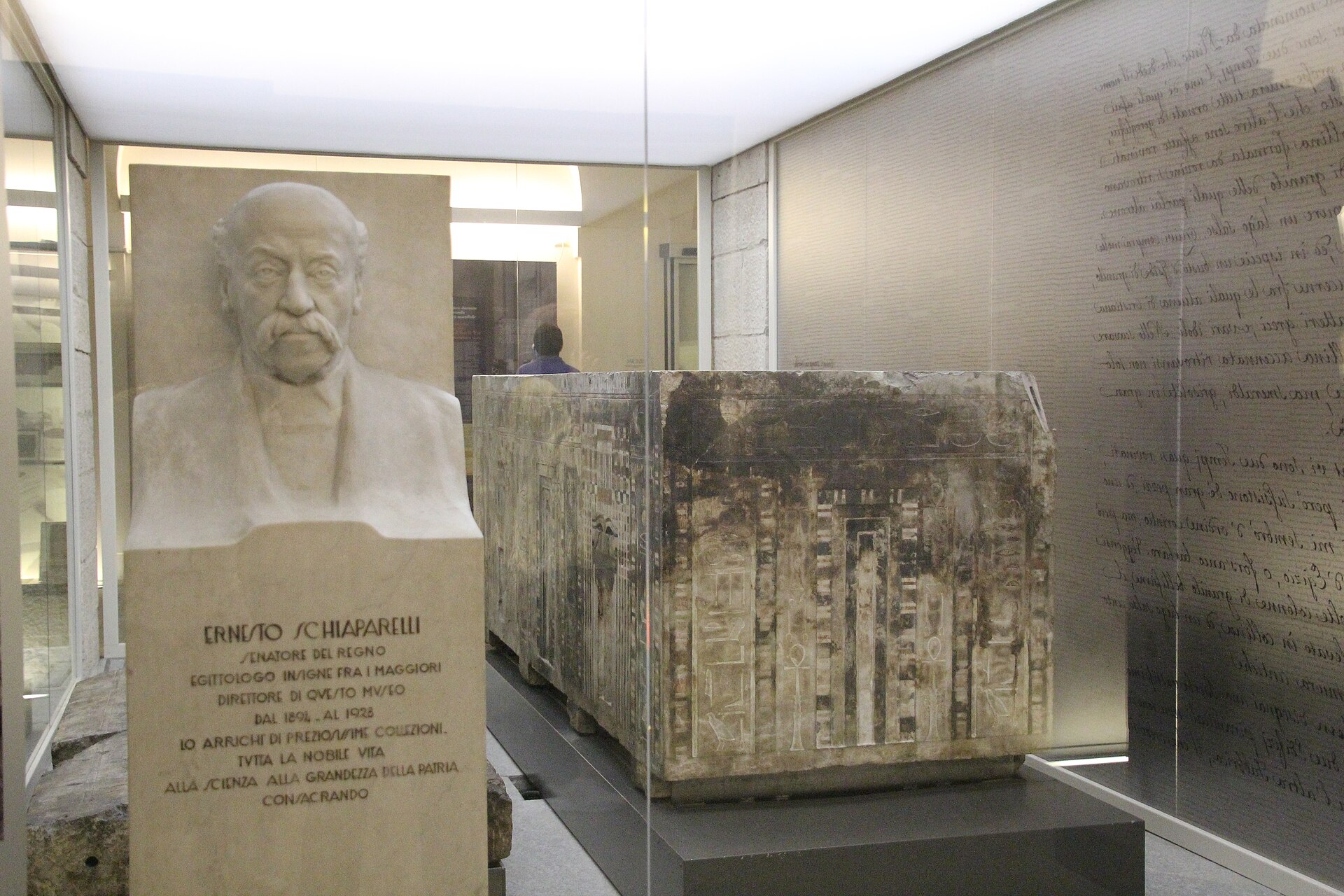
Photograph by Discanto · CC BY-SA 4.0 Papyrus collection room
Built around the papyri Bernardino Drovetti sold to the museum in 1824, later used by Jean-Francois Champollion to test his decipherment of hieroglyphs. Holds the Turin King List (a badly damaged papyrus recording Egyptian kings from myth down to roughly the 19th Dynasty, the single most important surviving chronological source for early Egyptian history despite large missing sections), the Turin Erotic Papyrus, the Judicial Papyrus of Turin, the Turin Papyrus Map, and the 18.47-metre Papyrus of Iuefankh, the longest papyrus in the collection
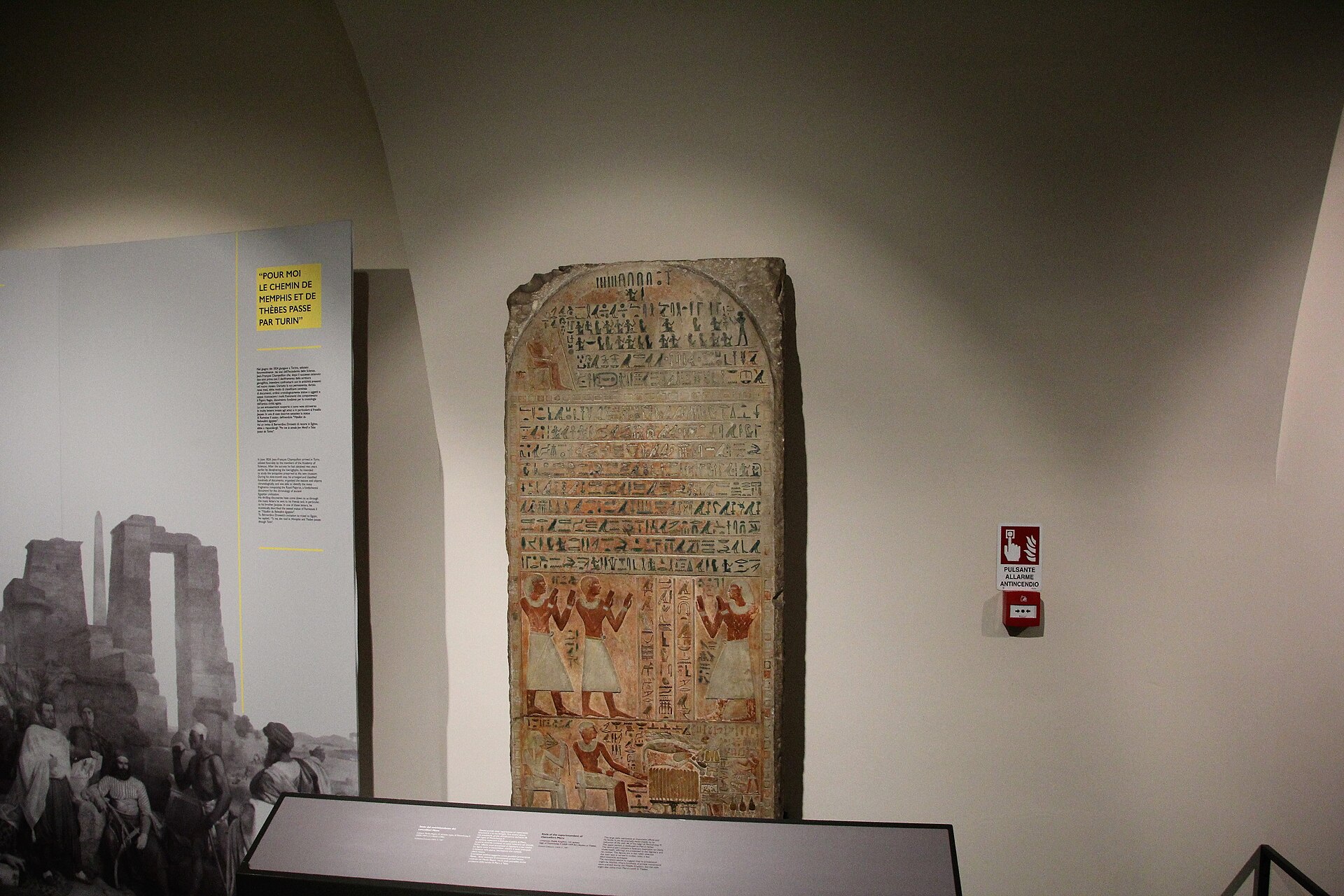
Photograph by Discanto · CC BY-SA 4.0 Statuary and material-culture galleries
Funerary stelae, sarcophagi, everyday objects and inscribed material spanning the Predynastic period to the Coptic era, including the Bembine Tablet and objects from the Drovetti, Sossio and Schiaparelli acquisitions. A sign in this part of the museum carries Jean-Francois Champollion's own 1824 verdict on the collection: the road to Memphis and Thebes passes through Turin
New galleries (recently opened, works ongoing)
The museum's own current visitor notice states the entire museum, including new galleries, is open, but that ongoing renovation work makes the visitor route less straightforward than usual and has taken the cloakroom temporarily out of service. This is separate from, and in addition to, the Historic Rooms closure on floor -1
What to see first
Turin King List (Turin Royal Canon)
Ancient Egyptian, Ramesside period, c. 1200 BCEThe most complete surviving king-list from ancient Egypt and a foundation stone of Egyptian chronology, despite being severely damaged: Bernardino Drovetti's papyrus arrived in Turin already fragmented, and Champollion's own study of it in the 1820s helped spark a persistent legend, repeated in the museum's own institutional history, that part of it went missing and was only later recovered, with a parapsychologist reportedly consulted in 1950 to locate the rest without success. Some fragments remain unplaced to this day.6
Tomb of Kha and Merit (TT8)
18th Dynasty, c. 1400 BCE; excavated by Ernesto Schiaparelli, 1906One of the very few ancient Egyptian tombs found completely undisturbed and moved to a museum as a whole assemblage rather than piece by piece, giving an unusually complete picture of an 18th-Dynasty household's funerary goods. Its 120th anniversary in February 2026 brought two objects from the tomb back into dialogue with it for the first time: the pyramidion of Kha, on loan from the Louvre, and Merit's Book of the Dead, on loan from the Bibliotheque nationale de France, both on display in Room 7 only until 17 August 2026.5
Book of the Dead of Kha
18th Dynasty, found in the Tomb of Kha and Merit, 1906One of three distinct versions of the Book of the Dead held by the museum and among the best-preserved illustrated copies known; found with its owner's own name and burial rather than assembled from unrelated fragments, it is normally on public display alongside a full illustrated version of the text.6
Statue of Ramesses II
19th Dynasty, c. 1250 BCEA monumental seated statue of the king shown alongside Amun and Hathor, and one of the anchor pieces of the Gallery of the Kings; frequently reproduced as the visual shorthand for the museum as a whole.6
Temple of Ellesiya
New Kingdom Egyptian rock-cut temple, reign of Thutmose III, c. 1450 BCEThe museum's last major acquisition of an entire monument: given to Italy by the Egyptian government in the 1960s in recognition of Italian participation in the international campaign to save Nubian monuments from the rising waters behind the Aswan High Dam, and rebuilt inside the museum stone by stone.6
Turin Erotic Papyrus
Ramesside period, c. 1150 BCEA satirical papyrus combining explicit sexual scenes with caricature, unusual for its content among surviving Egyptian papyri and long a subject of debate over how literally to read its satire, whether social, religious or purely comic.6
Sarcophagus of Ibi and Sarcophagus of Horkhebit
Late Period Egyptian, from the Drovetti collectionTwo of the collection's principal sarcophagi from the 1824 Drovetti purchase that founded the museum's holdings, representative of the mass of Late Period funerary material that made Turin's collection, alongside Cairo's, one of the two largest in the world at the time it was formed.6
Statue of Amun (Karlsruhe loan)
Egyptian, New Kingdom, post-Amarna period, circa 1353-1334 BCENot part of the Turin collection: a limestone statue of Amun seated on a throne, 111cm tall, arrived on 11 March 2026 as a ten-year loan from the Badisches Landesmuseum in Karlsruhe, itself closed for its own building renovation, and now stands in the museum's renovated Gallery of the Kings. The museum's director, Christian Greco, called it confirmation of the institution's scientific ties to other European collections; press coverage has noted the statue's facial features are unusually close to Tutankhamun's, including the famous gold funerary mask.17
Past exhibitions here
- Closed14 Feb to 17 Aug 2026Confirmed · check before you travel
The world's first museum built for Egypt alone, and an accidental founding
An Egyptian-style altar table, the Mensa Isiaca, reached Turin in 1630 for a temple to Isis in Rome and later passed into Savoy hands; its presence in the city is what prompted King Charles Emmanuel III to send the botanist Vitaliano Donati to Egypt in 1753, where he collected roughly 300 objects from Karnak and Coptos that became the collection's actual starting point. The museum as it exists, though, dates to 1824, when King Charles Felix bought the holdings of Bernardino Drovetti, Napoleon's former consul general in Egypt, whose own collecting had amassed 5,268 pieces, including around 100 statues and 170 papyri, stelae and mummies. That single purchase, not the 1753 expedition, is what the museum counts as its founding date, and it made Turin's the first museum anywhere devoted entirely to ancient Egyptian civilisation rather than to Egypt as one gallery among many. In the same year, Jean-Francois Champollion travelled to Turin specifically to test his newly cracked hieroglyphic system against the collection's papyri, and it was that visit that produced his verdict, still quoted on the museum's own walls: the road to Memphis and Thebes passes through Turin.
A king-list with its own missing chapter
Among the papyri Champollion examined was what is now called the Turin King List, a Ramesside-era papyrus recording pharaohs from legendary rulers down through roughly the 19th Dynasty, and still the single most important chronological source for early Egyptian history despite arriving in Turin already badly damaged in transit. Champollion's own study of the collection is bound up with a story the museum's own institutional history repeats rather than dismisses: that part of the King List went missing after his visit and was only later recovered, with some fragments still unaccounted for, and that a parapsychologist was consulted in 1950 in an unsuccessful attempt to locate them. Whatever the truth of the disappearance, the practical fact is plainer and better documented: the list survives with real gaps, and reconstructions of the early Egyptian king-lists still have to work around them.
An intact tomb, a century later back in dialogue with itself
The Egyptologist Ernesto Schiaparelli directed the museum from 1894 to 1928 and ran excavation campaigns in Egypt between 1900 and 1920 that substantially reshaped the collection. His most significant single find came in 1906: the tomb of the architect Kha and his wife Merit at Deir el-Medina (TT8), discovered completely undisturbed and moved to Turin as an intact funerary assemblage rather than dispersed piece by piece, an outcome rare enough that it remains one of the most complete non-royal Egyptian burials known anywhere. February 2026 marked the tomb's 120th anniversary, and the museum marked it by bringing two objects from the same burial back to Turin for the first time in living memory: the pyramidion carrying Kha's name, on loan from the Musee du Louvre, and Merit's own Book of the Dead, on loan from the Bibliotheque nationale de France. Both are shown in Room 7, inside the museum's own Kha-and-Merit itinerary, from 14 February to 17 August 2026, a loan that closes within days of this page being researched.
Privatised, then rebuilt twice inside two decades
The Museo Egizio has changed its own institutional shape more than most peer museums. At the end of 2004 it became a case study in an Italian government experiment: rather than remain a directly state-run museum, it was placed under a new Fondazione Museo delle Antichita Egizie, a private foundation structure. Ahead of Turin's hosting of the 2006 Winter Olympics the building itself was substantially remodelled, with its principal rooms, above all the statue corridor that became the Gallery of the Kings, redesigned by the film production designer Dante Ferretti using theatrical lighting and mirrored surfaces. Less than a decade later, on 1 April 2015, the museum reopened again under an entirely new exhibition layout, logo and visual identity designed by the studio Migliore+Servetto, under Christian Greco, who had become director the previous year. That pattern, of the same institution being substantially rebuilt and relaunched roughly every decade, continues now: as of August 2026 the museum's own visitor notice describes ongoing renovation work across new galleries, alongside the separate, still-unexplained closure of the Historic Rooms on floor -1 since 12 December 2025.
A director repeatedly attacked over how the museum presents itself
Christian Greco has run the Museo Egizio since 2014, a tenure widely credited, including by his political critics, with strong cultural and financial results. He has also spent much of that decade as a target of the Italian political right. The pattern began in 2017-2018, when Greco introduced a discounted admission scheme for Arabic-speaking visitors called Fortunato chi parla arabo (Lucky are those who speak Arabic). During the tense run-up to Italy's 2018 general election, members of Giorgia Meloni's Fratelli d'Italia accused Greco of reverse racism against Italians and staged a protest outside the museum behind a banner reading no islamizzazione. Greco walked outside and debated Meloni in person; the exchange was filmed, circulated widely, and Greco was broadly credited with responding calmly, pointing out that speaking Arabic and being Muslim are not the same thing. Meloni, in turn, accused the scheme of discriminating against Christians and of misusing public money, a claim Greco rebutted by noting the museum's budget is not state-funded and was in fact running a surplus. Fratelli d'Italia issued a statement threatening to replace museum directors, Greco among them, if it took power, although museum-director appointments do not in fact fall under Italy's political spoils system and the Museo Egizio is not a state museum. A second flashpoint came in 2021, when Piedmont's regional government tried to install the Egyptologist Francesco Tiradritti on the museum's board over Greco's objection; Greco threatened to resign rather than accept the appointment, and Tiradritti was kept off the board. The dispute reignited most sharply in September 2023, after Piedmont's regional welfare councillor Maurizio Marrone told Corriere della Sera he would not reconfirm Greco if it were his decision, citing unnamed 'more qualified figures.' Lega's deputy secretary Andrea Crippa went further, calling Greco ideological and racist against Italians and saying he would do everything to have him removed, calling on the culture minister to fire him if he did not resign of his own accord; Crippa had previously circulated a video making false claims about the 2018 scheme, for which he was initially found liable for damages before that judgment was overturned on appeal. This time the backing for Greco came from an unusually broad range of quarters: Italy's Egyptological community closed ranks behind him, and so, notably, did several members of Piedmont's own centre-right regional government, including its culture councillor, who stated that recent criticism did not dent the region's trust in a professional who had demonstrably worked well for the museum. Neither Meloni nor the national culture minister took a public position in 2023. Greco's own response, reported under the headline asking Meloni to come see the museum for herself rather than argue about it from a distance, was that he had no need to cling to his chair.
What visitors say
Visitors and critics alike rank this among the best-run and most modern-feeling Egyptology museums in the world, crediting director Christian Greco's decade-plus tenure with transforming a dated, dimly curated collection into an internationally admired institution, at the same time as the museum has become an unusually visible target for domestic Italian political attacks over how inclusively it presents itself.
What is praised, what is criticised
- Praised: the Gallery of the Kings, Dante Ferretti's theatrical 2006 lighting redesign of the statue corridor, widely singled out as one of the most memorable single rooms in any Egyptology museum
- Praised: the completeness and documentation of the Kha and Merit material, an intact tomb assemblage rather than scattered finds, which specialists and general visitors both cite as unusually rare
- Praised: the accessibility programme built with disabled visitors and their own advocacy organisations as design partners rather than as an afterthought
- Criticised: the closure of the Historic Rooms on floor -1 since 12 December 2025 with no published reopening date, and separately, current renovation work that the museum's own ticketing site says makes the visitor route less straightforward and has taken the cloakroom out of service
- Criticised: the museum's repeated entanglement in Italian party politics, most visibly the 2017-2018 dispute and its renewed 2023 flare-up (see narrative), which critics on the political right have used to call for the director's removal over what they characterise as ideologically driven, discriminatory programming, a characterisation the museum, most of the Egyptological community, and even some officials from the same regional right-wing coalition have rejected
- Criticised: the museum's own site not stating its standard adult full-price ticket figure on any page reachable without completing an interactive booking flow, an unusual gap for an institution this size (see open_questions)
Questions about Museo Egizio
Where is Museo Egizio?
Via Accademia delle Scienze 6, 10123 Torino, Italy.
How much does it cost to visit?
Full price (Intero): EUR 18; Reduced-price (Ridotto): EUR 15; Student reduced: EUR 3; Junior reduced: EUR 1; Family ticket: EUR 36. As confirmed 24 August 2026.
When is it open?
Tuesday, Wednesday, Thursday, Friday, Sunday 09:00-18:30; Saturday 09:00-20:00; Monday 09:00-14:00. Closed: See the museum's own opening-hours calendar for holiday exceptions. As confirmed 24 August 2026.
How do you get there?
Metro/walking: Central Turin, a short walk from Piazza Castello and the Palazzo Reale; the museum shares the building (Palazzo dell'Accademia delle Scienze) with the Galleria Sabauda picture gallery.
What should you see first?
Turin King List (Turin Royal Canon) (Ancient Egyptian, Ramesside period, c. 1200 BCE); Tomb of Kha and Merit (TT8) (18th Dynasty, c. 1400 BCE; excavated by Ernesto Schiaparelli, 1906); Book of the Dead of Kha (18th Dynasty, found in the Tomb of Kha and Merit, 1906); Statue of Ramesses II (19th Dynasty, c. 1250 BCE); Temple of Ellesiya (New Kingdom Egyptian rock-cut temple, reign of Thutmose III, c. 1450 BCE); Turin Erotic Papyrus (Ramesside period, c. 1150 BCE).
What we could not confirm
- The museum's own standard full-price ('Intero') adult admission figure could not be confirmed from any directly fetched page. Its official fares page (museoegizio.it/en/info/prices/) lists free categories, school rates and named partner discounts but defers the base walk-up price to an interactive Vivaticket booking widget at egizio.museitorino.it, which returned a bot-check challenge screen to a direct HTTP fetch and did not expose a price figure in the content reachable through the in-app browser either. The EUR 18.00 and EUR 36.00 figures used on this page are both baseline reference prices stated only in the context of a specific promotional discount, not confirmed as the museum's current standard rates.
- The museum's notice that the Historic Rooms on floor -1 have been closed since 12 December 2025 names no reopening date and gives no reason beyond 'temporarily closed.' What is actually inside those rooms, and whether the closure is related to the separately announced ongoing renovation of the 'new galleries,' is not stated anywhere on the museum's own site as of the research date.
- Sources differ on how many artefacts the museum holds: the museum's own homepage and press material describe roughly 32,500-37,000 items with about 6,500 on display, while English Wikipedia states 'more than 40,000 artifacts.' Neither figure is dated to a specific inventory count, and this page does not pick one as authoritative.
Images
Sources
- 1Wikidata, Museo Egizio (Q19877): label, description as an ancient Egyptian art and history museum in Turin, Italy, coordinates 45 04'06"N 7 41'04"E matching the brief's 45.06833,7.68444, founder Charles Felix of Savoy, director Christian Greco, inception 1824. Fetched and raw-verified 7 August 2026. wikidata.org/wiki/Q19877
- 2Museo Egizio, official homepage: current notices (Historic Rooms closure, From Paris for Kha and Merit exhibition, Materials: The Shape of Time permanent exhibition), collection statistics (24 human mummies, 17 animal mummies, 1,847cm Papyrus of Iuefankh, 5-tonne statue of Sethy II), Champollion quote, address and phone. Fetched and read in full, 7 August 2026. museoegizio.it/en/
- 3Museo Egizio, official Opening hours page: Monday 9-2, Tuesday/Wednesday/Thursday/Friday/Sunday 9-6:30, Saturday 9-8, last entrance one hour before closing, August 2026 special extended openings. Fetched and read in full, 7 August 2026. museoegizio.it/en/info/hours/
- 4Museo Egizio, official Accessibility page: the Accessibility Manifesto, partner organisations (UICI Piedmont and Turin, Fondazione Istituto dei Sordi di Torino, Tactile Vision Lab, Fondazione Paideia), tactile route and panel counts, LIS and International Sign audioguide, PNRR funding, free admission for disabled visitors and one companion. Fetched and read in full, 7 August 2026. museoegizio.it/en/info/accessibility/
- 5Museo Egizio, official 'From Paris for Kha and Merit' exhibition page: the 15 February 2026 120th-anniversary date of Schiaparelli's 1906 discovery of the Kha and Merit tomb, the Louvre pyramidion and Bibliotheque nationale de France Book of the Dead loans on display 14 February-17 August 2026 in Room 7. Fetched and read in full, 7 August 2026. museoegizio.it/en/explore/exhibitions/from-paris-for-kha-and-merit-two-masterpieces-on-loan-for-the-120th-anniversary-of-the-discovery-of-the-tomb/
- 6Fetched and read in full, 7 August 2026. en.wikipedia.org/wiki/Museo_Egizio
- 7Il Post, 'Le polemiche sul direttore del Museo Egizio si sono rianimate quasi dal nulla', 22 September 2023: the September 2023 renewed attacks on director Christian Greco by regional councillor Maurizio Marrone and Lega's Andrea Crippa, the full account of the 2017-2018 'Fortunato chi parla arabo' controversy and Greco's public debate with Giorgia Meloni, the 2021 Francesco Tiradritti board dispute, Crippa's 2018 false-claim video and its overturned damages judgment, and the defence of Greco by Piedmont's own centre-right regional officials and culture undersecretary Vittorio Sgarbi. Fetched and read in full, 7 August 2026. ilpost.it/2023/09/22/polemica-greco-museo-egizio-direttore/
- 8Corriere della Sera, 'Christian Greco: "Le critiche? Giorgia Meloni venga al museo Egizio di Torino. Non ho bisogno di poltrone"', 21 September 2023: headline and framing of Greco's own response to the 2023 criticism (full body text behind Corriere's paywall, not quoted beyond the headline). Fetched 7 August 2026; page loaded but full article content is subscriber-gated. corriere.it/cultura/23_settembre_21/christian-greco-direttore-museo-egizio-poltrona-ce4c1730-57e7-11ee-ad09-f5d0e4dba93a.shtml
- 9Museo Egizio, official Fares page (Italian): promotional discount rates including Royal Pass (EUR 15.00), Carta Giovani Nazionale (EUR 3.00), and the Tesori dei Faraoni exhibition-ticket promotion stating standard reduced/family baselines of EUR 18.00 and EUR 36.00 respectively. Fetched and read in full, 7 August 2026. museoegizio.it/it/info/prezzi/
- 10Museo Egizio online ticketing platform (Vivaticket-hosted), visitor notice: 'The entire museum is open to visitors, including the new galleries. Due to the ongoing renovation work, the visitor route is less straightforward and the cloakroom service is temporarily unavailable,' plus the free-Saturday-evenings promotion (4 July-8 August 2026) sponsored by Francorosso. Fetched via the in-app browser after a direct HTTP fetch returned a bot-check challenge page; read in full, 7 August 2026. egizio.museitorino.it/en/
- 11Museo Egizio, official NOTICE - closure of the Historic Rooms: 'Starting December 12, 2025, the Historic Rooms on floor -1 will be temporarily closed to the public. We apologize for the inconvenience,' with no reopening date stated. Fetched and read in full, 7 August 2026. museoegizio.it/en/explore/news/notice-closure-of-the-historic-rooms/
- 12Wikimedia Commons, File:Egyptian Museum, Turin (1).jpg: CC BY 2.0, author Prof. Mortel, confirmed by eye as the Via Accademia delle Scienze facade with museum banners visible. Used as the lead plate. commons.wikimedia.org/wiki/File:Egyptian_Museum,_Turin_(1).jpg
- 13Wikimedia Commons, File:Museo Egizio (Torino) 01.jpg: CC BY-SA 4.0, author FrDr, confirmed by eye as the same facade with a MUSEO EGIZIO banner. Used as a context plate. commons.wikimedia.org/wiki/File:Museo_Egizio_(Torino)_01.jpg
- 14Wikimedia Commons, File:Hall of Kings; Egyptian Museum, Turin (1).jpg: CC BY 2.0, author Prof. Mortel, confirmed by eye as statues of Sekhmet and other deities in the dramatically lit Gallery of the Kings. Used as the Gallery of the Kings wing plate. commons.wikimedia.org/wiki/File:Hall_of_Kings;_Egyptian_Museum,_Turin_(1).jpg
- 15Wikimedia Commons, File:Torino, Museo egizio (012).jpg: CC BY-SA 4.0, author Gianni Careddu, camera-location geotag matching the museum's own coordinates, confirmed by eye as a bust of Ernesto Schiaparelli beside a sarcophagus lid near the papyrus displays. Used as the papyrus-room wing plate. commons.wikimedia.org/wiki/File:Torino,_Museo_egizio_(012).jpg
- 16Wikimedia Commons, File:Torino, Museo egizio (020).jpg: CC BY-SA 4.0, author Gianni Careddu, confirmed by eye as an inscribed funerary stela with an interpretive panel quoting Champollion's 'road to Memphis and Thebes' remark. Used as the statuary/material-culture wing plate. commons.wikimedia.org/wiki/File:Torino,_Museo_egizio_(020).jpg
- 17ANSA (Piemonte), 'All'Egizio dalla Germania una statua del dio Amon per un prestito decennale', 6 March 2026: limestone statue of Amun, 111cm, dated 1353-1334 BCE, on ten-year loan from the Badisches Landesmuseum, Karlsruhe (closed for its own renovation), on display in the newly renovated Gallery of the Kings from 11 March 2026; director Christian Greco quoted. Fetched and raw-verified 24 August 2026. ansa.it/piemonte/notizie/2026/03/06/allegizio-dalla-germania-una-statua-del-dio-amon-per-un-prestito_c89a8a53-843c-439c-bc31-33b17437a418.html
.jpg)
_01.jpg)
.jpg)
.jpg)
.jpg)