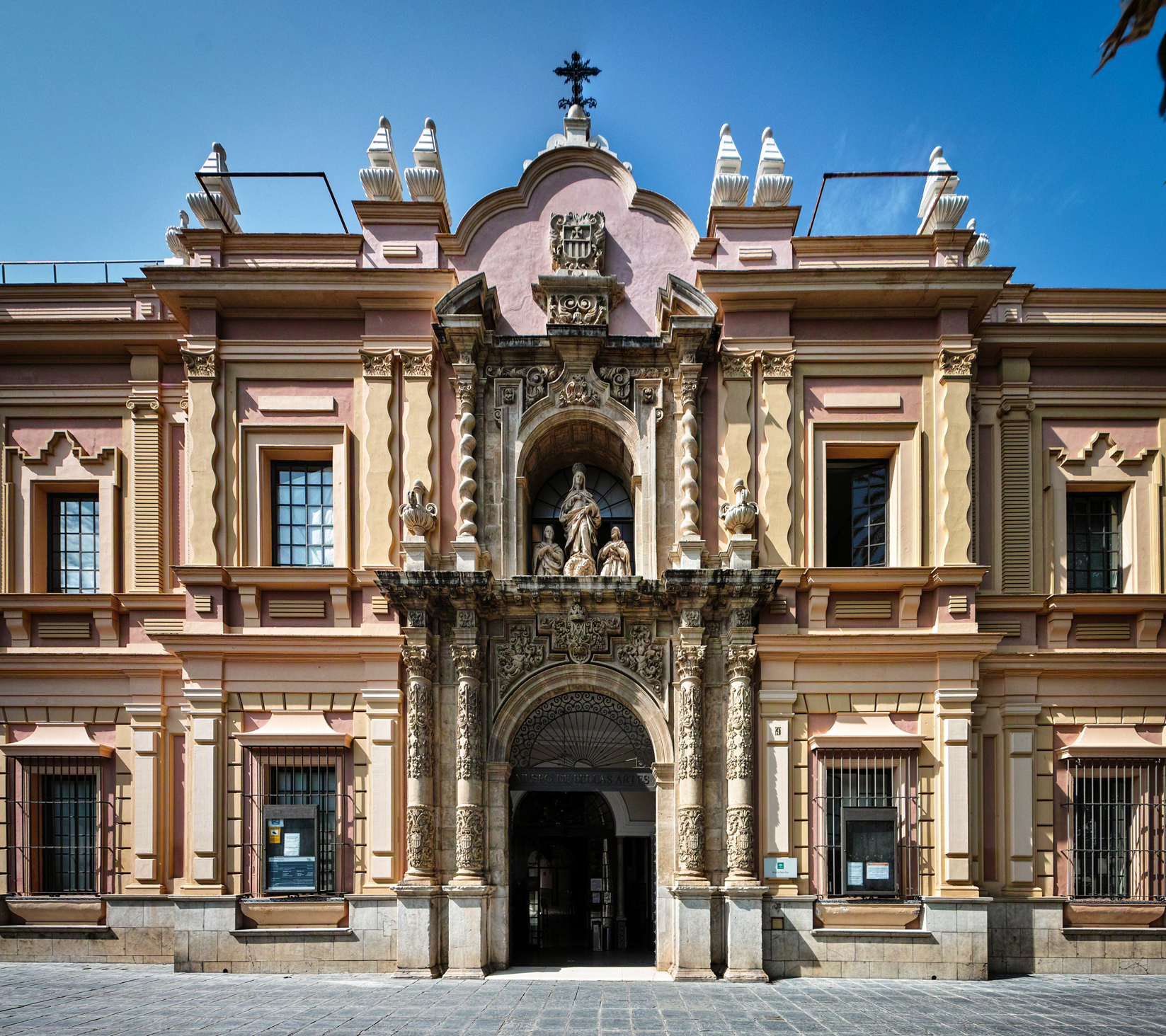
The ornate Baroque entrance portal of the Museo de Bellas Artes de Sevilla, the former Convento de la Merced Calzada.
Pepe Moron · Photograph by Pepe Morón · CC BY 4.0Museo de Bellas Artes de Sevilla
Museum · Founded 1835
Open, admission and hours confirmed 27 August 2026 · 12 sources
On this page 16 sections
ContentsClose
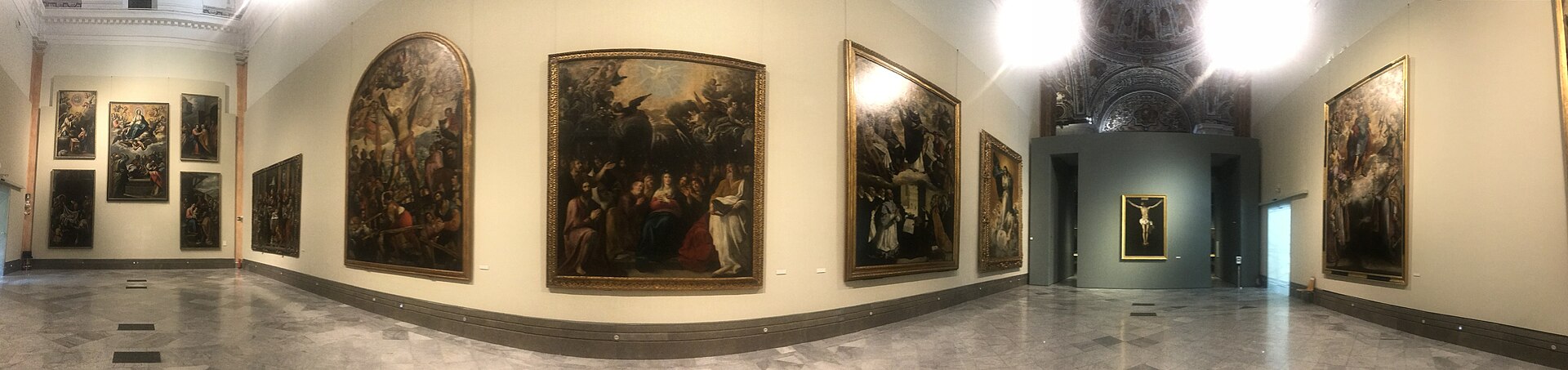
The museum's advantage is that its core holdings arrived in one historical event rather than through a century of individual purchases: the 1830s confiscation of convent and monastery property emptied Seville's religious houses of altarpieces made specifically for those spaces, which is why the collection is unusually deep in large-scale 17th-century Sevillian Baroque religious painting, Zurbaran and Murillo above all, rather than broad across periods or nationalities.
| Kind | Museum |
|---|---|
| Founded | 1835 |
| City and country |  Seville, Spain Seville, Spain |
| Address | Plaza del Museo 9, 41001 Sevilla, Spain |
| Website | museosdeandalucia.es/web/museodebellasartesdesevilla |
| Status | Open, confirmed |
| Record last verified |
Visiting
- Hours
- 1-31 August, Tuesday-Sunday and public holidays09:00 to 15:00summer hours; open 15 August; the last 25 tickets are sold 45 minutes before closing if capacity allows, room access closes 30 minutes before closing, and rooms are cleared 15 minutes before closing
- 1 September-31 July, Tuesday-Saturday09:00 to 21:00same 45/30/15-minute closing sequence as the summer schedule
- 1 September-31 July, Sunday and public holidays09:00 to 15:00
- MondayClosed, except a Monday that falls the day before a public holiday, which opens with that day's holiday hours (09:00-15:00); in 2026 these Mondays are 5 January, 12 October, 2 November and 7 December
- 1 and 6 January, 1 May, 24, 25 and 31 DecemberClosed all year regardless of season
- Closed
- Monday (except the day before a public holiday). 1 January. 6 January. 1 May. 24 December. 25 December. 31 December.
- Admission
- GeneralEUR 1.50
- European Union citizens (accredited) and ICOM membersFreefree on any day, at any time, on presentation of identification
Free entry: Every day, for accredited European Union citizens and ICOM members (a standing exemption, not a calendar date). 28 February (Dia de Andalucia). 18 May (International Museum Day). 27 September (World Tourism Day). 4 December (Dia de la Bandera Andaluza, Andalusian Flag Day). European Heritage Days, whenever they fall in a given year- Do I need to book?
- Not required for individual visitors. Groups of 10 or more, including guides, must book in advance; the permanent collection caps group size at 30 and requires a guiding system (microphone and headsets) that the museum does not provide
- Address
- Plaza del Museo 9, 41001 Sevilla, Spain Map
- Website
- museosdeandalucia.es/web/museodebellasartesdesevilla
- Telephone
- +34 954 786 498
- [email protected]
Before you go how long, access, photography, bags, eating, shop
- How long to allow
- Tripadvisor's own listing gives 1-2 hours; several detailed reviews describe spending 90 minutes to 2 hours
- Access
- Not established in detail from the pages read for this record; the museum's own accessibility page returned a permissions error rather than content during this research pass
- Photography
- Personal photographs and video are allowed for private use. Tripods, selfie sticks, flash and any other light-emitting device are not permitted. Photography and filming of any kind are not permitted in the temporary exhibition room
- Bags
- Backpacks and luggage larger than 20 by 30 by 10 centimetres are not allowed in; lockers are provided
- Eating
- Not listed among the museum's own services pages; no on-site cafe was found in this research pass
- Shop
- An online store; no on-site shop was described separately from it
Prices and hours change. We take them from the institution's own pages and print the day we read them, and you can check the current position at the source we used. Confirm before you travel.
What is inside
Claustro del Aljibe (Cistern Cloister)
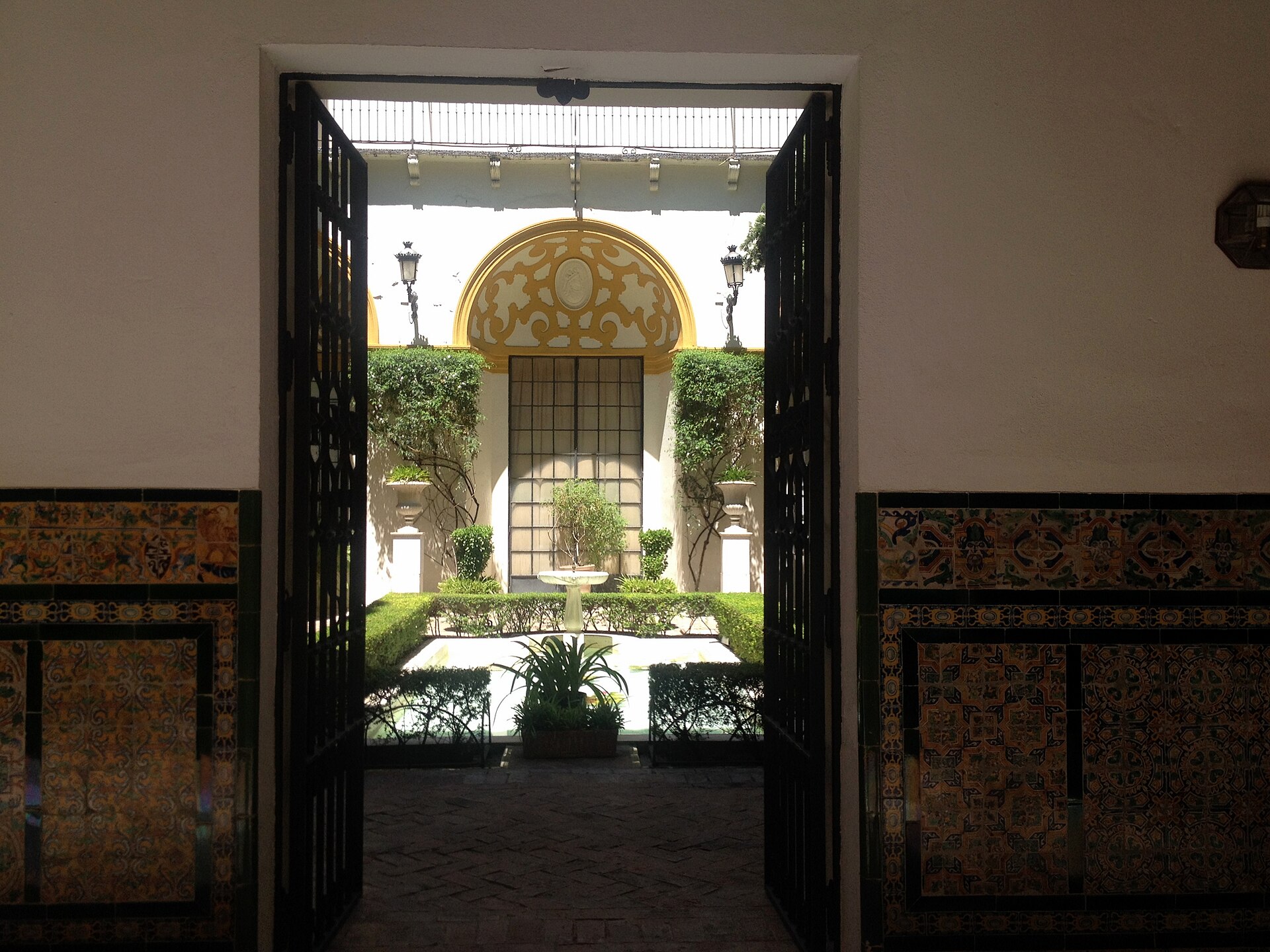
The convent's domestic quarter, where the friars' own living and sleeping quarters opened onto a slightly trapezoidal cloister of three arcaded levels; a cistern at its centre once collected rainwater for the convent's own supply. It is now tiled with azulejos taken from other convents dissolved in the same 1830s confiscation that created the museum, and holds Cristobal de Augusta's Virgin of the Rosary, painted to a protective Gothic model of the Virgin that Zurbaran later reused for his own Virgin of Las Cuevas, shown elsewhere in the museum.
Claustro de los Bojes
The more carefully finished of the two smaller cloisters, built as the antechamber to the friars' refectory, now Room II. It holds the Renaissance portal removed from the chapel of the Calahorra castle-palace in Granada, carved by Egidio de Grandia, and a ceramic altar frontal dedicated to Seville's own patron saints, Justa and Rufina, made by Hernando de Valladares around 1600.
Claustro Mayor and the Imperial Staircase
The largest and most formal of the three cloisters, laid out by Juan de Oviedo on Italian models with paired columns on raised plinths at ground level; its upper storey was rebuilt in 1724 by Leonardo de Figueroa with a balustraded gallery between paired Ionic pilasters. Four surviving paintings from a cycle by Francisco Pacheco and Alonso Vazquez narrating the history of the Mercedarian Order, originally spread across the cloister, now hang in Room III. Beside it, the convent's private Imperial Staircase, a double-flight design under an octagonal dome, became, according to the museum's own account, a model copied widely across colonial Ibero-America.
The church
A sober Latin-cross church that lost its choir and its original altarpieces, but keeps its 18th-century ceiling, dome and pilaster paintings by Domingo Martinez, whose iconography celebrates the Mercedarian Order's central mission: ransoming Christian captives. Old Testament kings and judges who freed the people of Israel appear allegorically in the dome, reinforcing the same theme of liberation the order itself existed to carry out.
What to see first
Apotheosis of Saint Thomas Aquinas
Francisco de ZurbaranA nearly five-metre canvas commissioned in January 1631 for 400 ducados by Fray Alonso Ortiz Zambrano for Seville's College of Santo Tomas, showing Aquinas beneath Christ, the Virgin, the four Latin Doctors of the Church and a row of kneeling donors including Emperor Charles I. Napoleon's Marshal Soult removed it from Seville during the French occupation and it hung in the Musee Napoleon in Paris before returning to Spain and reaching this museum in 1840.9
Virgen con el Nino, known as the Virgen de la Servilleta (Virgin of the Napkin)
Bartolome Esteban MurilloPainted around 1668-69 for the Capuchin convent in Seville, where Murillo lived for a period among the friars. The nickname comes from a 19th-century legend, which the museum's own text presents explicitly as legend rather than fact, that Murillo had no canvas to hand after a meal and sketched the Virgin's head straight onto the dinner napkin before finishing the picture in his usual manner.4
Saint Hugh in the Carthusian Refectory
Francisco de ZurbaranA 1655 painting made for the Carthusian monastery of Santa Maria de las Cuevas in Seville, showing monks seated at a meal so still and so evenly lit that the picture is usually discussed for its treatment of silence and stillness rather than for any narrative action.7
Portrait of Jorge Manuel Theotocopuli
El GrecoA portrait, dated around 1600, of the painter's own son and workshop assistant, Jorge Manuel, who later carried on his father's practice and eventually worked as an architect in Toledo; one of the comparatively few El Greco portraits of a sitter he knew this well.10
Don Cristobal Suarez de Ribera
Diego VelazquezA portrait from around 1620, from early in Velazquez's career in Seville before his move to the royal court in Madrid, of a local clergyman rather than a courtier, painted in the dark, closely observed manner of his Seville years.11
Saint Jerome in Penitence
Pietro TorrigianoA polychrome terracotta figure by the Florentine sculptor who, as a young man training alongside Michelangelo, broke Michelangelo's nose in a fistfight over a jeering remark, a disfigurement visible in every portrait of Michelangelo afterward. Torrigiano later built Henry VII's tomb in Westminster Abbey before settling in Seville, where he was arrested by the Spanish Inquisition after defacing a Virgin and Child sculpture in anger and died in custody in 1528.8
Retrato de Gustavo Adolfo Becquer
Valeriano Dominguez BecquerA 73 by 60 centimetre portrait of the Romantic poet Gustavo Adolfo Becquer, painted in 1862 by his own brother Valeriano, a fellow painter, shortly before both men left Seville for Madrid; acquired by the regional government in 1995 from the Ybarra family collection in Seville.5
Past exhibitions here
- Closed7 Jul to 11 Oct 2026Confirmed · check before you travel
A museum built from confiscated churches
The museum's own history page dates its founding to a Royal Decree of 16 September 1835, creating a picture museum from works taken out of convents and monasteries the liberal government of Juan Alvarez Mendizabal was in the process of dissolving and selling off; other sources, including Wikipedia and Tripadvisor's own listing, give 1839 instead, and this record states both rather than picking one, since the official page is the primary source but the discrepancy is real and unresolved in what was read for it. Whichever date is correct, the mechanism is the same and it matters more than the date: Spain's church property confiscation of the 1830s emptied dozens of religious houses of their altarpieces at once, and this museum exists because Seville's regional government redirected that windfall into a public collection rather than letting it disperse. The building itself came from the same wave: the former Convento de la Merced Calzada, home to the Mercedarian Order on land Ferdinand III had granted after his own conquest of Seville centuries earlier.
Visitors today still describe the result in market terms rather than only artistic ones: reviewers repeatedly call it the second-best painting collection in Spain after the Prado, a reputation built entirely on redistributed church property rather than on any single collector's purchases.
The convent before the museum
The building's present form dates to a rebuilding begun in the first years of the 17th century under Fray Alonso de Monroy, general of the Mercedarian Order from 1602, who commissioned the architect and sculptor Juan de Oviedo y de la Bandera to draw up plans in 1603. Construction started with the demolition of the convent's older Mudejar-period building; the new church was finished in 1612, and the rest of the complex took nearly another half-century to complete, producing what the museum's own history describes as one of the finest examples of Andalusian Mannerism.
Three renovations, one relocated facade
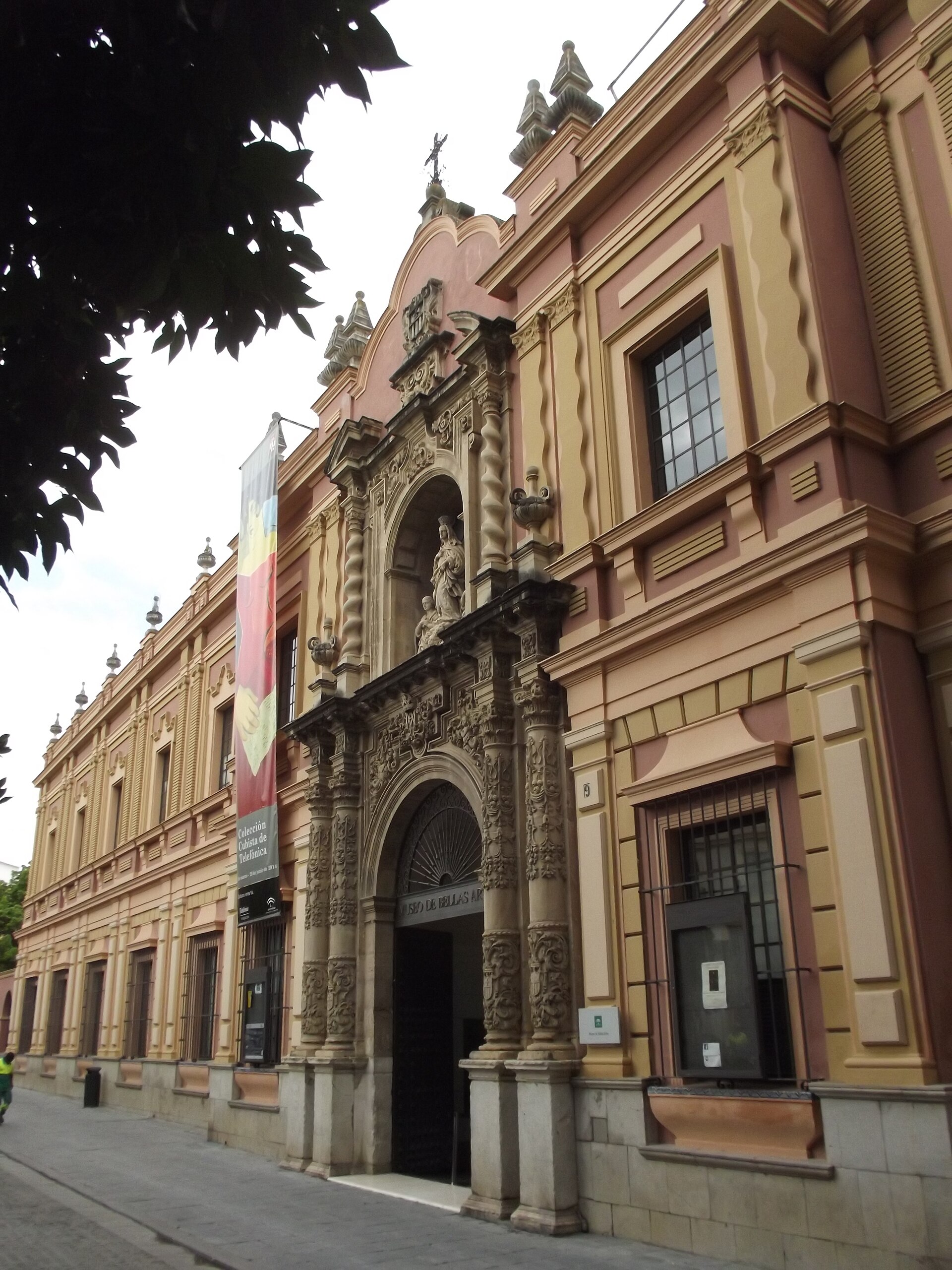
Since becoming a museum the building has been substantially reworked three times. Between 1868 and 1898 the arcades and first-floor walls were restored and the cloisters given new flooring and azulejo tilework salvaged from other convents that had themselves been dissolved. Between 1942 and 1945 the Patio de las Conchas was opened in the space of the old sacristy, and, in the change most likely to disorient anyone reading the building's facade as original, the old Baroque main doorway was physically moved to Calle Bailen. A third campaign, begun in 1987 and finished in 1993, rehabilitated the whole building to modern museum standards in several phases.
The cloisters, and a staircase that crossed the Atlantic as an idea
Three cloisters and the church form the core of what a visitor actually walks through. The Claustro del Aljibe was the convent's own domestic quarter, its name taken from the cistern at its centre that once caught rainwater for the friars' daily use; the smaller, more finely worked Claustro de los Bojes served as the antechamber to their refectory. The Claustro Mayor is the grandest of the three, its ground floor built to Italian models by Juan de Oviedo and its upper gallery rebuilt in 1724 by Leonardo de Figueroa. None of the three needs a single painting hung in it to justify the visit; the architecture is the exhibit in that part of the building.
The Escalera Imperial, the convent's private staircase, sat away from the public entrance by design, reached only from within the complex, and carried a Marian decorative programme now largely lost. Its double-flight plan, rising to an octagonal dome, is credited by the museum's own account with becoming an influential model, one that was copied widely across colonial Ibero-America - meaning a staircase built for a closed religious community's private use in 17th-century Seville went on to shape the public architecture of a different continent it had no other connection to.
A painting looted twice before it reached this room
The single largest picture in the museum, Zurbaran's Apotheosis of Saint Thomas Aquinas, is also the one with the longest paper trail. Fray Alonso Ortiz Zambrano, prior of Seville's College of Santo Tomas, commissioned it on 21 January 1631 for 400 ducados, for the college's own main altarpiece; the finished canvas, nearly five metres tall, shows Aquinas ringed by the four Latin Doctors of the Church, Christ and the Virgin above him, and a row of kneeling donors below including Emperor Charles I and the college's own founder. It stayed at the college until 1810, when French forces occupied Seville during the Peninsular War and Marshal Soult, an enthusiastic collector of Spanish paintings under occupation, took it along with a great deal else. It hung in the Musee Napoleon in Paris between 1813 and 1815, came back to Spain after Napoleon's defeat, passed through Madrid's Royal Academy and back to Seville institutions, and only reached this museum in 1840, folded into the same church-property confiscation that had founded the museum five years earlier. A painting made for a religious college's own altar was displaced twice, once by a French army and once by the Spanish state's own liberal government, before landing in a public collection neither institution had planned for it.
The sculptor who broke Michelangelo's nose
Pietro Torrigiano's Saint Jerome in Penitence, a polychrome terracotta figure now in this museum, is a minor object next to a career that reads more like a cautionary tale than an artist's biography. As a young sculptor training in Florence alongside Michelangelo, Torrigiano struck him in the face over a jeering remark, breaking his nose so badly that the disfigurement shows in every portrait of Michelangelo made afterward. Torrigiano fled Florence, eventually settling in England, where he built Henry VII's tomb monument in Westminster Abbey, completed in 1517 and later called by the art historian John Pope-Hennessy the finest Renaissance tomb north of the Alps. He moved on to Seville in his final years, and it was there, working on a sculpture of the Virgin and Child, that an error in the piece provoked him into defacing his own work. Clerics who discovered the damage reported him to the Spanish Inquisition; he was arrested and died in custody in 1528, one of the more violent ends any Renaissance sculptor of real standing came to.
A poet painted by his brother
The Retrato de Gustavo Adolfo Becquer is a smaller, later story from the same city. Valeriano Dominguez Becquer painted his brother, the Romantic poet Gustavo Adolfo, in 1862, shortly before Valeriano left Seville for Madrid to join Gustavo Adolfo, who was already there scraping by on journalism and early literary recognition. The portrait shows the poet three-quarter turned, dark curled hair loose, a black cloak with a brown lining, staring straight at the viewer against a loosely painted ochre sky that reads more as a mental landscape than a real one. It is read today as both a brother's private gesture of affection and a public act of positioning the poet within the visual codes of European Romanticism, painted at exactly the moment both brothers were leaving the city the museum now hangs the picture in.
What visitors say
Visitors consistently describe the museum as an underrated, quiet counterpart to the Prado, and the price is mentioned almost as often as the art: the free entry for EU citizens and the 1.50 euro charge for everyone else comes up in a large share of reviews, usually with visible surprise at how little the museum charges for what it holds. The building and its cloisters draw as much praise as the paintings themselves. The recurring reservation is about subject matter rather than quality: the collection is overwhelmingly religious, and more than one visitor found the sustained run of Baroque martyrdom scenes heavier than the museum's plain name led them to expect.
What is praised, what is criticised
- Praised: The price: free for EU citizens and ICOM members, 1.50 euro for everyone else, repeatedly called out by visitors as remarkable value
- Praised: The former convent building itself and its cloisters, treated by several reviewers as equal to the paintings as a reason to visit
- Praised: A quiet, uncrowded visit away from Seville's busier sights, useful as a break from summer heat
- Praised: The depth of Golden Age Sevillian painting, especially Zurbaran and Murillo, described by more than one reviewer as second only to the Prado in Spain
- Criticised: An almost entirely religious and ecclesiastical collection, which at least one visitor felt sat oddly against the plain name Museum of Fine Arts and wished had more thematic range
- Criticised: The recurring Baroque subject matter of martyrdom and suffering, which one reviewer found heavy and depressing rather than uplifting
- Criticised: An unannounced weather closure that at least one visitor found was not reflected on the museum's own website, leaving arriving visitors caught out
Ratings on other platforms
Tripadvisor: 4.4 from 2,227 ratings, read 7 August 2026
A platform average is a tertiary source: it moves, it is not audited, and we quote no visitor's words.
Questions about Museo de Bellas Artes de Sevilla
Where is Museo de Bellas Artes de Sevilla?
Plaza del Museo 9, 41001 Sevilla, Spain.
How much does it cost to visit?
General: EUR 1.5; European Union citizens (accredited) and ICOM members: free. As confirmed 27 August 2026.
When is it open?
1-31 August, Tuesday-Sunday and public holidays 09:00-15:00; 1 September-31 July, Tuesday-Saturday 09:00-21:00; 1 September-31 July, Sunday and public holidays 09:00-15:00; Monday closed; 1 and 6 January, 1 May, 24, 25 and 31 December closed. Closed: Monday (except the day before a public holiday). 1 January. As confirmed 27 August 2026.
What should you see first?
Apotheosis of Saint Thomas Aquinas (Francisco de Zurbaran); Virgen con el Nino, known as the Virgen de la Servilleta (Virgin of the Napkin) (Bartolome Esteban Murillo); Saint Hugh in the Carthusian Refectory (Francisco de Zurbaran); Portrait of Jorge Manuel Theotocopuli (El Greco); Don Cristobal Suarez de Ribera (Diego Velazquez); Saint Jerome in Penitence (Pietro Torrigiano).
What we could not confirm
- The museum's own history page dates its founding to a Royal Decree of 16 September 1835; Wikipedia and Tripadvisor's own listing both give 1839 instead. This record states both rather than resolving the conflict, since the primary institutional source and the secondary sources disagree and no page read for this record explained the gap.
- Wikidata's own inception date for the Torrigiano Saint Jerome (which one query returned as 1500) does not fit the documented outline of his career, since he is not recorded in Spain until the 1520s; this record uses his documented Seville period rather than the machine-recorded date, and flags the conflict rather than silently picking one number.
Images
Sources
- 1Museo de Bellas Artes de Sevilla (museosdeandalucia.es), Informacion general (hours, prices, contact, visit rules) museosdeandalucia.es/web/museodebellasartesdesevilla/informacion-general
- 2Museo de Bellas Artes de Sevilla, Historia (founding, building history, three renovations, cloisters) museosdeandalucia.es/web/museodebellasartesdesevilla/historia
- 3Museo de Bellas Artes de Sevilla, Obras Singulares (list) museosdeandalucia.es/web/museodebellasartesdesevilla/obras-singulares
- 4Museo de Bellas Artes de Sevilla, Virgen con el Nino (Virgen de la Servilleta) museosdeandalucia.es/web/museodebellasartesdesevilla/obras-singulares/-/asset_publisher/GRnu6ntjtLfp/content/virgen-con-el-nino-virgen-de-la-servilleta-
- 5Museo de Bellas Artes de Sevilla, Retrato de Gustavo Adolfo Becquer museosdeandalucia.es/web/museodebellasartesdesevilla/obras-singulares/-/asset_publisher/GRnu6ntjtLfp/content/retrato-de-gustavo-adolfo-becquer
- 6Museo de Bellas Artes de Sevilla, Servicios e instalaciones museosdeandalucia.es/web/museodebellasartesdesevilla/servicios-e-instalaciones
- 7Wikipedia, Museum of Fine Arts of Seville en.wikipedia.org/wiki/Museum_of_Fine_Arts_of_Seville
- 8Wikipedia, Pietro Torrigiano en.wikipedia.org/wiki/Pietro_Torrigiano
- 9Wikipedia (Spanish), Apoteosis de Santo Tomas de Aquino es.wikipedia.org/wiki/Apoteosis_de_Santo_Tom%C3%A1s_de_Aquino
- 10Wikidata, Portrait of Jorge Manuel Theotocopuli (Q6106760), collection Museo de Bellas Artes de Sevilla wikidata.org/wiki/Q6106760
- 11Wikidata, Don Cristobal Suarez de Ribera (Q4352285), collection Museo de Bellas Artes de Sevilla wikidata.org/wiki/Q4352285
- 12Tripadvisor, Museo De Bellas Artes De Sevilla attraction page and reviews, read 2026-08-07 tripadvisor.com/Attraction_Review-g187443-d191199-Reviews-Museo_De_Bellas_Artes_De_Sevilla-Seville_Province_of_Seville_Andalucia.html