Museum of Italian Art
Museum · Museo de Arte Italiano · Founded 1921 (gift announced); building inaugurated 11 November 1923, opened to the public 23 March 1924
Open, admission and hours confirmed 14 September 2026 · 12 sources
On this page 14 sections
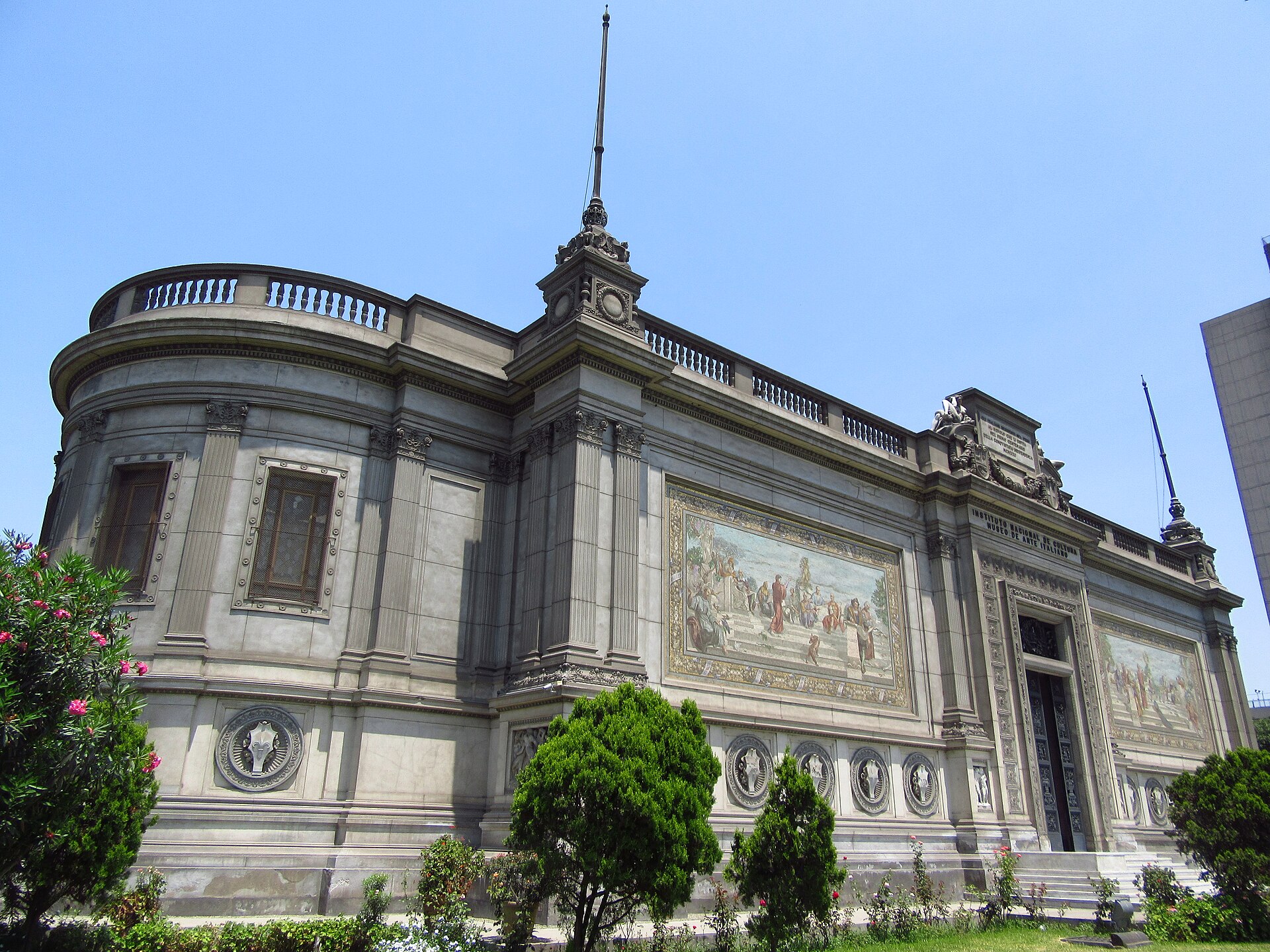
The permanent collection was assembled in a single, deliberate campaign: in 1921 and 1922 the Italian critic Mario Vannini Parenti travelled through Italy and bought roughly 200 works, sculpture, painting, prints, watercolours, drawings and ceramics, from more than 100 contemporary artists drawn from every Italian region, among them Giorgio Belloni, Italico Brass, Oscar Ghiglia and Gian Emilio Malerba. Donations in 1989 and 1990 added a further 35 pieces, and the museum's own count now stands above 300 objects. What the collection deliberately does not hold is the point sources return to again and again: no avant-garde, no Futurism, nothing that argues with the academic and late-Macchiaioli painting and Renaissance-referencing sculpture the collection was built to show. That makes it, on the evidence gathered here, the only museum dedicated entirely to Italian art outside Italy itself, a narrow claim but a real one, and its comparative advantage next to Lima's larger institutions is depth in one closely dated slice of Italian art rather than range.
| Local name | Museo de Arte Italiano |
|---|---|
| Kind | Museum |
| Founded | 1921 (gift announced); building inaugurated 11 November 1923, opened to the public 23 March 1924 |
| City and country |  Lima, Peru Lima, Peru |
| Address | Paseo de la Republica s/n, Lima, Peru |
| Website | museos.cultura.pe/museos/museo-de-arte-italiano |
| Status | Open, confirmed 14 September 2026 |
| Record last verified | 15 September 2026 |
Visiting
- Hours
- Tuesday to Saturday09:30 to 17:00last entry 16:30
- First Sunday of the month09:30 to 17:00
- Admission
- Adult (general)PEN 6payable in cash, Yape, Plin, Visa or Mastercard
- Foreign senior citizenPEN 3
- Foreign minorPEN 1
- Higher-education studentPEN 3
- School student, with workshopPEN 3
- TeacherPEN 3
- Peruvian and resident-foreigner children and students aged 3 to 17, senior citizens and people with disabilitiesFreefree entry under Resolucion Ministerial No 000247-2025-MC, dated 16 October 2025
- Tickets
- museos.cultura.pe/museos/museo-de-arte-italiano The museum's own ticket page.
- Do I need to book?
- Not published as required; tickets are sold on site and can be paid by cash, Yape, Plin, Visa or Mastercard
- Address
- Paseo de la Republica s/n, Lima, Peru MapOn foot Sits on the second block of Paseo de la Republica in the Parque de la Exposicion / Parque Juana Alarco de Dammert area of central Lima, directly across the avenue from the Museo de Arte de Lima (MALI)
- Website
- museos.cultura.pe/museos/museo-de-arte-italiano
- Telephone
- +51 1 7140115
- [email protected]
Before you go how long, access, photography, bags, eating, shop
- How long to allow
- A compact walk through six exhibition rooms; reviewers describe covering the whole collection in well under the half day a visitor sets aside for Lima's larger museums, some noting they walked the rooms twice
- Access
- Not published on the museum's own pages at the time of research; the museum has offered guided tactile visits for blind visitors, allowing touch access to the bronze and marble sculpture, since 1998
- Photography
- Not published on the museum's own pages at the time of research
- Bags
- Not published on the museum's own pages at the time of research
- Eating
- Not published on the museum's own pages at the time of research; the grounds include gardens and on-site parking
- Shop
- Not published on the museum's own pages at the time of research
Prices and hours change. We take them from the institution's own pages and print the day we read them, and you can check the current position at the source we used. Confirm before you travel.
What is inside
The sculpture rooms
Bronze and marble figures make up the museum's best-known holdings: Pietro Canonica's marble group The Abyss (El Abismo), Antonio Maraini's bronze The Kiss (Il Bacio), a bronze bust of Leonardo da Vinci prized by visitors for its naturalism despite the material, and a bronze of a Bedouin on a camel singled out in visitor photographs for its realism.
The painting galleries
Academic and late-Macchiaioli-adjacent Italian painting from the turn of the twentieth century: Raffaello Sorbi's Dante incontra Beatrice (Dante meets Beatrice), Ulisse Caputo's El Ensayo (The Rehearsal), Julio Cesar Gianchetti's Los descargadores de carbon (The Coal Unloaders), praised by visitors for its handling of colour, and further genre scenes of Italian peasant life.
Room 2, the Botticelli stained-glass room
A large stained-glass window facing the entrance, made after Sandro Botticelli's La Primavera, fills the room with coloured light and is the single most photographed interior feature in the museum.
The ceramics gallery
A small holding of Italian ceramic vases and jars from the same 1921-1922 acquisition campaign; visitors note there are few pieces but rate them among the most beautiful objects in the collection.
The library
A study library, one of the services the museum lists alongside its exhibition rooms, holding the museum's own catalogue of the collection (over 300 pages) and reference material on the artists represented.
What to see first
Stained-glass window after Botticelli's La Primavera
Unattributed Italian glassworker, early 20th centuryThe centrepiece of Room 2 and the most photographed feature inside the building, translating a famous Florentine painting into coloured glass facing the entrance.4
Dante incontra Beatrice
Raffaello SorbiNamed by visitors as one of the finest paintings in the collection, on a subject, Dante's meeting with Beatrice, that echoes the Dante mosaic on the museum's own facade.7
El Abismo (The Abyss)
Pietro CanonicaA marble sculpture visitors describe as having a vitality unusual for the material, by an Italian sculptor whose work also appears in Buenos Aires and Ankara.7
Il Bacio (The Kiss)
Antonio MarainiA bronze grouped by published criticism with Canonica's marble as one of the two sculptures that anchor the museum's reputation as a sculpture collection first and a painting collection second.8
El Ensayo (The Rehearsal)
Ulisse CaputoSingled out by a visitor for a handling of narrative and colour that rewards lingering, one of the paintings most often photographed by visitors leaving reviews.7
Los descargadores de carbon (The Coal Unloaders)
Julio Cesar GianchettiA labour scene visitors praise specifically for its colour handling, unusual subject matter next to the museum's mythological and society painting.7
Facade mosaics
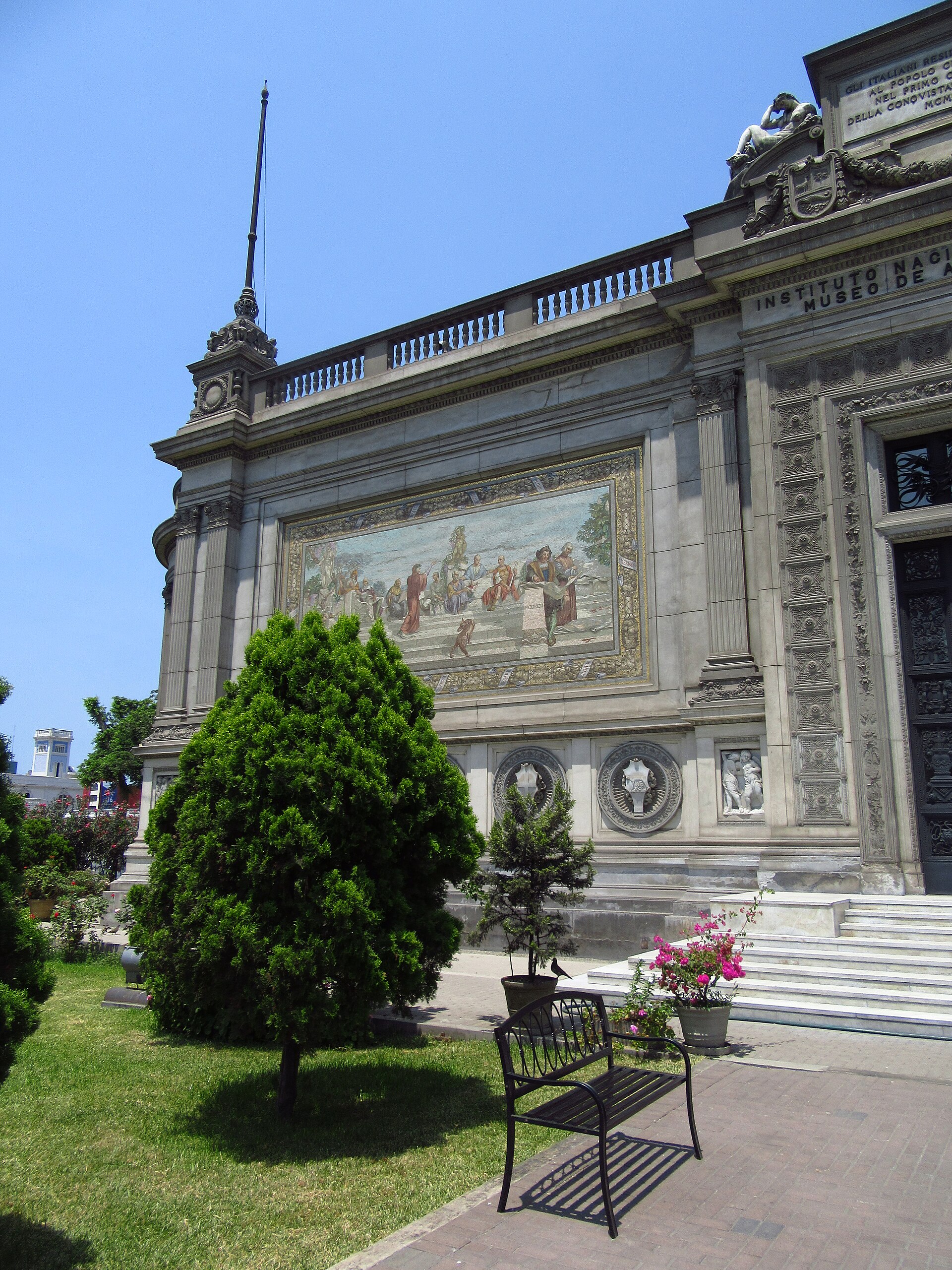
Venetian Mosaicists' AssociationTwo monumental mosaics on the exterior depicting Christopher Columbus, Dante Alighieri, Saint Francis of Assisi, Leonardo da Vinci and Marco Polo, the building's own declaration of what Italy contributed to the wider world.3
Wrought-iron entrance doors
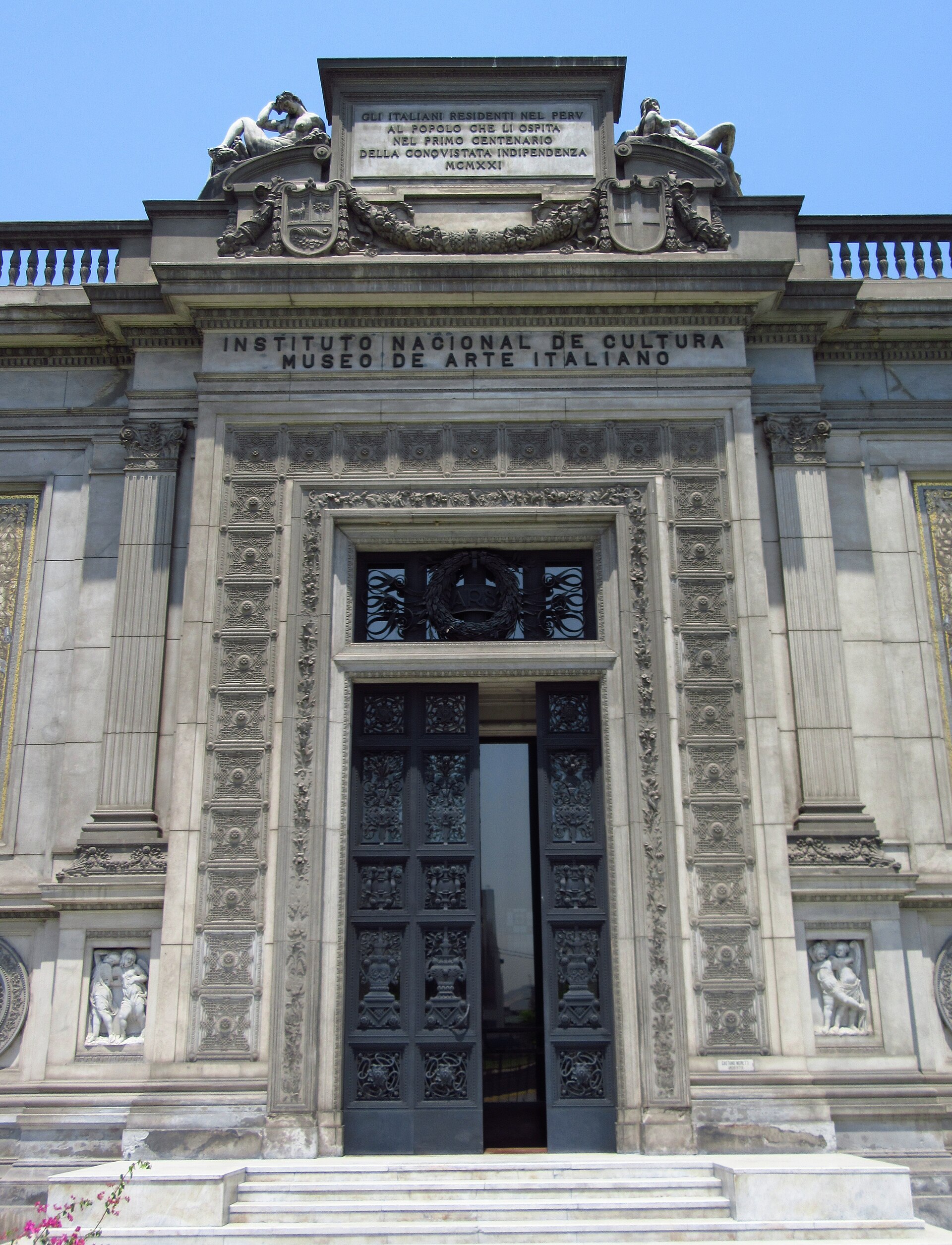
Alessandro MazzucotelliMade by an Italian ironworker whose decorative metalwork appears on Art Nouveau buildings across Milan, one of the imported craft contributions that make the building itself the museum's largest single artwork.8
A gift for a centenary
The museum exists because of a date. In 1921 Lima marked the first centenary of Peru's independence, and the city's resident Italian community, organised under Gino Salocchi, decided to mark the occasion with a permanent gift to the country that hosted them: a museum of contemporary Italian art, built and stocked at the colony's own expense and handed to the Peruvian state. The building was formally inaugurated on 11 November 1923, with President Augusto Leguia presiding, and opened its doors to the public a few months later, on 23 March 1924. The same 1921 centenary produced a second Italian-associated gift to the city, the ornamental Chinese Fountain built for Lima's Chinese community, and both projects were placed under the same architect. Read against that occasion, the museum was never conceived as a neutral cultural import: it is a diplomatic object first, built to state in stone, bronze and imported marble what one immigrant community wanted Peru to understand about its origins.
Gaetano Moretti's Renaissance pavilion
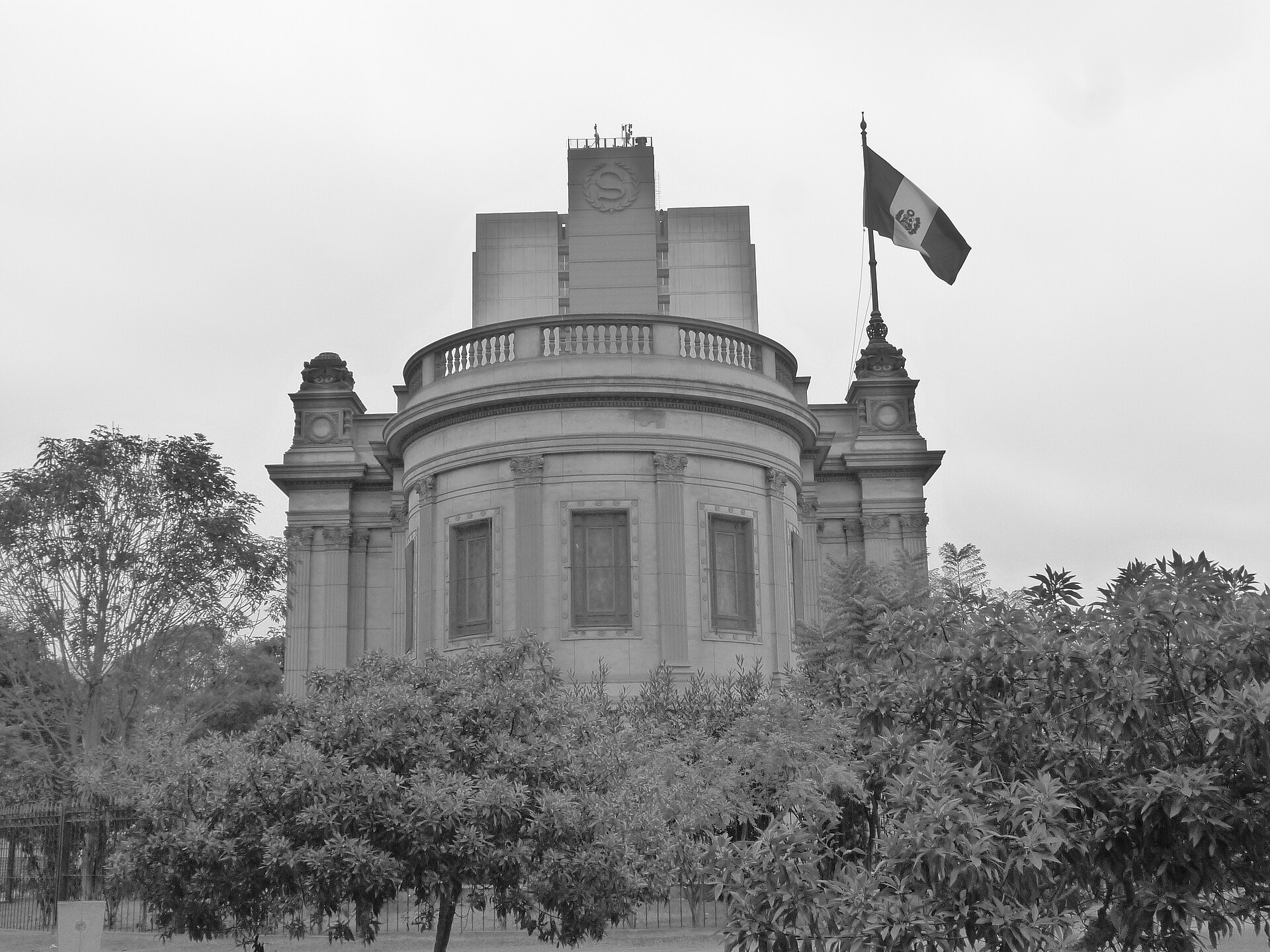
The building was designed by Gaetano Moretti, a Milanese architect, and it is explicit about its sources. The rectangular plan closes with an apse at each end, white marble decoration references Bramante's architecture and the sculptural language of Donatello, Ghiberti, Michelangelo and Botticelli, and the facade carries an Italian-language epigraph, dated in Roman numerals to 1921, recording the gift in the donors' own words. Above the epigraph, two monumental mosaics made by the Venetian Mosaicists' Association depict a roll call of Italians whose reputations travelled well past Italy: Christopher Columbus, Dante Alighieri, Saint Francis of Assisi, Leonardo da Vinci and Marco Polo, alongside the heraldic shields of Italy's principal cities. The wrought-iron entrance doors were made by Alessandro Mazzucotelli, an ironworker known in Milan for decorative metalwork on the city's Art Nouveau buildings, so that a visitor crosses an imported Milanese craft object before reaching a single painting. The building occupies roughly 800 square metres and has been described, not unfairly, as resembling a chest: a compact, self-contained box built to hold and display a fixed collection rather than to expand with one.
Mario Vannini Parenti's collection
The art critic Mario Vannini Parenti was given the commission of actually filling the building, and he did it as a single buying trip rather than a slow accumulation. Across 1921 and 1922 he travelled through Italy and bought close to 200 pieces, sculpture, painting, engravings, watercolours, drawings and ceramics, from more than 100 contemporary artists chosen so that every Italian region was represented rather than concentrating on any one school or city. Named among them on the museum's own site are Giorgio Belloni, Italico Brass, Oscar Ghiglia and Gian Emilio Malerba. What the resulting collection does not include is just as deliberate: no Futurism, no avant-garde work of any kind, even though both were already active in Italy by the early 1920s. Vannini Parenti bought a conservative, representative sample of academic and late-nineteenth-century Italian taste, and the museum has kept that character rather than modernising it. Donations from contemporary Italian artists in 1989 and 1990 added a further 35 works, and the collection the museum now describes runs past 300 pieces in total, still organised around the same six exhibition rooms the 1923 building was designed to hold.
From a private gift to a state museum
The museum has changed hands administratively more than once since 1923 without ever changing location or losing its collection. Peru's Instituto Nacional de Cultura took over its administration in 1972, and the Ministerio de Cultura, the successor body created when Peru's cultural administration was reorganised into a full ministry, now runs the museum directly; its own visit page lists the Ministerio de Cultura as the administering body today. The museum's phone number and contact routing go through the Ministry's central systems rather than a dedicated line the museum controls itself, consistent with a small institution absorbed into a larger state structure. None of that has touched the collection's core, which remains what Vannini Parenti assembled in 1921 and 1922 plus the 1989-1990 donations; what has changed is who pays for its lighting, its guards and its upkeep, and published criticism of the building's current condition, discussed below, puts that question of upkeep at the centre of the complaint.
Six rooms, walked twice
The museum's own listing of its services names six exhibition rooms, a garden, on-site parking and a library holding the museum's own catalogue of the collection, itself more than 300 pages. Reviewers consistently describe covering the whole building quickly, well under the half day a visitor sets aside for Lima's larger museums, and more than one says they walked the rooms a second time immediately after the first, finding new detail on the return pass rather than repeating themselves. The sculpture holdings, concentrated in dedicated rooms and including Pietro Canonica's marble group El Abismo and Antonio Maraini's bronze Il Bacio, draw the most consistent praise; the stained-glass window after Botticelli's La Primavera in Room 2 is the single most photographed interior feature. A small ceramics holding, drawn from the same 1921-1922 acquisition and few in number, is nonetheless singled out by visitors as among the most beautiful objects on view. Since 1998 the museum has also offered guided tactile visits for blind visitors, allowing touch access to the bronze and marble sculpture, a programme unusual enough among Lima's museums to be worth naming on its own.
A small museum with an outsized reputation problem
The museum carries a 4.0 out of 5 rating on Tripadvisor from 66 reviews as of this research, a solid but not exceptional score next to Lima's larger institutions, and the pattern behind that number is more informative than the number itself. Visitors who go describe the building as a gem they did not expect and the sculpture and stained glass as genuinely worth the detour; the recurring complaint is not about the art but about getting there, with reviewers naming the traffic and congestion of the surrounding historic-centre blocks as a real deterrent despite the collection's quality. A second, more pointed strand of criticism concerns upkeep rather than access: published commentary has described lighting inside the building as inconsistent, sometimes too warm and sometimes simply insufficient for the paintings, and an atmosphere that reads as under-resourced next to the quality of what is on the walls. That criticism is not isolated: an October 2025 visitor review went further, dismissing part of the collection as second grade and criticising the physical condition of the frames, a sharper judgement than the museum's own historical reputation as Peru's sole dedicated Italian-art collection would suggest. Read together, the reviews describe an institution whose building and best objects have not been in question for a century, but whose day-to-day maintenance, on the evidence gathered here, has become the live complaint.
What visitors say
We publish no visitor review prose and cite no single platform score as fact; what follows is our own reading of the pattern across published reviews and criticism. Visitors consistently describe a small, elegant neo-Renaissance building that exceeds their expectations, and just as consistently name two problems: the traffic and congestion of the surrounding streets in central Lima, and, in more recent and more critical accounts, an atmosphere that reads as under-maintained next to the quality of the objects inside it.
What is praised, what is criticised
- Praised: the building itself, a compact Italian Renaissance-style pavilion that several visitors call a gem independent of what is inside it
- Praised: the sculpture rooms, especially Pietro Canonica's marble The Abyss and the bronze pieces, which visitors describe as well executed and captivating
- Praised: the stained-glass window after Botticelli's La Primavera in Room 2, the most photographed interior feature
- Praised: its compact size and quality-over-quantity approach, walkable twice in the time a visitor sets aside for a single pass through Lima's larger museums
- Criticised: the traffic and congestion of the historic-centre blocks around the museum, which more than one reviewer says discourages a visit despite the collection's quality
- Criticised: published criticism describing inadequate or poorly judged lighting and a neglected, under-maintained atmosphere, a complaint echoed by an October 2025 visitor review that dismissed part of the collection as second grade and criticised the condition of the frames
Ratings on other platforms
Tripadvisor: 4 from 66 ratings, read 14 September 2026
A platform average is a tertiary source: it moves, it is not audited, and we quote no visitor's words.
Questions about Museum of Italian Art
Where is Museum of Italian Art?
Paseo de la Republica s/n, Lima, Peru.
How much does it cost to visit Museum of Italian Art?
Adult (general): PEN 6; Foreign senior citizen: PEN 3; Foreign minor: PEN 1; Higher-education student: PEN 3; School student, with workshop: PEN 3. As confirmed 14 September 2026.
When is Museum of Italian Art open?
Tuesday to Saturday 09:30-17:00; First Sunday of the month 09:30-17:00. As confirmed 14 September 2026.
How do you get to Museum of Italian Art?
On foot: Sits on the second block of Paseo de la Republica in the Parque de la Exposicion / Parque Juana Alarco de Dammert area of central Lima, directly across the avenue from the Museo de Arte de Lima (MALI).
What should you see at Museum of Italian Art?
Stained-glass window after Botticelli's La Primavera (Unattributed Italian glassworker, early 20th century); Dante incontra Beatrice (Raffaello Sorbi); El Abismo (The Abyss) (Pietro Canonica); Il Bacio (The Kiss) (Antonio Maraini); El Ensayo (The Rehearsal) (Ulisse Caputo); Los descargadores de carbon (The Coal Unloaders) (Julio Cesar Gianchetti).
What we could not confirm
- Sources disagree on the exact size of the founding acquisition: the museum's own visit page and most secondary sources say close to 200 works from more than 120 artists, while one academic-adjacent source gives 160 artists; this record follows the museum's own figure of more than 100/120 and flags the higher count as unconfirmed.
- Several tertiary sources state that the first Sunday of the month carries free general admission, but the museum's own tariff page lists the first Sunday only as an extra opening day at the same hours and prices, with no separate free-entry line; this record does not assert a first-Sunday free day because the museum's own source does not state one.
- The exact year the Ministerio de Cultura took over direct administration from the Instituto Nacional de Cultura is given as 1972 for the INC transition and, in one secondary source only, 2010 for a further transition to the Ministry; the museum's own site does not date this second transition and it is not asserted here beyond naming the Ministry as the current administrator.
- No photograph of any individual interior room could be verified against a free licence on Wikimedia Commons at the time of research, so the inside entries above carry no commons_title; a wing with no plate is treated as a good outcome under this project's rules rather than a reason to substitute an unverified image.
Images
Sources
- 1Ministerio de Cultura del Peru, museos.cultura.pe, official visit page for the Museo de Arte Italiano: open status, address, hours, full tariff list, administering body, contact phone and email, and the museum's own history paragraph naming Mario Vannini Parenti's 1921-1922 acquisition trip. Read directly in the in-app browser on 14 September 2026. museos.cultura.pe/museos/museo-de-arte-italiano
- 2Wikidata, Museum of Italian Art (Q776515): coordinates, inception date, official website, street address, phone, email and exhibition area, used only for the tertiary machine facts and cross-checked against the museum's own site before use. wikidata.org/wiki/Q776515
- 3Wikipedia (English), Museum of Italian Art: building history, architect Gaetano Moretti, architectural style and facade mosaics naming Columbus, Dante, Saint Francis, da Vinci and Marco Polo, collection size, six exhibition rooms, library, and the 1998 tactile-tour programme for blind visitors. en.wikipedia.org/wiki/Museum_of_Italian_Art
- 4Wikipedia (Spanish), Museo de Arte Italiano: founding narrative, Gino Salocchi and the Italian colony's gift, architect and neo-Renaissance style, Mario Vannini Parenti's curatorial role, the Room 2 Botticelli-derived stained glass and the painting Dante incontra Beatrice by Raffaello Sorbi, and the address. es.wikipedia.org/wiki/Museo_de_Arte_Italiano
- 5Tierras Vivas, Museum of Italian Art Lima: administrative history (Instituto Nacional de Cultura from 1972), the 1989-1990 donation of 35 further works bringing the collection past 300 pieces, six exhibition rooms, courtyard and library, and the 1998 guided tactile visits for blind visitors. tierrasvivas.com/en/museum-of-italian-art-lima
- 6En Lima, Agenda Cultural, Museo de Arte Italiano: address, phone, email, hours, tariff list and a short history paragraph, used to cross-check the museum's own tariff and contact figures. enlima.pe/lugares/museo-de-arte-italiano
- 7Tripadvisor, Museo de Arte Italiano, Lima: current rating (4.0 of 5, 66 reviews), ranking among Lima attractions, and individual review text and visitor photo captions naming Dante incontra Beatrice, El Abismo, El Ensayo and Los descargadores de carbon, all read directly in the in-app browser, including raw review and caption text, on 14 September 2026. tripadvisor.com/Attraction_Review-g294316-d319275-Reviews-Museo_de_Arte_Italiano-Lima_Lima_Region.html
- 8Camp UCSS (Universidad Catolica Sedes Sapientiae) blog, Museo de Arte Italiano: el homenaje al vinculo entre la comunidad italiana y el Peru: founding narrative naming President Augusto Leguia's inauguration remarks, architectural detail on the wrought-iron doors by Alessandro Mazzucotelli and the Venetian Mosaicists' Association facade mosaics, sculptures by Pietro Canonica and Antonio Maraini, and published criticism of the museum's current lighting and maintenance. camp.ucss.edu.pe/blog/museo-de-arte-italiano-el-homenaje-al-vinculo-entre-la-comunidad-italiana-y-el-peru/
- 9Peru en Videos, Historia del Museo de Arte Italiano: history, architect, collection description and a tariff and hours listing used only as a cross-check against the museum's own current figures. peruenvideos.com/museo-arte-italiano-historia-significad/
- 10Cultura Lima (blog), Museo de Arte Italiano: inauguration date (11 November 1923) and public opening date (23 March 1924), building dimensions (800 square metres), the Room 2 stained glass, and the museum's own six-room layout and educational programme Explorando el Museo. culturalima.home.blog/2019/04/11/museo-de-arte-italiano/
- 11WhichMuseum, Museum of Italian Art (Lima): facilities listing (garden, parking, six exhibition rooms), a list of past temporary exhibitions (Paisajes Memorias 1988, Giotto in Padua 2004, From myth to dream 2008-2009), and hours, tariffs and ranking figures used only as a cross-check. whichmuseum.com/museum/museum-of-italian-art-lima-21690
- 12Wikimedia Commons, File:2017 Lima - Museo de Arte Italiano.jpg and related files in the same 2017 series: licence (Creative Commons Attribution-Share Alike 4.0 International) and author credit, verified per file on the file information page in the in-app browser on 14 September 2026. commons.wikimedia.org/wiki/File:2017_Lima_-_Museo_de_Arte_Italiano.jpg
