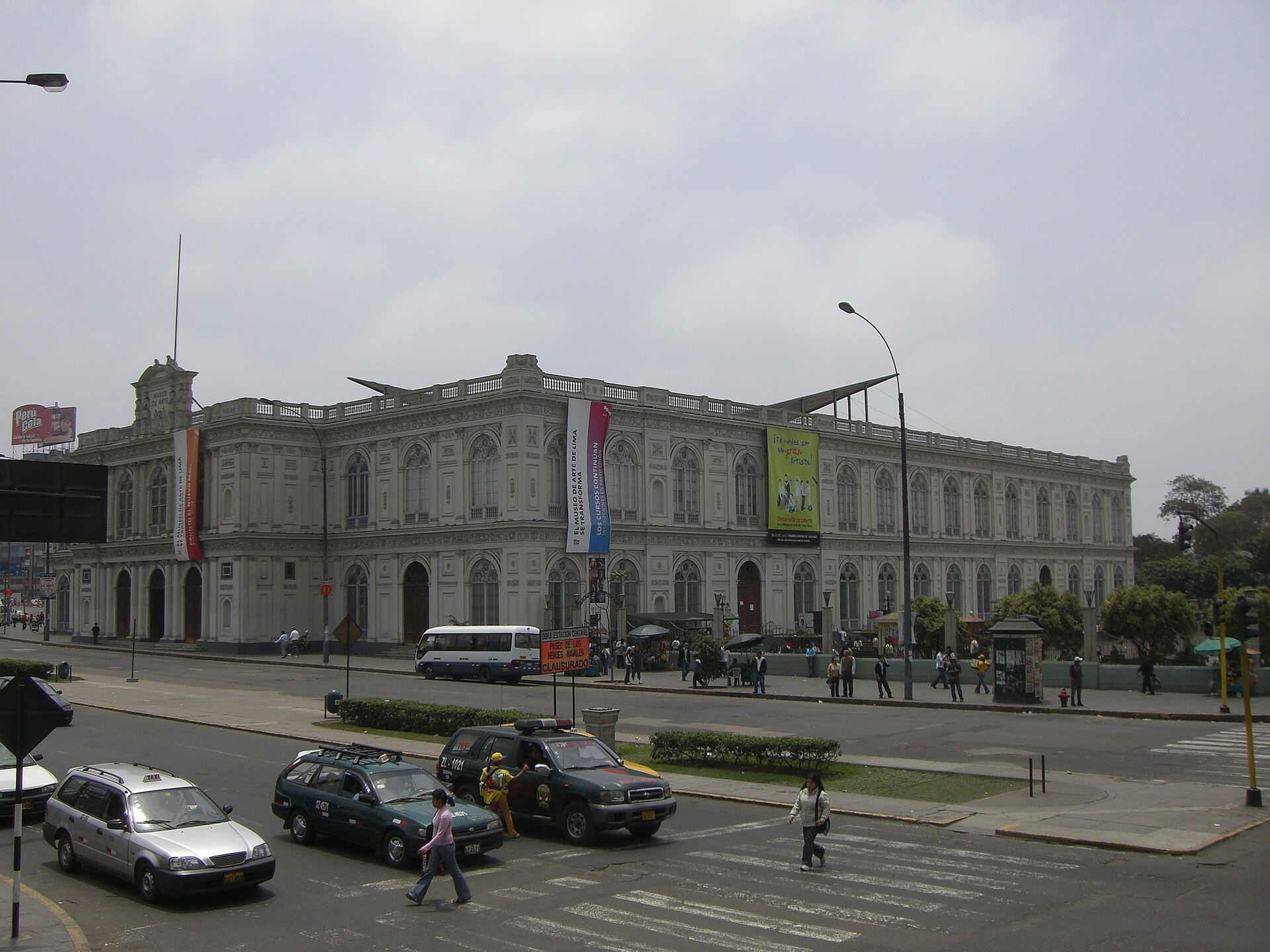
The Palacio de la Exposicion, seen from Paseo Colon in 2006, with the museum's own signage on the facade.
pratiproy, CC BY 2.0Lima Art Museum
Museum · Museo de Arte de Lima (MALI) · Founded 1961
Open, admission and hours confirmed 5 September 2026 · 15 sources
On this page 15 sections
ContentsClose
MALI's claim on Peruvian art history rests on breadth rather than a single blockbuster holding: pre-Columbian ceramics, metalwork and one of the country's most complete surveys of ancient and colonial textile weaving, sit in the same building as Lima- and Cuzco-school colonial painting, republican portraiture, a large costumbrista drawing collection, and a photography collection running from the 1840s to the present. The weak point by the museum's own account is contemporary art: more than a thousand post-1940 works exist in the collection, but a dedicated wing to show them has not been built, so what is on view at any time is a fraction of the holding.
| Local name | Museo de Arte de Lima (MALI) |
|---|---|
| Kind | Museum |
| Founded | 1961 |
| City and country |  Lima, Peru Lima, Peru |
| Address | Av. 9 de Diciembre 125 (Paseo Colon), Parque de la Exposicion, Lima 15046, Peru |
| Website | mali.pe |
| Status | Open, confirmed |
| Record last verified |
Visiting
- Hours
- Tue-Fri, Sun10:00 to 18:00
- Sat10:00 to 17:00
- Closed
- Monday.
- Admission
- Peruvian/resident adultPEN 15general admission
- Peruvian/resident senior (65+), student or accredited teacherPEN 7.50
- Foreign adultPEN 40general admission
- Foreign senior (65+), student or accredited teacherPEN 20
- Children under 8Freefree, both nationals and foreigners
Free entry: Every Wednesday. First Sunday of each month (Museos Abiertos program)- Tickets
- mali.pe/es/entradas The museum's own ticket page.
- Do I need to book?
- No advance booking required for general admission; tickets are sold online through the museum's own calendar or at the door
- Address
- Av. 9 de Diciembre 125 (Paseo Colon), Parque de la Exposicion, Lima 15046, Peru Mapcar/taxi Parque de la Exposicion, about 3.9 km and 14 minutes from Plaza Mayor in central Lima
- Website
- mali.pe
- Telephone
- (+51) 969 046254
- [email protected]
Before you go how long, access, photography, bags, eating, shop
- How long to allow
- Visitor guides suggest allowing a half day to see the permanent galleries and any temporary exhibition together
- Access
- Not detailed on the museum's own site as consulted for this page
- Photography
- Not stated on the museum's own site as consulted for this page; policy should be confirmed at the ticket desk
- Bags
- A checkroom (guardarropa) is available
- Eating
- Cafe MALI, in the courtyard, with vegetarian and vegan options noted by visitors
- Shop
- Mali Store, the museum's own shop for books, prints and crafts tied to the collection
Prices and hours change. We take them from the institution's own pages and print the day we read them, and you can check the current position at the source we used. Confirm before you travel.
What is inside
Pre-Columbian Art Room
Ceramics, textiles and metalwork from Moche, Nazca, Vicus and other pre-Inca cultures and from the Inca period, most of it drawn from funerary assemblages found across Peru.
Textiles Room
Coastal Peruvian weaving from Paracas, Nazca, Chimu and Chancay traditions and highland weaving from Wari, Chuquibamba and Inca traditions, with the oldest pieces basketwork from the Guitarrero Cave dated to around 8000 BC. Burial mantles, tunics, capes, headbands, belts, hats and standards are shown together.
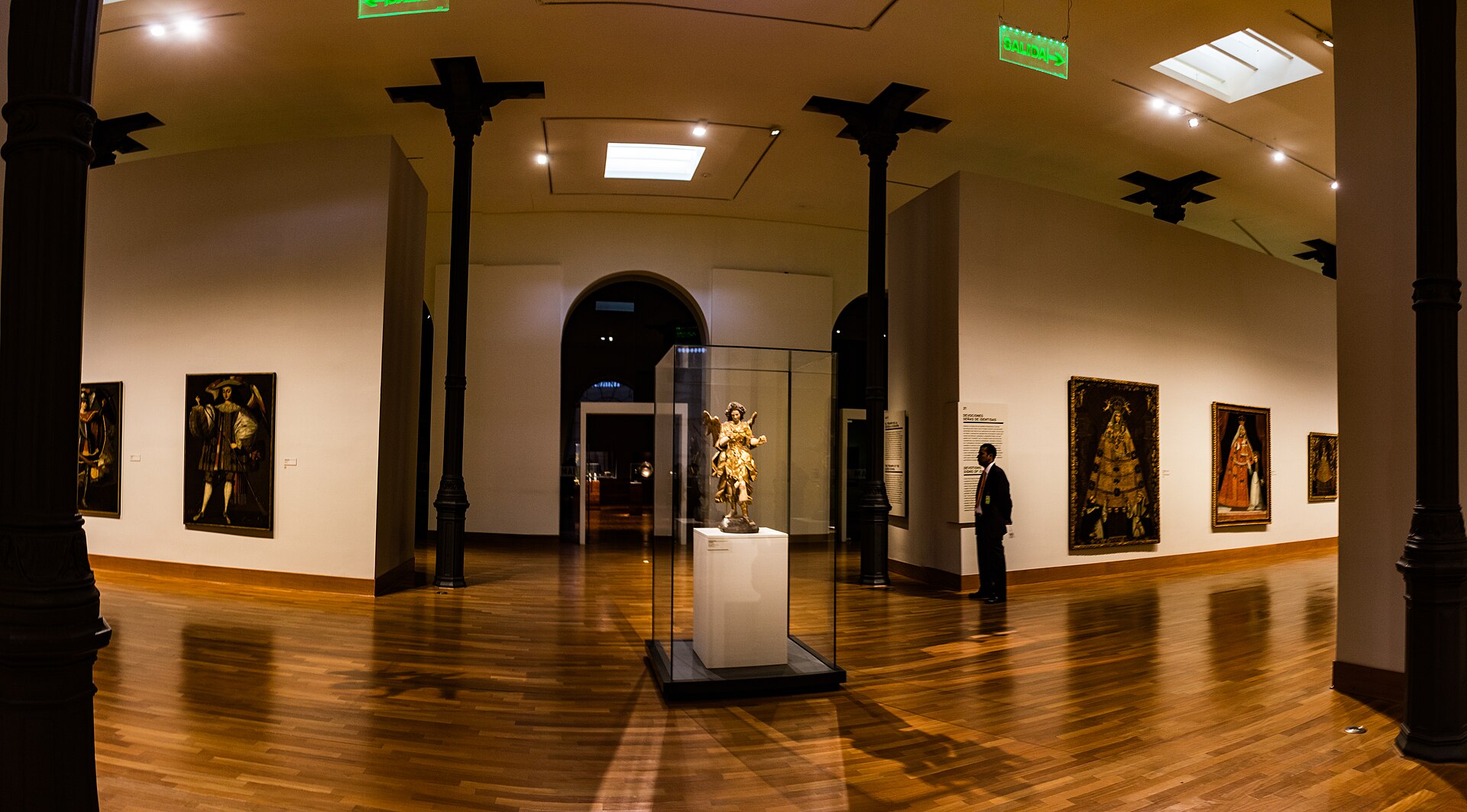
Photograph by Lucy Carcasi · CC BY-SA 4.0 Colonial Art Room
Painting from the Lima and Cuzco schools and colonial-period ceramics from the Viceroyalty of Peru, including the anonymous Cuzco Trinidad Trifacial (1750-1770) and gilded polychrome devotional sculpture.
Silverware Room
Peruvian silversmithing from the sixteenth-century Spanish conquest to the twentieth century, opened in 2003, largely built on pieces from the private collections of Javier Prado y Ugarteche and Waldemar Schroeder y Mendoza.
Republican Art Room (19th century)
History and portrait painting by Jose Gil de Castro, Ignacio Merino, Francisco Laso and Luis Montero, including Montero's monumental Los Funerales de Atahualpa.
Costumbrism Room
Drawings recording nineteenth- and twentieth-century Peruvian customs and social types, described by the museum's own historical material as the largest Peruvian collection of its kind.
20th Century Room
Academic and indigenista painting by Teofilo Castillo, Jose Sabogal, Julia Codesido, Mario Urteaga and Ricardo Grau.
Photography Room
A survey from the daguerreotype era (1842-1859) to the present, including work by Martin Chambi, opened in its current form in 2006.
Contemporary Art Room
Work from 1940 onward, including pieces by Fernando de Szyszlo, Tilsa Tsuchiya and Gerardo Chavez, and material on the political violence of the 1980s; the wider contemporary collection of more than a thousand works mostly stays in storage awaiting a dedicated new wing that has not been built.
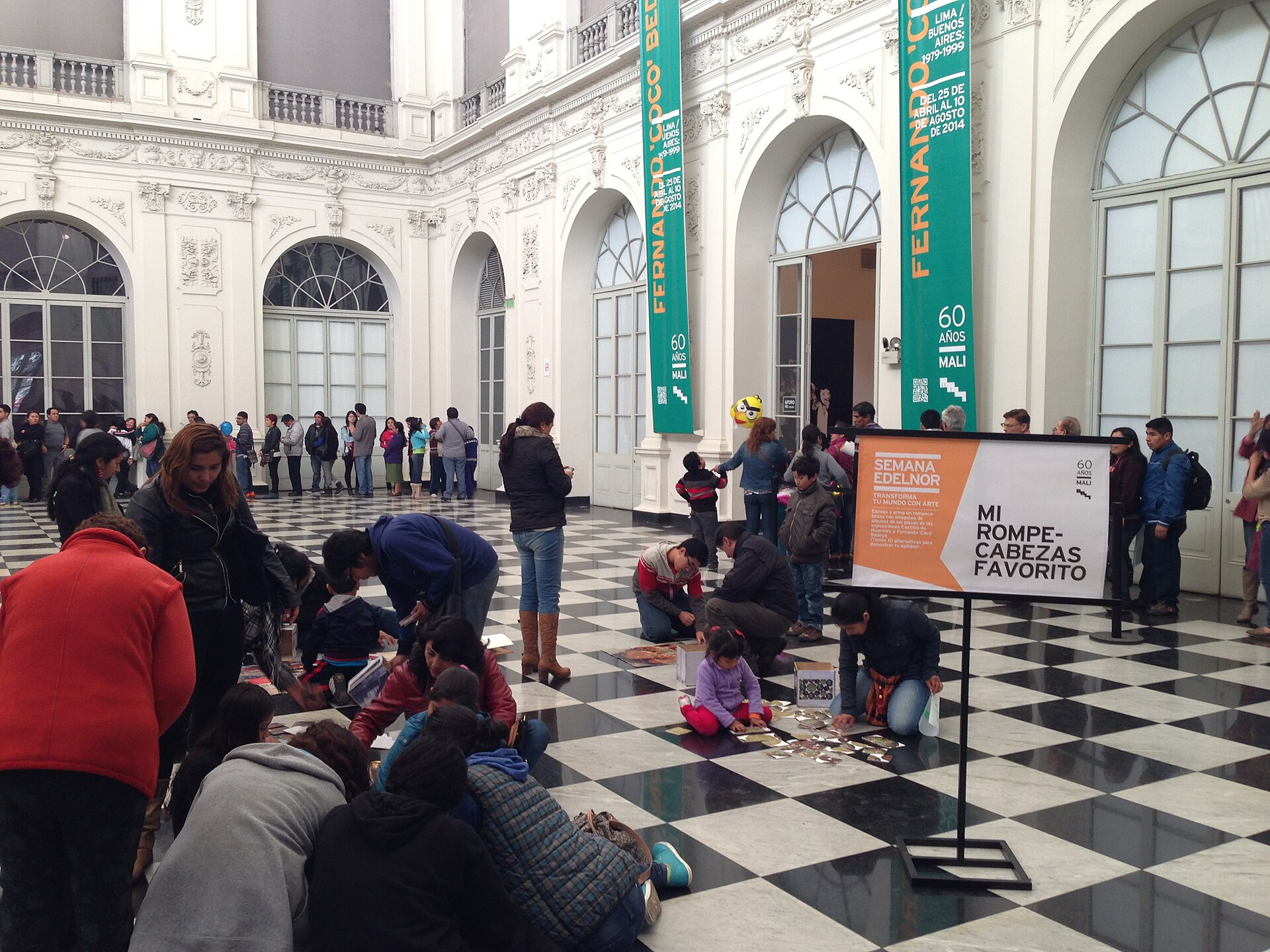
Photograph by RG72 · CC BY-SA 4.0 Central courtyard (Patio)
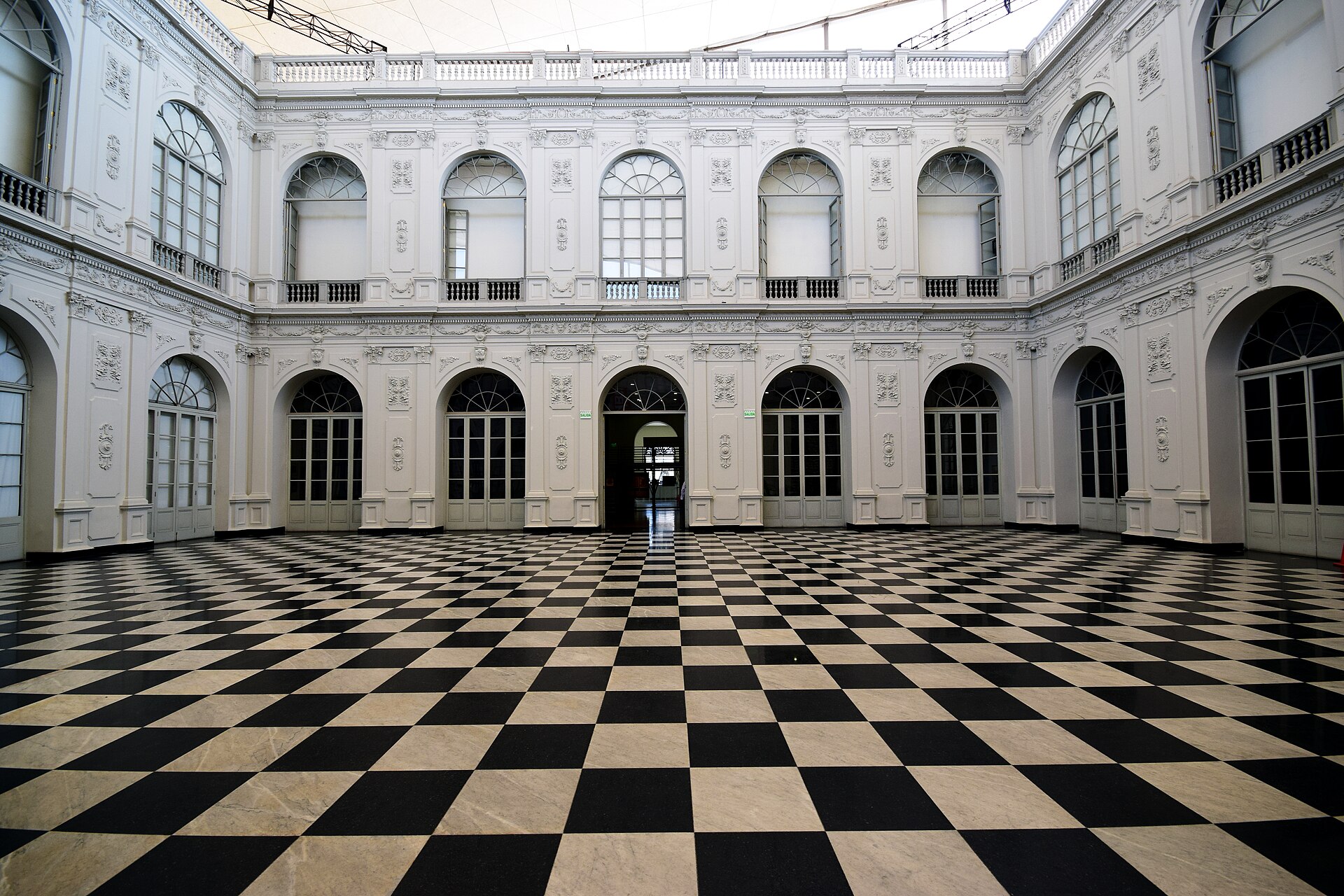
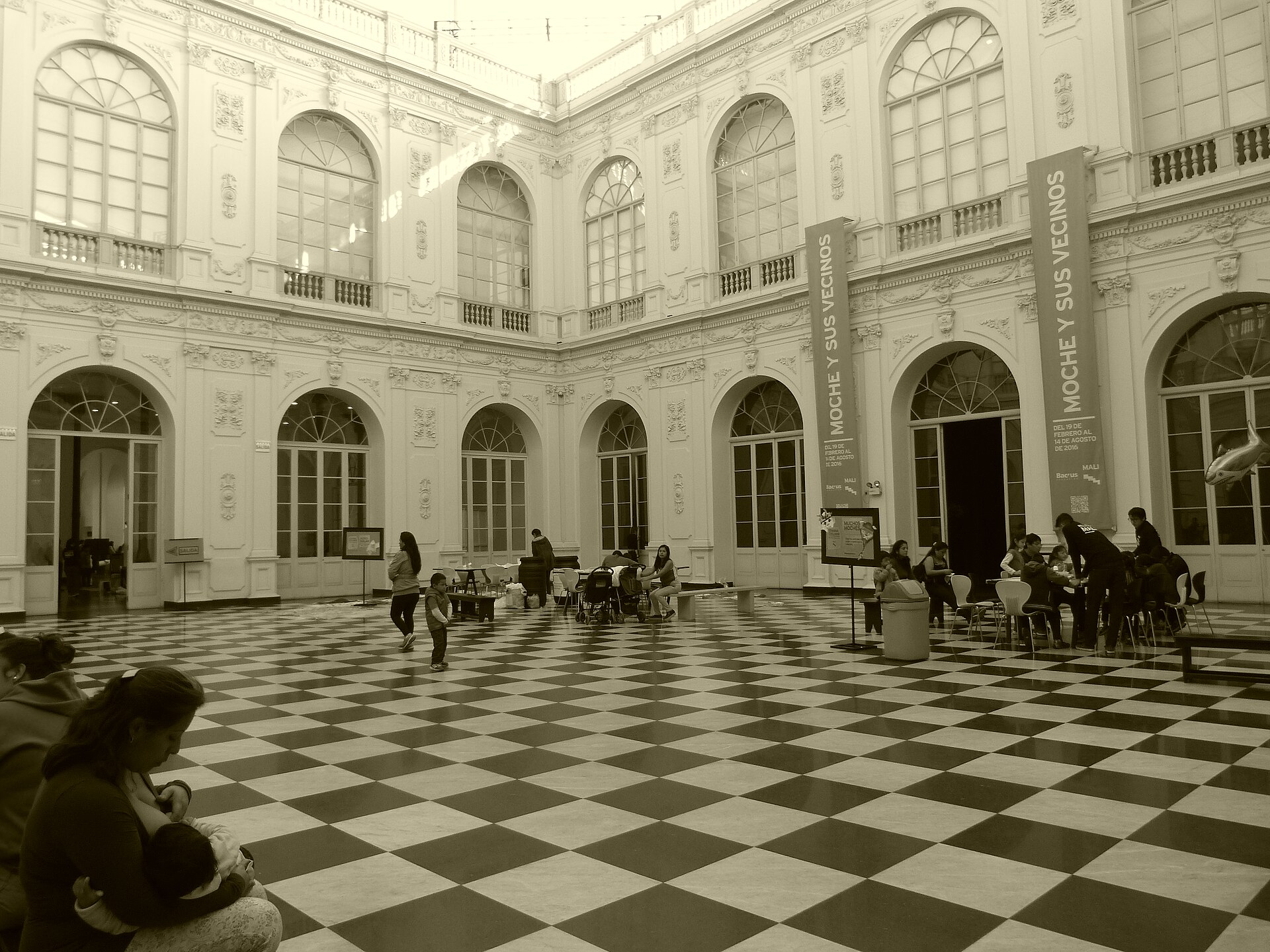
The Palacio de la Exposicion's arcaded ground-floor courtyard, used for public programs, family activities and banners for the museum's current exhibitions rather than as a gallery in its own right.
What to see first
El Contorsionista de Puemape
Cupisnique cultureA dark ceramic bottle, about 3,000 years old, of a young man bent double with his feet over his head; specialists have suggested Marfan syndrome, and his tattoos and the plant and serpent imagery on the vessel point to a shamanic or transformation theme. Acquired by MALI in 2022 and shown in room 29 among 18 Cupisnique ceramics.10
Trinidad Trifacial
Anonymous, Cuzco schoolAn oil-on-canvas Trinity painted as a single figure with three fused faces, four eyes, three noses and three mouths - a medieval convention for the Trinity that persisted in the Andes after it had fallen out of use in Europe. Signed with a Latin citation from a homily of John Chrysostom.4
Retablo
Joaquin Lopez AntayA carved and painted wood retablo by the Ayacucho master whose 1975 National Culture Prize for a popular-art form, rather than fine art, was itself a contested moment in how Peru defined artistic merit.4
Los Funerales de Atahualpa
Luis MonteroA 4.2 by 6 metre history painting of the Inca emperor's funeral, painted in Florence for the 1867 Paris exposition, toured through South America to some 30,000 viewers, then looted by the Chilean army during the War of the Pacific and held in Chile's National Museum until the writer Ricardo Palma helped secure its return to Peru.9
Pre-Columbian and colonial-era textiles
Paracas, Nazca, Chimu, Chancay, Wari, Chuquibamba and Inca weaversA textile room built around coastal and highland weaving traditions, anchored by burial mantles and tunics and, at the earliest end, basketwork from the Guitarrero Cave dated to about 8000 BC.8
Martin Chambi and the photography collection
Martin Chambi and othersA photography room tracing the medium in Peru from the daguerreotype era of the 1840s and 1850s to the present, including the work of Martin Chambi, the Quechua studio photographer of early twentieth-century Cuzco.8
Silverware from Javier Prado y Ugarteche and Waldemar Schroeder y Mendoza
Peruvian silversmiths, 16th-20th centuryA dedicated silverware room, opened in 2003, tracing Peruvian silversmithing from the Spanish conquest onward, built substantially on two private collections donated to the museum.8
Contemporary painting by Fernando de Szyszlo and Tilsa Tsuchiya
Fernando de Szyszlo, Tilsa TsuchiyaWork by the painter regarded as the father of Peruvian abstraction and by Tsuchiya's surrealist-inflected painting anchors the contemporary room, even as most of the wider contemporary holdings remain in storage.11
Exhibitions on now
A palace built for a nineteenth-century trade fair
The building MALI occupies was not built to be a museum. The Palacio de la Exposicion went up in 1868-1872 on the site of Lima's demolished Guadalupe Gate, commissioned for an international exhibition held to mark Peru's modernisation under President Jose Balta. The Italian architect Antonio Leonardi, then resident in Lima, designed its Italianate facade and worked with the journalist Manuel Atanasio Fuentes on the surrounding Parque de la Exposicion; the cast-iron structural frame behind that facade came from Gustave Eiffel's Paris atelier, built between 1870 and 1871, making the palace one of the first iron-framed buildings in Latin America.
After the 1872 exhibition the building had a long working life that had nothing to do with art. It served as the headquarters of the Fine Arts Society from 1872 to 1879, as a hospital for the wounded during the War of the Pacific with Chile, and from 1935 as offices of Lima's city government. The park around it grew a second layer of history in 1921, when Moorish and Byzantine pavilions were added to mark the centenary of Peruvian independence.
From exhibition hall to national art museum, 1954-1961
The museum itself began as a civic project. In 1954 a group of businessmen, academics and cultural figures - among them the historian Jorge Basadre and Manuel Solari Swayne, whose name the museum's library now carries - formed the Patronato de las Artes under the presidency of Carlos Neuhaus Ugarteche, with the explicit aim of giving Lima a museum of Peruvian art. Restoration of the war-damaged, long-repurposed Palacio de la Exposicion began in March 1956, led by the Peruvian architects Hector Velarde and Jose Garcia Bryce with financing from both the Peruvian and French governments; the building's first exhibition after that restoration, in 1956-57, was in fact a showcase of French industry and culture offered in thanks for French support.
The museum opened to the public on 10 March 1961, inaugurated by President Manuel Prado y Ugarteche, who donated the art collection of his late brother Javier Prado as a founding gift. The building was declared Cultural Heritage of the Nation in 1974 and reserved by supreme resolution for cultural use only in 1979; a thirty-year lease signed with the municipality in 1998 runs to 2028. A run of directors since then has included the art historian Natalia Majluf, who led the museum for a combined stretch from 2000 to 2018 with a short break, and the Catalan curator Bartomeu Mari, previously director of Barcelona's MACBA, who took charge in July 2019 and resigned in April 2020 as the museum absorbed the shock of the COVID-19 shutdown.
Nine rooms, three thousand years: what is inside
MALI's own description of its holdings runs to more than 17,000 works, most of them Peruvian, spanning close to 3,000 years. The permanent galleries occupy about 4,500 square metres and present a representative slice of some 1,200 pieces in a sequence that moves, room by room, from pre-Columbian ceramics, textiles and metalwork, through a dedicated textiles room built around coastal Paracas, Nazca, Chimu and Chancay weaving and highland Wari, Chuquibamba and Inca weaving - its oldest piece a scrap of basketwork from the Guitarrero Cave dated to about 8000 BC - into a colonial room of Lima- and Cuzco-school painting, a silverware room tracing Peruvian silversmithing from the Spanish conquest onward, a nineteenth-century republican room of history and portrait painting, a costumbrista room of social-type drawings, a twentieth-century room of academic and indigenista painting, a photography room running from the 1840s daguerreotype era to the present, and a contemporary room covering work from 1940 onward.
The arcaded ground-floor courtyard around which the palace is built is not a gallery in the curatorial sense, but it is where most visitors first experience the building: it hosts family workshops, temporary-exhibition banners and public programs under the same iron-framed glass roof that Eiffel's atelier built for an industrial fair a century and a half ago.
The core holdings, and one that got taken and got back
MALI's own promotional material names four works as the collection's icons, and each carries more than decorative value. El Contorsionista de Puemape is a roughly 3,000-year-old Cupisnique ceramic bottle showing a young man bent double, his feet drawn over his head; specialists who have studied the piece have raised Marfan syndrome as an explanation for the extreme flexibility shown, and the tattoos, serpents and San Pedro cactus imagery on his body point toward a shamanic reading rather than a purely anatomical one. It was acquired by the museum only in 2022. The Trinidad Trifacial, an anonymous eighteenth-century Cuzco-school painting of the Christian Trinity as a single figure with three fused faces, keeps alive a medieval convention that had already fallen out of use in Europe by the time it was painted in the Andes. The retablo by the Ayacucho master Joaquin Lopez Antay represents a different kind of recognition: Lopez Antay's 1975 National Culture Prize, awarded for what had been classed as popular rather than fine art, was itself an argument about who gets called an artist in Peru.
The fourth icon has the most eventful biography. Luis Montero's Los Funerales de Atahualpa, a history painting more than four metres tall showing the funeral of the last Inca emperor, was painted in Montero's Florence studio and shown at the 1867 Paris exposition before touring Rio de Janeiro, Montevideo and Buenos Aires; by the time it reached Lima in 1868 an estimated 30,000 people had seen it. Montero gave the canvas to Peru's Congress, and it was in Lima when Chilean forces occupying the city during the War of the Pacific took it as war booty and shipped it to Chile's National Museum. It came back to Peru only through the intervention of the writer Ricardo Palma, then spent time at the National Library before settling in the Palacio de la Exposicion itself.
Renovation, growth and the wing that has not been built
The museum's current shape is largely the product of renovation rather than new construction. A restoration laboratory opened in 1966, an auditorium and library in 1986, and a run of individual room openings followed over the next two decades: the silverware room in 2003, the photography room in 2006, and a new precolumbian textile room in 2008 built with support from the German embassy and Peruvian textile firm Creditex. A first phase of a larger, comprehensive renovation reopened in 2010 with the infrastructure now visible in the galleries.
What that renovation did not solve is space for contemporary art. MALI's own collection of contemporary work runs past a thousand pieces, but most of it stays in storage for lack of a dedicated wing that has been discussed for years without being built - a gap the museum's temporary-exhibition program, and shows built around donated or borrowed contemporary work, has had to work around rather than fill.
What visitors and critics say
MALI holds a strong aggregate rating from ordinary visitors, and the pattern in what they write is consistent: praise for being able to walk the whole chronological span of Peruvian art history in a single, physically striking building, for bilingual labelling, for guided tours, and for the courtyard cafe; complaints cluster around the permanent galleries feeling unchanged between repeat visits, and around signage near the entrance being unclear when construction work is under way nearby. Both threads point at the same underlying fact: MALI's core strength is depth of historical range rather than turnover, and the museum's own acknowledgement that most of its contemporary collection sits in storage is the institutional version of the same complaint.
What visitors say
Visitors consistently describe MALI as the place to get the whole span of Peruvian art in one visit, praising how clearly the chronological hang moves from pre-Columbian pieces through colonial and republican painting to modern and contemporary work, inside a building most reviewers single out on its own merits. The most common complaint is that the permanent galleries feel static between visits and that finding the entrance amid nearby construction and signage can be confusing.
What is praised, what is criticised
- Praised: The chronological sweep of the permanent collection, covering roughly 3,000 years of Peruvian art in one building
- Praised: The Palacio de la Exposicion building itself, and specific pieces such as Los Funerales de Atahualpa
- Praised: Bilingual (Spanish/English) labelling and knowledgeable guides
- Praised: Cafe MALI's food, including vegetarian and vegan options
- Criticised: The permanent collection can feel unchanged between visits, with some reviewers wanting more rotation beyond the core religious and republican-era paintings
- Criticised: Signage and nearby construction have made the entrance hard to find for some visitors
- Criticised: Most of the museum's contemporary holdings (over 1,000 works) stay in storage rather than on view, for lack of a dedicated wing
Ratings on other platforms
Tripadvisor: 4.6 from 1,438 ratings, read 5 September 2026
A platform average is a tertiary source: it moves, it is not audited, and we quote no visitor's words.
Questions about Lima Art Museum
Where is Lima Art Museum?
Av. 9 de Diciembre 125 (Paseo Colon), Parque de la Exposicion, Lima 15046, Peru.
How much does it cost to visit?
Peruvian/resident adult: PEN 15; Peruvian/resident senior (65+), student or accredited teacher: PEN 7.5; Foreign adult: PEN 40; Foreign senior (65+), student or accredited teacher: PEN 20; Children under 8: free. As confirmed 5 September 2026.
When is it open?
Tue-Fri, Sun 10:00-18:00; Sat 10:00-17:00. Closed: Monday. As confirmed 5 September 2026.
How do you get there?
car/taxi: Parque de la Exposicion, about 3.9 km and 14 minutes from Plaza Mayor in central Lima.
What should you see first?
El Contorsionista de Puemape (Cupisnique culture); Trinidad Trifacial (Anonymous, Cuzco school); Retablo (Joaquin Lopez Antay); Los Funerales de Atahualpa (Luis Montero); Pre-Columbian and colonial-era textiles (Paracas, Nazca, Chimu, Chancay, Wari, Chuquibamba and Inca weavers); Martin Chambi and the photography collection (Martin Chambi and others).
What we could not confirm
- MALI's own material does not give a current, dated total for the collection: figures cited across its own site and secondary sources range from about 12,000 to more than 21,000 works depending on the year and what is counted.
- No public timeline exists for the contemporary-art wing that MALI's own institutional history says has been planned for years.
Images
Sources
- 1MALI, official website, home page mali.pe/es/
- 2MALI, official website, root domain (open status, hours) mali.pe/
- 3MALI, official website, tickets page mali.pe/es/entradas/
- 4MALI, official website, IconosMALI (four collection icons) mali.pe/es/activity/iconosmali/
- 5Ministry of Culture of Peru, museum registry, Museo de Arte de Lima-MALI museos.cultura.pe/museos/museo-de-arte-de-lima-mali
- 6Centro Mallqui, admission price guide, 25 July 2024 centromallqui.pe/cuanto-cuesta-la-entrada-al-museo-de-arte-de-lima/
- 7Wikipedia (English), Lima Art Museum en.wikipedia.org/wiki/Lima_Art_Museum
- 8Wikipedia (Spanish), Museo de Arte de Lima es.wikipedia.org/wiki/Museo_de_Arte_de_Lima
- 9Wikipedia (English), Los funerales de Atahualpa en.wikipedia.org/wiki/Los_funerales_de_Atahualpa
- 10El Comercio (Somos), "Homenaje al arte cupisnique: el fabuloso Contorsionista de Puemape..." elcomercio.pe/somos/historias/homenaje-al-arte-cupisnique-el-fabuloso-contorsionista-de-puemape-y-piezas-rituales-se-lucen-en-sala-exclusiva-de-mali-noticia/
- 11Wikipedia (English), Fernando de Szyszlo en.wikipedia.org/wiki/Fernando_de_Szyszlo
- 12Tripadvisor, MALI - Museo de Arte de Lima, reviews page tripadvisor.com/Attraction_Review-g294316-d548258-Reviews-MALI_Museo_de_Arte_de_Lima-Lima_Lima_Region.html
- 13Machu Travel Peru, "MALI: Museum of Art of Lima" machutravelperu.com/blog/lima-art-museum
- 14Wikidata, Q6033913 (Museo de Arte de Lima) wikidata.org/wiki/Q6033913
- 15Wikimedia Commons, Category:Museo de Arte de Lima commons.wikimedia.org/wiki/Category:Museo_de_Arte_de_Lima