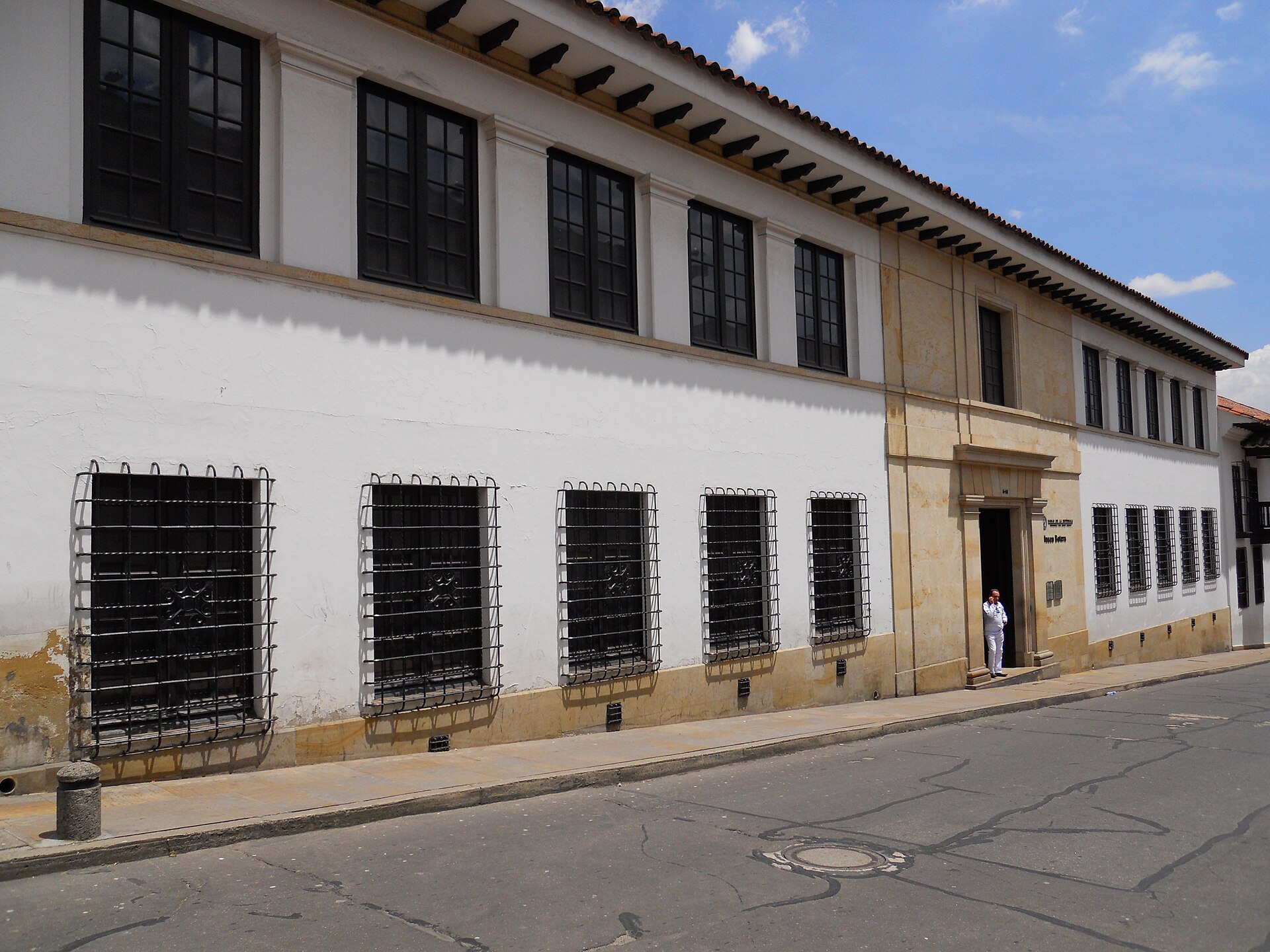
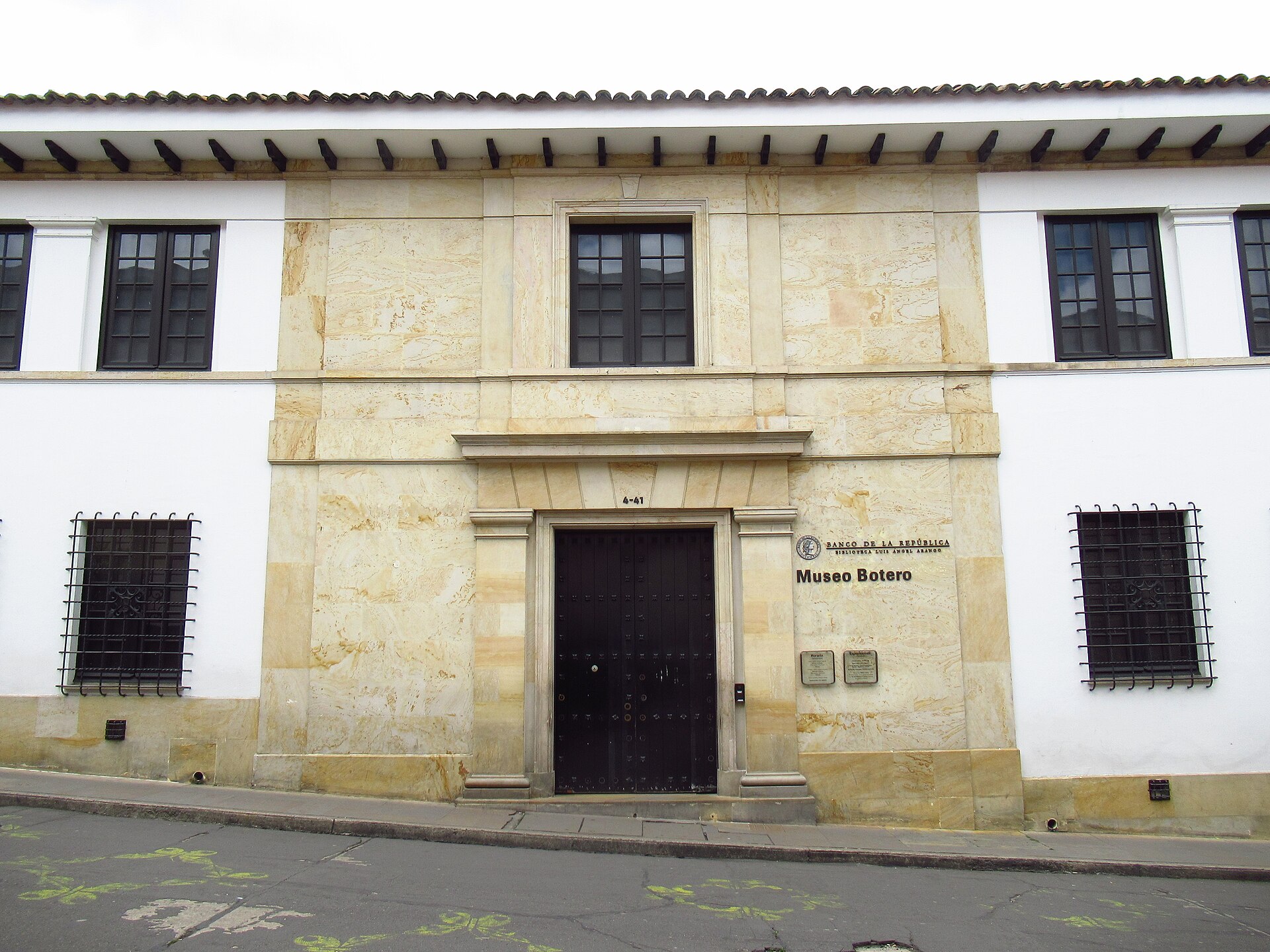
The Calle 11 facade of the Museo Botero in La Candelaria, Bogota.
Felipe Restrepo Acosta · Photograph by Pedro Felipe · CC BY-SA 3.0On this page 14 sections
ContentsClose
The museum's real strength is scale on both sides of the house at once. Nowhere else holds this many Botero paintings, drawings and sculptures under one roof, and the 85-work international side would stand as a serious modern art collection even without his name attached to it, spanning Corot to Barcelo with stops at Impressionism, Cubism and Surrealism along the way. Because Botero fixed the installation himself and barred any of the donated works from leaving, the rooms have not been rehung or thinned out since 2000; what a visitor sees today is close to what opened then, plus whatever the bank has acquired separately for its own wider art collection since.
| Kind | Museum |
|---|---|
| Founded | 2000 |
| City and country |  Bogota, Colombia Bogota, Colombia |
| Address | Calle 11 No. 4-41, La Candelaria, Bogota, D.C., Colombia |
| Website | banrepcultural.org/bogota/museo-botero |
| Status | Open, confirmed |
| Record last verified |
Visiting
- Hours
- Monday09:00 to 19:00
- TuesdayClosed
- Wednesday-Saturday09:00 to 19:00
- Sunday and public holidays10:00 to 17:00Last entry one hour before closing
- Closed
- Tuesday.
- Admission
- General admissionFreeFree entry to the permanent collection every open day; no reservation required
Free entry: Every open day - admission is free- Do I need to book?
- No. Both general admission and the standing guided tours are walk-in, free, and do not take reservations
- Address
- Calle 11 No. 4-41, La Candelaria, Bogota, D.C., Colombia MapTransMilenio Museo del Oro station, then east on Carrera 6 four blocks to Calle 11, then east to the pedestrian entrance at Calle 11 No. 4-21
On foot Shared pedestrian entrance for the whole Manzana Cultural complex (Museo Botero, MAMU, Museo Casa de Moneda) at Calle 11 No. 4-21 - Website
- banrepcultural.org/bogota/museo-botero
- Telephone
- +57 601 484 9980
- [email protected]
Before you go how long, access, photography, bags, eating, shop
- How long to allow
- Two to three hours to see both wings
- Access
- Wheelchair-accessible entrance shared with the Museo de Arte Miguel Urrutia at Calle 11 No. 4-21; loaner wheelchairs are available and a Colombian Sign Language guided tour of the permanent collection is offered for deaf visitors
- Photography
- Allowed inside the galleries; tripods, flash and additional lighting are not permitted
- Bags
- Lockers are provided for bags and other items that cannot be carried into the galleries
- Eating
- Not confirmed directly on the museum's own site; a third-party museum directory (museodata.com) lists an on-site cafeteria
- Shop
- Not confirmed directly on the museum's own site; the same directory lists a small museum shop
Prices and hours change. We take them from the institution's own pages and print the day we read them, and you can check the current position at the source we used. Confirm before you travel.
What is inside
West wing - the Botero galleries
123 paintings, drawings, watercolors and sculptures made by Fernando Botero himself, mostly from the last two decades of the twentieth century. Alongside his familiar still lifes, dancers and inflated portraits, this wing keeps a smaller group of paintings that turned the same style on Colombia's drug-war violence, including Pablo Escobar, Tirofijo and Carrobomba.
East wing - the international collection
85 works from Botero's private collection before the donation, hung to trace European and American painting and sculpture from Camille Corot's Gitane au tambourin, painted before 1862, to a large 1998 oil by Miquel Barcelo. Includes a room devoted to Impressionist and Post-Impressionist painting (Renoir, Monet, Pissarro, Caillebotte, Degas, Toulouse-Lautrec) and holdings of Picasso, Dali, Miro and Leger.
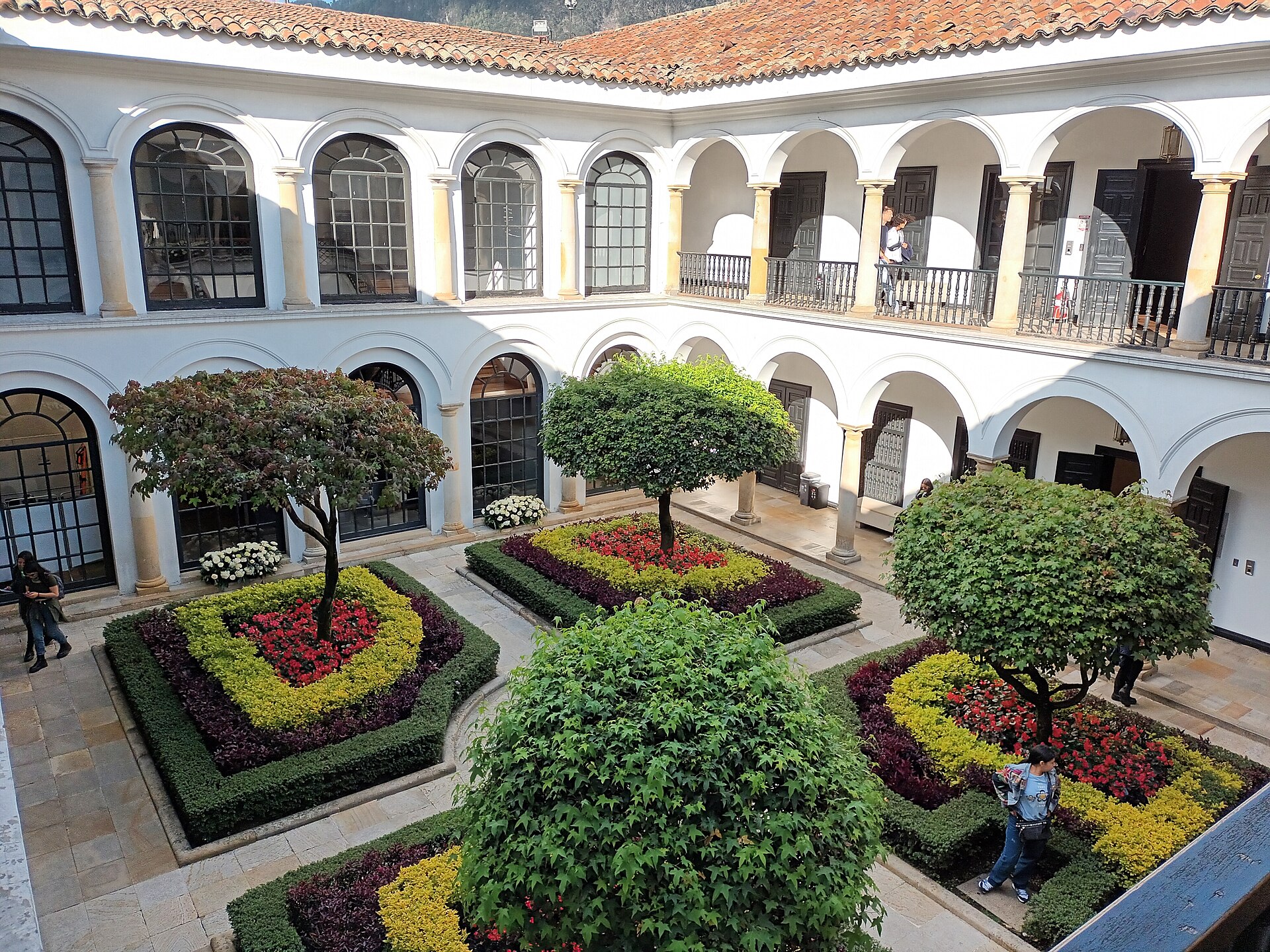
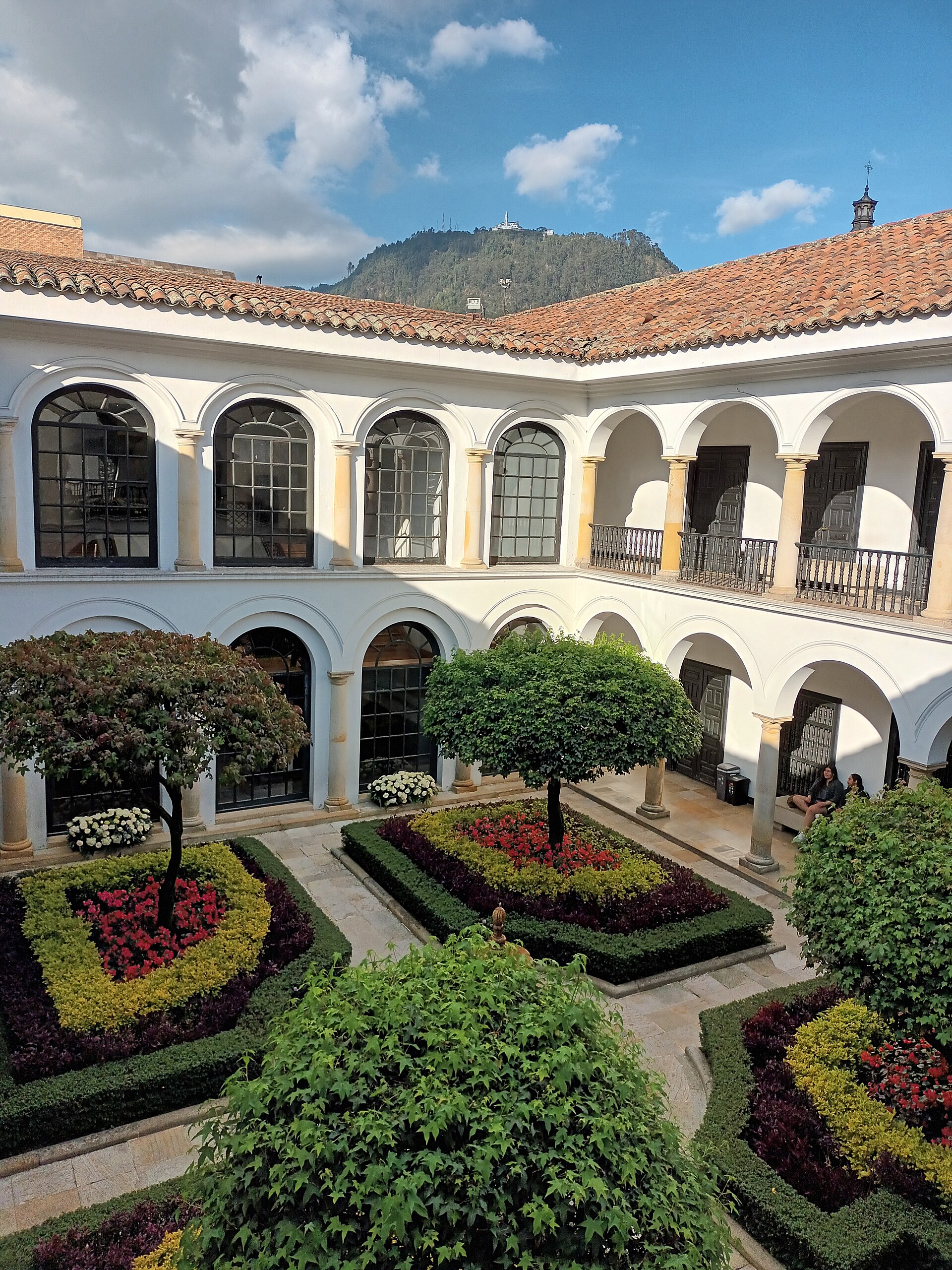
Photograph by SajoR · CC BY-SA 4.0 Central courtyard
The colonial patio at the heart of the former Archbishop's Palace, the one part of the house whose footprint predates the 1948 fire, the Supreme Court's tenancy and the newspaper archive that all later used these rooms before the art collection did.
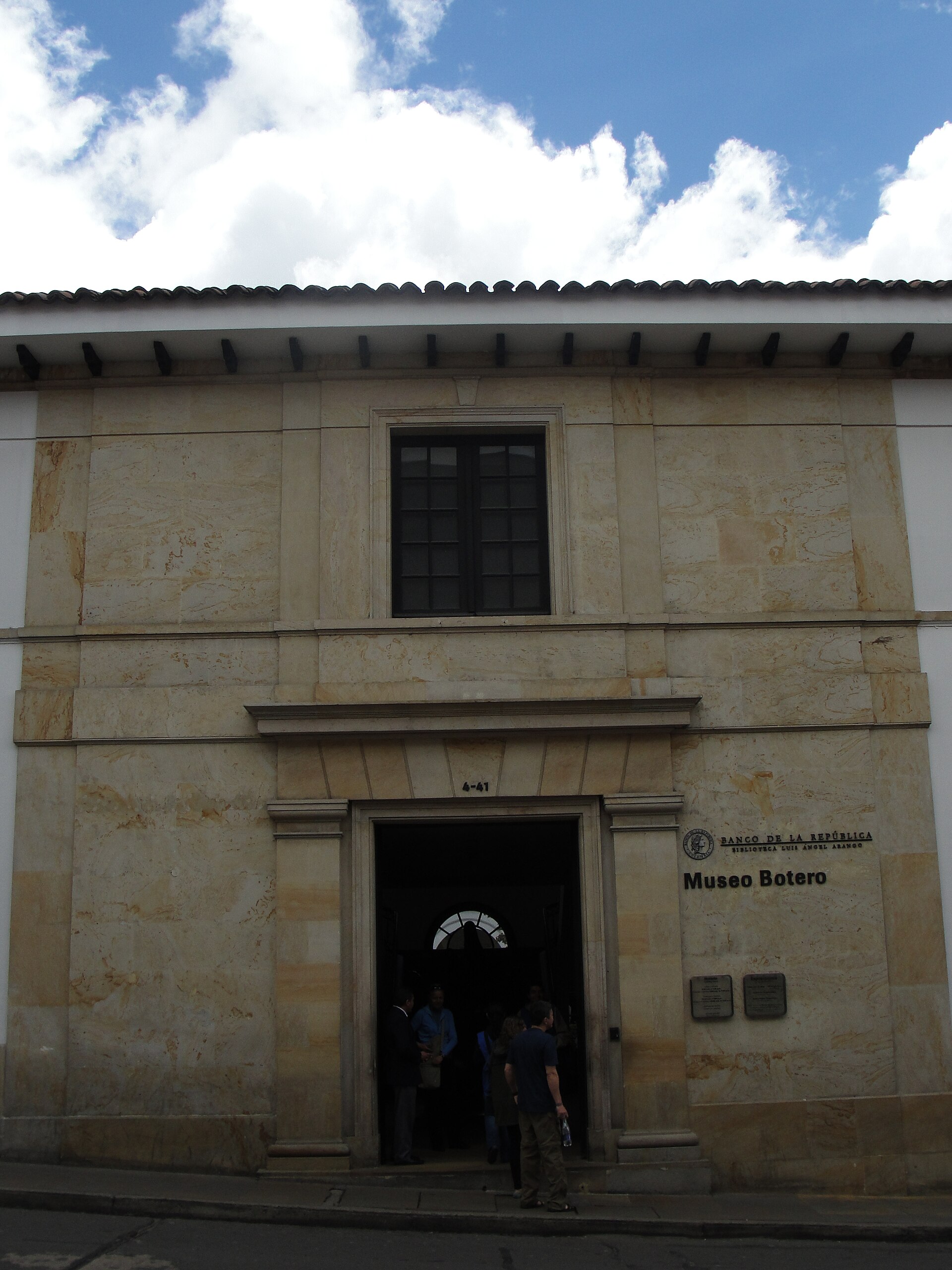
Photograph by Racso · CC BY-SA 3.0 The building itself
The Calle 11 facade and shared pedestrian entrance, rebuilt by the Banco de la Republica in the 1950s on the footprint, and where old photographs survived, the appearance of the pre-1948 Archbishop's Palace that stood on the same plot from 1724.
What to see first
Mona Lisa
Fernando BoteroBotero's own rounded, inflated reworking of Leonardo's portrait, hung far from the original's proportions and one of the most photographed single works in the museum.15
Pablo Escobar
Fernando BoteroPart of a small group of paintings in which Botero turned his volumetric style on Colombia's drug-war violence rather than his usual still lifes and dancers.16
Carrobomba (Car Bomb)
Fernando BoteroFrom the same violence series as Pablo Escobar and Tirofijo, kept in the same rooms as his gentler subjects rather than set apart.16
Tirofijo
Fernando BoteroA portrait of the FARC commander Manuel Marulanda under his guerrilla alias, part of Botero's cycle of paintings on Colombian political violence.16
Gitane au tambourin (Gypsy with Tambourine)
Camille CorotPainted before 1862, the oldest work in the international collection and the starting point of its walk through a century of European painting.3
Untitled oil, 1998
Miquel BarceloThe most recent work in the international collection, closing the chronological sequence that Corot opens.3
Hombre sentado con pipa (Seated Man with a Pipe)
Pablo PicassoA cubist painting in the international wing, among the works that led the bank's own guides to rank this collection among the five most important public holdings of international art in Latin America.15
Busto retrospectivo de mujer (Retrospective Bust of a Woman)
Salvador DaliA 1933 surrealist sculpture that greets visitors at one end of the international rooms.15
A palace built for archbishops, not for art
The house at Calle 11 No. 4-41 in La Candelaria did not start as a museum. The first record of the plot dates to 1724, when Archbishop Antonio Claudio Alvarez de Quinonez bought a half-built structure and spent nine years turning it into lodging for the archbishops who came to the capital. For more than two centuries afterward it stayed church property. Antonio Caballero y Gongora, bishop between 1788 and 1790, expanded it and filled it with his own library and, according to the historian Daniel Ortega Ricaurte, a collection that reportedly included paintings attributed to Titian, Michelangelo, Guido Reni, Murillo and Velazquez. In the nineteenth century Bishop Vicente Arbelaez had the building reworked from plans by Bartolome Monroy. The house survived a partisan attack in 1862, in which part of it and the neighboring mint were burned, and stayed in clerical use with only minor repairs into the twentieth century.
That ended on 9 April 1948. The assassination of the Liberal leader Jorge Eliecer Gaitan set off the Bogotazo, and the Archbishop's Palace burned along with much of the surrounding block. The Banco de la Republica bought the ruined lots and rebuilt the house in two phases from aerial photographs and old facade images, finishing in 1955. Its first tenant was not a museum but the Supreme Court of Justice, which rented the rebuilt rooms; the archbishopric moved permanently to a new palace on Carrera Septima. The Luis Angel Arango Library then opened its own newspaper archive, the Hemeroteca Luis Lopez de Mesa, in the same rooms in January 1979, only to hand them back to the Supreme Court in 1986 after the storming of the Palace of Justice left the court without offices of its own. A 1990 expansion of the library finally gave the newspaper archive a permanent home elsewhere, and the old Archbishop's Palace became exhibition space and offices for the bank's cultural division. The first works from the Banco de la Republica's own art collection went on view there in December 1996. The house closed again in 2000, its walls repainted and its rooms cleared, to receive the donation that would give it the name it carries now.
Why the collection came to Bogota and not Medellin
Fernando Botero had been collecting art since the 1960s, moving from pre-Columbian pieces to colonial art and finally to modern painting, drawing and sculpture by other artists. By 1999 that collection, and more than a hundred of his own works, sat scattered across his apartments in New York, Paris, Monte Carlo and Pietrasanta, plus a bank vault in Switzerland. He first raised the idea of donating everything to the Museo de Antioquia in his native Medellin in the mid-1990s, but the response from Antioquian authorities was slow enough that he turned instead to Bogota's mayor at the time, Enrique Penalosa, who offered to build a museum around the gift. Botero handed over a collection later valued at more than 200 million dollars to the Banco de la Republica, an institution already running museums, a numismatic collection and a network of libraries. The works travelled to Colombia after a preview exhibition at the Fundacion Santander Central Hispano in Madrid, and the Museo Botero opened in the restored Archbishop's Palace on 1 November 2000 with the donation on its walls. Antioquia was not left out entirely: once the bulk of the gift had gone to Bogota, Botero later gave the Museo de Antioquia a further set of his own paintings, a group of about twenty-one pieces by other artists including Matta, Lam, Stella and Rodin, and the bronzes that now stand in Medellin's Plaza Botero.
Two wings, one rule Botero set himself
The museum keeps the physical split it opened with. The west side of the house holds the 123 works Botero made himself: paintings, drawings, watercolors and sculptures, drawn mostly from the last decades of the twentieth century and covering the volume, humor and unmistakable proportion that defined his mature style. The east side holds the other 85 works, the international collection he had built as a private collector before the donation, arranged to trace European and American painting and sculpture from the middle of the nineteenth century to the end of the twentieth. Botero curated the installation himself with the critic Ana Maria Escallon, and he set one condition on the gift that the bank has kept without exception since 2000: none of the donated works can be loaned out or moved from where he placed them.
A room given to Impressionist and Post-Impressionist painting brings together Renoir, Monet, Camille Pissarro, Gustave Caillebotte, Edgar Degas and Toulouse-Lautrec; elsewhere the twentieth century is represented by Picasso, Miro, Leger and a Dali sculpture that greets visitors at one end of the international rooms. At the center of the house, unchanged since its archbishopric days, is the colonial courtyard that visitors cross between the two wings.
The pictures worth the trip
Two Boteros anchor the visit for most first-time visitors. His own version of the Mona Lisa, painted in his rounded, inflated style and hung far from Leonardo's original proportions, is one of the most photographed single works in the museum. A smaller cluster of paintings, including Pablo Escobar, Tirofijo and Carrobomba, shows the same hand turned toward Colombia's drug-war violence rather than its usual fruit bowls and dancers, a body of work Botero returned to more than once and that the museum keeps in the same rooms as his gentler subjects rather than setting apart. On the international side, the collection's own chronology runs from Camille Corot's Gitane au tambourin, painted before 1862 and the oldest work in the donation, to a large 1998 oil by Miquel Barcelo, the most recent. Picasso's Hombre sentado con pipa and Salvador Dali's 1933 sculpture Busto retrospectivo de mujer sit among the rooms that led the bank's own guides to call this one of the five most important public collections of international art in Latin America.
Planning a visit
Entry to the permanent collection is free every day the museum is open, with no reservation needed. The museum opens Monday and Wednesday through Saturday from 9 a.m. to 7 p.m., closes on Tuesdays, and keeps shorter Sunday and holiday hours of 10 a.m. to 5 p.m.; the last entry is always an hour before closing. Free guided tours in Spanish run most open days at noon and 5 p.m., and a joint tour of the whole Manzana Cultural complex, in English and Spanish, runs Friday through Sunday and holidays at 3 p.m. Neither requires booking ahead. Photography is allowed in the galleries, though tripods, flash and additional lighting are not, and the bank's own cultural network lists lockers for bags that cannot be carried into the rooms, plus a wheelchair-accessible entrance shared with the neighboring Museo de Arte Miguel Urrutia. The pedestrian entrance for the whole complex, Museo Botero included, is at Calle 11 No. 4-21; the nearest TransMilenio stop is Museo del Oro, four blocks west.
The museum estimates close to a thousand visitors a day and around 35,000 a month, and marked its 25th anniversary on 1 November 2025 with a guided tour and a Colombian Sign Language tour of the permanent collection for deaf visitors.
Reception, and what is still unclear
Reviewers and casual visitors converge on the same two points: the collection is free and larger than most people expect walking in, and the rooms are calm and well kept for a museum that some months sees more than a thousand visitors a day. The most repeated complaint is enforcement rather than content: guards who stop photography in some rooms without any posted sign explaining where the line is, and labels that are not translated into English for every work, which limits a self-guided visit for non-Spanish speakers.
Some questions about the house itself remain open on the public record. The bank's own history page does not give an exact date for when construction began on the plot the archbishop bought half-finished in 1724, only that he spent nine years completing it. The same page also states that 183 works arrived for the November 2000 opening, a figure at odds with the 208 the museum cites everywhere else on its site; nothing published explains the gap, though later additions to the wider collection are the likely reason.
What visitors say
Visitors consistently describe the museum as one of the best free things to do in Bogota: a serious international collection paired with the largest concentrated holding of Botero's own work anywhere, seen in two or three hours without a ticket or a line.
What is praised, what is criticised
- Praised: Free admission with no advance booking
- Praised: The depth of the international collection, which most first-time visitors do not expect from a museum they assume is Botero-only
- Praised: Clean, well-organized galleries and a calm, unhurried atmosphere for a site that draws close to a thousand visitors a day
- Criticised: Inconsistent enforcement of photography rules from room to room, with guards intervening after the fact rather than posted signage explaining where the line is
- Criticised: Incomplete English-language labeling on some works, which limits a self-guided visit for non-Spanish speakers
Ratings on other platforms
TripAdvisor: 4.7 from 10,574 ratings, read 24 August 2026
TripAdvisor (Botero Museum listing): 4.6 from 19 ratings, read 24 August 2026
A platform average is a tertiary source: it moves, it is not audited, and we quote no visitor's words.
Questions about Museo Botero
Where is Museo Botero?
Calle 11 No. 4-41, La Candelaria, Bogota, D.C., Colombia.
How much does it cost to visit?
General admission: free. As confirmed 24 August 2026.
When is it open?
Monday 09:00-19:00; Tuesday closed; Wednesday-Saturday 09:00-19:00; Sunday and public holidays 10:00-17:00. Closed: Tuesday. As confirmed 24 August 2026.
How do you get there?
TransMilenio: Museo del Oro station, then east on Carrera 6 four blocks to Calle 11, then east to the pedestrian entrance at Calle 11 No. 4-21; On foot: Shared pedestrian entrance for the whole Manzana Cultural complex (Museo Botero, MAMU, Museo Casa de Moneda) at Calle 11 No. 4-21.
What should you see first?
Mona Lisa (Fernando Botero); Pablo Escobar (Fernando Botero); Carrobomba (Car Bomb) (Fernando Botero); Tirofijo (Fernando Botero); Gitane au tambourin (Gypsy with Tambourine) (Camille Corot); Untitled oil, 1998 (Miquel Barcelo).
What we could not confirm
- The bank's own history page gives no exact start date for construction on the plot the archbishop bought half-built in 1724, only that fitting it out took nine years.
- The museum's history page states 183 works entered at the November 2000 opening, while every other page on the same site gives 208; no source found explains the gap, though later donations to the bank's wider art collection are the likely reason.
Images
Sources
- 1Museo Botero, La Red Cultural del Banco de la Republica (main page) banrepcultural.org/bogota/museo-botero
- 2Programa tu visita al Museo Botero, La Red Cultural del Banco de la Republica banrepcultural.org/bogota/museo-botero/visita
- 3Bienvenidos al Museo Botero (Acerca de), La Red Cultural del Banco de la Republica banrepcultural.org/bogota/museo-botero/acerca-de
- 4Historia del Museo Botero, by Katherine Rios, La Red Cultural del Banco de la Republica banrepcultural.org/bogota/museo-botero/acerca-de/historia
- 5Exposicion del Museo Botero en linea, La Red Cultural del Banco de la Republica banrepcultural.org/bogota/museo-botero/exposicion-del-museo-botero-en-linea
- 625 anos del Museo Botero, press release, La Red Cultural del Banco de la Republica, 28 October 2025 banrepcultural.org/noticias/25-anos-del-museo-botero
- 7Servicios Banrepcultural, La Red Cultural del Banco de la Republica banrepcultural.org/servicios
- 8Bogota - Museo Botero, Banco de la Republica branch directory banrep.gov.co/es/sucursales/bogota-museo-botero
- 9File:Fachada del Museo Botero, cl 11 con kr 4 Bogota.JPG, Wikimedia Commons (CC BY-SA 3.0 / GFDL, Felipe Restrepo Acosta) commons.wikimedia.org/wiki/File:Fachada_del_Museo_Botero,_cl_11_con_kr_4_Bogota.JPG
- 10File:2019 Bogota - Entrada del Museo Botero.jpg, Wikimedia Commons (CC BY-SA 4.0, Felipe Restrepo Acosta) commons.wikimedia.org/wiki/File:2019_Bogot%C3%A1_-_Entrada_del_Museo_Botero.jpg
- 11File:Museo Botero - Patio central - 1.jpg, Wikimedia Commons (CC BY-SA 4.0, SajoR) commons.wikimedia.org/wiki/File:Museo_Botero_-_Patio_central_-_1.jpg
- 12File:Museo Botero - Patio central - 2.jpg, Wikimedia Commons (CC BY-SA 4.0, SajoR) commons.wikimedia.org/wiki/File:Museo_Botero_-_Patio_central_-_2.jpg
- 13File:La Candelaria - Museo Botero (Bogota) 01.JPG, Wikimedia Commons (CC BY-SA 3.0, Racso / Oscar Fernando Gomez) commons.wikimedia.org/wiki/File:La_Candelaria_-_Museo_Botero_(Bogot%C3%A1)_01.JPG
- 14Museo Botero, Wikipedia () en.wikipedia.org/wiki/Museo_Botero
- 15Visita al museo Botero de Bogota, Xixerone travel blog, updated 23 October 2023 xixerone.com/museo-botero-de-bogota.html
- 16Museo Botero: conoce las obras mas famosas de este artista colombiano, RedBus blog blog.redbus.co/lugares-turisticos/museo-botero-conoce-obras-mas-famosas-artista-colombiano/
- 17Laura Camila Arevalo Dominguez, 'Museo de Botero de Bogota: coleccion permanente del artista y reflexiones sobre su obra', El Espectador, 15 September 2023 elespectador.com/el-magazin-cultural/museo-de-botero-de-bogota-coleccion-permanente-del-artista-y-reflexiones-sobre-su-obra-noticias-hoy/
- 18Museos del Banco de la Republica, Bogota - reviews and rating, TripAdvisor, read 24 August 2026 tripadvisor.com/Attraction_Review-g294074-d532215-Reviews-Museos_del_Banco_de_la_Republica-Bogota.html
- 19Botero Museum, Bogota - reviews and rating, TripAdvisor, read 24 August 2026 tripadvisor.com/Attraction_Review-g294074-d28206141-Reviews-Botero_Museum-Bogota.html
- 20Museo Botero, Urbipedia - Archivo de Arquitectura (donation history) urbipedia.org/hoja/Museo_Botero


_01.JPG)