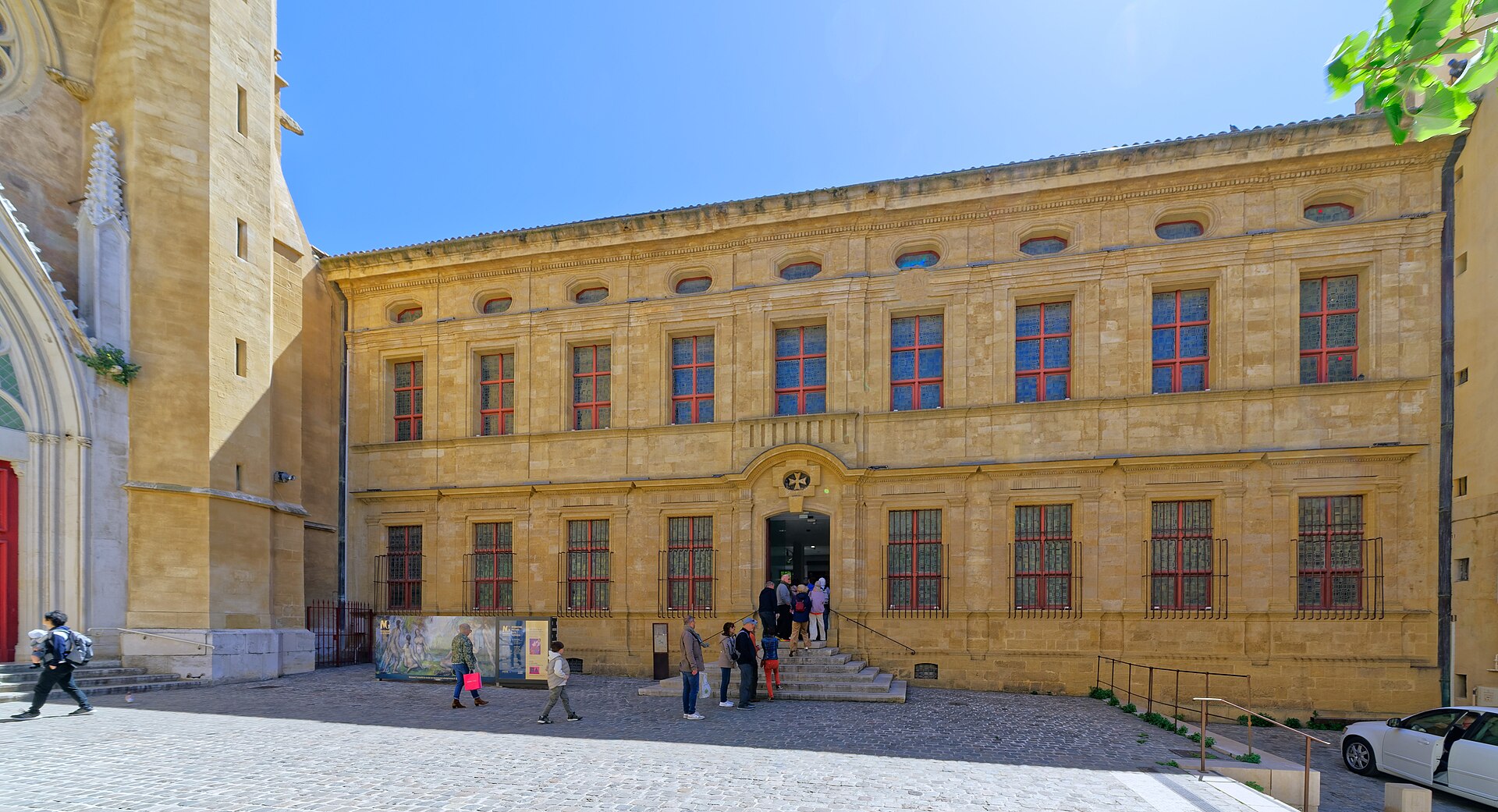
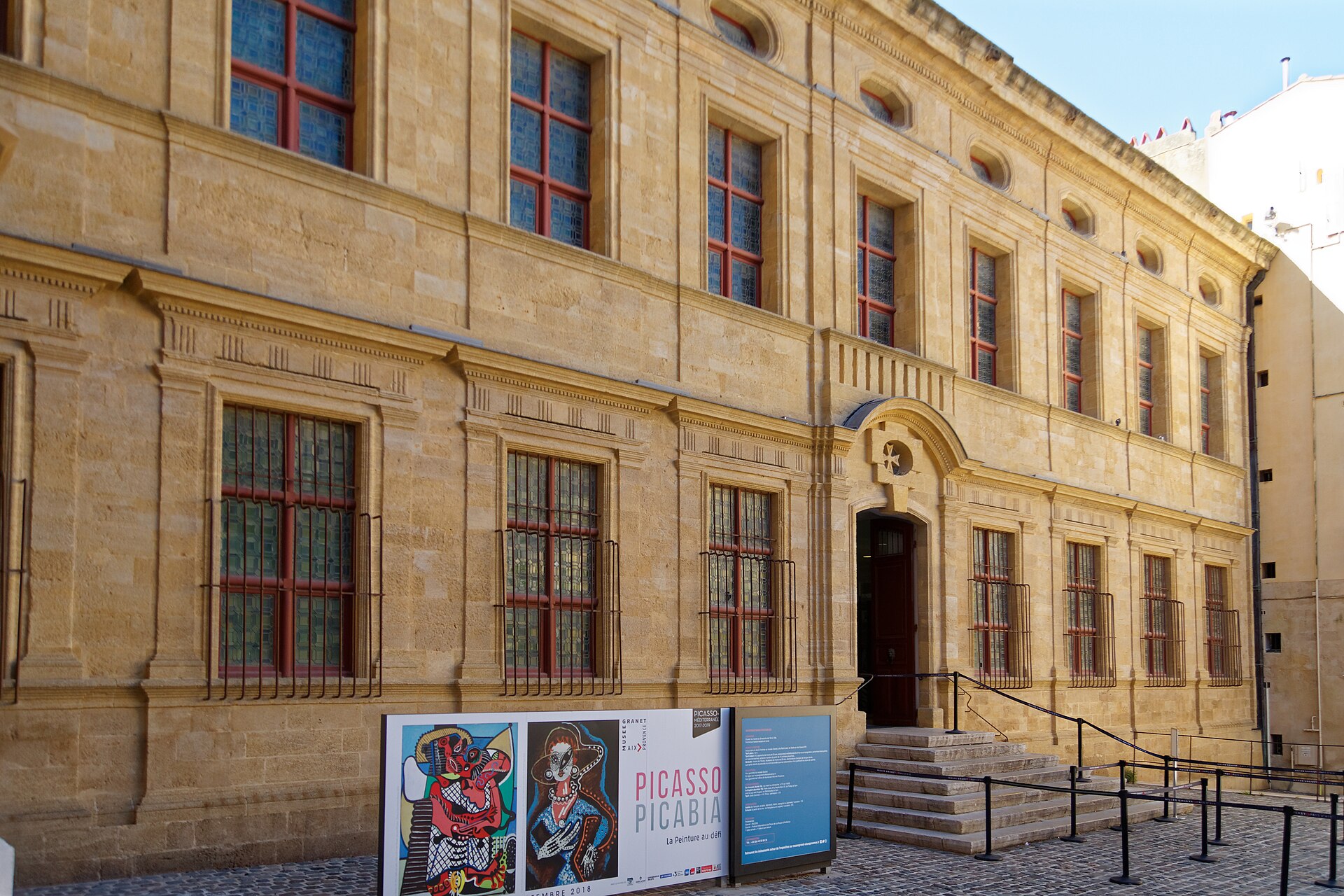
The Musee Granet frontage on the Place Saint-Jean de Malte, Aix-en-Provence, with the church of Saint-Jean-de-Malte at the left. Confirmed as this building: same facade as the museum's entrance on the square.
Holger Uwe Schmitt, CC BY-SA 4.0Musee Granet
Museum · Musée Granet · Founded 1838
Open, admission and hours confirmed 9 November 2026 · 14 sources
On this page 15 sections
ContentsClose
The depth is in three places: the Cezanne holdings and Aix's long reconciliation with him, the Philippe Meyer rooms with a major Giacometti group, and the Ingres and Granet paintings of the nineteenth century, backed by pre-Roman Celto-Ligurian sculpture from Entremont.
| Local name | Musée Granet |
|---|---|
| Kind | Museum |
| Founded | 1838 |
| City and country |  Aix-en-Provence, France |
| Address | Place Saint-Jean de Malte, 13100 Aix-en-Provence, France |
| Website | museegranet-aixenprovence.fr |
| Status | Open, confirmed |
| Record last verified |
Visiting
- Hours
- Tue-Sun12:00 to 18:00From 3 November 2026. Ticket office closes at 17:30 and rooms are cleared from 17:45.
- Closed
- Monday. 25 December. 1 January. 1 May.
- Admission
- Full priceEUR 14Access to the Paul McCartney exhibition (4 July 2026 to 3 January 2027) is included.
- Reduced priceEUR 12Apprentices up to 25, companions of a mobility inclusion card holder without the need-for-accompaniment mention, purchases of 15 or more paid tickets, teachers with a Pass Education card. Proof required.
- Free admission categoriesFreeUnder 18s, students under 26, long-term job seekers, RSA recipients, holders of a Ministry of Culture card, press card holders, members of Icom and Icomos and others listed on the museum page. Proof required.
- Audio guide rentalEUR 4Available in French, English, German, Italian, Spanish and Japanese.
- Individual guided tour supplement, 1 hourEUR 5Added to the admission fee, outside the summer exhibition period; 30 minutes is admission plus 3 EUR.
- Tickets
- museegranet.tickeasy.com The museum's own ticket page.
- Do I need to book?
- Not stated as required on the museum's page; tickets can be bought at the ticket office and on the museum website.
- Address
- Place Saint-Jean de Malte, 13100 Aix-en-Provence, France MapBus From La Rotonde: lines M1, 3, 5, 6 and 13, stop Gambetta or Saint-Jean
Car Parkings Carnot or Mignet, open every day - Website
- museegranet-aixenprovence.fr
- Telephone
- +33 4 42 52 88 32
- [email protected]
Before you go how long, access, photography, bags, eating, shop
- How long to allow
- About an hour, according to the visitor-review summary on Wanderlog (tertiary).
- Access
- Collection and exhibition rooms are accessible to people with reduced mobility. The step-free entrance is at 18 rue Roux-Alpheran behind the museum; a wheelchair is available at reception and folding chairs are lent free.
- Photography
- Not stated on the pages read.
- Bags
- The museum advises against backpacks under the stepped-up Vigipirate level and refuses voluminous luggage. A cloakroom takes clothes, bags and umbrellas but not pushchairs, scooters or suitcases.
- Eating
- Not stated on the pages read.
- Shop
- The museum's site lists a museum bookshop.
Prices and hours change. We take them from the institution's own pages and print the day we read them, and you can check the current position at the source we used. Confirm before you travel.
What is inside
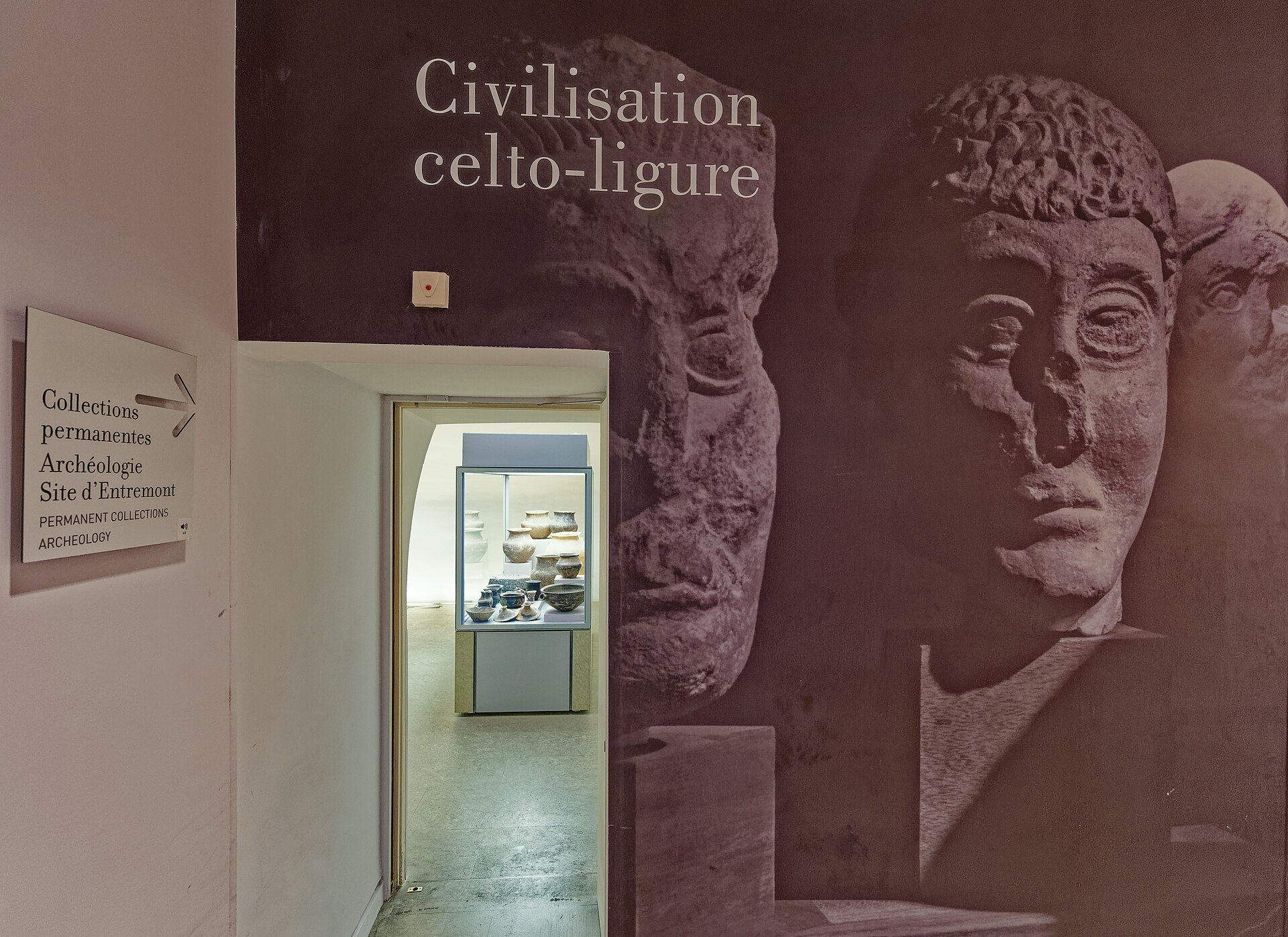
Photograph by Holger Uwe Schmitt · CC BY-SA 4.0 Archaeology and the Celto-Ligurian rooms
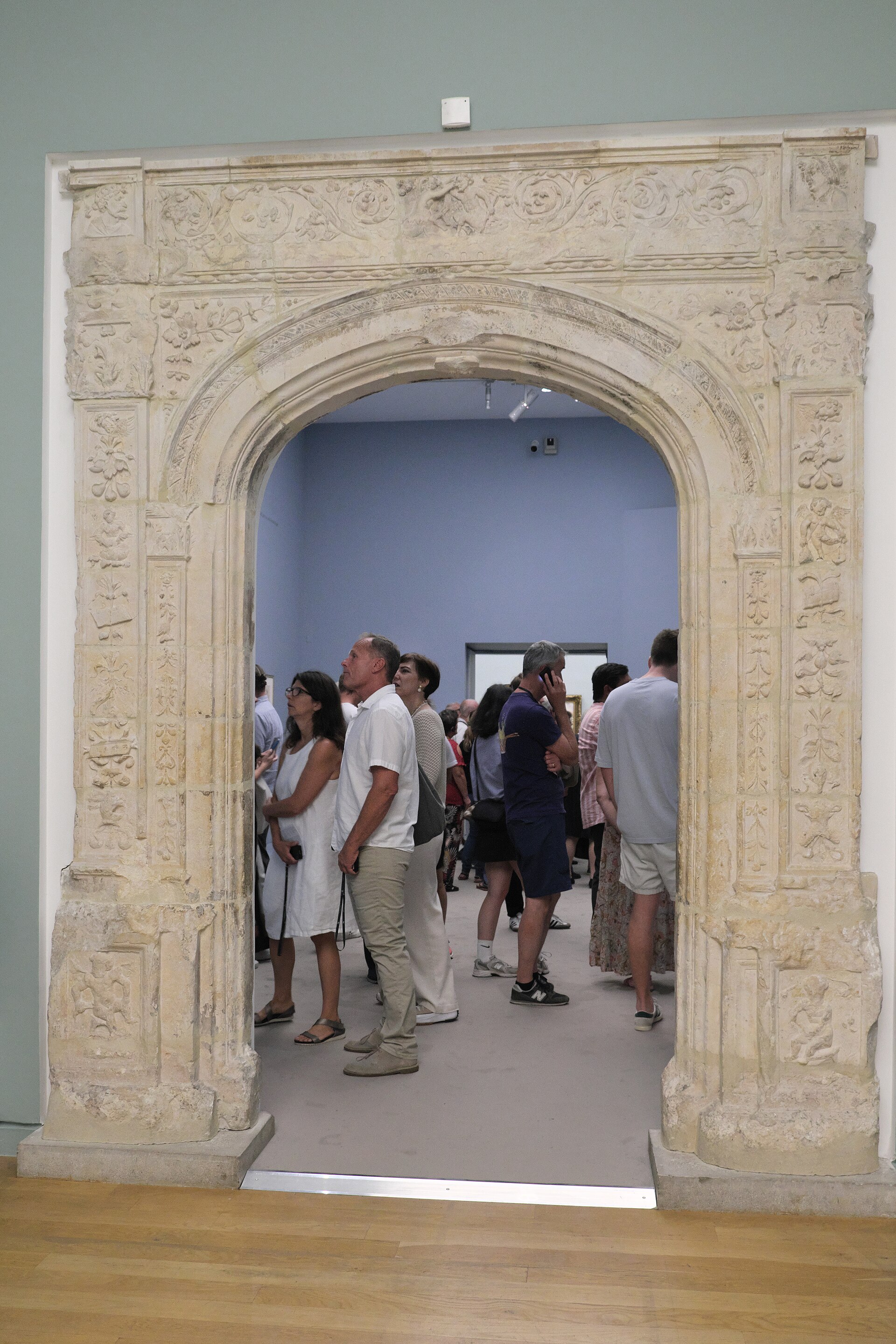
The route starts with Celto-Ligurian sculpture from the Entremont site of the second century BC, including a seated warrior figure and groups of warrior heads, and tableware from the same site. The rooms show Celtic Gaul in the Mediterranean before the Romans and the founding of Aix.
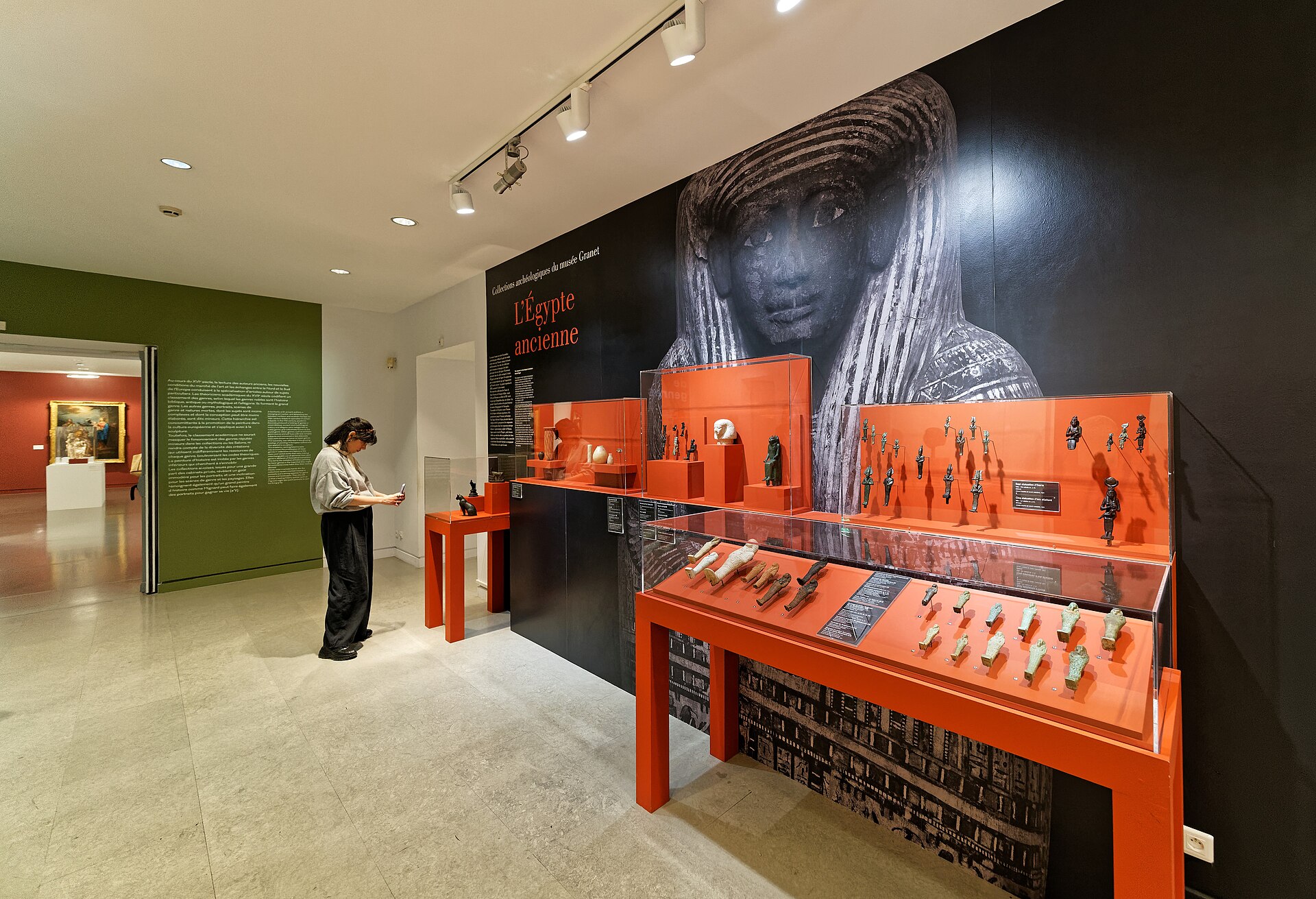
Photograph by Holger Uwe Schmitt · CC BY-SA 4.0 Ancient Egypt
A gallery of Egyptian objects, mostly from nineteenth-century gifts and bequests, with a sarcophagus of Ptahirdis and the stela of Isetemdinakht among the highlights named by English Wikipedia.
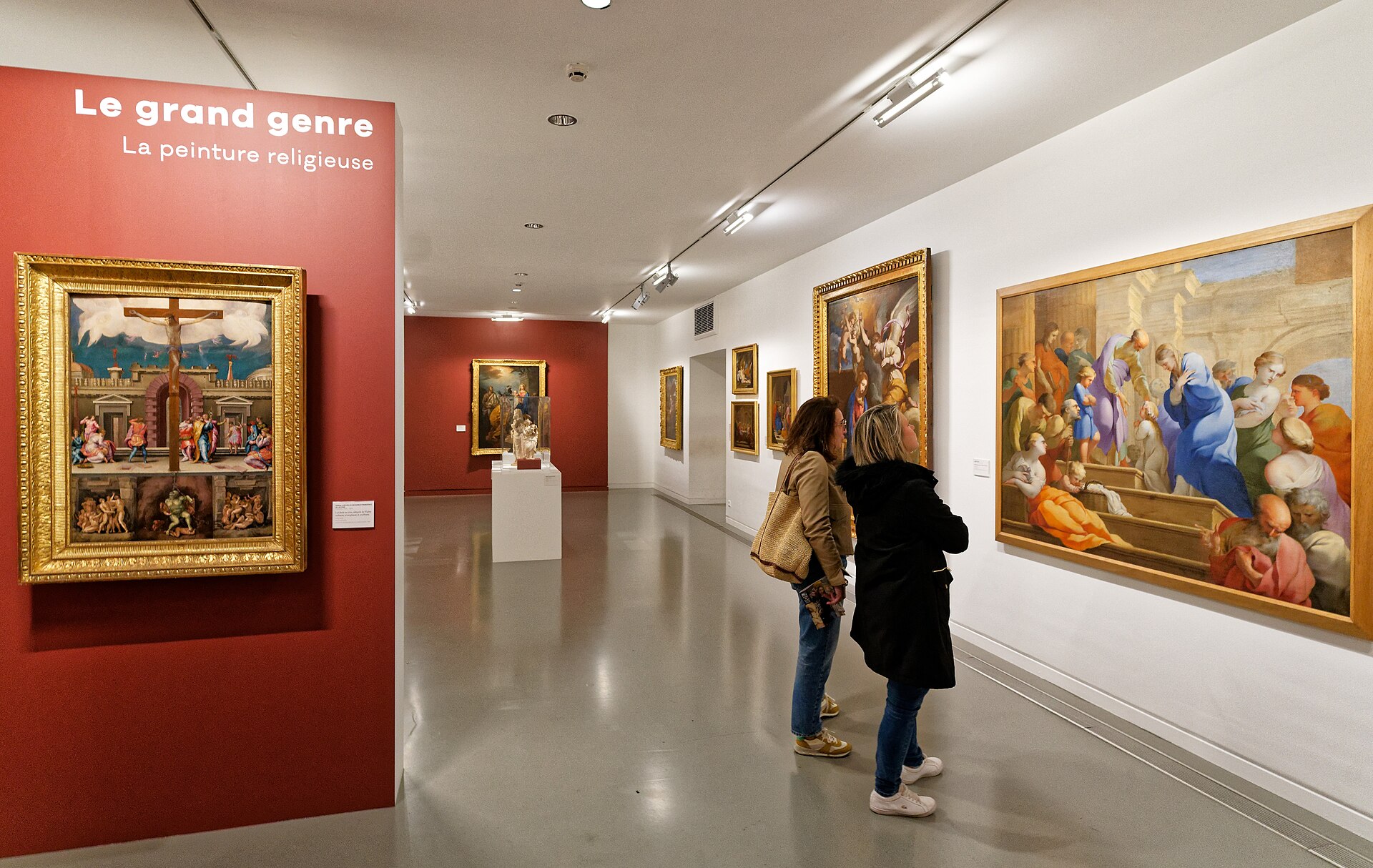
Photograph by Holger Uwe Schmitt · CC BY-SA 4.0 Painting of the 14th to 18th centuries
Rooms rehung by genre with more than 100 works: religious and history painting, portraits including the Gueydan family, still lifes and landscapes. Named works include Rembrandt's self-portrait, Van Wittel's view of Rome with Saint-Jean des Florentins and Daret's Guitar Player.
Nineteenth-century painting and the Granet room
Ingres's Jupiter and Thetis, the portrait of Granet by Ingres, a room of Granet's Roman landscapes, a David portrait, a Gericault, Duqueylard and the Provencal school. No free-licence photograph of this room has been verified, so none is attached.
Photograph by Holger Uwe Schmitt · CC BY-SA 4.0 Cezanne galleries
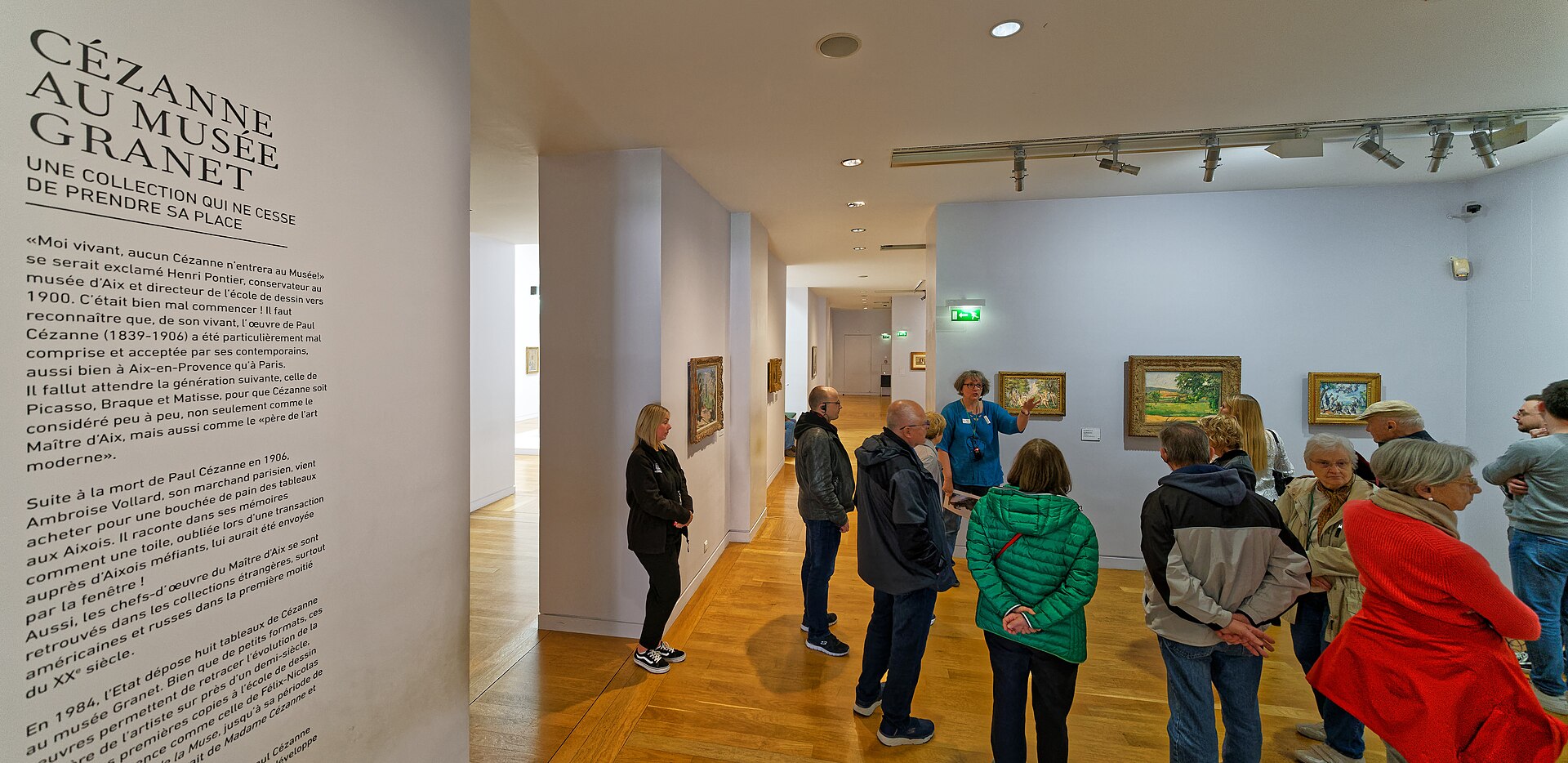
Two galleries on Cezanne since 2025, from the early drawing-school and Jas de Bouffan wall work to the later Provencal landscapes, including the Larock donation of Waterfall or Bathers in Front of Sainte-Victoire Mountain and the Zola portrait acquired in 2011.
Photograph by Holger Uwe Schmitt · CC BY-SA 4.0 From Cezanne to Giacometti: the Philippe Meyer donation
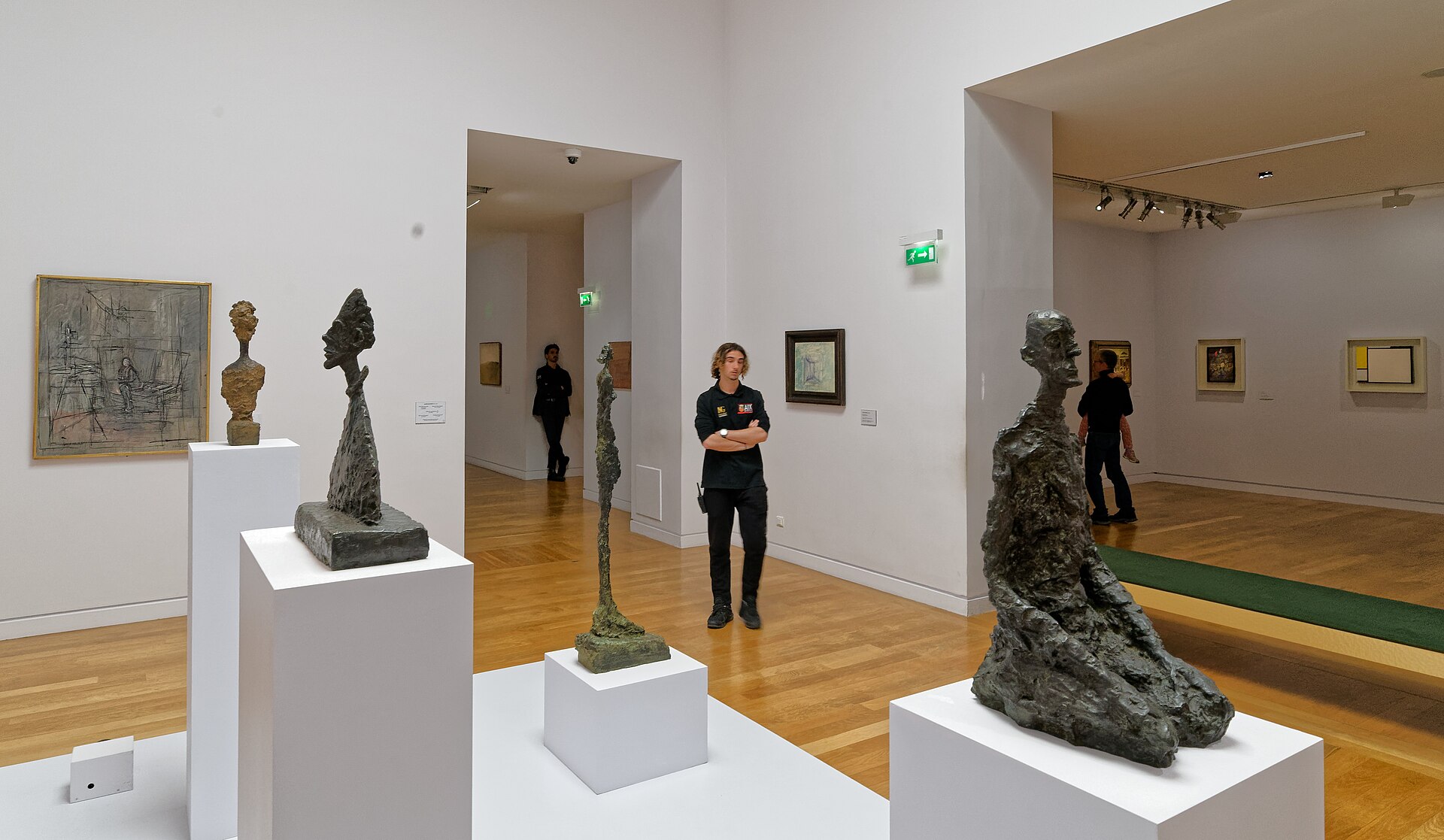
Seventy-one works on long-term loan from the Musee d'Orsay: Degas, Bonnard, Vuillard, Picasso, Leger, Mondrian, Klee, de Stael and a major group by Alberto Giacometti, set in dialogue with earlier artists such as Guardi, Corot, Boudin and Chardin.
Sculpture gallery
Ground-floor rooms with works by Jean-Pancrace Chastel, Trupheme and nineteenth-century Aix sculptors such as Ramus and Ferrat, and a bust gallery of regional figures including Vauvenargues, Cezanne and Mirabeau. No verified interior photograph is attached.
What to see first
Jupiter and Thetis
Jean Auguste Dominique IngresThe museum's best-known large canvas, painted in 1811 at 324 by 260 centimetres, on state deposit from 1835 until ownership passed to the city in 2024 according to the museum's caption.4
Portrait of Francois-Marius Granet in Rome
Jean Auguste Dominique IngresThe portrait around which the room of Granet's Roman paintings is organised; it ties the museum's namesake to the painter who made the museum's showpiece.4
Self-portrait
RembrandtA small oil on panel of about 1659, roughly 31 by 24 centimetres, credited by the museum to the Bourguignon de Fabregoules donation.7
Portrait of Emile Zola
Paul CezanneAcquired in 2011; the museum calls it Cezanne's only known portrait of his friend the writer.3
Waterfall
Paul CezanneA wall painting of 1862-64 on plaster, detached and mounted on canvas, 343 by 78 centimetres; it shows the young painter working in Aix before the museum accepted him.3
The Giacometti group
Alberto GiacomettiPaintings, sculptures and drawings that the museum calls a major highlight and a defining component of the Meyer rooms.8
Celto-Ligurian warrior heads and seated warrior
Entremont workshopsSecond-century BC sculpture from the Entremont site, the starting point of the museum route and evidence of pre-Roman Provence.5
Le Pot rouge
Fernand LegerA 1926 oil of 65 by 92 centimetres from the Philippe Meyer donation, on deposit from the Musee d'Orsay.8
Exhibitions on now
A priory of the Knights of Malta turned museum
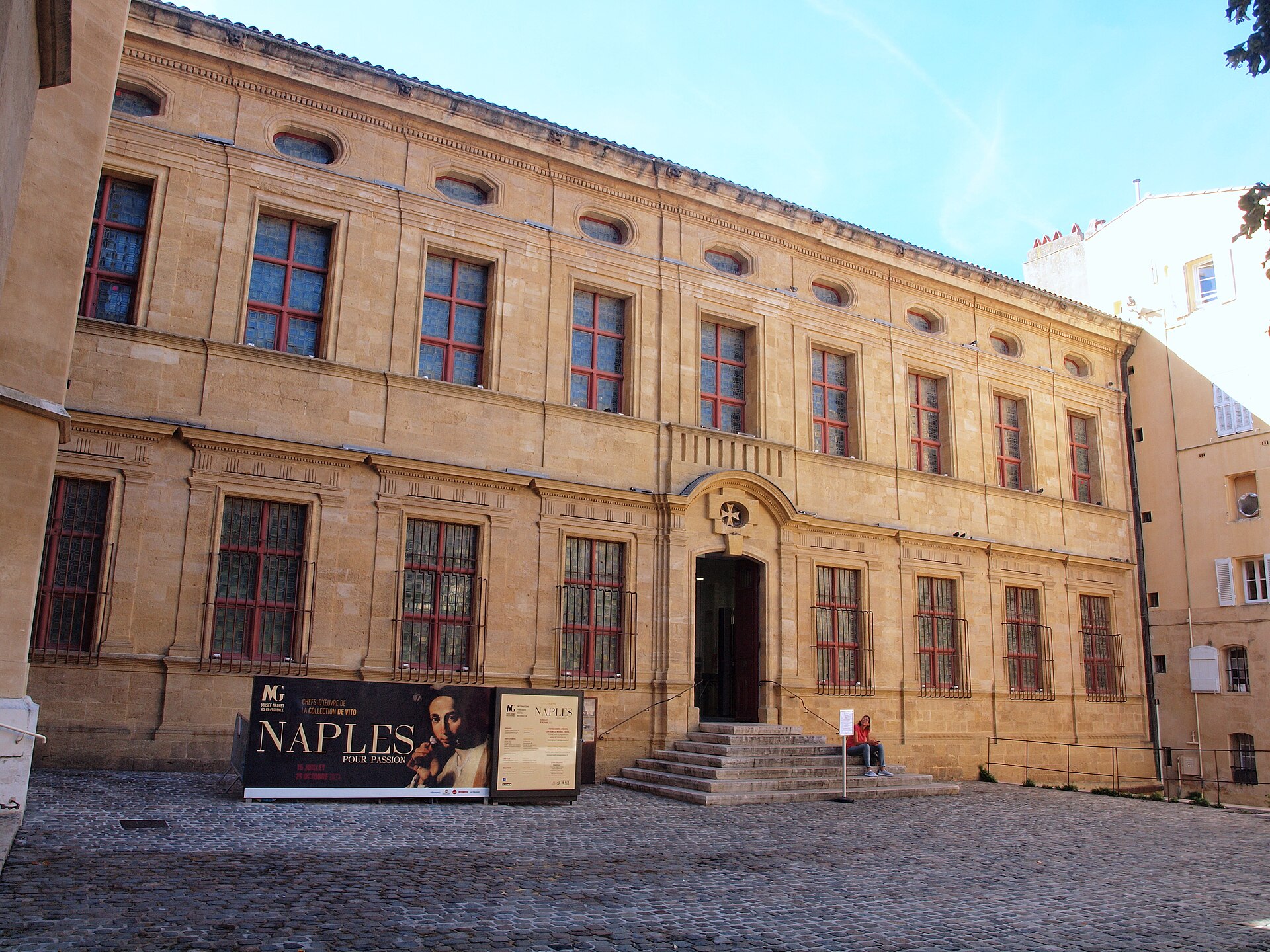
The Musee Granet stands on the Place Saint-Jean de Malte in the Mazarin quarter of Aix-en-Provence, in buildings that belonged to the priory of Saint-Jean-de-Malte. The Ministry of Culture's heritage record calls the building the Priory of the Hospitallers of Saint-Jean-de-Malte, now the Musee Granet, and dates its main building campaign to the 17th century. It is owned by the commune. Its main facade on the square and the roof above it were classified as a historic monument by an order of 7 November 1979, and the facade on the garden side was entered on the supplementary inventory by the same order.
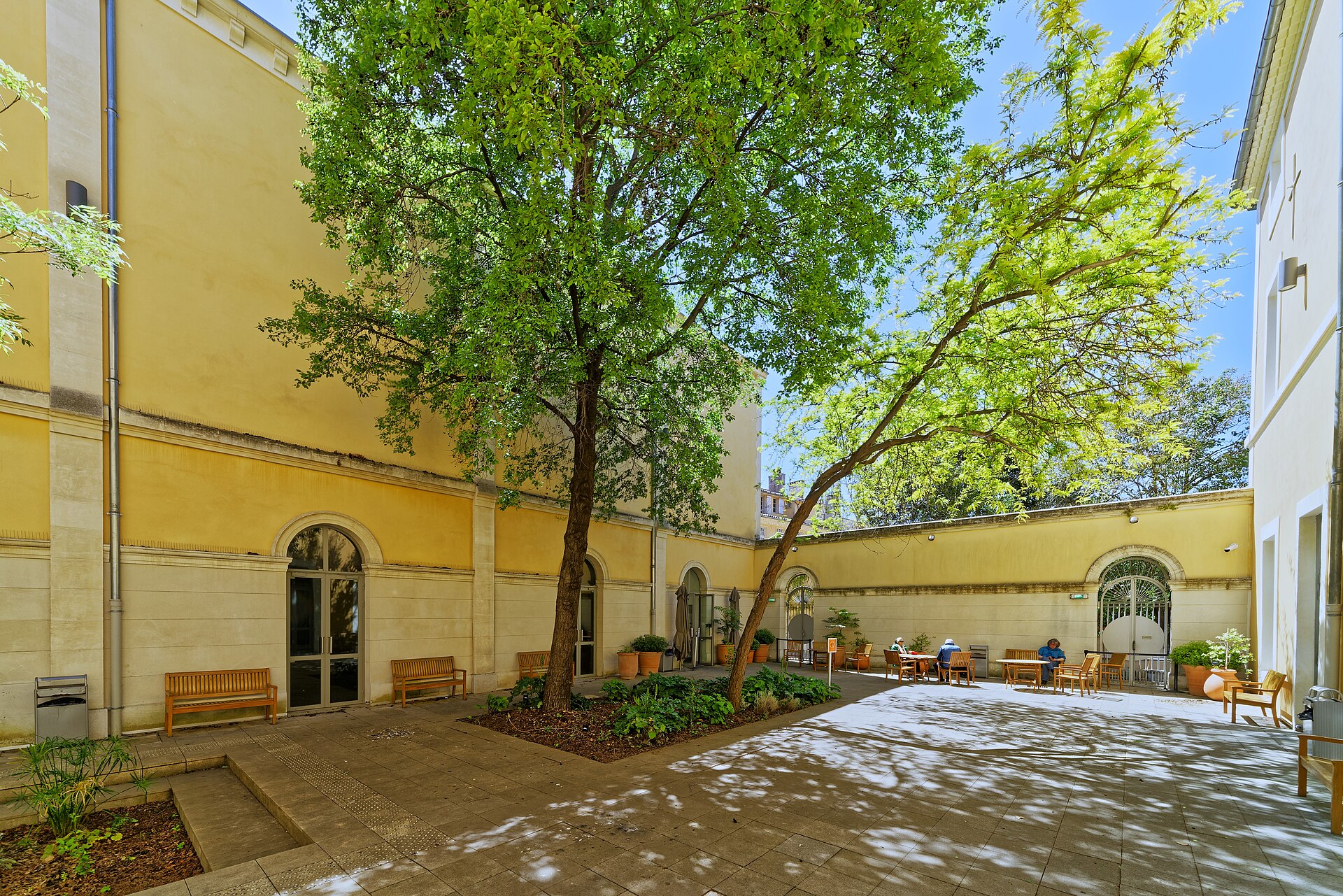
The museum shares a garden with the church of Saint-Jean-de-Malte next door, and the two stand together on the square, the church at the left of the frontage in the photographs. A reader who arrives expecting a purpose-built gallery will find instead a calm, sober stone frontage with regular windows and a modest central doorway, reached by a short flight of steps from the cobbled square.
This page concerns that building only. The museum also runs a second site, the Chapelle des Penitents Blancs, which shows other parts of the collections and is ticketed separately. The museum's price page states that a ticket to the chapel does not grant access to the Place Saint-Jean de Malte building.
From the Musee d'Aix to the Musee Granet
French Wikipedia records that a first museum opened in 1828 in the priory premises and was inaugurated in 1838; English Wikipedia gives 1838 as the opening, under the name Musee d'Aix. The founding holdings came mainly from the antiquities gathered by Fauris de Saint-Vincens at the end of the 18th century.
The decisive gift came in 1849, when the painter Francois Marius Granet, born in Aix in 1775, bequeathed his paintings and drawings to his native city. Under the terms of his will, 200 of the drawings were chosen for the Louvre. A further major bequest followed in 1863 from Jean-Baptiste de Bourguignon de Fabregoules, of more than 800 works according to Wikipedia. The museum's own caption for its Rembrandt self-portrait dates the Bourguignon de Fabregoules donation to 1860, a small discrepancy between the museum and the encyclopaedia that this page records rather than resolves. In 1949, on the centenary of Granet's death, the institution took his name.
The buildings grew with the collections. The Granet wing was begun in 1860, a second building was added after 1870 and a third in 1900, and the complex was enlarged again around 1940, according to French Wikipedia. The same source reports extensive renovation between 1990 and 2005, and a reopening in the summer of 2006, timed to the exhibition Cezanne en Provence, which ran from 9 June to 17 September 2006.
Cezanne in his home town
The museum's own account of Cezanne is frank about the history. Henri Pontier, curator of the museum and director of the Aix drawing school from 1892 to 1925, is said to have declared that no Cezanne would enter the museum in his lifetime, and the painter's work met hostility from critics and the public in Aix. The Paris dealer Ambroise Vollard was a notable exception.
That changed in 1984, when the French state placed eight Cezanne paintings on permanent loan at the Musee Granet. English Wikipedia says nine; the museum says eight and this page follows the museum. The group traces his development over nearly half a century, from The Kiss of the Muse, painted at the Aix drawing school, to mature works such as the Portrait of Madame Cezanne and The Bathers. In 2011 the museum acquired Cezanne's only known portrait of his friend the writer Emile Zola.
In 2025, after the exhibition Cezanne at the Jas de Bouffan, two galleries were given over to Cezanne with a new hanging that runs from his early work at the drawing school and on the walls of the Jas de Bouffan to the later paintings made between the Provencal countryside and the Lauves studio. The museum singles out the recent donation by Marc and Edouard Larock of Waterfall or Bathers in Front of Sainte-Victoire Mountain, on deposit from the D.G. Cazeau collection. A wall painting by the young Cezanne, Waterfall (1862-64), detached from its plaster and mounted on canvas, measures 343 by 78 centimetres.
Ingres, Granet and the 19th century
The nineteenth-century rooms hold the museum's best-known large canvas, Jupiter and Thetis by Jean Auguste Dominique Ingres, painted in 1811 and 324 by 260 centimetres. The museum's caption records that it came as a state deposit in 1835 and that ownership passed from the state to the city of Aix-en-Provence in 2024.
An entire room is given to Granet himself. It is largely devoted to his Roman period and organised around the portrait of Granet that his friend Ingres painted in Rome. The museum says Granet used landscape, one of his favourite subjects, to meditate on the decline and oblivion into which civilisations fall. His large Cloister of the Charterhouse of Sainte-Marie des Anges in Rome, 198.8 by 271 centimetres, came with his 1849 bequest.
Around them the museum shows a portrait of a young boy by David, a Gericault, The Young Greek Asleep on a Rock by the Sea, 37.4 by 45.8 centimetres, and rare paintings by Duqueylard, including The Dream of Ossian. The Provencal school is represented by figures such as L'Engaliere and Loubon, with a landscape of Sainte-Victoire by Prosper Gresy.
Before Rome and after Cezanne
The collection begins with archaeology. The Celto-Ligurian sculptures from the Entremont site, dated to the second century BC, show the cultural originality of Celtic Gaul in the Mediterranean region before the Romans arrived and before the founding of Aquae Sextiae, present-day Aix, at the very end of that century. A seated warrior and a group of warrior heads from Entremont are among the pieces the museum illustrates. English Wikipedia adds an Egyptian collection assembled mostly through nineteenth-century gifts and bequests, with the sarcophagus of Ptahirdis and the stela of Isetemdinakht among its highlights, and a marble mask of a woman by Francesco Laurana in the sculpture holdings.
The painting galleries of the 14th to 18th centuries were recently rehung around the genres of painting, which the museum says brings together more than 100 works, among them the portraits of the Gueydan family reunited for the occasion. Highlights named by the museum include Rembrandt's self-portrait of about 1659, a small oil on panel of about 31 by 24 centimetres, a Caspar van Wittel view of Rome, a Nicolas Mignard Mars and Venus of 1658 from the Granet bequest, and Jean Daret's Guitar Player of 1636.
The twentieth-century rooms come from the donation of Philippe Meyer, a physicist and collector who died in 2007 and gave much of his collection to French museums in 2000. The Musee Granet received 71 of the works, kept as a long-term loan from the Musee d'Orsay. The group includes Degas, Cezanne, Bonnard, Vuillard, Picasso, Leger, Mondrian, Klee and de Stael, and the museum calls the group of paintings, sculptures and drawings by Alberto Giacometti a defining part of the whole.
What the figures show, and what the critics say
French Wikipedia prints the annual visitor figures. The reopening year, 2006, brought 488,775 visitors. The next year, 2007, brought 71,267, and 2009 brought 449,709. The year 2013 reached 346,796, and the late 2010s settled near 175,000, with 175,096 in 2019. The pandemic years show 68,165 in 2020 and 105,012 in 2021.
The same article records the one structural criticism of the place. Because space is limited, the museum has favoured temporary exhibitions, which the article describes as more financially rewarding. As a result several major paintings, by Jordaens, Guercino, Puget and Piazzetta, and some sculptures have been placed in storage, and the galleries that had shown them were reassigned to temporary exhibitions after the 2007 renovation. English Wikipedia adds that the large archaeological collection is intended to move to a new museum for lack of room. A visitor planning around a single painting should therefore check that it is on view.
The current temporary show is Paul McCartney photographs, 1963-64: Eyes of the Storm, with over 250 photographs and running until 3 January 2027. Entry to it is included in the standard ticket, so the price of a visit now includes the show.
What visitors say
Visitors consistently value the Cezanne rooms for showing his development and his tie to Aix, and the museum for being compact enough to see in about an hour. The recurring complaints are thin explanatory labelling on some displays such as the archaeology unless the audio guide is used, a collection some find modest in size, and crowding at peak times. Reviewers also note that timed entry is well organised.
What is praised, what is criticised
- Praised: The Cezanne collection and how it shows his development and link to Aix
- Praised: A compact museum that can be seen in about an hour
- Praised: Well-organised timed entry that limits crowds
- Criticised: Limited explanatory information on some displays, such as the archaeology, unless the audio guide is used
- Criticised: A collection some visitors call not the most vast
- Criticised: Several major paintings by Jordaens, Guercino, Puget and Piazzetta kept in storage in favour of temporary exhibitions, as French Wikipedia records
Ratings on other platforms
Google: 4.4 from 4,976 ratings, read 9 November 2026
Tripadvisor: 4.2 from 1,395 ratings, read 9 November 2026
A platform average is a tertiary source: it moves, it is not audited, and we quote no visitor's words.
Questions about Musee Granet
Where is Musee Granet?
Place Saint-Jean de Malte, 13100 Aix-en-Provence, France.
How much does it cost to visit?
Full price: EUR 14; Reduced price: EUR 12; Free admission categories: free; Audio guide rental: EUR 4; Individual guided tour supplement, 1 hour: EUR 5. As confirmed 9 November 2026.
When is it open?
Tue-Sun 12:00-18:00. Closed: Monday. 25 December. As confirmed 9 November 2026.
How do you get there?
Bus: From La Rotonde: lines M1, 3, 5, 6 and 13, stop Gambetta or Saint-Jean; Car: Parkings Carnot or Mignet, open every day.
What should you see first?
Jupiter and Thetis (Jean Auguste Dominique Ingres); Portrait of Francois-Marius Granet in Rome (Jean Auguste Dominique Ingres); Self-portrait (Rembrandt); Portrait of Emile Zola (Paul Cezanne); Waterfall (Paul Cezanne); The Giacometti group (Alberto Giacometti).
What we could not confirm
- Whether the museum's counts of its Cezanne loan (eight paintings per the museum, nine per English Wikipedia) differ because of later changes in the deposit.
- The date of the Bourguignon de Fabregoules gift: 1860 in the museum's Rembrandt caption, 1863 in Wikipedia.
- Which of the stored major paintings return to view as the galleries are rehung.
Images
Sources
- 1Musee Granet, Opening hours and admissions (English page, read 2026-11-09) museegranet-aixenprovence.fr/en/practical-informations-1/opening-hours-and-admissions
- 2Musee Granet, homepage (English, read 2026-11-09) museegranet-aixenprovence.fr/en/homepage
- 3Musee Granet, Cezanne at the musee Granet museegranet-aixenprovence.fr/en/collections/collections/cezanne-at-the-musee-granet
- 4Musee Granet, French 19th century painting, Granet, Ingres, Provencal painting museegranet-aixenprovence.fr/en/collections/collections/french-19th-century-painting-granet-ingres-provencal-painting
- 5Musee Granet, Archaeology museegranet-aixenprovence.fr/en/collections/collections/archaeology
- 6Musee Granet, Sculpture gallery museegranet-aixenprovence.fr/en/collections/collections/sculpture-gallery
- 7Musee Granet, French, northern European and Italian painting of the 14th-18th centuries museegranet-aixenprovence.fr/en/collections/collections/french-northern-european-and-italian-painting-of-the-14th-18th-centuries
- 8Musee Granet, From Cezanne to Giacometti (Philippe Meyer donation) museegranet-aixenprovence.fr/en/collections/collections/from-cezanne-to-giacometti
- 9Musee Granet, Services museegranet-aixenprovence.fr/en/practical-informations-1/services
- 10Musee Granet, Access map to the musee Granet museegranet-aixenprovence.fr/en/practical-informations-1/access
- 11Wikipedia (French), Musee Granet fr.wikipedia.org/wiki/Mus%C3%A9e_Granet
- 12Wikipedia (English), Musee Granet () en.wikipedia.org/wiki/Mus%C3%A9e_Granet
- 13Ministry of Culture, Merimee base, notice PA00081105, Prieure des Hospitaliers de Saint-Jean-de-Malte, actuellement musee Granet pop.culture.gouv.fr/notice/merimee/PA00081105
- 14Wanderlog, Musee Granet place page, aggregated Google and Tripadvisor scores (, read 2026-11-09) wanderlog.com/place/details/28609/mus%C3%A9e-granet