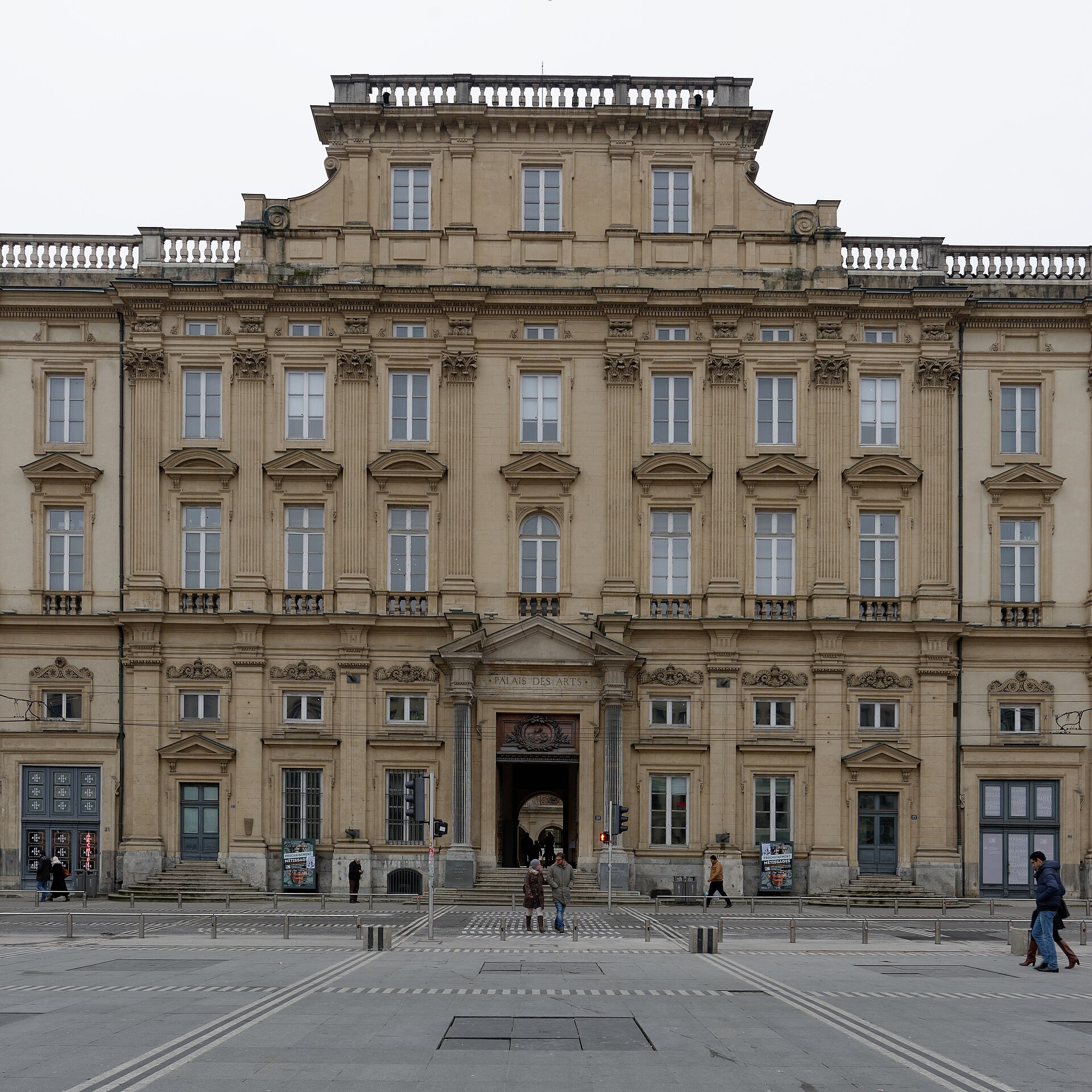
The main facade on place des Terreaux, photographed in 2012, with PALAIS DES ARTS inscribed over the central entrance arch - the building's nineteenth-century name and the one still used above its door.
Marie-Lan Nguyen · Photograph by Jastrow · CC BY 2.5Museum of Fine Arts of Lyon
Museum · Musée des Beaux-Arts de Lyon · Founded 1801
Open, admission and hours confirmed 15 September 2026 · 16 sources
On this page 14 sections
ContentsClose
The museum's own description of itself as the largest fine-arts museum in France outside the Louvre is not marketing shorthand; on the evidence gathered here it holds up room by room. The paintings department carries the collection's reputation, with an unbroken sweep from fourteenth-century Italian and Flemish primitives through the great seventeenth-century schools - Rubens, Rembrandt, Poussin, Guercino - into the nineteenth-century Lyon school, French Impressionism and Post-Impressionism, and on to Matisse, Picasso and Chagall in the twentieth. The antiquities department is unusually strong in Egyptian material for a museum outside Paris, built around excavated architecture from Medamoud rather than purchased fragments alone, and the coin cabinet's roughly 50,000 pieces make it the second such collection in the country. Depth this consistent across five separate departments, inside a single building that is itself a listed seventeenth-century monument, is what specialists mean when they rank this collection above every other French museum bar one.
| Local name | Musée des Beaux-Arts de Lyon |
|---|---|
| Kind | Museum |
| Founded | Founded by the Chaptal decree of 1801, which created museums of painting in fifteen provincial cities; opened to the public in 1803 in the former Benedictine abbey of Saint-Pierre-les-Nonnains |
| City and country |  Lyon, France Lyon, France |
| Address | 20 place des Terreaux, 69001 Lyon, France |
| Website | mba-lyon.fr |
| Status | Open, confirmed |
| Record last verified |
Visiting
- Hours
- Wednesday-Monday10:00 to 18:00Ticket desks close at 17:30 and room clearance begins at 17:50.
- Friday10:30 to 18:00The museum opens half an hour later on Fridays than on its other open days.
- TuesdayClosed every Tuesday and on public holidays (1 January, Easter Monday, 1 and 8 May, Ascension, Whit Monday, 14 July, 15 August, 1 and 11 November, 25 December).
- Closed
- Tuesday. 1 January. Easter Monday. 1 May. 8 May. Ascension. Whit Monday. 14 July. 15 August. 1 November. 11 November. 25 December.
- Admission
- Adult - permanent collectionsEUR 8Also the standard rate for holders of the Lyon Musees or Lyon Culture card, per the museum's own price table.
- Young adult 18-25 - permanent collectionsEUR 4
- Under 18 - permanent collectionsFreeFree for ages 3 to 17 and under 3; also free for disabled visitors and one companion, registered jobseekers, non-taxable individuals and museum members on production of proof.
- Adult - temporary exhibition Musee sentimentalEUR 14Combined ticket covering the current temporary exhibition, co-organised with the Centre Pompidou, plus the permanent collections. The museum's price page did not carry the exhibition's closing date at the time this record was checked.
- Young adult 18-25 - temporary exhibition Musee sentimentalEUR 8
- Lyon Musees card (6 municipal museums), adult annualEUR 25
- Lyon Culture card (6 municipal museums plus libraries), adult annualEUR 38
Free entry: The museum's own price page states no single calendar day of free admission (no first-Sunday clause was found); free entry instead runs by visitor category year-round - under 18s, disabled visitors and a companion, jobseekers, non-taxable individuals, museum members, Lyon Musees/Lyon Culture cardholders, city employees and journalists, each on production of current proof.- Tickets
- mba-lyon.fr/fr/article/billetterie-en-ligne The museum's own ticket page.
- Do I need to book?
- Not strictly required, but the museum treats a timed-entry ticket (billet horodate), booked through its own platform, as the effective way to enter, including for free and card-holder admissions; a ticket can be shown on arrival either printed or on a phone.
- Address
- 20 place des Terreaux, 69001 Lyon, France MapBus and metro Stops named Terreaux serve the square directly: Tobie Robatel - Terreaux and La Feuillee - Hotel de Ville, both on the museum's own access page.
Velo'v bike share Four docking stations sit within the immediate square: Terreaux/Terme, Terreaux/Chenavard, Herriot/Pizay and Meissonnier, all listed by the museum itself.
Restricted traffic zone A limited-traffic zone (ZTL) covers the surrounding streets; the museum's access page links its own circulation map for drivers. - Website
- mba-lyon.fr
- Telephone
- +33 4 72 10 17 40
Before you go how long, access, photography, bags, eating, shop
- How long to allow
- The building holds seventy rooms across roughly 7,000 square metres and five curatorial departments; the museum's own first-visit guidance steers newcomers toward a themed route rather than the whole building in one pass.
- Access
- Wheelchair users are received at a separate entrance at 17 place des Terreaux. Lifts serve the galleries with a maximum of two wheelchair users per car, staff assistance is available, and two wheelchairs are kept at the collections desk for visitors who need one.
- Photography
- Not published in the sources read for this record.
- Bags
- Free lockers are installed under the cloister. Large bags, backpacks and bulky items are not allowed into the galleries, and electric-bike batteries may not be brought inside.
- Eating
- Les Eclaireurs, a Lyon patisserie and tea room run by the Luyat brothers, overlooks the garden and its sculptures from a terrace. Open daily 10:00-17:45 except Tuesday, the museum's closed day.
- Shop
- A bookshop and boutique at 20 place des Terreaux, run under licence by GrandPalaisRmn, stocks museum guides and catalogues, artist monographs, children's books, postcards, a jewellery range tied to the collection and a print-on-demand poster kiosk.
Prices and hours change. We take them from the institution's own pages and print the day we read them, and you can check the current position at the source we used. Confirm before you travel.
What is inside
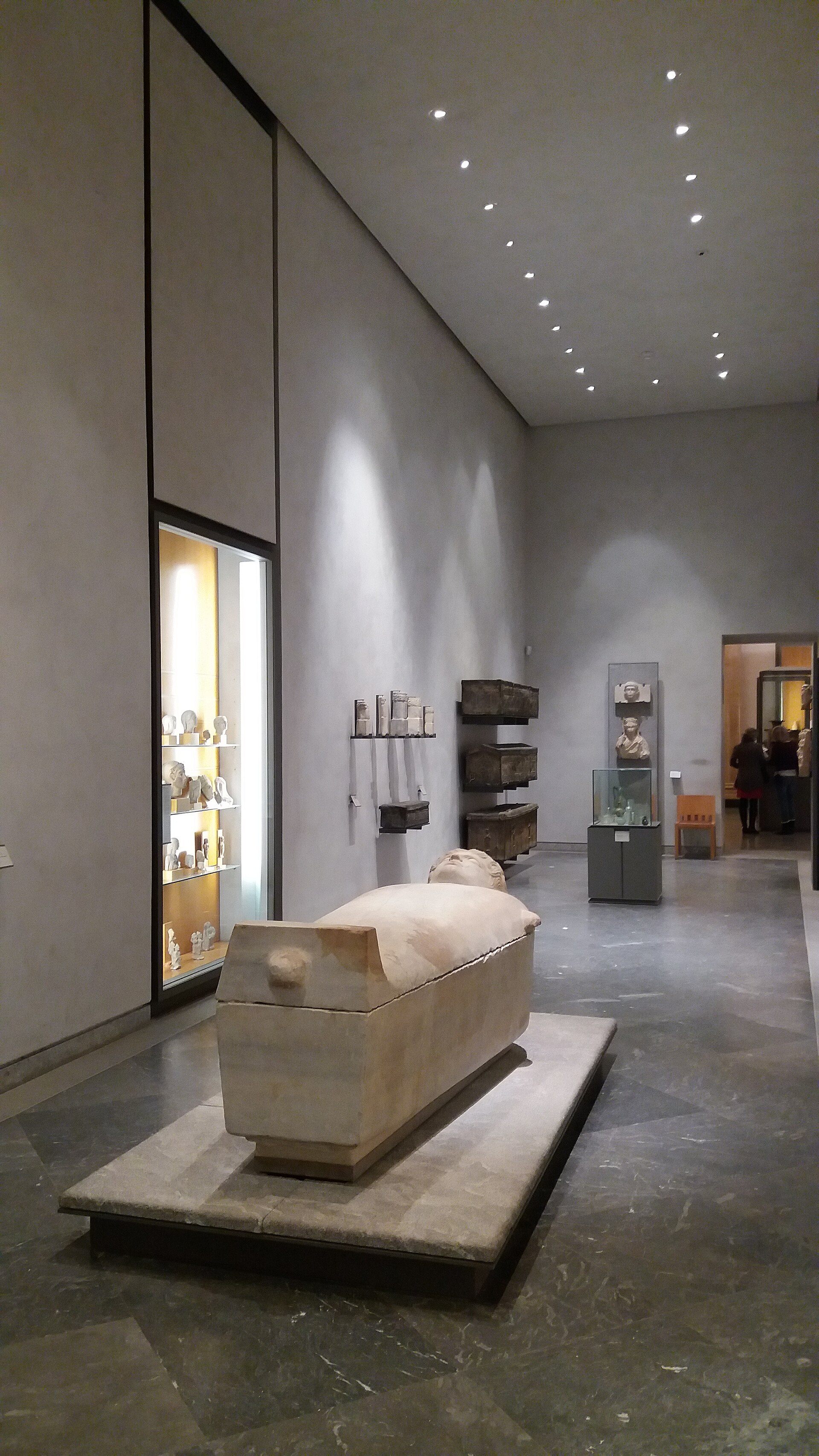
CC0 Antiquities
More than 8,000 objects spanning the archaeology of the Mediterranean basin, from pharaonic Egypt to the Roman Empire, arranged across nine rooms. Holdings include Egyptian coffins, funerary masks and temple architecture recovered from the Ptolemaic-era temple at Medamoud, Greek grave stelae and a Kore of about 540 BC, and Near Eastern material from Palmyra and Persepolis.
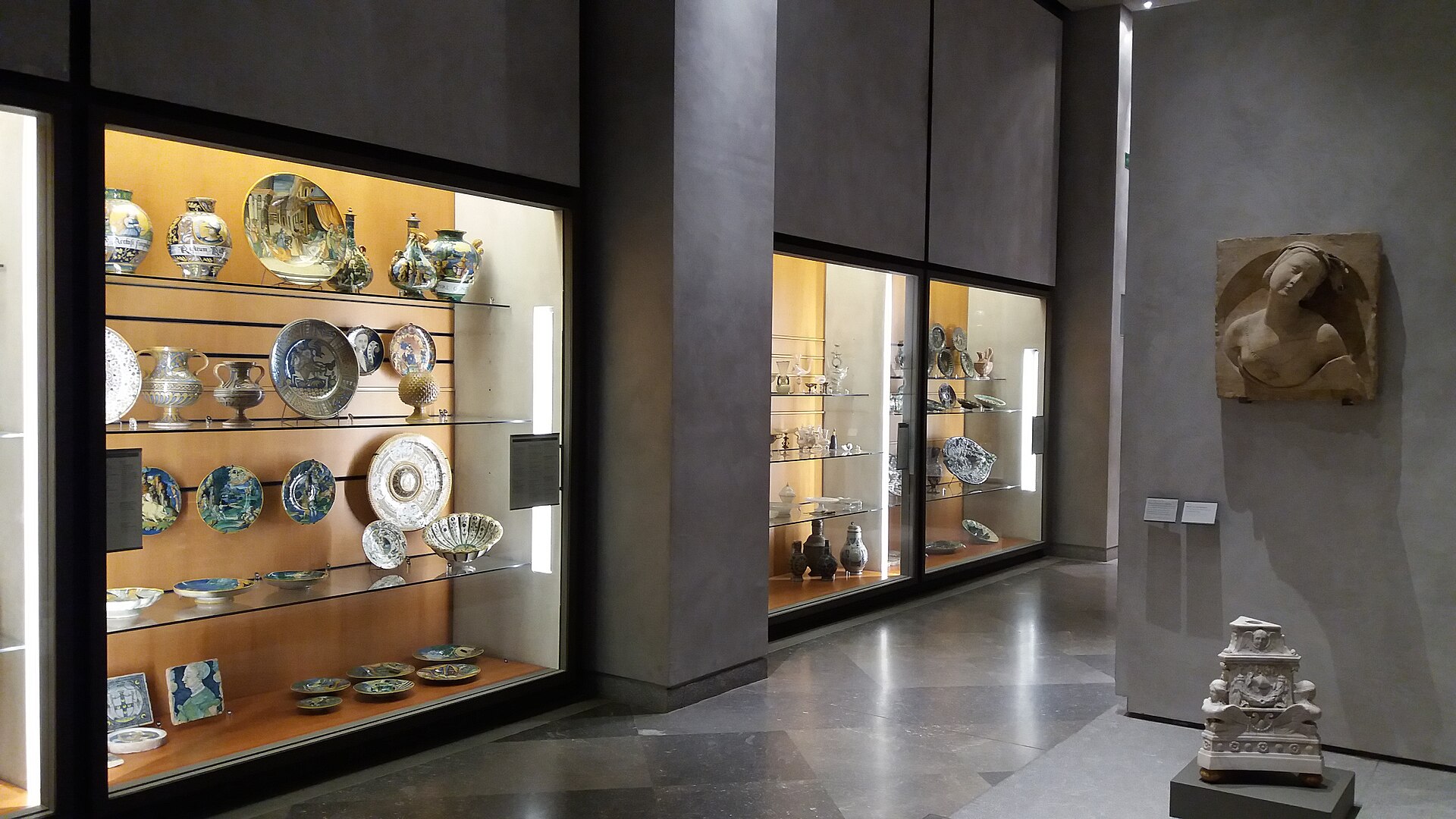
CC0 Objets d'art
Fourteen centuries of decorative arts, from the sixth to the twentieth, covering ivories, goldwork, enamels, glass and furniture. The department pairs an Islamic ceramics collection running from Iran to Ottoman Turkey with a display of East Asian ceramics, medieval Limoges enamels, and Hector Guimard's Art Nouveau bedroom suite.
CC0 Sculpture
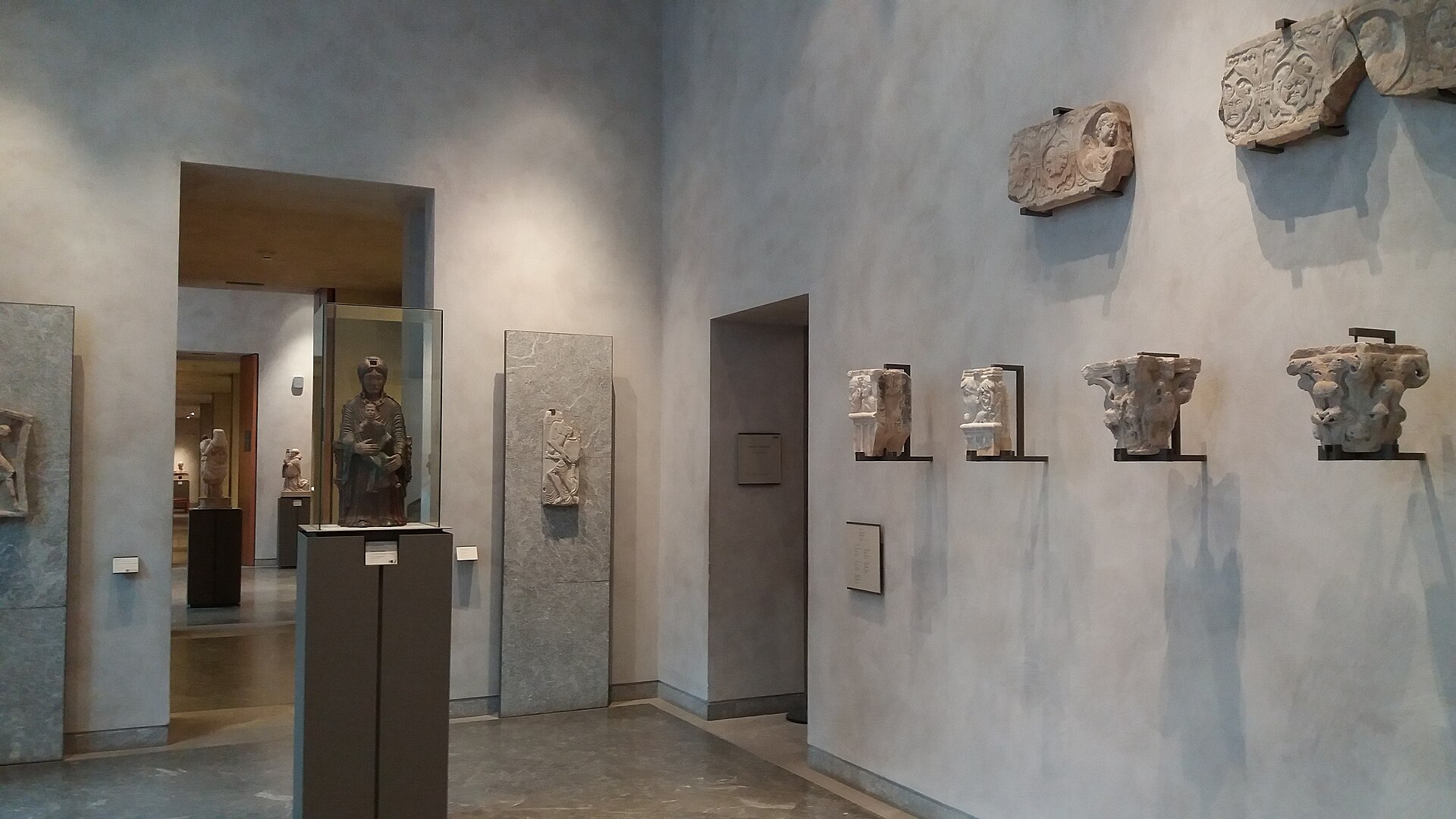
Sculpture from the Middle Ages to the early twentieth century, opening with Romanesque capitals and architectural fragments and Gothic figures such as a twelfth-century Auvergne Virgin in Majesty, and running through Chinard's portrait busts to Rodin, Bourdelle and Canova in the nineteenth and early twentieth centuries.
CC0 Paintings
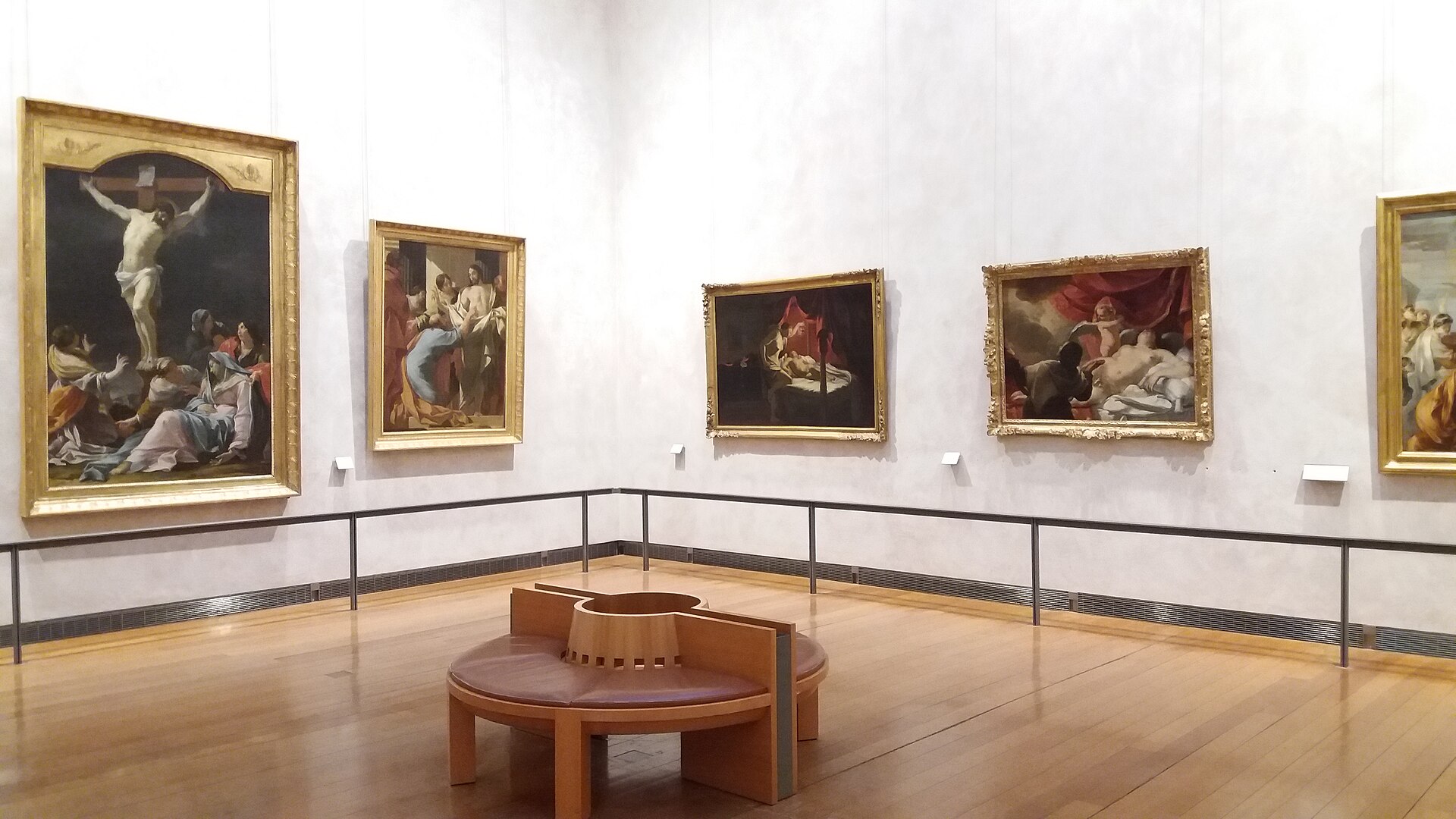
The museum's largest and best-known department, hung across the second floor from fourteenth-century primitives through Renaissance Italy and Flanders, the seventeenth-century schools of Rubens, Rembrandt and Poussin, the eighteenth century, and on to the nineteenth-century Lyon school, Impressionism and the early twentieth-century avant-gardes.
Coins and medals
Close to 50,000 coins, medals, tokens, seals and pieces of jewellery, making the cabinet the second-largest numismatic collection in France after the Bibliotheque nationale's in Paris. Holdings run from a Syracusan decadrachm of about 410 BC and a stater struck under Vercingetorix to a Roman-Lyon sestertius and the medieval Treasure of the Terreaux, found beneath the square the museum itself stands on. No free-licence photograph of this room was located on Wikimedia Commons; it is described here in text only, and the next desk should not substitute another room's image for it.
What to see first
Nave Nave Mahana
Paul Gauguin, 1896A major canvas from Gauguin's second and final Tahiti period, and one of the paintings that anchors the museum's post-Impressionist holdings.6
Paysanne au chale vert (Peasant Woman with a Green Shawl)
Vincent van Gogh, 1885A Nuenen-period Van Gogh, painted the same year as The Potato Eaters, showing the dark Dutch palette he abandoned within a year of arriving in Paris.6
La Lumiere du monde (The Light of the World)
Francois Boucher, 1750Painted for Madame de Pompadour's private chapel and shown at the Salon of 1750, the picture also carries an open provenance case: recovered after the Second World War and deposited by the Louvre in 1955 under M.N.R. 823, it is still formally awaiting restitution to its legitimate owners.9
L'Adoration des mages (Adoration of the Magi)
Peter Paul Rubens, circa 1617-1618One of 110 paintings the Musee du Louvre sent to Lyon from 1803 as the founding deposit that turned the Chaptal decree into an actual museum on the walls.3
Porte d'un temple de Medamoud (Gateway of a temple at Medamoud)
Egyptian, reign of Ptolemy IVA monumental piece of temple architecture from Alexandre Varille's excavations at Medamoud, giving the antiquities department a scale most French Egyptology collections outside the Louvre cannot match.7
L'Ombre (The Shade)
Auguste Rodin, 1902-1904A cast of one of the three figures Rodin repeated atop The Gates of Hell, representative of the sculpture department's strength in the artist's late work.8
Danseuses sur la scene (Dancers on Stage)
Edgar Degas, circa 1889One of Degas's stage studies of dancers seen from an oblique, cropped angle, part of the run of Impressionist and post-Impressionist paintings that draws repeat visits from specialists.6
Les Trois Graces (The Three Graces)
Antonio Canova, 1810A Canova marble group of the Three Graces, an unusual survival outside Italy or Britain and one of the sculpture department's set-piece works from the Napoleonic era.8
Exhibitions on now
A Benedictine abbey becomes the second museum of France
The building the museum occupies was not designed to hold paintings. It began as the abbey of Saint-Pierre-les-Nonnains, a Benedictine convent recorded from around the sixth century, whose church and outbuildings stood inside their own walled precinct at the edge of what is now place des Terreaux. In 1659, under Louis XIV, the abbess Anne de Chaulnes secured the funds to rebuild the whole complex, and the Avignon architects known as Royers de la Valfeniere designed a large four-winged building around a central cloister, modelled on Italian precedent and completed in 1685. Up to sixty Benedictine nuns lived there under an abbess usually drawn from the high nobility, supported partly by rents from shops built into the ground floor, until thirty-two remaining sisters were expelled at the Revolution in 1792. The building survived only because the city council, needing somewhere to store confiscated paintings, medals, bronzes and other art works seized from churches and emigre households, designated it a repository that same year - a decision that saved it from sale or demolition and set it on the path to becoming a museum. The formal founding act came on 14 Fructidor Year IX by the revolutionary calendar, in 1801: the Chaptal decree, issued by the interior minister Jean-Antoine Chaptal, which established museums of painting in fifteen provincial French cities at once. Lyon's share of that programme opened to the public in 1803, when the Musee du Louvre began sending paintings to fill the new institution's walls.
The Palais des Arts takes its present shape
The nineteenth century turned the former abbey into a public monument in its own right. From 1834 the architect Rene Dardel reworked the interior, producing a decorative scheme whose one surviving example is the room now used as the coin and medal cabinet, formerly a hall of modern marbles. At mid-century, new state deposits and the rise of the Lyon school of painting - a distinct local nineteenth-century movement the museum still collects in depth - filled out the galleries considerably. The most consequential rebuilding came under Abraham Hirsch, appointed architect from 1875, who restructured the south wing to house Paul Chenavard's monumental preparatory drawings for a never-completed Pantheon decoration in Paris, and who in 1881 commissioned the Lyon-born painter Puvis de Chavannes to decorate the grand staircase with an allegorical mural, Le Bois sacre cher aux arts et aux muses, still in place today. Through the early twentieth century, several institutions that had shared the building since the Revolution moved out: the natural history museum left in 1914, the city's own historical holdings transferred to the new Musee de Gadagne in 1921, and the school of fine arts departed in 1935, each departure freeing more of the abbey for the art collections alone. The most recent transformation ran from 1990 to 1998, when the curator Philippe Durey and the architects Philippe-Charles Dubois and Jean-Michel Wilmotte carried out a complete restructuring in five phases, timed so the museum never had to close entirely. The result, unchanged in its essentials since, is a building of roughly 14,500 square metres in total, with the public galleries themselves covering about 7,000 square metres across seventy rooms - large enough that the museum is routinely described as the biggest fine-arts museum in France after the Louvre.
Five departments under one roof
What fills those seventy rooms is organised into five curatorial departments, a structure the museum states plainly on its own site: antiquities, objets d'art, coins and medals, sculpture, and paintings, the last of which it calls its own principal collection. Between them the departments hold more than 8,000 antiquities, roughly 3,000 objets d'art, close to 50,000 coins and medals, about 3,000 paintings, some 15,000 works on paper and around 1,000 sculptures - a total the museum itself frames as five thousand years of art and history under a single roof. The antiquities rooms move from pharaonic Egypt and the Near East through Greece to Roman Italy; the objets d'art rooms cover fourteen centuries of ivory, goldwork, enamel, glass and furniture, including a notable holding of Islamic ceramics and Hector Guimard's Art Nouveau bedroom suite; the coin cabinet is the second-largest numismatic collection in the country after the Bibliotheque nationale's own in Paris; and the sculpture rooms run from Romanesque church carving to Rodin, Bourdelle and Canova. All of it sits inside a building whose own fabric - the baroque refectory and staircase decorated by Thomas Blanchet in the 1670s and 1680s, the Romanesque and Gothic remains of the deconsecrated abbey church, the arcaded cloister itself - is as much a part of the visit as anything hung on its walls.
What the paintings department is known for
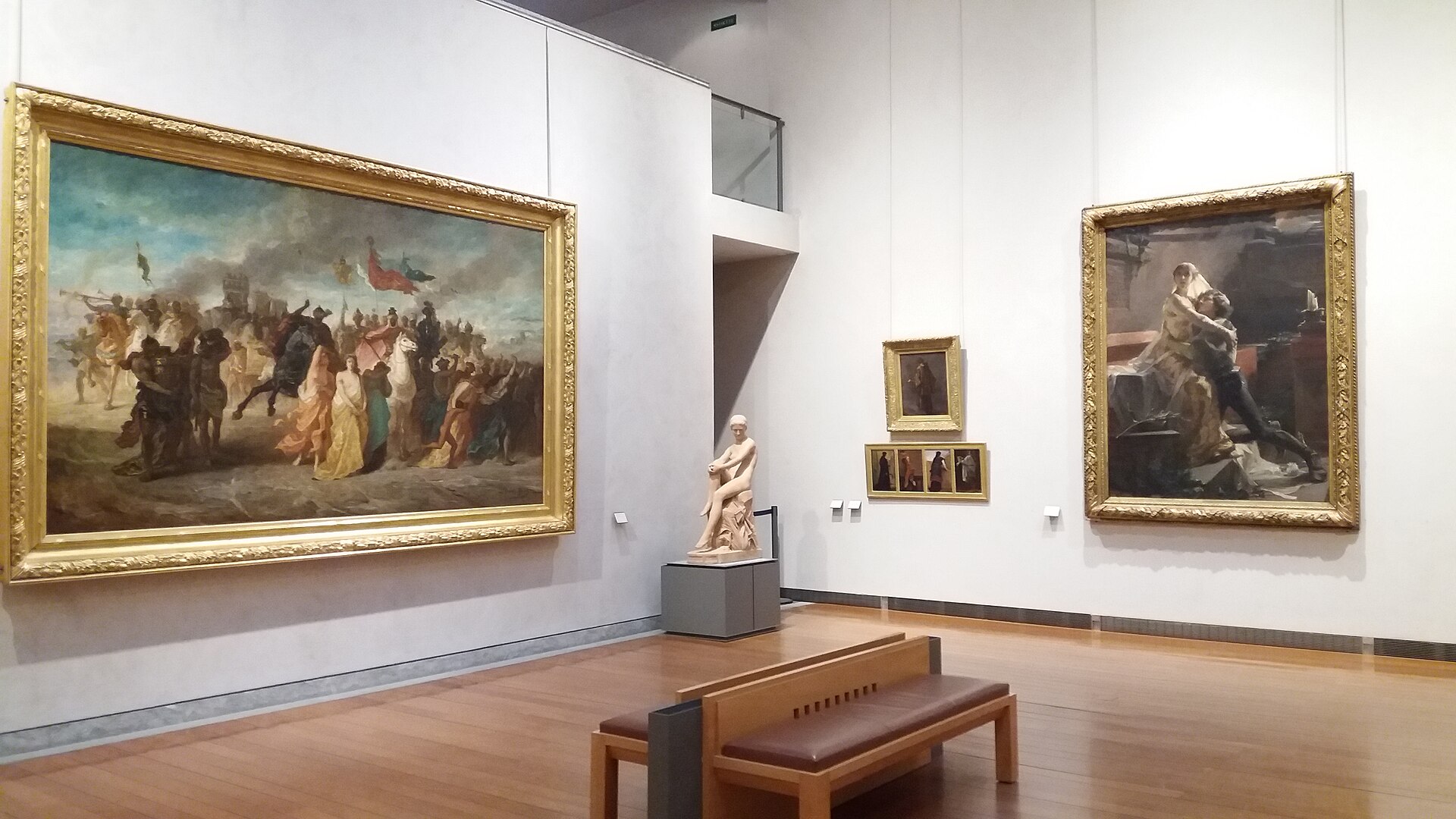
The paintings galleries, spread across the second floor, are where the museum's international reputation mostly rests. The founding 1803 gift from the Louvre - which included Rubens's Adoration of the Magi, Guercino's Circumcision and Philippe de Champaigne's Invention of the Relics of Saint Gervase and Saint Protais - set a precedent of depth in seventeenth-century European painting that later acquisitions and further state deposits kept building on, so that Rembrandt, Poussin, Perugino, Veronese and Tintoretto all hang here alongside the Rubens. The nineteenth-century rooms track the rise of the local Lyon school of flower and figure painting through Antoine Berjon and others, run into Romanticism with Delacroix and Gericault, and arrive at Impressionism and its aftermath with Monet, Sisley, Renoir, Degas and Courbet, before a Post-Impressionist run that includes Van Gogh's Peasant Woman with a Green Shawl and Gauguin's Tahiti-period Nave Nave Mahana. The twentieth-century rooms carry the collection forward again, with paintings by Matisse, Picasso, Chagall, Delaunay, Foujita and Leger extending the department into the art of the last hundred years. It is this unbroken run, from a fourteenth-century primitive to a twentieth-century modern master without a serious gap along the way, that specialists cite when they call the paintings department the museum's strongest single holding, and the reason its own five-department, seventy-room total is usually shortened in the press to one line: the largest museum in France after the Louvre.
A cloister garden, and a picture still waiting for an owner
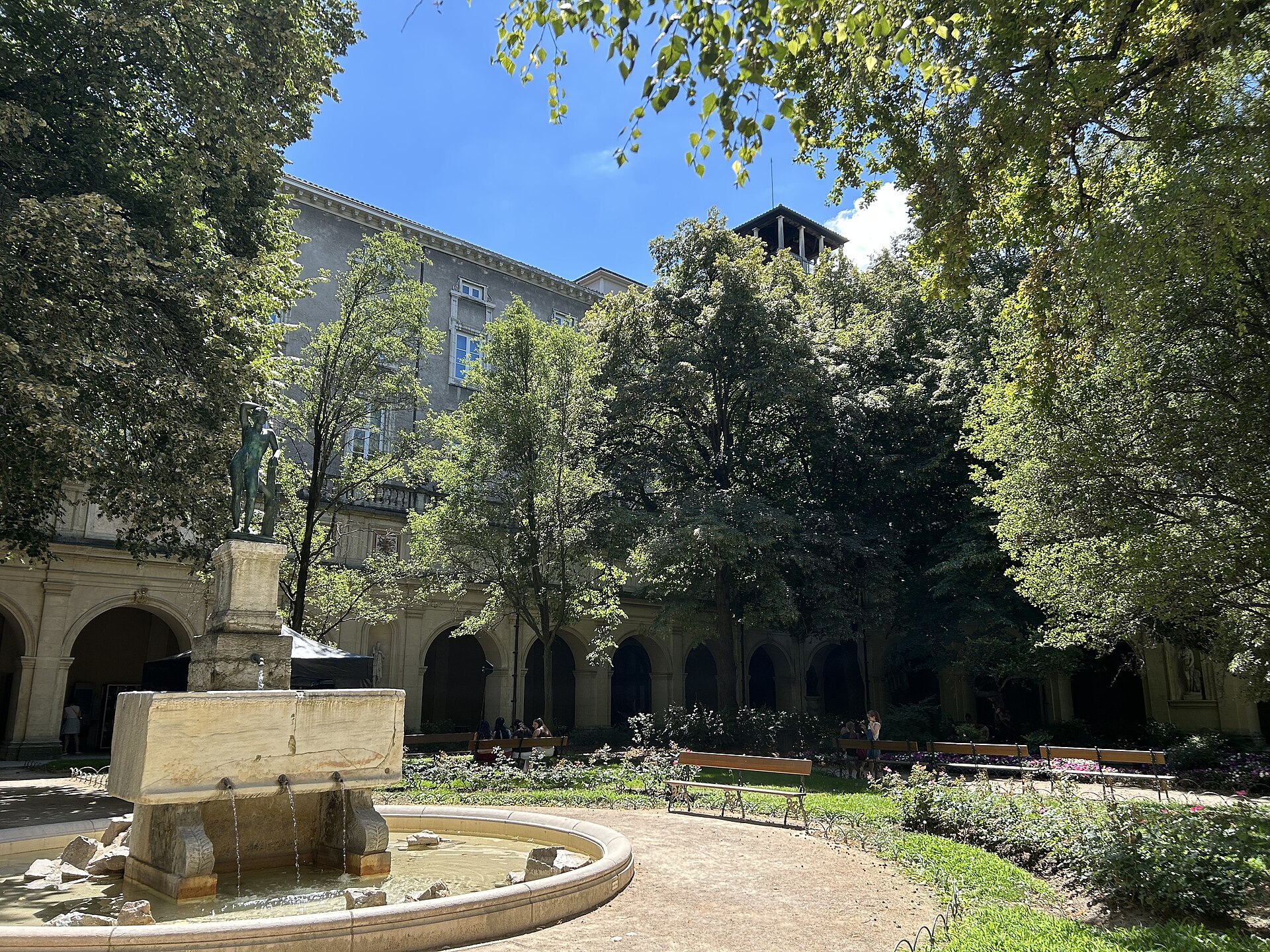
The museum's cloister garden is the clearest surviving trace of the building's life before it held any of this. Laid out inside the seventeenth-century cloister where Benedictine nuns once walked, it was opened to the public after the Revolution, first used to display fragments of Roman inscriptions under its arcades, then reworked from 1832 with a stone balustrade and plaster casts of the Parthenon frieze mounted above the arches, and reworked again by Hirsch between 1879 and 1883 with painted vault decoration by Louis Bardey. What visitors walk through today is effectively an open-air annex of the sculpture department: works by Rodin, Bourdelle, Chinard and a dozen lesser-known nineteenth-century sculptors stand among lime and birch trees around a circular fountain topped with an antique sarcophagus, a setting reviewers and visitors alike single out as the single best place in the building to sit down. It is a fitting close for a museum built almost entirely out of things given, deposited or transferred into it rather than commissioned for it - the abbey itself handed over rather than sold, the founding paintings sent down from the Louvre, the Egyptian temple gate excavated and shipped from Medamoud. Not every transfer in that history is settled. Francois Boucher's Light of the World, seized during the Second World War and deposited here by the Louvre in 1955 pending restitution, still carries its M.N.R. inventory number rather than an ordinary one: eighty years on, the museum's own label states plainly that it is holding the painting for legitimate owners who have not yet been found, a small, exact reminder that a collection this large was not assembled by acquisition alone.
What visitors say
Visitors consistently describe the museum as bigger and richer than its city-break reputation suggests, repeatedly invoking its billing as the largest fine-art collection in France outside the Louvre. The nineteenth-century and Impressionist rooms draw the most praise, alongside the quiet, sculpture-filled cloister garden used as a mid-visit break from the galleries. Recurring complaints centre on partial gallery closures on any given day, inconsistent labelling and lighting in some rooms, and signage that leans heavily on French with limited English translation.
What is praised, what is criticised
- Praised: the depth and quality of the nineteenth-century French and Impressionist painting rooms
- Praised: the quiet cloister garden with its sculptures, used as a break between galleries
- Praised: the value of the entry price against the size and quality of the collection
- Criticised: recurring, unpredictable partial closures of individual rooms for maintenance or reinstallation
- Criticised: gallery lighting and label placement that some visitors find inconsistent from room to room
- Criticised: wayfinding and object labels that lean heavily on French, with limited English provision
Ratings on other platforms
TripAdvisor: 4.4 from 2,328 ratings, read 13 August 2026
A platform average is a tertiary source: it moves, it is not audited, and we quote no visitor's words.
Questions about Museum of Fine Arts of Lyon
Where is Museum of Fine Arts of Lyon?
20 place des Terreaux, 69001 Lyon, France.
How much does it cost to visit?
Adult - permanent collections: EUR 8; Young adult 18-25 - permanent collections: EUR 4; Under 18 - permanent collections: free; Adult - temporary exhibition Musee sentimental: EUR 14; Young adult 18-25 - temporary exhibition Musee sentimental: EUR 8. As confirmed 15 September 2026.
When is it open?
Wednesday-Monday 10:00-18:00; Friday 10:30-18:00; Tuesday closed. Closed: Tuesday. 1 January. As confirmed 15 September 2026.
How do you get there?
Bus and metro: Stops named Terreaux serve the square directly: Tobie Robatel - Terreaux and La Feuillee - Hotel de Ville, both on the museum's own access page; Velo'v bike share: Four docking stations sit within the immediate square: Terreaux/Terme, Terreaux/Chenavard, Herriot/Pizay and Meissonnier, all listed by the museum itself; Restricted traffic zone: A limited-traffic zone (ZTL) covers the surrounding streets; the museum's access page links its own circulation map for drivers.
What should you see first?
Nave Nave Mahana (Paul Gauguin, 1896); Paysanne au chale vert (Peasant Woman with a Green Shawl) (Vincent van Gogh, 1885); La Lumiere du monde (The Light of the World) (Francois Boucher, 1750); L'Adoration des mages (Adoration of the Magi) (Peter Paul Rubens, circa 1617-1618); Porte d'un temple de Medamoud (Gateway of a temple at Medamoud) (Egyptian, reign of Ptolemy IV); L'Ombre (The Shade) (Auguste Rodin, 1902-1904).
What we could not confirm
- The exact closing date of the current Musee sentimental exhibition, and its post-exhibition admission price, were not stated on the pages read for this record and should be reconfirmed closer to any visit.
- The eventual disposition of Francois Boucher's La Lumiere du monde (M.N.R. 823) remains open; the museum's own label states it is still awaiting restitution to its legitimate owners.
Images
Sources
- 1Musee des Beaux-Arts de Lyon, official site, practical information page (hours, admission prices, ticketing rules), read 13 August 2026. mba-lyon.fr/fr/article/informations-pratiques
- 2Musee des Beaux-Arts de Lyon, official site, Coming to the museum page (address, phone, transport, accessibility, bag policy), read 13 August 2026. mba-lyon.fr/fr/informations-pratiques/venir-au-musee
- 3Musee des Beaux-Arts de Lyon, official site, museum history page (founding decree, 1803 Louvre deposit, nineteenth and twentieth-century building history, 1990-1998 renovation), read 13 August 2026. mba-lyon.fr/fr/historique/lhistoire-du-musee
- 4Musee des Beaux-Arts de Lyon, official site, The Royal Abbey page (1659-1685 construction, the abbey church, the cloister and refectory), read 13 August 2026. mba-lyon.fr/fr/historique/labbaye-royale
- 5Musee des Beaux-Arts de Lyon, official site, The museum today page (five-department structure and object counts), read 13 August 2026. mba-lyon.fr/fr/article/le-musee-aujourdhui
- 6Musee des Beaux-Arts de Lyon, official site, Paintings department page (selected works by period), read 13 August 2026. mba-lyon.fr/fr/type-de-collection/peintures
- 7Musee des Beaux-Arts de Lyon, official site, Antiquities department page (Egyptian, Near Eastern, Greek and Roman selections), read 13 August 2026. mba-lyon.fr/fr/type-de-collection/antiquites
- 8Musee des Beaux-Arts de Lyon, official site, Sculpture department page (medieval to twentieth-century selections), read 13 August 2026. mba-lyon.fr/fr/type-de-collection/sculptures
- 9Musee des Beaux-Arts de Lyon, official site, object record for La Lumiere du monde by Francois Boucher (M.N.R. 823 provenance note), read 13 August 2026. mba-lyon.fr/fr/fiche-oeuvre/la-lumiere-du-monde
- 10Musee des Beaux-Arts de Lyon, official site, The museum garden page (cloister and garden history, 1832 and 1879-1883 reworkings), read 13 August 2026. mba-lyon.fr/fr/article/le-jardin-du-musee
- 11Musee des Beaux-Arts de Lyon, official site, tea room and restaurant page (Les Eclaireurs, hours), read 13 August 2026. mba-lyon.fr/fr/article/restaurant-salon-the
- 12Musee des Beaux-Arts de Lyon, official site, bookshop and boutique page (GrandPalaisRmn concession), read 13 August 2026. mba-lyon.fr/fr/article/librairie-boutique
- 13Wikidata, item Q511, Museum of Fine Arts of Lyon (identity, French label, coordinates, country), read 13 August 2026. wikidata.org/wiki/Q511
- 14TripAdvisor, Musee des Beaux-Arts de Lyon attraction page, aggregate rating and review count, read 13 August 2026. tripadvisor.com/Attraction_Review-g187265-d197735-Reviews-Musee_des_Beaux_Arts_de_Lyon-Lyon_Rhone_Auvergne_Rhone_Alpes.html
- 15Musee des Beaux-Arts de Lyon, official site, Objets d'art department page (Islamic ceramics, Guimard bedroom, medieval enamels), read 13 August 2026. mba-lyon.fr/fr/type-de-collection/objets-dart
- 16Musee des Beaux-Arts de Lyon, official site, Coins and medals department page (numismatic collection, Treasure of the Terreaux), read 13 August 2026. mba-lyon.fr/fr/type-de-collection/monnaies-et-medailles