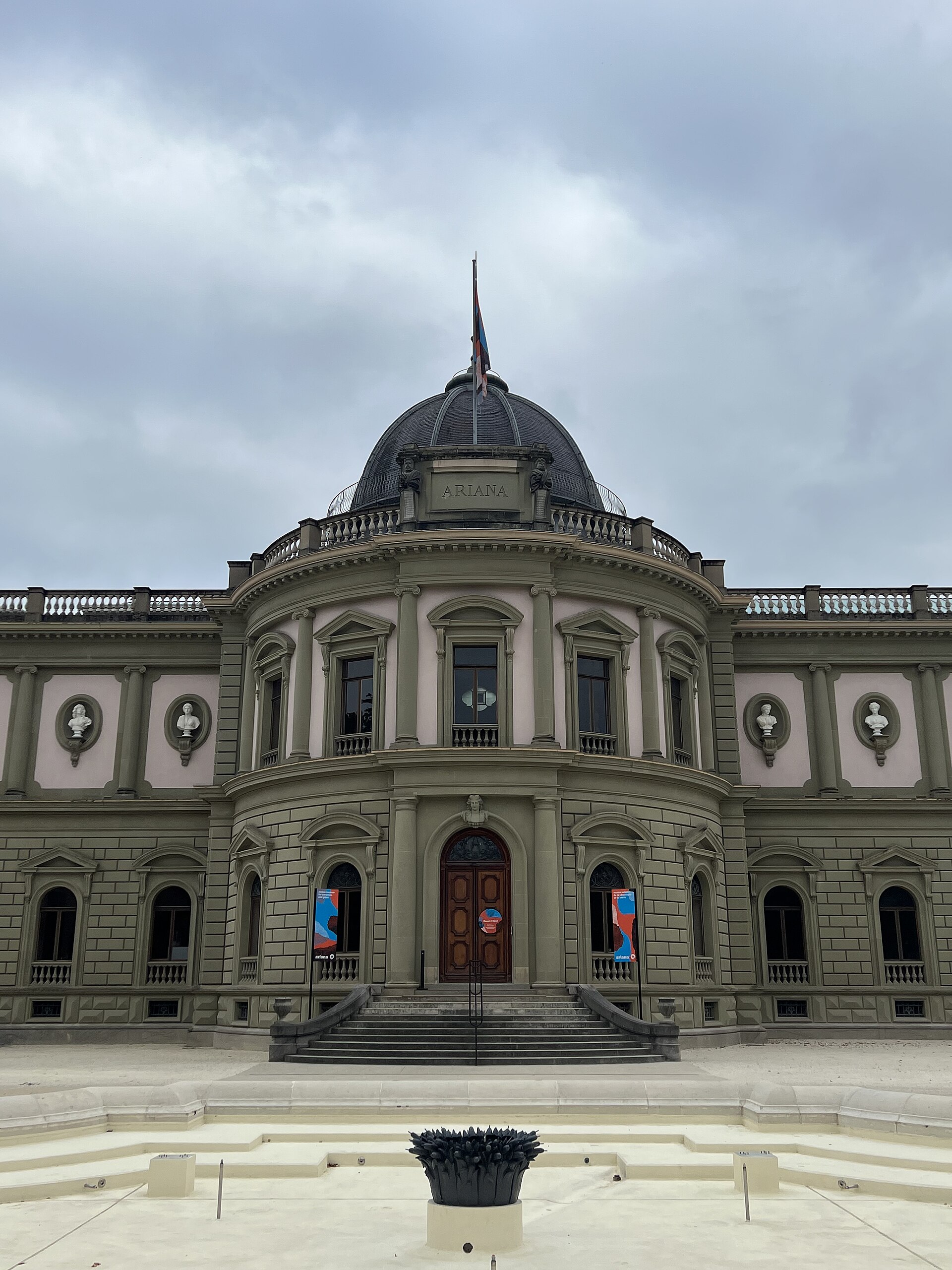
The facade and dome of the Musee Ariana in Geneva, with the name ARIANA on the drum, seen from the garden side. Photograph by Van Der Meulen Christofle, CC0.
Van Der Meulen Christofle (CC0)Musee Ariana
Museum · Musée Ariana · Founded 1884
Open, admission and hours confirmed 15 November 2026 · 10 sources
On this page 15 sections
ContentsClose
Strength lies in export porcelain from Jingdezhen, blue and white across Persia, China and Europe, Swiss ceramics and glass from the 14th century to the present, and a contemporary collection built up since the 1980s.
| Local name | Musée Ariana |
|---|---|
| Kind | Museum |
| Founded | 1884 |
| City and country |  Geneva, Switzerland |
| Address | Avenue de la Paix 10, 1202 Geneva, Switzerland |
| Website | musee-ariana.ch |
| Status | Open, confirmed |
| Record last verified |
Visiting
- Hours
- Tue-Sun10:00 to 17:00open all year
- Closed
- Monday.
- Admission
- Reference exhibition of the permanent collectionFreefree, open access
- Temporary exhibition, first floor room, full priceCHF 6reduced 4.00 CHF (AVS, unemployed, students, groups of 15 or more)
- Temporary exhibition, lower ground floor, full priceCHF 12reduced 9.00 CHF
- Temporary exhibitions, combined ticket for both spaces, full priceCHF 14reduced 10.00 CHF
- Up to age 25Freefree entry
Free entry: First Sunday of each month. Other Sundays: one paid entry brings one free entry. People with a disability and one companion- Do I need to book?
- No booking is stated for general entry; guided visits on request through the public service
- Address
- Avenue de la Paix 10, 1202 Geneva, Switzerland Map
- Website
- musee-ariana.ch
- Telephone
- +41 22 418 54 50
- [email protected]
Before you go how long, access, photography, bags, eating, shop
- How long to allow
- Several Tripadvisor visitors report one to two hours
- Access
- Twelve steps with handrail to the main door; step-free entry through a goods lift into the basement with a staff guide; all exhibition rooms reached by lift; tactile area; wheelchair and folding stools available at reception
- Bags
- Cloakroom in the basement
- Eating
- Il caffe, 11:00 to 16:45, Wednesday to Sunday
- Shop
- Boutique-librairie, 10:00 to 17:00
Prices and hours change. We take them from the institution's own pages and print the day we read them, and you can check the current position at the source we used. Confirm before you travel.
What is inside
Reference exhibition (ground floor and first floor)
The free permanent presentation of part of the collection of ceramics, glass and stained glass, from the 9th century to the present.
Temporary exhibition space, lower ground floor
Paid exhibitions that draw on reserve collections, offer new thematic readings or host contemporary artists. At the date of this entry it holds the Cirva glass exhibition.
Temporary exhibition room and free gallery, first floor
A paid exhibition room, currently Marie Ducate's Simultanes, and a second free-access exhibition gallery.
Entree en matieres tactile area and great hall
A touch zone with five vases in different clays and techniques to handle, the tools of the potter and glassmaker, and drawers of ceramic and glass decoration; reception is arranged around a column of the great hall.
Library, first floor
More than 10,000 books and about 100 periodical titles plus digital resources, open 10:00 to 12:00 and 13:00 to 17:00.
What to see first
Bowl, Mesopotamia, 9th century
Mesopotamian workshopFaience with high-fire blue, shown by the museum in its blue and white theme, and the oldest dated object the museum names on its collection page.3
Mug, Jingdezhen, about 1640
Jingdezhen workshop, ChinaBlue underglaze porcelain from the Fonds Laurent gift of 1993, an example of the Chinese export trade the museum uses to tell the East-West story.3
Dish, Jingdezhen, first quarter of the 17th century
Jingdezhen workshop, ChinaBlue underglaze porcelain from the Revilliod bequest of 1890, so a piece from the founder's own collecting.3
Table tray, Sinceny manufactory, about 1750
Manufacture de Sinceny, FranceFaience with high-fire polychrome decoration, the European faience answer to imported porcelain.3
Milk pot, Langenthal, 1958
Langenthal porcelain factory, model by Fernand RenferA Swiss industrial design from the factory whose later move to the Czech Republic the museum uses to tell the story of the industry under pressure.3
Sculpture, 1999
Maria Geszler (Hungary, born 1941)Porcelain with blue printed decoration under glaze, the museum's example of contemporary artists reworking blue and white.3
The building itself: dome, double colonnade and starred vault
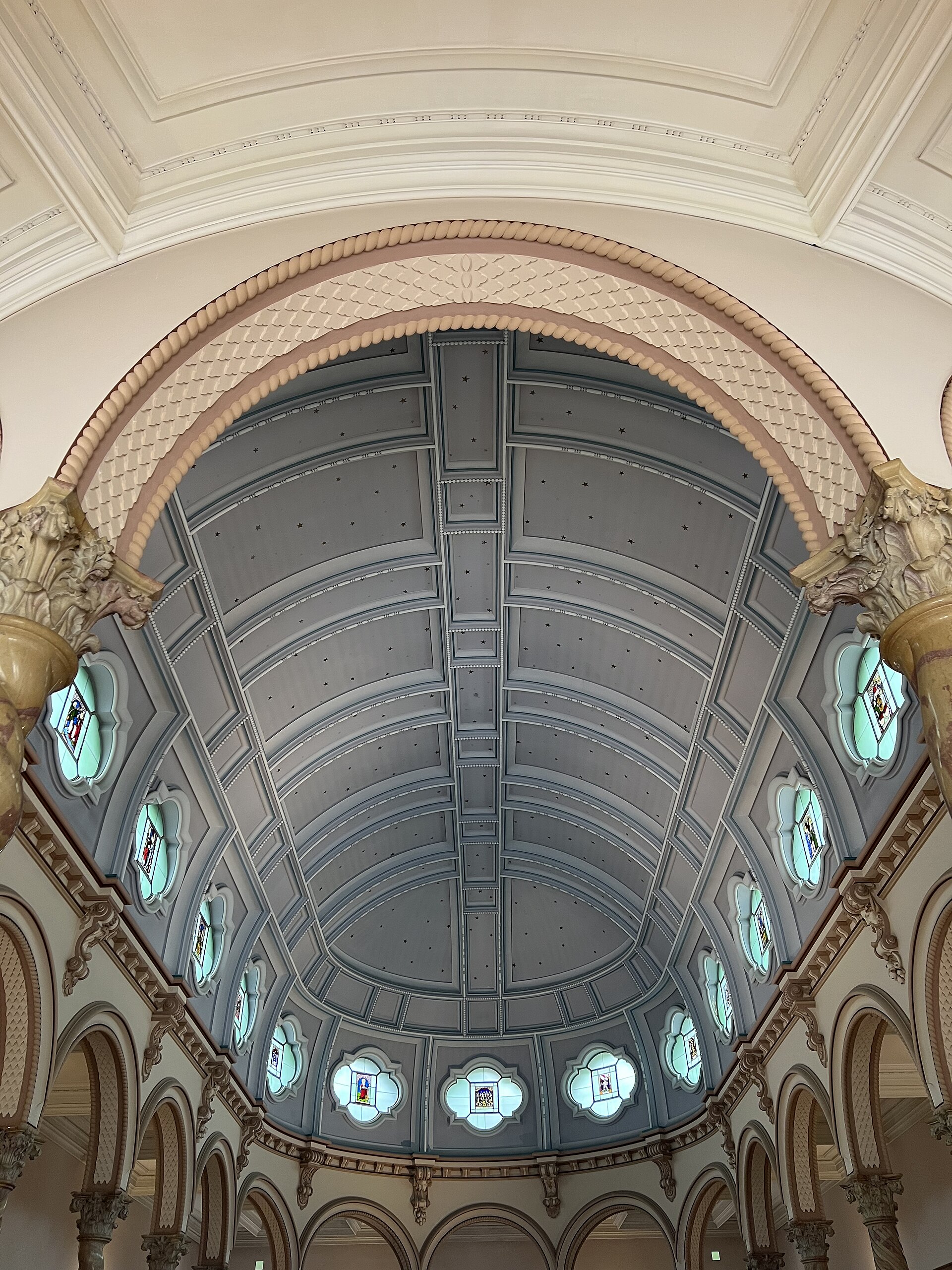
Emile Grobety and Jacques-Elysee Goss, with ceilings by Frederic DufauxThe museum presents the 1877 to 1884 building as one of its first treasures, with painted ceilings, facade sculpture and sphinxes at the original entrance.2
A palace for one man's collection
The Musee Ariana stands in a park on Avenue de la Paix in Geneva, a short walk from the Palais des Nations, and it is the one museum in the city given over entirely to ceramics, glass and stained glass. The museum describes its collections as covering 1,200 years, from the 9th century to the present, and as reaching Switzerland, Europe, the Near East and the Far East. The museum's own site gives the total as 28,688 works in 2025; other pages read for this entry give lower round numbers (about 25,000 on the Tripadvisor listing, about 20,000 in the body text of the English Wikipedia article), so the figure should be treated as a moving one.
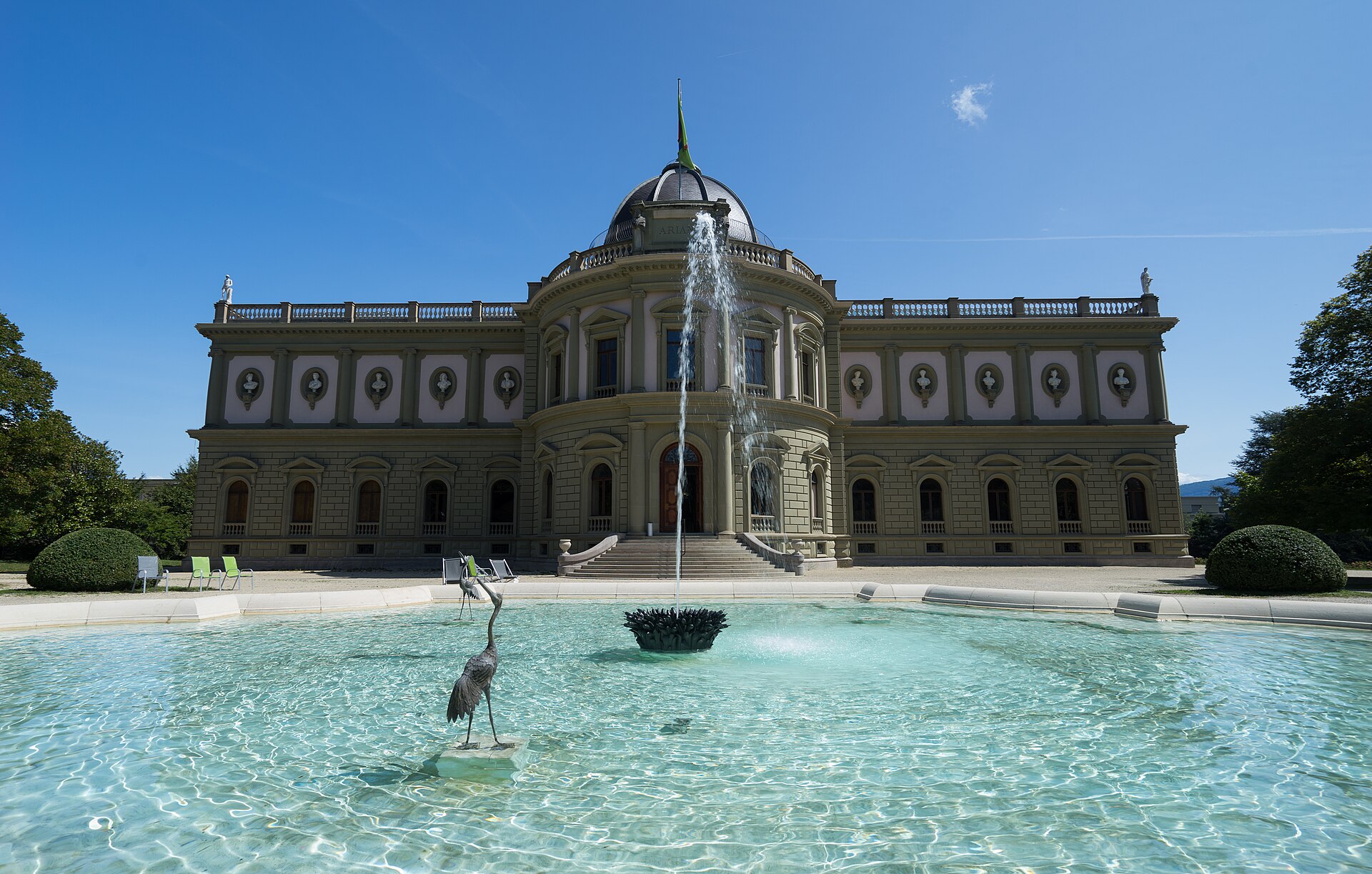
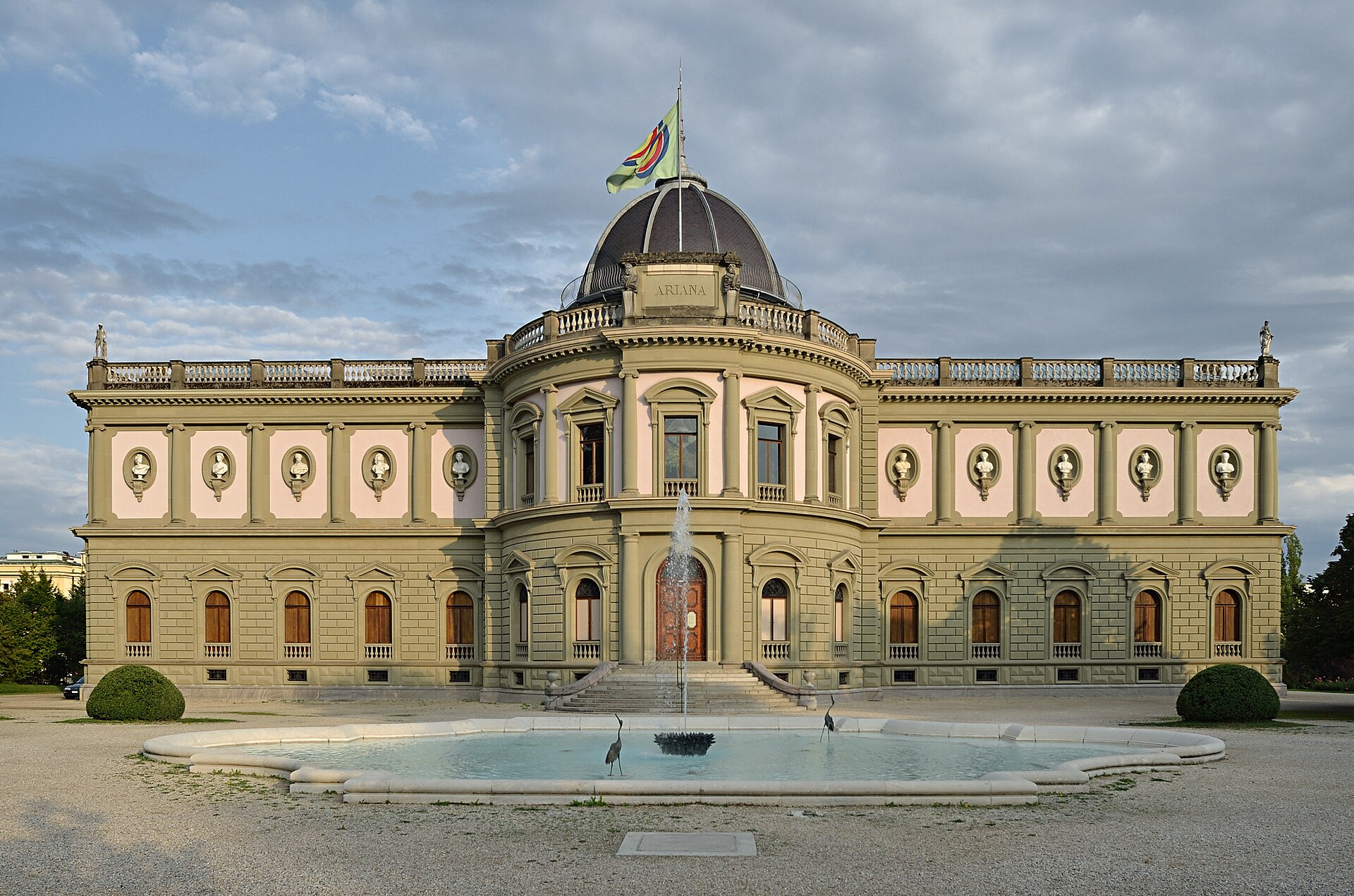
The building came first and the specialism came later. Gustave Revilliod, born in 1817 into a wealthy family of Savoyard origin settled in Geneva since the 16th century, spent his life travelling and buying across painting, coins, sculpture, prints, textiles, furniture, arms, books and silver as well as ceramics and glass. The museum's history page counts roughly 30,000 objects in the encyclopaedic collection he assembled. He chose a young architect, Emile Grobety, to build a museum for it in 1877, and Jacques-Elysee Goss later took over the site. The result, in the museum's words, sits halfway between an Italian palace and a basilica with Renaissance and baroque borrowings, which makes it an exception in Protestant Geneva.
The page names the features worth looking up for: the symmetry of the plan, the elliptical dome, the double colonnade of marbles and the starred vault, the painted ceilings by Frederic Dufaux and the statues and busts on the facades by Luigi Guglielmi, completed by Emile Leysalle. Sphinxes by Emile-Dominique Fasanino watch over the original entrance on the lake side. One thing was never built: the monumental staircase planned for the great hall.
From encyclopaedic museum to the arts of fire
Revilliod opened the museum to the public in 1884. A visitor of that time arrived by water, landed at the jetty on the Varembe estate, could take refreshment in a floating restaurant and walked up to the museum. The lodge and the large lobed pond with its fountain were finished in early 1889. Revilliod died in 1890 on a last journey to Cairo and left the museum, its collections, the Varembe estate, his town house in the old town and part of his fortune to the City of Geneva. His steward Godefroy Sidler became the first curator in 1891.
Two decisions of the following decades changed the place. In 1904 the Conservatoire and Botanical Garden moved onto the grounds, and between 1929 and 1937 the city ceded a large part of the Varembe land to the League of Nations for what became the Palais des Nations. The museum says openly that this ran against the donor's last wishes, and that visitors have entered from the rear of the building ever since, because the approach from the lake is no longer possible. In 1934 the Ariana was attached to the Museum of Art and History, lost its encyclopaedic role and became a specialist museum of the arts of fire. It regained its independence in 2010 and is now the fifth institution in the City of Geneva's museum network.
The International Academy of Ceramics, founded in 1952 by Henry J. Reynaud, set its seat in the museum. The museum records that Reynaud pushed acquisitions beyond European and historical work towards modern art ceramics, and that about 520 pieces in the collection came through the Academy.
What the collection is and how it is told
The museum rejects the shorthand that it is a museum of tableware, and its collection pages are organised as themes rather than a chronological march. The first theme is the journey of porcelain between East and West. The museum explains that Europe did not know the secret of porcelain until the early 18th century, so potters used substitutes such as slip-covered earthenware, faience and soft-paste porcelain to rival the imported white gold, and that merchants ordered shapes and decorations from Chinese makers and even supplied supposedly oriental motifs. A return voyage for the Dutch East India Company took at least 18 months when all went well.
The second theme is blue and white, which the museum calls the most common pairing in its collections. It runs from Persian siliceous wares through Delft faience and Meissen porcelain to English printed fine earthenware and contemporary artists who rework it. A third theme asks whether Swiss culture has an identity, and answers through Winterthur stove tiles and faience, slip-covered redware from the Bernese countryside, enamelled bottles from Fluhli, Nyon porcelain, Carouge fine earthenware and Zurich porcelain figures.
The fourth theme follows industry. The museum points to the Langenthal porcelain factory, founded in 1906, and the Saint-Prex glassworks, founded in 1911, as emblems of the pressure on table arts in the second half of the 20th century. It records that Langenthal production moved to the Czech Republic and that Saint-Prex gave up artistic production for industrial jars and bottles. The last theme is contemporary work. From the 1980s the museum committed to supporting contemporary ceramics and glass, with exhibitions, publications and acquisitions, and it notes that Switzerland has three professional training centres in the field, in Geneva, Vevey and Berne-Bienne.
Glass and stained glass
The glass section of the collection page describes the craft from the maker's side: a mix of sand, soda and lime heated in a crucible and blown or shaped while incandescent. It lists a range running from lead-framed church glass to engraved and filigree work from Murano, painted enamel glass from Fluhli in canton Lucerne, layered coloured glass of the Art Nouveau masters and contemporary glass that reinterprets every technique. The page also points to a feature on the glassmakers Hubert Crevoisier and Matteo Gonet.
Glass is also the subject of the main temporary exhibition on view at the date of this entry, Le verre, au-dela de la matiere, which runs from 24 April 2026 to 3 January 2027 in the lower ground floor space. It shows the collection of the Cirva, the international centre for research on glass and the visual arts founded in 1983 and based in Marseille since 1986, where artists from around the world work with specialist technicians, chemists and engineers. The museum states that the show was conceived and produced by the Museum of Modern and Contemporary Art of Saint-Etienne Metropole in partnership with the Cirva.
What is on show now and what comes next
On the first floor, the exhibition Simultanes by Marie Ducate runs from 20 February to 29 November 2026. Ducate, born in Lille in 1954 and working in Marseille, began as a painter and works across ceramics, glass, drawing and textile. The museum describes a theatre of objects in ceramic, tracing paper, watercolour, textile and glass, at the crossing of pop culture and art history, curated by Claire FitzGerald of the Ariana.
The museum's home page also lists a Lindsey Mendick exhibition, The Keeper of the Heads, from 12 February 2027 to 9 January 2028, described as her first solo show abroad and an exploration of the motif of decapitation. A programme of guided tours, workshops for small children and a conference weekend on glass in October 2026 sits around these shows. As a rule, readers should check the live programme before travelling, since the dates above were read on 15 November 2026.
Provenance research and the museum's own record
This publication treats a museum as a party to provenance, and the Ariana publishes more than most on that front. Its collection page states that, with financial help from the Swiss Confederation, it studied the provenance of its holdings in connection with Nazi-era spoliation and improved its acceptance process for new acquisitions. It publishes a general report with five annexes and six studies on objects whose 1933 to 1945 history had gaps. The museum also argues that ceramics and glass are only marginally touched by the question of looted art, because pieces such as Meissen figures are often multiples that can be identified only by decoration, which is impossible without photographs.
A second line of research concerns cultural property from colonial contexts. Under its service agreement with the Federal Office of Culture, the museum reviewed the extra-European pieces acquired before the last quarter of the 20th century, which it puts at one fifth of its collection, and identified 160 Swiss and international individuals who enriched the collection. It states that some names in the reports are anonymised under Geneva's data protection law. What the reports conclude about particular objects, and whether any claim has been made on the Ariana, was not established from the pages read for this entry and is left as an open question below.
Planning a visit
The museum is open all year from Tuesday to Sunday, 10:00 to 17:00, and closed on Monday. The reference exhibition of the permanent collection is free and open access. Temporary exhibitions are charged by space. The shop is open 10:00 to 17:00, the library 10:00 to 12:00 and 13:00 to 17:00, and the cafe Il caffe 11:00 to 16:45 from Wednesday to Sunday. Entry is free up to age 25 and on the first Sunday of each month, and on other Sundays one paid ticket brings one free ticket.
Access is by twelve steps with a handrail to an automatic door, or, for visitors with reduced mobility, by a concrete path to a goods lift on the right of the building that opens in the basement, where a staff member guides visitors up. All exhibition rooms are reached by lift and a tactile area called Entree en matieres lets visitors handle vases and potters' and glassmakers' tools. Visitors to the Tripadvisor listing, read on 15 November 2026, mention a cafe on the first floor, the view from the balconies and the nearby United Nations district, and several say they spent between one and two hours.
What visitors say
On the Tripadvisor page read on 15 November 2026 the listing stands at 4.3 out of 5 and the displayed visitor comments dwell on three things: the building and its marble hall, a free permanent collection, and the lack of crowds. The reasons given for liking it are the setting in the park, the balcony view and an easy one to two hour visit combined with the nearby United Nations district. Where reviewers qualify their praise, the point is that only the temporary shows are charged and that some are small.
What is praised, what is criticised
- Praised: The building and the marble entrance hall
- Praised: Free entry to the main collection rooms
- Praised: The park setting and views from the balconies
- Praised: Not crowded, easy to combine with a visit to the UN district
- Criticised: Only the temporary exhibitions are paid and some visitors call them small
- Criticised: The museum itself notes that the original lake-side approach was lost and that step-free access runs through a basement goods lift
Ratings on other platforms
Tripadvisor: 4.3 from 303 ratings, read 15 November 2026
A platform average is a tertiary source: it moves, it is not audited, and we quote no visitor's words.
Questions about Musee Ariana
Where is Musee Ariana?
Avenue de la Paix 10, 1202 Geneva, Switzerland.
How much does it cost to visit?
Reference exhibition of the permanent collection: free; Temporary exhibition, first floor room, full price: CHF 6; Temporary exhibition, lower ground floor, full price: CHF 12; Temporary exhibitions, combined ticket for both spaces, full price: CHF 14; Up to age 25: free. As confirmed 15 November 2026.
When is it open?
Tue-Sun 10:00-17:00. Closed: Monday. As confirmed 15 November 2026.
What should you see first?
Bowl, Mesopotamia, 9th century (Mesopotamian workshop); Mug, Jingdezhen, about 1640 (Jingdezhen workshop, China); Dish, Jingdezhen, first quarter of the 17th century (Jingdezhen workshop, China); Table tray, Sinceny manufactory, about 1750 (Manufacture de Sinceny, France); Milk pot, Langenthal, 1958 (Langenthal porcelain factory, model by Fernand Renfer); Sculpture, 1999 (Maria Geszler (Hungary, born 1941)).
What we could not confirm
- Collection totals differ by source: 28,688 works (museum, 2025), more than 25,000 (Tripadvisor listing text), about 20,000 (English Wikipedia body text).
- The museum publishes provenance reports on Nazi-era spoliation and on colonial contexts; what they conclude for individual objects and whether any restitution claim has been lodged was not established from the pages read.
- The museum says the Palais des Nations land cession ran against the donor's last wishes; no source read says whether the museum or the city has addressed this further.
Images
Sources
- 1Musee Ariana, Informations pratiques (hours, prices, access, address), read 2026-11-15 musee-ariana.ch/infos-pratiques
- 2Musee Ariana, Histoire, read 2026-11-15 musee-ariana.ch/histoire
- 3Musee Ariana, Nos collections, read 2026-11-15 musee-ariana.ch/nos-collections
- 4Musee Ariana, Contacts, read 2026-11-15 musee-ariana.ch/contacts
- 5Musee Ariana, home page (exhibitions and events), read 2026-11-15 musee-ariana.ch/
- 6Musee Ariana, Le verre, au-dela de la matiere, read 2026-11-15 musee-ariana.ch/expositions/CIRVA-verre
- 7Musee Ariana, Simultanes (Marie Ducate), read 2026-11-15 musee-ariana.ch/expositions/simultanes
- 8Tripadvisor listing, Musee Ariana, 4.3 from 303 reviews, read 2026-11-15 () tripadvisor.com/Attraction_Review-g188057-d195990-Reviews-Musee_Ariana-Geneva.html
- 9Wikipedia, Ariana Museum, read 2026-11-15 (, identity facts only) en.wikipedia.org/wiki/Ariana_Museum
- 10Wikimedia Commons file metadata for the four plates (licence and author), read 2026-11-15 commons.wikimedia.org/wiki/Category:Ariana_museum