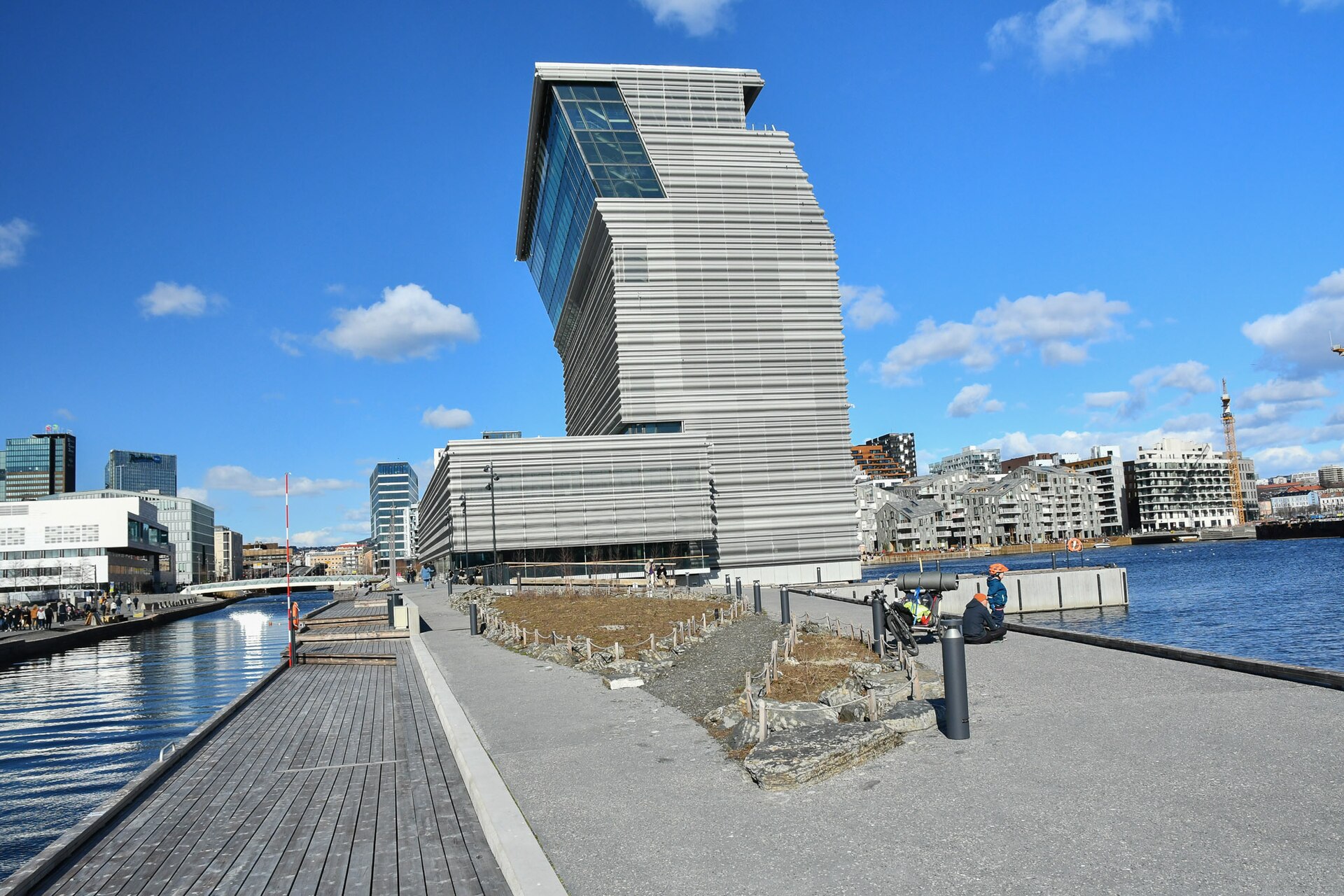
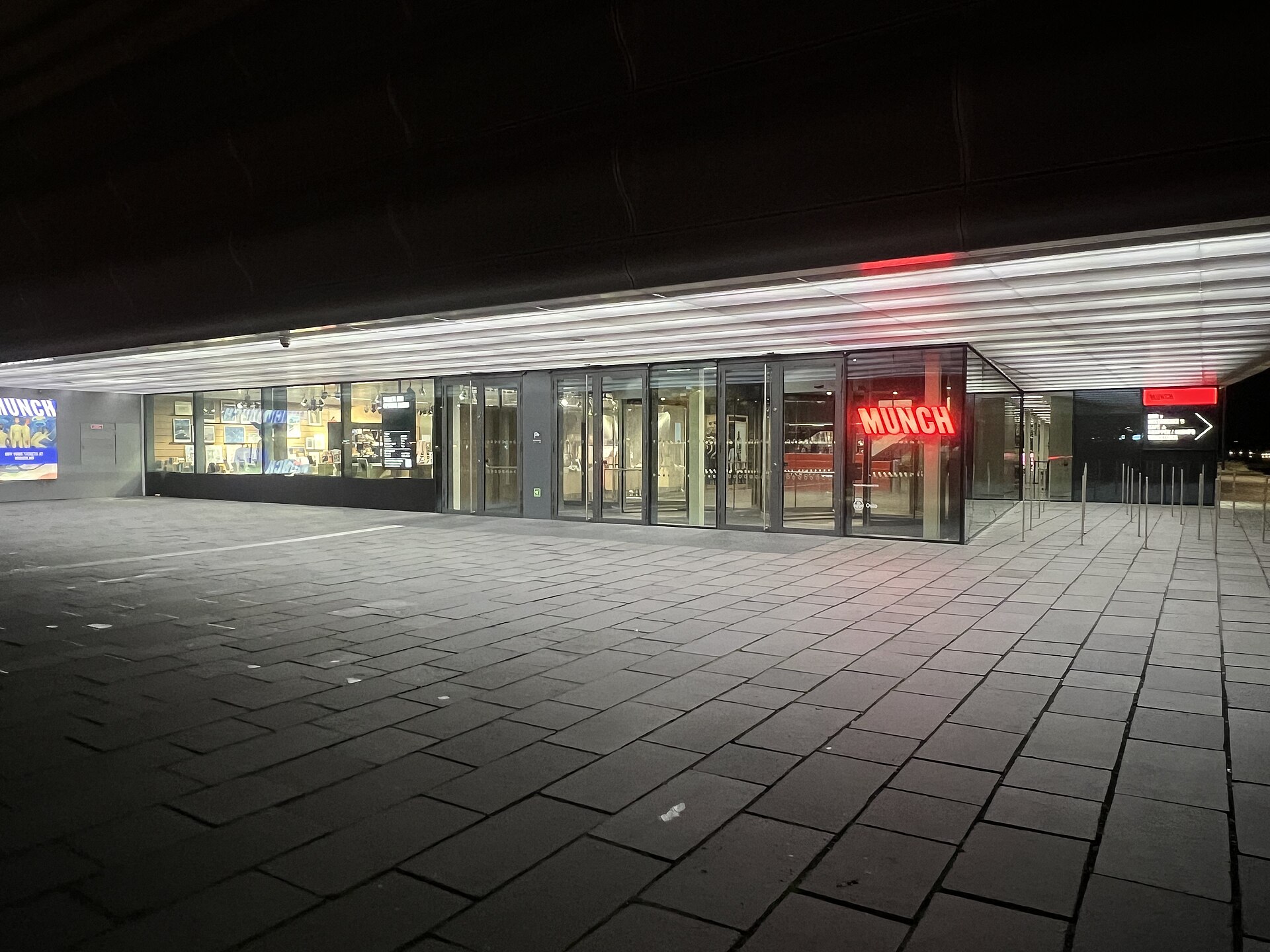
The MUNCH museum building in Bjorvika, Oslo, seen from the south with the Oslo Opera House visible alongside it. This is the current building the museum has occupied since October 2021, not the former Toyen location.
Helge Hoifoldt, CC BY-SA 4.0 · Photograph by Helge HøifødtMUNCH
Museum · Munchmuseet · Founded 1963
Open, admission and hours confirmed 8 September 2026 · 17 sources
On this page 16 sections
ContentsClose
MUNCH holds close to 28,000 artworks and more than 42,000 museum objects in total, described by multiple sources as the largest collection of work by a single artist held by any museum in the world. It includes two of the four surviving painted or pastel versions of The Scream (the other two are split between Norway's National Museum and a private collection), the 1910 Madonna, and the twelve Freia chocolate factory canvases - a body of decorative work with no real parallel elsewhere in Munch's output. Depth, not just fame, is the real strength: because almost the entire estate came to the museum directly from the artist rather than through the art market, MUNCH holds working states, prints pulled from the same plate at different stages, and material culture (photographs, letters, tools) that a museum assembling a Munch collection by purchase never could.
| Local name | Munchmuseet |
|---|---|
| Kind | Museum |
| Founded | Established 29 May 1963, on what would have been Edvard Munch's 100th birthday, to hold the collection he bequeathed to the City of Oslo on his death in 1944; construction of the original museum was financed from the profits of Oslo's municipal cinemas. That first building opened in the Toyen district in 1963 and was expanded in 1994. The museum, rebranded MUNCH, moved into an entirely new building on the Bjorvika waterfront, which opened to the public on 22 October 2021. |
| City and country |  Oslo, Norway Oslo, Norway |
| Address | Edvard Munchs plass 1, 0194 Oslo, Norway |
| Website | munch.no |
| Status | Open, confirmed |
| Record last verified |
Visiting
- Hours
- Monday-Tuesday10:00 to 18:00
- Wednesday-Saturday10:00 to 21:00
- Sunday10:00 to 18:00
- Closed
- 1 May (Labour Day) - the only day of the year the museum is fully closed. Reduced hours (10:00-18:00 or 10:00-14:00) apply on a published list of 2026 dates including 1 January, 2-4 April, 14 May, 23 May, 24 and 31 December, and 25-26 December.
- Admission
- Adult, 10:00-18:00 entryNOK 280
- Adult, 18:00-21:00 entryNOK 200Only on the extended-hours evenings, Wednesday to Saturday
- Under 25NOK 100
- Children and young people 0-17FreeFree
- Members plus one guestFreeFree
Free entry: Wednesdays 18:00-21:00, free entry - the museum's own ticket page states this does not apply in July and August- Tickets
- munch.no/en/buy-tickets The museum's own ticket page.
- Do I need to book?
- Not strictly required, but the museum recommends pre-booking a timed entry slot to guarantee admission at a preferred date and time; re-entry after leaving the exhibition floors cannot be guaranteed.
- Address
- Edvard Munchs plass 1, 0194 Oslo, Norway MapTram Lines 13 and 19 stop at Bjorvika, about 250 metres from the museum entrance.
Bus Bus lines including 20, 34, 54, 300 and 505 serve stops near Bjorvika, an 8 to 10 minute walk from the museum.
Ferry Munch Bjorvika ferry stop is about 250 metres from the museum.
Walking About 10 to 12 minutes on flat ground from Oslo Central Station (train, Metro, tram, bus). - Website
- munch.no
- Telephone
- +47 23 49 35 00
- [email protected]
Before you go how long, access, photography, bags, eating, shop
- How long to allow
- The museum's own listing suggests 1-2 hours, but repeat visitor accounts on Tripadvisor consistently say this is not enough for the 13 floors of galleries; two to three hours is closer to what regular visitors report needing to see the permanent collection and one temporary show.
- Access
- Wheelchair accessible throughout, with the museum asking that wheelchair users be given priority in the lifts. Further detail is published on a dedicated accessibility page.
- Photography
- Photography is permitted in the galleries; flash photography is not allowed inside the exhibition halls.
- Bags
- Backpacks, large suitcases and bags larger than 40 x 35 x 10 cm are not permitted in the exhibition areas; lobby lockers up to 55 x 40 x 23 cm are provided for hand luggage.
- Eating
- MUNCH kafe on the ground floor; a separate restaurant and Skybar occupy the 12th and 13th floors, run as concessions with their own booking contacts.
- Shop
- A museum shop in the lobby, described by the museum as a destination for design and art-book buyers in its own right, not only a checkout on the way out.
Prices and hours change. We take them from the institution's own pages and print the day we read them, and you can check the current position at the source we used. Confirm before you travel.
What is inside
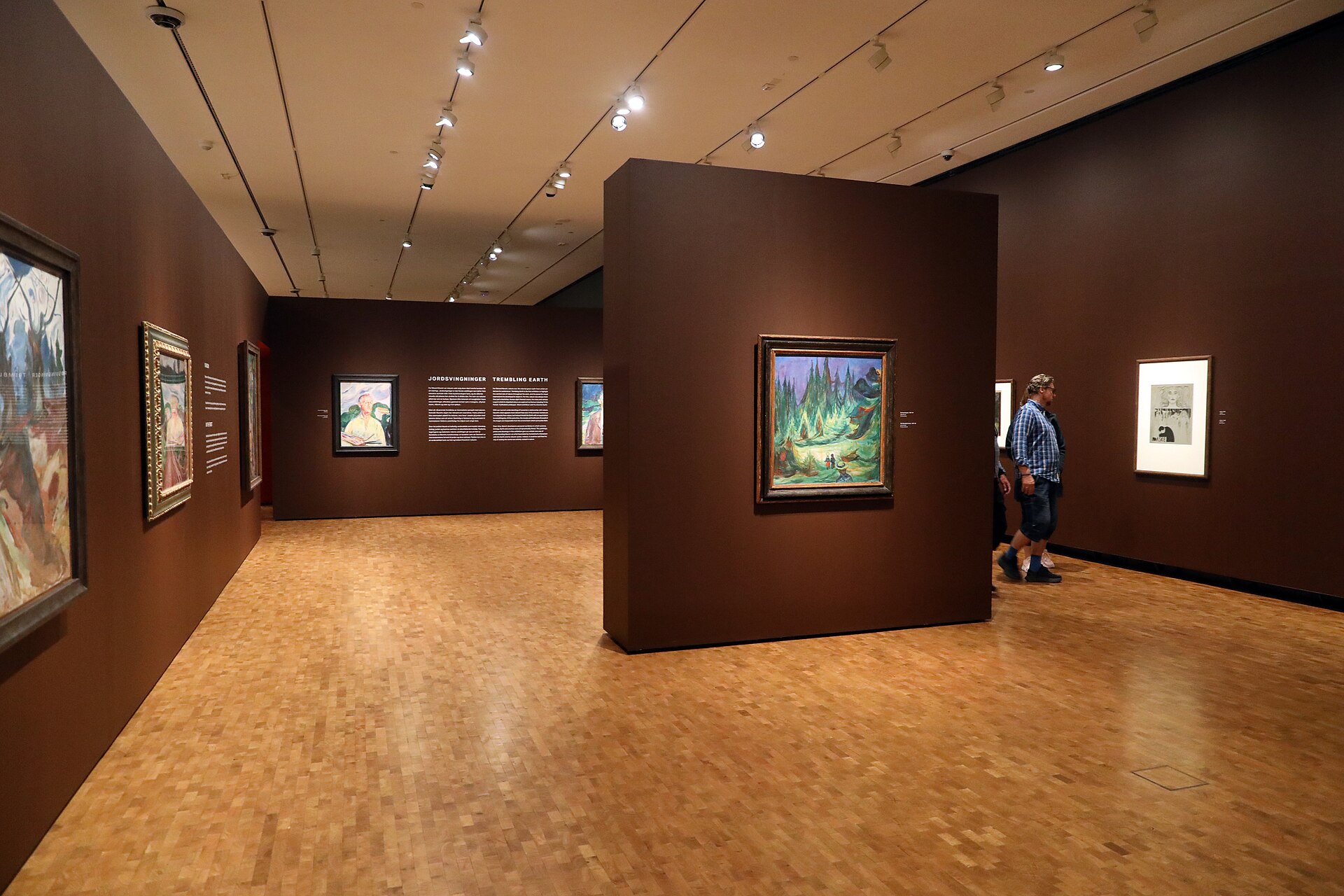
Edvard Munch Infinite - floor 4
The core of the permanent collection: a chronological and thematic journey through Munch's best-known paintings, including versions of The Scream and Madonna, The Dance of Life and Vampire. This is the floor most visitors mean when they say they have seen the museum.
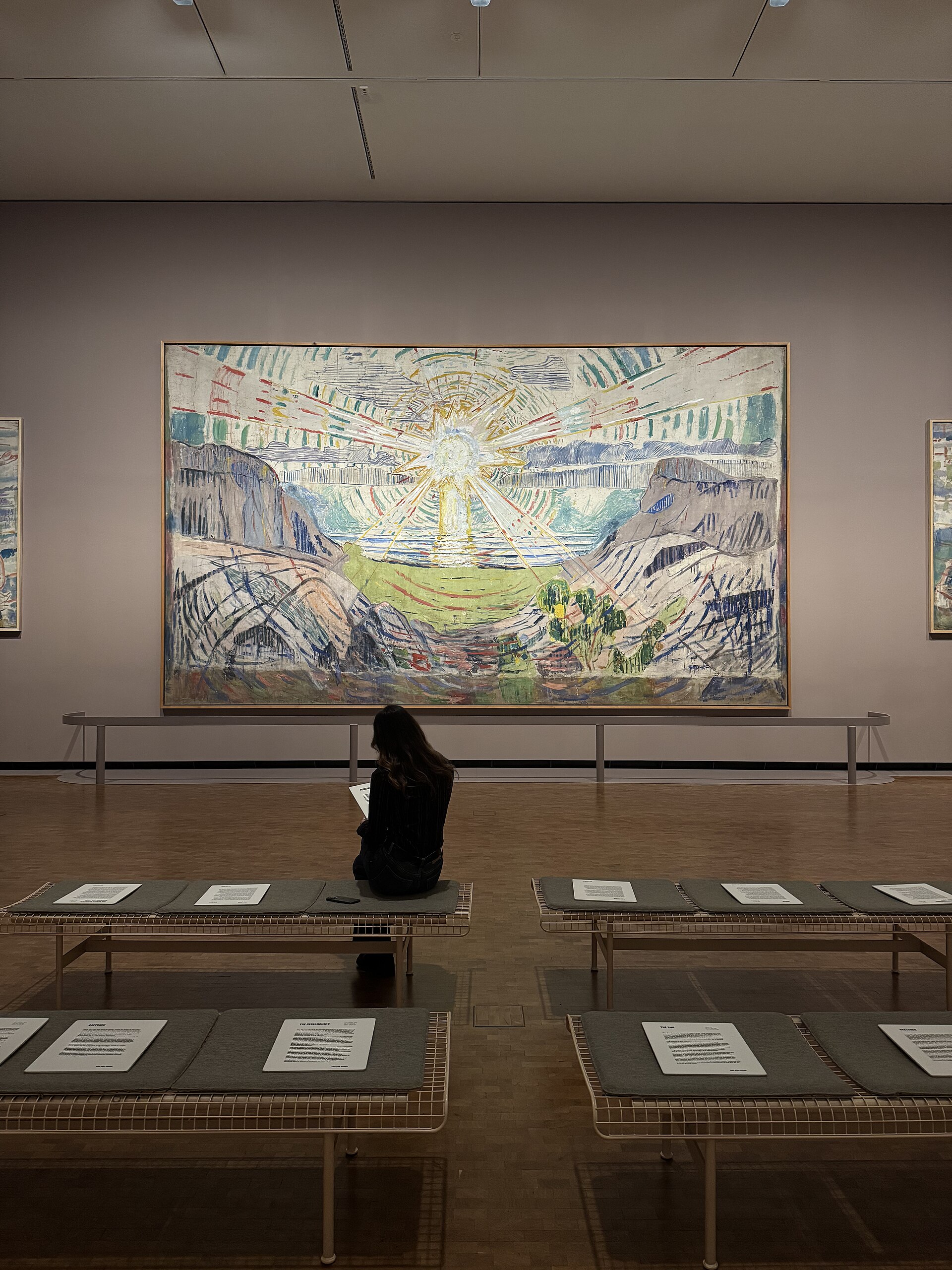
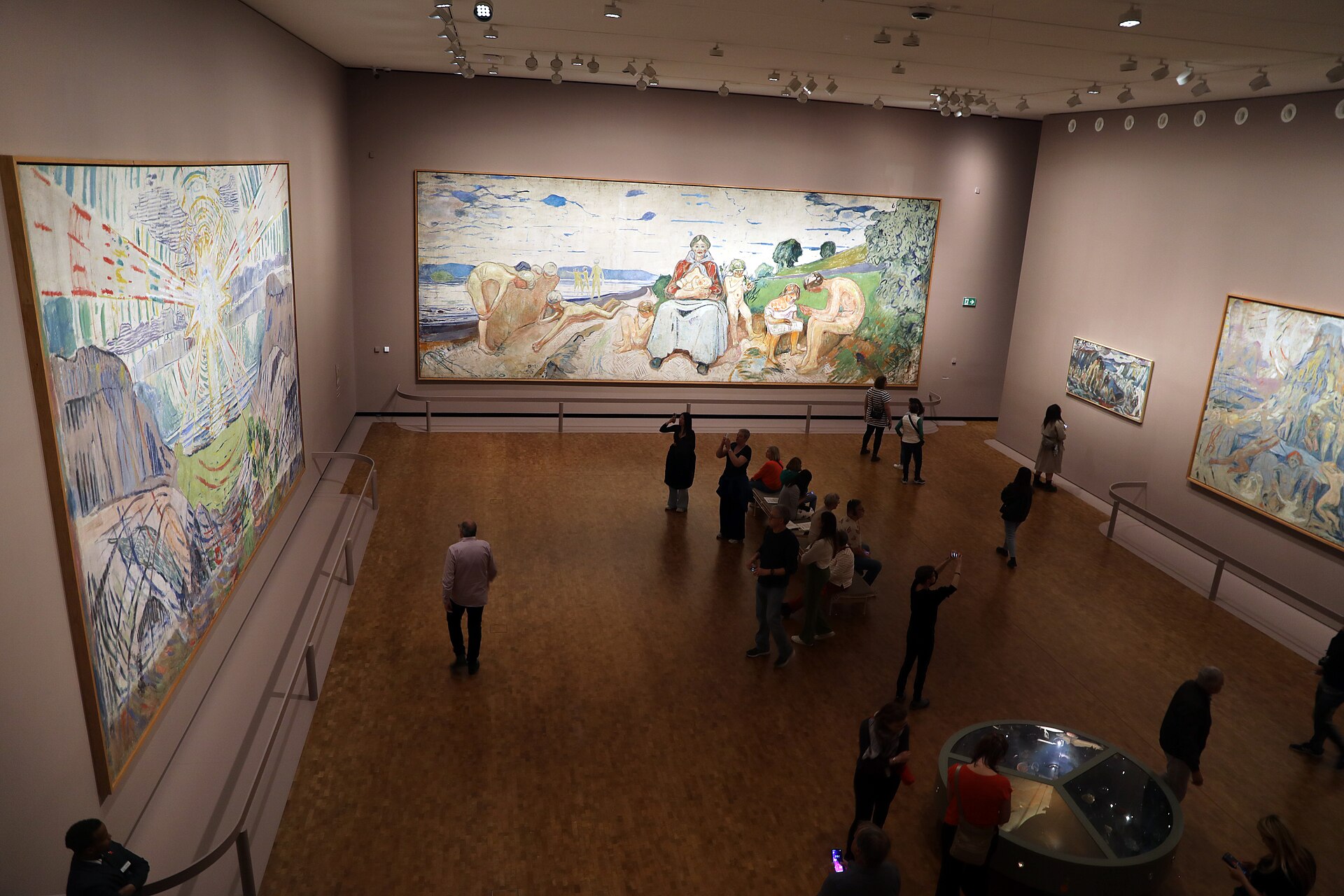
Photograph by Hanne Evensen · CC BY 4.0 Edvard Munch Monumental - floor 6
A dedicated double-height gallery built specifically for Munch's largest canvases, including work related to his monumental Aula murals for the University of Oslo, among them The Sun. The scale of the room is part of the display: paintings made for public, civic spaces are finally shown at the size Munch intended.
Up Close and Shadows - floor 7
Two linked displays: Up Close shows Munch's woodcut and print collection at close range, tracing his printmaking technique; Shadows is the museum's own description as an interactive experience built around Munch's imagery.
Edvard Munch and the Chocolate Factory - floor 9
Twelve large canvases Munch painted from 1922 for the women's canteen of Oslo's Freia chocolate factory - the first decorative scheme of its kind commissioned specifically for a factory interior. The Freia room itself was given protected-heritage status by Norwegian authorities in 2015, citing Munch's work explicitly; this floor puts the canvases, on themes of labour and the factory's largely female workforce, in front of the public.
Edvard Munch Horizons - floor 11
Munch's work set against the wider artistic landscape he worked within and reacted to, rather than shown in isolation as a single-artist canon.
Research library and conservation - floor 3
The museum's own documentation of the collection, including archival material about Munch, alongside public workshop space. The museum's collection materials, described by MUNCH itself as a fragile inheritance nearing a century old, are conserved on this floor.
Skybar and restaurant - floors 12-13
A restaurant with a west-facing roof terrace on floor 12, and a Skybar on floor 13 reached by a separate glass elevator, both used as much for the panoramic view over the Oslofjord and the Oslo Opera House as for the menu.
What to see first
The Scream
Edvard Munch, 1910The museum's own tempera-on-cardboard painted version of Munch's best-known image. This is the specific canvas, along with Madonna, that was cut from the wall and stolen in an armed daylight robbery in August 2004; it was recovered in August 2006 with moisture damage to one corner, restored, and returned to display in 2008. Distinct from the earlier 1893 oil-tempera-pastel version held by Norway's National Museum and a 1895 pastel in a private collection sold at auction in 2012.10
The Scream
Edvard Munch, 1893MUNCH's pastel-and-crayon version, among the earliest surviving executions of the composition Munch worked and reworked across mediums for the rest of his career.10
Madonna
Edvard Munch, 1894-95Stolen alongside the 1910 Scream in the 2004 robbery and recovered with it in 2006; a central image of the Frieze of Life series Munch built around love, anxiety and death.9
The Sick Child
Edvard Munch, 1885-86Painted from Munch's memory of his sister Sophie's death from tuberculosis when he was 13; widely credited as the picture where Munch broke from naturalism toward the psychologically charged style that defines his later work.9
Vampire (Love and Pain)
Edvard Munch, 1893-94One of the Frieze of Life's most reproduced and most argued-over images; the popular title was given by a critic, not Munch, who called the picture Love and Pain.9
The Dance of Life
Edvard Munch, 1899-1900A large horizontal canvas staging three women against a night beach as stages of a woman's life; shown at the scale Munch intended in the Monumental gallery on floor 6.9
Puberty
Edvard Munch, 1894-95A seated nude adolescent girl with a looming shadow behind her; one of the most direct images in the Frieze of Life of anxiety attached to the body.9
The Freia Frieze (12 canvases)
Edvard Munch, 1922Painted on commission for the women's canteen of the Freia chocolate factory, the first decorative cycle of its kind made specifically for a factory interior; the room they hung in for a century was given protected-heritage status in 2015 citing Munch's work by name.15
Exhibitions on now
- Opening soon4 Dec 2026 to 18 Apr 2027Confirmed , 7 weeks ago
A single-artist museum built to fit one man's gift
Edvard Munch died in Oslo in January 1944 and left almost everything still in his possession - some 1,100 paintings, more than 4,500 drawings and around 18,000 prints, along with sculptures, photographs, letters and printing plates - to the City of Oslo. The scale of that bequest is the reason MUNCH exists at all: no dealer, heir or auction ever dispersed the bulk of his output, because Munch himself never let it go. The city opened a museum to hold it on 29 May 1963, chosen because it was what would have been Munch's hundredth birthday, and paid for the building out of the profits of its own municipal cinemas.
That original museum stood in Toyen, in Oslo's Gamle Oslo borough, designed by the architects Einar Myklebust and Gunnar Fougner. It was expanded once, in 1994, for the fiftieth anniversary of Munch's death, and even then was already considered too small for a collection that kept growing as further gifts and transfers arrived. The pressure became sharper still after 1968, when the city separately acquired Peter Ludwig's contemporary art collection and needed exhibition space of a different kind altogether across town. A single-artist museum housing tens of thousands of objects in a building designed for a fraction of that number was, by the 2000s, not a sustainable arrangement.
The decade it took to leave Toyen
Oslo opened an architectural competition in 2008 for a new museum on the Bjorvika waterfront, next to the new Opera House, and the Madrid-based Estudio Herreros, led by Juan Herreros, won it in 2009. The project then spent several years not happening. Before Oslo's 2011 municipal election the Progress Party withdrew its support over cost, and after the election the City Council voted in December 2011 to terminate the project outright, weighing cheaper alternatives such as renovating the Toyen building in place or merging the collection into the National Gallery.
The reversal came in May 2013, when the City Council approved the Bjorvika site after all. Construction began in September 2015. In the summer of 2021 the entire collection - some 28,000 artworks, including single canvases large enough to need transport by ship through the city - was moved from Toyen to Bjorvika, and the last Toyen exhibition closed on 1 October of that year. King Harald V opened the new museum on 22 October 2021, thirteen years after the competition that produced it and roughly sixty years after the Toyen building the new one replaced.
A building critics have not stopped arguing about
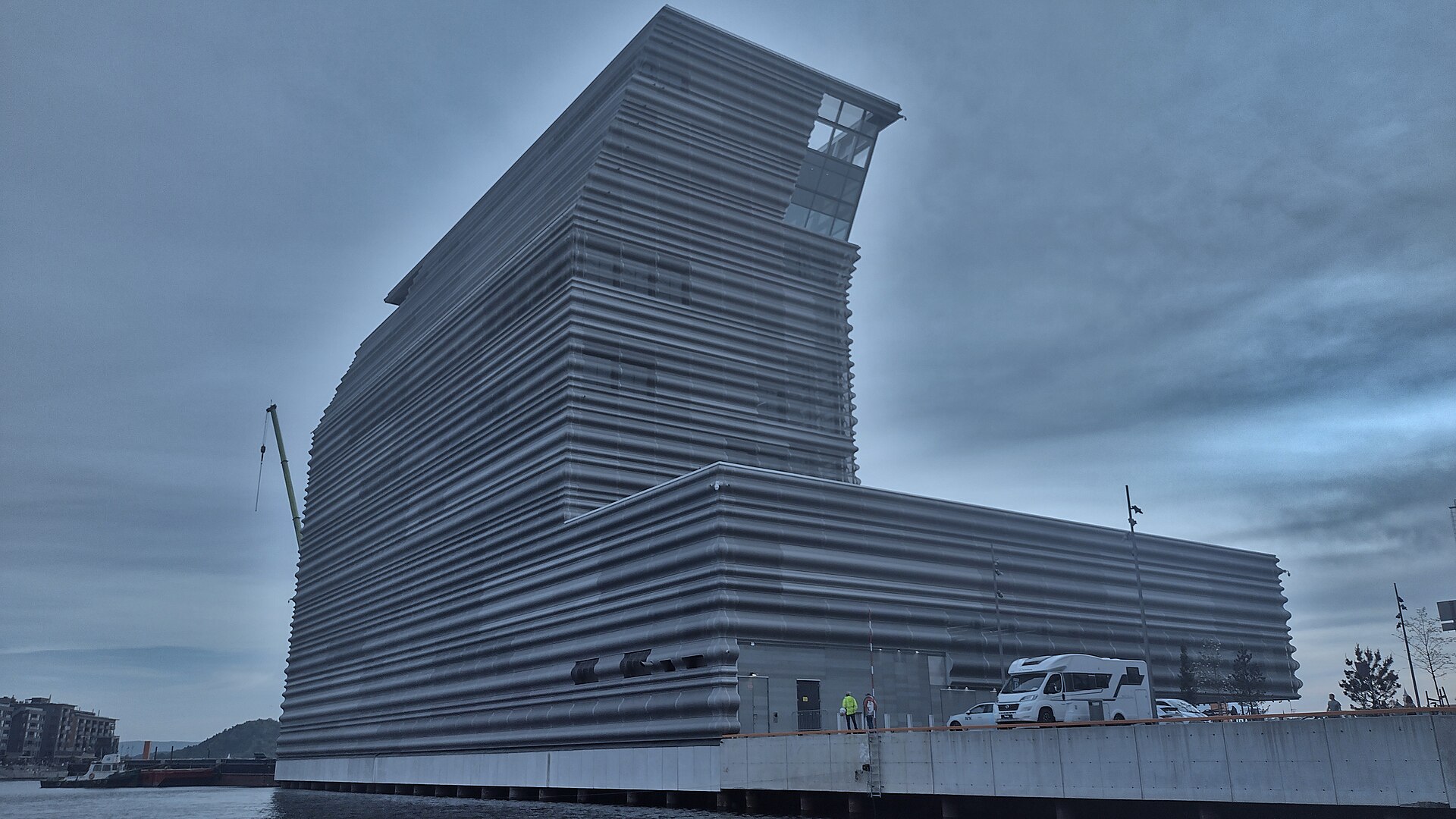
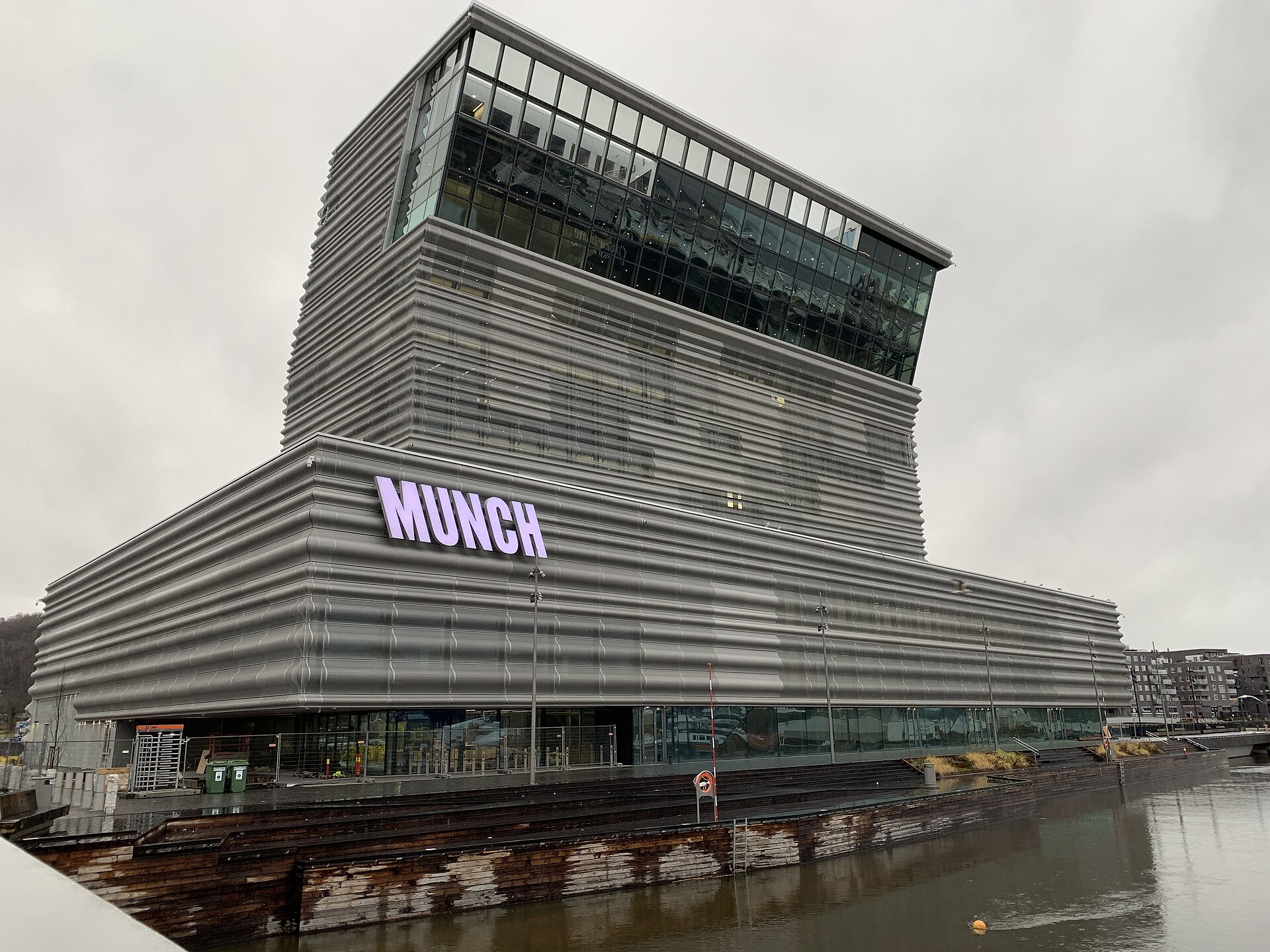
The building itself is a 60-metre tower on a three-storey podium, clad in perforated recycled aluminium panels of varying translucency, with a top section that leans outward and is visible from every side. Estudio Herreros describes the facade's changing reflectivity as deliberately 'enigmatic'; a large share of Oslo's public has called it something closer to grim. Local commentary before the museum even opened branded it, half-mockingly, the 'world's largest collection of guard rails', and descriptions ranging from 'eyesore' and 'lead-grey mastodon' to 'architectural masterpiece' have run side by side in the same press coverage since. The building was engineered to Passive House and FutureBuilt sustainability standards, with low-carbon concrete, recycled steel and seawater cooling, and is rated for a 200-year structural lifetime - none of which has settled the argument over what it looks like.
The renaming that came with the move is part of the same story. The institution now markets itself simply as MUNCH rather than Munch Museum, a shorter, more building-branded identity that arrived alongside the new address and has taken longer to bed in with some visitors and local critics than the architecture itself.
Thirteen floors, arranged as a vertical museum
MUNCH organises its programme vertically rather than as a single horizontal suite of rooms, which is unusual for a museum of this size. The permanent collection's core sits on floor 4, Edvard Munch Infinite, where the best-known paintings are shown in rotation. Floor 6, Edvard Munch Monumental, is a dedicated double-height gallery built to hang Munch's largest canvases - including work connected to his Aula murals for the University of Oslo - at the scale he actually painted them, something the Toyen building could never do. Floor 7 combines Up Close, built around the print and woodcut collection, with an interactive display the museum calls Shadows. Floor 9 currently holds Edvard Munch and the Chocolate Factory, built around twelve canvases Munch painted in 1922 for the women's canteen of Oslo's Freia chocolate factory - decorative work commissioned for an industrial interior rather than a gallery, and the first of its kind. Floor 11, Edvard Munch Horizons, places Munch's work against the wider circle of artists he worked alongside rather than treating him as a fixed canon on his own. A research library and conservation workshop on floor 3 hold the documentation behind the collection, alongside public-facing programming. The top two floors, 12 and 13, are a restaurant and a Skybar reached by its own glass lift, run as concessions rather than by the museum directly, and are as much a reason visitors go up as the art is.
The theft that changed how the paintings are shown
On 22 August 2004, armed and masked robbers walked into the Toyen museum in daylight, cut The Scream (the museum's 1910 tempera version) and Madonna from their wall mountings, and drove away with both. The paintings were missing for nearly two years, long enough that rumours circulated they had been destroyed. Oslo police recovered both on 31 August 2006, in what officials at the time called better condition than expected; the Scream had moisture damage to one corner. Both paintings were restored and went back on public display together on 23 May 2008.
The robbery reset how the museum thinks about security, and it is part of the background to the Bjorvika move as much as overcrowding was: a purpose-built museum gave Oslo the chance to design climate control, mounting and gallery security around a lesson the city had already paid for once. It also means the specific canvas visitors see labelled The Scream on floor 4 carries its own documented history of having been gone and away from public view for two years of the museum's own life, separate from the fame of the image itself.
An ethical question the museum has not resolved
Not every criticism of MUNCH is about the shape of the building. Writing in the Norwegian art-criticism journal Kunstkritikk at the museum's 2021 opening, the critic Mariann Enge raised a question that was not primarily about art at all: whether an institution acting as custodian of Munch's cultural heritage on behalf of the City of Oslo should accept sponsorship from oil and energy companies. She named Idemitsu Petroleum Norway, Aker BP and Equinor specifically as partners of the museum, and argued the question would only get louder rather than go away as scrutiny of corporate sponsorship in the cultural sector increased generally. That criticism has not been publicly answered or withdrawn by the museum in the material reviewed for this record, and it sits alongside, rather than instead of, the architectural debate as an open point about an institution that presents itself as custodian of a national artist's legacy.
What else came with Munch's gift
Munch's own bequest is not the whole collection. MUNCH also holds separate donations from the collector Rolf Stenersen, an early and unusually adventurous buyer of Munch's more experimental work, along with material from Amaldus Nielsen and Ludvig O. Ravensberg, together spanning close to a century of art history around Munch rather than only his own hand. The museum describes its holdings in total as a fragile inheritance: prints, drawings and painted surfaces now approaching or past a century old, some of them, like the Freia canvases, having spent decades in working buildings rather than climate-controlled storage before they ever reached a gallery wall. Conservation of that material, and the ongoing digitisation of Munch's letters and writings, is carried out on the museum's own research floor rather than outsourced, which the museum treats as part of its core function alongside exhibition.
What visitors say
Visitors are consistently struck by the scale of the collection and say it takes longer to see properly than they expected, and the top-floor views are repeatedly singled out. Opinion splits hardest over two things that have nothing to do with the paintings: the building's exterior, which has drawn both architectural praise and open ridicule since before it opened, and, among critics rather than tourists, the museum's sponsorship arrangements with oil and energy companies.
What is praised, what is criticised
- Praised: The depth of the collection - reviewers who say they came in with no particular interest in Munch consistently describe leaving impressed, and repeatedly say one hour is nowhere near enough for the 13 floors.
- Praised: The panoramic views over the Oslofjord and the Opera House from the top-floor Skybar and terrace.
- Praised: The staged rotation of different Scream versions on display, which visibly draws a crowd of visitors each time a new version is revealed.
- Criticised: Staff helpfulness is flagged as inconsistent in Tripadvisor's review-mined visitor tags, alongside otherwise positive marks for cleanliness and ease of access.
- Criticised: The building's grey, sloping form was mocked locally before it even opened - critics and the public called it 'the world's largest collection of guard rails' - and professional architectural opinion in Oslo has remained split between calling it a landmark and calling it a poorly resolved shape.
- Criticised: Writing in Kunstkritikk at the 2021 opening, critic Mariann Enge raised, and did not consider settled, whether a museum acting as custodian of Munch's cultural heritage should be sponsored by oil and energy companies - naming Idemitsu Petroleum Norway, Aker BP and Equinor as partners.
Ratings on other platforms
Tripadvisor: 3.8 from 2,757 ratings, read 11 August 2026
A platform average is a tertiary source: it moves, it is not audited, and we quote no visitor's words.
Questions about MUNCH
Where is MUNCH?
Edvard Munchs plass 1, 0194 Oslo, Norway.
How much does it cost to visit?
Adult, 10:00-18:00 entry: NOK 280; Adult, 18:00-21:00 entry: NOK 200; Under 25: NOK 100; Children and young people 0-17: free; Members plus one guest: free. As confirmed 8 September 2026.
When is it open?
Monday-Tuesday 10:00-18:00; Wednesday-Saturday 10:00-21:00; Sunday 10:00-18:00. Closed: 1 May (Labour Day) - the only day of the year the museum is fully closed. Reduced hours (10:00-18:00 or 10:00-14:00) apply on a published list of 2026 dates including 1 January, 2-4 April, 14 May, 23 May, 24 and 31 December, and 25-26 December. As confirmed 8 September 2026.
How do you get there?
Tram: Lines 13 and 19 stop at Bjorvika, about 250 metres from the museum entrance; Bus: Bus lines including 20, 34, 54, 300 and 505 serve stops near Bjorvika, an 8 to 10 minute walk from the museum; Ferry: Munch Bjorvika ferry stop is about 250 metres from the museum; Walking: About 10 to 12 minutes on flat ground from Oslo Central Station (train, Metro, tram, bus).
What should you see first?
The Scream (Edvard Munch, 1910); The Scream (Edvard Munch, 1893); Madonna (Edvard Munch, 1894-95); The Sick Child (Edvard Munch, 1885-86); Vampire (Love and Pain) (Edvard Munch, 1893-94); The Dance of Life (Edvard Munch, 1899-1900).
What we could not confirm
- Whether the museum's sponsorship arrangements with Idemitsu Petroleum Norway, Aker BP and Equinor - named specifically by critic Mariann Enge in 2021 as an unresolved ethical question for an institution acting as custodian of Munch's legacy - have been revisited, renewed or ended since the opening; nothing in the material reviewed for this record shows the museum has responded publicly.
- How the 2004 theft continues to shape loan decisions for The Scream and Madonna as international exhibitions request them; the museum's own site does not publish a loan history.
- Whether Oslo's architectural opinion of the Bjorvika building - still visibly split between calling it a landmark and calling it a poorly resolved shape five years after opening - will settle in either direction, or whether the debate is now simply part of how the building is discussed.
Images
Sources
- 8Munchmuseet, official site, Visit us (address, accessibility, photography and bag policy, cafe and shop) munch.no/en/visit-us/
- 9Wikipedia, Munch Museum en.wikipedia.org/wiki/Munch_Museum
- 10Wikipedia, The Scream (versions, ownership, 2004 theft and 2006 recovery) en.wikipedia.org/wiki/The_Scream
- 11Wikidata, Munch Museum, Q844926 wikidata.org/wiki/Q844926
- 12The Art Newspaper, Christian House, 'Forget everything you know about museums - this is different: Oslo's enormous Munch museum is ready to open after a decade of setbacks', 19 October 2021 theartnewspaper.com/2021/10/19/screaming-success-oslos-munch-museum-reboot
- 13Kunstkritikk, Mariann Enge, 'The Whole World Is Invited', 2 June 2021 kunstkritikk.com/the-whole-world-is-invited/
- 14Tripadvisor, Munch attraction page, aggregate rating and visitor review tags, read 11 August 2026 tripadvisor.com/Attraction_Review-g190479-d196805-Reviews-Munch-Oslo_Eastern_Norway.html
- 15The Art Newspaper, 'Edvard Munch's chocolate factory series shines a light on the public artist he wanted to be', 12 June 2026 theartnewspaper.com/2026/06/12/edvard-munchs-chocolate-factory-series-shines-a-light-on-the-public-artist-he-wanted-to-be
- 16Munchmuseet, official site, Plan your visit (floor-by-floor programme) munch.no/en/plan-your-visit/
- 17Munchmuseet, official site plus Moovit transit listing, public transport to the Bjorvika building munch.no/en/visit-us/
- 18Munchmuseet, official site, Our Collection munch.no/en/our-collection/
- 19Munchmuseet, official site, The Scream (versions held by MUNCH) munch.no/en/The-Scream/
- 20Munchmuseet, official site, Built for the future (architecture and sustainability) munch.no/en/this-is-munch/built-for-the-future/
- 21Munchmuseet, official site, Opening hours munch.no/en/visit-us/opening-hours/
- 22Munchmuseet, official site, Buy tickets munch.no/en/buy-tickets/
- 23Munchmuseet, official site, About / Contact munch.no/en/about/contact/
- 24Wikimedia Commons, file pages and for all images used, per file commons.wikimedia.org/wiki/Category:Munchmuseet