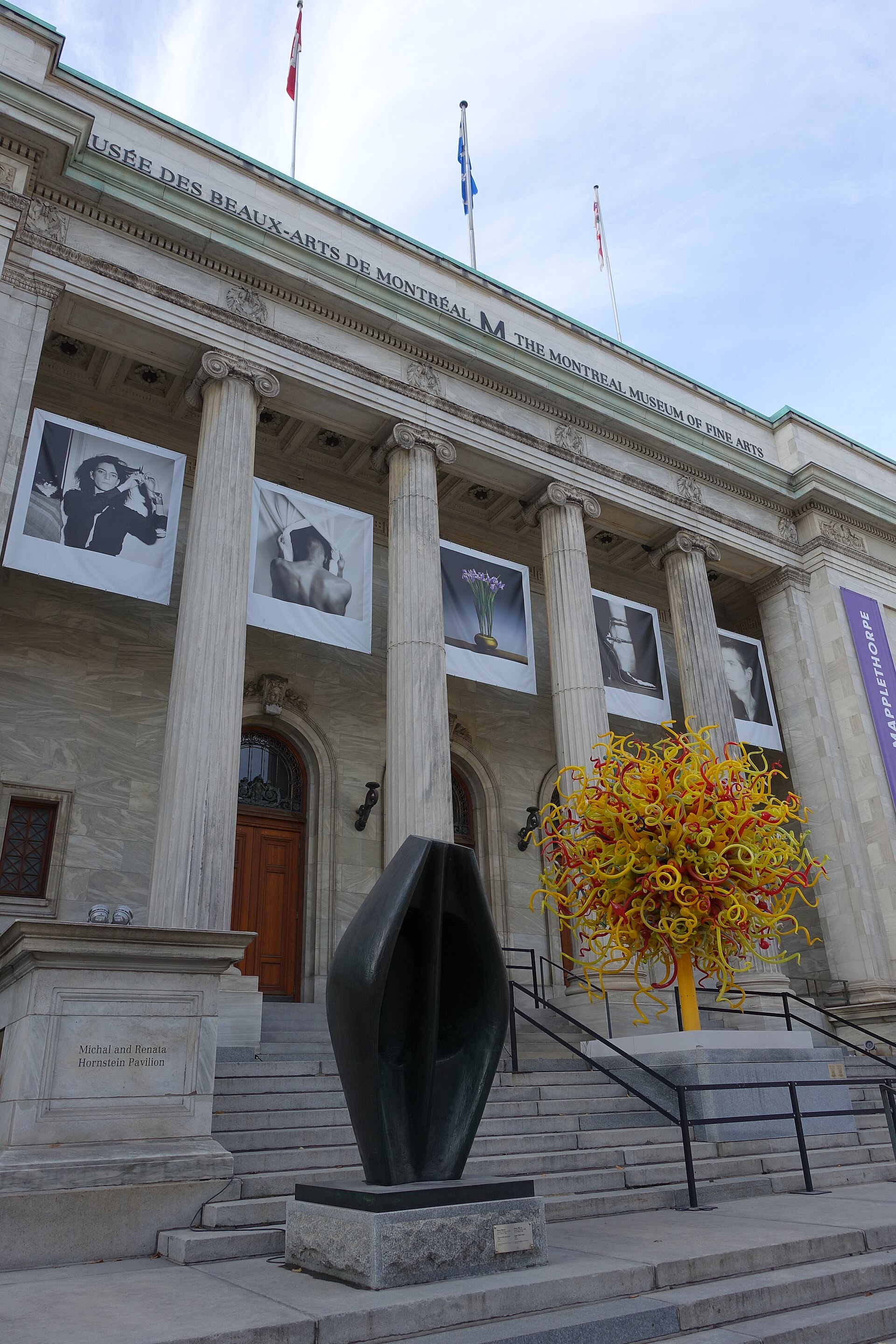
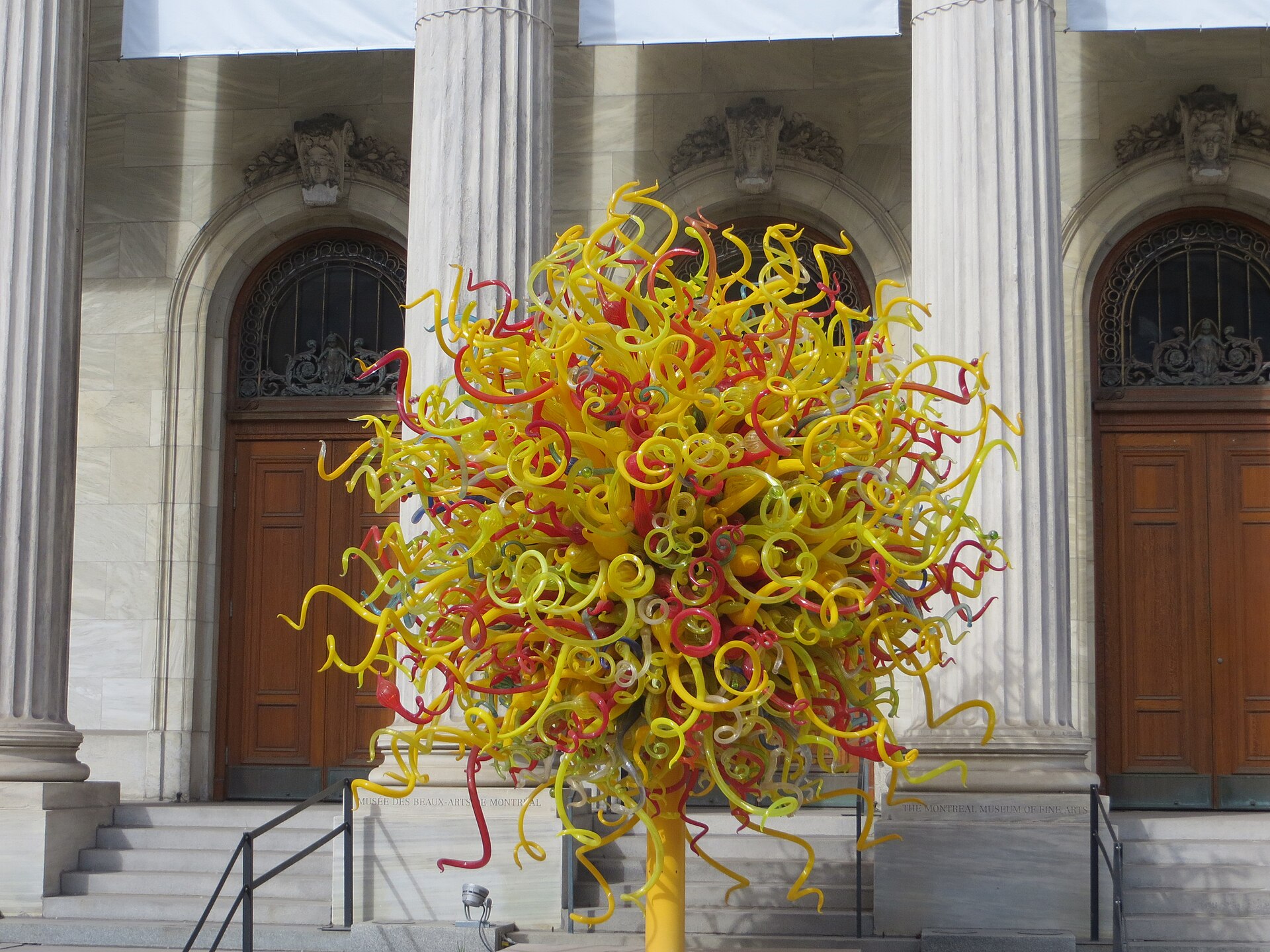
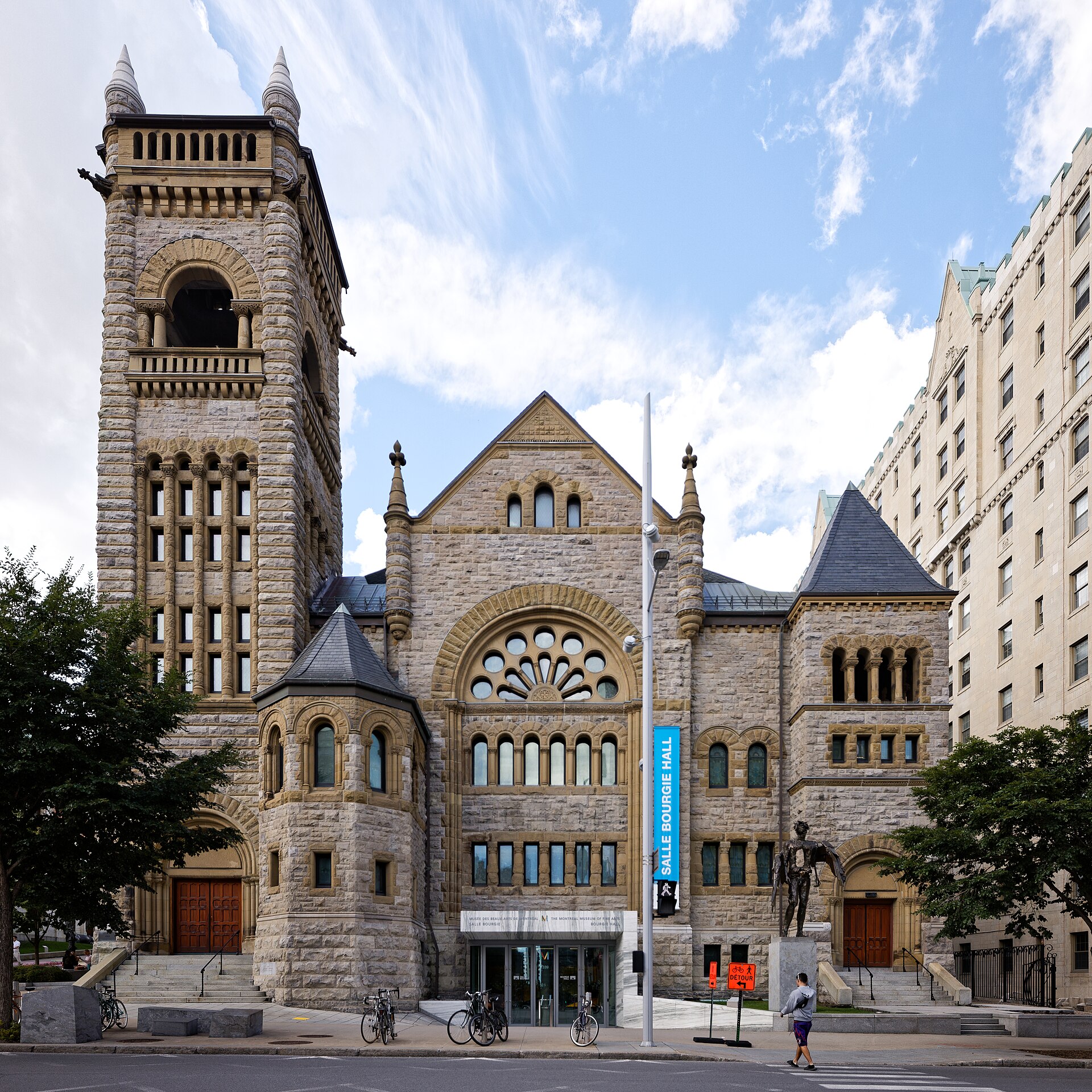
The museum's original 1912 facade on Sherbrooke Street West, with the bilingual inscription Musee des Beaux-Arts de Montreal / The Montreal Museum of Fine Arts across the entablature and a pediment plaque naming the Michal and Renata Hornstein Pavilion. A bronze sculpture and a temporary Dale Chihuly glass installation stand on the front steps.
Photograph by Guilhem Vellut · Photograph by Guilhem Vellut from Annecy, France · CC BY 2.0Montreal Museum of Fine Arts
Museum · Musée des beaux-arts de Montréal · Founded 1860
Open, admission and hours confirmed 10 September 2026 · 18 sources
On this page 17 sections
ContentsClose
The collection's genuine depth is less in any single trophy work than in its range across eras and traditions under one roof: Old Master paintings from the Hornstein gift, close to 900 decorative arts and design objects from the Stewart gift, Inuit art the museum says it has more than doubled the space for, and the Arts of One World collection spanning the 4th millennium BCE to the present across every continent. Quebec and Canadian art, including work by Jean-Paul Riopelle, has its own dedicated pavilion inside a former church. The weaker point, by the museum's own history rather than by any outside critic, is continuity of stewardship: an unsolved 1972 theft that took a Rembrandt and never gave it back, a 2011 theft still unresolved, and a 2020 to 2022 governance crisis that cancelled a major planned expansion mid-stream.
| Local name | Musée des beaux-arts de Montréal |
|---|---|
| Kind | Museum |
| Founded | 1860, as the Art Association of Montreal; renamed the Montreal Museum of Fine Arts in 1950 |
| City and country |  Montreal, Canada Montreal, Canada |
| Address | 1380 Sherbrooke Street West, Montreal, Quebec H3G 1J5, Canada |
| Website | mbam.qc.ca/en |
| Status | Open, confirmed |
| Record last verified |
Visiting
- Hours
- Tuesday-Sunday10:00 to 17:00
- Wednesday evening17:00 to 21:00Extension of the Wednesday day beyond the normal 17:00 close, with reduced-price entry. As of 10 September 2026 the museum's own visit page states this reduced rate runs until September 23 (year not printed; read as 2026)
- Closed
- Monday (the summer measure that also opened Mondays, in effect through 6 September 2026, has ended: re-read 10 September 2026, the museum's own schedule shows Monday as Closed with no summer exception currently stated). Easter Monday. Labour Day. 25 December (Christmas Day). 1 January (New Year's Day).
- Admission
- Adult (26 and older)CAD 32General admission to the collection and to current exhibitions
- Adult (26 and older), Wednesday evening 5 to 9 p.m.CAD 16Reduced-price viewing of the collections and exhibitions on Wednesday evenings. Re-read 10 September 2026: the museum's own visit page now states the reduced Wednesday-evening rate runs 'until September 23' (no year printed on the page; read in context of the page's own current date this reads as 23 September 2026), extended from the 2 September 2026 end date this desk read on 12 August 2026. This desk still could not confirm whether the reduction is a standing year-round policy or ends on that date
- Ages 25 and underFreeFree at all times, at every age, but an admission ticket is still required for every visitor regardless of age
- Museum membersFree
- Members of Indigenous communitiesFreeFree at all times; a piece of identification may be requested
- Persons with disabilities and one accompanying caregiverFree
Free entry: Every Tuesday, 10 a.m. to 1 p.m.: free general admission to the collection for adults 65 and older. Every Saturday, 10 a.m. to 1 p.m.: free general admission for families, presented by BMO. First Sunday of every month: free admission to the collection for Quebec residents; reservation required. Groups of 10 people or more must reserve by telephone rather than buy at the door- Tickets
- mbam.qc.ca/en/tickets The museum's own ticket page.
- Do I need to book?
- Not mandatory. The museum recommends buying tickets online to guarantee entry and skip the counter line; groups of 10 or more must reserve a time slot by phone rather than arrive unannounced
- Address
- 1380 Sherbrooke Street West, Montreal, Quebec H3G 1J5, Canada MapMetro Guy-Concordia and Peel stations are both a short walk from the main entrance
REM light rail McGill station, about a 10 to 15 minute walk away
Bicycle BIXI bike-share docks near the museum
Car and parking The museum has no private lot. The nearest paid option is the LB garage at Concordia University's J.W. McConnell Pavilion, 1453 Mackay Street; metered spots reserved for disabled parking permit holders are near 3410 Avenue du Musee and on Crescent Street - Website
- mbam.qc.ca/en
- Telephone
- +1 514 285 2000
- [email protected]
Before you go how long, access, photography, bags, eating, shop
- How long to allow
- Five pavilions on both sides of Sherbrooke Street, connected underground, holding close to 47,000 works between them. Seeing more than one or two pavilions properly in a single visit takes the better part of a day
- Access
- All five pavilions, including the exhibition galleries, washrooms and elevators, are described by the museum as wheelchair accessible. The museum asks visitors with specific needs to give advance notice so staff can prepare
- Photography
- Personal photography is allowed in the galleries unless a work is marked otherwise. Video recording, flash, tripods and selfie sticks are all forbidden at all times
- Bags
- Backpacks and bags larger than 30 by 40 centimetres, food, and water bottles, even empty ones, must be left at the free cloakroom. Smaller bags and handbags may enter the galleries but are subject to a visual security check
- Eating
- Aube Cafe, open the same hours as the museum including the Wednesday evening extension
- Shop
- The Boutique and Bookstore, open the same hours as the museum
Prices and hours change. We take them from the institution's own pages and print the day we read them, and you can check the current position at the source we used. Confirm before you travel.
What is inside
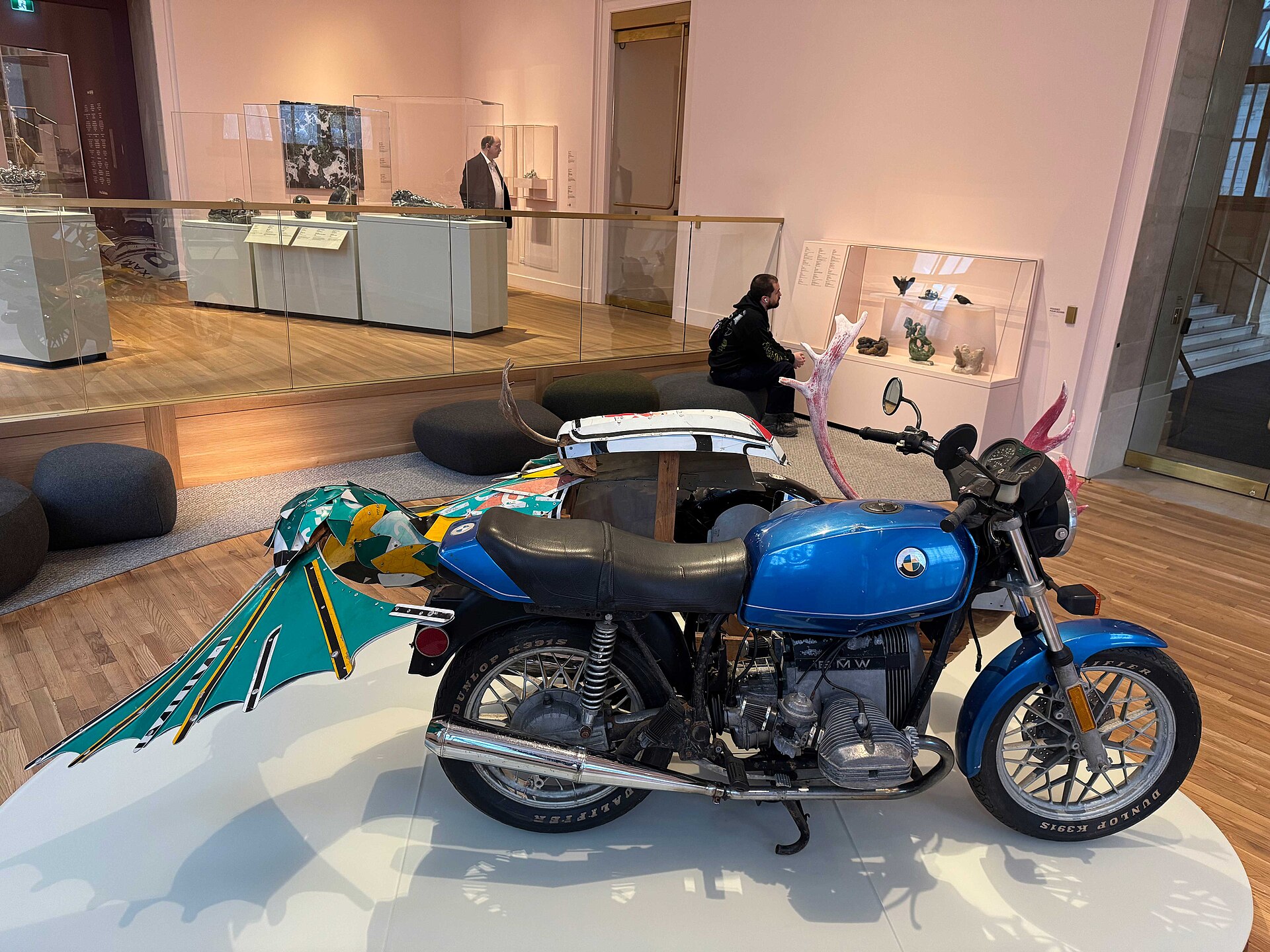
CC0 Michal and Renata Hornstein Pavilion (1912)
The museum's original building, a white-marble Beaux-Arts structure by brothers Edward and William Sutherland Maxwell, with a colonnaded portico and a monumental staircase facing Sherbrooke Street. It held the museum's first exhibition galleries, a lecture hall, a library and art-school studios, and today is home to the Inuit art galleries and temporary installations.
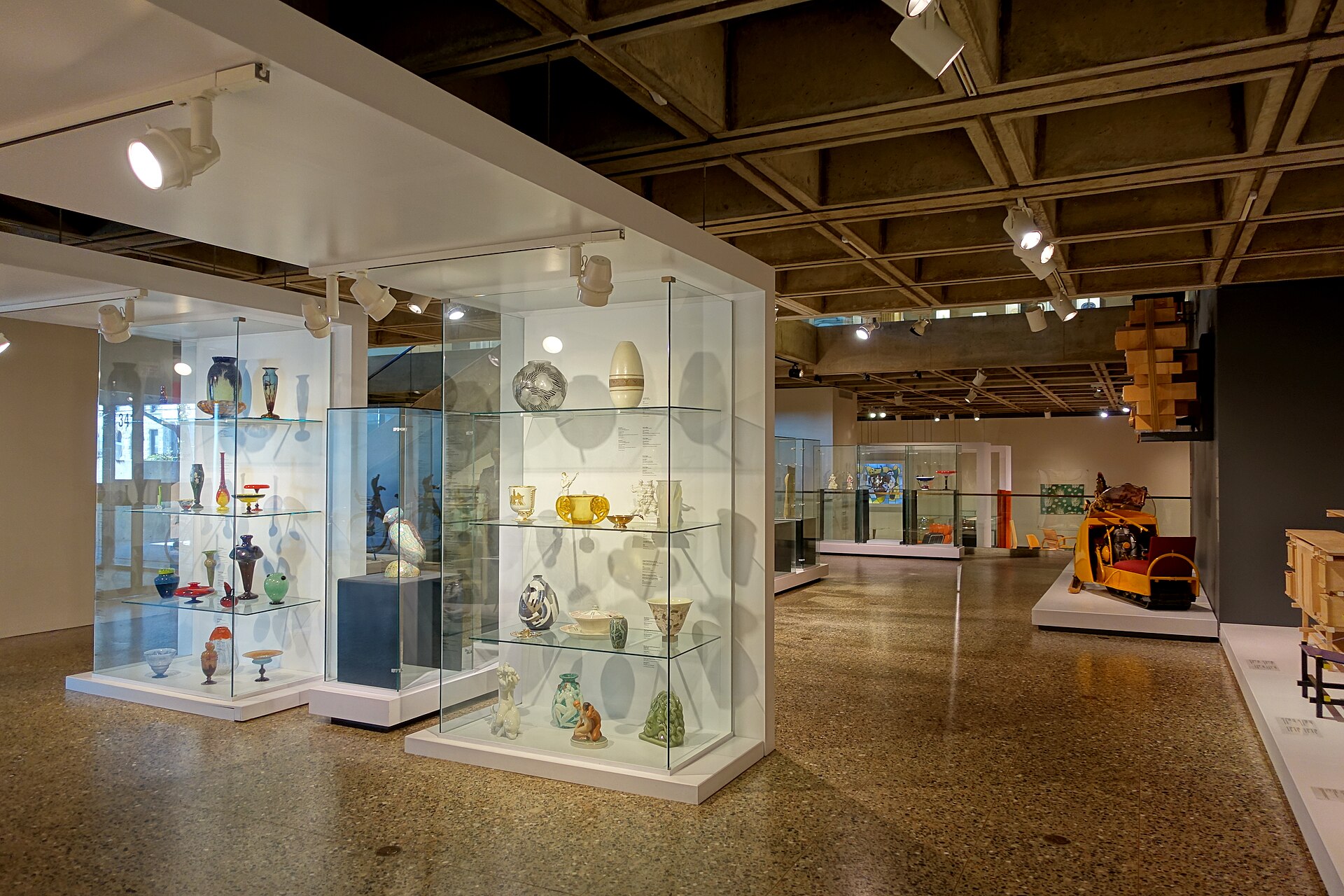
CC0 Liliane and David M. Stewart Pavilion (1976)
An addition in exposed concrete by architect Fred Lebensold, deliberately set against the classical building beside it. It holds close to 900 decorative arts and design objects, furniture, glass, silver, textiles, ceramics and industrial design, in a display unveiled in 2012 and built mainly on the donation of Liliane and David M. Stewart.
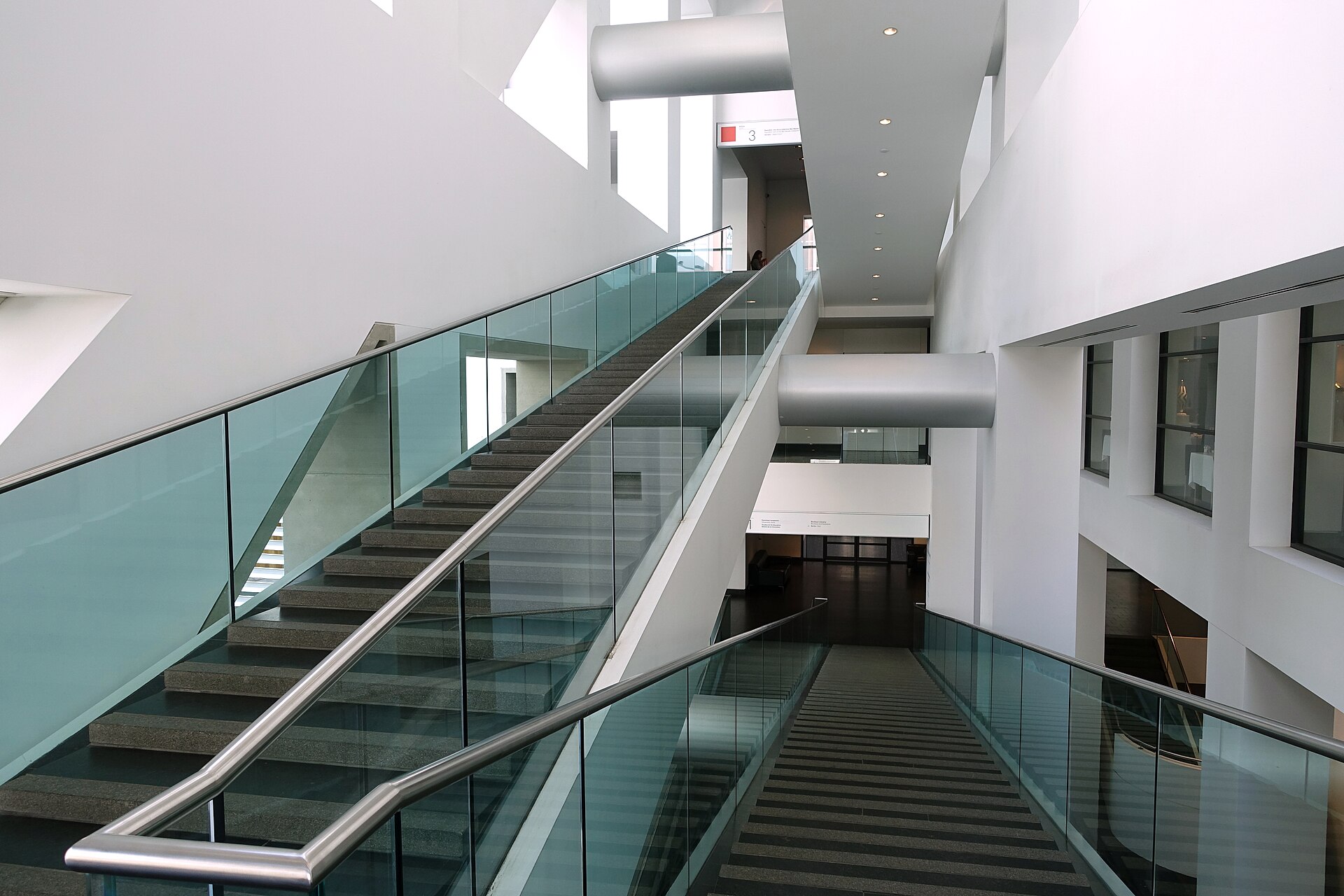
CC0 Jean-Noel Desmarais Pavilion (1991)
A modernist building across the street from the original pavilion, opened 21 November 1991. It holds modern and contemporary art and the galleries used for the museum's major temporary exhibitions, along with the Arts of One World collection in ten galleries spanning the 4th millennium BCE to the present, drawn from every continent.
Claire and Marc Bourgie Pavilion of Quebec and Canadian Art (2011)
Built inside the former Erskine and American United Church, a Romanesque Revival landmark of 1893 to 1894 designated a National Historic Site of Canada, this pavilion added 20 percent more gallery space and shows about 600 works of Quebec and Canadian art across more than 2,000 square metres. The former nave is now Bourgie Hall, a concert venue lit by 18 surviving Tiffany stained-glass windows.
Michal and Renata Hornstein Pavilion for Peace (2016)
The newest and fifth pavilion, six levels arranged chronologically from the Middle Ages and the Renaissance down through the Golden Age of Holland and Flanders, the Baroque and the Age of Enlightenment, to academic and modern art. It is anchored by more than 100 Old Master paintings given by Holocaust survivors and Montreal philanthropists Michal and Renata Hornstein, with contemporary works by artists including Antony Gormley worked into the route.
What to see first
The Tiffany windows of the former Erskine and American Church
Tiffany Studios, New York; the church built to designs by Alexander Cowper HutchinsonEighteen stained-glass windows installed in 1938-39 form the most extensive group of Louis Comfort Tiffany's religious glass identified in Canada, and they still light the nave the museum turned into Bourgie Hall13
Vent traversier (1952)
Jean Paul RiopelleAn abstract canvas by Quebec's best-known postwar painter, a gift of Nina and Harry Hart, catalogued by the artist's own foundation as part of this museum's holdings12
The Michal and Renata Hornstein gift of Old Master paintings
Various Dutch and Flemish Golden Age mastersMore than one hundred Old Master paintings given by two Holocaust survivors who made Montreal their home, described by the museum as the largest private donation to a Quebec museum in modern history5
The former Erskine and American United Church building
Architect Alexander Cowper Hutchinson, 1893-94; interior remodelled 1938-39 by Percy NobbsA Romanesque Revival landmark and National Historic Site of Canada that the museum adapted into a concert hall rather than replace, keeping the amphitheatre-plan sanctuary intact13
Contemporary interventions along the Path of Peace
Antony Gormley and other living artists, including Jean-Michel Othoniel and Barbara SteinmanContemporary sculpture threaded through galleries that otherwise run chronologically from the Middle Ages to the 20th century, so a visitor meets a living artist's response inside an Old Masters route5
The Inuit art collection
Various Inuit artists, prints, textiles, wampum and sculpture collected since the 1950sThe museum has more than doubled the gallery space it gives to Inuit art in the Peace Pavilion and states it has put over 10 percent of its annual budget toward growing Indigenous holdings8
The Liliane and David M. Stewart design collection
Various, decorative arts and industrial design, 17th century to the presentMore than 5,000 objects donated by Liliane M. Stewart, estimated at the time near 15 million Canadian dollars, forming one of the larger design collections in a North American encyclopedic museum8
Exhibitions on now
- On now9 Jun 2026 to 7 Mar 2027Confirmed , 8 weeks ago
Past exhibitions here
- Closed29 Nov 2025 to 11 Oct 2026Confirmed · check before you travel
The building and what it was built to hold
The institution now called the Montreal Museum of Fine Arts began in 1860 as the Art Association of Montreal, formed to encourage an appreciation of the fine arts among the city's residents. It spent its first decades without a purpose-built home, until a gift from Montreal businessman Benaiah Gibb of works and funds let it open a first gallery on Phillips Square in 1879, the first building in Canadian history constructed specifically to house an art collection. That building was outgrown within a generation. In 1912 the Art Association relocated to a new white-marble Beaux-Arts building on Sherbrooke Street, designed by brothers Edward and William Sutherland Maxwell with a colonnaded portico and a monumental staircase, soberly imposing by design. The Art Association was renamed the Montreal Museum of Fine Arts in 1950, and that 1912 building carries the name of Michal and Renata Hornstein today, its most consequential later donors. It is still the address a visitor is given first, still the facade photographed for the front of every brochure, and still, structurally, the least museum-like of the five buildings that now make up the site: a purpose-built exhibition hall from an age when a museum's job was assumed to be display alone.
Five pavilions, one museum district
What began as a single building on Sherbrooke Street is now five, spread across more than 53,000 square metres on both sides of the street and connected by an underground passage. After the 1912 Hornstein Pavilion came the Liliane and David M. Stewart Pavilion in 1976, a deliberately contrasting exposed-concrete addition by architect Fred Lebensold set right behind the original building. In 1991 the museum crossed Sherbrooke Street for the first time, opening the modernist Jean-Noel Desmarais Pavilion designed by Moshe Safdie to near-unanimous critical praise, built to hold major temporary exhibitions and the growing international collection. Two more pavilions followed in the 2010s: the Claire and Marc Bourgie Pavilion in 2011, built inside a former church, and the Michal and Renata Hornstein Pavilion for Peace in 2016, the newest and largest single addition, which won a Governor General's Medal in Architecture in 2018. Each pavilion was funded by a different set of donors and built to a different architectural brief, and the result reads less like one museum than like a small museum district that happens to share one ticket. That is a genuine strength for depth of collection and a genuine cost in orientation, and both are discussed elsewhere on this page.
What is inside, era by era and gallery by gallery
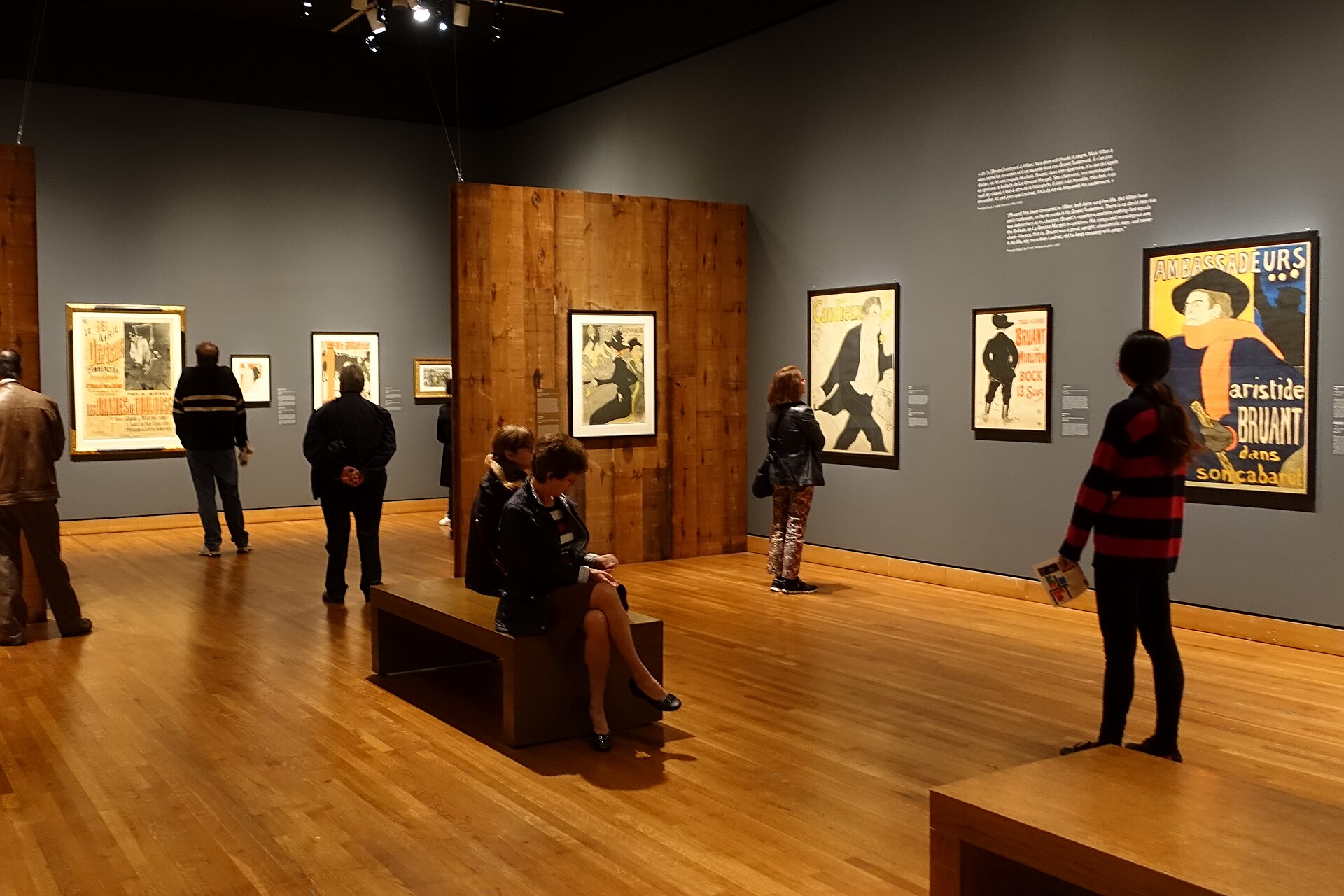
The five pavilions divide the collection roughly by period and origin rather than by building age. The Hornstein Pavilion for Peace, opened in 2016, runs chronologically across six levels from the medieval and Renaissance galleries down through the Golden Age of Holland and Flanders, the Baroque, and the Age of Enlightenment, to academic and early modern art, anchored by more than one hundred Old Master paintings the Hornsteins themselves gave the museum. The Desmarais Pavilion across the street holds modern and contemporary art alongside the Arts of One World, ten galleries of more than 1,200 objects drawn from every continent and from the 4th millennium BCE to the present. The original Hornstein Pavilion of 1912 now houses the Inuit art galleries, a collection the museum has said it has more than doubled in gallery space and continues to grow with a stated commitment of over ten percent of its annual budget. The Stewart Pavilion holds decorative arts and design, close to 900 objects in furniture, glass, silver, textiles, ceramics and industrial design. The Bourgie Pavilion, built inside a former church, holds Quebec and Canadian art across roughly 600 works, and its former nave, still lit by eighteen surviving Tiffany windows, is now a concert hall.
The 1972 theft, and what the museum has never gotten back
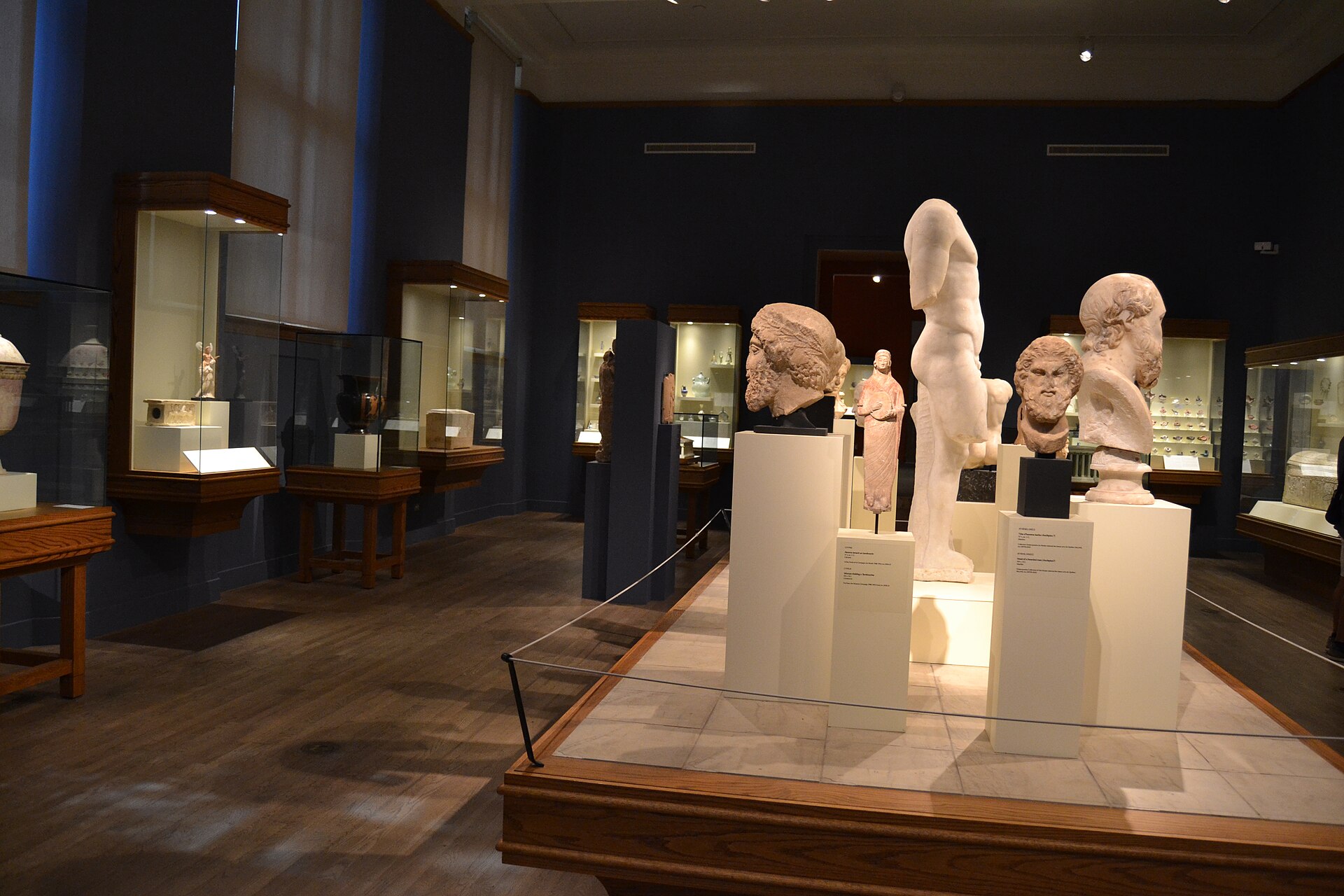
Just after midnight on 4 September 1972, three armed men climbed onto the museum's roof through a skylight under repair, tied up the guards on duty and, in about thirty minutes, made off with eighteen paintings and dozens of pieces of jewellery and figurines worth roughly two million dollars at the time. Among the paintings was a rare Rembrandt landscape, Landscape with Cottages, given to the museum by the daughter of railway baron William Van Horne, along with works attributed to Corot, Courbet, Delacroix and Gainsborough. It remains the largest unsolved art theft in Canadian history: no suspect was ever charged, and none of the eighteen paintings has ever surfaced. A former Quebec police art investigator has suggested the paintings ended up decorating organised-crime figures rather than being resold through any traceable market. The insurance payout was used to buy a large Rubens the museum promoted for years as the largest in Canada, until conservators later found its pigments dated decades after the painter's death and reattributed it to his workshop; it was quietly pulled from view in 2007. A second, smaller theft in 2011 took two antiquities from open display in broad daylight during visiting hours; one, a Persian relief, was recovered in Edmonton in 2014, and the other, a Roman marble head, has never been found.
A director fired, a lawsuit, and a settlement that answered little
In July 2020 the museum's board dismissed its long-serving director and chief curator, Nathalie Bondil, effective immediately, citing a staff-union complaint about workplace climate and what it called her inflexibility over a proposed transition. Bondil, who had led the museum since 2007 and was credited with tripling attendance and doubling gallery space over her tenure, gave a different account in the Montreal press, saying the rupture followed her own objections to a hiring decision favouring a curator related to major museum patrons. Quebec's culture minister called herself flabbergasted by the board's decision, and more than 2,400 people signed a petition asking for a members' assembly to explain it. Bondil sued the board for two million Canadian dollars over what she called a smear campaign against her reputation; the case was not settled until January 2022, on confidential terms, with the museum's statement clarifying that she had not personally been the subject of any harassment finding while still defending the board's handling of the situation. In the middle of the dispute, an ambitious, publicly backed plan for a new wing dedicated to painter Jean-Paul Riopelle, which Bondil had initiated with the Riopelle Foundation and the province of Quebec, was cancelled at this museum and moved to Quebec City instead.
Provenance and what the museum discloses about it
The museum maintains and publishes online a register of works in its collection with incomplete ownership records for the years 1933 to 1945, the period in which Nazi authorities and their collaborators looted art across occupied Europe, explicitly to help outside researchers pursue claims. It has acted on that history before: in 2013 the museum returned a 1623 to 1624 painting by Gerrit van Honthorst, The Duet, to the heirs of Bruno Spiro, a Jewish collector from whom it had been confiscated by the Nazis. A separate claim, lodged in 2005 by the heirs of Dutch dealer Jacques Goudstikker, sought the return of Charles Le Brun's The Deification of Aeneas; this desk could not confirm from the sources it read whether that claim was resolved, and does not assert an outcome it has not verified. A public provenance register is a stronger practice than silence, and it is also, necessarily, a public acknowledgement that the collection contains works whose full history the museum itself cannot yet document.
Visiting today
The practical shape of a visit has not changed much across all this institutional history. General admission runs 32 Canadian dollars for an adult 26 or older, free for everyone 25 and under at every visit, and free outright for museum members, for people with disabilities and one companion, and for members of Indigenous communities. Tuesday mornings bring free entry for adults 65 and older, Saturday mornings bring free family admission sponsored by BMO, and the first Sunday of each month is free for Quebec residents with a reservation. The museum opens Tuesday to Sunday, with an extended, reduced-price Wednesday evening, and is also open on Mondays through early September as a summer measure. All five pavilions are step-free, personal photography is allowed throughout unless a work says otherwise, and the free cloakroom takes anything bulkier than a small handbag. None of that changes what the building itself asks of a visitor: five pavilions, two sides of a street, and a collection built by donation after donation since 1860, so that seeing all of it properly, rather than the two or three pavilions most visitors manage, takes more than an afternoon.
What visitors say
No visitor-review prose or platform star average is reproduced here; what follows is drawn from the museum's own published statements, from named journalism, and from the aggregate figure below. Visitors consistently describe a large, encyclopedic collection that rewards more than one visit: Old Masters and contemporary art in the Peace Pavilion, Quebec and Canadian painting in the former church, Inuit and world art elsewhere, and concerts at Bourgie Hall inside the same building. The free admission for everyone 25 and under, at every visit, with no conditions, is the policy visitors mention most often as a point in the museum's favour. The friction points are less about any single gallery than about the building itself: five pavilions on both sides of Sherbrooke Street, connected underground, is genuinely disorienting to navigate on a first visit, and more than one visitor account complains specifically about galleries or whole pavilions being closed for reinstallation on the day they came, with no obvious warning in advance. The institution's own recent history is not spotless either, and is discussed below rather than smoothed over.
What is praised, what is criticised
- Praised: free admission for every visitor 25 or under, on every visit, without a timed ticket or a membership condition attached
- Praised: the range in one membership: Old Masters, Quebec and Canadian art, Inuit and world art, and design and decorative arts, rather than a single narrow specialty
- Praised: Bourgie Hall concerts held inside the former church nave, under the Tiffany glass the congregation itself worshipped beneath
- Praised: the free daily-life practicalities: step-free access across all five pavilions and a stated willingness to accommodate visitors who flag a need in advance
- Criticised: the museum is spread across five separate buildings on both sides of a public street, connected by an underground passage, and wayfinding between them is a common first-visit complaint
- Criticised: at least one Tripadvisor review is titled plainly as being about the admission price, and another about the opening hours, which suggests cost and scheduling are recurring friction points rather than isolated complaints
- Criticised: the institution's governance has not been calm: a celebrated director was dismissed in 2020 amid conflicting public accounts, sued the museum's board, and the dispute was not settled until January 2022, with the terms never made public
- Criticised: an ambitious Riopelle wing planned with the Riopelle Foundation and the province of Quebec was cancelled during that same period of instability and the project moved to Quebec City instead
- Criticised: the museum's own galleries have twice been the target of theft that was never fully resolved: the 1972 armed robbery remains unsolved and most of what was taken has never been recovered, and a Roman marble head stolen in 2011 is still missing
Ratings on other platforms
Tripadvisor: 4.5 from 4,645 ratings, read 12 August 2026
A platform average is a tertiary source: it moves, it is not audited, and we quote no visitor's words.
Questions about Montreal Museum of Fine Arts
Where is Montreal Museum of Fine Arts?
1380 Sherbrooke Street West, Montreal, Quebec H3G 1J5, Canada.
How much does it cost to visit?
Adult (26 and older): CAD 32; Adult (26 and older), Wednesday evening 5 to 9 p.m.: CAD 16; Ages 25 and under: free; Museum members: free; Members of Indigenous communities: free. As confirmed 10 September 2026.
When is it open?
Tuesday-Sunday 10:00-17:00; Wednesday evening 17:00-21:00. Closed: Monday (the summer measure that also opened Mondays, in effect through 6 September 2026, has ended: re-read 10 September 2026, the museum's own schedule shows Monday as Closed with no summer exception currently stated). Easter Monday. As confirmed 10 September 2026.
How do you get there?
Metro: Guy-Concordia and Peel stations are both a short walk from the main entrance; REM light rail: McGill station, about a 10 to 15 minute walk away; Bicycle: BIXI bike-share docks near the museum; Car and parking: The museum has no private lot. The nearest paid option is the LB garage at Concordia University's J.W. McConnell Pavilion, 1453 Mackay Street; metered spots reserved for disabled parking permit holders are near 3410 Avenue du Musee and on Crescent Street.
What should you see first?
The Tiffany windows of the former Erskine and American Church (Tiffany Studios, New York; the church built to designs by Alexander Cowper Hutchinson); Vent traversier (1952) (Jean Paul Riopelle); The Michal and Renata Hornstein gift of Old Master paintings (Various Dutch and Flemish Golden Age masters); The former Erskine and American United Church building (Architect Alexander Cowper Hutchinson, 1893-94; interior remodelled 1938-39 by Percy Nobbs); Contemporary interventions along the Path of Peace (Antony Gormley and other living artists, including Jean-Michel Othoniel and Barbara Steinman); The Inuit art collection (Various Inuit artists, prints, textiles, wampum and sculpture collected since the 1950s).
What we could not confirm
- Whether the Wednesday-evening reduced admission rate is a standing year-round policy or a summer-only measure; re-read 10 September 2026, the museum's own visit page now gives September 23 (year not printed, read as 2026) rather than the 2 September 2026 date this desk read on 12 August 2026, so the deadline itself appears to move rather than resolve the question
- Whether the 2005 Goudstikker heirs' claim on Charles Le Brun's The Deification of Aeneas was ever resolved; this desk read a reference to the claim but not to any outcome
- Whether the Roman marble head stolen in 2011 has surfaced since the last reporting this desk could locate
Images
Sources
- 1Montreal Museum of Fine Arts, Plan your visit: opening hours for each day including the Wednesday evening extension and the summer Monday measure through 6 September 2026, the individual admission fee table (32 dollars adult, 16 dollars Wednesday evening, free 25 and under, free members, free Indigenous community members, free persons with disabilities and caregiver), the free-admission time slots (Tuesday mornings 65 and up, Saturday mornings BMO family time, first Sunday of the month), the public holiday calendar, the main entrance address and phone number, the mailing address, and the tickets and contact pages. Fetched as raw HTML on 12 August 2026. mbam.qc.ca/en/information/plan-your-visit/
- 2Montreal Museum of Fine Arts, Visitor Guide and Policies: how to get to the museum by metro, REM and BIXI, the absence of a private parking lot and the LB garage at Concordia's J.W. McConnell Pavilion, accessible parking locations, payment methods, the recommendation to book online, the ticket policy for groups of 10 or more, the free-for-25-and-under policy applying to every visitor regardless of age, stroller rules, the cloakroom and bag-size policy, accessibility statement for all five pavilions, and the photography, video, flash, tripod and selfie-stick rules. Fetched as raw HTML on 12 August 2026. mbam.qc.ca/en/information/visitor-guide-and-policies/
- 3Montreal Museum of Fine Arts, About the Museum: the 1860 founding of the Art Association of Montreal, the 47,000-work collection figure, the museum's mission statement, the 160-year history timeline including the 1912 relocation to the Sherbrooke Street building, the 1950 renaming to Montreal Museum of Fine Arts, the 1997 to 2000 absorption of the Montreal Museum of Decorative Arts, the Tiffany Studios Angel of the Resurrection window credited to a 1904 design by Frederick Wilson, and the current governance list naming Stephane Aquin as director. Fetched as raw HTML on 12 August 2026. mbam.qc.ca/en/the-museum/about-the-museum/
- 4Montreal Museum of Fine Arts, Museum Complex: the museum district's total floor area of more than 53,000 square metres across five pavilions, and the museum's own description of each: the 1912 Hornstein Pavilion by architects Edward and William S. Maxwell, the 1976 Stewart Pavilion and its close to 900 decorative arts and design objects unveiled in 2012, the 1991 Desmarais Pavilion built with Tempest and Townsend bequest funds, the 2011 Bourgie Pavilion's 20 percent gallery-space increase and roughly 600 Quebec and Canadian works, and the 2016 Hornstein Pavilion for Peace. Fetched as raw HTML on 12 August 2026. mbam.qc.ca/en/the-museum/museum-complex/
- 5Montreal Museum of Fine Arts, Michal and Renata Hornstein Pavilion for Peace: the six chronological levels from the Middle Ages and Renaissance to 20th century art, the more than 750 works and more than one hundred Old Master paintings from the Hornstein gift described as the largest private donation to a Quebec museum in modern history, the contemporary artists worked into the route including Antony Gormley, Jean-Michel Othoniel and Barbara Steinman, the architects Atelier TAG and Jodoin Lamarre Pratte, and the Michel de la Cheneliere Centre for Learning and the Arts. Fetched as raw HTML on 12 August 2026. mbam.qc.ca/en/the-museum/the-michal-and-renata-hornstein-pavilion-for-peace/
- 6Montreal Museum of Fine Arts, Provenance research: the museum's own statement that it maintains a public register of works with incomplete provenance records for 1933 to 1945 to facilitate outside research into art spoliated during the Second World War. Fetched as raw HTML on 12 August 2026. mbam.qc.ca/en/the-museum/provenance-research/
- 7Wikidata, Montreal Museum of Fine Arts (Q860812): the English label confirming the museum's identity, coordinates 45.4991495 by -73.5797575, inception 1860, country Canada, and headquarters location Montreal. wikidata.org/wiki/Q860812
- 8Wikipedia, Montreal Museum of Fine Arts: the five-pavilion architectural history and dates, the Desmarais Pavilion's Arts of One World wing with more than 1,200 objects from the 4th millennium BCE across ten galleries, the Hornstein Pavilion's Inuit art galleries and the museum's stated commitment of over 10 percent of its annual budget to growing Indigenous art holdings, Liliane M. Stewart's donation of more than 5,000 objects estimated near 15 million Canadian dollars, the 1972 and 2011 thefts in outline, and the 2013 restitution of Gerrit van Honthorst's The Duet and the 2005 Goudstikker-heirs claim on Charles Le Brun's The Deification of Aeneas. en.wikipedia.org/wiki/Montreal_Museum_of_Fine_Arts
- 9Marilla Steuter-Martin, 'Night at the museum: Why the great skylight caper at the MMFA remains unsolved, 45 years later', CBC News, 3 September 2017: the skylight entry, the tied-up guards and warning shots, the eighteen paintings and other items taken including the Rembrandt Landscape with Cottages given by William Van Horne's daughter, the roughly 30-minute robbery, the failed escape-alarm trigger that forced the thieves to leave 20 more canvases behind, the insurance payout, researcher Catherine Schofield Sezgin's characterisation of the theft as cinematic, and former police art investigator Alain Lacoursiere's theory that the paintings ended up with organised crime. Read in raw HTML on 12 August 2026; quoted words verified in that text before use. cbc.ca/news/canada/montreal/45-years-mmfa-heist-1.4273365
- 10'Montreal Museum of Fine Arts axes director Nathalie Bondil after public spat over museum management', The Art Newspaper, 13 July 2020: the board's same-day termination of Bondil's contract, the staff union's complaint of a toxic work environment, the board's citing of her inflexibility and refusal of a smooth transition, Bondil's own account to Quebec media that the rupture followed her objection to a hiring decision, and culture minister Nathalie Roy's statement that she was flabbergasted. Read in raw HTML on 12 August 2026; quoted words verified in that text before use. theartnewspaper.com/2020/07/13/montreal-museum-of-fine-arts-axes-director-nathalie-bondil-after-public-spat-over-museum-management
- 11Vincent Noce, 'Montreal Museum of Fine Arts settles dispute with its former director', The Art Newspaper, 18 January 2022: the confidential January 2022 settlement of Bondil's C$2 million lawsuit, the museum's statement that she was not personally the subject of any harassment allegation alongside its praise for her record, the cancellation and relocation to Quebec City of the roughly C$25 million Riopelle wing project initiated with the province, board chair Michel de la Chenelliere's resignation two months after the firing, and Bondil's April 2021 appointment at the Institut du Monde Arabe in Paris. Read in raw HTML on 12 August 2026. theartnewspaper.com/2022/01/18/montreal-museum-of-fine-arts-nathalie-bondil-settle-dispute
- 12Catalogue raisonne de Jean Paul Riopelle, Public Collection listing: Vent traversier (1952), held by the Montreal Museum of Fine Arts, a gift of Nina and Harry Hart, among the museum's other listed Riopelle holdings. riopelle.ca/en/public-collection/
- 13Parks Canada, Directory of Federal Heritage Designations, Erskine and American United Church National Historic Site of Canada: construction 1893 to 1894 to designs by Montreal architect Alexander Cowper Hutchinson, the Romanesque Revival style influenced by Henry Hobson Richardson, the 1938-39 interior remodelling by Percy Nobbs, the 18 stained-glass windows by Tiffany Studios installed in 1938-39 forming the most extensive group of Tiffany religious glass identified in Canada, and the 1998 national historic site designation. Fetched as raw HTML on 12 August 2026. pc.gc.ca/apps/dfhd/page_nhs_eng.aspx?id=1850&i=50199
- 14Tripadvisor, Musee des beaux-arts de Montreal listing: the aggregate rating of 4.5 of 5 from 4,645 reviews and the ranking of number 13 of 801 things to do in Montreal, both read directly off the rendered page on 12 August 2026 in a live browser session rather than taken from a search summary; also the page's own stated typical visit duration of more than three hours. tripadvisor.com/Attraction_Review-g155032-d155250-Reviews-Musee_des_beaux_arts_de_Montreal-Montreal_Quebec.html
- 15Wikimedia Commons, Category:Montreal Museum of Fine Arts and the subcategories Interior of the Montreal Museum of Fine Arts and Erskine and American United Church. commons.wikimedia.org/wiki/Category:Montreal_Museum_of_Fine_Arts
- 16Montreal Museum of Fine Arts, Plan your visit: re-fetched 10 September 2026 for the re-confirmation pass. Confirmed the admission price table unchanged (32 dollars adult, 16 dollars Wednesday evening, free 25 and under, free members, free Indigenous community members, free persons with disabilities and caregiver), the free-admission time slots unchanged (Tuesday mornings 65 and up, Saturday mornings BMO family time, first Sunday of the month), the public holiday calendar unchanged, and the phone number and email unchanged. Found two changes against the 12 August 2026 read: the Wednesday-evening reduced rate now reads 'until September 23' rather than through 2 September 2026, and the summer Monday-opening measure (through 6 September 2026) is no longer stated anywhere on the page, with Monday shown simply as Closed. mbam.qc.ca/en/information/plan-your-visit/
- 17Montreal Museum of Fine Arts, Visitor Guide and Policies: re-fetched 10 September 2026, confirming phone, toll-free number, email and the wheelchair-accessibility statement for all five pavilions unchanged from the 12 August 2026 read. mbam.qc.ca/en/information/visitor-guide-and-policies/
- 18Montreal Museum of Fine Arts, About the Museum: re-fetched 10 September 2026, confirming Stephane Aquin still listed as director and no new acquisition, deaccession or headline object announced on the museum's own site since the 12 August 2026 read; noted the Rossy Foundation's 2025 donation establishing the endowed directorship and the Zhao-Ionescu Chief Curator position held by Mary-Dailey Desmarais, neither of which changes any field on this page. mbam.qc.ca/en/the-museum/about-the-museum/